1
Edit Presentation Title on Slide Master
Edit Date on Slide Master
Longitudinal and Lateral VehicleLongitudinal and Lateral Vehicle
Velocity Estimation with aVelocity Estimation with a
Nonlinear ObserverNonlinear Observer
An Example of Using TruckSim in Developing
Vehicle Control Algorithms
Ragnar Ledesma
CVS Advanced Engineering
2
Edit Presentation Title on Slide Master
Edit Date on Slide Master
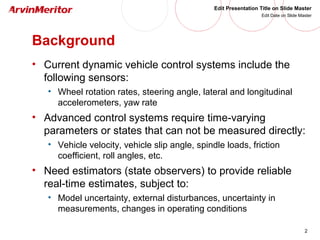
Background
• Current dynamic vehicle control systems include the
following sensors:
• Wheel rotation rates, steering angle, lateral and longitudinal
accelerometers, yaw rate
• Advanced control systems require time-varying
parameters or states that can not be measured directly:
• Vehicle velocity, vehicle slip angle, spindle loads, friction
coefficient, roll angles, etc.
• Need estimators (state observers) to provide reliable
real-time estimates, subject to:
• Model uncertainty, external disturbances, uncertainty in
measurements, changes in operating conditions
3
Edit Presentation Title on Slide Master
Edit Date on Slide Master
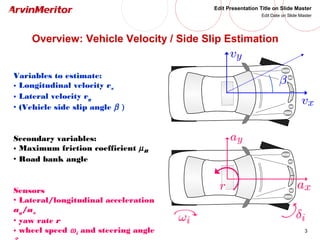
Overview: Vehicle Velocity / Side Slip Estimation
Variables to estimate:
• Longitudinal velocity vx
• Lateral velocity vy
• (Vehicle side slip angle β )
Secondary variables:
• Maximum friction coefficient µH
• Road bank angle
Sensors
• Lateral/longitudinal acceleration
ay/ax
• yaw rate r
• wheel speed ωi and steering angle
4
Edit Presentation Title on Slide Master
Edit Date on Slide Master
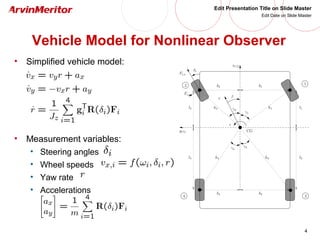
Vehicle Model for Nonlinear Observer
• Simplified vehicle model:
• Measurement variables:
• Steering angles
• Wheel speeds
• Yaw rate
• Accelerations
5
Edit Presentation Title on Slide Master
Edit Date on Slide Master
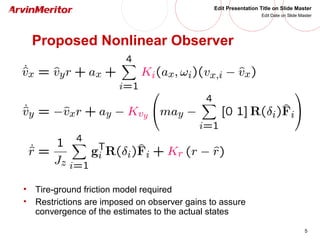
Proposed Nonlinear Observer
• Tire-ground friction model required
• Restrictions are imposed on observer gains to assure
convergence of the estimates to the actual states
6
Edit Presentation Title on Slide Master
Edit Date on Slide Master
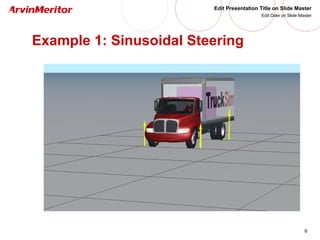
Example 1: Sinusoidal Steering
7
Edit Presentation Title on Slide Master
Edit Date on Slide Master
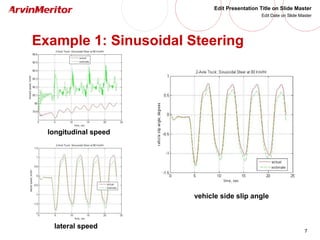
Example 1: Sinusoidal Steering
vehicle side slip angle
lateral speed
longitudinal speed
8
Edit Presentation Title on Slide Master
Edit Date on Slide Master
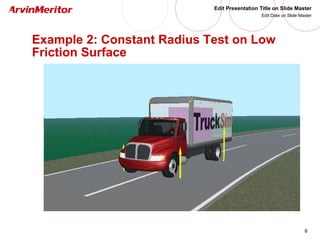
Example 2: Constant Radius Test on Low
Friction Surface
9
Edit Presentation Title on Slide Master
Edit Date on Slide Master
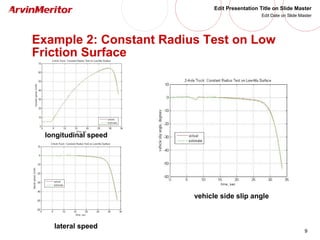
Example 2: Constant Radius Test on Low
Friction Surface
vehicle side slip angle
lateral speed
longitudinal speed
10
Edit Presentation Title on Slide Master
Edit Date on Slide Master
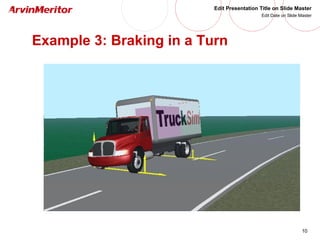
Example 3: Braking in a Turn
11
Edit Presentation Title on Slide Master
Edit Date on Slide Master
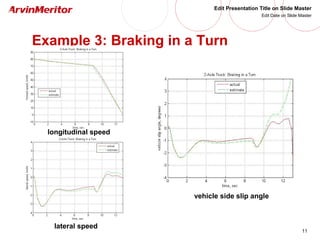
Example 3: Braking in a Turn
vehicle side slip angle
lateral speed
longitudinal speed
12
Edit Presentation Title on Slide Master
Edit Date on Slide Master
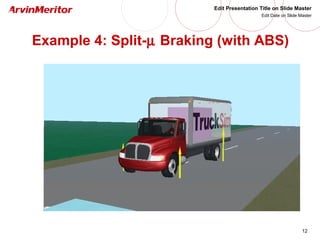
Example 4: Split-µ Braking (with ABS)
13
Edit Presentation Title on Slide Master
Edit Date on Slide Master
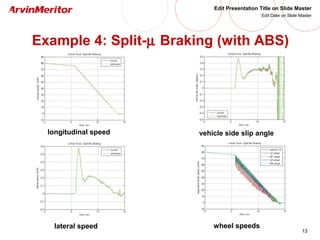
Example 4: Split-µ Braking (with ABS)
longitudinal speed
lateral speed
vehicle side slip angle
wheel speeds
14
Edit Presentation Title on Slide Master
Edit Date on Slide Master
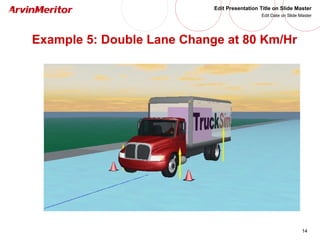
Example 5: Double Lane Change at 80 Km/Hr
15
Edit Presentation Title on Slide Master
Edit Date on Slide Master
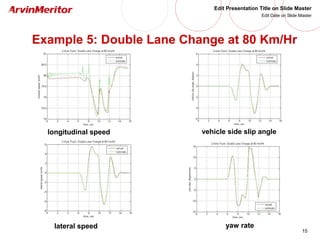
Example 5: Double Lane Change at 80 Km/Hr
longitudinal speed
lateral speed
vehicle side slip angle
yaw rate
16
Edit Presentation Title on Slide Master
Edit Date on Slide Master
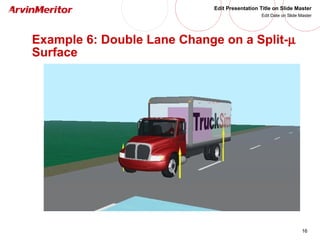
Example 6: Double Lane Change on a Split-µ
Surface
17
Edit Presentation Title on Slide Master
Edit Date on Slide Master
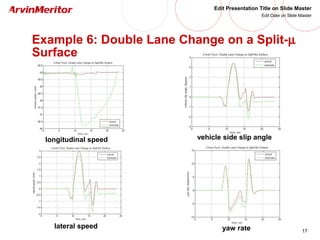
Example 6: Double Lane Change on a Split-µ
Surface
longitudinal speed
lateral speed
vehicle side slip angle
yaw rate
18
Edit Presentation Title on Slide Master
Edit Date on Slide Master
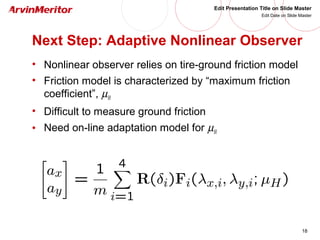
Next Step: Adaptive Nonlinear Observer
• Nonlinear observer relies on tire-ground friction model
• Friction model is characterized by “maximum friction
coefficient”, µΗ
• Difficult to measure ground friction
• Need on-line adaptation model for µΗ

Velocity_Estimation_w_Nonlinear_Observer

  • 1.
    1 Edit Presentation Titleon Slide Master Edit Date on Slide Master Longitudinal and Lateral VehicleLongitudinal and Lateral Vehicle Velocity Estimation with aVelocity Estimation with a Nonlinear ObserverNonlinear Observer An Example of Using TruckSim in Developing Vehicle Control Algorithms Ragnar Ledesma CVS Advanced Engineering
  • 2.
    2 Edit Presentation Titleon Slide Master Edit Date on Slide Master Background • Current dynamic vehicle control systems include the following sensors: • Wheel rotation rates, steering angle, lateral and longitudinal accelerometers, yaw rate • Advanced control systems require time-varying parameters or states that can not be measured directly: • Vehicle velocity, vehicle slip angle, spindle loads, friction coefficient, roll angles, etc. • Need estimators (state observers) to provide reliable real-time estimates, subject to: • Model uncertainty, external disturbances, uncertainty in measurements, changes in operating conditions
  • 3.
    3 Edit Presentation Titleon Slide Master Edit Date on Slide Master Overview: Vehicle Velocity / Side Slip Estimation Variables to estimate: • Longitudinal velocity vx • Lateral velocity vy • (Vehicle side slip angle β ) Secondary variables: • Maximum friction coefficient µH • Road bank angle Sensors • Lateral/longitudinal acceleration ay/ax • yaw rate r • wheel speed ωi and steering angle
  • 4.
    4 Edit Presentation Titleon Slide Master Edit Date on Slide Master Vehicle Model for Nonlinear Observer • Simplified vehicle model: • Measurement variables: • Steering angles • Wheel speeds • Yaw rate • Accelerations
  • 5.
    5 Edit Presentation Titleon Slide Master Edit Date on Slide Master Proposed Nonlinear Observer • Tire-ground friction model required • Restrictions are imposed on observer gains to assure convergence of the estimates to the actual states
  • 6.
    6 Edit Presentation Titleon Slide Master Edit Date on Slide Master Example 1: Sinusoidal Steering
  • 7.
    7 Edit Presentation Titleon Slide Master Edit Date on Slide Master Example 1: Sinusoidal Steering vehicle side slip angle lateral speed longitudinal speed
  • 8.
    8 Edit Presentation Titleon Slide Master Edit Date on Slide Master Example 2: Constant Radius Test on Low Friction Surface
  • 9.
    9 Edit Presentation Titleon Slide Master Edit Date on Slide Master Example 2: Constant Radius Test on Low Friction Surface vehicle side slip angle lateral speed longitudinal speed
  • 10.
    10 Edit Presentation Titleon Slide Master Edit Date on Slide Master Example 3: Braking in a Turn
  • 11.
    11 Edit Presentation Titleon Slide Master Edit Date on Slide Master Example 3: Braking in a Turn vehicle side slip angle lateral speed longitudinal speed
  • 12.
    12 Edit Presentation Titleon Slide Master Edit Date on Slide Master Example 4: Split-µ Braking (with ABS)
  • 13.
    13 Edit Presentation Titleon Slide Master Edit Date on Slide Master Example 4: Split-µ Braking (with ABS) longitudinal speed lateral speed vehicle side slip angle wheel speeds
  • 14.
    14 Edit Presentation Titleon Slide Master Edit Date on Slide Master Example 5: Double Lane Change at 80 Km/Hr
  • 15.
    15 Edit Presentation Titleon Slide Master Edit Date on Slide Master Example 5: Double Lane Change at 80 Km/Hr longitudinal speed lateral speed vehicle side slip angle yaw rate
  • 16.
    16 Edit Presentation Titleon Slide Master Edit Date on Slide Master Example 6: Double Lane Change on a Split-µ Surface
  • 17.
    17 Edit Presentation Titleon Slide Master Edit Date on Slide Master Example 6: Double Lane Change on a Split-µ Surface longitudinal speed lateral speed vehicle side slip angle yaw rate
  • 18.
    18 Edit Presentation Titleon Slide Master Edit Date on Slide Master Next Step: Adaptive Nonlinear Observer • Nonlinear observer relies on tire-ground friction model • Friction model is characterized by “maximum friction coefficient”, µΗ • Difficult to measure ground friction • Need on-line adaptation model for µΗ