WELCOME
VEGETATIVE PROPAGATION
INTRODUCTION
• Agriculture is the major occupation in India. For
increasing the economy, modern techniques are
introduced by using new farming equipments and
technology.
• India is known as the “Land of Agriculture to
increase the quantity and quality of the yield.
• Modern India Agriculture implement new
techniques to increase the yield.
• The teqnique in agricultural practice is
‘Vegetative Propagation’.
VEGETATIVE PROPAGATION
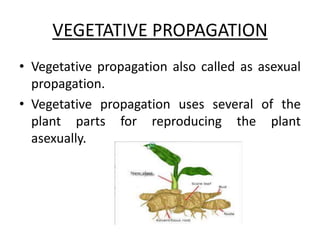
• Vegetative propagation also called as asexual
propagation.
• Vegetative propagation uses several of the
plant parts for reproducing the plant
asexually.
Uses of Vegetative Propagation
• Vegetative propagation is used to get the
similar genetic background of mother plants.
• Good skill, knowledge and experience aids in
vegetative propagation of plants in large scale.
• Vegetative Propagation is widely used in
horticultural crops nurseries.
ADVANTAGES
• Mass production of plants using plant parts of
mother parent.
• No seed is required to multiply varieties
having desired quantitative and qualitative
traits.
• Useful technique in production of plants
which are difficult to propagative using seed.
Types of Vegetative Propagation
•Cuttings
•Layering
•Grafting
CUTTINGS
• One of the easiest way of plant propagation is
by using cutting from various parts of plants
such as:
• Stem cuttings
• Root cuttings
• Leaf cuttings
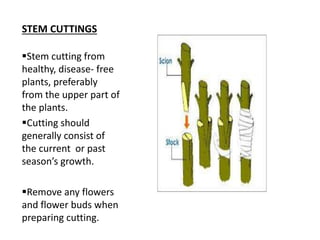
STEM CUTTINGS
Stem cutting from
healthy, disease- free
plants, preferably
from the upper part of
the plants.
Cutting should
generally consist of
the current or past
season’s growth.
Remove any flowers
and flower buds when
preparing cutting.
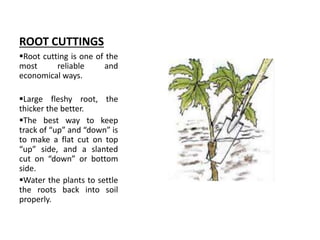
ROOT CUTTINGS
Root cutting is one of the
most reliable and
economical ways.
Large fleshy root, the
thicker the better.
The best way to keep
track of “up” and “down” is
to make a flat cut on top
“up” side, and a slanted
cut on “down” or bottom
side.
Water the plants to settle
the roots back into soil
properly.
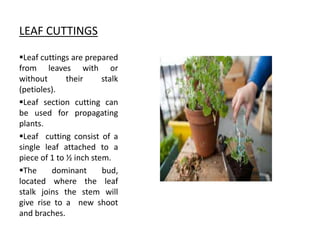
LEAF CUTTINGS
Leaf cuttings are prepared
from leaves with or
without their stalk
(petioles).
Leaf section cutting can
be used for propagating
plants.
Leaf cutting consist of a
single leaf attached to a
piece of 1 to ½ inch stem.
The dominant bud,
located where the leaf
stalk joins the stem will
give rise to a new shoot
and braches.
LAYERING
• Layering is a means of plant propagation in which a
portion of an aerial stem grows roots while still
attached to the parent plant and then detaches as an
independent plant.
• Layering has evolved as a common means of
vegetative propagation of numerous species in
natural environments.
• Layering is also utilized by horticulturists to
propagate desirable plants.
• Natural layering typically occurs when a branch
touches the ground, whereupon it
produces adventitious root.
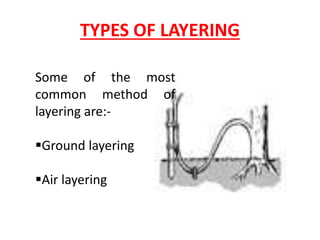
TYPES OF LAYERING
Some of the most
common method of
layering are:-
Ground layering
Air layering
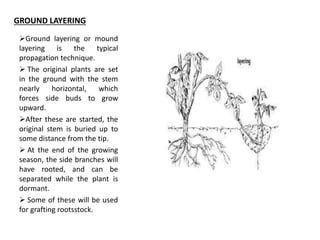
GROUND LAYERING
Ground layering or mound
layering is the typical
propagation technique.
 The original plants are set
in the ground with the stem
nearly horizontal, which
forces side buds to grow
upward.
After these are started, the
original stem is buried up to
some distance from the tip.
 At the end of the growing
season, the side branches will
have rooted, and can be
separated while the plant is
dormant.
 Some of these will be used
for grafting rootsstock.
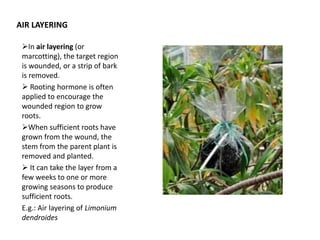
AIR LAYERING
In air layering (or
marcotting), the target region
is wounded, or a strip of bark
is removed.
 Rooting hormone is often
applied to encourage the
wounded region to grow
roots.
When sufficient roots have
grown from the wound, the
stem from the parent plant is
removed and planted.
 It can take the layer from a
few weeks to one or more
growing seasons to produce
sufficient roots.
E.g.: Air layering of Limonium
dendroides
GRAFTING
• Grafting or Graf tage is a horticultural
technique where by tissue from one plant are
inserted into those another.
• The technique is most commonly used
asexually propagation of commercially grown
plants.
Eg:- mango tree(Malgoa)
TYPES OF GRAFTING
• Some of the most common method of grafting
are the following:-
• Splice or whip grafting
• Whip and tongue grafting
• Approach grafting
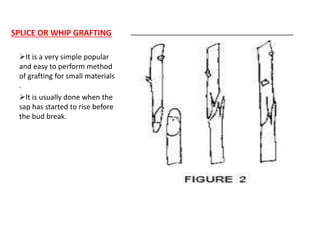
SPLICE OR WHIP GRAFTING
It is a very simple popular
and easy to perform method
of grafting for small materials
.
It is usually done when the
sap has started to rise before
the bud break.
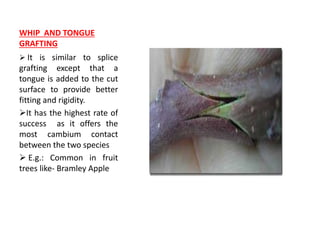
WHIP AND TONGUE
GRAFTING
 It is similar to splice
grafting except that a
tongue is added to the cut
surface to provide better
fitting and rigidity.
It has the highest rate of
success as it offers the
most cambium contact
between the two species
 E.g.: Common in fruit
trees like- Bramley Apple
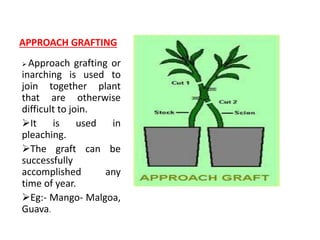
APPROACH GRAFTING
 Approach grafting or
inarching is used to
join together plant
that are otherwise
difficult to join.
It is used in
pleaching.
The graft can be
successfully
accomplished any
time of year.
Eg:- Mango- Malgoa,
Guava.
CONCLUSION
Asexual reproduction is the vegetative reproduction in
which new organism develop from the parent organisms by
simple division. Budding, fragmentation, mitosis,
regeneration, vegetative propagation are all the types of
asexual reproduction. In this type of reproduction the
produced organism and the parent organisms are exactly
alike. Thus asexual reproduction doesn't contribute into
evolution as it does not cause variation. But still it's
important for the growth of the organisms. The section
examine the benefits of modern day agriculture a task
made necessary by the fact that an increasing share of the
population has little connection to farms or rural areas. It is
important to recognize all the techniques in our life
experiences.
REFERENCE
• Rieger, R.; Michaelis A.; Green, M. M. (1991).
Glossary Of Genetics (5th Ed.). Springer
• Dr. Valsala Kumar, Msc Phil(phd)(zoology),
New Jyothi Publications, 2008
• Gerard J Tortora; Principles of Anatomy and
Physiology (13th edition)
THANK YOU

vegitativepropagation1-140926223253-phpapp02 (1).pdf

  • 1.
  • 2.
  • 3.
    INTRODUCTION • Agriculture isthe major occupation in India. For increasing the economy, modern techniques are introduced by using new farming equipments and technology. • India is known as the “Land of Agriculture to increase the quantity and quality of the yield. • Modern India Agriculture implement new techniques to increase the yield. • The teqnique in agricultural practice is ‘Vegetative Propagation’.
  • 4.
    VEGETATIVE PROPAGATION • Vegetativepropagation also called as asexual propagation. • Vegetative propagation uses several of the plant parts for reproducing the plant asexually.
  • 5.
    Uses of VegetativePropagation • Vegetative propagation is used to get the similar genetic background of mother plants. • Good skill, knowledge and experience aids in vegetative propagation of plants in large scale. • Vegetative Propagation is widely used in horticultural crops nurseries.
  • 6.
    ADVANTAGES • Mass productionof plants using plant parts of mother parent. • No seed is required to multiply varieties having desired quantitative and qualitative traits. • Useful technique in production of plants which are difficult to propagative using seed.
  • 7.
    Types of VegetativePropagation •Cuttings •Layering •Grafting
  • 8.
    CUTTINGS • One ofthe easiest way of plant propagation is by using cutting from various parts of plants such as: • Stem cuttings • Root cuttings • Leaf cuttings
  • 9.
    STEM CUTTINGS Stem cuttingfrom healthy, disease- free plants, preferably from the upper part of the plants. Cutting should generally consist of the current or past season’s growth. Remove any flowers and flower buds when preparing cutting.
  • 10.
    ROOT CUTTINGS Root cuttingis one of the most reliable and economical ways. Large fleshy root, the thicker the better. The best way to keep track of “up” and “down” is to make a flat cut on top “up” side, and a slanted cut on “down” or bottom side. Water the plants to settle the roots back into soil properly.
  • 11.
    LEAF CUTTINGS Leaf cuttingsare prepared from leaves with or without their stalk (petioles). Leaf section cutting can be used for propagating plants. Leaf cutting consist of a single leaf attached to a piece of 1 to ½ inch stem. The dominant bud, located where the leaf stalk joins the stem will give rise to a new shoot and braches.
  • 12.
    LAYERING • Layering isa means of plant propagation in which a portion of an aerial stem grows roots while still attached to the parent plant and then detaches as an independent plant. • Layering has evolved as a common means of vegetative propagation of numerous species in natural environments. • Layering is also utilized by horticulturists to propagate desirable plants. • Natural layering typically occurs when a branch touches the ground, whereupon it produces adventitious root.
  • 13.
    TYPES OF LAYERING Someof the most common method of layering are:- Ground layering Air layering
  • 14.
    GROUND LAYERING Ground layeringor mound layering is the typical propagation technique.  The original plants are set in the ground with the stem nearly horizontal, which forces side buds to grow upward. After these are started, the original stem is buried up to some distance from the tip.  At the end of the growing season, the side branches will have rooted, and can be separated while the plant is dormant.  Some of these will be used for grafting rootsstock.
  • 15.
    AIR LAYERING In airlayering (or marcotting), the target region is wounded, or a strip of bark is removed.  Rooting hormone is often applied to encourage the wounded region to grow roots. When sufficient roots have grown from the wound, the stem from the parent plant is removed and planted.  It can take the layer from a few weeks to one or more growing seasons to produce sufficient roots. E.g.: Air layering of Limonium dendroides
  • 16.
    GRAFTING • Grafting orGraf tage is a horticultural technique where by tissue from one plant are inserted into those another. • The technique is most commonly used asexually propagation of commercially grown plants. Eg:- mango tree(Malgoa)
  • 17.
    TYPES OF GRAFTING •Some of the most common method of grafting are the following:- • Splice or whip grafting • Whip and tongue grafting • Approach grafting
  • 18.
    SPLICE OR WHIPGRAFTING It is a very simple popular and easy to perform method of grafting for small materials . It is usually done when the sap has started to rise before the bud break.
  • 19.
    WHIP AND TONGUE GRAFTING It is similar to splice grafting except that a tongue is added to the cut surface to provide better fitting and rigidity. It has the highest rate of success as it offers the most cambium contact between the two species  E.g.: Common in fruit trees like- Bramley Apple
  • 20.
    APPROACH GRAFTING  Approachgrafting or inarching is used to join together plant that are otherwise difficult to join. It is used in pleaching. The graft can be successfully accomplished any time of year. Eg:- Mango- Malgoa, Guava.
  • 21.
    CONCLUSION Asexual reproduction isthe vegetative reproduction in which new organism develop from the parent organisms by simple division. Budding, fragmentation, mitosis, regeneration, vegetative propagation are all the types of asexual reproduction. In this type of reproduction the produced organism and the parent organisms are exactly alike. Thus asexual reproduction doesn't contribute into evolution as it does not cause variation. But still it's important for the growth of the organisms. The section examine the benefits of modern day agriculture a task made necessary by the fact that an increasing share of the population has little connection to farms or rural areas. It is important to recognize all the techniques in our life experiences.
  • 22.
    REFERENCE • Rieger, R.;Michaelis A.; Green, M. M. (1991). Glossary Of Genetics (5th Ed.). Springer • Dr. Valsala Kumar, Msc Phil(phd)(zoology), New Jyothi Publications, 2008 • Gerard J Tortora; Principles of Anatomy and Physiology (13th edition)
  • 23.