MGT3095 - vCloud Automation Center 
and Pivotal Cloud Foundry – Better PaaS 
Solution 
Vipul Shah - Director of Product Management, VMware 
Cornelia Davis - Director, Platform Engineering, Pivotal
Agenda 
• Pivotal CF Overview 
• vCloud Automation Center Overview 
• Why vCloud Automation & Pivotal CF? 
• The development experience begins 
• Demo 
• Bringing structure to the application lifecycle 
• Demo 
2
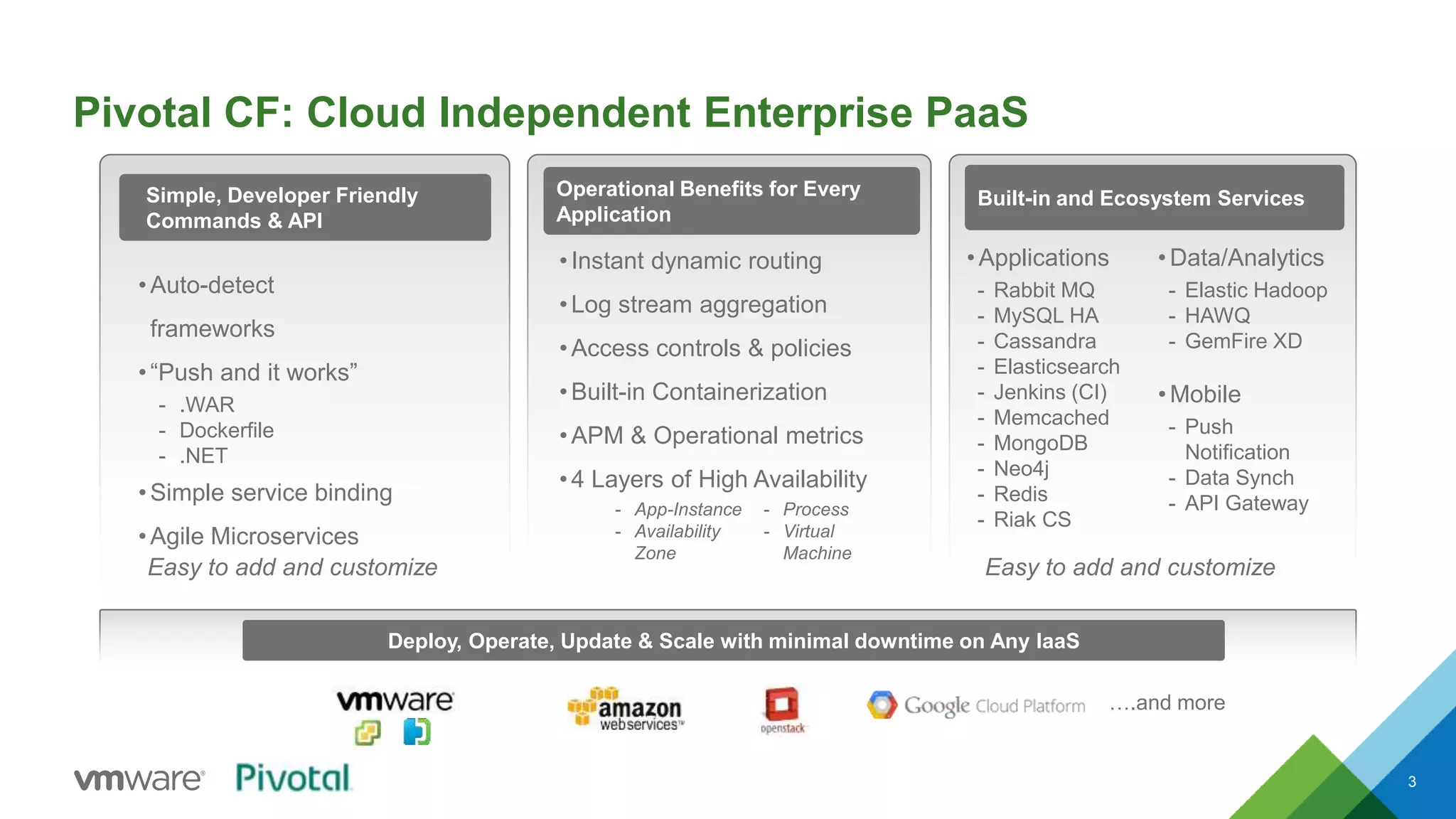
Pivotal CF: Cloud Independent Enterprise PaaS 
3 
Operational Benefits for Every 
Application 
• Applications 
- Rabbit MQ 
- MySQL HA 
- Cassandra 
- Elasticsearch 
- Jenkins (CI) 
- Memcached 
- MongoDB 
- Neo4j 
- Redis 
- Riak CS 
Deploy, Operate, Update & Scale with minimal downtime on Any IaaS 
• Data/Analytics 
- Elastic Hadoop 
- HAWQ 
- GemFire XD 
• Mobile 
- Push 
Notification 
- Data Synch 
- API Gateway 
….and more 
Simple, Developer Friendly 
Commands & API 
• Auto-detect 
frameworks 
• “Push and it works” 
- .WAR 
- Dockerfile 
- .NET 
• Simple service binding 
• Agile Microservices 
Easy to add and customize 
• Instant dynamic routing 
• Log stream aggregation 
• Access controls & policies 
• Built-in Containerization 
•APM & Operational metrics 
• 4 Layers of High Availability 
- App-Instance 
- Availability 
Zone 
- Process 
- Virtual 
Machine 
Built-in and Ecosystem Services 
Easy to add and customize
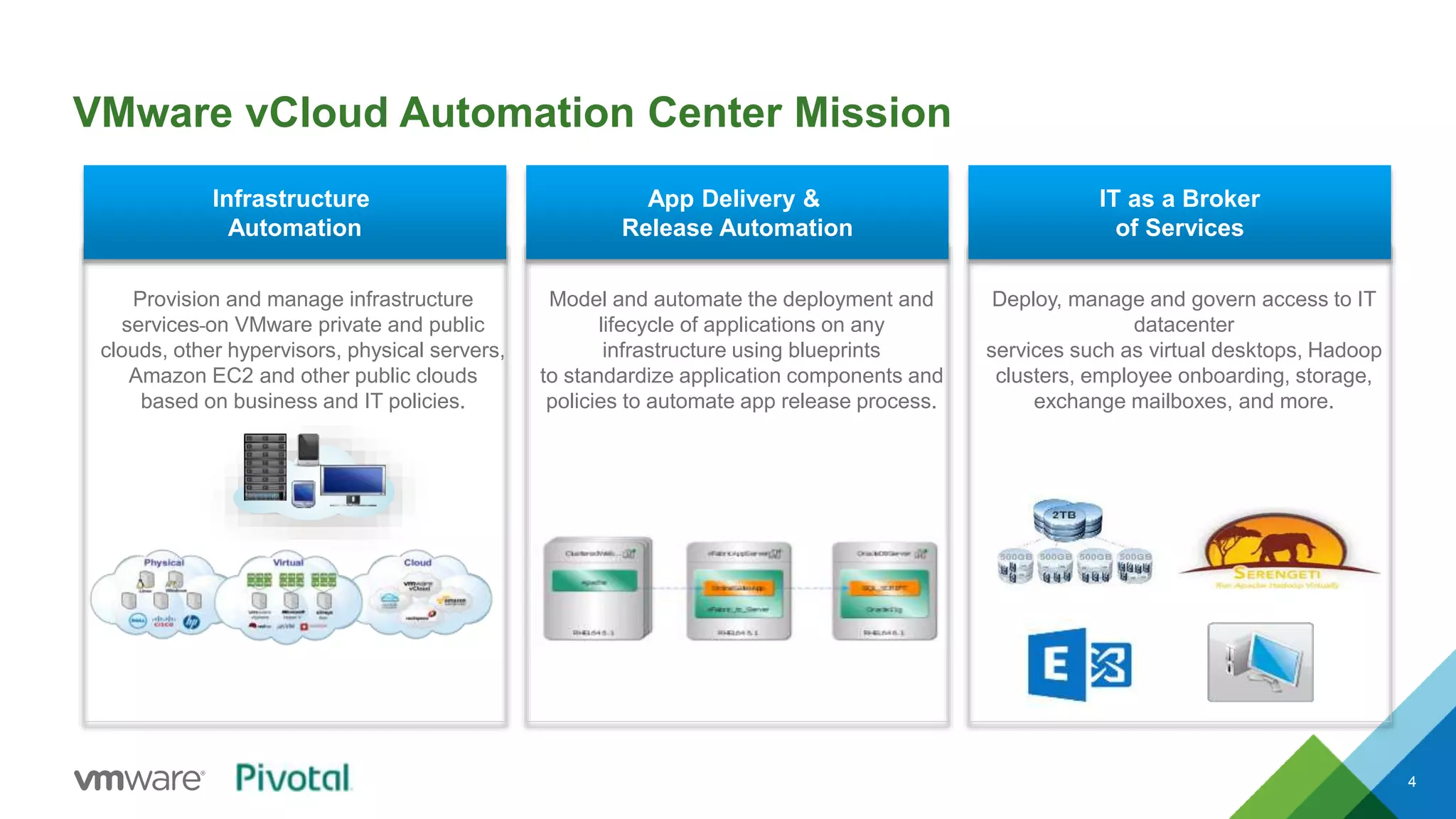
VMware vCloud Automation Center Mission 
4 
Infrastructure 
Automation 
Provision and manage infrastructure 
services on VMware private and public 
clouds, other hypervisors, physical servers, 
Amazon EC2 and other public clouds 
based on business and IT policies. 
App Delivery & 
Release Automation 
Model and automate the deployment and 
lifecycle of applications on any 
infrastructure using blueprints 
to standardize application components and 
policies to automate app release process. 
IT as a Broker 
of Services 
Deploy, manage and govern access to IT 
datacenter 
services such as virtual desktops, Hadoop 
clusters, employee onboarding, storage, 
exchange mailboxes, and more. 
Multi-platform
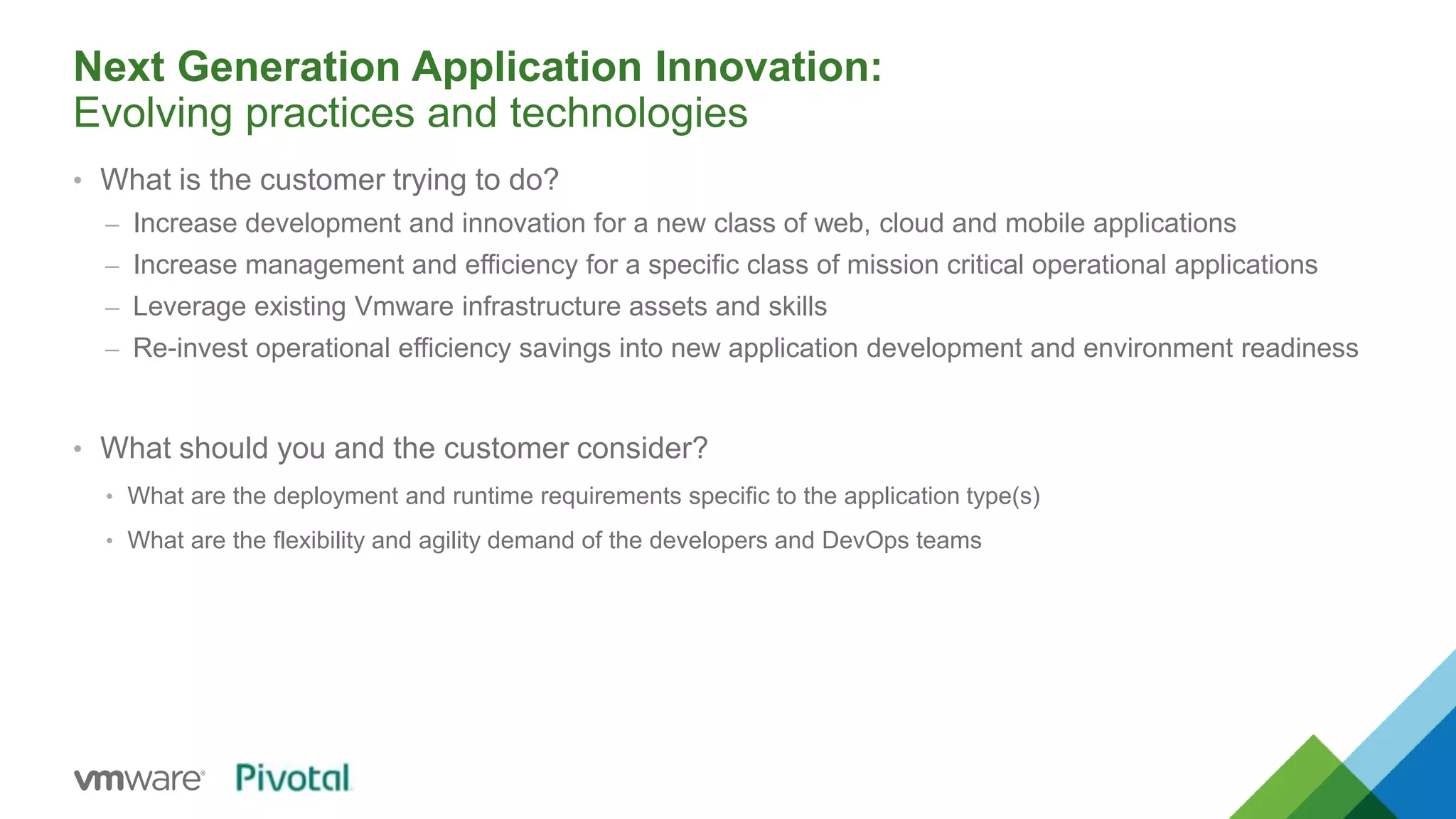
Next Generation Application Innovation: 
Evolving practices and technologies 
• What is the customer trying to do? 
– Increase development and innovation for a new class of web, cloud and mobile applications 
– Increase management and efficiency for a specific class of mission critical operational applications 
– Leverage existing Vmware infrastructure assets and skills 
– Re-invest operational efficiency savings into new application development and environment readiness 
• What should you and the customer consider? 
• What are the deployment and runtime requirements specific to the application type(s) 
• What are the flexibility and agility demand of the developers and DevOps teams
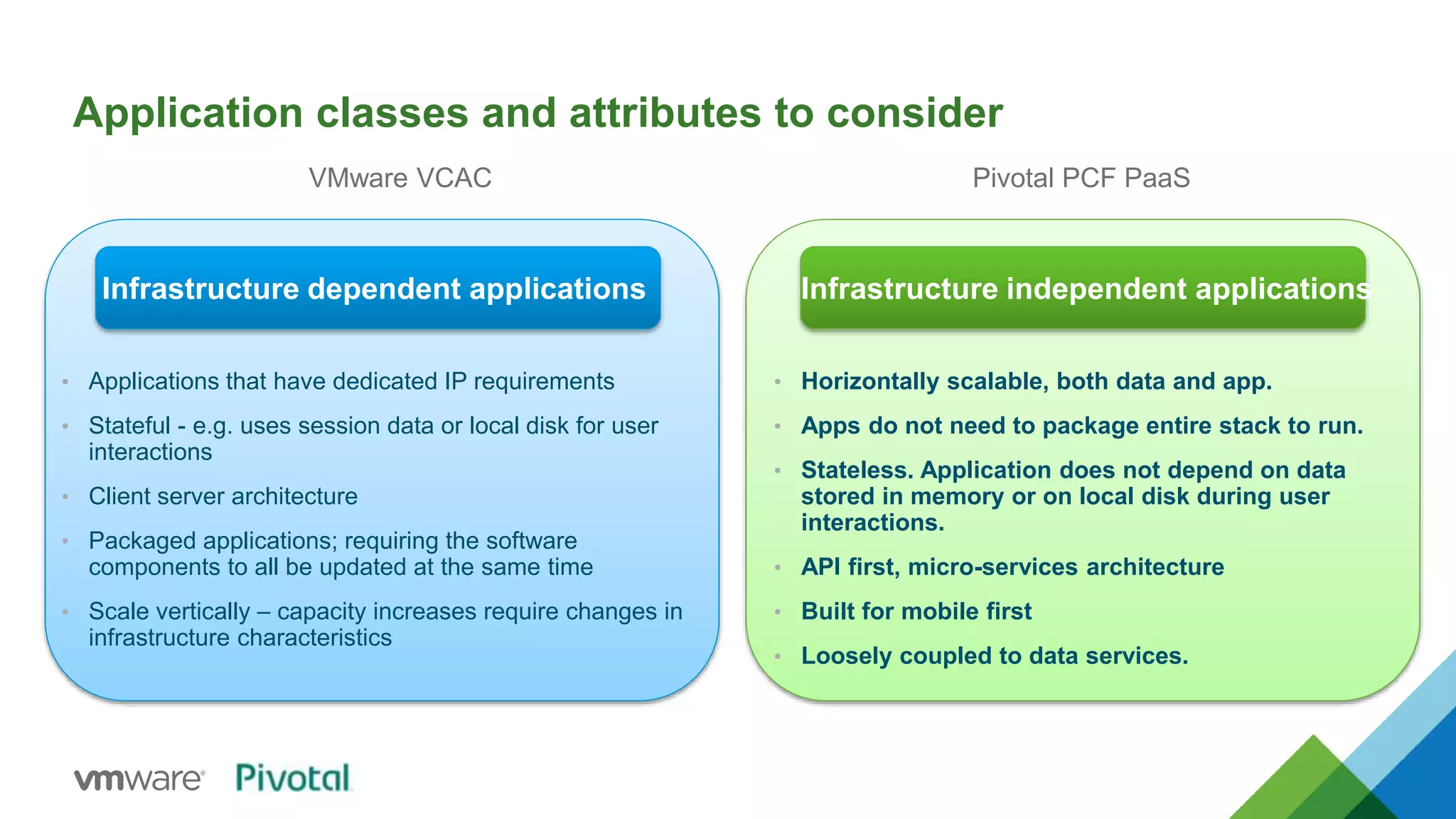
Application classes and attributes to consider 
VMware VCAC Pivotal PCF PaaS 
Infrastructure independent applications 
• Horizontally scalable, both data and app. 
• Apps do not need to package entire stack to run. 
• Stateless. Application does not depend on data 
stored in memory or on local disk during user 
interactions. 
• API first, micro-services architecture 
• Built for mobile first 
• Loosely coupled to data services. 
Infrastructure dependent applications 
• Applications that have dedicated IP requirements 
• Stateful - e.g. uses session data or local disk for user 
interactions 
• Client server architecture 
• Packaged applications; requiring the software 
components to all be updated at the same time 
• Scale vertically – capacity increases require changes in 
infrastructure characteristics
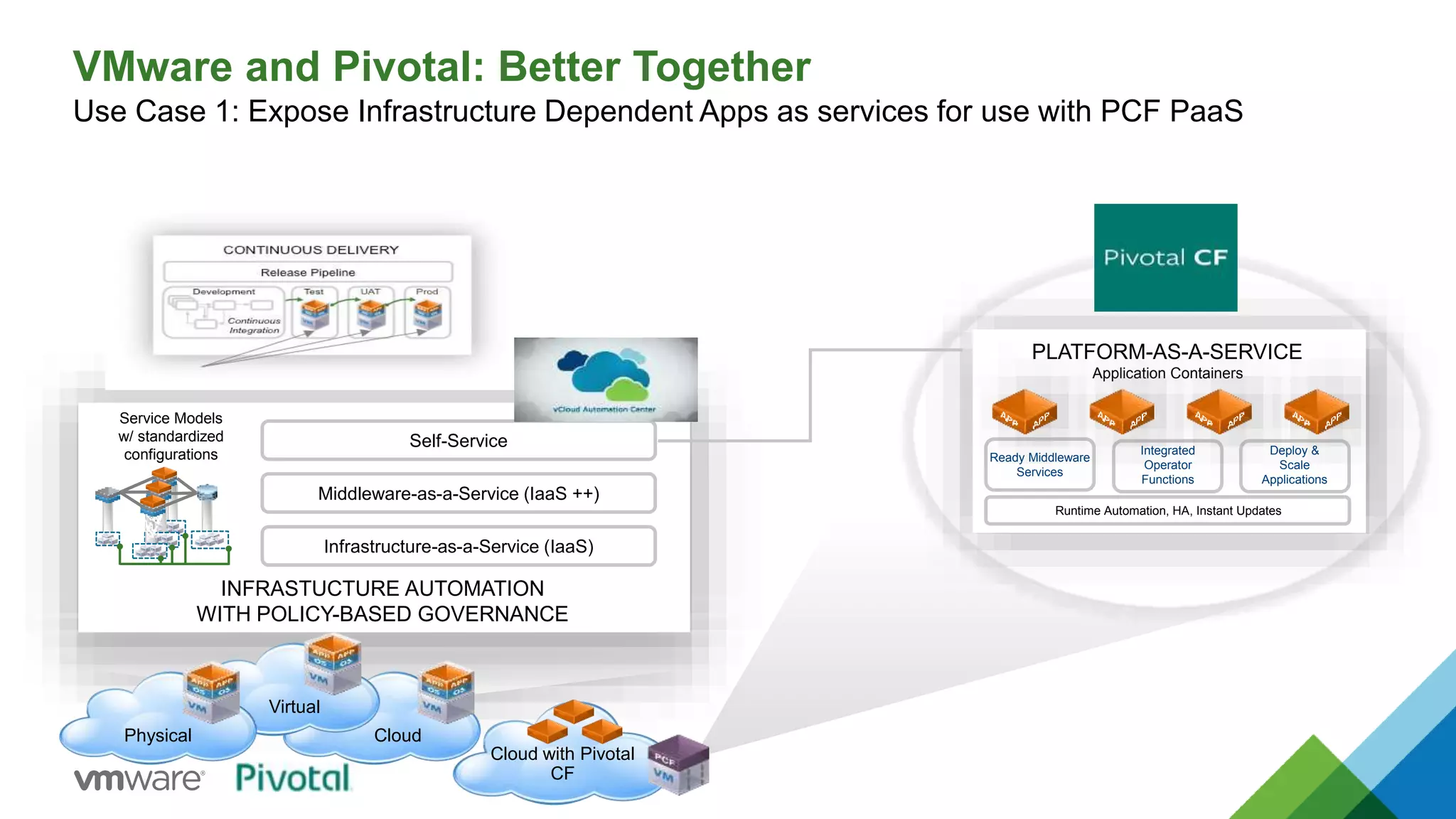
VMware and Pivotal: Better Together 
Use Case 1: Expose Infrastructure Dependent Apps as services for use with PCF PaaS 
Service Models 
w/ standardized 
configurations 
Self-Service 
Middleware-as-a-Service (IaaS ++) 
INFRASTUCTURE AUTOMATION 
WITH POLICY-BASED GOVERNANCE 
Cloud 
Virtual 
Physical 
Cloud with Pivotal 
CF 
PLATFORM-AS-A-SERVICE 
Application Containers 
Infrastructure-as-a-Service (IaaS) 
Deploy & 
Scale 
Applications 
Integrated 
Operator 
Functions 
Ready Middleware 
Services 
Runtime Automation, HA, Instant Updates
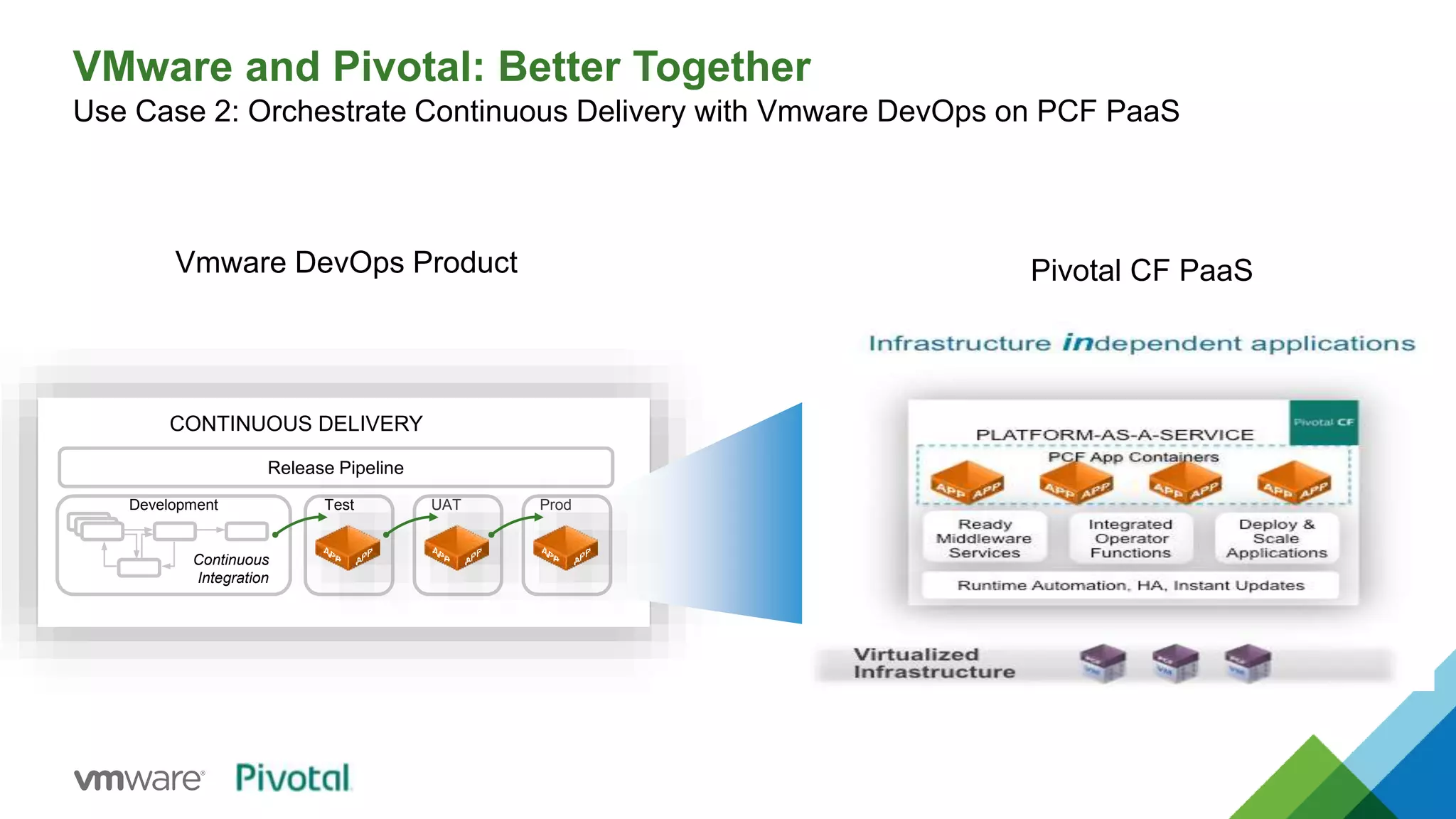
VMware and Pivotal: Better Together 
Use Case 2: Orchestrate Continuous Delivery with Vmware DevOps on PCF PaaS 
Vmware DevOps Product Pivotal CF PaaS 
CONTINUOUS DELIVERY 
Release Pipeline 
Development Test UAT Prod 
Continuous 
Integration
Let’s see it in action…
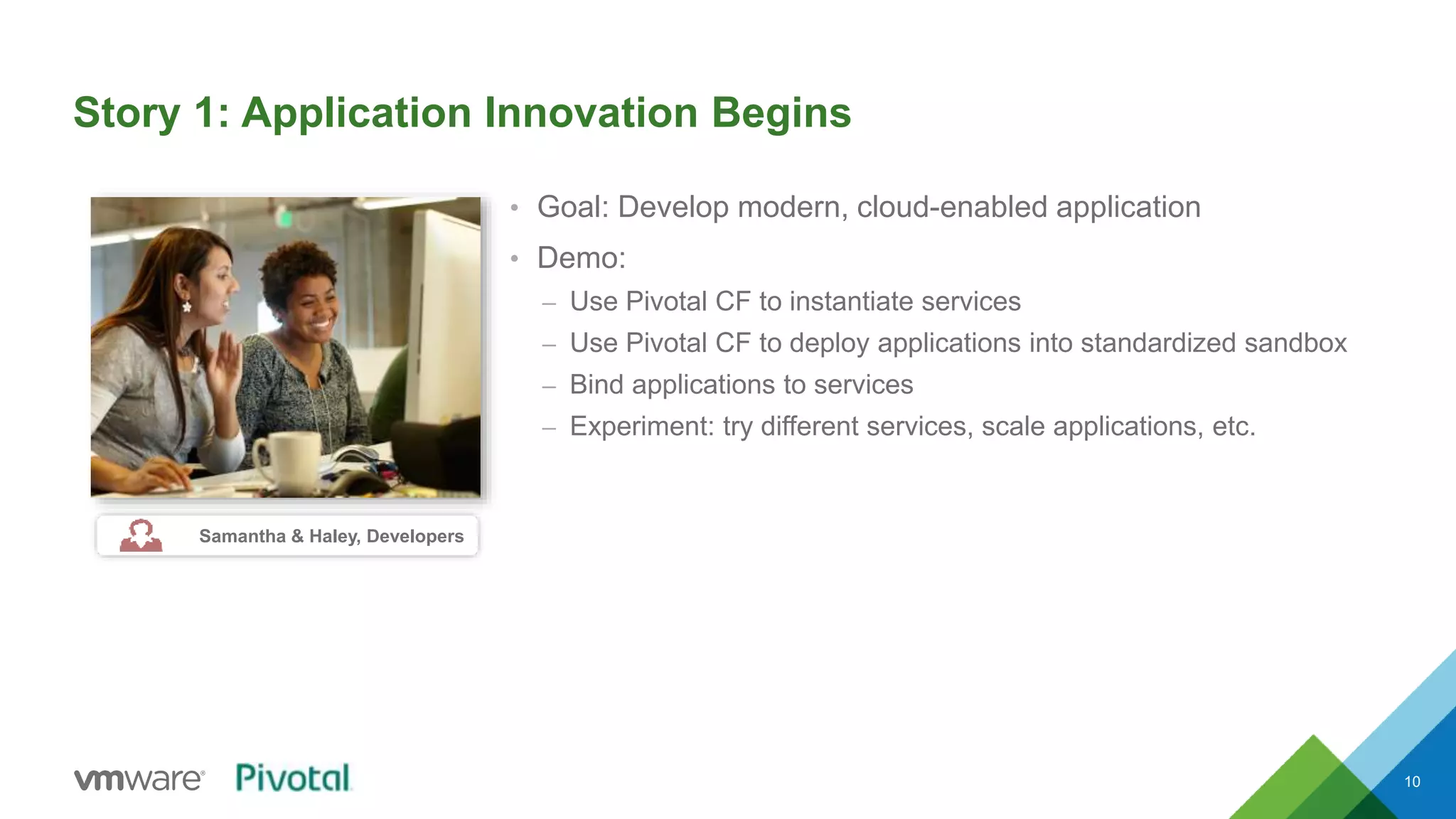
Story 1: Application Innovation Begins 
• Goal: Develop modern, cloud-enabled application 
• Demo: 
– Use Pivotal CF to instantiate services 
– Use Pivotal CF to deploy applications into standardized sandbox 
– Bind applications to services 
– Experiment: try different services, scale applications, etc. 
10 
Samantha & Haley, Developers
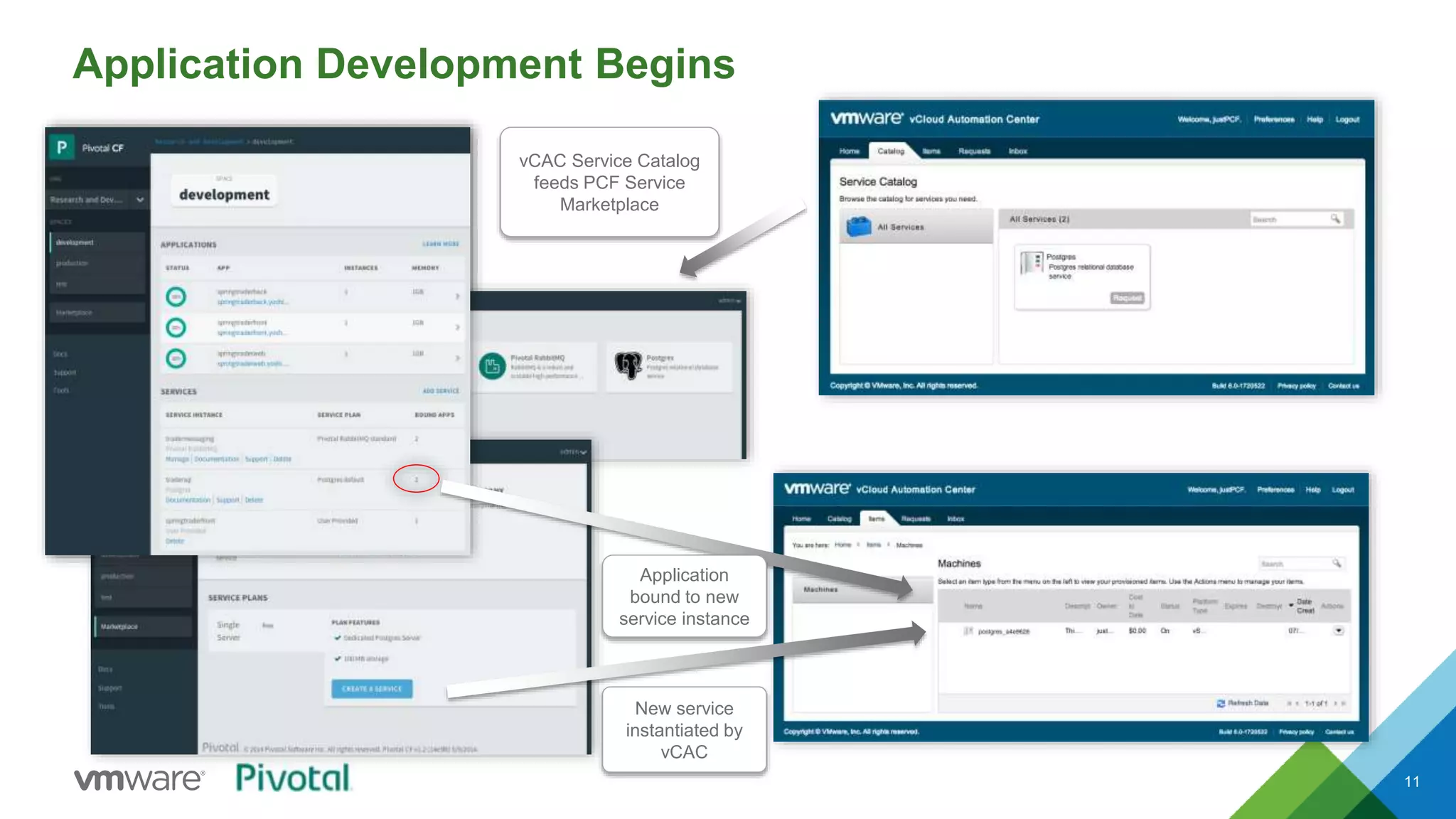
Application Development Begins 
11 
vCAC Service Catalog 
feeds PCF Service 
Marketplace 
Application 
bound to new 
service instance 
New service 
instantiated by 
vCAC
Demo
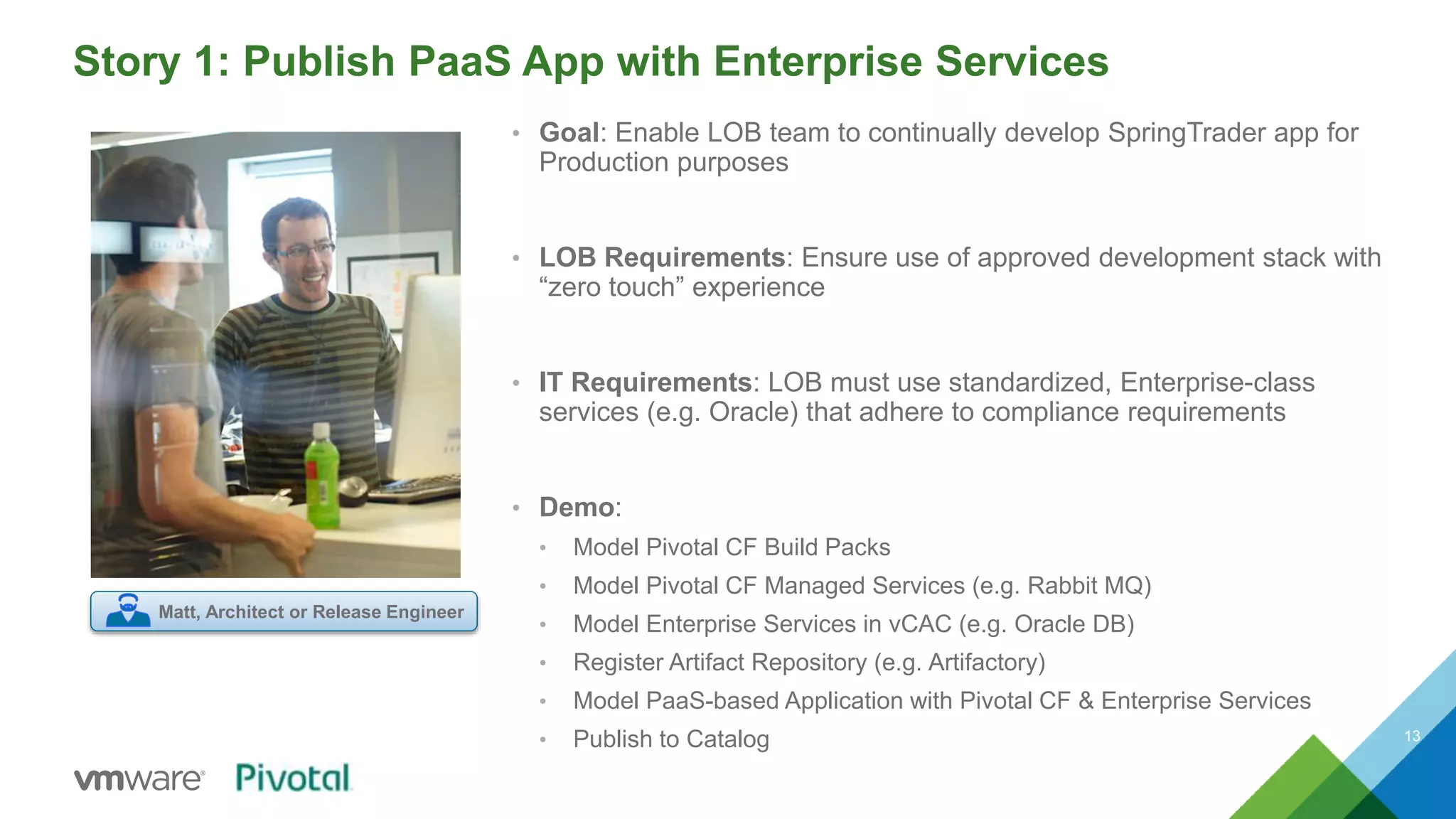
Story 1: Publish PaaS App with Enterprise Services 
13 
• Goal: Enable LOB team to continually develop SpringTrader app for 
Production purposes 
• LOB Requirements: Ensure use of approved development stack with 
“zero touch” experience 
• IT Requirements: LOB must use standardized, Enterprise-class 
services (e.g. Oracle) that adhere to compliance requirements 
• Demo: 
• Model Pivotal CF Build Packs 
• Model Pivotal CF Managed Services (e.g. Rabbit MQ) 
• Model Enterprise Services in vCAC (e.g. Oracle DB) 
• Register Artifact Repository (e.g. Artifactory) 
• Model PaaS-based Application with Pivotal CF & Enterprise Services 
• Publish to Catalog 
Matt, Architect or Release Engineer
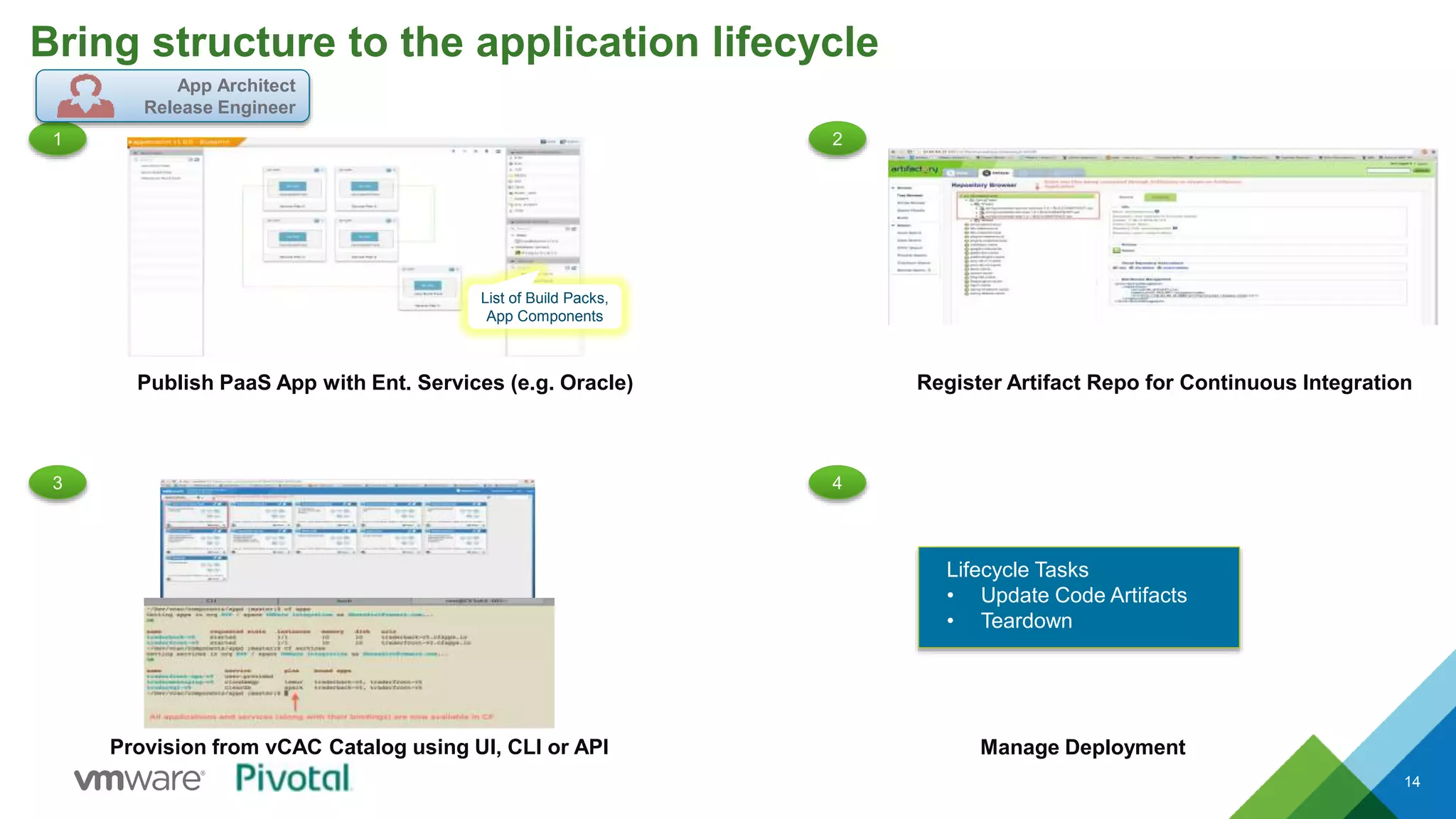
Bring structure to the application lifecycle 
Register Artifact Repo for Continuous Integration 
14 
App Architect 
Release Engineer 
1 2 
List of Build Packs, 
App Components 
Publish PaaS App with Ent. Services (e.g. Oracle) 
Lifecycle Tasks 
• Update Code Artifacts 
• Teardown 
Manage Deployment 
3 4 
Provision from vCAC Catalog using UI, CLI or API
Demo
Summary 
• Pivotal CF Platform as a Service: 
– Enables agility and short time to value for the developer 
– Supplies enterprise standardized deployment environment for development through production 
– Provides operational benefits including dynamic routing, log aggregation, containerization, high 
availability 
• vCloud Automation Center: 
– Automates the delivery of infrastructure and enterprise standardized applications across multiple cloud 
and platforms 
– Enables lifecycle management of infrastructure and applications 
– Automates the application release process 
• Together: Pivotal CF and vCloud Automation Center provide a complete continuous delivery 
platform for infrastructure-based and infrastructure independent applications 
16
Thank You

vCloud Automation Center and Pivotal Cloud Foundry – Better PaaS Solution (VMworld 2014)

  • 1.
    MGT3095 - vCloudAutomation Center and Pivotal Cloud Foundry – Better PaaS Solution Vipul Shah - Director of Product Management, VMware Cornelia Davis - Director, Platform Engineering, Pivotal
  • 2.
    Agenda • PivotalCF Overview • vCloud Automation Center Overview • Why vCloud Automation & Pivotal CF? • The development experience begins • Demo • Bringing structure to the application lifecycle • Demo 2
  • 3.
    Pivotal CF: CloudIndependent Enterprise PaaS 3 Operational Benefits for Every Application • Applications - Rabbit MQ - MySQL HA - Cassandra - Elasticsearch - Jenkins (CI) - Memcached - MongoDB - Neo4j - Redis - Riak CS Deploy, Operate, Update & Scale with minimal downtime on Any IaaS • Data/Analytics - Elastic Hadoop - HAWQ - GemFire XD • Mobile - Push Notification - Data Synch - API Gateway ….and more Simple, Developer Friendly Commands & API • Auto-detect frameworks • “Push and it works” - .WAR - Dockerfile - .NET • Simple service binding • Agile Microservices Easy to add and customize • Instant dynamic routing • Log stream aggregation • Access controls & policies • Built-in Containerization •APM & Operational metrics • 4 Layers of High Availability - App-Instance - Availability Zone - Process - Virtual Machine Built-in and Ecosystem Services Easy to add and customize
  • 4.
    VMware vCloud AutomationCenter Mission 4 Infrastructure Automation Provision and manage infrastructure services on VMware private and public clouds, other hypervisors, physical servers, Amazon EC2 and other public clouds based on business and IT policies. App Delivery & Release Automation Model and automate the deployment and lifecycle of applications on any infrastructure using blueprints to standardize application components and policies to automate app release process. IT as a Broker of Services Deploy, manage and govern access to IT datacenter services such as virtual desktops, Hadoop clusters, employee onboarding, storage, exchange mailboxes, and more. Multi-platform
  • 5.
    Next Generation ApplicationInnovation: Evolving practices and technologies • What is the customer trying to do? – Increase development and innovation for a new class of web, cloud and mobile applications – Increase management and efficiency for a specific class of mission critical operational applications – Leverage existing Vmware infrastructure assets and skills – Re-invest operational efficiency savings into new application development and environment readiness • What should you and the customer consider? • What are the deployment and runtime requirements specific to the application type(s) • What are the flexibility and agility demand of the developers and DevOps teams
  • 6.
    Application classes andattributes to consider VMware VCAC Pivotal PCF PaaS Infrastructure independent applications • Horizontally scalable, both data and app. • Apps do not need to package entire stack to run. • Stateless. Application does not depend on data stored in memory or on local disk during user interactions. • API first, micro-services architecture • Built for mobile first • Loosely coupled to data services. Infrastructure dependent applications • Applications that have dedicated IP requirements • Stateful - e.g. uses session data or local disk for user interactions • Client server architecture • Packaged applications; requiring the software components to all be updated at the same time • Scale vertically – capacity increases require changes in infrastructure characteristics
  • 7.
    VMware and Pivotal:Better Together Use Case 1: Expose Infrastructure Dependent Apps as services for use with PCF PaaS Service Models w/ standardized configurations Self-Service Middleware-as-a-Service (IaaS ++) INFRASTUCTURE AUTOMATION WITH POLICY-BASED GOVERNANCE Cloud Virtual Physical Cloud with Pivotal CF PLATFORM-AS-A-SERVICE Application Containers Infrastructure-as-a-Service (IaaS) Deploy & Scale Applications Integrated Operator Functions Ready Middleware Services Runtime Automation, HA, Instant Updates
  • 8.
    VMware and Pivotal:Better Together Use Case 2: Orchestrate Continuous Delivery with Vmware DevOps on PCF PaaS Vmware DevOps Product Pivotal CF PaaS CONTINUOUS DELIVERY Release Pipeline Development Test UAT Prod Continuous Integration
  • 9.
    Let’s see itin action…
  • 10.
    Story 1: ApplicationInnovation Begins • Goal: Develop modern, cloud-enabled application • Demo: – Use Pivotal CF to instantiate services – Use Pivotal CF to deploy applications into standardized sandbox – Bind applications to services – Experiment: try different services, scale applications, etc. 10 Samantha & Haley, Developers
  • 11.
    Application Development Begins 11 vCAC Service Catalog feeds PCF Service Marketplace Application bound to new service instance New service instantiated by vCAC
  • 12.
  • 13.
    Story 1: PublishPaaS App with Enterprise Services 13 • Goal: Enable LOB team to continually develop SpringTrader app for Production purposes • LOB Requirements: Ensure use of approved development stack with “zero touch” experience • IT Requirements: LOB must use standardized, Enterprise-class services (e.g. Oracle) that adhere to compliance requirements • Demo: • Model Pivotal CF Build Packs • Model Pivotal CF Managed Services (e.g. Rabbit MQ) • Model Enterprise Services in vCAC (e.g. Oracle DB) • Register Artifact Repository (e.g. Artifactory) • Model PaaS-based Application with Pivotal CF & Enterprise Services • Publish to Catalog Matt, Architect or Release Engineer
  • 14.
    Bring structure tothe application lifecycle Register Artifact Repo for Continuous Integration 14 App Architect Release Engineer 1 2 List of Build Packs, App Components Publish PaaS App with Ent. Services (e.g. Oracle) Lifecycle Tasks • Update Code Artifacts • Teardown Manage Deployment 3 4 Provision from vCAC Catalog using UI, CLI or API
  • 15.
  • 16.
    Summary • PivotalCF Platform as a Service: – Enables agility and short time to value for the developer – Supplies enterprise standardized deployment environment for development through production – Provides operational benefits including dynamic routing, log aggregation, containerization, high availability • vCloud Automation Center: – Automates the delivery of infrastructure and enterprise standardized applications across multiple cloud and platforms – Enables lifecycle management of infrastructure and applications – Automates the application release process • Together: Pivotal CF and vCloud Automation Center provide a complete continuous delivery platform for infrastructure-based and infrastructure independent applications 16
  • 17.

Editor's Notes

  • #5 vCAC charter is to automate any service on any platform. In order to accomplish this large goal – we break the charter into three specific categories. First one is Infrastructure automation. The goal here is to provide the ability to pool resources and setup the cloud on any platform. And then the goal is to automate infrastructure onto the cloud through use of policies. Second one is Application Delivery and Release Automation. The goal here is to automate deployment and lifecycle of any middleware and application on top of the cloud you created using the Infrastructure Automation. Again, the same concepts of policy-based management and governance applies here as well. In addition, we also provide Release automation, which helps automate the release process across various environments. And finally, the third one is to enable IT as Broker of Services. The goal here is to provide capabilities that allow custom services to be made available through the catalog. This means that vCAC has to be extensible in multiple ways so that existing IT services can be exposed and managed through it.
  • #8 vCAC supports a multi-vendor, Multi-cloud Infrastructure that allows IT services to be delivered across a wide range of multi-vendor, virtual, physical, and cloud platforms. vCAC can easily be configured to work with each of these infrastructure platforms by configuring vendor specific configuration parameters.
  • #9 vCAC supports a multi-vendor, Multi-cloud Infrastructure that allows IT services to be delivered across a wide range of multi-vendor, virtual, physical, and cloud platforms. vCAC can easily be configured to work with each of these infrastructure platforms by configuring vendor specific configuration parameters.