Vasoplegic syndrome
following cardiothoracic
surgery
Dr Vaibhav V Mahankale
INTRODUCTION
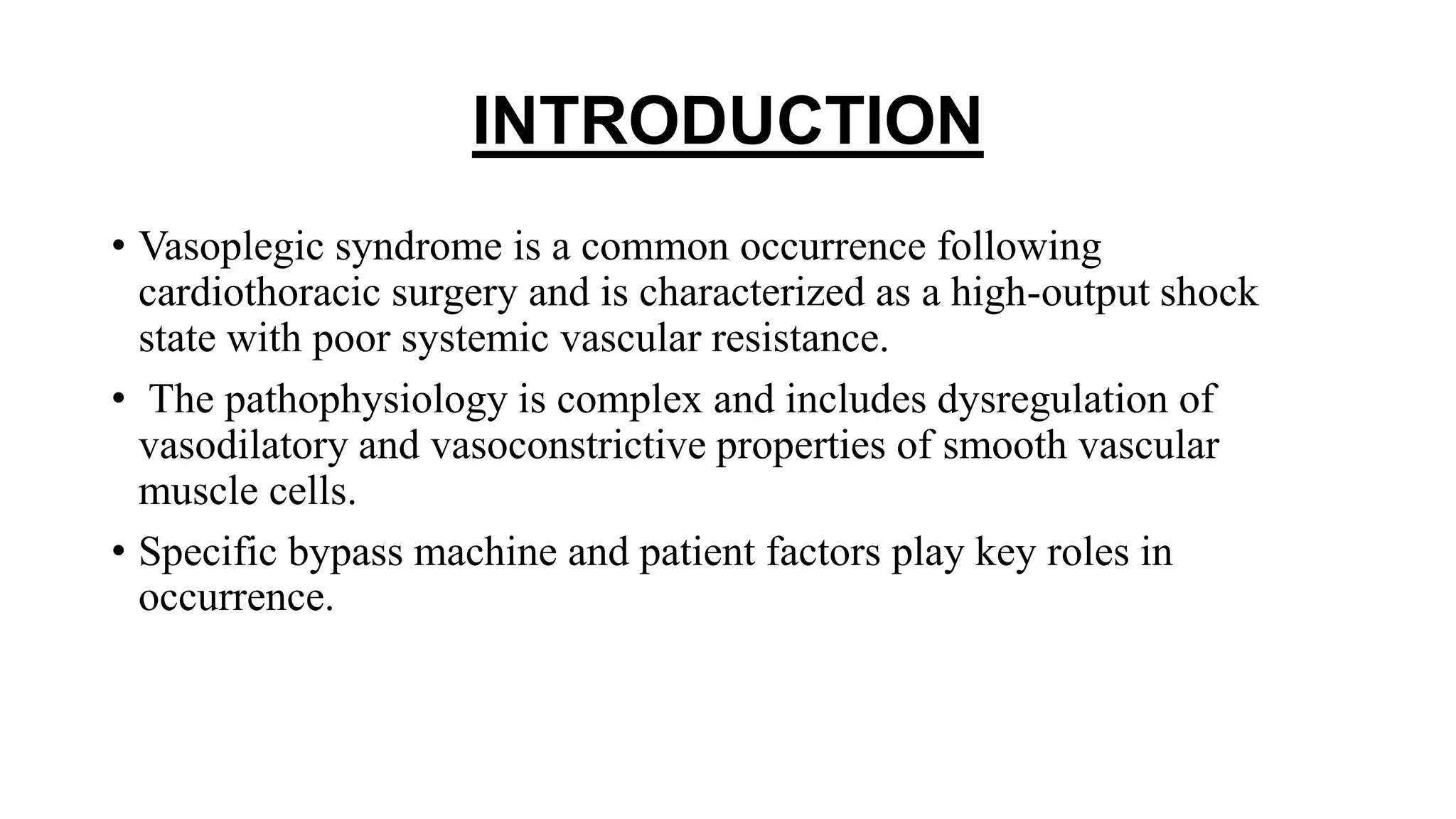
• Vasoplegic syndrome is a common occurrence following
cardiothoracic surgery and is characterized as a high-output shock
state with poor systemic vascular resistance.
• The pathophysiology is complex and includes dysregulation of
vasodilatory and vasoconstrictive properties of smooth vascular
muscle cells.
• Specific bypass machine and patient factors play key roles in
occurrence.
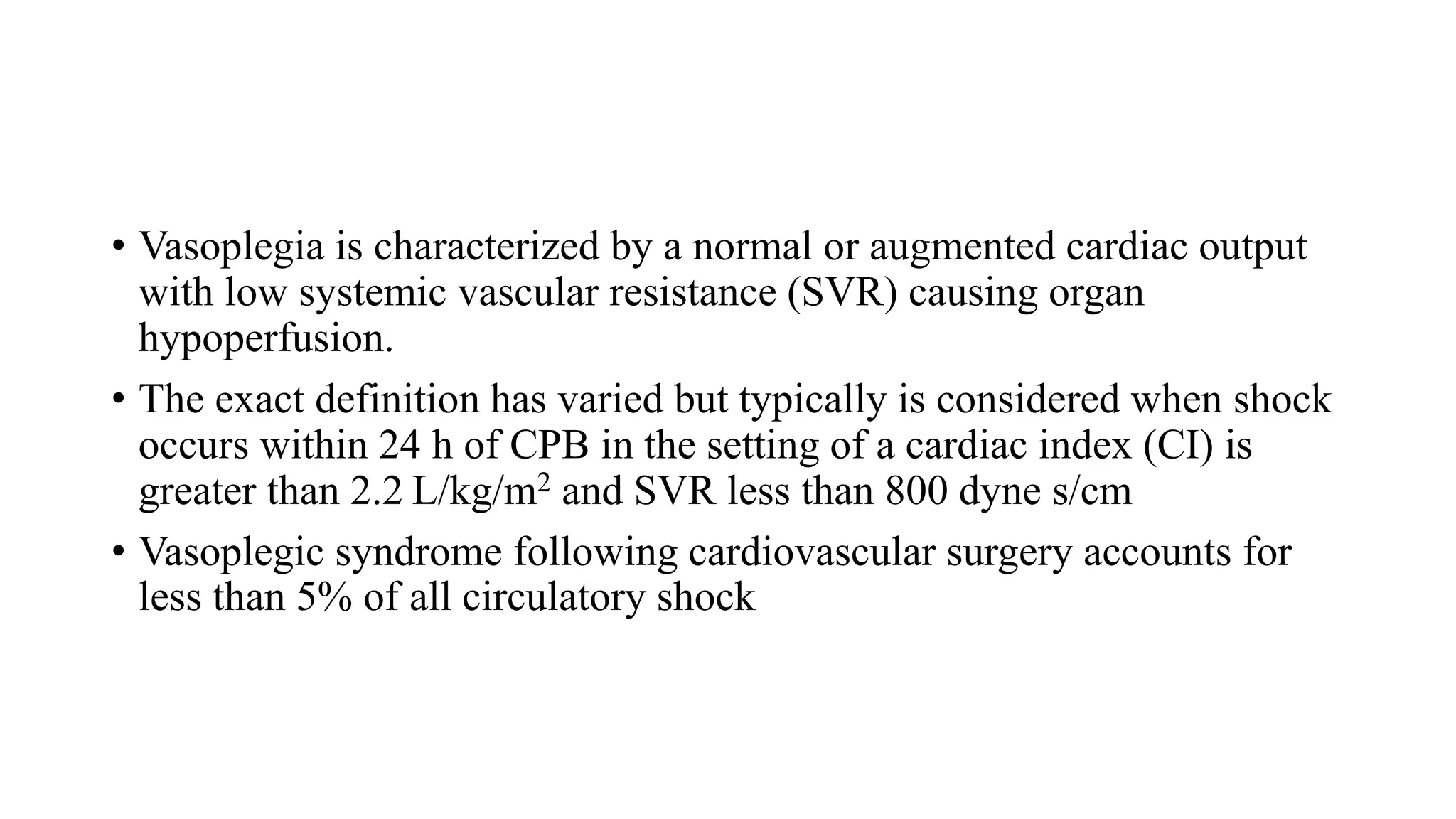
• Vasoplegia is characterized by a normal or augmented cardiac output
with low systemic vascular resistance (SVR) causing organ
hypoperfusion.
• The exact definition has varied but typically is considered when shock
occurs within 24 h of CPB in the setting of a cardiac index (CI) is
greater than 2.2 L/kg/m2 and SVR less than 800 dyne s/cm
• Vasoplegic syndrome following cardiovascular surgery accounts for
less than 5% of all circulatory shock
• Incidence is higher in patients with preoperative risk factors including
1)preoperative use of antihypertensive medications,
2) A large number of comorbidities,
3)warmer core temperatures while on bypass,
4)A longer duration on bypass
Pathophysiology
• Multifactorial and depends on several patient characteristics as well as
the nature of the surgical procedure.
• The mechanism is dysregulated during CPB, as the exposure of blood to
foreign surfaces inside of the CPB circuit stimulates the release of
inflammatory mediators, such as interleukin-1 (IL-1), interleukin-6 (IL-
6), and tumor necrosis factor-alpha (TNF).
• These cytokines stimulate the locus coeruleus and the hypothalamic
pituitary-adrenal axis in the paraventricular nucleus which over time
leads to adrenoreceptor desensitization and a proinflammatory state.
• These inflammatory mediators can also potentiate the production of
nitric oxide (NO), which is vasodilatory, and in excess, can result in
vasoplegic shock.
• As shock persists, there is subsequent depletion of these hormones.
• Endogenous vasopressin acutely increases in a hypotensive state
followed by decreasing concentrations leading to relative
AVP(arginine vasopressine) deficiency.
• AVP is of particular importance in vasoplegic syndrome, due to its
ability to neutralize the effects of NO and decrease NO production
• Physiologic contraction of vascular smooth muscle occurs in response
to intracellular calcium, which cause myosin phosphorylation leading
to myosin-actin filament crosslinking and vasoconstriction.
• Inflammatory mediators released during cardiopulmonary bypass can
lead to adrenoreceptor desensitization, an immediate increase in
vasoconstrictive mediators with subsequent depletion, and the
production of nitric oxide (NO).
• NO leads to an increase in cGMP, which inhibits calcium into cells,
leading to muscle relaxation.
• NO also activates ATP-sensitive potassium channels (KATP), leading
to hyperpolarization and inhibited vasoconstriction
Treatment
Conclusion
• NO is believed to play a large role in refractory vasodilation and thus
is a potential target for therapies.
• While catecholamines are considered first-line therapy in vasoplegic
syndrome, non-catecholamine agents may be considered early or in
place of catecholamines by virtue of their improved safety profile with
regard to cardiac toxicity. Moreover, these agents may be associated
with improved outcomes such as reduced kidney injury.
• In general, the treatment of vasoplegic syndrome should be rational
and balanced, with the judicious use of catecholamine and non-
catecholamine agents alike.
`
THANK YOU

Vasoplegic shock

  • 1.
  • 2.
    INTRODUCTION • Vasoplegic syndromeis a common occurrence following cardiothoracic surgery and is characterized as a high-output shock state with poor systemic vascular resistance. • The pathophysiology is complex and includes dysregulation of vasodilatory and vasoconstrictive properties of smooth vascular muscle cells. • Specific bypass machine and patient factors play key roles in occurrence.
  • 3.
    • Vasoplegia ischaracterized by a normal or augmented cardiac output with low systemic vascular resistance (SVR) causing organ hypoperfusion. • The exact definition has varied but typically is considered when shock occurs within 24 h of CPB in the setting of a cardiac index (CI) is greater than 2.2 L/kg/m2 and SVR less than 800 dyne s/cm • Vasoplegic syndrome following cardiovascular surgery accounts for less than 5% of all circulatory shock
  • 4.
    • Incidence ishigher in patients with preoperative risk factors including 1)preoperative use of antihypertensive medications, 2) A large number of comorbidities, 3)warmer core temperatures while on bypass, 4)A longer duration on bypass
  • 5.
    Pathophysiology • Multifactorial anddepends on several patient characteristics as well as the nature of the surgical procedure. • The mechanism is dysregulated during CPB, as the exposure of blood to foreign surfaces inside of the CPB circuit stimulates the release of inflammatory mediators, such as interleukin-1 (IL-1), interleukin-6 (IL- 6), and tumor necrosis factor-alpha (TNF). • These cytokines stimulate the locus coeruleus and the hypothalamic pituitary-adrenal axis in the paraventricular nucleus which over time leads to adrenoreceptor desensitization and a proinflammatory state. • These inflammatory mediators can also potentiate the production of nitric oxide (NO), which is vasodilatory, and in excess, can result in vasoplegic shock.
  • 6.
    • As shockpersists, there is subsequent depletion of these hormones. • Endogenous vasopressin acutely increases in a hypotensive state followed by decreasing concentrations leading to relative AVP(arginine vasopressine) deficiency. • AVP is of particular importance in vasoplegic syndrome, due to its ability to neutralize the effects of NO and decrease NO production
  • 8.
    • Physiologic contractionof vascular smooth muscle occurs in response to intracellular calcium, which cause myosin phosphorylation leading to myosin-actin filament crosslinking and vasoconstriction. • Inflammatory mediators released during cardiopulmonary bypass can lead to adrenoreceptor desensitization, an immediate increase in vasoconstrictive mediators with subsequent depletion, and the production of nitric oxide (NO). • NO leads to an increase in cGMP, which inhibits calcium into cells, leading to muscle relaxation. • NO also activates ATP-sensitive potassium channels (KATP), leading to hyperpolarization and inhibited vasoconstriction
  • 9.
  • 11.
    Conclusion • NO isbelieved to play a large role in refractory vasodilation and thus is a potential target for therapies. • While catecholamines are considered first-line therapy in vasoplegic syndrome, non-catecholamine agents may be considered early or in place of catecholamines by virtue of their improved safety profile with regard to cardiac toxicity. Moreover, these agents may be associated with improved outcomes such as reduced kidney injury. • In general, the treatment of vasoplegic syndrome should be rational and balanced, with the judicious use of catecholamine and non- catecholamine agents alike.
  • 12.