VASCULAR TUMORS
Surg Lt Cdr Rabia Ahmed
MBBS, FCPS, FRCPath (UK)
Consultant Histopathologist
Assistant Professor
BUHS, Karachi
Vascular tumors
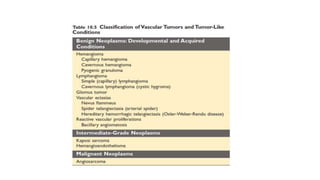
• Tumors of blood vessels and lymphatics include:
• Benign
• Intermediate
• Malignant
• Vascular neoplasms arise either from:
• Endothelium (e.g. hemangioma, lymphangioma, angiosarcoma)
• Cells that support or surround blood vessels (e.g., glomus tumor)
• Tumor-like lesions
• Congenital or developmental malformations
• Non-neoplastic reactive vascular proliferations (e.g., bacillary angiomatosis) can also
manifest as that may present diagnostic challenges
Vascular tumors
• In general, benign and malignant vascular neoplasms are distinguished by the following features:
• Benign tumors
• Composed of vascular channels filled with blood cells or lymph
• Lined by a monolayer of normal-appearing endothelial cells
• Malignant tumors
• More cellular
• Show cytologic atypia, are proliferative
• Usually do not form well-organized vessels
• Confirmation of the endothelial derivation of such proliferations may require
immunohistochemical detection of EC-specific markers, CD34 and Vwf.
Vascular tumors
• Vascular Ectasias
• A generic term for any local dilation of a structure
• Telangiectasia
• A permanent dilation of preexisting small vessels (capillaries, venules, and arterioles, usually
in the skin or mucous membranes) that forms a discrete red lesion
• Can be congenital or acquired and are not true neoplasms
Vascular tumors
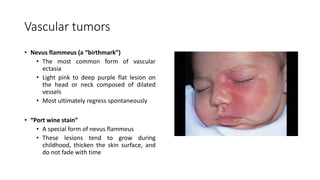
• Nevus flammeus (a “birthmark”)
• The most common form of vascular
ectasia
• Light pink to deep purple flat lesion on
the head or neck composed of dilated
vessels
• Most ultimately regress spontaneously
• “Port wine stain”
• A special form of nevus flammeus
• These lesions tend to grow during
childhood, thicken the skin surface, and
do not fade with time
Vascular tumors
• Sturge Weber syndrome
• Also called encephalotrigeminal
angiomatosis
• Uncommon congenital disorder
• Nevus flammeus (a “birthmark”) lesions
occurring in the distribution of the
trigeminal nerve
• Associated with facial port wine nevi,
ipsilateral venous angiomas in the cortical
leptomeninges, mental retardation,
seizures, hemiplegia, and radiologic
opacities of the skull
• A large facial telangiectasia in a child with
mental deficiencies may indicate the
presence of additional vascular
malformations
Vascular tumors
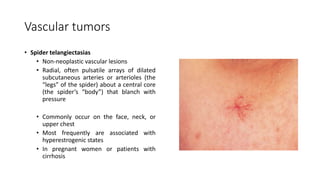
• Spider telangiectasias
• Non-neoplastic vascular lesions
• Radial, often pulsatile arrays of dilated
subcutaneous arteries or arterioles (the
“legs” of the spider) about a central core
(the spider’s “body”) that blanch with
pressure
• Commonly occur on the face, neck, or
upper chest
• Most frequently are associated with
hyperestrogenic states
• In pregnant women or patients with
cirrhosis
Vascular tumors
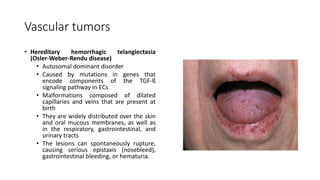
• Hereditary hemorrhagic telangiectasia
(Osler-Weber-Rendu disease)
• Autosomal dominant disorder
• Caused by mutations in genes that
encode components of the TGF-ß
signaling pathway in ECs
• Malformations composed of dilated
capillaries and veins that are present at
birth
• They are widely distributed over the skin
and oral mucous membranes, as well as
in the respiratory, gastrointestinal, and
urinary tracts
• The lesions can spontaneously rupture,
causing serious epistaxis (nosebleed),
gastrointestinal bleeding, or hematuria.
Hemangiomas
• Hemangiomas are very common tumors
• Composed of blood-filled vessels
• Constitute 7% of all benign tumors of infancy and childhood
• Most are present from birth and initially increase in size
• Many eventually regress spontaneously
• While hemangiomas typically are localized lesions confined to the head and neck
• They occasionally may be more extensive (angiomatosis)
• Can arise internally
• Nearly one third of these internal lesions are found in the liver
• Malignant transformation is rare
Hemangiomas
• Capillary hemangiomas
• The most common type
• Occur in the skin, subcutaneous tissues, and mucous membranes of the oral cavities and lips,
as well as in the liver, spleen, and kidneys
• Histologically, they are composed of thin-walled capillaries with scant stroma
• Juvenile hemangiomas (so-called “strawberry hemangiomas”)
• Extremely common (1 in 200 births)
• Can be multiple
• Grow rapidly for a few months but then fade by 1 to 3 years of age
• Complete regression by 7 years of age in majority of cases
Hemangiomas
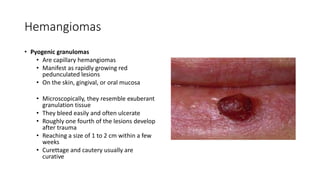
• Pyogenic granulomas
• Are capillary hemangiomas
• Manifest as rapidly growing red
pedunculated lesions
• On the skin, gingival, or oral mucosa
• Microscopically, they resemble exuberant
granulation tissue
• They bleed easily and often ulcerate
• Roughly one fourth of the lesions develop
after trauma
• Reaching a size of 1 to 2 cm within a few
weeks
• Curettage and cautery usually are
curative
Hemangiomas
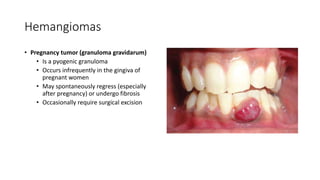
• Pregnancy tumor (granuloma gravidarum)
• Is a pyogenic granuloma
• Occurs infrequently in the gingiva of
pregnant women
• May spontaneously regress (especially
after pregnancy) or undergo fibrosis
• Occasionally require surgical excision
Hemangiomas
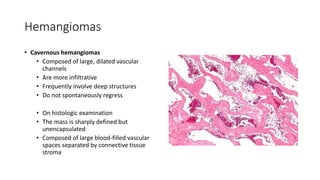
• Cavernous hemangiomas
• Composed of large, dilated vascular
channels
• Are more infiltrative
• Frequently involve deep structures
• Do not spontaneously regress
• On histologic examination
• The mass is sharply defined but
unencapsulated
• Composed of large blood-filled vascular
spaces separated by connective tissue
stroma
Hemangiomas
• Cavernous hemangiomas
• Intravascular thrombosis and dystrophic calcification are common
• Lesions may be locally destructive
• Surgical excision is required in some cases
• They can be cosmetically troublesome
• Vulnerable to traumatic ulceration and bleeding
• Brain hemangiomas are problematic - symptoms related to compression of adjacent tissue or
may rupture
• One component of von Hippel-Lindau disease - in which vascular lesions are commonly found
in the cerebellum, brain stem, retina, pancreas, and liver
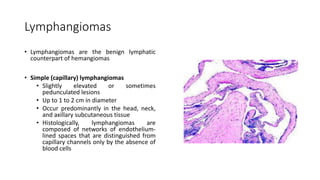
Lymphangiomas
• Lymphangiomas are the benign lymphatic
counterpart of hemangiomas
• Simple (capillary) lymphangiomas
• Slightly elevated or sometimes
pedunculated lesions
• Up to 1 to 2 cm in diameter
• Occur predominantly in the head, neck,
and axillary subcutaneous tissue
• Histologically, lymphangiomas are
composed of networks of endothelium-
lined spaces that are distinguished from
capillary channels only by the absence of
blood cells
Lymphangiomas
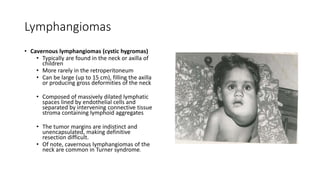
• Cavernous lymphangiomas (cystic hygromas)
• Typically are found in the neck or axilla of
children
• More rarely in the retroperitoneum
• Can be large (up to 15 cm), filling the axilla
or producing gross deformities of the neck
• Composed of massively dilated lymphatic
spaces lined by endothelial cells and
separated by intervening connective tissue
stroma containing lymphoid aggregates
• The tumor margins are indistinct and
unencapsulated, making definitive
resection difficult.
• Of note, cavernous lymphangiomas of the
neck are common in Turner syndrome.
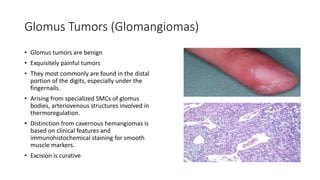
Glomus Tumors (Glomangiomas)
• Glomus tumors are benign
• Exquisitely painful tumors
• They most commonly are found in the distal
portion of the digits, especially under the
fingernails.
• Arising from specialized SMCs of glomus
bodies, arteriovenous structures involved in
thermoregulation.
• Distinction from cavernous hemangiomas is
based on clinical features and
immunohistochemical staining for smooth
muscle markers.
• Excision is curative
Bacillary Angiomatosis
• A vascular proliferation in immune-compromised
• Hosts (e.g., patients with AIDS) caused by opportunistic gram-negative bacilli of the Bartonella
family
• The lesions can involve the skin, bone, brain, and other organs
• Two species have been implicated:
• Bartonella henselae, whose principal reservoir is the domestic cat; this organism causes cat-
scratch disease (a necrotizing granulomatous inflammation of lymph nodes) in
immunocompetent hosts
• Bartonella quintana, which is transmitted by human body lice; this microbe was the cause of
“trench fever” in World War I
Bacillary Angiomatosis
• They most commonly are found in the distal portion of the digits, especially under the fingernails
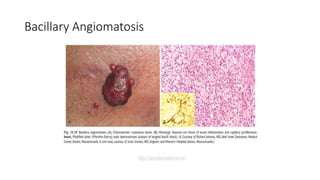
• Skin lesions take the form of red papules and nodules, rounded subcutaneous masses
• Histologically, there is a proliferation of capillaries lined by prominent epithelioid ECs, which
exhibit nuclear atypia and mitoses
• Other features include infiltrating neutrophils, nuclear debris, and purplish granular collections of
the causative bacteria
• The bacteria induce host tissues to produce hypoxiainducible factor-1a (HIF-1a), which drives
VEGF production and vascular proliferation
• The infections (and lesions) are cured by antibiotic treatment
Bacillary Angiomatosis
Kaposi sarcoma
• Kaposi sarcoma (KS) is a vascular neoplasm
• Caused by Kaposi sarcoma herpes virus (KSHV or HHV-8)
• It is most common in patients with AIDS
• Four forms of KS, based on population demographics and risks, are recognized:
• Classic KS
• Endemic African KS
• Transplantation-associated KS
• AIDS-associated (epidemic) KS
Kaposi sarcoma
• Classic KS
• Disorder of older men of Mediterranean, Middle Eastern, or Eastern European descent
(especially Ashkenazi Jews)
• Uncommon in the United States
• Associated with malignancy or altered immunity but is not associated with HIV infection
• Manifests as multiple red-purple skin plaques or nodules
• Usually on the distal lower extremities
• These progressively increase in size and number and spread proximally
• The tumors typically are asymptomatic
• Remain localized to the skin and subcutaneous tissue
Kaposi sarcoma
• Endemic African KS
• Occurs in younger (under 40 years of age) HIV-seronegative individuals
• Can follow an indolent or aggressive course
• It involves lymph nodes much more frequently than in the classic variant
• A particularly severe form, with prominent lymph node and visceral involvement, occurs in
prepubertal children; the prognosis is poor, with an almost 100% mortality within 3 years
Kaposi sarcoma
• Transplantation-associated KS
• Occurs in solid organ transplant recipients in the setting of T-cell immunosuppression
• In these patients, the risk for KS is increased 100-fold
• It pursues an aggressive course and often involves lymph nodes, mucosa, and viscera;
cutaneous lesions may be absent
• Lesions often regress with attenuation of immunosuppression, but at the risk for organ
rejection
Kaposi sarcoma
• AIDS-associated (epidemic) KS
• AIDS-defining illness
• Worldwide it represents the most common HIV-related malignancy
• Occurs in HIV-infected individuals with a 1000-fold higher incidence than in the general
population
• Often involves lymph nodes and disseminates widely to viscera early in its course
• Most patients eventually die of opportunistic infections rather than from KS
Kaposi sarcoma
• AIDS-associated (epidemic) KS
• Virtually all KS lesions are infected by KSHV (HHV-8)
• KSHV is a γ-herpesvirus
• It is transmitted both through sexual contact and potentially via oral secretions and
cutaneous exposures
• KSHV and altered T-cell immunity probably are required for KS development
• In older adults, diminished T-cell immunity may be related to aging
• It also is probable that acquired somatic mutations in the cells of origin contribute to tumor
development and progression.
Kaposi sarcoma
• AIDS-associated (epidemic) KS
• KSHV causes lytic and latent infections in Ecs
• A virally encoded G protein induces VEGF production, stimulating endothelial growth, and
cytokines produced by inflammatory cells recruited to sites of lytic infection also create a
local proliferative milieu
• In latently infected cells, KSHV encoded proteins disrupt normal cellular proliferation controls
(e.g., through synthesis of a viral homologue of cyclin D) and prevent apoptosis by inhibiting
p53
• Thus, the local inflammatory environment favors cellular proliferation, and latently infected
cells have a growth advantage
• In its early stages, only a few cells are KSHV-infected, but with time, virtually all of the
proliferating cells carry the virus
Kaposi sarcoma
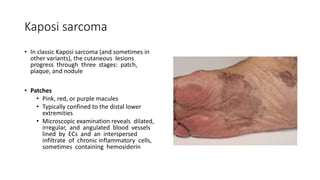
• In classic Kaposi sarcoma (and sometimes in
other variants), the cutaneous lesions
progress through three stages: patch,
plaque, and nodule
• Patches
• Pink, red, or purple macules
• Typically confined to the distal lower
extremities
• Microscopic examination reveals dilated,
irregular, and angulated blood vessels
lined by ECs and an interspersed
infiltrate of chronic inflammatory cells,
sometimes containing hemosiderin
Kaposi sarcoma
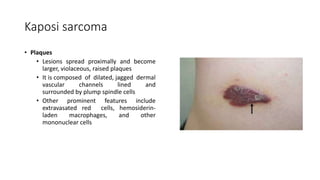
• Plaques
• Lesions spread proximally and become
larger, violaceous, raised plaques
• It is composed of dilated, jagged dermal
vascular channels lined and
surrounded by plump spindle cells
• Other prominent features include
extravasated red cells, hemosiderin-
laden macrophages, and other
mononuclear cells
Kaposi sarcoma
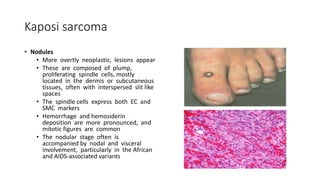
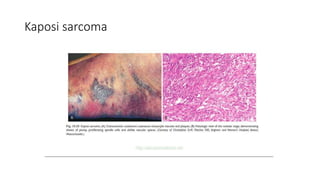
• Nodules
• More overtly neoplastic, lesions appear
• These are composed of plump,
proliferating spindle cells, mostly
located in the dermis or subcutaneous
tissues, often with interspersed slit like
spaces
• The spindle cells express both EC and
SMC markers
• Hemorrhage and hemosiderin
deposition are more pronounced, and
mitotic figures are common
• The nodular stage often is
accompanied by nodal and visceral
involvement, particularly in the African
and AIDS-associated variants
Kaposi sarcoma
Kaposi sarcoma
• The course of disease varies widely according to the clinical setting
• Most primary KSHV infections are asymptomatic
• Classic KS is—at least initially—largely restricted to the surface of the body and surgical resection
usually is adequate for an excellent prognosis
• Radiation therapy can be used for multiple lesions in a restricted area
• Chemotherapy yields satisfactory results for more disseminated disease, including nodal
involvement
• In KS associated with immunosuppression, withdrawal of therapy (with or without adjunct
chemotherapy or radiotherapy) often is effective
• For AIDS-associated KS, HIV anti-retroviral therapy generally is beneficial, with out without
additional therapy
• IFN-γ and angiogenesis inhibitors also have proved variably effective
Hemangioendotheliomas
• Comprise a wide spectrum of borderline vascular neoplasms
• Clinical behaviors intermediate between those of benign, well-differentiated hemangiomas and
aggressively malignant angiosarcomas
• Epithelioid hemangioendothelioma
• A tumor of adults arising in association with medium- to large-sized veins
• The clinical course is highly variable
• While excision is curative in a majority of the cases
• Up to 40% of the tumors recur
• 20% to 30% eventually metastasize
• 15% of patients die of their tumors
Angiosarcomas
• Malignant endothelial neoplasms
• Ranging from highly differentiated tumors resembling
• Hemangiomas to wildly anaplastic lesions
• Older adults are more commonly affected, without gender predilection
• Lesions can occur at any site, but most often involve
• Involve skin, soft tissue, breast, and liver
• Aggressive tumors that invade locally and metastasize
• Current 5-year survival rates are only about 30%
Angiosarcomas
• Can arise in the setting of lymphedema
• Classically in the ipsilateral upper extremity
several year after radical mastectomy (i.e.,
with lymph node resection) for breast cancer
• In such instances, the tumor presumably
arises from lymphatic vessels
(lymphangiosarcoma)
• Angiosarcomas can also be induced by
radiation
• Rarely are associated with long-term (years)
indwelling foreign bodies (e.g., catheters)
Angiosarcomas
• Hepatic angiosarcomas
• Associated with certain carcinogens
• Including arsenical pesticides and
polyvinyl chloride (one of the best known
examples of human chemical
carcinogenesis)
• Multiple years typically transpire
between exposure and subsequent
tumor development
Angiosarcomas
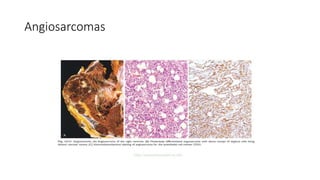
• Skin angiosarcomas
• Begin as small, sharply demarcated, asymptomatic red nodules
• More advanced lesions are large, fleshy red-tan to gray-white masses
• Margins blend imperceptibly with surrounding structures
• Necrosis and hemorrhage are common
• On microscopic examination
• Extent of differentiation is extremely variable
• Ranging from plump atypical ECs that form vascular channels to undifferentiated
spindle cell tumors without discernible blood vessels
• The EC origin can be demonstrated in the poorly differentiated tumors by staining for the EC
markers CD31 and von Willebrand factor
Angiosarcomas
Haemangiopericytoma
• Arise from pericytes
• Myofibroblast type cells associated with capillaries and venules
• Solitary fibrous tumor in pleura
Thank you

vascular tumors.pptx

  • 2.
    VASCULAR TUMORS Surg LtCdr Rabia Ahmed MBBS, FCPS, FRCPath (UK) Consultant Histopathologist Assistant Professor BUHS, Karachi
  • 3.
    Vascular tumors • Tumorsof blood vessels and lymphatics include: • Benign • Intermediate • Malignant • Vascular neoplasms arise either from: • Endothelium (e.g. hemangioma, lymphangioma, angiosarcoma) • Cells that support or surround blood vessels (e.g., glomus tumor) • Tumor-like lesions • Congenital or developmental malformations • Non-neoplastic reactive vascular proliferations (e.g., bacillary angiomatosis) can also manifest as that may present diagnostic challenges
  • 5.
    Vascular tumors • Ingeneral, benign and malignant vascular neoplasms are distinguished by the following features: • Benign tumors • Composed of vascular channels filled with blood cells or lymph • Lined by a monolayer of normal-appearing endothelial cells • Malignant tumors • More cellular • Show cytologic atypia, are proliferative • Usually do not form well-organized vessels • Confirmation of the endothelial derivation of such proliferations may require immunohistochemical detection of EC-specific markers, CD34 and Vwf.
  • 6.
    Vascular tumors • VascularEctasias • A generic term for any local dilation of a structure • Telangiectasia • A permanent dilation of preexisting small vessels (capillaries, venules, and arterioles, usually in the skin or mucous membranes) that forms a discrete red lesion • Can be congenital or acquired and are not true neoplasms
  • 7.
    Vascular tumors • Nevusflammeus (a “birthmark”) • The most common form of vascular ectasia • Light pink to deep purple flat lesion on the head or neck composed of dilated vessels • Most ultimately regress spontaneously • “Port wine stain” • A special form of nevus flammeus • These lesions tend to grow during childhood, thicken the skin surface, and do not fade with time
  • 8.
    Vascular tumors • SturgeWeber syndrome • Also called encephalotrigeminal angiomatosis • Uncommon congenital disorder • Nevus flammeus (a “birthmark”) lesions occurring in the distribution of the trigeminal nerve • Associated with facial port wine nevi, ipsilateral venous angiomas in the cortical leptomeninges, mental retardation, seizures, hemiplegia, and radiologic opacities of the skull • A large facial telangiectasia in a child with mental deficiencies may indicate the presence of additional vascular malformations
  • 9.
    Vascular tumors • Spidertelangiectasias • Non-neoplastic vascular lesions • Radial, often pulsatile arrays of dilated subcutaneous arteries or arterioles (the “legs” of the spider) about a central core (the spider’s “body”) that blanch with pressure • Commonly occur on the face, neck, or upper chest • Most frequently are associated with hyperestrogenic states • In pregnant women or patients with cirrhosis
  • 10.
    Vascular tumors • Hereditaryhemorrhagic telangiectasia (Osler-Weber-Rendu disease) • Autosomal dominant disorder • Caused by mutations in genes that encode components of the TGF-ß signaling pathway in ECs • Malformations composed of dilated capillaries and veins that are present at birth • They are widely distributed over the skin and oral mucous membranes, as well as in the respiratory, gastrointestinal, and urinary tracts • The lesions can spontaneously rupture, causing serious epistaxis (nosebleed), gastrointestinal bleeding, or hematuria.
  • 11.
    Hemangiomas • Hemangiomas arevery common tumors • Composed of blood-filled vessels • Constitute 7% of all benign tumors of infancy and childhood • Most are present from birth and initially increase in size • Many eventually regress spontaneously • While hemangiomas typically are localized lesions confined to the head and neck • They occasionally may be more extensive (angiomatosis) • Can arise internally • Nearly one third of these internal lesions are found in the liver • Malignant transformation is rare
  • 12.
    Hemangiomas • Capillary hemangiomas •The most common type • Occur in the skin, subcutaneous tissues, and mucous membranes of the oral cavities and lips, as well as in the liver, spleen, and kidneys • Histologically, they are composed of thin-walled capillaries with scant stroma • Juvenile hemangiomas (so-called “strawberry hemangiomas”) • Extremely common (1 in 200 births) • Can be multiple • Grow rapidly for a few months but then fade by 1 to 3 years of age • Complete regression by 7 years of age in majority of cases
  • 13.
    Hemangiomas • Pyogenic granulomas •Are capillary hemangiomas • Manifest as rapidly growing red pedunculated lesions • On the skin, gingival, or oral mucosa • Microscopically, they resemble exuberant granulation tissue • They bleed easily and often ulcerate • Roughly one fourth of the lesions develop after trauma • Reaching a size of 1 to 2 cm within a few weeks • Curettage and cautery usually are curative
  • 14.
    Hemangiomas • Pregnancy tumor(granuloma gravidarum) • Is a pyogenic granuloma • Occurs infrequently in the gingiva of pregnant women • May spontaneously regress (especially after pregnancy) or undergo fibrosis • Occasionally require surgical excision
  • 15.
    Hemangiomas • Cavernous hemangiomas •Composed of large, dilated vascular channels • Are more infiltrative • Frequently involve deep structures • Do not spontaneously regress • On histologic examination • The mass is sharply defined but unencapsulated • Composed of large blood-filled vascular spaces separated by connective tissue stroma
  • 16.
    Hemangiomas • Cavernous hemangiomas •Intravascular thrombosis and dystrophic calcification are common • Lesions may be locally destructive • Surgical excision is required in some cases • They can be cosmetically troublesome • Vulnerable to traumatic ulceration and bleeding • Brain hemangiomas are problematic - symptoms related to compression of adjacent tissue or may rupture • One component of von Hippel-Lindau disease - in which vascular lesions are commonly found in the cerebellum, brain stem, retina, pancreas, and liver
  • 18.
    Lymphangiomas • Lymphangiomas arethe benign lymphatic counterpart of hemangiomas • Simple (capillary) lymphangiomas • Slightly elevated or sometimes pedunculated lesions • Up to 1 to 2 cm in diameter • Occur predominantly in the head, neck, and axillary subcutaneous tissue • Histologically, lymphangiomas are composed of networks of endothelium- lined spaces that are distinguished from capillary channels only by the absence of blood cells
  • 19.
    Lymphangiomas • Cavernous lymphangiomas(cystic hygromas) • Typically are found in the neck or axilla of children • More rarely in the retroperitoneum • Can be large (up to 15 cm), filling the axilla or producing gross deformities of the neck • Composed of massively dilated lymphatic spaces lined by endothelial cells and separated by intervening connective tissue stroma containing lymphoid aggregates • The tumor margins are indistinct and unencapsulated, making definitive resection difficult. • Of note, cavernous lymphangiomas of the neck are common in Turner syndrome.
  • 20.
    Glomus Tumors (Glomangiomas) •Glomus tumors are benign • Exquisitely painful tumors • They most commonly are found in the distal portion of the digits, especially under the fingernails. • Arising from specialized SMCs of glomus bodies, arteriovenous structures involved in thermoregulation. • Distinction from cavernous hemangiomas is based on clinical features and immunohistochemical staining for smooth muscle markers. • Excision is curative
  • 21.
    Bacillary Angiomatosis • Avascular proliferation in immune-compromised • Hosts (e.g., patients with AIDS) caused by opportunistic gram-negative bacilli of the Bartonella family • The lesions can involve the skin, bone, brain, and other organs • Two species have been implicated: • Bartonella henselae, whose principal reservoir is the domestic cat; this organism causes cat- scratch disease (a necrotizing granulomatous inflammation of lymph nodes) in immunocompetent hosts • Bartonella quintana, which is transmitted by human body lice; this microbe was the cause of “trench fever” in World War I
  • 22.
    Bacillary Angiomatosis • Theymost commonly are found in the distal portion of the digits, especially under the fingernails • Skin lesions take the form of red papules and nodules, rounded subcutaneous masses • Histologically, there is a proliferation of capillaries lined by prominent epithelioid ECs, which exhibit nuclear atypia and mitoses • Other features include infiltrating neutrophils, nuclear debris, and purplish granular collections of the causative bacteria • The bacteria induce host tissues to produce hypoxiainducible factor-1a (HIF-1a), which drives VEGF production and vascular proliferation • The infections (and lesions) are cured by antibiotic treatment
  • 23.
  • 24.
    Kaposi sarcoma • Kaposisarcoma (KS) is a vascular neoplasm • Caused by Kaposi sarcoma herpes virus (KSHV or HHV-8) • It is most common in patients with AIDS • Four forms of KS, based on population demographics and risks, are recognized: • Classic KS • Endemic African KS • Transplantation-associated KS • AIDS-associated (epidemic) KS
  • 25.
    Kaposi sarcoma • ClassicKS • Disorder of older men of Mediterranean, Middle Eastern, or Eastern European descent (especially Ashkenazi Jews) • Uncommon in the United States • Associated with malignancy or altered immunity but is not associated with HIV infection • Manifests as multiple red-purple skin plaques or nodules • Usually on the distal lower extremities • These progressively increase in size and number and spread proximally • The tumors typically are asymptomatic • Remain localized to the skin and subcutaneous tissue
  • 26.
    Kaposi sarcoma • EndemicAfrican KS • Occurs in younger (under 40 years of age) HIV-seronegative individuals • Can follow an indolent or aggressive course • It involves lymph nodes much more frequently than in the classic variant • A particularly severe form, with prominent lymph node and visceral involvement, occurs in prepubertal children; the prognosis is poor, with an almost 100% mortality within 3 years
  • 27.
    Kaposi sarcoma • Transplantation-associatedKS • Occurs in solid organ transplant recipients in the setting of T-cell immunosuppression • In these patients, the risk for KS is increased 100-fold • It pursues an aggressive course and often involves lymph nodes, mucosa, and viscera; cutaneous lesions may be absent • Lesions often regress with attenuation of immunosuppression, but at the risk for organ rejection
  • 28.
    Kaposi sarcoma • AIDS-associated(epidemic) KS • AIDS-defining illness • Worldwide it represents the most common HIV-related malignancy • Occurs in HIV-infected individuals with a 1000-fold higher incidence than in the general population • Often involves lymph nodes and disseminates widely to viscera early in its course • Most patients eventually die of opportunistic infections rather than from KS
  • 29.
    Kaposi sarcoma • AIDS-associated(epidemic) KS • Virtually all KS lesions are infected by KSHV (HHV-8) • KSHV is a γ-herpesvirus • It is transmitted both through sexual contact and potentially via oral secretions and cutaneous exposures • KSHV and altered T-cell immunity probably are required for KS development • In older adults, diminished T-cell immunity may be related to aging • It also is probable that acquired somatic mutations in the cells of origin contribute to tumor development and progression.
  • 30.
    Kaposi sarcoma • AIDS-associated(epidemic) KS • KSHV causes lytic and latent infections in Ecs • A virally encoded G protein induces VEGF production, stimulating endothelial growth, and cytokines produced by inflammatory cells recruited to sites of lytic infection also create a local proliferative milieu • In latently infected cells, KSHV encoded proteins disrupt normal cellular proliferation controls (e.g., through synthesis of a viral homologue of cyclin D) and prevent apoptosis by inhibiting p53 • Thus, the local inflammatory environment favors cellular proliferation, and latently infected cells have a growth advantage • In its early stages, only a few cells are KSHV-infected, but with time, virtually all of the proliferating cells carry the virus
  • 31.
    Kaposi sarcoma • Inclassic Kaposi sarcoma (and sometimes in other variants), the cutaneous lesions progress through three stages: patch, plaque, and nodule • Patches • Pink, red, or purple macules • Typically confined to the distal lower extremities • Microscopic examination reveals dilated, irregular, and angulated blood vessels lined by ECs and an interspersed infiltrate of chronic inflammatory cells, sometimes containing hemosiderin
  • 32.
    Kaposi sarcoma • Plaques •Lesions spread proximally and become larger, violaceous, raised plaques • It is composed of dilated, jagged dermal vascular channels lined and surrounded by plump spindle cells • Other prominent features include extravasated red cells, hemosiderin- laden macrophages, and other mononuclear cells
  • 33.
    Kaposi sarcoma • Nodules •More overtly neoplastic, lesions appear • These are composed of plump, proliferating spindle cells, mostly located in the dermis or subcutaneous tissues, often with interspersed slit like spaces • The spindle cells express both EC and SMC markers • Hemorrhage and hemosiderin deposition are more pronounced, and mitotic figures are common • The nodular stage often is accompanied by nodal and visceral involvement, particularly in the African and AIDS-associated variants
  • 34.
  • 35.
    Kaposi sarcoma • Thecourse of disease varies widely according to the clinical setting • Most primary KSHV infections are asymptomatic • Classic KS is—at least initially—largely restricted to the surface of the body and surgical resection usually is adequate for an excellent prognosis • Radiation therapy can be used for multiple lesions in a restricted area • Chemotherapy yields satisfactory results for more disseminated disease, including nodal involvement • In KS associated with immunosuppression, withdrawal of therapy (with or without adjunct chemotherapy or radiotherapy) often is effective • For AIDS-associated KS, HIV anti-retroviral therapy generally is beneficial, with out without additional therapy • IFN-γ and angiogenesis inhibitors also have proved variably effective
  • 36.
    Hemangioendotheliomas • Comprise awide spectrum of borderline vascular neoplasms • Clinical behaviors intermediate between those of benign, well-differentiated hemangiomas and aggressively malignant angiosarcomas • Epithelioid hemangioendothelioma • A tumor of adults arising in association with medium- to large-sized veins • The clinical course is highly variable • While excision is curative in a majority of the cases • Up to 40% of the tumors recur • 20% to 30% eventually metastasize • 15% of patients die of their tumors
  • 37.
    Angiosarcomas • Malignant endothelialneoplasms • Ranging from highly differentiated tumors resembling • Hemangiomas to wildly anaplastic lesions • Older adults are more commonly affected, without gender predilection • Lesions can occur at any site, but most often involve • Involve skin, soft tissue, breast, and liver • Aggressive tumors that invade locally and metastasize • Current 5-year survival rates are only about 30%
  • 38.
    Angiosarcomas • Can arisein the setting of lymphedema • Classically in the ipsilateral upper extremity several year after radical mastectomy (i.e., with lymph node resection) for breast cancer • In such instances, the tumor presumably arises from lymphatic vessels (lymphangiosarcoma) • Angiosarcomas can also be induced by radiation • Rarely are associated with long-term (years) indwelling foreign bodies (e.g., catheters)
  • 39.
    Angiosarcomas • Hepatic angiosarcomas •Associated with certain carcinogens • Including arsenical pesticides and polyvinyl chloride (one of the best known examples of human chemical carcinogenesis) • Multiple years typically transpire between exposure and subsequent tumor development
  • 40.
    Angiosarcomas • Skin angiosarcomas •Begin as small, sharply demarcated, asymptomatic red nodules • More advanced lesions are large, fleshy red-tan to gray-white masses • Margins blend imperceptibly with surrounding structures • Necrosis and hemorrhage are common • On microscopic examination • Extent of differentiation is extremely variable • Ranging from plump atypical ECs that form vascular channels to undifferentiated spindle cell tumors without discernible blood vessels • The EC origin can be demonstrated in the poorly differentiated tumors by staining for the EC markers CD31 and von Willebrand factor
  • 41.
  • 42.
    Haemangiopericytoma • Arise frompericytes • Myofibroblast type cells associated with capillaries and venules • Solitary fibrous tumor in pleura
  • 43.