Variables

1
 General Issues in Using Variables:
 Guidelines for Initializing Variables.
 Scope
 Persistence.
 Binding time.
 Using each variable for exactly one purpose.
 Variables declaration.

2
 The Power of Variable Names:
 Considerations in choosing good names.
 The power of naming conventions.
 Informal naming conventions.
 Standardized prefixes.
 Creating short names that are Readable.
 Kinds of names to avoid.

3
General Issues in Using Variables

4
 Improper initialization problem.

 Reasons:
 The variable has never been assigned a value.
 Part of the variable has been assigned a value and part has
not.
 The value in the variable is outdated .

5
 Solutions:
 Initialize each variable as it's declared.
 Use const when possible.
 Pay attention to counters and accumulators.
 Initialize a class's member data in its constructor.
 Check the need for re-initialization.
 Take advantage of your compiler's warning messages
 Check input parameters for validity .
 Use a memory-access checker to check for bad pointers.
 Initialize working memory at the beginning of your program.

6
 Scope is variable visibility.

 We can measure scope by:
 Live time.
 Span.

7
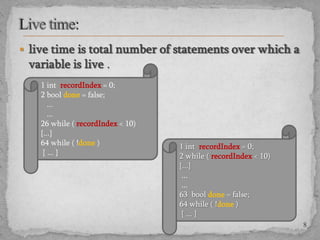
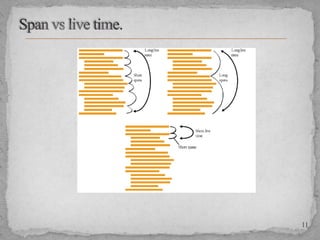
 live time is total number of statements over which a

variable is live .
1 int recordIndex = 0;
2 bool done = false;
...
...
26 while ( recordIndex < 10)
{...}
64 while ( !done )
{ ... }

1 int recordIndex = 0;
2 while ( recordIndex < 10)
{...}
...
...
63 bool done = false;
64 while ( !done )
{ ... }
8
 Why we try to restrict live time?
 You can concentrate on a smaller section of code.
 Code more readable.
 reduces the chance of initialization errors .
 Easy to modify.

9
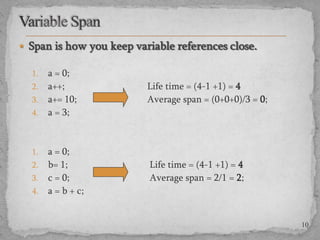
 Span is how you keep variable references close.
1.

2.
3.
4.

1.
2.
3.

4.

a = 0;
a++;
a+= 10;
a = 3;

Life time = (4-1 +1) = 4
Average span = (0+0+0)/3 = 0;

a = 0;
b= 1;
c = 0;
a = b + c;

Life time = (4-1 +1) = 4
Average span = 2/1 = 2;

10
11
 Initialize variables used in a loop immediately






before the loop .
Don't assign a value to a variable until just before
the value is used.
Break groups of related statements into separate
routines .
Begin with most restricted visibility, and expand
the scope if necessary .
Keep both span and live time as short as you can.
12
 Persistence is life span of a piece of data .
 Problem:

When you assume variable is persist but it's not .
 Solution:
 Set variables to "unreasonable values" when they doesn’t
persist.
 Use assertions to check critical variables.
 Declare and Initialize all data right before it's used.

13
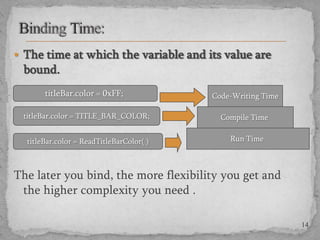
 The time at which the variable and its value are

bound.
titleBar.color = 0xFF;
titleBar.color = TITLE_BAR_COLOR;
titleBar.color = ReadTitleBarColor( )

Code-Writing Time
Compile Time

Run Time

The later you bind, the more flexibility you get and
the higher complexity you need .
14
 Use each variable for one purpose only.
// Compute roots of a quadratic equation
temp = Sqrt( b*b - 4*a*c );
root[0] = ( -b + temp ) / ( 2 * a );
root[1] = ( -b - temp ) / ( 2 * a );
...
// swap the roots
temp = root[0];
root[0] = root[1];
root[1] = temp ;

Creating unique variables for each purpose makes code more
readable.
15
 Avoid hybrid coupling.

Double use is clear to you but it won't be to someone else.
 Make sure all declared variables are used.

16
Initializing Variables
 Does each routine check input parameters for validity?
 Does the code declare variables close to where they're first

used?
 Does the code initialize variables as they're declared, if
possible?
 Are counters and accumulators initialized properly and, if
necessary, reinitialized each time they are used?
 Does the code compile with no warnings from the compiler?

17
Other General Issues in Using Data
 Do all variables have the smallest lift time possible?
 Are references to variables as close together as possible?
 Are all the declared variables being used?
 Are all variables bound with balance between the
flexibility and the complexity associated?
 Does each variable have only one purpose?
 Is each variable's meaning explicit, with no hidden
meanings?

18
The Power of Variable Names

19
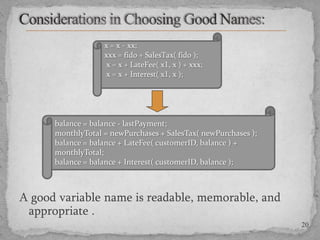
x = x - xx;
xxx = fido + SalesTax( fido );
x = x + LateFee( x1, x ) + xxx;
x = x + Interest( x1, x );

balance = balance - lastPayment;
monthlyTotal = newPurchases + SalesTax( newPurchases );
balance = balance + LateFee( customerID, balance ) +
monthlyTotal;
balance = balance + Interest( customerID, balance );

A good variable name is readable, memorable, and
appropriate .
20
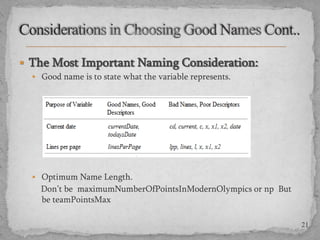
 The Most Important Naming Consideration:
 Good name is to state what the variable represents.

 Optimum Name Length.

Don’t be maximumNumberOfPointsInModernOlympics or np But
be teamPointsMax
21
 Are short names always bad?

 Common Opposites in Variable Names.
 maxPoints OR pointsMax OR both ?
 Avoid the confusion between maxPoints and

pointsMax .
 The most significant part of the variable name is at the
front.

22
 loop variables:
 Don’t use i, j, and k if:
1. variable is to be used outside the loop.
2. the loop is longer than a few lines.
3. you write nested loops.
Try to avoid altogether .

Code is so often changed, expanded, and copied
into other programs.

23
 Naming Status Variables:
 A flag should never have flag in its name .
 Use constants and enumerator for its value.
reportType == ReportType_Annual is more meaningful
than reportflag == 0x80 .
 Naming Temporary Variables:
 Use descriptive variable name instead of temp.

24
 Naming Boolean Variables:
 Give Boolean variables names that imply true or false.
(done , error ,found ,success)
 Don’t use negative boolean variable names .
(if not notFound)

 Naming Enumerated Types:
 Using group prefix if your language doesn’t support.
Enum Color {Color_Red , Color_Green }
 enum type itself can include prefix (enColor).

25
 When Should Have a Naming Convention
 When multiple programmers are working on a project
 When you plan t turn a program over to another
programmer
 When programs are reviewed by other programmers
 When program is so large that you think about it in
pieces
 When the program will be long-lived enough

26
 Why we Have Conventions?
 One global decision rather than many local ones .
 They help you transfer knowledge across projects.
 They reduce name proliferation.
 They compensate for language weaknesses.
 You work with a consistent code.

27
 Differentiate between classes and objects via:
 Initial Capitalization
Widget widget.
 All Caps

WIDGET widget.
 "t_" Prefix for Types

t_Widget Widget.
 More Specific Names for the Variables

Widget employeeWidget .

 Identify member variables.
with an m_ prefix.
28
 Identify named constants .
Via uppercase letters.

 Identify elements of enumerated types.
 Use all caps or an e_ or E_ prefix for the name of the type.
 Use a prefix based on the specific type like Color_Red.

 Format names to enhance readability.
CIRCLEPOINTTOTAL is less readable than circlePointTotal or
circle_point_total.

29
 Guidelines for Language-Specific Conventions:
 i and j are integer indexes.
 p is a pointer.
 Constants and macros are in ALL_CAPS.
 Class and other types are in MixedUpperAndLowerCase().
 Variable and function names as variableOrRoutineName.
 The underscore is not used as a separator within names, except

for names in all caps and certain kinds of prefixes

30
 As avgSize, maxNum, firsIndex.

 Advantages of Standardized Prefixes:
 Naming conventions advantage +
 You have fewer names to remember.
 Make names more compact.

31
 General Abbreviation Guidelines:
 Remove all nonleading vowels (screen becomes scrn).
 Remove and, or, the, and so on.
 Use the first/first few letters of the name.
 Keep the first and last letters of each word.
 Remove useless suffixes—ing, ed, and so on.
 Keep the most noticeable sound in each syllable.

Be sure not to change the meaning of the variable.

32
Comments on Abbreviations:
 Don't abbreviate by removing one character from a word.

 Abbreviate consistently.

Num everywhere or No .
 Create names that you can pronounce

Use xPos rather than xPstn.
 Avoid combinations that result in misreading .

Use bEnd/b_Endrather than bend
 Use a thesaurus to resolve naming collisions.
 Document all abbreviations in a document.
 A reader of the code might not understand the abbreviation.
 Other programmers might use multiple abbreviations to refer
to the same word.

33
 Avoid misleading names or abbreviations.
As FALSE as abb for "Fig and Almond Season.“.
 Avoid names with similar meanings.
As fileNumber and fileIndex .
 Avoid variables with different meanings but similar names.
As clientRecs and clientReps .
 Avoid names that sound similar.
As wrap and rap.
 Avoid numerals in names.
As file1,file2

34
 Avoid words that are commonly misspelled in English.
As occassionally, acummulate, and acsend.

 Don't differentiate variable names solely by capitalization.
As count and Count.
 Avoid multiple natural languages
As "color" or "colour”.

35
?

programmers over the lifetime of a system
spend more time reading code than writing
code.
36
 Steve McConnell, June 2004, Code Complete: A Practical Handbook of

Software Construction, 2nd edn.

37
38

Variables

  • 1.
  • 2.
     General Issuesin Using Variables:  Guidelines for Initializing Variables.  Scope  Persistence.  Binding time.  Using each variable for exactly one purpose.  Variables declaration. 2
  • 3.
     The Powerof Variable Names:  Considerations in choosing good names.  The power of naming conventions.  Informal naming conventions.  Standardized prefixes.  Creating short names that are Readable.  Kinds of names to avoid. 3
  • 4.
    General Issues inUsing Variables 4
  • 5.
     Improper initializationproblem.  Reasons:  The variable has never been assigned a value.  Part of the variable has been assigned a value and part has not.  The value in the variable is outdated . 5
  • 6.
     Solutions:  Initializeeach variable as it's declared.  Use const when possible.  Pay attention to counters and accumulators.  Initialize a class's member data in its constructor.  Check the need for re-initialization.  Take advantage of your compiler's warning messages  Check input parameters for validity .  Use a memory-access checker to check for bad pointers.  Initialize working memory at the beginning of your program. 6
  • 7.
     Scope isvariable visibility.  We can measure scope by:  Live time.  Span. 7
  • 8.
     live timeis total number of statements over which a variable is live . 1 int recordIndex = 0; 2 bool done = false; ... ... 26 while ( recordIndex < 10) {...} 64 while ( !done ) { ... } 1 int recordIndex = 0; 2 while ( recordIndex < 10) {...} ... ... 63 bool done = false; 64 while ( !done ) { ... } 8
  • 9.
     Why wetry to restrict live time?  You can concentrate on a smaller section of code.  Code more readable.  reduces the chance of initialization errors .  Easy to modify. 9
  • 10.
     Span ishow you keep variable references close. 1. 2. 3. 4. 1. 2. 3. 4. a = 0; a++; a+= 10; a = 3; Life time = (4-1 +1) = 4 Average span = (0+0+0)/3 = 0; a = 0; b= 1; c = 0; a = b + c; Life time = (4-1 +1) = 4 Average span = 2/1 = 2; 10
  • 11.
  • 12.
     Initialize variablesused in a loop immediately     before the loop . Don't assign a value to a variable until just before the value is used. Break groups of related statements into separate routines . Begin with most restricted visibility, and expand the scope if necessary . Keep both span and live time as short as you can. 12
  • 13.
     Persistence islife span of a piece of data .  Problem: When you assume variable is persist but it's not .  Solution:  Set variables to "unreasonable values" when they doesn’t persist.  Use assertions to check critical variables.  Declare and Initialize all data right before it's used. 13
  • 14.
     The timeat which the variable and its value are bound. titleBar.color = 0xFF; titleBar.color = TITLE_BAR_COLOR; titleBar.color = ReadTitleBarColor( ) Code-Writing Time Compile Time Run Time The later you bind, the more flexibility you get and the higher complexity you need . 14
  • 15.
     Use eachvariable for one purpose only. // Compute roots of a quadratic equation temp = Sqrt( b*b - 4*a*c ); root[0] = ( -b + temp ) / ( 2 * a ); root[1] = ( -b - temp ) / ( 2 * a ); ... // swap the roots temp = root[0]; root[0] = root[1]; root[1] = temp ; Creating unique variables for each purpose makes code more readable. 15
  • 16.
     Avoid hybridcoupling. Double use is clear to you but it won't be to someone else.  Make sure all declared variables are used. 16
  • 17.
    Initializing Variables  Doeseach routine check input parameters for validity?  Does the code declare variables close to where they're first used?  Does the code initialize variables as they're declared, if possible?  Are counters and accumulators initialized properly and, if necessary, reinitialized each time they are used?  Does the code compile with no warnings from the compiler? 17
  • 18.
    Other General Issuesin Using Data  Do all variables have the smallest lift time possible?  Are references to variables as close together as possible?  Are all the declared variables being used?  Are all variables bound with balance between the flexibility and the complexity associated?  Does each variable have only one purpose?  Is each variable's meaning explicit, with no hidden meanings? 18
  • 19.
    The Power ofVariable Names 19
  • 20.
    x = x- xx; xxx = fido + SalesTax( fido ); x = x + LateFee( x1, x ) + xxx; x = x + Interest( x1, x ); balance = balance - lastPayment; monthlyTotal = newPurchases + SalesTax( newPurchases ); balance = balance + LateFee( customerID, balance ) + monthlyTotal; balance = balance + Interest( customerID, balance ); A good variable name is readable, memorable, and appropriate . 20
  • 21.
     The MostImportant Naming Consideration:  Good name is to state what the variable represents.  Optimum Name Length. Don’t be maximumNumberOfPointsInModernOlympics or np But be teamPointsMax 21
  • 22.
     Are shortnames always bad?  Common Opposites in Variable Names.  maxPoints OR pointsMax OR both ?  Avoid the confusion between maxPoints and pointsMax .  The most significant part of the variable name is at the front. 22
  • 23.
     loop variables: Don’t use i, j, and k if: 1. variable is to be used outside the loop. 2. the loop is longer than a few lines. 3. you write nested loops. Try to avoid altogether . Code is so often changed, expanded, and copied into other programs. 23
  • 24.
     Naming StatusVariables:  A flag should never have flag in its name .  Use constants and enumerator for its value. reportType == ReportType_Annual is more meaningful than reportflag == 0x80 .  Naming Temporary Variables:  Use descriptive variable name instead of temp. 24
  • 25.
     Naming BooleanVariables:  Give Boolean variables names that imply true or false. (done , error ,found ,success)  Don’t use negative boolean variable names . (if not notFound)  Naming Enumerated Types:  Using group prefix if your language doesn’t support. Enum Color {Color_Red , Color_Green }  enum type itself can include prefix (enColor). 25
  • 26.
     When ShouldHave a Naming Convention  When multiple programmers are working on a project  When you plan t turn a program over to another programmer  When programs are reviewed by other programmers  When program is so large that you think about it in pieces  When the program will be long-lived enough 26
  • 27.
     Why weHave Conventions?  One global decision rather than many local ones .  They help you transfer knowledge across projects.  They reduce name proliferation.  They compensate for language weaknesses.  You work with a consistent code. 27
  • 28.
     Differentiate betweenclasses and objects via:  Initial Capitalization Widget widget.  All Caps WIDGET widget.  "t_" Prefix for Types t_Widget Widget.  More Specific Names for the Variables Widget employeeWidget .  Identify member variables. with an m_ prefix. 28
  • 29.
     Identify namedconstants . Via uppercase letters.  Identify elements of enumerated types.  Use all caps or an e_ or E_ prefix for the name of the type.  Use a prefix based on the specific type like Color_Red.  Format names to enhance readability. CIRCLEPOINTTOTAL is less readable than circlePointTotal or circle_point_total. 29
  • 30.
     Guidelines forLanguage-Specific Conventions:  i and j are integer indexes.  p is a pointer.  Constants and macros are in ALL_CAPS.  Class and other types are in MixedUpperAndLowerCase().  Variable and function names as variableOrRoutineName.  The underscore is not used as a separator within names, except for names in all caps and certain kinds of prefixes 30
  • 31.
     As avgSize,maxNum, firsIndex.  Advantages of Standardized Prefixes:  Naming conventions advantage +  You have fewer names to remember.  Make names more compact. 31
  • 32.
     General AbbreviationGuidelines:  Remove all nonleading vowels (screen becomes scrn).  Remove and, or, the, and so on.  Use the first/first few letters of the name.  Keep the first and last letters of each word.  Remove useless suffixes—ing, ed, and so on.  Keep the most noticeable sound in each syllable. Be sure not to change the meaning of the variable. 32
  • 33.
    Comments on Abbreviations: Don't abbreviate by removing one character from a word.  Abbreviate consistently. Num everywhere or No .  Create names that you can pronounce Use xPos rather than xPstn.  Avoid combinations that result in misreading . Use bEnd/b_Endrather than bend  Use a thesaurus to resolve naming collisions.  Document all abbreviations in a document.  A reader of the code might not understand the abbreviation.  Other programmers might use multiple abbreviations to refer to the same word. 33
  • 34.
     Avoid misleadingnames or abbreviations. As FALSE as abb for "Fig and Almond Season.“.  Avoid names with similar meanings. As fileNumber and fileIndex .  Avoid variables with different meanings but similar names. As clientRecs and clientReps .  Avoid names that sound similar. As wrap and rap.  Avoid numerals in names. As file1,file2 34
  • 35.
     Avoid wordsthat are commonly misspelled in English. As occassionally, acummulate, and acsend.  Don't differentiate variable names solely by capitalization. As count and Count.  Avoid multiple natural languages As "color" or "colour”. 35
  • 36.
    ? programmers over thelifetime of a system spend more time reading code than writing code. 36
  • 37.
     Steve McConnell,June 2004, Code Complete: A Practical Handbook of Software Construction, 2nd edn. 37
  • 38.

Editor's Notes