Developing OpenStack
Tooling
...without Python
Colleen Murphy, HP
The problem
We need to manage OpenStack resources with
puppet
Lightning intro to puppet
● resource - something being managed on a
system
● type - the interface of the resource
● provider - the backend implementation of the
resource
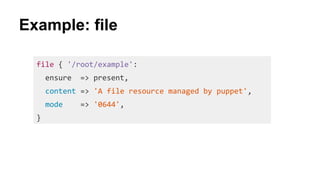
Example: file
file { '/root/example':
ensure => present,
content => 'A file resource managed by puppet',
mode => '0644',
}
Example: mysql_database
mysql_database { 'keystone':
ensure => present,
charset => 'utf8',
collate => 'utf8_general_ci',
}
Example: mysql_database
# puppet apply mysql.pp --debug
Debug: Prefetching mysql resources for mysql_database
Debug: Executing '/usr/bin/mysql --defaults-extra-file=/root/.my.cnf
-NBe show databases'
Debug: Executing '/usr/bin/mysql --defaults-extra-file=/root/.my.cnf
-NBe create database if not exists `keystone` character set `utf8`
collate `utf8_general_ci`'
Notice: /Stage[main]/Main/Mysql_database[keystone]/ensure: created
#
Example: keystone_tenant
keystone_tenant { 'services':
ensure => present,
description => 'The services tenant',
enabled => true,
}
Requirements
● features
● restrictions
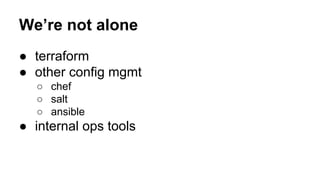
We’re not alone
● terraform
● other config mgmt
○ chef
○ salt
○ ansible
● internal ops tools
Stage 1
Shelling out to the CLI
commands :keystone => "keystone"
def self.auth_keystone(*args)
authenv = {:OS_SERVICE_TOKEN => admin_token}
withenv authenv do
remove_warnings(keystone('--os-endpoint', admin_endpoint, args))
end
end
results = auth_keystone('tenant-create', '--name', resource[:name],
'--enabled', resource[:
enabled])
Shelling out to the CLI
# puppet apply keystone.pp --debug
Debug: Prefetching keystone resources for keystone_tenant
Debug: Executing '/usr/local/bin/keystone --os-endpoint http://127.
0.0.1:35357/v2.0/ tenant-list'
Debug: Executing '/usr/local/bin/keystone --os-endpoint http://127.
0.0.1:35357/v2.0/ tenant-create --name services --enabled True --
description The services tenant'
Notice: /Stage[main]/Main/Keystone_tenant[services]/ensure: created
#
What was good
● Idiomatic
● Debuggable
What was bad
● Instability
● Duplicated code
Why we switched
Instability
Stage 2
curl?
curl -H 'Content-Type: application/json' -X POST -d '{
"auth": {
"tenantName": "admin",
"passwordCredentials": {
"username": "admin",
"password": "passw0rd"
}
}
}' http://127.0.0.1:35357/v2.0/tokens
curl - Update a project (v2)
curl -H 'X-Auth-Token: 8bc163' -H 'Content-Type: application/json' 
-X POST -d '{
"tenant": {
"description": "new description",
"enabled": true
}
}' http://localhost:35357/v2.0/tenants/28551b
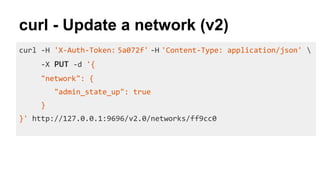
curl - Update a network (v2)
curl -H 'X-Auth-Token: 5a072f' -H 'Content-Type: application/json' 
-X PUT -d '{
"network": {
"admin_state_up": true
}
}' http://127.0.0.1:9696/v2.0/networks/ff9cc0
curl - Update an image (v1)
curl -H 'X-Auth-Token: c23ea2d' 
-H 'x-image-meta-disk_format: vhd' 
-X PUT http://localhost:9292/v1/images/7d863c
curl - Update an image (v2)
curl -H 'X-Auth-Token: 7ac5c8' 
-H 'Content-Type:
application/openstack-images-v2.1-json-patch' 
-d '[{
"path": "/disk_format", "value": "vhd", "op": "replace"
}]' 
-X PATCH http://127.0.0.1:9292/v2/images/40de3a
curl?
Let’s not reinvent a framework
An SDK?
“A set of language bindings that provide a
language-level API for accessing OpenStack in
a manner consistent with language standards.”
https://wiki.openstack.org/wiki/SDKs
An SDK?
“Currently, OpenStack's user stories for both
command-line and application developer
consumers of OpenStack based clouds is
confusing, fractured, and inconsistent.”
https://wiki.openstack.org/wiki/SDK-Development/PythonOpenStackSDK
fog?
● too big, too general-purpose
aviator
session = ::Aviator::Session.new(:config => configuration)
session.authenticate
response = session.request(:identity,
:create_tenant, options) do |params|
params.name = resource[:name]
params.enabled = resource[:enabled]
params.description = resource[:description]
end
What was good
● OpenStack-focused
● responsive maintainer
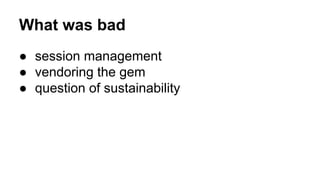
What was bad
● session management
● vendoring the gem
● question of sustainability
Why we switched
keystone v3
Stage 3
OpenStackClient (...another CLI)
# puppet apply keystone.pp --debug
Debug: Executing '/usr/local/bin/openstack project list --quiet
--format csv --long --os-token sosp-kyl --os-url http://127.
0.0.1:35357/v2.0/'
Debug: Executing '/usr/local/bin/openstack project create --
format shell services --enable --description The services tenant
--os-url http://127.0.0.1:35357/v2.0/'
Notice: /Stage[main]/Main/Keystone_tenant[services]/ensure:
created
#
What was good
● keystone v3 support
● distro packages
● well-supported
● consistency across modules
What was bad
● laggy support from distros
● stability is ?
Status
Incomplete
Colleen Murphy
cmurphy@hp.com
freenode: crinkle - #puppet-openstack
twitter: @pdx_krinkle
Questions or comments?

Vancouver presentation

  • 1.
  • 2.
    The problem We needto manage OpenStack resources with puppet
  • 3.
    Lightning intro topuppet ● resource - something being managed on a system ● type - the interface of the resource ● provider - the backend implementation of the resource
  • 4.
    Example: file file {'/root/example': ensure => present, content => 'A file resource managed by puppet', mode => '0644', }
  • 5.
    Example: mysql_database mysql_database {'keystone': ensure => present, charset => 'utf8', collate => 'utf8_general_ci', }
  • 6.
    Example: mysql_database # puppetapply mysql.pp --debug Debug: Prefetching mysql resources for mysql_database Debug: Executing '/usr/bin/mysql --defaults-extra-file=/root/.my.cnf -NBe show databases' Debug: Executing '/usr/bin/mysql --defaults-extra-file=/root/.my.cnf -NBe create database if not exists `keystone` character set `utf8` collate `utf8_general_ci`' Notice: /Stage[main]/Main/Mysql_database[keystone]/ensure: created #
  • 7.
    Example: keystone_tenant keystone_tenant {'services': ensure => present, description => 'The services tenant', enabled => true, }
  • 8.
  • 9.
    We’re not alone ●terraform ● other config mgmt ○ chef ○ salt ○ ansible ● internal ops tools
  • 10.
  • 11.
    Shelling out tothe CLI commands :keystone => "keystone" def self.auth_keystone(*args) authenv = {:OS_SERVICE_TOKEN => admin_token} withenv authenv do remove_warnings(keystone('--os-endpoint', admin_endpoint, args)) end end results = auth_keystone('tenant-create', '--name', resource[:name], '--enabled', resource[: enabled])
  • 12.
    Shelling out tothe CLI # puppet apply keystone.pp --debug Debug: Prefetching keystone resources for keystone_tenant Debug: Executing '/usr/local/bin/keystone --os-endpoint http://127. 0.0.1:35357/v2.0/ tenant-list' Debug: Executing '/usr/local/bin/keystone --os-endpoint http://127. 0.0.1:35357/v2.0/ tenant-create --name services --enabled True -- description The services tenant' Notice: /Stage[main]/Main/Keystone_tenant[services]/ensure: created #
  • 13.
    What was good ●Idiomatic ● Debuggable
  • 14.
    What was bad ●Instability ● Duplicated code
  • 15.
  • 16.
  • 17.
    curl? curl -H 'Content-Type:application/json' -X POST -d '{ "auth": { "tenantName": "admin", "passwordCredentials": { "username": "admin", "password": "passw0rd" } } }' http://127.0.0.1:35357/v2.0/tokens
  • 18.
    curl - Updatea project (v2) curl -H 'X-Auth-Token: 8bc163' -H 'Content-Type: application/json' -X POST -d '{ "tenant": { "description": "new description", "enabled": true } }' http://localhost:35357/v2.0/tenants/28551b
  • 19.
    curl - Updatea network (v2) curl -H 'X-Auth-Token: 5a072f' -H 'Content-Type: application/json' -X PUT -d '{ "network": { "admin_state_up": true } }' http://127.0.0.1:9696/v2.0/networks/ff9cc0
  • 20.
    curl - Updatean image (v1) curl -H 'X-Auth-Token: c23ea2d' -H 'x-image-meta-disk_format: vhd' -X PUT http://localhost:9292/v1/images/7d863c
  • 21.
    curl - Updatean image (v2) curl -H 'X-Auth-Token: 7ac5c8' -H 'Content-Type: application/openstack-images-v2.1-json-patch' -d '[{ "path": "/disk_format", "value": "vhd", "op": "replace" }]' -X PATCH http://127.0.0.1:9292/v2/images/40de3a
  • 22.
  • 23.
    An SDK? “A setof language bindings that provide a language-level API for accessing OpenStack in a manner consistent with language standards.” https://wiki.openstack.org/wiki/SDKs
  • 26.
    An SDK? “Currently, OpenStack'suser stories for both command-line and application developer consumers of OpenStack based clouds is confusing, fractured, and inconsistent.” https://wiki.openstack.org/wiki/SDK-Development/PythonOpenStackSDK
  • 27.
    fog? ● too big,too general-purpose
  • 28.
    aviator session = ::Aviator::Session.new(:config=> configuration) session.authenticate response = session.request(:identity, :create_tenant, options) do |params| params.name = resource[:name] params.enabled = resource[:enabled] params.description = resource[:description] end
  • 29.
    What was good ●OpenStack-focused ● responsive maintainer
  • 30.
    What was bad ●session management ● vendoring the gem ● question of sustainability
  • 31.
  • 32.
  • 33.
    OpenStackClient (...another CLI) #puppet apply keystone.pp --debug Debug: Executing '/usr/local/bin/openstack project list --quiet --format csv --long --os-token sosp-kyl --os-url http://127. 0.0.1:35357/v2.0/' Debug: Executing '/usr/local/bin/openstack project create -- format shell services --enable --description The services tenant --os-url http://127.0.0.1:35357/v2.0/' Notice: /Stage[main]/Main/Keystone_tenant[services]/ensure: created #
  • 34.
    What was good ●keystone v3 support ● distro packages ● well-supported ● consistency across modules
  • 35.
    What was bad ●laggy support from distros ● stability is ?
  • 36.
  • 37.
    Colleen Murphy cmurphy@hp.com freenode: crinkle- #puppet-openstack twitter: @pdx_krinkle Questions or comments?