UNIVERSIDAD TECNICA DE MACHALA
ACADEMIC UNIT OF CHEMICAL
SCIENCES AND HEALTH
MEDICINE SCHOOL
ENGLISH
VALVULOPATHIES
STUDENTS
William Cruz
Kevin Herrera
TEACHER:
Mgs. Barreto Huilcapi Lina Maribel
CLASS:
EIGHTH SEMESTER ‘’A’’
Machala, El Oro
2018
Valvulopathies
Definition
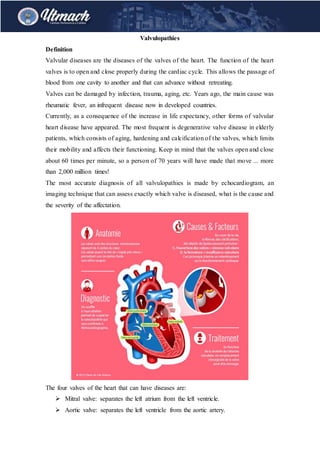
Valvular diseases are the diseases of the valves of the heart. The function of the heart
valves is to open and close properly during the cardiac cycle. This allows the passage of
blood from one cavity to another and that can advance without retreating.
Valves can be damaged by infection, trauma, aging, etc. Years ago, the main cause was
rheumatic fever, an infrequent disease now in developed countries.
Currently, as a consequence of the increase in life expectancy, other forms of valvular
heart disease have appeared. The most frequent is degenerative valve disease in elderly
patients, which consists of aging, hardening and calcification of the valves, which limits
their mobility and affects their functioning. Keep in mind that the valves open and close
about 60 times per minute, so a person of 70 years will have made that move ... more
than 2,000 million times!
The most accurate diagnosis of all valvulopathies is made by echocardiogram, an
imaging technique that can assess exactly which valve is diseased, what is the cause and
the severity of the affectation.
The four valves of the heart that can have diseases are:
 Mitral valve: separates the left atrium from the left ventricle.
 Aortic valve: separates the left ventricle from the aortic artery.
 Pulmonary valve: separates the right ventricle from the pulmonary artery.
 Tricuspid valve: separates the right atrium from the right ventricle.
Etiology
The heart valves regulate the flow of blood between the cavities of the heart and its exit
to the main arteries. These structures play a fundamental role in the functioning of the
heart. Valvulopathies are diseases that affect these structures, preventing their proper
opening (valvular stenosis) or closure (valvular insufficiency). The four valves of the
heart can be affected, although the most important valve diseases are those that affect
the aortic valve or the mitral valve.
Signs, diagnosis and treatment
Aortic valve disease or aortic stenosis
It affects the aortic valve and causes its obstruction. This hinders the outflow of blood
from the left ventricle to the aorta.
· Causes: The most frequent causes are rheumatic or degenerative affectation. There are
also congenital malformations of the aortic valve that cause stenosis.
· Symptoms: The three main symptoms that appear when the aortic stenosis is severe
are dyspnea
(feeling of shortness of breath), chest pain and syncope (loss of consciousness). These
symptoms are more pronounced when some effort is made.
· Treatment: Valvular replacement by a metallic or biological prosthesis. There is also
the possibility of implanting self-expanding prostheses, fixed in a special stent. This
technique is reserved, for the moment, for cases in which cardiac surgery is not
recommended. The implant is performed through the groin, without the need for
surgery. In young patients with non-calcified congenital aortic stenosis, valvuloplasty
can be used, which consists in dilating the stenosis by inflating a balloon inside the
valve.
Aortic insufficiency
It affects the aortic valve and prevents its proper closure during diastole. This causes the
return of blood to the heart, causing an overload of volume.
· Causes: The most frequent causes are the rheumatic affectation, the degenerative one
or the complication of infections at this level (endocarditis).
· Symptoms: In general, the symptomatology is not as important as in the stenosis and
may go unnoticed. Dyspnea usually appears, although chest pain may also occur.
· Treatment: Valvular replacement is performed by a metal or biological prosthesis.
Mitral stenosis
This valvular disease affects the mitral valve and causes an obstruction in the blood
flow between the left atrium and the left ventricle.
· Causes: The most frequent causes are rheumatic and degenerative affectation.
· Symptoms: Usually cause dyspnea. It is also frequent the appearance of arrhythmias
such as atrial fibrillation.
· Treatment: Usually the valve is replaced by a metal or biological prosthesis. In some
cases, if the valve is not calcified and there is no associated mitral regurgitation, a mitral
valve can be performed. This operation consists of dilating the valve through a
catheterization, inflating a balloon inside the narrow valve to dilate it.
Mitral insufficiency
It is the affectation of the mitral valve that prevents its correct closure. It causes a return
of blood in systole from the left ventricle to the left atrium. Causes a volume overload in
the left cavities.
· Causes: The most frequent causes are rheumatic, degenerative affectation, mitral
valve prolapse or mitral annulus dilation.
· Symptoms: Usually cause dyspnea. It is also frequent the appearance of arrhythmias
such as atrial fibrillation.
· Treatment: It is treated by valvular replacement by metal or biological prosthesis, or
by a valvular repair. In this case, the mitral valve is maintained and the defect that
causes the insufficiency is repaired.
Prevention
Cardiac valve dysfunctions can not always be avoided. However, there are general
measures that can be prevented. For example, it is important to treat the diseases that
cause heart valve dysfunction early. A balanced diet and sufficient and adequate
physical activity are essential for a healthy heart.
If you already have heart valve dysfunction (treated or not), other measures are also
needed, such as taking antibiotics to prevent bacterial endocarditis (inflammation of the
endocardium) because people with heart valve dysfunction have a greater risk of having
the endocardium is inflamed throughout its life, with the consequent complications that
derive from it.
Bibliography
 Clinical practice guidelines of the Spanish Society of Cardiology.
Valvulopathies. Rev Esp Cardiol 2000; 53: 1209-1278

Valvulopathies n

  • 1.
    UNIVERSIDAD TECNICA DEMACHALA ACADEMIC UNIT OF CHEMICAL SCIENCES AND HEALTH MEDICINE SCHOOL ENGLISH VALVULOPATHIES STUDENTS William Cruz Kevin Herrera TEACHER: Mgs. Barreto Huilcapi Lina Maribel CLASS: EIGHTH SEMESTER ‘’A’’ Machala, El Oro 2018
  • 2.
    Valvulopathies Definition Valvular diseases arethe diseases of the valves of the heart. The function of the heart valves is to open and close properly during the cardiac cycle. This allows the passage of blood from one cavity to another and that can advance without retreating. Valves can be damaged by infection, trauma, aging, etc. Years ago, the main cause was rheumatic fever, an infrequent disease now in developed countries. Currently, as a consequence of the increase in life expectancy, other forms of valvular heart disease have appeared. The most frequent is degenerative valve disease in elderly patients, which consists of aging, hardening and calcification of the valves, which limits their mobility and affects their functioning. Keep in mind that the valves open and close about 60 times per minute, so a person of 70 years will have made that move ... more than 2,000 million times! The most accurate diagnosis of all valvulopathies is made by echocardiogram, an imaging technique that can assess exactly which valve is diseased, what is the cause and the severity of the affectation. The four valves of the heart that can have diseases are:  Mitral valve: separates the left atrium from the left ventricle.  Aortic valve: separates the left ventricle from the aortic artery.
  • 3.
     Pulmonary valve:separates the right ventricle from the pulmonary artery.  Tricuspid valve: separates the right atrium from the right ventricle. Etiology The heart valves regulate the flow of blood between the cavities of the heart and its exit to the main arteries. These structures play a fundamental role in the functioning of the heart. Valvulopathies are diseases that affect these structures, preventing their proper opening (valvular stenosis) or closure (valvular insufficiency). The four valves of the heart can be affected, although the most important valve diseases are those that affect the aortic valve or the mitral valve. Signs, diagnosis and treatment Aortic valve disease or aortic stenosis It affects the aortic valve and causes its obstruction. This hinders the outflow of blood from the left ventricle to the aorta. · Causes: The most frequent causes are rheumatic or degenerative affectation. There are also congenital malformations of the aortic valve that cause stenosis. · Symptoms: The three main symptoms that appear when the aortic stenosis is severe are dyspnea (feeling of shortness of breath), chest pain and syncope (loss of consciousness). These symptoms are more pronounced when some effort is made. · Treatment: Valvular replacement by a metallic or biological prosthesis. There is also the possibility of implanting self-expanding prostheses, fixed in a special stent. This technique is reserved, for the moment, for cases in which cardiac surgery is not recommended. The implant is performed through the groin, without the need for surgery. In young patients with non-calcified congenital aortic stenosis, valvuloplasty can be used, which consists in dilating the stenosis by inflating a balloon inside the valve. Aortic insufficiency It affects the aortic valve and prevents its proper closure during diastole. This causes the return of blood to the heart, causing an overload of volume. · Causes: The most frequent causes are the rheumatic affectation, the degenerative one or the complication of infections at this level (endocarditis).
  • 4.
    · Symptoms: Ingeneral, the symptomatology is not as important as in the stenosis and may go unnoticed. Dyspnea usually appears, although chest pain may also occur. · Treatment: Valvular replacement is performed by a metal or biological prosthesis. Mitral stenosis This valvular disease affects the mitral valve and causes an obstruction in the blood flow between the left atrium and the left ventricle. · Causes: The most frequent causes are rheumatic and degenerative affectation. · Symptoms: Usually cause dyspnea. It is also frequent the appearance of arrhythmias such as atrial fibrillation. · Treatment: Usually the valve is replaced by a metal or biological prosthesis. In some cases, if the valve is not calcified and there is no associated mitral regurgitation, a mitral valve can be performed. This operation consists of dilating the valve through a catheterization, inflating a balloon inside the narrow valve to dilate it. Mitral insufficiency It is the affectation of the mitral valve that prevents its correct closure. It causes a return of blood in systole from the left ventricle to the left atrium. Causes a volume overload in the left cavities. · Causes: The most frequent causes are rheumatic, degenerative affectation, mitral valve prolapse or mitral annulus dilation. · Symptoms: Usually cause dyspnea. It is also frequent the appearance of arrhythmias such as atrial fibrillation. · Treatment: It is treated by valvular replacement by metal or biological prosthesis, or by a valvular repair. In this case, the mitral valve is maintained and the defect that causes the insufficiency is repaired. Prevention Cardiac valve dysfunctions can not always be avoided. However, there are general measures that can be prevented. For example, it is important to treat the diseases that cause heart valve dysfunction early. A balanced diet and sufficient and adequate physical activity are essential for a healthy heart. If you already have heart valve dysfunction (treated or not), other measures are also needed, such as taking antibiotics to prevent bacterial endocarditis (inflammation of the endocardium) because people with heart valve dysfunction have a greater risk of having
  • 5.
    the endocardium isinflamed throughout its life, with the consequent complications that derive from it. Bibliography  Clinical practice guidelines of the Spanish Society of Cardiology. Valvulopathies. Rev Esp Cardiol 2000; 53: 1209-1278