Cardiac Valvulopathy
Maria Bouzaid
What is?
Cardiac Valvulopathy is a condition in which
the heart valve becomes inflamed and stiff.
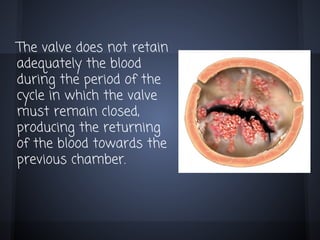
The valve does not retain
adequately the blood
during the period of the
cycle in which the valve
must remain closed,
producing the returning
of the blood towards the
previous chamber.
The valves can get damaged for infections, for
traumatism, for aging, etc. Years ago the
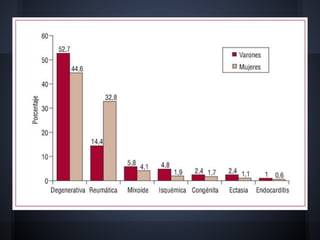
fundamental reason was the rheumatic fever,
an infrequent disease now in the countries
developed
The most frequent is the degenerative
valvulopatía in elderly patients, that there
consists of the aging and hardening of the
valves, which limits his mobility and concerns
his functioning. It is necessary to bear in
mind that the valves are opened and
approximately 60 times are closed per
minute, so a 70-year-old person will have
realized this movement more than 2.000
million times
The gravity of the valvulopathy is classified in
3 groups:
+Light: minimal affectation that never needs
treatment and only a follow-up.
+Moderated: that needs a narrower follow-up
and in some occasions it needs treatment.
+Severe: that will need surgical treatment
always and when there are fulfilled a series
of associate requirements.
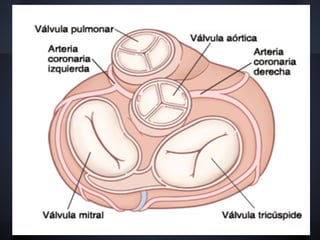
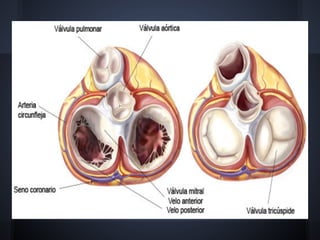
The four heart valves that may have diseases
are:
Mitral valve: separates the left atrium from
the left ventricle
Aortic valve separates the left ventricle from
the aorta
Pulmonary valve: separates the right ventricle
from the pulmonary artery
Tricuspid valve: separates the right atrium
from the right ventricle
Symptoms of valve disease depend mainly on:
- Increased pressure in the atria
- Commitment of cardiac output
- Imbalance between supply and myocardial
O2 consumption
Complications
If the heart is damaged, it is more likely that
is infected. Endocarditis is an infection of the
heart lining. It can affect the heart valves and
can be very serious.
If someone has a heart valve disease, he may
need to take antibiotics before surgery to
reduce the risk of infection.
Surgery
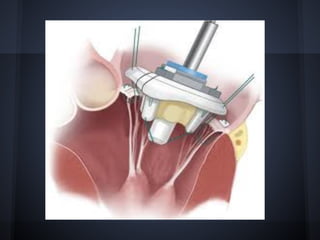
The defective heart valve can be replaced with
an artificial valve (valve replacement) or can
be repaired if possible (valve repair). Both
procedures are performed under general
anesthesia. This means you will be asleep
during the operation.
defective
Cardiac valvulopathy - Maria Bouzaid

Cardiac valvulopathy - Maria Bouzaid

  • 1.
  • 2.
    What is? Cardiac Valvulopathyis a condition in which the heart valve becomes inflamed and stiff.
  • 3.
    The valve doesnot retain adequately the blood during the period of the cycle in which the valve must remain closed, producing the returning of the blood towards the previous chamber.
  • 6.
    The valves canget damaged for infections, for traumatism, for aging, etc. Years ago the fundamental reason was the rheumatic fever, an infrequent disease now in the countries developed
  • 7.
    The most frequentis the degenerative valvulopatía in elderly patients, that there consists of the aging and hardening of the valves, which limits his mobility and concerns his functioning. It is necessary to bear in mind that the valves are opened and approximately 60 times are closed per minute, so a 70-year-old person will have realized this movement more than 2.000 million times
  • 8.
    The gravity ofthe valvulopathy is classified in 3 groups: +Light: minimal affectation that never needs treatment and only a follow-up. +Moderated: that needs a narrower follow-up and in some occasions it needs treatment. +Severe: that will need surgical treatment always and when there are fulfilled a series of associate requirements.
  • 11.
    The four heartvalves that may have diseases are: Mitral valve: separates the left atrium from the left ventricle Aortic valve separates the left ventricle from the aorta Pulmonary valve: separates the right ventricle from the pulmonary artery Tricuspid valve: separates the right atrium from the right ventricle
  • 14.
    Symptoms of valvedisease depend mainly on: - Increased pressure in the atria - Commitment of cardiac output - Imbalance between supply and myocardial O2 consumption
  • 17.
    Complications If the heartis damaged, it is more likely that is infected. Endocarditis is an infection of the heart lining. It can affect the heart valves and can be very serious. If someone has a heart valve disease, he may need to take antibiotics before surgery to reduce the risk of infection.
  • 18.
    Surgery The defective heartvalve can be replaced with an artificial valve (valve replacement) or can be repaired if possible (valve repair). Both procedures are performed under general anesthesia. This means you will be asleep during the operation. defective