How to value a business
Ivor Middleton
Talk for Heart Of Business
Friday 18th March 2016
Budget & Financial PlanningRisk Assessment Corporate Planning Working CapitalMargin Improvement
Valuation – one part of a much
larger process
Valuation is complex enough on its own.
Be aware that there is a lot more than just the
value to consider when buying and selling a
business.
There is a lot of jargon. I’ve tried to avoid it, but it
is inevitable and will help understanding when you
are involved.
Group Exercise - 5 minutes
What factors would you take into account when
buying a business?
Group Exercise - Some Answers
What factors would you take into account when buying a business?
There are a huge number of possible factors, many hidden or unclear. Experience and the ability to smell out
trouble is vital. You need a good nose, or to employ someone with one.
Reason for buying? Reason for selling?
What is being bought? Shares? Assets? Customer base?
Is there a USP? Niche? Intellectual property? (What makes them successful?)
Related to the above: does it have a protected position and if so, how long for?
Profitability? Growth? Synergies?
Current good growth and profits are obviously going to make the price higher. However, there may be fewer
buyers. Buyers tend to want a bargain. If the last filed accounts showed a bad year they might sniff one.
Synergies or untapped potential might make the difference and haul the price up again, or increase the
number of buyers for a business priced at a premium .
Group Exercise - Some Answers 2
What factors would you take into account when buying a business?
Minority shareholders refusing to sell. Need ‘drag along, tag along’ agreement.
Timing – made a profit in year just past, or a loss? Sales growing? Economy? Zeitgeist?
Buying shares? Where are the bodies buried??? Asbestos. TUPE. Legal disputes. Contract clauses about to
be triggered. Key client about to be lost. Key supplier just bought by a competitor. This is why due diligence
is important.
Am I in competition with other buyers? (always better to be the only buyer)
Is it a closed auction? If so, what is the best bidding strategy?
Group Exercise - Some Answers 3
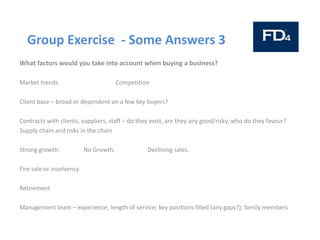
What factors would you take into account when buying a business?
Market trends Competition
Client base – broad or dependent on a few key buyers?
Contracts with clients, suppliers, staff – do they exist, are they any good/risky, who do they favour?
Supply chain and risks in the chain
Strong growth. No Growth. Declining sales.
Fire sale or insolvency
Retirement
Management team – experience; length of service; key positions filled (any gaps?); family members
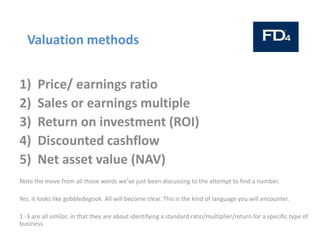
Valuation methods
1) Price/ earnings ratio
2) Sales or earnings multiple
3) Return on investment (ROI)
4) Discounted cashflow
5) Net asset value (NAV)
Note the move from all those words we’ve just been discussing to the attempt to find a number.
Yes, it looks like gobbledegook. All will become clear. This is the kind of language you will encounter.
1 -3 are all similar, in that they are about identifying a standard ratio/multiplier/return for a specific type of
business
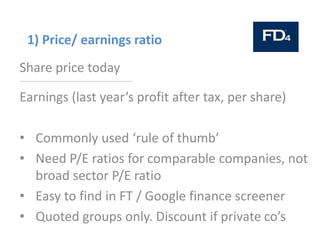
1) Price/ earnings ratio
Share price today
------------------------------------------------------------
Earnings (last year’s profit after tax, per share)
• Commonly used ‘rule of thumb’
• Need P/E ratios for comparable companies, not
broad sector P/E ratio
• Easy to find in FT / Google finance screener
• Quoted groups only. Discount if private co’s
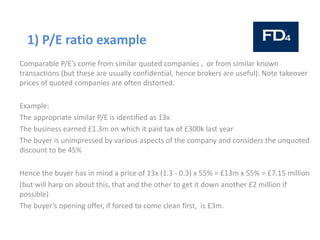
1) P/E ratio example
Comparable P/E’s come from similar quoted companies , or from similar known
transactions (but these are usually confidential, hence brokers are useful). Note takeover
prices of quoted companies are often distorted.
Example:
The appropriate similar P/E is identified as 13x
The business earned £1.3m on which it paid tax of £300k last year
The buyer is unimpressed by various aspects of the company and considers the unquoted
discount to be 45%
Hence the buyer has in mind a price of 13x (1.3 - 0.3) x 55% = £13m x 55% = £7.15 million
(but will harp on about this, that and the other to get it down another £2 million if
possible)
The buyer’s opening offer, if forced to come clean first, is £3m.
2) Sales or earnings multiple
• Earnings before interest, tax, depreciation and
amortisation (EBITDA)
• EBITDA a proxy for cash earnings
• Multiply by sector or comparable company
multiple
• Discount for unquoted company risks
*** Typically the preferred method ***
2) Sales / earnings multiple notes
Value is heavily discounted for unquoted status – shares are not liquid (easily traded), not
a diversified group. Expect 30% to 40%, even over 50% on sector or comparable quoted
company. A premium may be paid for control, for a great brand, for rarity, or for a key
strategic addition. Sometimes egos overpay while empire building.
Eg. A sector may have multiples of 1.3x forecast turnover and/or 7.0x forecast EBITDA,
so a business with £5m turnover and £1m EBITDA would be valued at:
£6.5m on a turnover basis; or
£7.0m on an EBITDA basis,
but that would then be discounted down to £4.5m or less as the expected sale price.
As an example of the difficulties, when calculating the sector average multiples, the
market capitalisation of firms is increased for debt and reduced for cash, to get
comparable values. Anomalies might need to be excluded.
A sector average may not be a useful comparable. Better to find similar firms within the
sector and calculate the average multiple for those.
3) Return on investment (ROI)
Acquisitive companies often seek a specific return
on the second full year after trading e.g. 20%
Adjusted profit before tax in Year 2
----------------------------------------------- >= 20%
Total investment
(Price plus Year1, 2 investment less Year 1,2 cash)
20% sets the max price they will pay. A canny seller might be able to pin down a
reasonable estimate of what this number might be.
4) Discounted cashflow (DCF)
• Purchase cost Year 0
• plus Cash generated by operations
• plus Income from surplus assets sold
• less Capital investment
• less Deferred consideration / earn out
All discounted for risk and time using a weighted
average cost of capital (WACC), gives
NPV – Net Present Value. Good if positive.
4) DCF notes
The discounted cashflow captures the idea that money today is worth more than money tomorrow, or next
year. Would you rather £100 today or £110 from me in a year? Risky - a lot can happen in a year.
The answer is expressed as the Net Present Value (NPV). This is the value over and above the desired return.
Any price giving an NPV of zero or more should be worth paying.
Typically 8 – 10 year time period. Sensitivity analysis important – consider a range of possible outcomes.
Include assets sellable at termination.
It can be hard to identify the appropriate discount rate (WACC) – sensitivity analysis is important again
It can be manipulated to say what you want to hear (as can most methods).
The maths looks complicated but is quite easy.
The numbers to input look simple but are quite hard to pin down.
WACC – think of it like the rate of interest you expect on your savings. If you’ve invested in something, you
expect a return. If you have partly borrowed to invest, the return is a blended rate of the return on the
shares and the return on the debt.
5) Net asset value (NAV)
• Used for companies in trouble – loss makers,
insolvencies, break-even
• Identify the lowest net asset value once losses
eliminated and costs borne
• Discount for risk
Tax
• Tax losses – an asset to buyer only if there are
profits to offset them. Profits no longer
transferable within group, so purchased
company must make a profit from trading to
use the losses (being broken up is not trading).
• Capital gains – tend to be tax beneficial for
sellers, so a buyer who is prepared to buy
shares, and their attendant risks, rather than
assets, has an advantage over other buyers.
Stories
Value gone – seller with unrealistic expectations throws it all away failing to get a deal
Value found - failure to recognise true worth (lucky he had an advisor!)
Empire builders always overpay
The dilapidations contract disaster – do your due diligence
No income, yet sold for £100m?
Earn out deal, but the buyer went bust!
(Due diligence cuts both ways)
Timing matters
PSYCHOLOGY IS EVERYTHING – personalities can kill or close the deal
Expectations management
• Buying or selling a business is complex
• Process management is critical, often from
years in advance
• Deals take weeks to years to complete, perhaps
10 months +/- many months
• Seller needs a trusted confidante to help take
the emotion out of it and retain perspective
“The business is only worth what
someone is prepared to pay”
which puts the buyer in a strong position
Process
Valuation is a small part of the larger process of
buying and selling a business. For more useful stuff on
process see:
http://fd4.co.uk/preparing-your-business-for-sale-
part-1/
(and part 2)
A solid foundation….
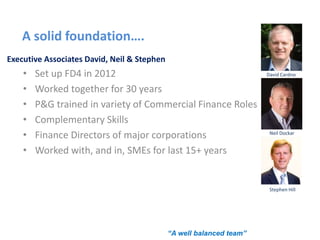
Executive Associates David, Neil & Stephen
• Set up FD4 in 2012
• Worked together for 30 years
• P&G trained in variety of Commercial Finance Roles
• Complementary Skills
• Finance Directors of major corporations
• Worked with, and in, SMEs for last 15+ years
David Cardno
Neil Dockar
“A well balanced team”
Stephen Hill
An Emerging and Growing Need
For the Client an opportunity for a more “hands on” role than a Non Exec
• Proactively lead and maximise the value from the Client’s
bookkeeper / controller and professional advisers
• Experience of larger organisations but able to apply those
business principles to the SME environment
• Have actually led Commercial Finance teams, not just advised
• Higher level skills and experiences needed for one-off
problems / opportunities; bank relationships; improved
performance & exit planning.
• Trusted, knowledgeable confidant to SME owners
• Access to a wide and varied professional network
And available by the hour on an as needed basis…
Diverse commercial experience
Passionate about adding value to your business
Our experience covers a range of sectors and business experiences :-
David Cardno - founder of FD4, sectors include consumer, b-t-b services and logistics. Business
experience covers M&A; Joint Ventures and highly leveraged situations.
Neil Dockar - founder of FD4 , ex FD in P&G and Fyffes. Sectors include consumer, franchising, logistics,
e-commerce, care homes, financial services and property. Led joint venture & M&A activity.
Paul Foster – bio pharmaceuticals and pre-revenue start-up expertise. Fund raising and managing
investors / venture capitalists. Intellectual property licensing.
Stephen Hill – ex FD in P&G and Volt, Sectors include consumer and B-t-B Services recruitment.
Experienced in M&A and running European subsidiaries for US parent.
Brian Kilcullen – football club, shipping, private equity and private investment. Bought and sold
companies, raised finance, carried out business valuations. Reclaimable energy experience.
Robert Sayers – ex FD Farnborough International Airshow. Wide industrial experience most recently in
the aerospace, defence and exhibition sectors and complex Trade Associations.
Colin Spencer – wide variety of FD roles in marketing and advertising sectors. Chairman Public relations
firm. Accredited with various cloud accounting products including Xero and Workflow Maxarent
Ivor Middleton– science and technology, people businesses, manufacturing, complex business
modelling. Helped raise tens of millions of pounds; win large contracts; makes difficult decisions easier.
Passionate about adding value
to your business
Budget & Financial PlanningRisk Assessment Corporate Planning Working CapitalMargin Improvement

Valuing a Business

  • 1.
    How to valuea business Ivor Middleton Talk for Heart Of Business Friday 18th March 2016 Budget & Financial PlanningRisk Assessment Corporate Planning Working CapitalMargin Improvement
  • 2.
    Valuation – onepart of a much larger process Valuation is complex enough on its own. Be aware that there is a lot more than just the value to consider when buying and selling a business. There is a lot of jargon. I’ve tried to avoid it, but it is inevitable and will help understanding when you are involved.
  • 3.
    Group Exercise -5 minutes What factors would you take into account when buying a business?
  • 4.
    Group Exercise -Some Answers What factors would you take into account when buying a business? There are a huge number of possible factors, many hidden or unclear. Experience and the ability to smell out trouble is vital. You need a good nose, or to employ someone with one. Reason for buying? Reason for selling? What is being bought? Shares? Assets? Customer base? Is there a USP? Niche? Intellectual property? (What makes them successful?) Related to the above: does it have a protected position and if so, how long for? Profitability? Growth? Synergies? Current good growth and profits are obviously going to make the price higher. However, there may be fewer buyers. Buyers tend to want a bargain. If the last filed accounts showed a bad year they might sniff one. Synergies or untapped potential might make the difference and haul the price up again, or increase the number of buyers for a business priced at a premium .
  • 5.
    Group Exercise -Some Answers 2 What factors would you take into account when buying a business? Minority shareholders refusing to sell. Need ‘drag along, tag along’ agreement. Timing – made a profit in year just past, or a loss? Sales growing? Economy? Zeitgeist? Buying shares? Where are the bodies buried??? Asbestos. TUPE. Legal disputes. Contract clauses about to be triggered. Key client about to be lost. Key supplier just bought by a competitor. This is why due diligence is important. Am I in competition with other buyers? (always better to be the only buyer) Is it a closed auction? If so, what is the best bidding strategy?
  • 6.
    Group Exercise -Some Answers 3 What factors would you take into account when buying a business? Market trends Competition Client base – broad or dependent on a few key buyers? Contracts with clients, suppliers, staff – do they exist, are they any good/risky, who do they favour? Supply chain and risks in the chain Strong growth. No Growth. Declining sales. Fire sale or insolvency Retirement Management team – experience; length of service; key positions filled (any gaps?); family members
  • 7.
    Valuation methods 1) Price/earnings ratio 2) Sales or earnings multiple 3) Return on investment (ROI) 4) Discounted cashflow 5) Net asset value (NAV) Note the move from all those words we’ve just been discussing to the attempt to find a number. Yes, it looks like gobbledegook. All will become clear. This is the kind of language you will encounter. 1 -3 are all similar, in that they are about identifying a standard ratio/multiplier/return for a specific type of business
  • 8.
    1) Price/ earningsratio Share price today ------------------------------------------------------------ Earnings (last year’s profit after tax, per share) • Commonly used ‘rule of thumb’ • Need P/E ratios for comparable companies, not broad sector P/E ratio • Easy to find in FT / Google finance screener • Quoted groups only. Discount if private co’s
  • 9.
    1) P/E ratioexample Comparable P/E’s come from similar quoted companies , or from similar known transactions (but these are usually confidential, hence brokers are useful). Note takeover prices of quoted companies are often distorted. Example: The appropriate similar P/E is identified as 13x The business earned £1.3m on which it paid tax of £300k last year The buyer is unimpressed by various aspects of the company and considers the unquoted discount to be 45% Hence the buyer has in mind a price of 13x (1.3 - 0.3) x 55% = £13m x 55% = £7.15 million (but will harp on about this, that and the other to get it down another £2 million if possible) The buyer’s opening offer, if forced to come clean first, is £3m.
  • 10.
    2) Sales orearnings multiple • Earnings before interest, tax, depreciation and amortisation (EBITDA) • EBITDA a proxy for cash earnings • Multiply by sector or comparable company multiple • Discount for unquoted company risks *** Typically the preferred method ***
  • 11.
    2) Sales /earnings multiple notes Value is heavily discounted for unquoted status – shares are not liquid (easily traded), not a diversified group. Expect 30% to 40%, even over 50% on sector or comparable quoted company. A premium may be paid for control, for a great brand, for rarity, or for a key strategic addition. Sometimes egos overpay while empire building. Eg. A sector may have multiples of 1.3x forecast turnover and/or 7.0x forecast EBITDA, so a business with £5m turnover and £1m EBITDA would be valued at: £6.5m on a turnover basis; or £7.0m on an EBITDA basis, but that would then be discounted down to £4.5m or less as the expected sale price. As an example of the difficulties, when calculating the sector average multiples, the market capitalisation of firms is increased for debt and reduced for cash, to get comparable values. Anomalies might need to be excluded. A sector average may not be a useful comparable. Better to find similar firms within the sector and calculate the average multiple for those.
  • 12.
    3) Return oninvestment (ROI) Acquisitive companies often seek a specific return on the second full year after trading e.g. 20% Adjusted profit before tax in Year 2 ----------------------------------------------- >= 20% Total investment (Price plus Year1, 2 investment less Year 1,2 cash) 20% sets the max price they will pay. A canny seller might be able to pin down a reasonable estimate of what this number might be.
  • 13.
    4) Discounted cashflow(DCF) • Purchase cost Year 0 • plus Cash generated by operations • plus Income from surplus assets sold • less Capital investment • less Deferred consideration / earn out All discounted for risk and time using a weighted average cost of capital (WACC), gives NPV – Net Present Value. Good if positive.
  • 14.
    4) DCF notes Thediscounted cashflow captures the idea that money today is worth more than money tomorrow, or next year. Would you rather £100 today or £110 from me in a year? Risky - a lot can happen in a year. The answer is expressed as the Net Present Value (NPV). This is the value over and above the desired return. Any price giving an NPV of zero or more should be worth paying. Typically 8 – 10 year time period. Sensitivity analysis important – consider a range of possible outcomes. Include assets sellable at termination. It can be hard to identify the appropriate discount rate (WACC) – sensitivity analysis is important again It can be manipulated to say what you want to hear (as can most methods). The maths looks complicated but is quite easy. The numbers to input look simple but are quite hard to pin down. WACC – think of it like the rate of interest you expect on your savings. If you’ve invested in something, you expect a return. If you have partly borrowed to invest, the return is a blended rate of the return on the shares and the return on the debt.
  • 15.
    5) Net assetvalue (NAV) • Used for companies in trouble – loss makers, insolvencies, break-even • Identify the lowest net asset value once losses eliminated and costs borne • Discount for risk
  • 16.
    Tax • Tax losses– an asset to buyer only if there are profits to offset them. Profits no longer transferable within group, so purchased company must make a profit from trading to use the losses (being broken up is not trading). • Capital gains – tend to be tax beneficial for sellers, so a buyer who is prepared to buy shares, and their attendant risks, rather than assets, has an advantage over other buyers.
  • 17.
    Stories Value gone –seller with unrealistic expectations throws it all away failing to get a deal Value found - failure to recognise true worth (lucky he had an advisor!) Empire builders always overpay The dilapidations contract disaster – do your due diligence No income, yet sold for £100m? Earn out deal, but the buyer went bust! (Due diligence cuts both ways) Timing matters PSYCHOLOGY IS EVERYTHING – personalities can kill or close the deal
  • 18.
    Expectations management • Buyingor selling a business is complex • Process management is critical, often from years in advance • Deals take weeks to years to complete, perhaps 10 months +/- many months • Seller needs a trusted confidante to help take the emotion out of it and retain perspective
  • 19.
    “The business isonly worth what someone is prepared to pay” which puts the buyer in a strong position
  • 20.
    Process Valuation is asmall part of the larger process of buying and selling a business. For more useful stuff on process see: http://fd4.co.uk/preparing-your-business-for-sale- part-1/ (and part 2)
  • 21.
    A solid foundation…. ExecutiveAssociates David, Neil & Stephen • Set up FD4 in 2012 • Worked together for 30 years • P&G trained in variety of Commercial Finance Roles • Complementary Skills • Finance Directors of major corporations • Worked with, and in, SMEs for last 15+ years David Cardno Neil Dockar “A well balanced team” Stephen Hill
  • 22.
    An Emerging andGrowing Need For the Client an opportunity for a more “hands on” role than a Non Exec • Proactively lead and maximise the value from the Client’s bookkeeper / controller and professional advisers • Experience of larger organisations but able to apply those business principles to the SME environment • Have actually led Commercial Finance teams, not just advised • Higher level skills and experiences needed for one-off problems / opportunities; bank relationships; improved performance & exit planning. • Trusted, knowledgeable confidant to SME owners • Access to a wide and varied professional network And available by the hour on an as needed basis…
  • 23.
    Diverse commercial experience Passionateabout adding value to your business Our experience covers a range of sectors and business experiences :- David Cardno - founder of FD4, sectors include consumer, b-t-b services and logistics. Business experience covers M&A; Joint Ventures and highly leveraged situations. Neil Dockar - founder of FD4 , ex FD in P&G and Fyffes. Sectors include consumer, franchising, logistics, e-commerce, care homes, financial services and property. Led joint venture & M&A activity. Paul Foster – bio pharmaceuticals and pre-revenue start-up expertise. Fund raising and managing investors / venture capitalists. Intellectual property licensing. Stephen Hill – ex FD in P&G and Volt, Sectors include consumer and B-t-B Services recruitment. Experienced in M&A and running European subsidiaries for US parent. Brian Kilcullen – football club, shipping, private equity and private investment. Bought and sold companies, raised finance, carried out business valuations. Reclaimable energy experience. Robert Sayers – ex FD Farnborough International Airshow. Wide industrial experience most recently in the aerospace, defence and exhibition sectors and complex Trade Associations. Colin Spencer – wide variety of FD roles in marketing and advertising sectors. Chairman Public relations firm. Accredited with various cloud accounting products including Xero and Workflow Maxarent Ivor Middleton– science and technology, people businesses, manufacturing, complex business modelling. Helped raise tens of millions of pounds; win large contracts; makes difficult decisions easier.
  • 24.
    Passionate about addingvalue to your business Budget & Financial PlanningRisk Assessment Corporate Planning Working CapitalMargin Improvement

Editor's Notes

  • #3 We’ll touch briefly on some of those factors as we go through. Mostly common sense with commercial nous Easy to be wise after the event
  • #9 Comparable P/E’s come from similar quoted companies , Or from similar known transactions (but usually confidential) Takeover prices of quoted companies often distorted. Example: Identify the appropriate similar P/E as 13x The business earned £1.3m on which it paid tax of £300k last year (needs advice !) The buyer is unimpressed by various aspects of the company and considers the unquoted discount to be 45% The buyer has in mind a price of 13x (1.3 - 0.3) x 55% = £13m x 55% = £7.15 million (but will harp on about this, that and the other to get it down another £2 million if possible) The buyer’s opening offer, if forced to come clean first, is £3m.
  • #10 Comparable P/E’s come from similar quoted companies , Or from similar known transactions (but usually confidential) Takeover prices of quoted companies often distorted. Example: Identify the appropriate similar P/E as 13x The business earned £1.3m on which it paid tax of £300k last year (needs advice !) The buyer is unimpressed by various aspects of the company and considers the unquoted discount to be 45% The buyer has in mind a price of 13x (1.3 - 0.3) x 55% = £13m x 55% = £7.15 million (but will harp on about this, that and the other to get it down another £2 million if possible) The buyer’s opening offer, if forced to come clean first, is £3m.
  • #11 Heavily discounted for unquoted status – not liquid (easily traded) shares, not a diversified group; 30% to 40%, even over 50% on sector or comparable quoted company. But: a premium for control, for a great brand, for rarity, or for a key strategic addition. And sometimes egos overpay while empire building. Eg. Sector may have : multiples of 1.3x forecast turnover and 7.0x forecast EBITDA, so a business with £5m turnover and £1m EBITDA would be valued at £6.5m on a turnover basis and £7.0m on an EBITDA basis, but that would then be discounted down to £4.5m or less as the expected sale price. As an example of the difficulties, when calculating the sector average multiples, the market capitalisation of firms is increased for debt and reduced for cash, to get comparable values. Anomalies might need to be excluded. A sector average may not be a useful comparable. Better to find similar firms within the sector and calculate the average multiple for those.
  • #12 Heavily discounted for unquoted status – not liquid (easily traded) shares, not a diversified group; 30% to 40%, even over 50% on sector or comparable quoted company. But: a premium for control, for a great brand, for rarity, or for a key strategic addition. And sometimes egos overpay while empire building. Eg. Sector may have : multiples of 1.3x forecast turnover and 7.0x forecast EBITDA, so a business with £5m turnover and £1m EBITDA would be valued at £6.5m on a turnover basis and £7.0m on an EBITDA basis, but that would then be discounted down to £4.5m or less as the expected sale price. As an example of the difficulties, when calculating the sector average multiples, the market capitalisation of firms is increased for debt and reduced for cash, to get comparable values. Anomalies might need to be excluded. A sector average may not be a useful comparable. Better to find similar firms within the sector and calculate the average multiple for those.
  • #14 It captures the idea that money today is worth more than money tomorrow, or next year. Would you rather from me £100 today or £110 from me in a year? Risky - a lot can happen in a year. The answer is expressed as the Net Present Value (NPV). This is the value over and above the expected return. Any price giving an NPV of zero or more should be worth paying. Typically 8 – 10 year time period Sensitivity analysis important, consider range of possible outcomes. Include assets sellable at termination Can be hard to identify appropriate discount rate (WACC) – sensitivity analysis important again Can be manipulated to say what you want to hear (as can most methods) The maths looks complicated but is quite easy. The numbers look simple but are quite hard to pin down. WACC – think of it like the rate of interest you expect on your savings. If you’ve invested in something, you expect a return. If you have partly borrowed to invest, the return is a blended rate of the return on the shares and the return on the debt.
  • #15 It captures the idea that money today is worth more than money tomorrow, or next year. Would you rather from me £100 today or £110 from me in a year? Risky - a lot can happen in a year. The answer is expressed as the Net Present Value (NPV). This is the value over and above the expected return. Any price giving an NPV of zero or more should be worth paying. Typically 8 – 10 year time period Sensitivity analysis important, consider range of possible outcomes. Include assets sellable at termination Can be hard to identify appropriate discount rate (WACC) – sensitivity analysis important again Can be manipulated to say what you want to hear (as can most methods) The maths looks complicated but is quite easy. The numbers look simple but are quite hard to pin down. WACC – think of it like the rate of interest you expect on your savings. If you’ve invested in something, you expect a return. If you have partly borrowed to invest, the return is a blended rate of the return on the shares and the return on the debt.
  • #16 Other buyers? Desperate seller?
  • #17 Not holding myself out as a tax expert. Written before the 2016 budget. Capital Gains Tax Entrepeneurs relief Rollover relief Enterprise Investment Scheme (EIS) reinvestment relief Incorporation relief Property stamp duty
  • #18 Value gone - unrealistic expectations that throw it all away Value found - failure to recognise true worth Empire builders always overpay The dilapidations disaster No income yet sold for £100m? Earn out deal, but the buyer went bust! (Due diligence cuts both ways) Timing matters PSYCHOLOGY IS EVERYTHING – personalities can kill or close the deal