





It is a given that we will all exit our business
at some point - willingly or not! - and it is
never to soon to start planning that exit.
There is a link at the end of this deck to
the associated blog and webinar
recording
Exit Strategy Planning
How to Value & Sell your Business – Andrew Heslop
Exit Strategy a practical guide to selling your business – Graham Watkins
Built to Sell – John Warrillow
Objectives
To help guide business owners in developing a
suitable exit strategy. We will:
• Consider reasons why we need an exit plan and
when we should make one
• Explore ideas to help identify potential purchasers
• Look at alternative ways of exiting
• Review ways to assess value
• Suggest ways to maximise the sale price
• Outline the planning and management of the sale
process
Why have an exit plan?
• Protection
• Helps drive greater success
• May help you stay on longer
• May help you to release maximum value from your
business
Why leave?
“In the long run we are all dead” John Maynard Keynes
• Retirement
• Desire to hand over control – e.g. to children
• Cashing in
• Time for something different/ boredom
• Change in personal circumstances
• Ill health
• Divorce etc.
• Outside opportunity
• Outside threat
When should you start planning?
Timing is important….
Alternatives for Exit
• Flotation – suitable for less than 1% and costs
£350k plus
• Trade Sale
• Management Buy Out – MBO.
• Management Buy In – MBI
• Hybrid Buy In – BIMBO
• Acquisition by another company
• Asset Sale - Voluntary or Compulsory Liquidation
• Walk away
Trade Sale – who will buy your
business?
• Competitors
• Suppliers
• Customers
• Employees
• Private Equity Firms
• Business Angels (national business Angels
organisation)
Activity: Make some lists!
Competitors
• Who are they?
• Why would they be
interested?
Suppliers/ partners
• Who are they?
• Why would they be
interested?
Customers
• Who are the key
customers?
• Why would they be
interested?
How much?!
• “…the price someone is prepared to pay for it in the
open market”
oIt is not just about the financial performance
• A valuation is an opinion – nothing more
• There are not two certainties in life but three.
‘Death, taxes and the valuation is wrong’
Why would someone pay more
than the financial valuation?
• Synergies
• Sell more
• Charge more
• Spend less
• Immediately revalue at higher multiple
Activity: Look for synergies
• Consider from an outsider’s perspective
• What opportunities to sell more, charge more or
spend less?
• E.g. would a larger business be able to bid for larger
contracts?
• Would they be able to strip out a layer of cost?
• Would it give them access to new markets more cheaply
than they could on their own? Etc.
Methods
• 4 Key methods
• Net Asset Value – not normally used for a thriving business
• Comparables - private sales and/ or p/e ratios of publicly
listed
• Multiples– multiples typically of pre-tax profit)
• Public companies approx. 15 x profits/ earnings
• Private companies approx. 4-5 x profits
• Net present value – discounted cash flow
Also
• Cost of entry
• Sector rules of thumb – e.g. 1 x Gross Recurring Fees
(Accountancies)
Previous webinar
Smart Room - biz-
smart.co.uk/smart-
room/
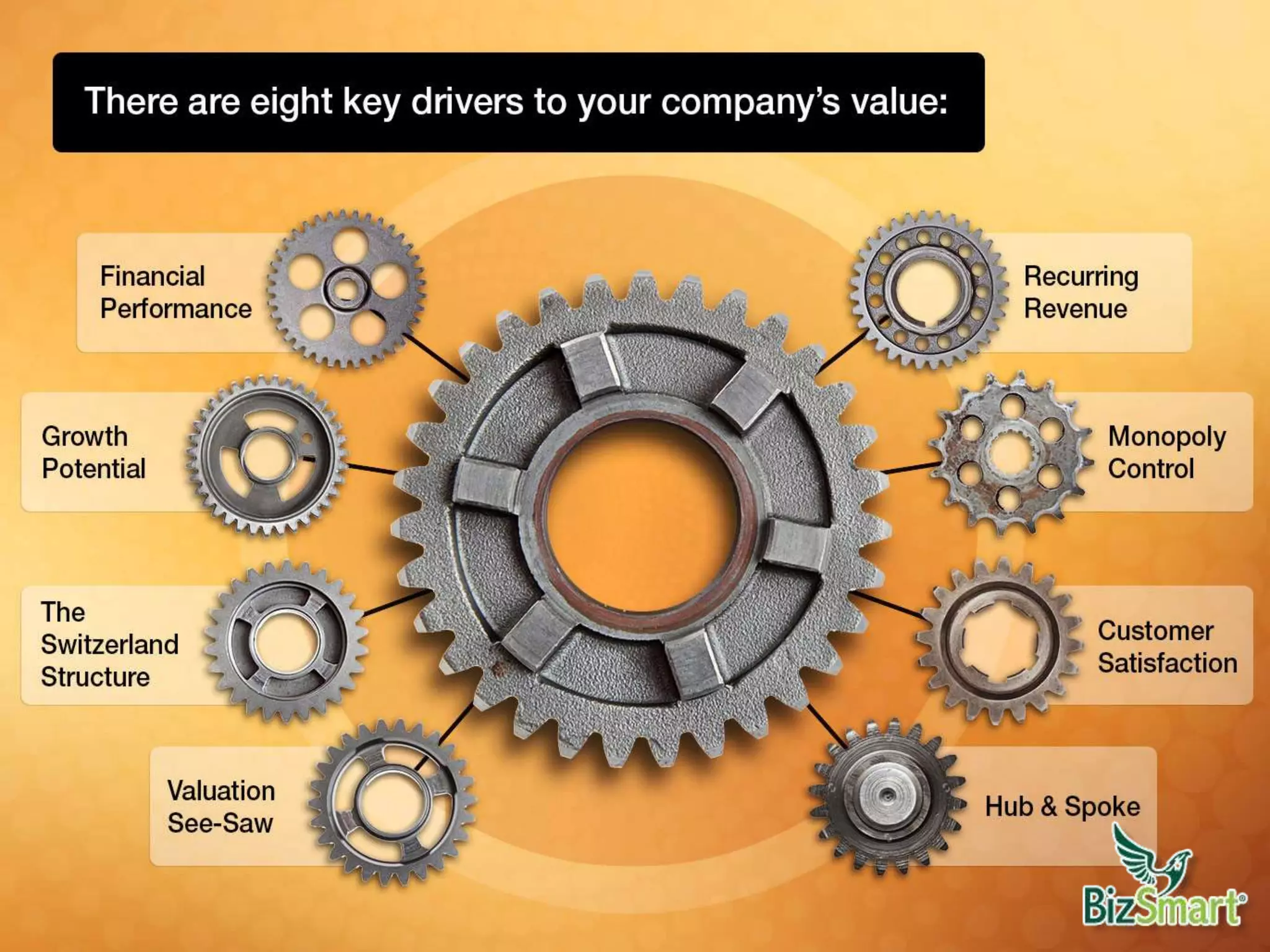
There are eight key drivers to your company’s value:
•Financial Performance
•Growth Potential
•The Switzerland structure
•Valuation See-Saw
•Recurring Revenue
•Monopoly Control
•Customer Satisfaction
•Hub & Spoke
Get Your Value Builder Rating
• Based on over 15,000 businesses
• Email kevin@biz-smart.co.uk
What are your objectives for exit?
• Aspiration for sale price
• Timescale
• Target market of potential buyers
• Practical ideas for maximising the value
• How you will manage the exit process
Activity: Creating your investment
story (2 minute version!)
• How does your business generate happy customers?
• Why are they happy to pay you?
• Why will this continue in the future?
• Why will you achieve this despite the efforts of
competitors?
• What is unique about your approach?
• Do the financials support this?
• Turnover?
• Profits?
• Costs?
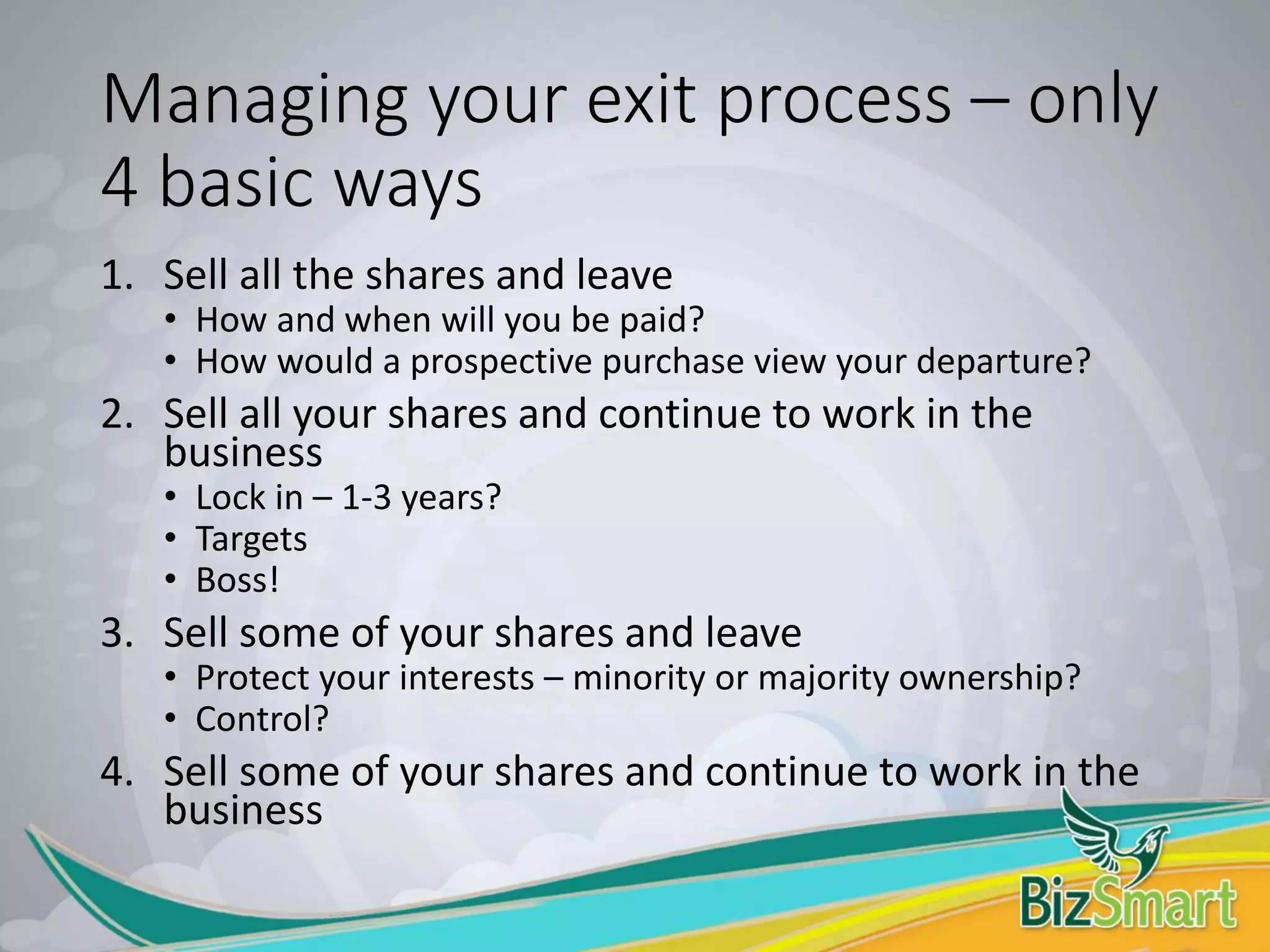
Managing your exit process – only
4 basic ways
1. Sell all the shares and leave
• How and when will you be paid?
• How would a prospective purchase view your departure?
2. Sell all your shares and continue to work in the
business
• Lock in – 1-3 years?
• Targets
• Boss!
3. Sell some of your shares and leave
• Protect your interests – minority or majority ownership?
• Control?
4. Sell some of your shares and continue to work in the
business
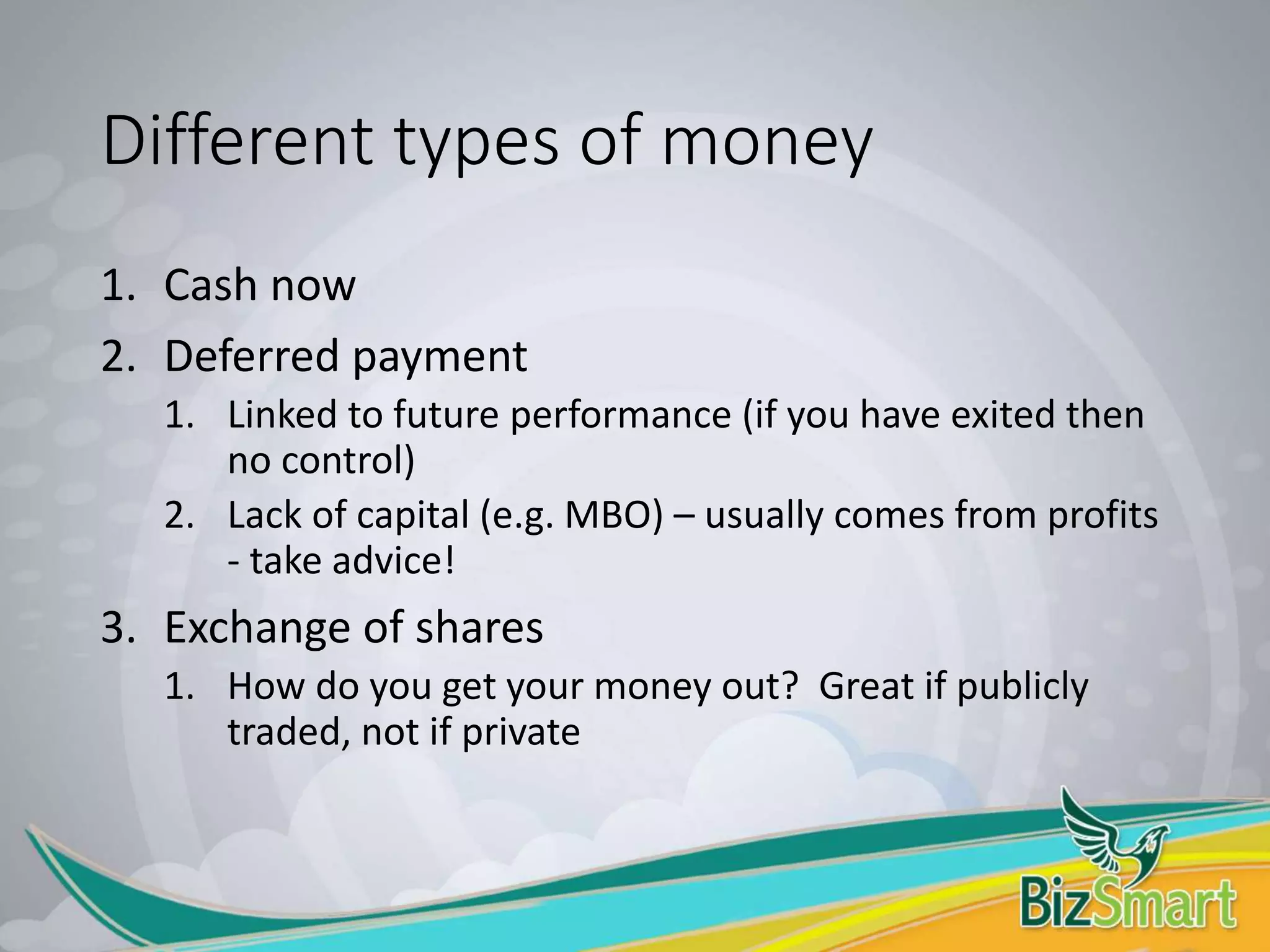
Different types of money
1. Cash now
2. Deferred payment
1. Linked to future performance (if you have exited then
no control)
2. Lack of capital (e.g. MBO) – usually comes from profits
- take advice!
3. Exchange of shares
1. How do you get your money out? Great if publicly
traded, not if private
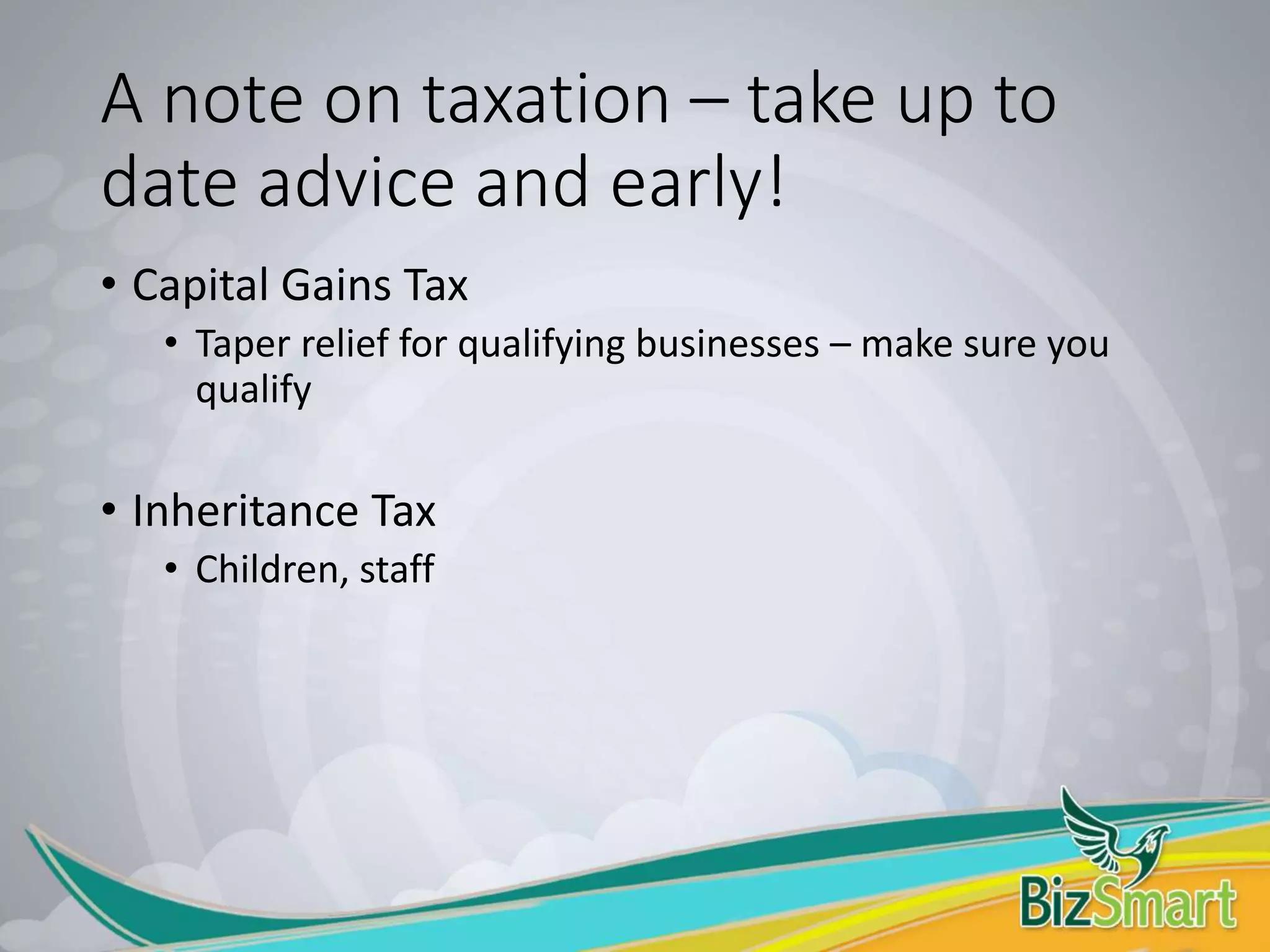
A note on taxation – take up to
date advice and early!
• Capital Gains Tax
• Taper relief for qualifying businesses – make sure you
qualify
• Inheritance Tax
• Children, staff
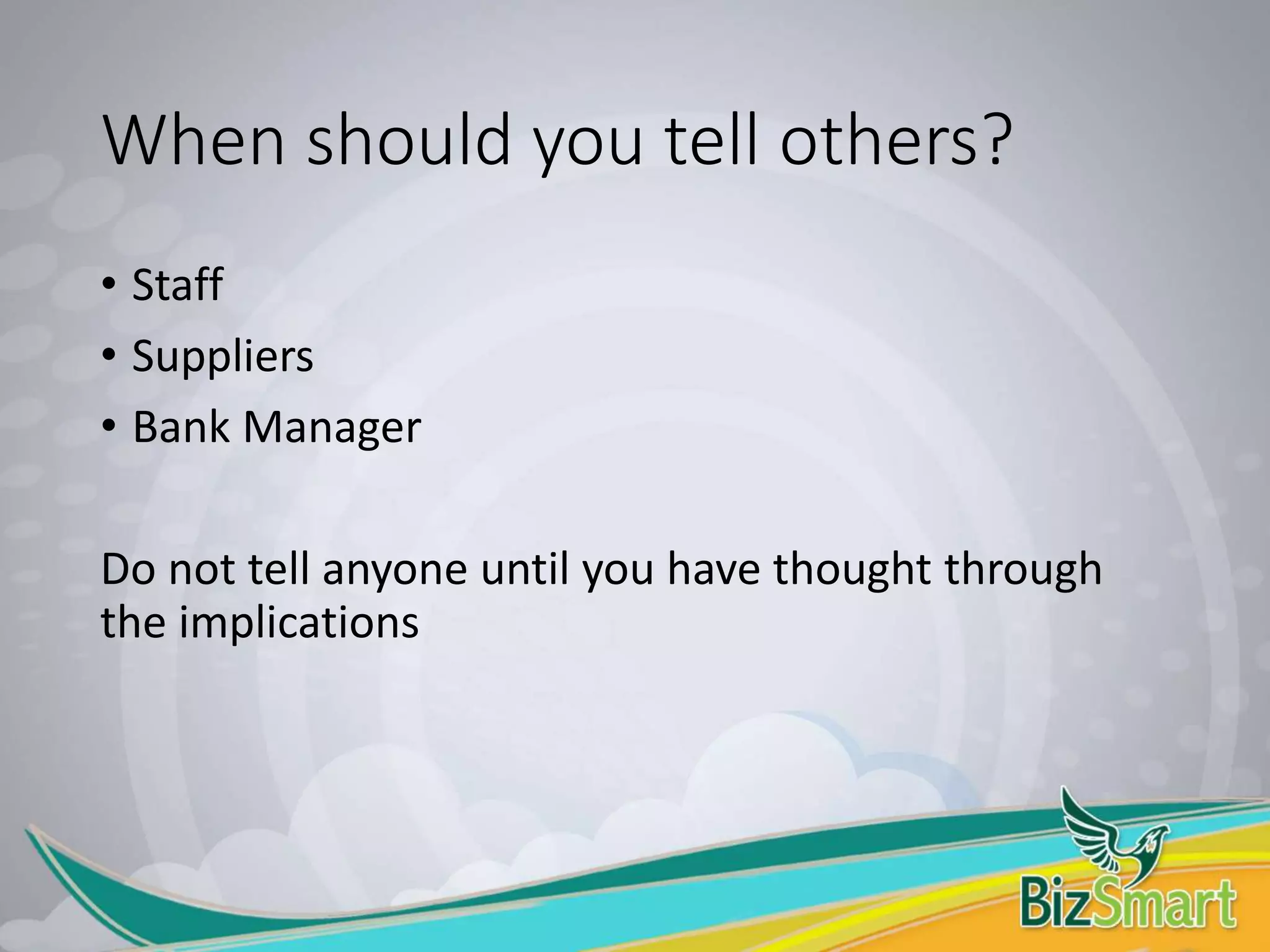
When should you tell others?
• Staff
• Suppliers
• Bank Manager
Do not tell anyone until you have thought through
the implications
A note on Intermediaries
“If you think hiring a professional is expensive, try
hiring an amateur!” Red Adair
• Broker - Commission between 2-5% of sale value
• Lawyer – Hourly rate or Fixed fee (?£20-30K)
• Accountant?
• Wealth manager/ planner
Role of a Broker– to manage a
competitive bid process
• Stage 1 – Prepare sale particulars. Identify potential
acquirers, circulate and follow-up
• Stage 2 – issue confidentiality letters to interested parties.
Prepare detailed business profile
• Stage 3 – Conduct negotiations and agree indicative offers
• Stage 4 – Provide assistance to seller during due diligence
• Stage 5 – Give detailed advice on purchase and sale
agreements. Liaise with legal advisors. Advise on
warranties and terms and conditions. Drive the deal.
• Stage 6 – Attend completion meeting.
Commission between 2-5% of sale value
Role of the corporate lawyer –
ensure no nasty surprises!
• Prepares the legal documents – confidentiality
letter, share sale etc etc
• Advises on implications
• Liaises with purchaser’s lawyers
• Negotiates final draft
• Attends completion meeting, completes legal
requirements of transaction and collects the
money!
Chose carefully
• Interview them – as you would a prospective employee
• Make a checklist
• Ask for examples/ evidence
• References
• Conflicts of interest – e.g. agent who approaches you with a
buyer
• They act for you – you must have confidence you can control
them!
• Consider different sources
• Accountants
• Chamber of Commerce/ FSB
• Trusted individuals/ networks
• Contacts who have sold out
Activity: Preparing your own exit
strategy
• Objectives and aspirations
• Current Valuation
• Opportunities for increasing the valuation
• Barriers to sale/ indirect limiting factors
• Sale process
• Tax Planning
BizSmart help business owners of small and medium sized
businesses to create value and scale their businesses through
sound practical business support by providing insight, Clarity
combined with a real determination to help you succeed.
You can access webinars and presentations like this and more
besides through our SmartRoom service here
You can read the associated blog and listen to a live recording of this
presentation by clicking here
You can read Kevin’s profile here
•Need a sounding board for your ideas?
•Need to know what to prioritise?
•Want someone to challenge your assumptions?
BizSmart –
Where Smart people go to surround themselves with other
Smart people, to gain business success.

How to plan your Exit Strategy

  • 1.
    It is agiven that we will all exit our business at some point - willingly or not! - and it is never to soon to start planning that exit. There is a link at the end of this deck to the associated blog and webinar recording
  • 2.
    Exit Strategy Planning Howto Value & Sell your Business – Andrew Heslop Exit Strategy a practical guide to selling your business – Graham Watkins Built to Sell – John Warrillow
  • 3.
    Objectives To help guidebusiness owners in developing a suitable exit strategy. We will: • Consider reasons why we need an exit plan and when we should make one • Explore ideas to help identify potential purchasers • Look at alternative ways of exiting • Review ways to assess value • Suggest ways to maximise the sale price • Outline the planning and management of the sale process
  • 4.
    Why have anexit plan? • Protection • Helps drive greater success • May help you stay on longer • May help you to release maximum value from your business
  • 5.
    Why leave? “In thelong run we are all dead” John Maynard Keynes • Retirement • Desire to hand over control – e.g. to children • Cashing in • Time for something different/ boredom • Change in personal circumstances • Ill health • Divorce etc. • Outside opportunity • Outside threat
  • 6.
    When should youstart planning?
  • 7.
  • 9.
    Alternatives for Exit •Flotation – suitable for less than 1% and costs £350k plus • Trade Sale • Management Buy Out – MBO. • Management Buy In – MBI • Hybrid Buy In – BIMBO • Acquisition by another company • Asset Sale - Voluntary or Compulsory Liquidation • Walk away
  • 10.
    Trade Sale –who will buy your business? • Competitors • Suppliers • Customers • Employees • Private Equity Firms • Business Angels (national business Angels organisation)
  • 11.
    Activity: Make somelists! Competitors • Who are they? • Why would they be interested? Suppliers/ partners • Who are they? • Why would they be interested? Customers • Who are the key customers? • Why would they be interested?
  • 12.
    How much?! • “…theprice someone is prepared to pay for it in the open market” oIt is not just about the financial performance • A valuation is an opinion – nothing more • There are not two certainties in life but three. ‘Death, taxes and the valuation is wrong’
  • 13.
    Why would someonepay more than the financial valuation? • Synergies • Sell more • Charge more • Spend less • Immediately revalue at higher multiple
  • 14.
    Activity: Look forsynergies • Consider from an outsider’s perspective • What opportunities to sell more, charge more or spend less? • E.g. would a larger business be able to bid for larger contracts? • Would they be able to strip out a layer of cost? • Would it give them access to new markets more cheaply than they could on their own? Etc.
  • 15.
    Methods • 4 Keymethods • Net Asset Value – not normally used for a thriving business • Comparables - private sales and/ or p/e ratios of publicly listed • Multiples– multiples typically of pre-tax profit) • Public companies approx. 15 x profits/ earnings • Private companies approx. 4-5 x profits • Net present value – discounted cash flow Also • Cost of entry • Sector rules of thumb – e.g. 1 x Gross Recurring Fees (Accountancies)
  • 16.
    Previous webinar Smart Room- biz- smart.co.uk/smart- room/
  • 17.
    There are eightkey drivers to your company’s value: •Financial Performance •Growth Potential •The Switzerland structure •Valuation See-Saw •Recurring Revenue •Monopoly Control •Customer Satisfaction •Hub & Spoke
  • 18.
    Get Your ValueBuilder Rating • Based on over 15,000 businesses • Email kevin@biz-smart.co.uk
  • 19.
    What are yourobjectives for exit? • Aspiration for sale price • Timescale • Target market of potential buyers • Practical ideas for maximising the value • How you will manage the exit process
  • 20.
    Activity: Creating yourinvestment story (2 minute version!) • How does your business generate happy customers? • Why are they happy to pay you? • Why will this continue in the future? • Why will you achieve this despite the efforts of competitors? • What is unique about your approach? • Do the financials support this? • Turnover? • Profits? • Costs?
  • 21.
    Managing your exitprocess – only 4 basic ways 1. Sell all the shares and leave • How and when will you be paid? • How would a prospective purchase view your departure? 2. Sell all your shares and continue to work in the business • Lock in – 1-3 years? • Targets • Boss! 3. Sell some of your shares and leave • Protect your interests – minority or majority ownership? • Control? 4. Sell some of your shares and continue to work in the business
  • 22.
    Different types ofmoney 1. Cash now 2. Deferred payment 1. Linked to future performance (if you have exited then no control) 2. Lack of capital (e.g. MBO) – usually comes from profits - take advice! 3. Exchange of shares 1. How do you get your money out? Great if publicly traded, not if private
  • 23.
    A note ontaxation – take up to date advice and early! • Capital Gains Tax • Taper relief for qualifying businesses – make sure you qualify • Inheritance Tax • Children, staff
  • 24.
    When should youtell others? • Staff • Suppliers • Bank Manager Do not tell anyone until you have thought through the implications
  • 25.
    A note onIntermediaries “If you think hiring a professional is expensive, try hiring an amateur!” Red Adair • Broker - Commission between 2-5% of sale value • Lawyer – Hourly rate or Fixed fee (?£20-30K) • Accountant? • Wealth manager/ planner
  • 26.
    Role of aBroker– to manage a competitive bid process • Stage 1 – Prepare sale particulars. Identify potential acquirers, circulate and follow-up • Stage 2 – issue confidentiality letters to interested parties. Prepare detailed business profile • Stage 3 – Conduct negotiations and agree indicative offers • Stage 4 – Provide assistance to seller during due diligence • Stage 5 – Give detailed advice on purchase and sale agreements. Liaise with legal advisors. Advise on warranties and terms and conditions. Drive the deal. • Stage 6 – Attend completion meeting. Commission between 2-5% of sale value
  • 27.
    Role of thecorporate lawyer – ensure no nasty surprises! • Prepares the legal documents – confidentiality letter, share sale etc etc • Advises on implications • Liaises with purchaser’s lawyers • Negotiates final draft • Attends completion meeting, completes legal requirements of transaction and collects the money!
  • 28.
    Chose carefully • Interviewthem – as you would a prospective employee • Make a checklist • Ask for examples/ evidence • References • Conflicts of interest – e.g. agent who approaches you with a buyer • They act for you – you must have confidence you can control them! • Consider different sources • Accountants • Chamber of Commerce/ FSB • Trusted individuals/ networks • Contacts who have sold out
  • 29.
    Activity: Preparing yourown exit strategy • Objectives and aspirations • Current Valuation • Opportunities for increasing the valuation • Barriers to sale/ indirect limiting factors • Sale process • Tax Planning
  • 30.
    BizSmart help businessowners of small and medium sized businesses to create value and scale their businesses through sound practical business support by providing insight, Clarity combined with a real determination to help you succeed. You can access webinars and presentations like this and more besides through our SmartRoom service here You can read the associated blog and listen to a live recording of this presentation by clicking here You can read Kevin’s profile here
  • 31.
    •Need a soundingboard for your ideas? •Need to know what to prioritise? •Want someone to challenge your assumptions?
  • 32.
    BizSmart – Where Smartpeople go to surround themselves with other Smart people, to gain business success.