Value Team as enabler of the “cloud” ecosystem March 2011
Summary Organizations are facing extensive and radical changes in the  competitive landscape :  new players coming out of nowhere, international turmoil, rising costs of raw materials, energy and labour, limited access to qualified knowledge workers and an ever accelerating pace of technological innovation In this environment,  managing  change  has become the key challenge :  staying on track, supporting effectively the  strategic business objectives  and at the same time keeping  operating costs  under control On the ICT front, CTOs and CIOs must be able to provide their organisations with an expanding set of solutions, thus making effective  orchestration of ICT resources  the key success factor Cloud Computing  can provide a substantial help in reaching this goal, but as a possible “disruptive” technology it might also add further uncertainty to the picture ICT governance, in this relatively new paradigm, is a question of balancing the  competitive cost  of not using the cloud, against the  risks  of actually using it Value Team , with its competences, methodologies and experiences, helps customers in  exploiting the full potential  of Cloud Computing, by serving the market as a  Cloud Services Enabler Value Team supports organisations in implementing an effective “cloud governance”, by evaluating the opportunities and risks of adopting Cloud Computing, and addressing themes such as  quality of service  as well as  data  and  infrastructure security
Cloud Computing: an overview Value Team vision of Cloud Computing Value Team approach to Cloud Computing
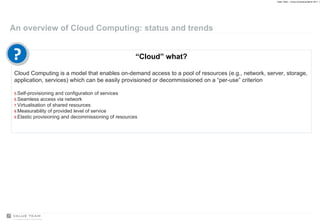
An overview of Cloud Computing: status and trends “ Cloud” what? Cloud Computing is a model that enables on-demand access to a pool of resources (e.g., network, server, storage, application, services) which can be easily provisioned or decommissioned on a “per-use” criterion Self-provisioning and configuration of services Seamless access via network Virtualisation of shared resources Measurability of provided level of service Elastic provisioning and decommissioning of resources ?
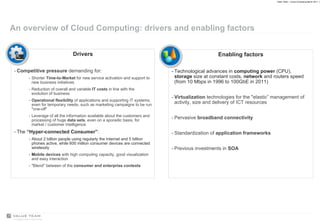
An overview of Cloud Computing: drivers and enabling factors Drivers Competitive pressure  demanding for: Shorter  Time-to-Market  for new service activation and support to new business initiatives Reduction of overall and variable  IT costs  in line with the evolution of business Operational flexibility  of applications and supporting IT systems, even for temporary needs, such as marketing campaigns to be run "one-off“ Leverage of all the information available about the customers and processing of huge  data sets , even on a sporadic basis, for market / customer intelligence The  “Hyper-connected Consumer” : About 2 billion people using regularly the Internet and 5 billion phones active, while 600 million consumer devices are connected wirelessly M obile devices  with high computing capacity, good visualization and easy interaction "Blend" between of the  consumer and enterprise contexts Enabling factors Technological advances in  computing power  (CPU),  storage  size at constant   costs,  network  and routers speed (from 10 Mbps in 1996 to 100GbE in 2011) Virtualization  technologies for the "elastic” management of activity, size and delivery of ICT resources Pervasive  broadband connectivity Standardization of  application frameworks Previous investments in  SOA
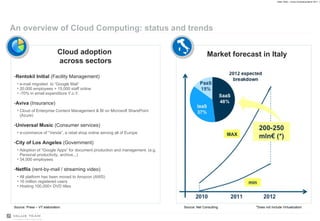
An overview of Cloud Computing: status and trends Source: Press – VT elaboration *Does not include Virtualization Source: Net Consulting Cloud adoption  across sectors Rentokil Initial  (Facility Management) e-mail migrated  to “Google Mail” 20,000 employees + 15,000 staff online -70% in email expenditure Y.o.Y.  Aviva  (Insurance) Cloud of Enterprise Content Management & BI on Microsoft SharePoint (Azure)  Universal Music  (Consumer services)  e-commerce of “Venda”, a retail shop online serving all of Europe City of Los Angeles  (Government)  Adoption of “Google Apps” for document production and management. (e.g. Personal productivity, archive...)  34,000 employees Netflix  (rent-by-mail / streaming video)  All platform has been moved to Amazon (AWS) 16 million registered users Hosting 100,000+ DVD titles Market forecast in Italy
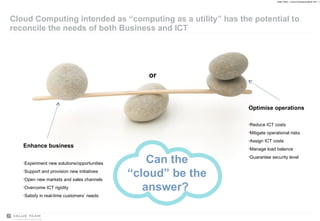
Cloud Computing intended as “computing as a utility” has the potential to reconcile the needs of both Business and ICT Can the “cloud” be the answer?  Optimise operations Reduce ICT costs Mitigate operational risks Assign ICT costs Manage load balance Guarantee security level Enhance business Experiment new solutions/opportunities Support and provision new initiatives Open new markets and sales channels Overcome ICT rigidity Satisfy in real-time customers’ needs or
Cloud Computing: an overview Value Team vision of Cloud Computing Value Team approach to Cloud Computing
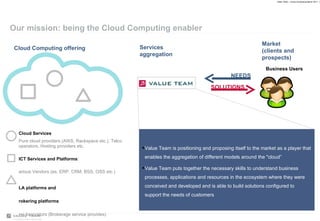
Our mission: being the Cloud Computing enabler Value Team is positioning and proposing itself to the market as a player that enables the aggregation of different models around the "cloud” Value Team puts together the necessary skills to understand business processes, applications and resources in the ecosystem where they were conceived and developed and is able to build solutions configured to support the needs of customers NEEDS Business Users Services aggregation Market  (clients and prospects) Cloud Services Pure cloud providers (AWS, Rackspace etc.), Telco operators, Hosting providers etc.  SLA platforms and Brokering platforms Few Innovators (Brokerage service provides) New products from established vendors  (EMC, VMWare, HP, IBM...) ICT Services and Platforms : Various Vendors (es. ERP, CRM, BSS, OSS etc.) Cloud Computing offering SOLUTIONS
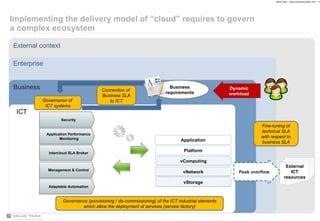
Implementing the delivery model of “cloud” requires to govern a complex ecosystem External context Enterprise Business vComputing vNetwork vStorage Application Platform External ICT resources Governance of  ICT systems Governance (provisioning / de-commissioning) of the ICT industrial elements which allow the deployment of services (service factory) Fine-tuning of technical SLA with respect to business SLA Peak overflow Adaptable Automation Management & Control Intercloud SLA Broker Application Performance Monitoring Security Connection of  Business SLA to ICT ICT Business requirements Dynamic workload
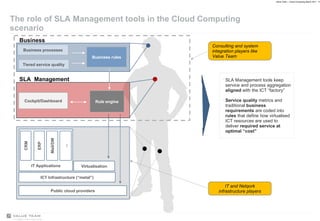
The role of SLA Management tools in the Cloud Computing scenario Cockpit/Dashboard Rule engine Business processes Tiered service quality Business rules SLA Management tools keep service and process aggregation  aligned  with the ICT “factory” Service quality  metrics and traditional  business requirements  are coded into  rules  that define how virtualised ICT resources are used to deliver  required service at optimal “cost” Consulting and system integration players like Value Team IT Applications CRM ERP Mail/DM ICT Infrastructure (“metal”) Virtualisation ... Public cloud providers IT and Netqork infrastructure players Business SLA  Management
Cloud Computing: an overview Value Team vision of Cloud Computing Value Team approach to Cloud Computing
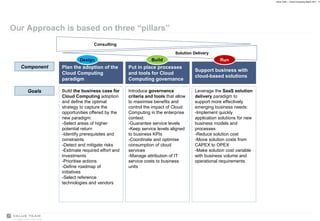
Our Approach is based on three “pillars” Solution Delivery Goals Component Plan the adoption of the Cloud Computing paradigm Put in place processes and tools for Cloud Computing governance Support business with cloud-based solutions Build  the business case for Cloud Computing  adoption and define the optimal strategy to capture the opportunities offered by the new paradigm: Select areas of higher potential return Identify prerequisites and constraints Detect and mitigate risks Estimate required effort and investments Prioritise actions Define roadmap of initiatives Select reference technologies and vendors Introduce  governance criteria and tools  that allow to maximise benefits and control the impact of Cloud Computing in the enterprise context: Guarantee service levels Keep service levels aligned to business KPIs Coordinate and optimise consumption of cloud services Manage attribution of IT service costs to business units Leverage the  SaaS solution delivery  paradigm to support more effectively emerging business needs: Implement quickly application solutions for new business models and processes Reduce solution cost Move solution costs from CAPEX to OPEX Make solution cost variable with business volume and operational requirements Design Build Run
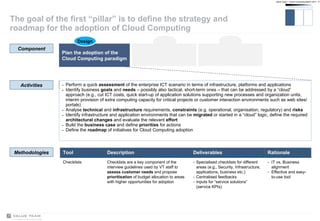
The goal of the first “pillar” is to define the strategy and roadmap for the adoption of Cloud Computing Perform a quick  assessment  of the enterprise ICT scenario in terms of infrastructure, platforms and applications Identify business  goals  and  needs  – possibly also tactical, short-term ones – that can be addressed by a “cloud” approach (e.g., cut ICT costs, quick start-up of application solutions supporting new processes and organization units, interim provision of extra computing capacity for critical projects or customer interaction environments such as web sites/portals) Analyse  technical  and  infrastructure  requirements,  constraints  (e.g. operational, organisation, regulatory) and  risks Identify infrastructure and application environments that can be  migrated  or started in a “cloud” logic, define the required  architectural changes  and evaluate the relevant  effort Build the  business case  and define  priorities  for actions Define the  roadmap  of initiatives for Cloud Computing adoption Activities Component Plan the adoption of the Cloud Computing paradigm Design Methodologies Tool Description Deliverables Rationale Checklists Checklists are a key component of the interview guidelines used by VT staff to  assess customer needs  and propose  prioritisation  of budget allocation to areas with higher opportunities for adoption Specialised checklists for different areas (e.g., Security, Infrastructure, applications, business etc.) Centralised feedbacks Inputs for “service solutions” (service KPIs) IT vs. Business alignment Effective and easy-to-use tool
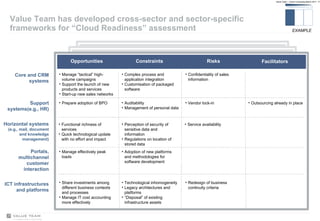
Value Team has developed cross-sector and sector-specific frameworks for “Cloud Readiness” assessment Core and CRM systems Support systems(e.g., HR) ICT infrastructures and platforms EXAMPLE Portals, multichannel customer interaction Opportunities Constraints Manage “tactical” high-volume campaigns Support the launch of new products and services Start-up new sales networks Risks Complex process and application integration Customisation of packaged software Confidentiality of sales information Auditability Management of personal data Share investments among different business contexts and processes Manage IT cost accounting more effectively Technological inhomogeneity Legacy architectures and platforms “ Disposal” of existing infrastructure assets Redesign of business continuity criteria Prepare adoption of BPO Vendor lock-in Manage effectively peak loads Adoption of new platforms and methodologies for software development Facilitators Outsourcing already in place Horizontal systems  (e.g., mail, document and knowledge management) Functional richness of services Quick technological update with no effort and impact Perception of security of sensitive data and information Regulations on location of stored data Service availability
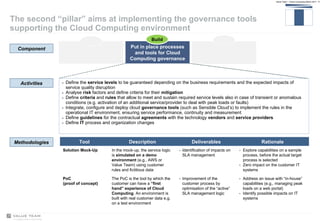
The second “pillar” aims at implementing the governance tools supporting the Cloud Computing environment Define the  service levels  to be guaranteed depending on the business requirements and the expected impacts of service quality disruption Analyse  risk  factors and define criteria for their  mitigation Define  criteria  and  rules  that allow to meet and sustain required service levels also in case of transient or anomalous conditions (e.g. activation of an additional service/provider to deal with peak loads or faults) Integrate, configure and deploy cloud  governance tools  (such as Sensible Cloud’s) to implement the rules in the operational IT environment, ensuring service performance, continuity and measurement Define  guidelines  for the contractual  agreements  with the technology  vendors  and  service providers Define  IT  process and organization changes Put in place processes and tools for Cloud Computing governance Build Activities Component Methodologies Tool Description Deliverables Rationale Solution Mock-Up In the mock-up, the service logic is  simulated on a demo environment  (e.g., AWS or Value Team) using customer rules and fictitious data Identification of impacts on SLA management Explore capabilities on a sample process, before the actual target process is selected Zero impact on the customer IT systems PoC (proof of concept) The PoC is the tool by which the customer can have a  “first hand” experience of Cloud Computing . An environment is built with real customer data e.g. on a test environment  Improvement of the customer process by optimisation of the “active” SLA management logic Address an issue with “in-house” capabilities (e.g., managing peak loads on a web portal) Identify possible impacts on IT systems
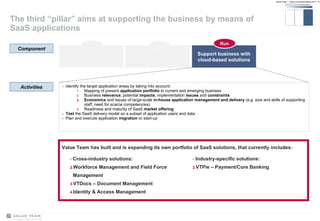
The third “pillar” aims at supporting the business by means of SaaS applications Identify the target application areas by taking into account: Mapping of present  application portfolio  to current and emerging business Business  relevance , potential  impacts , implementation  issues  and  constraints Economics  and issues of large-scale  in-house application management and delivery  (e.g. size and skills of supporting staff, need for scarce competencies) Readiness and maturity of SaaS  market offering Test  the SaaS delivery model on a subset of application users and data Plan and execute application  migration  or start-up Support business with cloud-based solutions Value Team has built and is expanding its own portfolio of SaaS solutions, that currently includes: Run Activities Component Cross-industry solutions: Workforce Management and Field Force Management VTDocs – Document Management Identity & Access Management Industry-specific solutions: VTPie – Payment/Core Banking

Value Team Cloud Computing

  • 1.
    Value Team asenabler of the “cloud” ecosystem March 2011
  • 2.
    Summary Organizations arefacing extensive and radical changes in the competitive landscape : new players coming out of nowhere, international turmoil, rising costs of raw materials, energy and labour, limited access to qualified knowledge workers and an ever accelerating pace of technological innovation In this environment, managing change has become the key challenge : staying on track, supporting effectively the strategic business objectives and at the same time keeping operating costs under control On the ICT front, CTOs and CIOs must be able to provide their organisations with an expanding set of solutions, thus making effective orchestration of ICT resources the key success factor Cloud Computing can provide a substantial help in reaching this goal, but as a possible “disruptive” technology it might also add further uncertainty to the picture ICT governance, in this relatively new paradigm, is a question of balancing the competitive cost of not using the cloud, against the risks of actually using it Value Team , with its competences, methodologies and experiences, helps customers in exploiting the full potential of Cloud Computing, by serving the market as a Cloud Services Enabler Value Team supports organisations in implementing an effective “cloud governance”, by evaluating the opportunities and risks of adopting Cloud Computing, and addressing themes such as quality of service as well as data and infrastructure security
  • 3.
    Cloud Computing: anoverview Value Team vision of Cloud Computing Value Team approach to Cloud Computing
  • 4.
    An overview ofCloud Computing: status and trends “ Cloud” what? Cloud Computing is a model that enables on-demand access to a pool of resources (e.g., network, server, storage, application, services) which can be easily provisioned or decommissioned on a “per-use” criterion Self-provisioning and configuration of services Seamless access via network Virtualisation of shared resources Measurability of provided level of service Elastic provisioning and decommissioning of resources ?
  • 5.
    An overview ofCloud Computing: drivers and enabling factors Drivers Competitive pressure demanding for: Shorter Time-to-Market for new service activation and support to new business initiatives Reduction of overall and variable IT costs in line with the evolution of business Operational flexibility of applications and supporting IT systems, even for temporary needs, such as marketing campaigns to be run "one-off“ Leverage of all the information available about the customers and processing of huge data sets , even on a sporadic basis, for market / customer intelligence The “Hyper-connected Consumer” : About 2 billion people using regularly the Internet and 5 billion phones active, while 600 million consumer devices are connected wirelessly M obile devices with high computing capacity, good visualization and easy interaction "Blend" between of the consumer and enterprise contexts Enabling factors Technological advances in computing power (CPU), storage size at constant costs, network and routers speed (from 10 Mbps in 1996 to 100GbE in 2011) Virtualization technologies for the "elastic” management of activity, size and delivery of ICT resources Pervasive broadband connectivity Standardization of application frameworks Previous investments in SOA
  • 6.
    An overview ofCloud Computing: status and trends Source: Press – VT elaboration *Does not include Virtualization Source: Net Consulting Cloud adoption across sectors Rentokil Initial (Facility Management) e-mail migrated to “Google Mail” 20,000 employees + 15,000 staff online -70% in email expenditure Y.o.Y. Aviva (Insurance) Cloud of Enterprise Content Management & BI on Microsoft SharePoint (Azure) Universal Music (Consumer services) e-commerce of “Venda”, a retail shop online serving all of Europe City of Los Angeles (Government) Adoption of “Google Apps” for document production and management. (e.g. Personal productivity, archive...) 34,000 employees Netflix (rent-by-mail / streaming video) All platform has been moved to Amazon (AWS) 16 million registered users Hosting 100,000+ DVD titles Market forecast in Italy
  • 7.
    Cloud Computing intendedas “computing as a utility” has the potential to reconcile the needs of both Business and ICT Can the “cloud” be the answer? Optimise operations Reduce ICT costs Mitigate operational risks Assign ICT costs Manage load balance Guarantee security level Enhance business Experiment new solutions/opportunities Support and provision new initiatives Open new markets and sales channels Overcome ICT rigidity Satisfy in real-time customers’ needs or
  • 8.
    Cloud Computing: anoverview Value Team vision of Cloud Computing Value Team approach to Cloud Computing
  • 9.
    Our mission: beingthe Cloud Computing enabler Value Team is positioning and proposing itself to the market as a player that enables the aggregation of different models around the "cloud” Value Team puts together the necessary skills to understand business processes, applications and resources in the ecosystem where they were conceived and developed and is able to build solutions configured to support the needs of customers NEEDS Business Users Services aggregation Market (clients and prospects) Cloud Services Pure cloud providers (AWS, Rackspace etc.), Telco operators, Hosting providers etc. SLA platforms and Brokering platforms Few Innovators (Brokerage service provides) New products from established vendors (EMC, VMWare, HP, IBM...) ICT Services and Platforms : Various Vendors (es. ERP, CRM, BSS, OSS etc.) Cloud Computing offering SOLUTIONS
  • 10.
    Implementing the deliverymodel of “cloud” requires to govern a complex ecosystem External context Enterprise Business vComputing vNetwork vStorage Application Platform External ICT resources Governance of ICT systems Governance (provisioning / de-commissioning) of the ICT industrial elements which allow the deployment of services (service factory) Fine-tuning of technical SLA with respect to business SLA Peak overflow Adaptable Automation Management & Control Intercloud SLA Broker Application Performance Monitoring Security Connection of Business SLA to ICT ICT Business requirements Dynamic workload
  • 11.
    The role ofSLA Management tools in the Cloud Computing scenario Cockpit/Dashboard Rule engine Business processes Tiered service quality Business rules SLA Management tools keep service and process aggregation aligned with the ICT “factory” Service quality metrics and traditional business requirements are coded into rules that define how virtualised ICT resources are used to deliver required service at optimal “cost” Consulting and system integration players like Value Team IT Applications CRM ERP Mail/DM ICT Infrastructure (“metal”) Virtualisation ... Public cloud providers IT and Netqork infrastructure players Business SLA Management
  • 12.
    Cloud Computing: anoverview Value Team vision of Cloud Computing Value Team approach to Cloud Computing
  • 13.
    Our Approach isbased on three “pillars” Solution Delivery Goals Component Plan the adoption of the Cloud Computing paradigm Put in place processes and tools for Cloud Computing governance Support business with cloud-based solutions Build the business case for Cloud Computing adoption and define the optimal strategy to capture the opportunities offered by the new paradigm: Select areas of higher potential return Identify prerequisites and constraints Detect and mitigate risks Estimate required effort and investments Prioritise actions Define roadmap of initiatives Select reference technologies and vendors Introduce governance criteria and tools that allow to maximise benefits and control the impact of Cloud Computing in the enterprise context: Guarantee service levels Keep service levels aligned to business KPIs Coordinate and optimise consumption of cloud services Manage attribution of IT service costs to business units Leverage the SaaS solution delivery paradigm to support more effectively emerging business needs: Implement quickly application solutions for new business models and processes Reduce solution cost Move solution costs from CAPEX to OPEX Make solution cost variable with business volume and operational requirements Design Build Run
  • 14.
    The goal ofthe first “pillar” is to define the strategy and roadmap for the adoption of Cloud Computing Perform a quick assessment of the enterprise ICT scenario in terms of infrastructure, platforms and applications Identify business goals and needs – possibly also tactical, short-term ones – that can be addressed by a “cloud” approach (e.g., cut ICT costs, quick start-up of application solutions supporting new processes and organization units, interim provision of extra computing capacity for critical projects or customer interaction environments such as web sites/portals) Analyse technical and infrastructure requirements, constraints (e.g. operational, organisation, regulatory) and risks Identify infrastructure and application environments that can be migrated or started in a “cloud” logic, define the required architectural changes and evaluate the relevant effort Build the business case and define priorities for actions Define the roadmap of initiatives for Cloud Computing adoption Activities Component Plan the adoption of the Cloud Computing paradigm Design Methodologies Tool Description Deliverables Rationale Checklists Checklists are a key component of the interview guidelines used by VT staff to assess customer needs and propose prioritisation of budget allocation to areas with higher opportunities for adoption Specialised checklists for different areas (e.g., Security, Infrastructure, applications, business etc.) Centralised feedbacks Inputs for “service solutions” (service KPIs) IT vs. Business alignment Effective and easy-to-use tool
  • 15.
    Value Team hasdeveloped cross-sector and sector-specific frameworks for “Cloud Readiness” assessment Core and CRM systems Support systems(e.g., HR) ICT infrastructures and platforms EXAMPLE Portals, multichannel customer interaction Opportunities Constraints Manage “tactical” high-volume campaigns Support the launch of new products and services Start-up new sales networks Risks Complex process and application integration Customisation of packaged software Confidentiality of sales information Auditability Management of personal data Share investments among different business contexts and processes Manage IT cost accounting more effectively Technological inhomogeneity Legacy architectures and platforms “ Disposal” of existing infrastructure assets Redesign of business continuity criteria Prepare adoption of BPO Vendor lock-in Manage effectively peak loads Adoption of new platforms and methodologies for software development Facilitators Outsourcing already in place Horizontal systems (e.g., mail, document and knowledge management) Functional richness of services Quick technological update with no effort and impact Perception of security of sensitive data and information Regulations on location of stored data Service availability
  • 16.
    The second “pillar”aims at implementing the governance tools supporting the Cloud Computing environment Define the service levels to be guaranteed depending on the business requirements and the expected impacts of service quality disruption Analyse risk factors and define criteria for their mitigation Define criteria and rules that allow to meet and sustain required service levels also in case of transient or anomalous conditions (e.g. activation of an additional service/provider to deal with peak loads or faults) Integrate, configure and deploy cloud governance tools (such as Sensible Cloud’s) to implement the rules in the operational IT environment, ensuring service performance, continuity and measurement Define guidelines for the contractual agreements with the technology vendors and service providers Define IT process and organization changes Put in place processes and tools for Cloud Computing governance Build Activities Component Methodologies Tool Description Deliverables Rationale Solution Mock-Up In the mock-up, the service logic is simulated on a demo environment (e.g., AWS or Value Team) using customer rules and fictitious data Identification of impacts on SLA management Explore capabilities on a sample process, before the actual target process is selected Zero impact on the customer IT systems PoC (proof of concept) The PoC is the tool by which the customer can have a “first hand” experience of Cloud Computing . An environment is built with real customer data e.g. on a test environment Improvement of the customer process by optimisation of the “active” SLA management logic Address an issue with “in-house” capabilities (e.g., managing peak loads on a web portal) Identify possible impacts on IT systems
  • 17.
    The third “pillar”aims at supporting the business by means of SaaS applications Identify the target application areas by taking into account: Mapping of present application portfolio to current and emerging business Business relevance , potential impacts , implementation issues and constraints Economics and issues of large-scale in-house application management and delivery (e.g. size and skills of supporting staff, need for scarce competencies) Readiness and maturity of SaaS market offering Test the SaaS delivery model on a subset of application users and data Plan and execute application migration or start-up Support business with cloud-based solutions Value Team has built and is expanding its own portfolio of SaaS solutions, that currently includes: Run Activities Component Cross-industry solutions: Workforce Management and Field Force Management VTDocs – Document Management Identity & Access Management Industry-specific solutions: VTPie – Payment/Core Banking