1960
CONGO
RESCUE
by Charles H. Briscoe
VERITAS  |  6VERITAS  |  6
I
n the wake of independence from Belgium on 30 June
1960, law and order collapsed in the Democratic
Republic of the Congo. The Force Publique mutinied
on 8 July, the two richest mining provinces, Katanga
and Kasai seceded (July and August respectively), and
tribal strength trials among government leaders never
stopped.1
Mistrust, suspicion, and bitterness towards
Belgians grew daily among the Congolese tribal factions
and political groups.2
White Europeans became targets
for racial attacks and a panic-stricken exodus began. In
response, the Belgian government convinced Sabena World
Airlines to divert aircraft to evacuate its citizens from the
Congo.3
To support that internationally maligned effort, a
U.S. European Command (USEUCOM) aviation task force
(TF), clandestinely directed by three Special Forces (SF)
soldiers, rescued 239 American and foreign missionaries,
doctors, and nurses from rural areas experiencing rampant
lawlessness.4
Mission success can be attributed to the
timelessness of SF operational capabilities and flexibility in
adapting to rapidly changing situations.
The purpose of this article is to detail a formerly
sensitive, classified rescue mission that was conducted by
10th
SF Group (SFG) in July 1960.6
It was the first operational
tasking given to SF by U.S. Army, Europe (USAREUR), a
service command of USEUCOM which was dominated by
heavy conventional forces (armor, mechanized infantry,
and armored cavalry). Its success demonstrated the ‘value
added’ of Special Forces to the command, and reminded
North Atlantic Treaty Organization (NATO) partner
nations of their capabilities. The U.S. Air Force overt airlift
of refugees, UN peacekeeping forces, food, equipment and
medical supplies has long garnered the most publicity.7
To understand what prompted this 10th
SFG-led
humanitarian rescue mission, some pre-independence
background and key facts and figures on society, politics,
and economic factors are necessary. Maps, charts, and
sidebars cover geography, concurrent world events,
population, tribal groups, religious distribution, and
identify key Congolese politicos: Patrice E. Lumumba;
Antoine Gizenga; Joseph Kasavubu; Joseph D. Mobutu;
and Moïse K. Tshombe. The reader must bear in mind that
activitiesinAfricamovedquicklyintheearly1960s.Current
status one day was history two days later, especially in the
political and social arenas of this very turbulent period.8
Hence, period sources are used for context. This article
is divided into four sections: Post-Independence, which
provides the background; the Special Forces Mission;
an Epilogue summarizes the first two years after UN
intervention; and the Postscript discusses awards, post-
operation security constraints, and rationale behind the SF
success in 1960.
Post-Independence in Democratic
Republic of the Congo (DRC)
Violent racial-economic riots broke out in Leopoldville,
the capital of the Belgian Congo, in January 1959. This
upheaval preceded internal tribal fighting in Kasai
province that spread to the capital in May 1960. Belgium’s
inability to resolve these problems reinforced anti-
colonial attitudes in America and the United Nations.
These dilemmas prompted young King Baudouin I to
accelerate the transition to independence of their African
colony.9
While the world media heralded nationalism with
independence, tribal blocs in the Congo defined politics.
Since no tribe had a majority, their political leaders vied for
key government positions. Simultaneously, newly-elected
legislators voted themselves pay raises and health benefits
“Almost all Europeans in
the Congo at this time were
apprehensive if not alarmed;
though many of us felt that
some troubles and minor
incidents were bound to
occur, a general racial
struggle was not foreseen.”
– Alan P. Merriam, Congo: Background of Conflict (1961)5
The Republic of the Congo was
truly the ‘Heart of Darkness.’
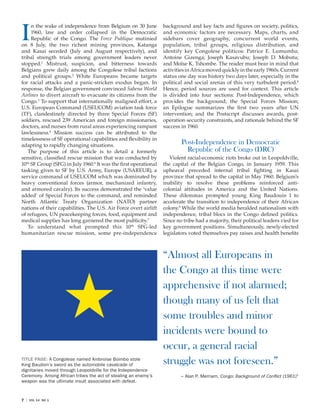
TITLE PAGE: A Congolese named Ambroise Boimbo stole
King Baudoin’s sword as the automobile cavalcade of
dignitaries moved through Leopoldville for the Independence
Ceremony. Among African tribes the act of stealing an enemy’s
weapon was the ultimate insult associated with defeat.
7  |  VOL 14 NO 1
with little concern for the state’s financial solvency. A
four-day holiday to celebrate independence was approved
unanimously. These were heady times for Congolese.
Dreamlike expectations were the norm.
The U.S. News & World Report correspondent on the
scene, David Reed, described the situation: “When the
blacks took over from the Belgian colonial administrators,
they were far from ready to govern. African officials
suddenly were big shots, rode around in fancy cars, and
took over elaborate homes. In short, they replaced a white
aristocracy with a black aristocracy. When the African
soldiersoftheBelgian-officeredForcePubliquesawwhatwas
happening, they wanted their share. The Premier (Patrice
Lumumba) did not deliver his pre-independence promises.
The troops went crazy and turned on whites to vent
their frustration and rage.”10
The three-man International
Staff team from that news magazine repeated the same
observations in the 8 August 1960 issue. As authority
broke down, senior white civil servants who knew how to
make the government operate panicked and ran for their
lives. When white business directors, industry managers,
and technicians followed suit, the economy collapsed.11
In reality, the May elections fractured the Congo by
exposing the ethno-political strength of the native tribes,
the strong autonomy accorded key economic regions, and
general opposition to a centralized national government
in Leopoldville, the former center of colonial power.12
“For
Congolese living outside of Leopoldville, the national
capital represented the epitome of central superior authority.
Whether exercised by black or white made little difference.
It was something that they had finished with,” espoused
George Martelli, who lived through the upheaval.13
Most
Congolese believed that a higher standard of living would
come with jobs vacated by the whites. Laborers who went
on strike on the first day of the four-day holiday were
dispersed by rifle fire from the Force Publique.14
On 5 July 1960, Force Publique soldiers rebelled against
their Belgian officers for higher rank, greater authority, and
better pay. A general refusal to work for status quo wages
shut down the public services.15
When the institution of law
and order (Force Publique) disintegrated, the popular unrest
grew rampant. Only in the foreign mining-financed Kasai
and Katanga provinces was there any semblance of order.16
The sidebar detailing the ethnicity, population, languages,
and religions in the Congo provides some perspective on
the elements of conflict.
Lawlessness escalated to violent attacks on white
Europeans everywhere except in the mineral-rich Katanga
and Kasai provinces. As Force Publique armories were
pillaged, tribal groups brandishing automatic weapons ruled
indiscriminately. Flemish speakers were targeted. Congolese
leaders had no means to restore order, nor stop the economic
death spiral. No revenue was coming in, the small reserve
had been exhausted, and monthly operating costs ranged
from 8 to 10 million dollars.26
Since political and social
turmoil in Leopoldville were constants they will be ignored
until the USEUCOM-directed rescue mission is discussed.
The Special Forces Mission
President Dwight D. Eisenhower knew that imperial
governments would face demands for colonial independence
after World War II. By 1960, decolonization was spreading
across Africa, often bringing with it violence and
instability. As anarchy engulfed the Congo Republic, the
U.S. ambassador, Clare H. ‘Tim’ Timberlake, appointed just
days before 30 June 1960, requested help from USEUCOM
in France. The career Foreign Service Officer (FSO) did
this before informing the State Department because the
violence was escalating rapidly. Several hundred American
and foreign missionaries, doctors, dentists, and nurses
working deep in the Congo bush were at grave risk of
attack. Isolated in very remote villages, they had no safe
way to escape the rampant lawlessness.27
Official U.S. military support to the Congo was to
be discrete and low key. USAREUR, the Army service
component command of USEUCOM, sent a classified
teletypewriter exchange (TWX) message to the 10th
SFG.
Infantry Colonel (COL) Michael ‘Iron Mike’ Paulick had
been alerted to expect a CONFIDENTIAL ‘eyes only’
TWX concerning the Congo crisis.28
It was serendipitous that a Frenchman born in Belgium
was assigned to the 10th
SFG. First Lieutenant (1LT) Sully H.
de Fontaine had just given a Congo presentation to a class
of University of Maryland students taught by Major (MAJ)
Charles M. Simpson III, the C Company commander.29
As
a newly promoted, seventeen-year-old British Corporal
(CPL), Fontaine parachuted twice behind enemy lines in
France for the Special Operations Executive (SOE). Using a
French Resistance escape ‘rat line’ he led a downed Allied
Sudan
Nigeria
Algeria Libya Egypt
French
West Africa
Liberia
Sierra Leone
Ghana
Saudi
Arabia
Yemen
Iran
Iraq
Turkey
Syria
Spain
Sahara
Morocco
Tunesia
Madagascar
Union of
South Africa
South-West
Africa Bechuanaland
Nyasaland Mozambique
Federation of
Rhodesia
Angola
Tanganyka
Kenya
Belgian Congo
Somalia
Ethiopia
French
Equatorial
Africa
Cameroon
United Kingdom
France
Belgium
Portugal
Spain
Italy
Union of South Africa
Independent country
AFRICAADMINISTRATIVE DIVISIONS - 1958
Colony,
Protectorate, etc.
Mandate
Trust
Territory
VERITAS  |  8
aircrew to safety in Spain and an American aircrew to U.S.
forces in France.30
After the war, Fontaine attended the
Belgian Military Academy. He spent a month serving with
the Commandos in Kamina Barracks (Kasai Province, the
Belgian Congo) as a cadet. The older dual-citizen American
SF lieutenant who spoke Flemish and French better than
English was the obvious choice to lead a clandestine
rescue mission.31
Though 1LT Fontaine was the best qualified, COL
Paulick spent an hour discussing the Congo situation with
him to eliminate any doubts. U.S. Ambassador Timberlake
had specifically asked for a French-speaking SF officer
to orchestrate the rescue effort. To give Fontaine time to
identify French-speaking volunteers, COL Paulick reminded
the USAREUR staff that SF worked as teams. By the time
Fontaine returned with his list, USAREUR had given direct
liaison authority (DIRLAUTH) to Ambassador Timberlake
to talk directly with COL Paulick.32
From his list [Captain (CPT) Albert V. ‘Jake’ Clement,
Specialist Five (SP5) Stefan Mazak, Sergeant (SGT) Vladimir
Sobichevsky, a Georgian Russian who retired as a colonel,
Sergeant First Class (SFC) George M. Yosich, a Korean War
(8240th
AU) veteran, Master Sergeant [MSG (E-6)] Willard E.
‘Pop’ Grant, a Navy Underwater Demolition Team (UDT)
Korean War veteran, and SGT Charles E. Hosking Jr., a
WWII (Europe) 517th
Parachute Infantry Regiment (PIR)
veteran (posthumous MOH - Vietnam)] Fontaine was told to
select two.33
The others would be placed on ‘stand by’ alert
to join him in the Congo. SP5 Mazak was his first choice for
non-commissioned officer in charge (NCOIC) of the team.
Fontaine chose SP5 Mazak, a WWII French Underground
veteran and Lodge Act soldier from Czechoslovakia, and
CPT Clement, a WWII (Pacific) and Korean War veteran,
to join him on the advance echelon (ADVON) because they
were the most fluent French speakers.37
In early SF, it was not
uncommon to place the most experienced soldier in charge,
regardless of rank. If someone could not work under that
arrangement, COL Paulick simply removed them from the
mission. Clement had no problem working for Fontaine.38
Firmly in charge of the mission, 1LT Fontaine would report
only to Ambassador Timberlake. He was given ‘full license
to make it happen.’39
The trio was flown to Evreux-Fauville
1 Soldier of the Force Publique in the Congo.
2 Within days of dispersing a Leopoldville city workers’ strike
the Force Publique mutinied against their Belgian officers.
3 Belgian King Baudoin I, President Joseph Kasavubu, & Premier
Patrice E. Lumumba (7th from left) at the Independence Day
celebration in Leopoldville on 30 June 1960.
1 2 3
9  |  VOL 14 NO 1
“The week-old Congo Republic is coming apart, exploding into a welter
of anarchic terror. There is little sign here yet that the 13 million
Congolese can be restrained from tearing apart their newly independent
country. Amid the chaos of street mobs, mutineers, and terrified whites,
the Congo’s chances of surviving as a unified country seemed to be
vanishing in anarchy.” – David Reed, U.S. News & World Report correspondent, 8 July 1960 cable.25
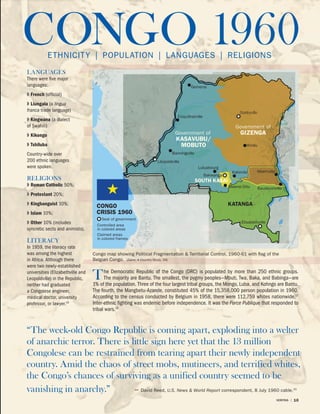
The Democratic Republic of the Congo (DRC) is populated by more than 250 ethnic groups.
The majority are Bantu. The smallest, the pygmy peoples—Mbuti, Twa, Baka, and Babinga—are
1% of the population. Three of the four largest tribal groups, the Mongo, Luba, and Kohngo are Bantu.
The fourth, the Mangbetu-Azande, constituted 45% of the 15,358,000 person population in 1960.
According to the census conducted by Belgium in 1958, there were 112,759 whites nationwide.17
Inter-ethnic fighting was endemic before independence. It was the Force Publique that responded to
tribal wars.18
Congo map showing Political Fragmentation & Territorial Control, 1960-61 with flag of the
Belgian Congo. (Zaire: A Country Study, 34)
Government of
KASAVUBU/
MOBUTO
Government of
GIZENGA
KATANGA
Elisabethville
Baudouinville
Albertville
Léopoldville
Banningville
Coquilhatville
Gemena
Stanleyville
Kindu
Kabinda
Mwene-Ditu
Bakwanga
SOUTH KASAI
Luluabourg
CONGO
CRISIS 1960
Seat of government
Controlled area
in colored areas
Claimed areas
in colored frames
LANGUAGES
There were five major
languages:
◗ French (official)
◗ Liungala (a lingua
franca trade language)
◗ Kingwana (a dialect
of Swahili)
◗ Kikongo
◗ Tshiluba
Country-wide over
200 ethnic languages
were spoken.
RELIGIONS
◗ Roman Catholic 50%;
◗ Protestant 20%;
◗ Kingbanguist 10%;
◗ Islam 10%;
◗ Other 10% (includes
syncretic sects and animists).
LITERACY
In 1959, the literacy rate
was among the highest
in Africa. Although there
were two newly-established
universities (Elizabethville and
Leopoldville) in the Republic,
neither had graduated
a Congolese engineer,
medical doctor, university
professor, or lawyer.19
ETHNICITY | POPULATION | LANGUAGES | RELIGIONS
CONGO 1960
VERITAS  |  10
President Joseph Kasavubu (C) and Premier & Defense Minister
Patrice E. Lumumba at Ndjili Airport, Leopoldville, Congo Republic.
Patrice E. Lumumba (1925-1961), the leader of the
Congolese National Movement (Mouvement National
Congolais [MNC]) that advocated for a strong central
government, was a member of the Batela tribe, one
of the smaller ethnic groups. The MNC dominated the
legislative elections in May 1960, but Lumumba lacked
tribal power. Since neither Lumumba nor his major political
rival, Joseph Kasavubu, the leader of Abako (Alliance
des Ba-Kongo [one of the four largest and most powerful
ethnic groups]), could form a parliamentary coalition,
the two split power in an uneasy partnership.20
The charismatic Lumumba, also “known as a clever,
anti-white rabble rouser,” dominated the political limelight
as the Premier (legislative leader) and Minister of Defense.21
Kasavubu, a federalist favoring tribal autonomy, adopted
a constrained role as Chief Executive/President. In the
turmoil, Moïse Tshombe proclaimed the independence of
the mineral-rich Katanga province on 11 July. By keeping
Belgians in charge of the military and police Tshombe
maintained order. On 8 August, Chief Albert Kalonji declared
the Mining State of South Kasai to be independent.22
These secessions prompted Premier Lumumba to demand
that the United Nations (UN) expel the Belgian forces and
restore order in Katanga and Kasai. When the UN refused
to interfere in the internal politics, Premier Lumumba
asked the Soviet Premier, Nikita I. Khrushchev, to airlift the
Congolese Army into the two provinces. This action caused
Western leaders, already suspicious of Lumumba’s motives
and political leanings, to label him a Communist.23
After the Congo premier and president unsuccessfully
tried to fire one another in early September, the Army Chief of
Staff, Joseph D. Mobutu, seized power to neutralize them. On
14 September 1960, Mobutu, a moderate, ordered all Soviet
and East European diplomats and technicians out of the
Congo. Lumumba was subsequently arrested and imprisoned.
Then, he was transferred to Katanga and executed on
21 January 1961.24
His deputy, co-founder of the leftist Parti
Solidaire Africain, Antoine Gizenga, had already escaped to
Stanleyville. Within a month Mobutu returned the presidency
to Joseph Kasavubu and focused on reorganizing the
Congolese Army.
★ThirtyYears11  |  VOL 14 NO 111  |  VOL 14 NO 1
3 Joseph D. Mobutu,
Commander-in-Chief,
Congolese Army.
2 Moïse Tshombe declared
the independence of Katanga
Province on 11 July 1960. It
was January 1963 before the
UN Peacekeeping Mission
(ONUC) defeated the Katangan
rebels and restored unity
to the Congo Republic.
1 Antoine Gizenga shared
leadership of the Congolese
National Movement (MNC).
Patrice E. Lumumba, Premier & Defense Minister, Congo Republic, was a gifted orator and rabble rouser. He symbolized
African colonial independence. After Joseph D. Mobutu seized power Premier Lumumba was jailed in the Thysville Prison
before being transferred to Katanga where he was killed. The Soviet Union created Patrice Lumumba University in Moscow
after his death. The USSR issued a Commemorative Stamp in his honor in 1961.
1 2 3
of Independent DisunityVERITAS  |  12VERITAS  |  12
Air Base (AB) in France after their Central Intelligence
Agency (CIA) briefing in Heidelberg. Three U.S. Air Force
squadrons stationed at Evreux had just been fielded with
new C-130 Hercules turboprop transports.40
Late Tuesday afternoon, 12 July 1960, the three SF soldiers,
accompanied by a French-speaking U.S. Air Force, Europe
(USAFE) radioman, Staff Sergeant (SSgt) Edward Cournoyer,
climbed down from a C-130A at the Belgian-guarded Ndjili
Airport just outside of Leopoldville. The four wore civilian
clothes and carried suitcases to ‘fit’ their French Canadian
medical‘cover.’Thenewturbopropaircrafthadjustescaped
a rebel-controlled airstrip in a hail of gunfire. The pilot
mistakenly landed on a gravel airstrip a few miles west of
the Ndjili Airport. From Leopoldville, Belgian commandos
had facilitated the evacuation of white Europeans aboard
Sabena, the national airline, since 8 July 1960.41
“Despite the
country-wide chaos, the Congolese international airport
was relatively calm, much like the ‘eye of a hurricane,’”
recalled retired COL Sully Fontaine.42
To avoid newspaper correspondents anticipating U.S.
support, the Belgian military had the American Air Force
plane park on the far side of the airport. While the aircrew
hurried to load the crates of radio equipment, rations
and generator aboard Belgian Army trucks, 1LT Fontaine
arranged to get the loadmaster to a hospital to cast his
broken leg. The Air Force crewman had been injured when
a generator had come unlashed during a violent desert
sand storm (naboob) above the Sahara. SP5 Mazak treated
him aboard the aircraft.43
Then, Fontaine explained to the Commando major in
charge that his mission was to coordinate light airplane
and helicopter rescues of American and foreign doctors,
nurses, and missionaries stranded in remote rural villages
in the contested countryside.44
Recognized as a fellow
Military Academy cadet the Belgian officer reassured
Fontaine that their medical cover story would be respected.
Since sunrise and sunset in equatorial Africa were at 6 AM
and PM respectively, the Americans were anxious to get to
the Embassy before dark.45
Ambassador Timberlake and his deputy, Robinson
‘Rob’ McIlvaine, the Consul General, welcomed the
American team. While SSgt Cournoyer was setting up his
radios in a spare room, 1LT Fontaine, CPT Clement, and
SGT Mazak were briefed on the situation and told that U.S.
military helicopters and light aircraft would arrive the
next day. Since the Belgian Commando security mission
at Ndjili Airport was temporary, Fontaine recommended
that U.S. aircraft be based out of Brazzaville Airport in
French Equatorial Africa. Ambassador Timberlake agreed,
and that decision was immediately relayed to USAREUR
to divert aircraft. The ambassador had already stationed a
U.S. Consul at the Brazzaville airport to assist refugees.46
A French Canadian medical ‘cover’ was acceptable to the
U.S. emissary.47
The Americans would adopt names related to the
humanitarian rescue mission codename, ROBERT SEVEN.
1LT Fontaine would be ROBERT ONE. He would be
‘carried on Embassy books’ as an Air Force first lieutenant
in the Air Attaché Office. He would liaison daily with
the ambassador.48
His role in the rescue mission was kept
from the CIA Station Chief, Lawrence R. ‘Larry’ Devlin,
who had been ‘in country’ three days.49
CPT Clement was
designated ROBERT TWO and SP5 Mazak was ROBERT
THREE. SSgt Cournoyer, as ROBERT FOUR, would be in
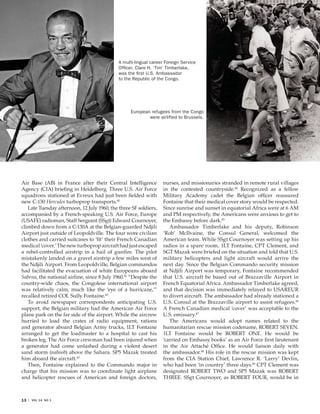
A multi-lingual career Foreign Service
Officer, Clare H. ‘Tim’ Timberlake,
was the first U.S. Ambassador
to the Republic of the Congo.
European refugees from the Congo
were airlifted to Brussels.
13  |  VOL 14 NO 1
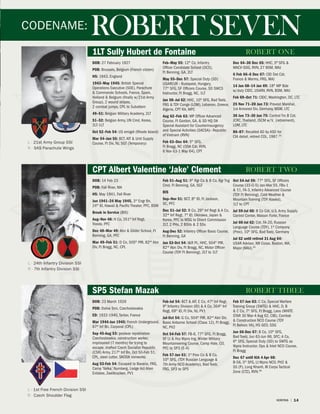
1LT Sully Hubert de Fontaine 	 ROBERT ONE
DOB: 27 February 1927
POB: Brussels, Belgium (French citizen)
HS: 1943, England
1943­–May 1945: British Special
Operations Executive (SOE), Parachute
& Commando Schools, France, Spain,
Holland & Belgium (finally w/21st Army
Group), 2 wound stripes,
2 combat jumps, CPL to Subaltern
49­–51: Belgian Military Academy, 2LT
51­–52: Belgian Army, UN Cmd, Korea,
2LT-1LT
Oct 52­–Feb 54: US emigré (Rhode Island)
Mar 54­–Jan 55: BCT, AIT & Unit Supply
Course, Ft Dix, NJ, SGT (Temporary)
Feb­–May 55: 12th
Co, Infantry
Officer Candidate School (OCS),
Ft Benning, GA, 2LT
May 55­–Dec 57: Special Duty (SD)
USAREUR - Budapest, Hungary,
77th
SFG, SF Officers Course, SD SWCS
Instructor, Ft Bragg, NC, 1LT
Jan 58­–Jul 62: HHC, 10th
SFG, Bad Toelz,
FRG & TDY Congo (LOM), Lebanon, Greece,
Algeria, CPT RA, MPC
Aug 62­–Feb 63: MP Officer Advanced
Course, Ft Gordon, GA, & SD HQ DA
Special Assistant for Counterinsurgency
and Special Activities (SACSA)– Republic
of Vietnam (RVN)
Feb 63­–Dec 64: 5th
SFG,
Ft Bragg, NC (ODA Cdr, RVN,
6 Nov 63-1 May 64), CPT
Dec 64­–30 Dec 65: HHC, 5th
SFG &
MACV-SOG, RVN, 27 BSM, MAJ
6 Feb 66­–6 Dec 67: CID Det Cdr,
France & Worms, FRG, MAJ
14 Jan 68­–14 Jan 69: 18th
MP Bde
w/duty CIDC, USARV, RVN, BSM, MAJ
Feb 69­–Oct 71: CIDC, Washington, DC, LTC
25 Nov 71­–20 Jun 73: Provost Marshal,
1st Armored Div, Germany, MSM, LTC
30 Jun 73­–30 Jun 75: Control Tm B Cdr,
JCRC, Thailand, JSCM w/V, (retirement),
LOM, LTC
86­–87: Recalled AD by ASD for
CIA detail, retired COL, 1987.34
CPT Albert Valentine ‘Jake’ Clement 	 ROBERT TWO
SP5 Stefan Mazak 	 ROBERT THREE
DOB: 14 Feb 23
POB: Fall River, MA
HS: May 1941, Fall River
Jun 1941­–24 May 1945, 3rd
Engr Bn,
24th
ID, Hawaii & Pacific Theater, PFC, BSM
Break in Service (BIS)
Aug­–Nov 48: H Co, 351st
Inf Regt,
Trieste, PFC
Dec 48­–Mar 49: Abn & Glider School, Ft
Benning, GA, PFC
Mar 49­–Feb 51: D Co, 505th
PIR, 82nd
Abn
Div, Ft Bragg, NC, CPL
Feb 51­–Aug 51: 9th
Rgr Co & B Co, Rgr Tng
Cmd, Ft Benning, GA, SGT
BIS
Sep­–Nov 51: BCT, 8th
ID, Ft Jackson,
SC, PFC
Dec 51­–Jul 52: B Co, 29th
Inf Regt & A Co,
32nd
Inf Regt, 7th
ID, Okinawa, Japan &
Korea, PFC to MSG to Direct Commission
2LT, 2 PHs, 2 BSVs & 2 SSs
Aug-Dec 52: Infantry Officer Basic Course,
Ft Benning, GA
Jan 53-Oct 54: I&R PL, HHC, 504th
PIR,
82nd
Abn Div, Ft Bragg, NC, Motor Officer
Course (TDY Ft Benning), 2LT to 1LT
Oct 54-Jul 59: 77th
SFG, SF Officers
Course (33-O-5) Jan-Mar 55, FBs-1
& 11, FA-3, Infantry Advanced Course
(TDY Ft Benning), Cold Weather &
Mountain Training (TDY Alaska),
1LT to CPT
Jul 59-Jul 60: B Co Cdr, U.S. Army Supply
Control Center, Maison Forte, France
Jul 60-Jul 62: Cdr, FA-20, Russian
Language Course (TDY), 1st
Company
(Prov), 10th
SFG, Bad Toelz, Germany
Jul 62 until retired 31 Aug 64:
USAR Advisor, XIII Corps, Boston, MA,
Major (MAJ).35
DOB: 23 March 1926
POB: Dolne Srni, Czechoslovakia
ED: 1932-1940, Tartier, France
Mar 1944-Jun 1945: French Underground,
67th
Inf Bn, Corporal (CPL)
Sep 45-Aug 53: postwar repatriation
Czechoslovakia, construction worker,
imprisoned (7 months) for trying to
escape, drafted Czech Socialist Republic
(CSR) Army, 217th
Inf Bn, Oct 50-Feb 51,
CPL, steel cutter, SKODA ironworks
Aug 53-Feb 54: Escaped to Bavaria, FRG,
Camp ‘Valka,’ Nurnberg, Lodge Act Alien
Enlistee, Zweibrucken, PV1
Feb-Jul 54: BCT & AIT, E Co, 47th
Inf Regt,
9th
Infantry Division (ID) & A Co, 364th
Inf
Regt, 69th
ID, Ft Dix, NJ, PV1
Jul-Oct 54: G Co, 504th
PIR, 82nd
Abn Div
Basic Airborne School (Class 12), Ft Bragg,
NC, PV2
Oct 54-Feb 57: FB-6, 77th
SFG, Ft Bragg,
SF Lt & Hvy Wpns tng, Winter Military
Mountaineering Course, Camp Hale, CO,
PFC to SP3 (E-4)
Feb 57-Jan 61: 1st
Prov Co & B Co,
10th
SFG, (TDY Russian Language &
7th Army NCO Academy), Bad Toelz,
FRG, SP3 to SP5
Feb 57-Jun 63: C Co, Special Warfare
Training Group (SWTG) & HHC, D, B
& C Co, 7th
SFG, Ft Bragg, Laos (WHITE
STAR 30 Mar-4 Aug 62, CIB), Combat
& Construction NCO Course (TDY
Ft Belvoir, VA), HS GED, SSG
Jun 66-Dec 67: B Co, 10th
SFG,
Bad Toelz, Jun 63-Jun 66, SFC; A Co,
6th
SFG, Special Duty (SD) to SWTG as
Wpns Instructor, Ops & Intel NCO Course,
Ft Bragg
Dec 67 until KIA 4 Apr 68:
B-56, 5th
SFG, Lt Wpns NCO, PH2 &
SS (P), Long Khanh, III Corps Tactical
Zone (CTZ), RVN.36
L - 21st Army Group SSI
R - SAS Parachute Wings
L - 24th Infantry Division SSI
R - 7th Infantry Division SSI
L - 1st Free French Division SSI
R - Czech Shoulder Flag
CODENAME:
ROBERTSEVEN
VERITAS  |  14
charge of the embassy radio base station that connected
Heidelberg, Bad Toelz, and Brazzaville Airport. COL Paulick
would be updated by message traffic, telephone calls from
Ambassador Timberlake, and by CPT Richard ‘Dick’
Kim, another ‘Ham’ operator working in the 10th
SFG
Operations Section, monitoring that system.50
The Air Force
communications ‘wizard’ got his ‘Ham’ radio working and
began broadcasting as “U.S. Congo Rescue Central.”51
But,
maps to guide air rescues in the bush were scarce.
Ambassador Timberlake had the 'best' map of the
Congo, circa 1950, mounted on his office wall. No others
were available because Congolese had burned the map
warehouse shortly after independence. Road maps from
the Belgian Congo Auto Club, though dated and lacking
detail, had to suffice. McIlvaine, a WWII Navy veteran,
gave twenty to Fontaine. After a simple sandwich meal,
ROBERT ONE, TWO, and THREE were driven to the
ambassador’s residence for the night. Timberlake was
‘living’ in his office.52
At daybreak Wednesday, 13 July 1960, an embassy car
took the three SF soldiers to the Congo River ferry landing.
There they witnessed firsthand some mutinous, inebriated
Congolese soldiers harassing the Belgian families waiting
to board Brazzaville ferries. When passage was secured
(tickets), the Europeans abandoned cars and trucks to carry
babies, suitcases, boxes and pets to get in the boarding
line.53
Once beyond the safety of their vehicles, harassment
from the Congolese troops began. They were in various
states of “battle dress with leaves and brush tied to their
helmets (matiti) lounging near the access way. Some carried
rifles while others had machetes,” reported Larry Devlin,
the Station Chief.54
ROBERT THREE, the former French Underground and
Czech Republic soldier, moved forward to check out the
situation. He described the scene at the ferry dock differently:
“There are a couple hundred whites lined up waiting
to get on the ferry and the rebels are taking anything of
value. Their uniforms look like s**t. One guy carrying
an assault rifle is wearing a business suit…a suit,
white shirt and tie with military webbing on. Can you
believe that? They all look like rabble, not rebels. But,
they’re bloody armed to the teeth. They’ve all got two
or three weapons…”55
The quick thinking Czech prevented an older woman
from having her ring finger broken by a Congolese soldier.
He simply stepped between them and applied Vaseline
from his ‘Red Cross’ medical pack. A wedding ring, he
decided, was not worth injury. The rebels appreciated the
jar of salve to facilitate their plundering.56
Interestingly,
the French-speaking ‘Canadian Red Cross’ medics were
accorded a measure of respect by the rebellious troops.
In the prevailing disorder patience was required. The
three ‘Canadian Red Cross’ medics were escorted to
the front of the line, but the strong currents of the ¾
mile-wide Congo River had to be navigated by the
grossly overloaded ferry, and a taxi hired to take the
ROBERTs to the airport. The French Air Base Commander,
LTC Cottar, met with ROBERT ONE to discuss housing,
C-124 Globemaster IIs
delivered the U.S. Air
Force, Europe (USAFE)
58th Air Rescue Squadron
H-21 Workhorse helicopter
(Wheelus Airbase, Tripoli,
Libya) to Brazzaville Airport,
French Equatorial Africa.
The 317th Troop Carrier
Wing at Evreux-Fauxville
Airbase in France received
three squadrons of the
new Lockheed C-130A
Hercules turboprop
transports in early 1960.
15  |  VOL 14 NO 115  |  VOL 14 NO 1
aircraft fuel, maintenance and facilities for the U.S. military
light aircraft. Then, the Americans went to a sporting
goods store in Brazzaville to buy safari clothing. When they
returned the French lieutenant colonel provided them with
two 9 mm MAT-49 (Manufacture National d’Armes de Tulle
1949) folding-stock submachineguns and extra magazines.
These substantially bolstered their ‘self-defense arsenal’
from Bad Toelz: three M1911 .45 caliber automatic pistols
and a box of fragmentation hand grenades.57
ROBERT ONE
introduced himself to the senior U.S. Army aviator, a major,
before going to see what had come from Europe.58
Several U.S. Air Force planes had arrived carrying
helicopters. A four-engine C-124 Globemaster II (from
Chateauroux AB, France) brought a 58th
Air Rescue
Squadron H-21B Workhorse (‘Flying Banana’) helicopter, crew,
and mechanics from Wheelus AB, Tripoli, Libya.59
Two
C-130s had flown in a pair of H-19 Choctaw helicopters
with aircrews and mechanics from Germany. The Army
aviation major as Officer-in-Charge (OIC) of the U.S.
Aviation Detachment, became ROBERT FIVE. The six light
airplanes ‘hopping’ to the Congo [two DeHaviland U1-A
Otter and four L-20 Beaver STOL (short takeoff/landing)]
were due in before dark. They were coming in two flights
(U1-As & L-20s) direct from Germany, stopping only to
refuel. ROBERT ONE told ROBERT FIVE that he would
provide a mission brief after everyone arrived.60
At the request of the Aviation Detachment OIC, ROBERT
ONE slipped his briefing to early morning, Thursday, 14 July
1960. Though the faster flying, longer range Otters arrived
well ahead of the slower, shorter range Beavers, the fixed-
wing aviators were mentally and physically drained. Despite
two pilots per aircraft, they had flown more than 1200 miles
with limited or no ground navigation aids (NAVAID) across
Europe, the Mediterranean Sea, and uncharted African
deserts. The Aviation Detachment with its Army and
Air Force personnel grew to more than seventy airmen,
mechanics, administrative, medical, and supply personnel.61
Unable to get back to Leopoldville before dark on Wednesday,
13 July, ROBERT ONE radioed ROBERT FOUR to talk with
Ambassador Timberlake. After that conversation ROBERT
FOUR provided the evacuation requests because the rescues
would begin the next day—14 July 1960.62
Shortly after first light on Thursday, 14 July, ROBERT
ONE, nattily dressed in a khaki safari bush hat, shirt,
shorts, and brogans, addressed the assembled Aviation
Detachment. He explained in detail the situation, their
mission and the evacuation plan. They would use jungle
airstrips while the Belgians flew their larger civilian and
military fixed wing transports from established airports.63
An American Consul located at the airport (Brazzaville)
was processing refugees, arranging flights on Sabena
Airlines and aboard U.S. Air Force aircraft, and housing
them in a temporary holding area.64
Standard operating
procedures (SOP) for rescue operations ended the briefing.
The helicopters each carried a 55-gallon drum of
aviation gasoline (AVGAS) and hand pump to emergency
refuel. With evacuation requests received from the villages
of Banza-Manteke and Sona-Bata, 1LT Fontaine led the
first mission aboard the Air Force H-21 helicopter with one
Army H-19 helicopter trailing.66
ROBERTONEandthehelicopterpilotsquicklydiscovered
that their 1/250,000 scale air and Belgian Congo Auto Club
maps were inadequate. ‘Dead reckoning’ using compass
headings and distance ‘guesstimating’ based on airspeed
AF SSgt Edward Cournoyer
established himself as
‘U.S. Congo Rescue Central’
and began broadcasting
with his Ham radio from the
U.S. Embassy-Leopoldville
on 12 July 1960. This
is the International
Amateur Radio Symbol.
The ramshackle Congo River ferries were packed to the rails with refugees and motor
vehicles. Safety was not an issue for those fleeing the former Belgian colony.
VERITAS  |  16
prompted the pilots to fly at different altitudes to improve
visual acuity and maintain radio communications. After
considerable searching the two aircraft finally located
Banza-Menteke and Sona-Bata. Twenty-four Americans
were shuttled to Brazzaville in several lifts. The wisdom of
the ‘two aircraft rule’ was verified; however, newer, smaller
scale maps had to be found.67
ROBERT ONE explained his problem to LTC Cottar,
the airbase commander, and MAJ Bena, an intelligence
officer from Deuxiéme Bureau (National D-2). A meeting
was arranged in Leopoldville with Henry Latur, a Belgian
aerial photographer, who had been mapping the Congo
before independence. He kept his airplane and had a
dark room at the Brazzaville Airport. With the possibility
of getting paid for what he had done, the photographer
agreed to share his photos, bush flying experience, and
knowledge of the countryside. A native Flemish speaker
proved essential to the negotiations. The aerial photos
were indispensable because they reduced the search time
to allow for more rescues.68
The next day, 15 July, the three SF ROBERTs, using the
two Army H-19 Choctaw helicopters, rescued twenty-six
American, British, and Belgian citizens from the villages
of Kimpese, Moerbeke, Zongo, and Sanga. Then, the SF
ROBERTs rescued another twelve individuals from Lutete
in the afternoon with the Air Force H-21 Workhorse.69
While these rescues were ongoing that day, Belgian
troops raced into Leopoldville to seize all refugee escape
routes. In accordance with unsigned pre-independence
agreements, several all-Belgian combat units had been
left behind in Kamina for ninety days to reinforce the
Force Publique.70
The motorized Belgian columns easily
took control of all roads to the ferry and the airport.
The soldiers had been dispatched to safeguard the lives
of whites and to ensure that any wanting to escape ‘the
jungle of anarchy’ could do so.71
Ambassador Timberlake took advantage of the Belgian
security measures to evacuate several American families
that had taken refuge in the embassy. These fifteen
personnel and their baggage were bundled into a convoy of
cars that collected another fifty-five Americans stranded in
hotels across the city. Because Consul Frank C. Carlucci III
had built the best connections with Congolese government
leaders, he and Larry Devlin, the Station Chief, escorted
1 3
2 4
1 The U.S. Air Force H-21 Workhorse (nicknamed ‘Flying
Banana’) helicopter with a crew of two (pilot & co-pilot) could
carry 12 U.S. combat-loaded troops at 85 mph for 450 miles.
2 The U.S. Army Korean War era H-19 Choctaw with
a crew of two (pilot & co-pilot) could carry ten U.S.
combat-loaded soldiers at 85 mph for 450 miles.
3 The Army L-20/U-6 Beaver STOL (short takeoff/landing)
airplane had a crew of one (pilot) and could carry 6 passengers
at 143 mph for 455 miles.
4 The U.S. Army U1-A Otter STOL airplane with a crew of one
(pilot) could carry 9-10 passengers at 160 mph for 945 miles.
17  |  VOL 14 NO 117  |  VOL 14 NO 1
the convoy of cars to the Congo River ferry dock and
secured passage on vessels crossing to Brazzaville. The
American embassy in Leopoldville was so new that its U.S.
Marine security detail had not yet arrived.72
With cars and
trucks denied passage on the ferries more than 200 men,
women, and children could be packed aboard. Because
few Congolese knew how to drive, ‘appropriated’ cars and
trucks abandoned by whites quickly littered city streets—
with engines blown and/or clutches burned out.73
In the
meantime, air rescues continued.
On 16 and 17 July, sixty-six personnel were evacuated by
helicopter. The SF ROBERTs encountered three scenarios
in the remote villages: mutilated white bodies in various
stages of decomposition; white families hidden from
marauders by loyal Congolese; and those electing to
stay despite the atrocities all around—longstanding
missionaries, nuns, and medical personnel.74
The former
was the most disconcerting to the team.75
On 18 July, the H-21 was sent to Vanga, two L-20 Beavers
were dispatched to Nicki, and two H-19s were sent
to Inkisi, then to Kikemebele. The number of aircraft
committed revealed that deviations from the SOP had
started: the ‘two aircraft-buddy team’ and security
overwatch rules for the SF ROBERTs were ignored.76
The
two H-19 Choctaws were driven off by ground fire near
Kikemebele; one helicopter took eight hits from automatic
rifle fire. The Beavers carried out eleven people from
Nicki and ROBERT ONE arranged for a U.S. Air Force
C-47 Skytrain to evacuate the remaining twenty-seven.
That WWII twin-engine workhorse was flying home [the
U.S. Military Assistance Advisory Group (MAAG)] to
Praetoria, South Africa, when it diverted in response to a
radio call for help. The C-47 pilots rescued twenty-seven
fear-stricken evacuees from Nicki. Hostile fire disabled an
engine, but the French Air Force at Brazzaville replaced
it.77
More deviations from the SOP resulted in a serious
incident on the way to Vanga.
Unable to locate Vanga, the H-21 Workhouse with only
ROBERT TWO onboard landed outside Dinga to get
directions. ROBERT TWO went into the village alone.
When he did not return promptly, Air Force LT George
Meyers, the co-pilot, ignored SOP and climbed out of
the idling helicopter to search for him. The pilot was left
alone at the controls. Meyers did not find ROBERT TWO,
but encountered an American missionary, George Franke.
As the Air Force lieutenant and Mr. Franke were heading
back to the helicopter, a number of hostile Congolese
began chasing after them. Then, a Life magazine photo-
journalist, Terry Spencer, who had been hiding in the cargo
compartment, jumped out with his camera. He managed to
take pictures of LT Meyers and Franke fleeing towards the
H-21. Spencer missed the return of ROBERT TWO because
he was running obliquely to the idling helicopter. After
Franke and Meyers scrambled aboard, Spencer, camera
in hand, followed as ROBERT TWO ran up. The H-21
immediately lifted clear of the danger but the damage had
been done. The newspaperman had his story and photos.78
After finding Vanga, twenty-eight people were evacuated
in separate lifts. During the evacuations SOPs were totally
disregarded and Spencer continued taking pictures.79
With the rescue mission potentially compromised
ROBERT ONE brought Spencer to the U.S. Embassy to
see Ambassador Timberlake. His film negatives were
checked closely. Since he had no photos of ROBERT TWO at
Dinga or Vanga to postulate an SF presence in the Congo,
Timberlake requested that Spencer delay dispatching his
story in exchange for details on the numbers rescued.
This ‘gentlemen’s agreement’ was honored; the story was
published in the 8 August 1960 issue of Life magazine. By
then, the American military light aircraft rescue mission
was long over.80
Back in the primary area of operations,
evacuation requests from villages ‘close in’ to Leopoldville
had been exhausted.
SOPRescueOperations
1 The USEUCOM humanitarian rescue effort was classified
CONFIDENTIAL because of its political sensitivity.
2 Aircraft would fly in pairs for safety reasons (two-plane
‘buddy rule’). There would be two SF ROBERTs in the lead
aircraft. The third SF ROBERT would be in the second plane
that remained aloft to maintain communications and to alert
the ground team of danger. It was not to land until radioed to
do so by an SF ROBERT on the ground.
3 Pilots were to stay at their controls with engines running,
ready for an immediate departure. The pilots were not to leave
the cockpit for any reason. Any weapons carried had to be
concealed and were not be used without an SF ROBERT
signaling to do so.
4 The lead aircraft would make a ‘touch and go’ to evaluate
landing conditions and assess the situation on the ground,
do a ‘fly around’ and then land to allow the two SF ROBERTs
to get out and contact the whites wishing evacuation. One
SF ROBERT would cover the other with a concealed weapon
(submachinegun, .45 automatic, and/or a hand grenade).
5 While one aircraft carried evacuees out, the other would stay
aloft to rescue the SF ROBERTs on the ground and maintain
radio communications with them, U.S. Congo Rescue Central
(ROBERT FOUR), and ROBERT FIVE at the Brazzaville Airport.
6 The signal that it was safe to land was one white sheet
while two sheets signified danger and/or unsafe to land.
ROBERT FOUR passed those signals to the ‘Ham’ operators
in the remote villages.65
VERITAS  |  18
First Lieutenant (1LT) George Meyers, 58th
Air
Rescue Squadron (Wheelus Airbase, Tripoli, Libya),
co-pilot of the H-21 Workhorse helicopter, ignored
their flight SOP. He left the cockpit to search for
ROBERT TWO [SF Captain (CPT) Albert V. Clement]
who had gone into Dinga for directions to Vanga.
Spotting the helicopter a few Belgian refugees in cars
vectored in on it. As they ran to clamber aboard Terry
Spencer, a Life magazine photo-journalist hidden
in the cargo compartment, scrambled out to take
pictures. He caught LT Meyers with George Franke, an
American missionary, first walking, and then running
as hostile Congolese began chasing them and
shooting. The gunfire forced Spencer back inside the
helicopter just before CPT Clement ran up. Shrapnel
from a ricocheting bullet nicked a Belgian’s nose.
The British war correspondent took photographs
during the two lifts of evacuees from Vanga. But,
true to his agreement with U.S. Ambassador Clare
H. Timberlake, Spencer did not send his story to Life
while the American light aircraft rescue mission was
ongoing. (Life, 10 August 1960, 10-17)
Terrence ‘Terry’ Spencer (1918-2009)
Royal Air Force (RAF) Spitfire & Hurricane pilot, Squadron
Leader, WWII, December 1939—February 1946, Distinguished
Flying Cross (DFC), destroyed seven V-1 rocket ‘buzz’ bombs,
POW twice—escaped once (Steve McQueen in The Great
Escape)…Aerial photographer and diamond smuggler, South
Africa, 1946-1952…Life magazine war correspondent:
REFUGEE
RESCUE
19  |  VOL 14 NO 1
Sharpeville massacre, Mau-Mau uprising, Congo crisis,
Nigerian civil war, Nelson Mandela and Jomo Kenyatta—
Apartheid in Africa, the Algerian war, Vietnam, Indonesia,
Middle East, and Cuba; Life celebrity photographer for The
Beatles, Bob Dylan, Freddie Mercury, Ava Gardner, Katherine
Hepburn, Princess Grace of Monaco, 1952-1972… New York
Times and People magazine celebrity photographer: Princess
Diana to Louis Armstrong, 1972-1992. 103
VERITAS  |  20VERITAS  |  20
To extend aircraft range, ROBERT ONE proposed to
establish a pair of forward operating bases at Belgian
Army-secured airstrips near Coquilhatville and Kikwit.
The U.S. ambassador agreed with extending the rescue
effort to the north and northwest. However, only selected
airplanes and helicopters would go north on 19 July.81
The
Army STOL airplanes, the Otters and Beavers, and the two
H-19 Choctaw helicopters had the longest ranges. The Air
Force H-21 Workhorse would remain at Brazzaville for local
emergencies. The 18 July mission to Vanga was its last
Congo flight.82
‘Away from the flagpole,’ buoyed with five
days of success, and having escaped compromise, deviation
from the SOP became the norm.
The three SF ROBERTs split themselves between the two
forward operating sites and went on missions with available
aircraft. An H-19 and an L-20 flying out of Kikwit on 20 July
with ROBERT TWO evacuated nineteen personnel from the
villages of Boeme, Kalagonda, Kintshua, and Tshene.83
Then,
ROBERTs ONE and THREE took a single U-1A Otter from
Coquihatville to Wema and Boende. Once on the ground
the two men split up.84
Any problems that they encountered
were not mentioned in the Rescue Mission Report or the
USAREUR 1953-1963 History Report. Nothing was found
in the three OMPR files of the SF ROBERTs.85
But, when a
second U-1A Otter arrived, twelve evacuees and the two
ROBERTs were shuttled out.86
During the period 19-23 July
1960, specific nightly locations of the three SF ROBERTs and
the various aircraft could not be determined.87
However, the military light aircraft team was quite busy.
Kikwit handled fifty evacuees on 20 and 21 July. Two L-20s
and a U1-A brought twelve refugees to Coquilhatville
on 21 July. Sabena Airlines evacuated twenty-four British
missionaries from Basankusu. And, on 22 July, eight
Catholic nuns and a sick priest were flown to Kikwit
to catch a Belgian Air Force C-119 Flying Boxcar going to
Brazzaville. One of two L-20s sent to make final checks
of Belenda, Semandua, Kutu, and Inongo on 23 July was
hit by small arms fire. That visual reconnaissance was the
final U.S. light aircraft rescue mission.88
From 14 to 22 July 1960, eight Army aircraft and one Air
Force helicopter evacuated 239 personnel and coordinated
airlift for another 51 people on larger U.S. and Belgian
airplanes. Two Aviation Detachment aircraft sustained minor
damage from small arms ground fire.89
While this American
military mission was engaged in rescuing Americans and
foreigners from the Congo bush, the United Nations (UN)
approved the creation of a peacekeeping force for the Congo.
The U.S. Air Force transported contingents from Ghana and
Tunisia to Ndjili Airport on 15 July and flew refugees back
to Europe.90
The Congo River separated the two elements
based at different airports. Once the light aircraft bush rescue
missionwascompleted,theU.S.militarytaskforcesupporting
Ambassador Timberlake started transferring equipment,
supplies, and communication networks to the UN.
The 10th
SFG role ended when ROBERTs TWO and
THREE left the Congo on 26 July. The explanation for
their absence from Bad Toelz, Germany, was ‘a classified
mission in Spain.’ Ambassador Timberlake convinced
COL Paulick to allow 1LT Fontaine to stay for thirty more
days to capitalize on his government contacts.91
Epilogue
On 24 July the EUCOM Aviation Detachment relocated
from the Brazzaville Airport to the Ndjili Airport across the
Congo River. That airport was designated as the UN Air
Command base. In addition to the two H-19Choctaw medium
transport helicopters, two U-1A Otter, and four L-20 Beaver
STOL airplanes, USAREUR transferred six Korean War-
era H-13 Sioux light observation helicopters to the UN. The
Army aviators conducted a ‘checkout’ program for UN
volunteer pilots from fifteen different nations. They were
oriented on flying conditions, weather, and environmental
nuances in the million square miles of the Congo.92
When the Air Force 58th
Air Rescue Squadron H-21
Workhorse helicopter team learned that USAREUR was
transferring its aircraft to the UN, they quickly arranged
transport back to Wheelus Airbase, Tripoli, Libya. While
this was happening, USAREUR signalmen installed radios
in the control tower so that U.S. Army air traffic control
(ATC) soldiers could train UN personnel. Mechanics and
repairmen provided technical instruction to UN personnel
on aircraft and radio maintenance. USAFE SSgt Edward
Cournoyer and the USAREUR pilots, mechanics, supply,
and medical personnel worked themselves out of jobs by
31 July. When 1LT Fontaine left the Congo on 27 August the
UN buildup was in full swing.93
The first contingent of UN forces arrived on 15 July.
Belgium began its withdrawal of combat troops on
16 July and the last elements left Leopoldville on 23 July. By
20 July there were 3,500 UN peacekeepers from Ethiopia,
Ghana, Morocco, and Tunisia in the country. With the
U.S. Air Force transporting foreign contingents the UN
buildup continued: 8,000 by 25 July; and over 11,000 by
31 July.94
With its Air Command established at Ndjili Airport,
the UN was able to expand its peacekeeping mission in the
Congo to peace enforcement.95
The UN peacekeeping mission in the Congo (ONUC for
its French name Opération des Nations Unis au Congo) became
Opération des Nations Unis au Congo I (ONUC I) became the largest,
most complex, and most expensive UN peacekeeping mission during
the Cold War.
21  |  VOL 14 NO 1
its largest, most complex and expensive military mission
during the Cold War.96
The peacekeeping mandate was
expanded in February 1961 to end the secession of Katanga
province. After UN ground forces ‘invaded’ the province a
shooting war developed in September 1961, when a single
Katangan Air Force Fouga Magister jet fighter strafed the
UN headquarters and its defensive positions, isolated an
Irish infantry company to force a surrender, damaged
UN Secretary-General Dag Hammarskjöld’s aircraft, and
destroyed several chartered airplanes at the Elizabethville
Airport. Premier Möise Tshombé scrambled to rebuild his
air force using the black arms market while the UN solicited
combat aircraft from the member nations.97
UN defeat of
the Katangan military in January 1963 finally restored the
secessionist province to the Congo, but the international
body faced another decade of turmoil.98
Postscript
In late January 1961, the three 10th
SFG soldiers were
decorated for conducting sixteen rescues of American and
European citizens from remote jungle areas of the Congo.
They faced possible capture and death at the hands of
warring tribes. The rescues were accomplished “in the face
of a highly explosive internal political situation.”99
1LT Sully
H. Fontaine was awarded the Legion of Merit (LOM) by
Department of Army. CPT Albert V. ‘Jake’ Clement and SP5
Stefan Mazak were presented Army Commendation Medals
(ARCOMs)approvedbytheSeventhU.S.Army,USAREUR.100
The three qualified for the Armed Forces Expeditionary
Medal (AFEM) and the UN ONUC I medal.101
The U.S.
Army Adjutant General (TAG), Major General (MG) R.V.
Lee, reminded these SF soldiers about the sensitivity of
their mission: “Disclosure of this information to news
media may be made only in the event of specific inquiry.”
Associated risk was downplayed: “By assisting the U.S.
Ambassador in protecting U.S. nationals in the Republic of
the Congo, you greatly aided in alleviating a potentially
dangerous situation.”102
Three Special Forces soldiers, 1LT
Fontaine, CPT Clement, and SP5 Mazak from the 10th
SFG
clandestinely effected light aircraft rescues and coordinated
transport for nearly 300 American and European refugees
in the Congo. These accomplishments by truly ‘silent
professionals’ went unheralded for almost sixty years.
1 2
3 4 5
1 Canadian U-1A Otter with UN markings in Congo.
2 USAREUR U-1A Otter inside Ndjili Airport
hangar, Leopoldville, Republic of Congo.
3 USAREUR L-20 Beavers with ONUC markings.
4 USAREUR H-19 Choctaw with UN markings.
5 USAREUR sent six H-13 Sioux observation helicopters to
the UN Air Command in the Congo.
VERITAS  |  22
Endnotes
1	 Sandra W. Meditz and Tim Merrill, eds., Zaire: A Country Study. Department of the
Army Pamphlet (DA Pam) 550-67 (Fourth Edition, Washington, DC: Department of
the Army, 1994), 28.
2	 Meditz and Merrill, Zaire, 31.
3	 Albert J. Meyers, “Airlift from Terror—The Refugees’ Story,” U.S. World & News
Report, 49:52 (25 July 1960), 53.
4	 D. J. Hickman, The United States Army in Europe, 1953-1963 (Heidelberg, Germany:
Operations Division Historical Section, 1964), 181, hereafter cited as USAREUR
History Report, 1953-1963.
5	 Alan P. Merriam, Congo: Background of Conflict (Evanston, IL: Northwestern
University Press, 1961), 206.
6	 Though a memoir [Jack Lawson with Sully de Fontaine, Slaver’s Wheel: A Green Beret’s
True Story of His CLASSIFIED MISSION in The Congo (Ashland, OR: Hellgate Press,
2012)] was ghost-written with the help of the last living participant, information
contained therein that could not be corroborated with official sources will not be
discussed to preclude lending credence.
7	 Daniel L. Haulman, “Crisis in the Congo: Operation NEW TAPE,” in A. Timothy
Warnock, ed., Short of War: Major USAF Contingency Operations 1947-1997 (Maxwell
AFB, AL: Air Force History and Museums Program, 2000), 24-27. The U.S. Air Force
began evacuating American citizens and airlifting desperately needed food into
the Congo on 8 July 1960 (Operation SAFARI). This evolved into Operation NEW
HOPE in mid-July as the mission expanded to airlifting UN military peacekeeping
contingents, supplies, and equipment. NEW HOPE lasted until 30 June 1964 and
marked the beginning of the end for the C-124 Globemaster II. It was slower and more
expensive to operate than the newly-fielded turboprop C-130 Hercules that could land
and takeoff from shorter field strips. 28-29.
8	 Violaine I. Junod, ed., The Handbook of Africa (New York: New York University Press,
1963), vi-vii.
9	 George Martelli, Leopold to Lumumba: A History of the Belgian Congo, 1877-1960
(London: Chapman & Hall, Ltd., 1962), 225-230.
10	 David Reed, “I Saw Whites Flee the Congo,” U.S. News & World Report (25 July 1960), 52.
11	 “Where the Congo Goes From Here,” U.S. News & World Report (8 August 1960), 48.
12	Martelli, Leopold to Lumumba, 231.
13	Martelli, Leopold to Lumumba, 231.
14	Martelli, Leopold to Lumumba, 224.
15	 Reed, “Mutiny in the Congo—More Troubles Coming,” U.S. News & World Report (18
July 1960), 51; Reed, “I Saw Whites Flee the Congo,” U.S. News &World Report (25 July
1960), 50; The Force Publique was composed of 24,000 African troops and 975 Belgian
officers. “Analytical Chronology” [December 1960], National Security Files, Box 27,
President John F. Kennedy Library, 2 of 73 pages at https://wilsoncenter.org.sites/
default/files/Congo1960-61_1.pdf accessed 2/20/2018.
16	Merriam, Congo, 286.
17	Junod, The Handbook of Africa, 79-83.
18	 “King Gives Up a Colony—and His Sword: IndepenDance Dance in the Congo,” Life
49:2 (11 July 1960), 24.
19	 “Summer in the Congo,” The New Republic 242:25: 2379 (20 June 1960), 6; “Drums
Along the Congo,” The Nation 191:3 (9 July 1960), 22.
20	Martelli, Leopold to Lumumba, 241; Francis B. Stevens, “A Letter From the Congo: How
Things Look in Katanga,” U.S. News & World Report 49:54 (15 August 1960), 52.
21	 “Analytical Chronology” [December 1960], National Security Files, Box 27, President
John F. Kennedy Library, 3 of 73 pages at https://wilsoncenter.org.sites/default/files/
Congo1960-61_1.pdf accessed 2/20/2018.
22	Martelli, Leopold to Lumumba, 241; Stevens, “A Letter From the Congo: How Things
Look in Katanga,” U.S. News & World Report 49:54 (15 August 1960), 52.
23	Martelli, Leopold to Lumumba, 241; Stevens, “A Letter From the Congo: How Things
Look in Katanga,” U.S. News & World Report 49:54 (15 August 1960), 52.
24	 The People’s Friendship University of the Soviet Union (today’s People’s Friendship
University of Russia), established on 5 February 1960, to help developing nations,
was renamed Patrice Lumumba University on 22 February 1961, a month after his
execution in Katanga. Until the collapse of the Soviet Union, the school awarded
full scholarships to everyone, and the Communist Party provided subsidies for
round-trip airfare, room and board, and a stipend. More than 70 percent of the
6,500 students were foreigners. Clara Germani, “Moscow’s Academic Nightmare,”
Baltimore Sun Journal, 5 November 1995 at https://articles.baltimore sun.com/1995-
11-05/news/1995309007_1_patrice-lumumba-dream accessed 2/21/2018.
25	 Reed, “Mutiny in the Congo—More Troubles Coming,” U.S. News & World Report (18
July 1960, 51.
26	Merriam, Congo, 286; “Where the Congo Goes From Here,” U.S. News & World Report
(8 August 1960), 48.
27	 Fontaine interview, 22 September 2009; “Analytical Chronology” [December 1960],
National Security Files, Box 27, President John F. Kennedy Library, 7 and 10 of 73
pages at https://wilsoncenter.org.sites/default/files/Congo1960-61_1.pdf accessed
2/20/2018. Ambassador Timberlake: “Cannot too greatly urge most immediate
dispatch of the two companies.” The US combat troops were to stabilize the
situation long enough to permit the peaceful entry of other forces. When his request
was answered with a Special Forces team and a light aviation task force, the U.S.
ambassador stated that the refusal to send troops was being interpreted by many
Congolese as U.S. sympathy for, or even complicity with, the Belgian action.
28	 Fontaine interviews, 23 April 2009 and 22 September 2009.
29	 Fontaine interview, 22 July 2008; Charles M. Simpson III, Inside the Green Berets: The First
Thirty Years: A History of the U.S. Army Special Forces (Novato, CA: Presidio Press, 1983),
78.
30	 Fontaine interview, 15 July 2008.
31	 COL Sully H. Fontaine, Official Military Personnel Record, National Personnel
Record Center, St. Louis, MO, hereafter cited as Fontaine, OMPR; Fontaine interview
15 July 2008. 1LT Fontaine infiltrated into Communist Hungary during the 1956
revolution while ‘seconded’ to another U.S. Government (USG) agency. “Visiting’
his cousin, the French military attaché in Budapest, Fontaine discerned that the
‘freedom fighters’ were not ‘patriots.’ This was sufficient for COL Aaron Bank, Chief,
Special Warfare Branch, G-3, USAREUR, to recommend that Special Forces not be
sent into Hungary as advisors. Fontaine interview, 23 April 2009.
32	 Fontaine interview, 23 April 2009.
33	 SFC Stefan Mazak, Official Military Personnel Record, National Personnel Record
Center, St. Louis, MO, hereafter cited as OMPR, Mazak; Fontaine interview, 23 April
2009; Lawson with Fontaine, Slaver’s Wheel, 27.
34	 Fontaine, OMPR; Fontaine interviews, 15 and 22 July 2008, 29 July 2009, 4 and 11
August 2008, and 9 January 2018.
35	 MAJ Albert V. Clement, Official Military Personnel Record, National Personnel
Record Center, St Louis, MO, hereafter cited as Clement, OMPR.
36	 Mazak, OMPR.
37	 Fontaine interview, 22 September 2009; Specialist Five (SP5) Stefan Mazak served
with 1LT Fontaine on a 10th SFG Mobile Training Team (MTT) to the 1st
Bataillon de
Chasseurs Parachutists at Calvi, Corsica, in early 1959. Mazak, who lived in France
from 1932 to 1945, rose to the rank of corporal (CPL) in the French Forces of the
Interior (FFI), 67th
Infantry Battalion during World War II (March 1944-June 1945).
He never served in the Foreign Legion. Captain (CPT) Albert V. Clement had been
called ‘Jake’ since boyhood. He got the nickname, ‘Jake the Snake,’ not as a Jungle
Warfare School Instructor in the Panama Canal Zone, but as the 77th
SFG FB-1
Survival Demonstration Team leader. He handled ‘poisonous snakes’ at the Armed
Forces Day demonstration in Washington, DC, in 1957. The team also gave their
demonstration to an Army Security Agency officer class in Maryland and a Cub
Scout troop at Fort Bragg. Clement never served in Panama nor attended the Jungle
Warfare School TDY. Mazak, OMPR; Clement, OMPR. This contradicts hearsay in
Lawson with Fontaine, Slaver’s Wheel, 27.
38	 Fontaine interview, 22 September 2009; Lawson with Fontaine, Slaver’s Wheel, 26-27.
39	 Fontaine interview, 22 July 2008.
40	 Fontaine interview, 23 April 2009.
41	 “Analytical Chronology” [December 1960], National Security Files, Box 27, President
John F. Kennedy Library, 5 of 73 pages at https://wilsoncenter.org.sites/default/files/
Congo1960-61_1.pdf accessed 2/20/2018. Belgium began flying reinforcements to its
retained bases in the Congo based on an unratified agreement with the new republic.
42	 Fontaine interview, 23 April 2009. Belgian commandos were securing the Ndjili
Airport when the four U.S. servicemen arrived on 12 July. This contradicts Larry
Devlin, Chief of Station, Congo: A Memoir of 1960-67 (Cambridge, MA: Perseus Books,
2007), 38, published 45 years after the events.
43	 Fontaine interview, 23 April 2009.
44	 Fontaine interview, 23 April 2009.
45	 Fontaine interview, 23 April 2009.
46	 Fontaine interview, 23 April 2009. On 1 August 1952, a new joint U.S. European
Command (USEUCOM) was established. The Army’s European Command (EUCOM)
headquartered in Heidelberg, Germany, became U.S. Army, Europe (USAREUR).
USEUCOM moved to Camp des Loges, west of Paris, France, in 1954. “History, U.S.
Army Europe” at http://www.eur.army.mil/organization/history.htm accessed
1/25/2018.
47	 Fontaine interview, 23 April 2009.
48	 Fontaine, interview, 9 July 2008; Lawson with Fontaine, Slaver’s Wheel, 117.
49	 Fontaine interview, 23 April 2009; Larry Devlin, Chief of Station, Congo: A Memoir of
1960-67 (Cambridge, MA: Perseus Books, 2007), 10.
50	 Fontaine interview, 22 September 2009; The Library of Congress. American Folklore
Center. Veterans History Project. “Interview with Richard Kim [6/21/2006] at http://
memory.loc.gov/diglib/vhp/story/loc.natlib.afc2001001/transcript?ID=mv0001
accessed 2/12/2018.
51	Devlin, Chief of Station, Congo, 10. The radioman that Larry Devlin mentioned was
SSgt Edward Cournoyer (ROBERT FOUR) on 1LT Fontaine’s team.
52	 Fontaine interview, 22 September 2009.
53	 Reed, “I Saw Whites Flee the Congo,” U.S. News & World Report 49:52 (25 July 1960), 53.
54	Devlin, Chief of Station, Congo, 6.
55	 Mazak, OMPR; Lawson with Fontaine, Slaver’s Wheel, 121.
56	 Lawson with Fontaine, Slaver’s Wheel, 122-123.
CHARLES H. BRISCOE, PhD
Charles H. Briscoe has been the USASOC Command Historian
since 2000. A graduate of The Citadel, this retired Army special
operations officer earned his PhD from the University of South
Carolina. Current research interests include Army special
operations in Latin America, the Congo, and the Lodge Act.
23  |  VOL 14 NO 1
57	 Fontaine interview, 23 April 2009. 1LT Fontaine and SP5 Mazak were also recognized
by a French Foreign Legion officer who had served in the 1st
Batallion de Chasseurs
Parachutists, Calvi, Corsica, in early 1959, when the two Americans were part of a 10th
SFG Mobile Training Team. He, like the Belgian commando officer at Ndjili Airport,
respected their ‘cover’ story as French Canadian medical personnel.
58	 Fontaine interview, 23 April 2009. The 9 mm MAT-49 was the iconic military
submachinegun of the French Indochina (1st
Vietnam) War and fighting in
Algeria. Robert Bruce, “The French MAT 49 Submachine Gun” at http://www.
smallarmsreview.com/display.arfticle.cfm?inarticles=2508 accessed 1/26/2018.
59	 In 1949, the Piasecki Aircraft Company in Philadelphia, PA, modified its HRP-2
Rescuer tandem rotor helicopter (originated from HRP-1) to create the H-21A & B
Workhorse (Air Force) /& H-21B & C Shawnee (Army). Search and Air Rescue were
initial roles for the H-21As. “Piasecki H-21 Workhorse/Shawnee Helicopter” at
http://.aviastar.org/helicopters_eng/piasecki_h-21.php accessed 1/29/2018.
60	 Fontaine interviews, 23 April 2009 and 9 August 2017; USAREUR History, 1953-1963,
181; U.S. Army Detachment, Leopoldville, Republic of the Congo, Rescue Mission
Report (U), 27 July 1960, Appendix to Lawson with Fontaine, Slaver’s Wheel, hereafter
cited as Rescue Mission Report.
61	 Rescue Mission Report; The USAREUR History Report, 1953-1963, differs from the
Rescue Mission Report in that it counted the Air Force H-21 helicopter from Wheelus
Airbase, Tripoli, Libya, and that a USAREUR colonel was appointed as the EUCOM
liaison officer to Ambassador Timberlake. He was to be EUCOM representative to
the Congolese Government and commander of all U.S. military personnel in the
African republic. However, U.S. Ambassador Timberlake was in charge of Operation
ROBERT SEVEN and the Aviation Detachment (EUCOM) was directed by ROBERT
ONE, SF 1LT Sully H. Fontaine. The detachment began flying missions on 14 July not
18 July. The Air Force delivery of a third helicopter was acknowledged, but it is not
included in the final report by USAREUR.
62	 Fontaine interview, 22 September 2009.
63	 Fontaine interviews, 15 July 2008 and 22 September 2009.
64	 USAREUR History Report, 1953-1963, 180-181; Fontaine interview, 22 September 2009.
65	Rescue Mission Report; USAREUR History Report, 1953-1963, 181; Fontaine
interviews, 23 April and 22 September 2009.
66	American Consulate Brazzaville Message, Subject: Breakdown of Mission
Evacuations from the Congo to Brazzaville, 19 July 1960, Appendix to Lawson with
Fontaine, Slaver’s Wheel, 315-316 hereafter cited as Brazzaville Consulate Report;
Rescue Mission Report; Fontaine interview, 22 September 2009.
67	 Rescue Mission Report; Fontaine interview, 22 September 2009.
68	 Fontaine interview, 22 September 2009; Lawson with Fontaine, Slaver’s Wheel, 223..
69	 Rescue Mission Report; Brazzaville Consulate Report.
70	 “Analytical Chronology” [December 1960], National Security Files, Box 27, President
John F. Kennedy Library, 3 of 73 pages at https://wilsoncenter.org.sites/default/files/
Congo1960-61_1.pdf accessed 2/20/2018.
71	 Reed, “I Saw Whites Flee the Congo,” U.S. News & World Report 49:52 (25 July 1960), 50.
72	 Ambassador Frank C. Carlucci III, interview by Briscoe, 28 July 2009 , USASOC
History Office Classified Files, Fort Bragg, NC, hereafter cited by name and date;
Devlin, Chief of Station, Congo, 30. This differs with what is reported in Lawson with
de Fontaine, Slaver’s Wheel, 117.
73	 Reed, “I Saw Whites Flee the Congo,” U.S. News & World Report 49:52 (25 July 1960),
51-52.
74	 Fontaine interview, 22 September 2009; “White Men Flee in Terror from Chaos of the
Congo,” Life 49:10-17 (8 August 1960).
75	 Fontaine interview, 22 September 2009.
76	 Rescue Mission Report.
77	 Rescue Mission Report; Fontaine interview, 22 July 2008; Lawson with Fontaine,
Slaver’s Wheel, 147.
78	 Fontaine interview, 23 April 2009; “White Men Flee in Terror from Chaos of the
Congo,” Life 49:10-17 (8 August 1960).
79	 Rescue Mission Report. Interestingly, that incident was cited differently in the
Rescue Mission Report: “VANGA: H-21 evacuated 28 persons. During flight to
VANGA, made an emergency landing; repair was made on the spot. No more trouble
after that.”; “White Men Flee in Terror from Chaos of the Congo,” Life, 49:10-17 (8
August 1960).
80	 Rescue Mission Report; Fontaine interviews, 23 April and 22 September 2009.
81	 Rescue Mission Report.
82	 Rescue Mission Report.
83	 Rescue Mission Report; “White Men Flee in Terror from Chaos of the Congo,” Life
49:10-17 (8 August 1960).
84	 Rescue Mission Report.
85	 Rescue Mission Report; Fontaine, Clement, and Mazak, OMPR.
86	 Rescue Mission Report.
87	 Rescue Mission Report.
88	 Rescue Mission Report.
89	 Rescue Mission Report; USAREUR History Report, 1953-1963; Brazzaville Consulate
Report. There are minor discrepancies between the reports: The total evacuated
varies from 220 to 239; 58th
Air Rescue Squadron, U.S. Air Force Europe (USAFE)
provided an H-21B Workhorse helicopter, aircrews, and mechanic for the mission; it
is unknown whether the total mileage reportedly flown (11,435 miles) and flying
hours accrued (210) included the Air Force H-21 and the fixed wing flying hours and
mileage from Germany to Brazzaville, French Equatorial Africa.
90	 USAREUR History Report, 1953-1963.
91	 Rescue Mission Report.
92	 Retired Canadian Air Force Lieutenant-General W.K. ‘Bill’ Carr, “Book Review of
‘Canada, the Congo Crisis, and UN Peacekeeping, 1960-64’” in The Royal Canadian Air
Force Journal 1:1 (Winter 2012), 84, 85.
93	 USAREUR History Report, 1953-1963. COL Paulick debriefed 1LT Fontaine for several
hours after his return from the Congo. Fontaine explained that his Rescue Mission
Report had been heavily edited by Ambassador Timberlake. The number of bullet
holes in the aircraft was reduced. He was instructed not to report or talk about any
negative incidents. The report was essentially ‘sterilized.’ The mission was labeled
a sensitive humanitarian rescue mission. Fontaine interviews, 23April 2009, 25 July
2017, and 9 August 2017; Lawson with Fontaine, Slaver’s Wheel, 292.
94	 United Nations (Official Documents System) (18 July 1960). “First Report by the
Secretary-General on the Implementation of Security Council Resolution S/4387 (18
July 1960)” at https://documents-dds-ny.un.org accessed 2/2/2018.
95	 A. Walter Dorn, “The UN’s First ‘Air Force’: Peacekeepers in Combat, Congo 1960-
64,” Journal of Military History, 77: 4 (October 2013), 1399 at http://walterdorn.net/189-
un-first-air-force-peacekeepers-in-combat-congo-1960-64 accessed 2/2/2018.
96	 Carr, “Book Review of Canada, the Congo Crisis, and UN Peacekeeping, 1960-64, 84.
97	Dorn, “The UN’s First ‘Air Force,’” 1399-1402. UN Secretary-General Dag
Hammarskjöld died on 18 September 1961. He was trying to negotiate a ceasefire
between UN forces and the Katanga troops of Moise Tshombe when his airplane
crashed .
98	 Dorn, “The UN’s First ‘Air Force,’” 1415.
99	 Fontaine, Clement, and Mazak, OMPR.
100	Department of Army (DA) supported the State Department recommendation and
overrode the recommended disapproval by the Commander-in-Chief (CINC),
USAREUR (General Clyde D. Eddleman). Fontaine, OMPR; Seventh U.S. Army,
USAREUR. General Order (G.O. Number 2) dated 21 January 1961), Clement and
Mazak, OMPR.
101	Fontaine, Clement, and Mazak, OMPR.
102	Mazak, OMPR; Fontaine, interview, 23 April 2009; Though COL Paulick supported
the USAREUR recommendation to award Army Commendation Medals (ARCOM)
to the three 10th
SFG soldiers, Ambassador Clare H. Timberlake was adamant that
1LT Sully H. Fontaine be awarded a Legion of Merit (LOM). He used the Flemish/
French speaker to infiltrate the ‘inner circle’ of Premier Patrice E. Lumumba to
confirm political leanings. Because the State Department was the ‘supported’ agency,
Department of Army (DA) overruled CINCUSAREUR (GEN Clyde D. Eddleman)
and directed a formal Reply by Indorsement (RBI) when the LOM was presented.
DA. Office of the Adjutant General (OTAG), Letter to Commander-in-Chief, U.S.
Army, Europe, SUBJECT: Presentation of Award dated 27 December 1960. A formal
attempt to upgrade awards for Clement and Mazak to LOMs via ‘another channel’
(Seventh Army Aviation Company commander) was sent to DA with ‘disapproval
recommended’ by USAREUR. It came back rejected by DA on 10 February 1961.
Mazak and Clement, OMPRs. MAJ (later COL) Robert B. Rheault, the Detachment
B-1 commander, 1st
Company (Prov), 10th
SFG softened the rejection with a Letter
of Appreciation (30 January 1961) to SP5 Mazak: “Your performance of duty in this
vital assignment has materially enhanced the prestige of the U.S. Army and the SF
concept. The nature of your accomplishments was recognized by the awarding of
the ARCOM.” Mazak, OMPR. The Legion of Merit had some effect at Department
of Army concerning CPT Fontaine’s application for Regular Army (RA). His date
of RA commission (21 January 1961) was coincidentally the day that the LOM was
presented. Fontaine was awarded a Military Police Corps (MPC) RA commission
because he was the junior aide-de- camp to BG Ralph J. Butchers during the Korean
War. MG Butchers was Provost Marshal General of the Army, 1960-64. Fontaine,
OMPR; Fontaine interviews, 9 January and 27 February 2018; “History of The Provost
Marshal General of the Army” at https://www.army.mil/e2/c/downloads/287488.
pdf accessed 2/27/2018. Contrary to the statement in the Preface of Lawson with
Fontaine, Slaver’s Wheel, xv, “SP5 Mazak’s DSC (Distinguished Service Cross) was
not revoked.” It never left 10th
SFG. COL Paulick had been the battalion commander
of 1LT Audie L. Murphy, the most decorated American soldier in WWII. Both soldiers
had been awarded DSCs in WWII. As mentioned above, an LOM award did go to DA
with a USAREUR recommendation of disapproval. The tasking authority for the 1960
Congo mission, USAREUR considered it to be a humanitarian rescue, not a combat
operation. The mission duration was less than two weeks. In 1960 the U.S. Army had
only two peacetime meritorious service awards, the ARCOM and the LOM. Rarely
did anyone below colonel receive the LOM. MAJ Clement received an ARCOM as his
retirement award in 1963. Clement, OMPR.
103	“The remarkable career of wartime fighter pilot and photographer Terry Spencer”
at http://www.dorsetmagazine.co.uk/people/the-remarkable-career-of-wartime-fighter-
pilot accessed accessed 4/16/2018; “Terry Spencer” at http://sparatuc-educational.
com/JFKspencerT.htm accessed 4/16/2018; “Terrence Spencer” at https://www.
worldpressphoto.org/people/terence-spencer accessed 4/16/2018.
VERITAS  |  24

V14n1 congo

  • 1.
    1960 CONGO RESCUE by Charles H.Briscoe VERITAS  |  6VERITAS  |  6
  • 2.
    I n the wakeof independence from Belgium on 30 June 1960, law and order collapsed in the Democratic Republic of the Congo. The Force Publique mutinied on 8 July, the two richest mining provinces, Katanga and Kasai seceded (July and August respectively), and tribal strength trials among government leaders never stopped.1 Mistrust, suspicion, and bitterness towards Belgians grew daily among the Congolese tribal factions and political groups.2 White Europeans became targets for racial attacks and a panic-stricken exodus began. In response, the Belgian government convinced Sabena World Airlines to divert aircraft to evacuate its citizens from the Congo.3 To support that internationally maligned effort, a U.S. European Command (USEUCOM) aviation task force (TF), clandestinely directed by three Special Forces (SF) soldiers, rescued 239 American and foreign missionaries, doctors, and nurses from rural areas experiencing rampant lawlessness.4 Mission success can be attributed to the timelessness of SF operational capabilities and flexibility in adapting to rapidly changing situations. The purpose of this article is to detail a formerly sensitive, classified rescue mission that was conducted by 10th SF Group (SFG) in July 1960.6 It was the first operational tasking given to SF by U.S. Army, Europe (USAREUR), a service command of USEUCOM which was dominated by heavy conventional forces (armor, mechanized infantry, and armored cavalry). Its success demonstrated the ‘value added’ of Special Forces to the command, and reminded North Atlantic Treaty Organization (NATO) partner nations of their capabilities. The U.S. Air Force overt airlift of refugees, UN peacekeeping forces, food, equipment and medical supplies has long garnered the most publicity.7 To understand what prompted this 10th SFG-led humanitarian rescue mission, some pre-independence background and key facts and figures on society, politics, and economic factors are necessary. Maps, charts, and sidebars cover geography, concurrent world events, population, tribal groups, religious distribution, and identify key Congolese politicos: Patrice E. Lumumba; Antoine Gizenga; Joseph Kasavubu; Joseph D. Mobutu; and Moïse K. Tshombe. The reader must bear in mind that activitiesinAfricamovedquicklyintheearly1960s.Current status one day was history two days later, especially in the political and social arenas of this very turbulent period.8 Hence, period sources are used for context. This article is divided into four sections: Post-Independence, which provides the background; the Special Forces Mission; an Epilogue summarizes the first two years after UN intervention; and the Postscript discusses awards, post- operation security constraints, and rationale behind the SF success in 1960. Post-Independence in Democratic Republic of the Congo (DRC) Violent racial-economic riots broke out in Leopoldville, the capital of the Belgian Congo, in January 1959. This upheaval preceded internal tribal fighting in Kasai province that spread to the capital in May 1960. Belgium’s inability to resolve these problems reinforced anti- colonial attitudes in America and the United Nations. These dilemmas prompted young King Baudouin I to accelerate the transition to independence of their African colony.9 While the world media heralded nationalism with independence, tribal blocs in the Congo defined politics. Since no tribe had a majority, their political leaders vied for key government positions. Simultaneously, newly-elected legislators voted themselves pay raises and health benefits “Almost all Europeans in the Congo at this time were apprehensive if not alarmed; though many of us felt that some troubles and minor incidents were bound to occur, a general racial struggle was not foreseen.” – Alan P. Merriam, Congo: Background of Conflict (1961)5 The Republic of the Congo was truly the ‘Heart of Darkness.’ TITLE PAGE: A Congolese named Ambroise Boimbo stole King Baudoin’s sword as the automobile cavalcade of dignitaries moved through Leopoldville for the Independence Ceremony. Among African tribes the act of stealing an enemy’s weapon was the ultimate insult associated with defeat. 7  |  VOL 14 NO 1
  • 3.
    with little concernfor the state’s financial solvency. A four-day holiday to celebrate independence was approved unanimously. These were heady times for Congolese. Dreamlike expectations were the norm. The U.S. News & World Report correspondent on the scene, David Reed, described the situation: “When the blacks took over from the Belgian colonial administrators, they were far from ready to govern. African officials suddenly were big shots, rode around in fancy cars, and took over elaborate homes. In short, they replaced a white aristocracy with a black aristocracy. When the African soldiersoftheBelgian-officeredForcePubliquesawwhatwas happening, they wanted their share. The Premier (Patrice Lumumba) did not deliver his pre-independence promises. The troops went crazy and turned on whites to vent their frustration and rage.”10 The three-man International Staff team from that news magazine repeated the same observations in the 8 August 1960 issue. As authority broke down, senior white civil servants who knew how to make the government operate panicked and ran for their lives. When white business directors, industry managers, and technicians followed suit, the economy collapsed.11 In reality, the May elections fractured the Congo by exposing the ethno-political strength of the native tribes, the strong autonomy accorded key economic regions, and general opposition to a centralized national government in Leopoldville, the former center of colonial power.12 “For Congolese living outside of Leopoldville, the national capital represented the epitome of central superior authority. Whether exercised by black or white made little difference. It was something that they had finished with,” espoused George Martelli, who lived through the upheaval.13 Most Congolese believed that a higher standard of living would come with jobs vacated by the whites. Laborers who went on strike on the first day of the four-day holiday were dispersed by rifle fire from the Force Publique.14 On 5 July 1960, Force Publique soldiers rebelled against their Belgian officers for higher rank, greater authority, and better pay. A general refusal to work for status quo wages shut down the public services.15 When the institution of law and order (Force Publique) disintegrated, the popular unrest grew rampant. Only in the foreign mining-financed Kasai and Katanga provinces was there any semblance of order.16 The sidebar detailing the ethnicity, population, languages, and religions in the Congo provides some perspective on the elements of conflict. Lawlessness escalated to violent attacks on white Europeans everywhere except in the mineral-rich Katanga and Kasai provinces. As Force Publique armories were pillaged, tribal groups brandishing automatic weapons ruled indiscriminately. Flemish speakers were targeted. Congolese leaders had no means to restore order, nor stop the economic death spiral. No revenue was coming in, the small reserve had been exhausted, and monthly operating costs ranged from 8 to 10 million dollars.26 Since political and social turmoil in Leopoldville were constants they will be ignored until the USEUCOM-directed rescue mission is discussed. The Special Forces Mission President Dwight D. Eisenhower knew that imperial governments would face demands for colonial independence after World War II. By 1960, decolonization was spreading across Africa, often bringing with it violence and instability. As anarchy engulfed the Congo Republic, the U.S. ambassador, Clare H. ‘Tim’ Timberlake, appointed just days before 30 June 1960, requested help from USEUCOM in France. The career Foreign Service Officer (FSO) did this before informing the State Department because the violence was escalating rapidly. Several hundred American and foreign missionaries, doctors, dentists, and nurses working deep in the Congo bush were at grave risk of attack. Isolated in very remote villages, they had no safe way to escape the rampant lawlessness.27 Official U.S. military support to the Congo was to be discrete and low key. USAREUR, the Army service component command of USEUCOM, sent a classified teletypewriter exchange (TWX) message to the 10th SFG. Infantry Colonel (COL) Michael ‘Iron Mike’ Paulick had been alerted to expect a CONFIDENTIAL ‘eyes only’ TWX concerning the Congo crisis.28 It was serendipitous that a Frenchman born in Belgium was assigned to the 10th SFG. First Lieutenant (1LT) Sully H. de Fontaine had just given a Congo presentation to a class of University of Maryland students taught by Major (MAJ) Charles M. Simpson III, the C Company commander.29 As a newly promoted, seventeen-year-old British Corporal (CPL), Fontaine parachuted twice behind enemy lines in France for the Special Operations Executive (SOE). Using a French Resistance escape ‘rat line’ he led a downed Allied Sudan Nigeria Algeria Libya Egypt French West Africa Liberia Sierra Leone Ghana Saudi Arabia Yemen Iran Iraq Turkey Syria Spain Sahara Morocco Tunesia Madagascar Union of South Africa South-West Africa Bechuanaland Nyasaland Mozambique Federation of Rhodesia Angola Tanganyka Kenya Belgian Congo Somalia Ethiopia French Equatorial Africa Cameroon United Kingdom France Belgium Portugal Spain Italy Union of South Africa Independent country AFRICAADMINISTRATIVE DIVISIONS - 1958 Colony, Protectorate, etc. Mandate Trust Territory VERITAS  |  8
  • 4.
    aircrew to safetyin Spain and an American aircrew to U.S. forces in France.30 After the war, Fontaine attended the Belgian Military Academy. He spent a month serving with the Commandos in Kamina Barracks (Kasai Province, the Belgian Congo) as a cadet. The older dual-citizen American SF lieutenant who spoke Flemish and French better than English was the obvious choice to lead a clandestine rescue mission.31 Though 1LT Fontaine was the best qualified, COL Paulick spent an hour discussing the Congo situation with him to eliminate any doubts. U.S. Ambassador Timberlake had specifically asked for a French-speaking SF officer to orchestrate the rescue effort. To give Fontaine time to identify French-speaking volunteers, COL Paulick reminded the USAREUR staff that SF worked as teams. By the time Fontaine returned with his list, USAREUR had given direct liaison authority (DIRLAUTH) to Ambassador Timberlake to talk directly with COL Paulick.32 From his list [Captain (CPT) Albert V. ‘Jake’ Clement, Specialist Five (SP5) Stefan Mazak, Sergeant (SGT) Vladimir Sobichevsky, a Georgian Russian who retired as a colonel, Sergeant First Class (SFC) George M. Yosich, a Korean War (8240th AU) veteran, Master Sergeant [MSG (E-6)] Willard E. ‘Pop’ Grant, a Navy Underwater Demolition Team (UDT) Korean War veteran, and SGT Charles E. Hosking Jr., a WWII (Europe) 517th Parachute Infantry Regiment (PIR) veteran (posthumous MOH - Vietnam)] Fontaine was told to select two.33 The others would be placed on ‘stand by’ alert to join him in the Congo. SP5 Mazak was his first choice for non-commissioned officer in charge (NCOIC) of the team. Fontaine chose SP5 Mazak, a WWII French Underground veteran and Lodge Act soldier from Czechoslovakia, and CPT Clement, a WWII (Pacific) and Korean War veteran, to join him on the advance echelon (ADVON) because they were the most fluent French speakers.37 In early SF, it was not uncommon to place the most experienced soldier in charge, regardless of rank. If someone could not work under that arrangement, COL Paulick simply removed them from the mission. Clement had no problem working for Fontaine.38 Firmly in charge of the mission, 1LT Fontaine would report only to Ambassador Timberlake. He was given ‘full license to make it happen.’39 The trio was flown to Evreux-Fauville 1 Soldier of the Force Publique in the Congo. 2 Within days of dispersing a Leopoldville city workers’ strike the Force Publique mutinied against their Belgian officers. 3 Belgian King Baudoin I, President Joseph Kasavubu, & Premier Patrice E. Lumumba (7th from left) at the Independence Day celebration in Leopoldville on 30 June 1960. 1 2 3 9  |  VOL 14 NO 1
  • 5.
    “The week-old CongoRepublic is coming apart, exploding into a welter of anarchic terror. There is little sign here yet that the 13 million Congolese can be restrained from tearing apart their newly independent country. Amid the chaos of street mobs, mutineers, and terrified whites, the Congo’s chances of surviving as a unified country seemed to be vanishing in anarchy.” – David Reed, U.S. News & World Report correspondent, 8 July 1960 cable.25 The Democratic Republic of the Congo (DRC) is populated by more than 250 ethnic groups. The majority are Bantu. The smallest, the pygmy peoples—Mbuti, Twa, Baka, and Babinga—are 1% of the population. Three of the four largest tribal groups, the Mongo, Luba, and Kohngo are Bantu. The fourth, the Mangbetu-Azande, constituted 45% of the 15,358,000 person population in 1960. According to the census conducted by Belgium in 1958, there were 112,759 whites nationwide.17 Inter-ethnic fighting was endemic before independence. It was the Force Publique that responded to tribal wars.18 Congo map showing Political Fragmentation & Territorial Control, 1960-61 with flag of the Belgian Congo. (Zaire: A Country Study, 34) Government of KASAVUBU/ MOBUTO Government of GIZENGA KATANGA Elisabethville Baudouinville Albertville Léopoldville Banningville Coquilhatville Gemena Stanleyville Kindu Kabinda Mwene-Ditu Bakwanga SOUTH KASAI Luluabourg CONGO CRISIS 1960 Seat of government Controlled area in colored areas Claimed areas in colored frames LANGUAGES There were five major languages: ◗ French (official) ◗ Liungala (a lingua franca trade language) ◗ Kingwana (a dialect of Swahili) ◗ Kikongo ◗ Tshiluba Country-wide over 200 ethnic languages were spoken. RELIGIONS ◗ Roman Catholic 50%; ◗ Protestant 20%; ◗ Kingbanguist 10%; ◗ Islam 10%; ◗ Other 10% (includes syncretic sects and animists). LITERACY In 1959, the literacy rate was among the highest in Africa. Although there were two newly-established universities (Elizabethville and Leopoldville) in the Republic, neither had graduated a Congolese engineer, medical doctor, university professor, or lawyer.19 ETHNICITY | POPULATION | LANGUAGES | RELIGIONS CONGO 1960 VERITAS  |  10
  • 6.
    President Joseph Kasavubu(C) and Premier & Defense Minister Patrice E. Lumumba at Ndjili Airport, Leopoldville, Congo Republic. Patrice E. Lumumba (1925-1961), the leader of the Congolese National Movement (Mouvement National Congolais [MNC]) that advocated for a strong central government, was a member of the Batela tribe, one of the smaller ethnic groups. The MNC dominated the legislative elections in May 1960, but Lumumba lacked tribal power. Since neither Lumumba nor his major political rival, Joseph Kasavubu, the leader of Abako (Alliance des Ba-Kongo [one of the four largest and most powerful ethnic groups]), could form a parliamentary coalition, the two split power in an uneasy partnership.20 The charismatic Lumumba, also “known as a clever, anti-white rabble rouser,” dominated the political limelight as the Premier (legislative leader) and Minister of Defense.21 Kasavubu, a federalist favoring tribal autonomy, adopted a constrained role as Chief Executive/President. In the turmoil, Moïse Tshombe proclaimed the independence of the mineral-rich Katanga province on 11 July. By keeping Belgians in charge of the military and police Tshombe maintained order. On 8 August, Chief Albert Kalonji declared the Mining State of South Kasai to be independent.22 These secessions prompted Premier Lumumba to demand that the United Nations (UN) expel the Belgian forces and restore order in Katanga and Kasai. When the UN refused to interfere in the internal politics, Premier Lumumba asked the Soviet Premier, Nikita I. Khrushchev, to airlift the Congolese Army into the two provinces. This action caused Western leaders, already suspicious of Lumumba’s motives and political leanings, to label him a Communist.23 After the Congo premier and president unsuccessfully tried to fire one another in early September, the Army Chief of Staff, Joseph D. Mobutu, seized power to neutralize them. On 14 September 1960, Mobutu, a moderate, ordered all Soviet and East European diplomats and technicians out of the Congo. Lumumba was subsequently arrested and imprisoned. Then, he was transferred to Katanga and executed on 21 January 1961.24 His deputy, co-founder of the leftist Parti Solidaire Africain, Antoine Gizenga, had already escaped to Stanleyville. Within a month Mobutu returned the presidency to Joseph Kasavubu and focused on reorganizing the Congolese Army. ★ThirtyYears11  |  VOL 14 NO 111  |  VOL 14 NO 1
  • 7.
    3 Joseph D.Mobutu, Commander-in-Chief, Congolese Army. 2 Moïse Tshombe declared the independence of Katanga Province on 11 July 1960. It was January 1963 before the UN Peacekeeping Mission (ONUC) defeated the Katangan rebels and restored unity to the Congo Republic. 1 Antoine Gizenga shared leadership of the Congolese National Movement (MNC). Patrice E. Lumumba, Premier & Defense Minister, Congo Republic, was a gifted orator and rabble rouser. He symbolized African colonial independence. After Joseph D. Mobutu seized power Premier Lumumba was jailed in the Thysville Prison before being transferred to Katanga where he was killed. The Soviet Union created Patrice Lumumba University in Moscow after his death. The USSR issued a Commemorative Stamp in his honor in 1961. 1 2 3 of Independent DisunityVERITAS  |  12VERITAS  |  12
  • 8.
    Air Base (AB)in France after their Central Intelligence Agency (CIA) briefing in Heidelberg. Three U.S. Air Force squadrons stationed at Evreux had just been fielded with new C-130 Hercules turboprop transports.40 Late Tuesday afternoon, 12 July 1960, the three SF soldiers, accompanied by a French-speaking U.S. Air Force, Europe (USAFE) radioman, Staff Sergeant (SSgt) Edward Cournoyer, climbed down from a C-130A at the Belgian-guarded Ndjili Airport just outside of Leopoldville. The four wore civilian clothes and carried suitcases to ‘fit’ their French Canadian medical‘cover.’Thenewturbopropaircrafthadjustescaped a rebel-controlled airstrip in a hail of gunfire. The pilot mistakenly landed on a gravel airstrip a few miles west of the Ndjili Airport. From Leopoldville, Belgian commandos had facilitated the evacuation of white Europeans aboard Sabena, the national airline, since 8 July 1960.41 “Despite the country-wide chaos, the Congolese international airport was relatively calm, much like the ‘eye of a hurricane,’” recalled retired COL Sully Fontaine.42 To avoid newspaper correspondents anticipating U.S. support, the Belgian military had the American Air Force plane park on the far side of the airport. While the aircrew hurried to load the crates of radio equipment, rations and generator aboard Belgian Army trucks, 1LT Fontaine arranged to get the loadmaster to a hospital to cast his broken leg. The Air Force crewman had been injured when a generator had come unlashed during a violent desert sand storm (naboob) above the Sahara. SP5 Mazak treated him aboard the aircraft.43 Then, Fontaine explained to the Commando major in charge that his mission was to coordinate light airplane and helicopter rescues of American and foreign doctors, nurses, and missionaries stranded in remote rural villages in the contested countryside.44 Recognized as a fellow Military Academy cadet the Belgian officer reassured Fontaine that their medical cover story would be respected. Since sunrise and sunset in equatorial Africa were at 6 AM and PM respectively, the Americans were anxious to get to the Embassy before dark.45 Ambassador Timberlake and his deputy, Robinson ‘Rob’ McIlvaine, the Consul General, welcomed the American team. While SSgt Cournoyer was setting up his radios in a spare room, 1LT Fontaine, CPT Clement, and SGT Mazak were briefed on the situation and told that U.S. military helicopters and light aircraft would arrive the next day. Since the Belgian Commando security mission at Ndjili Airport was temporary, Fontaine recommended that U.S. aircraft be based out of Brazzaville Airport in French Equatorial Africa. Ambassador Timberlake agreed, and that decision was immediately relayed to USAREUR to divert aircraft. The ambassador had already stationed a U.S. Consul at the Brazzaville airport to assist refugees.46 A French Canadian medical ‘cover’ was acceptable to the U.S. emissary.47 The Americans would adopt names related to the humanitarian rescue mission codename, ROBERT SEVEN. 1LT Fontaine would be ROBERT ONE. He would be ‘carried on Embassy books’ as an Air Force first lieutenant in the Air Attaché Office. He would liaison daily with the ambassador.48 His role in the rescue mission was kept from the CIA Station Chief, Lawrence R. ‘Larry’ Devlin, who had been ‘in country’ three days.49 CPT Clement was designated ROBERT TWO and SP5 Mazak was ROBERT THREE. SSgt Cournoyer, as ROBERT FOUR, would be in A multi-lingual career Foreign Service Officer, Clare H. ‘Tim’ Timberlake, was the first U.S. Ambassador to the Republic of the Congo. European refugees from the Congo were airlifted to Brussels. 13  |  VOL 14 NO 1
  • 9.
    1LT Sully Hubertde Fontaine ROBERT ONE DOB: 27 February 1927 POB: Brussels, Belgium (French citizen) HS: 1943, England 1943­–May 1945: British Special Operations Executive (SOE), Parachute & Commando Schools, France, Spain, Holland & Belgium (finally w/21st Army Group), 2 wound stripes, 2 combat jumps, CPL to Subaltern 49­–51: Belgian Military Academy, 2LT 51­–52: Belgian Army, UN Cmd, Korea, 2LT-1LT Oct 52­–Feb 54: US emigré (Rhode Island) Mar 54­–Jan 55: BCT, AIT & Unit Supply Course, Ft Dix, NJ, SGT (Temporary) Feb­–May 55: 12th Co, Infantry Officer Candidate School (OCS), Ft Benning, GA, 2LT May 55­–Dec 57: Special Duty (SD) USAREUR - Budapest, Hungary, 77th SFG, SF Officers Course, SD SWCS Instructor, Ft Bragg, NC, 1LT Jan 58­–Jul 62: HHC, 10th SFG, Bad Toelz, FRG & TDY Congo (LOM), Lebanon, Greece, Algeria, CPT RA, MPC Aug 62­–Feb 63: MP Officer Advanced Course, Ft Gordon, GA, & SD HQ DA Special Assistant for Counterinsurgency and Special Activities (SACSA)– Republic of Vietnam (RVN) Feb 63­–Dec 64: 5th SFG, Ft Bragg, NC (ODA Cdr, RVN, 6 Nov 63-1 May 64), CPT Dec 64­–30 Dec 65: HHC, 5th SFG & MACV-SOG, RVN, 27 BSM, MAJ 6 Feb 66­–6 Dec 67: CID Det Cdr, France & Worms, FRG, MAJ 14 Jan 68­–14 Jan 69: 18th MP Bde w/duty CIDC, USARV, RVN, BSM, MAJ Feb 69­–Oct 71: CIDC, Washington, DC, LTC 25 Nov 71­–20 Jun 73: Provost Marshal, 1st Armored Div, Germany, MSM, LTC 30 Jun 73­–30 Jun 75: Control Tm B Cdr, JCRC, Thailand, JSCM w/V, (retirement), LOM, LTC 86­–87: Recalled AD by ASD for CIA detail, retired COL, 1987.34 CPT Albert Valentine ‘Jake’ Clement ROBERT TWO SP5 Stefan Mazak ROBERT THREE DOB: 14 Feb 23 POB: Fall River, MA HS: May 1941, Fall River Jun 1941­–24 May 1945, 3rd Engr Bn, 24th ID, Hawaii & Pacific Theater, PFC, BSM Break in Service (BIS) Aug­–Nov 48: H Co, 351st Inf Regt, Trieste, PFC Dec 48­–Mar 49: Abn & Glider School, Ft Benning, GA, PFC Mar 49­–Feb 51: D Co, 505th PIR, 82nd Abn Div, Ft Bragg, NC, CPL Feb 51­–Aug 51: 9th Rgr Co & B Co, Rgr Tng Cmd, Ft Benning, GA, SGT BIS Sep­–Nov 51: BCT, 8th ID, Ft Jackson, SC, PFC Dec 51­–Jul 52: B Co, 29th Inf Regt & A Co, 32nd Inf Regt, 7th ID, Okinawa, Japan & Korea, PFC to MSG to Direct Commission 2LT, 2 PHs, 2 BSVs & 2 SSs Aug-Dec 52: Infantry Officer Basic Course, Ft Benning, GA Jan 53-Oct 54: I&R PL, HHC, 504th PIR, 82nd Abn Div, Ft Bragg, NC, Motor Officer Course (TDY Ft Benning), 2LT to 1LT Oct 54-Jul 59: 77th SFG, SF Officers Course (33-O-5) Jan-Mar 55, FBs-1 & 11, FA-3, Infantry Advanced Course (TDY Ft Benning), Cold Weather & Mountain Training (TDY Alaska), 1LT to CPT Jul 59-Jul 60: B Co Cdr, U.S. Army Supply Control Center, Maison Forte, France Jul 60-Jul 62: Cdr, FA-20, Russian Language Course (TDY), 1st Company (Prov), 10th SFG, Bad Toelz, Germany Jul 62 until retired 31 Aug 64: USAR Advisor, XIII Corps, Boston, MA, Major (MAJ).35 DOB: 23 March 1926 POB: Dolne Srni, Czechoslovakia ED: 1932-1940, Tartier, France Mar 1944-Jun 1945: French Underground, 67th Inf Bn, Corporal (CPL) Sep 45-Aug 53: postwar repatriation Czechoslovakia, construction worker, imprisoned (7 months) for trying to escape, drafted Czech Socialist Republic (CSR) Army, 217th Inf Bn, Oct 50-Feb 51, CPL, steel cutter, SKODA ironworks Aug 53-Feb 54: Escaped to Bavaria, FRG, Camp ‘Valka,’ Nurnberg, Lodge Act Alien Enlistee, Zweibrucken, PV1 Feb-Jul 54: BCT & AIT, E Co, 47th Inf Regt, 9th Infantry Division (ID) & A Co, 364th Inf Regt, 69th ID, Ft Dix, NJ, PV1 Jul-Oct 54: G Co, 504th PIR, 82nd Abn Div Basic Airborne School (Class 12), Ft Bragg, NC, PV2 Oct 54-Feb 57: FB-6, 77th SFG, Ft Bragg, SF Lt & Hvy Wpns tng, Winter Military Mountaineering Course, Camp Hale, CO, PFC to SP3 (E-4) Feb 57-Jan 61: 1st Prov Co & B Co, 10th SFG, (TDY Russian Language & 7th Army NCO Academy), Bad Toelz, FRG, SP3 to SP5 Feb 57-Jun 63: C Co, Special Warfare Training Group (SWTG) & HHC, D, B & C Co, 7th SFG, Ft Bragg, Laos (WHITE STAR 30 Mar-4 Aug 62, CIB), Combat & Construction NCO Course (TDY Ft Belvoir, VA), HS GED, SSG Jun 66-Dec 67: B Co, 10th SFG, Bad Toelz, Jun 63-Jun 66, SFC; A Co, 6th SFG, Special Duty (SD) to SWTG as Wpns Instructor, Ops & Intel NCO Course, Ft Bragg Dec 67 until KIA 4 Apr 68: B-56, 5th SFG, Lt Wpns NCO, PH2 & SS (P), Long Khanh, III Corps Tactical Zone (CTZ), RVN.36 L - 21st Army Group SSI R - SAS Parachute Wings L - 24th Infantry Division SSI R - 7th Infantry Division SSI L - 1st Free French Division SSI R - Czech Shoulder Flag CODENAME: ROBERTSEVEN VERITAS  |  14
  • 10.
    charge of theembassy radio base station that connected Heidelberg, Bad Toelz, and Brazzaville Airport. COL Paulick would be updated by message traffic, telephone calls from Ambassador Timberlake, and by CPT Richard ‘Dick’ Kim, another ‘Ham’ operator working in the 10th SFG Operations Section, monitoring that system.50 The Air Force communications ‘wizard’ got his ‘Ham’ radio working and began broadcasting as “U.S. Congo Rescue Central.”51 But, maps to guide air rescues in the bush were scarce. Ambassador Timberlake had the 'best' map of the Congo, circa 1950, mounted on his office wall. No others were available because Congolese had burned the map warehouse shortly after independence. Road maps from the Belgian Congo Auto Club, though dated and lacking detail, had to suffice. McIlvaine, a WWII Navy veteran, gave twenty to Fontaine. After a simple sandwich meal, ROBERT ONE, TWO, and THREE were driven to the ambassador’s residence for the night. Timberlake was ‘living’ in his office.52 At daybreak Wednesday, 13 July 1960, an embassy car took the three SF soldiers to the Congo River ferry landing. There they witnessed firsthand some mutinous, inebriated Congolese soldiers harassing the Belgian families waiting to board Brazzaville ferries. When passage was secured (tickets), the Europeans abandoned cars and trucks to carry babies, suitcases, boxes and pets to get in the boarding line.53 Once beyond the safety of their vehicles, harassment from the Congolese troops began. They were in various states of “battle dress with leaves and brush tied to their helmets (matiti) lounging near the access way. Some carried rifles while others had machetes,” reported Larry Devlin, the Station Chief.54 ROBERT THREE, the former French Underground and Czech Republic soldier, moved forward to check out the situation. He described the scene at the ferry dock differently: “There are a couple hundred whites lined up waiting to get on the ferry and the rebels are taking anything of value. Their uniforms look like s**t. One guy carrying an assault rifle is wearing a business suit…a suit, white shirt and tie with military webbing on. Can you believe that? They all look like rabble, not rebels. But, they’re bloody armed to the teeth. They’ve all got two or three weapons…”55 The quick thinking Czech prevented an older woman from having her ring finger broken by a Congolese soldier. He simply stepped between them and applied Vaseline from his ‘Red Cross’ medical pack. A wedding ring, he decided, was not worth injury. The rebels appreciated the jar of salve to facilitate their plundering.56 Interestingly, the French-speaking ‘Canadian Red Cross’ medics were accorded a measure of respect by the rebellious troops. In the prevailing disorder patience was required. The three ‘Canadian Red Cross’ medics were escorted to the front of the line, but the strong currents of the ¾ mile-wide Congo River had to be navigated by the grossly overloaded ferry, and a taxi hired to take the ROBERTs to the airport. The French Air Base Commander, LTC Cottar, met with ROBERT ONE to discuss housing, C-124 Globemaster IIs delivered the U.S. Air Force, Europe (USAFE) 58th Air Rescue Squadron H-21 Workhorse helicopter (Wheelus Airbase, Tripoli, Libya) to Brazzaville Airport, French Equatorial Africa. The 317th Troop Carrier Wing at Evreux-Fauxville Airbase in France received three squadrons of the new Lockheed C-130A Hercules turboprop transports in early 1960. 15  |  VOL 14 NO 115  |  VOL 14 NO 1
  • 11.
    aircraft fuel, maintenanceand facilities for the U.S. military light aircraft. Then, the Americans went to a sporting goods store in Brazzaville to buy safari clothing. When they returned the French lieutenant colonel provided them with two 9 mm MAT-49 (Manufacture National d’Armes de Tulle 1949) folding-stock submachineguns and extra magazines. These substantially bolstered their ‘self-defense arsenal’ from Bad Toelz: three M1911 .45 caliber automatic pistols and a box of fragmentation hand grenades.57 ROBERT ONE introduced himself to the senior U.S. Army aviator, a major, before going to see what had come from Europe.58 Several U.S. Air Force planes had arrived carrying helicopters. A four-engine C-124 Globemaster II (from Chateauroux AB, France) brought a 58th Air Rescue Squadron H-21B Workhorse (‘Flying Banana’) helicopter, crew, and mechanics from Wheelus AB, Tripoli, Libya.59 Two C-130s had flown in a pair of H-19 Choctaw helicopters with aircrews and mechanics from Germany. The Army aviation major as Officer-in-Charge (OIC) of the U.S. Aviation Detachment, became ROBERT FIVE. The six light airplanes ‘hopping’ to the Congo [two DeHaviland U1-A Otter and four L-20 Beaver STOL (short takeoff/landing)] were due in before dark. They were coming in two flights (U1-As & L-20s) direct from Germany, stopping only to refuel. ROBERT ONE told ROBERT FIVE that he would provide a mission brief after everyone arrived.60 At the request of the Aviation Detachment OIC, ROBERT ONE slipped his briefing to early morning, Thursday, 14 July 1960. Though the faster flying, longer range Otters arrived well ahead of the slower, shorter range Beavers, the fixed- wing aviators were mentally and physically drained. Despite two pilots per aircraft, they had flown more than 1200 miles with limited or no ground navigation aids (NAVAID) across Europe, the Mediterranean Sea, and uncharted African deserts. The Aviation Detachment with its Army and Air Force personnel grew to more than seventy airmen, mechanics, administrative, medical, and supply personnel.61 Unable to get back to Leopoldville before dark on Wednesday, 13 July, ROBERT ONE radioed ROBERT FOUR to talk with Ambassador Timberlake. After that conversation ROBERT FOUR provided the evacuation requests because the rescues would begin the next day—14 July 1960.62 Shortly after first light on Thursday, 14 July, ROBERT ONE, nattily dressed in a khaki safari bush hat, shirt, shorts, and brogans, addressed the assembled Aviation Detachment. He explained in detail the situation, their mission and the evacuation plan. They would use jungle airstrips while the Belgians flew their larger civilian and military fixed wing transports from established airports.63 An American Consul located at the airport (Brazzaville) was processing refugees, arranging flights on Sabena Airlines and aboard U.S. Air Force aircraft, and housing them in a temporary holding area.64 Standard operating procedures (SOP) for rescue operations ended the briefing. The helicopters each carried a 55-gallon drum of aviation gasoline (AVGAS) and hand pump to emergency refuel. With evacuation requests received from the villages of Banza-Manteke and Sona-Bata, 1LT Fontaine led the first mission aboard the Air Force H-21 helicopter with one Army H-19 helicopter trailing.66 ROBERTONEandthehelicopterpilotsquicklydiscovered that their 1/250,000 scale air and Belgian Congo Auto Club maps were inadequate. ‘Dead reckoning’ using compass headings and distance ‘guesstimating’ based on airspeed AF SSgt Edward Cournoyer established himself as ‘U.S. Congo Rescue Central’ and began broadcasting with his Ham radio from the U.S. Embassy-Leopoldville on 12 July 1960. This is the International Amateur Radio Symbol. The ramshackle Congo River ferries were packed to the rails with refugees and motor vehicles. Safety was not an issue for those fleeing the former Belgian colony. VERITAS  |  16
  • 12.
    prompted the pilotsto fly at different altitudes to improve visual acuity and maintain radio communications. After considerable searching the two aircraft finally located Banza-Menteke and Sona-Bata. Twenty-four Americans were shuttled to Brazzaville in several lifts. The wisdom of the ‘two aircraft rule’ was verified; however, newer, smaller scale maps had to be found.67 ROBERT ONE explained his problem to LTC Cottar, the airbase commander, and MAJ Bena, an intelligence officer from Deuxiéme Bureau (National D-2). A meeting was arranged in Leopoldville with Henry Latur, a Belgian aerial photographer, who had been mapping the Congo before independence. He kept his airplane and had a dark room at the Brazzaville Airport. With the possibility of getting paid for what he had done, the photographer agreed to share his photos, bush flying experience, and knowledge of the countryside. A native Flemish speaker proved essential to the negotiations. The aerial photos were indispensable because they reduced the search time to allow for more rescues.68 The next day, 15 July, the three SF ROBERTs, using the two Army H-19 Choctaw helicopters, rescued twenty-six American, British, and Belgian citizens from the villages of Kimpese, Moerbeke, Zongo, and Sanga. Then, the SF ROBERTs rescued another twelve individuals from Lutete in the afternoon with the Air Force H-21 Workhorse.69 While these rescues were ongoing that day, Belgian troops raced into Leopoldville to seize all refugee escape routes. In accordance with unsigned pre-independence agreements, several all-Belgian combat units had been left behind in Kamina for ninety days to reinforce the Force Publique.70 The motorized Belgian columns easily took control of all roads to the ferry and the airport. The soldiers had been dispatched to safeguard the lives of whites and to ensure that any wanting to escape ‘the jungle of anarchy’ could do so.71 Ambassador Timberlake took advantage of the Belgian security measures to evacuate several American families that had taken refuge in the embassy. These fifteen personnel and their baggage were bundled into a convoy of cars that collected another fifty-five Americans stranded in hotels across the city. Because Consul Frank C. Carlucci III had built the best connections with Congolese government leaders, he and Larry Devlin, the Station Chief, escorted 1 3 2 4 1 The U.S. Air Force H-21 Workhorse (nicknamed ‘Flying Banana’) helicopter with a crew of two (pilot & co-pilot) could carry 12 U.S. combat-loaded troops at 85 mph for 450 miles. 2 The U.S. Army Korean War era H-19 Choctaw with a crew of two (pilot & co-pilot) could carry ten U.S. combat-loaded soldiers at 85 mph for 450 miles. 3 The Army L-20/U-6 Beaver STOL (short takeoff/landing) airplane had a crew of one (pilot) and could carry 6 passengers at 143 mph for 455 miles. 4 The U.S. Army U1-A Otter STOL airplane with a crew of one (pilot) could carry 9-10 passengers at 160 mph for 945 miles. 17  |  VOL 14 NO 117  |  VOL 14 NO 1
  • 13.
    the convoy ofcars to the Congo River ferry dock and secured passage on vessels crossing to Brazzaville. The American embassy in Leopoldville was so new that its U.S. Marine security detail had not yet arrived.72 With cars and trucks denied passage on the ferries more than 200 men, women, and children could be packed aboard. Because few Congolese knew how to drive, ‘appropriated’ cars and trucks abandoned by whites quickly littered city streets— with engines blown and/or clutches burned out.73 In the meantime, air rescues continued. On 16 and 17 July, sixty-six personnel were evacuated by helicopter. The SF ROBERTs encountered three scenarios in the remote villages: mutilated white bodies in various stages of decomposition; white families hidden from marauders by loyal Congolese; and those electing to stay despite the atrocities all around—longstanding missionaries, nuns, and medical personnel.74 The former was the most disconcerting to the team.75 On 18 July, the H-21 was sent to Vanga, two L-20 Beavers were dispatched to Nicki, and two H-19s were sent to Inkisi, then to Kikemebele. The number of aircraft committed revealed that deviations from the SOP had started: the ‘two aircraft-buddy team’ and security overwatch rules for the SF ROBERTs were ignored.76 The two H-19 Choctaws were driven off by ground fire near Kikemebele; one helicopter took eight hits from automatic rifle fire. The Beavers carried out eleven people from Nicki and ROBERT ONE arranged for a U.S. Air Force C-47 Skytrain to evacuate the remaining twenty-seven. That WWII twin-engine workhorse was flying home [the U.S. Military Assistance Advisory Group (MAAG)] to Praetoria, South Africa, when it diverted in response to a radio call for help. The C-47 pilots rescued twenty-seven fear-stricken evacuees from Nicki. Hostile fire disabled an engine, but the French Air Force at Brazzaville replaced it.77 More deviations from the SOP resulted in a serious incident on the way to Vanga. Unable to locate Vanga, the H-21 Workhouse with only ROBERT TWO onboard landed outside Dinga to get directions. ROBERT TWO went into the village alone. When he did not return promptly, Air Force LT George Meyers, the co-pilot, ignored SOP and climbed out of the idling helicopter to search for him. The pilot was left alone at the controls. Meyers did not find ROBERT TWO, but encountered an American missionary, George Franke. As the Air Force lieutenant and Mr. Franke were heading back to the helicopter, a number of hostile Congolese began chasing after them. Then, a Life magazine photo- journalist, Terry Spencer, who had been hiding in the cargo compartment, jumped out with his camera. He managed to take pictures of LT Meyers and Franke fleeing towards the H-21. Spencer missed the return of ROBERT TWO because he was running obliquely to the idling helicopter. After Franke and Meyers scrambled aboard, Spencer, camera in hand, followed as ROBERT TWO ran up. The H-21 immediately lifted clear of the danger but the damage had been done. The newspaperman had his story and photos.78 After finding Vanga, twenty-eight people were evacuated in separate lifts. During the evacuations SOPs were totally disregarded and Spencer continued taking pictures.79 With the rescue mission potentially compromised ROBERT ONE brought Spencer to the U.S. Embassy to see Ambassador Timberlake. His film negatives were checked closely. Since he had no photos of ROBERT TWO at Dinga or Vanga to postulate an SF presence in the Congo, Timberlake requested that Spencer delay dispatching his story in exchange for details on the numbers rescued. This ‘gentlemen’s agreement’ was honored; the story was published in the 8 August 1960 issue of Life magazine. By then, the American military light aircraft rescue mission was long over.80 Back in the primary area of operations, evacuation requests from villages ‘close in’ to Leopoldville had been exhausted. SOPRescueOperations 1 The USEUCOM humanitarian rescue effort was classified CONFIDENTIAL because of its political sensitivity. 2 Aircraft would fly in pairs for safety reasons (two-plane ‘buddy rule’). There would be two SF ROBERTs in the lead aircraft. The third SF ROBERT would be in the second plane that remained aloft to maintain communications and to alert the ground team of danger. It was not to land until radioed to do so by an SF ROBERT on the ground. 3 Pilots were to stay at their controls with engines running, ready for an immediate departure. The pilots were not to leave the cockpit for any reason. Any weapons carried had to be concealed and were not be used without an SF ROBERT signaling to do so. 4 The lead aircraft would make a ‘touch and go’ to evaluate landing conditions and assess the situation on the ground, do a ‘fly around’ and then land to allow the two SF ROBERTs to get out and contact the whites wishing evacuation. One SF ROBERT would cover the other with a concealed weapon (submachinegun, .45 automatic, and/or a hand grenade). 5 While one aircraft carried evacuees out, the other would stay aloft to rescue the SF ROBERTs on the ground and maintain radio communications with them, U.S. Congo Rescue Central (ROBERT FOUR), and ROBERT FIVE at the Brazzaville Airport. 6 The signal that it was safe to land was one white sheet while two sheets signified danger and/or unsafe to land. ROBERT FOUR passed those signals to the ‘Ham’ operators in the remote villages.65 VERITAS  |  18
  • 14.
    First Lieutenant (1LT)George Meyers, 58th Air Rescue Squadron (Wheelus Airbase, Tripoli, Libya), co-pilot of the H-21 Workhorse helicopter, ignored their flight SOP. He left the cockpit to search for ROBERT TWO [SF Captain (CPT) Albert V. Clement] who had gone into Dinga for directions to Vanga. Spotting the helicopter a few Belgian refugees in cars vectored in on it. As they ran to clamber aboard Terry Spencer, a Life magazine photo-journalist hidden in the cargo compartment, scrambled out to take pictures. He caught LT Meyers with George Franke, an American missionary, first walking, and then running as hostile Congolese began chasing them and shooting. The gunfire forced Spencer back inside the helicopter just before CPT Clement ran up. Shrapnel from a ricocheting bullet nicked a Belgian’s nose. The British war correspondent took photographs during the two lifts of evacuees from Vanga. But, true to his agreement with U.S. Ambassador Clare H. Timberlake, Spencer did not send his story to Life while the American light aircraft rescue mission was ongoing. (Life, 10 August 1960, 10-17) Terrence ‘Terry’ Spencer (1918-2009) Royal Air Force (RAF) Spitfire & Hurricane pilot, Squadron Leader, WWII, December 1939—February 1946, Distinguished Flying Cross (DFC), destroyed seven V-1 rocket ‘buzz’ bombs, POW twice—escaped once (Steve McQueen in The Great Escape)…Aerial photographer and diamond smuggler, South Africa, 1946-1952…Life magazine war correspondent: REFUGEE RESCUE 19  |  VOL 14 NO 1
  • 15.
    Sharpeville massacre, Mau-Mauuprising, Congo crisis, Nigerian civil war, Nelson Mandela and Jomo Kenyatta— Apartheid in Africa, the Algerian war, Vietnam, Indonesia, Middle East, and Cuba; Life celebrity photographer for The Beatles, Bob Dylan, Freddie Mercury, Ava Gardner, Katherine Hepburn, Princess Grace of Monaco, 1952-1972… New York Times and People magazine celebrity photographer: Princess Diana to Louis Armstrong, 1972-1992. 103 VERITAS  |  20VERITAS  |  20
  • 16.
    To extend aircraftrange, ROBERT ONE proposed to establish a pair of forward operating bases at Belgian Army-secured airstrips near Coquilhatville and Kikwit. The U.S. ambassador agreed with extending the rescue effort to the north and northwest. However, only selected airplanes and helicopters would go north on 19 July.81 The Army STOL airplanes, the Otters and Beavers, and the two H-19 Choctaw helicopters had the longest ranges. The Air Force H-21 Workhorse would remain at Brazzaville for local emergencies. The 18 July mission to Vanga was its last Congo flight.82 ‘Away from the flagpole,’ buoyed with five days of success, and having escaped compromise, deviation from the SOP became the norm. The three SF ROBERTs split themselves between the two forward operating sites and went on missions with available aircraft. An H-19 and an L-20 flying out of Kikwit on 20 July with ROBERT TWO evacuated nineteen personnel from the villages of Boeme, Kalagonda, Kintshua, and Tshene.83 Then, ROBERTs ONE and THREE took a single U-1A Otter from Coquihatville to Wema and Boende. Once on the ground the two men split up.84 Any problems that they encountered were not mentioned in the Rescue Mission Report or the USAREUR 1953-1963 History Report. Nothing was found in the three OMPR files of the SF ROBERTs.85 But, when a second U-1A Otter arrived, twelve evacuees and the two ROBERTs were shuttled out.86 During the period 19-23 July 1960, specific nightly locations of the three SF ROBERTs and the various aircraft could not be determined.87 However, the military light aircraft team was quite busy. Kikwit handled fifty evacuees on 20 and 21 July. Two L-20s and a U1-A brought twelve refugees to Coquilhatville on 21 July. Sabena Airlines evacuated twenty-four British missionaries from Basankusu. And, on 22 July, eight Catholic nuns and a sick priest were flown to Kikwit to catch a Belgian Air Force C-119 Flying Boxcar going to Brazzaville. One of two L-20s sent to make final checks of Belenda, Semandua, Kutu, and Inongo on 23 July was hit by small arms fire. That visual reconnaissance was the final U.S. light aircraft rescue mission.88 From 14 to 22 July 1960, eight Army aircraft and one Air Force helicopter evacuated 239 personnel and coordinated airlift for another 51 people on larger U.S. and Belgian airplanes. Two Aviation Detachment aircraft sustained minor damage from small arms ground fire.89 While this American military mission was engaged in rescuing Americans and foreigners from the Congo bush, the United Nations (UN) approved the creation of a peacekeeping force for the Congo. The U.S. Air Force transported contingents from Ghana and Tunisia to Ndjili Airport on 15 July and flew refugees back to Europe.90 The Congo River separated the two elements based at different airports. Once the light aircraft bush rescue missionwascompleted,theU.S.militarytaskforcesupporting Ambassador Timberlake started transferring equipment, supplies, and communication networks to the UN. The 10th SFG role ended when ROBERTs TWO and THREE left the Congo on 26 July. The explanation for their absence from Bad Toelz, Germany, was ‘a classified mission in Spain.’ Ambassador Timberlake convinced COL Paulick to allow 1LT Fontaine to stay for thirty more days to capitalize on his government contacts.91 Epilogue On 24 July the EUCOM Aviation Detachment relocated from the Brazzaville Airport to the Ndjili Airport across the Congo River. That airport was designated as the UN Air Command base. In addition to the two H-19Choctaw medium transport helicopters, two U-1A Otter, and four L-20 Beaver STOL airplanes, USAREUR transferred six Korean War- era H-13 Sioux light observation helicopters to the UN. The Army aviators conducted a ‘checkout’ program for UN volunteer pilots from fifteen different nations. They were oriented on flying conditions, weather, and environmental nuances in the million square miles of the Congo.92 When the Air Force 58th Air Rescue Squadron H-21 Workhorse helicopter team learned that USAREUR was transferring its aircraft to the UN, they quickly arranged transport back to Wheelus Airbase, Tripoli, Libya. While this was happening, USAREUR signalmen installed radios in the control tower so that U.S. Army air traffic control (ATC) soldiers could train UN personnel. Mechanics and repairmen provided technical instruction to UN personnel on aircraft and radio maintenance. USAFE SSgt Edward Cournoyer and the USAREUR pilots, mechanics, supply, and medical personnel worked themselves out of jobs by 31 July. When 1LT Fontaine left the Congo on 27 August the UN buildup was in full swing.93 The first contingent of UN forces arrived on 15 July. Belgium began its withdrawal of combat troops on 16 July and the last elements left Leopoldville on 23 July. By 20 July there were 3,500 UN peacekeepers from Ethiopia, Ghana, Morocco, and Tunisia in the country. With the U.S. Air Force transporting foreign contingents the UN buildup continued: 8,000 by 25 July; and over 11,000 by 31 July.94 With its Air Command established at Ndjili Airport, the UN was able to expand its peacekeeping mission in the Congo to peace enforcement.95 The UN peacekeeping mission in the Congo (ONUC for its French name Opération des Nations Unis au Congo) became Opération des Nations Unis au Congo I (ONUC I) became the largest, most complex, and most expensive UN peacekeeping mission during the Cold War. 21  |  VOL 14 NO 1
  • 17.
    its largest, mostcomplex and expensive military mission during the Cold War.96 The peacekeeping mandate was expanded in February 1961 to end the secession of Katanga province. After UN ground forces ‘invaded’ the province a shooting war developed in September 1961, when a single Katangan Air Force Fouga Magister jet fighter strafed the UN headquarters and its defensive positions, isolated an Irish infantry company to force a surrender, damaged UN Secretary-General Dag Hammarskjöld’s aircraft, and destroyed several chartered airplanes at the Elizabethville Airport. Premier Möise Tshombé scrambled to rebuild his air force using the black arms market while the UN solicited combat aircraft from the member nations.97 UN defeat of the Katangan military in January 1963 finally restored the secessionist province to the Congo, but the international body faced another decade of turmoil.98 Postscript In late January 1961, the three 10th SFG soldiers were decorated for conducting sixteen rescues of American and European citizens from remote jungle areas of the Congo. They faced possible capture and death at the hands of warring tribes. The rescues were accomplished “in the face of a highly explosive internal political situation.”99 1LT Sully H. Fontaine was awarded the Legion of Merit (LOM) by Department of Army. CPT Albert V. ‘Jake’ Clement and SP5 Stefan Mazak were presented Army Commendation Medals (ARCOMs)approvedbytheSeventhU.S.Army,USAREUR.100 The three qualified for the Armed Forces Expeditionary Medal (AFEM) and the UN ONUC I medal.101 The U.S. Army Adjutant General (TAG), Major General (MG) R.V. Lee, reminded these SF soldiers about the sensitivity of their mission: “Disclosure of this information to news media may be made only in the event of specific inquiry.” Associated risk was downplayed: “By assisting the U.S. Ambassador in protecting U.S. nationals in the Republic of the Congo, you greatly aided in alleviating a potentially dangerous situation.”102 Three Special Forces soldiers, 1LT Fontaine, CPT Clement, and SP5 Mazak from the 10th SFG clandestinely effected light aircraft rescues and coordinated transport for nearly 300 American and European refugees in the Congo. These accomplishments by truly ‘silent professionals’ went unheralded for almost sixty years. 1 2 3 4 5 1 Canadian U-1A Otter with UN markings in Congo. 2 USAREUR U-1A Otter inside Ndjili Airport hangar, Leopoldville, Republic of Congo. 3 USAREUR L-20 Beavers with ONUC markings. 4 USAREUR H-19 Choctaw with UN markings. 5 USAREUR sent six H-13 Sioux observation helicopters to the UN Air Command in the Congo. VERITAS  |  22
  • 18.
    Endnotes 1 Sandra W.Meditz and Tim Merrill, eds., Zaire: A Country Study. Department of the Army Pamphlet (DA Pam) 550-67 (Fourth Edition, Washington, DC: Department of the Army, 1994), 28. 2 Meditz and Merrill, Zaire, 31. 3 Albert J. Meyers, “Airlift from Terror—The Refugees’ Story,” U.S. World & News Report, 49:52 (25 July 1960), 53. 4 D. J. Hickman, The United States Army in Europe, 1953-1963 (Heidelberg, Germany: Operations Division Historical Section, 1964), 181, hereafter cited as USAREUR History Report, 1953-1963. 5 Alan P. Merriam, Congo: Background of Conflict (Evanston, IL: Northwestern University Press, 1961), 206. 6 Though a memoir [Jack Lawson with Sully de Fontaine, Slaver’s Wheel: A Green Beret’s True Story of His CLASSIFIED MISSION in The Congo (Ashland, OR: Hellgate Press, 2012)] was ghost-written with the help of the last living participant, information contained therein that could not be corroborated with official sources will not be discussed to preclude lending credence. 7 Daniel L. Haulman, “Crisis in the Congo: Operation NEW TAPE,” in A. Timothy Warnock, ed., Short of War: Major USAF Contingency Operations 1947-1997 (Maxwell AFB, AL: Air Force History and Museums Program, 2000), 24-27. The U.S. Air Force began evacuating American citizens and airlifting desperately needed food into the Congo on 8 July 1960 (Operation SAFARI). This evolved into Operation NEW HOPE in mid-July as the mission expanded to airlifting UN military peacekeeping contingents, supplies, and equipment. NEW HOPE lasted until 30 June 1964 and marked the beginning of the end for the C-124 Globemaster II. It was slower and more expensive to operate than the newly-fielded turboprop C-130 Hercules that could land and takeoff from shorter field strips. 28-29. 8 Violaine I. Junod, ed., The Handbook of Africa (New York: New York University Press, 1963), vi-vii. 9 George Martelli, Leopold to Lumumba: A History of the Belgian Congo, 1877-1960 (London: Chapman & Hall, Ltd., 1962), 225-230. 10 David Reed, “I Saw Whites Flee the Congo,” U.S. News & World Report (25 July 1960), 52. 11 “Where the Congo Goes From Here,” U.S. News & World Report (8 August 1960), 48. 12 Martelli, Leopold to Lumumba, 231. 13 Martelli, Leopold to Lumumba, 231. 14 Martelli, Leopold to Lumumba, 224. 15 Reed, “Mutiny in the Congo—More Troubles Coming,” U.S. News & World Report (18 July 1960), 51; Reed, “I Saw Whites Flee the Congo,” U.S. News &World Report (25 July 1960), 50; The Force Publique was composed of 24,000 African troops and 975 Belgian officers. “Analytical Chronology” [December 1960], National Security Files, Box 27, President John F. Kennedy Library, 2 of 73 pages at https://wilsoncenter.org.sites/ default/files/Congo1960-61_1.pdf accessed 2/20/2018. 16 Merriam, Congo, 286. 17 Junod, The Handbook of Africa, 79-83. 18 “King Gives Up a Colony—and His Sword: IndepenDance Dance in the Congo,” Life 49:2 (11 July 1960), 24. 19 “Summer in the Congo,” The New Republic 242:25: 2379 (20 June 1960), 6; “Drums Along the Congo,” The Nation 191:3 (9 July 1960), 22. 20 Martelli, Leopold to Lumumba, 241; Francis B. Stevens, “A Letter From the Congo: How Things Look in Katanga,” U.S. News & World Report 49:54 (15 August 1960), 52. 21 “Analytical Chronology” [December 1960], National Security Files, Box 27, President John F. Kennedy Library, 3 of 73 pages at https://wilsoncenter.org.sites/default/files/ Congo1960-61_1.pdf accessed 2/20/2018. 22 Martelli, Leopold to Lumumba, 241; Stevens, “A Letter From the Congo: How Things Look in Katanga,” U.S. News & World Report 49:54 (15 August 1960), 52. 23 Martelli, Leopold to Lumumba, 241; Stevens, “A Letter From the Congo: How Things Look in Katanga,” U.S. News & World Report 49:54 (15 August 1960), 52. 24 The People’s Friendship University of the Soviet Union (today’s People’s Friendship University of Russia), established on 5 February 1960, to help developing nations, was renamed Patrice Lumumba University on 22 February 1961, a month after his execution in Katanga. Until the collapse of the Soviet Union, the school awarded full scholarships to everyone, and the Communist Party provided subsidies for round-trip airfare, room and board, and a stipend. More than 70 percent of the 6,500 students were foreigners. Clara Germani, “Moscow’s Academic Nightmare,” Baltimore Sun Journal, 5 November 1995 at https://articles.baltimore sun.com/1995- 11-05/news/1995309007_1_patrice-lumumba-dream accessed 2/21/2018. 25 Reed, “Mutiny in the Congo—More Troubles Coming,” U.S. News & World Report (18 July 1960, 51. 26 Merriam, Congo, 286; “Where the Congo Goes From Here,” U.S. News & World Report (8 August 1960), 48. 27 Fontaine interview, 22 September 2009; “Analytical Chronology” [December 1960], National Security Files, Box 27, President John F. Kennedy Library, 7 and 10 of 73 pages at https://wilsoncenter.org.sites/default/files/Congo1960-61_1.pdf accessed 2/20/2018. Ambassador Timberlake: “Cannot too greatly urge most immediate dispatch of the two companies.” The US combat troops were to stabilize the situation long enough to permit the peaceful entry of other forces. When his request was answered with a Special Forces team and a light aviation task force, the U.S. ambassador stated that the refusal to send troops was being interpreted by many Congolese as U.S. sympathy for, or even complicity with, the Belgian action. 28 Fontaine interviews, 23 April 2009 and 22 September 2009. 29 Fontaine interview, 22 July 2008; Charles M. Simpson III, Inside the Green Berets: The First Thirty Years: A History of the U.S. Army Special Forces (Novato, CA: Presidio Press, 1983), 78. 30 Fontaine interview, 15 July 2008. 31 COL Sully H. Fontaine, Official Military Personnel Record, National Personnel Record Center, St. Louis, MO, hereafter cited as Fontaine, OMPR; Fontaine interview 15 July 2008. 1LT Fontaine infiltrated into Communist Hungary during the 1956 revolution while ‘seconded’ to another U.S. Government (USG) agency. “Visiting’ his cousin, the French military attaché in Budapest, Fontaine discerned that the ‘freedom fighters’ were not ‘patriots.’ This was sufficient for COL Aaron Bank, Chief, Special Warfare Branch, G-3, USAREUR, to recommend that Special Forces not be sent into Hungary as advisors. Fontaine interview, 23 April 2009. 32 Fontaine interview, 23 April 2009. 33 SFC Stefan Mazak, Official Military Personnel Record, National Personnel Record Center, St. Louis, MO, hereafter cited as OMPR, Mazak; Fontaine interview, 23 April 2009; Lawson with Fontaine, Slaver’s Wheel, 27. 34 Fontaine, OMPR; Fontaine interviews, 15 and 22 July 2008, 29 July 2009, 4 and 11 August 2008, and 9 January 2018. 35 MAJ Albert V. Clement, Official Military Personnel Record, National Personnel Record Center, St Louis, MO, hereafter cited as Clement, OMPR. 36 Mazak, OMPR. 37 Fontaine interview, 22 September 2009; Specialist Five (SP5) Stefan Mazak served with 1LT Fontaine on a 10th SFG Mobile Training Team (MTT) to the 1st Bataillon de Chasseurs Parachutists at Calvi, Corsica, in early 1959. Mazak, who lived in France from 1932 to 1945, rose to the rank of corporal (CPL) in the French Forces of the Interior (FFI), 67th Infantry Battalion during World War II (March 1944-June 1945). He never served in the Foreign Legion. Captain (CPT) Albert V. Clement had been called ‘Jake’ since boyhood. He got the nickname, ‘Jake the Snake,’ not as a Jungle Warfare School Instructor in the Panama Canal Zone, but as the 77th SFG FB-1 Survival Demonstration Team leader. He handled ‘poisonous snakes’ at the Armed Forces Day demonstration in Washington, DC, in 1957. The team also gave their demonstration to an Army Security Agency officer class in Maryland and a Cub Scout troop at Fort Bragg. Clement never served in Panama nor attended the Jungle Warfare School TDY. Mazak, OMPR; Clement, OMPR. This contradicts hearsay in Lawson with Fontaine, Slaver’s Wheel, 27. 38 Fontaine interview, 22 September 2009; Lawson with Fontaine, Slaver’s Wheel, 26-27. 39 Fontaine interview, 22 July 2008. 40 Fontaine interview, 23 April 2009. 41 “Analytical Chronology” [December 1960], National Security Files, Box 27, President John F. Kennedy Library, 5 of 73 pages at https://wilsoncenter.org.sites/default/files/ Congo1960-61_1.pdf accessed 2/20/2018. Belgium began flying reinforcements to its retained bases in the Congo based on an unratified agreement with the new republic. 42 Fontaine interview, 23 April 2009. Belgian commandos were securing the Ndjili Airport when the four U.S. servicemen arrived on 12 July. This contradicts Larry Devlin, Chief of Station, Congo: A Memoir of 1960-67 (Cambridge, MA: Perseus Books, 2007), 38, published 45 years after the events. 43 Fontaine interview, 23 April 2009. 44 Fontaine interview, 23 April 2009. 45 Fontaine interview, 23 April 2009. 46 Fontaine interview, 23 April 2009. On 1 August 1952, a new joint U.S. European Command (USEUCOM) was established. The Army’s European Command (EUCOM) headquartered in Heidelberg, Germany, became U.S. Army, Europe (USAREUR). USEUCOM moved to Camp des Loges, west of Paris, France, in 1954. “History, U.S. Army Europe” at http://www.eur.army.mil/organization/history.htm accessed 1/25/2018. 47 Fontaine interview, 23 April 2009. 48 Fontaine, interview, 9 July 2008; Lawson with Fontaine, Slaver’s Wheel, 117. 49 Fontaine interview, 23 April 2009; Larry Devlin, Chief of Station, Congo: A Memoir of 1960-67 (Cambridge, MA: Perseus Books, 2007), 10. 50 Fontaine interview, 22 September 2009; The Library of Congress. American Folklore Center. Veterans History Project. “Interview with Richard Kim [6/21/2006] at http:// memory.loc.gov/diglib/vhp/story/loc.natlib.afc2001001/transcript?ID=mv0001 accessed 2/12/2018. 51 Devlin, Chief of Station, Congo, 10. The radioman that Larry Devlin mentioned was SSgt Edward Cournoyer (ROBERT FOUR) on 1LT Fontaine’s team. 52 Fontaine interview, 22 September 2009. 53 Reed, “I Saw Whites Flee the Congo,” U.S. News & World Report 49:52 (25 July 1960), 53. 54 Devlin, Chief of Station, Congo, 6. 55 Mazak, OMPR; Lawson with Fontaine, Slaver’s Wheel, 121. 56 Lawson with Fontaine, Slaver’s Wheel, 122-123. CHARLES H. BRISCOE, PhD Charles H. Briscoe has been the USASOC Command Historian since 2000. A graduate of The Citadel, this retired Army special operations officer earned his PhD from the University of South Carolina. Current research interests include Army special operations in Latin America, the Congo, and the Lodge Act. 23  |  VOL 14 NO 1
  • 19.
    57 Fontaine interview,23 April 2009. 1LT Fontaine and SP5 Mazak were also recognized by a French Foreign Legion officer who had served in the 1st Batallion de Chasseurs Parachutists, Calvi, Corsica, in early 1959, when the two Americans were part of a 10th SFG Mobile Training Team. He, like the Belgian commando officer at Ndjili Airport, respected their ‘cover’ story as French Canadian medical personnel. 58 Fontaine interview, 23 April 2009. The 9 mm MAT-49 was the iconic military submachinegun of the French Indochina (1st Vietnam) War and fighting in Algeria. Robert Bruce, “The French MAT 49 Submachine Gun” at http://www. smallarmsreview.com/display.arfticle.cfm?inarticles=2508 accessed 1/26/2018. 59 In 1949, the Piasecki Aircraft Company in Philadelphia, PA, modified its HRP-2 Rescuer tandem rotor helicopter (originated from HRP-1) to create the H-21A & B Workhorse (Air Force) /& H-21B & C Shawnee (Army). Search and Air Rescue were initial roles for the H-21As. “Piasecki H-21 Workhorse/Shawnee Helicopter” at http://.aviastar.org/helicopters_eng/piasecki_h-21.php accessed 1/29/2018. 60 Fontaine interviews, 23 April 2009 and 9 August 2017; USAREUR History, 1953-1963, 181; U.S. Army Detachment, Leopoldville, Republic of the Congo, Rescue Mission Report (U), 27 July 1960, Appendix to Lawson with Fontaine, Slaver’s Wheel, hereafter cited as Rescue Mission Report. 61 Rescue Mission Report; The USAREUR History Report, 1953-1963, differs from the Rescue Mission Report in that it counted the Air Force H-21 helicopter from Wheelus Airbase, Tripoli, Libya, and that a USAREUR colonel was appointed as the EUCOM liaison officer to Ambassador Timberlake. He was to be EUCOM representative to the Congolese Government and commander of all U.S. military personnel in the African republic. However, U.S. Ambassador Timberlake was in charge of Operation ROBERT SEVEN and the Aviation Detachment (EUCOM) was directed by ROBERT ONE, SF 1LT Sully H. Fontaine. The detachment began flying missions on 14 July not 18 July. The Air Force delivery of a third helicopter was acknowledged, but it is not included in the final report by USAREUR. 62 Fontaine interview, 22 September 2009. 63 Fontaine interviews, 15 July 2008 and 22 September 2009. 64 USAREUR History Report, 1953-1963, 180-181; Fontaine interview, 22 September 2009. 65 Rescue Mission Report; USAREUR History Report, 1953-1963, 181; Fontaine interviews, 23 April and 22 September 2009. 66 American Consulate Brazzaville Message, Subject: Breakdown of Mission Evacuations from the Congo to Brazzaville, 19 July 1960, Appendix to Lawson with Fontaine, Slaver’s Wheel, 315-316 hereafter cited as Brazzaville Consulate Report; Rescue Mission Report; Fontaine interview, 22 September 2009. 67 Rescue Mission Report; Fontaine interview, 22 September 2009. 68 Fontaine interview, 22 September 2009; Lawson with Fontaine, Slaver’s Wheel, 223.. 69 Rescue Mission Report; Brazzaville Consulate Report. 70 “Analytical Chronology” [December 1960], National Security Files, Box 27, President John F. Kennedy Library, 3 of 73 pages at https://wilsoncenter.org.sites/default/files/ Congo1960-61_1.pdf accessed 2/20/2018. 71 Reed, “I Saw Whites Flee the Congo,” U.S. News & World Report 49:52 (25 July 1960), 50. 72 Ambassador Frank C. Carlucci III, interview by Briscoe, 28 July 2009 , USASOC History Office Classified Files, Fort Bragg, NC, hereafter cited by name and date; Devlin, Chief of Station, Congo, 30. This differs with what is reported in Lawson with de Fontaine, Slaver’s Wheel, 117. 73 Reed, “I Saw Whites Flee the Congo,” U.S. News & World Report 49:52 (25 July 1960), 51-52. 74 Fontaine interview, 22 September 2009; “White Men Flee in Terror from Chaos of the Congo,” Life 49:10-17 (8 August 1960). 75 Fontaine interview, 22 September 2009. 76 Rescue Mission Report. 77 Rescue Mission Report; Fontaine interview, 22 July 2008; Lawson with Fontaine, Slaver’s Wheel, 147. 78 Fontaine interview, 23 April 2009; “White Men Flee in Terror from Chaos of the Congo,” Life 49:10-17 (8 August 1960). 79 Rescue Mission Report. Interestingly, that incident was cited differently in the Rescue Mission Report: “VANGA: H-21 evacuated 28 persons. During flight to VANGA, made an emergency landing; repair was made on the spot. No more trouble after that.”; “White Men Flee in Terror from Chaos of the Congo,” Life, 49:10-17 (8 August 1960). 80 Rescue Mission Report; Fontaine interviews, 23 April and 22 September 2009. 81 Rescue Mission Report. 82 Rescue Mission Report. 83 Rescue Mission Report; “White Men Flee in Terror from Chaos of the Congo,” Life 49:10-17 (8 August 1960). 84 Rescue Mission Report. 85 Rescue Mission Report; Fontaine, Clement, and Mazak, OMPR. 86 Rescue Mission Report. 87 Rescue Mission Report. 88 Rescue Mission Report. 89 Rescue Mission Report; USAREUR History Report, 1953-1963; Brazzaville Consulate Report. There are minor discrepancies between the reports: The total evacuated varies from 220 to 239; 58th Air Rescue Squadron, U.S. Air Force Europe (USAFE) provided an H-21B Workhorse helicopter, aircrews, and mechanic for the mission; it is unknown whether the total mileage reportedly flown (11,435 miles) and flying hours accrued (210) included the Air Force H-21 and the fixed wing flying hours and mileage from Germany to Brazzaville, French Equatorial Africa. 90 USAREUR History Report, 1953-1963. 91 Rescue Mission Report. 92 Retired Canadian Air Force Lieutenant-General W.K. ‘Bill’ Carr, “Book Review of ‘Canada, the Congo Crisis, and UN Peacekeeping, 1960-64’” in The Royal Canadian Air Force Journal 1:1 (Winter 2012), 84, 85. 93 USAREUR History Report, 1953-1963. COL Paulick debriefed 1LT Fontaine for several hours after his return from the Congo. Fontaine explained that his Rescue Mission Report had been heavily edited by Ambassador Timberlake. The number of bullet holes in the aircraft was reduced. He was instructed not to report or talk about any negative incidents. The report was essentially ‘sterilized.’ The mission was labeled a sensitive humanitarian rescue mission. Fontaine interviews, 23April 2009, 25 July 2017, and 9 August 2017; Lawson with Fontaine, Slaver’s Wheel, 292. 94 United Nations (Official Documents System) (18 July 1960). “First Report by the Secretary-General on the Implementation of Security Council Resolution S/4387 (18 July 1960)” at https://documents-dds-ny.un.org accessed 2/2/2018. 95 A. Walter Dorn, “The UN’s First ‘Air Force’: Peacekeepers in Combat, Congo 1960- 64,” Journal of Military History, 77: 4 (October 2013), 1399 at http://walterdorn.net/189- un-first-air-force-peacekeepers-in-combat-congo-1960-64 accessed 2/2/2018. 96 Carr, “Book Review of Canada, the Congo Crisis, and UN Peacekeeping, 1960-64, 84. 97 Dorn, “The UN’s First ‘Air Force,’” 1399-1402. UN Secretary-General Dag Hammarskjöld died on 18 September 1961. He was trying to negotiate a ceasefire between UN forces and the Katanga troops of Moise Tshombe when his airplane crashed . 98 Dorn, “The UN’s First ‘Air Force,’” 1415. 99 Fontaine, Clement, and Mazak, OMPR. 100 Department of Army (DA) supported the State Department recommendation and overrode the recommended disapproval by the Commander-in-Chief (CINC), USAREUR (General Clyde D. Eddleman). Fontaine, OMPR; Seventh U.S. Army, USAREUR. General Order (G.O. Number 2) dated 21 January 1961), Clement and Mazak, OMPR. 101 Fontaine, Clement, and Mazak, OMPR. 102 Mazak, OMPR; Fontaine, interview, 23 April 2009; Though COL Paulick supported the USAREUR recommendation to award Army Commendation Medals (ARCOM) to the three 10th SFG soldiers, Ambassador Clare H. Timberlake was adamant that 1LT Sully H. Fontaine be awarded a Legion of Merit (LOM). He used the Flemish/ French speaker to infiltrate the ‘inner circle’ of Premier Patrice E. Lumumba to confirm political leanings. Because the State Department was the ‘supported’ agency, Department of Army (DA) overruled CINCUSAREUR (GEN Clyde D. Eddleman) and directed a formal Reply by Indorsement (RBI) when the LOM was presented. DA. Office of the Adjutant General (OTAG), Letter to Commander-in-Chief, U.S. Army, Europe, SUBJECT: Presentation of Award dated 27 December 1960. A formal attempt to upgrade awards for Clement and Mazak to LOMs via ‘another channel’ (Seventh Army Aviation Company commander) was sent to DA with ‘disapproval recommended’ by USAREUR. It came back rejected by DA on 10 February 1961. Mazak and Clement, OMPRs. MAJ (later COL) Robert B. Rheault, the Detachment B-1 commander, 1st Company (Prov), 10th SFG softened the rejection with a Letter of Appreciation (30 January 1961) to SP5 Mazak: “Your performance of duty in this vital assignment has materially enhanced the prestige of the U.S. Army and the SF concept. The nature of your accomplishments was recognized by the awarding of the ARCOM.” Mazak, OMPR. The Legion of Merit had some effect at Department of Army concerning CPT Fontaine’s application for Regular Army (RA). His date of RA commission (21 January 1961) was coincidentally the day that the LOM was presented. Fontaine was awarded a Military Police Corps (MPC) RA commission because he was the junior aide-de- camp to BG Ralph J. Butchers during the Korean War. MG Butchers was Provost Marshal General of the Army, 1960-64. Fontaine, OMPR; Fontaine interviews, 9 January and 27 February 2018; “History of The Provost Marshal General of the Army” at https://www.army.mil/e2/c/downloads/287488. pdf accessed 2/27/2018. Contrary to the statement in the Preface of Lawson with Fontaine, Slaver’s Wheel, xv, “SP5 Mazak’s DSC (Distinguished Service Cross) was not revoked.” It never left 10th SFG. COL Paulick had been the battalion commander of 1LT Audie L. Murphy, the most decorated American soldier in WWII. Both soldiers had been awarded DSCs in WWII. As mentioned above, an LOM award did go to DA with a USAREUR recommendation of disapproval. The tasking authority for the 1960 Congo mission, USAREUR considered it to be a humanitarian rescue, not a combat operation. The mission duration was less than two weeks. In 1960 the U.S. Army had only two peacetime meritorious service awards, the ARCOM and the LOM. Rarely did anyone below colonel receive the LOM. MAJ Clement received an ARCOM as his retirement award in 1963. Clement, OMPR. 103 “The remarkable career of wartime fighter pilot and photographer Terry Spencer” at http://www.dorsetmagazine.co.uk/people/the-remarkable-career-of-wartime-fighter- pilot accessed accessed 4/16/2018; “Terry Spencer” at http://sparatuc-educational. com/JFKspencerT.htm accessed 4/16/2018; “Terrence Spencer” at https://www. worldpressphoto.org/people/terence-spencer accessed 4/16/2018. VERITAS  |  24