English Grammar Topics
No 3

On Major Verb Classes
On what it is understood by <verb>
and its two main senses in English.

Copyright 2013

Jesús Lorenzo Vieites
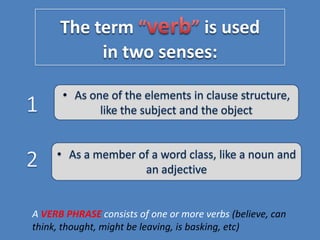
The term
is used
in two senses:

A VERB PHRASE consists of one or more verbs (believe, can
think, thought, might be leaving, is basking, etc)
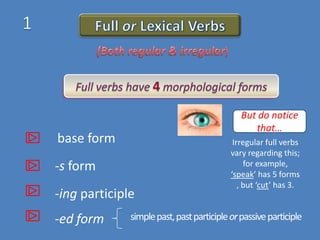
But do notice
that…

base form

-s form
-ing participle
-ed form

Irregular full verbs
vary regarding this;
for example,
‘speak’ has 5 forms
, but ‘cut’ has 3.

simple past, past participle or passive participle
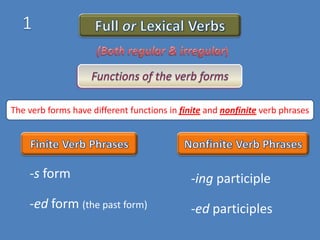
The verb forms have different functions in finite and nonfinite verb phrases

-s form

-ing participle

-ed form (the past form)

-ed participles
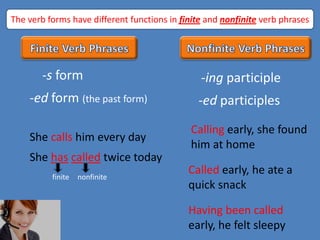
The verb forms have different functions in finite and nonfinite verb phrases

-s form

-ed form (the past form)
She calls him every day

-ing participle
-ed participles
Calling early, she found
him at home

She has called twice today
finite

nonfinite

Called early, he ate a
quick snack
Having been called
early, he felt sleepy
the base form

The present tense in all persons and
numbers (except 3rd person sing.)
The imperative
The present subjunctive

But it is a Nonfinite verb in:

the bare infinitive
the to-infinitive

the -s form

3rd person sing present tense

-ed form (the past form)

-ing participle
a) Progressive aspect
following <be>
b) -ing participle clauses

-ed participles
a) The perfect aspect
following <have>
b) The passive voice
following <be>
c) -ed participle clauses
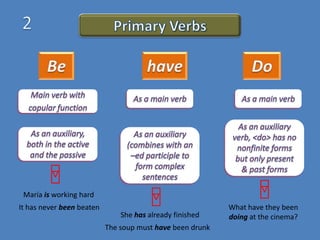
María is working hard
It has never been beaten

She has already finished
The soup must have been drunk

What have they been
doing at the cinema?
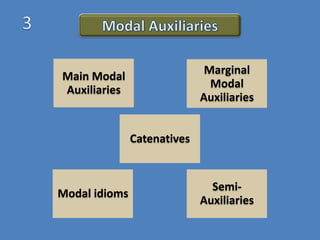
Marginal
Modal
Auxiliaries

Main Modal
Auxiliaries

Catenatives

Modal idioms

SemiAuxiliaries
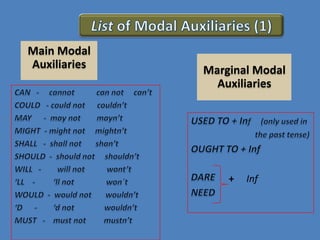
Main Modal
Auxiliaries

Marginal Modal
Auxiliaries

+

Inf
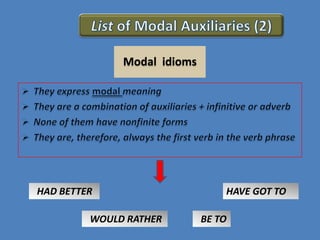
Modal idioms

HAD BETTER
WOULD RATHER

HAVE GOT TO
BE TO
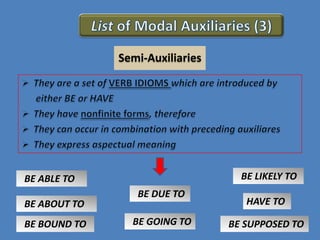
Semi-Auxiliaries

BE LIKELY TO

BE ABLE TO
BE ABOUT TO

BE BOUND TO

BE DUE TO
BE GOING TO

HAVE TO

BE SUPPOSED TO
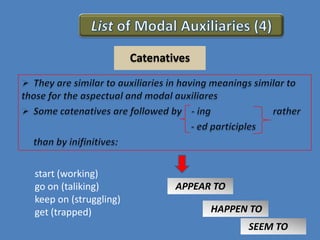
Catenatives

start (working)
go on (taliking)
keep on (struggling)
get (trapped)

APPEAR TO
HAPPEN TO
SEEM TO
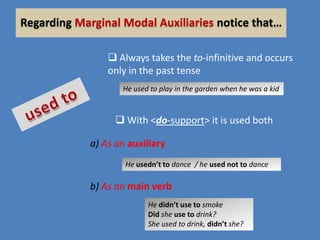
Regarding Marginal Modal Auxiliaries notice that…
 Always takes the to-infinitive and occurs
only in the past tense
He used to play in the garden when he was a kid

 With <do-support> it is used both
a) As an auxiliary
He usedn’t to dance / he used not to dance

b) As an main verb
He didn’t use to smoke
Did she use to drink?
She used to drink, didn’t she?
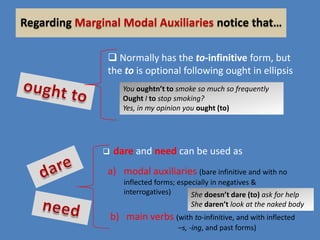
Regarding Marginal Modal Auxiliaries notice that…
 Normally has the to-infinitive form, but
the to is optional following ought in ellipsis
You oughtn’t to smoke so much so frequently
Ought I to stop smoking?
Yes, in my opinion you ought (to)



dare and need can be used as

a) modal auxiliaries (bare infinitive and with no
inflected forms; especially in negatives &
interrogatives)
She doesn’t dare (to) ask for help
She daren’t look at the naked body

b) main verbs (with to-infinitive, and with inflected
–s, -ing, and past forms)
English Grammar Topics
No 3

Copyright 2013

Jesús Lorenzo Vieites

Egt 3 Major Verb Classes

  • 1.
    English Grammar Topics No3 On Major Verb Classes On what it is understood by <verb> and its two main senses in English. Copyright 2013 Jesús Lorenzo Vieites
  • 2.
    The term is used intwo senses: A VERB PHRASE consists of one or more verbs (believe, can think, thought, might be leaving, is basking, etc)
  • 4.
    But do notice that… baseform -s form -ing participle -ed form Irregular full verbs vary regarding this; for example, ‘speak’ has 5 forms , but ‘cut’ has 3. simple past, past participle or passive participle
  • 5.
    The verb formshave different functions in finite and nonfinite verb phrases -s form -ing participle -ed form (the past form) -ed participles
  • 6.
    The verb formshave different functions in finite and nonfinite verb phrases -s form -ed form (the past form) She calls him every day -ing participle -ed participles Calling early, she found him at home She has called twice today finite nonfinite Called early, he ate a quick snack Having been called early, he felt sleepy
  • 7.
    the base form Thepresent tense in all persons and numbers (except 3rd person sing.) The imperative The present subjunctive But it is a Nonfinite verb in: the bare infinitive the to-infinitive the -s form 3rd person sing present tense -ed form (the past form) -ing participle a) Progressive aspect following <be> b) -ing participle clauses -ed participles a) The perfect aspect following <have> b) The passive voice following <be> c) -ed participle clauses
  • 8.
    María is workinghard It has never been beaten She has already finished The soup must have been drunk What have they been doing at the cinema?
  • 9.
  • 10.
  • 11.
    Modal idioms HAD BETTER WOULDRATHER HAVE GOT TO BE TO
  • 12.
    Semi-Auxiliaries BE LIKELY TO BEABLE TO BE ABOUT TO BE BOUND TO BE DUE TO BE GOING TO HAVE TO BE SUPPOSED TO
  • 13.
    Catenatives start (working) go on(taliking) keep on (struggling) get (trapped) APPEAR TO HAPPEN TO SEEM TO
  • 14.
    Regarding Marginal ModalAuxiliaries notice that…  Always takes the to-infinitive and occurs only in the past tense He used to play in the garden when he was a kid  With <do-support> it is used both a) As an auxiliary He usedn’t to dance / he used not to dance b) As an main verb He didn’t use to smoke Did she use to drink? She used to drink, didn’t she?
  • 15.
    Regarding Marginal ModalAuxiliaries notice that…  Normally has the to-infinitive form, but the to is optional following ought in ellipsis You oughtn’t to smoke so much so frequently Ought I to stop smoking? Yes, in my opinion you ought (to)  dare and need can be used as a) modal auxiliaries (bare infinitive and with no inflected forms; especially in negatives & interrogatives) She doesn’t dare (to) ask for help She daren’t look at the naked body b) main verbs (with to-infinitive, and with inflected –s, -ing, and past forms)
  • 16.
    English Grammar Topics No3 Copyright 2013 Jesús Lorenzo Vieites