GOPIKABAI SITARAM GAWANDE
MAHAVIDYALAYA
UMARKHED, DIST. YAVATMAL
NAAC REACCREDITED (3RD CYCLE) GRADE B++ CGPA 2.79
GOPIKABAI SITARAM GAWANDE MAHAVIDYALAYA UMARKHED, DIST. YAVATMAL
Utilization of Plants
B.Sc.-I Semester-II Botany (Unit-VI)
Presented by
Mr. Kailash S. Sontakke
Assistant Professor
Department of Botany
2GOPIKABAI SITARAM GAWANDE MAHAVIDYALAYA UMARKHED, DIST. YAVATMAL
Black Pepper
Common Names: Eng- Black Pepper,Hin-Kali Mirch, Mar- Kali Miri
Classification
Kingdom: Plantae
Division: Angiosperms
Class: Dicotyledons
Order: Pipeales
Family: Piperaceae
Genus: Piper
Species: P. nigrum
GOPIKABAI SITARAM GAWANDE MAHAVIDYALAYA UMARKHED, DIST. YAVATMAL 3
Black Pepper (or perhaps long pepper) was believed to cure illness such as:
 Constipation, Diarrhea,
 Earache, Gangrene,
 Heart Disease, Hernia,
 Hoarseness, Indigestion,
 Insect Bites, Insomnia,
 Joint Pain, Liver Problems,
 Lung Disease, Oral Abscesses, Sunburn, Tooth Decay, And Toothaches.
Economic Importance/Medicinal Uses:
GOPIKABAI SITARAM GAWANDE MAHAVIDYALAYA UMARKHED, DIST. YAVATMAL 4
Clove
Cloves (Syzygium aromaticum) are the aromatic dried flower buds of a tree in the family Myrtaceae. Cloves are native
to the Maluku islands in Indonesia and used as a spice in cuisines all over the world. Cloves are harvested primarily in
Indonesia, India, Madagascar, Zanzibar, Pakistan, and Sri Lanka.
Common Names: Eng- Clove,Hin-Laung, Mar- lavang
Classification
Kingdom: Plantae
Division: Angiosperms
Class: Dicotyledons
Order: Myrtales
Family: Myrtaceae
Genus: Syzygium
Species: S.aromaticum
GOPIKABAI SITARAM GAWANDE MAHAVIDYALAYA UMARKHED, DIST. YAVATMAL 5
 Cloves can be used in cooking either whole or in a ground form, but
as they are extremely strong, they are used sparingly.
 Cloves have historically been used in Indian cuisine(both North
Indian and South Indian).
 In North Indian cuisine, it is used in almost all rich or spicy dishes as
an ingredient of a mix named garam masala, along with other spices,
although it is not an everyday ingredient for home cuisine, nor is it
used in summer very often.
 In the Maharashtra region of India it is used sparingly for sweet or
spicy dishes, but rarely in everyday cuisine.
Economic Importance/Medicinal Uses:
GOPIKABAI SITARAM GAWANDE MAHAVIDYALAYA UMARKHED, DIST. YAVATMAL 6
In India, where it is cultivated on the hills of Kerala, it is called "karuvapatta" or "dalchini". In Indonesia, where it is
cultivated in Java and Sumatra, it is called kayu manis ("sweet wood") and sometimes cassia vera, the "real" cassia
In Sri Lanka,
Cinnamon
Classification
Kingdom: Plantae
Division: Angiosperms
Class: Dicotyledons
Order: Myrtales
Family: Lauraceae
Genus: Cinnamomum
Species: C. zeylanicum
Common Names: Eng- Cinnamon, Hin-Dalchini, Mar- Dalchini
GOPIKABAI SITARAM GAWANDE MAHAVIDYALAYA UMARKHED, DIST. YAVATMAL 7
 Cinnamon bark is widely used as a spice.
 It is principally employed in cookery as a condiment and flavoring
material.
 It is used in the preparation of chocolate, especially in Mexico, which is
the main importer of true cinnamon.
 It is also used in many desserts recipes, such as apple pie, donuts, and
cinnamon buns as well as spicy candies, tea, hot cocoa and liqueurs.
Economic Importance/Medicinal Uses:
GOPIKABAI SITARAM GAWANDE MAHAVIDYALAYA UMARKHED, DIST. YAVATMAL 8
 True cinnamon, rather than cassia, is more suitable for use in
sweet dishes. In the Middle East, it is often used in savory dishes
of chicken.
 In the United States, cinnamon and sugar are often used to flavor
cereals, bread-based dishes, and fruits, especially apples, a
cinnamon-sugar mixture is even sold separately for such purposes.
GOPIKABAI SITARAM GAWANDE MAHAVIDYALAYA UMARKHED, DIST. YAVATMAL 9
Cardamom
Cardamom (or Cardamon) refers to several plants of the genera Elettaria and Amomum in the ginger family
Zingiberaceae. Both genera are native to India and Bhutan;
Common Names: Eng- Cardamom,Hin-Elaichi, Mar- Elachi
Classification
Kingdom: Plantae
Division: Angiosperms
Class: Monocotyledons
Order: Zingiberales
Family: Zingiberaceae
Genus: Elettaria
Species: E. cardamomum
GOPIKABAI SITARAM GAWANDE MAHAVIDYALAYA UMARKHED, DIST. YAVATMAL 10
Economic Importance/Medicinal Uses:
 It is used only in savory dishes like curries and biryani.
 It is also an essential ingredient in garam masala (the blend of spices).
 The dark brown seeds are known for their medicinal values – particularly
so because of their nutrient content (volatile oils, calcium, iron, etc.).
GOPIKABAI SITARAM GAWANDE MAHAVIDYALAYA UMARKHED, DIST. YAVATMAL 11
General account of sources of Firewood
 Firewood is any wooden material that is gathered and used for fuel.
 Generally, firewood is not highly processed and is in some sort of recognizable
log or branch form.
 Some of the firewood trees of India
Botanical Name Common Name Family
Acacia nilotica Babul Mimoaceae
Albizia lebbeck Siris Fabaceae
Anogeissus latifolia Dhawara Combretaceae
Azadiracta indica Neem Meliaceae
Dalbergia sissoo Shisam Fabaceae
Syzygium cumini Jambhool Myrtaceae
GOPIKABAI SITARAM GAWANDE MAHAVIDYALAYA UMARKHED, DIST. YAVATMAL 12
Timber
 Wood to be used for construction work is commonly known as lumber or
timber.
 Lumber (American English) or timber (English speaking ) is a type
of wood that has been processed into beams and planks, a stage in the
process of wood production.
 Lumber is mainly used for structural purposes but has many other uses as
well.
GOPIKABAI SITARAM GAWANDE MAHAVIDYALAYA UMARKHED, DIST. YAVATMAL 13
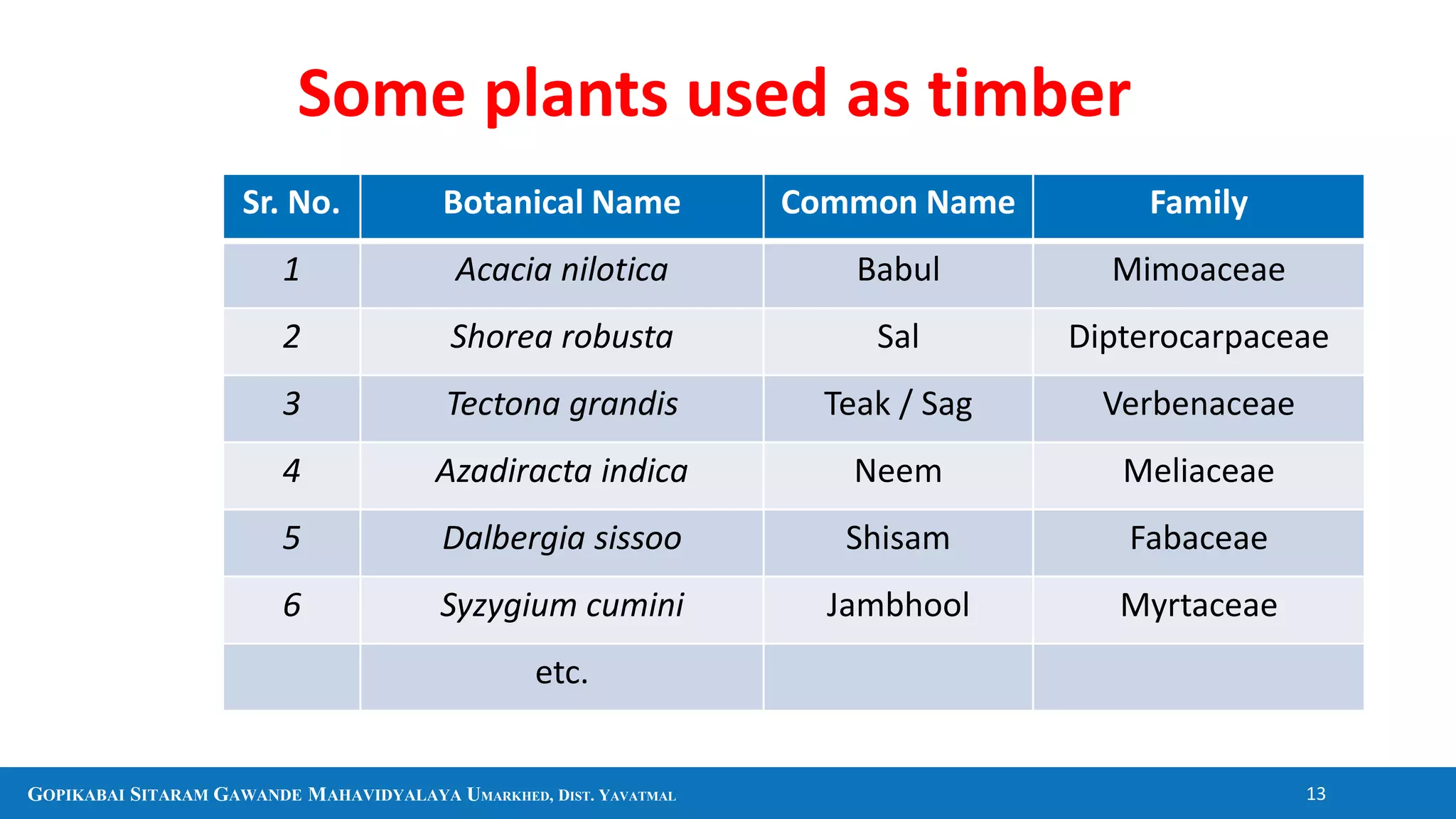
Some plants used as timber
Sr. No. Botanical Name Common Name Family
1 Acacia nilotica Babul Mimoaceae
2 Shorea robusta Sal Dipterocarpaceae
3 Tectona grandis Teak / Sag Verbenaceae
4 Azadiracta indica Neem Meliaceae
5 Dalbergia sissoo Shisam Fabaceae
6 Syzygium cumini Jambhool Myrtaceae
etc.
GOPIKABAI SITARAM GAWANDE MAHAVIDYALAYA UMARKHED, DIST. YAVATMAL 14
Uses of timber
 Timber is used for the following works:
 It is mainly used for construction purpose.
 For light construction works like doors, windows, flooring and roofing.
 For other permanent works like for railway sleepers, electric poles and gates.
 For temporary works in construction like scaffolding, centring, packing of
materials.
 For decorative works like showcases and furnitures.
 For body works of buses, lorries, trains and boats.
 For industrial uses like pulps (used in making papers), card boards, wall
papers.
 For making sports goods and musical instruments.
GOPIKABAI SITARAM GAWANDE MAHAVIDYALAYA UMARKHED, DIST. YAVATMAL 15
Bamboo
 The bamboos are evergreen perennial flowering plants in the subfamily
Bambusoideae of the grass family Poaceae.
 >1,462 (known species) species in 115 genera.
 In bamboo, as in other grasses, the internodal regions of the stem are usually
hollow and the vascular bundles in the cross section are scattered throughout
the stem instead of in a cylindrical arrangement.
 The absence of secondary growth.
 Bamboos include some of the fastest-growing plants in the world,due to a
unique rhizome-dependent system. Certain species of bamboo can grow 91 cm
(36 in) within a 24-hour period, at a rate of almost 4 cm (1.6 in) an hour (a
growth around 1 mm every 90 seconds, or 1 inch every 40 minutes).
GOPIKABAI SITARAM GAWANDE MAHAVIDYALAYA UMARKHED, DIST. YAVATMAL 16
Bamboo
 Giant bamboos are the largest members of the grass family. Bamboos are
of notable economic and cultural significance in South Asia, Southeast
Asia and East Asia, being used for building materials, as a food source,
and as a versatile raw product.
 Bamboo has a higher specific compressive strength than wood, brick, or
concrete and a specific tensile strength that rivals steel.
GOPIKABAI SITARAM GAWANDE MAHAVIDYALAYA UMARKHED, DIST. YAVATMAL 17
Uses of Bamboo
 Bamboo is used for building roads.
 Bamboo is used for medicinal purposes.
 Bamboo is used to promote fertility in cows.
 Bamboo is used to build houses and schools.
 Bamboo is used to make accessories.
 Bamboo is used to feed people and animals.
 Bamboo is used for scaffolding.
 Bamboo is used to make furniture.
 Bamboo is used to make musical instruments etc.
GOPIKABAI SITARAM GAWANDE MAHAVIDYALAYA UMARKHED, DIST. YAVATMAL 18
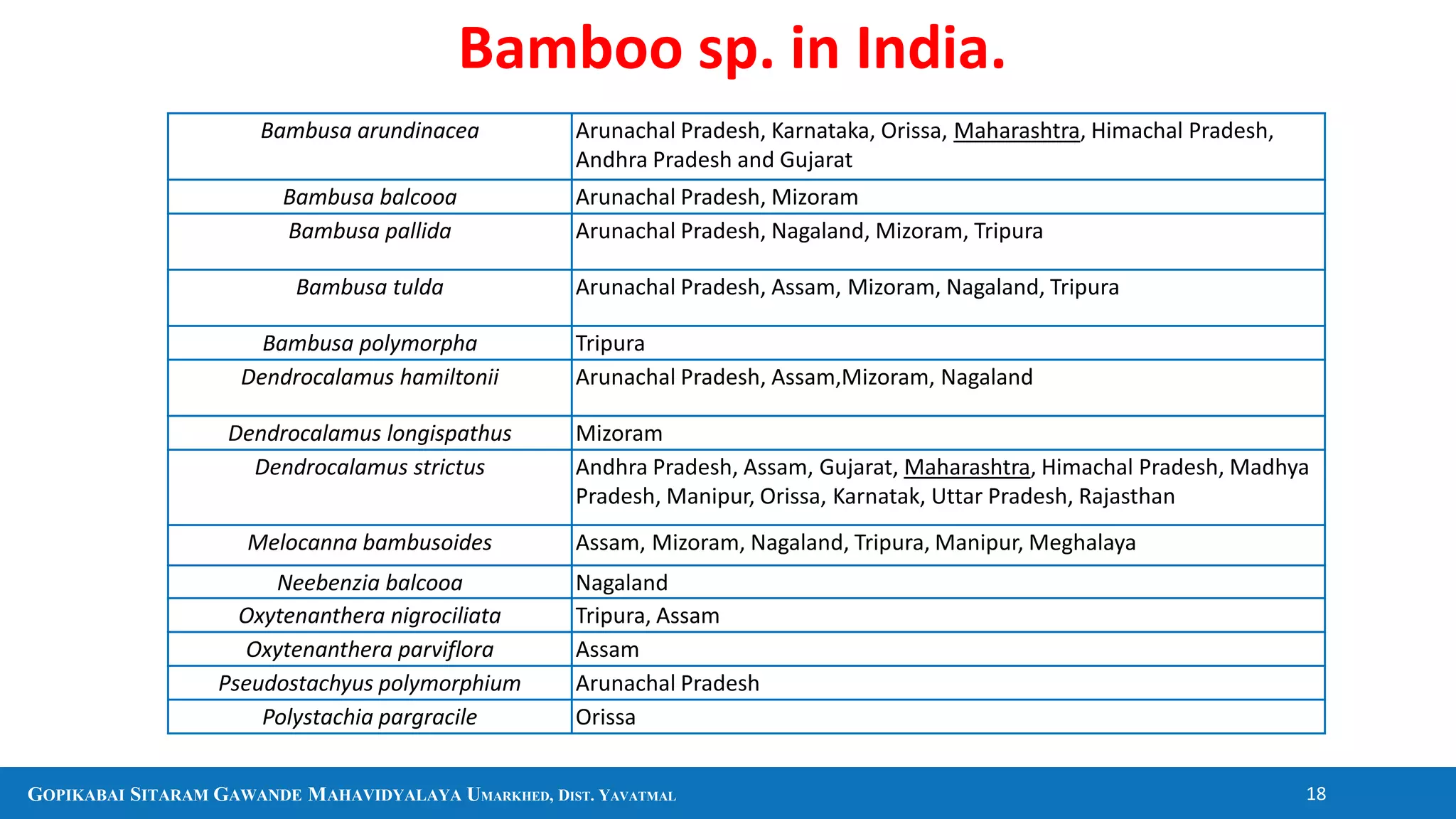
Bamboo sp. in India.
Bambusa arundinacea Arunachal Pradesh, Karnataka, Orissa, Maharashtra, Himachal Pradesh,
Andhra Pradesh and Gujarat
Bambusa balcooa Arunachal Pradesh, Mizoram
Bambusa pallida Arunachal Pradesh, Nagaland, Mizoram, Tripura
Bambusa tulda Arunachal Pradesh, Assam, Mizoram, Nagaland, Tripura
Bambusa polymorpha Tripura
Dendrocalamus hamiltonii Arunachal Pradesh, Assam,Mizoram, Nagaland
Dendrocalamus longispathus Mizoram
Dendrocalamus strictus Andhra Pradesh, Assam, Gujarat, Maharashtra, Himachal Pradesh, Madhya
Pradesh, Manipur, Orissa, Karnatak, Uttar Pradesh, Rajasthan
Melocanna bambusoides Assam, Mizoram, Nagaland, Tripura, Manipur, Meghalaya
Neebenzia balcooa Nagaland
Oxytenanthera nigrociliata Tripura, Assam
Oxytenanthera parviflora Assam
Pseudostachyus polymorphium Arunachal Pradesh
Polystachia pargracile Orissa
GOPIKABAI SITARAM GAWANDE MAHAVIDYALAYA UMARKHED, DIST. YAVATMAL 19
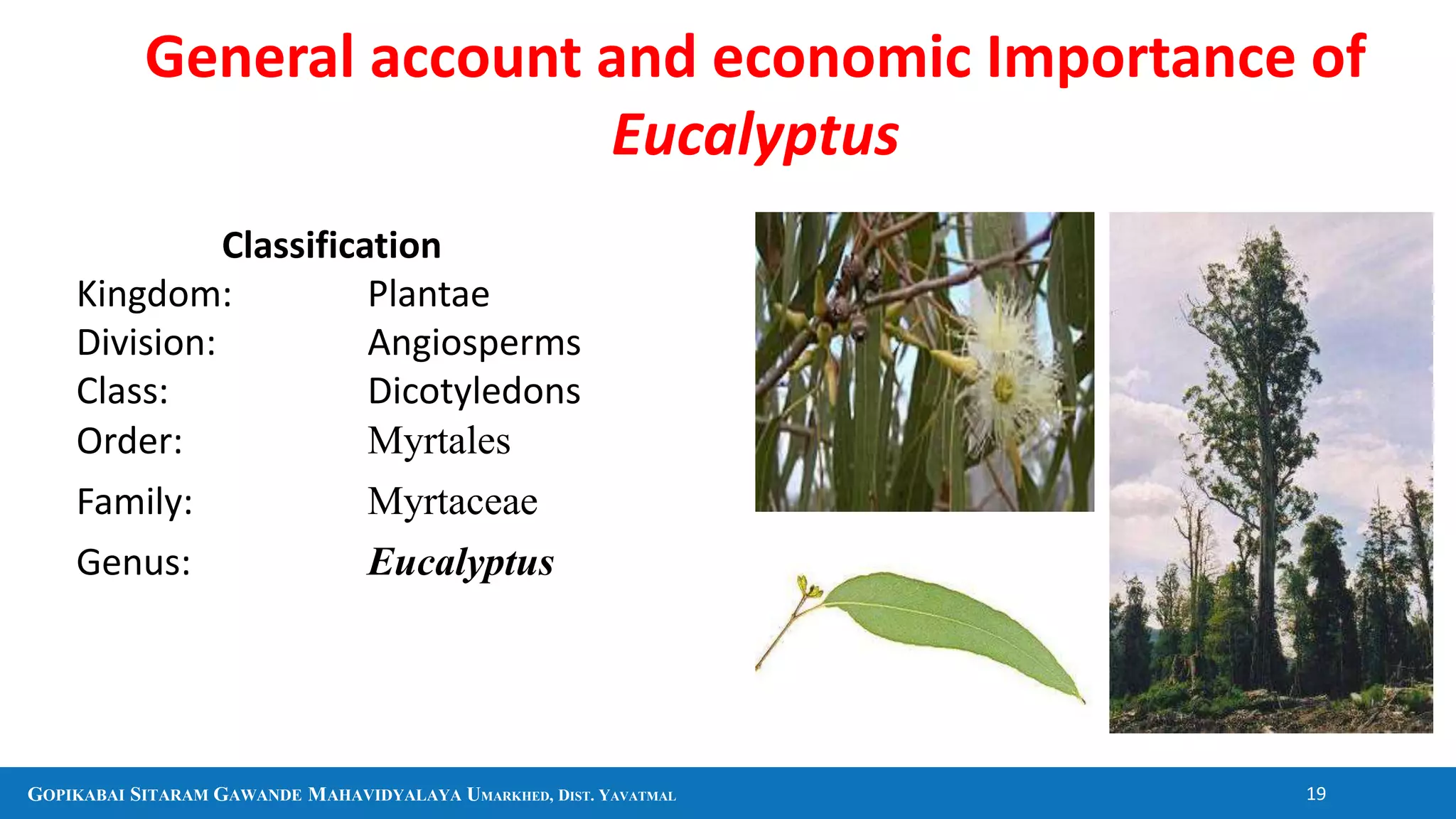
General account and economic Importance of
Eucalyptus
Classification
Kingdom: Plantae
Division: Angiosperms
Class: Dicotyledons
Order: Myrtales
Family: Myrtaceae
Genus: Eucalyptus
GOPIKABAI SITARAM GAWANDE MAHAVIDYALAYA UMARKHED, DIST. YAVATMAL 20
 Eucalyptus is a diverse genus of flowering trees (and a few shrubs)
in the family, Myrtaceae. Myrtle Members of the genus dominate
the tree flora of Australia.
 Nearly all Eucalyptus are evergreen but some tropical species lose
their leaves at the end of the dry season.
 As in other members of the myrtaceae family, Eucalyptus leaves are
covered with oil glands. The copious oils produced are an
important feature of the genus.
 Although mature Eucalyptus trees are usually fowering and fully
leafed, their shade is characteristically patchy because the leaves
usually hang downwards.
GOPIKABAI SITARAM GAWANDE MAHAVIDYALAYA UMARKHED, DIST. YAVATMAL 21
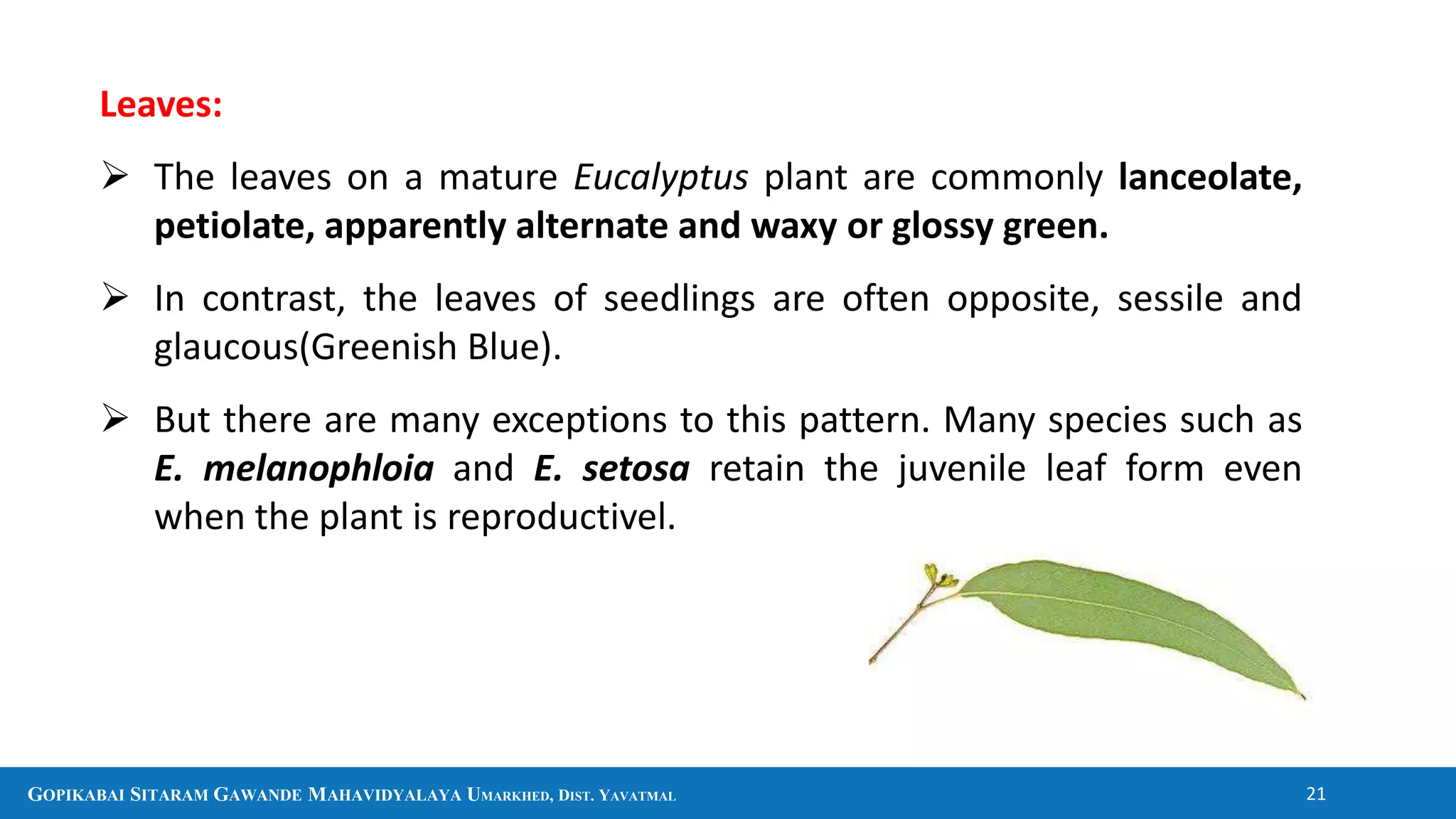
Leaves:
 The leaves on a mature Eucalyptus plant are commonly lanceolate,
petiolate, apparently alternate and waxy or glossy green.
 In contrast, the leaves of seedlings are often opposite, sessile and
glaucous(Greenish Blue).
 But there are many exceptions to this pattern. Many species such as
E. melanophloia and E. setosa retain the juvenile leaf form even
when the plant is reproductivel.
GOPIKABAI SITARAM GAWANDE MAHAVIDYALAYA UMARKHED, DIST. YAVATMAL 22
 USES
 Eucalyptus oil is readily steam distilled from the leaves and can be used
for cleaning, deodorising, and in very small quantities in food
supplements, especially sweets, cough drops, toothpaste and
decongestants.
 It also has insect repellent properties (Jahn 1991 a, b; 1992), and is an
active ingredient in some commercial mosquito repellents (Fradin & Day
2002).
GOPIKABAI SITARAM GAWANDE MAHAVIDYALAYA UMARKHED, DIST. YAVATMAL 23
 Pharmacognocy: Pharmacognosy is the study of drugs of natural origin.
The term comes from two Greek words: "pharmakon" meaning drug or
medicine, and "gnosis" meaning knowledge.
 The American Society of Pharmacognosy defines pharmacognosy as "the
study of the physical, chemical, biochemical and biological properties of
drugs, drug substances or potential drugs or drug substances of natural
origin as well as the search for new drugs from natural sources".
Pharmacognocy and Phytochemistry
GOPIKABAI SITARAM GAWANDE MAHAVIDYALAYA UMARKHED, DIST. YAVATMAL 24
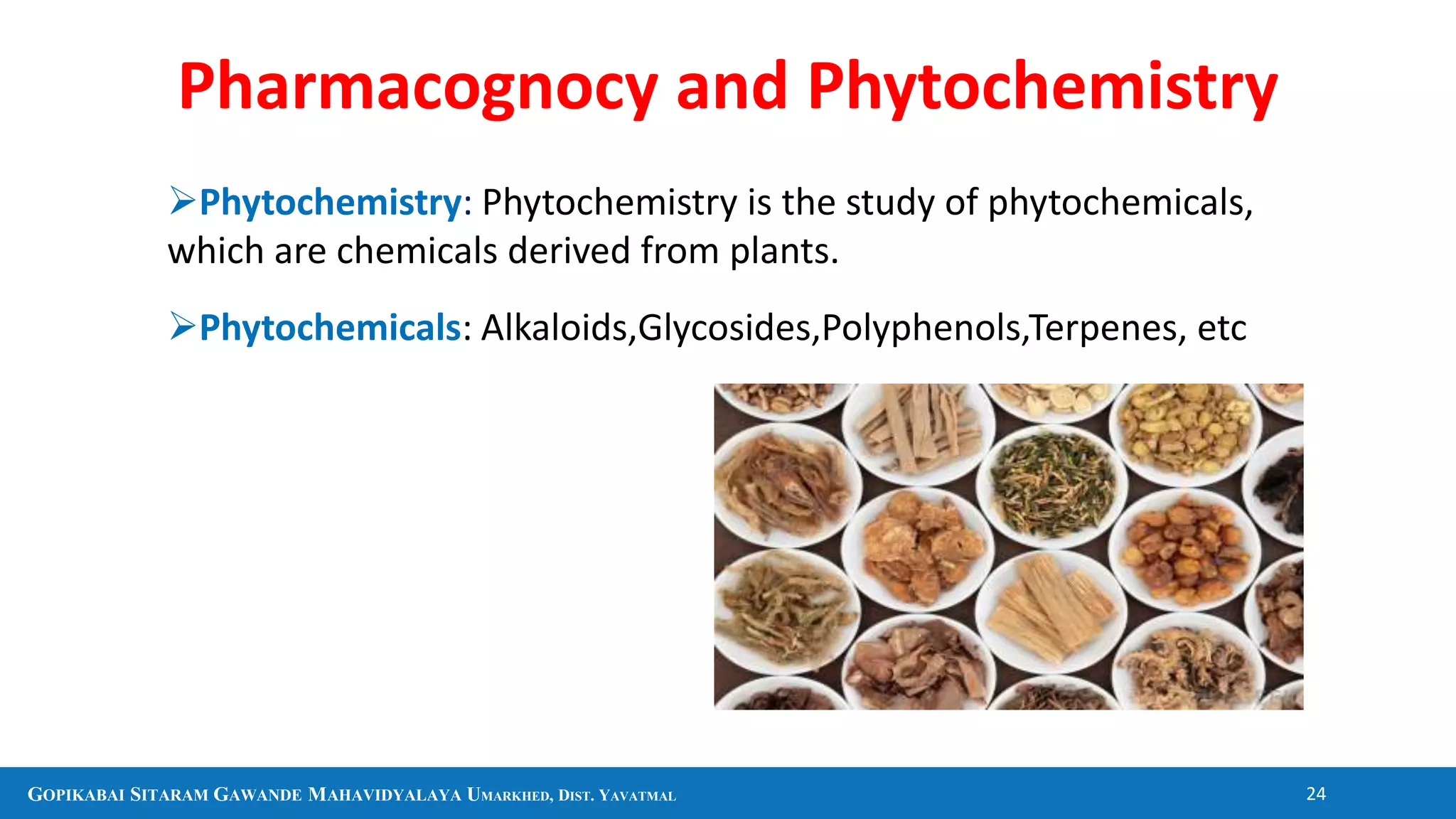
Phytochemistry: Phytochemistry is the study of phytochemicals,
which are chemicals derived from plants.
Phytochemicals: Alkaloids,Glycosides,Polyphenols,Terpenes, etc
Pharmacognocy and Phytochemistry
GOPIKABAI SITARAM GAWANDE MAHAVIDYALAYA UMARKHED, DIST. YAVATMAL 25
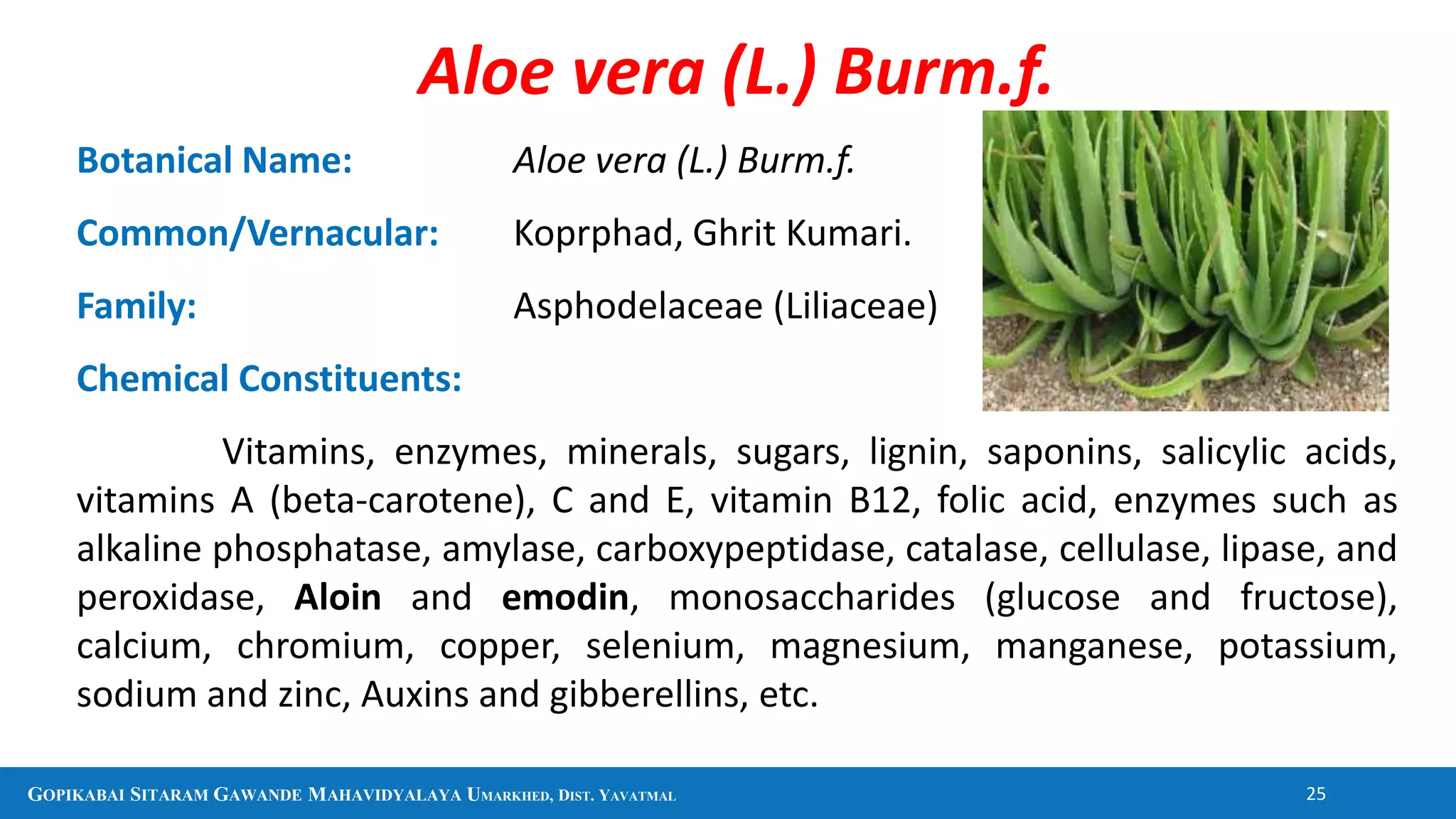
Botanical Name: Aloe vera (L.) Burm.f.
Common/Vernacular: Koprphad, Ghrit Kumari.
Family: Asphodelaceae (Liliaceae)
Chemical Constituents:
Vitamins, enzymes, minerals, sugars, lignin, saponins, salicylic acids,
vitamins A (beta-carotene), C and E, vitamin B12, folic acid, enzymes such as
alkaline phosphatase, amylase, carboxypeptidase, catalase, cellulase, lipase, and
peroxidase, Aloin and emodin, monosaccharides (glucose and fructose),
calcium, chromium, copper, selenium, magnesium, manganese, potassium,
sodium and zinc, Auxins and gibberellins, etc.
Aloe vera (L.) Burm.f.
GOPIKABAI SITARAM GAWANDE MAHAVIDYALAYA UMARKHED, DIST. YAVATMAL 26
 Prevents Signs Of Aging
 Moisturizes Skin
 Reduces Acne And Helps Lighten Blemishes(Dark spots)
 Helps With Sunburns
 Heals External Wounds And Insect Bites
 Reduces Stretch Marks
 Promotes Hair Growth
Economic Importance and Medicinal Uses
GOPIKABAI SITARAM GAWANDE MAHAVIDYALAYA UMARKHED, DIST. YAVATMAL 27
 Reduces Dandruff
 Maintains pH Balance Of The Scalp
 Conditions Hair
 Reduces Inflammation
 Reduces Cholesterol And Regulates Blood Sugar
 Maintains Oral Health
 Builds Immunity
 Lowers Risk Of Cancer
 Helps In Treating Hemorrhoids(Piles)
GOPIKABAI SITARAM GAWANDE MAHAVIDYALAYA UMARKHED, DIST. YAVATMAL 28
Botanical Name: Adhathoda vasica
Common/Vernacular: Malbar nut, Adulsa,vasaka
Family: Acanthaceae
Chemical Constituents:
Alkaloids, tannins, saponins,
phenolics and flavonoids.
The most important is vasicine,
a quinazoline alkaloid.
Adhathoda vasica
GOPIKABAI SITARAM GAWANDE MAHAVIDYALAYA UMARKHED, DIST. YAVATMAL 29
 Cough
 Removing Phlegm (Mucus)
 For Bleeding Gums
 Indigestion
 Skin Diseases
 Hemorrhoids
 Inflammation
 Asthma, etc.
Economic Importance and Medicinal Uses
GOPIKABAI SITARAM GAWANDE MAHAVIDYALAYA UMARKHED, DIST. YAVATMAL 30
Botanical Name: Asparagus racemosus Willd.
Common/Vernacular: Satavari
Family: Liliaceae
Chemical Constituents:
Vitamins A, B1, B2, C, E, Mg, P,
Ca, Fe, and folic acid , essential oils,
asparagine, arginine, tyrosine,
flavonoids (kaempferol, quercetin, and rutin),
resin, and tannin, Shatavarin IV etc.
Asparagus racemosus Willd.
GOPIKABAI SITARAM GAWANDE MAHAVIDYALAYA UMARKHED, DIST. YAVATMAL 31
 Pain.
 Anxiety.
 Stomach problems.
 Uterine bleeding.
 Premenstrual syndrome (PMS)
 Stomach ulcers.
 Diarrhea.
Economic Importance and Medicinal Uses
GOPIKABAI SITARAM GAWANDE MAHAVIDYALAYA UMARKHED, DIST. YAVATMAL 32
 Bronchitis.
 Diabetes.
 Dementia(Mental disorder)
 Easing alcohol withdrawal.
 Starting breast milk production
Economic Importance and Medicinal Uses
GOPIKABAI SITARAM GAWANDE MAHAVIDYALAYA UMARKHED, DIST. YAVATMAL 33
Botanical Name: Azadirachta indica A.Juss.
Common/Vernacular: Margosa, azadirachta, bead tree,
holy tree, Indian lilac tree
Family: Meliaceae
Chemical Constituents:
Isomeldenin, nimbin, nimbinene, 6-desacetyllnimbinene, nimbandiol,
immobile, nimocinol, quercetin, and beta-sitosterol, azadirachtin H and
azadirachtin I
Azadirachta indica A.Juss.
GOPIKABAI SITARAM GAWANDE MAHAVIDYALAYA UMARKHED, DIST. YAVATMAL 34
 Anthelmintic, anti-fungal, anti-diabetic, antibacterial, antiviral,
 Contraceptive and sedative
 Skin diseases,
 Healthy hair,
 Improve liver function,
 Detoxify the blood,
 Pest and disease control,
 fever reduction, dental treatments, cough, asthma, ulcers,
piles, intestinal worms, urinary diseases etc.
Economic Importance and Medicinal Uses
GOPIKABAI SITARAM GAWANDE MAHAVIDYALAYA UMARKHED, DIST. YAVATMAL 35
Botanical Name: Chlorophytum borivillianum
Common/Vernacular: Musli,Safed Musli
Family: Liliaceae
Chemical Constituents:
Carbohydrates (35- 45%), fiber (25-35%), alkaloids (15-25%), saponins (2-20%),
and proteins (5-10%). It is a rich source of over 25 alkaloids, vitamins, proteins,
carbohydrates, steroids, saponins, potassium, phenol, resins, mucilage, and
polysaccharides and also contains high quantity of simple sugars, mainly
sucrose, glucose, fructose, galactose, mannose and xylose.
Chlorophytum borivillianum
GOPIKABAI SITARAM GAWANDE MAHAVIDYALAYA UMARKHED, DIST. YAVATMAL 36
Chlorophytum borivillianum
GOPIKABAI SITARAM GAWANDE MAHAVIDYALAYA UMARKHED, DIST. YAVATMAL 37
 It is used in the treatment for diarrhea and dysentery and as a visualizer for
the entire body.
 It is also used as a treatment for arthritis, rheumatism and joint pain
 Used for restoring male reproductive system disorders like impotency, low
sperm count.
 Increase the sperm count.
Economic Importance and Medicinal Uses
GOPIKABAI SITARAM GAWANDE MAHAVIDYALAYA UMARKHED, DIST. YAVATMAL 38
 Useful to cure of certain forms of sexual deficiencies
 Anti-stress and anti-oxidant properties.
 It is also considered as an energy booster in asthmatic conditions.
 Safed musli powder are used to fortify the general immune system of the
body. Etc.
Economic Importance and Medicinal Uses
GOPIKABAI SITARAM GAWANDE MAHAVIDYALAYA UMARKHED, DIST. YAVATMAL 39
Botanical Name: Emblica officinalis Geartn
Common/Vernacular: Indian Goose berry, Amla.
Family: Euphorbiaceae
Chemical Constituents:
Ascorbic acid (Vit-C), Emblicanin-A: 27%
Emblicanin-B: 23% , Punigluconin: 8%
Pedunculagin: 14% , Gallo-ellagitannoids: 18%
Rutin: 10%.
Emblica officinalis Geartn
GOPIKABAI SITARAM GAWANDE MAHAVIDYALAYA UMARKHED, DIST. YAVATMAL 40
 As an energy refiller
 In anaemia therapy
 fights with acidity
 Action on toxins
 Urinary trouble frustration agent
 Effects on urinary stone, Emblica therapy for diarrhea
 Relieves headache, Improves body weight
 Skin Sores and Wounds and Scurvy
Economic Importance and Medicinal Uses
GOPIKABAI SITARAM GAWANDE MAHAVIDYALAYA UMARKHED, DIST. YAVATMAL 41
Botanical Name: Rouwlfia serpentina
Common/Vernacular: Sarpagandha
Family: Apocynaceae
Chemical Constituents:
The plant contains 200 alkaloids of the indole alkaloid family.
The major alkaloids are ajmaline, ajmalicine, ajmalimine, deserpidine,
indobine, indobinine, reserpine, reserpiline, rescinnamine,
rescinnamidine, serpentine, serpentinine and yohimbine.
Rauwolfia serpentina
GOPIKABAI SITARAM GAWANDE MAHAVIDYALAYA UMARKHED, DIST. YAVATMAL 42
Rauwolfia serpentina
GOPIKABAI SITARAM GAWANDE MAHAVIDYALAYA UMARKHED, DIST. YAVATMAL 43
 It is used for the treatment of high blood sugar.Hence called as universal
medicine for lowering blood pressure.
 It cures insomnia and hypertension
 It is also useful for in the treatment of cataract.
 It also cures plague and fever.
 Sarpagandha is used for the treatment of Schizophrenia.
 It is used in different countries as a sedative and tranquilizer.
 Rauwolfia serpentina is believed to cure anxiety, psychosis and epilepsy.
Economic Importance and Medicinal Uses
GOPIKABAI SITARAM GAWANDE MAHAVIDYALAYA UMARKHED, DIST. YAVATMAL 44
 It is used to stimulate uterine contraction.
 It is used in various part of the world for the treatment of snake (cobra), scorpion or
reptile bite and stings of any poisonous insects.
 It is used in the treatment of intractable skin disorder such as psoriasis, excessive
sweating and itching.
 It is also used against irregular heart action in old ages.
 Sarpagandha also cures toxic goitre.
 It also balances Vata and pitta in the body
 Sarpagandha is also used for rheumatism, inflammation and intestinal diseases.
 It is also used against constipation and dizziness.
Economic Importance and Medicinal Uses
GOPIKABAI SITARAM GAWANDE MAHAVIDYALAYA UMARKHED, DIST. YAVATMAL 45
Botanical Name: Catharanthus roseus (L.)
Common/Vernacular: Sadafuli, Madagascar periwinkle, rose periwinkle,
or rosy periwinkle
Family: Apocynaceae
Catharanthus roseus
GOPIKABAI SITARAM GAWANDE MAHAVIDYALAYA UMARKHED, DIST. YAVATMAL 46
 Linolenic acid ethyl ester (43.9 %), stearic acid (10.6 %), phytol (7.3 %) and
hexadecanoic acid (6.8 %),
 While the flower was made up of limonene (34.1 %), phytol (29.6 %) and
linolenic acid ethyl ester (14.0 %). Limonene (23.2 %), dodecyl alcohol (9.8
%), geraniol (7.3 %) and citral (7.0 %)
 From the leaf, with limonene (37.2 %) and dotriacontane (16.1 %)
 Source of the drugs vincristine and vinblastine, used to treat cancer.
Chemical Constituents
GOPIKABAI SITARAM GAWANDE MAHAVIDYALAYA UMARKHED, DIST. YAVATMAL 47
 It decreases blood pressure and reduces excitement.
 It is also proved anti-diabetic.
 Catharanthus roseus is used as an anticancer agent. It is most effective for the
treatment of lung cancer.
 It is used for the treatment of Leukaemia.
 It has antibacterial and antiviral property.
 The Vinca plant extract is useful for the treatment of dysentery and diarrhoea.
 It is also anti-inflammatory in nature.
Economic Importance and Medicinal Uses
GOPIKABAI SITARAM GAWANDE MAHAVIDYALAYA UMARKHED, DIST. YAVATMAL 48
 The flower petals and seeds have antioxidant property.
 It cures various skin diseases such as acne and dermatitis.
 It is also useful for the treatment of nose bleeding, gum bleeding.
 The extract of the plant is also useful for an eye infection and irritation of the
eyes.
 Catharanthus roseus regularizes bleeding problem for women.
 The plant is also useful for the treatment of mouth ulcer.
 The extract gives comfort during the depression, headache, nausea and
fatigue.
Economic Importance and Medicinal Uses
GOPIKABAI SITARAM GAWANDE MAHAVIDYALAYA UMARKHED, DIST. YAVATMAL 49
 Vinca is also useful for the treatment of malaria.
 Catharanthus roseus is also useful for the treatment of Asthma.
 The plant is used against insect bites.
 Catharanthus roseus is diuretic in nature and increases urine.
Economic Importance and Medicinal Uses
GOPIKABAI SITARAM GAWANDE MAHAVIDYALAYA UMARKHED, DIST. YAVATMAL 50
Botanical Name: Ocimum sanctum L.
Common/Vernacular: Tulsi, Tulas, Holy basil
Family: Lamiaceae
Chemical Constituents:
Eugenol,cirsilineol, circimaritin,
isothymusin, apigenin
and rosameric acid.
Ocimum sanctum L.
GOPIKABAI SITARAM GAWANDE MAHAVIDYALAYA UMARKHED, DIST. YAVATMAL 51
 Expectorant,
 Analgesic,
 Anticancer, Antiasthmatic, Antiemetic(Inhibit vometting),
 Diaphoretic (Increase sweating),
 Antidiabetic, Antifertility,
 Hepatoprotective,
 Hypotensive, Hypolipidmic and Antistress Agents.
 Tulsi Has Also Been Used In Treatment Of Fever, Bronchitis, Arthritis, etc.
Economic Importance and Medicinal Uses
GOPIKABAI SITARAM GAWANDE MAHAVIDYALAYA UMARKHED, DIST. YAVATMAL 52
Botanical Name: Vitex negundo L.
Common/Vernacular: Nergudi, Chinese chaste(Holy) tree, five-leaved chaste
tree, or horseshoe vitex
Family: Lamiaceae
Chemical Constituents:
Casticin, isoorientin, chrysophenol D, luteolin,
p–hydroxybenzoic acid and D-fructose,
oil are sabinene, linalool, terpinen-4-ol,
β-caryophyllene, α-guaiene and globulol
Vitex negundo L.
GOPIKABAI SITARAM GAWANDE MAHAVIDYALAYA UMARKHED, DIST. YAVATMAL 53
 Use its decoction for gargles. It cures all the throat and mouth related disorders.
 In case of boils in mouth, apply its oil on tongue, mouth and lips.
 In case of sourness and swelling of throat, mix its oil in slightly warm water to
gargle. It cures the throat problems.
 Use its oil on lips to cure the cracks and dryness of lips.
 It cures multiondular tuberculosis.
 It cures fever, chronic rhintic (Nosal disorders) and deafness.
Economic Importance and Medicinal Uses
GOPIKABAI SITARAM GAWANDE MAHAVIDYALAYA UMARKHED, DIST. YAVATMAL 54
 It enhances the digestion power and relieves the stomach pain.
 It helps to release the gas and cures swelling of the stomach caused by
indigestion or accumulation of wind.
 It normalizes the menstrual cycle etc
Economic Importance and Medicinal Uses
GOPIKABAI SITARAM GAWANDE MAHAVIDYALAYA UMARKHED, DIST. YAVATMAL 55
Botanical Name: Withania somnifera L.
Common/Vernacular: Ashwagandha, Indian ginseng, poison gooseberry
or winter cherry
Family: Solanaceae
Chemical Constituents:
Alkaloids and steroidal lactones
tropineand cuscohygrine.
withanolides, withaferin A,
ashwagandhine, ashwaganidhine,
and somniferine
Withania somnifera
GOPIKABAI SITARAM GAWANDE MAHAVIDYALAYA UMARKHED, DIST. YAVATMAL 56
 It is used as a sedative for the treatment of insanity and drugs prepared from
it can be used for the nervous disorder.
 People suffering from joint pain and paralysis can use the drug prepared from
Ashwagandha.
 It can be used for the treatment of high blood sugar, blood pressure, and
cholesterol.
 Ashwagandha also can be used for increase of haemoglobin. It also reduces
chronic stress and causes relaxation.
 It has been used as antioxidant, and it slows down the growth of lungs,
breasts, and colon cancer cells.
Economic Importance and Medicinal Uses
GOPIKABAI SITARAM GAWANDE MAHAVIDYALAYA UMARKHED, DIST. YAVATMAL 57
 It also has an anti-anxiety effect.
 Ashwagandha capsules can also be used to recover memory losses.
 As a tonic, it increases sexual potential.
 The powder mixed with oil reduces and cures skin infection.
 It protects the liver and reduces constipation and cures hypothyroidism.
 Seeds and fruits: The seeds and fruits are diuretic in nature and promote
passing of urine.
Economic Importance and Medicinal Uses
GOPIKABAI SITARAM GAWANDE MAHAVIDYALAYA UMARKHED, DIST. YAVATMAL
GOPIKABAI SITARAM GAWANDE
MAHAVIDYALAYA
UMARKHED, DIST. YAVATMAL
NAAC REACCREDITED (3RD CYCLE) GRADE B++ CGPA 2.79
THANK YOU

Utilization of Plants by Mr. Kailash Sontakke

  • 1.
    GOPIKABAI SITARAM GAWANDE MAHAVIDYALAYA UMARKHED,DIST. YAVATMAL NAAC REACCREDITED (3RD CYCLE) GRADE B++ CGPA 2.79 GOPIKABAI SITARAM GAWANDE MAHAVIDYALAYA UMARKHED, DIST. YAVATMAL Utilization of Plants B.Sc.-I Semester-II Botany (Unit-VI) Presented by Mr. Kailash S. Sontakke Assistant Professor Department of Botany
  • 2.
    2GOPIKABAI SITARAM GAWANDEMAHAVIDYALAYA UMARKHED, DIST. YAVATMAL Black Pepper Common Names: Eng- Black Pepper,Hin-Kali Mirch, Mar- Kali Miri Classification Kingdom: Plantae Division: Angiosperms Class: Dicotyledons Order: Pipeales Family: Piperaceae Genus: Piper Species: P. nigrum
  • 3.
    GOPIKABAI SITARAM GAWANDEMAHAVIDYALAYA UMARKHED, DIST. YAVATMAL 3 Black Pepper (or perhaps long pepper) was believed to cure illness such as:  Constipation, Diarrhea,  Earache, Gangrene,  Heart Disease, Hernia,  Hoarseness, Indigestion,  Insect Bites, Insomnia,  Joint Pain, Liver Problems,  Lung Disease, Oral Abscesses, Sunburn, Tooth Decay, And Toothaches. Economic Importance/Medicinal Uses:
  • 4.
    GOPIKABAI SITARAM GAWANDEMAHAVIDYALAYA UMARKHED, DIST. YAVATMAL 4 Clove Cloves (Syzygium aromaticum) are the aromatic dried flower buds of a tree in the family Myrtaceae. Cloves are native to the Maluku islands in Indonesia and used as a spice in cuisines all over the world. Cloves are harvested primarily in Indonesia, India, Madagascar, Zanzibar, Pakistan, and Sri Lanka. Common Names: Eng- Clove,Hin-Laung, Mar- lavang Classification Kingdom: Plantae Division: Angiosperms Class: Dicotyledons Order: Myrtales Family: Myrtaceae Genus: Syzygium Species: S.aromaticum
  • 5.
    GOPIKABAI SITARAM GAWANDEMAHAVIDYALAYA UMARKHED, DIST. YAVATMAL 5  Cloves can be used in cooking either whole or in a ground form, but as they are extremely strong, they are used sparingly.  Cloves have historically been used in Indian cuisine(both North Indian and South Indian).  In North Indian cuisine, it is used in almost all rich or spicy dishes as an ingredient of a mix named garam masala, along with other spices, although it is not an everyday ingredient for home cuisine, nor is it used in summer very often.  In the Maharashtra region of India it is used sparingly for sweet or spicy dishes, but rarely in everyday cuisine. Economic Importance/Medicinal Uses:
  • 6.
    GOPIKABAI SITARAM GAWANDEMAHAVIDYALAYA UMARKHED, DIST. YAVATMAL 6 In India, where it is cultivated on the hills of Kerala, it is called "karuvapatta" or "dalchini". In Indonesia, where it is cultivated in Java and Sumatra, it is called kayu manis ("sweet wood") and sometimes cassia vera, the "real" cassia In Sri Lanka, Cinnamon Classification Kingdom: Plantae Division: Angiosperms Class: Dicotyledons Order: Myrtales Family: Lauraceae Genus: Cinnamomum Species: C. zeylanicum Common Names: Eng- Cinnamon, Hin-Dalchini, Mar- Dalchini
  • 7.
    GOPIKABAI SITARAM GAWANDEMAHAVIDYALAYA UMARKHED, DIST. YAVATMAL 7  Cinnamon bark is widely used as a spice.  It is principally employed in cookery as a condiment and flavoring material.  It is used in the preparation of chocolate, especially in Mexico, which is the main importer of true cinnamon.  It is also used in many desserts recipes, such as apple pie, donuts, and cinnamon buns as well as spicy candies, tea, hot cocoa and liqueurs. Economic Importance/Medicinal Uses:
  • 8.
    GOPIKABAI SITARAM GAWANDEMAHAVIDYALAYA UMARKHED, DIST. YAVATMAL 8  True cinnamon, rather than cassia, is more suitable for use in sweet dishes. In the Middle East, it is often used in savory dishes of chicken.  In the United States, cinnamon and sugar are often used to flavor cereals, bread-based dishes, and fruits, especially apples, a cinnamon-sugar mixture is even sold separately for such purposes.
  • 9.
    GOPIKABAI SITARAM GAWANDEMAHAVIDYALAYA UMARKHED, DIST. YAVATMAL 9 Cardamom Cardamom (or Cardamon) refers to several plants of the genera Elettaria and Amomum in the ginger family Zingiberaceae. Both genera are native to India and Bhutan; Common Names: Eng- Cardamom,Hin-Elaichi, Mar- Elachi Classification Kingdom: Plantae Division: Angiosperms Class: Monocotyledons Order: Zingiberales Family: Zingiberaceae Genus: Elettaria Species: E. cardamomum
  • 10.
    GOPIKABAI SITARAM GAWANDEMAHAVIDYALAYA UMARKHED, DIST. YAVATMAL 10 Economic Importance/Medicinal Uses:  It is used only in savory dishes like curries and biryani.  It is also an essential ingredient in garam masala (the blend of spices).  The dark brown seeds are known for their medicinal values – particularly so because of their nutrient content (volatile oils, calcium, iron, etc.).
  • 11.
    GOPIKABAI SITARAM GAWANDEMAHAVIDYALAYA UMARKHED, DIST. YAVATMAL 11 General account of sources of Firewood  Firewood is any wooden material that is gathered and used for fuel.  Generally, firewood is not highly processed and is in some sort of recognizable log or branch form.  Some of the firewood trees of India Botanical Name Common Name Family Acacia nilotica Babul Mimoaceae Albizia lebbeck Siris Fabaceae Anogeissus latifolia Dhawara Combretaceae Azadiracta indica Neem Meliaceae Dalbergia sissoo Shisam Fabaceae Syzygium cumini Jambhool Myrtaceae
  • 12.
    GOPIKABAI SITARAM GAWANDEMAHAVIDYALAYA UMARKHED, DIST. YAVATMAL 12 Timber  Wood to be used for construction work is commonly known as lumber or timber.  Lumber (American English) or timber (English speaking ) is a type of wood that has been processed into beams and planks, a stage in the process of wood production.  Lumber is mainly used for structural purposes but has many other uses as well.
  • 13.
    GOPIKABAI SITARAM GAWANDEMAHAVIDYALAYA UMARKHED, DIST. YAVATMAL 13 Some plants used as timber Sr. No. Botanical Name Common Name Family 1 Acacia nilotica Babul Mimoaceae 2 Shorea robusta Sal Dipterocarpaceae 3 Tectona grandis Teak / Sag Verbenaceae 4 Azadiracta indica Neem Meliaceae 5 Dalbergia sissoo Shisam Fabaceae 6 Syzygium cumini Jambhool Myrtaceae etc.
  • 14.
    GOPIKABAI SITARAM GAWANDEMAHAVIDYALAYA UMARKHED, DIST. YAVATMAL 14 Uses of timber  Timber is used for the following works:  It is mainly used for construction purpose.  For light construction works like doors, windows, flooring and roofing.  For other permanent works like for railway sleepers, electric poles and gates.  For temporary works in construction like scaffolding, centring, packing of materials.  For decorative works like showcases and furnitures.  For body works of buses, lorries, trains and boats.  For industrial uses like pulps (used in making papers), card boards, wall papers.  For making sports goods and musical instruments.
  • 15.
    GOPIKABAI SITARAM GAWANDEMAHAVIDYALAYA UMARKHED, DIST. YAVATMAL 15 Bamboo  The bamboos are evergreen perennial flowering plants in the subfamily Bambusoideae of the grass family Poaceae.  >1,462 (known species) species in 115 genera.  In bamboo, as in other grasses, the internodal regions of the stem are usually hollow and the vascular bundles in the cross section are scattered throughout the stem instead of in a cylindrical arrangement.  The absence of secondary growth.  Bamboos include some of the fastest-growing plants in the world,due to a unique rhizome-dependent system. Certain species of bamboo can grow 91 cm (36 in) within a 24-hour period, at a rate of almost 4 cm (1.6 in) an hour (a growth around 1 mm every 90 seconds, or 1 inch every 40 minutes).
  • 16.
    GOPIKABAI SITARAM GAWANDEMAHAVIDYALAYA UMARKHED, DIST. YAVATMAL 16 Bamboo  Giant bamboos are the largest members of the grass family. Bamboos are of notable economic and cultural significance in South Asia, Southeast Asia and East Asia, being used for building materials, as a food source, and as a versatile raw product.  Bamboo has a higher specific compressive strength than wood, brick, or concrete and a specific tensile strength that rivals steel.
  • 17.
    GOPIKABAI SITARAM GAWANDEMAHAVIDYALAYA UMARKHED, DIST. YAVATMAL 17 Uses of Bamboo  Bamboo is used for building roads.  Bamboo is used for medicinal purposes.  Bamboo is used to promote fertility in cows.  Bamboo is used to build houses and schools.  Bamboo is used to make accessories.  Bamboo is used to feed people and animals.  Bamboo is used for scaffolding.  Bamboo is used to make furniture.  Bamboo is used to make musical instruments etc.
  • 18.
    GOPIKABAI SITARAM GAWANDEMAHAVIDYALAYA UMARKHED, DIST. YAVATMAL 18 Bamboo sp. in India. Bambusa arundinacea Arunachal Pradesh, Karnataka, Orissa, Maharashtra, Himachal Pradesh, Andhra Pradesh and Gujarat Bambusa balcooa Arunachal Pradesh, Mizoram Bambusa pallida Arunachal Pradesh, Nagaland, Mizoram, Tripura Bambusa tulda Arunachal Pradesh, Assam, Mizoram, Nagaland, Tripura Bambusa polymorpha Tripura Dendrocalamus hamiltonii Arunachal Pradesh, Assam,Mizoram, Nagaland Dendrocalamus longispathus Mizoram Dendrocalamus strictus Andhra Pradesh, Assam, Gujarat, Maharashtra, Himachal Pradesh, Madhya Pradesh, Manipur, Orissa, Karnatak, Uttar Pradesh, Rajasthan Melocanna bambusoides Assam, Mizoram, Nagaland, Tripura, Manipur, Meghalaya Neebenzia balcooa Nagaland Oxytenanthera nigrociliata Tripura, Assam Oxytenanthera parviflora Assam Pseudostachyus polymorphium Arunachal Pradesh Polystachia pargracile Orissa
  • 19.
    GOPIKABAI SITARAM GAWANDEMAHAVIDYALAYA UMARKHED, DIST. YAVATMAL 19 General account and economic Importance of Eucalyptus Classification Kingdom: Plantae Division: Angiosperms Class: Dicotyledons Order: Myrtales Family: Myrtaceae Genus: Eucalyptus
  • 20.
    GOPIKABAI SITARAM GAWANDEMAHAVIDYALAYA UMARKHED, DIST. YAVATMAL 20  Eucalyptus is a diverse genus of flowering trees (and a few shrubs) in the family, Myrtaceae. Myrtle Members of the genus dominate the tree flora of Australia.  Nearly all Eucalyptus are evergreen but some tropical species lose their leaves at the end of the dry season.  As in other members of the myrtaceae family, Eucalyptus leaves are covered with oil glands. The copious oils produced are an important feature of the genus.  Although mature Eucalyptus trees are usually fowering and fully leafed, their shade is characteristically patchy because the leaves usually hang downwards.
  • 21.
    GOPIKABAI SITARAM GAWANDEMAHAVIDYALAYA UMARKHED, DIST. YAVATMAL 21 Leaves:  The leaves on a mature Eucalyptus plant are commonly lanceolate, petiolate, apparently alternate and waxy or glossy green.  In contrast, the leaves of seedlings are often opposite, sessile and glaucous(Greenish Blue).  But there are many exceptions to this pattern. Many species such as E. melanophloia and E. setosa retain the juvenile leaf form even when the plant is reproductivel.
  • 22.
    GOPIKABAI SITARAM GAWANDEMAHAVIDYALAYA UMARKHED, DIST. YAVATMAL 22  USES  Eucalyptus oil is readily steam distilled from the leaves and can be used for cleaning, deodorising, and in very small quantities in food supplements, especially sweets, cough drops, toothpaste and decongestants.  It also has insect repellent properties (Jahn 1991 a, b; 1992), and is an active ingredient in some commercial mosquito repellents (Fradin & Day 2002).
  • 23.
    GOPIKABAI SITARAM GAWANDEMAHAVIDYALAYA UMARKHED, DIST. YAVATMAL 23  Pharmacognocy: Pharmacognosy is the study of drugs of natural origin. The term comes from two Greek words: "pharmakon" meaning drug or medicine, and "gnosis" meaning knowledge.  The American Society of Pharmacognosy defines pharmacognosy as "the study of the physical, chemical, biochemical and biological properties of drugs, drug substances or potential drugs or drug substances of natural origin as well as the search for new drugs from natural sources". Pharmacognocy and Phytochemistry
  • 24.
    GOPIKABAI SITARAM GAWANDEMAHAVIDYALAYA UMARKHED, DIST. YAVATMAL 24 Phytochemistry: Phytochemistry is the study of phytochemicals, which are chemicals derived from plants. Phytochemicals: Alkaloids,Glycosides,Polyphenols,Terpenes, etc Pharmacognocy and Phytochemistry
  • 25.
    GOPIKABAI SITARAM GAWANDEMAHAVIDYALAYA UMARKHED, DIST. YAVATMAL 25 Botanical Name: Aloe vera (L.) Burm.f. Common/Vernacular: Koprphad, Ghrit Kumari. Family: Asphodelaceae (Liliaceae) Chemical Constituents: Vitamins, enzymes, minerals, sugars, lignin, saponins, salicylic acids, vitamins A (beta-carotene), C and E, vitamin B12, folic acid, enzymes such as alkaline phosphatase, amylase, carboxypeptidase, catalase, cellulase, lipase, and peroxidase, Aloin and emodin, monosaccharides (glucose and fructose), calcium, chromium, copper, selenium, magnesium, manganese, potassium, sodium and zinc, Auxins and gibberellins, etc. Aloe vera (L.) Burm.f.
  • 26.
    GOPIKABAI SITARAM GAWANDEMAHAVIDYALAYA UMARKHED, DIST. YAVATMAL 26  Prevents Signs Of Aging  Moisturizes Skin  Reduces Acne And Helps Lighten Blemishes(Dark spots)  Helps With Sunburns  Heals External Wounds And Insect Bites  Reduces Stretch Marks  Promotes Hair Growth Economic Importance and Medicinal Uses
  • 27.
    GOPIKABAI SITARAM GAWANDEMAHAVIDYALAYA UMARKHED, DIST. YAVATMAL 27  Reduces Dandruff  Maintains pH Balance Of The Scalp  Conditions Hair  Reduces Inflammation  Reduces Cholesterol And Regulates Blood Sugar  Maintains Oral Health  Builds Immunity  Lowers Risk Of Cancer  Helps In Treating Hemorrhoids(Piles)
  • 28.
    GOPIKABAI SITARAM GAWANDEMAHAVIDYALAYA UMARKHED, DIST. YAVATMAL 28 Botanical Name: Adhathoda vasica Common/Vernacular: Malbar nut, Adulsa,vasaka Family: Acanthaceae Chemical Constituents: Alkaloids, tannins, saponins, phenolics and flavonoids. The most important is vasicine, a quinazoline alkaloid. Adhathoda vasica
  • 29.
    GOPIKABAI SITARAM GAWANDEMAHAVIDYALAYA UMARKHED, DIST. YAVATMAL 29  Cough  Removing Phlegm (Mucus)  For Bleeding Gums  Indigestion  Skin Diseases  Hemorrhoids  Inflammation  Asthma, etc. Economic Importance and Medicinal Uses
  • 30.
    GOPIKABAI SITARAM GAWANDEMAHAVIDYALAYA UMARKHED, DIST. YAVATMAL 30 Botanical Name: Asparagus racemosus Willd. Common/Vernacular: Satavari Family: Liliaceae Chemical Constituents: Vitamins A, B1, B2, C, E, Mg, P, Ca, Fe, and folic acid , essential oils, asparagine, arginine, tyrosine, flavonoids (kaempferol, quercetin, and rutin), resin, and tannin, Shatavarin IV etc. Asparagus racemosus Willd.
  • 31.
    GOPIKABAI SITARAM GAWANDEMAHAVIDYALAYA UMARKHED, DIST. YAVATMAL 31  Pain.  Anxiety.  Stomach problems.  Uterine bleeding.  Premenstrual syndrome (PMS)  Stomach ulcers.  Diarrhea. Economic Importance and Medicinal Uses
  • 32.
    GOPIKABAI SITARAM GAWANDEMAHAVIDYALAYA UMARKHED, DIST. YAVATMAL 32  Bronchitis.  Diabetes.  Dementia(Mental disorder)  Easing alcohol withdrawal.  Starting breast milk production Economic Importance and Medicinal Uses
  • 33.
    GOPIKABAI SITARAM GAWANDEMAHAVIDYALAYA UMARKHED, DIST. YAVATMAL 33 Botanical Name: Azadirachta indica A.Juss. Common/Vernacular: Margosa, azadirachta, bead tree, holy tree, Indian lilac tree Family: Meliaceae Chemical Constituents: Isomeldenin, nimbin, nimbinene, 6-desacetyllnimbinene, nimbandiol, immobile, nimocinol, quercetin, and beta-sitosterol, azadirachtin H and azadirachtin I Azadirachta indica A.Juss.
  • 34.
    GOPIKABAI SITARAM GAWANDEMAHAVIDYALAYA UMARKHED, DIST. YAVATMAL 34  Anthelmintic, anti-fungal, anti-diabetic, antibacterial, antiviral,  Contraceptive and sedative  Skin diseases,  Healthy hair,  Improve liver function,  Detoxify the blood,  Pest and disease control,  fever reduction, dental treatments, cough, asthma, ulcers, piles, intestinal worms, urinary diseases etc. Economic Importance and Medicinal Uses
  • 35.
    GOPIKABAI SITARAM GAWANDEMAHAVIDYALAYA UMARKHED, DIST. YAVATMAL 35 Botanical Name: Chlorophytum borivillianum Common/Vernacular: Musli,Safed Musli Family: Liliaceae Chemical Constituents: Carbohydrates (35- 45%), fiber (25-35%), alkaloids (15-25%), saponins (2-20%), and proteins (5-10%). It is a rich source of over 25 alkaloids, vitamins, proteins, carbohydrates, steroids, saponins, potassium, phenol, resins, mucilage, and polysaccharides and also contains high quantity of simple sugars, mainly sucrose, glucose, fructose, galactose, mannose and xylose. Chlorophytum borivillianum
  • 36.
    GOPIKABAI SITARAM GAWANDEMAHAVIDYALAYA UMARKHED, DIST. YAVATMAL 36 Chlorophytum borivillianum
  • 37.
    GOPIKABAI SITARAM GAWANDEMAHAVIDYALAYA UMARKHED, DIST. YAVATMAL 37  It is used in the treatment for diarrhea and dysentery and as a visualizer for the entire body.  It is also used as a treatment for arthritis, rheumatism and joint pain  Used for restoring male reproductive system disorders like impotency, low sperm count.  Increase the sperm count. Economic Importance and Medicinal Uses
  • 38.
    GOPIKABAI SITARAM GAWANDEMAHAVIDYALAYA UMARKHED, DIST. YAVATMAL 38  Useful to cure of certain forms of sexual deficiencies  Anti-stress and anti-oxidant properties.  It is also considered as an energy booster in asthmatic conditions.  Safed musli powder are used to fortify the general immune system of the body. Etc. Economic Importance and Medicinal Uses
  • 39.
    GOPIKABAI SITARAM GAWANDEMAHAVIDYALAYA UMARKHED, DIST. YAVATMAL 39 Botanical Name: Emblica officinalis Geartn Common/Vernacular: Indian Goose berry, Amla. Family: Euphorbiaceae Chemical Constituents: Ascorbic acid (Vit-C), Emblicanin-A: 27% Emblicanin-B: 23% , Punigluconin: 8% Pedunculagin: 14% , Gallo-ellagitannoids: 18% Rutin: 10%. Emblica officinalis Geartn
  • 40.
    GOPIKABAI SITARAM GAWANDEMAHAVIDYALAYA UMARKHED, DIST. YAVATMAL 40  As an energy refiller  In anaemia therapy  fights with acidity  Action on toxins  Urinary trouble frustration agent  Effects on urinary stone, Emblica therapy for diarrhea  Relieves headache, Improves body weight  Skin Sores and Wounds and Scurvy Economic Importance and Medicinal Uses
  • 41.
    GOPIKABAI SITARAM GAWANDEMAHAVIDYALAYA UMARKHED, DIST. YAVATMAL 41 Botanical Name: Rouwlfia serpentina Common/Vernacular: Sarpagandha Family: Apocynaceae Chemical Constituents: The plant contains 200 alkaloids of the indole alkaloid family. The major alkaloids are ajmaline, ajmalicine, ajmalimine, deserpidine, indobine, indobinine, reserpine, reserpiline, rescinnamine, rescinnamidine, serpentine, serpentinine and yohimbine. Rauwolfia serpentina
  • 42.
    GOPIKABAI SITARAM GAWANDEMAHAVIDYALAYA UMARKHED, DIST. YAVATMAL 42 Rauwolfia serpentina
  • 43.
    GOPIKABAI SITARAM GAWANDEMAHAVIDYALAYA UMARKHED, DIST. YAVATMAL 43  It is used for the treatment of high blood sugar.Hence called as universal medicine for lowering blood pressure.  It cures insomnia and hypertension  It is also useful for in the treatment of cataract.  It also cures plague and fever.  Sarpagandha is used for the treatment of Schizophrenia.  It is used in different countries as a sedative and tranquilizer.  Rauwolfia serpentina is believed to cure anxiety, psychosis and epilepsy. Economic Importance and Medicinal Uses
  • 44.
    GOPIKABAI SITARAM GAWANDEMAHAVIDYALAYA UMARKHED, DIST. YAVATMAL 44  It is used to stimulate uterine contraction.  It is used in various part of the world for the treatment of snake (cobra), scorpion or reptile bite and stings of any poisonous insects.  It is used in the treatment of intractable skin disorder such as psoriasis, excessive sweating and itching.  It is also used against irregular heart action in old ages.  Sarpagandha also cures toxic goitre.  It also balances Vata and pitta in the body  Sarpagandha is also used for rheumatism, inflammation and intestinal diseases.  It is also used against constipation and dizziness. Economic Importance and Medicinal Uses
  • 45.
    GOPIKABAI SITARAM GAWANDEMAHAVIDYALAYA UMARKHED, DIST. YAVATMAL 45 Botanical Name: Catharanthus roseus (L.) Common/Vernacular: Sadafuli, Madagascar periwinkle, rose periwinkle, or rosy periwinkle Family: Apocynaceae Catharanthus roseus
  • 46.
    GOPIKABAI SITARAM GAWANDEMAHAVIDYALAYA UMARKHED, DIST. YAVATMAL 46  Linolenic acid ethyl ester (43.9 %), stearic acid (10.6 %), phytol (7.3 %) and hexadecanoic acid (6.8 %),  While the flower was made up of limonene (34.1 %), phytol (29.6 %) and linolenic acid ethyl ester (14.0 %). Limonene (23.2 %), dodecyl alcohol (9.8 %), geraniol (7.3 %) and citral (7.0 %)  From the leaf, with limonene (37.2 %) and dotriacontane (16.1 %)  Source of the drugs vincristine and vinblastine, used to treat cancer. Chemical Constituents
  • 47.
    GOPIKABAI SITARAM GAWANDEMAHAVIDYALAYA UMARKHED, DIST. YAVATMAL 47  It decreases blood pressure and reduces excitement.  It is also proved anti-diabetic.  Catharanthus roseus is used as an anticancer agent. It is most effective for the treatment of lung cancer.  It is used for the treatment of Leukaemia.  It has antibacterial and antiviral property.  The Vinca plant extract is useful for the treatment of dysentery and diarrhoea.  It is also anti-inflammatory in nature. Economic Importance and Medicinal Uses
  • 48.
    GOPIKABAI SITARAM GAWANDEMAHAVIDYALAYA UMARKHED, DIST. YAVATMAL 48  The flower petals and seeds have antioxidant property.  It cures various skin diseases such as acne and dermatitis.  It is also useful for the treatment of nose bleeding, gum bleeding.  The extract of the plant is also useful for an eye infection and irritation of the eyes.  Catharanthus roseus regularizes bleeding problem for women.  The plant is also useful for the treatment of mouth ulcer.  The extract gives comfort during the depression, headache, nausea and fatigue. Economic Importance and Medicinal Uses
  • 49.
    GOPIKABAI SITARAM GAWANDEMAHAVIDYALAYA UMARKHED, DIST. YAVATMAL 49  Vinca is also useful for the treatment of malaria.  Catharanthus roseus is also useful for the treatment of Asthma.  The plant is used against insect bites.  Catharanthus roseus is diuretic in nature and increases urine. Economic Importance and Medicinal Uses
  • 50.
    GOPIKABAI SITARAM GAWANDEMAHAVIDYALAYA UMARKHED, DIST. YAVATMAL 50 Botanical Name: Ocimum sanctum L. Common/Vernacular: Tulsi, Tulas, Holy basil Family: Lamiaceae Chemical Constituents: Eugenol,cirsilineol, circimaritin, isothymusin, apigenin and rosameric acid. Ocimum sanctum L.
  • 51.
    GOPIKABAI SITARAM GAWANDEMAHAVIDYALAYA UMARKHED, DIST. YAVATMAL 51  Expectorant,  Analgesic,  Anticancer, Antiasthmatic, Antiemetic(Inhibit vometting),  Diaphoretic (Increase sweating),  Antidiabetic, Antifertility,  Hepatoprotective,  Hypotensive, Hypolipidmic and Antistress Agents.  Tulsi Has Also Been Used In Treatment Of Fever, Bronchitis, Arthritis, etc. Economic Importance and Medicinal Uses
  • 52.
    GOPIKABAI SITARAM GAWANDEMAHAVIDYALAYA UMARKHED, DIST. YAVATMAL 52 Botanical Name: Vitex negundo L. Common/Vernacular: Nergudi, Chinese chaste(Holy) tree, five-leaved chaste tree, or horseshoe vitex Family: Lamiaceae Chemical Constituents: Casticin, isoorientin, chrysophenol D, luteolin, p–hydroxybenzoic acid and D-fructose, oil are sabinene, linalool, terpinen-4-ol, β-caryophyllene, α-guaiene and globulol Vitex negundo L.
  • 53.
    GOPIKABAI SITARAM GAWANDEMAHAVIDYALAYA UMARKHED, DIST. YAVATMAL 53  Use its decoction for gargles. It cures all the throat and mouth related disorders.  In case of boils in mouth, apply its oil on tongue, mouth and lips.  In case of sourness and swelling of throat, mix its oil in slightly warm water to gargle. It cures the throat problems.  Use its oil on lips to cure the cracks and dryness of lips.  It cures multiondular tuberculosis.  It cures fever, chronic rhintic (Nosal disorders) and deafness. Economic Importance and Medicinal Uses
  • 54.
    GOPIKABAI SITARAM GAWANDEMAHAVIDYALAYA UMARKHED, DIST. YAVATMAL 54  It enhances the digestion power and relieves the stomach pain.  It helps to release the gas and cures swelling of the stomach caused by indigestion or accumulation of wind.  It normalizes the menstrual cycle etc Economic Importance and Medicinal Uses
  • 55.
    GOPIKABAI SITARAM GAWANDEMAHAVIDYALAYA UMARKHED, DIST. YAVATMAL 55 Botanical Name: Withania somnifera L. Common/Vernacular: Ashwagandha, Indian ginseng, poison gooseberry or winter cherry Family: Solanaceae Chemical Constituents: Alkaloids and steroidal lactones tropineand cuscohygrine. withanolides, withaferin A, ashwagandhine, ashwaganidhine, and somniferine Withania somnifera
  • 56.
    GOPIKABAI SITARAM GAWANDEMAHAVIDYALAYA UMARKHED, DIST. YAVATMAL 56  It is used as a sedative for the treatment of insanity and drugs prepared from it can be used for the nervous disorder.  People suffering from joint pain and paralysis can use the drug prepared from Ashwagandha.  It can be used for the treatment of high blood sugar, blood pressure, and cholesterol.  Ashwagandha also can be used for increase of haemoglobin. It also reduces chronic stress and causes relaxation.  It has been used as antioxidant, and it slows down the growth of lungs, breasts, and colon cancer cells. Economic Importance and Medicinal Uses
  • 57.
    GOPIKABAI SITARAM GAWANDEMAHAVIDYALAYA UMARKHED, DIST. YAVATMAL 57  It also has an anti-anxiety effect.  Ashwagandha capsules can also be used to recover memory losses.  As a tonic, it increases sexual potential.  The powder mixed with oil reduces and cures skin infection.  It protects the liver and reduces constipation and cures hypothyroidism.  Seeds and fruits: The seeds and fruits are diuretic in nature and promote passing of urine. Economic Importance and Medicinal Uses
  • 58.
    GOPIKABAI SITARAM GAWANDEMAHAVIDYALAYA UMARKHED, DIST. YAVATMAL GOPIKABAI SITARAM GAWANDE MAHAVIDYALAYA UMARKHED, DIST. YAVATMAL NAAC REACCREDITED (3RD CYCLE) GRADE B++ CGPA 2.79 THANK YOU