Utility and the Marginal
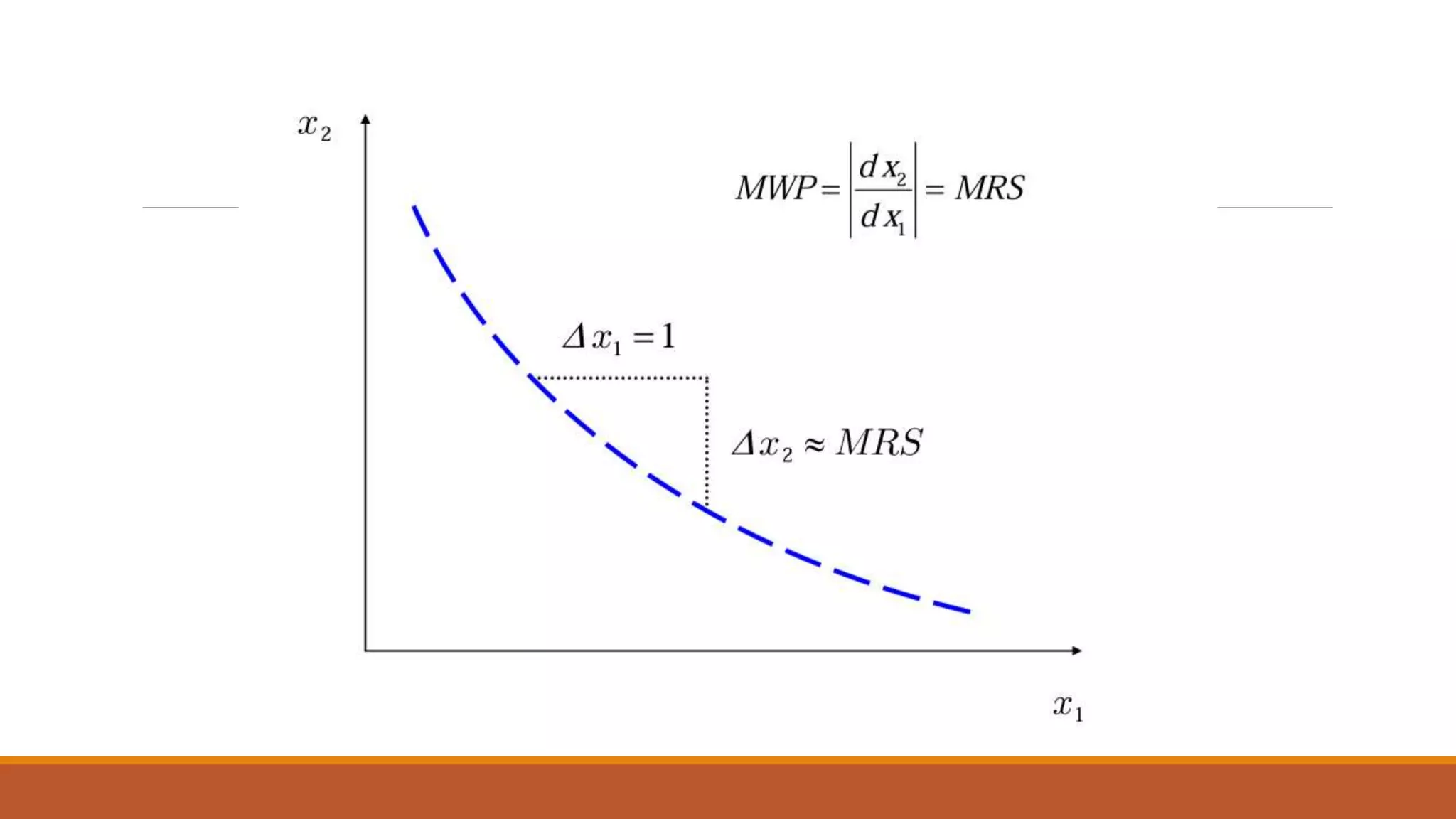
Rate of substitution
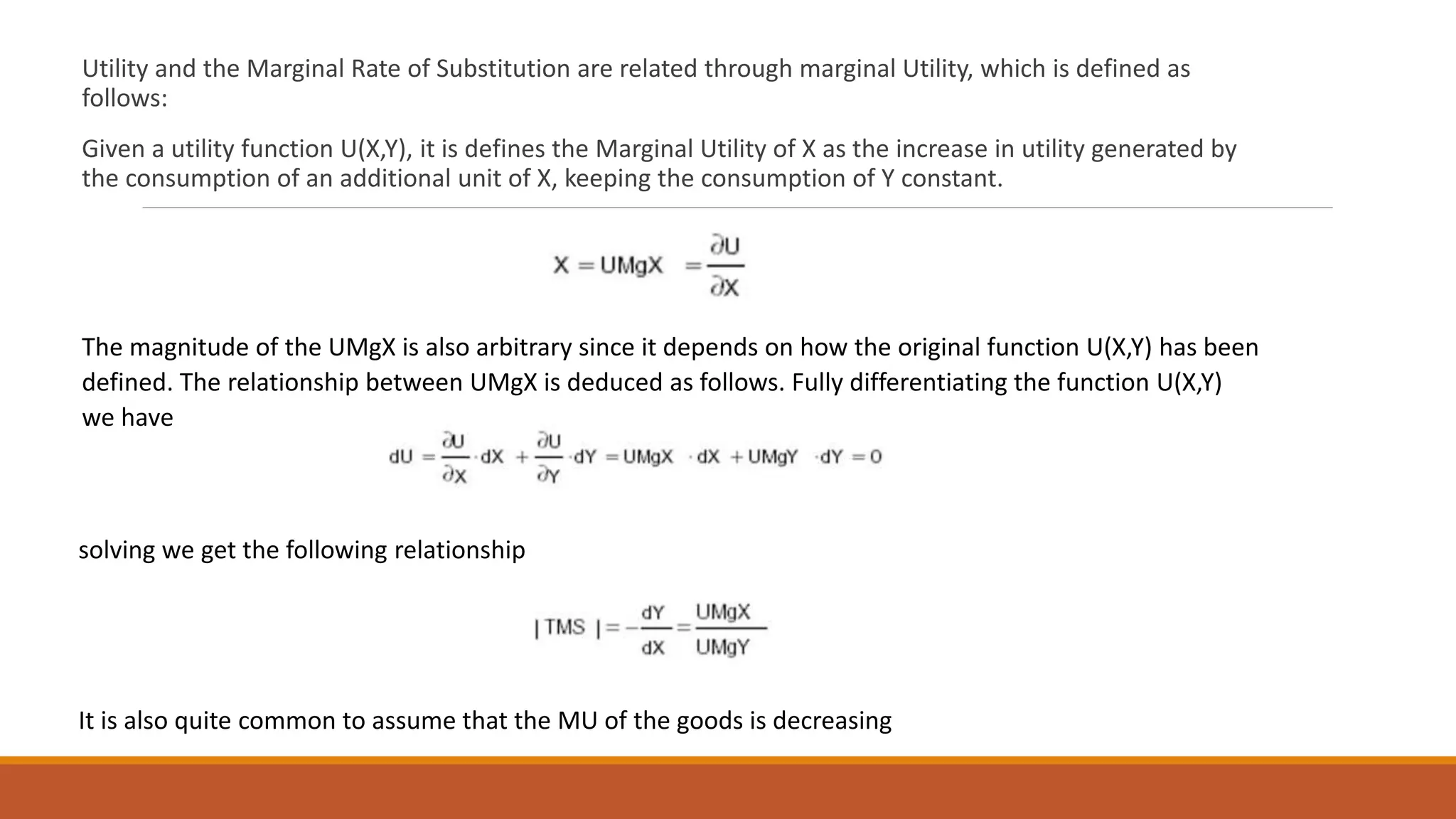
Utility and the Marginal Rate of Substitution are related through marginal Utility, which is defined as
follows:
Given a utility function U(X,Y), it is defines the Marginal Utility of X as the increase in utility generated by
the consumption of an additional unit of X, keeping the consumption of Y constant.
The magnitude of the UMgX is also arbitrary since it depends on how the original function U(X,Y) has been
defined. The relationship between UMgX is deduced as follows. Fully differentiating the function U(X,Y)
we have
solving we get the following relationship
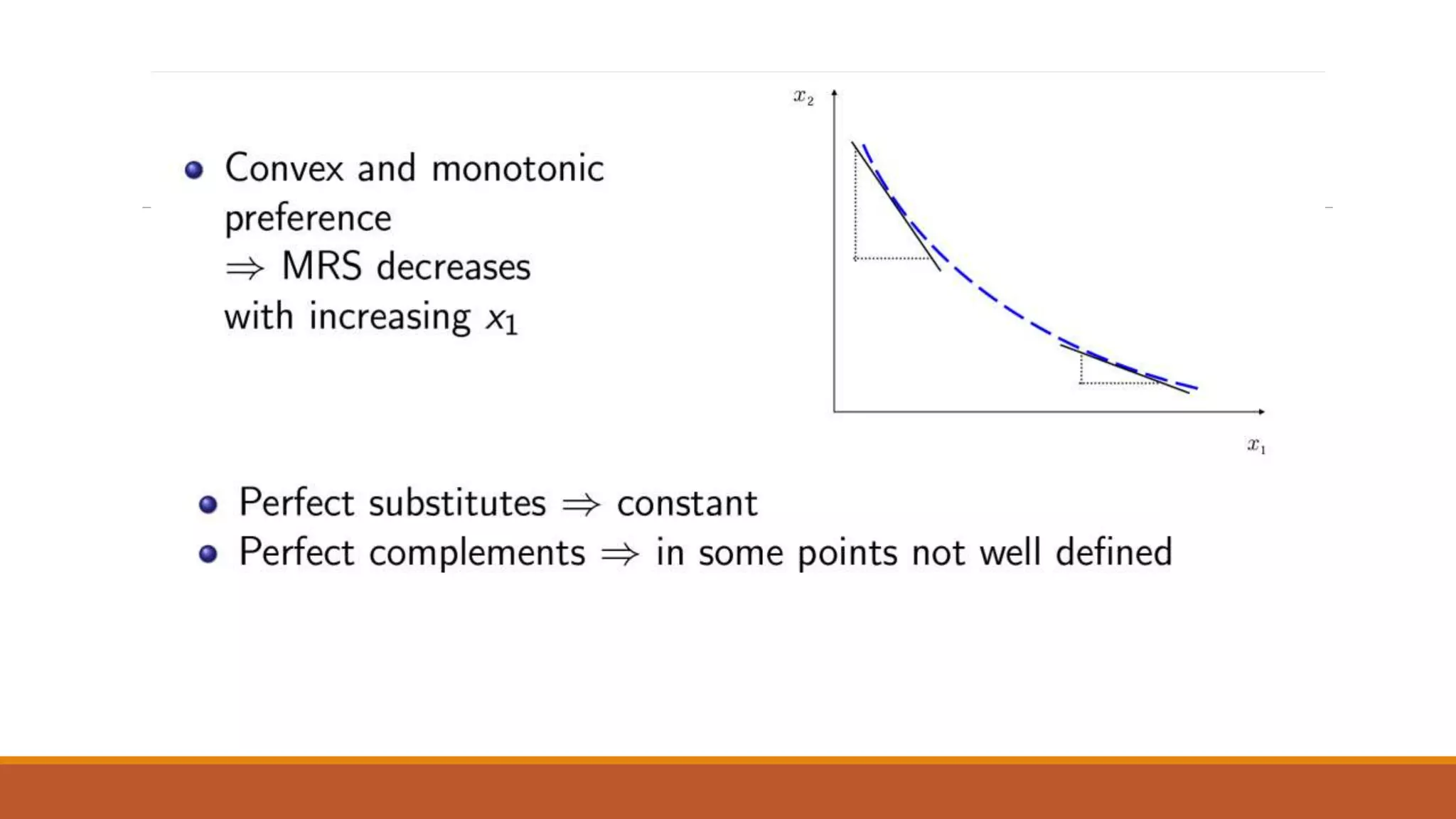
It is also quite common to assume that the MU of the goods is decreasing
Decreasing marginal utility
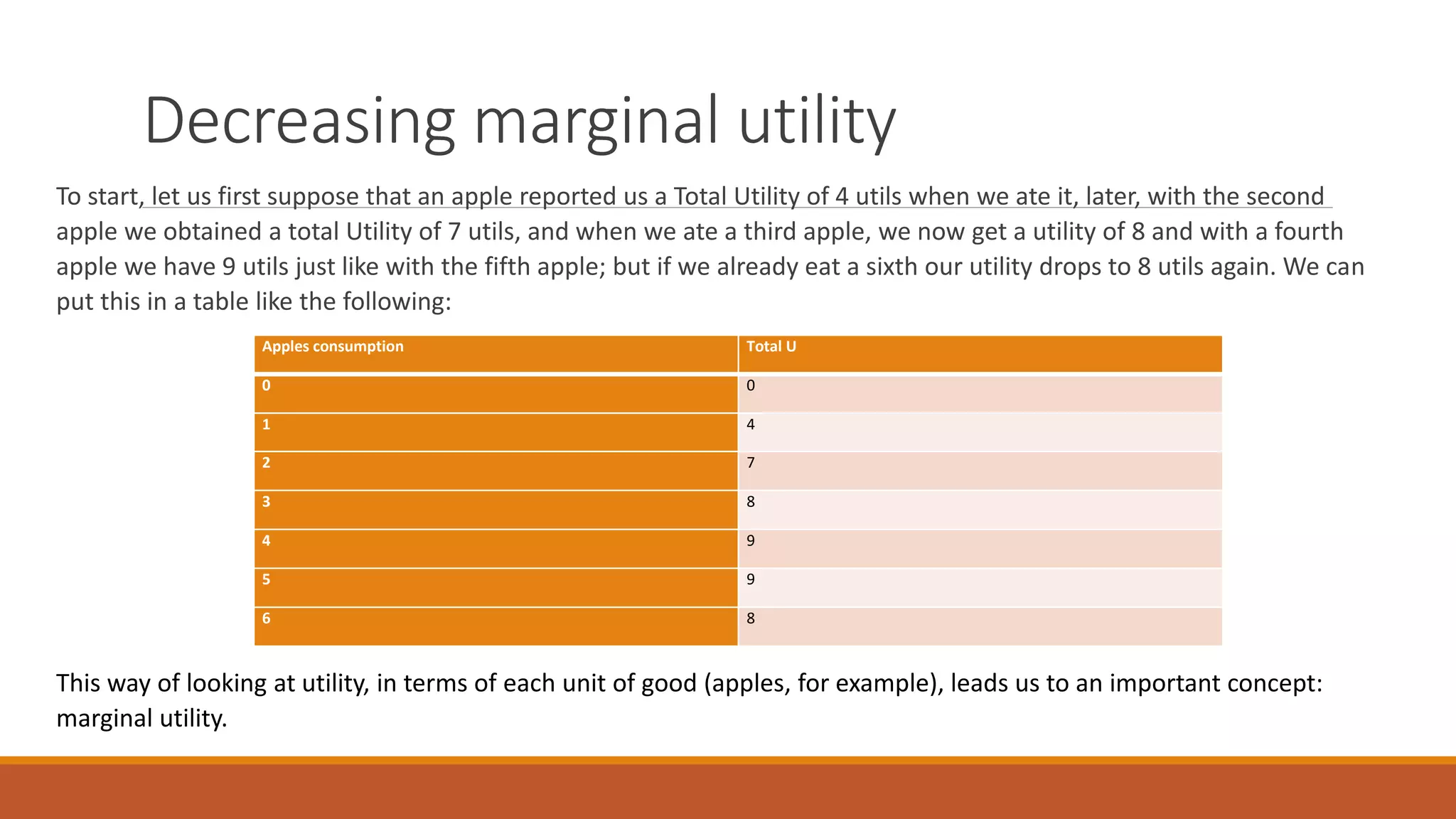
To start, let us first suppose that an apple reported us a Total Utility of 4 utils when we ate it, later, with the second
apple we obtained a total Utility of 7 utils, and when we ate a third apple, we now get a utility of 8 and with a fourth
apple we have 9 utils just like with the fifth apple; but if we already eat a sixth our utility drops to 8 utils again. We can
put this in a table like the following:
Apples consumption Total U
0 0
1 4
2 7
3 8
4 9
5 9
6 8
This way of looking at utility, in terms of each unit of good (apples, for example), leads us to an important concept:
marginal utility.
Marginal utility
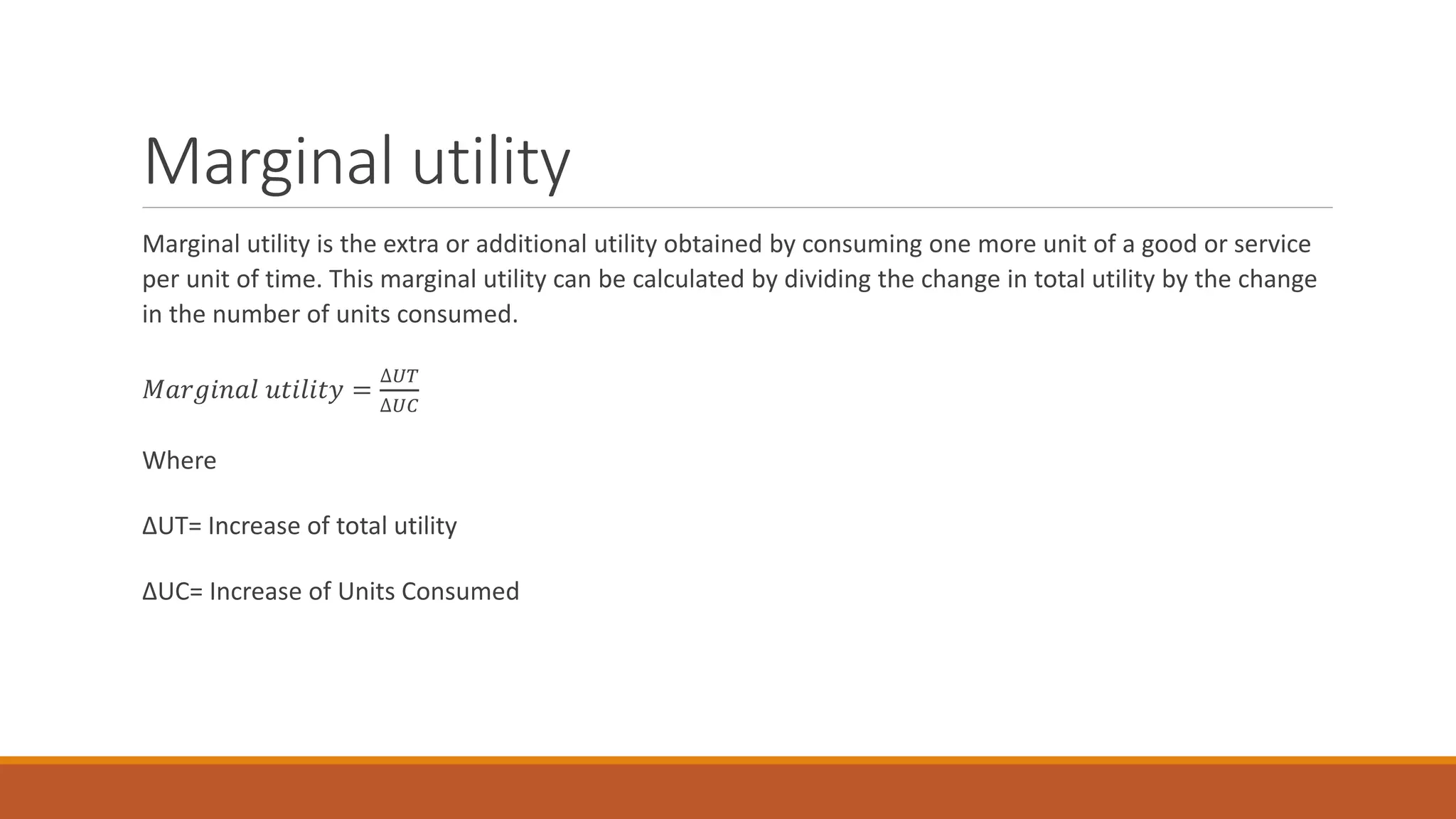
Marginal utility is the extra or additional utility obtained by consuming one more unit of a good or service
per unit of time. This marginal utility can be calculated by dividing the change in total utility by the change
in the number of units consumed.
𝑀𝑎𝑟𝑔𝑖𝑛𝑎𝑙 𝑢𝑡𝑖𝑙𝑖𝑡𝑦 =
∆𝑈𝑇
∆𝑈𝐶
Where
ΔUT= Increase of total utility
ΔUC= Increase of Units Consumed
Apples example
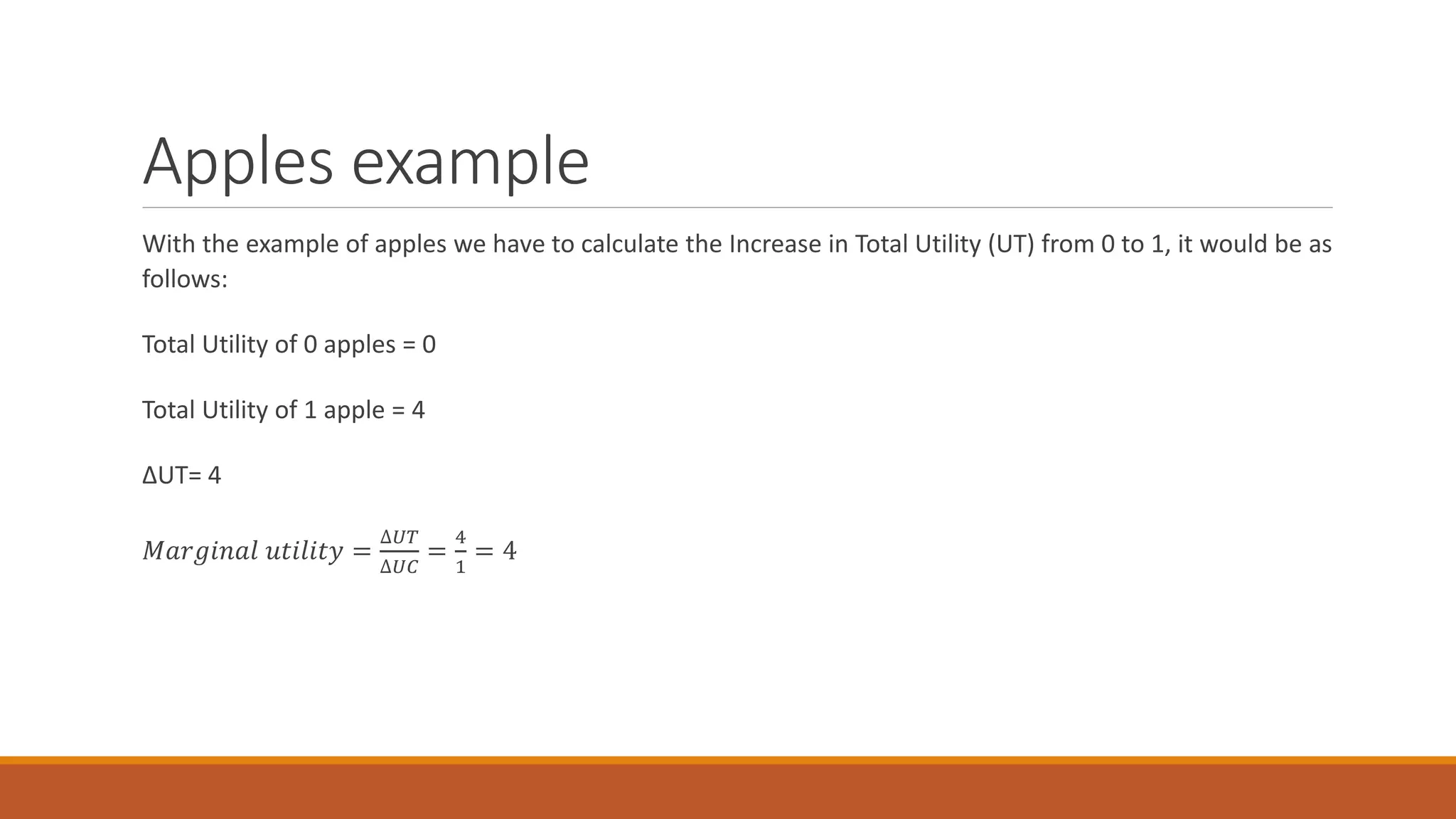
With the example of apples we have to calculate the Increase in Total Utility (UT) from 0 to 1, it would be as
follows:
Total Utility of 0 apples = 0
Total Utility of 1 apple = 4
ΔUT= 4
𝑀𝑎𝑟𝑔𝑖𝑛𝑎𝑙 𝑢𝑡𝑖𝑙𝑖𝑡𝑦 =
∆𝑈𝑇
∆𝑈𝐶
=
4
1
= 4
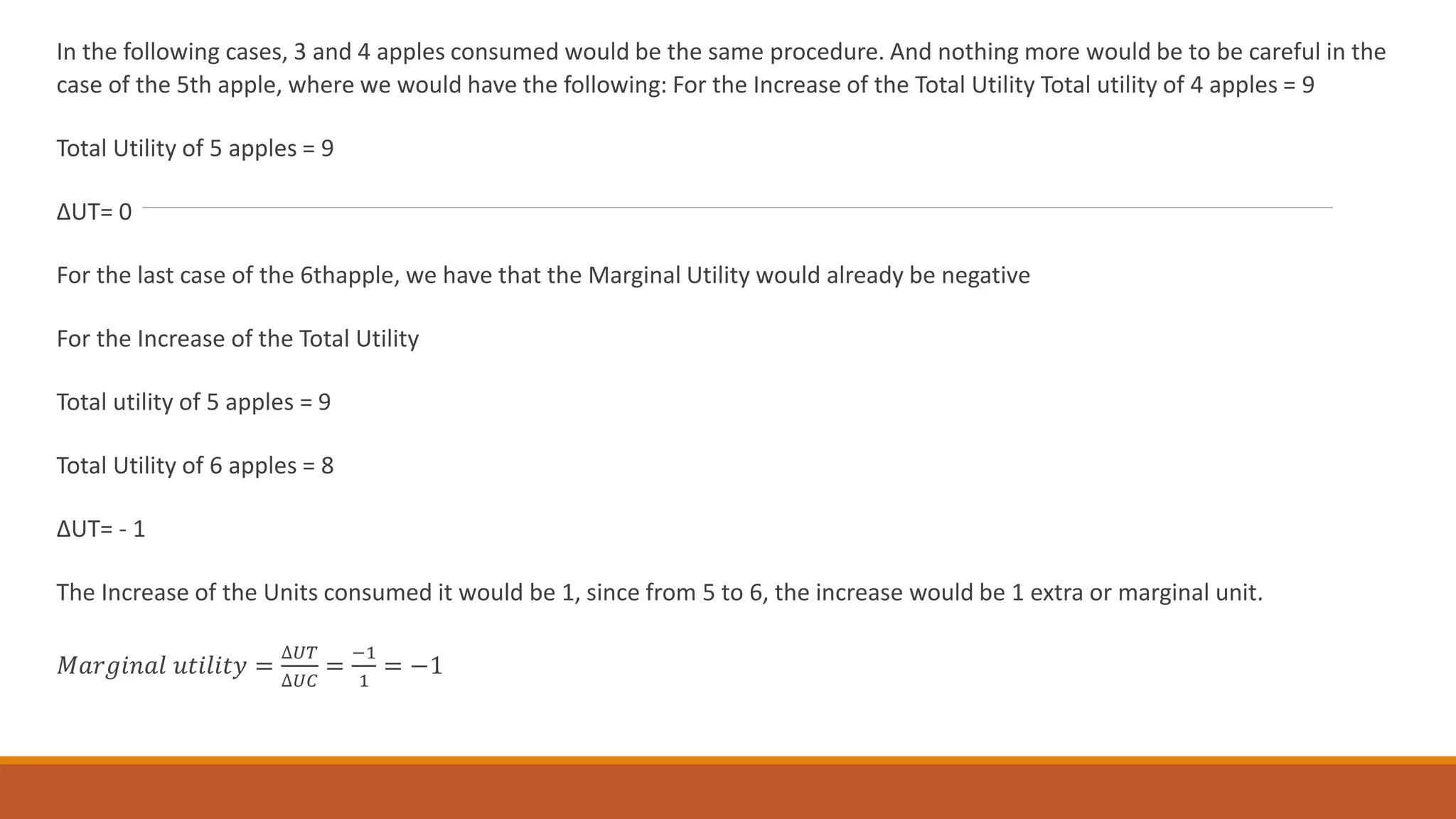
In the following cases, 3 and 4 apples consumed would be the same procedure. And nothing more would be to be careful in the
case of the 5th apple, where we would have the following: For the Increase of the Total Utility Total utility of 4 apples = 9
Total Utility of 5 apples = 9
ΔUT= 0
For the last case of the 6thapple, we have that the Marginal Utility would already be negative
For the Increase of the Total Utility
Total utility of 5 apples = 9
Total Utility of 6 apples = 8
ΔUT= - 1
The Increase of the Units consumed it would be 1, since from 5 to 6, the increase would be 1 extra or marginal unit.
𝑀𝑎𝑟𝑔𝑖𝑛𝑎𝑙 𝑢𝑡𝑖𝑙𝑖𝑡𝑦 =
∆𝑈𝑇
∆𝑈𝐶
=
−1
1
= −1
Utility and the Marginal Rate of substitution-.pptx

Utility and the Marginal Rate of substitution-.pptx

  • 1.
    Utility and theMarginal Rate of substitution
  • 2.
    Utility and theMarginal Rate of Substitution are related through marginal Utility, which is defined as follows: Given a utility function U(X,Y), it is defines the Marginal Utility of X as the increase in utility generated by the consumption of an additional unit of X, keeping the consumption of Y constant. The magnitude of the UMgX is also arbitrary since it depends on how the original function U(X,Y) has been defined. The relationship between UMgX is deduced as follows. Fully differentiating the function U(X,Y) we have solving we get the following relationship It is also quite common to assume that the MU of the goods is decreasing
  • 3.
    Decreasing marginal utility Tostart, let us first suppose that an apple reported us a Total Utility of 4 utils when we ate it, later, with the second apple we obtained a total Utility of 7 utils, and when we ate a third apple, we now get a utility of 8 and with a fourth apple we have 9 utils just like with the fifth apple; but if we already eat a sixth our utility drops to 8 utils again. We can put this in a table like the following: Apples consumption Total U 0 0 1 4 2 7 3 8 4 9 5 9 6 8 This way of looking at utility, in terms of each unit of good (apples, for example), leads us to an important concept: marginal utility.
  • 4.
    Marginal utility Marginal utilityis the extra or additional utility obtained by consuming one more unit of a good or service per unit of time. This marginal utility can be calculated by dividing the change in total utility by the change in the number of units consumed. 𝑀𝑎𝑟𝑔𝑖𝑛𝑎𝑙 𝑢𝑡𝑖𝑙𝑖𝑡𝑦 = ∆𝑈𝑇 ∆𝑈𝐶 Where ΔUT= Increase of total utility ΔUC= Increase of Units Consumed
  • 5.
    Apples example With theexample of apples we have to calculate the Increase in Total Utility (UT) from 0 to 1, it would be as follows: Total Utility of 0 apples = 0 Total Utility of 1 apple = 4 ΔUT= 4 𝑀𝑎𝑟𝑔𝑖𝑛𝑎𝑙 𝑢𝑡𝑖𝑙𝑖𝑡𝑦 = ∆𝑈𝑇 ∆𝑈𝐶 = 4 1 = 4
  • 6.
    In the followingcases, 3 and 4 apples consumed would be the same procedure. And nothing more would be to be careful in the case of the 5th apple, where we would have the following: For the Increase of the Total Utility Total utility of 4 apples = 9 Total Utility of 5 apples = 9 ΔUT= 0 For the last case of the 6thapple, we have that the Marginal Utility would already be negative For the Increase of the Total Utility Total utility of 5 apples = 9 Total Utility of 6 apples = 8 ΔUT= - 1 The Increase of the Units consumed it would be 1, since from 5 to 6, the increase would be 1 extra or marginal unit. 𝑀𝑎𝑟𝑔𝑖𝑛𝑎𝑙 𝑢𝑡𝑖𝑙𝑖𝑡𝑦 = ∆𝑈𝑇 ∆𝑈𝐶 = −1 1 = −1