URINARY TRACT INFECTIONS(UTI’S)
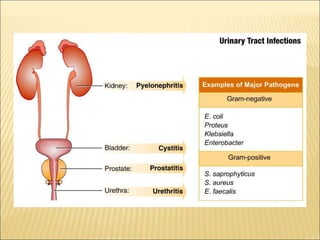
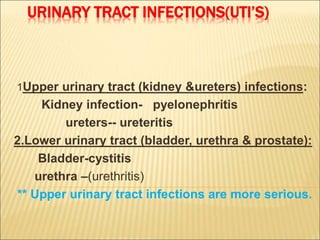
1Upper urinary tract (kidney &ureters) infections:
Kidney infection- pyelonephritis
ureters-- ureteritis
2.Lower urinary tract (bladder, urethra & prostate):
Bladder-cystitis
urethra –(urethritis)
** Upper urinary tract infections are more serious.
URINARY TRACT INFECTIONS(UTI’S)
 It is more common in women more than
men
30:1 (Why?).
 Females naturally have a shorter urethra
than males, whichmeans that there is less
distance for bacteria to travel to reach the
bladder
digestive tract to opening of the urethra.
• Obstruction of the flow of urine(e.g. kidney
stone)
• Enlargement of prostate gland in men(common
cause)
• Catheters placed in urethra and bladder.
• Not drinking enough fluids.
•Waiting too long to urinate.
• Large uterus in pregnant women.
• Poor toilet habits(wiping back to front for
women)
• Disorders that suppress the immune
system(diabetes &
cancer chemotherapy).
BACTERIA RESPONSIBLE OF URINARY TRACT
INFECTIONS
Gm- bacteria (most common):
•E.coli (approx. 80% of cases)
•Proteus
•Klebsiella
•Pseudomonas
Gm+ bacteria ( less common):
• Staphylococcus species(S.aureus and Saprophyticus)
•Chlamydia trachomatis ,Mycoplasma & N. gonorrhea
(limited to urethra, unlike E.coli may be sexually
transmitted)
4.Chemical Classification of UTI
 Nitro furan derivative : Nitrofurantoin
 Urinary Analgesic: phenazopyridine
 amines: Methanamine
 Tetracyclines: Doxycycline , chlortetracycline
 Fluroquinolnes- ciprofloxacin
 sulfonamides: Co-trimoxazole
 Aminoglycosides:Gentamicin
 β-Lactam antibiotics –Unasyn and Augumentin
7
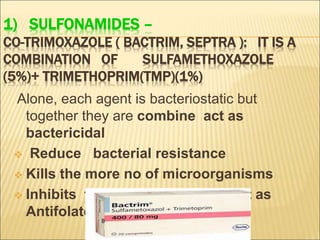
1) SULFONAMIDES –
CO-TRIMOXAZOLE ( BACTRIM, SEPTRA ): IT IS A
COMBINATION OF SULFAMETHOXAZOLE
(5%)+ TRIMETHOPRIM(TMP)(1%)
Alone, each agent is bacteriostatic but
together they are combine act as
bactericidal
 Reduce bacterial resistance
 Kills the more no of microorganisms
 Inhibits folic acid synthesis act as
Antifolate
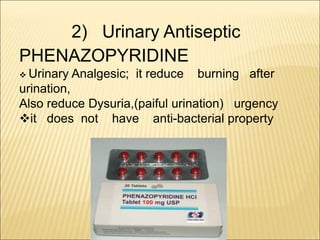
PHENAZOPYRIDINE
 Urinary Analgesic; it reduce burning after
urination,
Also reduce Dysuria,(paiful urination) urgency
it does not have anti-bacterial property
2) Urinary Antiseptic
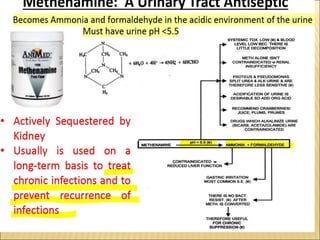
3) Amine - METHENAMINE (HEXAMINE)
Mechanism of Action:
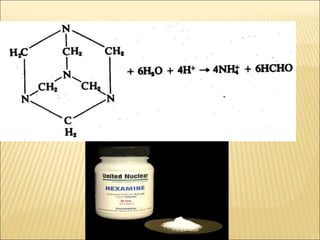
It act as prodrug - taken as orally when it enters to the
urinary tract Decomposes slowly in acidic urine( Ph 5.5 or less)
to release formaldehyde which inhibits all bacteria
 No antimicrobial activty in blood and tissues.
Needs to be administered with mandelic acid or
hippuric acid
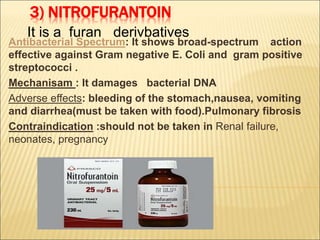
3) NITROFURANTOIN
Antibacterial Spectrum: It shows broad-spectrum action
effective against Gram negative E. Coli and gram positive
streptococci .
Mechanisam : It damages bacterial DNA
Adverse effects: bleeding of the stomach,nausea, vomiting
and diarrhea(must be taken with food).Pulmonary fibrosis
Contraindication :should not be taken in Renal failure,
neonates, pregnancy
It is a furan derivbatives
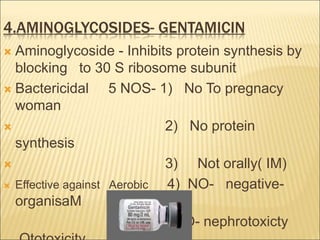
4.AMINOGLYCOSIDES- GENTAMICIN
 Aminoglycoside - Inhibits protein synthesis by
blocking to 30 S ribosome subunit
 Bactericidal 5 NOS- 1) No To pregnacy
woman
 2) No protein
synthesis
 3) Not orally( IM)
 Effective against Aerobic 4) NO- negative-
organisaM
5) NO- nephrotoxicty
5. TETRACYCLINES
(E.G. DOXYCYCLINE)
It is a long acting broad spectrum and
bacteristatic tetracycline
Mechanism of action
Inhibit protein synthesis by binding reversibly to
30 s subunit
•Uses: Treatment of UTI’s due to Mycoplasma & Chlamydia,
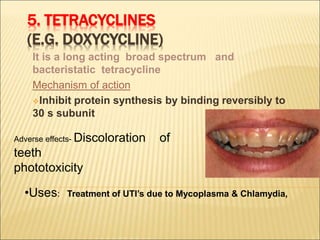
Adverse effects- Discoloration of
teeth
phototoxicity
6) Β-LACTAM ANTIBIOTICS
Unasyn – its is Combinations of
ampicilin + sulbactum
Augumentin - its is Combinations of
amoxacillin+ clavulanic acid
16
Mechanism: act as Bactericidal
,cell wall synthesis blocker
7) FLUROQUINOLONES
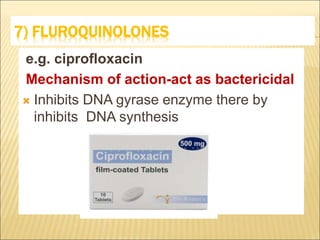
e.g. ciprofloxacin
Mechanism of action-act as bactericidal
 Inhibits DNA gyrase enzyme there by
inhibits DNA synthesis

urinary tract infections (1).ppt........

  • 3.
    URINARY TRACT INFECTIONS(UTI’S) 1Upperurinary tract (kidney &ureters) infections: Kidney infection- pyelonephritis ureters-- ureteritis 2.Lower urinary tract (bladder, urethra & prostate): Bladder-cystitis urethra –(urethritis) ** Upper urinary tract infections are more serious.
  • 4.
    URINARY TRACT INFECTIONS(UTI’S) It is more common in women more than men 30:1 (Why?).  Females naturally have a shorter urethra than males, whichmeans that there is less distance for bacteria to travel to reach the bladder
  • 5.
    digestive tract toopening of the urethra. • Obstruction of the flow of urine(e.g. kidney stone) • Enlargement of prostate gland in men(common cause) • Catheters placed in urethra and bladder. • Not drinking enough fluids. •Waiting too long to urinate. • Large uterus in pregnant women. • Poor toilet habits(wiping back to front for women) • Disorders that suppress the immune system(diabetes & cancer chemotherapy).
  • 6.
    BACTERIA RESPONSIBLE OFURINARY TRACT INFECTIONS Gm- bacteria (most common): •E.coli (approx. 80% of cases) •Proteus •Klebsiella •Pseudomonas Gm+ bacteria ( less common): • Staphylococcus species(S.aureus and Saprophyticus) •Chlamydia trachomatis ,Mycoplasma & N. gonorrhea (limited to urethra, unlike E.coli may be sexually transmitted)
  • 7.
    4.Chemical Classification ofUTI  Nitro furan derivative : Nitrofurantoin  Urinary Analgesic: phenazopyridine  amines: Methanamine  Tetracyclines: Doxycycline , chlortetracycline  Fluroquinolnes- ciprofloxacin  sulfonamides: Co-trimoxazole  Aminoglycosides:Gentamicin  β-Lactam antibiotics –Unasyn and Augumentin 7
  • 8.
    1) SULFONAMIDES – CO-TRIMOXAZOLE( BACTRIM, SEPTRA ): IT IS A COMBINATION OF SULFAMETHOXAZOLE (5%)+ TRIMETHOPRIM(TMP)(1%) Alone, each agent is bacteriostatic but together they are combine act as bactericidal  Reduce bacterial resistance  Kills the more no of microorganisms  Inhibits folic acid synthesis act as Antifolate
  • 9.
    PHENAZOPYRIDINE  Urinary Analgesic;it reduce burning after urination, Also reduce Dysuria,(paiful urination) urgency it does not have anti-bacterial property 2) Urinary Antiseptic
  • 10.
    3) Amine -METHENAMINE (HEXAMINE) Mechanism of Action: It act as prodrug - taken as orally when it enters to the urinary tract Decomposes slowly in acidic urine( Ph 5.5 or less) to release formaldehyde which inhibits all bacteria  No antimicrobial activty in blood and tissues. Needs to be administered with mandelic acid or hippuric acid
  • 13.
    3) NITROFURANTOIN Antibacterial Spectrum:It shows broad-spectrum action effective against Gram negative E. Coli and gram positive streptococci . Mechanisam : It damages bacterial DNA Adverse effects: bleeding of the stomach,nausea, vomiting and diarrhea(must be taken with food).Pulmonary fibrosis Contraindication :should not be taken in Renal failure, neonates, pregnancy It is a furan derivbatives
  • 14.
    4.AMINOGLYCOSIDES- GENTAMICIN  Aminoglycoside- Inhibits protein synthesis by blocking to 30 S ribosome subunit  Bactericidal 5 NOS- 1) No To pregnacy woman  2) No protein synthesis  3) Not orally( IM)  Effective against Aerobic 4) NO- negative- organisaM 5) NO- nephrotoxicty
  • 15.
    5. TETRACYCLINES (E.G. DOXYCYCLINE) Itis a long acting broad spectrum and bacteristatic tetracycline Mechanism of action Inhibit protein synthesis by binding reversibly to 30 s subunit •Uses: Treatment of UTI’s due to Mycoplasma & Chlamydia, Adverse effects- Discoloration of teeth phototoxicity
  • 16.
    6) Β-LACTAM ANTIBIOTICS Unasyn– its is Combinations of ampicilin + sulbactum Augumentin - its is Combinations of amoxacillin+ clavulanic acid 16 Mechanism: act as Bactericidal ,cell wall synthesis blocker
  • 17.
    7) FLUROQUINOLONES e.g. ciprofloxacin Mechanismof action-act as bactericidal  Inhibits DNA gyrase enzyme there by inhibits DNA synthesis