Present Absent Totals
Positive 60 120 180
Negative 20 200 220
Totals 320 80 400
Present Absent Totals
Positive TP FP TP+FP
Negativ
e
FN TN TN+FN
Totals TP+FN FP+TN N
PPV
NPV
Sensit Specif
Present Absent Totals
Risk A B
NO
Risk
C D
Totals N
AD/BC
Odds Ratio
1200/2400
0.5
Present Absent Totals
Risk A B
NO
Risk
C D
Totals N
Relative Risk
A/A+B
C/C+D
A B C D E
Healthy Diseased
A B C D E
Healthy Diseased
B to D: Sensitivity
D to E: NPV
D to B: Specificity
B to A: PPV
C: Accuracy
C: Fewest falses
A B C D E
Healthy Diseased
- +
FN FP
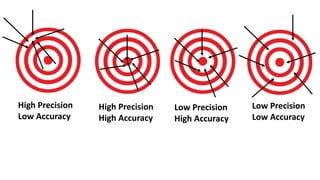
High Precision
High Accuracy
High Precision
Low Accuracy
Low Precision
High Accuracy
Low Precision
Low Accuracy
Selection Bias
Ex. Using athletes to
measure population’s fitness
level.
Berkson’s Bias
Ex. Using medical records
to talk about population
Solution
Get a random sample and
weight the data to match
the population
Hawthorne Effect:
Subject’s behavior changes
because they’re being observed.
VS Solution:
Get a control group
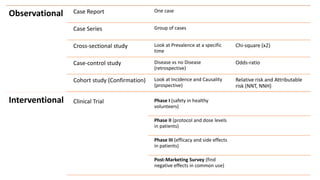
Observational Case Report One case
Case Series Group of cases
Cross-sectional study Look at Prevalence at a specific
time
Chi-square (x2)
Case-control study Disease vs no Disease
(retrospective)
Odds-ratio
Cohort study (Confirmation) Look at Incidence and Causality
(prospective)
Relative risk and Attributable
risk (NNT, NNH)
Interventional Clinical Trial Phase I (safety in healthy
volunteers)
Phase II (protocol and dose levels
in patients)
Phase III (efficacy and side effects
in patients)
Post-Marketing Survey (find
negative effects in common use)
Negative Positive
A B C
A – Mode
B – Median
C – Mean
Sensitivity
1-Specificity
99.7%
95.5%
68%
.15% 2.4% 13.5% 34% 34% 13.5% 2.4% .15%
Standard Deviation
50%
50%
84%
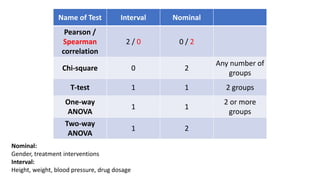
Name of Test Interval Nominal
Pearson /
Spearman
correlation
2 / 0 0 / 2
Chi-square 0 2
Any number of
groups
T-test 1 1 2 groups
One-way
ANOVA
1 1
2 or more
groups
Two-way
ANOVA
1 2
Nominal:
Gender, treatment interventions
Interval:
Height, weight, blood pressure, drug dosage
Stimulus
Behavior
Add Remove
Stops Punishment Extinction
Increases
Positive
Reinforcement
Negative
Reinforcement
Types of Reinforcement
Contingency
Schedule
Time Behaviors
Constant Fixed Interval Fixed Ratio
Changing Variable Interval Variable Ratio
Reinforcement Schedules
IQ Score:
MA
CA
x100
MA: Mental Age
CA: Chronological Age
X: Mean
S: Standard Deviation
S:
∑(X-X)
n-1
2
√
Odds ratio:
AD
BC
A: + Risk and + Disease
D: - Risk and - Disease
Relative R:
EG
UG
EG: Exposed Group
UG: Unexposed Group
Attributable R:EG - UG
EG: Exposed Group
UG: Unexposed Group
NNT:
ARr1
ARr2
NNT: Number needed to treat
ARr: Attributable risk result
ARr1
ARr2
=
Specificity:
TN
TN+FP
TN: True Negative
FP: False Positive
HI:
MZ-DZ
100-DZ
MZ: Monozygotic Concordance
DZ: Dizygotic Concordance
HI: Heritability Index
MA: IQ x CA
100
MA: Mental Age
CA: Chronological Age
3 years
Circle
4 years
Cross
4 1/2 years
Rectangle
5 years
Square
6 years
Triangle
7 years
Diamond
Stacks 9 cubes
3 years*
Stacks 3-4 cubes
18 months*
Stacks 6 cubes
2 years*
*Age multiplied by 3
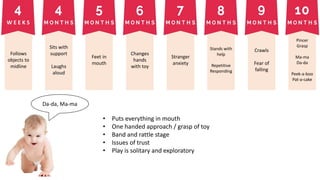
Feet in
mouth
Changes
hands
with toy
Stranger
anxiety
Stands with
help
Repetitive
Responding
Crawls
Fear of
falling
Pincer
Grasp
Ma-ma
Da-da
Peek-a-boo
Pat-a-cake
Sits with
support
Laughs
aloud
Da-da, Ma-ma
Follows
objects to
midline
W E E K S
• Puts everything in mouth
• One handed approach / grasp of toy
• Band and rattle stage
• Issues of trust
• Play is solitary and exploratory
10 words
Separation
Anxiety
Emergence of
hand
preference
Climbs stairs
alone
Walks alone
• Kicks ball, throws ball
• Pats pictures in book
• Bungee-kid
• Onlooker play
• Achieves object permanence
First words, First steps, First birthday
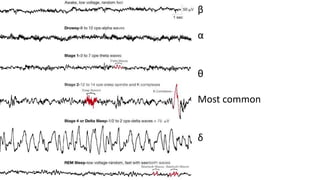
0 1 2 3 4 5 6 7 Wake
Awake
REM
Stage 1
Stage 2
Stage 3
Stage 4
1-4 Hours: Delta sleep
4-8 Hours: REM and Stage 2
Less time: Stage 1
Most time: Stage 2
Wake up out of: REM, Stage 2
β
α
θ
Most common
δ
Lymphocyte
Cortisol
Blood pressure
Amygdala activation
Negative mood
Glucose tolerance
Prefrontal cortical
activity
Sleep Deprivation
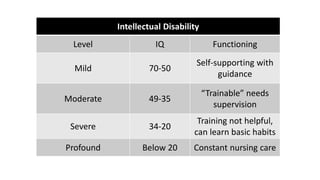
Intellectual Disability
Level IQ Functioning
Mild 70-50
Self-supporting with
guidance
Moderate 49-35
“Trainable” needs
supervision
Severe 34-20
Training not helpful,
can learn basic habits
Profound Below 20 Constant nursing care
Brief Psychotic Disorder
Schizophreniform Disorder
Schizophrenia
From 1-30 days
Return to full
former functioning
Less than 6 months
Auditory Hallucinations
Blunted affect
Disturbance in behavior
Hallucinations
Delusions
Bizarre behavior
Disorganized
speech
Catatonic behavior
Unusual motor
behavior
Depersonalization
Flat affect
Motor retardation
Apathy
Mutism
Alogia
Avolition
Mood Disorder
Mild Severe
Stable
Persistent
Depressive
disorder
Major
Depression
Alternating Cyclothymia Bipolar
At least for 2 years
Major Depression
• Anhedonia
• Lack of Motivation
• Worthlessness
• Decreased concentration
• Weight loss/gain
• Depressed mood
• Recurrent thoughts
• Insomnia/Hypersomnia
• Agitation/Retardation
• Somatic complains
• Delusions or
Hallucinations
• Loss of sex drive
Bipolar (Mania)
• Increased self-esteem
• Low frustration tolerance
• Decreased need for sleep
• Flight of ideas
• Excessive involvement
• Weight loss / Anorexia
• Increased Libido
Disease SE DO NE GL EP GA ACh
ADHD
Schizophrenia
Major
Depressive
Bulimia
Anorexia
PTSD
Anxiety
Tourette’s
Parkinson’s
Alzheimer’s
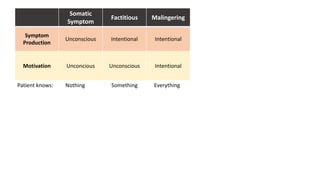
Somatic
Symptom
Factitious Malingering
Symptom
Production
Unconscious Intentional Intentional
Motivation Unconcious Unconscious Intentional
Patient knows: Nothing Something Everything
Perseveration – Frontal Lobe
Constructional Apraxia – Nondominant Parietal Lobe
Hemineglect – Right Parietal Lobe
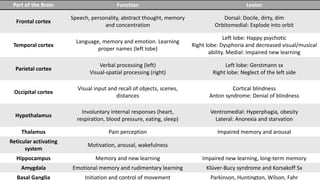
Part of the Brain Function Lesion
Frontal cortex
Speech, personality, abstract thought, memory
and concentration
Dorsal: Docile, dirty, dim
Orbitomedial: Explode into orbit
Temporal cortex
Language, memory and emotion. Learning
proper names (left lobe)
Left lobe: Happy psychotic
Right lobe: Dysphoria and decreased visual/musical
ability. Medial: Impaired new learning
Parietal cortex
Verbal processing (left)
Visual-spatial processing (right)
Left lobe: Gerstmann sx
Right lobe: Neglect of the left side
Occipital cortex
Visual input and recall of objects, scenes,
distances
Cortical blindness
Anton syndrome: Denial of blindness
Hypothalamus
Involuntary internal responses (heart,
respiration, blood pressure, eating, sleep)
Ventromedial: Hyperphagia, obesity
Lateral: Anorexia and starvation
Thalamus Pain perception Impaired memory and arousal
Reticular activating
system
Motivation, arousal, wakefulness
Hippocampus Memory and new learning Impaired new learning, long-term memory
Amygdala Emotional memory and rudimentary learning Klüver-Bucy syndrome and Korsakoff Sx
Basal Ganglia Initiation and control of movement Parkinson, Huntington, Wilson, Fahr
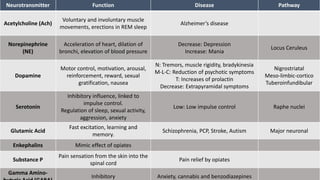
Neurotransmitter Function Disease Pathway
Acetylcholine (Ach)
Voluntary and involuntary muscle
movements, erections in REM sleep
Alzheimer’s disease
Norepinephrine
(NE)
Acceleration of heart, dilation of
bronchi, elevation of blood pressure
Decrease: Depression
Increase: Mania
Locus Ceruleus
Dopamine
Motor control, motivation, arousal,
reinforcement, reward, sexual
gratification, nausea
N: Tremors, muscle rigidity, bradykinesia
M-L-C: Reduction of psychotic symptoms
T: Increases of prolactin
Decrease: Extrapyramidal symptoms
Nigrostriatal
Meso-limbic-cortico
Tuberoinfundibular
Serotonin
Inhibitory influence, linked to
impulse control.
Regulation of sleep, sexual activity,
aggression, anxiety
Low: Low impulse control Raphe nuclei
Glutamic Acid
Fast excitation, learning and
memory.
Schizophrenia, PCP, Stroke, Autism Major neuronal
Enkephalins Mimic effect of opiates
Substance P
Pain sensation from the skin into the
spinal cord
Pain relief by opiates
Gamma Amino-
Inhibitory Anxiety, cannabis and benzodiazepines
Medication Type Notes
Haloperidol Typical Most used for acute symptoms
Fluphenazine Typical Long-lasting injection 2-3 weeks. Schizo and bipolar
Thioridazine Typical Retrograde ejaculation, retinal pigmentation
Loxapine Typical When non-responsive to other drugs
Clozapine Atypical
High affinity for serotonin
Agranulocytosis and seizures, NO TD
Risperidone Atypical
Dizziness, fatigue, dry mouth, tachycardia and hypotension, EP
effects
Olanzapine Atypical
Low rate of side effects
Little EP, may develop diabetes
Quetiapine Atypical
Serotonin, dopamine, NE, H1
Works for bipolar
Same somatic side effects
Aripipazole Atypical
Agonist on D2 and 5-HT1. Antagonist on 5-HT2
Bipolar, schizo and major depression
Ziprasidone Atypical
High affinity for DA, 5-HT, NE & H1
Inhibits serotonin reuptake, psychosis and mania, prolonged QT
Depression
• Any drug
Enuresis
• Imiprimine
Panic disorder
• Imipramine or Alprazolam (acute)
Obsessive-Compulsive disorder, PTSD
• Fluoxetine, clomipramine, paroxetine
Chronic pain w/wo depression
• Amitriptyline, escitalopram
Alprazolam, Clonazepam
• Panic, Anxiety
Diazepam
• Anxiety, Insomnia
Flurazepam, Triazolam, Temazepam
• Insomnia
Chlordiazepoxide, Oxazepam
• Alcohol detoxification
Lorazepam
• Anxiety, alcohol-related seizures
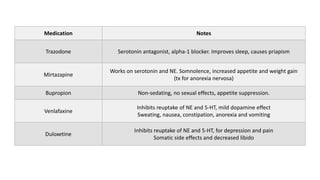
Medication Notes
Trazodone Serotonin antagonist, alpha-1 blocker. Improves sleep, causes priapism
Mirtazapine
Works on serotonin and NE. Somnolence, increased appetite and weight gain
(tx for anorexia nervosa)
Bupropion Non-sedating, no sexual effects, appetite suppression.
Venlafaxine
Inhibits reuptake of NE and 5-HT, mild dopamine effect
Sweating, nausea, constipation, anorexia and vomiting
Duloxetine
Inhibits reuptake of NE and 5-HT, for depression and pain
Somatic side effects and decreased libido
Lithium
• First line treatment for Bipolar disorder.
• Can interfere with the action of vasopressin or the renal
conducting ducts = Reduces water reabsorption.
• Can give rise to Nephrogenic diabetes insipidus.
Medications
that cause
Agranulocytocis
Clozapine
Valproic Acid
Carbamazepine
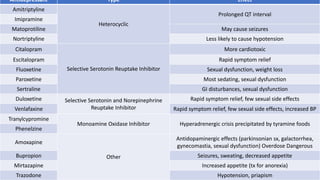
Antidepressant Type Effect
Amitriptyline
Heterocyclic
Prolonged QT interval
Imipramine
Matoprotiline May cause seizures
Nortriptyline Less likely to cause hypotension
Citalopram
Selective Serotonin Reuptake Inhibitor
More cardiotoxic
Escitalopram Rapid symptom relief
Fluoxetine Sexual dysfunction, weight loss
Paroxetine Most sedating, sexual dysfunction
Sertraline GI disturbances, sexual dysfunction
Duloxetine Selective Serotonin and Norepinephrine
Reuptake Inhibitor
Rapid symptom relief, few sexual side effects
Venlafaxine Rapid symptom relief, few sexual side effects, increased BP
Tranylcypromine
Monoamine Oxidase Inhibitor Hyperadrenergic crisis precipitated by tyramine foods
Phenelzine
Amoxapine
Other
Antidopaminergic effects (parkinsonian sx, galactorrhea,
gynecomastia, sexual dysfunction) Overdose Dangerous
Bupropion Seizures, sweating, decreased appetite
Mirtazapine Increased appetite (tx for anorexia)
Trazodone Hypotension, priapism
Schizoid Paranoid Schizotypal Narcissistic
Borderline Antisocial Histrionic Anton Sx
(PCAs occlusion)
Types of Health Insurance Plans
PPO HMO POS
Monthly
premiums
$$$ $ $$
Copayments &
deductibles
$$ $ Variable
PCP referral for
specialist visits
No Yes Yes
Size of “in-
network”
provider
Large Limited Limited
May go outside
provider network
Yes No Yes (additional
out-of-pocket)

USMLE Step 1 Behavioral Science

  • 2.
    Present Absent Totals Positive60 120 180 Negative 20 200 220 Totals 320 80 400 Present Absent Totals Positive TP FP TP+FP Negativ e FN TN TN+FN Totals TP+FN FP+TN N PPV NPV Sensit Specif Present Absent Totals Risk A B NO Risk C D Totals N AD/BC Odds Ratio 1200/2400 0.5 Present Absent Totals Risk A B NO Risk C D Totals N Relative Risk A/A+B C/C+D
  • 3.
    A B CD E Healthy Diseased A B C D E Healthy Diseased B to D: Sensitivity D to E: NPV D to B: Specificity B to A: PPV C: Accuracy C: Fewest falses A B C D E Healthy Diseased - + FN FP
  • 4.
    High Precision High Accuracy HighPrecision Low Accuracy Low Precision High Accuracy Low Precision Low Accuracy
  • 5.
    Selection Bias Ex. Usingathletes to measure population’s fitness level. Berkson’s Bias Ex. Using medical records to talk about population Solution Get a random sample and weight the data to match the population
  • 6.
    Hawthorne Effect: Subject’s behaviorchanges because they’re being observed. VS Solution: Get a control group
  • 7.
    Observational Case ReportOne case Case Series Group of cases Cross-sectional study Look at Prevalence at a specific time Chi-square (x2) Case-control study Disease vs no Disease (retrospective) Odds-ratio Cohort study (Confirmation) Look at Incidence and Causality (prospective) Relative risk and Attributable risk (NNT, NNH) Interventional Clinical Trial Phase I (safety in healthy volunteers) Phase II (protocol and dose levels in patients) Phase III (efficacy and side effects in patients) Post-Marketing Survey (find negative effects in common use)
  • 8.
    Negative Positive A BC A – Mode B – Median C – Mean Sensitivity 1-Specificity
  • 9.
    99.7% 95.5% 68% .15% 2.4% 13.5%34% 34% 13.5% 2.4% .15% Standard Deviation 50% 50% 84%
  • 10.
    Name of TestInterval Nominal Pearson / Spearman correlation 2 / 0 0 / 2 Chi-square 0 2 Any number of groups T-test 1 1 2 groups One-way ANOVA 1 1 2 or more groups Two-way ANOVA 1 2 Nominal: Gender, treatment interventions Interval: Height, weight, blood pressure, drug dosage
  • 11.
    Stimulus Behavior Add Remove Stops PunishmentExtinction Increases Positive Reinforcement Negative Reinforcement Types of Reinforcement Contingency Schedule Time Behaviors Constant Fixed Interval Fixed Ratio Changing Variable Interval Variable Ratio Reinforcement Schedules
  • 12.
    IQ Score: MA CA x100 MA: MentalAge CA: Chronological Age X: Mean S: Standard Deviation S: ∑(X-X) n-1 2 √ Odds ratio: AD BC A: + Risk and + Disease D: - Risk and - Disease Relative R: EG UG EG: Exposed Group UG: Unexposed Group Attributable R:EG - UG EG: Exposed Group UG: Unexposed Group NNT: ARr1 ARr2 NNT: Number needed to treat ARr: Attributable risk result ARr1 ARr2 = Specificity: TN TN+FP TN: True Negative FP: False Positive HI: MZ-DZ 100-DZ MZ: Monozygotic Concordance DZ: Dizygotic Concordance HI: Heritability Index MA: IQ x CA 100 MA: Mental Age CA: Chronological Age
  • 13.
    3 years Circle 4 years Cross 41/2 years Rectangle 5 years Square 6 years Triangle 7 years Diamond Stacks 9 cubes 3 years* Stacks 3-4 cubes 18 months* Stacks 6 cubes 2 years* *Age multiplied by 3
  • 14.
    Feet in mouth Changes hands with toy Stranger anxiety Standswith help Repetitive Responding Crawls Fear of falling Pincer Grasp Ma-ma Da-da Peek-a-boo Pat-a-cake Sits with support Laughs aloud Da-da, Ma-ma Follows objects to midline W E E K S • Puts everything in mouth • One handed approach / grasp of toy • Band and rattle stage • Issues of trust • Play is solitary and exploratory
  • 15.
    10 words Separation Anxiety Emergence of hand preference Climbsstairs alone Walks alone • Kicks ball, throws ball • Pats pictures in book • Bungee-kid • Onlooker play • Achieves object permanence First words, First steps, First birthday
  • 16.
    0 1 23 4 5 6 7 Wake Awake REM Stage 1 Stage 2 Stage 3 Stage 4 1-4 Hours: Delta sleep 4-8 Hours: REM and Stage 2 Less time: Stage 1 Most time: Stage 2 Wake up out of: REM, Stage 2
  • 17.
  • 18.
    Lymphocyte Cortisol Blood pressure Amygdala activation Negativemood Glucose tolerance Prefrontal cortical activity Sleep Deprivation
  • 19.
    Intellectual Disability Level IQFunctioning Mild 70-50 Self-supporting with guidance Moderate 49-35 “Trainable” needs supervision Severe 34-20 Training not helpful, can learn basic habits Profound Below 20 Constant nursing care
  • 20.
    Brief Psychotic Disorder SchizophreniformDisorder Schizophrenia From 1-30 days Return to full former functioning Less than 6 months Auditory Hallucinations Blunted affect Disturbance in behavior
  • 21.
    Hallucinations Delusions Bizarre behavior Disorganized speech Catatonic behavior Unusualmotor behavior Depersonalization Flat affect Motor retardation Apathy Mutism Alogia Avolition Mood Disorder Mild Severe Stable Persistent Depressive disorder Major Depression Alternating Cyclothymia Bipolar At least for 2 years
  • 22.
    Major Depression • Anhedonia •Lack of Motivation • Worthlessness • Decreased concentration • Weight loss/gain • Depressed mood • Recurrent thoughts • Insomnia/Hypersomnia • Agitation/Retardation • Somatic complains • Delusions or Hallucinations • Loss of sex drive Bipolar (Mania) • Increased self-esteem • Low frustration tolerance • Decreased need for sleep • Flight of ideas • Excessive involvement • Weight loss / Anorexia • Increased Libido
  • 23.
    Disease SE DONE GL EP GA ACh ADHD Schizophrenia Major Depressive Bulimia Anorexia PTSD Anxiety Tourette’s Parkinson’s Alzheimer’s
  • 24.
    Somatic Symptom Factitious Malingering Symptom Production Unconscious IntentionalIntentional Motivation Unconcious Unconscious Intentional Patient knows: Nothing Something Everything
  • 25.
    Perseveration – FrontalLobe Constructional Apraxia – Nondominant Parietal Lobe Hemineglect – Right Parietal Lobe
  • 26.
    Part of theBrain Function Lesion Frontal cortex Speech, personality, abstract thought, memory and concentration Dorsal: Docile, dirty, dim Orbitomedial: Explode into orbit Temporal cortex Language, memory and emotion. Learning proper names (left lobe) Left lobe: Happy psychotic Right lobe: Dysphoria and decreased visual/musical ability. Medial: Impaired new learning Parietal cortex Verbal processing (left) Visual-spatial processing (right) Left lobe: Gerstmann sx Right lobe: Neglect of the left side Occipital cortex Visual input and recall of objects, scenes, distances Cortical blindness Anton syndrome: Denial of blindness Hypothalamus Involuntary internal responses (heart, respiration, blood pressure, eating, sleep) Ventromedial: Hyperphagia, obesity Lateral: Anorexia and starvation Thalamus Pain perception Impaired memory and arousal Reticular activating system Motivation, arousal, wakefulness Hippocampus Memory and new learning Impaired new learning, long-term memory Amygdala Emotional memory and rudimentary learning Klüver-Bucy syndrome and Korsakoff Sx Basal Ganglia Initiation and control of movement Parkinson, Huntington, Wilson, Fahr
  • 27.
    Neurotransmitter Function DiseasePathway Acetylcholine (Ach) Voluntary and involuntary muscle movements, erections in REM sleep Alzheimer’s disease Norepinephrine (NE) Acceleration of heart, dilation of bronchi, elevation of blood pressure Decrease: Depression Increase: Mania Locus Ceruleus Dopamine Motor control, motivation, arousal, reinforcement, reward, sexual gratification, nausea N: Tremors, muscle rigidity, bradykinesia M-L-C: Reduction of psychotic symptoms T: Increases of prolactin Decrease: Extrapyramidal symptoms Nigrostriatal Meso-limbic-cortico Tuberoinfundibular Serotonin Inhibitory influence, linked to impulse control. Regulation of sleep, sexual activity, aggression, anxiety Low: Low impulse control Raphe nuclei Glutamic Acid Fast excitation, learning and memory. Schizophrenia, PCP, Stroke, Autism Major neuronal Enkephalins Mimic effect of opiates Substance P Pain sensation from the skin into the spinal cord Pain relief by opiates Gamma Amino- Inhibitory Anxiety, cannabis and benzodiazepines
  • 28.
    Medication Type Notes HaloperidolTypical Most used for acute symptoms Fluphenazine Typical Long-lasting injection 2-3 weeks. Schizo and bipolar Thioridazine Typical Retrograde ejaculation, retinal pigmentation Loxapine Typical When non-responsive to other drugs Clozapine Atypical High affinity for serotonin Agranulocytosis and seizures, NO TD Risperidone Atypical Dizziness, fatigue, dry mouth, tachycardia and hypotension, EP effects Olanzapine Atypical Low rate of side effects Little EP, may develop diabetes Quetiapine Atypical Serotonin, dopamine, NE, H1 Works for bipolar Same somatic side effects Aripipazole Atypical Agonist on D2 and 5-HT1. Antagonist on 5-HT2 Bipolar, schizo and major depression Ziprasidone Atypical High affinity for DA, 5-HT, NE & H1 Inhibits serotonin reuptake, psychosis and mania, prolonged QT
  • 29.
    Depression • Any drug Enuresis •Imiprimine Panic disorder • Imipramine or Alprazolam (acute) Obsessive-Compulsive disorder, PTSD • Fluoxetine, clomipramine, paroxetine Chronic pain w/wo depression • Amitriptyline, escitalopram Alprazolam, Clonazepam • Panic, Anxiety Diazepam • Anxiety, Insomnia Flurazepam, Triazolam, Temazepam • Insomnia Chlordiazepoxide, Oxazepam • Alcohol detoxification Lorazepam • Anxiety, alcohol-related seizures
  • 30.
    Medication Notes Trazodone Serotoninantagonist, alpha-1 blocker. Improves sleep, causes priapism Mirtazapine Works on serotonin and NE. Somnolence, increased appetite and weight gain (tx for anorexia nervosa) Bupropion Non-sedating, no sexual effects, appetite suppression. Venlafaxine Inhibits reuptake of NE and 5-HT, mild dopamine effect Sweating, nausea, constipation, anorexia and vomiting Duloxetine Inhibits reuptake of NE and 5-HT, for depression and pain Somatic side effects and decreased libido
  • 31.
    Lithium • First linetreatment for Bipolar disorder. • Can interfere with the action of vasopressin or the renal conducting ducts = Reduces water reabsorption. • Can give rise to Nephrogenic diabetes insipidus.
  • 32.
  • 33.
    Antidepressant Type Effect Amitriptyline Heterocyclic ProlongedQT interval Imipramine Matoprotiline May cause seizures Nortriptyline Less likely to cause hypotension Citalopram Selective Serotonin Reuptake Inhibitor More cardiotoxic Escitalopram Rapid symptom relief Fluoxetine Sexual dysfunction, weight loss Paroxetine Most sedating, sexual dysfunction Sertraline GI disturbances, sexual dysfunction Duloxetine Selective Serotonin and Norepinephrine Reuptake Inhibitor Rapid symptom relief, few sexual side effects Venlafaxine Rapid symptom relief, few sexual side effects, increased BP Tranylcypromine Monoamine Oxidase Inhibitor Hyperadrenergic crisis precipitated by tyramine foods Phenelzine Amoxapine Other Antidopaminergic effects (parkinsonian sx, galactorrhea, gynecomastia, sexual dysfunction) Overdose Dangerous Bupropion Seizures, sweating, decreased appetite Mirtazapine Increased appetite (tx for anorexia) Trazodone Hypotension, priapism
  • 34.
    Schizoid Paranoid SchizotypalNarcissistic Borderline Antisocial Histrionic Anton Sx (PCAs occlusion)
  • 35.
    Types of HealthInsurance Plans PPO HMO POS Monthly premiums $$$ $ $$ Copayments & deductibles $$ $ Variable PCP referral for specialist visits No Yes Yes Size of “in- network” provider Large Limited Limited May go outside provider network Yes No Yes (additional out-of-pocket)