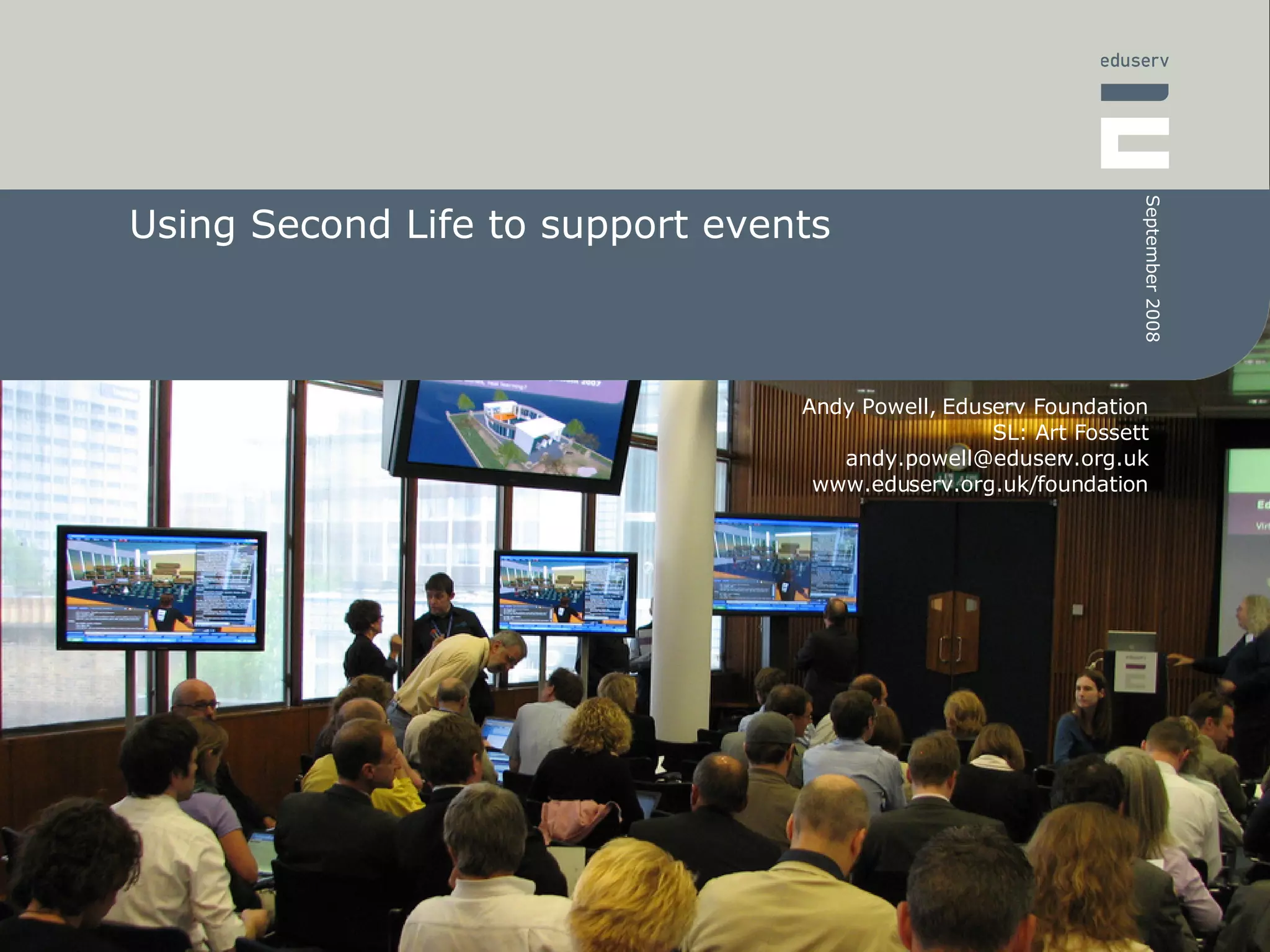
Using Second Life to support events
Outline a presentation in and of Second Life but intended to apply to virtual worlds more generally three parts… introduction to Second Life Second Life for events discussion
some issues to think about 1. introduction to SL
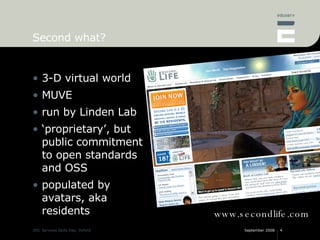
Second what? 3-D virtual world MUVE run by Linden Lab ‘proprietary’, but public commitment to open standards and OSS populated by avatars, aka residents www.secondlife.com
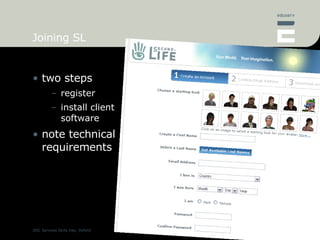
Joining SL two steps register install client software note technical requirements
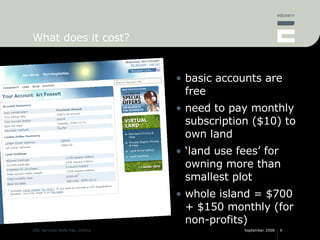
What does it cost? basic accounts are free need to pay monthly subscription ($10) to own land ‘land use fees’ for owning more than smallest plot whole island = $700 + $150 monthly (for non-profits)
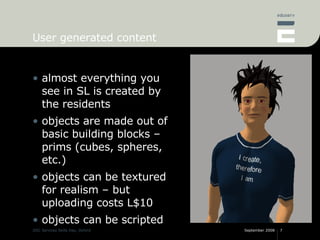
User generated content almost everything you see in SL is created by the residents objects are made out of basic building blocks – prims (cubes, spheres, etc.) objects can be textured for realism – but uploading costs L$10 objects can be scripted
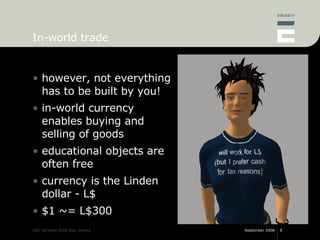
In-world trade however, not everything has to be built by you! in-world currency enables buying and selling of goods educational objects are often free currency is the Linden dollar - L$ $1 ~= L$300
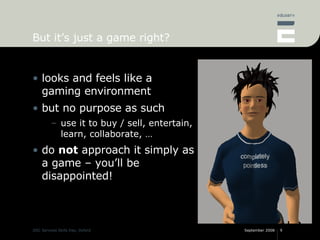
But it’s just a game right? looks and feels like a gaming environment but no purpose as such use it to buy / sell, entertain, learn, collaborate, … do  not  approach it simply as a game – you’ll be disappointed!
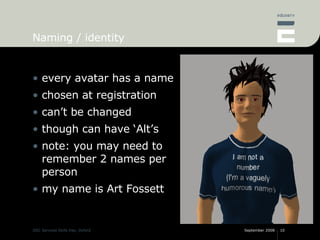
Naming / identity every avatar has a name chosen at registration can’t be changed though can have ‘Alt’s note: you may need to remember 2 names per person my name is Art Fossett
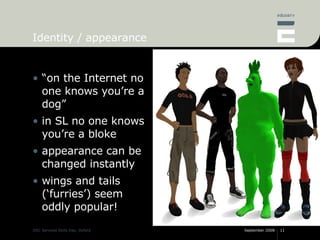
Identity / appearance “ on the Internet no one knows you’re a dog” in SL no one knows you’re a bloke appearance can be changed instantly wings and tails (‘furries’) seem oddly popular!
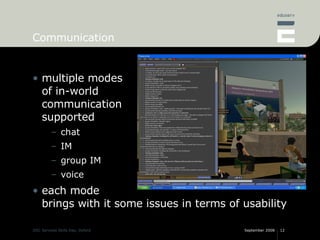
Communication multiple modes of in-world communication supported chat IM group IM voice each mode brings with it some issues in terms of usability
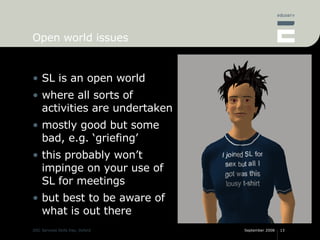
Open world issues SL is an open world where all sorts of activities are undertaken mostly good but some bad, e.g. ‘griefing’ this probably won’t impinge on your use of SL for meetings but best to be aware of what is out there
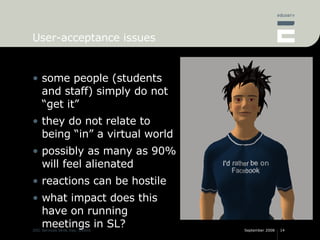
User-acceptance issues some people (students and staff) simply do not “get it” they do not relate to being “in” a virtual world possibly as many as 90% will feel alienated reactions can be hostile what impact does this have on running meetings in SL?
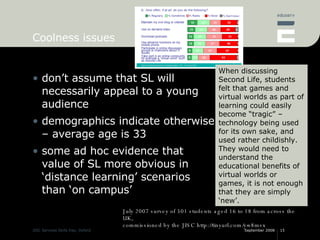
Coolness issues don’t assume that SL will necessarily appeal to a young audience demographics indicate otherwise – average age is 33 some ad hoc evidence that value of SL more obvious in ‘distance learning’ scenarios than ‘on campus’ July 2007 survey of 501 students aged 16 to 18 from across the UK, commissioned by the JISC http://tinyurl.com/yw8mvx When discussing Second Life, students felt that games and virtual worlds as part of learning could easily become “tragic” – technology being used for its own sake, and used rather childishly. They would need to understand the educational benefits of virtual worlds or games, it is not enough that they are simply ‘new’.
Life beyond Second Life SL is one of many virtual worlds OpenSIM, HiPiHi, Twinity, there.com, Project Wonderland, Entropia Universe, Active Worlds, OpenCroquet, Metaverse, … it is not clear that SL is  the  answer SL client now released as open source software clear demand for server to made OSS also some commitment to this by LL (partly because people are reverse-engineering the server anyway) and working with IBM on OpenSim
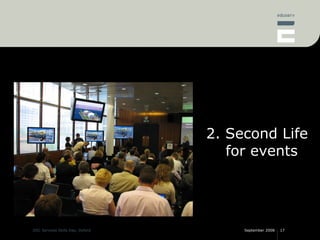
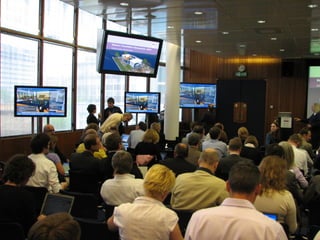
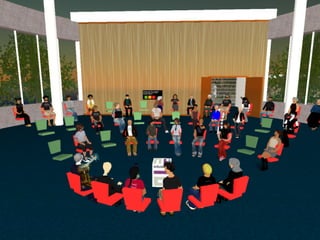
some issues to think about 2. Second Life for events


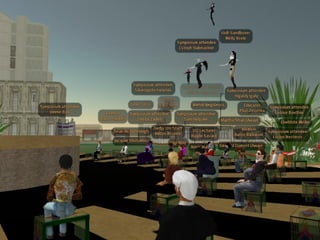
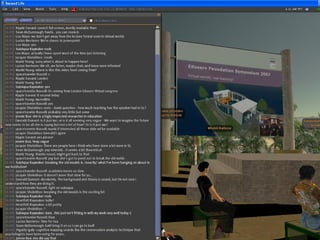
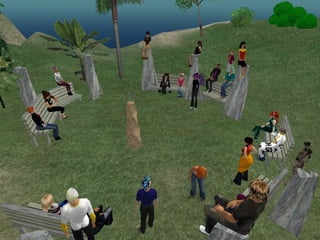
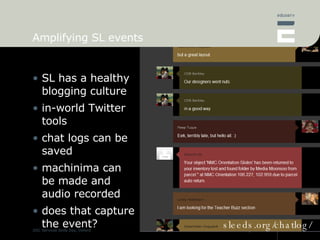
Amplifying SL events SL has a healthy blogging culture in-world Twitter tools chat logs can be saved machinima can be made and audio recorded does that capture the event? sleeds.org/chatlog/
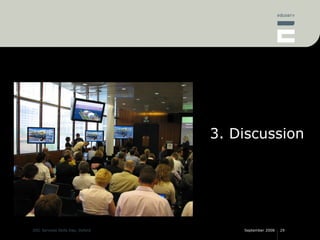
some issues to think about 3. Discussion

Using Second Life to support events

  • 1.
    Using Second Lifeto support events
  • 2.
    Outline a presentationin and of Second Life but intended to apply to virtual worlds more generally three parts… introduction to Second Life Second Life for events discussion
  • 3.
    some issues tothink about 1. introduction to SL
  • 4.
    Second what? 3-Dvirtual world MUVE run by Linden Lab ‘proprietary’, but public commitment to open standards and OSS populated by avatars, aka residents www.secondlife.com
  • 5.
    Joining SL twosteps register install client software note technical requirements
  • 6.
    What does itcost? basic accounts are free need to pay monthly subscription ($10) to own land ‘land use fees’ for owning more than smallest plot whole island = $700 + $150 monthly (for non-profits)
  • 7.
    User generated contentalmost everything you see in SL is created by the residents objects are made out of basic building blocks – prims (cubes, spheres, etc.) objects can be textured for realism – but uploading costs L$10 objects can be scripted
  • 8.
    In-world trade however,not everything has to be built by you! in-world currency enables buying and selling of goods educational objects are often free currency is the Linden dollar - L$ $1 ~= L$300
  • 9.
    But it’s justa game right? looks and feels like a gaming environment but no purpose as such use it to buy / sell, entertain, learn, collaborate, … do not approach it simply as a game – you’ll be disappointed!
  • 10.
    Naming / identityevery avatar has a name chosen at registration can’t be changed though can have ‘Alt’s note: you may need to remember 2 names per person my name is Art Fossett
  • 11.
    Identity / appearance“ on the Internet no one knows you’re a dog” in SL no one knows you’re a bloke appearance can be changed instantly wings and tails (‘furries’) seem oddly popular!
  • 12.
    Communication multiple modesof in-world communication supported chat IM group IM voice each mode brings with it some issues in terms of usability
  • 13.
    Open world issuesSL is an open world where all sorts of activities are undertaken mostly good but some bad, e.g. ‘griefing’ this probably won’t impinge on your use of SL for meetings but best to be aware of what is out there
  • 14.
    User-acceptance issues somepeople (students and staff) simply do not “get it” they do not relate to being “in” a virtual world possibly as many as 90% will feel alienated reactions can be hostile what impact does this have on running meetings in SL?
  • 15.
    Coolness issues don’tassume that SL will necessarily appeal to a young audience demographics indicate otherwise – average age is 33 some ad hoc evidence that value of SL more obvious in ‘distance learning’ scenarios than ‘on campus’ July 2007 survey of 501 students aged 16 to 18 from across the UK, commissioned by the JISC http://tinyurl.com/yw8mvx When discussing Second Life, students felt that games and virtual worlds as part of learning could easily become “tragic” – technology being used for its own sake, and used rather childishly. They would need to understand the educational benefits of virtual worlds or games, it is not enough that they are simply ‘new’.
  • 16.
    Life beyond SecondLife SL is one of many virtual worlds OpenSIM, HiPiHi, Twinity, there.com, Project Wonderland, Entropia Universe, Active Worlds, OpenCroquet, Metaverse, … it is not clear that SL is the answer SL client now released as open source software clear demand for server to made OSS also some commitment to this by LL (partly because people are reverse-engineering the server anyway) and working with IBM on OpenSim
  • 17.
    some issues tothink about 2. Second Life for events
  • 18.
  • 19.
  • 20.
  • 21.
  • 22.
  • 23.
  • 24.
  • 25.
  • 26.
  • 27.
  • 28.
    Amplifying SL eventsSL has a healthy blogging culture in-world Twitter tools chat logs can be saved machinima can be made and audio recorded does that capture the event? sleeds.org/chatlog/
  • 29.
    some issues tothink about 3. Discussion