Grails: How To Plug In

Burt Beckwith
SpringSource


                                                       CONFIDENTIAL
                         © 2010 SpringSource, A division of VMware. All rights reserved
Agenda

 What Is A Plugin?
 Implementation Details
 Testing
 Source Control and Release Management
 Best Practices and Tips


                            CONFIDENTIAL   2
My Plugins
 Acegi                                       Flex Scaffold (major rework, not yet released)
 App Info
                                              SpringMVC
 BlazeDS
                                              Spring Security Core
 Cloud Foundry
                                              Spring Security ACL
 Cloud Foundry UI
                                              Spring Security App Info
 CodeNarc
                                              Spring Security Kerberos
 Console
 Database Reverse Engineering                Spring Security LDAP
 Database Migrations                         Spring Security Open ID
 Datasources                                 Spring Security CAS
 Dynamic Controller                          Spring Security UI
 Dynamic Domain Class (core code)            Twitter
 FamFamFam                                   UI Performance
 Flex

                                     CONFIDENTIAL                                               3
What Is A Plugin?


      CONFIDENTIAL   4
What Is A Plugin?


       “  A set of software components that
          adds specific abilities to a larger
          software application
          https://secure.wikimedia.org/wikipedia/en/wiki/Plug-in_(computing)


                                  CONFIDENTIAL                                 5
What Is A Plugin?


 Very similar to a Grails application project
 Plus a *GrailsPlugin.groovy plugin descriptor file
 Use grails create­plugin to create one
 Often adds artifacts, resources, scripts
 Good for code reuse
 Modular development


                            CONFIDENTIAL               6
What Is A Plugin?


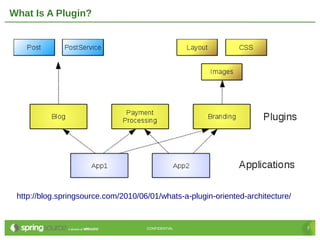
 http://blog.springsource.com/2010/06/01/whats-a-plugin-oriented-architecture/


                                     CONFIDENTIAL                                7
Application Directory Structure


           CONFIDENTIAL           8
Plugin Directory Structure


           CONFIDENTIAL      9
The Background


 Grails is designed to wire
  different libraries together and
  make them easy to use

 Can be seen as “platform for
  runtime configuration”

 Without well defined system, de-
  coupling those components was
  hard

                         CONFIDENTIAL   10
Extension Points


 The Build System
 Spring Application Context
 Dynamic method registration
 Auto Reloading
 Container Config (web.xml)
 Adding new Artefact Types


                          CONFIDENTIAL   11
Types of Plugin

 New functionality
  • Datasources, UI Performance, etc.
 Wrapper
  • Spring Security, Searchable, Quartz, etc.
  • Often have many scripts, e.g. Cloud Foundry, Database
  Migration
 UI
 Bug fix
 • http://grails.org/plugin/error-pages-fix, http://grails.org/plugin/aop-reloading-fix
 Resource-only
  • famfamfam

                                         CONFIDENTIAL                                     12
Plugin Architecture


                      CONFIDENTIAL   13
Plugin Goals


   Convention-based approaches
   DRY (Don't Repeat Yourself)
   Required extension points satisfied
   Easy to distribute & install
    • Without additional configuration


                             CONFIDENTIAL   14
What Can A Plugin Do?


 Enhance classes at runtime
 • Add methods, constructors, properties, etc.

 Perform runtime Spring configuration
 Modify web.xml on the fly
 Add new controllers, tag libraries, etc.


                              CONFIDENTIAL       15
A Basic Plugin


    class LoggingGrailsPlugin {
        def version = "0.1”
        def grailsVersion = "1.3 > *"
        def doWithDynamicMethods = {
          for (c in application.allClasses) {
             c.metaClass.getLog = {->
                LogFactory.getLog(c)
             }
          }
        }
    }


                                   CONFIDENTIAL   16
DEMO


CONFIDENTIAL   17
Implementation Details


         CONFIDENTIAL    18
Application Object

 'GrailsApplication' object
 • available with the 'application' variable
 • holds convention information
 Useful methods like:
 • get*Classes
   • Retrieve all GrailsClass instances for particular artifact, e.g.
    getControllerClasses()
 • add*Class(Class clazz)
   • Adds new GrailsClass for specified class,
    e.g. addControllerClass(myClass)
 • get*Class(String name)
   • Retrieves GrailsClass for given name,
    e.g. getControllerClass(name)


                                        CONFIDENTIAL                    19
Grails Artifacts


 Some resource that fulfills a convention
 • controllers, services, etc.

 Represented by the GrailsClass interface
 • http://grails.org/doc/latest/api/org/codehaus/groovy/grails/
  commons/package-summary.html for API of all artifacts

 Add new artifacts via the Artifact API
 • http://grails.org/Developer+-+Artefact+API


                                      CONFIDENTIAL                20
Grails Artifacts


 Design decision: include or generate artifacts?
  • Include is more automatic, no explicit step
  • Including requires workflow to override
  • Generate requires extra step but is more customizable
  • Generation is static – old files can get out of date
 Overriding domain classes?
  • Really only an issue with create-drop and update, not with migrations
 Overriding controllers?
  • “un-map” with UrlMappings
  "/admin/console/$action?/$id?"(controller: "console")
  "/console/$action?/$id?"(controller: "errors", action: "urlMapping")


                                        CONFIDENTIAL                        21
The GrailsClass Interface

 Implemented by Grails artifacts written in Groovy
 • getPropertyValue(String name)
 • newInstance()
 • getName()                ← logical name

 • getFullName()            ← class name including package

 • getShortName()           ← class name without package

 • getPropertyName()        ← class name as property name

 • getClazz()               ← actual java.lang.Class


                              CONFIDENTIAL                   22
Plugin Descriptor

 Metadata
 • version, grailsVersion range, pluginExcludes, dependsOn, etc.

 Lifecycle Closures
                                  ← Modify XML generated for web.xml at
 doWithWebDescriptor              runtime

 doWithSpring                     ← Participate in Spring configuration
                                  ← Post ApplicationContext initialization
 doWithApplicationContext         activities

 doWithDynamicMethods             ← Add methods to MetaClasses

 onChange                         ← Participate in reload events


                              CONFIDENTIAL                                   23
Configuring Spring


  class JcrGrailsPlugin {
    def version = 0.1               Bean name is method name,
    def dependsOn = [core:0.4]      first argument is bean class
      def doWithSpring = {
        jcrRepository(RepositoryFactoryBean) {
           configuration = "classpath:repository.xml"
           homeDir = "/repo"
        }
      }                              Set properties on the bean
  }


                                   CONFIDENTIAL                    24
Advantages Of Spring DSL


 Just Groovy code, so can contain complex logic
 dependent on:

 • environment
 • project conventions
 • anything!

 Easy to specify complex bean definitions
 • thanks to Groovy's neat lists and maps syntax


                            CONFIDENTIAL           25
Overriding Spring Beans


 Use loadAfter to define plugin load order; your beans
 override other plugins' and Grails'

 resources.groovy loads last, so applications can
 redefine beans there
  Import com.mycompany.myapp.MyUserDetailsService
  beans = {
    userDetailsService(MyUserDetailsService) {
      grailsApplication = ref('grailsApplication')
      foo = 'bar'
    }
  }


 BeanPostProcessor/BeanFactoryPostProcessor
                                 CONFIDENTIAL             26
Plugging In Dynamic Methods


                                                  Taken from Grails core, this
 def doWithDynamicMethods = { ctx ->              plugin finds all classes ending
   application                                    with “Codec” and dynamically
      .allClasses                                 creates “encodeAsFoo” methods!
      .findAll { it.name.endsWith("Codec") }
      .each {clz ->
         Object
            .metaClass
            ."encodeAs${clz.name-'Codec'}" = {
               clz.newInstance().encode(delegate)
            }
         }
                                               The “delegate” variable
      }
                                               is equivalent to “this” in
 }
                                               regular methods


                                   CONFIDENTIAL                                27
Reload Events


  Grails apps must be reloadable during
  development

  • Can mean many things
  • Plugin's responsibility

  Plugins can define
  watchedResources
  firing onChange events
  when modified


                              CONFIDENTIAL   28
Example Reloading Plugin


class I18nGrailsPlugin {                           Defines set of files to watch
  def version = "0.4.2"                            using Spring Resource pattern
  def watchedResources =
    "file:../grails-app/i18n/*.properties"
    def onChange = { event ->
      def messageSource =
         event.ctx.getBean("messageSource")
        messageSource?.clearCache()
    }
}
                                                       When one changes, event
                                                       is fired and plugin responds
                                                       by clearing message cache


                                    CONFIDENTIAL                                   29
The Event Object


   event.source
    • Source of the change – either a Spring Resource or a
     java.lang.Class if the class was reloaded
   event.ctx
    • the Spring ApplicationContext
   event.application
    • the GrailsApplication
   event.manager
    • the GrailsPluginManager


                              CONFIDENTIAL                   30
Adding Elements to web.xml

    def doWithWebDescriptor = { xml →

        def contextParam = xml.'context-param'
        contextParam[contextParam.size() - 1] + {
          'filter' {
              'filter-name'('springSecurityFilterChain')
              'filter-class'(DelegatingFilterProxy.name)
          }
        }

        def filterMapping = xml.'filter-mapping'
        filterMapping[filterMapping.size() - 1] + {
           'listener' {
              'listener-class'(HttpSessionEventPublisher.name)
           }
        }
    }

                                     CONFIDENTIAL                31
Dependency Management


   Jar files
   • Prefer BuildConfig.groovy → Maven repos
   • lib directory is ok if unavailable otherwise

   Other plugins
   • def dependsOn = [springSecurityCore: '1.1 > *']

   • def loadAfter = ['controllers']

   Grails
   • def grailsVersion = '1.2.3 > *'


                          CONFIDENTIAL                 32
BuildConfig.groovy

 grails.project.dependency.resolution = {
   inherits 'global'
   log 'warn'

  repositories {
    grailsPlugins()
    grailsHome()
    grailsCentral()

      flatDir name:'myRepo', dirs:'/path/to/repo'

      mavenCentral()
      mavenRepo 'http://download.java.net/maven/2/'
      mavenRepo 'http://my.cool.repo.net/maven/'
  }


                                    CONFIDENTIAL      33
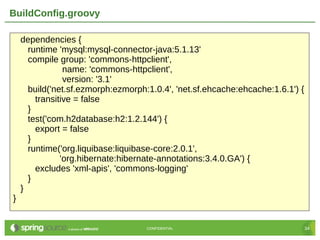
BuildConfig.groovy

    dependencies {
      runtime 'mysql:mysql-connector-java:5.1.13'
      compile group: 'commons-httpclient',
                name: 'commons-httpclient',
                version: '3.1'
      build('net.sf.ezmorph:ezmorph:1.0.4', 'net.sf.ehcache:ehcache:1.6.1') {
        transitive = false
      }
      test('com.h2database:h2:1.2.144') {
        export = false
      }
      runtime('org.liquibase:liquibase-core:2.0.1',
               'org.hibernate:hibernate-annotations:3.4.0.GA') {
        excludes 'xml-apis', 'commons-logging'
      }
    }
}


                                    CONFIDENTIAL                                34
Troubleshooting Dependency Management


   Run grails dependency­report
   • See http://burtbeckwith.com/blog/?p=624 for
    visualization tips

   Increase logging level
   • log 'warn' → 'info', 'verbose', or 'debug'


                         CONFIDENTIAL              35
Scripts


   Gant: http://gant.codehaus.org/
   Groovy + Ant - XML
   Can be used in apps but more common in plugins
   Put in plugin's (or app's) scripts directory
   _Install.groovy
    • runs when you run grails install­plugin or
     when it's transitively installed - don't overwrite!
     might be reinstall or plugin upgrade


                           CONFIDENTIAL                    36
Scripts


   _Uninstall.groovy
    • runs when you run grails uninstall­plugin so
     you can do cleanup, but don't delete user-
     created/edited stuff

   _Upgrade.groovy
    • runs when you run grails upgrade (not when
     you upgrade a plugin)


                            CONFIDENTIAL             37
Scripts

                      eventCreateWarStart = { name, stagingDir →
   _Events.groovy    …
                      }
    • Respond to
                      eventGenerateWebXmlEnd = {
     build events     …
                      }


   Naming convention
    • Prefix with '_' → don't show in grails help
    • Suffix with '_' → 'global' script, i.e. doesn't need
     to run in a project dir (e.g. create­app)

                            CONFIDENTIAL                           38
Scripts


   Reuse existing scripts with includeTargets
    • includeTargets << grailsScript("_GrailsWar")

   Include common code in _*Common.groovy
    • includeTargets << new 
     File("$cloudFoundryPluginDir/scripts/ 
     _CfCommon.groovy")


                          CONFIDENTIAL               39
Testing Scripts


   Put tests in test/cli
   Extend grails.test.AbstractCliTestCase
   stdout and stderr will be in target/cli-output
   http://www.cacoethes.co.uk/blog/groovyandgrails/t
    esting-your-grails-scripts

   Run with the rest with grails test­app or alone
    with grails test­app ­­other


                            CONFIDENTIAL                40
Scripts

                             Typical Structure
  includeTargets << new File(
          "$cloudFoundryPluginDir/scripts/_CfCommon.groovy")

  USAGE = '''
  grails cf-list-files [path] [--appname] [--instance]
  '''

  target(cfListFiles: 'Display a directory listing') {
    depends cfInit

      // implementation of script
  }

  def someHelperMethod() { … }

  setDefaultTarget cfListFiles

                                      CONFIDENTIAL             41
Custom Artifacts


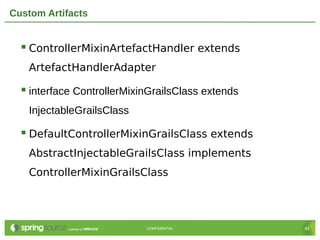
   ControllerMixinArtefactHandler extends
   ArtefactHandlerAdapter

   interface ControllerMixinGrailsClass extends
   InjectableGrailsClass

   DefaultControllerMixinGrailsClass extends
   AbstractInjectableGrailsClass implements
   ControllerMixinGrailsClass


                            CONFIDENTIAL           42
Custom Artifacts


  class MyGrailsPlugin {

      def watchedResources = [
        'file:./grails-app/controllerMixins/**/*ControllerMixin.groovy',
        'file:./plugins/*/grails-app/controllerMixins/**/*ControllerMixin.groovy'
      ]

      def artefacts = [ControllerMixinArtefactHandler]

      def onChange = { event →
        ...
      }
  }


                                      CONFIDENTIAL                                  43
Testing


 CONFIDENTIAL   44
Testing

   Write regular unit and integration tests in test/unit
   and test/integration

   'Install' using inline mechanism in
   BuildConfig.groovy
   • grails.plugin.location.'my­plugin' = '../my­plugin'

   Test scripts as described earlier
   Create test apps programmatically – all of the
   Spring Security plugins do this with bash scripts


                           CONFIDENTIAL                     45
Testing

   Use build.xml or Gradle to create single target that
   tests and builds plugin
   <target name='package' description='Package the plugin'
           depends='test, doPackage, post-package-cleanup'/>

   Use inline plugin or install from zip
   grails install-plugin /path/to/plugin/grails-myplugin-0.1.zip


                                   CONFIDENTIAL                    46
Source Control and Release Management


                CONFIDENTIAL            47
Becoming A Plugin Developer


   Signup at Codehaus xircles
   • http://xircles.codehaus.org/signup &
     http://xircles.codehaus.org/projects/grails-plugins/members
   Talk about your idea on the mailing list
   • http://grails.org/Mailing+lists
   • Summarize your contribution and ask on the dev list
     for your request to be processed - include your xircles
     user name in the request
   Build (and test!) your plugin and run:
    • grails publish-plugin
   Done!

                              CONFIDENTIAL                         48
Source Control and Release Management

   Internal server for jars & plugins is easy with Artifactory or
    Nexus
  repositories {
    grailsPlugins()
    grailsHome()
    mavenRepo "http://yourserver:8081/artifactory/libs-releases-local/"
    mavenRepo "http://yourserver:8081/artifactory/plugins-releases-local/"
    grailsCentral()
  }

   Release with grails publish­plugin ­­repository=repo_name
  grails.project.dependency.distribution = {
    remoteRepository(
        id: "repo_name",
        url: "http://yourserver:8081/artifactory/plugins-snapshots-local/") {
      authentication username: "admin", password: "password"
    }
  }
                                      CONFIDENTIAL                              49
Source Control and Release Management

   Use “release” plugin http://grails.org/plugin/release
   • Will be default in 1.4+, publish-plugin replaces release-plugin
   • Sends tweet from @grailsplugins and email to plugin forum
     http://grails-plugins.847840.n3.nabble.com/
   • Will check code into SVN for you
     • disable with ­­noScm or grails.release.scm.enabled = false


                                     CONFIDENTIAL                      50
Best Practices and Tips


         CONFIDENTIAL     51
Best Practices and Tips


   Delete anything auto-generated that you don't use
    • grails-app/views/error.gsp
    • _Uninstall.groovy and other generated scripts
    • Empty descriptor callbacks

   Exclude files used in development or testing
    • Use def pluginExcludes = [...]
    • src/docs
    • Test artifacts
   Use Ivy + Maven repos in BuildConfig.groovy, not lib dir


                             CONFIDENTIAL                      52
Best Practices and Tips


   Write tests
   Run them often
   Run tests before commit and especially before
    release (use build.xml)

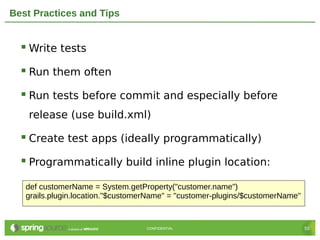
   Create test apps (ideally programmatically)
   Programmatically build inline plugin location:
   def customerName = System.getProperty("customer.name")
   grails.plugin.location."$customerName" = "customer-plugins/$customerName"


                                   CONFIDENTIAL                                53
Best Practices and Tips


   Get to 1.0
    • Initial version 0.1 is just a suggestion
    • People trust 1.0+ more
   Start using source control early
    • Easy to run git init locally and later → github
   Support your plugin!


                          CONFIDENTIAL                  54
Best Practices and Tips


   http://grails.org/doc/latest/guide/12.%20Plug-ins.html
   http://grails.org/doc/latest/guide/4.%20The
    %20Command%20Line.html#4.3%20Hooking%20into
    %20Events

   http://www.grails.org/The+Plug-in+Developers+Guide
   http://blog.springsource.com/2010/05/18/managing-
    plugins-with-grails-1-3/


                               CONFIDENTIAL                  55
Hackergarten


Signup for hackergarten here:

http://bit.ly/gr8_hackergarten


               CONFIDENTIAL      56

GR8Conf 2011: Grails, how to plug in

  • 1.
    Grails: How ToPlug In Burt Beckwith SpringSource CONFIDENTIAL © 2010 SpringSource, A division of VMware. All rights reserved
  • 2.
    Agenda  What IsA Plugin?  Implementation Details  Testing  Source Control and Release Management  Best Practices and Tips CONFIDENTIAL 2
  • 3.
    My Plugins  Acegi  Flex Scaffold (major rework, not yet released)  App Info  SpringMVC  BlazeDS  Spring Security Core  Cloud Foundry  Spring Security ACL  Cloud Foundry UI  Spring Security App Info  CodeNarc  Spring Security Kerberos  Console  Database Reverse Engineering  Spring Security LDAP  Database Migrations  Spring Security Open ID  Datasources  Spring Security CAS  Dynamic Controller  Spring Security UI  Dynamic Domain Class (core code)  Twitter  FamFamFam  UI Performance  Flex CONFIDENTIAL 3
  • 4.
    What Is APlugin? CONFIDENTIAL 4
  • 5.
    What Is APlugin? “ A set of software components that adds specific abilities to a larger software application https://secure.wikimedia.org/wikipedia/en/wiki/Plug-in_(computing) CONFIDENTIAL 5
  • 6.
    What Is APlugin?  Very similar to a Grails application project  Plus a *GrailsPlugin.groovy plugin descriptor file  Use grails create­plugin to create one  Often adds artifacts, resources, scripts  Good for code reuse  Modular development CONFIDENTIAL 6
  • 7.
    What Is APlugin? http://blog.springsource.com/2010/06/01/whats-a-plugin-oriented-architecture/ CONFIDENTIAL 7
  • 8.
  • 9.
  • 10.
    The Background  Grailsis designed to wire different libraries together and make them easy to use  Can be seen as “platform for runtime configuration”  Without well defined system, de- coupling those components was hard CONFIDENTIAL 10
  • 11.
    Extension Points  TheBuild System  Spring Application Context  Dynamic method registration  Auto Reloading  Container Config (web.xml)  Adding new Artefact Types CONFIDENTIAL 11
  • 12.
    Types of Plugin New functionality • Datasources, UI Performance, etc.  Wrapper • Spring Security, Searchable, Quartz, etc. • Often have many scripts, e.g. Cloud Foundry, Database Migration  UI  Bug fix • http://grails.org/plugin/error-pages-fix, http://grails.org/plugin/aop-reloading-fix  Resource-only • famfamfam CONFIDENTIAL 12
  • 13.
    Plugin Architecture CONFIDENTIAL 13
  • 14.
    Plugin Goals  Convention-based approaches  DRY (Don't Repeat Yourself)  Required extension points satisfied  Easy to distribute & install • Without additional configuration CONFIDENTIAL 14
  • 15.
    What Can APlugin Do?  Enhance classes at runtime • Add methods, constructors, properties, etc.  Perform runtime Spring configuration  Modify web.xml on the fly  Add new controllers, tag libraries, etc. CONFIDENTIAL 15
  • 16.
    A Basic Plugin class LoggingGrailsPlugin { def version = "0.1” def grailsVersion = "1.3 > *" def doWithDynamicMethods = { for (c in application.allClasses) { c.metaClass.getLog = {-> LogFactory.getLog(c) } } } } CONFIDENTIAL 16
  • 17.
  • 18.
    Implementation Details CONFIDENTIAL 18
  • 19.
    Application Object  'GrailsApplication'object • available with the 'application' variable • holds convention information  Useful methods like: • get*Classes • Retrieve all GrailsClass instances for particular artifact, e.g. getControllerClasses() • add*Class(Class clazz) • Adds new GrailsClass for specified class, e.g. addControllerClass(myClass) • get*Class(String name) • Retrieves GrailsClass for given name, e.g. getControllerClass(name) CONFIDENTIAL 19
  • 20.
    Grails Artifacts  Someresource that fulfills a convention • controllers, services, etc.  Represented by the GrailsClass interface • http://grails.org/doc/latest/api/org/codehaus/groovy/grails/ commons/package-summary.html for API of all artifacts  Add new artifacts via the Artifact API • http://grails.org/Developer+-+Artefact+API CONFIDENTIAL 20
  • 21.
    Grails Artifacts  Designdecision: include or generate artifacts? • Include is more automatic, no explicit step • Including requires workflow to override • Generate requires extra step but is more customizable • Generation is static – old files can get out of date  Overriding domain classes? • Really only an issue with create-drop and update, not with migrations  Overriding controllers? • “un-map” with UrlMappings "/admin/console/$action?/$id?"(controller: "console") "/console/$action?/$id?"(controller: "errors", action: "urlMapping") CONFIDENTIAL 21
  • 22.
    The GrailsClass Interface Implemented by Grails artifacts written in Groovy • getPropertyValue(String name) • newInstance() • getName() ← logical name • getFullName() ← class name including package • getShortName() ← class name without package • getPropertyName() ← class name as property name • getClazz() ← actual java.lang.Class CONFIDENTIAL 22
  • 23.
    Plugin Descriptor  Metadata • version, grailsVersion range, pluginExcludes, dependsOn, etc.  Lifecycle Closures ← Modify XML generated for web.xml at doWithWebDescriptor runtime doWithSpring ← Participate in Spring configuration ← Post ApplicationContext initialization doWithApplicationContext activities doWithDynamicMethods ← Add methods to MetaClasses onChange ← Participate in reload events CONFIDENTIAL 23
  • 24.
    Configuring Spring class JcrGrailsPlugin { def version = 0.1 Bean name is method name, def dependsOn = [core:0.4] first argument is bean class def doWithSpring = { jcrRepository(RepositoryFactoryBean) { configuration = "classpath:repository.xml" homeDir = "/repo" } } Set properties on the bean } CONFIDENTIAL 24
  • 25.
    Advantages Of SpringDSL  Just Groovy code, so can contain complex logic dependent on: • environment • project conventions • anything!  Easy to specify complex bean definitions • thanks to Groovy's neat lists and maps syntax CONFIDENTIAL 25
  • 26.
    Overriding Spring Beans Use loadAfter to define plugin load order; your beans override other plugins' and Grails'  resources.groovy loads last, so applications can redefine beans there Import com.mycompany.myapp.MyUserDetailsService beans = { userDetailsService(MyUserDetailsService) { grailsApplication = ref('grailsApplication') foo = 'bar' } }  BeanPostProcessor/BeanFactoryPostProcessor CONFIDENTIAL 26
  • 27.
    Plugging In DynamicMethods Taken from Grails core, this def doWithDynamicMethods = { ctx -> plugin finds all classes ending application with “Codec” and dynamically .allClasses creates “encodeAsFoo” methods! .findAll { it.name.endsWith("Codec") } .each {clz -> Object .metaClass ."encodeAs${clz.name-'Codec'}" = { clz.newInstance().encode(delegate) } } The “delegate” variable } is equivalent to “this” in } regular methods CONFIDENTIAL 27
  • 28.
    Reload Events Grails apps must be reloadable during development • Can mean many things • Plugin's responsibility  Plugins can define watchedResources firing onChange events when modified CONFIDENTIAL 28
  • 29.
    Example Reloading Plugin classI18nGrailsPlugin { Defines set of files to watch def version = "0.4.2" using Spring Resource pattern def watchedResources = "file:../grails-app/i18n/*.properties" def onChange = { event -> def messageSource = event.ctx.getBean("messageSource") messageSource?.clearCache() } } When one changes, event is fired and plugin responds by clearing message cache CONFIDENTIAL 29
  • 30.
    The Event Object  event.source • Source of the change – either a Spring Resource or a java.lang.Class if the class was reloaded  event.ctx • the Spring ApplicationContext  event.application • the GrailsApplication  event.manager • the GrailsPluginManager CONFIDENTIAL 30
  • 31.
    Adding Elements toweb.xml def doWithWebDescriptor = { xml → def contextParam = xml.'context-param' contextParam[contextParam.size() - 1] + { 'filter' { 'filter-name'('springSecurityFilterChain') 'filter-class'(DelegatingFilterProxy.name) } } def filterMapping = xml.'filter-mapping' filterMapping[filterMapping.size() - 1] + { 'listener' { 'listener-class'(HttpSessionEventPublisher.name) } } } CONFIDENTIAL 31
  • 32.
    Dependency Management  Jar files • Prefer BuildConfig.groovy → Maven repos • lib directory is ok if unavailable otherwise  Other plugins • def dependsOn = [springSecurityCore: '1.1 > *'] • def loadAfter = ['controllers']  Grails • def grailsVersion = '1.2.3 > *' CONFIDENTIAL 32
  • 33.
    BuildConfig.groovy grails.project.dependency.resolution ={ inherits 'global' log 'warn' repositories { grailsPlugins() grailsHome() grailsCentral() flatDir name:'myRepo', dirs:'/path/to/repo' mavenCentral() mavenRepo 'http://download.java.net/maven/2/' mavenRepo 'http://my.cool.repo.net/maven/' } CONFIDENTIAL 33
  • 34.
    BuildConfig.groovy dependencies { runtime 'mysql:mysql-connector-java:5.1.13' compile group: 'commons-httpclient', name: 'commons-httpclient', version: '3.1' build('net.sf.ezmorph:ezmorph:1.0.4', 'net.sf.ehcache:ehcache:1.6.1') { transitive = false } test('com.h2database:h2:1.2.144') { export = false } runtime('org.liquibase:liquibase-core:2.0.1', 'org.hibernate:hibernate-annotations:3.4.0.GA') { excludes 'xml-apis', 'commons-logging' } } } CONFIDENTIAL 34
  • 35.
    Troubleshooting Dependency Management  Run grails dependency­report • See http://burtbeckwith.com/blog/?p=624 for visualization tips  Increase logging level • log 'warn' → 'info', 'verbose', or 'debug' CONFIDENTIAL 35
  • 36.
    Scripts Gant: http://gant.codehaus.org/  Groovy + Ant - XML  Can be used in apps but more common in plugins  Put in plugin's (or app's) scripts directory  _Install.groovy • runs when you run grails install­plugin or when it's transitively installed - don't overwrite! might be reinstall or plugin upgrade CONFIDENTIAL 36
  • 37.
    Scripts _Uninstall.groovy • runs when you run grails uninstall­plugin so you can do cleanup, but don't delete user- created/edited stuff  _Upgrade.groovy • runs when you run grails upgrade (not when you upgrade a plugin) CONFIDENTIAL 37
  • 38.
    Scripts eventCreateWarStart = { name, stagingDir →  _Events.groovy … } • Respond to eventGenerateWebXmlEnd = { build events … }  Naming convention • Prefix with '_' → don't show in grails help • Suffix with '_' → 'global' script, i.e. doesn't need to run in a project dir (e.g. create­app) CONFIDENTIAL 38
  • 39.
    Scripts Reuse existing scripts with includeTargets • includeTargets << grailsScript("_GrailsWar")  Include common code in _*Common.groovy • includeTargets << new  File("$cloudFoundryPluginDir/scripts/  _CfCommon.groovy") CONFIDENTIAL 39
  • 40.
    Testing Scripts  Put tests in test/cli  Extend grails.test.AbstractCliTestCase  stdout and stderr will be in target/cli-output  http://www.cacoethes.co.uk/blog/groovyandgrails/t esting-your-grails-scripts  Run with the rest with grails test­app or alone with grails test­app ­­other CONFIDENTIAL 40
  • 41.
    Scripts Typical Structure includeTargets << new File( "$cloudFoundryPluginDir/scripts/_CfCommon.groovy") USAGE = ''' grails cf-list-files [path] [--appname] [--instance] ''' target(cfListFiles: 'Display a directory listing') { depends cfInit // implementation of script } def someHelperMethod() { … } setDefaultTarget cfListFiles CONFIDENTIAL 41
  • 42.
    Custom Artifacts  ControllerMixinArtefactHandler extends ArtefactHandlerAdapter  interface ControllerMixinGrailsClass extends InjectableGrailsClass  DefaultControllerMixinGrailsClass extends AbstractInjectableGrailsClass implements ControllerMixinGrailsClass CONFIDENTIAL 42
  • 43.
    Custom Artifacts class MyGrailsPlugin { def watchedResources = [ 'file:./grails-app/controllerMixins/**/*ControllerMixin.groovy', 'file:./plugins/*/grails-app/controllerMixins/**/*ControllerMixin.groovy' ] def artefacts = [ControllerMixinArtefactHandler] def onChange = { event → ... } } CONFIDENTIAL 43
  • 44.
  • 45.
    Testing Write regular unit and integration tests in test/unit and test/integration  'Install' using inline mechanism in BuildConfig.groovy • grails.plugin.location.'my­plugin' = '../my­plugin'  Test scripts as described earlier  Create test apps programmatically – all of the Spring Security plugins do this with bash scripts CONFIDENTIAL 45
  • 46.
    Testing Use build.xml or Gradle to create single target that tests and builds plugin <target name='package' description='Package the plugin' depends='test, doPackage, post-package-cleanup'/>  Use inline plugin or install from zip grails install-plugin /path/to/plugin/grails-myplugin-0.1.zip CONFIDENTIAL 46
  • 47.
    Source Control andRelease Management CONFIDENTIAL 47
  • 48.
    Becoming A PluginDeveloper  Signup at Codehaus xircles • http://xircles.codehaus.org/signup & http://xircles.codehaus.org/projects/grails-plugins/members  Talk about your idea on the mailing list • http://grails.org/Mailing+lists • Summarize your contribution and ask on the dev list for your request to be processed - include your xircles user name in the request  Build (and test!) your plugin and run: • grails publish-plugin  Done! CONFIDENTIAL 48
  • 49.
    Source Control andRelease Management  Internal server for jars & plugins is easy with Artifactory or Nexus repositories { grailsPlugins() grailsHome() mavenRepo "http://yourserver:8081/artifactory/libs-releases-local/" mavenRepo "http://yourserver:8081/artifactory/plugins-releases-local/" grailsCentral() }  Release with grails publish­plugin ­­repository=repo_name grails.project.dependency.distribution = { remoteRepository( id: "repo_name", url: "http://yourserver:8081/artifactory/plugins-snapshots-local/") { authentication username: "admin", password: "password" } } CONFIDENTIAL 49
  • 50.
    Source Control andRelease Management  Use “release” plugin http://grails.org/plugin/release • Will be default in 1.4+, publish-plugin replaces release-plugin • Sends tweet from @grailsplugins and email to plugin forum http://grails-plugins.847840.n3.nabble.com/ • Will check code into SVN for you • disable with ­­noScm or grails.release.scm.enabled = false CONFIDENTIAL 50
  • 51.
    Best Practices andTips CONFIDENTIAL 51
  • 52.
    Best Practices andTips  Delete anything auto-generated that you don't use • grails-app/views/error.gsp • _Uninstall.groovy and other generated scripts • Empty descriptor callbacks  Exclude files used in development or testing • Use def pluginExcludes = [...] • src/docs • Test artifacts  Use Ivy + Maven repos in BuildConfig.groovy, not lib dir CONFIDENTIAL 52
  • 53.
    Best Practices andTips  Write tests  Run them often  Run tests before commit and especially before release (use build.xml)  Create test apps (ideally programmatically)  Programmatically build inline plugin location: def customerName = System.getProperty("customer.name") grails.plugin.location."$customerName" = "customer-plugins/$customerName" CONFIDENTIAL 53
  • 54.
    Best Practices andTips  Get to 1.0 • Initial version 0.1 is just a suggestion • People trust 1.0+ more  Start using source control early • Easy to run git init locally and later → github  Support your plugin! CONFIDENTIAL 54
  • 55.
    Best Practices andTips  http://grails.org/doc/latest/guide/12.%20Plug-ins.html  http://grails.org/doc/latest/guide/4.%20The %20Command%20Line.html#4.3%20Hooking%20into %20Events  http://www.grails.org/The+Plug-in+Developers+Guide  http://blog.springsource.com/2010/05/18/managing- plugins-with-grails-1-3/ CONFIDENTIAL 55
  • 56.
    Hackergarten Signup for hackergartenhere: http://bit.ly/gr8_hackergarten CONFIDENTIAL 56