© 2015 Enroll America and Get Covered America
EnrollAmerica.org | GetCoveredAmerica.org
Using	
  Data	
  to	
  Support	
  Partner	
  
Coordina3on	
  
John	
  Malloy,	
  Na,onal	
  Partner	
  Data	
  Manager,	
  Enroll	
  America	
  
Erik	
  Wallenius,	
  Deputy	
  Director	
  of	
  Outreach,	
  Get	
  Covered	
  Illinois	
  
Andrew	
  Greenberg,	
  CO	
  Data	
  &	
  Training	
  Coordinator,	
  Enroll	
  America	
  
•  Understand	
  how	
  data	
  can	
  be	
  used	
  to	
  support	
  
coali,ons	
  
•  Learn	
  from	
  case	
  studies	
  on	
  partner	
  
coordina,on	
  using	
  data.	
  
•  Understand	
  tools	
  available	
  to	
  support	
  data	
  
collabora,on	
  between	
  partner	
  organiza,ons	
  
Objec3ves	
  
•  Introduc,ons	
  
•  The	
  What	
  &	
  Why	
  of	
  Data	
  
•  Program	
  Planning	
  &	
  Management	
  using	
  Data	
  
in	
  Illinois	
  
•  Coordina,ng	
  Partner	
  Ac,vity	
  Using	
  Data	
  in	
  
Colorado	
  
•  Ques,ons	
  
Agenda 	
  	
  
Introduc3ons	


5
So,	
  What	
  Is	
  Data?	


What	
  Is	
  Data	
  A?er	
  All?	


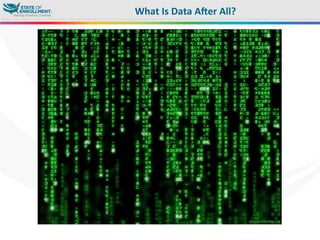
•  1’s & 0’s? Like the Matrix?
What	
  Is	
  Data	
  A?er	
  All?	
  
What	
  Is	
  Data	
  A?er	
  All?	
  
•  1’s & 0’s? Like the Matrix?
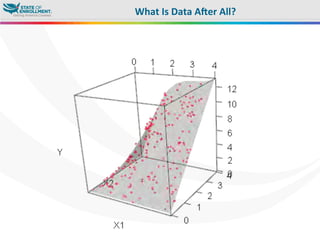
•  Complex Regression Graphs?
What	
  Is	
  Data	
  A?er	
  All?	
  
What	
  Is	
  Data	
  A?er	
  All?	
  
•  1’s & 0’s? Like the Matrix?
•  Complex Regression Graphs?
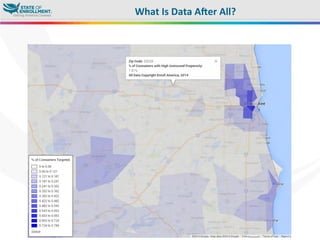
•  Really cool heat maps?
What	
  Is	
  Data	
  A?er	
  All?	
  
12
Data	
  can	
  be	
  used	
  
to	
  create	
  all	
  of	
  
those	
  things.	


However…	


13
“Data”	
  is	
  simply	
  
tracking	
  the	
  
conversa3ons	
  your	
  
program	
  has	
  with	
  
its	
  intended	
  
audience	


14
Why	
  Does	
  Enroll	
  
America	
  Care	
  About	
  
Data?	


•  	
  Where	
  are	
  the	
  Uninsured?	
  
•  What	
  Strategies	
  will	
  work	
  when	
  we	
  try	
  to	
  engage	
  
with	
  consumers?	
  
•  How	
  can	
  we	
  evaluate	
  our	
  program?	
  
•  How	
  can	
  we	
  tell	
  the	
  story	
  of	
  our	
  program?	
  
We	
  All	
  have	
  Big	
  Ques3ons	
  
•  	
  Where	
  are	
  the	
  Uninsured?	
  
Using	
  demographic	
  data,	
  we	
  can	
  find	
  consumers	
  who	
  are	
  
more	
  likely	
  to	
  be	
  uninsured	
  
•  What	
  Strategies	
  will	
  work	
  when	
  we	
  try	
  to	
  engage	
  
with	
  consumers?	
  
Once	
  we	
  find	
  them,	
  we	
  can	
  track	
  our	
  strategies	
  by	
  tracking	
  
each	
  conversa3on	
  we	
  have.	
  
•  How	
  can	
  we	
  evaluate	
  our	
  program?	
  
With	
  the	
  data	
  we	
  gather	
  on	
  conversa3ons,	
  we	
  can	
  evaluate	
  
our	
  strategies	
  against	
  each	
  other.	
  
•  How	
  can	
  we	
  tell	
  the	
  story	
  of	
  our	
  program?	
  
When	
  you	
  track	
  your	
  data	
  as	
  you	
  go,	
  you	
  can	
  provide	
  
snapshot	
  reports	
  to	
  stakeholders	
  quickly.	
  
We	
  All	
  have	
  Big	
  Ques3ons	
  
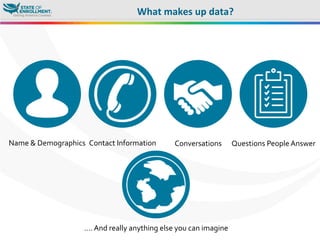
What	
  makes	
  up	
  data?	


Name	
  &	
  Demographics	
   Contact	
  Information	
   Conversations	
   Questions	
  People	
  Answer	
  
….	
  And	
  really	
  anything	
  else	
  you	
  can	
  imagine	
  
18
How	
  can	
  data	
  be	
  
used	
  to	
  target	
  
outreach?	


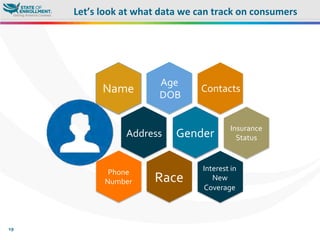
Let’s	
  look	
  at	
  what	
  data	
  we	
  can	
  track	
  on	
  consumers	
  
19	
  
Uninsured	
  
Propensity	
  Address	
  
Age	
  
	
  DOB	
  
Gender	
  
Name	
  
Phone	
  	
  
Number	
   Race	
  
Contacts	
  
Insurance	
  	
  
Status	
  
Interest	
  in	
  
New	
  	
  
Coverage	
  
20	
  
Uninsured	
  
Propensity	


21	
  
21	


22	
  
23
How	
  we	
  use	
  data	


Follow	
  Up	
  MaTers	
  
0%	
  
10%	
  
20%	
  
30%	
  
40%	
  
1	
   2	
   3	
   4+	
  
Percent	
  Successfully	
  Enrolled	
  
(Among	
  Uninsured	
  Consumers)	
  
Number	
  of	
  Field	
  Conversa,ons	
  
20%	
  
22%	
  
28%	
  
33%	
  
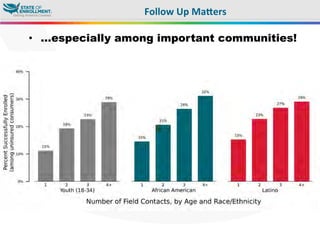
•  …especially among important communities!
Follow	
  Up	
  MaTers	
  
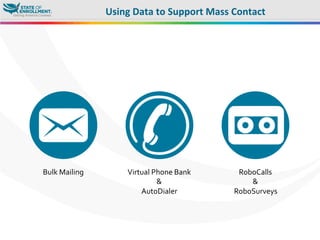
Using	
  Data	
  to	
  Support	
  Mass	
  Contact	
  
Bulk	
  Mailing	
   Virtual	
  Phone	
  Bank	
  
&	
  
AutoDialer	
  
RoboCalls	
  
&	
  
RoboSurveys	
  
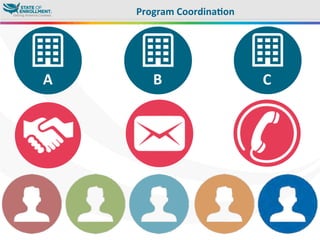
Program	
  Coordina3on	
  
A	
   B	
   C	
  
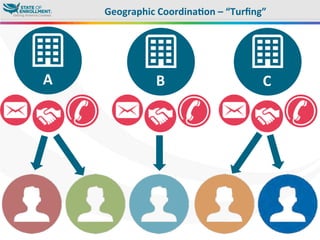
Geographic	
  Coordina3on	
  –	
  “Turfing”	
  
A	
   B	
   C	
  
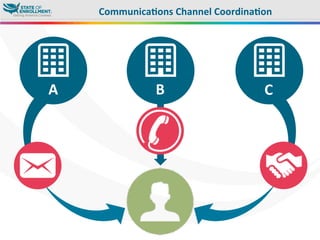
Communica3ons	
  Channel	
  Coordina3on	
  
A	
   B	
   C	
  
“Get Your House In Order (With Data)”
Erik Wallenius
Deputy Director, Outreach & Consumer
Education
Our Approach:
“Work Really Hard and Hope For the Best”
Our Approach:
“Focus, Measure, and Track”
* (not an actual Navigator)
Data Can Help You
Manage Turf
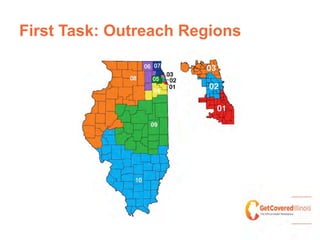
First Task: Outreach Regions
•  The Census
•  Small Area Health Insurance Estimates (SAHIE)
•  Public Use Microdata Areas (PUMAs)
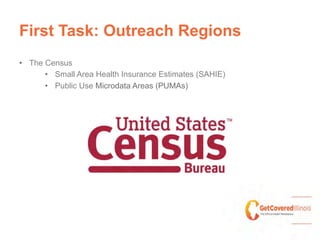
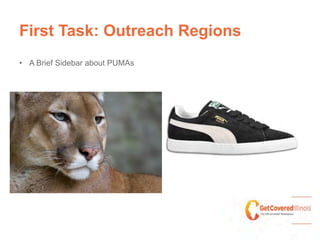
First Task: Outreach Regions
•  A Brief Sidebar about PUMAs
First Task: Outreach Regions
•  Healthcare-Related Nonprofits
•  Kaiser Family Foundation (KFF)
•  Shriver Center
•  Health & Disability Advocates (HDA)
•  Illinois Health Matters
First Task: Outreach Regions
•  Other Research and Data Entities
•  State Health Access Data Assistance Center (SHADAC)
First Task: Outreach Regions
•  Tools Used
•  Microsoft Excel
•  Google Earth
•  Two computer monitors (optional, but recommended)
Data Can Help You
Understand Consumers
Second Task: Consumer Data
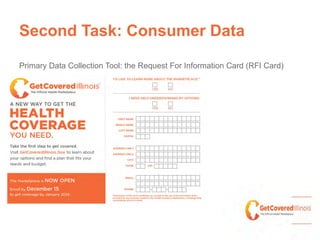
Primary Data Collection Tool: the Request For Information Card (RFI Card)
Second Task: Consumer Data
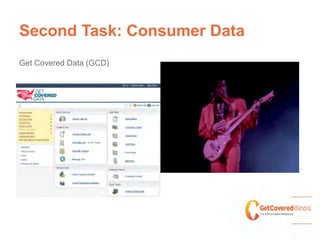
Get Covered Data (GCD)
Data Can Help You
Manage Assisters
Third Task: Navigator Management
•  Weekly performance metrics
Third Task: Navigator Management
•  Build data into grant application process
Thank you
•  Engage local partners
•  Provide data services to empower and increase
efficiency
•  Reach an ever-harder-to-reach population
Colorado	
  Program	
  Goals	
  
•  Existing Relationships within Vital Communities
•  Intricate knowledge of opportunities & challenges
in each community
•  Ability to create long-lasting institutions of
coverage outreach, education & enrollment.
Why	
  Work	
  with	
  Partners?	
  
•  Convened 13 Organizations
•  10 Enrollment Assister Organizations
•  3 Outreach-Only Organizations
•  Partner Organizations:
•  Met with Enroll America to develop Program Goals
& Strategies
•  Used Get Covered Data to track their work and
share data
•  Engaged in joint training & planning meetings.
OE2	
  Program	
  in	
  Colorado	
  
•  Partners wanted to be able to collaborate on phone banks
and canvassing.
•  Partners wanted to identify consumers they were working
with, while maintaining some data privacy between
organizations.
Why	
  Share	
  Data?	
  
•  Each Enrollment Assister Organization had non-overlapping
turf for outreach purposes
•  Enroll America staff helped define these areas based on Zip Codes,
to create very specific geographic areas.
•  Partners did not call into each other’s areas
Turfing	
  to	
  Avoid	
  Duplica3on	
  
Direct Mail Campaign
Funded by Piton
Foundation
Robocall
Based on Mailing List
Major	
  Data	
  Coordina3on	
  Pieces	
  
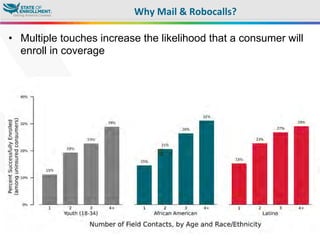
•  Multiple touches increase the likelihood that a consumer will
enroll in coverage
Why	
  Mail	
  &	
  Robocalls?	
  
•  Funded by the Piton Foundation
•  Post cards with health coverage
information sent to 75,000 likely
uninsured consumers
•  Coverage area touched several
Partner Turfs
Direct	
  Mail	
  Campaign	
  
•  Encourage specific targeted
consumers to enroll
•  Provide Baseline Contact Attempt
to Narrow Outreach Efforts
•  Partners combining resources to
reach the one group
Direct	
  Mail	
  Campaign	
  
•  Used GCD and Enroll America’s
Uninsured Propensity Model to
create list
•  Divided the mailing list by ZIP
codes for each partner to use for
follow-up outreach
•  Database structure made data
sharing easy
Piton	
  Mailing	
  –	
  Role	
  of	
  Data	
  
•  15-second message
•  Built on Piton mailing list
•  Sent during hours people would be
home
Robocall	
  -­‐	
  What	
  
•  An additional touch
•  Give consumers information on
enrollment deadline
•  Provide better contact lists to
Partners
Robocall	
  -­‐	
  Why	
  
•  Built In Robocall Tools in GCD
•  Existing Piton list already in
database – easy to access
•  Database structure made data
sharing easy
Robocall	
  –	
  Role	
  of	
  Data	
  
•  Used to share information between outreach-only groups and
enrollment groups
•  Consumers ID’ed as needing a referral
•  Typically a phone list within GCD
•  Could also be an Excel export
Referrals	
  
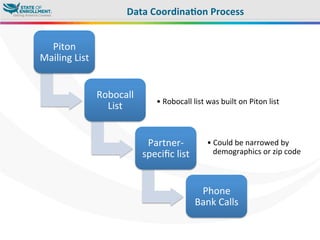
Piton	
  
Mailing	
  List	
  
Robocall	
  
List	
   • Robocall	
  list	
  was	
  built	
  on	
  Piton	
  list	
  
Partner-­‐
specific	
  list	
  
• Could	
  be	
  narrowed	
  by	
  
demographics	
  or	
  zip	
  code	
  
Phone	
  
Bank	
  Calls	
  
Data	
  Coordina3on	
  Process	
  
•  Avoid overlapping areas of activity
•  Develop a data-sharing system that includes referrals for
enrollment assistance
•  Data from large outreach efforts, like mailings and robocalls,
should be shared
Recommenda3ons	
  
•  What We Know & How We Learned It
•  Friday – 10:15AM – 11:45AM
•  Mt. Vernon B (Meeting Room Level)
•  Know Your Numbers: How to Quantify Qualitative Data on Media
Outreach
•  Friday – 2:15PM – 3:15PM
•  Mt. Vernon A (Meeting Room Level)
Other Data & Analytics Workshops
•  Getting Started with Google Docs
•  Friday – 10:15AM – 11:45AM
•  Get Covered Data Interactive Demonstration
•  Friday – 2:15PM – 3:15PM
Get Covered Academy Learning Lab
Meeting Room 16
Data & Analytics Interactive Trainings
The Data & Analytics Booth is on the Ballroom Level,
where you can…
Meet members of our Data & Analytics Team
Learn more about Data Services we provide to partner organizations,
including
Get Covered Data Access & Support
Customized Mapping Services
Customized Market Analysis Services
Data & Analytics Training Opportunities
Ask any follow up questions from any of our sessions
Data & Analytics Booth
ACA
www.enrollamerica.org/gcd/
PartnerData@EnrollAmerica.org
67
New training resources
•  Highly customized, action-oriented
•  New suite of training services
•  Goal-setting
•  Planning
•  Coaching
•  In-person training
•  FOR MORE INFO –
training@enrollamerica.org

Using Data to Support Partner Coordination

  • 1.
    © 2015 EnrollAmerica and Get Covered America EnrollAmerica.org | GetCoveredAmerica.org Using  Data  to  Support  Partner   Coordina3on   John  Malloy,  Na,onal  Partner  Data  Manager,  Enroll  America   Erik  Wallenius,  Deputy  Director  of  Outreach,  Get  Covered  Illinois   Andrew  Greenberg,  CO  Data  &  Training  Coordinator,  Enroll  America  
  • 2.
    •  Understand  how  data  can  be  used  to  support   coali,ons   •  Learn  from  case  studies  on  partner   coordina,on  using  data.   •  Understand  tools  available  to  support  data   collabora,on  between  partner  organiza,ons   Objec3ves  
  • 3.
    •  Introduc,ons   • The  What  &  Why  of  Data   •  Program  Planning  &  Management  using  Data   in  Illinois   •  Coordina,ng  Partner  Ac,vity  Using  Data  in   Colorado   •  Ques,ons   Agenda    
  • 4.
  • 5.
    5 So,  What  Is  Data?      
  • 6.
      What  Is  Data  A?er  All?    
  • 7.
    •  1’s &0’s? Like the Matrix? What  Is  Data  A?er  All?  
  • 8.
    What  Is  Data  A?er  All?  
  • 9.
    •  1’s &0’s? Like the Matrix? •  Complex Regression Graphs? What  Is  Data  A?er  All?  
  • 10.
    What  Is  Data  A?er  All?  
  • 11.
    •  1’s &0’s? Like the Matrix? •  Complex Regression Graphs? •  Really cool heat maps? What  Is  Data  A?er  All?  
  • 12.
    12 Data  can  be  used   to  create  all  of   those  things.     However…      
  • 13.
    13 “Data”  is  simply   tracking  the   conversa3ons  your   program  has  with   its  intended   audience      
  • 14.
    14 Why  Does  Enroll   America  Care  About   Data?      
  • 15.
    •   Where  are  the  Uninsured?   •  What  Strategies  will  work  when  we  try  to  engage   with  consumers?   •  How  can  we  evaluate  our  program?   •  How  can  we  tell  the  story  of  our  program?   We  All  have  Big  Ques3ons  
  • 16.
    •   Where  are  the  Uninsured?   Using  demographic  data,  we  can  find  consumers  who  are   more  likely  to  be  uninsured   •  What  Strategies  will  work  when  we  try  to  engage   with  consumers?   Once  we  find  them,  we  can  track  our  strategies  by  tracking   each  conversa3on  we  have.   •  How  can  we  evaluate  our  program?   With  the  data  we  gather  on  conversa3ons,  we  can  evaluate   our  strategies  against  each  other.   •  How  can  we  tell  the  story  of  our  program?   When  you  track  your  data  as  you  go,  you  can  provide   snapshot  reports  to  stakeholders  quickly.   We  All  have  Big  Ques3ons  
  • 17.
    What  makes  up  data?       Name  &  Demographics   Contact  Information   Conversations   Questions  People  Answer   ….  And  really  anything  else  you  can  imagine  
  • 18.
    18 How  can  data  be   used  to  target   outreach?      
  • 19.
    Let’s  look  at  what  data  we  can  track  on  consumers   19   Uninsured   Propensity  Address   Age    DOB   Gender   Name   Phone     Number   Race   Contacts   Insurance     Status   Interest  in   New     Coverage  
  • 20.
  • 21.
          21   21  
  • 22.
  • 23.
    23 How  we  use  data      
  • 24.
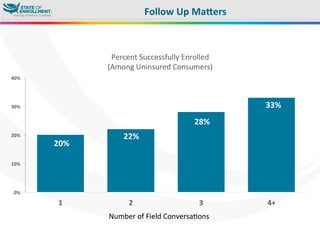
    Follow  Up  MaTers   0%   10%   20%   30%   40%   1   2   3   4+   Percent  Successfully  Enrolled   (Among  Uninsured  Consumers)   Number  of  Field  Conversa,ons   20%   22%   28%   33%  
  • 25.
    •  …especially amongimportant communities! Follow  Up  MaTers  
  • 26.
    Using  Data  to  Support  Mass  Contact   Bulk  Mailing   Virtual  Phone  Bank   &   AutoDialer   RoboCalls   &   RoboSurveys  
  • 27.
  • 28.
    Geographic  Coordina3on  –  “Turfing”   A   B   C  
  • 29.
  • 30.
    “Get Your HouseIn Order (With Data)” Erik Wallenius Deputy Director, Outreach & Consumer Education
  • 31.
    Our Approach: “Work ReallyHard and Hope For the Best”
  • 32.
    Our Approach: “Focus, Measure,and Track” * (not an actual Navigator)
  • 33.
    Data Can HelpYou Manage Turf
  • 34.
  • 35.
    First Task: OutreachRegions •  The Census •  Small Area Health Insurance Estimates (SAHIE) •  Public Use Microdata Areas (PUMAs)
  • 36.
    First Task: OutreachRegions •  A Brief Sidebar about PUMAs
  • 37.
    First Task: OutreachRegions •  Healthcare-Related Nonprofits •  Kaiser Family Foundation (KFF) •  Shriver Center •  Health & Disability Advocates (HDA) •  Illinois Health Matters
  • 38.
    First Task: OutreachRegions •  Other Research and Data Entities •  State Health Access Data Assistance Center (SHADAC)
  • 39.
    First Task: OutreachRegions •  Tools Used •  Microsoft Excel •  Google Earth •  Two computer monitors (optional, but recommended)
  • 40.
    Data Can HelpYou Understand Consumers
  • 41.
    Second Task: ConsumerData Primary Data Collection Tool: the Request For Information Card (RFI Card)
  • 42.
    Second Task: ConsumerData Get Covered Data (GCD)
  • 43.
    Data Can HelpYou Manage Assisters
  • 44.
    Third Task: NavigatorManagement •  Weekly performance metrics
  • 45.
    Third Task: NavigatorManagement •  Build data into grant application process
  • 46.
  • 47.
    •  Engage localpartners •  Provide data services to empower and increase efficiency •  Reach an ever-harder-to-reach population Colorado  Program  Goals  
  • 48.
    •  Existing Relationshipswithin Vital Communities •  Intricate knowledge of opportunities & challenges in each community •  Ability to create long-lasting institutions of coverage outreach, education & enrollment. Why  Work  with  Partners?  
  • 49.
    •  Convened 13Organizations •  10 Enrollment Assister Organizations •  3 Outreach-Only Organizations •  Partner Organizations: •  Met with Enroll America to develop Program Goals & Strategies •  Used Get Covered Data to track their work and share data •  Engaged in joint training & planning meetings. OE2  Program  in  Colorado  
  • 50.
    •  Partners wantedto be able to collaborate on phone banks and canvassing. •  Partners wanted to identify consumers they were working with, while maintaining some data privacy between organizations. Why  Share  Data?  
  • 51.
    •  Each EnrollmentAssister Organization had non-overlapping turf for outreach purposes •  Enroll America staff helped define these areas based on Zip Codes, to create very specific geographic areas. •  Partners did not call into each other’s areas Turfing  to  Avoid  Duplica3on  
  • 52.
    Direct Mail Campaign Fundedby Piton Foundation Robocall Based on Mailing List Major  Data  Coordina3on  Pieces  
  • 53.
    •  Multiple touchesincrease the likelihood that a consumer will enroll in coverage Why  Mail  &  Robocalls?  
  • 54.
    •  Funded bythe Piton Foundation •  Post cards with health coverage information sent to 75,000 likely uninsured consumers •  Coverage area touched several Partner Turfs Direct  Mail  Campaign  
  • 55.
    •  Encourage specifictargeted consumers to enroll •  Provide Baseline Contact Attempt to Narrow Outreach Efforts •  Partners combining resources to reach the one group Direct  Mail  Campaign  
  • 56.
    •  Used GCDand Enroll America’s Uninsured Propensity Model to create list •  Divided the mailing list by ZIP codes for each partner to use for follow-up outreach •  Database structure made data sharing easy Piton  Mailing  –  Role  of  Data  
  • 57.
    •  15-second message • Built on Piton mailing list •  Sent during hours people would be home Robocall  -­‐  What  
  • 58.
    •  An additionaltouch •  Give consumers information on enrollment deadline •  Provide better contact lists to Partners Robocall  -­‐  Why  
  • 59.
    •  Built InRobocall Tools in GCD •  Existing Piton list already in database – easy to access •  Database structure made data sharing easy Robocall  –  Role  of  Data  
  • 60.
    •  Used toshare information between outreach-only groups and enrollment groups •  Consumers ID’ed as needing a referral •  Typically a phone list within GCD •  Could also be an Excel export Referrals  
  • 61.
    Piton   Mailing  List   Robocall   List   • Robocall  list  was  built  on  Piton  list   Partner-­‐ specific  list   • Could  be  narrowed  by   demographics  or  zip  code   Phone   Bank  Calls   Data  Coordina3on  Process  
  • 62.
    •  Avoid overlappingareas of activity •  Develop a data-sharing system that includes referrals for enrollment assistance •  Data from large outreach efforts, like mailings and robocalls, should be shared Recommenda3ons  
  • 63.
    •  What WeKnow & How We Learned It •  Friday – 10:15AM – 11:45AM •  Mt. Vernon B (Meeting Room Level) •  Know Your Numbers: How to Quantify Qualitative Data on Media Outreach •  Friday – 2:15PM – 3:15PM •  Mt. Vernon A (Meeting Room Level) Other Data & Analytics Workshops
  • 64.
    •  Getting Startedwith Google Docs •  Friday – 10:15AM – 11:45AM •  Get Covered Data Interactive Demonstration •  Friday – 2:15PM – 3:15PM Get Covered Academy Learning Lab Meeting Room 16 Data & Analytics Interactive Trainings
  • 65.
    The Data &Analytics Booth is on the Ballroom Level, where you can… Meet members of our Data & Analytics Team Learn more about Data Services we provide to partner organizations, including Get Covered Data Access & Support Customized Mapping Services Customized Market Analysis Services Data & Analytics Training Opportunities Ask any follow up questions from any of our sessions Data & Analytics Booth ACA
  • 66.
  • 67.
    67 New training resources • Highly customized, action-oriented •  New suite of training services •  Goal-setting •  Planning •  Coaching •  In-person training •  FOR MORE INFO – training@enrollamerica.org