Using Data from the
Census Bureau
to Grow Your Business
2019 Heart of North Texas Business Conference
November 1, 2019
Presented by: Eric Coyle
Data Dissemination Specialist
U.S. Census Bureau
1
About the Census Bureau
Census Bureau Economic Programs
• Key Terms
• Overview
American Community Survey
• Overview
• Geography
Accessing Census Data
• AFF, API, CBB, Infographics, etc.
Additional Resources
Q&A
Agenda
2
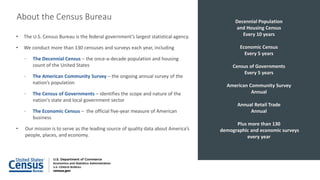
• The U.S. Census Bureau is the federal government’s largest statistical agency.
• We conduct more than 130 censuses and surveys each year, including
- The Decennial Census – the once-a-decade population and housing
count of the United States
- The American Community Survey – the ongoing annual survey of the
nation’s population
- The Census of Governments – identifies the scope and nature of the
nation's state and local government sector
- The Economic Census – the official five-year measure of American
business
• Our mission is to serve as the leading source of quality data about America’s
people, places, and economy.
Decennial Population
and Housing Census
Every 10 years
Economic Census
Every 5 years
Census of Governments
Every 5 years
American Community Survey
Annual
Annual Retail Trade
Annual
Plus more than 130
demographic and economic surveys
every year
About the Census Bureau
Census Bureau Economic Programs
4
Key Economic Census Terms
• NAICS (North American Industry Classification System)
• Our primary data dimension
• Adopted in 1997 to replace the Standard Industrial Classification (SIC)
system
• Updated every 5 years
• 2017 NAICS Manual
• Establishments (vs. Companies, Firms, etc.)
• Our collection/tabulation level
• Employers (vs. Nonemployers)
• EC only covers employer businesses
• U.S. Code Title 13 and 26
• Protects business privacy
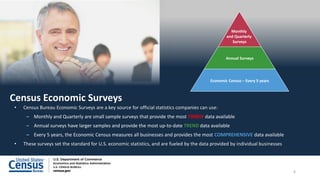
• Census Bureau Economic Surveys are a key source for official statistics companies can use:
– Monthly and Quarterly are small sample surveys that provide the most TIMELY data available
– Annual surveys have larger samples and provide the most up-to-date TREND data available
– Every 5 years, the Economic Census measures all businesses and provides the most COMPREHENSIVE data available
• These surveys set the standard for U.S. economic statistics, and are fueled by the data provided by individual businesses
Monthly
and Quarterly
Surveys
Annual Surveys
Economic Census – Every 5 years
Census Economic Surveys
6
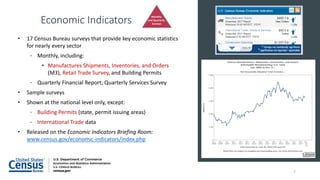
• 17 Census Bureau surveys that provide key economic statistics
for nearly every sector
- Monthly, including:
• Manufactures Shipments, Inventories, and Orders
(M3), Retail Trade Survey, and Building Permits
- Quarterly Financial Report; Quarterly Services Survey
• Sample surveys
• Shown at the national level only, except:
- Building Permits (state, permit issuing areas)
- International Trade data
• Released on the Economic Indicators Briefing Room:
www.census.gov/economic-indicators/index.php
Economic Indicators
Monthly
and Quarterly
Surveys
7
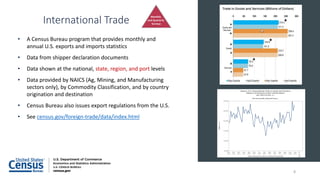
• A Census Bureau program that provides monthly and
annual U.S. exports and imports statistics
• Data from shipper declaration documents
• Data shown at the national, state, region, and port levels
• Data provided by NAICS (Ag, Mining, and Manufacturing
sectors only), by Commodity Classification, and by country
origination and destination
• Census Bureau also issues export regulations from the U.S.
• See census.gov/foreign-trade/data/index.html
International Trade
Monthly
and Quarterly
Surveys
8
• 20 Census Bureau surveys that provide annual economic
statistics for nearly every sector
• Sample surveys or administrative data
• Shown primarily at the national level, except:
- County Business Patterns: National, State, Metro, County,
ZIP Code
- Nonemployer Statistics: National, State, Metro, County
- Annual Survey of Manufacturers: National and State
• Other Related Annual Programs, including Retail eCommerce
Sales (E-Stats) and Annual Capital Expenditures Survey
• Released on American FactFinder, QuickFacts, Excel files, and
other Census tools
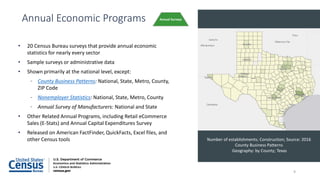
Annual Economic Programs Annual Surveys
Number of establishments; Construction; Source: 2016
County Business Patterns
Geography: by County; Texas
9
About the Economic Census
• The U.S. Census Bureau measures the nation’s population once
every 10 years. It also measures U.S. businesses every 5 years
with the Economic Census
• Response is required by law
• Responses are confidential. Company data is used for statistical
purposes only. The Census Bureau is required by law to keep
your information private and secure
• Response is required online. This reduces the time needed for
completion, improves accuracy, and provides significant cost
savings for taxpayers
• Results from the Economic Census are free and available to
guide business decisions and policy-making
10
Information Required
The Economic Census asks for the following information
by location
• Employer Identification Number
• Physical location
• Primary business activity
• Sales, receipts, or revenue
• Employment and payroll
• Industry-specific questions
11
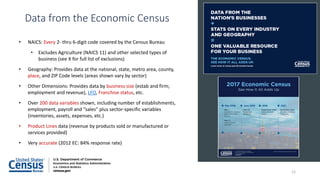
• NAICS: Every 2- thru 6-digit code covered by the Census Bureau
• Excludes Agriculture (NAICS 11) and other selected types of
business (see X for full list of exclusions)

• Geography: Provides data at the national, state, metro area, county,
place, and ZIP Code levels (areas shown vary by sector)
• Other Dimensions: Provides data by business size (estab and firm;
employment and revenue), LFO, Franchise status, etc.
• Over 200 data variables shown, including number of establishments,
employment, payroll and “sales” plus sector-specific variables
(inventories, assets, expenses, etc.)
• Product Lines data (revenue by products sold or manufactured or
services provided)
• Very accurate (2012 EC: 84% response rate)
Data from the Economic Census
12
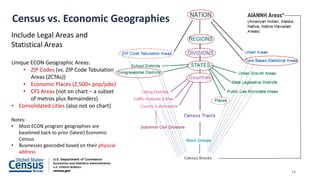
Include Legal Areas and
Statistical Areas
Unique ECON Geographic Areas:
• ZIP Codes (vs. ZIP Code Tabulation
Areas (ZCTAs))
• Economic Places (2,500+ pop/jobs)
• CFS Areas (not on chart – a subset
of metros plus Remainders)
• Consolidated cities (also not on chart)
Notes:
• Most ECON program geographies are
baselined back to prior (latest) Economic
Census
• Businesses geocoded based on their physical
address
Census vs. Economic Geographies
13
American Community Survey
14
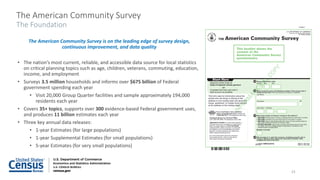
The American Community Survey
The Foundation
The American Community Survey is on the leading edge of survey design,
continuous improvement, and data quality
• The nation’s most current, reliable, and accessible data source for local statistics
on critical planning topics such as age, children, veterans, commuting, education,
income, and employment
• Surveys 3.5 million households and informs over $675 billion of Federal
government spending each year
• Visit 20,000 Group Quarter facilities and sample approximately 194,000
residents each year
• Covers 35+ topics, supports over 300 evidence-based Federal government uses,
and produces 11 billion estimates each year
• Three key annual data releases:
• 1-year Estimates (for large populations)
• 1-year Supplemental Estimates (for small populations)
• 5-year Estimates (for very small populations)
15
The American Community Survey
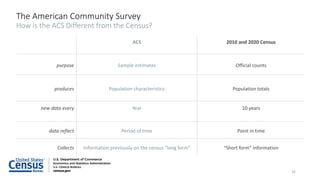
How is the ACS Different from the Census?
16
ACS 2010 and 2020 Census
purpose Sample estimates Official counts
produces Population characteristics Population totals
new data every Year 10 years
data reflect Period of time Point in time
Collects Information previously on the census “long form” “Short form” information
The American Community Survey
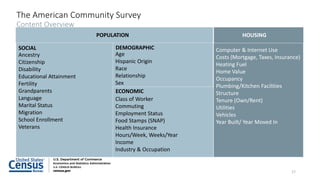
Content Overview
Ancestry
Citizenship
Disability
Educational Attainment
Fertility
Grandparents
Language
Marital Status
Migration
School Enrollment
Veterans
Class of Worker
Commuting
Employment Status
Food Stamps (SNAP)
Health Insurance
Hours/Week, Weeks/Year
Income
Industry & Occupation
Age
Hispanic Origin
Race
Relationship
Sex
POPULATION
SOCIAL DEMOGRAPHIC
ECONOMIC
Computer & Internet Use
Costs (Mortgage, Taxes, Insurance)
Heating Fuel
Home Value
Occupancy
Plumbing/Kitchen Facilities
Structure
Tenure (Own/Rent)
Utilities
Vehicles
Year Built/ Year Moved In
HOUSING
17
The American Community Survey
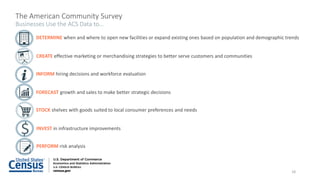
Businesses Use the ACS Data to…
INFORM hiring decisions and workforce evaluation
DETERMINE when and where to open new facilities or expand existing ones based on population and demographic trends
CREATE effective marketing or merchandising strategies to better serve customers and communities
FORECAST growth and sales to make better strategic decisions
STOCK shelves with goods suited to local consumer preferences and needs
INVEST in infrastructure improvements
PERFORM risk analysis
$
18
The ACS tells businesses about its potential customers:
• Are residents of a different age, sex, or family size in these
locations?
• Have changes to employment or earnings changed local
household budgets? (Maybe rent and utility costs are impacting
budgets as well.)
• Are new residents part of a demographic that doesn’t drive?
• Do residents speak different languages? Does the dealership
need signs or products promoted in other languages?
• Is a rise in computer and internet use providing opportunities
for new ways to reach your customers?
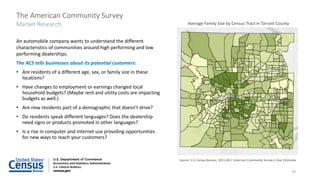
An automobile company wants to understand the different
characteristics of communities around high performing and low
performing dealerships.
The American Community Survey
Market Research
19
Source: U.S. Census Bureau, 2013-2017 American Community Survey 5-Year Estimates
Average Family Size by Census Tract in Tarrant County
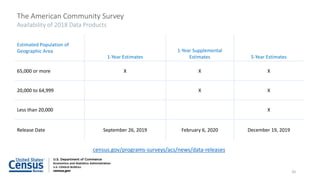
Estimated Population of
Geographic Area
1-Year Estimates
1-Year Supplemental
Estimates 5-Year Estimates
65,000 or more X X X
20,000 to 64,999 X X
Less than 20,000 X
Release Date September 26, 2019 February 6, 2020 December 19, 2019
census.gov/programs-surveys/acs/news/data-releases
The American Community Survey
Availability of 2018 Data Products
20
Census Geography
21
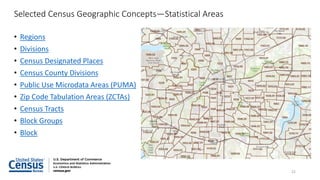
Selected Census Geographic Concepts—Statistical Areas
• Regions
• Divisions
• Census Designated Places
• Census County Divisions
• Public Use Microdata Areas (PUMA)
• Zip Code Tabulation Areas (ZCTAs)
• Census Tracts
• Block Groups
• Block
22
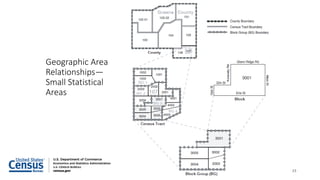
Geographic Area
Relationships—
Small Statistical
Areas
23
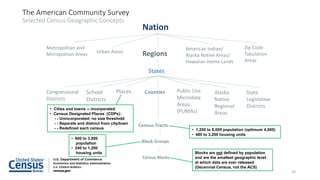
Nation
Regions
States
Counties
Census Tracts
Block Groups
Congressional
Districts
American Indian/
Alaska Native Areas/
Hawaiian Home Lands
Urban Areas
Metropolitan and
Micropolitan Areas
Zip Code
Tabulation
Areas
PlacesSchool
Districts
Public Use
Microdata
Areas
(PUMAs)
Alaska
Native
Regional
Areas
State
Legislative
Districts
24 24
The American Community Survey
Selected Census Geographic Concepts
• 600 to 3,000
population
• 240 to 1,200
housing units
Census Blocks
Blocks are not defined by population
and are the smallest geographic level
at which data are ever released
(Decennial Census, not the ACS)
• 1,200 to 8,000 population (optimum 4,000)
• 480 to 3,200 housing units
• Cities and towns -- incorporated
• Census Designated Places (CDPs):
- - Unincorporated; no size threshold
- - Separate and distinct from city/town
- - Redefined each census
Accessing Census Data
25
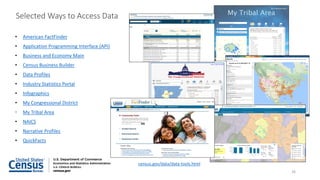
Selected Ways to Access Data
• American FactFinder
• Application Programming Interface (API)
• Business and Economy Main
• Census Business Builder
• Data Profiles
• Industry Statistics Portal
• Infographics
• My Congressional District
• My Tribal Area
• NAICS
• Narrative Profiles
• QuickFacts
census.gov/data/data-tools.html
26
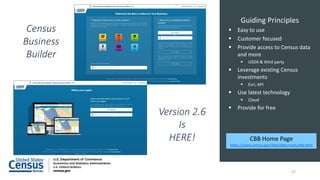
Census
Business
Builder
Guiding Principles
 Easy to use
 Customer focused
 Provide access to Census data
and more
 USDA & third party
 Leverage existing Census
investments
 Esri, API
 Use latest technology
 Cloud
 Provide for free
CBB Home Page
https://www.census.gov/data/data-tools/cbb.html
27
Version 2.6
Is
HERE!
28
29
30
31
Create your own Business Profile!
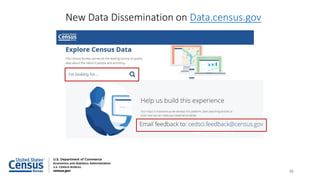
New Data Dissemination on Data.census.gov
32
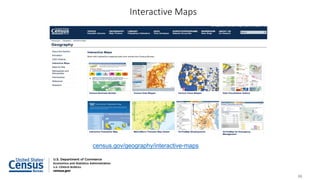
Interactive Maps
33
census.gov/geography/interactive-maps
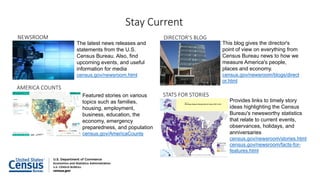
The latest news releases and
statements from the U.S.
Census Bureau. Also, find
upcoming events, and useful
information for media
census.gov/newsroom.html
Featured stories on various
topics such as families,
housing, employment,
business, education, the
economy, emergency
preparedness, and population
census.gov/AmericaCounts
Stay Current
This blog gives the director's
point of view on everything from
Census Bureau news to how we
measure America's people,
places and economy.
census.gov/newsroom/blogs/direct
or.html
Provides links to timely story
ideas highlighting the Census
Bureau's newsworthy statistics
that relate to current events,
observances, holidays, and
anniversaries
census.gov/newsroom/stories.html
census.gov/newsroom/facts-for-
features.html
NEWSROOM
AMERICA COUNTS
DIRECTOR’S BLOG
STATS FOR STORIES
Sign up for and manage alerts at
https://public.govdelivery.com/acco
unts/USCENSUS/subscriber/new
More information on the
American Community Survey:
https://www.census.gov/acs
Stay Connected #CensusData
Census (Non-media inquiries)
800-923-8282
Public Information Office (Media)
301-763-3030
facebook.com/uscensusbureau
twitter.com/uscensusbureau
youtube.com/user/uscensusbureau
instagram.com/uscensusbureau
pinterest.com/uscensusbureau
linkedin.com/company/us-census-bureau
35
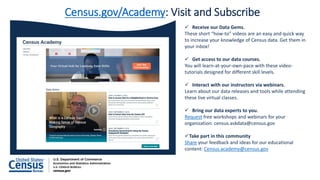
 Receive our Data Gems.
These short “how-to” videos are an easy and quick way
to increase your knowledge of Census data. Get them in
your inbox!
 Get access to our data courses.
You will learn-at-your-own-pace with these video-
tutorials designed for different skill levels.
 Interact with our instructors via webinars.
Learn about our data releases and tools while attending
these live virtual classes.
 Bring our data experts to you.
Request free workshops and webinars for your
organization: census.askdata@census.gov
Take part in this community
Share your feedback and ideas for our educational
content: Census.academy@census.gov
Census.gov/Academy: Visit and Subscribe
U.S. Census Bureau
Data Dissemination Specialist
Eric Coyle
(702) 236-3202
eric.a.coyle@census.gov
Additional Assistance:
Toll-free number:
1-844-ASK-DATA (1-844-275-2342)
census.askdata@census.gov
Additional Resources:
Want Free Training?
Need Local Stats?
36
Q&A and Thank You!
38

Using census bureau data to grow your business

  • 1.
    Using Data fromthe Census Bureau to Grow Your Business 2019 Heart of North Texas Business Conference November 1, 2019 Presented by: Eric Coyle Data Dissemination Specialist U.S. Census Bureau 1
  • 2.
    About the CensusBureau Census Bureau Economic Programs • Key Terms • Overview American Community Survey • Overview • Geography Accessing Census Data • AFF, API, CBB, Infographics, etc. Additional Resources Q&A Agenda 2
  • 3.
    • The U.S.Census Bureau is the federal government’s largest statistical agency. • We conduct more than 130 censuses and surveys each year, including - The Decennial Census – the once-a-decade population and housing count of the United States - The American Community Survey – the ongoing annual survey of the nation’s population - The Census of Governments – identifies the scope and nature of the nation's state and local government sector - The Economic Census – the official five-year measure of American business • Our mission is to serve as the leading source of quality data about America’s people, places, and economy. Decennial Population and Housing Census Every 10 years Economic Census Every 5 years Census of Governments Every 5 years American Community Survey Annual Annual Retail Trade Annual Plus more than 130 demographic and economic surveys every year About the Census Bureau
  • 4.
  • 5.
    Key Economic CensusTerms • NAICS (North American Industry Classification System) • Our primary data dimension • Adopted in 1997 to replace the Standard Industrial Classification (SIC) system • Updated every 5 years • 2017 NAICS Manual • Establishments (vs. Companies, Firms, etc.) • Our collection/tabulation level • Employers (vs. Nonemployers) • EC only covers employer businesses • U.S. Code Title 13 and 26 • Protects business privacy
  • 6.
    • Census BureauEconomic Surveys are a key source for official statistics companies can use: – Monthly and Quarterly are small sample surveys that provide the most TIMELY data available – Annual surveys have larger samples and provide the most up-to-date TREND data available – Every 5 years, the Economic Census measures all businesses and provides the most COMPREHENSIVE data available • These surveys set the standard for U.S. economic statistics, and are fueled by the data provided by individual businesses Monthly and Quarterly Surveys Annual Surveys Economic Census – Every 5 years Census Economic Surveys 6
  • 7.
    • 17 CensusBureau surveys that provide key economic statistics for nearly every sector - Monthly, including: • Manufactures Shipments, Inventories, and Orders (M3), Retail Trade Survey, and Building Permits - Quarterly Financial Report; Quarterly Services Survey • Sample surveys • Shown at the national level only, except: - Building Permits (state, permit issuing areas) - International Trade data • Released on the Economic Indicators Briefing Room: www.census.gov/economic-indicators/index.php Economic Indicators Monthly and Quarterly Surveys 7
  • 8.
    • A CensusBureau program that provides monthly and annual U.S. exports and imports statistics • Data from shipper declaration documents • Data shown at the national, state, region, and port levels • Data provided by NAICS (Ag, Mining, and Manufacturing sectors only), by Commodity Classification, and by country origination and destination • Census Bureau also issues export regulations from the U.S. • See census.gov/foreign-trade/data/index.html International Trade Monthly and Quarterly Surveys 8
  • 9.
    • 20 CensusBureau surveys that provide annual economic statistics for nearly every sector • Sample surveys or administrative data • Shown primarily at the national level, except: - County Business Patterns: National, State, Metro, County, ZIP Code - Nonemployer Statistics: National, State, Metro, County - Annual Survey of Manufacturers: National and State • Other Related Annual Programs, including Retail eCommerce Sales (E-Stats) and Annual Capital Expenditures Survey • Released on American FactFinder, QuickFacts, Excel files, and other Census tools Annual Economic Programs Annual Surveys Number of establishments; Construction; Source: 2016 County Business Patterns Geography: by County; Texas 9
  • 10.
    About the EconomicCensus • The U.S. Census Bureau measures the nation’s population once every 10 years. It also measures U.S. businesses every 5 years with the Economic Census • Response is required by law • Responses are confidential. Company data is used for statistical purposes only. The Census Bureau is required by law to keep your information private and secure • Response is required online. This reduces the time needed for completion, improves accuracy, and provides significant cost savings for taxpayers • Results from the Economic Census are free and available to guide business decisions and policy-making 10
  • 11.
    Information Required The EconomicCensus asks for the following information by location • Employer Identification Number • Physical location • Primary business activity • Sales, receipts, or revenue • Employment and payroll • Industry-specific questions 11
  • 12.
    • NAICS: Every2- thru 6-digit code covered by the Census Bureau • Excludes Agriculture (NAICS 11) and other selected types of business (see X for full list of exclusions) • Geography: Provides data at the national, state, metro area, county, place, and ZIP Code levels (areas shown vary by sector) • Other Dimensions: Provides data by business size (estab and firm; employment and revenue), LFO, Franchise status, etc. • Over 200 data variables shown, including number of establishments, employment, payroll and “sales” plus sector-specific variables (inventories, assets, expenses, etc.) • Product Lines data (revenue by products sold or manufactured or services provided) • Very accurate (2012 EC: 84% response rate) Data from the Economic Census 12
  • 13.
    Include Legal Areasand Statistical Areas Unique ECON Geographic Areas: • ZIP Codes (vs. ZIP Code Tabulation Areas (ZCTAs)) • Economic Places (2,500+ pop/jobs) • CFS Areas (not on chart – a subset of metros plus Remainders) • Consolidated cities (also not on chart) Notes: • Most ECON program geographies are baselined back to prior (latest) Economic Census • Businesses geocoded based on their physical address Census vs. Economic Geographies 13
  • 14.
  • 15.
    The American CommunitySurvey The Foundation The American Community Survey is on the leading edge of survey design, continuous improvement, and data quality • The nation’s most current, reliable, and accessible data source for local statistics on critical planning topics such as age, children, veterans, commuting, education, income, and employment • Surveys 3.5 million households and informs over $675 billion of Federal government spending each year • Visit 20,000 Group Quarter facilities and sample approximately 194,000 residents each year • Covers 35+ topics, supports over 300 evidence-based Federal government uses, and produces 11 billion estimates each year • Three key annual data releases: • 1-year Estimates (for large populations) • 1-year Supplemental Estimates (for small populations) • 5-year Estimates (for very small populations) 15
  • 16.
    The American CommunitySurvey How is the ACS Different from the Census? 16 ACS 2010 and 2020 Census purpose Sample estimates Official counts produces Population characteristics Population totals new data every Year 10 years data reflect Period of time Point in time Collects Information previously on the census “long form” “Short form” information
  • 17.
    The American CommunitySurvey Content Overview Ancestry Citizenship Disability Educational Attainment Fertility Grandparents Language Marital Status Migration School Enrollment Veterans Class of Worker Commuting Employment Status Food Stamps (SNAP) Health Insurance Hours/Week, Weeks/Year Income Industry & Occupation Age Hispanic Origin Race Relationship Sex POPULATION SOCIAL DEMOGRAPHIC ECONOMIC Computer & Internet Use Costs (Mortgage, Taxes, Insurance) Heating Fuel Home Value Occupancy Plumbing/Kitchen Facilities Structure Tenure (Own/Rent) Utilities Vehicles Year Built/ Year Moved In HOUSING 17
  • 18.
    The American CommunitySurvey Businesses Use the ACS Data to… INFORM hiring decisions and workforce evaluation DETERMINE when and where to open new facilities or expand existing ones based on population and demographic trends CREATE effective marketing or merchandising strategies to better serve customers and communities FORECAST growth and sales to make better strategic decisions STOCK shelves with goods suited to local consumer preferences and needs INVEST in infrastructure improvements PERFORM risk analysis $ 18
  • 19.
    The ACS tellsbusinesses about its potential customers: • Are residents of a different age, sex, or family size in these locations? • Have changes to employment or earnings changed local household budgets? (Maybe rent and utility costs are impacting budgets as well.) • Are new residents part of a demographic that doesn’t drive? • Do residents speak different languages? Does the dealership need signs or products promoted in other languages? • Is a rise in computer and internet use providing opportunities for new ways to reach your customers? An automobile company wants to understand the different characteristics of communities around high performing and low performing dealerships. The American Community Survey Market Research 19 Source: U.S. Census Bureau, 2013-2017 American Community Survey 5-Year Estimates Average Family Size by Census Tract in Tarrant County
  • 20.
    Estimated Population of GeographicArea 1-Year Estimates 1-Year Supplemental Estimates 5-Year Estimates 65,000 or more X X X 20,000 to 64,999 X X Less than 20,000 X Release Date September 26, 2019 February 6, 2020 December 19, 2019 census.gov/programs-surveys/acs/news/data-releases The American Community Survey Availability of 2018 Data Products 20
  • 21.
  • 22.
    Selected Census GeographicConcepts—Statistical Areas • Regions • Divisions • Census Designated Places • Census County Divisions • Public Use Microdata Areas (PUMA) • Zip Code Tabulation Areas (ZCTAs) • Census Tracts • Block Groups • Block 22
  • 23.
  • 24.
    Nation Regions States Counties Census Tracts Block Groups Congressional Districts AmericanIndian/ Alaska Native Areas/ Hawaiian Home Lands Urban Areas Metropolitan and Micropolitan Areas Zip Code Tabulation Areas PlacesSchool Districts Public Use Microdata Areas (PUMAs) Alaska Native Regional Areas State Legislative Districts 24 24 The American Community Survey Selected Census Geographic Concepts • 600 to 3,000 population • 240 to 1,200 housing units Census Blocks Blocks are not defined by population and are the smallest geographic level at which data are ever released (Decennial Census, not the ACS) • 1,200 to 8,000 population (optimum 4,000) • 480 to 3,200 housing units • Cities and towns -- incorporated • Census Designated Places (CDPs): - - Unincorporated; no size threshold - - Separate and distinct from city/town - - Redefined each census
  • 25.
  • 26.
    Selected Ways toAccess Data • American FactFinder • Application Programming Interface (API) • Business and Economy Main • Census Business Builder • Data Profiles • Industry Statistics Portal • Infographics • My Congressional District • My Tribal Area • NAICS • Narrative Profiles • QuickFacts census.gov/data/data-tools.html 26
  • 27.
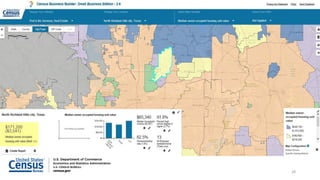
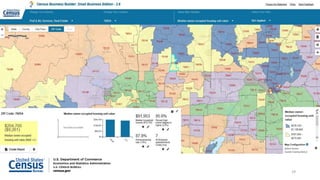
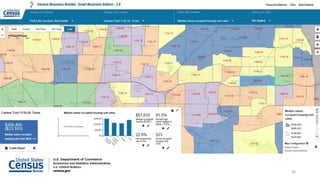
    Census Business Builder Guiding Principles  Easyto use  Customer focused  Provide access to Census data and more  USDA & third party  Leverage existing Census investments  Esri, API  Use latest technology  Cloud  Provide for free CBB Home Page https://www.census.gov/data/data-tools/cbb.html 27 Version 2.6 Is HERE!
  • 28.
  • 29.
  • 30.
  • 31.
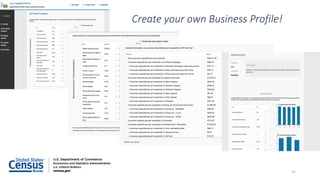
    31 Create your ownBusiness Profile!
  • 32.
    New Data Disseminationon Data.census.gov 32
  • 33.
  • 34.
    The latest newsreleases and statements from the U.S. Census Bureau. Also, find upcoming events, and useful information for media census.gov/newsroom.html Featured stories on various topics such as families, housing, employment, business, education, the economy, emergency preparedness, and population census.gov/AmericaCounts Stay Current This blog gives the director's point of view on everything from Census Bureau news to how we measure America's people, places and economy. census.gov/newsroom/blogs/direct or.html Provides links to timely story ideas highlighting the Census Bureau's newsworthy statistics that relate to current events, observances, holidays, and anniversaries census.gov/newsroom/stories.html census.gov/newsroom/facts-for- features.html NEWSROOM AMERICA COUNTS DIRECTOR’S BLOG STATS FOR STORIES
  • 35.
    Sign up forand manage alerts at https://public.govdelivery.com/acco unts/USCENSUS/subscriber/new More information on the American Community Survey: https://www.census.gov/acs Stay Connected #CensusData Census (Non-media inquiries) 800-923-8282 Public Information Office (Media) 301-763-3030 facebook.com/uscensusbureau twitter.com/uscensusbureau youtube.com/user/uscensusbureau instagram.com/uscensusbureau pinterest.com/uscensusbureau linkedin.com/company/us-census-bureau 35
  • 36.
     Receive ourData Gems. These short “how-to” videos are an easy and quick way to increase your knowledge of Census data. Get them in your inbox!  Get access to our data courses. You will learn-at-your-own-pace with these video- tutorials designed for different skill levels.  Interact with our instructors via webinars. Learn about our data releases and tools while attending these live virtual classes.  Bring our data experts to you. Request free workshops and webinars for your organization: census.askdata@census.gov Take part in this community Share your feedback and ideas for our educational content: Census.academy@census.gov Census.gov/Academy: Visit and Subscribe
  • 37.
    U.S. Census Bureau DataDissemination Specialist Eric Coyle (702) 236-3202 eric.a.coyle@census.gov Additional Assistance: Toll-free number: 1-844-ASK-DATA (1-844-275-2342) census.askdata@census.gov Additional Resources: Want Free Training? Need Local Stats? 36
  • 38.