1 
Meet Your Customers and Your Competitors with Census Data 
Downtown Seattle Association 
Seattle, Washington 
October 9, 2014
2 
Outline 
Customers: Demographic Programs 
Competitors: Economic Programs 
Business Scenario 
Accessing the Data: American FactFinder 
Data Dissemination Services
3 
Customers: Demographic Programs
4 
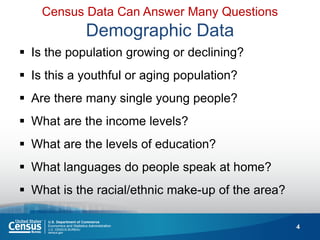
Is the population growing or declining? 
Is this a youthful or aging population? 
Are there many single young people? 
What are the income levels? 
What are the levels of education? 
What languages do people speak at home? 
What is the racial/ethnic make-up of the area? 
Census Data Can Answer Many Questions Demographic Data
5 
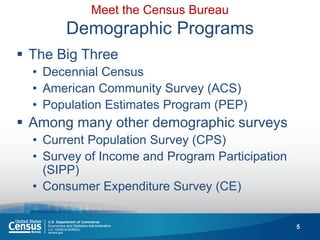
Meet the Census Bureau Demographic Programs 
The Big Three 
•Decennial Census 
•American Community Survey (ACS) 
•Population Estimates Program (PEP) 
Among many other demographic surveys 
•Current Population Survey (CPS) 
•Survey of Income and Program Participation (SIPP) 
•Consumer Expenditure Survey (CE)
6 
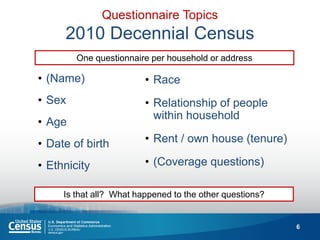
Questionnaire Topics 2010 Decennial Census 
•(Name) 
•Sex 
•Age 
•Date of birth 
•Ethnicity 
•Race 
•Relationship of people within household 
•Rent / own house (tenure) 
•(Coverage questions) 
Is that all? What happened to the other questions? 
One questionnaire per household or address
7 
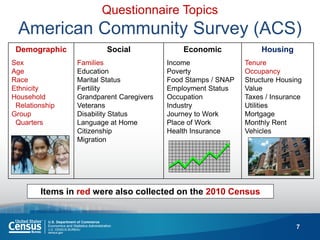
Questionnaire Topics American Community Survey (ACS) 
Demographic 
Sex 
Age 
Race 
Ethnicity 
Household 
Relationship 
Group Quarters 
Social 
Families 
Education 
Marital Status 
Fertility 
Grandparent Caregivers 
Veterans 
Disability Status 
Language at Home 
Citizenship 
Migration 
Economic 
Income 
Poverty 
Food Stamps / SNAP 
Employment Status 
Occupation 
Industry 
Journey to Work 
Place of Work 
Health Insurance 
Housing 
Tenure 
Occupancy 
Structure Housing Value 
Taxes / Insurance 
Utilities 
Mortgage 
Monthly Rent 
Vehicles 
Items in red were also collected on the 2010 Census
8 
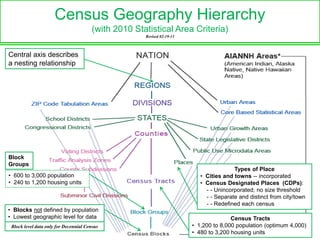
Census Geography Hierarchy 
(with 2010 Statistical Area Criteria) 
Revised 02-19-13 
Central axis describes a nesting relationship 
• 600 to 3,000 population 
• 240 to 1,200 housing units 
• Blocks not defined by population 
• Lowest geographic level for data 
Block level data only for Decennial Census 
Types of Place 
• Cities and towns -- incorporated 
• Census Designated Places (CDPs): - - Unincorporated; no size threshold - - Separate and distinct from city/town - - Redefined each census 
Census Tracts 
• 1,200 to 8,000 population (optimum 4,000) 
• 480 to 3,200 housing units 
Block 
Groups
9 
Competitors: Economic Programs
10 
Economic Data Organized by: Industry Survey Geography
11 
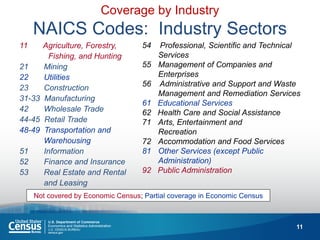
11 Agriculture, Forestry, Fishing, and Hunting 21 Mining 22 Utilities 23 Construction 31-33 Manufacturing 42 Wholesale Trade 44-45 Retail Trade 48-49 Transportation and Warehousing 51 Information 52 Finance and Insurance 53 Real Estate and Rental and Leasing 
54 Professional, Scientific and Technical Services 
55Management of Companies and Enterprises 56 Administrative and Support and Waste Management and Remediation Services 61 Educational Services 62 Health Care and Social Assistance 
71Arts, Entertainment and Recreation 
72Accommodation and Food Services 
81Other Services (except Public Administration) 92 Public Administration 
Not covered by Economic Census; Partial coverage in Economic Census 
Coverage by Industry NAICS Codes: Industry Sectors
12 
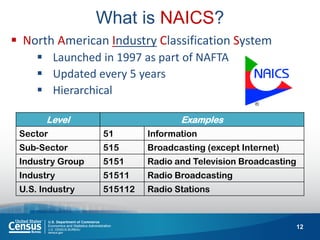
What is NAICS? 
North American Industry Classification System 
Launched in 1997 as part of NAFTA 
Updated every 5 years 
Hierarchical 
Level 
Examples 
Sector 
51 
Information 
Sub-Sector 
515 
Broadcasting (except Internet) 
Industry Group 
5151 
Radio and Television Broadcasting 
Industry 
51511 
Radio Broadcasting 
U.S. Industry 
515112 
Radio Stations
13 
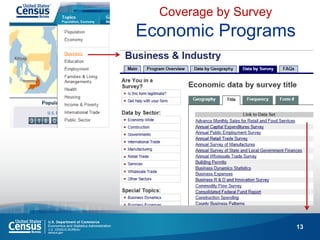
Coverage by Survey Economic Programs
14 
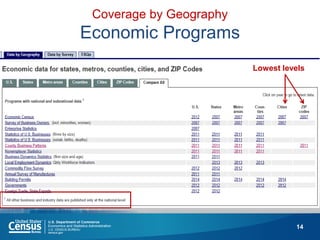
Coverage by Geography Economic Programs 
Lowest levels
15 
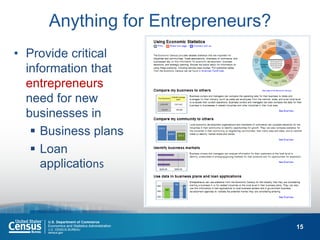
Anything for Entrepreneurs? 
•Provide critical information that entrepreneurs need for new businesses in 
Business plans 
Loan applications
16 
Business Scenario
17 
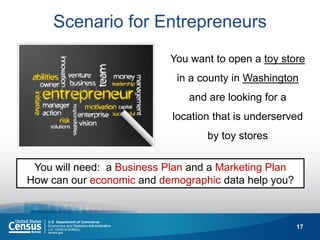
Scenario for Entrepreneurs 
You want to open a toy store in a county in Washington and are looking for a location that is underserved by toy stores 
You will need: a Business Plan and a Marketing Plan 
How can our economic and demographic data help you?
18 
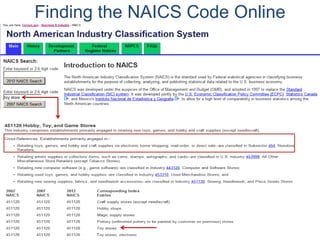
Finding the NAICS Code Online
19 
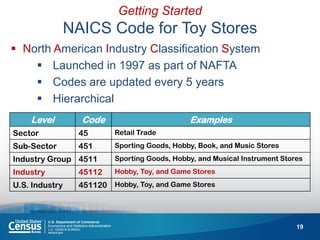
Getting Started NAICS Code for Toy Stores 
North American Industry Classification System 
Launched in 1997 as part of NAFTA 
Codes are updated every 5 years 
Hierarchical 
Level 
Code 
Examples 
Sector 
45 
Retail Trade 
Sub-Sector 
451 
Sporting Goods, Hobby, Book, and Music Stores 
Industry Group 
4511 
Sporting Goods, Hobby, and Musical Instrument Stores 
Industry 
45112 
Hobby, Toy, and Game Stores 
U.S. Industry 
451120 
Hobby, Toy, and Game Stores
20 
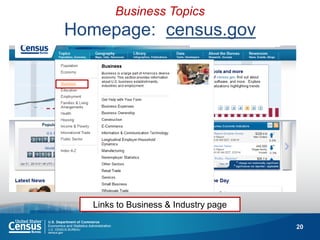
Business Topics Homepage: census.gov 
Links to Business & Industry page
21 
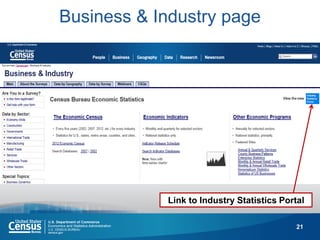
Business & Industry page 
Link to Industry Statistics Portal
22 
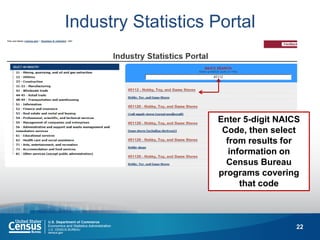
Industry Statistics Portal 
Enter 5-digit NAICS Code, then select from results for information on Census Bureau programs covering that code
23 
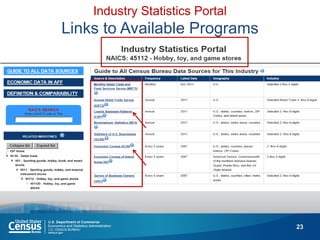
Industry Statistics Portal Links to Available Programs
24 
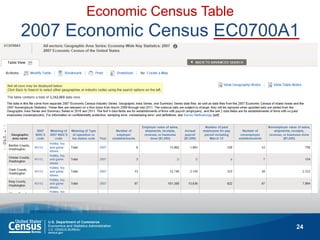
Economic Census Table 2007 Economic Census EC0700A1
25 
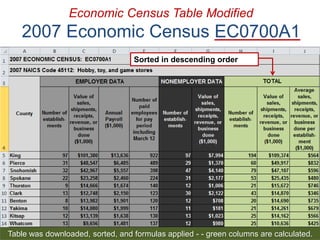
Economic Census Table Modified 2007 Economic Census EC0700A1 
Table was downloaded, sorted, and formulas applied - - green columns are calculated. 
Sorted in descending order
26 
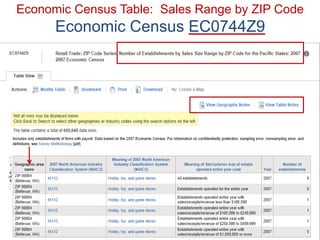
Economic Census Table: Sales Range by ZIP Code Economic Census EC0744Z9
27 
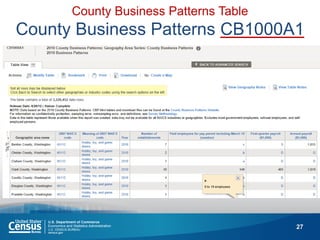
County Business Patterns Table County Business Patterns CB1000A1
28 
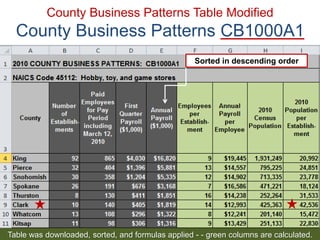
County Business Patterns Table Modified County Business Patterns CB1000A1 
Table was downloaded, sorted, and formulas applied - - green columns are calculated. 
Sorted in descending order
29 
Why might Clark County not be the best location for a toy store? 
Hint?
30 
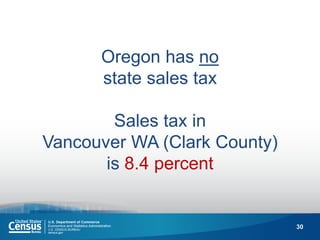
Oregon has no state sales tax Sales tax in Vancouver WA (Clark County) is 8.4 percent
31 
Business Analysis = 
DATA 
+ 
JUDGMENT 
(We supply the data!)
32 
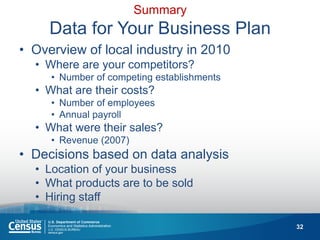
Summary Data for Your Business Plan 
•Overview of local industry in 2010 
•Where are your competitors? 
•Number of competing establishments 
•What are their costs? 
•Number of employees 
•Annual payroll 
•What were their sales? 
•Revenue (2007) 
•Decisions based on data analysis 
•Location of your business 
•What products are to be sold 
•Hiring staff
33 
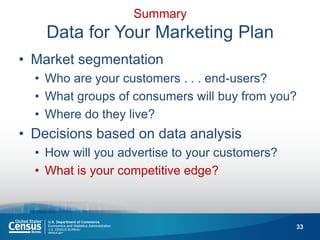
Summary Data for Your Marketing Plan 
•Market segmentation 
•Who are your customers . . . end-users? 
•What groups of consumers will buy from you? 
•Where do they live? 
•Decisions based on data analysis 
•How will you advertise to your customers? 
•What is your competitive edge?
34 
Accessing the Data: American FactFinder
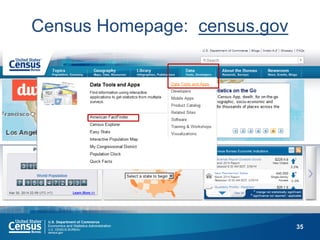
35 
Census Homepage: census.gov
36 
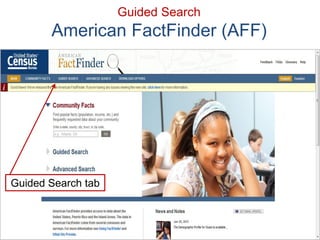
Guided Search American FactFinder (AFF) 
Guided Search tab
37 
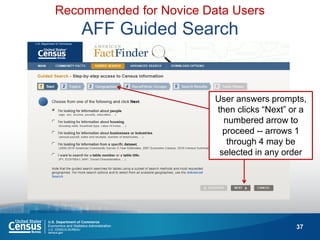
Recommended for Novice Data Users AFF Guided Search 
User answers prompts, then clicks “Next” or a numbered arrow to proceed -- arrows 1 through 4 may be selected in any order
38 
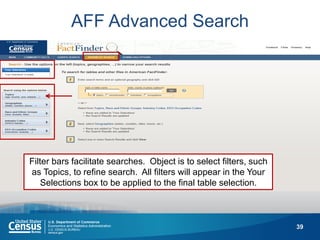
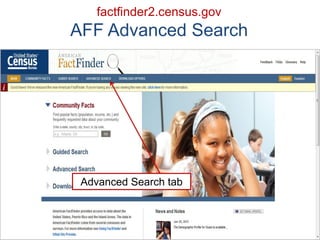
factfinder2.census.gov AFF Advanced Search 
Advanced Search tab
39 
AFF Advanced Search 
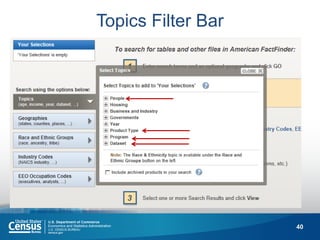
Filter bars facilitate searches. Object is to select filters, such as Topics, to refine search. All filters will appear in the Your Selections box to be applied to the final table selection.
40 
Topics Filter Bar
41 
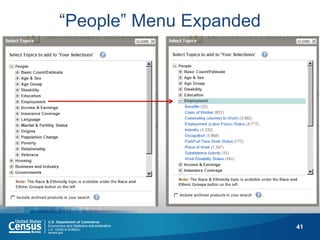
“People” Menu Expanded
42 
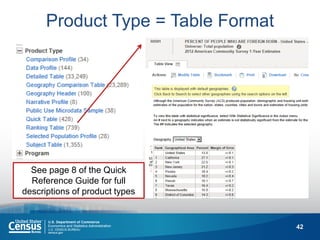
Product Type = Table Format 
See page 8 of the Quick Reference Guide for full descriptions of product types
43 
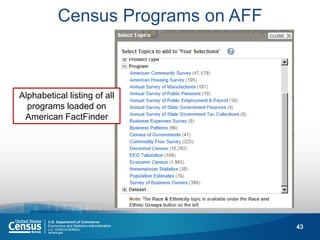
Census Programs on AFF 
Alphabetical listing of all programs loaded on American FactFinder
44 
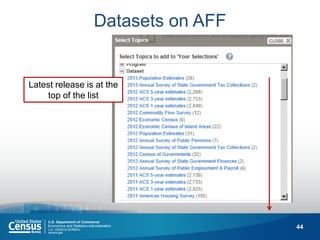
Datasets on AFF 
Latest release is at the top of the list
45 
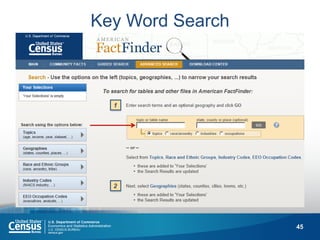
Key Word Search
46 
Data Dissemination Services
47 
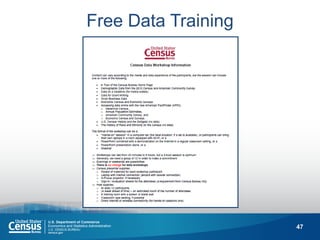
Free Data Training
48 
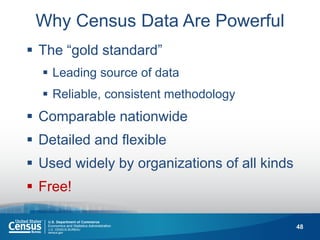
Why Census Data Are Powerful 
The “gold standard” 
Leading source of data 
Reliable, consistent methodology 
Comparable nationwide 
Detailed and flexible 
Used widely by organizations of all kinds 
Free!
49 
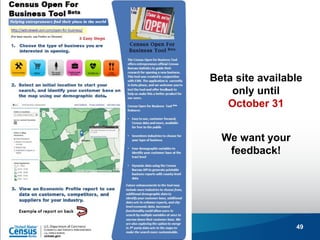
Beta site available 
only until 
October 31 
We want your feedback!
50 
Workshop Information 
and 
Data Questions 
Los Angeles Regional Office 
818-267-1725 or 
888-806-6389 (toll-free ) 
Linda Clark 
Data Dissemination Specialist 
Pacific Northwest & Alaska 
U.S. Census Bureau 
Los Angeles Region 
linda.clark@census.gov 
Mobile: 206-446-8794 
Questions? 
Thank you!

Census bureau Only in Seattle Presentation Oct 9 2014

  • 1.
    1 Meet YourCustomers and Your Competitors with Census Data Downtown Seattle Association Seattle, Washington October 9, 2014
  • 2.
    2 Outline Customers:Demographic Programs Competitors: Economic Programs Business Scenario Accessing the Data: American FactFinder Data Dissemination Services
  • 3.
  • 4.
    4 Is thepopulation growing or declining? Is this a youthful or aging population? Are there many single young people? What are the income levels? What are the levels of education? What languages do people speak at home? What is the racial/ethnic make-up of the area? Census Data Can Answer Many Questions Demographic Data
  • 5.
    5 Meet theCensus Bureau Demographic Programs The Big Three •Decennial Census •American Community Survey (ACS) •Population Estimates Program (PEP) Among many other demographic surveys •Current Population Survey (CPS) •Survey of Income and Program Participation (SIPP) •Consumer Expenditure Survey (CE)
  • 6.
    6 Questionnaire Topics2010 Decennial Census •(Name) •Sex •Age •Date of birth •Ethnicity •Race •Relationship of people within household •Rent / own house (tenure) •(Coverage questions) Is that all? What happened to the other questions? One questionnaire per household or address
  • 7.
    7 Questionnaire TopicsAmerican Community Survey (ACS) Demographic Sex Age Race Ethnicity Household Relationship Group Quarters Social Families Education Marital Status Fertility Grandparent Caregivers Veterans Disability Status Language at Home Citizenship Migration Economic Income Poverty Food Stamps / SNAP Employment Status Occupation Industry Journey to Work Place of Work Health Insurance Housing Tenure Occupancy Structure Housing Value Taxes / Insurance Utilities Mortgage Monthly Rent Vehicles Items in red were also collected on the 2010 Census
  • 8.
    8 Census GeographyHierarchy (with 2010 Statistical Area Criteria) Revised 02-19-13 Central axis describes a nesting relationship • 600 to 3,000 population • 240 to 1,200 housing units • Blocks not defined by population • Lowest geographic level for data Block level data only for Decennial Census Types of Place • Cities and towns -- incorporated • Census Designated Places (CDPs): - - Unincorporated; no size threshold - - Separate and distinct from city/town - - Redefined each census Census Tracts • 1,200 to 8,000 population (optimum 4,000) • 480 to 3,200 housing units Block Groups
  • 9.
  • 10.
    10 Economic DataOrganized by: Industry Survey Geography
  • 11.
    11 11 Agriculture,Forestry, Fishing, and Hunting 21 Mining 22 Utilities 23 Construction 31-33 Manufacturing 42 Wholesale Trade 44-45 Retail Trade 48-49 Transportation and Warehousing 51 Information 52 Finance and Insurance 53 Real Estate and Rental and Leasing 54 Professional, Scientific and Technical Services 55Management of Companies and Enterprises 56 Administrative and Support and Waste Management and Remediation Services 61 Educational Services 62 Health Care and Social Assistance 71Arts, Entertainment and Recreation 72Accommodation and Food Services 81Other Services (except Public Administration) 92 Public Administration Not covered by Economic Census; Partial coverage in Economic Census Coverage by Industry NAICS Codes: Industry Sectors
  • 12.
    12 What isNAICS? North American Industry Classification System Launched in 1997 as part of NAFTA Updated every 5 years Hierarchical Level Examples Sector 51 Information Sub-Sector 515 Broadcasting (except Internet) Industry Group 5151 Radio and Television Broadcasting Industry 51511 Radio Broadcasting U.S. Industry 515112 Radio Stations
  • 13.
    13 Coverage bySurvey Economic Programs
  • 14.
    14 Coverage byGeography Economic Programs Lowest levels
  • 15.
    15 Anything forEntrepreneurs? •Provide critical information that entrepreneurs need for new businesses in Business plans Loan applications
  • 16.
  • 17.
    17 Scenario forEntrepreneurs You want to open a toy store in a county in Washington and are looking for a location that is underserved by toy stores You will need: a Business Plan and a Marketing Plan How can our economic and demographic data help you?
  • 18.
    18 Finding theNAICS Code Online
  • 19.
    19 Getting StartedNAICS Code for Toy Stores North American Industry Classification System Launched in 1997 as part of NAFTA Codes are updated every 5 years Hierarchical Level Code Examples Sector 45 Retail Trade Sub-Sector 451 Sporting Goods, Hobby, Book, and Music Stores Industry Group 4511 Sporting Goods, Hobby, and Musical Instrument Stores Industry 45112 Hobby, Toy, and Game Stores U.S. Industry 451120 Hobby, Toy, and Game Stores
  • 20.
    20 Business TopicsHomepage: census.gov Links to Business & Industry page
  • 21.
    21 Business &Industry page Link to Industry Statistics Portal
  • 22.
    22 Industry StatisticsPortal Enter 5-digit NAICS Code, then select from results for information on Census Bureau programs covering that code
  • 23.
    23 Industry StatisticsPortal Links to Available Programs
  • 24.
    24 Economic CensusTable 2007 Economic Census EC0700A1
  • 25.
    25 Economic CensusTable Modified 2007 Economic Census EC0700A1 Table was downloaded, sorted, and formulas applied - - green columns are calculated. Sorted in descending order
  • 26.
    26 Economic CensusTable: Sales Range by ZIP Code Economic Census EC0744Z9
  • 27.
    27 County BusinessPatterns Table County Business Patterns CB1000A1
  • 28.
    28 County BusinessPatterns Table Modified County Business Patterns CB1000A1 Table was downloaded, sorted, and formulas applied - - green columns are calculated. Sorted in descending order
  • 29.
    29 Why mightClark County not be the best location for a toy store? Hint?
  • 30.
    30 Oregon hasno state sales tax Sales tax in Vancouver WA (Clark County) is 8.4 percent
  • 31.
    31 Business Analysis= DATA + JUDGMENT (We supply the data!)
  • 32.
    32 Summary Datafor Your Business Plan •Overview of local industry in 2010 •Where are your competitors? •Number of competing establishments •What are their costs? •Number of employees •Annual payroll •What were their sales? •Revenue (2007) •Decisions based on data analysis •Location of your business •What products are to be sold •Hiring staff
  • 33.
    33 Summary Datafor Your Marketing Plan •Market segmentation •Who are your customers . . . end-users? •What groups of consumers will buy from you? •Where do they live? •Decisions based on data analysis •How will you advertise to your customers? •What is your competitive edge?
  • 34.
    34 Accessing theData: American FactFinder
  • 35.
  • 36.
    36 Guided SearchAmerican FactFinder (AFF) Guided Search tab
  • 37.
    37 Recommended forNovice Data Users AFF Guided Search User answers prompts, then clicks “Next” or a numbered arrow to proceed -- arrows 1 through 4 may be selected in any order
  • 38.
    38 factfinder2.census.gov AFFAdvanced Search Advanced Search tab
  • 39.
    39 AFF AdvancedSearch Filter bars facilitate searches. Object is to select filters, such as Topics, to refine search. All filters will appear in the Your Selections box to be applied to the final table selection.
  • 40.
  • 41.
  • 42.
    42 Product Type= Table Format See page 8 of the Quick Reference Guide for full descriptions of product types
  • 43.
    43 Census Programson AFF Alphabetical listing of all programs loaded on American FactFinder
  • 44.
    44 Datasets onAFF Latest release is at the top of the list
  • 45.
  • 46.
  • 47.
    47 Free DataTraining
  • 48.
    48 Why CensusData Are Powerful The “gold standard” Leading source of data Reliable, consistent methodology Comparable nationwide Detailed and flexible Used widely by organizations of all kinds Free!
  • 49.
    49 Beta siteavailable only until October 31 We want your feedback!
  • 50.
    50 Workshop Information and Data Questions Los Angeles Regional Office 818-267-1725 or 888-806-6389 (toll-free ) Linda Clark Data Dissemination Specialist Pacific Northwest & Alaska U.S. Census Bureau Los Angeles Region linda.clark@census.gov Mobile: 206-446-8794 Questions? Thank you!