The Decennial U.S. Census and
the American Community Survey
An Introduction
Agenda
 Introductions
 Michele Hayslett
 You and your questions
 Decennial Census – methodology, variables,
geographies, vocabulary
 American Community Survey (ACS) –
differences in methodology & variables
Introductions
 Me
 You
 How many of you are working with
decennial/historical data vs. the American
Community Survey?
 What are your research questions?
 What specific questions do you have about
Census data?
(Check chat)
Decennial Census
 What: Complete enumeration of a population
 Where: “Usual place of residence”
 When: as of “Census Day”
 Reference period for income: last calendar year
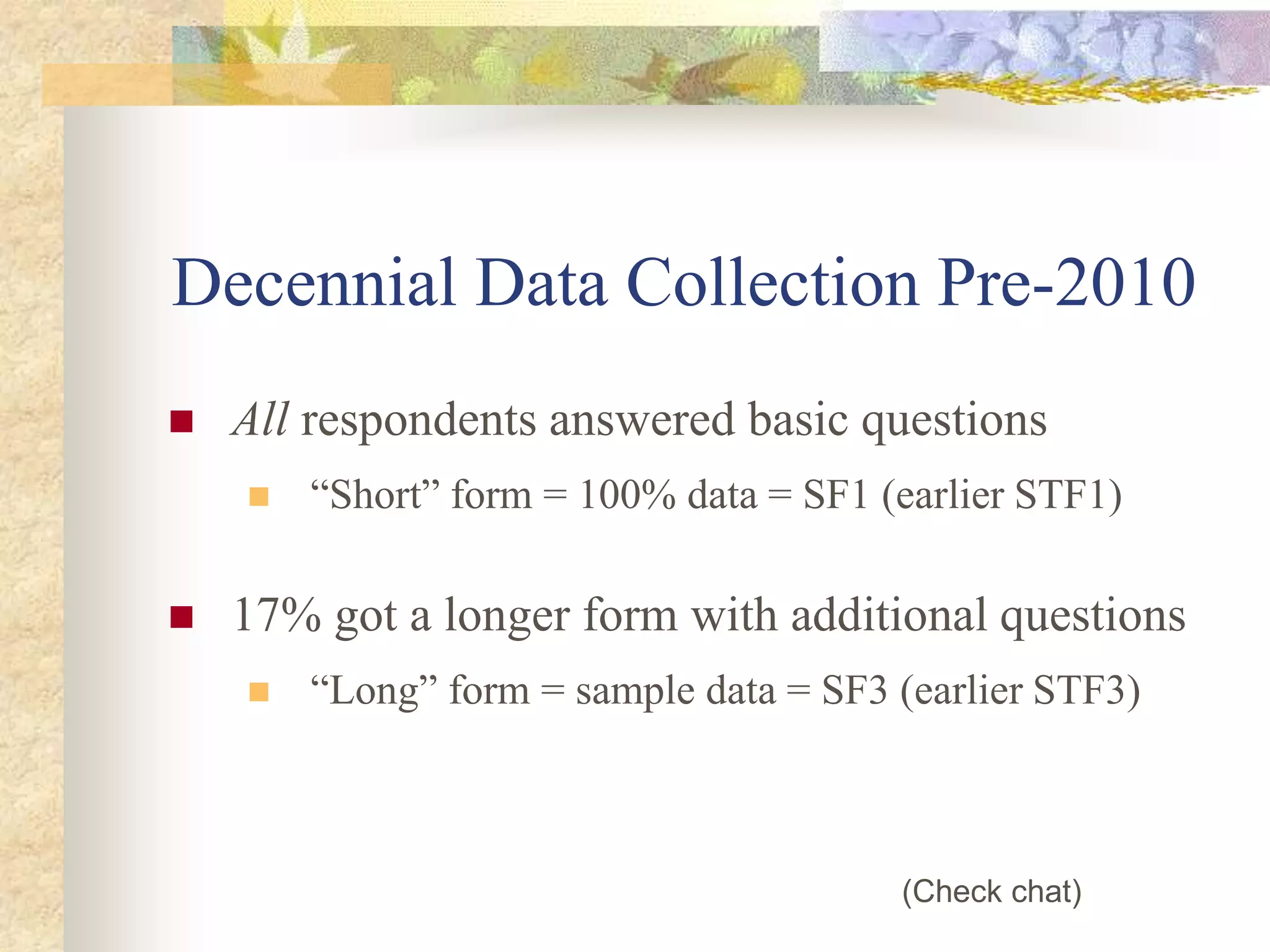
Decennial Data Collection Pre-2010
 All respondents answered basic questions
 “Short” form = 100% data = SF1 (earlier STF1)
 17% got a longer form with additional questions
 “Long” form = sample data = SF3 (earlier STF3)
(Check chat)
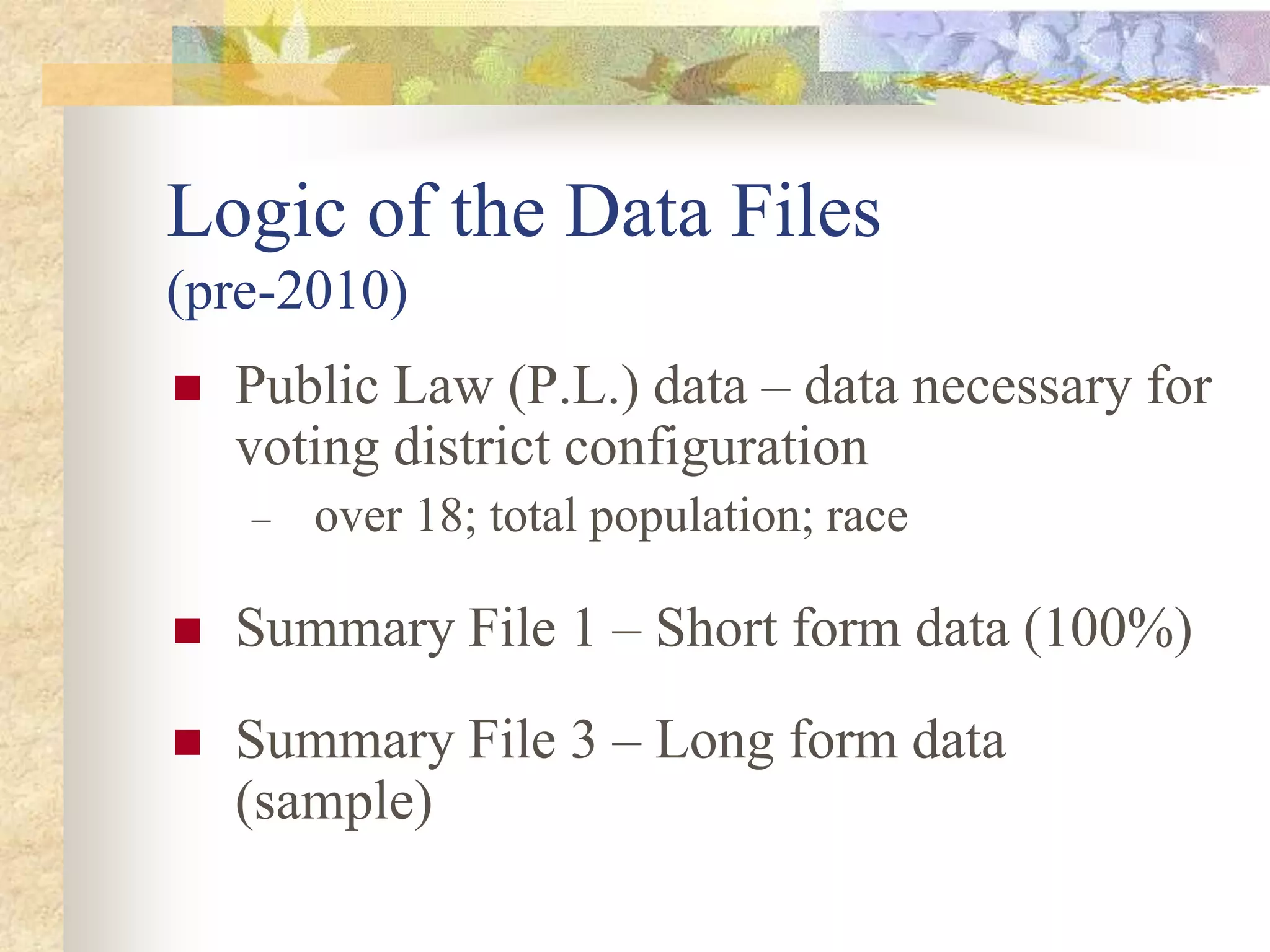
Logic of the Data Files
(pre-2010)
 Public Law (P.L.) data – data necessary for
voting district configuration
 over 18; total population; race
 Summary File 1 – Short form data (100%)
 Summary File 3 – Long form data
(sample)
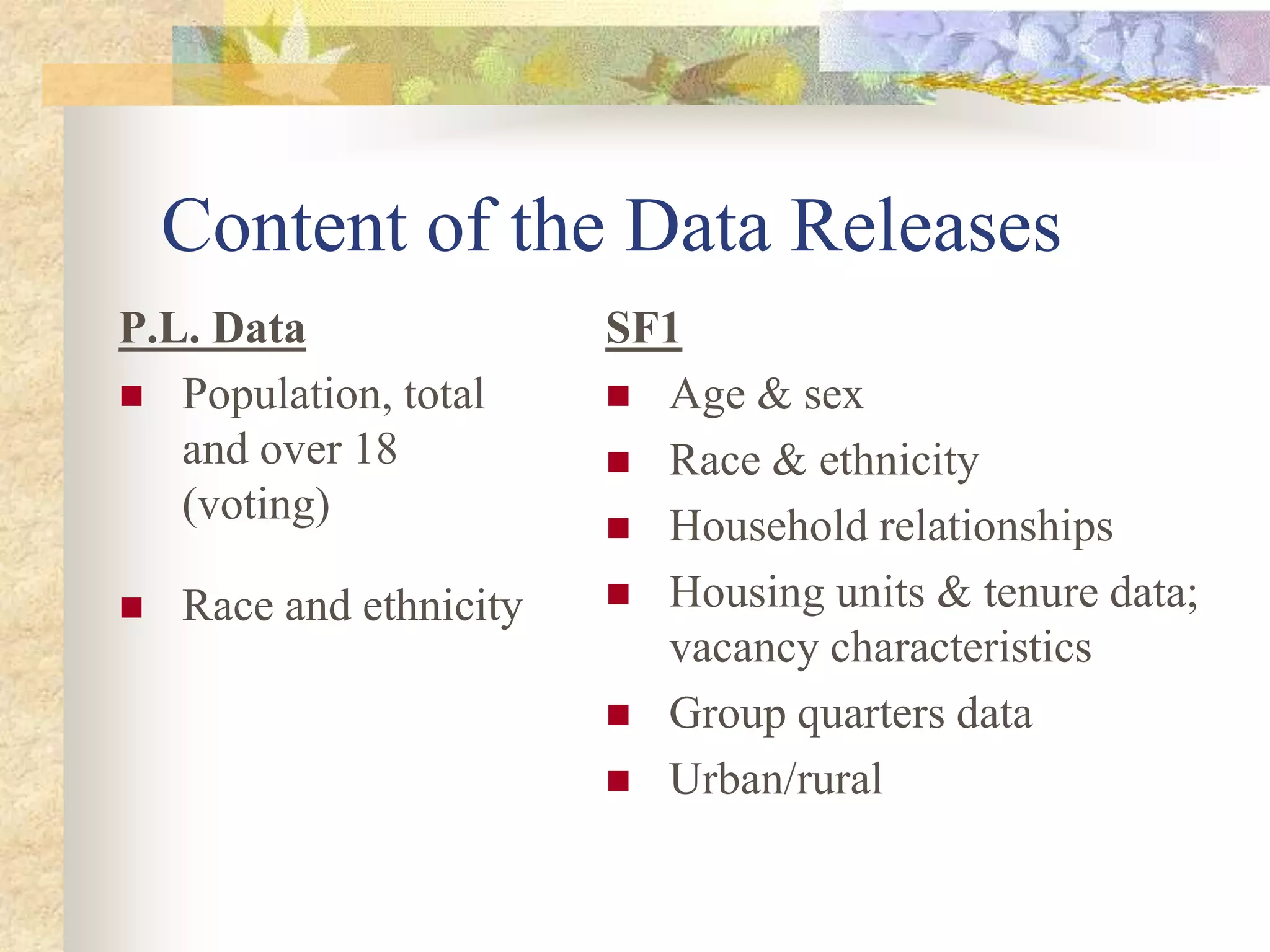
Content of the Data Releases
P.L. Data
 Population, total
and over 18
(voting)
 Race and ethnicity
SF1
 Age & sex
 Race & ethnicity
 Household relationships
 Housing units & tenure data;
vacancy characteristics
 Group quarters data
 Urban/rural
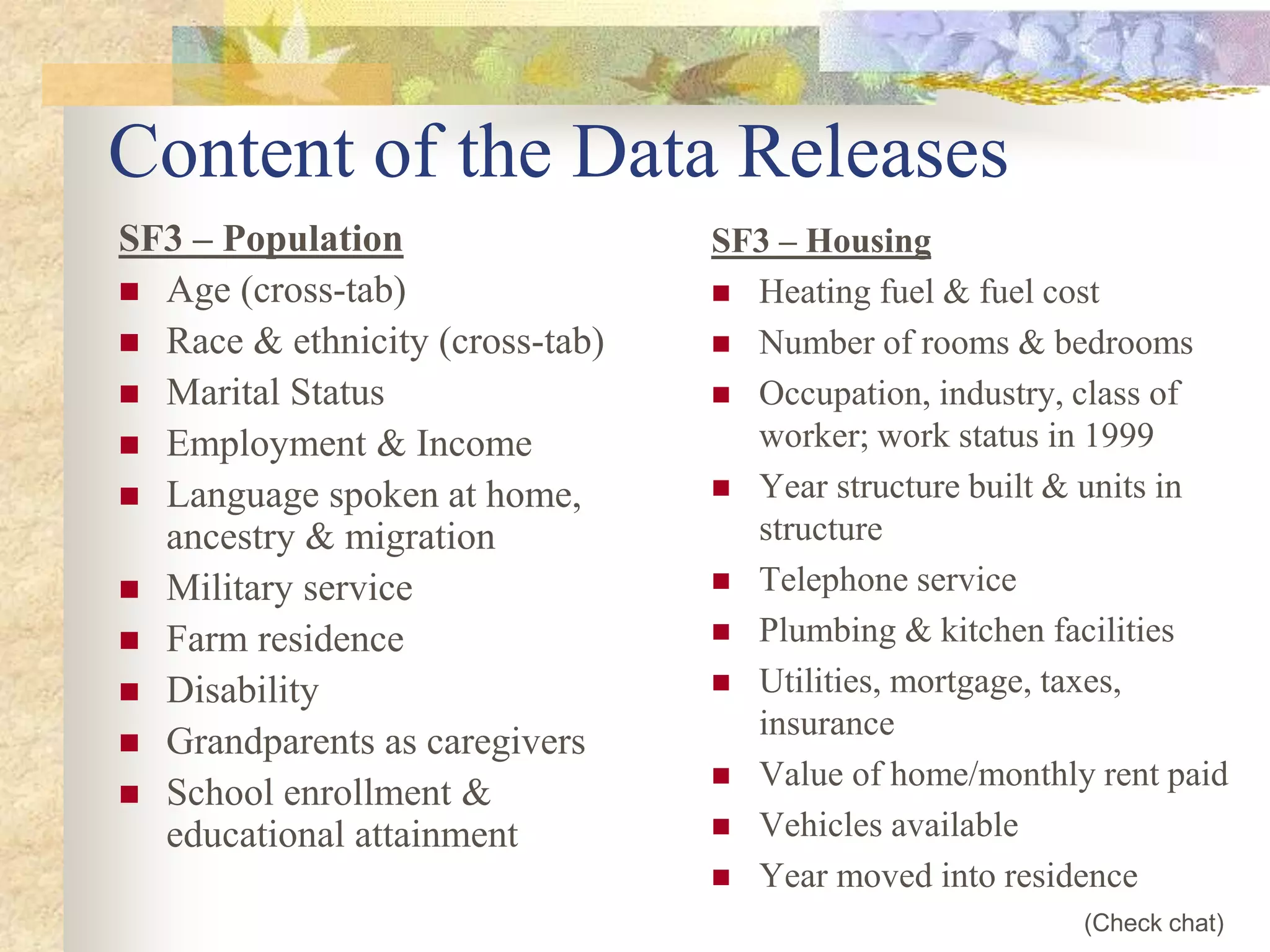
Content of the Data Releases
SF3 – Population
 Age (cross-tab)
 Race & ethnicity (cross-tab)
 Marital Status
 Employment & Income
 Language spoken at home,
ancestry & migration
 Military service
 Farm residence
 Disability
 Grandparents as caregivers
 School enrollment &
educational attainment
SF3 – Housing
 Heating fuel & fuel cost
 Number of rooms & bedrooms
 Occupation, industry, class of
worker; work status in 1999
 Year structure built & units in
structure
 Telephone service
 Plumbing & kitchen facilities
 Utilities, mortgage, taxes,
insurance
 Value of home/monthly rent paid
 Vehicles available
 Year moved into residence
(Check chat)
Which SF covers more topics?
What is that SF called?
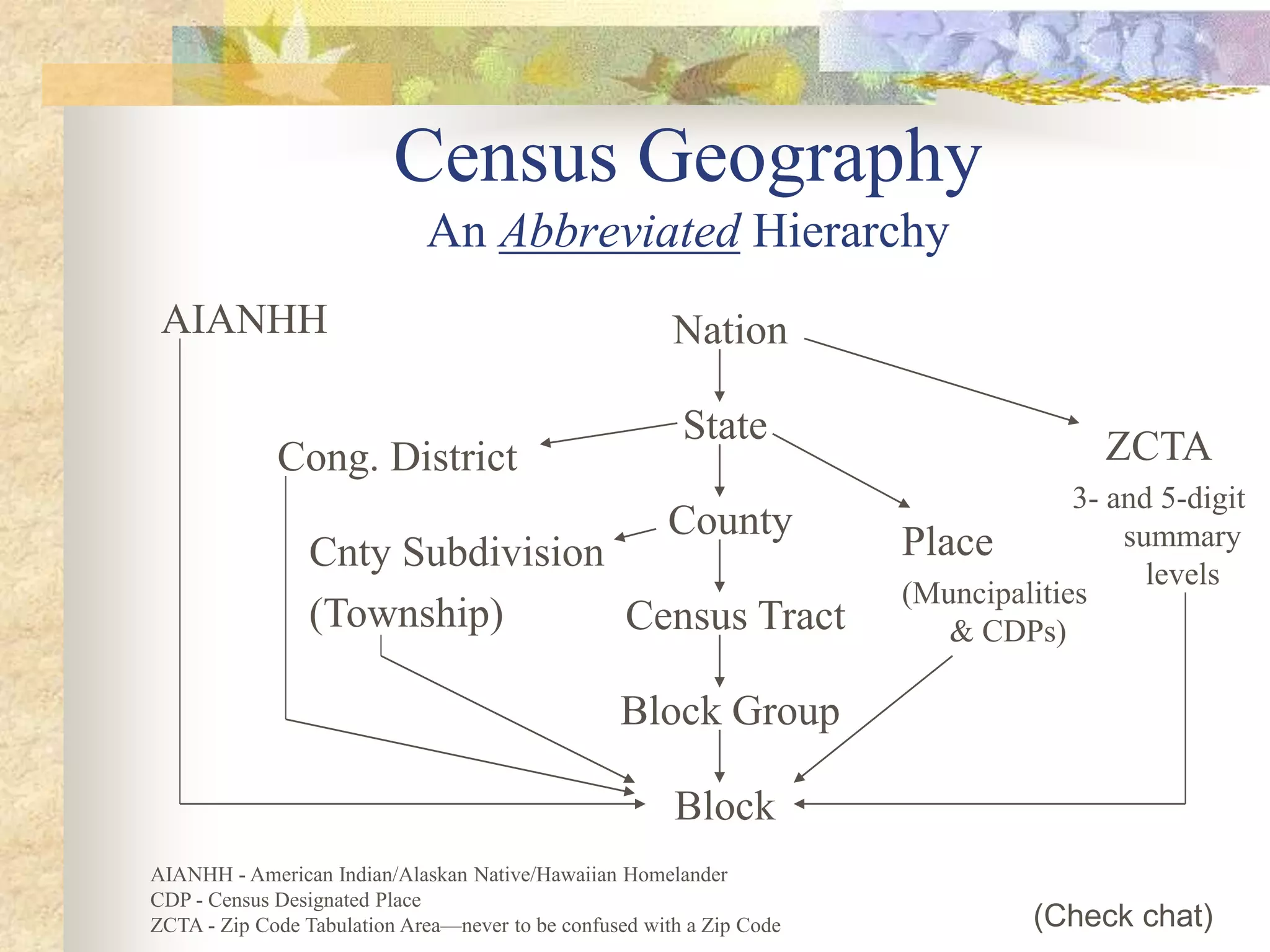
Nation
County
State
Census Tract
Block Group
Block
AIANHH
Cong. District
Cnty Subdivision
(Township)
Place
(Muncipalities
& CDPs)
ZCTA
3- and 5-digit
summary
levels
Census Geography
An Abbreviated Hierarchy
AIANHH - American Indian/Alaskan Native/Hawaiian Homelander
CDP - Census Designated Place
ZCTA - Zip Code Tabulation Area—never to be confused with a Zip Code (Check chat)
What word describes the
center line of the
geographies diagram?
Important Distinctions
 Race versus Ethnicity
NPR story about 2020 changes:
http://n.pr/2i3WRSV
 Household versus Family
 Metropolitan versus Urban
(Check chat)
What is important to
remember when using a
spreadsheet of race and
ethnicity data?
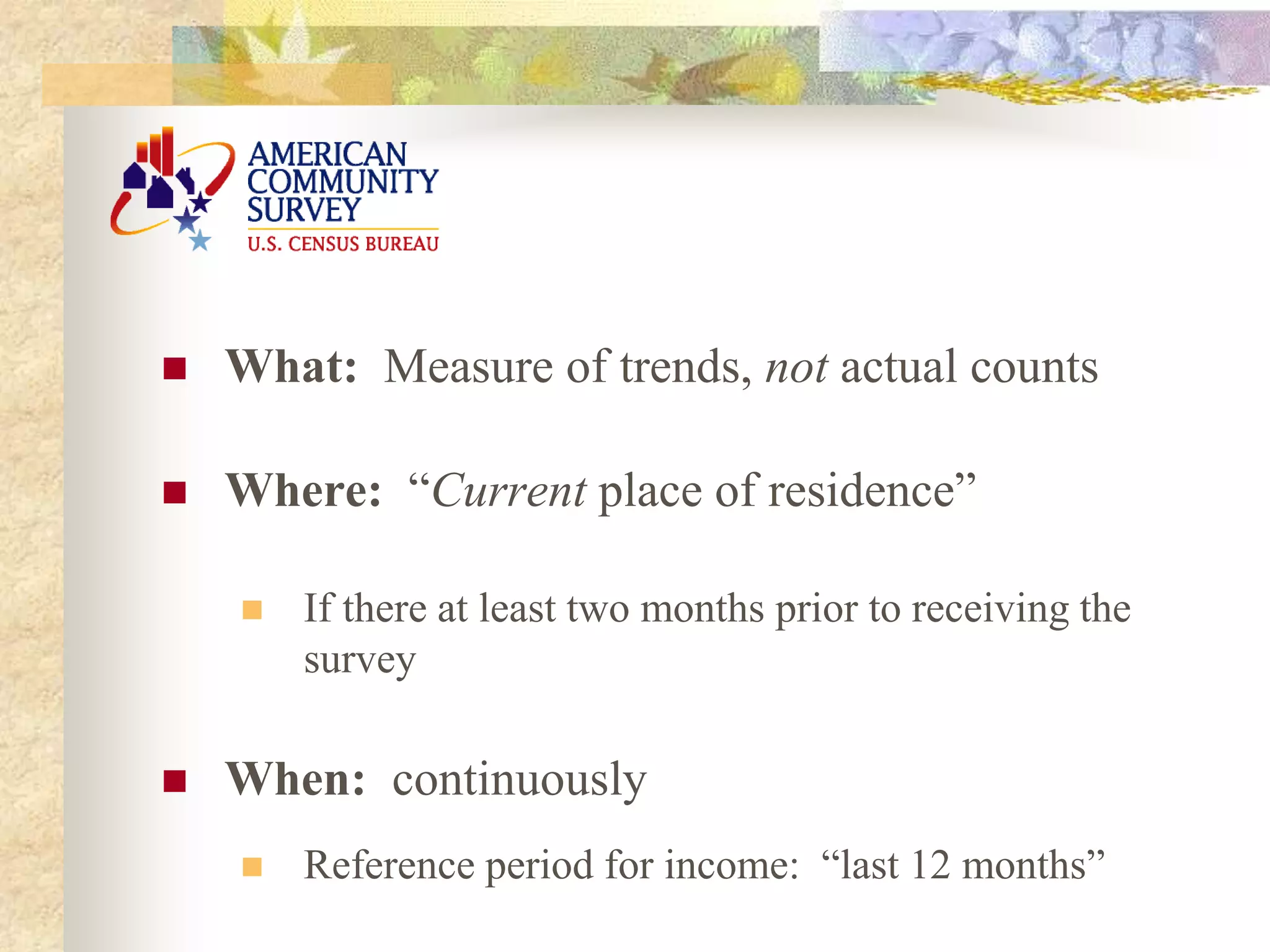
 What: Measure of trends, not actual counts
 Where: “Current place of residence”
 If there at least two months prior to receiving the
survey
 When: continuously
 Reference period for income: “last 12 months”
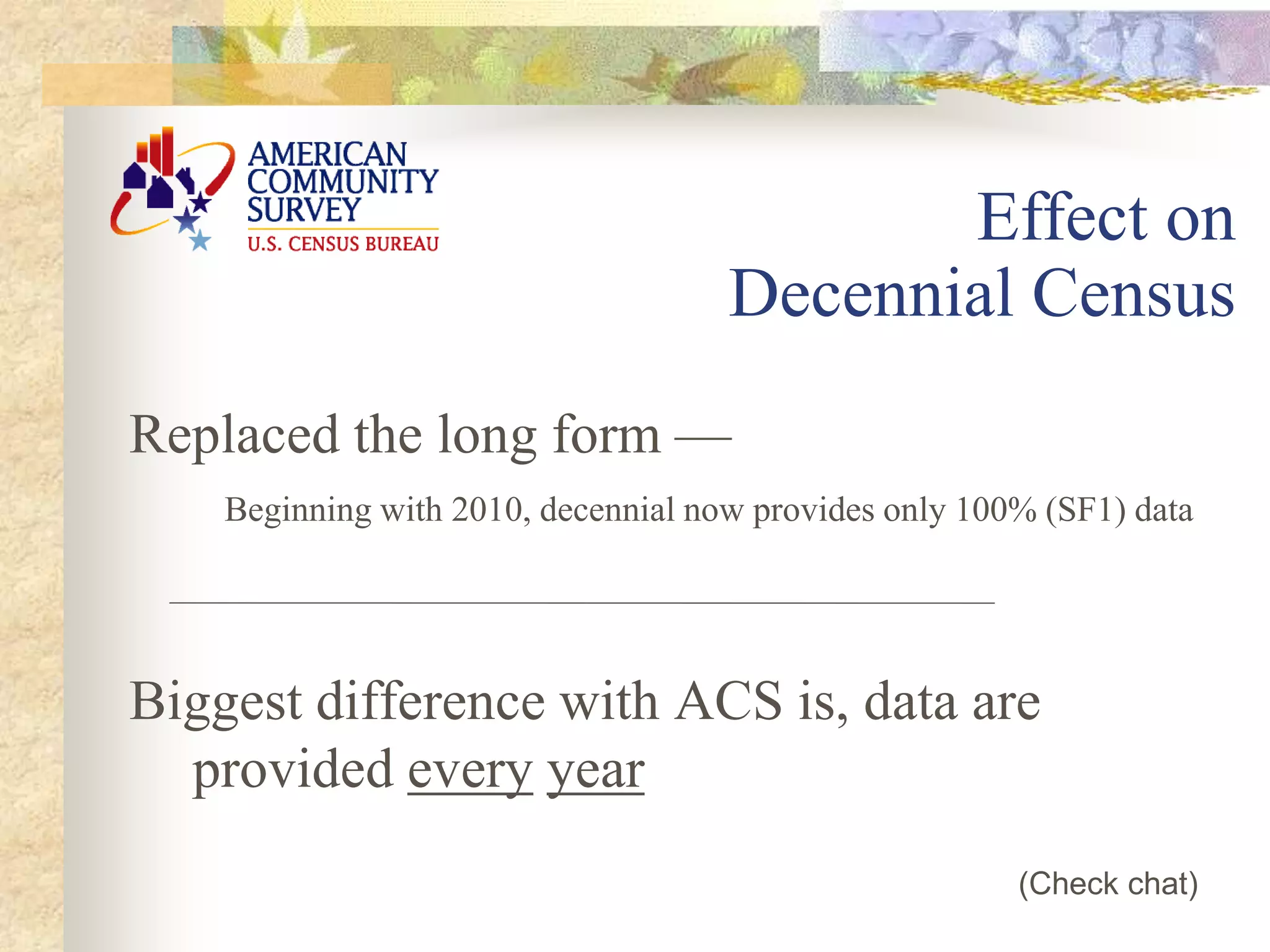
Replaced the long form —
Beginning with 2010, decennial now provides only 100% (SF1) data
Biggest difference with ACS is, data are
provided every year
Effect on
Decennial Census
(Check chat)
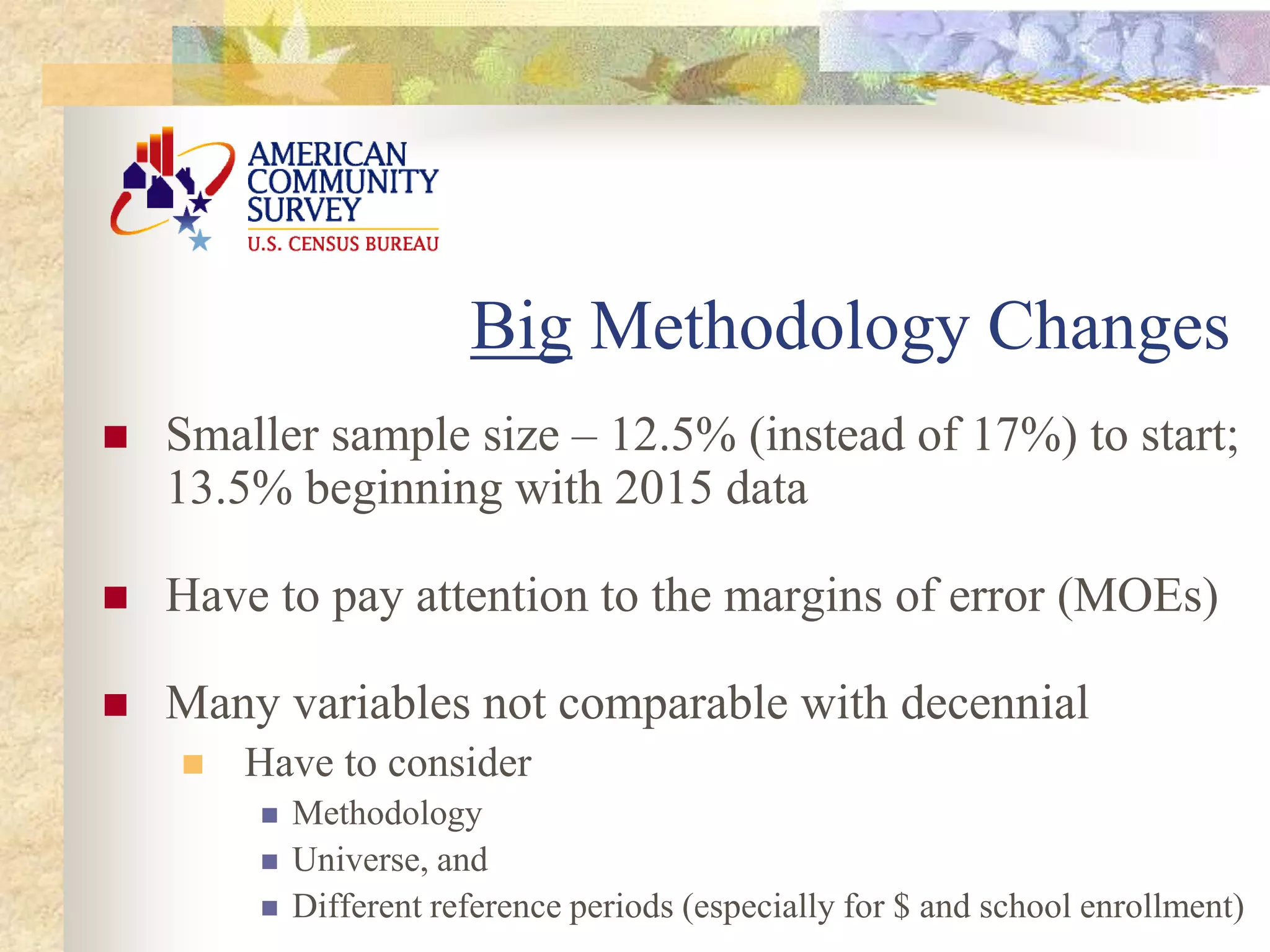
 Smaller sample size – 12.5% (instead of 17%) to start;
13.5% beginning with 2015 data
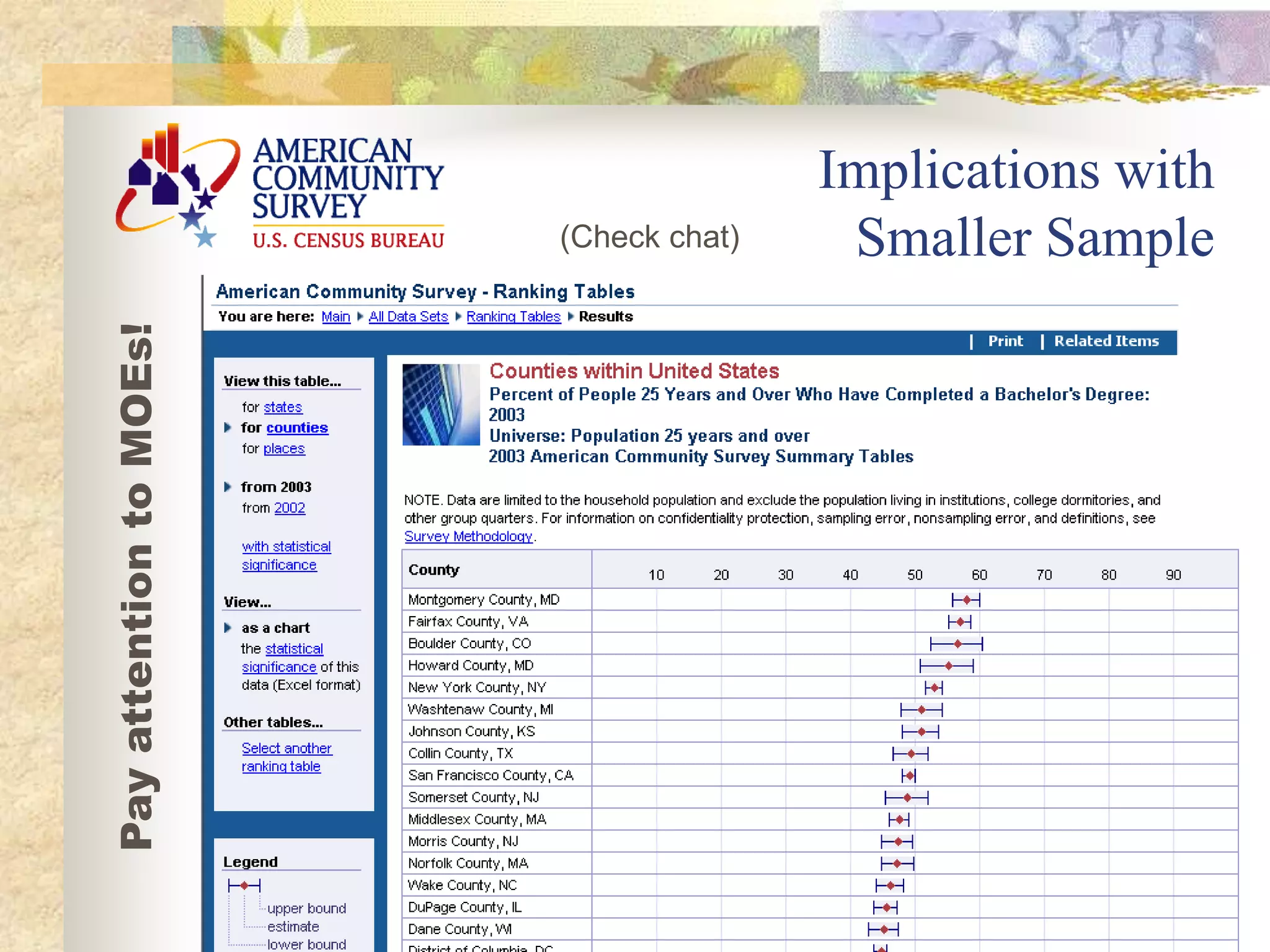
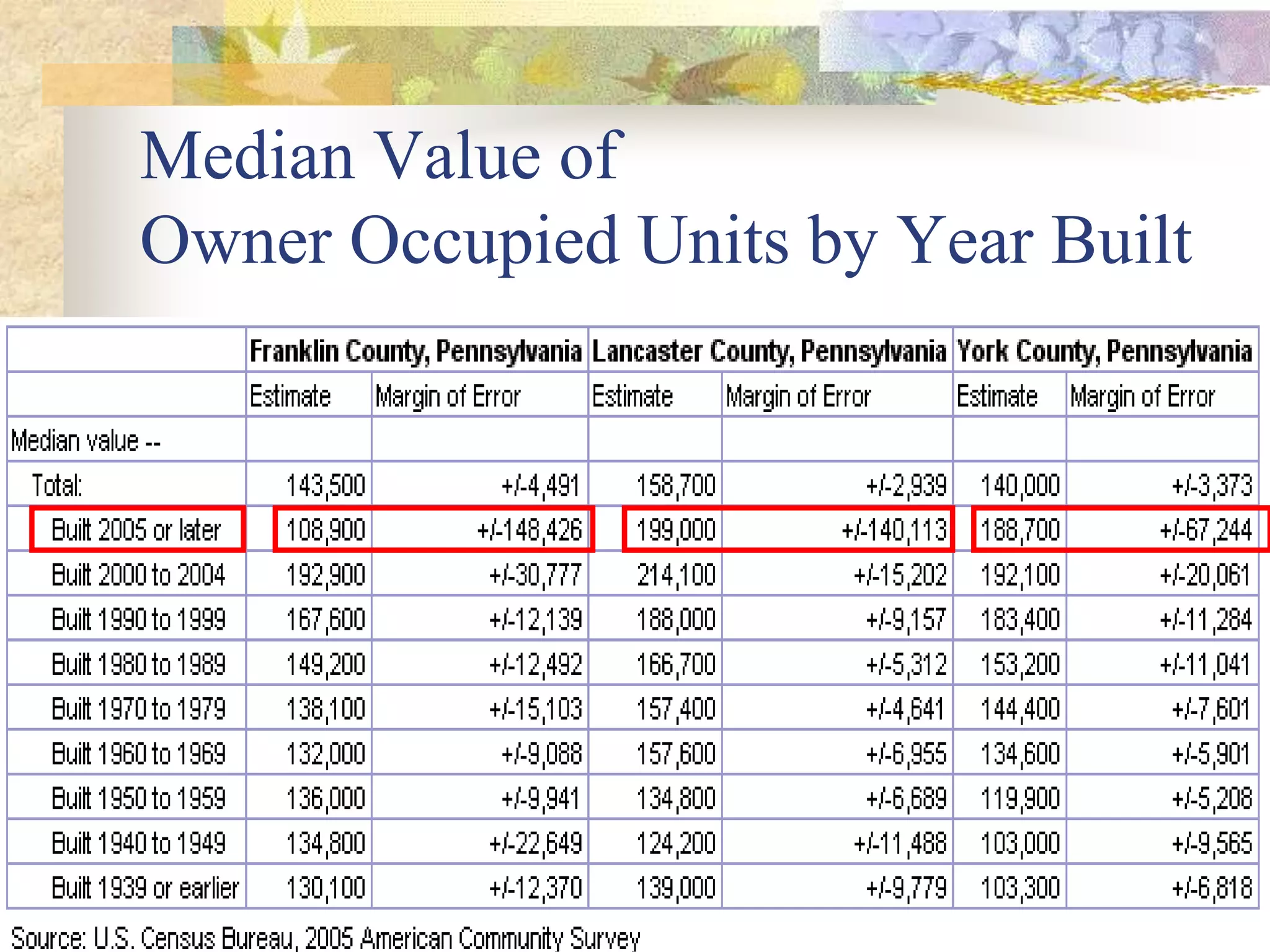
 Have to pay attention to the margins of error (MOEs)
 Many variables not comparable with decennial
 Have to consider
 Methodology
 Universe, and
 Different reference periods (especially for $ and school enrollment)
Big Methodology Changes
What is one pro and one
con of the ACS?
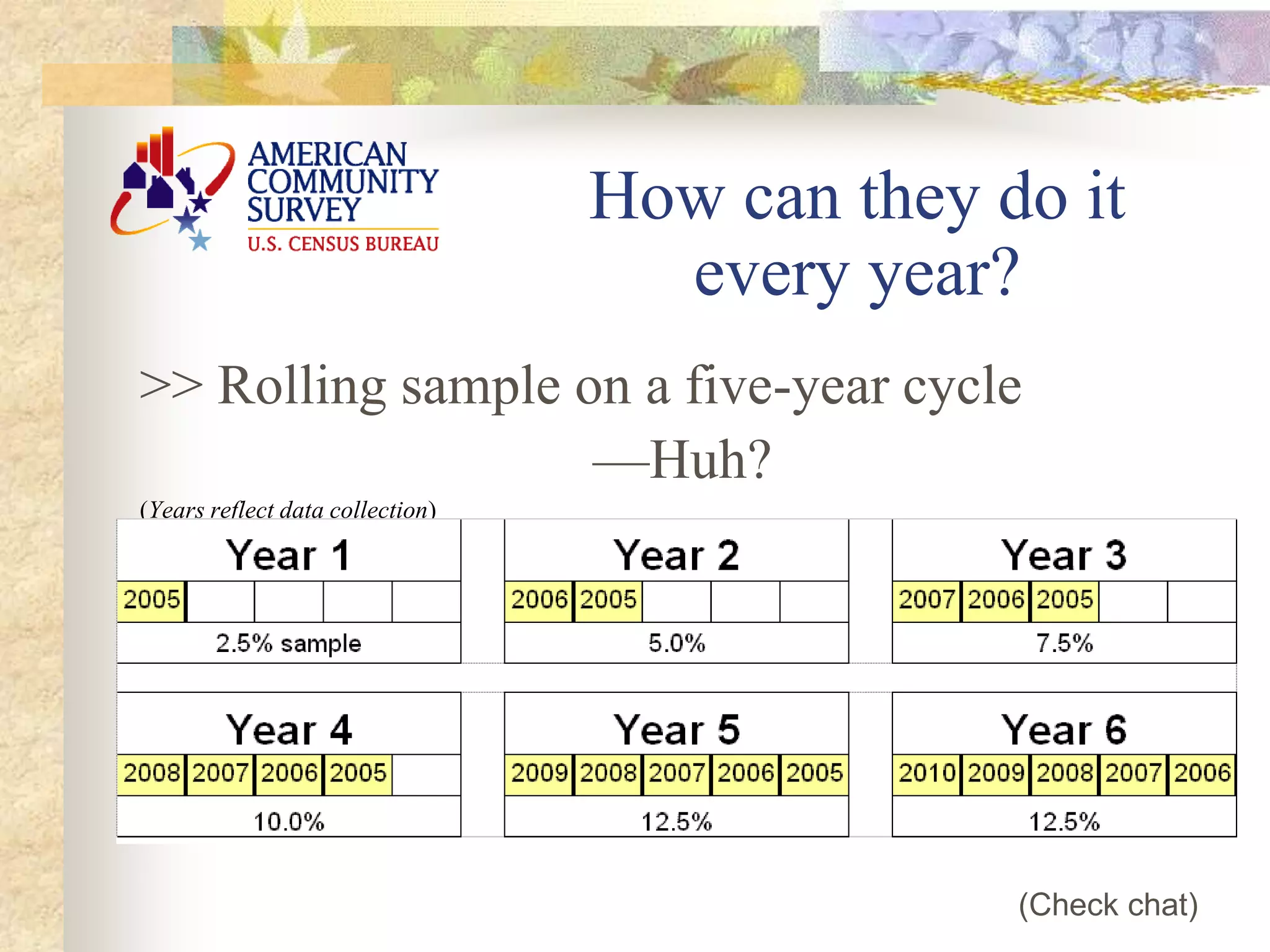
>> Rolling sample on a five-year cycle
—Huh?
(Years reflect data collection)
How can they do it
every year?
(Check chat)
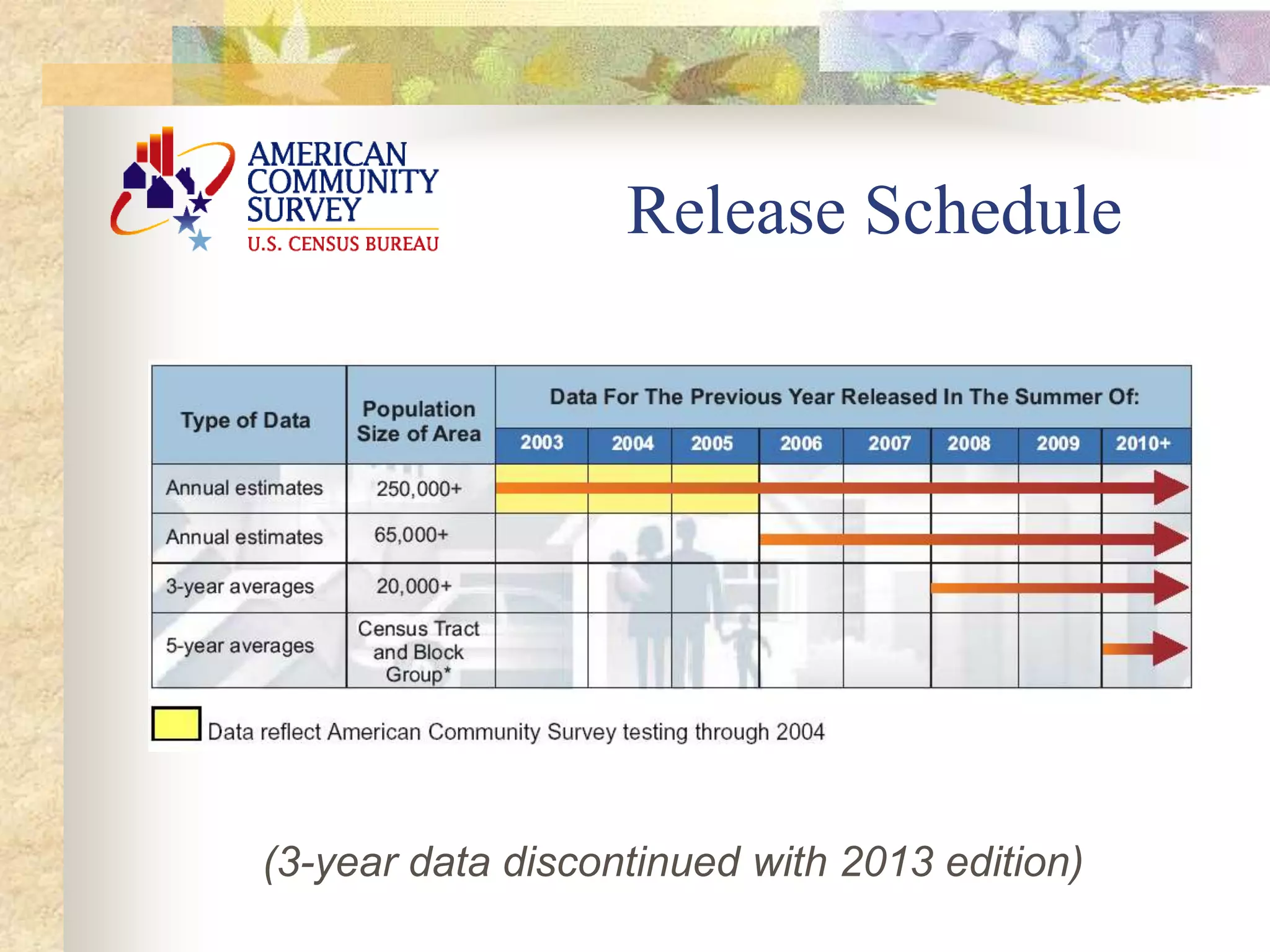
Release Schedule
(3-year data discontinued with 2013 edition)
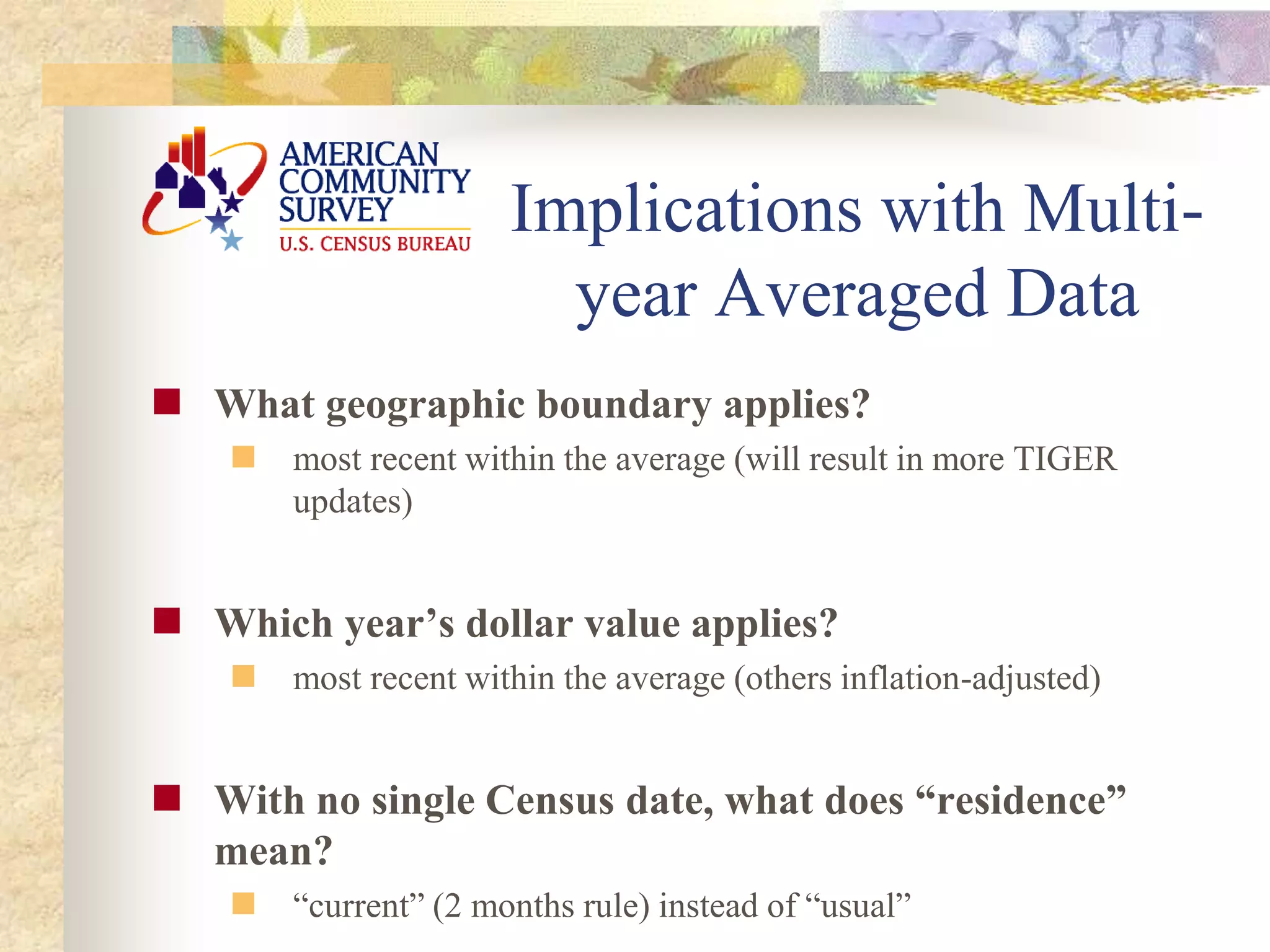
Implications with Multi-
year Averaged Data
 What geographic boundary applies?
 most recent within the average (will result in more TIGER
updates)
 Which year’s dollar value applies?
 most recent within the average (others inflation-adjusted)
 With no single Census date, what does “residence”
mean?
 “current” (2 months rule) instead of “usual”
Implications with
Smaller Sample
Pay
attention
to
MOEs!
(Check chat)
Median Value of
Owner Occupied Units by Year Built
Check out Handbooks
 https://www.census.gov/programs-
surveys/acs/guidance/handbooks.html
 Also, on
https://www.census.gov/programs-
surveys/acs/, sections at left, Guidance for
Data Users and Technical Documentation
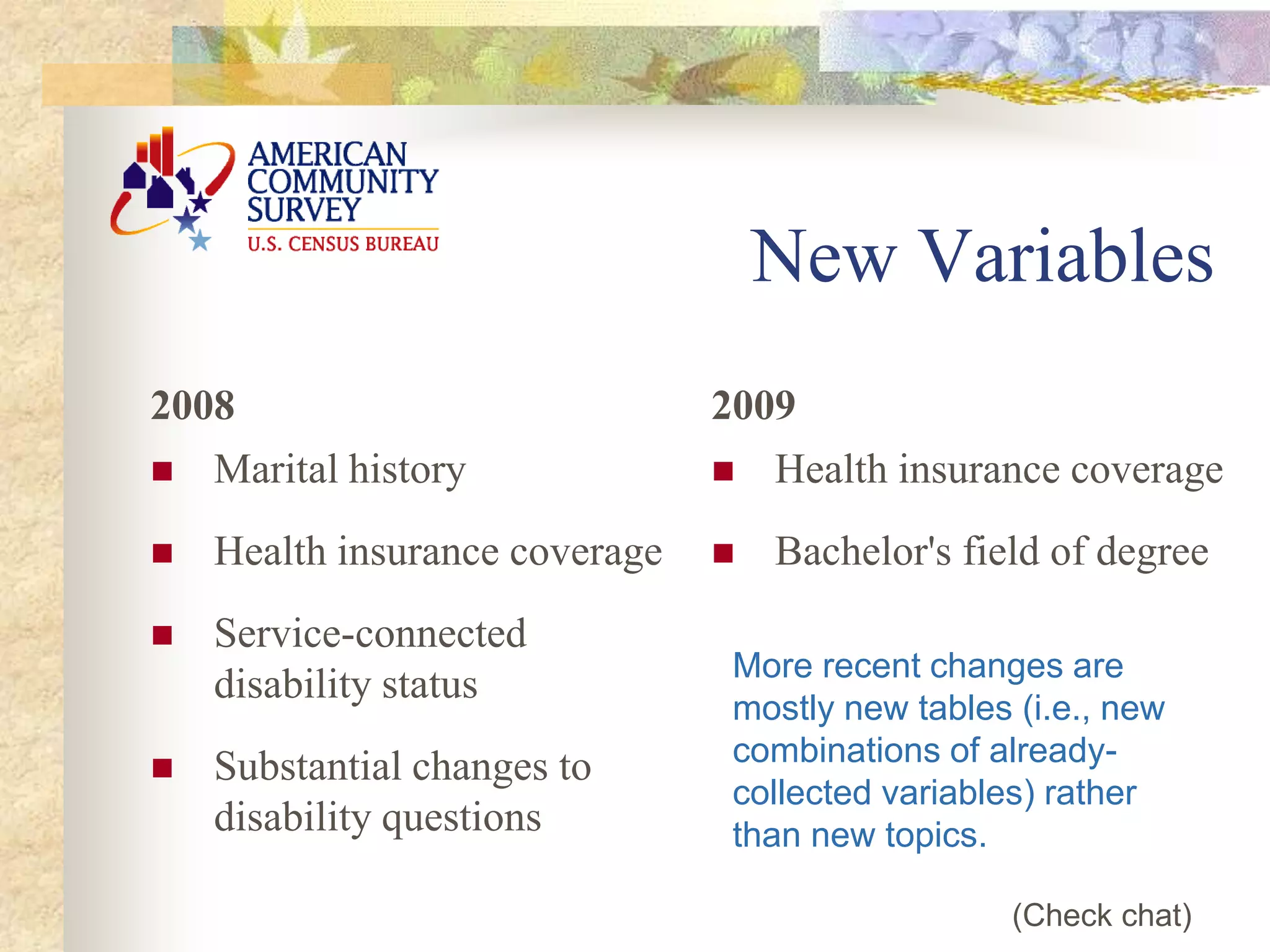
New Variables
2008
 Marital history
 Health insurance coverage
 Service-connected
disability status
 Substantial changes to
disability questions
2009
 Health insurance coverage
 Bachelor's field of degree
More recent changes are
mostly new tables (i.e., new
combinations of already-
collected variables) rather
than new topics.
(Check chat)
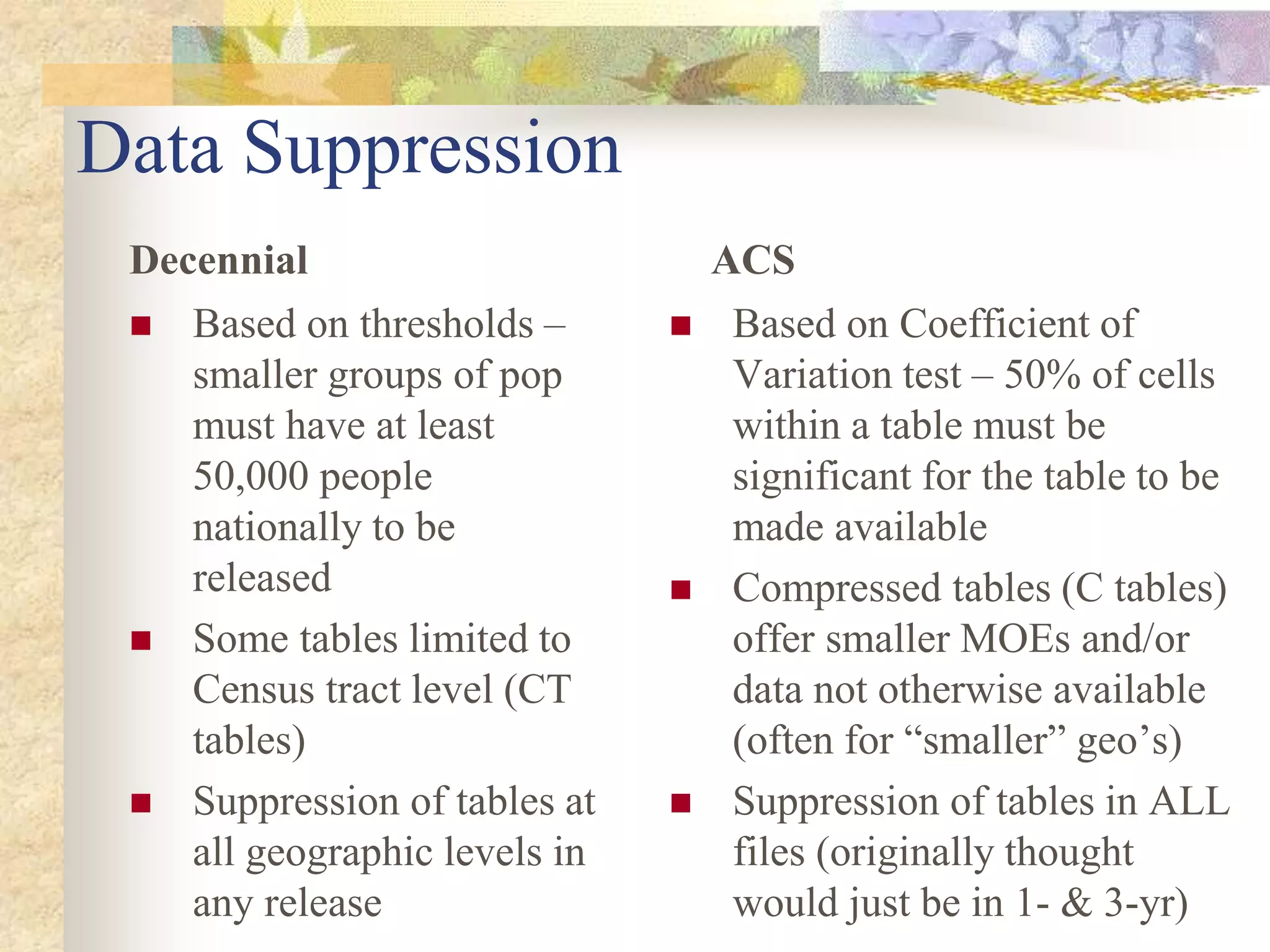
Data Suppression
Decennial
 Based on thresholds –
smaller groups of pop
must have at least
50,000 people
nationally to be
released
 Some tables limited to
Census tract level (CT
tables)
 Suppression of tables at
all geographic levels in
any release
ACS
 Based on Coefficient of
Variation test – 50% of cells
within a table must be
significant for the table to be
made available
 Compressed tables (C tables)
offer smaller MOEs and/or
data not otherwise available
(often for “smaller” geo’s)
 Suppression of tables in ALL
files (originally thought
would just be in 1- & 3-yr)
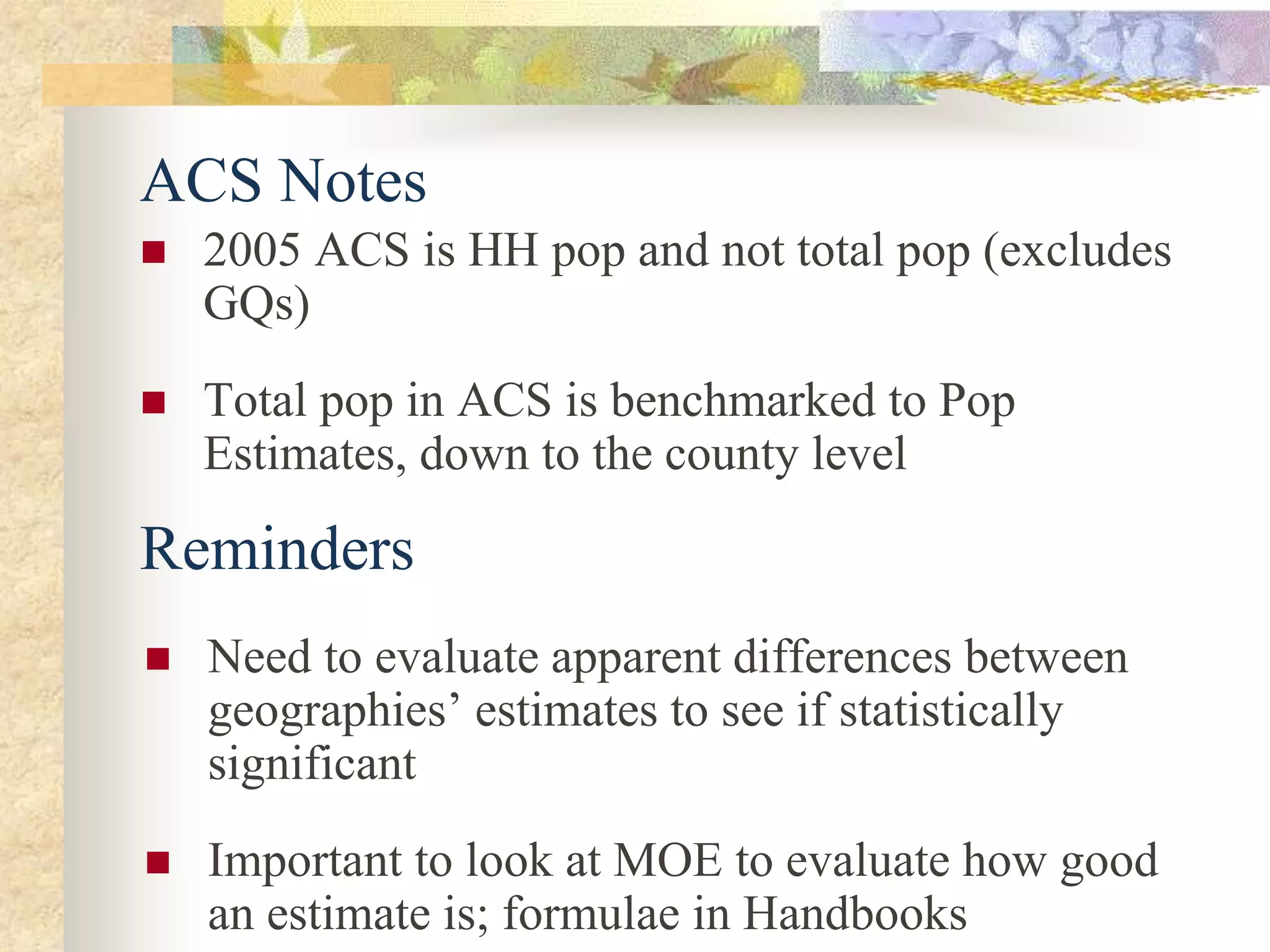
ACS Notes
 2005 ACS is HH pop and not total pop (excludes
GQs)
 Total pop in ACS is benchmarked to Pop
Estimates, down to the county level
 Need to evaluate apparent differences between
geographies’ estimates to see if statistically
significant
 Important to look at MOE to evaluate how good
an estimate is; formulae in Handbooks
Reminders
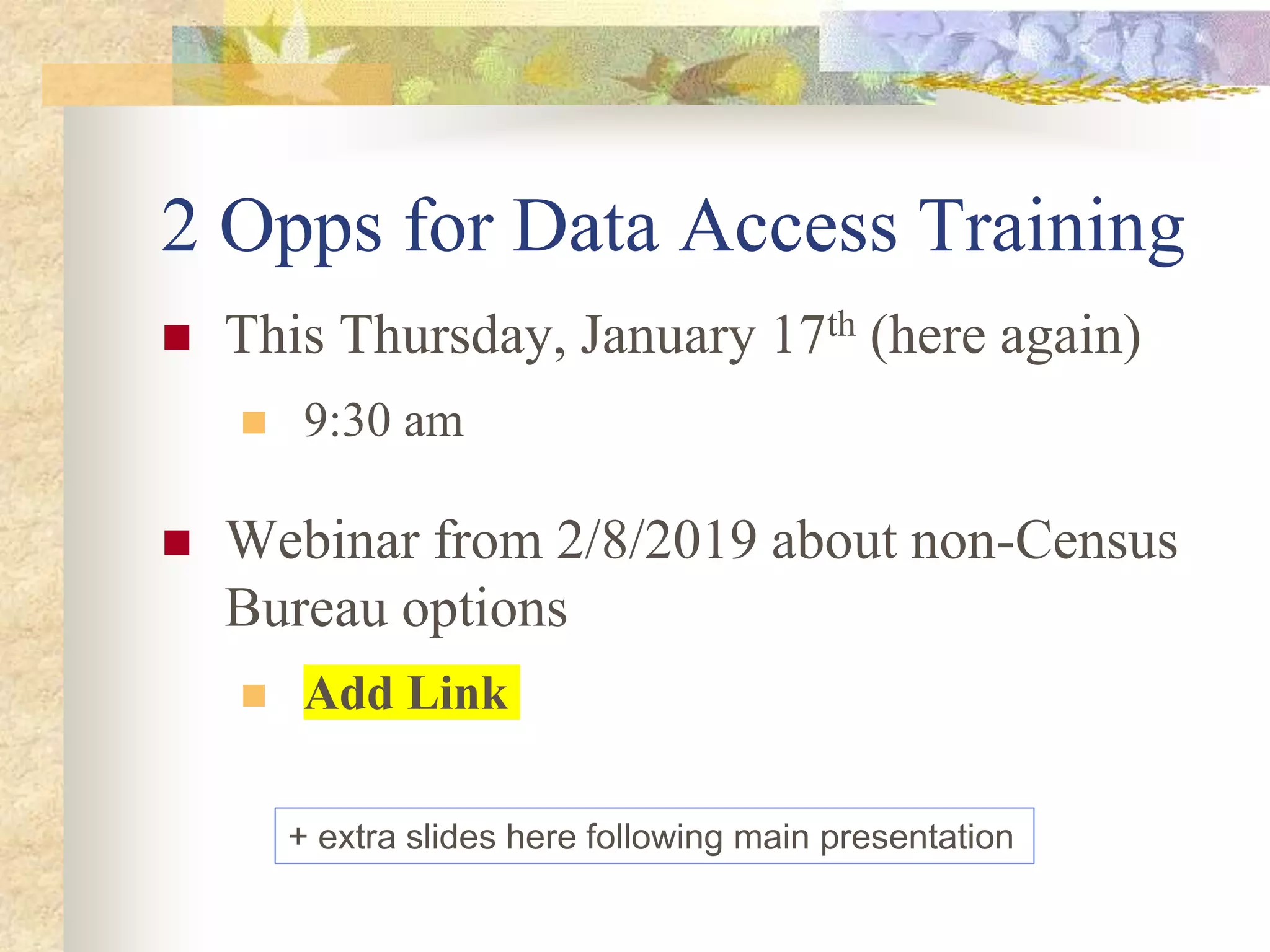
2 Opps for Data Access Training
 This Thursday, January 17th (here again)
 9:30 am
 Webinar from 2/8/2019 about non-Census
Bureau options
 Add Link
+ extra slides here following main presentation
Questions? + Evaluation
 michele_hayslett@unc.edu
 http://go.unc.edu/hub-short-courses
(Check chat)
Access to Data
 Census Bureau focuses on current data
 Basic access is to cross-tabulations CB
creates (custom cross-tabs only available
with Public Use Microdata Sample
[PUMS] in advanced access, currently
through DataFerrett or IPUMS)
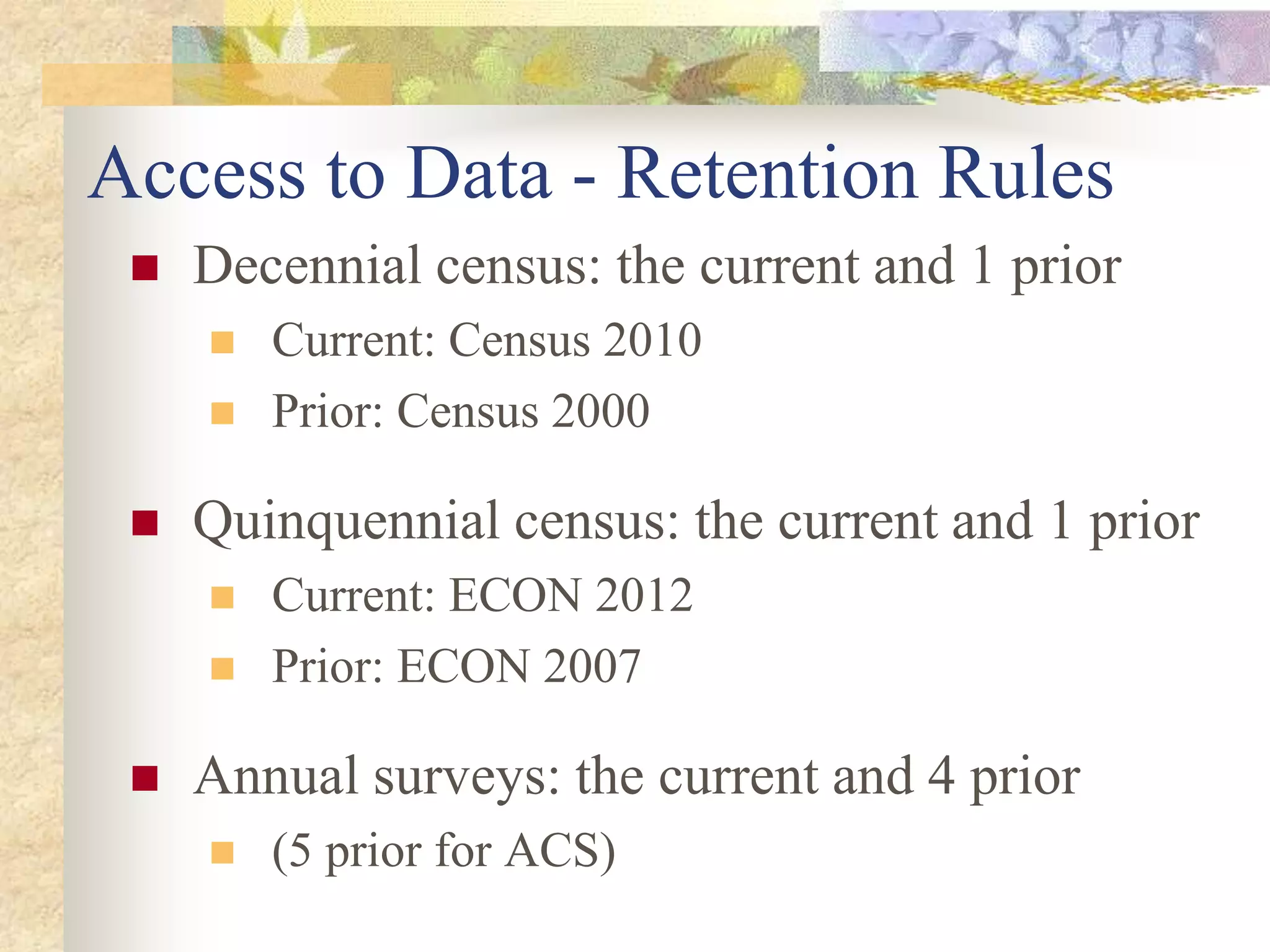
Access to Data - Retention Rules
 Decennial census: the current and 1 prior
 Current: Census 2010
 Prior: Census 2000
 Quinquennial census: the current and 1 prior
 Current: ECON 2012
 Prior: ECON 2007
 Annual surveys: the current and 4 prior
 (5 prior for ACS)
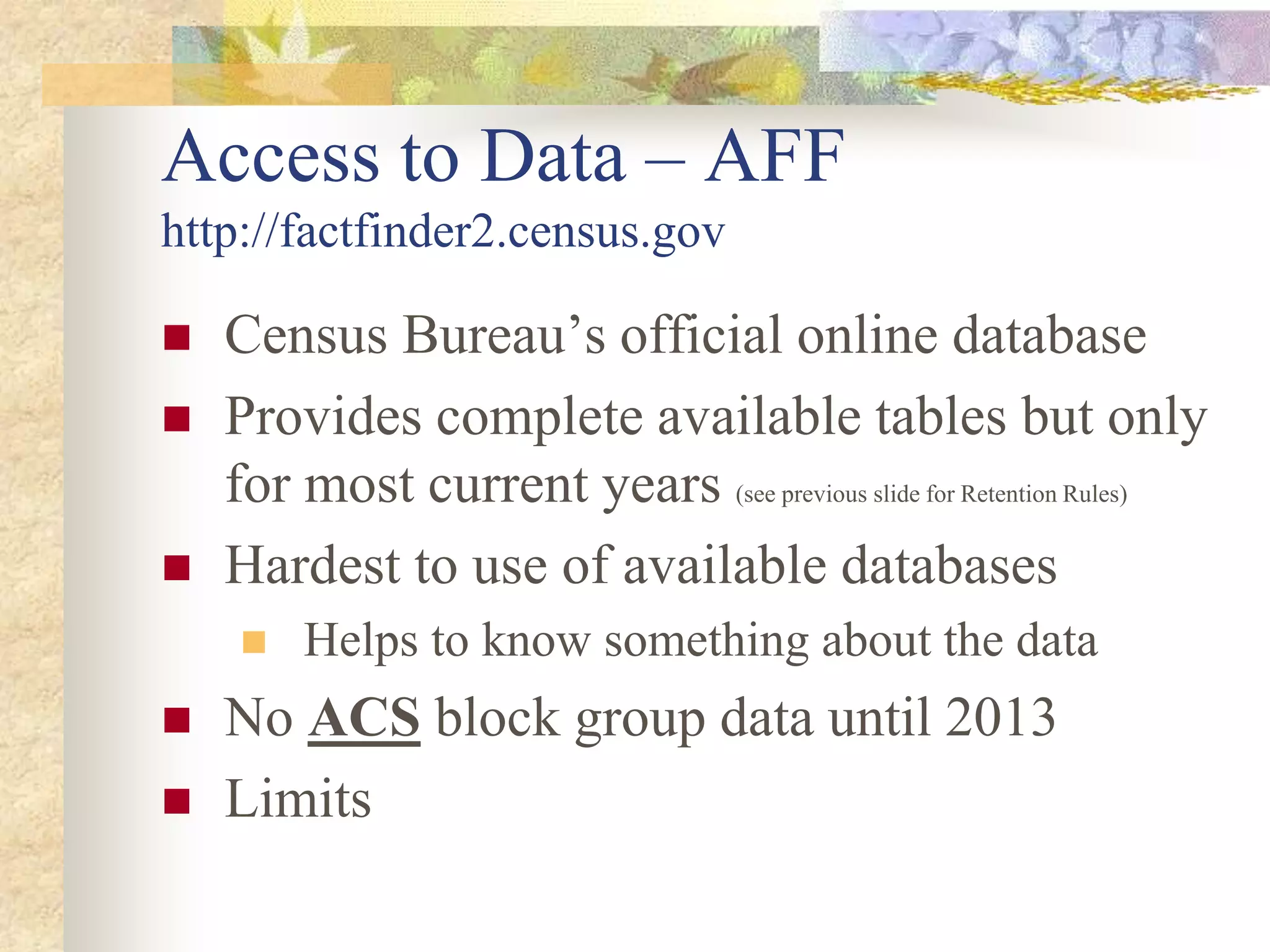
Access to Data – AFF
http://factfinder2.census.gov
 Census Bureau’s official online database
 Provides complete available tables but only
for most current years (see previous slide for Retention Rules)
 Hardest to use of available databases
 Helps to know something about the data
 No ACS block group data until 2013
 Limits
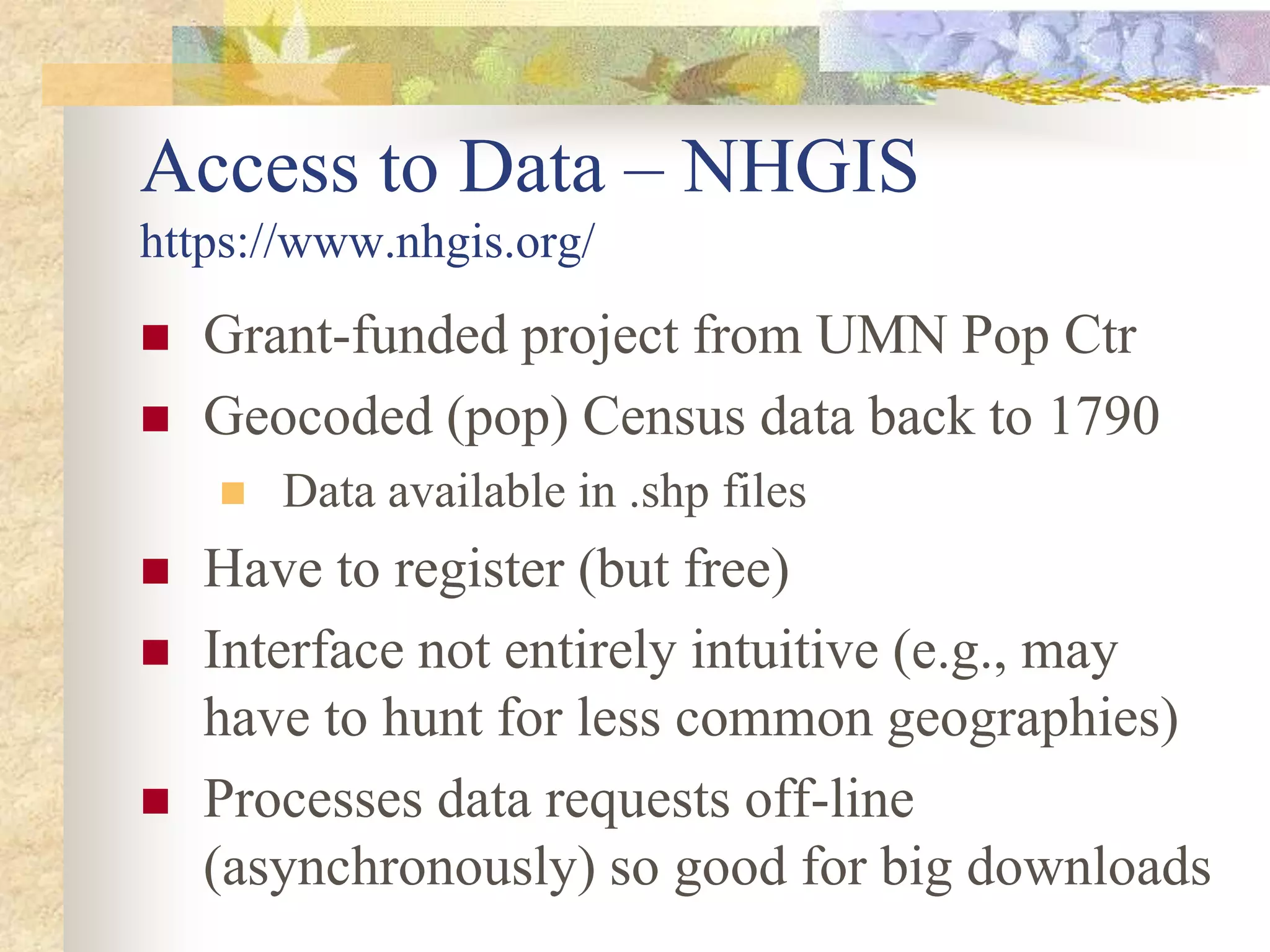
 Grant-funded project from UMN Pop Ctr
 Geocoded (pop) Census data back to 1790
 Data available in .shp files
 Have to register (but free)
 Interface not entirely intuitive (e.g., may
have to hunt for less common geographies)
 Processes data requests off-line
(asynchronously) so good for big downloads
Access to Data – NHGIS
https://www.nhgis.org/
 Easiest interface
 Based on NHGIS project but now
commercial
 Touts all data in all years but not entirely
everything – likely to have the most
common variables and geographies;
nothing that involves suppression
Access to Data – Social Explorer
http://eresources.lib.unc.edu/eid/description.php?res
ourceID=200892&passthrough=no

Census concepts

  • 1.
    The Decennial U.S.Census and the American Community Survey An Introduction
  • 2.
    Agenda  Introductions  MicheleHayslett  You and your questions  Decennial Census – methodology, variables, geographies, vocabulary  American Community Survey (ACS) – differences in methodology & variables
  • 3.
    Introductions  Me  You How many of you are working with decennial/historical data vs. the American Community Survey?  What are your research questions?  What specific questions do you have about Census data?
  • 4.
  • 5.
    Decennial Census  What:Complete enumeration of a population  Where: “Usual place of residence”  When: as of “Census Day”  Reference period for income: last calendar year
  • 6.
    Decennial Data CollectionPre-2010  All respondents answered basic questions  “Short” form = 100% data = SF1 (earlier STF1)  17% got a longer form with additional questions  “Long” form = sample data = SF3 (earlier STF3) (Check chat)
  • 7.
    Logic of theData Files (pre-2010)  Public Law (P.L.) data – data necessary for voting district configuration  over 18; total population; race  Summary File 1 – Short form data (100%)  Summary File 3 – Long form data (sample)
  • 8.
    Content of theData Releases P.L. Data  Population, total and over 18 (voting)  Race and ethnicity SF1  Age & sex  Race & ethnicity  Household relationships  Housing units & tenure data; vacancy characteristics  Group quarters data  Urban/rural
  • 9.
    Content of theData Releases SF3 – Population  Age (cross-tab)  Race & ethnicity (cross-tab)  Marital Status  Employment & Income  Language spoken at home, ancestry & migration  Military service  Farm residence  Disability  Grandparents as caregivers  School enrollment & educational attainment SF3 – Housing  Heating fuel & fuel cost  Number of rooms & bedrooms  Occupation, industry, class of worker; work status in 1999  Year structure built & units in structure  Telephone service  Plumbing & kitchen facilities  Utilities, mortgage, taxes, insurance  Value of home/monthly rent paid  Vehicles available  Year moved into residence (Check chat)
  • 10.
    Which SF coversmore topics? What is that SF called?
  • 11.
    Nation County State Census Tract Block Group Block AIANHH Cong.District Cnty Subdivision (Township) Place (Muncipalities & CDPs) ZCTA 3- and 5-digit summary levels Census Geography An Abbreviated Hierarchy AIANHH - American Indian/Alaskan Native/Hawaiian Homelander CDP - Census Designated Place ZCTA - Zip Code Tabulation Area—never to be confused with a Zip Code (Check chat)
  • 12.
    What word describesthe center line of the geographies diagram?
  • 13.
    Important Distinctions  Raceversus Ethnicity NPR story about 2020 changes: http://n.pr/2i3WRSV  Household versus Family  Metropolitan versus Urban (Check chat)
  • 14.
    What is importantto remember when using a spreadsheet of race and ethnicity data?
  • 16.
     What: Measureof trends, not actual counts  Where: “Current place of residence”  If there at least two months prior to receiving the survey  When: continuously  Reference period for income: “last 12 months”
  • 17.
    Replaced the longform — Beginning with 2010, decennial now provides only 100% (SF1) data Biggest difference with ACS is, data are provided every year Effect on Decennial Census (Check chat)
  • 18.
     Smaller samplesize – 12.5% (instead of 17%) to start; 13.5% beginning with 2015 data  Have to pay attention to the margins of error (MOEs)  Many variables not comparable with decennial  Have to consider  Methodology  Universe, and  Different reference periods (especially for $ and school enrollment) Big Methodology Changes
  • 19.
    What is onepro and one con of the ACS?
  • 20.
    >> Rolling sampleon a five-year cycle —Huh? (Years reflect data collection) How can they do it every year? (Check chat)
  • 21.
    Release Schedule (3-year datadiscontinued with 2013 edition)
  • 22.
    Implications with Multi- yearAveraged Data  What geographic boundary applies?  most recent within the average (will result in more TIGER updates)  Which year’s dollar value applies?  most recent within the average (others inflation-adjusted)  With no single Census date, what does “residence” mean?  “current” (2 months rule) instead of “usual”
  • 23.
  • 24.
    Median Value of OwnerOccupied Units by Year Built
  • 25.
    Check out Handbooks https://www.census.gov/programs- surveys/acs/guidance/handbooks.html  Also, on https://www.census.gov/programs- surveys/acs/, sections at left, Guidance for Data Users and Technical Documentation
  • 26.
    New Variables 2008  Maritalhistory  Health insurance coverage  Service-connected disability status  Substantial changes to disability questions 2009  Health insurance coverage  Bachelor's field of degree More recent changes are mostly new tables (i.e., new combinations of already- collected variables) rather than new topics. (Check chat)
  • 27.
    Data Suppression Decennial  Basedon thresholds – smaller groups of pop must have at least 50,000 people nationally to be released  Some tables limited to Census tract level (CT tables)  Suppression of tables at all geographic levels in any release ACS  Based on Coefficient of Variation test – 50% of cells within a table must be significant for the table to be made available  Compressed tables (C tables) offer smaller MOEs and/or data not otherwise available (often for “smaller” geo’s)  Suppression of tables in ALL files (originally thought would just be in 1- & 3-yr)
  • 28.
    ACS Notes  2005ACS is HH pop and not total pop (excludes GQs)  Total pop in ACS is benchmarked to Pop Estimates, down to the county level  Need to evaluate apparent differences between geographies’ estimates to see if statistically significant  Important to look at MOE to evaluate how good an estimate is; formulae in Handbooks Reminders
  • 29.
    2 Opps forData Access Training  This Thursday, January 17th (here again)  9:30 am  Webinar from 2/8/2019 about non-Census Bureau options  Add Link + extra slides here following main presentation
  • 30.
    Questions? + Evaluation michele_hayslett@unc.edu  http://go.unc.edu/hub-short-courses (Check chat)
  • 31.
    Access to Data Census Bureau focuses on current data  Basic access is to cross-tabulations CB creates (custom cross-tabs only available with Public Use Microdata Sample [PUMS] in advanced access, currently through DataFerrett or IPUMS)
  • 32.
    Access to Data- Retention Rules  Decennial census: the current and 1 prior  Current: Census 2010  Prior: Census 2000  Quinquennial census: the current and 1 prior  Current: ECON 2012  Prior: ECON 2007  Annual surveys: the current and 4 prior  (5 prior for ACS)
  • 33.
    Access to Data– AFF http://factfinder2.census.gov  Census Bureau’s official online database  Provides complete available tables but only for most current years (see previous slide for Retention Rules)  Hardest to use of available databases  Helps to know something about the data  No ACS block group data until 2013  Limits
  • 34.
     Grant-funded projectfrom UMN Pop Ctr  Geocoded (pop) Census data back to 1790  Data available in .shp files  Have to register (but free)  Interface not entirely intuitive (e.g., may have to hunt for less common geographies)  Processes data requests off-line (asynchronously) so good for big downloads Access to Data – NHGIS https://www.nhgis.org/
  • 35.
     Easiest interface Based on NHGIS project but now commercial  Touts all data in all years but not entirely everything – likely to have the most common variables and geographies; nothing that involves suppression Access to Data – Social Explorer http://eresources.lib.unc.edu/eid/description.php?res ourceID=200892&passthrough=no