Use your pharmacists: lead
         screening, care
   management, PEP roles taken
         by pharmacists

Heather Huentelman, PharmD, AAHIVP, LCDR USPHS
       Director of HIV Center of Excellence (Acting)
   Nothing to disclose
   Jessica Leston
   RADM Scott Giberson, Rockville
   Lisa Neel, MPH, HIV Analyst, Rockville
   Brigg Reilley, MPH, HIV Epi, Albuquerque
   Scott Wiegand, Pharm D, Rosebud
   The IHS HIV/STD/HCV Pharmacy Workgroup


                                               3
   Define the different roles of pharmacist in HIV
    management
   “Increasing the number of HIV providers, as
    well as increasing knowledge among all
    health professionals about HIV risks and
    prevention is a critical need. This involves a
    wide range of health professionals in all
    health care settings including physicians,
    registered nurses, nurse practitioners,
    physician assistants, social workers,
    pharmacists, and dentists.”
   “There is also a need for ongoing support to
    maintain the necessary high levels of
    adherence to antiretroviral treatment.”
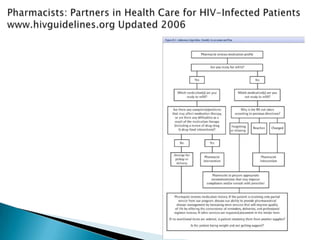
   STANDARD: Monitor proper dosing, drug
    interactions and drug utilization.
   MEASURE: Dosing order in chart matches
    provider’s order.
   MEASURE: Potential drug interactions are
    reviewed by the pharmacist and noted in the
    patient profile.
   MEASURE: Indications for drug utilized
    matches provider order.
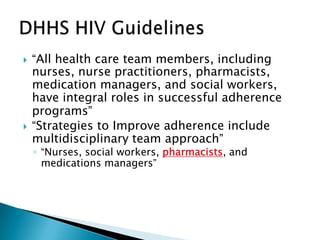
   “All health care team members, including
    nurses, nurse practitioners, pharmacists,
    medication managers, and social workers,
    have integral roles in successful adherence
    programs”
   “Strategies to Improve adherence include
    multidisciplinary team approach”
    ◦ “Nurses, social workers, pharmacists, and
      medications managers”
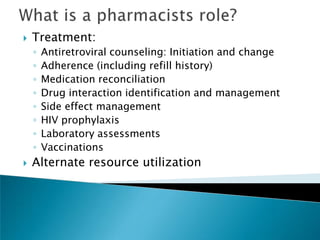
   Treatment:
    ◦   Antiretroviral counseling: Initiation and change
    ◦   Adherence (including refill history)
    ◦   Medication reconciliation
    ◦   Drug interaction identification and management
    ◦   Side effect management
    ◦   HIV prophylaxis
    ◦   Laboratory assessments
    ◦   Vaccinations
   Alternate resource utilization
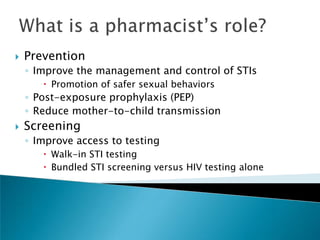
   Prevention
    ◦ Improve the management and control of STIs
        Promotion of safer sexual behaviors
    ◦ Post-exposure prophylaxis (PEP)
    ◦ Reduce mother-to-child transmission
   Screening
    ◦ Improve access to testing
        Walk-in STI testing
        Bundled STI screening versus HIV testing alone
   Facilities with pharmacists working in HIV
    ◦   PIMC
    ◦   Rosebud
    ◦   GIMC
    ◦   Ft Defiance
    ◦   Shiprock

   Any other sites here today with active
    pharmacy involvement in HIV?
   New Case Identification (iCare)
   Clinic multidisciplinary team
   HIV test interpretation
   Refill management
   Adherence clinic
   Alternate resource utilization
   HIV/HCV co-infection management
   Co-morbidity management
    ◦ Hyperlipidemia and Hypertension
   Post-exposure prophylaxis
   2004- HIV registry 235
   2012- HIV registry 442
    ◦ Active patients: 200

   Treatment with antiretrovirals
    ◦ FY2005         83 patients, 802 pt-mo
    ◦ FY2010         149 patients, 1446 pt-mo
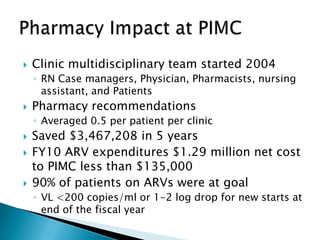
   Clinic multidisciplinary team started 2004
    ◦ RN Case managers, Physician, Pharmacists, nursing
      assistant, and Patients
   Pharmacy recommendations
    ◦ Averaged 0.5 per patient per clinic
   Saved $3,467,208 in 5 years
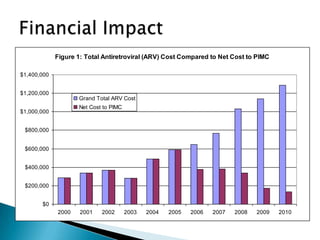
   FY10 ARV expenditures $1.29 million net cost
    to PIMC less than $135,000
   90% of patients on ARVs were at goal
    ◦ VL <200 copies/ml or 1-2 log drop for new starts at
      end of the fiscal year
Figure 1: Total Antiretroviral (ARV) Cost Compared to Net Cost to PIMC

$1,400,000


$1,200,000
                    Grand Total ARV Cost
                    Net Cost to PIMC
$1,000,000


 $800,000


 $600,000


 $400,000


 $200,000


       $0
             2000    2001   2002       2003   2004   2005   2006   2007   2008   2009   2010
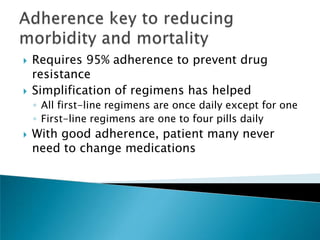
   Requires 95% adherence to prevent drug
    resistance
   Simplification of regimens has helped
    ◦ All first-line regimens are once daily except for one
    ◦ First-line regimens are one to four pills daily
   With good adherence, patient many never
    need to change medications
   Access to medications
   Side effects
   Drug interactions
   Active substance abuse
   Homeless
   Adherence assessment at each medical visit
    ◦ Self-report +/- refill history + lab results
   Separate adherence clinic:
    ◦ New starts- pharmacist protocol
    ◦ Med changes- provider/pharmacist recommended
    ◦ Med box fills
   Automatic refills (including mail order)
   Majority (if not all) of treatment failure is
    from nonadherence
   Patients need consistently reminded of drug
    interactions and food restrictions
   Side effects can be life altering and should be
    addressed even if someone is well controlled
How can a pharmacist be involved?
   PEP (post-exposure prophylaxis
    ◦ Occupational exposure
   nPEP (nonoccupational post-exposure prophylaxis)
    ◦ Support 3 drugs for known HIV+ source and 2
      drugs for unknown source
    ◦ Must be started within 72 hours of exposure
    ◦ Highly recommend consulting PEPLine
   PrEP (pre-exposure prophylaxis)
    ◦ Recommendation for use in MSM population
    ◦ Need to use with caution (TDF)
      Screening HBV, HIV x2, HIV VL?, SrCr, UA?, PO4?
    ◦ Able to replicate study conditions?
   Consider having pre-packaged PEP kits
    ◦ Recommend short supply 3-5 days
      Allows time for additional source patient testing
      Continued follow-up in population with high rate of
       discontinuation
      Reduce cost if discontinued or changed
    ◦ Include reference material
      Contain medication guide, follow-up for employee
   Many providers believe giving PEP is
    always the right answer
   Appropriate med choice
    ◦ Efavirenz
    ◦ Renal function
    ◦ Drug interactions
   PEPline
    ◦ Especially for nPEP
   Employees are more likely to have ADRs
   Most employees do not complete 28 days
   Continue meds past “PEP kit” as appropriate
   Coping with ADRs or changing if needed
   Follow-up testing
    ◦ Use EHR notifications
   PEP & nPEP guidelines expect update soon
    ◦ Make sure to update your policies
    ◦ Recommended antiretrovirals likely to change
   HCV
    ◦ Treat acute infection with peg-interferon alone?
Universal screening and pharmacy
   based HIV testing program
   Implement universal screening measures
   Increase overall number of patients ever
    tested for HIV
   Identify HIV infection as early as possible to
    increase survival and decrease transmission
   Link patients to appropriate care
   Implement Expedited Partner Therapy (EPT)
   Current progress:
    ◦ Proposal to adopt new HIV and STD screening
      measures approved by Medical Staff
    ◦ STD/HIV and EPT Protocol being developed based
      on CDC protocol and adapted to fit local needs
    ◦ Routine screening is being done at providers
      discretion until protocol is approved by P&T
    ◦ EPT and presumptive treatment of STDs per area
      guidelines with protocol to come
   Still to come:
    ◦ Nurses to be trained on how to offer “opt-out”
      testing and obtain informed consent per protocol
    ◦ Will use clinical reminder in EHR once a new Clinical
      Applications Coordinator is established
    ◦ Provider to attend HIV preceptorship training in
      Denver to become local HIV care provider
   Pharmacy testing goals:
    ◦   Provide increased access to HIV testing
    ◦   Reduce stigma attached to HIV testing
    ◦   Increase awareness of the need for HIV testing
    ◦   Incorporate HIV testing into other routine
        screenings and healthcare services in IHS
        pharmacies
   Pharmacy will provide private testing to any
    patient asking for an HIV test
   Testing will occur in private counseling rooms
   Tests done using either Insti (60 second) test
    or OraSure Rapid test (20 minutes)
   Results reported to patient according to
    patient preference (phone, in person, or
    patient call-in)
   Current Progress
    ◦ Pharmacists trained on testing procedures for both
      testing types
    ◦ Proposal for pharmacy testing model approved by
      medical staff
    ◦ Protocol developed, awaiting revision and P&T
      Committee approval
    ◦ Billing procedure is being explored but no model
      has been developed yet
QUESTIONS???
PIMC – HIV Center of Excellence

Heather Huentelman, PharmD
Heather.huentelman@ihs.gov
602-263-1200 x2002
602-723-3974


                                  3
                                  7
   Funding
    ◦ Minority AIDS Initiative (MAI) Grant
    ◦ Ryan White (direct or subcontractor) Grant
      Policy Notice 07-01
    ◦ ADAP
    ◦ Patient assistant programs
   Federal sites
    ◦ Interested in expanding HIV testing contact Lisa
      Neel or Brigg Reilley
    ◦ Other HIV initiates in pharmacy submit plans now
      for funding for 2014
   Urban
    ◦ Through a cooperative agreement
    ◦ Contact Phyllis Wolf
   Tribal
    ◦ Grant cycle $90,000/year up to 5 years
    ◦ Grants.gov released in early summer submit by
      Aug
   Get on IHS HIV list serve for other
    opportunities

Use your Pharmacist Huentelman

  • 1.
    Use your pharmacists:lead screening, care management, PEP roles taken by pharmacists Heather Huentelman, PharmD, AAHIVP, LCDR USPHS Director of HIV Center of Excellence (Acting)
  • 2.
    Nothing to disclose
  • 3.
    Jessica Leston  RADM Scott Giberson, Rockville  Lisa Neel, MPH, HIV Analyst, Rockville  Brigg Reilley, MPH, HIV Epi, Albuquerque  Scott Wiegand, Pharm D, Rosebud  The IHS HIV/STD/HCV Pharmacy Workgroup 3
  • 4.
    Define the different roles of pharmacist in HIV management
  • 6.
    “Increasing the number of HIV providers, as well as increasing knowledge among all health professionals about HIV risks and prevention is a critical need. This involves a wide range of health professionals in all health care settings including physicians, registered nurses, nurse practitioners, physician assistants, social workers, pharmacists, and dentists.”  “There is also a need for ongoing support to maintain the necessary high levels of adherence to antiretroviral treatment.”
  • 7.
    STANDARD: Monitor proper dosing, drug interactions and drug utilization.  MEASURE: Dosing order in chart matches provider’s order.  MEASURE: Potential drug interactions are reviewed by the pharmacist and noted in the patient profile.  MEASURE: Indications for drug utilized matches provider order.
  • 8.
    “All health care team members, including nurses, nurse practitioners, pharmacists, medication managers, and social workers, have integral roles in successful adherence programs”  “Strategies to Improve adherence include multidisciplinary team approach” ◦ “Nurses, social workers, pharmacists, and medications managers”
  • 10.
    Treatment: ◦ Antiretroviral counseling: Initiation and change ◦ Adherence (including refill history) ◦ Medication reconciliation ◦ Drug interaction identification and management ◦ Side effect management ◦ HIV prophylaxis ◦ Laboratory assessments ◦ Vaccinations  Alternate resource utilization
  • 11.
    Prevention ◦ Improve the management and control of STIs  Promotion of safer sexual behaviors ◦ Post-exposure prophylaxis (PEP) ◦ Reduce mother-to-child transmission  Screening ◦ Improve access to testing  Walk-in STI testing  Bundled STI screening versus HIV testing alone
  • 13.
    Facilities with pharmacists working in HIV ◦ PIMC ◦ Rosebud ◦ GIMC ◦ Ft Defiance ◦ Shiprock  Any other sites here today with active pharmacy involvement in HIV?
  • 14.
    New Case Identification (iCare)  Clinic multidisciplinary team  HIV test interpretation  Refill management  Adherence clinic  Alternate resource utilization  HIV/HCV co-infection management  Co-morbidity management ◦ Hyperlipidemia and Hypertension  Post-exposure prophylaxis
  • 15.
    2004- HIV registry 235  2012- HIV registry 442 ◦ Active patients: 200  Treatment with antiretrovirals ◦ FY2005 83 patients, 802 pt-mo ◦ FY2010 149 patients, 1446 pt-mo
  • 16.
    Clinic multidisciplinary team started 2004 ◦ RN Case managers, Physician, Pharmacists, nursing assistant, and Patients  Pharmacy recommendations ◦ Averaged 0.5 per patient per clinic  Saved $3,467,208 in 5 years  FY10 ARV expenditures $1.29 million net cost to PIMC less than $135,000  90% of patients on ARVs were at goal ◦ VL <200 copies/ml or 1-2 log drop for new starts at end of the fiscal year
  • 17.
    Figure 1: TotalAntiretroviral (ARV) Cost Compared to Net Cost to PIMC $1,400,000 $1,200,000 Grand Total ARV Cost Net Cost to PIMC $1,000,000 $800,000 $600,000 $400,000 $200,000 $0 2000 2001 2002 2003 2004 2005 2006 2007 2008 2009 2010
  • 18.
    Requires 95% adherence to prevent drug resistance  Simplification of regimens has helped ◦ All first-line regimens are once daily except for one ◦ First-line regimens are one to four pills daily  With good adherence, patient many never need to change medications
  • 19.
    Access to medications  Side effects  Drug interactions  Active substance abuse  Homeless
  • 20.
    Adherence assessment at each medical visit ◦ Self-report +/- refill history + lab results  Separate adherence clinic: ◦ New starts- pharmacist protocol ◦ Med changes- provider/pharmacist recommended ◦ Med box fills  Automatic refills (including mail order)
  • 21.
    Majority (if not all) of treatment failure is from nonadherence  Patients need consistently reminded of drug interactions and food restrictions  Side effects can be life altering and should be addressed even if someone is well controlled
  • 22.
    How can apharmacist be involved?
  • 23.
    PEP (post-exposure prophylaxis ◦ Occupational exposure  nPEP (nonoccupational post-exposure prophylaxis) ◦ Support 3 drugs for known HIV+ source and 2 drugs for unknown source ◦ Must be started within 72 hours of exposure ◦ Highly recommend consulting PEPLine  PrEP (pre-exposure prophylaxis) ◦ Recommendation for use in MSM population ◦ Need to use with caution (TDF)  Screening HBV, HIV x2, HIV VL?, SrCr, UA?, PO4? ◦ Able to replicate study conditions?
  • 24.
    Consider having pre-packaged PEP kits ◦ Recommend short supply 3-5 days  Allows time for additional source patient testing  Continued follow-up in population with high rate of discontinuation  Reduce cost if discontinued or changed ◦ Include reference material  Contain medication guide, follow-up for employee
  • 25.
    Many providers believe giving PEP is always the right answer  Appropriate med choice ◦ Efavirenz ◦ Renal function ◦ Drug interactions  PEPline ◦ Especially for nPEP
  • 26.
    Employees are more likely to have ADRs  Most employees do not complete 28 days  Continue meds past “PEP kit” as appropriate  Coping with ADRs or changing if needed  Follow-up testing ◦ Use EHR notifications
  • 27.
    PEP & nPEP guidelines expect update soon ◦ Make sure to update your policies ◦ Recommended antiretrovirals likely to change  HCV ◦ Treat acute infection with peg-interferon alone?
  • 29.
    Universal screening andpharmacy based HIV testing program
  • 30.
    Implement universal screening measures  Increase overall number of patients ever tested for HIV  Identify HIV infection as early as possible to increase survival and decrease transmission  Link patients to appropriate care  Implement Expedited Partner Therapy (EPT)
  • 31.
    Current progress: ◦ Proposal to adopt new HIV and STD screening measures approved by Medical Staff ◦ STD/HIV and EPT Protocol being developed based on CDC protocol and adapted to fit local needs ◦ Routine screening is being done at providers discretion until protocol is approved by P&T ◦ EPT and presumptive treatment of STDs per area guidelines with protocol to come
  • 32.
    Still to come: ◦ Nurses to be trained on how to offer “opt-out” testing and obtain informed consent per protocol ◦ Will use clinical reminder in EHR once a new Clinical Applications Coordinator is established ◦ Provider to attend HIV preceptorship training in Denver to become local HIV care provider
  • 33.
    Pharmacy testing goals: ◦ Provide increased access to HIV testing ◦ Reduce stigma attached to HIV testing ◦ Increase awareness of the need for HIV testing ◦ Incorporate HIV testing into other routine screenings and healthcare services in IHS pharmacies
  • 34.
    Pharmacy will provide private testing to any patient asking for an HIV test  Testing will occur in private counseling rooms  Tests done using either Insti (60 second) test or OraSure Rapid test (20 minutes)  Results reported to patient according to patient preference (phone, in person, or patient call-in)
  • 35.
    Current Progress ◦ Pharmacists trained on testing procedures for both testing types ◦ Proposal for pharmacy testing model approved by medical staff ◦ Protocol developed, awaiting revision and P&T Committee approval ◦ Billing procedure is being explored but no model has been developed yet
  • 36.
  • 37.
    PIMC – HIVCenter of Excellence Heather Huentelman, PharmD Heather.huentelman@ihs.gov 602-263-1200 x2002 602-723-3974 3 7
  • 38.
    Funding ◦ Minority AIDS Initiative (MAI) Grant ◦ Ryan White (direct or subcontractor) Grant  Policy Notice 07-01 ◦ ADAP ◦ Patient assistant programs
  • 39.
    Federal sites ◦ Interested in expanding HIV testing contact Lisa Neel or Brigg Reilley ◦ Other HIV initiates in pharmacy submit plans now for funding for 2014  Urban ◦ Through a cooperative agreement ◦ Contact Phyllis Wolf  Tribal ◦ Grant cycle $90,000/year up to 5 years ◦ Grants.gov released in early summer submit by Aug  Get on IHS HIV list serve for other opportunities

Editor's Notes

  • #18 Need updated info for FY2008 and change formatThe net cost of antiretrovirals was the entire amount until FY2006