Organic Integrity &
Innovations in Traceability:
Part II
Thorsten Arnold
Cory Van Gronigan
Oritain
Moderator: Sarah Grant
The future of food and
agriculture
How can we better communicate farming
practices to citizens?
... Traceability in German organics
Consumer confusion...
Which label is best?
What diet is best?
What is currently communicated
to buyers?
Food labelling:
All about nutrition
Fridges labelling:
Efficiency / Environmental
outcome!
Source: Article by Joseph Poor in The Guardian
https://www.theguardian.com/environment/2018/oct/10/we-label-fridges-to-show-their-
environmental-impact-why-not-food
Idea: Food Labels showing
environmental impacts.
Source: Article & illustration by Joseph Poor in The Guardian
https://www.theguardian.com/environment/2018/oct/10/we-label-
fridges-to-show-their-environmental-impact-why-not-food
Benefits from environmental impacts
food labelling
• Create market distinction for farmers
employing innovative regenerative
technologies
• Educate “consumers” to act as informed
citizens, based on full transparency and choice
• Independent from government and volatile
policy intervention
• Market solution based on education,
voluntary choice of citizen buyers
Other data needs by the sector
1. Cost-effective access to product and producer data.
– internal data management of retailers,
processors, and other food enterprises
– Online vendors have significant costs in
populating their online stores
– Simple printing of labels with relevant and legally
vetted information
2. Buyers can conveniently find vendors.
3. Sector overview for research and policy advice.
How can you lobby for a sector that remains opaque?
Example: Europe’s Bio-mit-Gesicht
(BMG)
• Translated to “Organics-With-Face”
• BMG:
– Central producer database including stories,
location, address, products, production practices
– Driven by premium/private organic standards
(Demeter, Bioland, Naturland, BioSwiss)
– Way to distinguish family farm from commodity
market by preserving identity and story
“Organics with a face”
Source: https://www.bio-mit-gesicht.de
•Fruits & vegetables
•Potted herbs,
•Potatoes and processed
potato products
•Mushrooms,
•Eggs, milk and dairy products
(e.g. yoghurt, cheese etc.),
•Meat (e.g. beef, pork,
poultry), fruit and
•Beverages (vegetable juices,
beer and wine)
•Coffee and tea, chocolate,
•Cereals, sugar, flours,
•Flakes and cereals,
•Bread and baked goods.
“Organics with a face”
Source: https://www.bio-mit-gesicht.de
Recipes
About the juice
Link to processor
Links to producers, with information
about growing practices
Map with
producers,
processors,
retail
locations
Data verification
by certification bodies
Manually via
web interface
Automated via
organicXML Data exchange using
organicXML
Databases
Basic
data
Batch
info
Basic
data
Batch
info
Basic
data
Batch
info
Basic
data
Batch
info
Producers Distributor Processors Wholesalers Retailers
Data exchange in the European organic sector
ECOINFORM
(product DB)
bioCbioC
(producers DB)
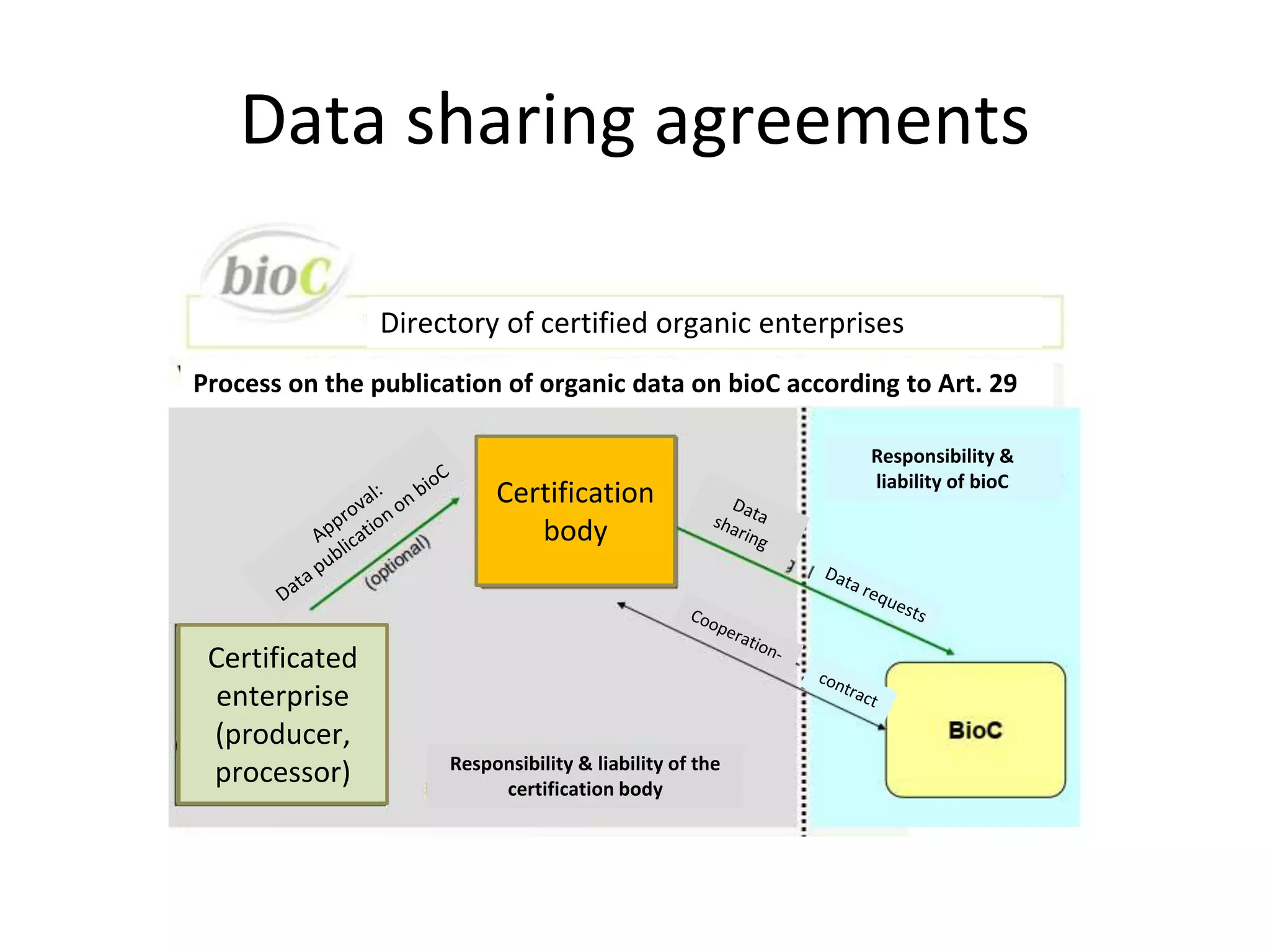
Data sharing agreements
Directory of certified organic enterprises
Process on the publication of organic data on bioC according to Art. 29
Certification
body
Certificated
enterprise
(producer,
processor) Responsibility & liability of the
certification body
Responsibility &
liability of bioC
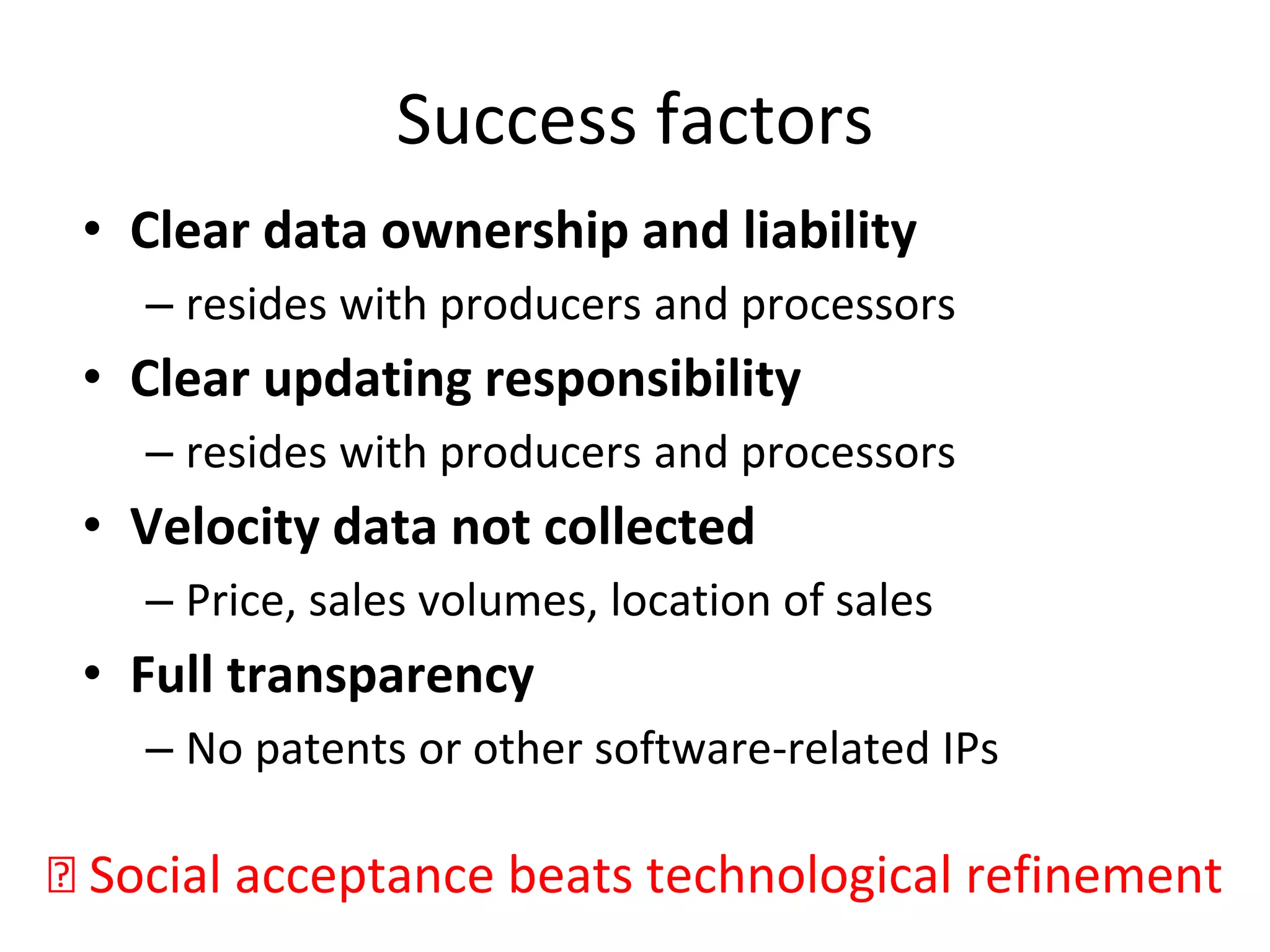
Success factors
• Clear data ownership and liability
– resides with producers and processors
• Clear updating responsibility
– resides with producers and processors
• Velocity data not collected
– Price, sales volumes, location of sales
• Full transparency
– No patents or other software-related IPs
🡪 Social acceptance beats technological refinement
Thank you!
Thorsten Arnold,
thorsten.arnold@gbcae.com
DATABASE COMPONENTS
Part B:
... Central Europe’ organic product database:
ECOINFORM – Central product database with
extended product label
information of processed goods
– API interface to websites,
check-out counters, scanners,
scales, etc
– Ownership: Database privately
owned, data ownership with
producers/processors.
– Cost: Registration $15/product,
plus $3/year
– Successful because online
stores are required to print
allergy information and content
on each product sold. Products
not featured in ECOINFORM
not sold via online stores.
ECOINFORM
Producers
Processors
Retail stores Online stores
Access Product Data
(cost around $40/month)
Product description
(upload almost free)
Wholesale
... Central Europe and integration:
ECOINFORM
ECOINFORM:
Products
ECOINFORM:
Products
EU organic
or
premium label?
• Quality Control Authority
EEC 834/2007 standard, 100% organic, Demeter, EU organic logo EU agriculture DE-ECO-006 | ABCERT
• Brand origin Natural Cool Germany (DE)
• Ingredients
chopped tomatoes *, ** WHOLE MILK, durum wheat semolina **, ** beef (11%), water, CHEESE ** (with
microbial rennet), onions **, ** carrots, leeks ** * WHEAT FLOUR, WHEAT STARCH *, virgin sea ​​salt, cane
sugar **, * garlic, onion powder *, basil *, thyme *, pepper *, nutmeg *
• Allergenic Ingredients: gluten, milk
* = Ingredients from ecol. Farming, ** = ingredients from biol.dynamischem cultivation
•
... an example: Lasagne
• Special Features
Goods not completely cooked through, become even more
rich in vitamins and value-giving ingredients, no artificial
additives
• Storage Information
Store at -18 ° C. Do not refreeze after thawing.
• Preparation
Preheat oven to 200 ° C (fan oven 180 ° C), cover the bowl
deduct heat on the middle rack for 45 minutes. Time
depends on the power of the oven. Already have defrosted
lasagna just 30 minutes. Bake. The lasagna is ready to serve,
if the sauce is cooking and the cheese is nicely browned.
• Allergy Information
Possible traces of eggs, fish, vegetables / legumes, chicken,
cilantro, corn, pork, celery, soy
Gluten, cow's milk protein, lactose, milk, pepper, beef,
Umbelliferae, wheat
No: Sulphur dioxide and sulphites> 10mg / kg
• Dietary notes
Commodities not iodized, unsweetened
•
... Lasagne, cont.
� Category-specific information
Legal status: Food
Preservation: Frozen
Method of cooking: Oven Upper / -Unterhitze, circulating
air oven
� Nutrition Facts analytical results per 100 g
Energy kJ / kcal 498 kJ / 119 kcal
Fat: 3.5 g
of which saturates: 1.9g
Carbohydrates: 15.4g
of which sugars: 2.8g
Dietary Fiber: 1.6 g
Protein: 6.3 g
Salt: 1.18 g
Determining the nutritional values ​​by: Calculation
� Information about packing (consumption unit / individual)
Verp.material: cardboard, PET
Pack. Type: shell
� Sensors, texture
Taste: savory taste of meat sauce and herbs, mild bechamel
sauce and grated cheese
Smell: fresh and arttypisch
Consistency: pastry with a slight bite, filling soft
� Information on LMIV
Distributor: Demeter Felderzeugnisse GmbH, New Bergstr.
13, 64665 Alsbach
Where to Buy
You have the option to find your location by entering shops
or delivery services, which can lead or order this product.
This feature is currently only available for North Rhine-
Westphalia and is quickly Selected to other provinces

Organic Integrity and Innovations in Traceability: Part II

  • 1.
    Organic Integrity & Innovationsin Traceability: Part II Thorsten Arnold Cory Van Gronigan Oritain Moderator: Sarah Grant
  • 2.
    The future offood and agriculture How can we better communicate farming practices to citizens? ... Traceability in German organics
  • 3.
    Consumer confusion... Which labelis best? What diet is best?
  • 4.
    What is currentlycommunicated to buyers? Food labelling: All about nutrition Fridges labelling: Efficiency / Environmental outcome! Source: Article by Joseph Poor in The Guardian https://www.theguardian.com/environment/2018/oct/10/we-label-fridges-to-show-their- environmental-impact-why-not-food
  • 5.
    Idea: Food Labelsshowing environmental impacts. Source: Article & illustration by Joseph Poor in The Guardian https://www.theguardian.com/environment/2018/oct/10/we-label- fridges-to-show-their-environmental-impact-why-not-food
  • 6.
    Benefits from environmentalimpacts food labelling • Create market distinction for farmers employing innovative regenerative technologies • Educate “consumers” to act as informed citizens, based on full transparency and choice • Independent from government and volatile policy intervention • Market solution based on education, voluntary choice of citizen buyers
  • 7.
    Other data needsby the sector 1. Cost-effective access to product and producer data. – internal data management of retailers, processors, and other food enterprises – Online vendors have significant costs in populating their online stores – Simple printing of labels with relevant and legally vetted information 2. Buyers can conveniently find vendors. 3. Sector overview for research and policy advice. How can you lobby for a sector that remains opaque?
  • 8.
    Example: Europe’s Bio-mit-Gesicht (BMG) •Translated to “Organics-With-Face” • BMG: – Central producer database including stories, location, address, products, production practices – Driven by premium/private organic standards (Demeter, Bioland, Naturland, BioSwiss) – Way to distinguish family farm from commodity market by preserving identity and story
  • 9.
    “Organics with aface” Source: https://www.bio-mit-gesicht.de •Fruits & vegetables •Potted herbs, •Potatoes and processed potato products •Mushrooms, •Eggs, milk and dairy products (e.g. yoghurt, cheese etc.), •Meat (e.g. beef, pork, poultry), fruit and •Beverages (vegetable juices, beer and wine) •Coffee and tea, chocolate, •Cereals, sugar, flours, •Flakes and cereals, •Bread and baked goods.
  • 10.
    “Organics with aface” Source: https://www.bio-mit-gesicht.de Recipes About the juice Link to processor Links to producers, with information about growing practices Map with producers, processors, retail locations
  • 11.
    Data verification by certificationbodies Manually via web interface Automated via organicXML Data exchange using organicXML Databases Basic data Batch info Basic data Batch info Basic data Batch info Basic data Batch info Producers Distributor Processors Wholesalers Retailers Data exchange in the European organic sector ECOINFORM (product DB) bioCbioC (producers DB)
  • 12.
    Data sharing agreements Directoryof certified organic enterprises Process on the publication of organic data on bioC according to Art. 29 Certification body Certificated enterprise (producer, processor) Responsibility & liability of the certification body Responsibility & liability of bioC
  • 13.
    Success factors • Cleardata ownership and liability – resides with producers and processors • Clear updating responsibility – resides with producers and processors • Velocity data not collected – Price, sales volumes, location of sales • Full transparency – No patents or other software-related IPs 🡪 Social acceptance beats technological refinement
  • 14.
  • 15.
  • 16.
    ... Central Europe’organic product database: ECOINFORM – Central product database with extended product label information of processed goods – API interface to websites, check-out counters, scanners, scales, etc – Ownership: Database privately owned, data ownership with producers/processors. – Cost: Registration $15/product, plus $3/year – Successful because online stores are required to print allergy information and content on each product sold. Products not featured in ECOINFORM not sold via online stores. ECOINFORM Producers Processors Retail stores Online stores Access Product Data (cost around $40/month) Product description (upload almost free) Wholesale
  • 17.
    ... Central Europeand integration: ECOINFORM
  • 18.
  • 19.
  • 20.
    • Quality ControlAuthority EEC 834/2007 standard, 100% organic, Demeter, EU organic logo EU agriculture DE-ECO-006 | ABCERT • Brand origin Natural Cool Germany (DE) • Ingredients chopped tomatoes *, ** WHOLE MILK, durum wheat semolina **, ** beef (11%), water, CHEESE ** (with microbial rennet), onions **, ** carrots, leeks ** * WHEAT FLOUR, WHEAT STARCH *, virgin sea ​​salt, cane sugar **, * garlic, onion powder *, basil *, thyme *, pepper *, nutmeg * • Allergenic Ingredients: gluten, milk * = Ingredients from ecol. Farming, ** = ingredients from biol.dynamischem cultivation • ... an example: Lasagne
  • 21.
    • Special Features Goodsnot completely cooked through, become even more rich in vitamins and value-giving ingredients, no artificial additives • Storage Information Store at -18 ° C. Do not refreeze after thawing. • Preparation Preheat oven to 200 ° C (fan oven 180 ° C), cover the bowl deduct heat on the middle rack for 45 minutes. Time depends on the power of the oven. Already have defrosted lasagna just 30 minutes. Bake. The lasagna is ready to serve, if the sauce is cooking and the cheese is nicely browned. • Allergy Information Possible traces of eggs, fish, vegetables / legumes, chicken, cilantro, corn, pork, celery, soy Gluten, cow's milk protein, lactose, milk, pepper, beef, Umbelliferae, wheat No: Sulphur dioxide and sulphites> 10mg / kg • Dietary notes Commodities not iodized, unsweetened • ... Lasagne, cont. � Category-specific information Legal status: Food Preservation: Frozen Method of cooking: Oven Upper / -Unterhitze, circulating air oven � Nutrition Facts analytical results per 100 g Energy kJ / kcal 498 kJ / 119 kcal Fat: 3.5 g of which saturates: 1.9g Carbohydrates: 15.4g of which sugars: 2.8g Dietary Fiber: 1.6 g Protein: 6.3 g Salt: 1.18 g Determining the nutritional values ​​by: Calculation � Information about packing (consumption unit / individual) Verp.material: cardboard, PET Pack. Type: shell � Sensors, texture Taste: savory taste of meat sauce and herbs, mild bechamel sauce and grated cheese Smell: fresh and arttypisch Consistency: pastry with a slight bite, filling soft � Information on LMIV Distributor: Demeter Felderzeugnisse GmbH, New Bergstr. 13, 64665 Alsbach Where to Buy You have the option to find your location by entering shops or delivery services, which can lead or order this product. This feature is currently only available for North Rhine- Westphalia and is quickly Selected to other provinces