Beyond Traffic  Draft  Table of Contents ii
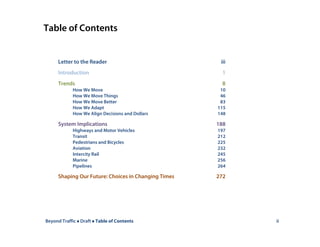
Table of Contents
Letter to the Reader iii
Introduction 1
Trends 8
How We Move 10
How We Move Things 46
How We Move Better 83
How We Adapt 115
How We Align Decisions and Dollars 148
System Implications 188
Highways and Motor Vehicles 197
Transit 212
Pedestrians and Bicycles 225
Aviation 232
Intercity Rail 245
Marine 256
Pipelines 264
Shaping Our Future: Choices in Changing Times 272
Beyond Traffic  Draft  Letter to the Reader iii
Letter to the Reader
Transportation is really a simple idea. We want to move ourselves
or our things from one place to another efficiently, reliably and
safely. We, as users of the transportation system, think little of the
untold intricacies that converge so we can get to work, take
children to their activities or enjoy a cross country trip. There is
the hardscape—the roads, runways, and railways. There are the
vehicles in which we move. There are the vehicle operators and
fellow travelers with whom we share the highway, the sky or the
railroad tracks. There are the maps we use to chart our course. If
any one of these elements fail, we may reach our destination but
only after many hours have been lost. We may not get there at all.
Beyond throughput, transportation is and perhaps always has been an organizing element of our
society. Many road networks have been built upon foot worn paths of our forbearers. Along these
paths grew towns, and some of those towns grew into cities. As new forms of transportation grew
—from the horse and buggy, to the bicycle, to the locomotive, to the automobile—it became
necessary to smooth those paths and, more recently, pave them or lay rails upon them.
Transportation has both gotten us places and made places.
Beyond Traffic  Draft  Letter to the Reader iv
As we have evolved and understood more about our transportation system, we know it to be an
interdependent system of systems that shapes and is shaped by all it touches. Clogged highways
are not per se the product of poor design. Sometimes they choke with unanticipated traffic flows
brought about by unforeseen zoning and land use decisions, regional population growth or
deferred maintenance caused by inadequate budgets or perhaps misplaced priorities. Congestion is
not limited to roads. A Midwestern farmer may have harvested several tons of grain to ship by rail
only to find limited space on freight trains due to growing competition from commodities such as
energy products. Even our commercial airspace is experiencing congestion around major hub
airports. As we grow, and as our economy grows, the challenge of moving will become even more
complicated. If we could anticipate today what will likely slow or stop our national progress, we
could plan an effective response, engage in robust debate and settle on a course of action.
Unfortunately, we have too often misstated the problem as simply one of funding when it may be
one of both resources and design.
Can we imagine a future in which traffic jams decline? Yes. How do we get beyond traffic?
Essentially, three strategies need to be employed—all of which demand increased funding and
new, more adaptive policymaking at the federal, state and local levels. First, we have to take better
care of our legacy transportation systems. We cannot cross bridges that have fallen apart or
connect commerce to ports in disrepair. Second, we must build what is new and necessary, taking
into account changes in living patterns and where products will move to and from. Third, we must
use technologies and better design approaches that will allow us to maximize the use of our old
and new transportation assets. Doing so may involve adapting new innovations in vehicle safety
and automation, improving federal, state, and local coordination, and adopting best practices in
road design.
These strategies are at variance with our current posture. The U.S. transportation system is still
proceeding under a 20th century model in which our policies, practices, and programs are
presumed to be sufficient, as are the resources devoted to them.
Beyond Traffic  Draft  Letter to the Reader v
Over the past six years, the United States government has passed 32 short-term measures to keep
its surface transportation system afloat. Funding uncertainty has undermined our ability to
modernize our air traffic control system. Diffuse decision-making mechanisms at the state and
local level have hampered our ability to address critical freight and trade corridors. And our
programs and policies have not been reformed to tackle the challenges of tomorrow. The
combination of these forces—inconsistent, unreliable funding, and static policies in an era of rapid
change—has left our transportation infrastructure in an increasingly deteriorated and fragile
state. It has left the United States on the precipice of losing its historical advantage in moving
people and things faster, safer, and more reliably than any other nation in the world.
It is important to note that Beyond Traffic is not an action plan and is not intended to be. It is a
survey of where we are and where current trends may take us if left unaddressed. The federal
government alone cannot achieve resolution of all of the issues and concerns the future will bring;
much decisionmaking belongs to other stakeholders, including state and local governments and
the private sector. Any comprehensive action plan would require consultation and coordinated
execution by all of these participants.
Beyond Traffic is intended to open a national dialogue about what our country really needs and
why we need it. It is a draft survey of major forces impacting transportation and a discussion of
potential solutions that can be adopted to address those forces. We hope it prompts a long-
overdue national conversation. We also hope it generates a lot of thoughtful feedback to inform
the final version. Our hope is to release a final product later in 2015.
Beyond Traffic  Draft  Letter to the Reader vi
This survey is not the first effort to capture current and future trends in transportation.
Secretaries William Coleman, Sam Skinner and Rodney Slater each published major reports in the
past to contribute to the national dialogue. Each of these efforts has involved dedicated teams
within the U.S. Department of Transportation, and Beyond Traffic is no exception. Undersecretary
of Policy Peter Rogoff and his team in the Office of Policy, as well as the Volpe Center led by Robert
Johns, have been deeply vested in overseeing the development of this product.
In perhaps the most definitive of these surveys, Secretary Coleman, in the 1977 study entitled
“National Transportation: Trends and Choices (to the year 2000)” captured the sentiments that
have guided our efforts in this work:
“National Transportation: Trends and Choices” provides a starting point for that much needed
public debate. It is an agenda of national transportation issues and alternative solutions that, from
the perspective of the Department of Transportation, appear to have merit. It is not intended as a
plan of action, although it encompasses programs and plans that already may have the force of law
at various levels of Government. It is intended to be a prospectus of what is possible, practicable,
and in the public service.
I, therefore, ask that you, the reader, accept this document in the spirit in which it was prepared—
as a basis upon which we can all build together. Your comments and criticisms are welcome—
indeed your constructive advice is essential to our task of developing truly responsible
transportation planning for the future.
Anthony Foxx
U.S. Secretary of Transportation
Beyond Traffic  Draft  Introduction 1
Introduction
Beyond Traffic  Draft  Introduction 2
Foreword
In the enabling legislation that gave rise to the U.S. Department of Transportation, the Secretary
of Transportation is vested with the responsibility to report on current and future conditions of
our transportation system. With the nation’s transportation system experiencing repeated trauma
due to inaction in the public sphere, such a report could not come at a more crucial time.
Beyond Traffic: Trends and Choices 2045 has been developed over the course of a year. U.S. DOT
assembled a team of internal and external experts to conduct a comprehensive examination of our
nation’s transportation system. This team shared key findings and solicited feedback in six public
webinar sessions that drew 1,300 participants. These participants included engineers, researchers,
transportation planners, pilots, truck drivers, transit operators, safety advocates and disability
rights advocates, among others.
This document is a draft. Our objective in publishing this draft is to widen the scope of public
feedback and discourse. This report is not final, and we anticipate that it will benefit from
substantial public feedback. We invite you to read this work and share your feedback at
www.dot.gov/beyondtraffic.
Beyond Traffic  Draft  Introduction 3
Introduction: Summary in Brief
In the race to build world-class transportation, America once set the pace. We used to have a big
lead.
In the 19th century, we built the Erie Canal and Transcontinental Railroad. In the last century, we
took over building the Panama Canal, completed the Interstate Highway System, and set the world
standard in freight transport and aviation.
But our lead has slipped away. We are behind. Way behind.
The quality of our roads, for example, is no longer rated No. 1.
We’re No. 16.
And it is not just that our infrastructure is showing its age—our country, in many ways, has
outgrown it. If you drive a car, you now spend, on average, the equivalent of five vacation days
every year sitting in traffic. If you drive a truck, highway congestion has made you an expert at
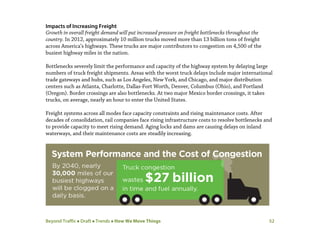
navigating bumpy side roads—and you are not alone. Every year, trucks are losing $27 billion on
wasted time and fuel.
In this report, we not only analyzed the condition and performance of our transportation system
today, but forecasted how it will look and perform 30 years from now if we fail to develop a new
game plan.
Beyond Traffic reveals that, if we don’t change, in 2045, the transportation system that powered
our rise as a nation will instead slow us down. Transit systems will be so backed up that riders will
wonder not just when they will get to work, but if they will get there at all. At the airports, and on
the highway, every day will be like Thanksgiving is today.
Beyond Traffic  Draft  Introduction 4
This is not a picture of our inevitable future. It is the objective truth—and one we hope inspires
Americans to, in a way, launch a comeback. We encourage our readers to learn about the challenges
ahead, and to think of them as opportunities. The potential is there, Beyond Traffic tells us, to
make a transportation system as amazing, frankly, as the stark scenario above is troubling—a
system that is safer, more efficient, more sustainable, and more satisfying—one that successfully
connects all Americans to the 21st century economy.
Beyond Traffic doesn’t prescribe a course of action or advocate for any specific solution. It doesn’t
provide a blueprint.
Our purpose in producing this report was to analyze the latest data and trends shaping
transportation so we could objectively frame critical policy choices that need to be made. Trends
and choices such as:
 How will we move? How will we build a transportation system to accommodate a growing
population and changing travel patterns?
o America’s population will grow by 70 million by 2045.
o By 2050, emerging megaregions could absorb 75 percent of the U.S. population; rural
populations are expected to continue declining.
o Population growth will be greatest in the South and West; existing infrastructure
might not be able to accommodate it.
o It is possible that Americans, particularly millennials, will continue reducing trips by
car in favor of more trips by transit and intercity passenger rail.
o In 2045 there will be nearly twice as many older Americans—thus, more people
needing quality transit connections to medical and other services.
 How will we move things? And reduce freight chokepoints that drive up the cost of owning a
business?
o By 2045, freight volume will increase 45 percent.
Beyond Traffic  Draft  Introduction 5
o Online shopping is driving up demand for small package home delivery, which could
soon substitute for many household shopping trips.
o Airline mergers and the consolidation of hubs may result in increased air traffic
congestion.
o International trade balances, due in part to low U.S. energy costs, could shift from
imports toward exports, but overall globalization will increase both, straining ports
and border crossings.
o Strong domestic energy production may enable the U.S. to become a natural gas net
exporter by 2020, but pipeline capacity may hamper growth and lead to greater
movement of oil by rail.
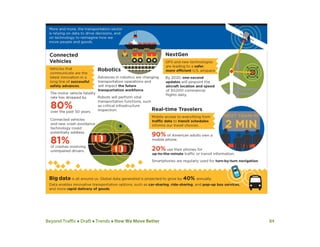
 How will we move better? And knock down barriers to new technologies that promise to
make travel safer and more convenient?
o Technological changes and innovation may transform vehicles, infrastructure,
logistics, and the delivery of transportation services to promote efficiency and safety.
o New sources of travel data have the potential to improve travelers’ experience,
support more efficient management of transportation systems, and enhance
investment decisions.
o Automation and robotics will affect all modes of transportation, improving
infrastructure maintenance and travel safety, and enabling the mainstream use of
autonomous vehicles.
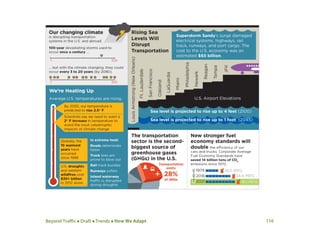
 How will we adapt? And make our infrastructure more resilient to events like Hurricane
Sandy?
o The effects of climate change will include global mean sea level rise, temperature
increases, and more frequent and intense storm events, all of which will impact
highways, bridges, public transportation, coastal ports and waterways.
Beyond Traffic  Draft  Introduction 6
 How will we align decisions and dollars, and invest the trillions of dollars our transportation
system needs in the smartest way possible?
o Public revenues to support transportation are not keeping up with the rising costs of
maintenance and capacity expansion.
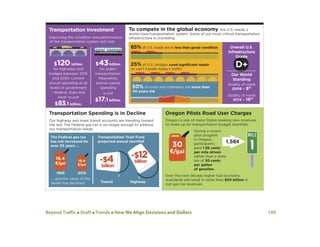
o Sixty-five percent of our roads are rated in less than good condition; a quarter of our
bridges need significant repair; 45 percent of Americans lack access to transit.
o The federal gas tax is no longer enough to address our transportation needs.
o Overall financing uncertainty, shortfalls in the Highway Trust Fund, and the absence
of reliable federal funding for rail, marine highways, and ports have created a need for
new financing mechanisms.
Beyond Traffic does not close the book on these questions. It opens the book wider, giving all of us
more and better data with which to answer them.
Our hope is, at the end of the day, Beyond Traffic provides Americans with a common basis of fact
for a larger national discussion about the future of transportation.
It’s a discussion we need to have. After all, since Lewis and Clark blazed a trail to the Pacific and
Lincoln linked our country with a railroad, transportation has been a national effort. No matter
what changes in the next 30 years, it will continue to be one.
Beyond Traffic  Draft  Introduction 7
Report Organization
This report is structured in three parts.
The first part discusses the major trends shaping our changing transportation system. These
include both trends originating from the transportation sector, such as improvements in freight
logistics, and external trends impacting the transportation sector, such as population growth and
climate change.
The second part discusses the implications of these trends for each mode of transportation:
highways, transit, pedestrian and bicycle, aviation, intercity and freight rail, maritime and pipeline.
The third part presents a description of a baseline future scenario—a future that may emerge from
the trends analyzed previously. It concludes with a discussion of policy options based on the
implications of these trends.
Beyond Traffic  Draft  Trends 8
Trends
We can start the discussion by examining some of the most important
trends that will shape our future.
This report describes five major trends:
How We Move
This section describes demographic, economic, geographic, and cultural trends affecting
everyday travel. The focus is on the most common form of travel for most Americans: short-
distance trips by surface transportation.
How We Move Things
This section describes emerging challenges and opportunities in the freight sector. It
discusses how changes in the population, economy, and technology are affecting the
movement of cargo and energy.
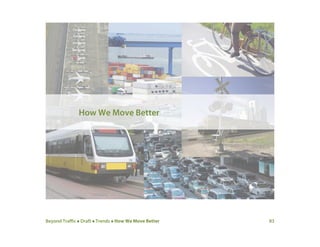
How We Move Better
In this section, discussion focuses on how technological advances, many of which have
originated outside of the transportation sector and are now ready for implementation
within it, are affecting and will affect our transportation system.
Beyond Traffic  Draft  Trends 9
How We Adapt
This section describes how the transportation system is contributing to, and may be
impacted by, climate change. It discusses how the transportation sector is finding ways to
limit greenhouse-gas emissions, as well as the challenges of developing a resilient
transportation system that can withstand the projected impacts of climate change, today
and in the future.
How We Align Decisions and Dollars
This section explains the evolving role of government in planning, building, managing, and
regulating the transportation system. It describes the financial challenges many
governments are facing and discusses how the role of government and the way
transportation is funded may change.
Beyond Traffic  Draft  Trends  How We Move 10
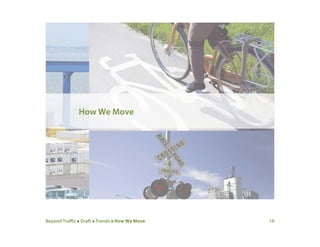
How We Move
Beyond Traffic  Draft  Trends  How We Move 11
Beyond Traffic  Draft  Trends  How We Move 12
Our transportation system connects us to our work, our homes, and our friends and families. We
all have different needs, and different values, that we consider as we make transportation
decisions—but we all value the connections that our transportation system provides.
As our population grows and changes, our needs and preferences will also change. In fact, we are
already changing how we travel. For instance, the number of miles that we drive each year is no
longer increasing—reversing a decades-old trend. Many young Americans are choosing not to own
cars—some do not even seek driver’s licenses. Our growing population will necessarily lead to
increasing demand for travel overall, but it is conceivable that increasing congestion make travel so
inconvenient that many individuals will find ways to travel less.
This chapter examines some of the most important demographic and trends in everyday personal
travel that will shape our transportation network by 2045.
Demographics: Increasing Population
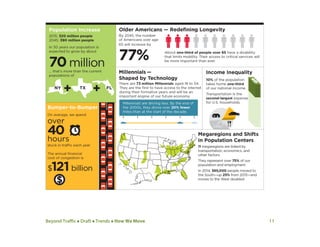
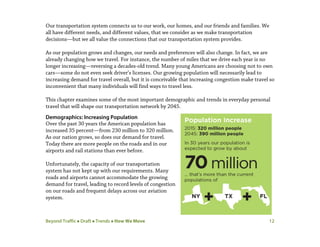
Over the past 30 years the American population has
increased 35 percent—from 230 million to 320 million.
As our nation grows, so does our demand for travel.
Today there are more people on the roads and in our
airports and rail stations than ever before.
Unfortunately, the capacity of our transportation
system has not kept up with our requirements. Many
roads and airports cannot accommodate the growing
demand for travel, leading to record levels of congestion
on our roads and frequent delays across our aviation
system.
Beyond Traffic  Draft  Trends  How We Move 13
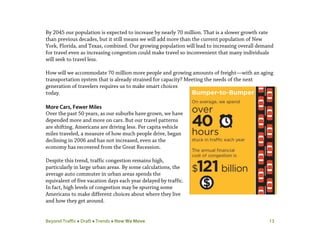
By 2045 our population is expected to increase by nearly 70 million. That is a slower growth rate
than previous decades, but it still means we will add more than the current population of New
York, Florida, and Texas, combined. Our growing population will lead to increasing overall demand
for travel even as increasing congestion could make travel so inconvenient that many individuals
will seek to travel less.
How will we accommodate 70 million more people and growing amounts of freight—with an aging
transportation system that is already strained for capacity? Meeting the needs of the next
generation of travelers requires us to make smart choices
today.
More Cars, Fewer Miles
Over the past 50 years, as our suburbs have grown, we have
depended more and more on cars. But our travel patterns
are shifting. Americans are driving less. Per capita vehicle
miles traveled, a measure of how much people drive, began
declining in 2006 and has not increased, even as the
economy has recovered from the Great Recession.
Despite this trend, traffic congestion remains high,
particularly in large urban areas. By some calculations, the
average auto commuter in urban areas spends the
equivalent of five vacation days each year delayed by traffic.
In fact, high levels of congestion may be spurring some
Americans to make different choices about where they live
and how they get around.
Beyond Traffic  Draft  Trends  How We Move 14
Throughout the 1980s and 1990s, Americans spent more and more of their time in cars as
commute lengths increased and traffic grew. Personal vehicle travel increased as a share of all
travel; carpooling, transit, and walking all declined. Driving became more affordable as the cost of
cars and gas fell relative to other costs and fuel economies improved. More Americans entered the
workforce, especially women, and the boundaries of metropolitan areas expanded. The population
of the suburbs increased and rural areas on the fringe of metropolitan areas became exurbs.
Meanwhile, the population of cities stagnated. Commutes grew in distance and commuters spent
more time in traffic.
Beyond Traffic  Draft  Trends  How We Move 15
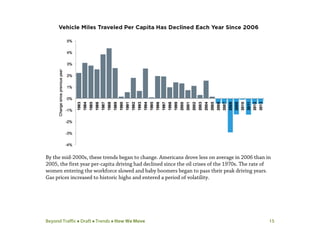
By the mid-2000s, these trends began to change. Americans drove less on average in 2006 than in
2005, the first year per-capita driving had declined since the oil crises of the 1970s. The rate of
women entering the workforce slowed and baby boomers began to pass their peak driving years.
Gas prices increased to historic highs and entered a period of volatility.
Beyond Traffic  Draft  Trends  How We Move 16
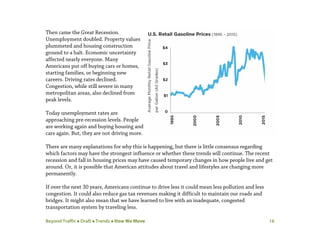
Then came the Great Recession.
Unemployment doubled. Property values
plummeted and housing construction
ground to a halt. Economic uncertainty
affected nearly everyone. Many
Americans put off buying cars or homes,
starting families, or beginning new
careers. Driving rates declined.
Congestion, while still severe in many
metropolitan areas, also declined from
peak levels.
Today unemployment rates are
approaching pre-recession levels. People
are working again and buying housing and
cars again. But, they are not driving more.
There are many explanations for why this is happening, but there is little consensus regarding
which factors may have the strongest influence or whether these trends will continue. The recent
recession and fall in housing prices may have caused temporary changes in how people live and get
around. Or, it is possible that American attitudes about travel and lifestyles are changing more
permanently.
If over the next 30 years, Americans continue to drive less it could mean less pollution and less
congestion. It could also reduce gas tax revenues making it difficult to maintain our roads and
bridges. It might also mean that we have learned to live with an inadequate, congested
transportation system by traveling less.
Beyond Traffic  Draft  Trends  How We Move 17
Millennial Driving Patterns
While all Americans are driving less than they did a decade ago, younger adults are driving much
less. In 2009, Americans between the ages of 18 and 34 drove 21 percent fewer miles than those in
that age group did in 2001. Fewer young adults are getting their driver’s licenses. The total number
of licensed drivers under the age of 34 actually declined between 2001 and 2012, despite an
increasing population. Many are choosing to live in cities where they can bike, walk, and take
public transit to work or school.
The travel behaviors of young adults matter.
Today there are more Millennials than there
are Baby Boomers. There are 74 million
Americans aged 18 to 34, compared to 68
million Americans aged 50 to 68.
Social trends are changing attitudes about
travel, especially among young adults. From
Uber to Zipcar to Skype, young adults are
increasingly using technology to find new ways
to travel or to avoid traveling. Surveys of
Millennials have shown that they are more likely to value access to their phone over access to a car
and to shop or socialize online as alternatives to driving. However, surveys also show that most
still aspire to own a home, and a majority would prefer a single-family home with more space in
the suburbs, rather than a smaller home closer to amenities in an urban environment.
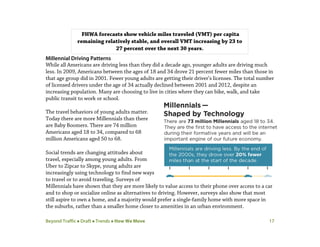
FHWA forecasts show vehicle miles traveled (VMT) per capita
remaining relatively stable, and overall VMT increasing by 23 to
27 percent over the next 30 years.
Beyond Traffic  Draft  Trends  How We Move 18
That said, many Millennials may not have much of a choice over where they live or whether they
own a car or drive. The Great Recession hit young adults particularly hard. Many struggled to find
a job and strike out on their own. Student debt burdens increased. Many also delayed forming
families. These trends likely impacted the ability of many young adults to own a car, and delayed
choices, such as having children or buying a home, that often lead to increased driving.
It is unclear whether driving less is a matter of choice or a matter of economic necessity. It is
conceivable that a significant portion of young adults have learned to manage without a car and
will continue to drive less throughout their lives than previous generations. What is clear is that
Millennials are choosing where they live and how they get around, whether by bikeshare,
skateboard, bus, compact car or pickup truck, based on their budget and their lifestyle.
Older Americans
Changes in the age of our population will have a lasting effect on how much we drive. Older Americans
drive less on average than other Americans. On average, Americans over the age of 65 drive half
the amount of Americans aged 25 to 64. That said, Americans are living longer and healthier lives
and they are retiring later in life. Over the next 30 years, older Americans may work later in their
lives and travel for work and leisure more often.
Between 1990 and 2013, the proportion of Americans aged 18–34
living with their parents increased from 24 percent to 32 percent.
Beyond Traffic  Draft  Trends  How We Move 19
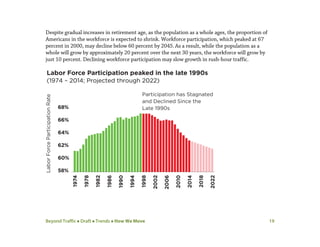
Despite gradual increases in retirement age, as the population as a whole ages, the proportion of
Americans in the workforce is expected to shrink. Workforce participation, which peaked at 67
percent in 2000, may decline below 60 percent by 2045.As a result, while the population as a
whole will grow by approximately 20 percent over the next 30 years, the workforce will grow by
just 10 percent. Declining workforce participation may slow growth in rush-hour traffic.
Beyond Traffic  Draft  Trends  How We Move 20
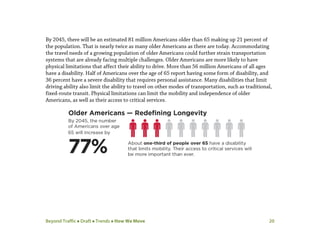
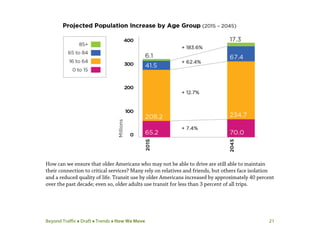
By 2045, there will be an estimated 81 million Americans older than 65 making up 21 percent of
the population. That is nearly twice as many older Americans as there are today. Accommodating
the travel needs of a growing population of older Americans could further strain transportation
systems that are already facing multiple challenges. Older Americans are more likely to have
physical limitations that affect their ability to drive. More than 56 million Americans of all ages
have a disability. Half of Americans over the age of 65 report having some form of disability, and
36 percent have a severe disability that requires personal assistance. Many disabilities that limit
driving ability also limit the ability to travel on other modes of transportation, such as traditional,
fixed-route transit. Physical limitations can limit the mobility and independence of older
Americans, as well as their access to critical services.
Beyond Traffic  Draft  Trends  How We Move 21
How can we ensure that older Americans who may not be able to drive are still able to maintain
their connection to critical services? Many rely on relatives and friends, but others face isolation
and a reduced quality of life. Transit use by older Americans increased by approximately 40 percent
over the past decade; even so, older adults use transit for less than 3 percent of all trips.
Beyond Traffic  Draft  Trends  How We Move 22
Paratransit services—individualized door-to-door transportation services—offer a good option for
some older and Americans with disabilities, but they are more than three times as expensive to
provide as traditional transit services. Older Americans are unlikely to want to move from their
homes to areas with better access to services. For people to be able to age in their community and
to maintain their connections to family, friends, and critical services they need access to a
responsive transportation system designed to meet their needs.
Income Inequality
For many Americans, declining incomes may make reliable transportation options difficult to
afford. Our economy is recovering from a long recession, but not all segments of the population
have benefited. Since 2009, Americans’ incomes have declined for all but the wealthiest 10 percent.
Today, the average wealth for the other 90 percent of families is at the same level as it was in 1986.
Wealth disparities between white and black and Hispanic households have grown since 2007. The
median wealth of white households is now 13 times the median wealth of black families and 10
times that of Hispanic households.
The number of Americans living in poverty is also increasing. In 2013, there were 45.3 million
people living in poverty, an increase of more than 14 million since 2000. This stagnation in
incomes and wealth for the vast majority of Americans is affecting all aspects of life, including
access to reliable and convenient transportation.
Beyond Traffic  Draft  Trends  How We Move 23
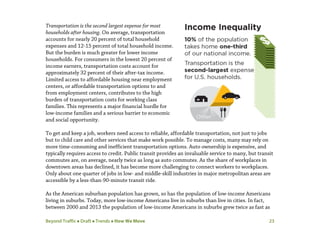
Transportation is the second largest expense for most
households after housing. On average, transportation
accounts for nearly 20 percent of total household
expenses and 12-15 percent of total household income.
But the burden is much greater for lower income
households. For consumers in the lowest 20 percent of
income earners, transportation costs account for
approximately 32 percent of their after-tax income.
Limited access to affordable housing near employment
centers, or affordable transportation options to and
from employment centers, contributes to the high
burden of transportation costs for working class
families. This represents a major financial hurdle for
low-income families and a serious barrier to economic
and social opportunity.
To get and keep a job, workers need access to reliable, affordable transportation, not just to jobs
but to child care and other services that make work possible. To manage costs, many may rely on
more time-consuming and inefficient transportation options. Auto ownership is expensive, and
typically requires access to credit. Public transit provides an invaluable service to many, but transit
commutes are, on average, nearly twice as long as auto commutes. As the share of workplaces in
downtown areas has declined, it has become more challenging to connect workers to workplaces.
Only about one quarter of jobs in low- and middle-skill industries in major metropolitan areas are
accessible by a less-than-90-minute transit ride.
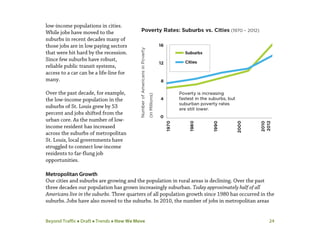
As the American suburban population has grown, so has the population of low-income Americans
living in suburbs. Today, more low-income Americans live in suburbs than live in cities. In fact,
between 2000 and 2013 the population of low-income Americans in suburbs grew twice as fast as
Beyond Traffic  Draft  Trends  How We Move 24
low-income populations in cities.
While jobs have moved to the
suburbs in recent decades many of
those jobs are in low paying sectors
that were hit hard by the recession.
Since few suburbs have robust,
reliable public transit systems,
access to a car can be a life-line for
many.
Over the past decade, for example,
the low-income population in the
suburbs of St. Louis grew by 53
percent and jobs shifted from the
urban core. As the number of low-
income resident has increased
across the suburbs of metropolitan
St. Louis, local governments have
struggled to connect low-income
residents to far-flung job
opportunities.
Metropolitan Growth
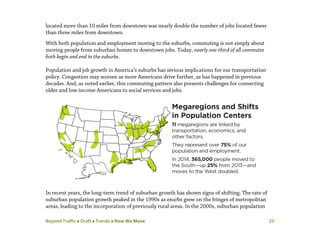
Our cities and suburbs are growing and the population in rural areas is declining. Over the past
three decades our population has grown increasingly suburban. Today approximately half of all
Americans live in the suburbs. Three quarters of all population growth since 1980 has occurred in the
suburbs.Jobs have also moved to the suburbs. In 2010, the number of jobs in metropolitan areas
Beyond Traffic  Draft  Trends  How We Move 25
located more than 10 miles from downtown was nearly double the number of jobs located fewer
than three miles from downtown.
With both population and employment moving to the suburbs, commuting is not simply about
moving people from suburban homes to downtown jobs. Today, nearly one-third of all commutes
both begin and end in the suburbs.
Population and job growth in America’s suburbs has serious implications for our transportation
policy. Congestion may worsen as more Americans drive further, as has happened in previous
decades. And, as noted earlier, this commuting pattern also presents challenges for connecting
older and low-income Americans to social services and jobs.
In recent years, the long-term trend of suburban growth has shown signs of shifting. The rate of
suburban population growth peaked in the 1990s as exurbs grew on the fringes of metropolitan
areas, leading to the incorporation of previously rural areas. In the 2000s, suburban population
Beyond Traffic  Draft  Trends  How We Move 26
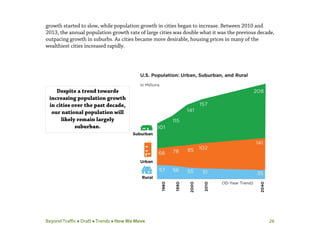
growth started to slow, while population growth in cities began to increase. Between 2010 and
2013, the annual population growth rate of large cities was double what it was the previous decade,
outpacing growth in suburbs. As cities became more desirable, housing prices in many of the
wealthiest cities increased rapidly.
Despite a trend towards
increasing population growth
in cities over the past decade,
our national population will
likely remain largely
suburban.
Beyond Traffic  Draft  Trends  How We Move 27
Despite signs of change in settlement patterns, our population is likely to remain primarily
suburban. While cities have become more desirable to many Americans, and the rate of population
growth in cities has increased, the majority of Americans continue to move to areas with lower
density, cheaper housing, and more jobs.
Regional Differences
For these reasons, population growth has been strongest in the South and the West. Between 1980
and 2010, the South and West added 68 million people, accounting for 83 percent of all population
growth. Many of the metropolitan areas in these regions have experienced particularly high rates
of population growth, resulting in rising demand for transportation system capacity and
increasing congestion. At the same time, many counties in the Midwest and Northeast have been
losing population.
Beyond Traffic  Draft  Trends  How We Move 28
Jacksonville Expands Transportation Options
In recent years, the population of Jacksonville has grown at a rate nearly twice the national
average, largely as the result of burgeoning employment opportunities in Northeast Florida. This
growth has presented a major transportation challenge for Jacksonville. Traffic congestion is
getting worse and convenient transit alternatives to downtown jobs are in short supply. In order
to help move city’s growing population, the Jacksonville Transportation Authority is using $9.3
million in federal funding to begin work on a Bus Rapid Transit (BRT) system. BRT systems use
dedicated bus lanes to offer faster, more frequent, and more reliable trips to travelers.
Jacksonville’s BRT, known as the First Coast Flyer, will begin with six miles of BRT routes and
expand to a system of over 50 miles by 2019. First Coast Flyer is just one key element of
Jacksonville’s larger vision for transforming their transportation system. In addition to transit
improvements, city leaders plan to invest $100 million in new road work.
.
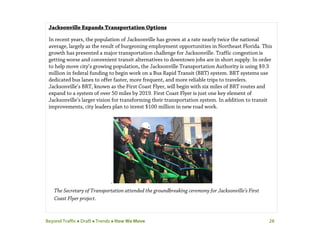
The Secretary of Transportation attended the groundbreaking ceremony for Jacksonville’s First
Coast Flyer project.
Beyond Traffic  Draft  Trends  How We Move 29
As the economy has shifted away from agriculture and manufacturing, rural counties in the
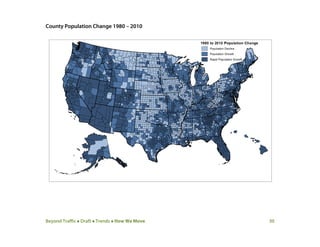
Midwest and industrial counties in the Great Lakes region have shrunk. Between 1980 and 2010,
more than one thousand counties—nearly 40 percent of rural counties—experienced a net loss in
population.As suburbs have expanded, rural populations have declined, birth rates in rural areas
have declined, and retirees and job-seekers have moved to metropolitan areas.
And, even as urban areas gained population overall, some of the largest population losses over the
past 30 years have occurred in metropolitan counties. A number of traditional manufacturing
cities along the Great Lakes—in New York, Pennsylvania, Ohio, Indiana, and Michigan—lost
population. Cities including Baltimore, Philadelphia, Detroit, and St. Louis declined in population.
Areas with shrinking populations face challenges maintaining existing infrastructure and
preserving access to economic opportunities and social services.
Beyond Traffic  Draft  Trends  How We Move 30
County Population Change 1980 – 2010
Beyond Traffic  Draft  Trends  How We Move 31
Population Change Projections by Commuting Zone, 2010-2030
Beyond Traffic  Draft  Trends  How We Move 32
Innovations in How We Move
Advances in mobile and information technologies are allowing people to make different travel
choices. The availability of Global Positioning Systems (GPS) has made it easier for individuals and
businesses to find the most efficient routes to their destination. Increasingly, the public has access
to real-time traffic conditions and transit schedule information, giving them more power to set
and change travel schedules and routes. Innovations in the business world that use these
technologies are also changing the way people access transportation, and the way they consume
goods and services.
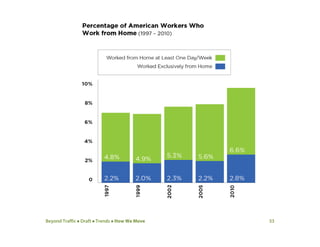
The number of Americans who work from home at least one day a week increased by 43 percent between
1997 and 2010. Travel preferences, flexible schedules, “hoteling” (unassigned office seating),
teleworking, and improvements in communications technologies are all changing how many
people work and commute to work. The fastest growing “mode” for commuting is, in fact,
telecommuting.
Many employers now have much more flexibility in how their workers can commute and interact
with their coworkers. Well over one-third of workers have the ability to set or change their arrival
time at work—including nearly half of those in professional, managerial, and technical
occupations. Increases in telecommuting and flexible work schedules could help to reduce
congestion in large metropolitan areas by reducing rush-hour travel.
In 2010, more than 13 million Americans—9.4 percent of all
workers—worked from home at least one day per week.
Beyond Traffic  Draft  Trends  How We Move 33
Beyond Traffic  Draft  Trends  How We Move 34
E-commerce may soon substitute for a significant portion of household shopping trips. Currently, more
than one in five trips taken by households is a shopping trip; online shopping has not yet
significantly affected this pattern.In 2009, the average household reported purchasing three items
per month online, and approximately 4 percent of retail sales were made online—but, by 2014,
e-commerce sales accounted for 6.6 percent of all sales. The most common types of products
purchased online were consumer electronics, books, and clothing.Online shopping continues to
grow rapidly and its use is significantly more widespread among younger age cohorts. At current
rates of growth, online purchases could account for 10 percent of retail in less than five years.
New ways to access transportation are emerging that could reduce the degree to which Americans rely on
personal vehicle travel. Car sharing is growing at a rapid rate. In 2014, there were 1.6 million
members in 24 active programs in the United States, marking a more than tenfold increase in
membership in just seven years. For many urban households, car sharing services make it more
convenient to not own a car. For those households, car sharing makes using a car more affordable.
Car sharing also reduces the incentive for households to own cars (either a second car, or any car at
all). New sharing and ride-matching services now emerging allow individuals to share their
personal vehicles with others and to match drivers with passengers.
As online shopping captures a large market share, it will reduce
travel associated with shopping trips, and reduce the need for
private vehicle ownership, but it may also increase truck traffic in
urban areas as goods are delivered to residences.
Beyond Traffic  Draft  Trends  How We Move 35
In recent years, bicycle sharing has also emerged in more than 30 cities, including New York,
Chicago, San Francisco, Minneapolis, Boston, and Washington, D.C. Bike-share systems allow
people to conveniently travel short distances and connect to other modes, particularly public
transit. They also allow tourists to travel by bike. Similar to car sharing, bike sharing provides a
low-cost mobility service, to address “first-mile” and “last-mile” needs.
Ride sourcing services, such as Lyft and Uber, are disrupting and augmenting traditional taxi
service by using mobile apps to connect for-hire drivers to riders. In response, traditional taxi
companies are also adopting new technologies to make their service more reliable and convenient.
Ride sourcing services are growing rapidly. Ride sourcing and ridesharing business models could
help to speed the adoption of automated vehicles, as they become available, by lowering costs of
ownership and expanding their accessibility. They can also help to supplement transit service in
urban areas by providing efficient, direct service for short trips and providing service during
transit system off-hours.
The recent emergence of ride sourcing businesses demonstrates a key challenge for governments.
The sharing economy uses the Internet and mobile apps to allow individuals to monetize
underutilized space, assets, and skills. The emerging sharing economy defies traditional categories
of “business” and “personal” and new business models are proliferating faster than the legal and
regulatory arenas can adapt to them. Over the next 30 years, our legal and regulatory system may
be increasingly challenged by emerging forms of business and travel that transcend traditional
legal and planning concepts.
Uber, launched in 2010, is now valued at $40 billion,
and operates in 90 American cities.
Beyond Traffic  Draft  Trends  How We Move 36
On an average day in America, 90 people die in motor vehicle
crashes and more than 6,000 are injured.
Roadway Safety
Transportation safety is a critical societal issue and the U.S. DOT’s top priority. Among Americans
aged 1 to 34, motor vehicle crashes are the leading cause of death. Americans spend more than 1
million days in the hospital each year as a result of crash injuries. Motor vehicle crashes resulted in
32,719 deaths, including 4,735 pedestrians, 4,668 motorcyclists, 743 cyclists, and 396 children
under the age of 5. Among those killed, almost half were not wearing a seatbelt and nearly a third
of fatalities involved an alcohol-impaired driver. Crash injuries resulted in Americans paying an
estimated $18 billion in medical costs and losing an estimated $33 billion in work lost costs.
Fortunately, much progress has been made in reducing the number of deaths and injuries across
our transportation system. Passenger safety is rapidly improving across all transportation modes.
Since 1990 the total number of transportation fatalities has decreased by 25 percent despite
increasing passenger travel on all modes. Fatalities in commercial aviation have become
exceedingly rare, while fatalities in rail and on waterborne transportation have steadily declined.
These changes are the result of a wide range of factors, including improving vehicle technologies,
safer infrastructure, increased enforcement, higher safety standards, and changing demographics.
For example, seatbelt use has increased dramatically from a national level of about 14 percent in
the early 1980s to 87 percent in 2013. It is estimated that seatbelt use alone saves more than
12,000 lives each year. Today, 49 States have adopted mandatory belt use laws. The introduction
of airbags has also saved thousands of lives. NHTSA estimates that since their introduction,
frontal air bags have saved nearly 43,000 lives.
Beyond Traffic  Draft  Trends  How We Move 37
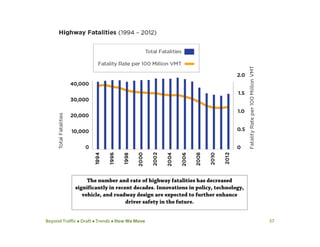
The number and rate of highway fatalities has decreased
significantly in recent decades. Innovations in policy, technology,
vehicle, and roadway design are expected to further enhance
driver safety in the future.
Beyond Traffic  Draft  Trends  How We Move 38
Now, vehicle safety is progressing beyond basic seatbelts and lighting, to high-tech safety features
that can help drivers avoid accidents altogether. Thanks to continuing innovation, today's vehicles
are the safest in history and have contributed to year-over-year decreases in crash-related fatalities
and injuries nationwide. In addition to frontal and side air bags that help to prevent injuries in
crashes, a number of crash avoidance technologies are now featured in passenger cars and trucks
including automated emergency braking systems, lane-departure and forward collision warning
systems, and electronic stability control. In the future, connected and automated vehicle
technologies could help drivers avoid a significant portion of the type of vehicle crashes that occur
today.
Roadway safety is also improving thanks to innovations in roadway design and the introduction of
a number of low-cost safety features to roadways. Roundabouts and other alternative intersection
designs are improving safety and mobility at interchanges. Widespread use of rumble strips,
reduced pavement edge drop-offs, and the application of high friction surface treatments at critical
locations are reducing the risk of crashes. Finally, the electronic collection of roadway and crash
data is allowing decisionmakers to better understand the characteristics of high crash locations
and to systematically apply safety features to roadways.
Policy Implications
Understanding how people might travel and where they might live in the future helps planners and
policymakers decide what policies and investments may be needed to ensure the performance of
our transportation system. The trends in population, geography, and mobility reviewed in this
chapter begin to demonstrate the challenges and opportunities that will face us in the coming
years.
Beyond Traffic  Draft  Trends  How We Move 39
First and foremost, we will need to find ways to ensure that
our already congested transportation system can
accommodate the travel needs of nearly 70 million more
people. To do this, we will either need more capacity to
accommodate growing demand, or we will need
strategies that result in more efficient use of existing
capacity. Some strategies, like pricing, rely less on
government investment; however, they may have other
effects, such as creating “first” and “second” class
transportation systems.
Changes in the composition of our population will
counteract some, but not nearly all, of the increase in
demand for transportation. As our population ages and
workforce participation declines, per capita driving
rates will likely stabilize or decrease. However, an
increasing number of older Americans living in auto-
dependent areas will face challenges accessing critical
services.
We know that social and technological changes will affect how Americans travel, although we do
not know exactly how. Millennials and future generations of Americans might drive less than their
parents throughout their lives. They might prefer cities to suburbs, phones to cars, and buying
their groceries from online retailers instead of going to the supermarket. Initial indications seem
to suggest that the overall effects of changes like these may be to slow growth in individual driving
rates—even as population increases result in more travelers on all modes.
Attracting Millennials through
Transportation
Across the country, cities are looking for
ways to attract and retain young
workers and promote local economic
development. A survey conducted by the
American Planning Association found
that only 8% of Millennials would prefer
to live in an auto-dependent suburb. In
Denver, city leaders have heard from
both residents and business leaders that
building a comprehensive bicycle
network should be a top priority in
order to attract and retain young people
and the businesses that employ them.
As a result, Denver’s Downtown Area
Plan outlines a specific strategy to build
protected bike lanes to promote
mobility and economic development.
Beyond Traffic  Draft  Trends  How We Move 40
In 2045, most of us will probably still use personal vehicles to get to work and to go about our daily
tasks. Our population will increasingly move toward large metropolitan areas. However, these
metropolitan areas will not look like the cities of one hundred or even fifty years ago. They will be
much larger and much less dense, with new investments and developments being located outside
the urban core where land is less expensive. Short of land use plans that expressly curtail it, sprawl
is likely to remain a dominant development pattern and, if we do not act, congestion will be much
more widespread.
Some cities are becoming laboratories for new types of transportation, including ridesharing and
ride sourcing services, enhanced cycling facilities, and an expanding set of transit options.
However, if cities cannot find ways to affordably accommodate increased population growth,
suburbs will grow at a faster rate. We may increasingly find ourselves in a world where some cities
become the domain of the affluent, while those with less wealth must contend with congestion on
metropolitan outskirts. As income inequality increases, and poverty becomes suburbanized, the
provision of affordable housing and transportation options will become an increasingly important
policy challenge.
As many metropolitan areas grow, rural populations and some economically challenged
metropolitan areas are shrinking. These areas are likely to face challenges maintaining access for
rural and economically disadvantaged populations as their tax bases decline. Governments at all
levels will face challenges structuring programs to balance equity and fairness claims, while
ensuring that scarce resources are allocated to areas that most need capacity.
Barring major social changes, we will remain a largely suburban
population given the current housing supply and infrastructure
network in suburbs.
Beyond Traffic  Draft  Trends  How We Move 41
There is a wide range of policies that could potentially reduce congestion and preserve quality,
affordable, and accessible transportation options for all of us. These options include:
 Increasing investments in roadway capacity to address congestion in metropolitan areas.
 Restructuring federal surface transportation programs to allow for more targeted, demand-
driven, mode-neutral investments.
 Expanding and/or improving the quality of transit services.
 Strengthen the coordination of human service transportation services to meet the needs of
older adults and people with disabilities.
 Subsidizing car ownership for the working poor.
 Promoting integrated transportation and land-use planning.
 Supporting services such as bike sharing, car sharing and ride sourcing.
 Integrating land use and transportation planning to support sustainable and efficient
development patterns.
 Supporting design and planning choices that support alternatives to vehicle travel.
 Adopting congestion pricing.
 Lifting the federal restriction on the tolling of interstate highways.
 Encouraging companies to adopt telework policies.
 Supporting investments in transportation technologies and operational strategies that can
reduce congestion.
These policy options are explored in further depth in the conclusion of this report.
Beyond Traffic  Draft  Trends  How We Move 42
References
• (BLS) Bureau of Labor Statistics. “Consumer Expenditure 2013.” News release. September 9, 2014.
(http://www.bls.gov/news.release/cesan.nr0.htm)
• Brault, Matthew W. U.S. Census Bureau. 2012. Americans with Disabilities: 2010, Current Population Reports.
(http://www.census.gov/prod/2012pubs/p70-131.pdf)
• Dutzik, Tony and Phineas Baxandall. U.S. PIRG Education Fund/Frontier Group. 2013. A New Direction: Our Changing Relationship with Driving and the Implications
for America’s Future.
(http://www.uspirg.org/sites/pirg/files/reports/A%20New%20Direction%20vUS.pdf)
• (FHWA) Federal Highway Administration. 2014. “National Household Travel Survey Brief: Mobility Challenges for Households in Poverty.” News Release.
(http://nhts.ornl.gov/briefs/PovertyBrief.pdf)
• Henderson, Tim. The Washington Post. “Population grows in South and West, slows in D.C. and North Dakota.” January 11, 2015.
(http://www.washingtonpost.com/politics/population-grows-in-south-and-west-slows-in-dc-and-north-dakota/2015/01/11/9789100e-99dc-11e4-bcfb-
059ec7a93ddc_story.html)
• (MIT) Massachusetts Institute of Technology AgeLab. “Disruptive Demographics.”
(http://agelab.mit.edu/disruptive-demographics)
• Nielsen. Millennials Prefer Cities to Suburbs, Subways to Driveways. News release. March 4, 2014.
(http://www.nielsen.com/us/en/insights/news/2014/millennials-prefer-cities-to-suburbs-subways-to-driveways.html)
• (RPA) Regional Planning Association. 2007. The Healdsburg Research Seminar on Megaregions. April.
(http://library.rpa.org/pdf/2050-The-Healdsburg-Research-Seminar-on-Megaregions-2007.pdf)
• Ross, Catherine. “Critical Transportation Infrastructure Funding.” Presentation on the Piedmont Atlantic Megalopolis. September 3, 2014.
(http://www.house.ga.gov/Documents/CommitteeDocuments/2014/Critical_Trans_Infra_Funding/Macon_PAM_20140903_CLR.pdf)
• (TTI) Texas Transportation Institute. 2012. Urban Mobility Report. December.
(http://d2dtl5nnlpfr0r.cloudfront.net/tti.tamu.edu/documents/mobility-report-2012.pdf)
• (USCB) U.S. Census Bureau. “New Census Bureau Statistics Show How Young Adults Today Compare With Previous Generations in Neighborhoods Nationwide.”
News release. December 4, 2014.
(http://www.census.gov/newsroom/press-releases/2014/cb14-219.html)
• (USCB) U.S. Census Bureau. Population Projection; “2012 National Population Projections: Summary Tables.” See “Table 2. Projections of the Population by
Selected Age Groups and Sex for the United States: 2015 to 2060: Middle Series.”
(http://www.census.gov/population/projections/data/national/2012/summarytables.html;
http://www.census.gov/population/projections/files/summary/NP2012-T2.xls)
• (USCB) U.S. Census Bureau. U.S. and World Population Clock. Accessed January 19, 2015.
(http://www.census.gov/popclock/)
Beyond Traffic  Draft  Trends  How We Move 43
• The White House, Council of Economic Advisors. 2014. 15 Economic Facts about Millenials. October.
(http://www.whitehouse.gov/sites/default/files/docs/millennials_report.pdf)
• The White House, Office of the Press Secretary. “Remarks by the President on Economic Mobility.” News release. December 4, 2013.
(http://www.whitehouse.gov/the-press-office/2013/12/04/remarks-president-economic-mobility)
• Federal Reserve Bank of St. Louis. Travel Volume Trends; “Moving 12-Month Total Vehicle Miles Traveled.” Analysis by Volpe, the National Transportation
Systems Center.
(http://research.stlouisfed.org/fred2/series/M12MTVUSM227NFWA#)
• (BOC) Bureau of the Census. Population Estimates; “Historical Data.” Analysis by Volpe, the National Transportation Systems Center.
(https://www.census.gov/popest/data/historical)
• (BTS) Bureau of Transportation Statistics. 1982-2011 data. Analysis by Texas A&M Transportation Institute.
(http://tti.tamu.edu/documents/ums/congestion-data/complete-data.xls)
• Krauss, Clifford. The New York Times. “Driving Less, Americans Finally React to Sting of Gas Prices, a Study Says.” June 19, 2008.
(http://www.nytimes.com/2008/06/19/business/19gas.html)
• Zipcar. 2014. Millennials & the “New American Dream”: A Survey Commissioned by Zipcar. January.
(http://www.slideshare.net/Zipcar_PR/millennials-2013-slide-share)
• Burbank, Jeremy, and Louise Keely. The Demand Institute. 2014. Millennials and Their Homes: Still Seeking the American Dream. September.
(http://www.demandinstitute.org/sites/default/files/blog-uploads/millennials-and-their-homes-final.pdf)
• Nelson, Libby. Vox. “Why has student debt increased so much?” October 1, 2014.
(http://www.vox.com/cards/student-debt/why-has-student-debt-increased-so-much)
• Interrante, Erica. Federal Highway Administration. The Next Generation of Travel: Research, Analysis and Scenario Development.
(http://www.fhwa.dot.gov/policy/otps/nextgen_finalreport.cfm)
• Kolko, Jed. Trulia Trends. “Basement-Dwelling Millennials Are For Real.” July 8, 2014.
(http://www.trulia.com/trends/2014/07/basement-dwelling-millennials)
• (BOC) Bureau of the Census. Population Projection; “2012 National Population Projections: Summary Tables.” See “Table 2. Projections of the Population by
Selected Age Groups and Sex for the United States: 2015 to 2060: Middle Series.”
(http://www.census.gov/population/projections/data/national/2012/summarytables.html);
(http://www.census.gov/population/projections/files/summary/NP2012-T2.xls)
• Riffkin, Rebecca. Gallup, Inc. “Average U.S. Retirement Age Rises to 62.” April 2014.
(http://www.gallup.com/poll/168707/average-retirement-age-rises.aspx)
• (BLS) Bureau of Labor Statistics. Databases, Tables & Calculators by Subject; “Labor Force Statistics from the Current Population Survey.”
(http://data.bls.gov/timeseries/LNS11300000)
Beyond Traffic  Draft  Trends  How We Move 44
• (BOC) Bureau of the Census. 2012 National Population Projections: Summary Tables; “Table 2. Projections of the Population by selected Age Groups and Sex for the
United States: 2015 to 2060.”
(http://www.census.gov/population/projections/data/national/2012/summarytables.html)
• Brault, Matthew W. Bureau of the Census. 2012. Americans With Disabilities: 2010. July.
(http://www.census.gov/prod/2012pubs/p70-131.pdf)
• DeGood, Kevin. Transportation for America. 2011. Aging in Place, Stuck without Options: Fixing the Mobility Crisis Threatening the Baby Boom Generation.
(http://t4america.org/docs/SeniorsMobilityCrisis.pdf)
• Lynott, Jana and Carlos Figueiredo. AARP Public Policy Institute. 2011. How the Travel Patterns of Older Adults Are Changing: Highlights from the 2009 National
Household Travel Survey. April.
(http://assets.aarp.org/rgcenter/ppi/liv-com/fs218-transportation.pdf)
• Mattson, Jeremy. Upper Great Plains Transportation Institute. North Dakota State University, Fargo. 2012. Travel Behavior and Mobility of Transportation-
Disadvantaged Populations: Evidence from the National Household Travel Survey. December.
(http://www.ugpti.org/pubs/pdf/DP258.pdf)
• (GAO) Government Accountability Office. 2012. ADA Paratransit Services: Demand has Increased, but Little is Known about Compliance. November.
(http://www.gao.gov/assets/660/650079.pdf)
• Yglesias, Matthew, and Joe Posner. Vox. “Watch how the rich stole the recovery.” September 30, 2014.
(http://www.vox.com/2014/9/30/6874987/the-most-important-chart-of-the-year-explained-in-45-seconds)
• Saez, Emmanuel and Gabriel Zucman. Centre for Economic and Policy Research. “Exploding wealth inequality in the United States.” October 28, 2014.
(http://www.voxeu.org/article/exploding-wealth-inequality-united-states)
• DeNavas-Walt, Carmen, and Bernadette D. Proctor. Bureau of the Census. 2014. Income and Poverty in the United States: 2013. September.
(http://www.census.gov/content/dam/Census/library/publications/2014/demo/p60-249.pdf)
• (FHWA) Federal Highway Administration. Livability Initiative; “Transportation and Housing Costs.”
(http://www.fhwa.dot.gov/livability/fact_sheets/transandhousing.cfm)
• (BLS) Bureau of Labor Statistics. 2013. Consumer Expenditures in 2011. April.
(http://www.bls.gov/cex/csxann11.pdf)
• (BOC) Bureau of the Census. Poverty; “Historical Poverty Tables – People.”
(https://www.census.gov/hhes/www/poverty/data/historical/people.html)
• Housing Assistance Council. The Rural Data Portal; “Get Detailed Data.”
(http://www.ruraldataportal.org/search.aspx)
• Roberto, Elizabeth. The Brookings Institution. 2008. Commuting to Opportunity: The Working Poor and Commuting in the United States. February.
(http://web.stanford.edu/group/scspi/_media/pdf/key_issues/transportation_policy.pdf)
• Tomer, Adie, et. al. The Brookings Institution. 2011. Missed Opportunity: Transit and Jobs in Metropolitan America. May.
(http://www.brookings.edu/~/media/research/files/reports/2011/5/12%20jobs%20and%20transit/0512_jobs_transit.pdf)
Beyond Traffic  Draft  Trends  How We Move 45
• Bowman, Marcus. IAC Transportation. “U.S. Commuting Statistics: Where are people going? How?” Online presentation. July 2008.
(http://www.slideshare.net/marcus.bowman.slides/us-commuting-statistical-analysis)
• Mather, Mark, Kelvin Pollard, and Linda A. Jacobsen. Bureau of the Census. 2011. First Results from the 2010 Census. July. (http://www.prb.org/pdf11/reports-on-
america-2010-census.pdf)
• Kneebone, Elizabeth. The Brookings Institution. 2013. Job Sprawl Stalls: The Great Recession and Metropolitan Employment Location. April.
(http://www.brookings.edu/~/media/research/files/reports/2013/04/18%20job%20sprawl%20kneebone/srvy_jobsprawl.pdf)
• Frey, William H. The Brookings Institution. 2012. Population Growth in Metro America since 1980: Putting the Volatile 2000s in Perspective. March.
(http://www.brookings.edu/~/media/research/files/papers/2012/3/20%20population%20frey/0320_population_frey.pdf)
• Frey, William H. The Brookings Institution. “Will This Be the Decade of Big City Growth?” May 23, 2014.
(http://www.brookings.edu/research/opinions/2014/05/23-decade-of-big-city-growth-frey)
• Wilson, Steven G., et. al. Bureau of the Census. 2012. Patterns of Metropolitan and Micropolitan Population Change: 2000 to 2010. September.
(https://www.census.gov/prod/cen2010/reports/c2010sr-01.pdf)
• (BOC) Bureau of the Census. Metropolitan and Micropolitan; “Patterns of Metropolitan and Micropolitan Population Change: 2000 to 2010.”
(http://www.census.gov/population/metro/data/pop_pro.html)
• Kolko, Jed. Trulia Trends. “Where Americans Are Moving.” September 4, 2014.
(http://www.trulia.com/trends/2014/09/where-americans-are-moving)
• (BOC) Bureau of the Census. Population Estimates; “1980s: County Tables.”
(http://www.census.gov/popest/data/historical/1980s/county.html)
• (BOC) Bureau of the Census. Population Estimates; “Historical Data: 2000s.”
(http://www.census.gov/popest/data/historical/2000s/index.html)
• Butler, Margaret A. Department of Agriculture. 1990. Rural-Urban Continuum Codes for Metro and Nonmetro Counties. April.
(http://naldc.nal.usda.gov/download/CAT10407597/PDF)
• (USDA) Department of Agriculture. Economic Research Service. “Recent Population Change.” April 3, 2014.
(http://www.ers.usda.gov/topics/rural-economy-population/population-migration/recent-population-change.aspx)
• Mateyka, Peter J., Melanie A. Rapino, and Liana Christin Landivar. Bureau of the Census. 2012. Home-Based Workers in the United States: 2010. October.
(http://www.census.gov/hhes/commuting/files/2010/P70-132.pdf)
• Santos, Adella, et. al. Federal Highway Administration. 2011. Summary of Travel Trends: 2009 National Household Travel Survey. June.
(http://nhts.ornl.gov/2009/pub/stt.pdf)
• (NHTSA) National Highway Traffic Safety Administration. FARS Data Tables; “National Statistics: Summary.”
(http://www-fars.nhtsa.dot.gov/Main/index.aspx)
• Walker Sands Communications. 2014. Reinventing Retail: What Businesses Need to Know for 2014.
(http://www.walkersands.com/images/files/file/Future%20of%20Retail%20Whitepaper(1).pdf)
Beyond Traffic  Draft  Trends  How We Move Things 46
How We Move Things
Beyond Traffic  Draft  Trends  How We Move Things 47
Beyond Traffic  Draft  Trends  How We Move Things 48
Introduction
Our freight system is a multimodal engine that we depend on to drive our economy. These trucks,
trains, barges and ports operate so efficiently at times most of us take it for granted. Yet, our
coastal ports are modern wonders and critical gateways to a global economy. The twin ports of
Long Beach and Los Angeles process hundreds of billions of dollars’ worth of imports and exports
each year. Imports arrive on giant container ships and are transferred to trucks and trains which
take the cargo to intermodal transfer centers and, from there, to warehouses and stores across the
country. Freight trains move enormous volumes grain from farms in the Midwest and Great Plains
to barges on the Mississippi, Missouri and Ohio Rivers to get transferred to ships in ports along
the gulf coast, eventually feeding markets abroad. As we dine in St. Louis on a fresh fillet of
Sockeye Salmon caught off Alaska’s Kenai Peninsula most of us don’t give a passing thought to the
wonders of our modern air freight system.
Our nation’s ability to compete in global markets, and to meet the needs and expectations of
consumers and industry, depends on a robust multimodal freight transportation system. In an age
of online shopping and next-day delivery, it can be easy to take for granted the policies,
infrastructure, vehicles, trains and vessels, and workers that make all of this possible. But, today,
our freight system is under serious strain. Our roads, railways, and some of the largest, busiest
airports are becoming increasingly congested. Many of our ports and inland waterways suffer from
lack of dredging and aging facilities. Despite these challenges, there are opportunities to improve
the performance of our freight system.
Beyond Traffic  Draft  Trends  How We Move Things 49
Today, freight patterns are changing at a global and local scale. International trade is increasing,
global manufacturing centers are shifting and trade routes are changing. Firms are driving down
logistics costs through just-in-time shipping. Online shopping is increasing demand for home
delivery of consumer products. Ports worldwide are becoming increasingly automated. Intermodal
freight shipped in containers by ships, trains, and trucks is increasingly rapidly. Surging domestic
energy production is straining infrastructure in oil production regions. In the next 30 years,
changes in freight demand, shipping, manufacturing, logistics, technology, and energy production
are poised to transform the economics of transportation yet again.
This chapter addresses the trends that will shape the economics of transportation and freight
movement through 2045.
Population and Economic Growth
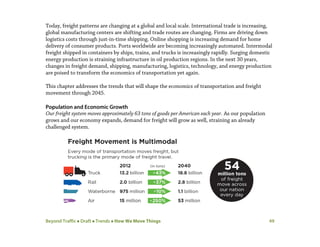
Our freight system moves approximately 63 tons of goods per American each year. As our population
grows and our economy expands, demand for freight will grow as well, straining an already
challenged system.
Beyond Traffic  Draft  Trends  How We Move Things 50
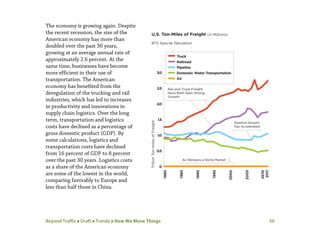
The economy is growing again. Despite
the recent recession, the size of the
American economy has more than
doubled over the past 30 years,
growing at an average annual rate of
approximately 2.6 percent. At the
same time, businesses have become
more efficient in their use of
transportation. The American
economy has benefited from the
deregulation of the trucking and rail
industries, which has led to increases
in productivity and innovations in
supply chain logistics. Over the long
term, transportation and logistics
costs have declined as a percentage of
gross domestic product (GDP). By
some calculations, logistics and
transportation costs have declined
from 16 percent of GDP to 8 percent
over the past 30 years. Logistics costs
as a share of the American economy
are some of the lowest in the world,
comparing favorably to Europe and
less than half those in China.
Beyond Traffic  Draft  Trends  How We Move Things 51
The American economy has become less freight-intensive as economic growth has outpaced the
growth in freight activity. As we have shifted from a manufacturing economy toward a more
service-oriented economy, and increased our production and consumption of higher-value, lower-
weight products, such as pharmaceuticals and personal electronics, freight movements have
declined in proportion to the total economy. Likewise, as our economy has become increasingly
dependent on foreign trade, the nature and location of freight movements has shifted. More goods
produced by American factories and farms are now bound for exports and manufactured goods are
increasingly imported from overseas through our ports.
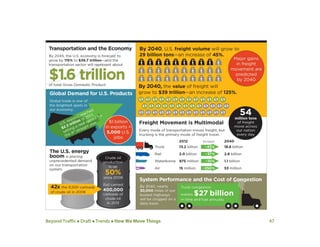
As our economy grows, and even by conservative estimates it is expected to double in size over the
next 30 years, freight movement will increase as well, albeit at a slower rate. Truck and rail freight
movements are expected to increase by approximately 45 percent. Air freight is expected to triple
in response to demand for the rapid movement of high-value merchandise, while multimodal
shipments will likely double. Overall, the volume of imports and exports transported by our freight
system are expected to more than double in the next 30 years. This will have implications for
ports, which handle 75 percent of America’s international trade by volume, and for intermodal
carriers that move imports and exports between ports of entry and inland locations.
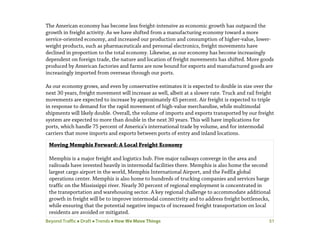
Moving Memphis Forward: A Local Freight Economy
Memphis is a major freight and logistics hub. Five major railways converge in the area and
railroads have invested heavily in intermodal facilities there. Memphis is also home the second
largest cargo airport in the world, Memphis International Airport, and the FedEx global
operations center. Memphis is also home to hundreds of trucking companies and services barge
traffic on the Mississippi river. Nearly 30 percent of regional employment is concentrated in
the transportation and warehousing sector. A key regional challenge to accommodate additional
growth in freight will be to improve intermodal connectivity and to address freight bottlenecks,
while ensuring that the potential negative impacts of increased freight transportation on local
residents are avoided or mitigated.
Beyond Traffic  Draft  Trends  How We Move Things 52
Impacts of Increasing Freight
Growth in overall freight demand will put increased pressure on freight bottlenecks throughout the
country. In 2012, approximately 10 million trucks moved more than 13 billion tons of freight
across America’s highways. These trucks are major contributors to congestion on 4,500 of the
busiest highway miles in the nation.
Bottlenecks severely limit the performance and capacity of the highway system by delaying large
numbers of truck freight shipments. Areas with the worst truck delays include major international
trade gateways and hubs, such as Los Angeles, New York, and Chicago, and major distribution
centers such as Atlanta, Charlotte, Dallas-Fort Worth, Denver, Columbus (Ohio), and Portland
(Oregon). Border crossings are also bottlenecks. At two major Mexico border crossings, it takes
trucks, on average, nearly an hour to enter the United States.
Freight systems across all modes face capacity constraints and rising maintenance costs. After
decades of consolidation, rail companies face rising infrastructure costs to resolve bottlenecks and
to provide capacity to meet rising demand. Aging locks and dams are causing delays on inland
waterways, and their maintenance costs are steadily increasing.
Beyond Traffic  Draft  Trends  How We Move Things 53
Increased demand for higher value goods is limiting the supply of transportation available for
lower value bulk goods across all modes. The agriculture and natural-resource sectors tend to ship
heavy products, such as grain and ore, in bulk, using barges, rail, and pipelines. These industries
typically deal in high-weight, low-value commodity products, where transportation costs account
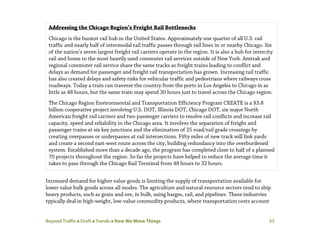
Addressing the Chicago Region’s Freight Rail Bottlenecks
Chicago is the busiest rail hub in the United States. Approximately one quarter of all U.S. rail
traffic and nearly half of intermodal rail traffic passes through rail lines in or nearby Chicago. Six
of the nation’s seven largest freight rail carriers operate in the region. It is also a hub for intercity
rail and home to the most heavily used commuter rail services outside of New York. Amtrak and
regional commuter rail service share the same tracks as freight trains leading to conflict and
delays as demand for passenger and freight rail transportation has grown. Increasing rail traffic
has also created delays and safety risks for vehicular traffic and pedestrians where railways cross
roadways. Today a train can traverse the country from the ports in Los Angeles to Chicago in as
little as 48 hours, but the same train may spend 30 hours just to travel across the Chicago region.
The Chicago Region Environmental and Transportation Efficiency Program CREATE is a $3.8
billion cooperative project involving U.S. DOT, Illinois DOT, Chicago DOT, six major North
American freight rail carriers and two passenger carriers to resolve rail conflicts and increase rail
capacity, speed and reliability in the Chicago area. It involves the separation of freight and
passenger trains at six key junctions and the elimination of 25 road/rail grade crossings by
creating overpasses or underpasses at rail intersections. Fifty miles of new track will link yards
and create a second east-west route across the city, building redundancy into the overburdened
system. Established more than a decade ago, the program has completed close to half of a planned
70 projects throughout the region. So far the projects have helped to reduce the average time it
takes to pass through the Chicago Rail Terminal from 48 hours to 32 hours.
Beyond Traffic  Draft  Trends  How We Move Things 54
for a higher proportion of the overall cost than is the case for manufactured goods. The relative
efficiency of the American freight system helps these industries compete in export markets. For
example, one dollar of final demand for agricultural products generally requires about 14 cents of
transportation services, while manufactured goods and mining products require only between 8
and 9 cents. Higher freight costs for bulk goods could increase the prices that American consumers
pay for goods, negatively impact local economies, particularly in rural areas, and reduce U.S.
competitiveness when exporting these products abroad. In a global economy, transportation costs
can have a major impact on whether U.S. products are competitively priced.
Our increasingly urbanized population poses challenges for “first mile” and “last mile” freight movements.
Freight demand is expected to be concentrated in the large metropolitan areas where America’s
population is growing the fastest. Congestion in several metropolitan population centers is already
severe and could become more extreme. Increasing freight demand in these densely populated
areas will complicate “first mile” movement of goods out of ports and the “last mile” movement of
goods from freight hubs to their final destinations, which is often the least efficient portion of the
supply chain for many consumer goods.
Freight-related traffic can also result in delays and congested road conditions for passenger and
emergency response vehicles. For example, highway-rail grade crossings can lead to lengthy delays.
Traffic to and from ports and other major freight centers can increase traffic on local roads and
affect neighboring communities through noise and air pollution. These issues may become more
challenging as online shopping increases the portion of deliveries that are made directly to
consumers’ homes. The challenge of delivering freight to dense urban areas will grow in
importance as urban populations and deliveries increase.
Beyond Traffic  Draft  Trends  How We Move Things 55
Rural Freight Transportation: A Critical Link
Many rural areas depend on a robust multimodal freight network to support their economy. While
the majority of freight in our country is delivered by trucks, railways are often essential for the
affordable transport of heavy and bulky commodities such as lumber, wheat, coal, and heavy
equipment. Inland waterways are also a critical feature of a robust rural freight transportation
network. The first long distance system for moving goods and people, inland waterways remain an
inexpensive alternative for moving commodities such as grain and iron ore. Ultimately, the role of
freight in rural communities varies according to the primary economic sectors whether it is
tourism, manufacturing or agriculture. The nature of agriculture product matters as well: heavy
grains rely upon barge and rail transport, while specialized or highly perishable fruits and
vegetables may require air transport or overnight trucking to reach domestic and global markets.
Freight transport is critical to support rural industry, as it transports the raw goods and products
needed to support and promote growth in rural economies. Well-planned, multimodal freight
systems provide opportunities for companies to locate and grow in rural regions due to efficient
and reliable connections with major markets and ports. Intermodal facilities and logistics centers
located in rural areas can benefit from lower costs than urban areas and may be strategically
located at a key transfer point in a freight corridor.
Rural freight transportation also poses challenges to policymakers. For example, the restructuring
of the rail industry has led to the abandonment of many branch lines, cutting off service to many
rural areas, leading to grain elevator consolidation along mainline and increased truck travel on
rural roads to get wheat from farms to grain elevators. Heavy truck traffic along freight corridors
passing through rural areas can also raise road maintenance costs without bringing direct
economic benefits to the area. Such issues present challenges for rural regions, which have fewer
resources and less flexibility to address such issues.
Beyond Traffic  Draft  Trends  How We Move Things 56
Beyond Traffic  Draft  Trends  How We Move Things 57
Peak-Period Congestion on the National
Highway System: 2011 and 2040
Assuming no changes in network capacity,
increases in truck and passenger vehicle traffic
are forecast to expand areas of recurring peak-
period congestion to 37 percent of
the National Highway System in 2040
compared with 11 percent in 2007. This will
slow traffic on 21,000 miles of the NHS and
create stop-and-go conditions on an additional
40,000 miles. 2011
2040
Beyond Traffic  Draft  Trends  How We Move Things 58
Safety Effects
The need to transport increasing amounts of freight to large urban areas could increase conflicts
between freight and passenger traffic. Higher truck traffic and increasing movement of hazardous
materials such as crude oil, could raise safety risks, however trends show impressive improvements
freight safety.
Freight transportation is involved in approximately 13 percent of all transportation fatalities. In
2013, 3,944 people were killed in crashes involving large trucks. Large trucks are less likely to be
involved in crashes than passenger vehicles, but crashes involving trucks are more likely to be fatal.
In 2012, approximately 600 people died in rail, vessel, and pipeline accidents. While the amount of
freight transportation activity has increased in recent decades, the number of fatalities has
declined in nearly all modes. New technologies and better driver education (for both car and truck
drivers) could augment this decline.
The rail safety record is improving with accidents and derailment down by nearly 50 percent over
the past decade and fatalities down by 12 percent. Accidents related to human error and track
defects account for more than two-thirds of all train accidents, and trespassing and highway-rail
grade crossing incidents account for approximately 95 percent of all rail-related fatalities. The
implementation of positive train control should contribute to increasing safety in railroad
operations.
Beyond Traffic  Draft  Trends  How We Move Things 59
Transportation of oil by rail has increased
dramatically since 2008, when less than 1 percent of
oil was transported by rail. Today, more than 10
percent of all crude oil is now shipped by rail. Even
so, crude oil still accounts for less than two percent
of all car loads on Class I railroads.
Recent derailments of tank cars highlight rising
safety and environmental risks associated with
increasing transportation of oil by rail. As more oil
has moved by rail, accidents involving oil spills have
increased. In 2013, more than one million gallons of
oil were spilled due to derailments, more than the
total oil spilled as a result of rail accidents over the
past 35 years. Many railroads and trucking
companies are also working closely with government and labor representatives to address operator
fatigue issues, instill a culture of safety among operators and establish the use of performance-
based risk management programs that can further improve safety records. In the long term, the
introduction of connected vehicle technologies in trucks and automated vehicle technologies in
both cars and trucks should lead to further improvements in safety as they come on-line.
Beyond Traffic  Draft  Trends  How We Move Things 60
Environmental Impacts
Increasing freight activity in urban areas could also intensify the debate over land use and
pollution. Without effective policies and regulations, growing freight movements will increase
greenhouse gas emissions, and will affect human health in neighborhoods along freight corridors.
Trucking, intermodal rail, waterborne transportation, and air cargo constitute large and growing
sources of greenhouse gas emissions. Trucking accounts for about 9 percent of all highway miles
traveled, but it is the source of 20 percent of all transportation-sector greenhouse gas emissions.
Freight on other modes accounts for an additional 7 percent of greenhouse gas emissions.
Trucking is the single largest contributor to freight-related air pollution nationally. Compared to cars,
heavy trucks emit large amounts of toxic air pollutants—including hydrocarbons and nitrous
oxides. While trucks have made great strides in reducing emissions, the average diesel-fueled heavy
truck emits more than twice as many hydrocarbons per mile and more than 15 times as many
nitrous oxides as the average passenger car. These emissions can impact human health,
particularly in neighborhoods adjacent to heavily trafficked freight corridors.
Heavy trucks are responsible for most of the growth in greenhouse
gas emissions in the freight sector.
Since 1990, greenhouse gas emissions from trucking have increased
five times faster than emissions from passenger travel.
Beyond Traffic  Draft  Trends  How We Move Things 61
Beyond Traffic  Draft  Trends  How We Move Things 62
Even as demand for freight movement increases, new emissions standards, fuel sources, and
energy-efficient intermodal transportation may lead to reductions in emissions of nitrous oxide
(NOx) and particulate matter. Substantial reductions in freight-related NOx emissions have been
made since the U.S. Environmental Protection Agency required the use of ultralow sulfur diesel
fuel in heavy-duty trucks and other diesel-powered highway vehicles beginning in 2006. Truck-
related NOx and PM-10 emissions are projected to decline by 56 and 66 percent, respectively, from
2012 to 2030. Continued improvements in engine technologies, including the use of new fuels
(such as natural gas or hydrogen) and vehicles built from lighter materials, should reduce fuel
consumption and emissions from all forms of freight vehicles. Similarly, new standards for cleaner
and more fuel efficient trucks, trains, vessels, and aircraft may reduce the pollution associated with
carrying more freight.
Globalization
Over the past 30 years, international trade has increased at a much faster rate than overall
economic growth. U.S. exports nearly doubled over the past decade. Total exports and imports of
goods reached $3.9 trillion in 2013, accounting for 23 percent of U.S. GDP.
In the next 30 years, it is likely that globalization will continue to expand the supply of imports
domestically and demand for exports globally. With 95 percent of the world’s consumers outside
the United States, and with a shrinking share of global GDP due to the projected economic rise of
China, India, and other emerging markets, international trade will grow in importance and put
increasing pressure on our ports, border crossings, airports, and intermodal facilities to efficiently
move imports and exports to market.
Beyond Traffic  Draft  Trends  How We Move Things 63
In addition to changes in the volume of international freight, the origin and destination of freight
trips may undergo significant changes. Maritime trade will remain the leading form of
international freight transportation; however, there will be changes in the dominant maritime
trade routes.
The widening and deepening of the Panama Canal, which is expected to be completed by 2016, will
enable larger ocean-going vessels, known as “post-Panamax” ships, to pass through the Canal. Of
the cargo passing through the Canal, 64 percent originates in or is destined for the United States,
so the widening is expected to increase container ship freight volume loaded and unloaded at Gulf
and East Coast ports. Canal improvements may also increase traffic at West Coast ports by
enabling more efficient commerce between those ports and the Caribbean, as well as Atlantic ports
in South America. It will also become increasingly important for ports to address congestion and
equipment shortage challenges generated by bigger, new-generation container ships that offload
larger volumes of containers in relatively shorter amounts of time.
The melting polar ice cap is opening Arctic shipping lanes. The Northern Sea Route, a shipping lane
across the rim of Siberia connecting the Atlantic to the Pacific, first became passable in 2007. In
2013, a Danish cargo ship became the first to use the Northwest Passage, the sea route running
from Alaska through the Canadian Arctic Archipelago, as an alternative to the traditional voyage
through the Panama Canal. While these seasonal routes are unlikely to rival the high-traffic Suez
Canal and Panama Canal routes, they may provide a partial alternative to existing maritime routes.
However, regular use of these new routes would require considerable investments in facilities to
service and ensure safe passage of ships through these areas.
Beyond Traffic  Draft  Trends  How We Move Things 64
Beyond Traffic  Draft  Trends  How We Move Things 65
Increasing imports and exports could lead to greater congestion at container ports and border
crossings, resulting in delayed shipments, increased transportation costs, and intensifying
pollution. Today, intermodal shipments are concentrated in the top 10 to 12 deep water ports with
the requisite infrastructure. Eighty-five percent of America’s imported and exported containerized
freight flows through just 10 ports.
There are also international shipments that do not involve U.S. importers or exporters, or
domestic supply and demand, but still influence volume and congestion on our freight network.
These shipments, commonly referred to as in-transit shipments, travel from one country through
the U.S. destined for another country without ever entering into U.S. commerce. Some foreign
shippers use our nation’s freight system of coastal ports, airports, pipelines, railways, and
highways as a “land bridge.” The Northern Sea Route, expansion of the Panama Canal, and the
continued trends in congestion and bottlenecks may lead to a decrease in in-transit shipments
through the U.S. in the future.
Beyond Traffic  Draft  Trends  How We Move Things 66
The concentration of intermodal shipments in these ports makes our international freight system
vulnerable to disruption. If security incidents were to lead to heightened inspection requirements,
they could further slow goods movement at ports of entry. Labor disputes and natural disasters
also have the potential to impact operations at key ports and disrupt the national economy.
Port authorities are already investing billions to modernize their facilities and accommodate new-
generation container ships by dredging harbors, raising bridges, and purchasing larger ship-to-
shore cranes. Ports will need to continue to respond to increased demand for efficient intermodal
freight movement with innovations that allow them to transfer cargo from ships to roads and rails
more quickly. Finally, American ports may need to expand and become more efficient to compete
with growing deep-water ports in neighboring and nearby countries.
Beyond Traffic  Draft  Trends  How We Move Things 67
Beyond Traffic  Draft  Trends  How We Move Things 68
Freight Innovations
The freight industry is quietly going through a technological revolution as information and
communications technologies are applied to optimize global supply chains. These technologies and
business innovations are accelerating trends that have led to 30 years of declining logistics and
transportation costs relative to GDP. Emerging supply-chain optimization practices are resulting
in firms placing a premium on the reliability of transportation services.
Manufacturers and shippers are becoming better and better at using information technology to
optimize performance. Today, the private sector uses new technologies to analyze demand and
rapidly adjust supply chains. This is not a new practice, but enhanced data systems now provide
manufacturers and distributors access to real-time information that allows them to adapt more
quickly than ever before.
Private firms are also changing the way they package and ship products to make deliveries more
efficient. Delivery consolidation through less-than-truckload deliveries combines multi-stop
shipments into a single truck, and reduces the number of trucks on our highways. Similarly, firms
are now using mobile technology to connect truck drivers to last-mile freight orders that can fill
excess truck capacity. By matching supply and demand, these companies have the potential to
improve the efficiency of independent operators. These efficiency innovations may also help to
reduce the impact of growing demand on the capacity of our freight transportation system.
Recent technological advances in data analysis systems, automatic vehicle and container
identification systems, and satellite navigational systems will improve the efficiency of freight
movement. These technologies will improve situational awareness, allowing real-time
decentralized access to location and operational data. Understanding where a package is at any
given time (even when it is in the air or on the road) and when it is due to arrive will allow for more
efficient movement of freight across modes and through processing facilities.
Beyond Traffic  Draft  Trends  How We Move Things 69
Advances in information and communications technologies will improve data collection and
analysis capabilities of logistics firms and freight planners, enabling faster and more accurate
analysis of freight routes, travel times, and infrastructure capacity. They will also improve safety
by automating and expediting inspection processes, and by allowing for improved monitoring of
security information.
Fully and partially automated trucks, ships, and planes, and automatic freight-transfer facilities, may
eventually transform the freight industry. Autonomous vehicles will not suddenly appear on our
roads, but automated features that promise to improve the safety and efficiency of freight
movement are already being introduced. On trucks, these include sensor systems that combine
adaptive speed control, automatic braking, lane-departure warning systems, and vehicle-to-vehicle
communications. By allowing sensors on one truck to communicate with sensors on another truck,
partially automated trucks could soon travel more closely together to improve fuel efficiency, in a
practice known as truck platooning or truck trains.
Automation is already affecting ports. At major container ports around the world, the process of
transferring containers from ships to docks, trucks, and trains is becoming highly automated,
reducing reliance on human operators. Major American container ports will need to invest in
automation to compete.
Automation will change the nature of work in the freight industry. Advanced automation will increase
productivity in the freight industry and change the skills needed to work in freight. Technologies
that affect driving, vehicle maintenance, warehousing, and loading will alter professional
development needs, and employment levels—and will affect the average income for transportation
workers. Managing and maintaining automated ports and fleets will require advanced mechanical
and data analysis jobs that demand higher skills and higher pay than traditional freight work.
Beyond Traffic  Draft  Trends  How We Move Things 70
While some innovations in freight, such as automated driving, seem incredibly complex, some of
the most transformative innovations are remarkably simple. The container—a large, standardized
metal box used for cargo shipments—has become the essential unit of intermodal freight
movement. Since its introduction as an alternative to conventional break-bulk cargo shipping in
the 1960s, the container has influenced virtually all aspects of the freight transportation system,
including the size of cargo ships, the design of container ships, the structure of freight railroads,
and the scale of global trade.
The use of efficient, high-speed intermodal transfers in economically large units between ships,
railcars, truck chassis, and barges has led to profound changes in the transportation sector. By
reducing handling time, labor costs, and packing costs, and also reducing damage and theft during
transport, container transportation has facilitated economies of scale and improvements in
handling speed and throughput, particularly for valuable non-bulk commodities. As a result of
container use, intermodal freight movement has expanded dramatically since the 1980s,
particularly for shipments over 2,000 miles.
The advent of containerization has put a premium on seamless intermodal freight movements.
The efficiency of our freight system now depends on fast and effective transfers of containers
between modes. Intermodal facilities where cargo is stored, assembled, and transferred have
become increasingly important for the efficient movement of freight. Many of the operational
bottlenecks that cause delays and raise the costs of moving freight occur at or around intermodal
transfer points, such as ports, rail facilities, and distribution centers.
The number of intermodal rail shipments increased from 2 million
in 1980 to 12.8 million in 2013.
Beyond Traffic  Draft  Trends  How We Move Things 71
Freight planners and policymakers will increasingly look to intermodal logistics hubs to improve
the efficiency of transfers between multiple freight modes and reduce the negative impacts of
freight on local communities. Increased use of practices, such as double-stacking of containers on
railway cars, will also increase the capacity and efficiency of the freight system.
Beyond Traffic  Draft  Trends  How We Move Things 72
Increasing Domestic Energy Production
America is experiencing an energy renaissance. This current boom is a result of advances in
technology that have opened up reserves of natural gas and shale oil previously unreachable at
economically competitive rates. While shale oil has been extracted for over a century, new
technologies and changes in global energy markets have made the recovery of shale oil, and gas
production, significantly more profitable in recent years. As a result, domestic oil and gas
production has increased rapidly, creating issues for the safe and efficient transportation of energy
from production regions to refineries and consumer markets.
Over the past three years, domestic oil production has increased by nearly 60 percent. We now produce
more than 260 million barrels of oil a month, the highest level in more than 30 years. Domestic
shale gas production has increased from 2 trillion cubic feet in 2007 to 10 trillion cubic feet in
2013. By 2035, experts predict that annual shale gas production will rise to 13.6 trillion cubic
feet—enough natural gas to heat 204 million homes each year. As a result of this boom, net
imports of natural gas and oil have been falling since 2007. The Energy Information
Administration has predicted that we will become a net exporter of natural gas before 2020. That
said, future developments, such as fluctuations in global fuel prices or the development of
affordable alternative fuels, could alter current oil and gas production trends.
In 2013, the United States surpassed Saudi Arabia to become the
largest oil-producing country in the world.
Beyond Traffic  Draft  Trends  How We Move Things 73
High-value energy products already account
for more than 30 percent of the domestic ton-
miles of freight moved each year.Should U.S.
energy production continue to grow, it will
have profound implications for our
transportation system. The natural gas and oil
boom has created jobs in drilling, pipelines,
and construction, and is attracting many new
people to production regions. Simultaneously,
these regions are transporting unprecedented
levels of natural gas and oil to distribution
centers around the country. As a result,
demand for transportation in energy
production regions has grown. Industrial
traffic—heavy trucks, and drilling and other
production equipment—is overwhelming
many roads in states such as Pennsylvania,
West Virginia, Ohio, and North Dakota.
Beyond Traffic  Draft  Trends  How We Move Things 74
The shifting geography of petroleum production is increasing safety risks and raising
transportation and infrastructure maintenance costs. The current pipeline network, regulated by
the U.S. DOT’s Pipeline and Hazardous Materials Safety Administration, is oriented toward
imports arriving at Gulf Coast refineries and does not connect the East and West Coasts to the
newer domestic oil supplies.
The domestic production boom will increase demand for infrastructure capacity to move oil and
gas. Facilities will need to be reoriented to accommodate gas and oil supply and demand. Federal
and state agencies will need to address new challenges related to human safety, and risks to the
natural environment, resulting from the transportation of natural gas and petroleum. Lower fuel
prices will lead the trucking, rail, and transit industries to increase the use of compressed natural
gas (CNG) and liquid natural gas (LNG) as an affordable alternative to diesel.
Beyond Traffic  Draft  Trends  How We Move Things 75
Recent growth in domestic oil production has been concentrated in
states such as Texas and North Dakota, increasing the volume of
industrial traffic in these areas.
Beyond Traffic  Draft  Trends  How We Move Things 76
Policy Implications
Freight transportation is quietly undergoing a transformation. Our economy is becoming ever
more globalized, with cargo increasingly moving across borders and between modes. This trend has
increased the importance of international gateways and intermodal connections for facilitating the
efficient movement of imports and exports. Innovations in supply chain logistics and information
technologies are raising the expectations of consumers and firms for fast, reliable, flexible, and
efficient delivery of goods and resources. Automation has the potential to revolutionize how ports,
trains, vessels, and trucks operate. Domestic energy production has increased, leading to increased
demand for infrastructure to safely and efficiently transport energy products to where they are
needed.
As global economic competition increases and trade patterns change, we will need to decide how
best to invest limited public resources in freight capacity. We will need to consider what
infrastructure capacity is needed and where, and how to make the best use of existing capacity
while considering the public benefits these investments offer. We will also need to consider what
role government should play in ensuring that American workers have the skills and information
needed to ensure the most efficient use of existing capacity and emerging technologies.
Policymakers will also need to work with the private sector, when appropriate and mutually
beneficial, to expand capacity and improving the efficient use of our freight infrastructure.
Beyond Traffic  Draft  Trends  How We Move Things 77
We will also need to consider how local policies, constraints, and investments may affect the
performance of regional and national networks. Locally-driven decisions about freight capacity can
create regional competition that leads to inefficient national investments. The decisionmaking
structure for critical freight networks varies from locale to locale, and the authority is often held by
a mixture of public and private, state, local, and regional entities, that may represent one or many
modes of freight movement. The Alameda Corridor, a 20-mile grade-separated rail corridor that
runs directly to the Ports of Los Angeles and Long Beach to the rail mainlines near downtown Los
Angeles, took nearly 20 years of coordinated efforts among public and private stakeholders across
the region to become a reality. Completed in 2002, the project reduced travel times along the
corridor from 4 hours to 30 minutes.
Many of the worst freight bottlenecks are located on the roads surrounding major urban areas and
near coastal container ports and large intermodal terminals, where freight traffic and passenger
traffic compete for capacity. As the population and economies of urban areas grow, demand for
freight on already congested access gateways to ports, road, rail, and aviation infrastructure is
likely to increase. How can regions plan for increasing traffic and resolve conflicts that may arise
between the transportation demands for freight, passengers, businesses, and local residents?
As we have seen with efforts to accommodate increasing domestic energy production, meeting the
transportation needs of growing regional economies is not without challenges and controversy.
There are serious tradeoffs that need to be considered, especially when societal goals conflict.
Policymakers have a significant role to play in assessing those tradeoffs to set policies and
regulatory standards that effectively address issues of economic development, public safety, and
environmental sustainability.
Beyond Traffic  Draft  Trends  How We Move Things 78
Public agencies will need to develop policies and regulations that address those risks and improve
the resilience of our freight system. Policy options for improving the efficiency of our freight
transportation system and mitigating the negative impacts of freight movements include:
 Establishing strategic freight funding programs that target freight bottlenecks.
 Encouraging private investment in freight infrastructure.
 Adopting policies that shift freight demand to safer, more environmentally sustainable
modes.
 Using congestion pricing to manage demand.
 Investing in ports and intermodal facilities to make intermodal shipping more efficient.
 Incorporating freight planning into transportation planning and regional economic
development decisions.
 Incentivizing the adoption of alternative-fuel and electric vehicles by freight companies.
 Supporting research into automation technologies.
 Investing in infrastructure to support the safe and efficient movement of energy supplies.
These policy options are explored in further depth in the conclusion of this report.
Beyond Traffic  Draft  Trends  How We Move Things 79
References
• Gross Domestic Product data from Global Insight. Analysis by Volpe, the National Transportation Systems Center.
• (BTS) Bureau of Transportation Statistics. Transportation Satellite Accounts 2011; “Contribution of Transportation Services to Gross Domestic Product (GDP).”
(http://www.rita.dot.gov/bts/sites/rita.dot.gov.bts/files/publications/transportation_satellite_accounts/2011/html/table_01.html)
• (Commerce) Department of Commerce. “U.S. Exports Reach $2.3 Trillion in 2013, Set New Record for Fourth Straight Year.” News release. February 6, 2014.
(http://www.commerce.gov/news/press-releases/2014/02/06/us-exports-reach-23-trillion-2013-set-new-record-fourth-straight-year)
• The White House. “Remarks by the President on the Economy – Port of New Orleans.” News release. November 8, 2013.
(http://www.whitehouse.gov/the-press-office/2013/11/08/remarks-president-economy-port-new-orleans)
• (EIA) Energy Information Administration. Petroleum & Other Liquids; “Crude Oil Production.”
(http://www.eia.gov/dnav/pet/pet_crd_crpdn_adc_mbbl_a.htm)
• Association of American Railroads. 2014. Moving Crude Oil by Rail. September.
(https://www.aar.org/BackgroundPapers/Crude%20Oil%20by%20Rail.pdf)
• Schrank, David, Bill Eisele, and Tim Lomax. Texas A&M Transportation Institute. 2012. TTI’s 2012 Urban Mobility Report. December.
(http://d2dtl5nnlpfr0r.cloudfront.net/tti.tamu.edu/documents/mobility-report-2012.pdf)
• (MARAD) Maritime Administration. CMTS Data Inventory;“Maritime Statistics.”
(http://www.marad.dot.gov/library_landing_page/data_and_statistics/Data_and_Statistics.htm)
• American Association of Port Authorities. Port Industry Statistics; “Western Hemisphere Port TEU Container Volumes 1980-2013.”
(http://www.aapa-ports.org/Industry/content.cfm?ItemNumber=900)
• American Association of Port Authorities. Port Industry Statistics; “U.S. Waterborne Foreign Trade 2013 Port Ranking by Cargo Volume.”
(http://www.aapa-ports.org/Industry/content.cfm?ItemNumber=900)
• American Association of Port Authorities. Port Industry Statistics; “U.S. Waterborne Foreign Trade 2013 Port Ranking by Cargo Value.”
(http://www.aapa-ports.org/Industry/content.cfm?ItemNumber=900)
• Han, Stephanie, and Natalie Soroka. Department of Commerce. 2014. U.S. Trade Overview, 2013. October.
(http://www.trade.gov/mas/ian/build/groups/public/@tg_ian/documents/webcontent/tg_ian_002065.pdf)
• (FHWA) Federal Highway Administration. 2014. Freight Facts and Figures 2013. January.
(http://ops.fhwa.dot.gov/freight/freight_analysis/nat_freight_stats/docs/13factsfigures/pdfs/fff2013_highres.pdf)
• (BOC) Bureau of the Census. Population Estimates; “Vintage 2012: Annual Population Estimates.”
(http://www.census.gov/popest/data/historical/2010s/vintage_2012/national.html)
• Multpl. U.S. GDP Growth Rate by Year. 2014.
(http://www.multpl.com/us-gdp-growth-rate/table/by-year)
Beyond Traffic  Draft  Trends  How We Move Things 80
• (FHWA) Federal Highway Administration. 2005. Logistics Costs and U.S. Gross Domestic Product. August.
(http://ops.fhwa.dot.gov/freight/freight_analysis/econ_methods/lcdp_rep/index.htm)
• Gilmore, Dan. Supply Chain Digest. “State of the Logistics Union 2014.” June 17, 2014.
(http://www.scdigest.com/ASSETS/FIRSTTHOUGHTS/14-06-17.php?cid=8190)
• (FHWA) Federal Highway Administration. 2005. An Initial Assessment of Freight Bottlenecks on Highways. October.
(http://www.fhwa.dot.gov/policy/otps/bottlenecks/bottlenecks.pdf)
• (BTS) Bureau of Transportation Statistics. National Transportation Statistics; “Table 1-50: U.S. Ton-Miles of Freight.”
(http://www.rita.dot.gov/bts/sites/rita.dot.gov.bts/files/publications/national_transportation_statistics/html/table_01_50.html)
• (FHWA) Federal Highway Administration. 2008. Freight Story 2008. November.
(http://ops.fhwa.dot.gov/freight/freight_analysis/freight_story/fs2008.pdf)
• (FHWA) Federal Highway Administration. 2012. Annual Vehicle Distance Traveled in Miles and Related Data. December.
(https://www.fhwa.dot.gov/policyinformation/statistics/2010/pdf/vm1.pdf)
• (FHWA) Federal Highway Administration. Freight Facts and Figures 2013; “Figure 3-1. Freight Flows by Highway, Railroad, and Waterway: 2010.”
(http://www.ops.fhwa.dot.gov/freight/freight_analysis/nat_freight_stats/docs/13factsfigures/figure3_01.htm)
• Transportation Research Board. 2003. Freight Capacity for the 21st
Century.
(http://onlinepubs.trb.org/onlinepubs/sr/sr271.pdf)
• (EPA) Environmental Protection Agency. 2014. Inventory of U.S. Greenhouse Gas Emissions and Sinks: 1990 – 2012. April.
(http://www.epa.gov/climatechange/Downloads/ghgemissions/US-GHG-Inventory-2014-Main-Text.pdf)
• (BOC) Bureau of the Census. “U.S. International Trade in Goods and Services.” News release. November 4, 2014.
(https://www.census.gov/foreign-trade/Press-Release/2014pr/09/ft900.pdf)
• Sabonge, Rodolfo. “Expansion of the Panama Canal: Potential Impact on Asia – East Coast/Golf Trade.” Presentation for the Federal Highway Administration’s
Talking Freight Series. October 21, 2009.
(http://www.fhwa.dot.gov/planning/freight_planning/talking_freight/talkingfreight10_21_09rs.pdf)
• Masters, Jonathan. Council on Foreign Relations. “The Thawing Arctic: Risks and Opportunities.” December 16, 2013.
(http://www.cfr.org/arctic/thawing-arctic-risks-opportunities/p32082)
• Rodrigue, Jean-Paul. Hofstra University. The Geography of Transport Systems; “Evolution of Containerships.”
(http://people.hofstra.edu/geotrans/eng/ch3en/conc3en/containerships.html)
• (MARAD) Maritime Administration. 2009. America’s Ports and Intermodal Transportation System. January.
(http://www.glmri.org/downloads/Ports&IntermodalTransport.pdf)
• Hillestad, Richard, Ben D. Van Roo, and Keenan D. Yoho. Rand Corporation. 2009. Fast-Forward: Key Issues in Modernizing the U.S. Freight-Transportation System.
(http://www.rand.org/content/dam/rand/pubs/monographs/2009/RAND_MG883.pdf)
Beyond Traffic  Draft  Trends  How We Move Things 81
• Ting, Eric. The Containerships and Containers.
(http://ind.ntou.edu.tw/~ericting/download/Container%20Transport/03%20The%20Containerships%20and%20Containers.pdf)
• (DOE) Department of Energy. 2013. Freight Transportation Modal Shares: Scenarios for a Low-Carbon Future. March.
(http://www.camsys.com/pubs/55636.pdf)
• Paresh, Dave. Los Angeles Times. “Cargomatic’s mobile technology connects truckers to short-range jobs.” September 27, 2014.
(http://www.latimes.com/business/la-fi-cargomatic-20140927-story.html)
• Rodrigue, Jean-Paul. “Challenging the derived transport-demand thesis: geographical issues in freight distribution.” Environment and Planning 38 (2006): 1449 –
1462, doi: 10.1068/a38117.
(http://www.environmentandplanning.com/epa/fulltext/a38/a38117.pdf)
• Ranaiefar, Fatemeh. University of California, Irvine, Institute of Transportation Studies. 2012. Intelligent Freight Transportation Systems. Spring.
(http://freight.its.uci.edu/sites/default/files/cee298_presentations/rfatemeh/Intelligent%20Freight%20Transportation%20Systems_Fatemeh.pdf)
• (FHWA) Federal Highway Administration and (FTA) Federal Transit Administration. 2013. 2013 Status of the Nation’s Highways, Bridges, and Transit: Conditions &
Performance.
(http://www.fhwa.dot.gov/policy/2013cpr/pdfs/cp2013.pdf)
• Association of American Railroads. “Freight Rail Traffic for 2013 Saw Record Intermodal Growth, Slight Dip in Carloads.” News release. January 9, 2014.
(https://www.aar.org/newsandevents/Freight-Rail-Traffic/Pages/2014-01-09-railtraffic.aspx)
• Notteboom, Theo and Jean-Paul Rodrigue. “The Future of Containerization: Perspectives from Maritime and Inland Freight Distribution.” GeoJournal 74 (2009):
7-22.
(http://people.hofstra.edu/jean-paul_rodrigue/downloads/future_containerization_tn_jpr_draft%20final.pdf)
• Rodrigue, Jean-Paul, Claude Comtois, and Brian Slack. 2006. Geography of Transportation Systems.
(https://people.hofstra.edu/geotrans/eng/gallery/Geography%20of%20Transport%20Systems_1ed.pdf)
• “The Humble Hero.” The Economist. May 18, 2013.
(http://www.economist.com/news/finance-and-economics/21578041-containers-have-been-more-important-globalisation-freer-trade-humble)
• Sulbaran, Tulio, and MD Sarder. American Society for Engineering Education, Southeast Section Conference. 2013. Logistical Impact of Intermodal Facilities. April.
(http://se.asee.org/proceedings/ASEE2013/Papers2013/183.PDF)
• American Association of Port Authorities. Port Industry Statistics; “Western Hemisphere Port TEU Container Volumes, 1980-2013.”
(http://www.aapa-ports.org/Industry/content.cfm?ItemNumber=900)
• (EIA) Energy Information Administration. 2014. International Energy Statistics; “Total Oil Supply Data.”
(http://www.eia.gov/cfapps/ipdbproject/IEDIndex3.cfm?tid=5&pid=53&aid=1)
• (DOE) Department of Energy. “Producing Natural Gas from Shale.” January 26, 2012.
(http://energy.gov/articles/producing-natural-gas-shale)
• (EIA) Energy Information Administration. Natural Gas; “Natural Gas Gross Withdrawals and Production.”
(http://www.eia.gov/dnav/ng/ng_prod_sum_dcu_nus_a.htm)
Beyond Traffic  Draft  Trends  How We Move Things 82
• (EIA) Energy Information Administration. 2013. Natural Gas Annual 2013.
(http://www.eia.gov/naturalgas/annual/pdf/nga13.pdf)
• (EIA) Energy Information Administration. 2014. Annual Energy Outlook 2014. April.
(http://www.eia.gov/forecasts/aeo/pdf/0383(2014).pdf)
• (BTS) Bureau of Transportation Statistics. National Transportation Statistics; “Table 1-59.”
(http://www.rita.dot.gov/bts/sites/rita.dot.gov.bts/files/publications/national_transportation_statistics/html/table_01_59.html)
• Begos, Kevin and Jonathan Fahey. Associated Press. “Deadly Side Effect to Fracking Boom.” May 5, 2014.
(http://bigstory.ap.org/article/ap-impact-deadly-side-effect-fracking-boom-0)
• Curtis, Trisha, et. al. Oil & Gas Journal. “Lagging pipelines create U.S. gulf light sweet crude glut.” March 3, 2014.
(http://eprinc.org/wp-content/uploads/2014/03/OGJ-EPRINC-Article.pdf)
• Association of American Railroads. 2014. Moving Crude Oil by Rail. September.
(https://www.aar.org/BackgroundPapers/Crude%20oil%20by%20rail.pdf)
• Frittelli, John, et. al. Congressional Research Service. 2014. U.S. Rail Transportation of Crude Oil: Background and Issues for Congress. May.
(http://fas.org/sgp/crs/misc/R43390.pdf)
• Esser, Charles. International Energy Agency. “Rail vs. pipelines: how to move oil.” May 2, 2014.
(http://www.iea.org/ieaenergy/issue6/rail-vs-pipelines-how-to-move-oil.html)
• (EIA) Energy Information Administration. Petroleum & Other Liquids; “Crude Oil Production.”
(http://www.eia.gov/dnav/pet/pet_crd_crpdn_adc_mbbl_m.htm)
• (FHWA) Federal Highway Administration. Freight Management and Operations; “Freight Facts and Figures 2013.”
(http://ops.fhwa.dot.gov/freight/freight_analysis/nat_freight_stats/docs/13factsfigures/index.htm)
Beyond Traffic  Draft  Trends  How We Move Better 83
How We Move Better
Beyond Traffic  Draft  Trends  How We Move Better 84
Beyond Traffic  Draft  Trends  How We Move Better 85
Introduction
Over the next 30 years, advances in data collection, computing, navigation systems,
communication and mobile technologies, and robotics have the potential to dramatically change
the way we travel and deliver goods and services. Technologies emerging today promise to make
our future transportation system safer, more reliable, more efficient, more environmentally
sustainable, and more convenient. Many of the most transformative technology applications for
transportation have been developed in other sectors and for other purposes. One magazine
recently declared the smartphone the “most important transportation innovation of the decade.”
Governments have provided essential contributions through research, regulation, and policy to
support the development of a number of technologies important to transportation, such as GPS,
the Internet, and fuel-efficient vehicles, vessels and aircraft. These inventions have boosted the
American economy, creating jobs for American workers and improving our quality life. Still,
governments are often perceived as “behind the curve”—too slow to adopt promising technologies,
and imposing unwarranted barriers on beneficial innovations.
As technology continues to advance, governments will need to anticipate, accommodate, and
incentivize innovation. At the same time, as new technologies increase our reliance on ever more
sophisticated and complex systems, governments will need to understand and mitigate the risks
associated with new technologies to ensure that our transportation system remains safe and
secure.
This section summarizes broad, crosscutting technological trends that are transforming
transportation.
Beyond Traffic  Draft  Trends  How We Move Better 86
Global Positioning System
GPS, initially developed for the military, is now used to access accurate location, timing, and
navigation services by transportation users, from drivers to cyclists to ocean-going cargo vessels.
With the strong support of the federal government positioning, navigation, and timing services
have become widely available.
America’s GPS is no longer the only global navigation satellite system—Russia’s Global Navigation
Satellite System is now operational and Europe’s Galileo soon may be. Nations such as China,
Japan, and India are planning their own. Private systems combine other data sources, such as cell-
tower locations and Wi-Fi signals, to provide location information. Future travelers will be able to
access many of these systems from the same device, enabling speedier and more accurate location
fixes, while providing some measure of redundancy. Today, GPS provides positioning, navigation,
and timing information to all takers.
GPS is increasingly yielding benefits for transportation. For example, it allows drivers to choose
routes based on traffic, and allows transit riders to know when the next bus or train is arriving.
Fleet managers of freight companies, transit systems, and school buses are able to track vehicles in
real time, maximize vehicle utilization, and select efficient, reliable routes. Applied to aviation,
GPS can help pilots navigate, and allow planes to fly more efficient routes more safely; it is already
doing so in Alaska. In marine transportation, it improves the efficiency and security of ports by
allowing for the identification and tracking of vessels and containers. Rail systems use GPS for
asset management, tracking, and positive train control. For truck safety enforcement, GPS allows
inspection sites to be mobile. In the future, GPS may play a large role in enabling the development
of automated vehicles and payment systems, which are discussed below.
Beyond Traffic  Draft  Trends  How We Move Better 87
Data collection and analysis will become cheap and widespread. The information that agencies and
companies need to make transportation decisions has never been easier to acquire, understand,
and use. The billions of machines networked together by the Internet are constantly collecting
data, much of which can be useful to all types of transportation agencies, as well as freight and
logistics companies.
Emerging data source and tools have the potential to improve how public agencies make
investment and operational decisions, set standards and engage the public. For example, mobile
applications can allow citizens to report potholes allowing local agencies to quickly respond to road
maintenance needs. Sensors on transit, taxi, and truck fleets can monitor where vehicles drive,
how fast they are being driven, and when maintenance is required. The same technologies can be
applied to planes, trains and vessels.
Among their many uses, GPS and smartphones allow for automatic no-hands tracking, replacing
the frequent written journal entries traditionally used by shippers and carriers. Data can be
collected from commercial providers, or volunteers, across all modes, even biking and walking.
Data can also be collected in the field. For example, license-plate scanners and wireless signal
detection can collect the data needed to model traffic movement and demand at lower costs and
higher volumes than traditional, manual methods.
In a “big data” world, public agencies will need to develop their
capacity to collect, store, analyze, and report data.
Beyond Traffic  Draft  Trends  How We Move Better 88
Data are increasingly easy to share and use, thanks to open-source software and open-data
standards. For example, it is now routine to share transit schedule and route information, making
it possible for software developers and researchers to work with transit agencies across the globe.
Defining the public sector’s role in collecting, formatting, and sharing data will require input and
support from stakeholders and potential beneficiaries.
The widespread use of GPS also raises serious privacy concerns. Data security and privacy will
continue to be concerns that limit transportation applications. Freight companies, airlines—
actually, anyone who keeps information private to retain a competitive advantage—may be
reluctant to release their data. Regulators, researchers, and other data users will need to establish
agreements and systems to protect certain data. If agencies want to continue to use information
collected from individual travelers, it will be critical to remove characteristics from data that would
allow for personal identification of individuals. Malicious thefts or inadvertent releases can erode
public trust and make it difficult or impossible to use modern data science.
Payment will be easy, frequent, and inexpensive. Collecting user fees to fund transportation has often
been a cumbersome process, whether it has involved bus riders converting change to tokens, or
drivers stopping to pay highway tolls. New payment and fee collection technologies are reducing
queuing for collection, increasing the efficiency of collection, and allowing user fees to reflect true
user costs.
These technologies can take many forms. Built-in and standardized hardware radio tags for vehicle
tolls and swipe cards for transit riders have been implemented across the country, but require
users to install dedicated hardware. Seamless payment that uses smartphone apps or license-plate
readers are beginning to roll out, and are becoming popular with both users and implementers.
Beyond Traffic  Draft  Trends  How We Move Better 89
New methods of payment will enable transportation agencies to develop more targeted user-fee-based
revenue streams. It is now technically feasible for a transportation agency to charge each road user
for their use of infrastructure and their contributions to congestion, emissions, and wear and tear
on roads, by using GPS, smartphones, image-recognition software, and automated payment
systems. In comparison, fuel taxes, sales taxes, and general-fund revenues are crude instruments,
and physical toll infrastructure has significant costs of collection. To alleviate privacy concerns and
incentivize voluntary citizen participation in more efficient and targeted automated payment
systems, transportation agencies could use incentive-based programs, similar to auto insurance
programs that offer discounts to drivers who use devices that track how safely they appear to
drive.
The vast majority of Americans now have access to the Internet; more than half of all Americans
now own a smartphone; and many vehicles are equipped with on-board computers and GPS
navigation systems. These systems can be used to access detailed maps, real-time travel
conditions, and up-to-the-minute service schedules that help travelers make decisions about how,
when, and where to travel.
The widespread adoption of traveler information systems is
making travel easier and more convenient.
Beyond Traffic  Draft  Trends  How We Move Better 90
The relative openness of major smartphone platforms has allowed developers to release
applications useful across all modes. A range of tasks—from obtaining walking directions to the
nearest bus stop, to hailing taxis—is made easier due to the widespread adoption of smartphones.
Mobile-phone apps are being used by public agencies to monitor air and vessel traffic and
infrastructure conditions. Freight companies use mobile phones and tablets to log driver hours
and monitor packages. Phone GPS data are used to collect and provide real-time information on
traffic conditions. Smartphones are increasingly being used to make or certify payments for
transportation services.
Beyond Traffic  Draft  Trends  How We Move Better 91
3D printing has the potential to disrupt traditional
supply chains and counteract the growth of imports
by reducing the need for large-scale manufacturing,
transportation, and storage. 3D printing is a
groundbreaking technology that allows
manufacturers to render three-dimensional
objects from a digital file with great precision
using a laser or an extruder to build an object layer
by layer. Engineers have been using 3D printers
for more than a decade, but 3D printers are now
becoming more precise and more amenable to
using a broader range of materials. Desktop 3D
printers have now been made commercially
available and their costs are dropping, leading to
more widespread consumer use. 3D printers could
make it possible to manufacture customized
products and parts more quickly and
inexpensively.
Just as online shopping now makes it possible for companies to bypass traditional storefronts, 3D
printing will allow for more localized production and decentralized manufacturing. It may also lead
to an increase in the delivery of raw materials for 3D manufacturing. In the service parts industry,
3D printing may result in decreasing shipments of finished parts.In health care, 3D printing is
being used to manufacture customized hearing aids, braces, and even artificial limbs. The potential
effects of 3D printing on certain industries—electronics, automobiles, medicine—are great, but
the future of such a novel technology is difficult to predict. Continued advances in 3D printing
could impact freight transportation by shortening supply chains for high-value, urgent products,
reducing demand for air freight in particular.
Beyond Traffic  Draft  Trends  How We Move Better 92
Robotics research is advancing across all transportation modes. Advances in robotics are useful in
many broad applications. An algorithm that uses camera feeds to detect humans may have been
developed to protect factory workers, but can be just as useful when applied to security cameras on
a transit platform, or to the sensors on an automated vehicle. Billions of dollars in military,
commercial, and academic research have brought about unmanned, commercially-available aerial
and ground vehicles and watercraft. Robotics and automation research is poised to change much of
how transportation functions.
The advent of automated ground vehicles can change
the way transportation agencies perform operations
and maintenance, and deploy fleets and utility
vehicles. Many tasks associated with construction, and
road operations and maintenance, can be performed
by either automated vehicles or remotely-operated
vehicles. Automated climbing robots for aviation radio
towers, autonomous railroad track measurers, and
fully autonomous pipeline inspection gauges are all
under development, with some already available
commercially.
Beyond Traffic  Draft  Trends  How We Move Better 93
Automation will have a potentially transformative impact across all transportation modes, increasing
productivity, improving safety, and enhancing the capacity of existing infrastructure. It may also
have a profound impact on the transportation workforce, changing the skills required to manage,
operate, and maintain transportation vehicles and systems. The applications and effects of
automation and other technological advances on the transportation system are described in
further detail below.
Prototype Automated Inspection Vehicle
Beyond Traffic  Draft  Trends  How We Move Better 94
Modal Advances
Aviation
The Next Generation Air Transportation System
(NextGen) will modernize air traffic control
nationwide. The Federal Aviation Administration
(FAA) controls and regulates the national airspace
system. NextGen is an upgrade from the earlier
ground-based radar navigation system to satellite-
based navigation technology that is expected to
make aviation safer and more efficient. Although
NextGen is a long-term and complex undertaking,
we are already witnessing very significant benefits from it—giving pilots and controllers more
flexibility at certain airports, reducing wake-based separation standards at others, and reducing
congestion in some busy metro areas.
Many of these gains will be enabled by new technologies, policies and procedures, such as systems
to coordinate information exchange, and GPS-based aircraft surveillance and communications to
improve safety. The use of GPS-based systems will greatly improve the precision of air traffic
control operations. Aircraft will be routed to more direct and more efficient paths between origins
and destinations and will be able to fly more closely spaced, reducing congestion and delays caused
by congestion, and improving efficiency. Onboard digital communications equipment will improve
communications between the cockpit and air traffic control and allow for enhanced information
accessibility. Improved air navigation procedures are already being rolled out which allow aircraft
to use less fuel, saving airlines money and reducing emissions. Still, challenges remain to complete
the roll-out of NextGen.
Beyond Traffic  Draft  Trends  How We Move Better 95
Commercial space transportation will become available to the public. Wealthy individuals have
been able to purchase seats on the Russian Soyuz for many years, but flights are infrequent, cost
millions of dollars, and require months of training.
New vendors are competing to provide lower cost and more routine private space flight, eventually
turning this once novel mode of transportation into a reality for many. Established vendors will
provide cost-effective transportation for critical government or private-sector assets, such as
satellites. Additionally, space tourism is seen as highly likely at some point in the near future, and
nearly a thousand tickets have already been purchased. Communities across the country are
already competing to host this emerging market and have invested public funds in infrastructure
to support spaceport development.
Initial uses will be suborbital tourism flights, where tourists experience the sights and sensations
of space for a few minutes. The appeal of a two-hour suborbital flight from the East Coast to Asia
continues to draw interest and research funds, but it may take decades to become economically
feasible. Success in the suborbital market is expected to eventually translate into longer orbital
flights and visits to space stations.
Widespread commercial use of unmanned aircraft systems (UAS) is imminent. Authorization has
recently been granted for limited commercial UAS uses, including Arctic pipeline inspection and
moviemaking.
Beyond Traffic  Draft  Trends  How We Move Better 96
Many of the early missions for civilian UAS will be for
such purposes as remote sensing and surveillance.
Larger vehicles capable of carrying large payloads will
enable more uses, such as spraying farm fields,
surveying lands and infrastructure, and providing
radio coverage to broad areas as an alternative to
satellites.
Google, Amazon, and DHL have been evaluating
delivery of packages by unmanned aircraft for several
years. Remotely-piloted drone deliveries could be
used to provide high-value and urgent cargo to
remote and hard-to-reach locations within a decade.
For example, unmanned aircraft deliveries could be
used to deliver medical supplies to remote areas after
a natural disaster. Delivery by unmanned aircraft in
dense urban environments presents significantly
greater security, safety, and privacy risks, and will
likely take longer to develop.
Marine Transportation
Marine automation is increasing efficiency and decreasing crew size. A large vessel that would have
employed a crew of 25 only a decade ago may be possible to operate with a much smaller crew over
the next few decades. While this reduces the costs of shipping freight and grants cargo operators
more flexibility, it could also mean that a ship’s crew has less ability to quickly respond to incidents
such as spills, groundings, and piracy. Ships could be piloted remotely with a small crew of
technicians onboard in case of mechanical failure.
Beyond Traffic  Draft  Trends  How We Move Better 97
While full automation is still decades away, the signs of the future are on the horizon. In the
summer of 2014, the U.S. Coast Guard introduced a pilot project to deploy virtual aids to
navigation as opposed to physical sea buoys. Virtual aids to navigation will help to lay the
foundation for remotely-operated ships in the future. Likewise, research and development efforts
are focused on examining barge operations on inland waterways.
The labor required to load and unload vessels has been decreasing since motorized equipment
became available at ports. With the advent of containerization, even more cargo transfer functions
have been automated. These trends continue to enhance the efficiency of cargo handling
operations and are leading to changes in the skillsets required of the port workforce. Technological
advances also reduce the cost of shipping and increase flexibility, while also providing the needed
capacity expansion to handle larger vessel sizes.
Rail Transportation
Positive Train Control (PTC) refers to critical national transportation infrastructure consisting of
advanced interoperable technologies, which, when fully and properly configured can prevent
collisions, derailments, and other safety incidents. PTC systems use digital radio communications,
GPS services and other technologies to send and receive a continuous stream of information about
the location, direction and speed of trains in real time. In this way, PTC helps dispatchers and train
crews safely and efficiently manage train movements.
In 2008, the Port of Pittsburgh was granted a patent for
“SmartLock,” a new integration of technologies that allows
towboats and their tows to pass safely through locks in zero
visibility.
Beyond Traffic  Draft  Trends  How We Move Better 98
Deployment of PTC on critical portions of the nation’s rail transportation network is mandated by
federal law. Meeting this mandate requires the installation of equipment and technology on
60,000 miles of Class I freight railroad rights-of-way, and an additional 8,400 miles of track for
intercity passenger and commuter railroads. Railroads implementing PTC must equip over 22,500
locomotives, install over 48,000 radios, and modify 23,000 signals and switches. They also must
secure sufficient radio frequency spectrum and install 22,000 wireless communications towers.
These final two items are subject to Federal Communications Commission approval, in addition to
the normal regulatory oversight by the Federal Railroad Administration. Implementation of
interoperable PTC systems at this scale is unprecedented and has been slow due to the enormous
complexity of the task. Even though railroads continue to make incremental progress towards
implementation, they will not fully overcome technical and programmatic obstacles by the
December 31, 2015, deadline mandated by federal law.
New technologies are emerging to monitor the health of tracks and identify locations on the rail
network that require attention to prevent derailments. These technologies will be mounted to
trains in operational service so that measurements are made continuously and automatically.
Other new technology is being installed by the side of the track to monitor the health of every rail
car that passes. These devices automatically analyze trends in performance so that cars needing
attention can be taken out of service for maintenance before their condition deteriorates below a
safe limit.
Beyond Traffic  Draft  Trends  How We Move Better 99
Advances in high-speed rail technologies could increase the speed and convenience of passenger
travel. In addition to high-speed locomotives due to emerge in the United States over the coming
decades, magnetic levitation (maglev) trains—which utilize magnetic forces to lift, guide, and
propel trains—are a budding technology (though more prominent in some international systems).
In congested travel corridors, high-speed rail could compete for airline traffic, alleviating aviation
congestion and boosting regional economies. The investment required to make high-speed rail
corridors a reality, even if only in our most densely populated areas, is on the order of tens of
billions of dollars. Public high-speed rail investments have moved forward in California, as have
investments to improve the speed of trains along the North East Corridor, but sufficient public
support has not been forthcoming elsewhere.
Motor Vehicles
Three distinct but related streams of technological change and development are occurring
simultaneously: in-vehicle crash avoidance systems that provide warnings and/or limited
automated control of safety functions; connected vehicle technologies—vehicle-to-vehicle (V2V)
and vehicle-to-infrastructure (V2I) communications that support various crash avoidance
applications; and self-driving vehicles.
V2V technologies are currently under development that allow nearby vehicles to exchange data on
their position and use these data to warn drivers of potential collisions. While many new models of
automobiles currently use sensor-based crash avoidance technologies to provide similar
functionality (e.g., blind-spot and head-on-collision warnings), V2V technologies are capable of
warning drivers of potential collisions that are not visible to sensors, such as a stopped vehicle
blocked from view, or a moving vehicle at a blind intersection.
Beyond Traffic  Draft  Trends  How We Move Better 100
V2I communications will allow infrastructure, such as traffic signals, to communicate with
vehicles. V2I systems could be used to send warnings to drivers about weather conditions, traffic,
upcoming work zones, and even potholes. V2I communications could also create a variety of
operational and regulatory benefits, such as enabling wireless roadside inspections and helping
truckers to identify parking spots. V2I technologies could also allow for coordinated signal timing
and improved parking information systems that could improve traffic flows in urban areas. Data
from connected vehicle systems could provide traffic management centers with detailed, real-time
information on traffic flow, speeds, and other vehicle conditions, and allow more rapid response to
traffic incidents.
The application of connected vehicle technologies
presents significant technical and policy challenges to
public agencies and private partners. These include
developing the standards and architecture for wireless
systems, and deploying the systems needed to enable
V2I communications. Deployment of V2I systems will
require substantial investments to install and
maintain roadside equipment. Government is working
with automakers to develop and deploy V2V systems,
but technical, legal, and regulatory challenges remain.
The full benefits of V2V technologies will not be
achieved until many more automobiles on the roads
are similarly equipped.
Beyond Traffic  Draft  Trends  How We Move Better 101
Automated Vehicles
The automation of motor vehicles is likely, and has the potential to revolutionize ground transportation.
We are on the threshold of a period of dramatic change in the capabilities of, and expectations for,
the vehicles we drive. Automated vehicles use GPS and sensor systems, including cameras, lasers,
and radar, to “see” and to navigate through their environment. Partial automation of driving
functions, such as lane guidance, active cruise control, and automatic braking, have been available
in luxury vehicles for several years, and are becoming more widespread. With hundreds of millions
of private and public dollars invested in researching and developing automation features, these
technologies will become increasingly common in the near future.
Automated vehicles have the potential to transform our transportation system. There are
unresolved issues, such as cost considerations and the impact on emissions, but automated
vehicles may create many benefits, including:
 Significantly reducing crashes, thereby improving safety, travel time reliability, and
congestion associated with crashes.
 Enabling real-time route planning, thus improving travel time and reliability.
 Increasing the ability of existing infrastructure to accommodate more vehicles due to
synchronized traffic flows.
 Improving transportation access to the young, older adults, and people with disabilities.
 Reducing costs associated with delivering freight.
 Freeing up time traditionally spent driving for more productive or recreational activities.
Emerging technologies promise a continuum of vehicle automation,
from vehicles with no active control systems to self-driving cars.
Beyond Traffic  Draft  Trends  How We Move Better 102
Research shows that unsafe driving is partly or totally to blame for more than 90 percent of all
accidents. Unsafe driving behavior—including distracted driving, speeding, reckless driving, and
driving under the influence—is a common cause of, and contributor to, fatalities and serious
injuries. Until full vehicle autonomy is achieved, distracted driving will also remain a critical
concern as the flow of information to the driver from in-vehicle systems and portable electronic
devices is expected to increase. This information must be managed to ensure safety.
In 2012, 32,719 people died in traffic crashes; 2.31 million people were injured. Ultimately,
automation features in vehicles could prevent many of the crashes that are caused by unsafe
driving, potentially saving tens of thousands of lives. Preventing significant numbers of crashes, in
addition to relieving the enormous emotional toll on families, will also greatly reduce the
enormous related societal costs—lives lost, hospital stays, days of work missed, and property
damage—that cost hundreds of billions of dollars each year.
Eliminating a significant portion of motor vehicle crashes would also reduce congestion. Currently,
traffic incidents account for about one-third of all delays due to traffic congestion. Congestion
caused by motor vehicle crashes also leads to wasted fuel and increased pollution. The ability to
anticipate braking and acceleration in other vehicles will not only reduce crashes—it will also lead
to additional fuel savings and less vehicle maintenance.
The Insurance Institute for Highway Safety has estimated that if all
vehicles had forward collision and lane departure warning, blind
spot assist, and adaptive headlights, about 1 in 3 fatal crashes and 1
in 5 injury crashes could be prevented.
Beyond Traffic  Draft  Trends  How We Move Better 103
Automated vehicles might also be able to drive more closely together, increasing highway speeds
and capacity. A fully automated automobile fleet can potentially increase highway capacity five-
fold. In urban areas, automation will increase parking capacity: self-parking cars can park more
closely together. Congestion could be further reduced as cars spend less time searching for parking
spaces. Parking apps, including truck parking apps, are already being deployed, and have already
begun to reduce emissions and improve efficiency.
Automation can vastly increase the use of on-demand car services and reduce the need to own a
car. This could transform transit services. Automated vehicles could lower transit operating costs,
allowing for the expansion of routes. Rail transit is likely to be needed in highly dense cities and
central business districts, but other rail and bus services could see a declining share of passenger
travel due to the relative convenience of automated vehicle travel. On the other hand, on-demand
services provide connectivity and last-mile services that work in conjunction with rail and other
transit services, making line-haul services more efficient. In an age of automated vehicles and big
data, transit agency models may come to embrace subsidized, automated on-demand car services
with flexible demand-based routing.
Beyond Traffic  Draft  Trends  How We Move Better 104
Carnegie Mellon Autonomous Car
A self-driving car
developed by Carnegie
Mellon University is one
demonstration of the
possibility of autonomous
vehicles.
Beyond Traffic  Draft  Trends  How We Move Better 105
Perhaps one of the greatest benefits of automated vehicles from a user perspective is time. The
average American driver spends almost an hour each day driving. Automated driving could free up
most of this time.
By making driving more accessible and convenient, automated driving could increase the number
of “drivers,” as well as the total number of miles driven. Automated vehicles could also make
driving more accessible to people with disabilities, the young, and older adults. Currently, slightly
more than two-thirds of the population is licensed to drive. Between 5 and 10 million people do
not drive due to disabilities.
Automated driving may also change where people live and the distances they are willing to travel.
This could lead to increased settlement of exurban areas, resulting in reductions in agricultural
land and open space.
Increased volumes of traffic could also increase the maintenance needs of infrastructure and offset
efficiency gains, leading to increased emissions. However, vehicles may also be lighter due to the
reduced risk of crashes, thereby consuming less fuel, and heavier vehicles could be automatically
routed on roads better able to accommodate them without as much damage to the roads. Thus, the
overall impacts on maintenance and emissions are uncertain.
Many expect a tiered roll-out of vehicles as driving functions are increasingly automated over the
next decade. Vehicles that can apply emergency braking or keep a driver in their lane are available
now. Automated driving on limited-access highways could be an option on luxury vehicles in
several years. Full automation, where a driver no longer has to steer or adjust speed, could be
commercially available within the next 20 years.
Beyond Traffic  Draft  Trends  How We Move Better 106
Despite the technical feasibility and potential benefits, there are a number of barriers to more
widespread adoption of automated vehicles, including:
 High vehicle costs.
 Public safety and privacy concerns.
 Unresolved regulatory and legal liability issues.
 Security issues.
Automated car features tend to be costly, at least initially, and will likely be first introduced to a
luxury market. Widespread availability of automated vehicles may be delayed until costs come
down. Public agencies will also need to determine how to regulate automated vehicles to ensure
their safety. New performance standards will be needed to ensure that automation systems have
the ability to recognize hazards and avoid collisions in a wide variety of situations. Other
standards will be needed to ensure system reliability and security from outside interference.
Questions abound: How will automated vehicles be licensed? How will legal responsibility be
determined if an automated vehicle is in a crash? Will automated vehicles be vulnerable to cyber-
attack due to their reliance on information systems, or could they even be used as weapons?
Finally, there is the question of how to manage data generated by automated vehicles. Drivers may
have privacy concerns regarding the generation, ownership, and sharing of vehicle travel data.
Widespread adoption of automated vehicles would have a transformative effect on nearly all
aspects of transportation. Entire business models and professions would be created, transformed,
or eliminated as robotic taxis and driverless freight become possible. The broader effects on society
are subject to debate, with uncertainty surrounding whether automated vehicles will curtail or
enable sprawling land use patterns. Many of these questions will not be answered until fully
automated vehicles are commercially available and popular enough to prompt widespread
adoption.
Beyond Traffic  Draft  Trends  How We Move Better 107
Technology, Safety, and Security
While many emerging technologies could have major safety and security benefits when applied to
transportation, in some cases they could also create new vulnerabilities. The safe operation of NextGen,
positive train control, and intelligent transportation systems all depend on secure, reliable digital
communication infrastructure and systems. Attacking a conventional train signal system requires
actually being there in person—but, in theory, a transportation control system that is connected
to the Internet can be attacked from anywhere in the world. One teenager in Poland, for example,
hacked into a tram system, causing multiple derailments. Frequent hacks into highway dynamic
message signs are a more benign demonstration of the vulnerability of electronic systems.
Preventing these attacks will be a major challenge for transportation agencies and companies.
There are also risks to a future where transportation services depend too heavily on access to GPS
technologies for operations. Disruptions to service can be created by weather events, demand
overload,jamming and spoofing by hackers, and excess system demand. The government agencies
responsible for GPS and the transportation firms and agencies that depend on those systems will
need to consider ways to mitigate the risks of service disruptions. This may require making
decisions on how best to maintain legacy navigation systems and capabilities, and/or building
redundancy.
Beyond Traffic  Draft  Trends  How We Move Better 108
Increasing automation of vehicles, vessels, trains and aircraft can also result in diminishing ability
and awareness among operators to respond to incidents when they occur. We have already seen
several high profile incidents where overreliance on automation features has led to safety failures,
such as the crash of Asiana Airlines Flight 214 at San Francisco International Airport. Greater
information flows from on-board or independent systems can also create distractions that increase
the risk of operator error. Finally, the increasing complexity of automated and interconnected
systems may make it more difficult for those responsible for the safety and security of these
systems to detect defects or vulnerabilities in advance of potentially harmful events.
While the net benefit of new technologies should lead to a safer, more efficient and secure
transportation system, significant effort and resources will be required to address the
vulnerabilities raised by reliance on increasingly complex and interdependent systems. Ensuring
the resilience, safety and security of these systems will require a holistic consideration of security
issues across the transportation enterprise, from systems engineering, to risk management by
system administrators, to training and certification of system operators. Greater cooperation
between national governments will also be essential in combating breaches of security in
transportation-related systems.
Beyond Traffic  Draft  Trends  How We Move Better 109
Policy Implications
Continued success will require sustained public and private investment in transportation research and
development activities. The federal government can play a key role in supporting and promoting
innovation, and in keeping America on the forefront of new technologies. Federal funding invested
in transportation research has declined to 0.01 percent of GDP, down from a high of 0.07 percent
in 1971. Such research has led to breakthroughs in automotive and aviation safety, such as
connected vehicle technology and NextGen. It has also been instrumental in the advancement of
alternative fuels technologies, the development of charging stations for electric vehicles, improved
roadway designs and traffic controls that have saved countless lives, and more durable pavements
that reduce the need for expensive reconstruction and repair of roads, bridges and runways. By
sponsoring research, the federal government allows us to understand and plan for the challenges
facing us and to train the next generation of transportation professionals to help meet those
challenges. Federally-supported research can also help to ensure that the public and policymakers
are kept fully informed of the potential benefits and risks of new technologies.
Transportation innovation may be restricted by the slow pace of legislation and rulemaking.
Rapidly evolving technology will demand government flexibility: regulations may be necessary, but in
order to advance and encourage innovation, not prevent it. Government must also ensure the
primacy of safety as new technologies are implemented. As innovations are developed, we will face
new challenges in confronting the idea of what should, and should not, be regulated.
Public agencies assume many roles in their relationships with transportation technologies: from
researchers to regulators, from users to developers. This requires a talented workforce, but
attracting and keeping such a workforce presents major challenges. The evolving role of
transportation agencies means that they must hire staff with expertise in entirely new disciplines.
This requires recruiting and training for very specific skills, or at least ensuring that contracts are
written for these precise skills. It could be difficult for public agencies to develop these capabilities,
since transportation agencies are not the only employers in the labor market, and wage
Beyond Traffic  Draft  Trends  How We Move Better 110
competition for the best-qualified workers is already fierce, especially for in-demand skill sets,
such as software engineering.
At the international level, the U.S. government will need to ensure that foreign governments do
not erect regulations or product standards that set unfair standards for U.S. technology.
Furthermore, because of the competitive nature of international business, if the U.S. government
seeks to maintain global leadership in developing these technologies, and retain the employment
opportunities associated with them, regulations and policies need to be structured in a way that
facilitate the industry’s growth.
Policy decisions will undoubtedly shape the extent to which technology and data are continually
incorporated into our already complex transportation systems. Decisionmakers may consider a
variety of policy options, including:
 A regulatory framework that encourages innovation, rather than hinders it, and places a top
priority on ensuring the safety of the overall transportation system.
 Fostering proactive engagement with those in technology-related industries to help the
public sector anticipate future technology enhancements.
 Incentivizing a skilled transportation workforce that is increasingly competent in the fields
of science, technology, engineering, and mathematics.
 Requiring that privacy and cybersecurity concerns are adequately addressed in the
consideration and adoption of new technologies.
These policy options are explored in further depth in the conclusion of this report.
Beyond Traffic  Draft  Trends  How We Move Better 111
References
• (NHTSA) National Highway Traffic Safety Administration. 2013. 2013 Motor Vehicle Crashes: Overview. November.
(http://www-nrd.nhtsa.dot.gov/Pubs/812101.pdf)
• Volpe, the National Transportation Systems Center. “Motor Vehicle Crash Avoidance.”
(http://www.volpe.dot.gov/content/infographic-motor-vehicle-crash-avoidance)
• Volpe, the National Transportation Systems Center. “A Safer and More Efficient Airspace.”
(http://www.volpe.dot.gov/content/infographic-safer-and-more-efficient-airspace-automatic-dependent-surveillance-broadcast)
• Whitaker, Michael. Federal Aviation Administration. “Delivering Efficiency with NextGen.” June 19, 2014.
(http://www.faa.gov/news/speeches/news_story.cfm?newsId=16436&omniRss=speechesAoc&cid=104_Speeches)
• Rainie, Lee, and Susannah Fox. PewResearch Internet Project. “Just-in-time Information through Mobile Connections.” May 7, 2012.
(http://www.pewinternet.org/2012/05/07/main-report-16)
• Manyika, James, et. al. The McKinsey Global Institute. 2011. Big data: The next frontier for innovation, competitions, and productivity. June.
(http://www.mckinsey.com/~/media/McKinsey/dotcom/Insights%20and%20pubs/MGI/Research/Technology%20and%20Innovation/Big%20Data/MGI_big_dat
a_full_report.ashx)
• Manheim, Amy. Department of Energy. “The Future of Manufacturing Takes Shape: 3D Printed Car on Display at Manufacturing Summit.” September 17, 2014.
(http://energy.gov/eere/articles/future-manufacturing-takes-shape-3d-printed-car-display-manufacturing-summit-0)
• Teal Group Corporation. “Teal Group Predicts Worldwide UAV Market Will Total $91 Billion in its 2014 UAV Market Profile and Forecast.” News release. July 17,
2014.
(http://www.tealgroup.com/index.php/about-teal-group-corporation/press-releases/118-2014-uav-press-release)
• Goldwyn, Eric. The Atlantic CityLab. “The Most Important Transportation Innovation of the Decade is the Smartphone.” September 4, 2014.
(http://www.citylab.com/commute/2014/09/the-most-important-transportation-innovation-of-this-decade-is-the-smartphone/379525)
• National Research Council. Aeronautics and Space Engineering Board. 2014. Autonomy Research for Civil Aviation: Toward a New Era of Flight.
(http://www.nap.edu/openbook.php?record_id=18815&page=R1)
• (DOD) Department of Defense, (DHS) Department of Homeland Security, and (DOT) Department of Transportation. 2012. 2012 Federal Radionavigation Plan.
April.
(http://www.navcen.uscg.gov/pdf/2012_FRP_Final_Signed.pdf)
• The Royal Academy of Engineering. 2011. Global Navigation Space Systems: reliance and vulnerabilities. March.
(http://www.raeng.org.uk/publications/reports/global-navigation-space-systems)
• Google Developers. Transit; “What is GTFS?”
(https://developers.google.com/transit/gtfs)
Beyond Traffic  Draft  Trends  How We Move Better 112
• Transportation Research Board. 2011. How We Travel: A Sustainable National Program for Travel Data.
(http://onlinepubs.trb.org/onlinepubs/sr/sr304.pdf)
• Anderson, James M., et. al. RAND Corporation. 2014. Autonomous Vehicle Technology: A Guide for Policymakers.
(http://www.rand.org/content/dam/rand/pubs/research_reports/RR400/RR443-1/RAND_RR443-1.pdf)
• Nielsen. “Mobile Millennials: Over 85% of Generation Y Owns Smartphones.” News release. September 5, 2014.
(http://www.nielsen.com/us/en/insights/news/2014/mobile-millennials-over-85-percent-of-generation-y-owns-smartphones.html)
• (DOT) Department of Transportation. 2013. Research, Development, and Technology Strategic Plan. September.
(http://www.rita.dot.gov/rdt/sites/rita.dot.gov.rdt/files/rdt_strategic_plan_2013.pdf)
• Smith, Aaron. Pew Research Center. 2013. Smartphone Ownership – 2013 Update. June.
(http://www.pewinternet.org/files/old-media/Files/Reports/2013/PIP_Smartphone_adoption_2013_PDF.pdf)
• Janega, James. Chicago Tribune. “The ‘next frontier’ for 3D printing and additive manufacturing.” August 25, 2014.
(http://www.chicagotribune.com/bluesky/originals/chi-wohlers-report-3d-printing-additive-manufacturing-bsi-20140822-story.html)
• Manners-Bell, John and Ken Lyon. Supply Chain 24/7. “The Implications of 3D Printing for the Global Logistics Industry.” January 23, 2014.
(http://www.supplychain247.com/article/the_implications_of_3d_printing_for_the_global_logistics_industry)
• The Economist. “3D Printing Scales Up.” September 7, 2013.
(http://www.economist.com/news/technology-quarterly/21584447-digital-manufacturing-there-lot-hype-around-3d-printing-it-fast)
• Schmahl, Andrew. strategy+business. “Future Disruptions in Transportation—2014 and Beyond.” January 15, 2014.
(http://www.strategy-business.com/blog/Future-Disruptions-in-Transportation-2014-and-Beyond?gko=5bd6e)
• PricewaterhouseCoopers. 2014. 3D printing and the new shape of industrial manufacturing. June.
(http://www.pwc.se/sv_SE/se/verkstad/assets/3d-printing-and-the-new-shape-of-industrial-manufacturing.pdf)
• Lane, Sue, et. al. “Long-Term Bridge Performance (LTBP) Program Update.” Presentation at the 2014 Transportation Research Board Annual Meeting. January 16,
2014.
(http://www.fhwa.dot.gov/multimedia/research/infrastructure/bridges/ltbp/ltbp_wrkshp_01162014.pdf)
• Bin Salam, Sakib. Eno Center for Transportation. 2012. NextGen: Aligning Costs, Benefits and Political Leadership. April.
(https://enotrans.r.worldssl.net/wp-content/uploads/wpsc/downloadables/NextGen-paper.pdf)
• (GAO) Government Accountability Office. 2013. NextGen Air Transportation System: FAA Has Made Some Progress in Midterm Implementation, but Ongoing
Challenges Limit Expected Benefits. April.
(http://www.gao.gov/assets/660/653626.pdf)
• (FAA) Federal Aviation Administration. Performance Success Stories; “NextGen Saves the Day in Juneau.” October 2013.
(https://www.faa.gov/nextgen/snapshots/stories/?slide=10)
• (FAA) Federal Aviation Administration. NextGen; “Aviation’s Economic Impact.”
(https://www.faa.gov/nextgen/slides/?slide=2)
Beyond Traffic  Draft  Trends  How We Move Better 113
• (FAA) Federal Aviation Administration and The Tauri Group. 2012. Suborbital Reusable Vehicles: A 10-Year Forecast of Market Demand.
(http://www.spaceflorida.gov/docs/misc/srvs-10-year-forecast-of-market-demand-report.pdf)
• (FAA) Federal Aviation Administration. 2013. U.S. Launch Sites and Spaceports. February.
(https://www.faa.gov/about/office_org/headquarters_offices/ast/industry/media/Spaceport_Map_Feb_2013.pdf)
• Walker, Lauren. Newsweek. “Drone Delivery for Amazon and Google Slowed by Headwinds.” October 7, 2014.
(http://www.newsweek.com/will-wind-be-end-commercial-drone-delivery-amazon-and-google-275999)
• Pearce, Robert. “Presentation to the UAS COE Public Meeting.” Presentation of the NASA Aeronautics Research Mission. May 28, 2014.
(http://www.faa.gov/about/office_org/headquarters_offices/ang/offices/management/coe/media/pdf/UAS_COE_Briefing_Robert.pdf)
• (USCG) United States Coast Guard. “Local Notice to Mariners.”News release. March 19, 2014.
(http://www.navcen.uscg.gov/pdf/lnms/lnm11112014.pdf)
• Bulatao, Via, et. al. Port of Pittsburgh Commission. 2003. SmartLock: Instrumented Locking System for Inland Waterway Navigation. April.
(http://www.port.pittsburgh.pa.us/Modules/ShowDocument.aspx?documentid=560)
• Mozo, Maxwell R. CH2M HILL. The Future of Container Terminal Automation. May 16, 2013.
(http://aapa.files.cms-plus.com/SeminarPresentations/2013Seminars/13Technology/Mozo,%20Maxwell.pdf)
• Peters, Jeffrey C., and John Frittelli. Congressional Research Service. 2012. Positive Train Control (PTC): Overview and Policy Issues. July.
(http://www.purdue.edu/research/gpri/publications/documents/Peters_CRS_Report.pdf)
• Association of American Railroads. 2014. Positive Train Control. July.
(https://www.aar.org/BackgroundPapers/Positive%20Train%20Control.pdf)
• (GAO) Government Accountability Office. 2013. Positive Train Control: Additional Authorities Could Benefit Implementation. August.
(http://www.gao.gov/assets/660/656975.pdf)
• Railway Technology Blog. “Top ten fastest trains in the world.” August 29, 2013.
(http://www.railway-technology.com/features/feature-top-ten-fastest-trains-in-the-world)
• (GAO) Government Accountability Office. 2013. Intelligent Transportation Systems: Vehicle-to-Vehicle Technologies Expected to Offer Safety Benefits, but a Variety of
Deployment Challenges Exist. November.
(http://www.gao.gov/assets/660/658709.pdf)
• (DOT) Department of Transportation. Connected Vehicle Applications; “Vehicle-to-Infrastructure (V2I) Communications for Safety.”
(http://www.its.dot.gov/safety/v2i_comm_safety.htm)
• (DOT) Department of Transportation. Intelligent Transportation Systems (ITS) Program Overview.
(http://www.its.dot.gov/factsheets/pdf/JPO-036%20ITS%20OVERVIEW%20V5.5.1%20F.pdf)
• (NHTSA) National Highway Safety Administration. 2008. National Motor Vehicle Crash Causation Survey. July.
(http://www-nrd.nhtsa.dot.gov/pubs/811059.pdf)
Beyond Traffic  Draft  Trends  How We Move Better 114
• (NHTSA) National Highway Traffic Safety Administration. 2013. 2012 Motor Vehicle Crashes: Overview. November.
(http://www-nrd.nhtsa.dot.gov/Pubs/811856.pdf)
• Pedro Fernandes, and U. Nunes. “Multiplatooning Leaders Positioning and Cooperative Behavior Algorithms of Communicant Automated Vehicles for High
Traffic Capacity.” IEEE Transactions on ITS (September 2014): 1-16, doi: 10.1109/TITS.2014.2352858.
(http://ieeexplore.ieee.org/xpl/articleDetails.jsp?arnumber=6906280)
• Santos, Adella, et. al. Federal Highway Administration. 2011. Summary of Travel Trends: 2009 National Household Travel Survey. June.
(http://nhts.ornl.gov/2009/pub/stt.pdf)
• (EIA) Energy Information Administration. 2014. Annual Energy Outlook 2014. April.
(http://www.eia.gov/forecasts/aeo/pdf/0383(2014).pdf)
• Fagnant, Daniel J. and Kara M. Kockelman. Eno Center for Transportation. 2013. Preparing a Nation for Autonomous Vehicles: Opportunities, Barriers, and Policy
Recommendations. October.
(https://www.enotrans.org/wp-content/uploads/wpsc/downloadables/AV-paper.pdf)
• Anderson, James M., et. al. RAND Corporation. 2014. Autonomous Vehicle Technology: A Guide for Policymakers.
(http://www.rand.org/content/dam/rand/pubs/research_reports/RR400/RR443-1/RAND_RR443-1.pdf)
• Cuadra, Alberto. The Washington Post. “Driver not required.” August 25, 2014.
(http://apps.washingtonpost.com/g/page/local/autonomous-cars/1260)
• (OMB) Office of Management and Budget. The Budget; “Opportunity for All: The President’s Fiscal Year 2015 Budget.” (http://www.whitehouse.gov/omb/budget)
• Transportation Research Board. 2014. Critical Issues in Transportation: 2013.
(http://onlinepubs.trb.org/Onlinepubs/general/criticalissues13.pdf)
• Gusso, Lexi. University of Montana Center for Transportation Studies. Conversations. “Self-driving vehicles could spark big changes in roadways, travel, law.”
June 5, 2014.
(http://blog.lib.umn.edu/cts/blog/intelligent-vehicles)
• Transportation Research Board. 2013. The Workforce Challenge: Recruiting, Training, and Retaining Qualified Workers for Transportation and Transit Agencies.
(http://onlinepubs.trb.org/onlinepubs/sr/sr275.pdf)
• Bayless, Steven H., Sean Murphy, and Anthony Shaw. Intelligent Transportation Society of America. Connected Vehicle Technology Scan Series, 2011-2014.
Connected Vehicle Assessment: Cybersecurity and Dependable Transportation.
(http://connectedvehicle.itsa.wikispaces.net/file/view/Connected+Vehicle+Assessment+Cybersecurity+ITSA+FINAL+PUBLICATION2+Jan12014.pdf/500136998
/Connected%20Vehicle%20Assessment%20Cybersecurity%20ITSA%20FINAL%20PUBLICATION2%20Jan12014.pdf)
• Baker, Graeme. The Daily Telegraph. “Schoolboy hacks into city's tram system.” January 11, 2008.
(http://www.telegraph.co.uk/news/worldnews/1575293/Schoolboy-hacks-into-citys-tram-system.html)
Beyond Traffic  Draft  Trends  How We Adapt 115
How We Adapt
Beyond Traffic  Draft  Trends  How We Adapt 116
Beyond Traffic  Draft  Trends  How We Adapt 117
Introduction
Our climate is changing, producing harsher storms and higher average temperatures. In 2014, we
experienced the warmest year on record. Droughts and floods have become more frequent, and
more damaging. The scientific consensus is that these changes are largely the result of human
activities that have emitted carbon dioxide and other heat-trapping gases into the atmosphere.
These changes have costs and consequences—for our economy, our public health, and our
infrastructure. While it is difficult to connect climate change to particular weather events, the
trends are disturbing. Since 1980, the frequency of billion-dollar natural disasters has increased by
approximately five percent per year, controlling for inflation. In 2012 alone, weather-related
disasters in the United States were estimated to have cost over $100 billion. At least $2 billion in
crops and 17,000 jobs have already been lost to the ongoing California drought—the worst
drought in more than a century.
Our transportation facilities—our roads, bridges, tunnels, rails, airports, waterways, and ports—
are uniquely vulnerable to damage caused by severe storms, rising sea levels, drought and extremes
of temperature. These vulnerabilities have become more pronounced as the frequency of these
events increases. For example, in 2012, Hurricane Sandy caused $700 million in damage to the rail
infrastructure in four century-old tunnels under New York City, forcing repairs that will disrupt
service and severely inconvenience riders for years to come.
Beyond Traffic  Draft  Trends  How We Adapt 118
In 2012, transportation sources directly accounted for 28 percent of total U.S. greenhouse gas emissions.
Next to the generation of electricity, which contributes 32 percent of greenhouse gases, the
transportation sector is the second largest source in the United States. Industrial emissions related
to the manufacture of transportation vehicles and the construction of infrastructure add to the
total contribution of the transportation sector to emissions.
However, the transportation sector is making major strides: new fuels, new vehicles, and new
policies that can help to reduce emissions. New types of fuels that promise to dramatically reduce
emissions for automobiles, trains, planes, and vessels are emerging; the fuel efficiency of new
vehicles is improving, and Americans are driving less on average than they have in nearly a decade.
Recently, fuel standards for new cars were raised for the first time in decades, and fuel standards
were set for trucks for the first time ever. These regulations are expected to increase the fuel
efficiency of vehicles by approximately 50 percent over the next decade.
New regulations, policies, incentives, and market forces to reduce emissions may all be needed, as
will increased research and development of alternative fuels and vehicle types. Policymakers and
planners may also need to find ways to discourage energy-intensive land use patterns and
transportation choices.
The next generation of Americans could decide to make significantly different lifestyle choices
than do current Americans—for reasons of cost or preference—that substantially reduce their
environmental footprint. However, it is unlikely that just one measure—technological advances,
market forces, or the altruism of future generations—will, by itself, solve the problem of climate
change; we will have to combine multiple measures to make progress.
Beyond Traffic  Draft  Trends  How We Adapt 119
Introducing new policies might be difficult, but they may blunt the expected long-term economic,
social, and environmental consequences of climate change. This chapter will explore the effects of
climate change on the transportation system and the efforts already underway to combat it.
Impacts of Change
Human activities contribute to climate change by adding carbon dioxide and other heat-trapping
gases to the atmosphere. When we burn fuel—gasoline to power our car, oil to heat our home, coal
to produce electricity—we produce carbon emissions. These emissions cause the surface
temperature of the Earth to rise and increase the acidity of the oceans, changing the weather,
threatening species, and jeopardizing crops.
Severe weather and temperature changes associated with our changing climate, are damaging our
infrastructure, and making travel conditions increasingly unreliable. Each major weather event
brings with it disruption and delay across our surface, air, and marine transportation systems.
Transportation agencies are forced to scramble and improvise in order to patch and repair after big
storms, often with enormous financial and productivity losses, as well as tremendous
inconvenience for the average commuter.
Higher Temperatures
By 2045, much of the United States is projected to experience average temperatures that are 1-2
degrees Fahrenheit higher than today’s averages. This may not sound like a significant increase,
but the negative consequences of this change would be substantial and wide-reaching. The
frequency of heat waves will increase. Northern areas are expected to grow wetter, while southern
and western areas are expected to grow drier. Sea levels will rise due to the loss of glaciers and
polar ice.
Beyond Traffic  Draft  Trends  How We Adapt 120
Higher average temperatures will raise maintenance costs across all modes. High temperatures
accelerate the deterioration of pavement on roads and runways, and cause failures of railroad
tracks. Heavy trucks are more prone to tire blowouts in conditions of high heat, and
transportation costs will increase as more refrigeration is needed for perishable items. Higher
temperatures would significantly increase the frequency of restrictions on aviation operations,
particularly at high altitude airports. Extreme heat also impairs the operation of aircraft. In 2013,
more than a dozen commercial flights from Phoenix were canceled due to extreme heat.
Beyond Traffic  Draft  Trends  How We Adapt 121
Increasing temperatures may cause rail tracks to buckle, which could result in dangerous and costly
derailments, and could increase the costs of rail maintenance, causing delays during extreme heat.
Track buckling and other problems blamed on extreme heat caused more than $77 million in
damage to American railroads between 2010 and 2013.Extreme heat could also increase
evaporation, lowering water levels in the Great Lakes and our nation’s waterways, reducing
navigability draft for vessels, forcing them to carry less cargo, resulting in increased freight costs.
Severe Weather and Sea-Level Rise
Climate change will make severe weather, such as thunderstorms, tornadoes, and hurricanes, more
frequent, increasing damage to infrastructure and reducing the reliability of our transportation
system. Major storms have become more common across the globe since the early 1950s, including
more intense winter storms that track northward and more damaging hurricanes and tropical
storms.
By 2045, projections indicate that global sea levels will rise another six inches to one foot over
current levels. Sea-level rise, coupled with a higher frequency of severe weather, will make low-
lying infrastructure increasingly vulnerable to flooding from storm surges, and may impede the
clearance of vessels under bridges that were not designed for higher sea levels.
Beyond Traffic  Draft  Trends  How We Adapt 122
Much of our transportation infrastructure is designed to withstand a 100-year storm—a storm of
such severity that it is only has a one percent chance of occurring annually. By 2045, storms of this
severity are likely to happen more frequently, leading to frequent weather-related outages and
repairs. Flooding caused by rising sea levels and storms could force tunnels, subway stations, low-
lying roads, rail lines and marine cargo facilities to be relocated or even abandoned. Governments
may divert funds to relocating infrastructure and completing weather-related repairs—
inconveniencing the public with closures, detours, and disruptions.
Beyond Traffic  Draft  Trends  How We Adapt 123
There are 60,000 miles of coastal roads in America that are exposed to flooding from heavy rain
and storm surges. Low-lying road infrastructure is particularly vulnerable to storm surges. During
Hurricane Katrina in 2005, a 27-foot storm surge occurred along the Bay St. Louis coast in
Mississippi, washing out roads, bridges, railroad tracks—and entire neighborhoods.
Beyond Traffic  Draft  Trends  How We Adapt 124
Even relatively small sea-level changes will increase the vulnerability of infrastructure, particularly
in areas that are unaccustomed to flooding from storm surges. For example, infrastructure in San
Francisco and New York City may be more susceptible to damage from storm surges than cities in
the Gulf Coast, where hurricanes occur more frequently and infrastructure has been designed to be
resilient to the impacts of these storms.
Bridges, because they often cross or are near bodies of water, are vulnerable to storm surges.
Powerful waves stress super- and sub-structures, causing bridge spans to shift or even be unseated.
Storm surges may also cause debris, vehicles, and buildings to collide with bridges and marine
facilities.
Low-lying coastal and tidal-river airports are likely to suffer infrastructure damage from
increasingly intense storms and sea level rise, which both can contribute to greater storm surge.
Thirteen of the 47 largest airports in America are within reach of moderate-to-high storm surges,
including all three major New York-area airports. Serving a region of 1.3 million people, Louis
Armstrong International Airport in New Orleans is the lowest-lying airport in America, at 1.7 feet
below sea level. Increased frequency of severe weather will also decrease the overall reliability of air
travel as airline operations are disrupted and delays ripple throughout our entire aviation system.
A two-foot rise in sea level could submerge more than 600 miles of
track along the East Coast, and some of the busiest airports in
America.
Beyond Traffic  Draft  Trends  How We Adapt 125
Like airports, rail yards are often located in low-lying areas near water. The proximity of rail
infrastructure and rolling stock to shorelines makes them vulnerable to damage during and after
intense storms. Hurricane Katrina caused nearly $90 million in damage to rail assets throughout
the affected area, and Amtrak service east of New Orleans into Florida remains suspended almost
10 years later. In Vermont in 2011, Tropical Storm Irene damaged more than 200 miles of rail and
six rail bridges, with total damage of more than $20 million.
Ports are also vulnerable to storm surges. Severe storms and storm surges can damage
infrastructure, equipment and goods temporarily stored at ports, and can disrupt fuel supplies;
this threat is particularly acute in areas in the Gulf and along the East Coast, where intense storms
will likely become more common by 2045. In fact, seven of the 10 largest ports (by freight
tonnage) are located on the Gulf Coast.
Storms can also create movements in sediment and debris that reduce the navigability of shipping
channels. The Mississippi River-Gulf Outlet was closed to commercial shipping after its depth fell
to 22 feet—restricting access for large vessels—following Hurricane Katrina. A two-foot rise in sea
level could force a change in shipping routes, and might prompt huge new investments in
modifying infrastructure to allow for vessel clearance. As an example, the Bayonne Bridge, which
connects New Jersey with Staten Island, is currently being modified to provide additional
clearance for post-Panamax size vessels, at an estimated cost of $1 billion.
The likelihood of increased flooding and storm related power outages may impact energy
transported by pipeline. Pipelines are generally constructed inland such that coastal flooding will
not likely impact safety or the environment. However, pipelines located offshore and around the
Gulf Coast could be subject to great stresses, making failure more likely.
Beyond Traffic  Draft  Trends  How We Adapt 126
The burden of weather-related damage is borne mostly in the immediate area of a storm, but the
effects are felt widely, as shipping and personal travel alike is disrupted. Substantial public money
has been dedicated to cleaning up damage from recent major storms, and such costs are expected
to rise as the effects of climate change become more pronounced. Creating ‘resilient’ infrastructure
is increasingly important in order to allow our transportation system to withstand and recover
from weather events.
Beyond Traffic  Draft  Trends  How We Adapt 127
U.S. DOT Funding Builds Resiliency in the Wake of Superstorm Sandy
In the coming decades, climate change will result in more frequent severe weather. At the same
time, sea level rise is already increasing the vulnerability of low-lying infrastructure to flooding
from storm surges. Superstorm Sandy, for example, produced massive flooding that forced
transportation agencies to suspend more than 40 percent of all transit service in America,
primarily in the New York-New Jersey region.
Since Superstorm Sandy, America has made great progress in rebuilding its damaged
transportation assets, particularly transit systems. However, to help prepare for the continued
impacts of climate change and the potential for stronger storms, the U.S. DOT recently
awarded $3.59 billion in grants to 40 transit projects in areas affected by Superstorm Sandy.
These projects include resilience work such as sealing street-level vents and manholes;
protecting underground pump rooms, and shielding underground facilities that deliver power
throughout the subway system. While many of these projects will be invisible to riders, they
will help the New York-New Jersey region withstand more frequent and severe storms. In the
long term, these proactive projects will also save taxpayer dollars in repairs to transit services if
and when another storm hits.
Although these disaster relief funds are concentrated in the Northeast, the wide-ranging
impacts of Superstorm Sandy demonstrate the tremendous scale of the transportation
investment needed nationwide. Beyond transit, severe flooding and storm damage also
threaten highways, tunnels, rail lines, airports, and other critical assets across the nation. In
order to improve the resilience of the transportation system, agencies must not only recover
from the last storm, but also rebuild to withstand the next one.
Beyond Traffic  Draft  Trends  How We Adapt 128
Transportation Emissions
The effects of climate change on our transportation infrastructure are being felt today. We know
that carbon emissions are a major cause of climate change, and that transportation is a major
contributor to carbon emissions through the burning of petroleum-based fuels. So how is the
transportation sector reducing carbon emissions?
Almost all (95 percent) of the world’s
transportation energy comes from petroleum-
based fuels, largely gasoline and diesel, which
are a major source of greenhouse gas
emissions. Globally, transportation accounts
for approximately 13 percent of all
greenhouse gas emissions. In the United
States, where per capita levels of driving are
higher than in other countries, transportation
directly accounts for 28 percent of all such
emissions.
In 2012, American automobiles accounted for
10 percent of all the oil consumed in the
world, but their global share is falling over
time as oil consumption and automobile use
increases in emerging markets, such as China
and India.
Beyond Traffic  Draft  Trends  How We Adapt 129
Fuel Efficiency
Corporate Average Fuel Economy (CAFE) standards have had a significant positive impact on the
fuel efficiency of light duty vehicles. First enacted by Congress in 1975, CAFE standards reduce
energy consumption by increasing the fuel economy of cars and light trucks. When first enacted,
these standards raised the fuel economy of light duty vehicles significantly, but the standards
remained unchanged for nearly 25 years. The standards were updated in 2011 and they are now
scheduled to rise from 32.7 miles per gallon in 2012 to 47.2 miles per gallon in 2025.
The automobile industry has already taken steps
to meet the new CAFE standards earlier than
required by the regulations. Approximately 28
percent of vehicles sold in 2013 met the most
stringent greenhouse gas targets for 2016,
accelerating efforts to reduce carbon emissions
and the pace of climate change. Of course, CAFE
standards apply to new vehicles only, so the effect
on the average emissions of all cars on the road is
a function of the number of new cars on the road.
Today, fleet turnover takes about 14 years.
Heavy trucks account for 22 percent of
transportation emissions, and diesel-related
emissions have more than doubled over the past 30 years. This is more than three times the rate of
increase for cars and light trucks. Increases in truck emissions outpaced increases in truck ton-
miles, meaning that truck freight movement actually became less energy efficient. This occurred
despite improvements in engine efficiency, trailer aerodynamics, and truck tires. Operational
factors, such as the growth in small, just-in-time shipments, and increasing congestion and idling,
might explain some of the loss in efficiency.
Beyond Traffic  Draft  Trends  How We Adapt 130
Greenhouse gas and fuel efficiency standards have recently been expanded to cover medium- and
heavy-duty trucks. By 2018, new combination trucks will be required to achieve a 20 percent
reduction in fuel consumption and greenhouse gas emissions. Tighter standards for these vehicles
for model years after 2018 are due to be proposed by March 2015 and finalized a year later.
Beyond Traffic  Draft  Trends  How We Adapt 131
Other transportation modes—including rail, aviation, pipeline, and maritime—make up the
remaining 17 percent of transportation sector greenhouse gas emissions. Aviation activities
accounted for eight percent of domestic transportation-related emissions in 2012.
Commercial airlines achieved efficiencies by improving the fuel economy of their fleet and
increasing the number of passengers per flight. The FAA is working with industry to accelerate the
development and commercial deployment of environmentally promising new aircraft and engine
technologies. Improvements to the design of aircraft and aircraft engines will likely continue to
improve their energy efficiency. When fully implemented, NextGen will allow planes to fly more
direct routes, further improving efficiency and reducing emissions.
Other modes have also reduced emissions. Stricter regulatory requirements have been enacted for
maritime emissions. Marine vessels and rail locomotives have adopted more energy efficient
engines and designs. The energy efficiency of trains has increased by 50 percent since 1980 and
will likely continue to increase as railroads put more efficient locomotives into service and make
operational improvements.
CO2 emissions from commercial aircraft rose by three percent
between 1990 and 2012, while the number of U.S. carrier aircraft
departures increased by over 40 percent over the same period.
Beyond Traffic  Draft  Trends  How We Adapt 132
Curbing emissions of methane is critical to our overall effort to address global climate change.
Methane currently accounts for roughly 9 percent of domestic greenhouse gas emissions and has a
global warming potential that is nearly 25 times greater than carbon dioxide. Methane is a primary
component of natural gas and leaks in natural gas distribution pipelines are a significant source of
methane emissions. These leaks are most likely to occur from damage and corrosion of older
pipelines made from cast iron and unprotected steel. Currently, there are more than 90,000 miles
of gas distribution mains made from these materials. Improving the monitoring of methane
emissions and replacing aging and leaking pipes is critical to reducing methane emissions from
natural gas pipelines.
Over the next 30 years, higher regulatory standards are expected to spur continued improvements
in fuel efficiency for cars and trucks. In recent years, high fuel prices have given individuals and
private firms strong incentives to purchase vehicles with better fuel economy. But if gas prices
decline in the coming decades, will regulatory standards need to be strengthened? Additional
government policies or regulations could provide stronger incentives to accelerate the
development and adoption of energy efficient transportation.
Alternative Energy for Transportation
In recent years a number of ‘alternative’ fuels, many of which emit fewer pollutants than do
petroleum-based fuels, have emerged as economically competitive alternatives. These include
biomass fuels, natural gas, and hydrogen. In addition, hybrid vehicles are increasingly popular, and
plug-in electric vehicles are breaking into the commercial market.
Advances in technology, volatile oil prices, public concern about climate change, and expanding
recharging/refueling infrastructure have increased the market appeal of alternative fuel, hybrid
electric, and all-electric vehicles. The use of alternative fuels in all modes is gradually increasing.
Aggressive investment and innovation could reduce the use of conventional gas and diesel
combustion engines to less than 10 percent of the passenger vehicle market by 2045.
Beyond Traffic  Draft  Trends  How We Adapt 133
Hybrid and Plug-In Electric Vehicles
Hybrid electric vehicles were successfully introduced into the passenger car market in the late
1990s. Hybrid vehicles use regenerative braking and an internal combustion engine to charge a
battery. They are significantly more fuel efficient than are non-hybrid vehicles, and increasingly
popular with the public. The fleet of hybrid electric vehicles in the United States is the largest in
the world. Approximately 500,000 hybrid vehicles were sold in 2013; one in every 30 light-duty
vehicles sold was a hybrid vehicle.
Beyond Traffic  Draft  Trends  How We Adapt 134
Plug-in electric vehicles run on electricity stored in rechargeable battery packs. Currently, plug-in
electric vehicles take time to recharge and their range between charges is limited by their battery
storage capacity. Typically, electric cars can travel approximately 100 miles on 30-40 kilowatt
hours of electricity, the equivalent of more than 100 miles per gallon. Some high-end commercial
plug-in vehicles can travel as far as 300 miles on a single charge.
Increases in battery storage capacity will almost certainly expand the market for electric vehicles.
To be a widely viable transportation mode, however, plug-in electric vehicles require investments
in recharging infrastructure, akin to our current network of gas stations. Major cities and regions
have already installed plug-in stations, including Boston, Anaheim, Seattle and Pasadena. In
September 2014, ‘National Plug-In Day’ attracted participation from 115 cities.
Due in part to their lower market share, electric and hybrid vehicles cost more to purchase than
conventional fuel vehicles, although they can offer potential operational savings, since they do not
require gasoline.
In 2013, nearly 100,000 plug-in electric vehicles and 500,000 hybrid
electric vehicles were sold.
Beyond Traffic  Draft  Trends  How We Adapt 135
Beyond Traffic  Draft  Trends  How We Adapt 136
Electric vehicle motors are more efficient than internal combustion engines, but the
environmental benefits of electric vehicles depend, in part, on the source of their electricity.
Although electric vehicles produce no tailpipe emissions, the electricity on which they run is
produced by power plants, which vary considerably in their carbon intensity. According to the EPA,
coal-fired plants are among the most carbon-intensive sources of electricity and are the source of
39 percent of the electricity generated in the United States. In regions that depend on coal-fired
plants for electricity, the use of electric vehicles may not result in significantly lower carbon
emissions.
Biofuels
Biofuels can be used to power every mode of transportation. Bioethanol can be produced from
corn, sugar cane, sugar beet and other cereals. Biodiesel can be manufactured from vegetable oils,
animal fats, or recycled restaurant grease. Ethanol, the most popular biofuel, was blended into
gasoline as early as the late-1970s. Since then its volume has increased from one percent in 2001
to 10 percent of domestic gasoline consumption in 2011.
Producing ethanol and certain other biomass fuels requires the use of machinery, fertilizers, and
land clearing, all of which can lead to increased carbon in the atmosphere. Depending on the
feedstock and production process, some biofuels can emit even more greenhouse gas than some
fossil fuels. Ethanol derived from food crops, such as corn, can lead to higher global food prices.
Currently, biofuels require subsidies and other market interventions to compete economically with
petroleum and natural gas-based fuels. Today, most ethanol is derived from corn and cane sugar,
however, research is underway on the conversion of non-food based crops such as crop residue
(e.g., corn stalks), switch grass, and algae that are believed to have greater potential to reduce
greenhouse gas emissions.
Beyond Traffic  Draft  Trends  How We Adapt 137
Hydrogen
Hydrogen fuel-cell vehicles produce no tailpipe greenhouse gas emissions and are highly efficient.
Unlike electric vehicles, they can be quickly refueled. Toyota recently announced that it will begin
selling cars powered by hydrogen fuel cells in Japan. However, for hydrogen to become a viable fuel
source for passenger and freight vehicles in the United States, it would require significant
investments in production, distribution, and refueling infrastructure. Technical challenges for
safely storing fuel and producing affordable fuel cells remain, and hydrogen, like biofuels, requires
energy to produce. To encourage automakers to produce vehicles and reduce statewide auto
emissions, California has recently begun investing millions of dollars to establish hydrogen fuel
cell stations throughout the state. As with biofuels, research is underway to overcome challenges
to the economic viability of hydrogen-fueled vehicles, as well as to study uses of hydrogen in the
marine industry.
Liquid and Compressed Natural Gas
Liquid and compressed natural gas (CNG) are fossil fuels, but they burn cleaner than conventional
gasoline or diesel due to their lower carbon content. The recent natural gas boom has reduced
liquid natural gas (LNG) prices significantly, so that the price of LNG is now approximately half the
price of diesel. As a result, natural gas vehicles have become an increasingly attractive alternative,
particularly for centrally-fueled fleets that operate within a limited area. Public transit agencies
have already invested heavily in CNG vehicles and infrastructure. In addition, some private
trucking and delivery firms have begun to invest in natural gas vehicle fleets. UPS now has nearly
1,000 natural gas powered delivery trucks in its fleet.
In 2013, one in five transit buses used compressed natural gas or
liquid natural gas.
Beyond Traffic  Draft  Trends  How We Adapt 138
Other transportation modes and industries could also adopt compressed natural gas as a primary
fuel, and may eventually do so. Locomotives that have been converted to natural gas are currently
being tested by several U.S. railroads. However, converting any type of vehicle fleet to natural gas
requires significant investment and is not without risk and complication, including the fact that
existing fueling infrastructure is limited. Furthermore, similar to the production of biofuels, the
extraction of natural gas can also result in significant methane leakage (a major contributor to
climate change) and cause water pollution.
The use of natural gas for the propulsion of marine vessels is already well underway, at least in part
as a result of strict international maritime regulations requiring the reduction of maritime
emissions. At present, the American domestic maritime industry is building vessels that will be
powered by LNG.
Mode Shift
Over the past decade, many communities throughout America have adopted policies to encourage
Americans to reduce carbon emissions by driving less. Although they are not viable options for
every trip, walking and bicycling burn no fuel. Freight rail is significantly more efficient per ton-
mile than truck haulage and other freight modes, and transit options are often more efficient per
passenger mile than driving alone. In general, transit options become more efficient the more
people they carry. Increased use of these modes as an alternative to driving could lead to a
reduction in carbon emission levels.
Beyond Traffic  Draft  Trends  How We Adapt 139
Today, however, the use of alternative modes of transportation is often not a viable alternative for
many trips. Limited facilities and services for alternative modes, and a legacy of auto-oriented
planning and design in many cities, make shifting travel demand to more energy-efficient modes
challenging. A lack of sidewalks and bike paths in many communities can make walking and cycling
feel unsafe—even for short trips. While more Americans than ever live in metropolitan areas, only
slightly more than half of all Americans have access to public transit. Intercity rail is a competitive
alternative to flying or driving in only a few corridors.
Many Americans live in suburban areas and less dense cities where homes, jobs, schools, and
services are spread out. Less dense settlement patterns can make it difficult to walk and cycle to
destinations. It can also be more expensive to provide transit services in less dense communities.
Major expansions of rail and public transit systems can cost billions of dollars. As transit services
have expanded over the past decades to less dense cities such as Los Angeles and Atlanta, and into
rural areas, transit, as a whole, has become less fuel efficient and more carbon intensive. Local
zoning and development policies often encourage less dense development, raising the cost of
transportation infrastructure and services, and discouraging the use of alternative modes.
Beyond Traffic  Draft  Trends  How We Adapt 140
Some communities have found ways to provide viable alternatives to driving by providing better
bicycle lanes, wider sidewalks, and new public transit options. Others have found ways to
coordinate land use and transportation planning, adopting “smart growth” and sustainable
development policies that support the use walking, cycling, and less carbon-intensive modes.
Strategies that support mixed-use development and multiple transportation options and
discourage sprawling development patterns can enable travelers to reduce trip lengths and
frequencies, and select more carbon efficient means of travel.
Beyond Traffic  Draft  Trends  How We Adapt 141
Policies could be adopted to influence freight mode choices. Rail and water transportation are
significantly less carbon intensive than transportation by truck. Policies that restrict
transportation by truck or make it more expensive, or that increase subsidies to rail or maritime
freight, could make these less carbon intensive modes more economically competitive. For
example, it is estimated that major investments in rail capacity expansion could increase rail
tonnage by 10 to 20 percent, potentially reducing carbon emissions by shifting freight from trucks.
Policy Implications
Our climate is changing as a result of human activity, especially the consumption of fossil fuels.
Scientists predict that some effects of climate change may be so profound as to be irreversible. The
actions of policymakers today—in the transportation sector and other parts of society and the
economy, particularly the production of energy and industrial production—will play a large role in
determining the climate impacts of our future.
The transportation system uses vast amounts of petroleum, and vehicles and equipment of all
types emit carbon-based pollution that is damaging our atmosphere. As much as it is a cause, our
transportation system can also be a casualty of climate change. Reducing greenhouse gas emissions
from transportation could help to avoid further effects of climate change. At the same time, we
need to prepare for the major impacts climate change will have on our transportation system.
U.S. DOT’s 2014 Climate Adaptation Plan describes the actions
U.S. DOT will take to address potential climate impacts, including
incorporating climate variability and change impact considerations
in asset management systems, and ensuring that transportation
plans and projects address potential climate impacts in order to
protect federal investments.
Beyond Traffic  Draft  Trends  How We Adapt 142
Governments at all levels are beginning to adopt policies to try to slow and adapt to climate
change. They are incorporating climate change goals in their transportation plans and adopting
strategies to make transportation systems more resilient to severe weather and sea level rise. At
the federal level, multiple agencies are investing in research and developing guidance and policies
to address climate change. Increasing federal fuel efficiency standards for cars and trucks is
helping to reduce emissions in the transportation sector.
We know that vehicles are becoming more efficient, through a combination of technological
improvements, fuel changes, and behavioral changes. Over the next three decades, higher fuel
efficiency standards, changes in consumer behavior and the adoption of alternative fuels in the
U.S. transportation sector are expected to reduce overall greenhouse gas emissions by nearly 10
percent relative to current levels. But the U.S. is only one country and, as we look out 30 years into
the future, will likely not be the largest emitter of greenhouse gas emissions at any point over the
next three decades. In the United States, much more could be done to support fuel efficiency
improvements, encourage the development and adoption of alternative fuels, and support shifting
travel to more fuel efficient modes. But real success in decreasing greenhouse gas emissions
globally will require a concerted push of international diplomacy to address this global problem.
Policy options to reduce transportation sector greenhouse gas emissions include:
 Investing in alternative fuel research and infrastructure and the development of fuel
efficient technologies.
 Subsidizing the purchase of electric and alternative-fuel vehicles.
 Taxing carbon emissions.
 Supporting pricing and operational strategies that reduce congestion on roadways.
 Increasing and extending fuel efficiency standards across all modes.
 Supporting zoning and development policies that discourage sprawl.
Beyond Traffic  Draft  Trends  How We Adapt 143
 Encouraging companies to adopt telework policies.
 Investing in transit, rail and maritime infrastructure to support mode shifts.
 Increasing international government-to-government engagement to pursue joint
commitments to control greenhouse gas emissions.
It is becoming clear that climate change will have significant impacts on our current transportation
infrastructure and on the ways we plan for our infrastructure of the future. Planners making
decisions about infrastructure intended to last 50 or more years now need to plan for climate
change. This could require making difficult choices about how and where to invest resources to
harden critical infrastructure and build system resilience to withstand severe weather events.
Policy options for adapting to climate change include:
 Integrating climate change considerations into asset management and transportation plans.
 Strengthening or abandoning infrastructure that is vulnerable to flooding.
 Setting higher standards for the resilience of yet-to-be constructed infrastructure.
 Adding redundant infrastructure to increase system resiliency.
 Promoting zoning, insurance and disaster recovery policies that discourage development in
vulnerable areas.
These policy options are explored in further depth in the conclusion of this report.
Beyond Traffic  Draft  Trends  How We Adapt 144
References
• (EPA) Environmental Protection Agency. “Overview of Greenhouse Gases: Carbon Dioxide Emissions.” Accessed January 19, 2015.
(http://www.epa.gov/climatechange/ghgemissions/gases/co2.html)
• Melillo, Jerry M., Terese Richmond, and Gary W. Yohe. U.S. Global Change Research Program 2014. Climate Change Impacts in the United States: The Third National
Climate Assessment.
(http://nca2014.globalchange.gov/report/sectors/transportation)
• (NCDC) National Climatic Data Center. “Billion-Dollar Weather and Climate Disasters: Table of Events.” Accessed January 19, 2015.
(http://www.ncdc.noaa.gov/billions/events)
• (NOAA) National Oceanic and Atmospheric Administration. 2013. Regional Climate Trends and Scenarios for the U.S. National Climate Assessment. January.
(http://www.nesdis.noaa.gov/technical_reports/NOAA_NESDIS_Tech_Report_142-9-Climate_of_the_Contiguous_United_States.pdf)
• (NCDC) National Climatic Data Center. “Temperature Change and Carbon Dioxide Change.” Accessed January 19, 2015.
(http://www.ncdc.noaa.gov/paleo/globalwarming/temperature-change.html)
• The White House. Climate Change and President Obama’s Action Plan.
(http://www.whitehouse.gov/climate-change)
• Volpe, The National Transportation Systems Center. “Corporate Average Fuel Economy Standards.”
(http://www.volpe.dot.gov/sites/volpe.dot.gov/files/docs/CAFE_infographic_v3.pdf)
• The White House. The White House; “Climate Change and President Obama’s Action Plan.”
(http://www.whitehouse.gov/climate-change)
• Smith, Adam B., and Richard W. Katz. “U.S. Billion-dollar Weather and Climate Disasters: Data Sources, Trends, Accuracy and Biases.” Natural Hazards 67 (June
2013): 387-410, doi: 10.1007/s11069-013-0566-5.
(http://www.ncdc.noaa.gov/billions/docs/smith-and-katz-2013.pdf)
• Carlton, Jim. The Wall Street Journal. “California Drought Will Cost $2.2 Billion in Agricultural Losses This Year.” July 15, 2014.
(http://online.wsj.com/articles/drought-will-cost-california-2-2-billion-in-losses-costs-this-year-1405452120)
• McGeehan, Patrick. The New York Times. “Repairs to New York Tunnels Will Limit Rail Service.” October 2, 2014.
(http://www.nytimes.com/2014/10/02/nyregion/repairs-to-new-york-tunnels-will-limit-rail-service.html?_r=1)
• (EPA) Environmental Protection Agency. Future Climate Change; “Increasing greenhouse gas concentrations will have many effects.”
(http://www.epa.gov/climatechange/science/future.html)
• Meyer, Michael, et. al. 2014. Climate Change, Extreme Weather Events, and the Highway System.
(http://onlinepubs.trb.org/onlinepubs/nchrp/nchrp_rpt_750v2.pdf)
• (NASA) National Aeronautics and Space Administration. GISS Surface Temperature Analysis; “Global Annual Mean Surface Air Temperature Change.”
(http://data.giss.nasa.gov/gistemp/graphs_v3)
Beyond Traffic  Draft  Trends  How We Adapt 145
• Woodfill, D.S., and Cecilia Chan. The Arizona Republic. “Phoenix area breaks record with 119-degree heat.” June 29, 2013.
(http://www.azcentral.com/weather/articles/20130629phoenix-heat-records-weather-brk.html)
• (FRA) Federal Railroad Administration. Accident Causes. Search, “Cause of Accident: T- Track Geometry.”
(http://safetydata.fra.dot.gov/OfficeofSafety/publicsite/query/inccaus.aspx)
• Melillo, Jerry, Terese (T.C.) Richmond, and Gary W. Yohe, Eds. 2014. Global Change Research Program. “Changes in Storms.” Climate Change Impacts in the United
States: The Third National Climate Assessment. May.
(http://nca2014.globalchange.gov/report/our-changing-climate/changes-storms)
• Diffenbaugh, Noah S., Martin Scherer, and Robert J. Trapp. “Robust increases in severe thunderstorm environments in response to greenhouse forcing.”
Proceedings of the National Academy of Sciences of the United States of America 110 (October 2013): 16361-16366, doi: 10.1073/pnas.1307758110.
(http://www.pnas.org/content/110/41/16361.full.pdf+html?sid=22f67c33-b194-4918-b63b-7946f76d8810)
• Fischetti, Mark. Scientific American. “Sandy versus Katrina, and Irene: Monster Hurricanes by the Numbers.” October 29, 2014.
(http://www.scientificamerican.com/article/sandy-vs-katrina-and-irene)
• Transportation Research Board. 2008. Potential Impacts of Climate Change on U.S. Transportation.
(http://onlinepubs.trb.org/onlinepubs/sr/sr290.pdf)
• (EPA) Environmental Protection Agency. Transportation; “Climate Impacts on Transportation.”
(http://www.epa.gov/climatechange/impacts-adaptation/transportation.html)
• Douglass, Scott L., and Joe Krolak. Federal Highway Administration. 2008. “Tides, Storm Surge and Water Levels.” Highways in the Coastal Environment: Second
Edition. June.
(http://www.fhwa.dot.gov/engineering/hydraulics/pubs/07096/3.cfm)
• (EPA) Environmental Protection Agency. Climate Change Indicators in the United States; “Oceans.”
(http://www.epa.gov/climatechange/science/indicators/oceans/sea-level.html)
• National Center for Atmospheric Research. News Center; “Evaluating the Effects of Future Sea Level Rise and Storm Surges Along U.S. Coastlines.”
(http://ncar.ucar.edu/press/evaluating-the-effects-of-future-sea-level-rise-and-storm-surges-along-us-coastlines)
• Melillo, Jerry, Terese (T.C.) Richmond, and Gary W. Yohe, Eds. 2014. Global Change Research Program. “Airports Vulnerable to Storm Surge.” Climate Change
Impacts in the United States: The Third National Climate Assessment. May.
(http://www.globalchange.gov/browse/multimedia/airports-vulnerable-storm-surge)
• Wright, Kevin M., and Christopher Hogan. Department of Transportation. 2008. The Potential Impacts of Global Sea Level Rise on Transportation Infrastructure.
October.
(http://climate.dot.gov/impacts-adaptations/pdf/entire.pdf)
• (EPA) Environmental Protection Agency. Global Greenhouse Gas Emissions Data; “Global Emissions by Source.”
(http://www.epa.gov/climatechange/ghgemissions/global.html#two)
Beyond Traffic  Draft  Trends  How We Adapt 146
• (EPA) Environmental Protection Agency. Sources of Greenhouse Gas Emissions; “Overview.”
(http://www.epa.gov/climatechange/ghgemissions/sources.html)
• McBride, Bill. Calculated RISK. “Vehicle Sales: Fleet Turnover Ratio.” September 10, 2014.
(http://www.calculatedriskblog.com/2014/09/vehicle-sales-fleet-turnover-ratio.html)
• Volpe, The National Transportation Systems Center. “Corporate Average Fuel Economy Standards.”
(http://www.volpe.dot.gov/sites/volpe.dot.gov/files/docs/CAFE_infographic_v3.pdf)
• (NHTSA) National Highway Traffic Safety Administration. 2011. Summary of Fuel Economy Performance. April.
(http://www.nhtsa.gov/staticfiles/rulemaking/pdf/cafe/2011_Summary_Report.pdf)
• (NHTSA) National Highway Traffic Safety Administration and (EPA) Environmental Protection Agency. 2012. NHTSA and EPA Set Standards to Improve Fuel
Economy and Reduce Greenhouse Gases for Passenger Cars and Light Trucks for Model Years 2017 and Beyond.
(http://www.nhtsa.gov/staticfiles/rulemaking/pdf/cafe/CAFE_2017-25_Fact_Sheet.pdf)
• McCollum, David, Gregory Gould, and David Greene. Pew Center on Global Climate Change. 2009. Greenhouse Gas Emissions from Aviation and Marine
Transportation: Mitigation Potential and Policies. December.
(http://www.c2es.org/docUploads/aviation-and-marine-report-2009.pdf)
• (FHWA) Federal Highway Administration. 2005. Assessing the Effects of Freight Movement on Air Quality at the National and Regional Level. April.
(http://www.oregon.gov/ODOT/TD/TP/docs/reports/fhwafrtairqualrep1.pdf)
• (DOE) Department of Energy. 2013. Transportation Energy Futures: Project Overview and Findings.
(http://www.nrel.gov/docs/fy13osti/56270.pdf)
• (EPA) Environmental Protection Agency. 2013. Inventory of U.S. Greenhouse Gas Emissions and Sinks: 1990 – 2011. April.
(http://www.epa.gov/climatechange/Downloads/ghgemissions/US-GHG-Inventory-2013-Main-Text.pdf)
• (DOE) Department of Energy. Alternative Fuels Data Center; “Maps and Data.”
(http://www.afdc.energy.gov/data)
• (DOE) Department of Energy. 2014. Clean Cities Alternative Fuel Price Report. July.
(http://www.afdc.energy.gov/uploads/publication/alternative_fuel_price_report_july_2014.pdf)
• (EIA) Energy Information Administration. Short-Term Energy Outlook; “Real Prices Viewer.”
(http://www.eia.gov/forecasts/steo/realprices)
• Frades, Matt. Center for Climate and Energy Solutions. “Electric Vehicle Consumers – Beyond Early Adopters.” January 10, 2014.
(http://www.c2es.org/blog/fradesm/electric-vehicle-consumers-beyond-early-adopters)
• (DOE) Department of Energy. Alternative Fuels Data Center; “U.S. HEV Sales by Model.”
(http://www.afdc.energy.gov/data/10301)
• (DOE) Department of Energy. Alternative Fuels Data Center; “Light-Duty Vehicles Sold in the U.S.”
(http://www.afdc.energy.gov/data/10314)
Beyond Traffic  Draft  Trends  How We Adapt 147
• (EIA) Energy Information Administration. Frequently Asked Questions; “What is U.S. electricity generation by energy source?”
(http://www.eia.gov/tools/faqs/faq.cfm?id=427&t=3)
• (EIA) Energy Information Administration. 2012. Biofuels Issues and Trends. October.
(http://www.eia.gov/biofuels/issuestrends/pdf/bit.pdf)
• (EPA) Environmental Protection Agency. Biofuels and the Environment; “Basic Information.”
(http://www.epa.gov/ncea/biofuels/basicinfo.htm)
• Baier, Scott, et. al. Board of Governors of the Federal Reserve System. 2009. Biofuels Impact on Crop and Food Prices: Using an Interactive Spreadsheet. March.
(http://www.federalreserve.gov/pubs/ifdp/2009/967/ifdp967.pdf)
• (CBO) Congressional Budget Office. 2009. The Impact of Ethanol Use on Food Prices and Greenhouse-Gas Emissions. April.
(http://www.cbo.gov/sites/default/files/04-08-ethanol.pdf)
• (EERE) Office of Energy Efficiency and Renewable Energy. Research, Development, Demonstration, and Deployment.
(http://energy.gov/eere/bioenergy/research-development-demonstration-and-deployment)
• Chase, Nicholas. Energy Information Administration. “Potential of liquefied natural gas use as a railroad fuel.” April 14, 2014.
(http://www.eia.gov/forecasts/aeo/section_issues.cfm#liq_nat_gas)
• (DOE) Department of Energy. Alternative Fuels Data Center; “Average Per-Passenger Fuel Economy of Various Travel Modes.”
(http://www.afdc.energy.gov/data/10311)
• Neff, John and Matthew Dickens. American Public Transportation Association. 2014. 2014 Public Transportation Fact Book: Appendix A. September.
(http://www.apta.com/resources/statistics/Documents/FactBook/2014-APTA-Fact-Book-Appendix-A.pdf)
• United Parcel Service of North America. Fact Sheets; “Saving Fuel: Alternative Fuels Drive UPS to Innovative Solutions.”
(http://pressroom.ups.com/Fact+Sheets/Saving+Fuel%3A+Alternative+Fuels+Drive+UPS+to+Innovative+Solutions)
• (DOT) Department of Transportation. 2010. Transportation’s Role in Reducing U.S. Greenhouse Gas Emissions: Volume 1. April.
(http://ntl.bts.gov/lib/32000/32700/32779/DOT_Climate_Change_Report_-_April_2010_-_Volume_1_and_2.pdf)
• (EIA) Energy Information Administration. 2014. Annual Energy Outlook 2014. April.
(http://www.eia.gov/forecasts/aeo/pdf/0383(2014).pdf)
Beyond Traffic  Draft  Trends  How We Align Decisions and Dollars 148
How We Align Decisions and Dollars
Beyond Traffic  Draft  Trends  How We Align Decisions and Dollars 149
Beyond Traffic  Draft  Trends  How We Align Decisions and Dollars 150
Introduction
When a bridge collapses, highway traffic stalls, or a tragedy occurs on a major transit line,
Americans wonder not only what went wrong but whom to hold responsible. When a major road
project takes years to build or the funding for a new project falls apart, Americans lack a clear line
of accountability. Every level of government depends on others to ensure the effectiveness of the
entire system.
The transportation decisions we need to make—to plan, fund and build infrastructure, to safely
operate our national airspace system, and to make our trains and buses run—have become
increasingly complex. These decisions often require coordination across multiple government
agencies and with the private sector, and this coordination can take a lot of time. For example,
building a new airport runway can easily take more than a decade: such a project requires planning
and public meetings, billions of dollars of funding and financing from an array of sources at every
level of government, an extensive environmental review and permits from multiple federal and
state agencies.
In the future, as metropolitan populations grow, our economy expands and technology changes, it
is likely that transportation decisionmaking will only become more complex and infrastructure will
grow more costly. To respond to these trends—to make it possible for projects to still be carried
out despite increasing complexity—governments will need to become smarter and more
innovative. They will need to adopt strategies and technologies that allow them to improve
coordination, streamline processes, increase efficiency and accountability, and make the best
possible use of time and money. The future calls for more resourceful, responsive and adaptive
governance that can meet emerging challenges, and that can build and sustain a transportation
system that meets the needs of current and future generations.
Beyond Traffic  Draft  Trends  How We Align Decisions and Dollars 151
This chapter describes how the transportation system is financed and governed, and concludes
with policy options to address finance and governance considerations going forward. What role do
we expect the various levels of government to play in ensuring the performance of our
transportation system? How do we fund those different governmental agencies to perform those
roles? How can we optimize transportation decisionmaking to reduce inefficiency and overlapping
authorities while still meeting varied local, regional, and national transportation needs? What role
should the private sector play? These questions are often subject to fierce debates that we do not
intend to resolve here. Instead, this chapter lays out in broad terms some of the trends underlying
those debates and seeks to identify possibilities for change in the future.
The Evolving Role of Government
The Federal Role
The federal government and state and local governments and authorities each have distinct and
evolving roles to play in supporting our transportation system. Federal involvement in
transportation has evolved to address a core set of concerns. First, federal transportation
programs allow for the coordination across jurisdictions at a national scale to ensure consistent
standards, interconnectivity of facilities and sufficient investment in nationally beneficial
infrastructure. Second, the federal government is uniquely positioned to raise funds and to spread
the financial burden of supporting costly and critical transportation services. Finally, the federal
government can promote national objectives, such as national security, environmental
sustainability, economic expansion and social welfare and equity.
Beyond Traffic  Draft  Trends  How We Align Decisions and Dollars 152
Of course, as the history of transportation governance demonstrates, there are limits to federal
power and effectiveness. Battles over limited resources whether between southern and northern
states, or urban and rural areas, have often divided Congress and limited federal support for
initiatives that provided distinctly regional benefits. This holds true across all modes of
transportation. The first transcontinental railroad was delayed as Congress debated whether the
route should pass through free or slave states; today, part of the debate over federal transit and
intercity rail funding is over their limited regional applications. In fact, some federal
transportation programs allocate resources to areas with less demand that are less able to pay for
the full value of a particular service, in order to ensure that those areas maintain access to transit,
rail or aviation services.
As the transportation system has grown and become more complex, the federal role has changed as
well. Federal support for transportation modes has created constituents with a distinct interest in
preserving federal support, even while some have promoted more devolution of authority to state
and local levels. In addition to these challenges, governments at all levels face challenges
coordinating across modes and jurisdictions, generating sufficient revenues to maintain
performance, and efficiently allocating resources.
Political conditions also limit the ability of the federal government to dictate how federal aid is
spent at the state and local levels. Over the past 30 years, states have increasingly been given more
discretion over how they spend federal dollars and federal discretionary programs have declined as
a portion of overall funding. The exception is earmarks, which, until recently, members of
Congress used to directly allocate federal funding to specific local and regional projects. The
number of Congressional earmarks grew from 10 in 1982 to 6,373 in 2005—accounting for 10
percent of all federal surface transportation funding. Subsequently, Congress has banned
earmarks.
Beyond Traffic  Draft  Trends  How We Align Decisions and Dollars 153
Coordinating Decisions
Decentralization of decisionmaking can help to ensure investment in projects that local residents
value. In the 1960s and 1970s, some local citizens and city governments protested against a
highway planning process that was largely controlled by state highway engineers. At its peak in
1960s, federally funded construction of highways demolished tens of thousands of housing units
each year, the majority in low-income and minority communities. The highway revolts,
demonstrate how centralized decisionmaking can lead to decisions that disregard local concerns
and cause harm to local communities.
Today, federally-mandated planning and environmental review processes are designed to ensure
that community stakeholders have a voice in the transportation decisionmaking process. However,
these same processes are often blamed for slowing or preventing the delivery of needed
transportation projects and driving up transportation costs. It can take more than a decade to
complete the planning and environmental review process for an infrastructure project such as a
new runway, as such projects require comprehensive study and coordination across multiple
jurisdictions and public agencies.
Beyond Traffic  Draft  Trends  How We Align Decisions and Dollars 154
As local responsibility over transportation decisionmaking has increased, and the number of local
governments and independent authorities has grown, the coordination of transportation
programs has become increasingly difficult. The federal government provides funding for
transportation and sets policies and goals that serve to guide investments of federal funding, but it
does not take a direct role in land use decisions. Instead a large number of organizations share
authority over surface transportation and land use decisions, including state agencies, municipal
governments, metropolitan planning organizations (MPOs), port authorities, transit operators,
the business community and others, all of which have various ownership, operations, and planning
authorities that affect the transportation network.
This multi-layered decisionmaking process can pose challenges for efficient network development
and require time-consuming inter-agency coordination. As metropolitan areas continue to expand
and responsibilities for planning, financing, permitting, constructing and operating infrastructure
become more and more fragmented, it has become increasingly difficult to reconcile local goals
while ensuring transportation investments are efficient at a regional level. The necessary process
of developing a consensus among numerous transportation agencies, local governments, and
community stakeholder groups with varying objectives often leads to delays and inefficiencies in
delivering projects.
For example, roads that are part of the Interstate Highway System are subject to certain standards
and are usually maintained by a state department of transportation (DOT). County or city streets
are designed, operated, and maintained by counties or local municipalities. Transit systems are
often built, operated, and maintained by a separate entity. In metropolitan areas, the MPO is
responsible for actively seeking the participation of all relevant agencies and stakeholders in the
planning process; similarly, the state DOT is typically responsible for activities outside
metropolitan areas.
Beyond Traffic  Draft  Trends  How We Align Decisions and Dollars 155
Increasingly, metropolitan areas are the locus for the vast majority of our nation’s economic and
population growth. MPOs are responsible for planning transportation investments in these areas
and to do so they must coordinate with state departments of transportation as well as local transit
operators, development agencies, local governments, environmental resource agencies, tribal
governments, ports, airports, and railways within their boundaries. But addressing issues like air
pollution and traffic congestion often requires coordinating across jurisdictions to achieve regional
transportation planning solutions. As metropolitan areas grow in size and population, traditional
jurisdictional boundaries are becoming blurred. This increases the impetus for regional
cooperation across planning agencies to address issues that do not stop at state or county lines.
Beyond Traffic  Draft  Trends  How We Align Decisions and Dollars 156
Overview of the Transportation Planning Process
Beyond Traffic  Draft  Trends  How We Align Decisions and Dollars 157
Obstacles to Metropolitan Planning: The Challenge of Coordination Across Boundaries
The challenges of interagency coordination are especially pronounced in Florida, where a large
number of county-based MPOs, transit operators, airports, seaports, and toll authorities share
responsibility for the transportation network. This governance structure means that groups of
agencies make joint decisions for regions that might be better served by a single regional
planning entity. In light of this fact, 22 of the state’s 26 MPOs have entered into formal
partnerships to coordinate regional transportation planning activities. In the Tampa Bay Area, 7
regional planning organizations have formed the West Central Florida MPO Chairs Coordinating
Committee (CCC) to collaboratively address the region’s transportation needs. While alliances
like these exist to reconcile local goals and streamline collaborative decisionmaking, interagency
coordination often adds a costly and time-consuming layer to the transportation planning
process. When not done effectively, this approach can result in project delays, poor public
involvement, inefficient investments, and a confused decisionmaking process.
Beyond Traffic  Draft  Trends  How We Align Decisions and Dollars 158
Funding Scarcity
Since the mid-1990s, inflation has eroded 40
percent of the purchasing power of federal
transportation funds and the balances of
most dedicated transportation trust funds
has declined as outlays have exceeded
revenues. Federal fuel taxes per gallon have
not been increased since 1993. Similarly, the
growth of per capita vehicle miles traveled
(VMT) that had characterized the highway
system for decades, peaked in 2004 and has
declined each year since then, for a total
decline of 7.5 percent, falling in 2013 to its
lowest level since 1996. Fuel economy
standards have also increased over this same
period leading to reductions in fuel use and
reduced fuel tax revenues.
Today funding constraints motivate many major transportation decisions across all modes. As
public revenues have become increasingly scarce relative to the costs of maintaining, operating and
expanding infrastructure assets, public agencies have had to find ways to do more with less and, in
some cases, scale back services. Often funding scarcity constrains options in ways that are
ultimately detrimental and inefficient, for example, forcing public agencies to defer maintenance
such that the ultimate costs associated with repair increase.
Beyond Traffic  Draft  Trends  How We Align Decisions and Dollars 159
The growing scarcity of federal funding has led some state and local governments to seek to
generate additional revenues to pay for a greater share of infrastructure across all modes. In
aviation, passenger facility fees, first authorized by Congress in 1990, now contribute to more than
30 percent of airport capital investment. However, following the recession of 2007, state and local
governments faced sharply declining
revenues and spending cutbacks.
Governments at all levels had to make
difficult tradeoffs and find ways to do more
with less. Adjusted for inflation, federal and
state spending on surface transportation fell
between 2002 and 2011.
One major exception to the trend in
declining surface transportation spending
was the American Recovery and
Reinvestment Act of 2009 (ARRA). Passed in
direct response to the economic crisis, ARRA
included $27.5 billion in federal funding for
highways, $8.4 billion for transit, $9.3
billion for passenger rail, and $1.5 billion in
multi-modal infrastructure grants.
Beyond Traffic  Draft  Trends  How We Align Decisions and Dollars 160
Some states, such as California, Maryland, Massachusetts, Vermont and Wyoming have raised
state gas taxes and more than 30 states have passed transportation-related fiscal initiatives in
recent years. In California, regional and local governments now provide 49 percent of all
transportation funding, while the federal government provides less than a quarter. County-level
sales taxes in California generate nearly $4 billion annually for transportation.
However, nearly half of all states have chosen not to raise their gas tax over the past decade. Other
states have found alternative ways to fund transportation spending by, for example, dedicating a
portion of the state sales tax to transportation or raising vehicle registration fees. States have
increasingly used debt to fund transportation projects. State-issued debt to fund surface
transportation projects nearly tripled, from $11 billion in 2000 to $30 billion in 2010.
At all levels of government, user fees have declined as a portion of surface transportation
revenues. In 2000, user charges accounted for more than 95 percent of all federal highway
revenues. By 2010, less than half of all federal highway revenues were derived from user charges as
a result of the use of General Funds to cover Highway Trust Fund shortfalls. Stimulus spending on
transportation projects following the Great Recession was drawn from the General Fund. Lower-
than-expected federal fuel tax revenues have also led Congress to supplement the Highway Trust
Fund with transfers from the General Fund and other revenue sources. The portion of state
highway revenues derived from user charges also declined—from 74 percent in 2000 to 56 percent
in 2010.
Public transit system revenues are also covering a lesser share of operating costs than was
previously the case. In 2010, public transit systems recovered 38 percent of operating expenditures
from system generated revenues, down from 46 percent in 2000.
Beyond Traffic  Draft  Trends  How We Align Decisions and Dollars 161
Airport and Airway Trust Fund excise tax revenues have fluctuated since 2000. A number of
factors, such as external events and general economic conditions, contributed to this fluctuation in
revenues because they affect the number of tickets purchased, the fares paid by passengers, the
amount of fuel purchased, and the value of air cargo shipped. For example, revenues declined early
in the decade because of a series of largely unforeseen events, including the September 11, 2001,
terrorist attacks, which reduced the
demand for air travel, resulting in a
steep decline in airline industry
revenue. Similarly, during the recent
recession, Trust Fund revenues declined
from $12.0 billion in fiscal year 2008 to
$10.9 billion in fiscal year 2009, in part
because of the decline in domestic
passenger traffic during that period.
Trust fund tax revenues reached $12.5
billion in fiscal year 2012 and $13.5
billion in fiscal year 2014. In recent
years, FAA budget resources received
from General Fund revenues has
averaged about 28 percent annually.
Declining Trust Funds
Over the past decade, Congress has
struggled to pass timely long-term
transportation authorizations. The last
five-year transportation act, the Safe,
Accountable, Flexible, Efficient
Beyond Traffic  Draft  Trends  How We Align Decisions and Dollars 162
Transportation Equity Act: A Legacy for Users (SAFETEA-LU) was passed in 2005 after a two year
delay. The most recent transportation act, Moving Ahead for Progress in the 21st
Century (MAP-
21), passed in 2012, authorized spending for just two years and was passed after nearly a three
year delay. Uncertainty about federal funding leads to delays in planning and constructing
transportation projects and can raise the cost of issuing debt.
The critical issue facing Congress in recent years, given unprecedented declines in gas tax revenues
as fuel economy has improved and per capita driving has decreased, has been identifying sufficient
revenues to fund a long-term surface transportation program without dramatic cuts to spending.
Since 2001, Congress has authorized greater federal spending on highways and transit than the
HTF has accrued in receipts from highway excise taxes and outlays from the HTF have generally
exceeded revenues on an annual basis.
Rather than raise fuel tax rates or reduce outlays, Congress has supplemented federal
transportation funding on an ad-hoc basis. Between 2007 and 2014, Congress has transferred
more than $60 billion from the Treasury’s General Fund to the Highway Trust Fund. MAP-21 was
funded through transfers from the General Fund and from the Leaking Underground Storage Tank
Trust Fund. To offset the cost of these transfers, Congress has enacted provisions unrelated to
transportation. For example, in the most recent extension, Congress offset transfers to keep the
HTF solvent through May 2015 and by allowing companies to reduce the amount they contribute
to pension funds and extending customs service fees for one year, from 2023 to 2024.
Beyond Traffic  Draft  Trends  How We Align Decisions and Dollars 163
Declining and uncertain federal surface transportation funding could have major impacts on states
that rely heavily on federal funds to maintain, improve and construct roadways, bridges and
transit systems. In states such as South Dakota, Rhode Island, and Arkansas, federal funding
accounts for more than 40 percent of overall highway and transit funding. Uncertainty about
federal funding means that states have had to delay projects to ensure that cash flows will be
sufficient to fund or finance new projects.
Transportation Planning under Short-Term Federal Transportation Funding
Authorizations
States and metropolitan areas develop long-range transportation plans and program specific
projects in four-year cycles. This requires careful planning and certainty that demands knowledge
of the amount of available funding for the next four to six years. Short-term transportation
funding authorization, coupled with the financial instability of the Highway Trust Fund, leaves
states with tough choices: advance projects with their own funds without federal partnership—a
risk that few states can afford—or delay starting construction of projects that are ready to break
ground.
Some states are already delaying some of their planned projects. For states with short
construction seasons, this could mean the loss of the whole construction season. Delaying
projects can result in increased project costs and delays in the transportation benefits the
projects would bring. Other economic impacts could include shrinking employment by
construction contractors, less work for consulting engineers, and falloffs in construction
equipment sales and leases.
Beyond Traffic  Draft  Trends  How We Align Decisions and Dollars 164
The Inland Waterways Trust Fund (IWTF) supports the construction and rehabilitation of capital
projects on U.S. inland waterways. Approximately $80 million annually is generated for the IWTF
from a fuel tax on vessels using inland waterways. The balance of the IWTF has declined over the
past from around $400 million in 2001 to slightly more than $100 million today largely due to
greater than expected costs to construct the Olmsted Locks and Dam on the Ohio River. To
support new construction and major rehabilitation of our inland waterways, Congress recently
increased the per gallon tax on barge fuel from 20 cents to 29 cents.
The expiration in 2007 of the FAA’s long-term authorization was followed by 23 short-term
extensions before Congress passed a multi-year authorization in 2012. An authorization lapse in
2011 led to a two-week partial shutdown of the FAA in 2011 that required the FAA to stop
construction projects and then restart them. The Airport and Airway Trust Fund lost an estimated
$400 million in revenues from the lapse in authority. Operating under a long series of short-term
extensions complicated agency operations and made it difficult for FAA to carry out long-term
planning and strategic development of future technologies and innovation.
Following the expiration of a multi-year funding bill in 2007 for the
FAA’s long-term authorization, the FAA was funded by 23 short-
term extensions before Congress passed a multi-year authorization
in 2012.
Beyond Traffic  Draft  Trends  How We Align Decisions and Dollars 165
Policy Trends and Options
Governments can address the challenge of funding scarcity through a range of approaches,
including better allocation of limited resources, more efficient delivery of projects, and increased
revenues. Many governments are deploying these approaches in combination through use of
innovative financing. Recently Vermont, Maryland, and Michigan have increased sales taxes on
gasoline to raise transportation revenues. The Commonwealth of Virginia, for example, has both
raised taxes to fund transportation and embarked on an ambitious program of public private
partnerships which use private financing to incentivize the accelerated delivery and efficient
management of transportation projects.
Focusing the Federal Role
Experienced observers from think tanks representing views from across the political spectrum
have called for the establishment of a more focused, goal-driven, mode-neutral, and performance-
based federal transportation program. Some have argued that federal transportation spending
could be brought more closely in line with federal transportation revenues by limiting the federal
role to focus on funding those projects of national and regional significance that increase national
economic competiveness as demonstrated through rigorous benefit-cost analysis. Nonprofit policy
think tanks have proposed consolidated, competitive, non-modal federal funding programs that
set performance standards and incentivize improved performance. Some transportation policy
experts have proposed directing funding to improve the conditions of existing infrastructure first
and foremost, while financing new capacity projects through federally-subsidized bonds and loans
and non-federal revenue sources.
Geographic equity concerns increase the challenge of allocating federal funding on the basis of
performance, or to focus funding programs on areas with the most need. Geographic equity is
considered by many to be essential for gaining national support for federal transportation
programs, but the goal of equitably distributing funding across states or regions often conflicts
Beyond Traffic  Draft  Trends  How We Align Decisions and Dollars 166
with the goal or providing funding where it will have the greatest impact on transportation system
performance. These concerns extend across every mode. With surface transportation, the concern
is that sufficient federal gas tax revenues are distributed to small and rural states. In aviation,
federal funding is provided to ensure the availability of air services for small and rural areas.
Federal funding for Amtrak is provided to subsidize service on national routes that incur large
operating losses. In transit, we often fund projects to extend service to new areas with less
ridership rather than invest in improvements in service quality where ridership is high. These
same tensions concerning the geographic equity of transportation investments exist at all scales,
withing states, regions and cities.
Performance Management
Transportation agencies in all modes and at all levels are increasingly using performance measures
and data to inform decisions and increase accountability. State and local agencies utilize these
practices to demonstrate to the public that they are good stewards of taxpayer dollars and that
transportation infrastructure is a worthwhile investment.
A study by the Pew Center and Rockefeller Foundation found that over the past 30 years public
agencies have developed increasingly sophisticated measures to guide asset management and
safety decisions. However, few state agencies have found effective ways to accurately measure how
transportation investments can affect outcomes in critical goal areas such as economic
development and environmental sustainability. The Pew Center report identified 13 states
including Washington, California, Virginia, Minnesota, and Missouri that are leading the way on
the use of performance measures to guide decisions across a range of goals. Washington State, for
example, has used performance measures to demonstrate to voters and the state legislature how a
5 cent/gallon increase in the state gas tax funded projects to improve safety, mitigate congestion,
reduce emissions and support economic development.
Beyond Traffic  Draft  Trends  How We Align Decisions and Dollars 167
U.S. DOT is bolstering efforts to develop standardized performance
measures for surface transportation that reflect federal goals. In
some areas, achievement of performance targets will be tied to a
small portion of federal funding for states.
Beyond Traffic  Draft  Trends  How We Align Decisions and Dollars 168
Despite the increasing use
of performance measures,
many state transportation
investment decisions are
still driven in large part by
political, funding, and cost
considerations. According
to a survey conducted by
the Government
Accountability Office
(GAO), next to funding
availability, the most
important considerations
for states choosing which
transportation projects to
fund were public and
political support.
Economic analysis was
considered an important
factor by only a small
minority of state DOTs.
Beyond Traffic  Draft  Trends  How We Align Decisions and Dollars 169
At the federal level, most transportation funding is currently allocated on the basis of formulas
that are not directly tied to performance, such as population or lane miles. For example, under
MAP-21 92 percent of federal highway funding and 80 percent of transit funding is distributed by
formula to state DOTs who are responsible for investment decisions. Few federal transportation
programs use performance-based criteria to award funding.
The Moving Ahead for Progress in the 21st
Century Act (MAP-21) of 2012 marked a significant
step towards making federal surface transportation programs more performance-based. MAP-21
defines seven national goal areas (see Table) and performance planning and reporting
requirements for a number of surface transportation programs. MAP-21 establishes the National
Highway Performance Program which will define measures for states to use to assess and report
pavement and bridge condition. It requires that safety performance measures be established for
carrying out the Highway Safety Improvement Program and that traffic congestion and emissions
measures be established for the Congestion Mitigation and Air Quality Improvement Program.
Under MAP-21, states and MPOs are required to develop a number of performance-based plans
including: Metropolitan Transportation Plan, Statewide Transportation Plan, Asset Management
Plan, Strategic Highway Safety Plan, CMAQ Performance Plan, and State Freight Plan. Several
federal highway programs now have performance-based rules that require funding set asides if
performance in a particular goal area fall below established standards. MAP-21 also authorizes
NHTSA to establish national performance measures for motor vehicle safety which must be
reported on annually in state highway safety plans.
Beyond Traffic  Draft  Trends  How We Align Decisions and Dollars 170
Several prominent examples of competitive, multimodal, discretionary federal transportation
programs that incentivize performance have also emerged in recent years. The Transportation
Investment Generating Economic Recovery, or TIGER Program, is a competitive grant program
that was initiated as part of ARRA in 2009. TIGER grants fund planning and capital projects across
different surface transportation modes. TIGER was originally funded for $1.5 billion, and it has
subsequently been renewed five times totaling over $4 billion in funding since the program’s
inception. Criteria for grant awards included stipulations from Congress that awards be equitably
distributed across the country and balance the needs of urban and rural communities. The U.S.
DOT, however, has faced challenges measuring program outcomes.
Innovative Finance
Facing limits on transportation revenues, states are increasingly turning to tax-exempt bond
markets and innovative funding mechanisms to finance transportation infrastructure. State and
local municipal bond issuances for highways have tripled since 1995, as states have sought to take
advantage of low interest rates on bonds to advance urgent transportation projects.
Beyond the municipal bond market, innovative financing for infrastructure investment is
becoming increasingly important as public budgets continue to tighten at all levels of government.
Through programs such as the Transportation Infrastructure Finance and Innovation Act (TIFIA),
the Railroad Rehabilitation and Improvement Financing Program (RRIF), and tax-exempt qualified
private activity bonds (PABs), U.S. DOT plays a particularly important role in supporting
innovative finance for projects across the country. Interest in these programs has increased in
recent years. These funding tools apply to transportation projects across modes. Highway, transit,
railroad, intermodal freight, and port access projects are all eligible for federal credit assistance
through the TIFIA program. Any form of transportation project receiving federal assistance is
eligible for PABS. Freight rail projects and intermodal facilities are eligible for assistance under the
RRIF Program.
Beyond Traffic  Draft  Trends  How We Align Decisions and Dollars 171
The TIFIA program provides federal credit assistance in the form of direct loans, loan guarantees,
and standby lines of credit to partially finance transportation surface transportation projects at
low interest rates. The program can leverage $1 billion in federal funding authority to provide as
much as $10 billion in credit assistance. Loans are repaid by revenues generated by revenues
generated by the projects—through tolls, for example—or committed to the project by sponsor
agencies.
Beyond Traffic  Draft  Trends  How We Align Decisions and Dollars 172
TIFIA Loan Helps Extend Transit Service in Los Angeles
In response to declining transportation revenues, many transportation agencies are using
innovative finance mechanisms to fund much needed transportation infrastructure. The Los
Angeles County Metropolitan Transportation Authority (LACMTA), for example, recently
received $2.1 billion in federal support to help build the 9.4-mile Westside Purple Line Extension
project from downtown Los Angeles to Beverly Hills, the University of California, Los Angeles,
and the Westwood Veterans Affairs Hospital. LACMTA will receive $1.25 billion in construction
grant funds from FTA’s Capital Investment Grant program and $856 million from the U.S. DOT’s
TIFIA federal credit program. LACMTA will repay the TIFIA loan with revenues from a voter-
approved retail sales tax. As transportation projects struggle to get off the ground nationwide,
innovative funding mechanisms will remain a popular strategy for investing in beneficial projects
that help communities such as Los Angeles plan for a livable, sustainable future.
Beyond Traffic  Draft  Trends  How We Align Decisions and Dollars 173
Interest in TIFIA has grown in recent years. The rate and structure of TIFIA loans are attractive to
many states seeking alternative ways to finance major transportation projects. Some have
proposed taking the TIFIA program model a step further, by establishing a national infrastructure
bank. Such an institution would be established as an independent government-owned organization
and would provide low-rate partial financing to a wide array of infrastructure projects.
The RRIF program is authorized to provide direct loans and loan guarantees up to $35 billion to
finance development of railroad infrastructure. Up to $7 billion is reserved for projects benefiting
freight railroads other than Class I carriers. Direct loans can fund up to 100 percent of a railroad
project with repayment periods of up to 35 years and interest rates equal to the cost of borrowing.
Some state and local governments have entered into public-private partnerships (P3s) to finance,
construct and operate transportation infrastructure. The goal of P3s is to deliver projects more
efficiently by expanding the role of the private sector. Because P3s typically take more resources to
evaluate and procure than conventional projects, and private financing costs are often higher than
the costs of public financing, P3s are only appropriate for complex, high-risk projects.
Consequently, P3 investments account for only a small portion of overall transportation
investments. Between 2007 and 2013, $22.7 billion of public and private funds were invested in
P3s, about 2 percent of overall capital investment in the nation’s highways during that same
period.
Beyond Traffic  Draft  Trends  How We Align Decisions and Dollars 174
P3s can provide an alternative source of financing that can accelerate projects and save taxpayers
money when used appropriately under the right circumstances. However, P3s should not be
considered as a source of funding for
transportation infrastructure, but rather as a
form of financing which will be repaid by public
users. In a P3, the private firms invest equity
upfront to help pay for the design and
construction costs of the project, but, over the
long-run, they seek competitive rates of return
on those investments. Those returns are
typically paid through tolls on the constructed
facility or by annual payments from the public
partner.
P3s face a number of challenges, including
estimating the value of delivering of a project
through a P3, estimating the lifecycle costs of a
project and the expected project revenues, and
estimating the value of transferring risk to the
private sector. Another significant obstacle is the
patchwork of legal environments and
procurement practices that differ across states,
raising transaction costs for investors. In
addition, state and local governments are very
familiar with traditional municipal bond
financing of infrastructure projects, which thus
becomes the default approach, even on projects
Virginia’s I-495 Express Lanes P3
A few states, such as Virginia and Florida,
have used P3s to successfully deliver a
number of major projects. For example, the
I-495 Express Lanes added dynamically
tolled express lanes to a 14-mile stretch of
the Capital Beltway in Virginia through a
public private partnership. An innovative
design proposed by the private sector
minimized property takings and drove
down project costs. The $2 billion project,
which involves an 85 year concession to a
private entity to design, build, finance,
operate and maintain the express lanes,
was ultimately financed using $589 million
in Private Activity Bonds, $348 million in
private equity, a $589 million federal TIFIA
loan, and $409 million grant from the
Commonwealth of Virginia. The financing
will be repaid with income from toll
revenues.
Beyond Traffic  Draft  Trends  How We Align Decisions and Dollars 175
for which there are opportunities for long-term net savings through well-designed P3s. Some P3s
have also been criticized for providing overly generous terms or subsidies to private, for-profit
firms. Policymakers may also lack the political will either to implement enabling legislation or to
increase revenue streams through tolling and other approaches.
The Build America Transportation Investment Center, established by U.S. DOT in 2014, will help
to bridge gaps among both the public and private sectors in the development of mutually beneficial
P3s. This Center will support state and local governments, as well as public and private developers
and investors seeking to utilize innovative financing strategies for transportation infrastructure
projects.
Alternative Revenues
Federal and state governments are increasingly turning to alternatives to the gas tax to funding
transportation infrastructure. Gas tax receipts are declining as cars and trucks become more fuel
efficient and growth in highway travel slows. In the face of political challenges to raising fuel taxes
and declining prospects for future revenues, state and local governments have sought alternative
revenue sources to finance transportation.
At the state level, states such as Massachusetts, Maryland, New Hampshire, and Wyoming have
raised state gas taxes in recent years. Some states, such as Pennsylvania and Virginia, have
transitioned from a traditional motor fuels tax levied as a flat amount per gallon to a sales tax at
the wholesale level. Others have dedicated a portion of the state sales tax to transportation
funding or have raised license, registration and excise fees on vehicles. A number of states have
turned to tolling and priced express lanes, in particular, to deliver projects that expand roadway
capacity while managing congestion.
Beyond Traffic  Draft  Trends  How We Align Decisions and Dollars 176
Local governments have also demonstrated success raising taxes for transportation, often in
exchange for a dedicated program of projects. For example, local options sales taxes have been
used fund the expansion of transit systems in Los Angeles, Denver, and Seattle. In Portland,
Oregon, the city used a variety funding sources including special assessments on local businesses
and tax increment financing, which captured property tax revenues generated by increasing
property values, to help finance a 15-mile streetcar network.
Value Capture
Some localities have experimented with more innovative forms of revenue, such as value capture
and transportation utility fees. Value capture strategies can include a variety of mechanisms to
capture a portion of the value generated by increases in land value near transportation
improvements. Value capture can take the form of improvement districts where property owners
and businesses agree to pay annual fees to fund a transportation improvement. Tax increment
financing districts are another form of value capture where a portion of future property taxes
resulting from increased property values is used to pay for infrastructure. Transportation utility
fees are charged to residents and businesses on the basis of the type of business or residency and
the number of trips they are estimated to generate.
Mileage Fees
Vehicle-miles-traveled (VMT) fees are charged to drivers based on the miles they drive. Devices can
be installed in vehicles to securely collect mileage data, data can be collected by satellite, or drivers
can self-report usage. VMT fees have been piloted by Oregon and in 12 cities as part of a federally-
funded national evaluation. VMT fees are increasingly considered as a long-term solution to
transportation revenue needs.
The advantage of VMT fees is that they are a more direct user fee. Revenues will not erode as
vehicles become more efficient. If used in conjunction with a Global Positioning System (GPS)
Beyond Traffic  Draft  Trends  How We Align Decisions and Dollars 177
system, rates could be varied based on the geographic location of the vehicle or the time of travel.
Such widespread congestion pricing could result in savings from reduced delays and fuel
consumption equaling more than $20 billion annually. Implementing VMT taxes is far more
technically challenging than collecting gas taxes. There are also privacy concerns to consider, as
citizens may fear that the government could use GPS data to track their whereabouts. One way to
protect the privacy of citizens would be to restrict government’s access to data about where people
are traveling by using independent private services to scramble the data and manage billing.
Beyond Traffic  Draft  Trends  How We Align Decisions and Dollars 178
Tolling
Many state and local governments have also begun implementing tolling strategies to raise
revenue for transportation infrastructure. Not only can tolling be used to generate revenues to
fund the construction of new highway capacity and to maintain existing capacity, it can also be
used to manage congestion on a facility. Dynamic tolling, in which toll rates change based on the
time of day or level of congestion, is particularly well suited to this role.
Tolling has also increased as a strategy to fund highways, bridges and tunnels. Since 1992, tolls as
a portion of state and local highway revenues have increased from 6 to 9 percent. Tolling is a more
direct user fee than the gas tax, but it is more costly to collect than the gas tax. However, with the
advent of electronic toll collection and mobile payment technologies, tolling has become more
cost-effective and convenient. Tolling has increasingly been used to fund the construction and
maintenance of price-managed lanes—or dedicated toll and High Occupancy Vehicle (HOV) lanes.
Federal law currently restricts the use of tolls on interstate system routes. However, beginning
with the enactment of the Intermodal Surface Transportation Efficiency Act (ISTEA) in 1991 and
through succeeding federal surface transportation authorization acts, several exceptions to
restrictions on tolling have been provided. Tolling can be used on new facilities and on bridges and
tunnels that are reconstructed or replaced. These include special pilot programs that were
established to allow tolling on a limited number of interstate segments for the purpose of funding
reconstruction and rehabilitation of the interstate. However, none of these pilots have been
implemented to date.
Beyond Traffic  Draft  Trends  How We Align Decisions and Dollars 179
Building Communities: The Economic Benefits of Transportation Projects
Transportation plays a major role in promoting economic growth and livability in communities
across America. Transportation projects create new jobs, expand the gross regional product,
increase property values and tax bases, and improve the overall quality of life. Transportation
supports economic growth though short-term stimulus impacts and longer-term impacts on
economic productivity. In assessing the economic development impacts of transportation,
economists at University of Minnesota’s Center for Transportation Studies have demonstrated
that careful investments and well-designed transportation projects can yield substantial
economic benefits that greatly exceed overall project costs.
Consider, for example, the case of East St. Louis, Illinois—an industrial suburb. For decades, the
city’s economic and demographic situation has been bleak; the city lost more than two-thirds of
its population between 1950 and 2010 as a result of deindustrialization and economic decline.
Despite these challenges, in the early 2000s planners and citizens were able to capitalize on the
eastward expansion of the St. Louis light rail system—MetroLink—to enact a transportation
vision that promised a brighter future for the area. The construction of a MetroLink station in
the Emerson Park neighborhood helped link low-income residents with job opportunities in the
Greater St. Louis area and spurred a series of transit-oriented affordable housing projects for
local residents. The rail station also helped persuade lenders to finance mortgages and began to
attract developers, retailers, and employers to the area. More than ten years later, the station is
still spurring economic development, including a recently-opened $22 million mixed-use
apartment complex.
Beyond Traffic  Draft  Trends  How We Align Decisions and Dollars 180
International Cooperation
Over the past 30 years, the global economy has become increasingly integrated. More global travel
and trade has made international government cooperation more important than ever. Issues
requiring international cooperation include setting safety and security standards for international
travel, pursuing standards harmonization for transportation industry products, seeking greater
regulatory cooperation, facilitating market access and promoting international trade, and
addressing global environmental issues.
For example, Open Skies civil aviation agreements— an international service agreement between
two or more nations, designed to loosen rules and regulations of international aviation—especially
for commercial aviation—lead to international travel and economic growth, by reducing
government involvement in commercial airline decisions about routes, capacity and pricing. The
U.S. has pursued Open Skies agreements with international partners since 1992 and there are now
more than 100 agreements in place covering 70 percent of international departures. By opening up
international aviation, Open Skies agreements improve flexibility for airline operations, boost local
economies, and strengthen and expand economic and cultural links with foreign countries.
In our globalized economy, international cooperation is needed to ensure compatibility and
consistency as technological advances are adopted in aviation and marine transportation, vehicle
safety and fuel efficiency, and international transportation systems. International research
collaboration can promote innovation to address the common transportation problems faced by
countries and individuals.
Open Skies agreements are estimated to have lowered ticket costs
and increased demand for international flights.
Beyond Traffic  Draft  Trends  How We Align Decisions and Dollars 181
International cooperation is critical to addressing global environmental issues. For example, to
address air pollution and emissions, the U.S. and other countries have worked cooperatively to
establish marine fuel quality and engine emissions standards for international shipping. The
United States is also working with the United Nations International Civil Aviation Organization to
find ways to address aircraft emissions caused by international air travel through coordinated
action and cooperative research and the development of new technologies.
Policy Implications
Transportation agencies at all levels and across all modes face serious financial challenges that
limit their ability to maintain our existing transportation system, let alone invest in the
transportation system of tomorrow. While the American public believes in the importance of
transportation, they are unable to agree on how to pay for it. Some are not convinced that
governments will make efficient use of new revenues. Others want to be assured that tax dollars
and other investments are distributed to the region where they live, or to the mode that they use.
The last 20 years have been marked by a shift from transportation system expansion to system
preservation. The federal gasoline tax was last raised in 1993, just a couple of years after the last
major segments of the interstate highway system were completed. Today, the bulk of
transportation funding goes to preserving and enhancing existing facilities. For example, one of
most costly transportation projects currently underway is the $2.3 billion reconstruction of a 21-
mile stretch of Interstate 4 through Orlando, which will preserve the existing corridor while adding
additional lanes of traffic to accommodate a growing metropolis.
Beyond Traffic  Draft  Trends  How We Align Decisions and Dollars 182
Some of the largest projects are to replace structurally deficient bridges. The replacement of the
Tappan Zee Bridge in New York will cost an estimated $3.9 billion, while the replacement of the
San Francisco Bay Bridge cost $6.4 billion. The bulk of ARRA transportation funding went to
projects to repair and rehabilitate existing systems rather than expand capacity. In this era of
scarcity, visionary capacity building projects, like the development of high speed rail corridors, face
intense scrutiny and skepticism.
As resources have become increasingly constrained, governments are being forced to make hard
choices about whether to maintain services on roads and facilities that are less economically
important. The use of enhanced data on the location and conditions of infrastructure and the
location and characteristics of safety incidents have become increasingly important to public
agency decisionmakers to guide resources to where they can be used most effectively to preserve
the system and to demonstrate to the public that their tax dollars are put to good use. Asset
management data help transportation agencies make investments that minimize lifecycle costs.
Public agencies are using safety data to assess risks and guide the implementation of
countermeasures.
Increasingly, governments are looking for ways to transfer risks and responsibilities for managing
transportation systems to the private sector. But, the private sector tends to be interested in
assets from which it can generate a competitive rate of return. Governments are also developing
strategies to leverage revenues through finance to bring private and public funding to the table to
fund projects in the public interest. In the absence of robust federal support, local governments
have increasingly sought ways to develop their own revenues to fund transportation projects that
directly benefit those localities. But, ultimately, the performance of our transportation system
depends on planning and making decisions at a regional and national level that benefit the
performance of the network as a whole. And, it is the federal government’s responsibility to ensure
the sustained performance of this interconnected multi-modal, national transportation system.
Beyond Traffic  Draft  Trends  How We Align Decisions and Dollars 183
Over the next 30 years the nation will need to embrace reforms to improve the effectiveness of
transportation governance. A wealth of policy options exist that can improve transportation
governance and finance, including:
 Developing measurable national transportation objectives that tie performance to incentives
or consequences for recipients of federal funding.
 Incentivizing coordination across jurisdictions and the development of local revenues.
 Strengthening planning and project development at the regional level.
 Improving data collection and analysis capabilities to enable transportation programs to
become more performance-based.
 Quantifying the economic benefits and lifecycle costs of projects to aid in maintenance and
investment decisions.
 Developing revenue vehicles that can provide sustainable, predictable revenue streams that
support efficient, long-term planning decisions for both capital expenditures and operating
expenses.
 Facilitating access to credit assistance for transportation projects and establishing policies
that level the playing field for states and municipalities seeking to deliver transportation
infrastructure through public private partnerships.
 Reforming the project delivery process by improving coordination and streamlining
permitting and oversight.
 Using pricing and market-based solutions when appropriate to efficiently manage demand
and to reduce regulatory burdens on travelers and industry.
These policy options are explored in further depth in the conclusion of this report.
Beyond Traffic  Draft  Trends  How We Align Decisions and Dollars 184
References
• American Public Transportation Association. “AASHTO and APTA’s 2015 Bottom Line Report Estimates $163 Billion Needed Annually to Fix Nation’s Aging
Surface Transportation System.” News release. December 9, 2014.
(http://www.apta.com/mediacenter/pressreleases/2014/Pages/1412.aspx)
• The White House. 2014. An Economic Analysis of Transportation Infrastructure Investment. July.
(http://www.whitehouse.gov/sites/default/files/docs/economic_analysis_of_transportation_investments.pdf)
• The White House. America’s Roads and Bridges are Crumbling and There’s Something Congress Can Do Right Now; “It’s Time to Rebuild America.”
(http://www.whitehouse.gov/share/rebuild-america)
• American Society of Civil Engineers. 2013. 2013 Report Card for America’s Infrastructure. March.
(http://www.infrastructurereportcard.org/a/#p/home)
• World Economic Forum. The Global Competitiveness Report 2014-2015; “Country/Economic Profiles: United States.”
(http://reports.weforum.org/global-competitiveness-report-2014-2015/economies/#economy=USA)
• Porter, Michael E., and Klaus Schwab. World Economic Forum. 2008. The Global Competitiveness Report 2008-2009.
• Halsey, Ashley III. The Washington Post. “15-cent increase in federal gas tax proposed.” December 4, 2013.
(http://www.washingtonpost.com/local/trafficandcommuting/15-cent-increase-in-federal-gas-tax-proposed/2013/12/04/548d6d80-5ce9-11e3-95c2-
13623eb2b0e1_story.html)
• (CBO) Congressional Budget Office. 2014. The Highway Trust Fund and the Treatment of Surface Transportation programs in the Federal Budget. June.
(http://www.cbo.gov/sites/default/files/45416-TransportationScoring.pdf)
• (FHWA) Federal Highway Administration. Fact Sheets on Highway Provisions; “Transportation Infrastructure Finance and Innovation Act (TIFIA).”
(https://www.fhwa.dot.gov/safetealu/factsheets/tifia.htm)
• Statement of the Honorable Anthony Foxx Secretary of Transportation. Statement before the Senate Committee on Environment and Public Works. 113th
Cong.
(2013).
(http://www.epw.senate.gov/public/index.cfm?FuseAction=Files.View&FileStore_id=9a3ecfde-0783-4744-ace6-d825ff352fe1)
• Fishman, Robert. Blueprint America: PBS Reports on Infrastructure. “1808 – 1908–2008: National Planning for America.” January 23, 2010.
(http://www.pbs.org/wnet/blueprintamerica/reports/the-next-american-system/op-ed-1808-%E2%80%93-1908-%E2%80%93-2008-national-planning-for-
america/885)
• Mysak, Joe. Bloomberg. “Erie Canal Marked Birth of U.S. Public Finance.” January 12, 2005.
(http://www.bloomberg.com/apps/news?pid=newsarchive&sid=a6BWEmzOmNuI)
• PBS American Experience. Transcontinental Railroad; “The Impact of the Transcontinental Railroad.”
(http://www.pbs.org/wgbh/americanexperience/features/general-article/tcrr-impact)
Beyond Traffic  Draft  Trends  How We Align Decisions and Dollars 185
• (NARA) National Archives and Records Administration. Guide to Federal Records; “Records of the Bureau of Public Roads, 1892-1972.”
(http://www.archives.gov/research/guide-fed-records/groups/030.html)
• Williamson, John. Congressional Research Service. 2012. Federal Aid to Roads and Highways Since the 18th
Century: A Legislative History. January.
(http://fas.org/sgp/crs/misc/R42140.pdf)
• American Association of Airport Executives. 2005. Body of Knowledge Module 1: History, the Regulation of Air Transportation, Airports, and the Federal Aviation
Administration.
(https://www.aaae.org/training_professional_development/professional_development/accredited_airport_executive_program/program_study_materials/ACC%
20Module1.pdf)
• Mohl, Raymond A. 2002. The Interstates and the Cities: Highways, Housing, and the Freeway Revolt.
(http://www.prrac.org/pdf/mohl.pdf)
• Gale More, Thomas. Library of Economics and Liberty. 2008. “Surface Freight Transportation Deregulation: History of Regulation.”
(http://www.econlib.org/library/Enc/SurfaceFreightTransportationDeregulation.html)
• (CBO) Congressional Budget Office. 1988. New Directions for the Nation’s Public Works. September.
(http://www.cbo.gov/sites/default/files/doc09b-entire.pdf)
• Miller, John. Virginia Transportation Research Council. 2009. Institutional Changes in Transportation Decision Making. October.
(http://www.vtrans.org/resources/vtrans2035_decisionmaking_final.pdf)
• Sundquist, Eric. State Smart Transportation Initiative. News; “Per capita VMT ticks down for the eighth straight year.” February 25, 2013.
(http://www.ssti.us/2013/02/per-capita-vmt-ticks-down-for-eighth-straight-year)
• (EPA) Environmental Protection Agency. 2013. Light-Duty Automotive Technology, Carbon Dioxide Emissions, and Fuel Economy Trends: 1975 Through 2013.
December.
(http://www.epa.gov/fueleconomy/fetrends/1975-2013/420s13002.pdf)
• Airports Council International. Passenger Facility Charges.
(http://www.aci-na.org/static/entransit/Passenger%20Facility%20Charges%20Fact%20Sheet.pdf)
• California Department of Transportation. 2014. Transportation Funding in California.
(http://www.dot.ca.gov/hq/tpp/offices/eab/fundchrt_files/Transportation_Funding_in_CA_2014.pdf)
• Schroeder, Ingrid and Anne Stauffer, et. al. The Pew Charitable Trusts. 2014. Intergovernmental Challenges in Surface Transportation Funding. September.
(http://www.pewtrusts.org/~/media/Assets/2014/09/SurfaceTransportationIntergovernmentalChallengesFunding.pdf?la=en)
• (CBO) Congressional Budget Office. 2013. Federal Investment. December.
(http://www.cbo.gov/sites/default/files/44974-FederalInvestment.pdf)
• Orski, Ken. Infrastructure USA. “Transportation Policy and Funding in the Post-Election Climate.” November 12, 2014.
(http://www.infrastructureusa.org/transportation-policy-and-funding-in-the-post-election-climate)
Beyond Traffic  Draft  Trends  How We Align Decisions and Dollars 186
• Oakley, Janet. “Outlook for the Federal Highway Trust Fund.” Presentation at the National Council of County Association Executives: Presidents & Executive
Directors Meeting. January 9, 2014.
(http://www.naco.org/about/leadership/nccae/Documents/Oakley-Presentation-Slides__AASHTO_2014.pdf)
• (FHWA) Federal Highway Administration and (FTA) Federal Transit Administration. 2013. 2013 Status of the Nation’s Highways, Bridges, and Transit: Conditions &
Performance.
(http://www.fhwa.dot.gov/policy/2013cpr/pdfs/cp2013.pdf)
• (FAA) Federal Aviation Administration. 2014. Airport and Airway Trust Fund: Fact Sheet. April.
(http://www.faa.gov/about/office_org/headquarters_offices/apl/aatf/media/AATF_Fact_Sheet.pdf)
• Lu, Adrienne. Pew Charitable Trusts: Stateline. “States Hit the Brakes on Road Projects as Federal Fund Goes Broke.” July 2, 2014.
(http://www.pewtrusts.org/en/research-and-analysis/blogs/stateline/2014/07/02/states-hit-the-brakes-on-road-projects-as-Federal-fund-goes-broke)
• Laing, Keith. The Hill. “Obama signs $63B FAA funding bill into law.” February 14, 2012.
(http://thehill.com/policy/transportation/210649-obama-signs-63b-faa-funding-bill-into-law)
• (FHWA) Federal Highway Administration. 2014. Funding for Highways and Disposition of Highway-User Revenues, All Units of Government, 2012. March.
(http://www.fhwa.dot.gov/policyinformation/statistics/2012/pdf/hf10.pdf)
• Fritelli, John. Congressional Research Service. 2013. Harbor Maintenance Financing and Funding. September. (http://fas.org/sgp/crs/misc/R43222.pdf)
• (BOC) Bureau of the Census. State & Local Government Finance; “Historical Data.” (http://www.census.gov/govs/local/historical_data.html)
• The Pew Charitable Trusts. 2014. Figure 7: Surface Transportation Investment is Declining.
(http://www.pewtrusts.org/~/media/Assets/2014/09/FF-Transportation-Report-Horizontal-Graphics_v3_123114.pdf)
• (BEA) Bureau of Economic Analysis. Interactive Data; “National Data: National Income and Product Accounts Tables: Section 1 – Domestic Product and Income.”
(http://www.bea.gov/iTable/iTable.cfm?ReqID=9&step=1#reqid=9&step=1&isuri=1)
• Poole, Robert W., Jr. and Adrian T. Moore. Reason Foundation. 2010. Restoring Trust in the Highway Trust Fund. August.
(http://reason.org/files/restoring_highway_trust_fund.pdf)
• Kahn, Matthew E. and David M. Levinson. The Brookings Institution. The Hamilton Project. 2011. Fix it First, Expand it Second, Reward it Third: A New Strategy for
America’s Highways. February.
(http://www.brookings.edu/~/media/research/files/papers/2011/2/highway%20infrastructure%20kahn%20levinson/02_highway_infrastructure_kahn_levinson
_paper.pdf)
• (GAO) Government Accountability Office. 2014. Surface Transportation: Department of Transportation Should Measure the Overall Performance and Outcomes of the
TIGER Discretionary Grant Program. September. (http://www.gao.gov/assets/670/666025.pdf)
• (GAO) Government Accountability Office. 2010. Statewide Transportation Planning: Opportunities Exist to Transition to Performance-Based Planning and Federal
Oversight. December.
(http://www.gao.gov/assets/320/314004.pdf)
Beyond Traffic  Draft  Trends  How We Align Decisions and Dollars 187
• (FHWA) Federal Highway Administration. 2013. “Table SF-21.” State Funding for Highways – Summary – 2011. December.
(http://www.fhwa.dot.gov/policyinformation/statistics/2011/pdf/sf21.pdf)
• Galston, William A. and Korin Davis. The Brookings Institution. “Setting Priorities, Meeting Needs: The Case for a National Infrastructure Bank.” December 13,
2012.
(http://www.brookings.edu/research/papers/2012/12/13-infrastructure-bank-galston-davis)
• (Treasury) Department of the Treasury. 2014. Expanding our Nation’s Infrastructure through Innovative Financing. September.
(http://www.treasury.gov/press-center/press-releases/Documents/Expanding%20our%20Nation's%20
Infrastructure%20through%20Innovative%20Financing.pdf)
• The White House. “Fact Sheet: Building a 21st
Century Infrastructure: Increasing Public and Private Collaboration with the Build America Investment Initiative.”
News release. July 17, 2014.
(http://www.whitehouse.gov/the-press-office/2014/07/17/fact-sheet-building-21st-century-infrastructure-
increasing-public-and-pr)
• National Surface Transportation Policy and Revenue Study Commission. 2007. Evaluation of Impact Fees and Value Capture Techniques. January.
(http://transportationfortomorrow.com/final_report/pdf/volume_3/technical_issue_papers/paper5a_11.pdf)
• (CBO) Congressional Budget Office. 2011. Alternative Approaches to Funding Highways. March.
(https://www.cbo.gov/sites/default/files/03-23-highwayfunding.pdf)
• Adams, John S. and Barbara J. VanDrasek. Center for Transportation Studies, University of Minnesota, and The American Institute of Architects. 2007.
Transportation as Catalyst for Community Economic Development. December.
(http://www.its.umn.edu/Publications/ResearchReports/pdfdownloadl.pl?id=838)
• Florida Department of Transportation. I-4 Ultimate Improvement Project; “Project Info.”
(http://i4ultimate.com/project-info)
Beyond Traffic  Draft  System Implications  Why Do People Travel? 188
System Implications
How will trends affect the different components of the transportation
system? We must examine implications for each mode.
This part of the report explores how the trends we have just presented will affect the
transportation system’s modal components.
Each “modal” section, in addition to describing the implications of the major trends, discusses
trends in safety and physical infrastructure conditions, or state of good repair.
The modal sections are as follows:
 Highways
 Pedestrians and Bicycles
 Public Transit
 Aviation
 Intercity Rail
 Maritime
 Pipelines
The modal sections are preceded by a discussion of travel demand.
Beyond Traffic  Draft  System Implications  Why Do People Travel? 189
Why Do People Travel?
To understand trends in transportation demand, we must understand why people travel. The most
common reasons are to commute to and from work, to travel to school and religious services, to
shop, to go on vacation and visit friends and relatives, and to travel for business purposes.
Personal travel makes up about three quarters of all highway travel. Freight movement, public-
vehicle travel, and utility-services travel make up the remaining quarter of travel on roads.
People travel much more today than they did 30 years ago. While VMT per capita has declined in
recent years, over the past 30 years total VMT nearly doubled; VMT per capita increased by
approximately 40 percent. Today there are 90 million more registered vehicles and nearly 60
million more licensed drivers on our roads than there were 30 years ago. Indeed, travel by all
modes has been increasing. Both passenger rail and public transit travel have increased by more
than a third. The largest increase is in commercial aviation, where passenger miles traveled has
more than doubled. However, as described in the How We Move section, the trend in growth in per
capita travel may be slowing.
Commuting
Commuting is one of the most common reasons for travel. Over the past 30 years, average
commuting distances have increased and commuting speeds have declined, leading Americans to
spend more time commuting. More and more Americans traveled to work in a car alone and traffic
increased in many major metropolitan areas.
Travel for commuting constitutes nearly 40 percent of all public transit passenger miles traveled,
and 28 percent of all vehicle miles traveled. Workers travel significantly more than non-workers.
Workers as a group average about twice the level of overall travel and almost three times the level
of auto travel compared to retirees.
Beyond Traffic  Draft  System Implications  Why Do People Travel? 190
People are much more likely to travel alone when they are commuting than when they are
traveling to run errands and for social and recreational purposes. Although rush hour traffic
includes a significant portion of people traveling for non-work purposes, commuting times tend to
coincide with peak travel times, between 7 and 9 a.m. and again between 4 and 6 p.m. According to
National Household Travel Survey data average commute distances increased significantly
between 1983 and 2001, from 8.5 miles to 12.1 miles per trip, before declining slightly to 11.8
miles in 2009. Likewise, the average time we spend commuting has increased, from 18 minutes per
trip in 1983 to 24 minutes in 2009. Finally, since 1990, the average speed of commuting has
declined in all metropolitan areas as traffic has increased.
Nearly all of the growth in commuting traffic can be attributed to growth in commutes by private
vehicle. Census data on commuting show that between 1980 and 2013, the proportion of workers
driving alone to work increased from 64 percent to 77 percent. During the same period, carpooling
decreased from 20 percent of all trips to 10 percent and public transit’s share of commuters
decreased from 6 percent to 5 percent.
Beyond Traffic  Draft  System Implications  Why Do People Travel? 191
Beyond Traffic  Draft  System Implications  Why Do People Travel? 192
Between 2003 and 2013, the long-term trend of travel by personal vehicle has slowed. While the
share of those carpooling continued to decline, the share of other modes, such as transit, walking,
cycling and telecommuting, increased slightly. The long-term trend of rapid growth in the share of
automobile commuting appears to be ending, and the use of public transit and other modes is
rebounding. Overall, however, these recent changes have had a relatively minor impact on overall
commuting patterns. Today more than three in four Americans commute by driving alone.
Looking ahead to the next 30 years, the most influential factors affecting commuter travel are
likely to be two trends highlighted earlier: the size of the workforce and the growth in flexible
schedules and teleworking. The portion of Americans in the workforce is expected to decline as the
population ages, moderating growth in the number of commuters. The continued growth in
teleworking and the use of flexible schedules, will also serve to moderate demand for commuting,
particularly at peak travel times. These changes may combine to slow growth in congestion in
metropolitan areas.
Non-Work Travel
While commuting is an important component of personal travel, nearly half the population does
not work, and a majority of travel is for non-work purposes. Non-work trips include trips for
shopping, personal errands, and social and recreational travel. They account for 81 percent of all
passenger miles traveled and 54 percent of all vehicle miles traveled.
Unlike commuting, non-work trips are more likely to be undertaken with others. For non-work
trips, particularly social and recreational travel and travel to school and religious services,
individuals are less likely to use a private vehicle or take transit, and much more likely to walk.
Non-work travel also tends to be undertaken throughout the day, and on weekends, as well as
weekdays.
Beyond Traffic  Draft  System Implications  Why Do People Travel? 193
Long-Distance Travel
The vast majority of trips we take are for
relatively short distances. Less than 5 percent
of all trips people take are more than 30 miles
in length. However these trips account for
approximately a third of passenger vehicle
miles traveled. Most long-distance trips are to
visit friends and family, and for vacation.
Another common reason is business travel.
Like all trips over one mile, the dominant mode
for long distance travel is a personal vehicle.
Personal vehicle travel accounts for 9 out of 10
trips of 100 miles or more. Another 6 percent
are made by air travel. The remaining 4 percent
are made by bus and train.
For trips between 100 and 500 miles, express
buses, trains, and airlines all compete for
customers. Altogether, between 2010 and 2012
the number of operations by intercity bus
carriers nearly doubled. Today, the motorcoach
industry carries more than 600 million
passengers a year in the United States, nearly
as many as U.S. airlines.
While traditional scheduled motor coach
providers, such as Greyhound, have operated
for almost 100 years, today, discount intercity
Tourism and the U.S. Economy
Increasing travel and tourism can increase
employment and strengthen economies in
urban, suburban, and rural regions
throughout the United States. According to
the Department of Commerce, spending by
international visitors in 2013 totaled more
than $180.7 billion, up nearly $1.3 billion per
month from 2012. The travel and tourism
industry now accounts for 26 percent of all
American services exports, making tourism
the top service that the United States exports,
and nearly eight percent of overall exports.
The National Travel and Tourism Strategy,
proposed by President Obama and adopted in
2012, identified ways to significantly increase
travel and tourism in and to the United States
and set a goal of annually welcoming 100
million international visitors to the United
States by 2021. U.S. DOT is working hard with
other federal agencies to help accomplish that
goal. The United States requires world class
infrastructure to attract and facilitate
domestic and international tourism, and
maintain its leadership position as a top
global travel destination.
Beyond Traffic  Draft  System Implications  Why Do People Travel? 194
bus services—which first emerged in the mid-2000s—are expanding rapidly. As a result,
traditional providers have remodeled their business approach to compete with discount carriers.
This entry of new carriers is spurring competition that also leads to more convenient services.
Intercity bus carriers compete for travelers by providing low fares, convenient online ticketing
services and amenities such as power outlets and uninterrupted Wi-Fi service. Average intercity
bus fares are significantly lower than those for passenger train and airlines for the same city pair,
and the costs are generally lower than driving.
The rapidly increasing intercity bus market has also led to increased safety risks as new low-cost
carriers have entered the market. Strengthening federal and state regulations and increased
oversight and enforcement can help to ensure that intercity bus services are safe and accessible.
A majority of trips over 750 miles in length are taken by plane. More than half of all international
trips, and virtually all trips taken outside of North America, are taken by plane. About two thirds
of all international trips are to Mexico or Canada, and personal vehicle trips account for nearly two
thirds of those trips.
Freight
Our freight transportation system is made up of multiple interconnected modes and networks that
fit together to transport an immense variety of goods and services.
The fastest growing rail freight sector is intermodal traffic—or the movement of a wide range of
products in containers and trailers. More than 10 percent of freight is now transported on
multiple modes. For example, imported merchandise arrives in container ships to coastal ports
such as Los Angeles/Long Beach, where it is transferred to trains and trucks to be transported to
inland distribution centers across the country.
Beyond Traffic  Draft  System Implications  Why Do People Travel? 195
Trucking is the primary mode of travel for most freight and is the dominant mode for distances
under 750 miles. Commercial trucking accounts for about 9 percent of all highway vehicle miles
traveled. Trucks are the dominant mode for freight because the extensive public road network
allows for point-to-point delivery.
Rail and marine transportation are more commonly used for long-distance hauls of bulk goods and
raw materials. Freight rail traffic has nearly doubled since the industry was deregulated in the early
1980s.
The transportation of agricultural products and other goods by barge remains a viable alternative
to road and rail transportation in many parts of our country. Millions of tons of bulk commodities
are transported throughout the Ohio River Basin, along the Mississippi River and the Great Lakes,
and on the Columbia and Snake Rivers on the West Coast. However, over the past 30 years ton-
mileage of domestic marine transportation has declined considerably, as trucks have taken a larger
share of domestic freight, and the economy has shifted toward services and away from agricultural
production.
Air freight carries only a small portion of overall freight tonnage, but it is the mode of choice for
carrying high value cargo over long distances. The most important cargo airports, by landed
weight, are Memphis and Louisville, which are the global hubs for FedEx and UPS, respectively, as
well as Anchorage, which is a gateway for trade with Asia. However, many other airports also
accommodate significant levels of air cargo, such as Miami International, Los Angeles
International, Chicago O’Hare, the New York-area airports.
Beyond Traffic  Draft  System Implications  Why Do People Travel? 196
References
• Pisarski, Alan E. Transportation Research Board. 2006. Commuting in America: The Third National Report on Commuting Pattern and Trends. June.
(http://onlinepubs.trb.org/onlinepubs/nchrp/CIAIII.pdf)
• Santos, Adella, et. al. Federal Highway Administration. 2011. Summary of Travel Trends: 2009 National Household Travel Survey. June.
(http://nhts.ornl.gov/2009/pub/stt.pdf)
• American Association of State Highway and Transportation Officials. 2013. Commuting in America 2013: The National Report on Commuting Patterns and Trends.
October.
(http://traveltrends.transportation.org/Documents/CA10-4.pdf)
• McGuckin, Nancy. “Long Distance Travel in the United States.” Presentation at the Transportation Research Board Annual Conference. January 2009.
(http://www.travelbehavior.us/Nancy--ppt/Long%20Distance%20Travel%20in%20the%20US%20-%20PPT.pdf)
Beyond Traffic  Draft  System Implications  Highways and Motor Vehicles 197
Highways and Motor Vehicles
Our nation’s robust highway system connects Americans from across the country. Safe, high-
functioning roadways, bridges and tunnels support freedom of movement and enable access to
goods, services and markets that are essential to the way of life of all Americans. Yet today our
highway system is facing many challenges, from aging infrastructure and increased congestion to
reduced fuel tax revenues, which threaten to lower our quality of life and reduce our economic
competitiveness.
As we look to the future it is clear that the demographic, economic, technological, environmental
and cultural trends highlighted in this report will have a major impact on highway performance
over the next 30 years. Critical trends affecting highways include:
 Population and economic growth will lead to increased motor vehicle travel, particularly in
metropolitan areas, leading to increasing congestion.
 Many aging highways and deficient bridges will require reconstruction and replacement
demanding more funds to maintain our roadway infrastructure in a state of good repair.
 Higher fuel efficiency standards will lead to lower fuel consumption driving down fuel tax
revenues and forcing policy makers to consider alternative sources of funding for
transportation.
 Advances in automation of vehicles will lead to continued improvements in safety and
enhance the productivity of our transportation system while creating new challenges for
planners, regulators and policymakers.
 Continued safety advances will result in thousands of lives saved.
Beyond Traffic  Draft  System Implications  Highways and Motor Vehicles 198
History
The modern era of public road planning and construction begins with the bicycle. In the 1890s
groups like the League of American Wheelmen, with 150,000 members at its peak, and the
National League for Good Roads, started the Good Roads Movement to lobby for public
investment in roads. But it was not until 1916 that the Federal Aid Road Act was established to
improve rural post roads, marking the beginning of federal aid to states for modern road
construction. The Federal Aid Highway Act of 1921 extended funding to interstate highways for
urban motorists. In 1932, the Hoover administration enacted a penny-per-gallon fuel tax—the
first federal gas tax—to address the growing federal budget deficit. The federal gas tax continued
to support general federal revenues until the Federal Highway Act of 1956.
The Federal Aid Highway Act of 1944 was the first to call for an extensive national system of
interstate highways, but the interstate system was not federally funded until President
Eisenhower signed the landmark Federal Aid Highway Act in 1956. The Act created the Highway
Trust Fund to cover the expenses of the federal aid highway program and dedicated federal fuel tax
receipts to it. With more than 41,000 miles of interstates constructed, the system was proclaimed
essentially complete in 1992.
The vast majority of our roadway system is made up of state and local roads that are not part of
the interstate highway system. In total, there are more than 4 million miles of public roads. More
than three quarters of these roads are owned by local governments.
Interstate highways make up only about 1 percent of roadway
miles in the United States but they carry more than 17 percent of
all traffic.
Beyond Traffic  Draft  System Implications  Highways and Motor Vehicles 199
Beyond Traffic  Draft  System Implications  Highways and Motor Vehicles 200
The construction and expansion of highways slowed following the substantive completion of the
interstate system in 1992. Construction of new roads and bridges slowed in part due to technical
and fiscal challenges of expanding capacity in the built up metropolitan areas where capacity is
most needed. Higher planning, environmental and engineering standards increased the cost and
time it takes to build roadway capacity, while fuel efficiency gains reduced fuel tax revenue and
inflation eroded the purchasing power of transportation dollars. As highway expansion slowed,
vehicle travel continued to increase, leading to increasing congestion. Today, highways across the
country suffer from high levels of congestion, particularly in metropolitan areas, even as the
growth of vehicle travel has slowed.
Increasing Congestion
We all know the frustrating experience of sitting in traffic. Unfortunately, for many of us traffic is
part of our daily lives. We spend long hours stuck in traffic, or we go out of our way to avoid traffic
by going to work at odd hours, leaving early for appointments, or by taking round-about routes to
avoid areas of chronic congestion. By some estimates, the average American spends an estimated
41 hours in traffic each year, the equivalent to five days of vacation. Congestion also holds back
our economy; all told, highway congestion costs our economy an estimated $121 billion each year
in wasted time and fuel and an average commuter more than $800.
Congestion will likely increase in the coming years as the population and economic growth is
increasingly concentrated in already congested metropolitan areas. Highway congestion has a
negative impact on all aspects of our lives that require travel and the movement of goods. As the
population in metropolitan areas grows over the next 30 years, the increases in vehicle travel,
albeit at slower rates than the past 30 years, can be expected to further exacerbate congestion
resulting in added costs for road users.
The average amount of time that Americans auto commuters lost
due to congestion delays has nearly tripled since 1982.
Beyond Traffic  Draft  System Implications  Highways and Motor Vehicles 201
FHWA projects vehicle travel to grow at an average
annual rate ranging between 0.69 and 0.82 percent
over the long-term, or as fast or slightly faster than
the rate of population growth. At these rates, the
traffic on our roadways would increase between 23
and 28 percent by 2045. Since most population
growth will be located in metropolitan areas,
growth in vehicle travel will likely
disproportionately affect fast growing
metropolitan areas.
Congestion not only inconveniences commuters it
also hurts our economy by raising the costs of
delivering goods. Trucking is the primary freight
mode and many key truck routes on the National
Highway System are expected to experience
significant increases in truck volume over the next
30 years. Congestion along truck corridors
decreases the reliability of truck deliveries affecting
the industry's ability to respond to customer
requirements and raising the costs of goods. Over
the past 30 years, deregulation and other factors
have increased the productivity and lowered the
cost of freight transportation. However, failure to
invest in strategies to address congestion could
increase the cost of moving all goods in the years
ahead.
The Costs of Freight Bottlenecks
The long and often vulnerable supply
chains of high-value, time-sensitive
commodities are particularly susceptible
to congestion. Congestion results in
enormous costs to shippers, carriers, and
the economy. For example, Nike spends
an additional $4 million per week to carry
an extra 7 to 14 days of inventory to
compensate for shipping delays. One day
of delay requires a container
transportation provider to use an
additional 1,300 containers and chassis,
which adds $4 million in costs per year. A
week-long disruption to container
movements through the Ports of Los
Angeles and Long Beach could cost the
national economy between $65 million
and $150 million per day. Freight
bottlenecks on highways throughout the
United States cause more than 243
million hours of delay to truckers
annually, a loss of about $6.5 billion per
year.
Beyond Traffic  Draft  System Implications  Highways and Motor Vehicles 202
Aging Highways and Bridges
It is becoming more costly to maintain high-quality driving conditions on America’s roadways —
many of which were constructed in the 1950s and 1960s with engineering lifespans of 25 to 50
years. While certain states or regions face more severe pavement quality issues than do other
states, state of good repair is an issue across the nation, particularly on urban and rural roads off
of the NHS. Poor conditions on roads and bridges threaten to increase vehicle operating costs,
produce time delays, and increase the frequency of crashes.
Bridge conditions are improving, but significant investments are needed to address continued
maintenance backlogs on our nation’s bridges. Of the 607,000 public road bridges, about 67,000
were classified as structurally deficient in 2012, and another 85,000 were classified as functionally
obsolete. In other words, one quarter of the bridges in our transportation system are not meeting
today’s standards. A bridge classified as structurally deficient or functionally obsolete is not
unsafe, but may require the posting of a vehicle weight or height restriction.
Over the past decades, governments have prioritized bridge maintenance and have made the
investments necessary to improve the conditions of bridges. Since 1990 the number of bridges
classified as structurally deficient or functionally obsolete have been gradually falling. Fixing and
replacing bridges can be costly, though, in recent years more than 15 percent of state capital
spending on highways has gone to bridge rehabilitation and replacement.
Declining Revenues
The erosion of fuel tax revenues has made it close to impossible for many states and regions to
maintain a state of good repair and an acceptable level of service on our roadways. The federal gas
One quarter of the bridges in our transportation system are
either structurally deficient or functionally obsolete.
Beyond Traffic  Draft  System Implications  Highways and Motor Vehicles 203
tax has not been increased since 1993 and inflation has reduced the purchasing power of gas tax
revenues. Increasing fuel efficiency and reduced vehicle travel have compounded this problem as
inflation-adjusted federal gas tax revenue fell by $15 billion, or 31 percent, from 2002 to 2012.
Over the same period, state gas tax revenues decreased by $10 billion, or 19 percent, adjusting for
inflation. Consequently, in 2010, user charges accounted for just $93 billion out of a total $205
billion in all highway revenue, as governments have increasingly resorted to alternative revenue
sources to fund highway expenditures.
The Congressional Budget Office (CBO) estimates that, to prevent future shortfalls and preserve
current levels of spending without transferring additional funds, lawmakers would either need to
reduce federal highway obligations by approximately 25 to 30 percent or raise the gas tax by about
10 to 15 cents per gallon. CBO has further determined that simply maintaining current levels of
federal highway spending would require a minimum of $11-12 billion more per year. FHWA has
estimated that at least $24 billion in additional capital spending would be required from all levels
of government to improve highway system performance.
In the coming years, higher fuel standards will increase our energy independence, reduce air
pollution, and lower costs for consumers, but they will also reduce fuel tax revenues. The CBO has
estimated that the higher fuel efficiency standards already in place will reduce fuel tax revenues by
21 percent by 2040. Breakthroughs in renewable fuels, electric vehicles or automation could lead
to further decreases in fuel tax revenues over the next 30 years.
Beyond Traffic  Draft  System Implications  Highways and Motor Vehicles 204
Looking to the future, innovations in highway financing and highway revenue sources could help
to address revenue shortfalls. Finding new revenue sources that are not tied to fuel consumption
such as taxes on vehicle miles traveled, vehicle registration fees, or sales taxes could help to
alleviate the downward pressure on revenues caused by declining fuel consumption. Expanding the
use of tolling and congestion pricing could help to reduce congestion, while generating revenues
that could be used to finance the construction of new roadways and bridges or maintain existing
facilities. Public-private partnerships, where the private sector finances the construction of new
capacity, could be used to accelerate the timeline of some transportation projects and shift a
greater share of the risks of delivering transportation projects to the private sector.
Beyond Traffic  Draft  System Implications  Highways and Motor Vehicles 205
The Federal Highway
Administration has estimated
that approximately $77 billion in
annual investment is needed to
meet the needs of our federal-aid
highway system.
Beyond Traffic  Draft  System Implications  Highways and Motor Vehicles 206
Automated and Connected Vehicles
New technologies will have significant implications for the operations and use of roadways and
motor vehicles, including changes to how we drive, how we choose where and whether or not to
drive, and how we pay for using roadways. There is a significant opportunity for new technology to
expand capacity and efficiency of our roads and other transportation systems, and to also expand
the travel options available to us, while also allowing transportation agencies to collect user fees
that accurately reflect the cost of the service provided while ensuring the privacy of individuals.
Automation, connected vehicles and advancing automotive technologies offers some of the most
potentially transformative changes, enhancing safety through obstacle detection systems, and
potentially expanding capacity on roads by enabling vehicles to travel more closely together.
County Governments Use Federal Funding To Rebuild Roads in Rural Mississippi
In one rural part of Mississippi, three counties—Claiborne, Franklin and Jefferson counties—
struggle to maintain high-quality roadways. Many roads are deteriorating faster than county
governments can repair them, and 60 area bridges have been rated as deficient.
In recognition of this challenge, the U.S. DOT recently awarded $17.8 million in TIGER grant
funding to support the Three-County Roadway Improvements Program, also known as TRI-
Mississippi. Through TRI-Mississippi, the three county governments are undertaking a series of
improvements that will modernize 41 miles of roads and 18 substandard bridges. Across the
nation, projects like TRI-Mississippi are making American lives easier by connecting them with
employers, schools, and services. While the need for infrastructure investment is great, projects
like these demonstrate that local governments have the power to ensure that their communities
have access to reliable transportation options.
Beyond Traffic  Draft  System Implications  Highways and Motor Vehicles 207
Continued introduction of automation features to vehicles will likely lead to improvements in
safety and eventually could enhance the capacity of our roadways. While the technical feasibility of
these features is becoming increasingly apparent, the timeline for the mainstream adoption of
automated features and the impact of these features on safety, highway capacity and travel and
settlement patterns remains unclear. The advance of these potentially transformative technologies
makes it difficult for transportation planners to plan for long-term transportation system needs.
Vehicle Safety Recalls
The National Highway Traffic Safety Administration has the authority to issue vehicle safety
standards and to require manufacturers to recall vehicles that have safety-related defects or do
not meet federal safety standards. In 2014 more than 60 million vehicles were recalled double the
previous annual record of 30 million.
Manufacturers voluntarily initiate many of these recalls, while others are either influenced by
NHTSA investigations or ordered by NHTSA via the courts. If a safety defect is discovered, the
manufacturer must notify NHTSA, as well as vehicle or equipment owners, dealers, and
distributors. The manufacturer is then required to remedy the problem at no charge to the
owner. NHTSA is responsible for monitoring the manufacturer’s corrective action. Consumers,
however, are not required to fix their vehicle regardless of the severity of a safety defect and the
recall completion rate has been estimated at around 75 percent. This means that unsafe vehicles
remain on the road and may be resold. Furthermore, NHTSA does not have authority to notify
potential used car buyers of a defect. One potential solution would be to ban the sale and rental
of unfixed recalled vehicles or to increase authority to levy civil penalties against automakers who
fail to act quickly on vehicle recalls.
Beyond Traffic  Draft  System Implications  Highways and Motor Vehicles 208
Improving Safety
Safety on America’s highways has dramatically
improved over the past several decades. Cars and
roadways have become safer, seat belt use has
increased, and alcohol-impaired driving rates have
declined. Over the past decade, the number of people
killed in crashes on American highways has declined by
24 percent.
Despite these improvements, motor vehicle crashes
remain among the leading causes of death for
Americans under the age of 64. In 2013, 32,719
individuals lost their lives in motor vehicle crashes. Of
those, nearly one third were killed in a crash involving
an alcohol-impaired driver. Nearly half of those killed
were not wearing a seatbelt.
Demographic trends, technological advances and
improvements to traffic safety enforcement, education
and engineering are likely to lead to continued safety
improvements in the next 30 years. As our population
grows more urban, more driving will likely take place on
safer roads at slower speeds. Stronger restrictions on
youth driving and an overall aging of our population
may contribute to reduced incidents of reckless driving.
Continued education and enforcement efforts will be needed in the future as issues such as
distracted driving threaten the safety of our roadways.
Distracted Driving: A Serious
Safety Concern
Distracted driving is a dangerous
epidemic on America’s roadways. In
2012 alone, 3,328 people were killed
in distracted driving crashes.
Distracted driving involves all types
of distractions from adjusting the
radio to reading a map, but the use of
text messaging is by far the most
alarming source of distraction. At
highway speeds a car can travel the
length of a football field in the time
it takes to read a text message.
Texting while driving makes it 23
times more likely a driver could end
up in a crash and causes an estimated
1,600,000 accidents per year. Yet,
more than half of young adult drivers
claim it is easy to text and drive. As
the use of mobile devices increases in
our society there is a real concern
Beyond Traffic  Draft  System Implications  Highways and Motor Vehicles 209
Advances in automation and connected vehicle technology will likely contribute to sustained
improvements in safety. Safety features such as airbags, antilock braking systems, electronic
stability control, rearview and blind spot cameras, lane departure warnings and adaptive cruise
control have all made vehicles much safer. The introduction of automated features and connected
vehicle systems will likely lead to substantial improvements in safety in the near future.
Policy Implications
Personal motor vehicles will continue to be a predominant mode of travel, despite shifting
demographics and economic climates, but the rate of growth in vehicle miles traveled will increase
at a lower rate than that experienced over the last 30 years. Over the next 30 years, several policy
options will be critical to how highways are utilized, paid for, and maintained:
 Identifying sustainable funding mechanisms to offset the decreasing purchasing power of
motor fuel taxes, and increasing federal credit assistance and private financing options for
roadway improvements.
 Utilizing technology to create seamless intermodal travel routes, schedules, payment
systems, and traveler information.
 Improving access to current and emerging shared transportation modes (bike share, car
share, transit, etc.) through public education, affordability, and infrastructure investment.
 Prioritizing investments in key transportation corridors to provide reliable freight and
passenger movement.
 Ensuring that states and law enforcement agencies take steps to address distracted driving.
Beyond Traffic  Draft  System Implications  Highways and Motor Vehicles 210
References
• Williamson, John. Congressional Research Service. 2012. Federal Aid to Roads and Highways Since the 18th
Century: A Legislative History. January.
(http://fas.org/sgp/crs/misc/R42140.pdf)
• Weingroff, Richard F. Public Roads. “Federal Aid Road Act of 1916: Building the Foundation.” Summer 1996.
(https://www.fhwa.dot.gov/publications/publicroads/96summer/p96su2.cfm)
• Row, Karen Stufflebeam, Eva LaDow, and Steve Moler. Public Roads. 2004. “Glenwood Canyon 12 Years Later.” March/April.
(http://www.fhwa.dot.gov/publications/publicroads/04mar/04.cfm)
• (FHWA) Federal Highway Administration and (FTA) Federal Transit Administration. 2013. 2013 Status of the Nation’s Highways, Bridges, and Transit: Conditions &
Performance.
(http://www.fhwa.dot.gov/policy/2013cpr/pdfs/cp2013.pdf)
• (BTS) Bureau of Transportation Statistics. National Transportation Statistics; “Table 1-69: Annual Person-Hours of Highway Traffic Delay Per Auto Commuter.”
(http://www.rita.dot.gov/bts/sites/rita.dot.gov.bts/files/publications/national_transportation_statistics/html/table_01_69.html)
• (BTS) Bureau of Transportation Statistics. National Transportation Statistics; “Table 1-36: Roadway Vehicle-Miles Traveled (VMT) and VMT per Lane-Mile by
Functional Class (a).”
(http://www.rita.dot.gov/bts/sites/rita.dot.gov.bts/files/publications/national_transportation_statistics/html/table_01_36.html)
• (BTS) Bureau of Transportation Statistics. National Transportation Statistics; “Table 1-4: Public Road and Street Mileage in the United States by Type of Surface.”
(http://www.rita.dot.gov/bts/sites/rita.dot.gov.bts/files/publications/national_transportation_statistics/html/table_01_04.html)
• Puentes, Robert. International Transport Forum. The Organisation for Economic Co-operation and Development. 2013. Have Americans Hit Peak Travel? A
discussion of the changes in U.S. driving habits. February.
(http://www.internationaltransportforum.org/jtrc/DiscussionPapers/DP201214.pdf)
• Santos, Adella, et. al. Federal Highway Administration. 2011. Summary of Travel Trends: 2009 National Household Travel Survey. June.
(http://nhts.ornl.gov/2009/pub/stt.pdf)
• Schroeder, Ingrid and Anne Stauffer, et. al. The Pew Charitable Trusts. 2014. Intergovernmental Challenges in Surface Transportation Funding. September.
(http://www.pewtrusts.org/~/media/Assets/2014/09/SurfaceTransportationIntergovernmentalChallengesFunding.pdf?la=en)
• Status of the Highway Trust Fund. Testimony Before the Subcommittee on Highways and Transit, Committee on Transportation and Infrastructure. 113th
Cong.
(2013). Statement of Kim P. Cawley, Chief, Natural and Physical Resources Cost Estimates Unit, Congressional Budget Office.
(http://www.cbo.gov/sites/default/files/cbofiles/attachments/44434-HighwayTrustFund_Testimony.pdf)
• (NHTSA) National Highway Traffic Safety Administration. 2013. 2012 Motor Vehicle Crashes: Overview. November.
(http://www-nrd.nhtsa.dot.gov/Pubs/811856.pdf)
• (CDC) Centers for Disease Control and Prevention. Injury Prevention & Control: Motor Vehicle Safety; “Impaired Driving: Get the Facts.”
(http://www.cdc.gov/motorvehiclesafety/impaired_driving/impaired-drv_factsheet.html)
Beyond Traffic  Draft  System Implications  Highways and Motor Vehicles 211
• (CDC) Centers for Disease Control and Prevention. Injury Prevention & Control: Motor Vehicle Safety; “Distracted Driving.”
(http://www.cdc.gov/motorvehiclesafety/distracted_driving)
• (CDC) Centers for Disease Control and Prevention. Injury Prevention & Control: Motor Vehicle Safety; “Seat Belts: Get the Facts.”
(http://www.cdc.gov/Motorvehiclesafety/seatbelts/facts.html)
• Grambsch, Anne. Environmental Protection Agency. 2002. “Climate Change and Air Quality.” The Potential Impacts of Climate Change on Transportation. October.
(http://climate.dot.gov/documents/workshop1002/workshop.pdf)
Beyond Traffic  Draft  System Implications  Transit 212
Transit
Public transit is experiencing a resurgence. Public transit ridership is the highest it has been in
more than 50 years. Over the past two decades public transit ridership has increased by nearly 25
percent outpacing the rate of national population growth and VMT growth over the same period.
Cities and counties across the country are expanding transit services – whether in traditional
transit cities in the Northeast, such as New York City and Boston, or in the once exclusively auto-
centric cities of Los Angeles and Phoenix. Over the past decade, new rail transit systems have
opened. Demand-response transit services, services that dispatch cars, vans or small buses to
respond to reservations by riders are expanding rapidly, as well. Rural areas are even getting in on
the act; today more than three quarters of all counties in America have some level of rural transit
service.
While nationwide transit only accounts for less than five percent of all trips to and from work, and
approximately two percent of all trips, it performs a number of critical functions, including
alleviating congestion and pollution in large metropolitan areas and providing a critical
transportation option to those who cannot or choose not to drive. By one estimate if public
transportation services in the 15 largest metropolitan areas in America were eliminated and their
riders shifted to private vehicle travel, it would result in a 24 percent increase in traffic congestion
and cost our economy more than $17 billion annually.
Beyond Traffic  Draft  System Implications  Transit 213
Many of the trends highlighted in this document, such as growing urban populations or the
emergence of ride-sourcing services could have a major impact on public transit over the next 30
years. These trends include:
 Growing populations in metropolitan areas and changing attitudes towards travel will likely
increase demand for transit services.
 Declining fuel tax revenues could constrain federal support for the expansion and
maintenance of aging transit systems leading to increasing maintenance backlogs and higher
transit fares.
 Enhanced information and communications technologies are improving the convenience of
transit and the efficiency and responsiveness of transit services.
 Emerging vehicle technologies are providing opportunities for continued improvements to
the safety and fuel efficiency of new transit vehicles.
 Climate change will increase the vulnerability of some transit systems, particularly those in
low-lying areas, to flooding.
History
In the 19th
century, public transit was a popular, transformative innovation. As public transit
modes developed from horse- and cable-drawn trolley systems to suburban rail services and,
eventually, modern subways and motorized buses, workers and residents used them to seek respite
from overcrowded city centers, pushing the boundaries of urban development outwards. Transit
systems were privately-owned, profit-driven operations often established to support real estate
ventures in the areas they would serve.
Beyond Traffic  Draft  System Implications  Transit 214
The advent of the automobile, the creation of the modern
freeway system, and the suburbanization of America’s
population changed all of this. Public transit ridership
peaked in 1946, and then declined rapidly. By 1963
ridership had dropped to one third of its peak level. Local
government agencies took over public transit systems,
which were no longer profitable for private operators.
When the Urban Mass Transportation Act of 1964
established the agency now known as the Federal Transit
Administration (FTA), the federal government began to
provide assistance to those local agencies. Despite the
federal role in transit, ridership flagged through the
1990s, as Americans spent more and more of their time
in cars.
Increasing Ridership and Service
In the 1990s, after decades of public investments to
improve and expand public transit services, ridership
started to grow again. Over the past two decades, public
transit ridership, led by increased rail transit system use,
has grown by more than 20 percent, or approximately the
same pace as metropolitan area population growth.
Increasing populations in urban areas and expansions in
transit service have helped to spur increasing ridership.
The fastest growing cities for sheer numbers of transit
rides over the last 20 years include traditional transit-
oriented cities like New York, Washington, D.C., Boston,
Philadelphia and Chicago as well as fast growing cities
Who Uses Transit?
Public transit is as popular as it has
been in 50 years. Transit use is
growing across all age groups and
ethnicities and in regions across the
country. But, who are transit users?
Not surprisingly, transit users are
more likely to live in areas with
convenient and reliable transit
systems. Transit users also tend to
be regular riders; trips to work and
school account for approximately
70 percent of all trips. Those who
earn less than $50,000 per year are
more likely to be regular transit
riders than those who earn between
$50,000 and $150,000 per year.
Transit ridership is also higher
among those who make more than
$150,000 per year. Approximately
30 percent of transit riders come
from households that do not own a
car. Finally, those under the age of
30 are more than twice as likely as
those over the age of 30 to use
transit.
Beyond Traffic  Draft  System Implications  Transit 215
with expanding transit systems such as Seattle, Miami, Las Vegas, Denver and San Diego.
Many public transit agencies have substantially expanded service; since 1995, transit vehicle
revenue service hours, a measure of transit service, have increased by 46 percent. Over that same
time period, commuter rail service has increased by nearly 50 percent, while the amount of light
rail service has more than doubled and on-demand paratransit services have tripled.
Transit agencies are also investing in new buses, bus shelters, and fare systems to make bus
services more accessible and convenient. While the use of traditional transit bus services has
declined in recent decades, the use of on-demand services, van service and other innovative on-
the-road transit services has increased rapidly. Bus Rapid Transit (BRT) systems, where buses have
priority right of way and operate at faster speeds, have been established in cities such as Boston,
Cleveland, Miami, Eugene, Las Vegas, Los Angeles, Pittsburgh, and Seattle.
Population growth in urban areas, increasing congestion on roadways, and changing attitudes
towards travel are factors that are likely to contribute to continued gains in transit ridership over
the next 30 years. Increased interest in the development of compact, mixed-use development near
transit facilities, or transit-oriented development, may also help to increase transit ridership and
conserve land in metropolitan areas. California, for example, is embarking on an ambitious
program to build affordable housing near transit, as part of an effort to reduce greenhouse gas
pollution from auto emissions.
Beyond Traffic  Draft  System Implications  Transit 216
Beyond Traffic  Draft  System Implications  Transit 217
Significant progress has also been achieved in increasing the accessibility of transit station to
Americans with disabilities. Over the past 20 years transit agencies have made major capital
investments to make nearly all of America’s busiest public transit stations Americans with
Disabilities Act (ADA) accessible. Today nearly all transit buses and two thirds of transit stations
are ADA accessible.
Beyond Traffic  Draft  System Implications  Transit 218
Rising Costs of Service
While ridership has increased over the past two decades, aging vehicles and infrastructure are
increasing the costs of maintaining our public transit systems in a state of good repair. As a whole,
public transit systems in our nation face an estimated $86 billion backlog in preservation
investments. At current levels of investment this backlog is expected to grow to $141 billion by
2030. Addressing this investment backlog would require public transit agencies to increase their
current spending on system preservation from approximately $10 billion to $18 billion annually.
As ridership grows, higher levels of investment will be needed to maintain the current level of
service. To support the growth rate in ridership we’ve seen over the past 15 years at the same level
of service, transit agencies would need to invest an estimated $7 billion annually in system
expansion. To effectively maintain the conditions and level of service on our current transit
systems, the vast majority of these investments would need to be made in higher-growth
urbanized areas like New York, San Francisco, and Chicago, where they are most needed.
Generating funding sufficient to meet the growing needs of our public transit system will mean
that governments will have to find ways to increase revenues to support transit. Increasing
ridership can help increase the revenues from fares, but fares cover only about 23 percent of the
nearly $60 billion spent annually to provide transit services in America. Beyond fare collection, the
remainder of transit funding comes from various federal, state, local, and private sources. Federal,
state and local fuel taxes provide approximately $10 billion in funding, while states and locals use
sales and fuel tax revenues, general funds and other sources of dedicated tax revenues to pay for
the difference.
Public transit systems in our nation face an estimated $86 billion
backlog in preservation investments, a backlog that is expected to
grow to $141 billion by 2030.
Beyond Traffic  Draft  System Implications  Transit 219
Barring increased funding to address system preservation
needs, public transit costs are likely to grow in the coming
decades as systems continue to expand and age. Public
transit operating costs are likely to increase as new transit
services expand to less densely populated cities and an
aging population drives demand for paratransit services.
Meeting these needs will require innovative strategies to
operate more efficiently and generate revenues to support
targeted investments.
Technologies Transforming Public Transit
Improving information and communication technologies
are increasing the convenience of transit by providing
real-time schedule information and simple, seamless fare
payment. The same technologies are making data on
public transit increasingly easy to access and use, allowing
public transit agencies to improve operations. Information
on trips by time of day, for example, can allow public
transit agencies to model the impacts of different detours,
lane closures, or route changes for bus services.
As data capabilities increase in the coming years,
improved traffic and demand data could allow for more dynamic, demand-responsive scheduling
and dispatching of buses potentially replacing some late night or mid-day fixed-route services.
Using sensors and mobile technologies, transit systems could also be used as probes to collect
information on traffic and roadway conditions for local and regional transportation agencies.
Improving Transit Safety
The passenger fatality rate on
public transit is approximately one
twentieth the rate of private
motor vehicles, and the rate of
transit fatalities has been more or
less constant since 2004.
Excluding suicides, the fatality
rate for transit passengers is very
low: one death for each 250
million passenger miles traveled.
Despite this impressive record,
transit safety could still be
improved – safety gains have been
far slower than those seen in other
modes, and several high profile
rail transit safety incidents led to
the extension of federal safety
oversight to transit in 2012.
Beyond Traffic  Draft  System Implications  Transit 220
In addition to data and mobile technologies, automation and connected vehicle technologies
promises to improve the safety, efficiency and convenience of public transit activities. For
example, signal systems at intersections can be connected to transit system information to allow
for signal prioritization to ensure that buses stay on schedule and maintain headways. PTC, which
uses digital and radio communications and GPS systems to allow dispatchers to remotely manage
trains, has the potential to improve the efficiency of public transit costs and improve safety on
transit rail systems. New urban transit systems constructed in the next 30 years will be able to
take advantage of PTC and other automation technologies. Driverless vehicles, meanwhile, will
improve the productivity of bus transit and potentially allow for the expansion of bus routes.
Over the past decade public transit agencies have demonstrated that they are well poised to take
advantage of advances in fuel cell technologies, electric vehicle engines, and other vehicle energy
technologies to reduce emissions and save on fuel costs. The percentage of buses using compressed
or LNG or biodiesel in our nation’s public transit fleet increased from 7 percent in 2000 to 26
percent in 2011. An additional nine percent of transit buses run on electric or hybrid-electric
engines. As domestic production of natural gas expands, public transit agencies are likely to
convert their buses to run on more efficient liquefied natural gas rather than diesel fuel or
gasoline.
Adapting to Climate Change
Many of our busiest public transit systems, including those in the New York-Newark metropolitan
area, serve coastal metropolitan areas that are highly vulnerable to sea level rise and frequent
storm surges. Transit assets, such as subway or bus tunnels, rail yards, tracks, and control signals
are often located underground and in low-lying areas and are especially vulnerable to flooding. To
prepare for the effects of climate change, public transit agencies with at-risk assets will need to
assess the resiliency of their assets to climate change hazards, such as heat waves and flooding, and
develop adaptation strategies, such as retrofitting existing assets to prevent water incursion and
siting new facilities outside of expanded flood plains.
Beyond Traffic  Draft  System Implications  Transit 221
Beyond Traffic  Draft  System Implications  Transit 222
Conclusion
In the next 30 years, public transit may take on a larger overall share of commuting and local non-
work travel. However, many factors influence an individual’s choice of travel mode, including
availability, cost, and convenience. Expanding public transit would help promote mode-shift, but
the benefits of these investments must be weighed with the costs, since expanding and
maintaining rail transit infrastructure requires high initial investments and long-term financial
commitment to reasonable levels of service and proper maintenance. Policy options to preserve
and expand public transit’s vital role include:
 Investing in the reconstruction and rehabilitation of existing public transit services that are
in critical need of repair.
 Decreasing total travel-time and increasing the reliability and frequency of public transit
services.
 Investing in bus rapid transit services by converting existing general-purpose travel lanes
into connected regional networks of dedicated bus-only right of way to greatly improve
safety, access, travel speeds, frequency, and reliability.
 Identifying sustainable funding mechanisms to offset the decreasing purchase power of fuel
taxes.
 Increasing use of performance measurements to direct funds for state of good repair.
 Promoting the use of common technologies and platforms to make transit payments more
seamless and convenient.
Beyond Traffic  Draft  System Implications  Transit 223
References
• Thompson, Louis S. Thompson Galenson and Associates. 2008. Public Transportation in the U.S.: History and Current Status. March.
(http://siteresources.worldbank.org/INTURBANTRANSPORT/Resources/Thompson-PT-history-USA_08.pdf)
• American Public Transportation Association. 2013. 2013 Public Transportation Fact Book. October.
(http://www.apta.com/resources/statistics/Documents/FactBook/2013-APTA-Fact-Book.pdf)
• (FHWA) Federal Highway Administration and (FTA) Federal Transit Administration. 2013. 2013 Status of the Nation’s Highways, Bridges, and Transit: Conditions &
Performance.
(http://www.fhwa.dot.gov/policy/2013cpr/pdfs/cp2013.pdf)
• Mattson, Jeremy. National Center for Transit Research. 2014. Rural Transit Fact Book 2014. August.
(http://www.surtc.org/transitfactbook/downloads/2014-rural-transit-fact-book.pdf)
• Neff, John and Matthew Dickens. American Public Transportation Association. 2014. 2014 Public Transportation Fact Book: Appendix A. September.
(http://www.apta.com/resources/statistics/Documents/FactBook/2014-APTA-Fact-Book-Appendix-A.pdf)
• American Public Transportation Association. Resource Library; “Ridership Report Archives.” Analysis by Volpe, the National Transportation Systems Center.
(http://www.apta.com/resources/statistics/Pages/RidershipArchives.aspx)
• Tomer, Adie, et. al. The Brookings Institution. “Missed Opportunity: Transit and Jobs in Metropolitan America.” May 12, 2011.
(http://www.brookings.edu/research/reports/2011/05/12-jobs-and-transit)
• Lynott, Jana and Carlos Figueiredo. AARP Public Policy Institute. 2011. How the Travel Patterns of Older Adults Are Changing: Highlights from the 2009 National
Household Travel Survey. April.
(http://assets.aarp.org/rgcenter/ppi/liv-com/fs218-transportation.pdf)
• Mattson, Jeremy. Upper Great Plains Transportation Institute. North Dakota State University. 2012. Travel Behavior and Mobility of Transportation-Disadvantaged
Populations: Evidence from the National Household Travel Survey. December.
(http://www.ugpti.org/pubs/pdf/DP258.pdf)
• (GAO) Government Accountability Office. 2012. “ADA Paratransit Services: Demand Has Increased, but Little is Known about Compliance. November.
(http://www.gao.gov/assets/660/650079.pdf)
• (FTA) Federal Transit Administration. 2013. Transit Profiles: 2012 Report Year Summary. October.
(http://www.ntdprogram.gov/ntdprogram/pubs/profiles/2012/Transit%20Profiles%202012%20Report%20Year%20Summary.pdf)
• (FTA) Federal Transit Administration. National Transit Database. Historical Data Files; “TS1 – Operating and Capital Funding.”
(http://www.ntdprogram.gov/ntdprogram/data.htm)
• (BTS) Bureau of Transportation Statistics. National Transportation Statistics; “Table 1-8: ADA Lift- or Ramp-Equipped Transit Buses.”
(http://www.rita.dot.gov/bts/sites/rita.dot.gov.bts/files/publications/national_transportation_statistics/html/table_01_08.html)
Beyond Traffic  Draft  System Implications  Transit 224
• (BTS) Bureau of Transportation Statistics. National Transportation Statistics; “Table 1-9: ADA-Accessible Rail Transit Stations by Agency.”
(http://www.rita.dot.gov/bts/sites/rita.dot.gov.bts/files/publications/national_transportation_statistics/html/table_01_09.html)
• (FTA) Federal Transit Administration. 2012. Fact Sheet: Transit Safety and Oversight. August.
(http://www.fta.dot.gov/documents/MAP-21_Fact_Sheet_-_Transit_Safety_and_Oversight.pdf)
Beyond Traffic  Draft  System Implications  Pedestrians and Bicycles 225
Pedestrians and Bicycles
Walking and cycling offer an appealing, active, and affordable travel alternative for many
Americans. Together, cycling and walking make up a substantial proportion of local trips that
people take for non-work purposes, particularly in urban areas. Together, they account for
approximately one half of all trips taken under one mile and more than 10 percent of all trips of
any length. Over the next three decades, trends that will affect walking and cycling include:
 Cycling and walking will continue to grow in popularity as metropolitan areas grow in
population, lifestyle preferences change, and infrastructure is adapted to accommodate their
use.
 Cities and towns across the country will increasing invest in pedestrian and bicycle friendly
infrastructure to accommodate increased demand for these modes.
 As people bicycle and walk more frequently, pedestrian and bicyclist safety will become an
increasingly pressing issue for policymakers, particularly in urban areas.
Rising Popularity of Walking and Cycling
Since the 1960s, as our population has grown more suburban and automobile-oriented, cycling and
walking have declined in popularity. In 1969, nearly half of all K-8th grade students walked or
biked to school; today only 13 percent of children walk or bike to school. In 1980, 5.6 percent of
Americans walked to work; in 2012, only 2.8 percent of Americans walked to work. However, there
is evidence to suggest that Americans have been walking and bicycling more in recent years. For
example, national travel survey data show that since 1995, walking has gone from 5 percent of all
trips to more than 10 percent of all trips, mainly as a result of increases in walking for social and
recreational purposes. While less than 1 percent of Americans bike to work on a regular basis, the
number of regular cycling commuters has nearly doubled over the past decade.
Beyond Traffic  Draft  System Implications  Pedestrians and Bicycles 226
In those cities that are densest— that have robust transit systems, high student populations, or
where significant investments have been made in walking and biking facilities— walking to work
or bicycling are more common. More than 10 percent of commuters walk to work in four American
cities - Boston, Washington D.C., New York, and San Francisco. These cities also have very high
public transit usage for commuting trips: New York at 56 percent, Washington, DC at 38 percent,
San Francisco at 34 percent, and Boston at 33 percent. Portland, Oregon had the highest share of
cycling commuters: 6.1 percent.
Increasing Investments in Pedestrian- and Bike-Friendly Infrastructure
Legacy infrastructure designed to accommodate heavy automobile traffic complicates travel by
walking or bicycling. Over the last decade, many cities have made a commitment to change this,
adopting complete streets policies to ensure roads are designed for all users, including public
transit vehicles, walkers, and cyclists. Techniques used to accommodate walking and bicycling
include “road diets,”pedestrian and bicycling walk signals, and separated bicycle lanes.
Cities throughout the country are expanding their bike lane networks. This is not only happening
in large metropolises like New York City, San Francisco and Chicago, but bike lanes are in the
planning or construction phases in Louisville, KY, Raleigh, NC, the Buckhead neighborhood of
Atlanta, Ferndale, MI, Rutland, VT, and Elyria, OH. Several American cities have also introduced a
new infrastructure element: bicycle sharing programs that put bicycles on the street for short-term
rental. In cities in which such programs have been implemented, these systems have increased the
use of bicycles, particularly as a way to make connections to public transit.
Over the next 30 years, American cities have planned tens of
thousands of new bike facilities.
Beyond Traffic  Draft  System Implications  Pedestrians and Bicycles 227
Federal funding for pedestrian and bicycle improvements increased significantly beginning in
1991. Federal funding peaked in 2009 as a result of the federal stimulus programs, but overall
spending levels remain more than double what they were a decade ago. In 2013, federal
transportation programs provided $676 million in funding for pedestrian and bicycle facilities and
programs. This amounted to approximately 2 percent of total federal transportation funding.
Beyond Traffic  Draft  System Implications  Pedestrians and Bicycles 228
Safety Trends
Safety for cyclists and walkers has improved significantly since 1990. The number of pedestrian
and cyclist fatalities declined from 9,035 in 1980 to 5,469 in 2012 – a 41 percent reduction.
Nevertheless, safety for the most vulnerable users of our transportation systems remains a
problem, and we have not had the same success in reducing pedestrian and bicyclist fatalities that
we have had in reducing highway fatalities. In fact, overall numbers of deaths among pedestrians
and bicyclists have been steadily climbing since 2009, with the vast majority occurring in urban
areas.
Beyond Traffic  Draft  System Implications  Pedestrians and Bicycles 229
Policy Implications
The following policy options can help build upon recent advances to ensure continued growth and
improved safety in cycling and walking over the next 30 years:
 Incentivizing improved pedestrian and bicycle infrastructure and mixed-use development in
and around multimodal transit hubs to promote car-free travel;
 Designing and retrofitting of roads to allow for safe, harmonious passage of vehicles,
bicycles, and pedestrians, including individuals who use assisted mobility devices
 Educating drivers, bicyclists and pedestrians on their legal responsibilities and sound
practices to safely share public streets; and,
 Promoting policies that advance safe and independent mobility for people with disabilities
and older adults.
Beyond Traffic  Draft  System Implications  Pedestrians and Bicycles 230
References
• National Center for Safe Routes to School. 2011. How Children Get to School: School Travel Patterns From 1969 to 2009. November.
(http://saferoutesinfo.org/sites/default/files/resources/NHTS_school_travel_report_2011_0.pdf)
• McKenzie, Brian. Bureau of the Census. 2014. Modes Less Traveled: Bicycling and Walking to Work in the United States 2008-2012. May.
(http://www.census.gov/prod/2014pubs/acs-25.pdf)
• (NHTSA) National Highway Traffic Safety Administration. Fatality Analysis Reporting System; “Index of /fars/” Analysis by Volpe, the National Transportation
Systems Center.
(ftp://ftp.nhtsa.dot.gov/fars)
• (FHWA) Federal Highway Administration. Bicycle & Pedestrian; “Federal-Aid Highway Program Funding for Pedestrian and Bicycle Facilities and Programs.”
(http://www.fhwa.dot.gov/environment/bicycle_pedestrian/funding/bipedfund.cfm)
• (EIA) Energy Information Administration. Today in Energy. “U.S. household expenditures for gasoline account for nearly 4% of pretax income.” February 4, 2013.
(http://www.eia.gov/todayinenergy/detail.cfm?id=9831)
• (BOC) Bureau of the Census. “Growth in Urban Population Outpaces Rest of Nation, Census Bureau Reports.” News release. March 26, 2012.
(https://www.census.gov/newsroom/releases/archives/2010_census/cb12-50.html)
• Frey, William H. The Brookings Institution. “Demographic Reversal: Cities Thrive, Suburbs Sputter.” June 29, 2012.
(http://www.brookings.edu/research/opinions/2012/06/29-cities-suburbs-frey)
• American Public Transportation Association. Pedestrian and Bicycle Information Center. Who’s Walking and Bicycling; “Daily Travel Information.”
(http://www.pedbikeinfo.org/data/factsheet_general.cfm)
• TransitCenter. 2014. Who’s On Board 2014: Mobility Attitudes Survey.
(http://transitcenter.org/wp-content/uploads/2014/08/WhosOnBoard2014-ForWeb.pdf)
• (BOC) Bureau of the Census. American Fact Finder; “2010 American Community Survey 1-Year Estimates.”
(http://factfinder2.census.gov/faces/nav/jsf/pages/searchresults.xhtml?refresh=t)
• Milne, Andrea, and Maggie Melin. Alliance for Biking & Walking. 2014. Bicycling and Walking in the United States: 2014 Benchmarking Report.
(https://www.bikewalkalliance.org/storage/documents/reports/2014BenchmarkingReport.pdf)
• (DOT) Department of Transportation. 2014. Safer People, Safer Streets: Summary of U.S. Department of Transportation Action Plan to Increase Walking and Biking and
Reduce Pedestrian and Bicyclist Fatalities. September.
(http://www.dot.gov/sites/dot.gov/files/docs/safer_people_safer_streets_summary_doc_acc_v1-11-9.pdf)
• (CDC) Centers for Disease Control and Prevention. Division of Nutrition, Physical Activity, and Obesity. 2011. The CDC Guide to Strategies to Increase Physical
Activity in the Community.
(http://www.cdc.gov/obesity/downloads/PA_2011_WEB.pdf)
Beyond Traffic  Draft  System Implications  Pedestrians and Bicycles 231
• (FHWA) Federal Highway Administration. Bicycle & Pedestrian Program; “Federal-Aid Highway Program Funding for Pedestrian and Bicycle Facilities and
Programs.”
(http://www.fhwa.dot.gov/environment/bicycle_pedestrian/funding/bipedfund.cfm)
• Leinberger, Christopher B. and Mariela Alfonzo. The Brookings Institution. “Walk this Way: The Economic Promise of Walkable Places in Metropolitan
Washington, D.C.” May 25, 2012.
(http://www.brookings.edu/research/papers/2012/05/25-walkable-places-leinberger)
Beyond Traffic  Draft  System Implications  Aviation 232
Aviation
Our air transportation system connects friends and families across the country, supports national
and international business travel, and enables the fast delivery of time sensitive goods. A well-
functioning aviation system is critical to ensuring our economic growth and way of life. Making up
a significant component of this system, U.S. commercial airlines operate on average, over 29,000
domestic and international flights every day carrying an average of 2 million passengers and
21,000 tons of cargo. Another crucial component of our aviation system is general aviation, whose
airports form an extensive network and make important economic contributions to society,
providing access when scheduled service is either not available or inconvenient.
Over the next 30 years advancing technology and increasing demand for air travel will present
challenges and opportunities that will demand flexible and innovative responses from government
and industry. Trends that are expected to impact aviation in the coming years include:
• Growing demand for air passenger and cargo traffic will increase air congestion and impact
service, particularly at busy metropolitan airports.
• The maintenance backlog on our aging air traffic control facilities and equipment will
increase.
• NextGen technologies will be gradually implemented across our aviation system leading to
safety improvements, reduced delays, and increased fuel efficiency.
• The commercial use of unmanned aircraft systems and space travel will grow as technical,
regulatory and operational challenges are gradually overcome.
Beyond Traffic  Draft  System Implications  Aviation 233
History
The American civil aviation system began as a government-run air mail system in the early 1900s.
As air travel became safer, faster and more convenient its popularity grew and by the 1950s air
travel became the mode of choice for long distance travel. From the passage of the Air Commerce
Act in 1926, the federal government has taken steps to foster air commerce and ensure the safety
of the air transportation system. After World War II air traffic control became a federal
responsibility at most airports. In 1958, the Federal Aviation Agency was established, and has been
known as the Federal Aviation Administration since 1967, when it became part of the newly
established Department of Transportation DOT. The Airline Deregulation Act of 1978, created a
highly competitive airline industry, which in turn increased FAA workload exponentially. Since its
establishment, the FAA has worked to modernize the air traffic control system, enhance safety and
security throughout the system.
Growing Demand for Air Travel
Air travel has grown steadily since the end of the Great
Recession and is expected to continue to grow in the
coming years as economic and population growth and an
increasingly globalized economy drive demand for
domestic and international air travel. The total number
of people flying on U.S. airlines is expected to increase by
approximately 50 percent over the next two decades,
while international air travel to and from the United
States will more than double. This could lead to
increased workloads for air traffic controllers and
potentially increase congestion at certain busy airports.
Flight delays and congestion cost the economy more
than $20 billion each year. In 2014 only 76 percent of
10 Worst Airports for Delays
(Percent of On-Time Flights in 2013)
Newark, NJ 70.4%
New York, NY 72.2%
San Francisco, CA 72.7%
Chicago, IL 73.5%
New York, NY 75.0%
Fort Lauderdale, FL 75.3%
Philadelphia, PA 76.0%
Denver, CO 76.8%
Chicago, IL 77.2%
Washington, DC 77.5%
Dallas/Fort Worth, TX 78.12%
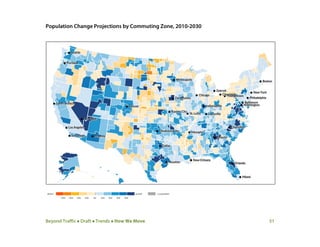
Beyond Traffic  Draft  System Implications  Aviation 234
domestic flights by U.S. air carriers arrived on time.
While many flight delays are due to weather, high
airport terminal volumes are a factor in approximately
20 percent of all of flight delays. Some of the busiest
airports in the country including the three major New
York-area airports—Kennedy, La Guardia, and
Newark—as well as San Francisco International,
Philadelphia, Atlanta, and Chicago O’Hare, suffer from
high levels of delays which can cause delays throughout
the national aviation system. In 2010, a GAO review of
FAA data found that 80 percent of all departure delays
can be traced back to seven airports.
A Dynamic Aviation Industry
Since the turn of the century the commercial air carrier
industry has suffered several major shocks that have
led to volatile demand for air travel including the
terrorist attacks of September 11, 2001, rising fuel
costs, and a severe global recession. In response,
airlines have adjusted their business models to lower operating costs, eliminated unprofitable
routes, and grounded older, less fuel efficient planes. Starting in 2010, the passenger and cargo
airline industries have posted net profits. While the average cost of a roundtrip ticket in inflation-
adjusted dollars has dropped 15 percent over the last 20 years, many airlines have found ways to
generate additional revenue by charging for services, such as bag fees, that had been previously
included in the price of a ticket and by increasing the number of paying passengers on each flight.
Load factor—the percentage of seats carrying passengers—increased from 69 percent in the 1990s
to 83 percent today.
General Aviation
Most air travelers pass through our
389 primary airports. However, there
are more than 19,000 airports,
heliports, seaplane bases, and other
landing facilities in America, the
majority of which are used primarily
for general aviation. General aviation
airports provide a variety of
specialized functions, such as access
to remote communities, emergency
medical services, firefighting, law
enforcement and border control,
flight training, freight and business
transportation, agricultural services,
and recreational aviation.
Beyond Traffic  Draft  System Implications  Aviation 235
To save costs and increase revenues many airlines are gradually shifting to larger jets that carry
more passengers per flight. Industry consolidation and streamlining is also leading to reductions in
the number of flights that service smaller, less profitable airports. This has reduced access in
smaller communities where it may no longer be economically viable to provide service with larger
aircraft. Between 2007 and 2012, 24 small airports lost network carrier services.
Modernizing our Nation’s Air Traffic System
To make best use of emerging technology to meet the needs of the flying public, the FAA has
committed to major investments in NextGen. NextGen is a wide-ranging transformation of the air
transportation system, including air traffic management technologies and procedures; airport
infrastructure improvements; and environmental, safety and security related enhancements.
NextGen technologies use satellite navigation to allow planes to fly more direct routes closer
together, saving fuel and reducing delays.
The overall vision of this system includes the use of digital communication, satellite surveillance,
improved navigation technologies and more advanced safety systems to increase the capacity of
the national airspace system and the predictability of flights. New digital technologies will improve
flight and weather information and enhance communications among pilots and air traffic
controllers. FAA estimates that over the next 15 years NextGen could result in more than $130
billion in social benefits from avoided delays and cancellations, reduced flight times and other
benefits.
Significant financial investment from the aviation industry and the public is required to achieve
the benefits of NextGen. The FAA’s total investment in NextGen is projected to be $14 billion
from 2013 to 2030 in addition to the costs necessary to continue to operate and maintain existing
systems and infrastructure.
Beyond Traffic  Draft  System Implications  Aviation 236
Many NextGen benefits require large numbers of aircraft with the necessary avionics to be
equipped in order to accrue the maximum amount of benefit. Some commercial aircraft are already
equipped with the building blocks for certain NextGen capabilities but retrofitting previously
unequipped aircraft could prove costly to operators. In 2014, cost estimates to retrofit one
commercial aircraft with the required foundational NextGen technologies range from $135,000 to
$150,000, whereas for general aviation aircraft the costs are estimated to be between $14,000 and
$15,000 and estimates to retrofit avionics that would take full advantage of more advanced
NextGen operations have ranged up to $525,000 per commercial aircraft. FAA estimates that over
the next 15 years, $15 billion in expenditures are required from aircraft operators to equip their
aircraft with NextGen avionics.
The Airport and Airway Trust Fund (AATF) provides the primary source of funding for FAA and
receives revenues principally from a variety of excise taxes paid by users of the national airspace
system. In the last five fiscal years, approximately 60 percent of FAA funding was dedicated to
operating our air traffic control system and safety programs. About 20 percent of funding was for
the Airport Improvement Program (AIP), which provides grants to airports for projects that
generally enhance capacity, safety, or environmental concerns, such as runway construction and
rehabilitation, airfield lighting, and airplane noise mitigation. Remaining FAA funds are used for
modernization and maintenance of air traffic facilities and equipment, and research, engineering,
and development of new air traffic technologies, such as NextGen.
Constrained budgets have resulted in deferral of maintenance of today’s air traffic control system
infrastructure over the last several years, placing at risk reliability in operations and resilience in
emergency situations. Some types of critical air traffic control facilities are many decades old,
though replacing and/or consolidating them requires substantial investment. Under the current
budget environment, FAA’s maintenance backlog is expected to continue growing.
Beyond Traffic  Draft  System Implications  Aviation 237
Running a complex enterprise operating 24 hours a day while undertaking as large and
sophisticated an infrastructure project as modernizing the entire national airspace system
presents governance challenges, especially in the face of conflicting priorities within constrained
budgets. The FAA has improved program management focus and increased collaboration with
industry—resulting in improved safety, program performance, and aligned prioritization with
industry on which NextGen capabilities to deploy together over the next few years—but continues
to seek opportunities for further improvements.
Integrating Unmanned Aircraft Systems
In recent years private sector interest in UAS has increased at a rapid rate. The private sector sees
the potential for a wide range of uses of UAS from crop dusting and land surveying to
humanitarian disaster response and filmmaking. A recent U.S. DOT report commissioned by the
United States Air Force estimated that between public and commercial uses, there total number of
UAS vehicles in operation will reach 250,000 by the year 2035.
FAA first allowed the use of UAS in the national airspace system in 1990. Most UAS that are
allowed to operate today are used for security, research, and environmental monitoring purposes.
UAS operations over major urban areas, where there tend to be high densities of manned aircraft,
is limited and approved on a case-by-case basis. Existing restrictions on the use of UAS have been
based around concerns about the safety and intent of use of these vehicles. New regulations
targeted at the phased integration of UAS are in development.
Beginning in 2013, there are six test sites around the country conducting UAS research. In order to
safely integrate UAS into national airspace system, several technical and procedural hurdles will
have to be overcome (e.g. making sure UAS can detect and avoid other aircraft and maintain
communication with pilots). The FAA is pursuing a phased integration of UAS. This gradual
process is intended to ensure safety and manage risk to the national airspace system.
Beyond Traffic  Draft  System Implications  Aviation 238
A full regulatory framework agreement on certification and technology standards, and procedures
to collect and analyze safety data are still challenges that need to be met in order to ensure that
UAS operate effectively and safely.
Safety Trends
Over the last 50 years, taking a flight in a commercial aircraft has become the safest possible
means of travel. Aviation accident rates have declined dramatically since the 1960s. Today,
commercial aviation accidents with fatalities are exceedingly rare—some 99.997 percent of air
traffic operations occur without safety or
compliance incidents. On average, a person could fly
every single day for 50,000 years and still not be
involved in a fatal crash. In 2013 there were over
800 million passenger miles flown without a single
air carrier fatality. Globally, the accident rates for
scheduled commercial flight fell by 36 percent from
2005 to 2013 and the fatality rate fell by 82 percent,
to 5.4 deaths per million scheduled commercial
flight.
Advancements in safety are the result of improving
technologies, better training, effective regulation
and the use of a risk-based approach to safety
management. The aviation system and regulators
systematically analyze and learn from safety
incidents. Sophisticated aircraft systems and
modern air traffic control technologies also improve
the situational awareness of pilots and air traffic
controllers. Today, the FAA increasingly uses tools
Commercial Space Transportation
Commercial space transportation and
the services it enables, such as weather
forecasts, emergency and disaster
response, and credit card payments,
accounted for more than $208 billion in
economic activity in 2009. Today,
commercial space transportation is used
for launching satellites into orbit, as well
as delivering cargo to and from the
International Space Station and
conducting science and technology
demonstrations. There is also increasing
momentum behind space tourism—
space travel flights for the general
public.
Beyond Traffic  Draft  System Implications  Aviation 239
and techniques for data recording, collection, reporting, and analysis that allow for early
identification, assessment and mitigation of safety risks. These tools and techniques provide FAA
with access to an abundance of safety data, allowing them to make smarter, data-driven, risk-based
decisions and, with industry and global partners, to identify emerging hazards and predict the
associated safety risks before they
become accidents.
This data-driven approach helps
FAA improve safety and informs
the agency’s policies, standards,
and training programs. Due to the
extremely low rate of casualties in
air travel, it is becoming necessary
to employ data and analysis more
effectively in order to prevent
crashes before they occur, rather
than analyzing accidents that have
already happened. The future will
require us to move away from the
forensics towards a more
predictive safety analysis
approach. Safety challenges for
aviation in the future are likely to be focused around the introduction of new technology and the
safe entry of new types of aircraft into the system (e.g. space launches, unmanned aircraft
systems) and the maintenance of high levels of safety around increasingly congested hub airports.
Beyond Traffic  Draft  System Implications  Aviation 240
Policy Implications
Aviation has changed much in the past 30 years and will undoubtedly continue to evolve over the
next 30 years, as new technologies are introduced and the population and economy grows. Policy
options that will influence the future course of the aviation system include:
 Ensuring that sufficient revenue is available to support the operating and capital needs of
our national airspace system.
 Balancing the system’s multiple and sometimes conflicting needs for modernization,
maintenance, access, efficiency, capacity, environmental sustainability, and services.
 Enabling the safe integration of commercial space flights and unmanned aircraft systems
into the NAS while minimizing risk to other users of the system.
 Shifting to a more collaborative, data-informed and risk-based safety management approach
to proactively address emerging safety risks.
 Improving surface access to airports for passengers and freight.
Beyond Traffic  Draft  System Implications  Aviation 241
References
• (BTS) Bureau of Transportation Statistics. Passengers; “All Carriers – All Airports.”
(http://www.transtats.bts.gov/Data_Elements.aspx?Data=1)
• Open Flights.
(http://openflights.org)
• (FAA) Federal Aviation Administration. FAA Historical Chronology, 1926-1996.
(https://www.faa.gov/about/media/b-chron.pdf)
• (FAA) Federal Aviation Administration. 2013. “Activity Forecasts.” Report to Congress: National Plan of Integrated Airport Systems 2013-2017.
(http://www.faa.gov/airports/planning_capacity/npias/reports/historical/media/2013/npias2013Narrative.pdf)
• (BTS) Bureau of Transportation Statistics. National Transportation Statistics; “Table 1-67: FAA-Cited Causes of Departure and En Route Delays (After pushing back
from the gate).”
(http://www.rita.dot.gov/bts/sites/rita.dot.gov.bts/files/publications/national_transportation_statistics/html/table_01_67.html)
• Foxx, Anthony. DOT Fast Lane Blog. “FAA’s Hughes Technical Center leading U.S. to NextGen of aviation safety, efficiency.”
(http://www.dot.gov/fastlane/faa-tech-center-leading-us-nextgen)
• (GAO) Government Accountability Office. 2010. National Airspace System: Setting On-Time Performance Targets at Congested Airports Could Help Focus FAA’s Actions.
May.
(http://www.gao.gov/new.items/d10542.pdf)
• (BTS) Bureau of Transportation Statistics. “2nd
-Quarter 2014 Air Fare Data.” News release. October 28, 2014.
(http://www.rita.dot.gov/bts/press_releases/bts050_14_fig1)
• Brueckner, Jan. Access. “Airport Congestion Management: Prices or Quantities?” Fall 2009.
(http://www.uctc.net/access/35/access35_Airport_Congestion_Management.pdf)
• (BTS) Bureau of Transportation Statistics. Airlines and Airports; “Airline On-Time Statistics and Delay Causes.”
(http://www.transtats.bts.gov/OT_Delay/OT_DelayCause1.asp)
• Testimony before the Subcommittee on Aviation, Committee on Transportation & Infrastructure, U.S. House of Representatives. 113th
Cong. (2013). Statement
of Susan L. Kurland, assistant secretary for aviation and international affairs, U.S. Department of Transportation.
(http://transportation.house.gov/uploadedfiles/2013-12-12-kurland.pdf)
• (GAO) Government Accountability Office. 2014. Impact of Fuel Price Increases on the Aviation Industry. September.
(http://www.gao.gov/assets/670/666127.pdf)
• Aircraft Owners and Pilots Association. Airports and Landing Areas; “Airports and Landing Areas 1965-2009.”
(http://www.aopa.org/About-AOPA/General-Aviation-Statistics/Airports-and-Landing-Areas)
• (FAA) Federal Aviation Administration. GA Airports: National Asset; “General Aviation Airports: A National Asset.”
(http://www.faa.gov/airports/planning_capacity/ga_study)
Beyond Traffic  Draft  System Implications  Aviation 242
• (FAA) Federal Aviation Administration. 2014. FAA Aerospace Forecast: Fiscal Years 2014-2034.
(http://www.faa.gov/about/office_org/headquarters_offices/apl/aviation_forecasts/aerospace_forecasts/2014-2034/media/2014_FAA_Aerospace_Forecast.pdf)
• Moore, Jim. Aircraft Owners and Pilots Association. “FAA predicts continued GA decline.” March 13, 2014.
(http://www.aopa.org/News-and-Video/All-News/2014/March/13/faa-forecast)
• (DOT) Department of Transportation. Aviation Policy; “Essential Air Service.”
(http://www.dot.gov/policy/aviation-policy/small-community-rural-air-service/essential-air-service)
• (DOT) Department of Transportation. 2009. What is Essential Air Service (EAS)? April.
(http://www.dot.gov/sites/dot.gov/files/docs/easwhat.pdf)
• (DOT) Department of Transportation. 2014. Subsidized EAS report for communities in Alaska. June.
(http://www.dot.gov/sites/dot.gov/files/docs/Subsidized%20EAS%20report%20for%20communities%20in%20Alaska-Jun%202014.pdf)
• (DOT) Department of Transportation. Office of Inspector General. 2012. Aviation Industry Performance: A Review of the Aviation Industry, 2008-2011. September.
(https://www.oig.dot.gov/sites/default/files/Aviation%20Industry%20Performance%5E9-24-12.pdf)
• Editorial. Capital Journal. “On Essential Air Service: Let’s really hold it to what’s essential.” October 9, 2014.
(http://www.capjournal.com/opinions/on-essential-air-service-let-s-really-hold-it-to/article_b4341efa-5036-11e4-bd31-3fd604b6b7a2.html)
• Elias, Bart. Congressional Research Service. 2013. Federal Civil Aviation Programs: In Brief. December.
(http://fas.org/sgp/crs/misc/R42781.pdf)
• Frank, Thomas. USA Today. “Feds keep little-used airports in business.” September 17, 2009.
(http://usatoday30.usatoday.com/travel/flights/2009-09-17-little-used-airports_N.htm?csp)
• (FAA) Federal Aviation Administration. 2012. The Business Case for the Next Generation Air Transportation System. August.
(http://www.faa.gov/nextgen/media/NextGen%20Bus%20Case%202012%20(2012-10-05).pdf)
• (GAO) Government Accountability Office. 2013. NextGen Air Transportation System: FAA Has Made Some Progress in Midterm Implementation, but Ongoing
Challenges Limit Expected Benefits. April.
(http://www.gao.gov/assets/660/653626.pdf)
• (FAA) Federal Aviation Administration. Airports; “Passenger Facility Charge (PFC) Program Airports.”
(http://www.faa.gov/airports/pfc)
• (GAO) Government Accountability Office. 2014. Airport Funding: Aviation Industry Changes Affect Airport Development Costs and Financing. June.
(http://www.gao.gov/assets/670/664188.pdf)
• (DOT) Department of Transportation. Aviation Policy; “Essential Air Service.”
(http://www.dot.gov/policy/aviation-policy/small-community-rural-air-service/essential-air-service)
• (DOT) Department of Transportation. 2013. Subsidized EAS web report for communities in Alaska. November.
(http://www.dot.gov/sites/dot.gov/files/docs/Subsidized%20EAS%20web%20report%20for%20communities%20in%20Alaska-Nov%202013.pdf)
Beyond Traffic  Draft  System Implications  Aviation 243
• Airport Council International. CDM Smith. 2014. The Economic Impact of Commercial Airports in 2013. September.
(http://airportsforthefuture.org/did-you-know/files/2014/09/Economic-Impact-of-Commercial-Aviation-2013.pdf)
• Oregon Department of Aviation. 2008. Airport and Aviation Funding Programs. February.
(http://www.oregon.gov/aviation/docs/system_plan/chapter_7_-_funding.pdf)
• (WSDOT) Washington State Department of Transportation. Grant Recipients; “WSDOT Aviation Grant Recipients.”
(http://www.wsdot.wa.gov/aviation/Grants/GrantRecipients/default.htm)
• Gagnon, Pierre. “Privatization of Airports – The Canadian model.” Presentation to Aeroports de Montreal. October 16, 2011.
(http://aci-na.org/sites/default/files/session5--privatization--gagnon.pdf)
• Carmargo, Luis M. Southern Illinois University Carbondale. 2013. Airport Privatization Movement in the 21st
Century. May.
(http://opensiuc.lib.siu.edu/cgi/viewcontent.cgi?article=1010&context=ps_wp)
• (FAA) Federal Aviation Administration. Airport Compliance; “Airport Privatization Pilot Program.”
(http://www.faa.gov/airports/airport_compliance/privatization)
• Airport Funding: Aviation Industry Changes Affect Airport Development Costs and Financing. Testimony Before the Subcommittee on Aviation, Committee on
Transportation and Infrastructure, House of Representatives. 113th
Cong. (2013). Statement of Gerald L. Dillingham, Ph.D., Director, Physical Infrastructure
Issues.
(http://www.gao.gov/assets/670/664188.pdf)
• Airport Council International - North America. 2013. Airports Flying High on Non-Aeronautical Passenger Revenue. November.
(http://aci-na.org/sites/default/files/concessions_benchmarking_ppt_media_version.pdf)
• Airport Council International - North America. 2013. Air Cargo Guide. December.
(http://www.aci-na.org/content/air-cargo-guide)
• (FAA) Federal Aviation Administration. 2013. Performance Measure Profile: Noise Exposure. September.
(http://www.faa.gov/about/plans_reports/performance_profiles/media/noise_exposure_-_FY13_measure_profile.pdf)
• (FAA) Federal Aviation Administration. “FAA Completes Nationwide Equipment Installation for NextGen Aircraft Tracking System.” News release. April 14, 2014.
(https://www.faa.gov/news/press_releases/news_story.cfm?newsId=16135)
• (DOT) Department of Transportation. Office of Inspector General. 2014. FAA Made Limited Progress in Implementing NextGen Provisions of the FAA Modernization
and Reform Act of 2012. January.
(https://www.oig.dot.gov/sites/default/files/FAA%20Implementation%20of%20NextGen%20Provisions%20of%20the%20FAA%20Modernization%20and%20R
eform%20Act%20of%202012%5EJanuary%2028%2C%202014.pdf)
• Hochberg, Adam. National Public Radio. “Federal Subsidies Keep Small-Town Airports Flying.” November 18, 2009.
(http://www.npr.org/templates/story/story.php?storyId=120126620)
• (FAA) Federal Aviation Administration. “Unmanned Aircraft Systems.”
(https://www.faa.gov/uas)
Beyond Traffic  Draft  System Implications  Aviation 244
• (FAA) Federal Aviation Administration. 2012. NextGen: the Business Case for the Next Generation Air Transportation System. August.
(http://www.faa.gov/nextgen/media/NextGen%20Bus%20Case%202012%20(2012-10-05).pdf)
• (DOT) Department of Transportation. Office of Inspector General. 2014. FAA Faces Significant Barriers to Safely Integrate Unmanned Aircraft Systems into the
National Airspace System. June.
(https://www.oig.dot.gov/sites/default/files/FAA%20Oversight%20of%20Unmanned%20Aircraft%20Systems%5E6-26-14.pdf)
• Electronic Privacy Information Center. Domestic Unmanned Aerial Vehicles and Drones; “Privacy Issues.”
(http://epic.org/privacy/drones/#privacy)
• (FAA) Federal Aviation Administration. 2010. The Economic Impact of Commercial Space Transportation on the U.S. Economy in 2009. September.
(https://www.faa.gov/news/updates/media/Economic%20Impact%20Study%20September%202010_20101026_PS.pdf)
• (NASA) National Aeronautics and Space Administration. NASA HQ Library: “Space Commercialization and Space Tourism.” March 2011.
(http://www.hq.nasa.gov/office/hqlibrary/pathfinders/spacetourism.htm)
• Fields, Liz. ABC News. “What Are the Odds of Surviving a Plane Crash?” March 12, 2014.
(http://abcnews.go.com/International/odds-surviving-plane-crash/story?id=22886654)
• (BTS) Bureau of Transportation Statistics. U.S. Air Carrier Traffic Statistics; “Monthly - System.”
(http://www.rita.dot.gov/bts/acts)
Beyond Traffic  Draft  System Implications  Intercity Rail 245
Intercity Rail
Our intercity passenger and freight rail networks are a vital component of America’s vast
intermodal transportation network. The intercity passenger rail system operated by Amtrak
carries millions of passengers each year to destinations across the country. Freight rail is a $70
billion industry connecting U.S. consumers to agricultural, economic, logistics and manufacturing
centers.
Trends that will impact the performance of our passenger and freight rail system over the next 30
years include:
 Demand for speedy and reliable passenger rail service in growing megaregions will continue
to increase.
 Ridership growth will result in continuing improvements to Amtrak’s financial performance,
but, absent sustainable federal funding, Amtrak will continue to face challenges meeting the
costs of providing national passenger rail service.
 Increasing freight rail demand will increase pressure to address freight chokepoints and
resolve passenger-freight conflicts.
 Continued emphasis on rail safety will lead to sustained safety improvements.
Intercity Passenger Rail
Amtrak operates our intercity passenger rail system. Amtrak was created by the 1970 Rail
Passenger Service Act in order to assure the continuation of passenger train service given financial
turmoil in the private rail industry at the time. Amtrak operates as a national public-private
Beyond Traffic  Draft  System Implications  Intercity Rail 246
corporation, operating a national rail network of more than 21,000 route miles serving more than
500 destinations in 46 states, the District of Columbia and three Canadian provinces.
Rising Passenger Rail Ridership
Our intercity passenger rail system carries more than 30 million passengers each year. Millions
more passengers ride commuter trains over tracks that are often shared with Amtrak and freight
trains. Although Amtrak trips comprise less than one percent of all domestic intercity trips,
Amtrak’s ridership has grown in recent years.Annual ridership has grown by more than 50 percent
since 1993, with total passenger trips reaching 30.9 million in Fiscal Year 2014. Increasing
popularity among young adults and improvements in service such as e-ticketing and improving
broadband access are helping to drive demand.
Passenger rail service is an attractive alternative for intercity travel, particularly for trips between
100 and 500 miles. Well over 85% of all passenger trips on Amtrak are for journeys less than 250
miles, while less than 5% of trips are for journeys more than 400 miles. Amtrak ridership is
especially strong in growing megaregions such as the Northeast Corridor, the Chicago Hub area,
and the West Coast. More than one out of every three Amtrak passengers travel along the
Northeast Corridor between Washington, D.C., New York, and Boston.
Amtrak-owned infrastructure also supports critical commuter rail services particularly in the
northeast corridor. An average of more than 847,000 people every weekday depend on commuter
rail services that use Amtrak-owned infrastructure and shared operations. In addition, states
provide intercity passenger rail corridor services across the country through operating contracts
with Amtrak. These state-supported routes carry nearly half of all of Amtrak’s passengers. This
arrangement is part of a shift in the passenger rail service industry away from centralized Amtrak-
operated services toward more services funded, managed, and overseen by states and localities.
While this shift is only just beginning, it could ultimately result in the creation of intercity
operators other than Amtrak.
Beyond Traffic  Draft  System Implications  Intercity Rail 247
In the next 30 years, the American population will grow
by 23 percent, increasing demand for personal travel
across all modes, including rail. As the American
population grows and the population and economy
become increasingly centered in major metropolitan
areas, passenger rail could become a more attractive
option for many travelers. Increasing highway and
airport congestion could also make passenger rail a more
competitive alternative. Other social and cultural
changes, such as changing attitudes toward driving,
especially among young adults, may also influence future
ridership. In the future, higher-speed rail service in
dense population corridors could increase travel options
for intercity travelers and help to relieve growth in
congestion on highways and at busy airports in major
metropolitan areas.
Funding Passenger Rail to Address Growing Demand
Unlike highways, transit, and aviation, passenger rail
lacks a source of predictable, dedicated funding. Revenues from passenger rail tickets are Amtrak’s
primary source of funding. In Fiscal Year 2014, Amtrak earned a record setting $2.2 billion in
ticket revenues, of which more than half were generated on the Northeast Corridor. On top of its
annual revenues, Amtrak receives approximately $1.5 billion in federal appropriations each year.
In 2014, Congress provided more than $1 billion in grants for capital expenses and debt service
and $340 million in grants for operating costs.
High Speed Intercity Rail
The FRA’s High Speed Intercity Rail
Program has provided $10 billion in
grant funding to states along critical
rail corridors. Several projects are
currently underway, including
nearly $1 billion in investment to
upgrade the Northeast Corridor,
$3.9 billion to lay the groundwork
for high speed rail in California, and
$1.9 billion for track upgrades in the
Midwest. With the exception of high
speed rail in California, these
projects have largely focused on
upgrading existing track and
vehicles to improve speeds and
reduce delays.
Beyond Traffic  Draft  System Implications  Intercity Rail 248
Ticket sales for popular routes, such as the Northeast
Corridor, produce an operating surplus for Amtrak that
defrays, but does not fully cover the operating costs of
long-distance routes. Although Amtrak’s 15 long-
distance lines comprise only a small percentage of all
intercity trips by rail, they offer the only intercity
transportation alternatives in many areas. Five percent
of Amtrak riders travel to or from communities that are
underserved by intercity bus and airline operators.
Highways, transit, aviation, inland waterways, ports and
harbors all benefit from dedicated trust funds. Rail is
unique in that it lacks a committed source of federal
revenue. As a result, passenger rail capital investments
have generally failed to keep up with the needs of
existing fleet and infrastructure, leading to a backlog of
state of good repair and other basic infrastructure
needs. There is currently a multi-billion dollar backlog of
projects required to maintain a state of good repair on
our nation’s rails, as well as a significant deficit in the
capital funding available for maintaining assets and
adding capacity for anticipated increases in demand. The
Northeast Corridor alone requires investments of nearly
$1.5 billion per year over 15 years to bring the corridor
into a state of good repair and maintain it in that
condition.
Short-Line Railroads
While Class 1 railroads generate
over 95 percent of all freight rail
revenues in America, they own and
maintain less than 70 percent of
America’s rail miles. Most of the
remaining rail miles are owned by
small and medium railroad
companies, including short-line
railroads that serve a small number
of towns and industries. Many
short-line railroads lack the capital
to make the investments necessary
to maintain a state of good repair.
With limited annual revenues, these
rail operators may struggle to meet
current and future freight demand.
Beyond Traffic  Draft  System Implications  Intercity Rail 249
Freight Rail
America’s freight rail system consists of over 140,000
route miles connecting consumers to agricultural,
economic, manufacturing, and population centers. An
indispensable aspect of our freight infrastructure,
railroads move roughly 39 percent of all intercity
freight ton-miles in America each year. Rail is the
predominant mode of transportation for heavy bulk
commodities like coal, grain and minerals and for high
valued cargo, such as intermodal traffic, traveling
between 750 and 2000 miles. Freight rail is a $70
billion industry comprising over 560 regional and
short-line freight railroads, including seven “Class 1”
railroads that represent the bulk of the industry’s rail
mileage, revenues and workforce.
Meeting Freight Rail Demand
After the Staggers Rail Act partially deregulated rail
freight in 1980, shipping rates for all railroads
declined by more than 30 percent, and rail freight
traffic has nearly doubled. Railroads have generated record revenues by growing traffic and
concentrating on highly-trafficked railroad lines. The number of privately operated rail miles has
declined by more than 40 percent and the workforce has fallen by more than half.
The volume of goods moved by rail has increased steadily since 1980, and is projected to increase
by over 37 percent through 2045. With increases in passenger traffic and freight demand, track
Intermodal Container Traffic
Intermodal container traffic is one of
the fastest growing segment of the
freight rail industry and currently
accounts for 11 percent of rail freight.
The use of intermodal transfers in
large containers has greatly improved
the efficiency of freight rail by
reducing handling time and labor costs
for non-bulk commodities. Although
the growth in container transportation
has affected freight movement by all
modes, the productivity of freight
railroads has improved dramatically
due to the growth in intermodal
freight and the development of
practices such as double-stack rail
transport.
Beyond Traffic  Draft  System Implications  Intercity Rail 250
congestion may increase, especially in higher-traffic passenger corridors. Growing congestion may
reduce the reliability of the railway network for both freight and passenger movements.
Meeting this growing demand will require substantial investments led by the private rail industry
in rail capacity. Unlike most other modes of transportation, rail operates on infrastructure that is
built and maintained as private infrastructure. As such, private railroads invest a high percentage
of their revenues to maintain and add capacity to their system, including more than $25 billion in
both 2012 and 2013. Since 1980, freight railroads have spent $550 billion on these investments.
To meet burgeoning freight demand effective investments in U.S. transportation infrastructure
must be made and innovative transportation solutions must be considered. One way to do this is
to form public-private partnerships where private companies and governments cooperate
to maintain, improve, and expand transportation infrastructure. Rail transportation investments
provided by public-private partnerships are an effective way to meet future transportation
challenges while at the same time providing significant public benefits such as reductions in road
congestion, highway fatalities, fuel consumption and greenhouse gasses, logistics costs, and public
infrastructure maintenance costs. Public-private partnerships may also help to resolve freight
chokepoints, particularly where freight and passenger traffic operate on the same track.
As new rail projects emerge and private participation increases, federal regulatory agencies, such as
the Surface Transportation Board, the regulatory agency that authorizes rail construction,
abandonments, and other transactions, may face increasing demands for timely decisions and
oversight.
Beyond Traffic  Draft  System Implications  Intercity Rail 251
Beyond Traffic  Draft  System Implications  Intercity Rail 252
Improving Rail Safety
Rail transportation is safe and getting safer. Train accident rates, already low, steadily declined
since the 1990s. Fatal accidents involving employees have been cut in half since the early 1990s.
The vast majority of fatal train accidents—96 percent—are related to trespassing or highway-rail
grade crossing incidents. Trespassing fatalities have remained high over the same period and now
account for 60 percent of all train-related fatalities. Continued focus on safety by Amtrak and
Class 1 railroads, the adoption of safety management systems, fostering of a safety culture at rail
agencies, and the research, development and implementation of new safety technologies and
practices will continue to drive safety improvements in the future.
Beyond Traffic  Draft  System Implications  Intercity Rail 253
Policy Implications
Increasingly interconnected communities and mega-regions drive a need for strong intercity
transportation connections for both people and goods. Passenger and freight rail services compete
for limited capacity in some markets, although there are policy options available that can help to
align incentives and achieve a more collaborative working environment:
 Encourage public private partnerships and new models for the shared use of privately-owned
freight rail lines that identify incentives to encourage more efficient passenger and freight
movements.
 Focus federal investment in research, development and technology to accelerate safety
technology while creating a regulatory structure that incentivizes advanced safety
technology.
Current public funding levels are not able to meet the coming transportation demand or fully fund
the replacement of legacy infrastructure; however, steps can be taken to leverage current funding
and spur more investment:
 Continue investment in high-performance passenger and freight rail, through track and
vehicle upgrades, particularly on shared use corridors and those for which cost-effective
improvements will make passenger train travel both price and time competitive with the
automobile and aviation markets.
 Provide a predictable dedicated funding source for rail projects, which allows for current
projects to advance, while spurring the development of a pipeline of new projects and
encouraging private participation by reducing uncertainty.
 Explore new models of public-private partnerships that more clearly identifies public and
private benefits of projects to enable the inclusion of a broader spectrum of public and
private sector participants.
Beyond Traffic  Draft  System Implications  Intercity Rail 254
References
• (BTS) Bureau of Transportation Statistics. Long Distance Travel Patterns; “Table 4: Percent of Trips by Mode for One Way Travel Distance.”
(http://www.rita.dot.gov/bts/sites/rita.dot.gov.bts/files/publications/america_on_the_go/long_distance_transportation_patterns/html/table_04.html)
• Neff, John and Matthew Dickens. American Public Transportation Association. 2014. 2014 Public Transportation Fact Book: Appendix A. September.
(http://www.apta.com/resources/statistics/Documents/FactBook/2014-APTA-Fact-Book-Appendix-A.pdf)
• The Brookings Institution. “U.S. Passenger Rail Ridership.” March 1, 2013.
(http://www.brookings.edu/research/interactives/2013/amtrakroutes)
• Amtrak. 2012. Annual Report Fiscal Year 2012.
(http://www.amtrak.com/ccurl/103/360/Amtrak-Annual-Report-2012.pdf)
• Amtrak. 2014. National Fact Sheet: FY 2013.
(http://www.amtrak.com/ccurl/826/406/Amtrak-National-Fact-Sheet-FY2013-rev.pdf)
• Peterman, David Randall, John Frittelli, and William J. Mallet. Congressional Research Service. 2013. The Development of High Speed Rail in the United States: Issues
and Recent Events. December.
(http://fas.org/sgp/crs/misc/R42584.pdf)
• (FRA) Federal Railroad Administration. Rail Development Network; “Freight Rail Today.”
(https://www.fra.dot.gov/Page/P0362)
• (BTS) Bureau of Transportation Statistics. National Transportation Statistics; “Table 1-50: U.S. Ton-Miles of Freight.”
(http://www.rita.dot.gov/bts/sites/rita.dot.gov.bts/files/publications/national_transportation_statistics/html/table_01_50.html)
• (FHWA) Federal Highway Administration. Freight Facts and Figures 2013; “Figure 2-3a. Mode Share of Freight Ton-Miles by Distance Band: 2007.”
(http://ops.fhwa.dot.gov/freight/freight_analysis/nat_freight_stats/docs/13factsfigures/figure2_03a.htm)
• (BLS) Bureau of Labor Statistics. Top Picks: Producer Price Index-Industry Data. Select, “Line-haul railroads.”
(http://data.bls.gov/cgi-bin/surveymost?pc)
• Palley, Joel. Federal Railroad Administration. 2013. Freight Railroads Background. April.
(https://www.fra.dot.gov/eLib/Details/L03011)
• (FHWA) Federal Highway Administration. Freight Facts and Figures 2013; “Tables 2-1 and 2-1M. Weight of Shipments by Transportation Mode: 2007, 2012, and
2040.”
(http://ops.fhwa.dot.gov/freight/freight_analysis/nat_freight_stats/docs/13factsfigures/table2_01.htm)
• Puentes, Robert, Adie Tomer, and Joseph Kane. 2013. The Brookings Institution. A New Alignment: Strengthening America’s Commitment to Passenger Rail. March.
(http://www.brookings.edu/~/media/Research/Files/Reports/2013/03/01%20passenger%20rail%20puentes%20tomer/passenger%20rail%20puentes%20tomer.
pdf)
• (CBO) Congressional Budget Office. Options for Reducing the Deficit: 2014 to 2023; “Discretionary Spending: Function 400 – Transportation.” November 13, 2013.
(http://www.cbo.gov/budget-options/2013/44782)
Beyond Traffic  Draft  System Implications  Intercity Rail 255
• American Society of Civil Engineers. 2013. 2013 Report Card for America’s Infrastructure. March.
(http://www.infrastructurereportcard.org/a/#p/home)
• Association of American Railroads. Private Rail Investments Power America’s Economy: Freight Railroads Have Invested $550 Billion into the National Rail Network Since
1980.
(http://freightrailworks.org/wp-content/uploads/FRW-Investments2.pdf)
• Amtrak. 2009. Northeast Corridor State of Good Repair Spend Plan. April.
(http://www.amtrak.com/ccurl/771/1002/NEC_StateOfGoodRepair_PRIIA.pdf)
• Association of American Railroads. 2013. Class I Railroad Statistics. January.
(https://www.aar.org/StatisticsAndPublications/Documents/AAR-Stats-2013-01-10.pdf)
• Nussbaum, Paul. The Philadelphia Inquirer. “$700M in repairs needed for Amtrak tunnels in and out of New York.” October 4, 2014.
(http://articles.philly.com/2014-10-04/business/54603970_1_northeast-corridor-tunnels-craig-schulz)
• Association of American Railroads. Positive Train Control; “Ensuring the Successful Deployment of Advanced Safety Technology.”
(https://www.aar.org/policy/positive-train-control)
• (BTS) Bureau of Transportation Statistics. National Transportation Statistics; (Table 2-39: Railroad and Grade-Crossing Fatalities by Victim Class.”
(http://www.rita.dot.gov/bts/sites/rita.dot.gov.bts/files/publications/national_transportation_statistics/html/table_02_39.html)
Beyond Traffic  Draft  System Implications  Marine 256
Marine
America’s rivers and waterways formed the nation’s first freight corridors. In the early nineteenth
century, substantial public, private and state resources were invested in canals and ports, which
functioned as engines of economic development in the pre-railroad era. Even as railroads and
highways spread across the nation, today’s marine transportation system, made up of inland
waterways and ports, coastal routes and deep water ports, is still the foundation of our robust
international and domestic trade and will remain so for the foreseeable future.
Looking to the future, several critical trends will have a major impact on the performance of the
critical marine links in our transportation system, they include:
 Increasing imports and exports and containerized freight will lead to greater congestion at
America’s coastal and inland ports.
 Investments in ports, harbors and waterways will be essential to meet the demand of
increased global trade and competition.
 Automation will improve the productivity and efficiency of marine transportation and ports.
Increasing Global Trade and Intermodal Freight
In 2013, total exports and imports reached a value of $3.9 trillion, or approximately 23 percent of
U.S. Gross Domestic Product. In the next 30 years, it is reasonable to expect that the volume of
imports and exports transported by sea will continue to grow with dramatic implications for
America’s ports and transportation system.
Deep water ports on every coast handle over 70 percent of our nation’s imports and exports by
weight and are a vital link in our globalized economy. Ports along the Gulf Coast, such as South
Louisiana, Houston, New Orleans and Beaumont, handle much of the petroleum, gas, steel, coal
Beyond Traffic  Draft  System Implications  Marine 257
and grain entering and leaving the United States.
Three ports, Los Angeles, Long Beach, and New
York/New Jersey handle 49 percent of all foreign
containerized trade entering and exiting the United
States. In fact, 10 ports account for 85 percent of our
nation’s containerized international trade. This
concentration provides an opportunity for America to
focus its resources on expanding the capacity of our
most important ports. But, it also makes our entire
freight system vulnerable to disruption or delay due
to natural disasters or security incidents.
At the same time, container ships will continue to
expand their capacity, potentially leading to increases
in containerized freight movement. If not adequately
accommodated and planned for, this increase in
throughput could lead to delayed shipments,
congestion at intermodal transfer points, increased
transportation costs, intensifying pollution, and other
negative consequences.
Over the past 30 years, U.S.-international trade has
increased at a much faster rate than our nation’s
overall economic growth, as measured in annual GDP
growth. In the next 30 years, increasing imports and
exports will lead to greater congestion at America’s
coastal ports.
Marine Governance
Most port facilities are owned by state
and local government or the private
sector. The Maritime Administration
(MARAD) is responsible for improving
port facilities; expanding the use of
the nation’s waterways; promoting
the development of the United States
merchant marine; and ensuring that
the United States maintains adequate
shipbuilding and repair services,
effective inter-modal connections to
marine transportation systems.
Several other agencies also have
considerable responsibility for
elements of the marine transportation
system. The U.S. Army Corps of
Engineers is responsible for deepening
and maintaining navigation channels.
The U.S. Coast Guard is responsible
for maritime security, law
enforcement, and the maintenance of
aids to navigation. Customs and
Border Protection is responsible for
clearing goods into and out of the
United States.
Beyond Traffic  Draft  System Implications  Marine 258
Because international trade and GDP are thoroughly linked, modern and efficient ports are
essential to our international trade and to the health of our overall economy.
Modernizing Ports and Waterways
To support the continued competitiveness of American goods in a global economy it is essential
that we maintain and modernize our ports and repair our aging inland waterway infrastructure.
Significant inland waterways include the Great Lakes and St. Lawrence Seaway, the Ohio River
Basin, the Mississippi River System, the Columbia River, and the Gulf Coast Coastal Waterways.
Our nation’s largest inland ports, like Duluth, Pittsburgh, St. Louis, and Huntington, handle tens
of millions of tons of grain, steel, cars and coal.
American port authorities are already investing billions of dollars to modernize their facilities and
accommodate increasingly larger ships. Raising bridges, dredging harbors, widening channels, and
purchasing bigger ship-to-shore cranes are key steps to preparing for expected increases in demand
and ensuring safe and efficient intermodal freight movement into the future. Ports do not stand
alone. Port authorities and their partners are also participating in many efficiency-improving road
and rail projects to eliminate freight bottlenecks and facilitate the movement of freight from ports
to distribution centers. Although our ports are becoming increasingly busy, opportunities for
innovation may be able to improve our port infrastructure even as the international economy
places greater strains on the marine component of our transportation system.
Port infrastructure itself has not historically received federal funding assistance. However, with
ports struggling to keep pace with increasing demand, TIGER Discretionary Grants have provided
nearly $500 million for port projects. In light of the increasing need for ports infrastructure to
keep pace with demand, MARAD’s Strong Ports Program is also helping ports modernize their
infrastructure by providing planning expertise and assistance to U.S. port authorities. However,
this program does not yet include a dedicated funding vehicle.
Beyond Traffic  Draft  System Implications  Marine 259
The Harbor Maintenance Trust Fund (HMTF)
funds the federal government’s surveying and
dredging projects, as well as the maintenance of
breakwaters, the operation of locks and the Saint
Lawrence Seaway Development Corporation. Over
the past decade, the U.S. Army Corps of Engineers
has spent an average of $1.5 to $2 billion on
navigation projects each year. These federal
navigation projects are funded by a combination
of user-fee supported trust funds and
appropriations from the General Fund. Costs for
deep-draft improvements are typically shared with
local port authorities. Public port authorities
spend more than $1 billion annually on dredging
and infrastructure improvement.
The HMTF draws its funding from an ad valorem
tax (duty on imported items) on inbound
shipments. In response to the increasing value of
imports, HMTF revenues have grown to a current
total nearly $2 billion annually. Over the past
decade, these receipts have outpaced spending
from the HMTF, leaving the HMTF with a surplus
balance of $8.5 billion. Spending can only be
authorized by Congress and, in recent years,
The St. Lawrence Seaway
The St. Lawrence Seaway is a binational
waterway directly serving an eight-state,
two-province region. The Seaway moves,
on average, 40 million metric tons of cargo
annually between North American and
international markets of virtually every
type of bulk, breakbulk, and general cargo,
including iron ore for the U.S. steel
industry, limestone for construction and
steel industries, coal for power generation
and steel production, grain exports from
U.S. farms, and finished steel and heavy
lift products for industry. Maritime
commerce on the Seaway System impacts
227,000 U.S. and Canadian jobs, $35
billion in transportation-related business
revenue, $14 billion in personal income,
and $5 billion in federal, state, provincial,
and Great Lakes taxes each year.
Beyond Traffic  Draft  System Implications  Marine 260
Congress has preferred to preserve the surplus in order to count it toward deficit reduction figure,
although the latest spending authorization bill includes scheduled increases in spending over the
next decade.
The Inland Waterways Trust Fund (IWTF) funds capital projects to improve inland waterways.
This fund generates approximately $80 million each year from a fuel tax on vessels using inland
waterways. The balance of the IWTF declined from $400 million in 2001 to slightly more than
$100 million today, largely due to the cost of building the Olmsted Locks and Dam project on the
Ohio River in Illinois. This fund will get a boost in revenues of approximately $26 million with the
enactment of the Achieving a Better Life Experience Act (ABLE Act) of 2014 which will raise barge
fuel taxes.
The U.S. Army Corps of Engineers (USACE) reports a backlog of over 500 active inland navigation
projects, with an estimated completion cost of about $38 billion. Movement of fright on our inland
rivers and waterways is hampered by an aging, antiquated system of locks and dams which have
exceeded their design service live and are too frequently out of service. Approximately half of the
navigation locks on inland waterways are over 50 years of age and require frequent repair.
Targeted, performance-based investments are needed to repair and reconstruct this aging inland
waterway infrastructure.
Automating Ports and Ships
Automation technologies are having major impacts at foreign ports and may spread to American
ports. With the advent of standardized containerization, cargo transfer functions have become
increasingly automated. At major container ports around the world, the process of transferring
containers from ships to docks, trucks or rail is becoming highly automated, reducing reliance on
human operators. If this trend continues, the human role in cargo handling could be greatly
altered and reduced, thereby reducing the cost of shipping, providing the needed capacity to
handle increased vessel sizes, and changing the nature of work in the marine transportation sector.
Beyond Traffic  Draft  System Implications  Marine 261
At sea, automation is also increasing efficiency allowing vessels to operate with fewer crew
members than ever before. This trend has the potential to reduce the costs of freight, but may also
create new risks as larger ships are crewed by fewer mariners. Managing and maintaining these
new vessels will, in some cases, require advanced mechanical and data analysis jobs that demand
higher skills and offer higher pay than traditional freight work, but may also displace the
traditional mariner workforce.
Port Infrastructure: The Port of Seattle Prepares for the Future
Our nation’s economy depends on the efficiency of port facilities to keep goods moving in and
out of the country. However, growth in international trade and the expanding capacity of
containerships will lead to greater congestion at America’s seaports and intermodal facilities.
American port authorities are taking steps to prepare for expected increases in demand. For
example, the Port of Seattle, which recently formed a Seaport Alliance with the Port of Tacoma,
just received a $20 million TIGER grant from the U.S. DOT to make strategic investments that
will help Seattle maintain its competitiveness with American and Canadian ports.
Seattle/Tacoma is a key stop on the trade corridor between East Asia and the United States.
Although the port handles roughly 5,000 containers per day, its facilities are in need of repair. In
light of this fact, the port plans to use the TIGER grant funding to strengthen an aging dock and
extend a dock crane rail. These improvements will increase the port’s capacity and allow it to
accommodate two post-Panamax vessels at the same time. The port will also use the TIGER grant
to construct a new truck ramp with more direct access to the port’s intermodal yard. Together,
these investments will improve safety conditions, speed up the intermodal transfer of goods, and
relieve highway congestion in and around the port.
Beyond Traffic  Draft  System Implications  Marine 262
Policy Implications
Our ports, rivers, waterways and coastal routes remain a critical piece of our intricate
transportation network, and continued investment is essential to keep up with increased
globalization and technology advancements. These are some of the policy options available to
bolster our maritime industry:
 Develop a nationwide strategy to improve capacity at U.S. ports, where appropriate, with
emphasis on those ports that are or will be able to accommodate larger container ships;
 Investing in America’s port and related infrastructure, where this would be highly effective
in reducing the congestion and environmental impacts of trucks on our nation’s roadways;
 Consolidating the roles and responsibilities of the many agencies with jurisdiction over port
facilities, which will streamline goods movement and increase safety and security;
 Addressing performance of our port and related infrastructure as an integral component of
our nation’s freight transportation system and;
 Encourage automation in ports and on ships that increase efficiency and create jobs for
highly skilled workers.
Beyond Traffic  Draft  System Implications  Marine 263
References
• Nagle, Kurt. DOT Fast Lane Blog. “America’s Ports Need a National Freight Funding Strategy to Delivery Prosperity.”
(http://www.dot.gov/fastlane/ports-need-national-freight-funding-strategy)
• (BTS) Bureau of Transportation Statistics. 2011. America’s Container Ports: Linking Markets at Home and Abroad. January.
(http://www.rita.dot.gov/bts/sites/rita.dot.gov.bts/files/publications/americas_container_ports/2011/pdf/entire.pdf)
• (MARAD) Maritime Administration. StrongPorts FAQs Page.
(http://www.marad.dot.gov/documents/StrongPorts_FAQs.pdf)
• Han, Stephanie, and Natalie Soroka. International Trade Administration. 2014. U.S. Trade Overview, 2013. October.
(http://www.trade.gov/mas/ian/build/groups/public/@tg_ian/documents/webcontent/tg_ian_002065.pdf)
• (MARAD) Maritime Administration. 2009. America’s Ports and Intermodal Transportation System. January.
(http://www.glmri.org/downloads/Ports&IntermodalTransport.pdf)
• Hillestad, Richard, Ben D. Van Roo, and Keenan D. Yoho. RAND Corporation. 2009. Fast Forward: Key Issues in Modernizing the U.S. Freight-Transportation System
for Future Economic Growth.
(http://www.rand.org/content/dam/rand/pubs/monographs/2009/RAND_MG883.pdf)
• American Society of Civil Engineers. 2012. 2012 Annual Report.
(http://www.asce.org/uploadedFiles/About_ASCE/Content_Pieces/asce-annual-report-2012.pdf)
• American Society of Civil Engineers. 2013. 2013 Report Card for America’s Infrastructure. March.
(http://www.infrastructurereportcard.org/a/#p/home)
• Frittelli, John. Congressional Research Service. 2013. Harbor Maintenance Finance and Funding. September.
(http://fas.org/sgp/crs/misc/R43222.pdf)
• Masters, Jonathan. Council on Foreign Relations. “The Thawing Arctic: Risks and Opportunities.” December 16, 2013.
(http://www.cfr.org/arctic/thawing-arctic-risks-opportunities/p32082)
• (EPA) Environmental Protection Agency. 2014. Inventory of U.S. Greenhouse Gas Emissions and Sinks: 1990-2012. April.
(http://www.epa.gov/climatechange/Downloads/ghgemissions/US-GHG-Inventory-2014-Main-Text.pdf)
• International Maritime Organization. Air pollution and energy efficiency; “Energy efficiency and the reduction of GHG emissions from ships.”
(http://www.imo.org/MediaCentre/HotTopics/GHG/Pages/default.aspx)
• The Journal of Commerce. “U.S. ports weigh value of terminal automation investment.” October 2, 2014.
(http://www.joc.com/port-news/port-productivity/us-ports-weigh-value-terminal-automation-investment_20141002.html)
Beyond Traffic  Draft  System Implications  Pipelines 264
Pipelines
More than 2.6 million miles of pipelines transport natural gas, oil, and other hazardous liquids
across the United States every day. Each year pipelines carry oil, gas and other products valued at
more than a trillion dollars from production fields to refineries, processing plants, and ports and,
eventually to consumers. Our natural gas distribution mains and service pipelines bring natural
gas to more than 70 million homes and businesses. In 2012, this system moved approximately 1.5
billion tons of products, about 8 percent of all freight shipments by volume.
 Rising domestic production of oil and natural gas will strain existing pipeline capacity.
 Highest risk pipeline infrastructure will raise safety and environmental risks if not repaired,
rehabilitated or replaced.
Rising Domestic Energy Production
America is experiencing an energy boom. American oil production has increased by nearly 60
percent over just the past three years. In fact, the United States now produces more crude oil than
any other country in the world. At the same time, America is consuming natural gas at historic
highs, primarily for electric power and industrial uses. Some 23 trillion cubic feet of natural gas
were used by residential, commercial, power, and industrial consumers in 2012.
These trends are likely to continue, although sharply dropping oil prices may curtail growth in
domestic fossil fuel production in the near-term. Over the long-term, the Energy Information
Administration (EIA) expects natural gas production to continue to grow and that energy
production will expand rapidly in regions of the country with shale energy resources. This growth
will likely outpace domestic energy consumption, even as the demand for natural gas increases. As
a result of growing production and increasing global demand, the United States could become a net
exporter of natural gas.
Beyond Traffic  Draft  System Implications  Pipelines 265
Beyond Traffic  Draft  System Implications  Pipelines 266
America’s fossil fuel boom will continue to increase
demand for the processing facilities, storage fields, and
transmission lines necessary to move oil and gas safely
and efficiently. Approximately 76 percent of domestic
crude oil—more than 3 billion barrels per year—and
many gas products are shipped by pipeline.
America’s current pipeline network, which was
primarily designed to transport crude oil to refineries in
the Gulf Coast, has limited connections from the East
and West Coasts to the shale formations that are
accelerating America’s energy production. This has
resulted in limited pipeline capacity in many regions,
which has placed extra demand on other modes, such as
rail and maritime. However, pipeline construction may
replace the use of other modes to move oil, gas, and
hazardous liquids.
As production of domestic natural gas and crude oil has surged in recent years, the oil and gas
industry has had to invest in infrastructure to reorient our nation’s existing network of pipelines.
In 2013, private companies invested $6.6 billion in crude oil pipelines and $3 billion in natural gas
liquid pipelines. These companies will continue to create new infrastructure to expand capacity
and accommodate rapidly shifting production patterns, increasing demand for government
oversight of pipeline construction. Although pipeline construction may increase, much of the new
demand for energy movement will be absorbed by our existing pipeline infrastructure.
Who Operates Pipelines?
America’s pipelines are operated by
approximately 3,000 companies that
vary in size and type, including both
small local gas utilities and large
multi-national corporations. Four
industry segments are directly
involved in transporting materials
by pipelines: hazardous liquid
pipeline operators, gas transmission
pipeline operators, LNG facilities
which store gas, and gas distribution
utilities, who distribute natural gas
to residential customers and smaller
commercial users.
Beyond Traffic  Draft  System Implications  Pipelines 267
Improving Safety of Pipelines
Pipeline incidents resulting in death, major injury, and hazardous liquid spills have gradually
declined over the past 20 years, even as shipments of hazardous materials by pipeline has
increased. Much of this improvement is attributable to advances in pipeline materials, corrosion
protection methods, and construction technologies and standards over time. However, many of
our nation’s existing pipelines were designed using materials that would not meet safety standards
Beyond Traffic  Draft  System Implications  Pipelines 268
if they were built today. Older cast and wrought iron pipelines, for example, represent 2.5 percent
of gas distribution mains and account for 10.5 percent of gas main incidents. Pipelines that were
constructed before requirements to install a protective coating on outside of the pipe are also of
concern. This aging infrastructure raises the risk of safety incidents.
In recent years the pipeline industry, the U.S. DOT and state governments have focused on the
repair, rehabilitation, and replacement of the highest-risk pipeline infrastructure. As a result, the
amount of cast and wrought iron pipeline in use has declined significantly. Currently, 38 states
have accelerated pipe replacement programs. Sixteen states have completely eliminated cast or
wrought iron natural gas distribution lines within their borders, including Alaska, Arizona, Hawaii,
Idaho, Montana, North Carolina, North Dakota, New Mexico, Nevada, Oklahoma, Oregon, South
Carolina, Utah, Vermont, Wisconsin, and Wyoming.
While overall incidents have declined, major pipeline accidents over the last five years have done
extensive damage to the environment, increasing public concern. The Deepwater Horizon oil spill
in 2010, while not a pipeline incident, still raised public awareness of the potential environmental
consequences and operational risks of petroleum production and transport. Minor leaks in gas
transmission lines are a source of methane emissions. Methane is about 40 times as powerful a
greenhouse gas as carbon dioxide. The EPA has estimated that 1-2 percent of all natural gas moved
through pipelines is lost through leaks, accidents, maintenance or operations. Finally, while major
incidents have not occurred in the United States, pipelines may be vulnerable to vandalism, theft
and conventional and cyber-terrorism, and must be protected. The pipelines industry is taking
The EPA has estimated that 1-2 percent of all natural gas moved
through pipelines is lost through leaks, accidents, maintenance or
operations.
Beyond Traffic  Draft  System Implications  Pipelines 269
steps to ensure that these complex control systems are secure and resilient to cyber attack or
natural disasters.
Emerging technologies also promise to improve the safe and efficient operation of America’s
pipelines. Fully autonomous pipeline inspection “pigs,” for example, have recently become widely
available. These devices travel inside of pipelines and detect corrosion, cracks, and other problems.
New “smart pig” technology promises to improve the accuracy of these devices and alternative
methods of detecting trouble spots are on the horizon, as are data analytics innovations that can
conduct continuous and automatic analysis of pipelines.
These cost-effective monitoring systems will reduce pipeline leaks and help pipeline companies cut
costs. Additionally, automated technologies for valve operation, communications, and actuators
may help the pipeline industry improve safety by shortening pipeline isolations and response time.
Policy Implications
As the production of oil and gas and other commodities extracted far from ports and inland
waterways increases, there will be increased need to upgrade and expand our pipeline network.
Among the policy options to sustain, maintain, and develop new pipeline infrastructure include:
 Working with public and private partners at all levels, and building on efforts to date, to
coordinate comprehensive inventories of the national pipeline infrastructure.
 Utilizing performance metrics to identify emerging safety trends and structure oversight to
drive pipeline companies toward pipeline integrity assurance.
 Removing impediments and provide incentives for repair, replacement, rehabilitation of the
nation’s higher risk pipelines, including promotion of creative rate recovery mechanisms.
 Addressing new challenges resulting from the changing demands of the energy boom.
Beyond Traffic  Draft  System Implications  Pipelines 270
References
• (FHWA) Federal Highway Administration and (FTA) Federal Transit Administration. 2013. 2013 Status of the Nation’s Highways, Bridges, and Transit: Conditions &
Performance.
(http://www.fhwa.dot.gov/policy/2013cpr/pdfs/cp2013.pdf)
• (EIA) Energy Information Administration. International Energy Statistics; “Total Oil Supply (Thousand Barrels Per Day).”
(http://www.eia.gov/cfapps/ipdbproject/IEDIndex3.cfm?tid=5&pid=53&aid=1)
• (EIA) Energy Information Administration. Natural Gas; “Natural Gas Consumption by End Use.” November 28, 2014.
(http://www.eia.gov/dnav/ng/ng_cons_sum_dcu_nus_a.htm)
• (EIA) Energy Information Administration. 2014. Annual Energy Outlook 2014. April.
(http://www.eia.gov/forecasts/aeo/pdf/0383(2014).pdf)
• (EIA) Energy Information Administration. 2013. Natural Gas Annual 2013.
(http://www.eia.gov/naturalgas/annual/pdf/nga13.pdf)
• (EIA) Energy Information Administration. Petroleum & Other Liquids; “Refinery Receipts of Crude Oil by Method of Transportation.” June 25, 2014.
(http://www.eia.gov/dnav/pet/PET_PNP_CAPREC_DCU_NUS_A.htm)
• Curtis, Trisha, et. al. Oil & Gas Journal. “Lagging pipelines create U.S. gulf light sweet crude glut.” March 3, 2014.
(http://eprinc.org/wp-content/uploads/2014/03/OGJ-EPRINC-Article.pdf)
• Roberts, Randy L. “What Do We Really Know About Pipeline Pigging and Cleaning?” Pipeline and Gas Journal 236 (August 2009).
(http://www.pipelineandgasjournal.com/what-do-we-really-know-about-pipeline-pigging-and-cleaning)
• (PHMSA) Pipeline and Hazardous Materials Safety Administration. Pipeline Safety Awareness; “Pipeline Incidents and Mileage Reports.” September 2012.
(https://opsweb.phmsa.dot.gov/pipelineforum/facts-and-stats/incidents-and-mileage-report)
• American Petroleum Institute. 2013. Oil and Natural Gas Transportation and Storage Infrastructure: Status, Trends, & Economic Benefits. December.
(http://www.api.org/~/media/Files/Policy/SOAE-2014/API-Infrastructure-Investment-Study.pdf)
• (PHMSA) Pipeline and Hazardous Materials Safety Administration. Pipeline Replacement Updates; “Cast and Wrought Iron Inventory.”
(http://opsweb.phmsa.dot.gov/pipeline_replacement/cast_iron_inventory.asp)
• (PHMSA) Pipeline and Hazardous Materials Safety Administration. Pipeline Safety Community. “About Us.”
(http://www.phmsa.dot.gov/pipeline/about)
• (PHMSA) Pipeline and Hazardous Materials Safety Administration. 2013. Budget Estimates: Fiscal Year 2014. April.
(www.dot.gov/sites/dot.gov/files/docs/PHMSA_FY2014_Budget_Estimates.pdf)
• (PHMSA) Pipeline and Hazardous Materials Safety Administration. State Programs & Grants; “Pipeline Safety Grants.”
(http://phmsa.dot.gov/portal/site/PHMSA/menuitem.6f23687cf7b00b0f22e4c6962d9c8789/?vgnextoid=c83a7b3646adc310VgnVCM1000001ecb7898RCRD&v
gnextchannel=840b764e4da7e010VgnVCM1000008055a8c0RCRD&vgnextfmt=print)
Beyond Traffic  Draft  System Implications  Pipelines 271
• (FHWA) Federal Highway Administration. 2014. Freight Facts and Figures 2013. January.
(http://ops.fhwa.dot.gov/freight/freight_analysis/nat_freight_stats/docs/13factsfigures/pdfs/fff2013_highres.pdf)
• (DOT) Department of Transportation. The State of the National Pipeline Infrastructure.
(https://opsweb.phmsa.dot.gov/pipelineforum/docs/Secretarys%20Infrastructure%20Report_Revised%20per%20PHC_103111.pdf)
• (PHMSA) Pipeline and Hazardous Materials Safety Administration. Pipeline Serious Incident 20 Year Trend; “Serious Pipeline Incidents by Cause.”
(http://primis.phmsa.dot.gov/comm/reports/safety/SerPSIDet_1994_2013_US.html?nocache=3781#_all)
• (PHMSA) Pipeline and Hazardous Materials Safety Administration. Pipeline Safety Awareness; “Obama Administration Pipeline Safety Goals and
Accomplishments.”
(https://opsweb.phmsa.dot.gov/pipelineforum/obama-administration-accomplishments/)
• (NTSB) National Transportation Safety Board. Accident Investigation; “Pacific Gas and Electric Company Natural Gas Transmission Pipeline Rupture and Fire.”
(https://www.ntsb.gov/investigations/summary/PAR1101.html)
• (NTSB) National Transportation Safety Board. Pipeline Accident Reports. “Preliminary Report Pipeline DCA14MP002.” March 2014.
(https://www.ntsb.gov/doclib/reports/2014/Manhattan_NY_Pipeline_Preliminary_Report.pdf)
• Parformak, Paul. Congressional Research Service. 2013. Keeping America’s Pipelines Safe and Secure: Key Issues for Congress. January.
(http://fas.org/sgp/crs/homesec/R41536.pdf)
• (EIA) Energy Information Administration. Petroleum & Other Liquids; “Refinery Receipts of Crude Oil by Method of Transportation.”
(http://www.eia.gov/dnav/pet/pet_pnp_caprec_dcu_nus_a.htm)
Beyond Traffic  Draft  Shaping Our Future: Choices in Changing Times 272
Shaping Our Future:
Choices in Changing Times
What do all the changes we’re seeing mean for our transportation
policies? What should we do about them?
Understanding the changes we’re experiencing makes it possible for us to sketch out our
transportation future—and to outline the hard decisions we will need to make.
Beyond Traffic  Draft  Shaping Our Future: Choices in Changing Times  Scenario 2045 273
Scenario 2045: Drifting Toward Gridlock
Purpose
This is a scenario, not a forecast. We have used our trend analysis as a guide to construct
constructed a possible snapshot of a future: one in which we have failed to make the choices we
need to make to address the challenges our transportation system faces. It is possible that
different policies, technological breakthroughs, economic crises, or other developments could yield
different outcomes. We certainly hope so. Nevertheless, this future scenario provides a starting
point for discussing tough choices.
Summary
In the Drifting Toward Gridlock scenario, transportation policies at all levels of government
continue essentially unchanged. Circumstances are driven largely by the trends discussed earlier in
this report, rather than by policies that aim to anticipate, or even simply respond to, such changes.
In this future, just going about one’s daily travel routine is increasingly challenging. Highway
congestion increases and major metropolitan areas and air travel delays become more frequent.
Transit services become increasingly expensive and intercity rail services are reduced. Shipping of
goods becomes increasingly unreliable and American exports become less competitive as the costs
of shipping go up. The effects of climate change raise the costs of maintaining infrastructure and
increase the frequency of travel disruption. Our regulatory system can’t keep up with technological
change and potentially transformative transportation and safety technologies are held back.
Governments fail to make the investments necessary to preserve our infrastructure and patchwork
state policies increase the costs of interstate commerce. In the absence of any new thinking, and a
willingness to make hard decisions, the performance and condition of the entire transportation
system decreases overall, acting as a drag on the economy, constraining its growth. If this sounds
familiar, it’s because many of these trends are already affecting our transportation system. And,
they may only get worse if we fail to act.
Beyond Traffic  Draft  Shaping Our Future: Choices in Changing Times  Scenario 2045 274
Atlanta Regional Commission, Plan 2040
In the years 2010 through 2040, the 20-county
Atlanta region is projected to add 2.6 million
residents for a total population of nearly 7.9
million. This forecasted growth rate represents an
average annual growth of 87,825 people. This
forecasted growth rate is significant enough to
place a heavy burden on regional infrastructure,
which is already strained by the robust growth
experienced over the past 60 years. The projected
net effect of not taking action to the year 2040 will
result in daily average congestion speed nearly 10
miles per hour slower (27.5mph to 18.8mph) and a
distinct rise in annual congestion costs—that is,
wasted time and fuel used in traffic—per capita
($874 to $2,945).
Drifting Toward Gridlock: How We Move
Petroleum prices remain relatively stable in
large part due to strong domestic
production, so the vehicle fleet is still largely
powered by gasoline and diesel. Fluctuations
in oil prices continue to cause occasional
price shocks. However, without significant
market or policy incentives in place to
encourage major technological
breakthroughs in alternative fuels or battery
capacity, there are none, with the exception
of some niche applications. The low price of
fuel encourages Americans to increase their
driving.
Congestion increases significantly in major
metropolitan areas. Although congestion is
viewed as a major inconvenience, especially
when combined with the deterioration of roads and bridges, suburbs continue to grow. Housing
prices in the city centers of high-growth metropolitan areas increase precipitously, becoming
unaffordable to most Americans; suburban growth is fueled by land and housing that is less
expensive. To adapt to congestion, many companies have generous telework policies and flexible
schedules. However, there is a growing divide between Americans who are able to take advantage
of these flexibilities, and those who are not.
Transit use remains strong in large cities with heavy-rail systems; transit system construction
stalls in Sunbelt cities, with the construction of few new light rail lines. Ridership increases
Beyond Traffic  Draft  Shaping Our Future: Choices in Changing Times  Scenario 2045 275
nationally, but transit still accounts for less than one in 10 commutes. Transit services become
increasingly expensive to provide: the population grows older and more suburban, infrastructure
and fleet-replacement costs mount, and transit agencies face legacy retirement and health-care
costs for their employees. Fares increase, disrepair becomes more widespread, and the quality of
service, particularly in poorer neighborhoods, declines.
Intercity passenger rail increasingly provides efficient services in many markets, including the
heavily-used Northeast Corridor, throughout California and in the Chicago region. Some services,
including long distance routes, continue to rely on a public operating subsidy to provide critical
national connections between regional networks. While revenues may not be gained annually in
these markets, these routes provide mobility options for communities—including across rural
landscapes.
Passenger air travel increases and remains affordable, but air traffic delays become more frequent.
Airports with high volumes of international travelers find ways to generate revenues through user
fees or retail receipts. Regional airports, on the other hand, face reduced services, and many rural
airports depend on federal subsidies. Airport infrastructure and air traffic control, particularly at
the largest, busiest airports, are not able to keep up with the growth in passenger demand.
Beyond Traffic  Draft  Shaping Our Future: Choices in Changing Times  Scenario 2045 276
PLANYC, A Stronger, More Resilient New York
According to the City of New York’s PLANYC, the
New York City Panel on Climate Change (NPCC)
predicts that, by the 2050s, the city may see as
much as 30 inches of sea level rise and twice the
number of residents (up to 800,000) living in the
100-year-floodplain. To make the transportation
system more resilient, the city is seeking to protect
critical elements of the system from damage,
maintain system operations during extreme events,
and put in place backup transportation options in
case of system interruption. The city has already
raised traffic control signals above flood elevation
in vulnerable areas, nearly completed road
reconstruction and drainage infrastructure along
roads in some vulnerable and impacted areas, and
has begun to plan with a variety of city agencies to
identify critical transportation network elements
and improve transportation responses to major
events through regular resiliency planning
exercises.
Drifting Toward Gridlock: How We Move Things
Freight traffic increases as the population grows. Trucking carries an increasing portion of freight,
but increasing congestion, combined with unreliable infrastructure, reduces service reliability.
More hazardous materials are transported by truck increasing safety risks.
Traffic at a few large container ports
increases rapidly, as does intermodal
traffic. Other ports struggle to compete
despite significant subsidies from states
and metropolitan areas that are trying to
generate local economic activity.
Intermodal traffic increases rail revenues,
but capacity constraints limit the amount
of freight that can be shifted to rail.
Domestic maritime freight declines as
locks and dams critical to internal
waterways fall into disrepair or fail.
Increasing shipping costs reduce the
competitiveness of American businesses
abroad. Air freight triples and the
economy at air freight hubs thrives.
Beyond Traffic  Draft  Shaping Our Future: Choices in Changing Times  Scenario 2045 277
Knoxville, Tennessee
Adopted in 2013, the Knoxville Regional
Planning Organization Long Range
Mobility Plan 2040 identified the need to
leverage and invest in technologies in
transportation. It identified strategies to
coordinate local investments in intelligent
transportation systems by transit
providers to improve service and
efficiency.
Drifting Toward Gridlock: How We Adapt
The negative impacts of climate change are felt broadly. The increasing frequency and intensity of
severe weather events cause major disruptions to travel and the closure of critical transportation
facilities to become more commonplace. Critical airports and ports are shut down by major storm
surge events with increasing frequency. The costs of disaster recovery increase significantly.
Passenger and freight traffic gradually shifts to less vulnerable areas. Great sums are expended on
improving the resiliency of such facilities—but only on a case-by-case basis, and usually after major
damage has already been sustained. Such spending rarely improves the economic competitiveness
of areas now perceived as unreliable, and is derided. National climate-change regulations have not
been introduced.
Drifting Toward Gridlock: How We Move Better
Vehicle automation has progressed incrementally,
but because a comprehensive regulatory framework
was never established for them, fully automated
vehicles are not permitted on public roadways. Only
a patchwork of local, regional, and commercial
standards and applications exists, yielding a number
of technological and operational incompatibilities. A
few high-profile safety incidents result in further
limitations on automation features. Meanwhile,
automated vehicles are commonplace in other
developed countries. Fortunately, driving continues
to become safer, although only because improved vehicle safety technologies contribute to declines
in fatalities and serious injuries resulting from crashes.
Beyond Traffic  Draft  Shaping Our Future: Choices in Changing Times  Scenario 2045 278
Unmanned aircraft systems are widespread, but regulations generally restrict them to public-
sector functions, such as law enforcement, and recreational use. In the absence of a comprehensive
policy and regulatory approach to UAS, commercial applications remain severely limited.
America is no longer a leader in the transportation technology industry. American jobs in the
transportation sector decline as most innovation in the sector is driven by countries with
conducive regulatory environments and ample research budgets.
Drifting Toward Gridlock: How We Align Decisions and Dollars
The federal fuel tax has not been increased, and no alternative funding source has been identified
for the Highway Trust Fund. As a result, revenues do not keep pace with needs—in fact, they have
continued to decline, as the average fuel economy of cars and trucks has increased. The Highway
Trust Fund is maintained through transfers from the General Fund and short-term budget fixes
(as political conditions permit), but its purchasing power continues to decrease. Multi-year surface
transportation authorizations are no longer the norm; transportation spending is instead
authorized mainly through short-term bills and extensions. Political deadlocks sometimes result in
withholding of federal funding creating economic uncertainty.
Beyond Traffic  Draft  Shaping Our Future: Choices in Changing Times  Scenario 2045 279
This short-term focus leads to delays in roadway and transit projects, especially large projects. It is
increasingly difficult to plan for major capital projects requiring the certainty of more than one
year of funding. Some needed projects are canceled, and others never make it off the drawing
board. The construction workforce in particular is affected, with short-term contract employment
becoming more and more common. This creates a “skills gap” in the construction industry, and
much institutional knowledge is lost, and never regained, as employment in construction becomes
less attractive. Lack of experience and expertise hinders the industry’s take-up of new construction
technologies that might otherwise have yielded improved performance at lower cost.
Birmingham’s Comprehensive Plan: Getting from Here to There - Transportation and
Mobility
The City of Birmingham’s 2013 Comprehensive Plan documents the city’s struggle to match federal
funding for projects. As a result, the city’s record of project delivery does not meet their
development aspirations. These aspirations seek to adapt their 1960s system design to transit,
bicycle and pedestrian travel modes. In addition, the result of supporting this growing road network
over time has led to a decline in the ability to maintain streets, since costs for maintenance have
outstripped available maintenance funding. Exacerbating this dilemma is Birmingham limited
ability to match at restricted levels, which does not put the city in a sufficiently competitive position
for limited federal funds. Therefore, their 2013 Plan sets a goal—to leverage Birmingham’s
transportation systems to help build the city’s 21st-century economy and a livable urban center of
the region—and a local policy for decisionmakers to build upon and deliver: Support strategic
initiatives drawing in greater private financing and use public funds to maintain and enhance the
city’s street and transit systems to support city livability.
Beyond Traffic  Draft  Shaping Our Future: Choices in Changing Times  Scenario 2045 280
Changes in the aviation industry and increasing pressure on the federal budget create increasing
funding instability and budget uncertainties for FAA, delaying the adoption of NextGen and
delaying the integration of UAS and commercial space transportation into the national airspace.
Transportation revenues are patchwork and increasingly decentralized. Some states have turned to
tolling and public and private debt financing to fund major transportation projects. Other states
have placed tolls on major facilities. Some states develop alternative sources of transportation
revenues, including mileage-based fee taxes. Other states raise vehicle registration fees, increase
sales taxes, and revert to using general funds rather than dedicated transportation revenues.
Overall, a patchwork system of financing and an unequal quality of service between states exerts a
drag on interstate commerce. Drivers become accustomed to paying tolls and fees.
Some states manage to maintain their roads and bridges in good condition. Overall, however,
many states with stagnant populations struggle to maintain critical transportation facilities as
their tax base declines and maintenance costs increase. Due to aging and physical deterioration,
select major facilities and infrastructure experience weight restrictions or emergency repairs with
greater frequency; this leads to congestion on existing alternate routes. Drivers, especially truck
drivers, are used to frequently being rerouted due to closed facilities and other emergency
restrictions, such as weight limitations applied to bridges while critical repairs are conducted.
Travel times generally increase, and become less reliable. Freight shipments are often delayed.
Drifting Toward Gridlock: Conclusion
In general, public cynicism about transportation increases. Vehicle manufacturers advertise their
products’ strong suspensions and entertainment capabilities. The quality of the transportation
workforce declines, as the industry is considered a backwater, while nations such as China
showcase the latest technologies and operational enhancements. Political and business leaders
speak of “managing the decline,” and openly predict not just gridlock in the transportation
system—but complete economic gridlock as well.
Beyond Traffic  Draft  Shaping Our Future: Choices in Changing Times  A Better Path 281
A Better Path
To avoid Drifting Toward Gridlock, we will need to make choices in a number of major areas. The
list of choices we present is not exhaustive, but follows from this report’s analysis, and is meant to
illustrate the range of options that can be considered. Our task is to understand how to prepare
our policies, and our institutions, to lead us to the best possible future.
To set our path, we will first elaborate a set of principles to guide us in making sound
transportation policy decisions. Policies should:
1. Recognize the perilous forces that threaten our transportation system and address those
forces honestly, transparently, and in a fact-based manner framed by data and analysis.
2. Develop new mechanisms to adapt to changing circumstances and advancing technologies
with speed and flexibility.
3. Reevaluate and simplify the roles of various levels of government and engage the private
sector to foster collaborative solutions and partnerships to achieve common goals.
4. Assure adequate resources to preserve, sustain and build transportation assets and support
options for funding and/or financing new investments in 21st century assets.
5. Advance balanced and sustainable economic growth without exacerbating income inequality
or social division.
6. Support technological innovation, while ensuring the preeminence of safety, security, and
privacy.
Beyond Traffic  Draft  Shaping Our Future: Choices in Changing Times  A Better Path 282
Although we do not include an evaluation of policy options in this document, we suggest that the
reader evaluate the options presented by considering if they are consistent with these simple
principles and by remembering this—if we make no policy choices, we’ve seen what will happen.
But, this all can be avoided if we are willing to think differently and creatively about the challenges
we face, and make the difficult choices we must confront.
Beyond Traffic  Draft  Shaping Our Future: Choices in Changing Times  A Better Path 283
How We Move
Beyond Traffic  Draft  Shaping Our Future: Choices in Changing Times  A Better Path 284
How will we make it possible for Americans to get around in 2045? Our basic policy for decades has
been to expand capacity to meet demand by building new facilities. This in itself may not be
enough in the face of a growing and changing population, increasing congestion, and other factors
(such as deteriorating facility conditions).
Most Americans expect transportation choices—and the access to opportunity those choices
bring—that are probably unmatched in history or anywhere else in the world today. Nonetheless,
we face obstacles about how to maintain and improve those options as our circumstances change.
How can we continue to make possible the mobility that we want and need? The policies we
ultimately choose can also be used to achieve broader social goals. Our transportation system does
not have to be a force that exacerbates social divisions and income inequality—it can be connective
tissue, that provides opportunities for us all.
Key Policy Options:
 Increase infrastructure capacity: build new roads, bridges, and other facilities; maintain
existing facilities more effectively; use existing facilities more effectively by
implementing better designs and technologies; or use some combination of these
methods
 Reduce congestion through land use, telework and flex-time work schedules, smaller and
automated vehicles, and pricing
 Promote public transit, biking, and walking
Beyond Traffic  Draft  Shaping Our Future: Choices in Changing Times  A Better Path 285
Increasing infrastructure capacity. The traditional response to addressing congestion has been to
increase the supply of roads, rail, and other infrastructure. Particularly in fast-growing and highly-
congested corridors, new capacity is needed just to meet existing demand, much less accommodate
projected growth. Design and construction of new facilities can respond to the needs and
preferences of current and future generations. For instance, younger people living in cities may
prefer to ride public transit in greater numbers than their parents did. On the other hand, new
capacity can be very costly to build, and even more costly to maintain over its lifetime. There may
be physical limits to the construction of new facilities in areas that are already fully built up. Non-
financial costs (time, environmental effects) may add up. And, in the long term, new facilities
could encourage development patterns that may actually induce even more congestion.
But increasing capacity doesn’t just have to mean building new facilities. Our existing
transportation system can in many cases be used more efficiently, increasing capacity without
pouring concrete. Better designs, such as “Complete Streets,” could make it possible to handle
travel growth, in several different modes of transportation, without breaking any new ground. And
implementing advanced technologies, across every type of transportation, can also increase
capacity—NextGen airplane-navigation aids, for instance, can enable planes to land every two
minutes, rather than every four minutes. Incorporating modern designs and technologies can yield
safety benefits, too, not just increased capacity.
Capacity can also be increased by providing up-to-date information to the traveling public,
allowing people to make better decisions—choosing the least congested, most efficient route, or
mode, available.
Beyond Traffic  Draft  Shaping Our Future: Choices in Changing Times  A Better Path 286
We can also manage and maintain our system more effectively. Better data and decisionmaking
about which facilities are most critical to the smooth operation of the whole network will make it
possible to precisely target scarce construction and maintenance dollars. This kind of prioritization
can increase capacity by keeping roads open and trains running: reducing the time that vital pieces
of our transportation system are out of commission due to their condition. Improved construction
and maintenance practices, including new materials, and even innovations in the contracting
process (such as incentive payments for early project completion) also have the potential to reduce
delays and closures.
Beyond Traffic  Draft  Shaping Our Future: Choices in Changing Times  A Better Path 287
Portland, Oregon
Many local communities are forecasting future population growth and developing strategies to
address it. For example, by adopting Resolution 36918, Portland’s City Council agreed to use
the Portland Plan as a strategic plan to guide decisionmaking. To this end, the City Council set
a host of improvement benchmarks to be met by the year 2035. To measure the progress of
their 12 Portland Plan Measures of Success, Portland strives to ensure that:
 70 percent of Portlanders take active transportation, transit or carpool to work or work
from home.
 80 percent of Portlanders live in walkable, complete neighborhoods.
 Carbon emission levels are 50 percent below 1990 levels.
To get there, the city is pursuing an aggressive Transportation System Plan that meets state
and regional planning requirements and addresses local transportation needs. It includes:
 Policies that guide the maintenance, development and implementation of Portland’s
transportation system.
 A list of projects and a financial plan that will accommodate 20 years of population and
employment growth.
 Thorough examination of Master Street Plans and modal plans.
 Strategies and regulations for implementation, including street classification maps.
Beyond Traffic  Draft  Shaping Our Future: Choices in Changing Times  A Better Path 288
Kansas City–Mid-Area Regional Council - Transportation Outlook 2040
In the future, an aging population, continued decline in the proportion of families with children, and
changing settlement preferences could increase the demand for more walkable, transit-friendly
development. While developing Transportation Outlook 2040, the Mid-Area Regional Council created
two growth scenarios that showed alternate ways of accommodating the region’s expected overall
growth. The baseline scenario shows how the region would look if past development trends were
extended into the future. An adaptive scenario shows how the region might look if local governments
continue a trend toward adopting sustainable growth patterns so that sustainable growth is carried
out at a regional scale.
Baseline Scenario 2040 Adaptive Scenario 2040
Both scenarios show the same amount of new population added to the region. An adopted Kansas
City area forecast settled somewhere between the two ends of the growth spectrum, with a
redevelopment rate between 10 and 20 percent, on average, over the next 30 years.
Beyond Traffic  Draft  Shaping Our Future: Choices in Changing Times  A Better Path 289
Reducing congestion. Matching supply and demand works both ways: in addition to increasing
transportation capacity to meet the demand for travel, another policy option is to consider how
travel demand could be leveled, or even reduced, to meet the existing capacity of the system. This
may mean considering how to address demand throughout a single day or within a region, to
reduce the occurrence of congestion during peak periods, or in areas that suffer chronic high
congestion.
One mechanism of accomplishing this is to use tolls that vary in cost throughout the day,
depending on the extent of congestion. This creates an incentive for those with schedule flexibility
to travel at off-peak periods. The same concept can be applied to all transportation modes to
spread out demand and reduce congestion.
Congestion can also be managed through land use policies that help to reduce commuting distance.
Mixed-use developments, where homes are near jobs, mean that commutes are shorter, and often
make it possible for people to walk or bike to work. In general, development patterns that promote
denser land use rather than sprawl help to reduce total commuter travel demand.
Employers can be an important partner in managing congestion through travel demand, if they are
able to facilitate flex-time schedules and teleworking. This reduces the need for commuters to be
traveling during peak times. Employers may also provide benefits and amenities that encourage
employees to use public transit, or to bike or walk to work.
Congestion can also be reduced by reducing the actual amount of roadway needed by drivers. This
can take several forms. First, smaller vehicles require less space for parking. Second, an increase in
ridesharing would increase the number of passengers per car, reducing the number of cars on the
road. Third, just as with airplanes, better technologies, leading to full automation, could make it
possible for vehicles to follow one another more closely, without compromising safety.
Beyond Traffic  Draft  Shaping Our Future: Choices in Changing Times  A Better Path 290
Some efforts to enhance mobility by reducing congestion may align with policies to achieve social
goals, such as improving access to jobs and opportunities, and reducing income inequality. These
can include new capacity investments that are planned in ways that connect disadvantaged
communities to jobs. On the other hand, some such policies may not enhance quality of life or
opportunities, and some congestion mitigation policies may even be at odds with such goals. For
instance, a pricing policy—increasing commuter costs during peak times—can reduce congestion,
but for individuals, particularly those of low income, who may lack work-hour flexibility, such costs
also create barriers to accessing centers of employment during working hours. Policymakers
should consider how to mitigate these kinds of conflicts. As one example, the money collected
from congestion fees could be rebated to all commuters.
Finally, freight congestion can affect passenger transportation, as trucks jostle with cars on
freeways, and freight trains and Amtrak trains share our nation’s rails. New policies or
investments may be needed to address these kinds of conflicts: facilities dedicated to commercial
use, for instance—or more advanced techniques, drawing on new technologies, for different kinds
of vehicles to safely and efficiently share the same infrastructure.
Promoting transit, biking, and walking. Encouraging Americans to take transit, and to bike and walk,
not only enhances mobility but can provide other benefits as well—improved health, greater
flexibility, and a reduction in travel costs, energy use, and emissions—all while reducing
congestion on our roadways.
Beyond Traffic  Draft  Shaping Our Future: Choices in Changing Times  A Better Path 291
How We Move Things
Beyond Traffic  Draft  Shaping Our Future: Choices in Changing Times  A Better Path 292
How can we keep our freight engine running? Our multimodal freight system was once the envy of the
world, but today it is increasingly inadequate to meet the needs of a growing and changing
population and economy. Congestion on highways and at airports, chokepoints on our rail system,
aging locks and dams on our inland rivers and waterways, delays at border crossings, and
inefficient intermodal connections at our port facilities are resulting in lost productivity, increased
pollution, and higher transportation costs. Ultimately, these costs fall on American workers and
consumers.
Much more can be done to address the issues facing our nation’s freight system. Improved
coordination between the public and private sectors could guide more efficient and innovative
freight investments and operations. A national freight strategy that engages freight stakeholders
across all modes and regions could identify actions to address major freight issues affecting
national goals. Increased financing and funding, including public funding, for targeted freight
projects could be used to alleviate freight bottlenecks. Greater attention to international gateways
could speed freight flows across borders. Finally, streamlining regulations on freight movements
could lower the costs of freight.
Key Policy Options:
 Improve freight planning and coordination at national, regional and local levels
 Target policies and investments aimed at resolving freight congestion
 Encourage innovative strategies to address first and last-mile freight issues
Beyond Traffic  Draft  Shaping Our Future: Choices in Changing Times  A Better Path 293
Improving freight planning. With the globalization of our economy and the growth of intermodal
container shipping, the efficient functioning of our freight system increasingly depends on reliable
and seamless freight movements across borders and modes to meet just-in-time expectations.
Even so, there is little coordination among the myriad public agencies and private companies that
own and operate our freight system to improve the efficiency of freight system operations and
investments. As a result, public and private resources are often used inefficiently, and important
safety, environmental and infrastructure issues go unaddressed. Our country lacks a coordinated
national freight strategy that could help to focus attention and investments on issues that would
allow for the achievement of national goals. Strategies to improve our freight system could include
leadership in improving freight data and planning processes, streamlined regulations, and targeted
investments to address freight bottlenecks.
Beyond Traffic  Draft  Shaping Our Future: Choices in Changing Times  A Better Path 294
Charlotte, North Carolina
Challenging terrain and deteriorating facilities present obstacles to moving freight. With $364
billion in goods shipped from sites within North Carolina and $337 billion in goods shipped to
sites in the state each year, the quality of the transportation system is increasingly important as
a site selection criterion for companies looking to relocate or expand. Specifically, highway
accessibility remains their number-one site selection factor. Eighty-six percent of goods shipped
from sites within North Carolina are carried by truck, which illustrates that well-maintained
roads without traffic bottlenecks are essential to a vibrant economy.
The strength of the logistics and shipping industries in the state’s central region will be
marginalized unless the needed maintenance and traffic flow improvements are made in this
increasingly congested portion of the state. The call to invest in solutions includes enhancing
access to inland ports—including improving highway connections and seeking economically
competitive rail service to inland ports in and around Charlotte—and strengthening highway
connectivity from mountains to coast in an effort to improve U.S. 74 to interstate standards
from Asheville to Charlotte and from Charlotte to Wilmington to improve freight movements
and in-state access to the Port of Wilmington. Without new investments to expand industrial
rail access, freight movements throughout the region may become less efficient and less
reliable. Growth in agribusiness will become flat, commercial warehouses will continue to move
away, and businesses attracted to the quality of life unique to the region will ultimately decide
to locate elsewhere. That would mean fewer jobs available for local residents.
Beyond Traffic  Draft  Shaping Our Future: Choices in Changing Times  A Better Path 295
The federal government could create incentives, and provide guidance and technical assistance to
state and local agencies, to integrate freight issues into policies and planning processes. Public
agencies could also develop institutions and policies that allow for the coordination of freight
investments across state lines, such as the I-95 Corridor Coalition. Federally-funded competitive
grant programs could be established to incentivize innovative state, regional, and local solutions to
freight issues.
States, metropolitan planning organizations, and local governments could work more closely with
private partners in the freight industry to resolve first- and last-mile freight issues. Strategies
could include developing strategically located distribution centers, intermodal centers, and “freight
villages” to facilitate efficient movement of goods into and out of urban areas. For example,
distribution centers on the edges of urban areas could be used to encourage the consolidation of
deliveries into dense commercial and residential areas, making possible the use of smaller, quieter
and more energy efficient trucks. Strategies to address truck parking along freight corridors and in
urban areas can improve safety and help to relieve local congestion. Regions and states could also
work with the freight industry to encourage off-hours delivery schedules that reduce truck-related
congestion. Finally, intelligent transportation system (ITS) technologies that provide real-time
parking or traffic information, enable automated toll collection, and help to speed the resolution of
traffic incidents can be applied to facilitate freight movements.
Beyond Traffic  Draft  Shaping Our Future: Choices in Changing Times  A Better Path 296
Addressing freight bottlenecks. Roadways and rail lines, particularly in metropolitan areas that are
home to ports and intermodal transfer centers, are becoming increasingly congested. Policies to
alleviate freight bottlenecks could include targeted capacity investments, or planning strategies
and policies that influence the timing or location of freight movements to avoid congestion.
Capital investments in the modernization of facilities or in new capacity can help improve
reliability while also improving efficiency. For instance, older bridges or railways that restrict the
total weight carried by trucks and trains could be modernized to allow for more efficient routing of
freight, thereby improving travel times and reducing emissions harmful to the environment.
Investments to reduce at-grade rail crossings could also improve the efficiency of freight
movements and the safety of travel.
Projects to increase freight capacity and modernize freight facilities could be undertaken in
conjunction with private partners that would benefit from such improvements. To spur private
investment in freight infrastructure, federal financing programs, such as RRIF and TIFIA, could be
expanded. Tax credits for freight infrastructure investments could also be used to reduce the
private sector tax burden, and incentivize the creation of new capacity.
There is currently no federal funding source dedicated to supporting surface transportation freight
movements, but there are a number of potential revenue sources. A portion of federal fuel taxes
could be dedicated to freight issues; however, fuel-tax revenues have failed to keep up with
inflation and may not represent a sustainable source of revenues. Alternatively, federal freight-
related taxes based on freight waybills or freight ton-miles, or taxes on imported or exported
goods, could be used to raise revenue to address freight bottleneck issues. Where federal funding
mechanisms do exist to support the maintenance and infrastructure of inland waterway assets and
the dredging of harbors, funding for capital projects could be more focused on the most
economically beneficial improvements. Finally, pricing strategies such as dynamic tolling could
also improve the reliability of high-value freight shipments along congested freight corridors.
Beyond Traffic  Draft  Shaping Our Future: Choices in Changing Times  A Better Path 297
Streamlining regulations. Competition among shippers within and between modes can help ensure
that shipping costs stay low and therefore do not act as drag on the economy. Regulations that
inhibit competitiveness and drive up costs could be eliminated or streamlined. Regulatory agencies
can work to standardize regulations across jurisdictions and to simplify, reduce or eliminate
paperwork and paperwork submission processes. However, many regulatory reforms that could
lower freight costs such as raising weight limits or allowing combination trucks on national
highways, have tradeoffs in terms of safety, security, infrastructure condition and environmental
impacts that would need to be considered.
Beyond Traffic  Draft  Shaping Our Future: Choices in Changing Times  A Better Path 298
How We Move Better
Beyond Traffic  Draft  Shaping Our Future: Choices in Changing Times  A Better Path 299
How can we make the best use of rapid technological advances? New technologies have the potential to
radically improve our entire transportation enterprise. However, our regulatory, permitting, and
oversight tools are all products of a previous era—and many of them have been very slow or
difficult to adapt to technological innovations. Government also must balance its dual role:
promoting technologies, but ensuring that they are safe for widespread adoption.
Whether we, as a society, are positioned to take advantage of these opportunities will depend on
the choices we make. Will we speed or hinder the emergence and adoption of new technologies?
Will we invest public funding in research? And how will we develop the future transportation
workforce? For decades, when “transportation” primarily meant “road-building,” we needed civil
engineers who were versed in construction and materials technologies. In a time of smartphones,
autonomous aircraft, and “big data,” what kinds of professions and technical skills will we need for
the system of tomorrow?
Key Policy Options:
 Address regulatory barriers to deployment of new technology or procedures; develop
infrastructure and standards to support emerging technologies
 Collect and manage data and transition to a data-driven investment system, while
protecting individual privacy
 Support research on technological developments and deployment
 Maintain a paramount focus on safety
Beyond Traffic  Draft  Shaping Our Future: Choices in Changing Times  A Better Path 300
Addressing regulatory barriers. As new technologies emerge, we will need to build upon the
principles of flexibility and innovation to help ensure that our policies lead, rather than follow,
change, and enable us to maximize the positive benefits of technological improvements and the
informative value of “big data.” Regulations will need to be balanced to ensure public safety and
security while enabling commercial development of technologies with widespread social benefits.
In every mode, our capacity to improve safety and efficiency has never been better—or more
fraught with policy ramifications that can substantially affect our privacy, our footprint on the
planet, and our ability to foster shared prosperity.
Boston, Massachusetts
In early January of 2015, Massachusetts filed a list of rules and regulations that formally
recognize Uber, Lyft and other ridesharing operations as official modes of transportation in
the state. Regulations will establish rules for how ridesharing companies are allowed to
operate across the state, as well as rider and driver safety. Later in January, Uber pledged to
give government officials a look inside its transportation data. By providing the city of
Boston with anonymized information about rides on the car-hailing service, the city hopes to
find ways to help ease traffic congestion and make smarter city planning decisions.
Beyond Traffic  Draft  Shaping Our Future: Choices in Changing Times  A Better Path 301
With many new technologies, such as NextGen and connected vehicles, a critical mass of people
must adopt it for there to be any benefit. This is often a chicken-and-egg problem: electric cars, for
instance, are only viable with a network of charging stations—but charging stations are only viable
once there is sufficient use of electric cars. Once a new technology is sufficiently adopted,
substantial network benefits may accrue—so that even those who haven’t adopted the technology
can be better off. For example, the availability of automobiles equipped with collision-avoidance
warning systems helps us all, not just those who buy such vehicles. To make these outcomes
possible, government agencies will need to find ways to overcome barriers to adopting new
technologies with clear societal benefits, while enacting policies that set mandatory technology
standards or incentivize adoption of such technologies. In some cases, where the barriers are
largely economic, government support to those with limited resources may help to ensure that a
critical mass of users adopt such technologies.
Public agencies need to be prepared to support and regulate rapidly emerging technologies. For
example, in recent years public agencies at all levels and across all modes have had to develop
policies, laws and regulations to deal with the safety effects of distracted driving caused by the use
mobile technologies. At the federal level, the Federal Aviation Administration is currently faced
with the challenge of developing regulatory policies to manage the use of unmanned aircraft
systems, which have commercial potential but also present great safety, security and
environmental concerns that will need to be fully addressed before that potential can be realized.
Beyond Traffic  Draft  Shaping Our Future: Choices in Changing Times  A Better Path 302
As cars increasingly become computers on wheels, the National Highway Traffic Safety
Administration must develop a regulatory approach that allows performance failures in electronic
control systems to be identified. Detecting a bug in software code requires a very different
approach and skill set than determining whether there is a mechanical defect in a braking system.
As connected and automated vehicles are deployed, public agencies will need to consider investing
in infrastructure that supports their use, while addressing workforce capacity issues, and
developing policies to manage data and mitigate privacy concerns.
Overall, our institutions themselves may need to evolve. Government agencies historically have
not changed at the speed of technology. If they cannot adapt quickly enough to technological
developments in the marketplace, we will need to reassess our institutions, so they do not become
barriers to innovation, or deter would-be innovators from pursuing their work.
Collecting and managing data. For all the promise of new technologies, we will need to find ways to
manage their use to preserve our safety, security and privacy. As collection of data from cell
phones, payment systems and remote sensors becomes increasingly inexpensive and widespread,
governments may need to set standards and regulations to ensure that our personal information is
protected. This is an entirely new area, changing by the day.
Beyond Traffic  Draft  Shaping Our Future: Choices in Changing Times  A Better Path 303
Supporting research. As technology advances in other sectors, increased investments in
transportation research will likely be needed to identify and deploy transportation applications
and to effectively manage the effects of technological change on the transportation system. Such
research goes beyond the direct study of technology to examining a much broader set of related
issues: for instance, the legal and jurisdictional implications of new technologies. Increased
research investment could be ensured by increasing public research spending or private sector
research could be encouraged through partnerships, tax credits and subsidies. Increased research
investments could boost efforts to commercialize leading edge technologies, increasing the
competitiveness of U.S. firms.
Maintaining safety as the top priority. As we become more reliant on increasingly sophisticated
technological systems, we will need to find ways to preserve the functioning of transportation
systems when these systems are disrupted. This will require retaining redundant systems and
maintaining piloting, driving and navigation skills, even as GPS-based navigation systems and
automated functions become more prevalent. We will also need to develop systems that can
identify, diagnose, and anticipate breakdowns in complex technological systems. Finally, we will
need to develop standards that protect such systems from malicious attacks that could disrupt
services, sowing chaos and confusion.
Beyond Traffic  Draft  Shaping Our Future: Choices in Changing Times  A Better Path 304
How We Adapt
Beyond Traffic  Draft  Shaping Our Future: Choices in Changing Times  A Better Path 305
How do we ensure that our transportation system can weather the years to come? To be responsible
stewards of our transportation system, we must work to reduce its impact on the environment; to
keep America moving, we must adapt to the anticipated effects of climate change. We have
achieved large successes in cleaning our air, land, and water relative to trends evident 30 to 40
years ago, but these were highly focused efforts; today, our challenge is to consider more broadly
how we can reduce, mitigate, or eliminate the negative effects of transportation projects and
operations.
Our transportation system presents challenges — but it can also be part of a solution that allows
our entire economy to adapt to a changing environment. We cannot always expect exactly when or
how a Hurricane Katrina or Superstorm Sandy will strike, but we can work to minimize the
disruptions caused by such events from the moment we begin thinking about any kind of
transportation project. To accomplish this holistic goal, we need a strong, resilient infrastructure,
backed up by thoughtful policies.
Key Policy Options:
 Reduce transportation emissions by improving fuel efficiency and increasing the
use of alternative, cleaner fuels
 Align costs and incentives to encourage development patterns, and research
into new technologies, that can aid in reducing greenhouse-gas emissions and
energy use
 Design and build better infrastructure that is more resilient to anticipated
climate-change effects, such as severe storms, rising sea-levels, and flooding
 Avoid developments in vulnerable locations
Beyond Traffic  Draft  Shaping Our Future: Choices in Changing Times  A Better Path 306
Reducing emissions means meeting our transportation demand in a less “carbon-intensive” manner.
This may mean, for instance, moving more freight by rail or water, or moving more people by
public transit or in electric vehicles, assuming the electricity is supplied by a renewable or low-
carbon source. Vehicle emissions are expected to decline significantly due to rising fuel-economy
standards for light- and heavy-duty cars and trucks. Standards are set for all vehicle model years
through 2025; new policies could accelerate fuel efficiency gains for the years to follow. The
potential health benefits that could result from lower emissions are also significant.
Technological advances such as carbon capture and sequestration—technologies that can capture
up to 90 percent of the CO2 emissions produced from the use of fossil fuels in electricity
generation and industrial processes—may also significantly reduce the greenhouse gas emissions
being released into the atmosphere.
Oahu, Hawaii—Prioritizing Vulnerable Sites
The Oahu Metropolitan Planning Organization coordinates transportation planning
for the island of Oahu. A key priority of this MPO is ensuring the resilience of the
island’s roads, airports, and harbors to climate changes. To begin to address this
issue, the MPO has identified five high-priority sites that are especially vulnerable
to extreme weather and climate variability. These places — including Honolulu
Harbor, Honolulu International Airport, and Farrington Highway on the Waianae
Coast — could all become more prone to flooding as sea levels rise and storms
intensify.
Beyond Traffic  Draft  Shaping Our Future: Choices in Changing Times  A Better Path 307
Aligning costs and incentives. Changes in land use that reduce the total demand for transportation—
such as promoting mixed-use developments, enabling convenient bicycling and walking options,
and other measures that reduce the travel required for commutes and other trips—can lead to
reduced energy use. Thoughtful policies could effectively reduce demand or make low-emissions
alternatives more attractive. Such policies could use financial incentives to encourage cleaner types
of transportation. Other strategies, such as promoting ridesharing, could also help to reduce
overall transportation demand.
Policies may change the relative costs of different modes. For instance, increasing the cost of
carbon could make shipping goods by truck more expensive relative to shipping by barge. Such a
scenario would also increase the total cost of travel for all modes that rely on fossil fuels. However,
this kind of policy is likely to stimulate research into new technologies that can reduce emissions
and energy use, and it may prompt shippers, carriers, vehicle manufacturers and others to seek
innovative ways to reduce their costs.
Any revenues resulting from new policies could be rebated back to individuals in order to reduce
overall costs, or could be used to finance resilient, energy-efficient transportation facilities.
Without an alignment of costs and incentives, the marketplace—both individuals and the private
sector as a whole—is less likely to choose to pursue courses of action that support a responsible
future. In the absence of coordinated policy, if we fail to create a more resilient infrastructure, the
effects of climate change—ranging from higher temperatures to sea-level rise—will mean higher
costs, greater disruption, and more damage to vulnerable communities.
Beyond Traffic  Draft  Shaping Our Future: Choices in Changing Times  A Better Path 308
Designing and building better infrastructure. In addition to reducing contributions to climate change-
causing emissions, transportation policies can shape how resilient we are to the effects of climate
change, both disruptive individual events (that may occur with greater frequency over time) and
gradual, long-term changes to our atmosphere, land and seas. Infrastructure can be designed and
built to be less vulnerable to heat or storm events, and design standards can be used to promote
resilience through the choice of adopting building standards, using stronger building materials or
building in locations that are less exposed to flooding, heat, and other impacts. While such policies
may require greater initial investments, they may substantially reduce long-term overall costs.
Ongoing research into materials and technologies that enhance resilience could also advance the
state of the practice.
Avoiding vulnerable developments. Policies can also be used to shape where investments are made,
and to reduce the overall costs to our nation for new developments in vulnerable areas. For
instance, laws can require the purchase of private insurance in flood-prone areas, or use zoning
and land-use policies to limit new developments in vulnerable locations. Funding could be made
available for improving the resilience of critical infrastructure — or funding could be withheld for
investments that are likely to be short-lived due to the effect of climate-change.
Beyond Traffic  Draft  Shaping Our Future: Choices in Changing Times  A Better Path 309
How We Align Decisions and Dollars
Beyond Traffic  Draft  Shaping Our Future: Choices in Changing Times  A Better Path 310
How will we ensure that we have the institutions and funding we need to accomplish our goals? Our
institutional structure is piecemeal; it has been built up over many decades, even centuries, in
response to case-by-case situations. Even the U.S. Department of Transportation, which was
established nearly half a century ago, is in some ways a collection of agencies that were created at
different times, for different reasons, with separate sources of funding. In the past, our solution to
each problem may have been to add a new layer or institution of governance; now, we have a
collection of stovepipes that do not always work together. The solution is not to add yet more
stovepipes—we need to reimagine the way we fund and govern our system.
In times of both crisis and opportunity throughout our history, both our federal, state and local
governments and our robust private sector have found ways to support critical transportation
infrastructure that has spurred the growth of our Nation. The public and private sectors have
worked together to raise the funds needed to construct and maintain critical infrastructure, and to
coordinate investments that ensure that standards are met, and regional and national benefits are
achieved. Visionary leadership has played an essential role in the planning and construction of
infrastructure in every mode from the Erie Canal and the Transcontinental Railroad to our
Key Policy Options:
 Ensure adequate revenues to address critical needs, through existing taxes, new excise
taxes, user fees, tolls, congestion pricing, VMT fees, or other funding mechanisms
 Reduce spending to match revenues
 Prioritize investments based on performance outcomes
 Ensure clear roles of the public and private sectors: clarify authorities (greater federal role,
the devolution of more functions to non-federal entities, privatization); improve
investment coordination between states, MPOs, and private investors
Beyond Traffic  Draft  Shaping Our Future: Choices in Changing Times  A Better Path 311
national air traffic control system and interstate highways. These investments have connected
population centers to our frontiers, opened new markets and created economic opportunities for
all Americans. Today, however, we confront institutional structures that often hamper, rather
than facilitate, the sophisticated decisionmaking and funding mechanisms we need to tackle our
toughest transportation challenges.
Ensuring adequate revenues. The overall funding challenge is stark: how will we fund the
maintenance, expansion and modernization of our transportation system? This is not just a
question about how much money is needed—it is also a question about what kind of
transportation system we want, who should be responsible for what, and how we ensure that we
make the best use of limited public resources.
Revenues can be derived from a variety of sources, including mechanisms already in place (such as
state and federal gasoline taxes), excise taxes, user fees (such as vehicle-registration fees), tolls,
Utah’s Unified Transportation Plan: 2011-2040
Future revenue increases are needed to maintain, preserve, and expand our state and local road
and transit systems. Utah’s Unified Transportation Plan cannot be implemented by using only
the future revenue stream from existing funding sources. The legislature, local communities,
and the public will decide how to raise this revenue. The following specific strategies were
assumed but will likely vary at the discretion of Utah’s state and local elected officials:
 Increase statewide fuel tax or equivalent
 Increase statewide vehicle registration fee
 Add local-option taxes (varies by MPO and county)
Beyond Traffic  Draft  Shaping Our Future: Choices in Changing Times  A Better Path 312
congestion-pricing programs, and vehicle-miles-traveled fees. If we want our nation to continue to
support a world-class transportation system that can meet the needs of a growing population and
a growing economy, we will need to raise funding levels to support the necessary public
investment, and we will need policies that spur private investment. In recent years, many of the
revenues paid by users that support public funding of our transportation system, such as the
federal gasoline tax, have proven insufficient to meet the challenge of maintaining and
modernizing our current system. For example, over the past decade, lawmakers have transferred
more than $65 billion of general funds into the Highway Trust Fund to keep it solvent.
As gasoline-powered vehicles become even more fuel-efficient, electric and alternative-fuel vehicles
become more popular, and the cost of building and maintaining infrastructure continues to rise,
the purchasing power of the gas tax will keep declining. We may need to revisit the fundamental
assumptions that underpin how our surface transportation infrastructure is funded. The
Congressional Budget Office estimates that we will face a $167 billion budget shortfall over the
next decade if we choose to maintain current spending levels without addressing revenues. This is
unsustainable.
In recent years, a number of proposals have come forward to raise revenues to support federal
surface transportation programs. The CBO estimates that a fuel tax increase of 10 to 15 cents per
gallon would restore its purchasing power to roughly its 1993 level, after adjusting for inflation,
and would be sufficient to accommodate current levels of spending over the next decade. Fuel
taxes could also be pegged to inflation, so that future increases in the costs of building and
maintaining infrastructure trigger automatic adjustments to tax rates. New sources of funding
could also be derived from alternative user fees, such as mileage-based user fees or federal vehicle
registration taxes. Finally, user-based revenues could be further augmented, or replaced, by more
broad-based revenue streams, such as a dedicated national sales tax, carbon tax or income tax.
Beyond Traffic  Draft  Shaping Our Future: Choices in Changing Times  A Better Path 313
There are also revenue challenges associated with the rail, marine, and aviation sectors. In some
ways, these are even more difficult, given the complicated mix of public and private revenue
streams. One priority should be to ensure that revenues are aligned as much as possible with the
policies and goals associated with each mode: funding should support priorities.
Reducing expenditures. Alternatively, we could decide that it is infeasible or undesirable to raise
revenues for surface transportation and instead cut federal funding of transportation so that it is
in line with dedicated revenues. This would require an approximate 30 percent cut in current
federal funding levels. Cuts could be made in a variety of ways. Currently, the federal government
pays for 80 percent of most capital projects. State matching requirements could be increased so
that states assume more of the burden of funding capital projects. Eligibility of projects for federal
funding could be narrowed. Federal funding for transit and transportation alternatives from gas
tax revenues, which account for approximately 17 percent of Highway Trust Fund revenues, could
be eliminated in favor of road projects. Federal funding could be prioritized for critical
maintenance, reconstruction and replacement of existing roads, bridges and transit infrastructure,
while federal support for capacity expansion projects could be limited to financing and tax
subsidies.
Prioritizing investments to emphasize performance. Transportation programs and funding sources
could be more closely tied to performance metrics, so that a greater portion of federal funding is
dedicated to investments that demonstrably support national objectives. Federal requirements
could be strengthened to ensure that lower levels of government use planning processes that fully
consider the economic costs and benefits of transportation projects, and collect data on completed
projects that allows them to assess whether the stated goals of a particular project are actually
being met.
Beyond Traffic  Draft  Shaping Our Future: Choices in Changing Times  A Better Path 314
Ensuring clear roles. Proper governance is about much more than the question of doing more or
less: it should be about doing things better. Transportation programs and institutions could be
reformed to increase their efficiency and effectiveness. This could result in better decisions, lower
costs, and faster delivery of infrastructure projects.
Traditionally, most federal surface transportation funding is distributed to states through
formulas set by Congress and based on factors such as road miles, road usage, and state
population. One way to reform federal transportation programs would be to revisit who has
authority over how federal transportation dollars are spent. Currently, only a small portion of
federal funding is allocated at the discretion of the U.S. DOT; most transportation investment
decisions are made by states and metropolitan planning organizations. A greater portion of federal
funding could be dedicated to competitive grant and financing programs with criteria tied to
national objectives.
Or, the federal government could be given less control over federal funding; investment decisions
could be transferred to states, or to other governance structures, including new institutions,
perhaps organized around emerging megaregions. Federal requirements tied to federal funding—
such as environmental and labor standards—could be reduced or eliminated in favor of standards
established by other bodies. Federal transportation funding could be allocated in block grants,
reducing limitations on the use of funding to support particular programmatic objectives such as
safety or air quality. Alternatively, increased funding flexibility could be granted as a reward for
states that demonstrate good governance and planning practices.
Beyond Traffic  Draft  Shaping Our Future: Choices in Changing Times  A Better Path 315
Policies could be adopted that support increased private sector participation in the transportation
sector with the goal of speeding the delivery of projects and improving the efficiency of operations
and maintenance. More states could adopt policies that support the use of private financing to
deliver transportation projects and the federal government could support tax policies that
encourage greater private investment in infrastructure. Management of transportation systems
and facilities, such as the air traffic control system or public toll roads, could be privatized or
restructured to operate more like a business, potentially generating near-term revenues and
creating long-term cost savings for government agencies. Regulatory bodies could find ways to
reduce barriers of entry and encourage competition among private firms seeking to provide
transportation services in all modes.
Beyond Traffic  Draft  A Better Path: Policy Conclusions 316
Conclusions
Our transportation network is the tie that literally binds our nation together. It sows the seeds of
economic opportunity and national prosperity one row at a time, and links those rows to each
other—neighbor to neighbor, town to town, state to state, all into one nation. It is the finest
transportation system the world has ever known. But it is aging and increasingly incapable of
bearing the load our future demands.
It is perhaps the greatest testament to our forbearers and their dedication to us that we enjoy this
system in relative complacency. They built the transcontinental railroad. They built the Panama
Canal. They built a national highway system. They carved an inland waterway of locks and dams.
They established the world’s first—and still the most robust—air traffic control system. They
broke the sound barrier and put men on the moon. It is because they envisioned a better future
and endured sacrifices to achieve it that we even are in a position to choose which future we want
now.
But there is a difference between having choices and making choices. By knowing more about
trends impacting upon our transportation system over the long-term, we hope to make clear that
current and future conditions will require greater coordination between levels of government and
between government and the private sector. We will make our choices one stitch at a time, in state
capitals, city halls, corporate boardrooms and union halls. All of them, put together, reflect where
we will go.
The future is always a choice.

Beyond Traffic: US DOT's 30 Year Framework for the Future

  • 2.
    Beyond Traffic Draft  Table of Contents ii Table of Contents Letter to the Reader iii Introduction 1 Trends 8 How We Move 10 How We Move Things 46 How We Move Better 83 How We Adapt 115 How We Align Decisions and Dollars 148 System Implications 188 Highways and Motor Vehicles 197 Transit 212 Pedestrians and Bicycles 225 Aviation 232 Intercity Rail 245 Marine 256 Pipelines 264 Shaping Our Future: Choices in Changing Times 272
  • 3.
    Beyond Traffic Draft  Letter to the Reader iii Letter to the Reader Transportation is really a simple idea. We want to move ourselves or our things from one place to another efficiently, reliably and safely. We, as users of the transportation system, think little of the untold intricacies that converge so we can get to work, take children to their activities or enjoy a cross country trip. There is the hardscape—the roads, runways, and railways. There are the vehicles in which we move. There are the vehicle operators and fellow travelers with whom we share the highway, the sky or the railroad tracks. There are the maps we use to chart our course. If any one of these elements fail, we may reach our destination but only after many hours have been lost. We may not get there at all. Beyond throughput, transportation is and perhaps always has been an organizing element of our society. Many road networks have been built upon foot worn paths of our forbearers. Along these paths grew towns, and some of those towns grew into cities. As new forms of transportation grew —from the horse and buggy, to the bicycle, to the locomotive, to the automobile—it became necessary to smooth those paths and, more recently, pave them or lay rails upon them. Transportation has both gotten us places and made places.
  • 4.
    Beyond Traffic Draft  Letter to the Reader iv As we have evolved and understood more about our transportation system, we know it to be an interdependent system of systems that shapes and is shaped by all it touches. Clogged highways are not per se the product of poor design. Sometimes they choke with unanticipated traffic flows brought about by unforeseen zoning and land use decisions, regional population growth or deferred maintenance caused by inadequate budgets or perhaps misplaced priorities. Congestion is not limited to roads. A Midwestern farmer may have harvested several tons of grain to ship by rail only to find limited space on freight trains due to growing competition from commodities such as energy products. Even our commercial airspace is experiencing congestion around major hub airports. As we grow, and as our economy grows, the challenge of moving will become even more complicated. If we could anticipate today what will likely slow or stop our national progress, we could plan an effective response, engage in robust debate and settle on a course of action. Unfortunately, we have too often misstated the problem as simply one of funding when it may be one of both resources and design. Can we imagine a future in which traffic jams decline? Yes. How do we get beyond traffic? Essentially, three strategies need to be employed—all of which demand increased funding and new, more adaptive policymaking at the federal, state and local levels. First, we have to take better care of our legacy transportation systems. We cannot cross bridges that have fallen apart or connect commerce to ports in disrepair. Second, we must build what is new and necessary, taking into account changes in living patterns and where products will move to and from. Third, we must use technologies and better design approaches that will allow us to maximize the use of our old and new transportation assets. Doing so may involve adapting new innovations in vehicle safety and automation, improving federal, state, and local coordination, and adopting best practices in road design. These strategies are at variance with our current posture. The U.S. transportation system is still proceeding under a 20th century model in which our policies, practices, and programs are presumed to be sufficient, as are the resources devoted to them.
  • 5.
    Beyond Traffic Draft  Letter to the Reader v Over the past six years, the United States government has passed 32 short-term measures to keep its surface transportation system afloat. Funding uncertainty has undermined our ability to modernize our air traffic control system. Diffuse decision-making mechanisms at the state and local level have hampered our ability to address critical freight and trade corridors. And our programs and policies have not been reformed to tackle the challenges of tomorrow. The combination of these forces—inconsistent, unreliable funding, and static policies in an era of rapid change—has left our transportation infrastructure in an increasingly deteriorated and fragile state. It has left the United States on the precipice of losing its historical advantage in moving people and things faster, safer, and more reliably than any other nation in the world. It is important to note that Beyond Traffic is not an action plan and is not intended to be. It is a survey of where we are and where current trends may take us if left unaddressed. The federal government alone cannot achieve resolution of all of the issues and concerns the future will bring; much decisionmaking belongs to other stakeholders, including state and local governments and the private sector. Any comprehensive action plan would require consultation and coordinated execution by all of these participants. Beyond Traffic is intended to open a national dialogue about what our country really needs and why we need it. It is a draft survey of major forces impacting transportation and a discussion of potential solutions that can be adopted to address those forces. We hope it prompts a long- overdue national conversation. We also hope it generates a lot of thoughtful feedback to inform the final version. Our hope is to release a final product later in 2015.
  • 6.
    Beyond Traffic Draft  Letter to the Reader vi This survey is not the first effort to capture current and future trends in transportation. Secretaries William Coleman, Sam Skinner and Rodney Slater each published major reports in the past to contribute to the national dialogue. Each of these efforts has involved dedicated teams within the U.S. Department of Transportation, and Beyond Traffic is no exception. Undersecretary of Policy Peter Rogoff and his team in the Office of Policy, as well as the Volpe Center led by Robert Johns, have been deeply vested in overseeing the development of this product. In perhaps the most definitive of these surveys, Secretary Coleman, in the 1977 study entitled “National Transportation: Trends and Choices (to the year 2000)” captured the sentiments that have guided our efforts in this work: “National Transportation: Trends and Choices” provides a starting point for that much needed public debate. It is an agenda of national transportation issues and alternative solutions that, from the perspective of the Department of Transportation, appear to have merit. It is not intended as a plan of action, although it encompasses programs and plans that already may have the force of law at various levels of Government. It is intended to be a prospectus of what is possible, practicable, and in the public service. I, therefore, ask that you, the reader, accept this document in the spirit in which it was prepared— as a basis upon which we can all build together. Your comments and criticisms are welcome— indeed your constructive advice is essential to our task of developing truly responsible transportation planning for the future. Anthony Foxx U.S. Secretary of Transportation
  • 7.
    Beyond Traffic Draft  Introduction 1 Introduction
  • 8.
    Beyond Traffic Draft  Introduction 2 Foreword In the enabling legislation that gave rise to the U.S. Department of Transportation, the Secretary of Transportation is vested with the responsibility to report on current and future conditions of our transportation system. With the nation’s transportation system experiencing repeated trauma due to inaction in the public sphere, such a report could not come at a more crucial time. Beyond Traffic: Trends and Choices 2045 has been developed over the course of a year. U.S. DOT assembled a team of internal and external experts to conduct a comprehensive examination of our nation’s transportation system. This team shared key findings and solicited feedback in six public webinar sessions that drew 1,300 participants. These participants included engineers, researchers, transportation planners, pilots, truck drivers, transit operators, safety advocates and disability rights advocates, among others. This document is a draft. Our objective in publishing this draft is to widen the scope of public feedback and discourse. This report is not final, and we anticipate that it will benefit from substantial public feedback. We invite you to read this work and share your feedback at www.dot.gov/beyondtraffic.
  • 9.
    Beyond Traffic Draft  Introduction 3 Introduction: Summary in Brief In the race to build world-class transportation, America once set the pace. We used to have a big lead. In the 19th century, we built the Erie Canal and Transcontinental Railroad. In the last century, we took over building the Panama Canal, completed the Interstate Highway System, and set the world standard in freight transport and aviation. But our lead has slipped away. We are behind. Way behind. The quality of our roads, for example, is no longer rated No. 1. We’re No. 16. And it is not just that our infrastructure is showing its age—our country, in many ways, has outgrown it. If you drive a car, you now spend, on average, the equivalent of five vacation days every year sitting in traffic. If you drive a truck, highway congestion has made you an expert at navigating bumpy side roads—and you are not alone. Every year, trucks are losing $27 billion on wasted time and fuel. In this report, we not only analyzed the condition and performance of our transportation system today, but forecasted how it will look and perform 30 years from now if we fail to develop a new game plan. Beyond Traffic reveals that, if we don’t change, in 2045, the transportation system that powered our rise as a nation will instead slow us down. Transit systems will be so backed up that riders will wonder not just when they will get to work, but if they will get there at all. At the airports, and on the highway, every day will be like Thanksgiving is today.
  • 10.
    Beyond Traffic Draft  Introduction 4 This is not a picture of our inevitable future. It is the objective truth—and one we hope inspires Americans to, in a way, launch a comeback. We encourage our readers to learn about the challenges ahead, and to think of them as opportunities. The potential is there, Beyond Traffic tells us, to make a transportation system as amazing, frankly, as the stark scenario above is troubling—a system that is safer, more efficient, more sustainable, and more satisfying—one that successfully connects all Americans to the 21st century economy. Beyond Traffic doesn’t prescribe a course of action or advocate for any specific solution. It doesn’t provide a blueprint. Our purpose in producing this report was to analyze the latest data and trends shaping transportation so we could objectively frame critical policy choices that need to be made. Trends and choices such as:  How will we move? How will we build a transportation system to accommodate a growing population and changing travel patterns? o America’s population will grow by 70 million by 2045. o By 2050, emerging megaregions could absorb 75 percent of the U.S. population; rural populations are expected to continue declining. o Population growth will be greatest in the South and West; existing infrastructure might not be able to accommodate it. o It is possible that Americans, particularly millennials, will continue reducing trips by car in favor of more trips by transit and intercity passenger rail. o In 2045 there will be nearly twice as many older Americans—thus, more people needing quality transit connections to medical and other services.  How will we move things? And reduce freight chokepoints that drive up the cost of owning a business? o By 2045, freight volume will increase 45 percent.
  • 11.
    Beyond Traffic Draft  Introduction 5 o Online shopping is driving up demand for small package home delivery, which could soon substitute for many household shopping trips. o Airline mergers and the consolidation of hubs may result in increased air traffic congestion. o International trade balances, due in part to low U.S. energy costs, could shift from imports toward exports, but overall globalization will increase both, straining ports and border crossings. o Strong domestic energy production may enable the U.S. to become a natural gas net exporter by 2020, but pipeline capacity may hamper growth and lead to greater movement of oil by rail.  How will we move better? And knock down barriers to new technologies that promise to make travel safer and more convenient? o Technological changes and innovation may transform vehicles, infrastructure, logistics, and the delivery of transportation services to promote efficiency and safety. o New sources of travel data have the potential to improve travelers’ experience, support more efficient management of transportation systems, and enhance investment decisions. o Automation and robotics will affect all modes of transportation, improving infrastructure maintenance and travel safety, and enabling the mainstream use of autonomous vehicles.  How will we adapt? And make our infrastructure more resilient to events like Hurricane Sandy? o The effects of climate change will include global mean sea level rise, temperature increases, and more frequent and intense storm events, all of which will impact highways, bridges, public transportation, coastal ports and waterways.
  • 12.
    Beyond Traffic Draft  Introduction 6  How will we align decisions and dollars, and invest the trillions of dollars our transportation system needs in the smartest way possible? o Public revenues to support transportation are not keeping up with the rising costs of maintenance and capacity expansion. o Sixty-five percent of our roads are rated in less than good condition; a quarter of our bridges need significant repair; 45 percent of Americans lack access to transit. o The federal gas tax is no longer enough to address our transportation needs. o Overall financing uncertainty, shortfalls in the Highway Trust Fund, and the absence of reliable federal funding for rail, marine highways, and ports have created a need for new financing mechanisms. Beyond Traffic does not close the book on these questions. It opens the book wider, giving all of us more and better data with which to answer them. Our hope is, at the end of the day, Beyond Traffic provides Americans with a common basis of fact for a larger national discussion about the future of transportation. It’s a discussion we need to have. After all, since Lewis and Clark blazed a trail to the Pacific and Lincoln linked our country with a railroad, transportation has been a national effort. No matter what changes in the next 30 years, it will continue to be one.
  • 13.
    Beyond Traffic Draft  Introduction 7 Report Organization This report is structured in three parts. The first part discusses the major trends shaping our changing transportation system. These include both trends originating from the transportation sector, such as improvements in freight logistics, and external trends impacting the transportation sector, such as population growth and climate change. The second part discusses the implications of these trends for each mode of transportation: highways, transit, pedestrian and bicycle, aviation, intercity and freight rail, maritime and pipeline. The third part presents a description of a baseline future scenario—a future that may emerge from the trends analyzed previously. It concludes with a discussion of policy options based on the implications of these trends.
  • 14.
    Beyond Traffic Draft  Trends 8 Trends We can start the discussion by examining some of the most important trends that will shape our future. This report describes five major trends: How We Move This section describes demographic, economic, geographic, and cultural trends affecting everyday travel. The focus is on the most common form of travel for most Americans: short- distance trips by surface transportation. How We Move Things This section describes emerging challenges and opportunities in the freight sector. It discusses how changes in the population, economy, and technology are affecting the movement of cargo and energy. How We Move Better In this section, discussion focuses on how technological advances, many of which have originated outside of the transportation sector and are now ready for implementation within it, are affecting and will affect our transportation system.
  • 15.
    Beyond Traffic Draft  Trends 9 How We Adapt This section describes how the transportation system is contributing to, and may be impacted by, climate change. It discusses how the transportation sector is finding ways to limit greenhouse-gas emissions, as well as the challenges of developing a resilient transportation system that can withstand the projected impacts of climate change, today and in the future. How We Align Decisions and Dollars This section explains the evolving role of government in planning, building, managing, and regulating the transportation system. It describes the financial challenges many governments are facing and discusses how the role of government and the way transportation is funded may change.
  • 16.
    Beyond Traffic Draft  Trends  How We Move 10 How We Move
  • 17.
    Beyond Traffic Draft  Trends  How We Move 11
  • 18.
    Beyond Traffic Draft  Trends  How We Move 12 Our transportation system connects us to our work, our homes, and our friends and families. We all have different needs, and different values, that we consider as we make transportation decisions—but we all value the connections that our transportation system provides. As our population grows and changes, our needs and preferences will also change. In fact, we are already changing how we travel. For instance, the number of miles that we drive each year is no longer increasing—reversing a decades-old trend. Many young Americans are choosing not to own cars—some do not even seek driver’s licenses. Our growing population will necessarily lead to increasing demand for travel overall, but it is conceivable that increasing congestion make travel so inconvenient that many individuals will find ways to travel less. This chapter examines some of the most important demographic and trends in everyday personal travel that will shape our transportation network by 2045. Demographics: Increasing Population Over the past 30 years the American population has increased 35 percent—from 230 million to 320 million. As our nation grows, so does our demand for travel. Today there are more people on the roads and in our airports and rail stations than ever before. Unfortunately, the capacity of our transportation system has not kept up with our requirements. Many roads and airports cannot accommodate the growing demand for travel, leading to record levels of congestion on our roads and frequent delays across our aviation system.
  • 19.
    Beyond Traffic Draft  Trends  How We Move 13 By 2045 our population is expected to increase by nearly 70 million. That is a slower growth rate than previous decades, but it still means we will add more than the current population of New York, Florida, and Texas, combined. Our growing population will lead to increasing overall demand for travel even as increasing congestion could make travel so inconvenient that many individuals will seek to travel less. How will we accommodate 70 million more people and growing amounts of freight—with an aging transportation system that is already strained for capacity? Meeting the needs of the next generation of travelers requires us to make smart choices today. More Cars, Fewer Miles Over the past 50 years, as our suburbs have grown, we have depended more and more on cars. But our travel patterns are shifting. Americans are driving less. Per capita vehicle miles traveled, a measure of how much people drive, began declining in 2006 and has not increased, even as the economy has recovered from the Great Recession. Despite this trend, traffic congestion remains high, particularly in large urban areas. By some calculations, the average auto commuter in urban areas spends the equivalent of five vacation days each year delayed by traffic. In fact, high levels of congestion may be spurring some Americans to make different choices about where they live and how they get around.
  • 20.
    Beyond Traffic Draft  Trends  How We Move 14 Throughout the 1980s and 1990s, Americans spent more and more of their time in cars as commute lengths increased and traffic grew. Personal vehicle travel increased as a share of all travel; carpooling, transit, and walking all declined. Driving became more affordable as the cost of cars and gas fell relative to other costs and fuel economies improved. More Americans entered the workforce, especially women, and the boundaries of metropolitan areas expanded. The population of the suburbs increased and rural areas on the fringe of metropolitan areas became exurbs. Meanwhile, the population of cities stagnated. Commutes grew in distance and commuters spent more time in traffic.
  • 21.
    Beyond Traffic Draft  Trends  How We Move 15 By the mid-2000s, these trends began to change. Americans drove less on average in 2006 than in 2005, the first year per-capita driving had declined since the oil crises of the 1970s. The rate of women entering the workforce slowed and baby boomers began to pass their peak driving years. Gas prices increased to historic highs and entered a period of volatility.
  • 22.
    Beyond Traffic Draft  Trends  How We Move 16 Then came the Great Recession. Unemployment doubled. Property values plummeted and housing construction ground to a halt. Economic uncertainty affected nearly everyone. Many Americans put off buying cars or homes, starting families, or beginning new careers. Driving rates declined. Congestion, while still severe in many metropolitan areas, also declined from peak levels. Today unemployment rates are approaching pre-recession levels. People are working again and buying housing and cars again. But, they are not driving more. There are many explanations for why this is happening, but there is little consensus regarding which factors may have the strongest influence or whether these trends will continue. The recent recession and fall in housing prices may have caused temporary changes in how people live and get around. Or, it is possible that American attitudes about travel and lifestyles are changing more permanently. If over the next 30 years, Americans continue to drive less it could mean less pollution and less congestion. It could also reduce gas tax revenues making it difficult to maintain our roads and bridges. It might also mean that we have learned to live with an inadequate, congested transportation system by traveling less.
  • 23.
    Beyond Traffic Draft  Trends  How We Move 17 Millennial Driving Patterns While all Americans are driving less than they did a decade ago, younger adults are driving much less. In 2009, Americans between the ages of 18 and 34 drove 21 percent fewer miles than those in that age group did in 2001. Fewer young adults are getting their driver’s licenses. The total number of licensed drivers under the age of 34 actually declined between 2001 and 2012, despite an increasing population. Many are choosing to live in cities where they can bike, walk, and take public transit to work or school. The travel behaviors of young adults matter. Today there are more Millennials than there are Baby Boomers. There are 74 million Americans aged 18 to 34, compared to 68 million Americans aged 50 to 68. Social trends are changing attitudes about travel, especially among young adults. From Uber to Zipcar to Skype, young adults are increasingly using technology to find new ways to travel or to avoid traveling. Surveys of Millennials have shown that they are more likely to value access to their phone over access to a car and to shop or socialize online as alternatives to driving. However, surveys also show that most still aspire to own a home, and a majority would prefer a single-family home with more space in the suburbs, rather than a smaller home closer to amenities in an urban environment. FHWA forecasts show vehicle miles traveled (VMT) per capita remaining relatively stable, and overall VMT increasing by 23 to 27 percent over the next 30 years.
  • 24.
    Beyond Traffic Draft  Trends  How We Move 18 That said, many Millennials may not have much of a choice over where they live or whether they own a car or drive. The Great Recession hit young adults particularly hard. Many struggled to find a job and strike out on their own. Student debt burdens increased. Many also delayed forming families. These trends likely impacted the ability of many young adults to own a car, and delayed choices, such as having children or buying a home, that often lead to increased driving. It is unclear whether driving less is a matter of choice or a matter of economic necessity. It is conceivable that a significant portion of young adults have learned to manage without a car and will continue to drive less throughout their lives than previous generations. What is clear is that Millennials are choosing where they live and how they get around, whether by bikeshare, skateboard, bus, compact car or pickup truck, based on their budget and their lifestyle. Older Americans Changes in the age of our population will have a lasting effect on how much we drive. Older Americans drive less on average than other Americans. On average, Americans over the age of 65 drive half the amount of Americans aged 25 to 64. That said, Americans are living longer and healthier lives and they are retiring later in life. Over the next 30 years, older Americans may work later in their lives and travel for work and leisure more often. Between 1990 and 2013, the proportion of Americans aged 18–34 living with their parents increased from 24 percent to 32 percent.
  • 25.
    Beyond Traffic Draft  Trends  How We Move 19 Despite gradual increases in retirement age, as the population as a whole ages, the proportion of Americans in the workforce is expected to shrink. Workforce participation, which peaked at 67 percent in 2000, may decline below 60 percent by 2045.As a result, while the population as a whole will grow by approximately 20 percent over the next 30 years, the workforce will grow by just 10 percent. Declining workforce participation may slow growth in rush-hour traffic.
  • 26.
    Beyond Traffic Draft  Trends  How We Move 20 By 2045, there will be an estimated 81 million Americans older than 65 making up 21 percent of the population. That is nearly twice as many older Americans as there are today. Accommodating the travel needs of a growing population of older Americans could further strain transportation systems that are already facing multiple challenges. Older Americans are more likely to have physical limitations that affect their ability to drive. More than 56 million Americans of all ages have a disability. Half of Americans over the age of 65 report having some form of disability, and 36 percent have a severe disability that requires personal assistance. Many disabilities that limit driving ability also limit the ability to travel on other modes of transportation, such as traditional, fixed-route transit. Physical limitations can limit the mobility and independence of older Americans, as well as their access to critical services.
  • 27.
    Beyond Traffic Draft  Trends  How We Move 21 How can we ensure that older Americans who may not be able to drive are still able to maintain their connection to critical services? Many rely on relatives and friends, but others face isolation and a reduced quality of life. Transit use by older Americans increased by approximately 40 percent over the past decade; even so, older adults use transit for less than 3 percent of all trips.
  • 28.
    Beyond Traffic Draft  Trends  How We Move 22 Paratransit services—individualized door-to-door transportation services—offer a good option for some older and Americans with disabilities, but they are more than three times as expensive to provide as traditional transit services. Older Americans are unlikely to want to move from their homes to areas with better access to services. For people to be able to age in their community and to maintain their connections to family, friends, and critical services they need access to a responsive transportation system designed to meet their needs. Income Inequality For many Americans, declining incomes may make reliable transportation options difficult to afford. Our economy is recovering from a long recession, but not all segments of the population have benefited. Since 2009, Americans’ incomes have declined for all but the wealthiest 10 percent. Today, the average wealth for the other 90 percent of families is at the same level as it was in 1986. Wealth disparities between white and black and Hispanic households have grown since 2007. The median wealth of white households is now 13 times the median wealth of black families and 10 times that of Hispanic households. The number of Americans living in poverty is also increasing. In 2013, there were 45.3 million people living in poverty, an increase of more than 14 million since 2000. This stagnation in incomes and wealth for the vast majority of Americans is affecting all aspects of life, including access to reliable and convenient transportation.
  • 29.
    Beyond Traffic Draft  Trends  How We Move 23 Transportation is the second largest expense for most households after housing. On average, transportation accounts for nearly 20 percent of total household expenses and 12-15 percent of total household income. But the burden is much greater for lower income households. For consumers in the lowest 20 percent of income earners, transportation costs account for approximately 32 percent of their after-tax income. Limited access to affordable housing near employment centers, or affordable transportation options to and from employment centers, contributes to the high burden of transportation costs for working class families. This represents a major financial hurdle for low-income families and a serious barrier to economic and social opportunity. To get and keep a job, workers need access to reliable, affordable transportation, not just to jobs but to child care and other services that make work possible. To manage costs, many may rely on more time-consuming and inefficient transportation options. Auto ownership is expensive, and typically requires access to credit. Public transit provides an invaluable service to many, but transit commutes are, on average, nearly twice as long as auto commutes. As the share of workplaces in downtown areas has declined, it has become more challenging to connect workers to workplaces. Only about one quarter of jobs in low- and middle-skill industries in major metropolitan areas are accessible by a less-than-90-minute transit ride. As the American suburban population has grown, so has the population of low-income Americans living in suburbs. Today, more low-income Americans live in suburbs than live in cities. In fact, between 2000 and 2013 the population of low-income Americans in suburbs grew twice as fast as
  • 30.
    Beyond Traffic Draft  Trends  How We Move 24 low-income populations in cities. While jobs have moved to the suburbs in recent decades many of those jobs are in low paying sectors that were hit hard by the recession. Since few suburbs have robust, reliable public transit systems, access to a car can be a life-line for many. Over the past decade, for example, the low-income population in the suburbs of St. Louis grew by 53 percent and jobs shifted from the urban core. As the number of low- income resident has increased across the suburbs of metropolitan St. Louis, local governments have struggled to connect low-income residents to far-flung job opportunities. Metropolitan Growth Our cities and suburbs are growing and the population in rural areas is declining. Over the past three decades our population has grown increasingly suburban. Today approximately half of all Americans live in the suburbs. Three quarters of all population growth since 1980 has occurred in the suburbs.Jobs have also moved to the suburbs. In 2010, the number of jobs in metropolitan areas
  • 31.
    Beyond Traffic Draft  Trends  How We Move 25 located more than 10 miles from downtown was nearly double the number of jobs located fewer than three miles from downtown. With both population and employment moving to the suburbs, commuting is not simply about moving people from suburban homes to downtown jobs. Today, nearly one-third of all commutes both begin and end in the suburbs. Population and job growth in America’s suburbs has serious implications for our transportation policy. Congestion may worsen as more Americans drive further, as has happened in previous decades. And, as noted earlier, this commuting pattern also presents challenges for connecting older and low-income Americans to social services and jobs. In recent years, the long-term trend of suburban growth has shown signs of shifting. The rate of suburban population growth peaked in the 1990s as exurbs grew on the fringes of metropolitan areas, leading to the incorporation of previously rural areas. In the 2000s, suburban population
  • 32.
    Beyond Traffic Draft  Trends  How We Move 26 growth started to slow, while population growth in cities began to increase. Between 2010 and 2013, the annual population growth rate of large cities was double what it was the previous decade, outpacing growth in suburbs. As cities became more desirable, housing prices in many of the wealthiest cities increased rapidly. Despite a trend towards increasing population growth in cities over the past decade, our national population will likely remain largely suburban.
  • 33.
    Beyond Traffic Draft  Trends  How We Move 27 Despite signs of change in settlement patterns, our population is likely to remain primarily suburban. While cities have become more desirable to many Americans, and the rate of population growth in cities has increased, the majority of Americans continue to move to areas with lower density, cheaper housing, and more jobs. Regional Differences For these reasons, population growth has been strongest in the South and the West. Between 1980 and 2010, the South and West added 68 million people, accounting for 83 percent of all population growth. Many of the metropolitan areas in these regions have experienced particularly high rates of population growth, resulting in rising demand for transportation system capacity and increasing congestion. At the same time, many counties in the Midwest and Northeast have been losing population.
  • 34.
    Beyond Traffic Draft  Trends  How We Move 28 Jacksonville Expands Transportation Options In recent years, the population of Jacksonville has grown at a rate nearly twice the national average, largely as the result of burgeoning employment opportunities in Northeast Florida. This growth has presented a major transportation challenge for Jacksonville. Traffic congestion is getting worse and convenient transit alternatives to downtown jobs are in short supply. In order to help move city’s growing population, the Jacksonville Transportation Authority is using $9.3 million in federal funding to begin work on a Bus Rapid Transit (BRT) system. BRT systems use dedicated bus lanes to offer faster, more frequent, and more reliable trips to travelers. Jacksonville’s BRT, known as the First Coast Flyer, will begin with six miles of BRT routes and expand to a system of over 50 miles by 2019. First Coast Flyer is just one key element of Jacksonville’s larger vision for transforming their transportation system. In addition to transit improvements, city leaders plan to invest $100 million in new road work. . The Secretary of Transportation attended the groundbreaking ceremony for Jacksonville’s First Coast Flyer project.
  • 35.
    Beyond Traffic Draft  Trends  How We Move 29 As the economy has shifted away from agriculture and manufacturing, rural counties in the Midwest and industrial counties in the Great Lakes region have shrunk. Between 1980 and 2010, more than one thousand counties—nearly 40 percent of rural counties—experienced a net loss in population.As suburbs have expanded, rural populations have declined, birth rates in rural areas have declined, and retirees and job-seekers have moved to metropolitan areas. And, even as urban areas gained population overall, some of the largest population losses over the past 30 years have occurred in metropolitan counties. A number of traditional manufacturing cities along the Great Lakes—in New York, Pennsylvania, Ohio, Indiana, and Michigan—lost population. Cities including Baltimore, Philadelphia, Detroit, and St. Louis declined in population. Areas with shrinking populations face challenges maintaining existing infrastructure and preserving access to economic opportunities and social services.
  • 36.
    Beyond Traffic Draft  Trends  How We Move 30 County Population Change 1980 – 2010
  • 37.
    Beyond Traffic Draft  Trends  How We Move 31 Population Change Projections by Commuting Zone, 2010-2030
  • 38.
    Beyond Traffic Draft  Trends  How We Move 32 Innovations in How We Move Advances in mobile and information technologies are allowing people to make different travel choices. The availability of Global Positioning Systems (GPS) has made it easier for individuals and businesses to find the most efficient routes to their destination. Increasingly, the public has access to real-time traffic conditions and transit schedule information, giving them more power to set and change travel schedules and routes. Innovations in the business world that use these technologies are also changing the way people access transportation, and the way they consume goods and services. The number of Americans who work from home at least one day a week increased by 43 percent between 1997 and 2010. Travel preferences, flexible schedules, “hoteling” (unassigned office seating), teleworking, and improvements in communications technologies are all changing how many people work and commute to work. The fastest growing “mode” for commuting is, in fact, telecommuting. Many employers now have much more flexibility in how their workers can commute and interact with their coworkers. Well over one-third of workers have the ability to set or change their arrival time at work—including nearly half of those in professional, managerial, and technical occupations. Increases in telecommuting and flexible work schedules could help to reduce congestion in large metropolitan areas by reducing rush-hour travel. In 2010, more than 13 million Americans—9.4 percent of all workers—worked from home at least one day per week.
  • 39.
    Beyond Traffic Draft  Trends  How We Move 33
  • 40.
    Beyond Traffic Draft  Trends  How We Move 34 E-commerce may soon substitute for a significant portion of household shopping trips. Currently, more than one in five trips taken by households is a shopping trip; online shopping has not yet significantly affected this pattern.In 2009, the average household reported purchasing three items per month online, and approximately 4 percent of retail sales were made online—but, by 2014, e-commerce sales accounted for 6.6 percent of all sales. The most common types of products purchased online were consumer electronics, books, and clothing.Online shopping continues to grow rapidly and its use is significantly more widespread among younger age cohorts. At current rates of growth, online purchases could account for 10 percent of retail in less than five years. New ways to access transportation are emerging that could reduce the degree to which Americans rely on personal vehicle travel. Car sharing is growing at a rapid rate. In 2014, there were 1.6 million members in 24 active programs in the United States, marking a more than tenfold increase in membership in just seven years. For many urban households, car sharing services make it more convenient to not own a car. For those households, car sharing makes using a car more affordable. Car sharing also reduces the incentive for households to own cars (either a second car, or any car at all). New sharing and ride-matching services now emerging allow individuals to share their personal vehicles with others and to match drivers with passengers. As online shopping captures a large market share, it will reduce travel associated with shopping trips, and reduce the need for private vehicle ownership, but it may also increase truck traffic in urban areas as goods are delivered to residences.
  • 41.
    Beyond Traffic Draft  Trends  How We Move 35 In recent years, bicycle sharing has also emerged in more than 30 cities, including New York, Chicago, San Francisco, Minneapolis, Boston, and Washington, D.C. Bike-share systems allow people to conveniently travel short distances and connect to other modes, particularly public transit. They also allow tourists to travel by bike. Similar to car sharing, bike sharing provides a low-cost mobility service, to address “first-mile” and “last-mile” needs. Ride sourcing services, such as Lyft and Uber, are disrupting and augmenting traditional taxi service by using mobile apps to connect for-hire drivers to riders. In response, traditional taxi companies are also adopting new technologies to make their service more reliable and convenient. Ride sourcing services are growing rapidly. Ride sourcing and ridesharing business models could help to speed the adoption of automated vehicles, as they become available, by lowering costs of ownership and expanding their accessibility. They can also help to supplement transit service in urban areas by providing efficient, direct service for short trips and providing service during transit system off-hours. The recent emergence of ride sourcing businesses demonstrates a key challenge for governments. The sharing economy uses the Internet and mobile apps to allow individuals to monetize underutilized space, assets, and skills. The emerging sharing economy defies traditional categories of “business” and “personal” and new business models are proliferating faster than the legal and regulatory arenas can adapt to them. Over the next 30 years, our legal and regulatory system may be increasingly challenged by emerging forms of business and travel that transcend traditional legal and planning concepts. Uber, launched in 2010, is now valued at $40 billion, and operates in 90 American cities.
  • 42.
    Beyond Traffic Draft  Trends  How We Move 36 On an average day in America, 90 people die in motor vehicle crashes and more than 6,000 are injured. Roadway Safety Transportation safety is a critical societal issue and the U.S. DOT’s top priority. Among Americans aged 1 to 34, motor vehicle crashes are the leading cause of death. Americans spend more than 1 million days in the hospital each year as a result of crash injuries. Motor vehicle crashes resulted in 32,719 deaths, including 4,735 pedestrians, 4,668 motorcyclists, 743 cyclists, and 396 children under the age of 5. Among those killed, almost half were not wearing a seatbelt and nearly a third of fatalities involved an alcohol-impaired driver. Crash injuries resulted in Americans paying an estimated $18 billion in medical costs and losing an estimated $33 billion in work lost costs. Fortunately, much progress has been made in reducing the number of deaths and injuries across our transportation system. Passenger safety is rapidly improving across all transportation modes. Since 1990 the total number of transportation fatalities has decreased by 25 percent despite increasing passenger travel on all modes. Fatalities in commercial aviation have become exceedingly rare, while fatalities in rail and on waterborne transportation have steadily declined. These changes are the result of a wide range of factors, including improving vehicle technologies, safer infrastructure, increased enforcement, higher safety standards, and changing demographics. For example, seatbelt use has increased dramatically from a national level of about 14 percent in the early 1980s to 87 percent in 2013. It is estimated that seatbelt use alone saves more than 12,000 lives each year. Today, 49 States have adopted mandatory belt use laws. The introduction of airbags has also saved thousands of lives. NHTSA estimates that since their introduction, frontal air bags have saved nearly 43,000 lives.
  • 43.
    Beyond Traffic Draft  Trends  How We Move 37 The number and rate of highway fatalities has decreased significantly in recent decades. Innovations in policy, technology, vehicle, and roadway design are expected to further enhance driver safety in the future.
  • 44.
    Beyond Traffic Draft  Trends  How We Move 38 Now, vehicle safety is progressing beyond basic seatbelts and lighting, to high-tech safety features that can help drivers avoid accidents altogether. Thanks to continuing innovation, today's vehicles are the safest in history and have contributed to year-over-year decreases in crash-related fatalities and injuries nationwide. In addition to frontal and side air bags that help to prevent injuries in crashes, a number of crash avoidance technologies are now featured in passenger cars and trucks including automated emergency braking systems, lane-departure and forward collision warning systems, and electronic stability control. In the future, connected and automated vehicle technologies could help drivers avoid a significant portion of the type of vehicle crashes that occur today. Roadway safety is also improving thanks to innovations in roadway design and the introduction of a number of low-cost safety features to roadways. Roundabouts and other alternative intersection designs are improving safety and mobility at interchanges. Widespread use of rumble strips, reduced pavement edge drop-offs, and the application of high friction surface treatments at critical locations are reducing the risk of crashes. Finally, the electronic collection of roadway and crash data is allowing decisionmakers to better understand the characteristics of high crash locations and to systematically apply safety features to roadways. Policy Implications Understanding how people might travel and where they might live in the future helps planners and policymakers decide what policies and investments may be needed to ensure the performance of our transportation system. The trends in population, geography, and mobility reviewed in this chapter begin to demonstrate the challenges and opportunities that will face us in the coming years.
  • 45.
    Beyond Traffic Draft  Trends  How We Move 39 First and foremost, we will need to find ways to ensure that our already congested transportation system can accommodate the travel needs of nearly 70 million more people. To do this, we will either need more capacity to accommodate growing demand, or we will need strategies that result in more efficient use of existing capacity. Some strategies, like pricing, rely less on government investment; however, they may have other effects, such as creating “first” and “second” class transportation systems. Changes in the composition of our population will counteract some, but not nearly all, of the increase in demand for transportation. As our population ages and workforce participation declines, per capita driving rates will likely stabilize or decrease. However, an increasing number of older Americans living in auto- dependent areas will face challenges accessing critical services. We know that social and technological changes will affect how Americans travel, although we do not know exactly how. Millennials and future generations of Americans might drive less than their parents throughout their lives. They might prefer cities to suburbs, phones to cars, and buying their groceries from online retailers instead of going to the supermarket. Initial indications seem to suggest that the overall effects of changes like these may be to slow growth in individual driving rates—even as population increases result in more travelers on all modes. Attracting Millennials through Transportation Across the country, cities are looking for ways to attract and retain young workers and promote local economic development. A survey conducted by the American Planning Association found that only 8% of Millennials would prefer to live in an auto-dependent suburb. In Denver, city leaders have heard from both residents and business leaders that building a comprehensive bicycle network should be a top priority in order to attract and retain young people and the businesses that employ them. As a result, Denver’s Downtown Area Plan outlines a specific strategy to build protected bike lanes to promote mobility and economic development.
  • 46.
    Beyond Traffic Draft  Trends  How We Move 40 In 2045, most of us will probably still use personal vehicles to get to work and to go about our daily tasks. Our population will increasingly move toward large metropolitan areas. However, these metropolitan areas will not look like the cities of one hundred or even fifty years ago. They will be much larger and much less dense, with new investments and developments being located outside the urban core where land is less expensive. Short of land use plans that expressly curtail it, sprawl is likely to remain a dominant development pattern and, if we do not act, congestion will be much more widespread. Some cities are becoming laboratories for new types of transportation, including ridesharing and ride sourcing services, enhanced cycling facilities, and an expanding set of transit options. However, if cities cannot find ways to affordably accommodate increased population growth, suburbs will grow at a faster rate. We may increasingly find ourselves in a world where some cities become the domain of the affluent, while those with less wealth must contend with congestion on metropolitan outskirts. As income inequality increases, and poverty becomes suburbanized, the provision of affordable housing and transportation options will become an increasingly important policy challenge. As many metropolitan areas grow, rural populations and some economically challenged metropolitan areas are shrinking. These areas are likely to face challenges maintaining access for rural and economically disadvantaged populations as their tax bases decline. Governments at all levels will face challenges structuring programs to balance equity and fairness claims, while ensuring that scarce resources are allocated to areas that most need capacity. Barring major social changes, we will remain a largely suburban population given the current housing supply and infrastructure network in suburbs.
  • 47.
    Beyond Traffic Draft  Trends  How We Move 41 There is a wide range of policies that could potentially reduce congestion and preserve quality, affordable, and accessible transportation options for all of us. These options include:  Increasing investments in roadway capacity to address congestion in metropolitan areas.  Restructuring federal surface transportation programs to allow for more targeted, demand- driven, mode-neutral investments.  Expanding and/or improving the quality of transit services.  Strengthen the coordination of human service transportation services to meet the needs of older adults and people with disabilities.  Subsidizing car ownership for the working poor.  Promoting integrated transportation and land-use planning.  Supporting services such as bike sharing, car sharing and ride sourcing.  Integrating land use and transportation planning to support sustainable and efficient development patterns.  Supporting design and planning choices that support alternatives to vehicle travel.  Adopting congestion pricing.  Lifting the federal restriction on the tolling of interstate highways.  Encouraging companies to adopt telework policies.  Supporting investments in transportation technologies and operational strategies that can reduce congestion. These policy options are explored in further depth in the conclusion of this report.
  • 48.
    Beyond Traffic Draft  Trends  How We Move 42 References • (BLS) Bureau of Labor Statistics. “Consumer Expenditure 2013.” News release. September 9, 2014. (http://www.bls.gov/news.release/cesan.nr0.htm) • Brault, Matthew W. U.S. Census Bureau. 2012. Americans with Disabilities: 2010, Current Population Reports. (http://www.census.gov/prod/2012pubs/p70-131.pdf) • Dutzik, Tony and Phineas Baxandall. U.S. PIRG Education Fund/Frontier Group. 2013. A New Direction: Our Changing Relationship with Driving and the Implications for America’s Future. (http://www.uspirg.org/sites/pirg/files/reports/A%20New%20Direction%20vUS.pdf) • (FHWA) Federal Highway Administration. 2014. “National Household Travel Survey Brief: Mobility Challenges for Households in Poverty.” News Release. (http://nhts.ornl.gov/briefs/PovertyBrief.pdf) • Henderson, Tim. The Washington Post. “Population grows in South and West, slows in D.C. and North Dakota.” January 11, 2015. (http://www.washingtonpost.com/politics/population-grows-in-south-and-west-slows-in-dc-and-north-dakota/2015/01/11/9789100e-99dc-11e4-bcfb- 059ec7a93ddc_story.html) • (MIT) Massachusetts Institute of Technology AgeLab. “Disruptive Demographics.” (http://agelab.mit.edu/disruptive-demographics) • Nielsen. Millennials Prefer Cities to Suburbs, Subways to Driveways. News release. March 4, 2014. (http://www.nielsen.com/us/en/insights/news/2014/millennials-prefer-cities-to-suburbs-subways-to-driveways.html) • (RPA) Regional Planning Association. 2007. The Healdsburg Research Seminar on Megaregions. April. (http://library.rpa.org/pdf/2050-The-Healdsburg-Research-Seminar-on-Megaregions-2007.pdf) • Ross, Catherine. “Critical Transportation Infrastructure Funding.” Presentation on the Piedmont Atlantic Megalopolis. September 3, 2014. (http://www.house.ga.gov/Documents/CommitteeDocuments/2014/Critical_Trans_Infra_Funding/Macon_PAM_20140903_CLR.pdf) • (TTI) Texas Transportation Institute. 2012. Urban Mobility Report. December. (http://d2dtl5nnlpfr0r.cloudfront.net/tti.tamu.edu/documents/mobility-report-2012.pdf) • (USCB) U.S. Census Bureau. “New Census Bureau Statistics Show How Young Adults Today Compare With Previous Generations in Neighborhoods Nationwide.” News release. December 4, 2014. (http://www.census.gov/newsroom/press-releases/2014/cb14-219.html) • (USCB) U.S. Census Bureau. Population Projection; “2012 National Population Projections: Summary Tables.” See “Table 2. Projections of the Population by Selected Age Groups and Sex for the United States: 2015 to 2060: Middle Series.” (http://www.census.gov/population/projections/data/national/2012/summarytables.html; http://www.census.gov/population/projections/files/summary/NP2012-T2.xls) • (USCB) U.S. Census Bureau. U.S. and World Population Clock. Accessed January 19, 2015. (http://www.census.gov/popclock/)
  • 49.
    Beyond Traffic Draft  Trends  How We Move 43 • The White House, Council of Economic Advisors. 2014. 15 Economic Facts about Millenials. October. (http://www.whitehouse.gov/sites/default/files/docs/millennials_report.pdf) • The White House, Office of the Press Secretary. “Remarks by the President on Economic Mobility.” News release. December 4, 2013. (http://www.whitehouse.gov/the-press-office/2013/12/04/remarks-president-economic-mobility) • Federal Reserve Bank of St. Louis. Travel Volume Trends; “Moving 12-Month Total Vehicle Miles Traveled.” Analysis by Volpe, the National Transportation Systems Center. (http://research.stlouisfed.org/fred2/series/M12MTVUSM227NFWA#) • (BOC) Bureau of the Census. Population Estimates; “Historical Data.” Analysis by Volpe, the National Transportation Systems Center. (https://www.census.gov/popest/data/historical) • (BTS) Bureau of Transportation Statistics. 1982-2011 data. Analysis by Texas A&M Transportation Institute. (http://tti.tamu.edu/documents/ums/congestion-data/complete-data.xls) • Krauss, Clifford. The New York Times. “Driving Less, Americans Finally React to Sting of Gas Prices, a Study Says.” June 19, 2008. (http://www.nytimes.com/2008/06/19/business/19gas.html) • Zipcar. 2014. Millennials & the “New American Dream”: A Survey Commissioned by Zipcar. January. (http://www.slideshare.net/Zipcar_PR/millennials-2013-slide-share) • Burbank, Jeremy, and Louise Keely. The Demand Institute. 2014. Millennials and Their Homes: Still Seeking the American Dream. September. (http://www.demandinstitute.org/sites/default/files/blog-uploads/millennials-and-their-homes-final.pdf) • Nelson, Libby. Vox. “Why has student debt increased so much?” October 1, 2014. (http://www.vox.com/cards/student-debt/why-has-student-debt-increased-so-much) • Interrante, Erica. Federal Highway Administration. The Next Generation of Travel: Research, Analysis and Scenario Development. (http://www.fhwa.dot.gov/policy/otps/nextgen_finalreport.cfm) • Kolko, Jed. Trulia Trends. “Basement-Dwelling Millennials Are For Real.” July 8, 2014. (http://www.trulia.com/trends/2014/07/basement-dwelling-millennials) • (BOC) Bureau of the Census. Population Projection; “2012 National Population Projections: Summary Tables.” See “Table 2. Projections of the Population by Selected Age Groups and Sex for the United States: 2015 to 2060: Middle Series.” (http://www.census.gov/population/projections/data/national/2012/summarytables.html); (http://www.census.gov/population/projections/files/summary/NP2012-T2.xls) • Riffkin, Rebecca. Gallup, Inc. “Average U.S. Retirement Age Rises to 62.” April 2014. (http://www.gallup.com/poll/168707/average-retirement-age-rises.aspx) • (BLS) Bureau of Labor Statistics. Databases, Tables & Calculators by Subject; “Labor Force Statistics from the Current Population Survey.” (http://data.bls.gov/timeseries/LNS11300000)
  • 50.
    Beyond Traffic Draft  Trends  How We Move 44 • (BOC) Bureau of the Census. 2012 National Population Projections: Summary Tables; “Table 2. Projections of the Population by selected Age Groups and Sex for the United States: 2015 to 2060.” (http://www.census.gov/population/projections/data/national/2012/summarytables.html) • Brault, Matthew W. Bureau of the Census. 2012. Americans With Disabilities: 2010. July. (http://www.census.gov/prod/2012pubs/p70-131.pdf) • DeGood, Kevin. Transportation for America. 2011. Aging in Place, Stuck without Options: Fixing the Mobility Crisis Threatening the Baby Boom Generation. (http://t4america.org/docs/SeniorsMobilityCrisis.pdf) • Lynott, Jana and Carlos Figueiredo. AARP Public Policy Institute. 2011. How the Travel Patterns of Older Adults Are Changing: Highlights from the 2009 National Household Travel Survey. April. (http://assets.aarp.org/rgcenter/ppi/liv-com/fs218-transportation.pdf) • Mattson, Jeremy. Upper Great Plains Transportation Institute. North Dakota State University, Fargo. 2012. Travel Behavior and Mobility of Transportation- Disadvantaged Populations: Evidence from the National Household Travel Survey. December. (http://www.ugpti.org/pubs/pdf/DP258.pdf) • (GAO) Government Accountability Office. 2012. ADA Paratransit Services: Demand has Increased, but Little is Known about Compliance. November. (http://www.gao.gov/assets/660/650079.pdf) • Yglesias, Matthew, and Joe Posner. Vox. “Watch how the rich stole the recovery.” September 30, 2014. (http://www.vox.com/2014/9/30/6874987/the-most-important-chart-of-the-year-explained-in-45-seconds) • Saez, Emmanuel and Gabriel Zucman. Centre for Economic and Policy Research. “Exploding wealth inequality in the United States.” October 28, 2014. (http://www.voxeu.org/article/exploding-wealth-inequality-united-states) • DeNavas-Walt, Carmen, and Bernadette D. Proctor. Bureau of the Census. 2014. Income and Poverty in the United States: 2013. September. (http://www.census.gov/content/dam/Census/library/publications/2014/demo/p60-249.pdf) • (FHWA) Federal Highway Administration. Livability Initiative; “Transportation and Housing Costs.” (http://www.fhwa.dot.gov/livability/fact_sheets/transandhousing.cfm) • (BLS) Bureau of Labor Statistics. 2013. Consumer Expenditures in 2011. April. (http://www.bls.gov/cex/csxann11.pdf) • (BOC) Bureau of the Census. Poverty; “Historical Poverty Tables – People.” (https://www.census.gov/hhes/www/poverty/data/historical/people.html) • Housing Assistance Council. The Rural Data Portal; “Get Detailed Data.” (http://www.ruraldataportal.org/search.aspx) • Roberto, Elizabeth. The Brookings Institution. 2008. Commuting to Opportunity: The Working Poor and Commuting in the United States. February. (http://web.stanford.edu/group/scspi/_media/pdf/key_issues/transportation_policy.pdf) • Tomer, Adie, et. al. The Brookings Institution. 2011. Missed Opportunity: Transit and Jobs in Metropolitan America. May. (http://www.brookings.edu/~/media/research/files/reports/2011/5/12%20jobs%20and%20transit/0512_jobs_transit.pdf)
  • 51.
    Beyond Traffic Draft  Trends  How We Move 45 • Bowman, Marcus. IAC Transportation. “U.S. Commuting Statistics: Where are people going? How?” Online presentation. July 2008. (http://www.slideshare.net/marcus.bowman.slides/us-commuting-statistical-analysis) • Mather, Mark, Kelvin Pollard, and Linda A. Jacobsen. Bureau of the Census. 2011. First Results from the 2010 Census. July. (http://www.prb.org/pdf11/reports-on- america-2010-census.pdf) • Kneebone, Elizabeth. The Brookings Institution. 2013. Job Sprawl Stalls: The Great Recession and Metropolitan Employment Location. April. (http://www.brookings.edu/~/media/research/files/reports/2013/04/18%20job%20sprawl%20kneebone/srvy_jobsprawl.pdf) • Frey, William H. The Brookings Institution. 2012. Population Growth in Metro America since 1980: Putting the Volatile 2000s in Perspective. March. (http://www.brookings.edu/~/media/research/files/papers/2012/3/20%20population%20frey/0320_population_frey.pdf) • Frey, William H. The Brookings Institution. “Will This Be the Decade of Big City Growth?” May 23, 2014. (http://www.brookings.edu/research/opinions/2014/05/23-decade-of-big-city-growth-frey) • Wilson, Steven G., et. al. Bureau of the Census. 2012. Patterns of Metropolitan and Micropolitan Population Change: 2000 to 2010. September. (https://www.census.gov/prod/cen2010/reports/c2010sr-01.pdf) • (BOC) Bureau of the Census. Metropolitan and Micropolitan; “Patterns of Metropolitan and Micropolitan Population Change: 2000 to 2010.” (http://www.census.gov/population/metro/data/pop_pro.html) • Kolko, Jed. Trulia Trends. “Where Americans Are Moving.” September 4, 2014. (http://www.trulia.com/trends/2014/09/where-americans-are-moving) • (BOC) Bureau of the Census. Population Estimates; “1980s: County Tables.” (http://www.census.gov/popest/data/historical/1980s/county.html) • (BOC) Bureau of the Census. Population Estimates; “Historical Data: 2000s.” (http://www.census.gov/popest/data/historical/2000s/index.html) • Butler, Margaret A. Department of Agriculture. 1990. Rural-Urban Continuum Codes for Metro and Nonmetro Counties. April. (http://naldc.nal.usda.gov/download/CAT10407597/PDF) • (USDA) Department of Agriculture. Economic Research Service. “Recent Population Change.” April 3, 2014. (http://www.ers.usda.gov/topics/rural-economy-population/population-migration/recent-population-change.aspx) • Mateyka, Peter J., Melanie A. Rapino, and Liana Christin Landivar. Bureau of the Census. 2012. Home-Based Workers in the United States: 2010. October. (http://www.census.gov/hhes/commuting/files/2010/P70-132.pdf) • Santos, Adella, et. al. Federal Highway Administration. 2011. Summary of Travel Trends: 2009 National Household Travel Survey. June. (http://nhts.ornl.gov/2009/pub/stt.pdf) • (NHTSA) National Highway Traffic Safety Administration. FARS Data Tables; “National Statistics: Summary.” (http://www-fars.nhtsa.dot.gov/Main/index.aspx) • Walker Sands Communications. 2014. Reinventing Retail: What Businesses Need to Know for 2014. (http://www.walkersands.com/images/files/file/Future%20of%20Retail%20Whitepaper(1).pdf)
  • 52.
    Beyond Traffic Draft  Trends  How We Move Things 46 How We Move Things
  • 53.
    Beyond Traffic Draft  Trends  How We Move Things 47
  • 54.
    Beyond Traffic Draft  Trends  How We Move Things 48 Introduction Our freight system is a multimodal engine that we depend on to drive our economy. These trucks, trains, barges and ports operate so efficiently at times most of us take it for granted. Yet, our coastal ports are modern wonders and critical gateways to a global economy. The twin ports of Long Beach and Los Angeles process hundreds of billions of dollars’ worth of imports and exports each year. Imports arrive on giant container ships and are transferred to trucks and trains which take the cargo to intermodal transfer centers and, from there, to warehouses and stores across the country. Freight trains move enormous volumes grain from farms in the Midwest and Great Plains to barges on the Mississippi, Missouri and Ohio Rivers to get transferred to ships in ports along the gulf coast, eventually feeding markets abroad. As we dine in St. Louis on a fresh fillet of Sockeye Salmon caught off Alaska’s Kenai Peninsula most of us don’t give a passing thought to the wonders of our modern air freight system. Our nation’s ability to compete in global markets, and to meet the needs and expectations of consumers and industry, depends on a robust multimodal freight transportation system. In an age of online shopping and next-day delivery, it can be easy to take for granted the policies, infrastructure, vehicles, trains and vessels, and workers that make all of this possible. But, today, our freight system is under serious strain. Our roads, railways, and some of the largest, busiest airports are becoming increasingly congested. Many of our ports and inland waterways suffer from lack of dredging and aging facilities. Despite these challenges, there are opportunities to improve the performance of our freight system.
  • 55.
    Beyond Traffic Draft  Trends  How We Move Things 49 Today, freight patterns are changing at a global and local scale. International trade is increasing, global manufacturing centers are shifting and trade routes are changing. Firms are driving down logistics costs through just-in-time shipping. Online shopping is increasing demand for home delivery of consumer products. Ports worldwide are becoming increasingly automated. Intermodal freight shipped in containers by ships, trains, and trucks is increasingly rapidly. Surging domestic energy production is straining infrastructure in oil production regions. In the next 30 years, changes in freight demand, shipping, manufacturing, logistics, technology, and energy production are poised to transform the economics of transportation yet again. This chapter addresses the trends that will shape the economics of transportation and freight movement through 2045. Population and Economic Growth Our freight system moves approximately 63 tons of goods per American each year. As our population grows and our economy expands, demand for freight will grow as well, straining an already challenged system.
  • 56.
    Beyond Traffic Draft  Trends  How We Move Things 50 The economy is growing again. Despite the recent recession, the size of the American economy has more than doubled over the past 30 years, growing at an average annual rate of approximately 2.6 percent. At the same time, businesses have become more efficient in their use of transportation. The American economy has benefited from the deregulation of the trucking and rail industries, which has led to increases in productivity and innovations in supply chain logistics. Over the long term, transportation and logistics costs have declined as a percentage of gross domestic product (GDP). By some calculations, logistics and transportation costs have declined from 16 percent of GDP to 8 percent over the past 30 years. Logistics costs as a share of the American economy are some of the lowest in the world, comparing favorably to Europe and less than half those in China.
  • 57.
    Beyond Traffic Draft  Trends  How We Move Things 51 The American economy has become less freight-intensive as economic growth has outpaced the growth in freight activity. As we have shifted from a manufacturing economy toward a more service-oriented economy, and increased our production and consumption of higher-value, lower- weight products, such as pharmaceuticals and personal electronics, freight movements have declined in proportion to the total economy. Likewise, as our economy has become increasingly dependent on foreign trade, the nature and location of freight movements has shifted. More goods produced by American factories and farms are now bound for exports and manufactured goods are increasingly imported from overseas through our ports. As our economy grows, and even by conservative estimates it is expected to double in size over the next 30 years, freight movement will increase as well, albeit at a slower rate. Truck and rail freight movements are expected to increase by approximately 45 percent. Air freight is expected to triple in response to demand for the rapid movement of high-value merchandise, while multimodal shipments will likely double. Overall, the volume of imports and exports transported by our freight system are expected to more than double in the next 30 years. This will have implications for ports, which handle 75 percent of America’s international trade by volume, and for intermodal carriers that move imports and exports between ports of entry and inland locations. Moving Memphis Forward: A Local Freight Economy Memphis is a major freight and logistics hub. Five major railways converge in the area and railroads have invested heavily in intermodal facilities there. Memphis is also home the second largest cargo airport in the world, Memphis International Airport, and the FedEx global operations center. Memphis is also home to hundreds of trucking companies and services barge traffic on the Mississippi river. Nearly 30 percent of regional employment is concentrated in the transportation and warehousing sector. A key regional challenge to accommodate additional growth in freight will be to improve intermodal connectivity and to address freight bottlenecks, while ensuring that the potential negative impacts of increased freight transportation on local residents are avoided or mitigated.
  • 58.
    Beyond Traffic Draft  Trends  How We Move Things 52 Impacts of Increasing Freight Growth in overall freight demand will put increased pressure on freight bottlenecks throughout the country. In 2012, approximately 10 million trucks moved more than 13 billion tons of freight across America’s highways. These trucks are major contributors to congestion on 4,500 of the busiest highway miles in the nation. Bottlenecks severely limit the performance and capacity of the highway system by delaying large numbers of truck freight shipments. Areas with the worst truck delays include major international trade gateways and hubs, such as Los Angeles, New York, and Chicago, and major distribution centers such as Atlanta, Charlotte, Dallas-Fort Worth, Denver, Columbus (Ohio), and Portland (Oregon). Border crossings are also bottlenecks. At two major Mexico border crossings, it takes trucks, on average, nearly an hour to enter the United States. Freight systems across all modes face capacity constraints and rising maintenance costs. After decades of consolidation, rail companies face rising infrastructure costs to resolve bottlenecks and to provide capacity to meet rising demand. Aging locks and dams are causing delays on inland waterways, and their maintenance costs are steadily increasing.
  • 59.
    Beyond Traffic Draft  Trends  How We Move Things 53 Increased demand for higher value goods is limiting the supply of transportation available for lower value bulk goods across all modes. The agriculture and natural-resource sectors tend to ship heavy products, such as grain and ore, in bulk, using barges, rail, and pipelines. These industries typically deal in high-weight, low-value commodity products, where transportation costs account Addressing the Chicago Region’s Freight Rail Bottlenecks Chicago is the busiest rail hub in the United States. Approximately one quarter of all U.S. rail traffic and nearly half of intermodal rail traffic passes through rail lines in or nearby Chicago. Six of the nation’s seven largest freight rail carriers operate in the region. It is also a hub for intercity rail and home to the most heavily used commuter rail services outside of New York. Amtrak and regional commuter rail service share the same tracks as freight trains leading to conflict and delays as demand for passenger and freight rail transportation has grown. Increasing rail traffic has also created delays and safety risks for vehicular traffic and pedestrians where railways cross roadways. Today a train can traverse the country from the ports in Los Angeles to Chicago in as little as 48 hours, but the same train may spend 30 hours just to travel across the Chicago region. The Chicago Region Environmental and Transportation Efficiency Program CREATE is a $3.8 billion cooperative project involving U.S. DOT, Illinois DOT, Chicago DOT, six major North American freight rail carriers and two passenger carriers to resolve rail conflicts and increase rail capacity, speed and reliability in the Chicago area. It involves the separation of freight and passenger trains at six key junctions and the elimination of 25 road/rail grade crossings by creating overpasses or underpasses at rail intersections. Fifty miles of new track will link yards and create a second east-west route across the city, building redundancy into the overburdened system. Established more than a decade ago, the program has completed close to half of a planned 70 projects throughout the region. So far the projects have helped to reduce the average time it takes to pass through the Chicago Rail Terminal from 48 hours to 32 hours.
  • 60.
    Beyond Traffic Draft  Trends  How We Move Things 54 for a higher proportion of the overall cost than is the case for manufactured goods. The relative efficiency of the American freight system helps these industries compete in export markets. For example, one dollar of final demand for agricultural products generally requires about 14 cents of transportation services, while manufactured goods and mining products require only between 8 and 9 cents. Higher freight costs for bulk goods could increase the prices that American consumers pay for goods, negatively impact local economies, particularly in rural areas, and reduce U.S. competitiveness when exporting these products abroad. In a global economy, transportation costs can have a major impact on whether U.S. products are competitively priced. Our increasingly urbanized population poses challenges for “first mile” and “last mile” freight movements. Freight demand is expected to be concentrated in the large metropolitan areas where America’s population is growing the fastest. Congestion in several metropolitan population centers is already severe and could become more extreme. Increasing freight demand in these densely populated areas will complicate “first mile” movement of goods out of ports and the “last mile” movement of goods from freight hubs to their final destinations, which is often the least efficient portion of the supply chain for many consumer goods. Freight-related traffic can also result in delays and congested road conditions for passenger and emergency response vehicles. For example, highway-rail grade crossings can lead to lengthy delays. Traffic to and from ports and other major freight centers can increase traffic on local roads and affect neighboring communities through noise and air pollution. These issues may become more challenging as online shopping increases the portion of deliveries that are made directly to consumers’ homes. The challenge of delivering freight to dense urban areas will grow in importance as urban populations and deliveries increase.
  • 61.
    Beyond Traffic Draft  Trends  How We Move Things 55 Rural Freight Transportation: A Critical Link Many rural areas depend on a robust multimodal freight network to support their economy. While the majority of freight in our country is delivered by trucks, railways are often essential for the affordable transport of heavy and bulky commodities such as lumber, wheat, coal, and heavy equipment. Inland waterways are also a critical feature of a robust rural freight transportation network. The first long distance system for moving goods and people, inland waterways remain an inexpensive alternative for moving commodities such as grain and iron ore. Ultimately, the role of freight in rural communities varies according to the primary economic sectors whether it is tourism, manufacturing or agriculture. The nature of agriculture product matters as well: heavy grains rely upon barge and rail transport, while specialized or highly perishable fruits and vegetables may require air transport or overnight trucking to reach domestic and global markets. Freight transport is critical to support rural industry, as it transports the raw goods and products needed to support and promote growth in rural economies. Well-planned, multimodal freight systems provide opportunities for companies to locate and grow in rural regions due to efficient and reliable connections with major markets and ports. Intermodal facilities and logistics centers located in rural areas can benefit from lower costs than urban areas and may be strategically located at a key transfer point in a freight corridor. Rural freight transportation also poses challenges to policymakers. For example, the restructuring of the rail industry has led to the abandonment of many branch lines, cutting off service to many rural areas, leading to grain elevator consolidation along mainline and increased truck travel on rural roads to get wheat from farms to grain elevators. Heavy truck traffic along freight corridors passing through rural areas can also raise road maintenance costs without bringing direct economic benefits to the area. Such issues present challenges for rural regions, which have fewer resources and less flexibility to address such issues.
  • 62.
    Beyond Traffic Draft  Trends  How We Move Things 56
  • 63.
    Beyond Traffic Draft  Trends  How We Move Things 57 Peak-Period Congestion on the National Highway System: 2011 and 2040 Assuming no changes in network capacity, increases in truck and passenger vehicle traffic are forecast to expand areas of recurring peak- period congestion to 37 percent of the National Highway System in 2040 compared with 11 percent in 2007. This will slow traffic on 21,000 miles of the NHS and create stop-and-go conditions on an additional 40,000 miles. 2011 2040
  • 64.
    Beyond Traffic Draft  Trends  How We Move Things 58 Safety Effects The need to transport increasing amounts of freight to large urban areas could increase conflicts between freight and passenger traffic. Higher truck traffic and increasing movement of hazardous materials such as crude oil, could raise safety risks, however trends show impressive improvements freight safety. Freight transportation is involved in approximately 13 percent of all transportation fatalities. In 2013, 3,944 people were killed in crashes involving large trucks. Large trucks are less likely to be involved in crashes than passenger vehicles, but crashes involving trucks are more likely to be fatal. In 2012, approximately 600 people died in rail, vessel, and pipeline accidents. While the amount of freight transportation activity has increased in recent decades, the number of fatalities has declined in nearly all modes. New technologies and better driver education (for both car and truck drivers) could augment this decline. The rail safety record is improving with accidents and derailment down by nearly 50 percent over the past decade and fatalities down by 12 percent. Accidents related to human error and track defects account for more than two-thirds of all train accidents, and trespassing and highway-rail grade crossing incidents account for approximately 95 percent of all rail-related fatalities. The implementation of positive train control should contribute to increasing safety in railroad operations.
  • 65.
    Beyond Traffic Draft  Trends  How We Move Things 59 Transportation of oil by rail has increased dramatically since 2008, when less than 1 percent of oil was transported by rail. Today, more than 10 percent of all crude oil is now shipped by rail. Even so, crude oil still accounts for less than two percent of all car loads on Class I railroads. Recent derailments of tank cars highlight rising safety and environmental risks associated with increasing transportation of oil by rail. As more oil has moved by rail, accidents involving oil spills have increased. In 2013, more than one million gallons of oil were spilled due to derailments, more than the total oil spilled as a result of rail accidents over the past 35 years. Many railroads and trucking companies are also working closely with government and labor representatives to address operator fatigue issues, instill a culture of safety among operators and establish the use of performance- based risk management programs that can further improve safety records. In the long term, the introduction of connected vehicle technologies in trucks and automated vehicle technologies in both cars and trucks should lead to further improvements in safety as they come on-line.
  • 66.
    Beyond Traffic Draft  Trends  How We Move Things 60 Environmental Impacts Increasing freight activity in urban areas could also intensify the debate over land use and pollution. Without effective policies and regulations, growing freight movements will increase greenhouse gas emissions, and will affect human health in neighborhoods along freight corridors. Trucking, intermodal rail, waterborne transportation, and air cargo constitute large and growing sources of greenhouse gas emissions. Trucking accounts for about 9 percent of all highway miles traveled, but it is the source of 20 percent of all transportation-sector greenhouse gas emissions. Freight on other modes accounts for an additional 7 percent of greenhouse gas emissions. Trucking is the single largest contributor to freight-related air pollution nationally. Compared to cars, heavy trucks emit large amounts of toxic air pollutants—including hydrocarbons and nitrous oxides. While trucks have made great strides in reducing emissions, the average diesel-fueled heavy truck emits more than twice as many hydrocarbons per mile and more than 15 times as many nitrous oxides as the average passenger car. These emissions can impact human health, particularly in neighborhoods adjacent to heavily trafficked freight corridors. Heavy trucks are responsible for most of the growth in greenhouse gas emissions in the freight sector. Since 1990, greenhouse gas emissions from trucking have increased five times faster than emissions from passenger travel.
  • 67.
    Beyond Traffic Draft  Trends  How We Move Things 61
  • 68.
    Beyond Traffic Draft  Trends  How We Move Things 62 Even as demand for freight movement increases, new emissions standards, fuel sources, and energy-efficient intermodal transportation may lead to reductions in emissions of nitrous oxide (NOx) and particulate matter. Substantial reductions in freight-related NOx emissions have been made since the U.S. Environmental Protection Agency required the use of ultralow sulfur diesel fuel in heavy-duty trucks and other diesel-powered highway vehicles beginning in 2006. Truck- related NOx and PM-10 emissions are projected to decline by 56 and 66 percent, respectively, from 2012 to 2030. Continued improvements in engine technologies, including the use of new fuels (such as natural gas or hydrogen) and vehicles built from lighter materials, should reduce fuel consumption and emissions from all forms of freight vehicles. Similarly, new standards for cleaner and more fuel efficient trucks, trains, vessels, and aircraft may reduce the pollution associated with carrying more freight. Globalization Over the past 30 years, international trade has increased at a much faster rate than overall economic growth. U.S. exports nearly doubled over the past decade. Total exports and imports of goods reached $3.9 trillion in 2013, accounting for 23 percent of U.S. GDP. In the next 30 years, it is likely that globalization will continue to expand the supply of imports domestically and demand for exports globally. With 95 percent of the world’s consumers outside the United States, and with a shrinking share of global GDP due to the projected economic rise of China, India, and other emerging markets, international trade will grow in importance and put increasing pressure on our ports, border crossings, airports, and intermodal facilities to efficiently move imports and exports to market.
  • 69.
    Beyond Traffic Draft  Trends  How We Move Things 63 In addition to changes in the volume of international freight, the origin and destination of freight trips may undergo significant changes. Maritime trade will remain the leading form of international freight transportation; however, there will be changes in the dominant maritime trade routes. The widening and deepening of the Panama Canal, which is expected to be completed by 2016, will enable larger ocean-going vessels, known as “post-Panamax” ships, to pass through the Canal. Of the cargo passing through the Canal, 64 percent originates in or is destined for the United States, so the widening is expected to increase container ship freight volume loaded and unloaded at Gulf and East Coast ports. Canal improvements may also increase traffic at West Coast ports by enabling more efficient commerce between those ports and the Caribbean, as well as Atlantic ports in South America. It will also become increasingly important for ports to address congestion and equipment shortage challenges generated by bigger, new-generation container ships that offload larger volumes of containers in relatively shorter amounts of time. The melting polar ice cap is opening Arctic shipping lanes. The Northern Sea Route, a shipping lane across the rim of Siberia connecting the Atlantic to the Pacific, first became passable in 2007. In 2013, a Danish cargo ship became the first to use the Northwest Passage, the sea route running from Alaska through the Canadian Arctic Archipelago, as an alternative to the traditional voyage through the Panama Canal. While these seasonal routes are unlikely to rival the high-traffic Suez Canal and Panama Canal routes, they may provide a partial alternative to existing maritime routes. However, regular use of these new routes would require considerable investments in facilities to service and ensure safe passage of ships through these areas.
  • 70.
    Beyond Traffic Draft  Trends  How We Move Things 64
  • 71.
    Beyond Traffic Draft  Trends  How We Move Things 65 Increasing imports and exports could lead to greater congestion at container ports and border crossings, resulting in delayed shipments, increased transportation costs, and intensifying pollution. Today, intermodal shipments are concentrated in the top 10 to 12 deep water ports with the requisite infrastructure. Eighty-five percent of America’s imported and exported containerized freight flows through just 10 ports. There are also international shipments that do not involve U.S. importers or exporters, or domestic supply and demand, but still influence volume and congestion on our freight network. These shipments, commonly referred to as in-transit shipments, travel from one country through the U.S. destined for another country without ever entering into U.S. commerce. Some foreign shippers use our nation’s freight system of coastal ports, airports, pipelines, railways, and highways as a “land bridge.” The Northern Sea Route, expansion of the Panama Canal, and the continued trends in congestion and bottlenecks may lead to a decrease in in-transit shipments through the U.S. in the future.
  • 72.
    Beyond Traffic Draft  Trends  How We Move Things 66 The concentration of intermodal shipments in these ports makes our international freight system vulnerable to disruption. If security incidents were to lead to heightened inspection requirements, they could further slow goods movement at ports of entry. Labor disputes and natural disasters also have the potential to impact operations at key ports and disrupt the national economy. Port authorities are already investing billions to modernize their facilities and accommodate new- generation container ships by dredging harbors, raising bridges, and purchasing larger ship-to- shore cranes. Ports will need to continue to respond to increased demand for efficient intermodal freight movement with innovations that allow them to transfer cargo from ships to roads and rails more quickly. Finally, American ports may need to expand and become more efficient to compete with growing deep-water ports in neighboring and nearby countries.
  • 73.
    Beyond Traffic Draft  Trends  How We Move Things 67
  • 74.
    Beyond Traffic Draft  Trends  How We Move Things 68 Freight Innovations The freight industry is quietly going through a technological revolution as information and communications technologies are applied to optimize global supply chains. These technologies and business innovations are accelerating trends that have led to 30 years of declining logistics and transportation costs relative to GDP. Emerging supply-chain optimization practices are resulting in firms placing a premium on the reliability of transportation services. Manufacturers and shippers are becoming better and better at using information technology to optimize performance. Today, the private sector uses new technologies to analyze demand and rapidly adjust supply chains. This is not a new practice, but enhanced data systems now provide manufacturers and distributors access to real-time information that allows them to adapt more quickly than ever before. Private firms are also changing the way they package and ship products to make deliveries more efficient. Delivery consolidation through less-than-truckload deliveries combines multi-stop shipments into a single truck, and reduces the number of trucks on our highways. Similarly, firms are now using mobile technology to connect truck drivers to last-mile freight orders that can fill excess truck capacity. By matching supply and demand, these companies have the potential to improve the efficiency of independent operators. These efficiency innovations may also help to reduce the impact of growing demand on the capacity of our freight transportation system. Recent technological advances in data analysis systems, automatic vehicle and container identification systems, and satellite navigational systems will improve the efficiency of freight movement. These technologies will improve situational awareness, allowing real-time decentralized access to location and operational data. Understanding where a package is at any given time (even when it is in the air or on the road) and when it is due to arrive will allow for more efficient movement of freight across modes and through processing facilities.
  • 75.
    Beyond Traffic Draft  Trends  How We Move Things 69 Advances in information and communications technologies will improve data collection and analysis capabilities of logistics firms and freight planners, enabling faster and more accurate analysis of freight routes, travel times, and infrastructure capacity. They will also improve safety by automating and expediting inspection processes, and by allowing for improved monitoring of security information. Fully and partially automated trucks, ships, and planes, and automatic freight-transfer facilities, may eventually transform the freight industry. Autonomous vehicles will not suddenly appear on our roads, but automated features that promise to improve the safety and efficiency of freight movement are already being introduced. On trucks, these include sensor systems that combine adaptive speed control, automatic braking, lane-departure warning systems, and vehicle-to-vehicle communications. By allowing sensors on one truck to communicate with sensors on another truck, partially automated trucks could soon travel more closely together to improve fuel efficiency, in a practice known as truck platooning or truck trains. Automation is already affecting ports. At major container ports around the world, the process of transferring containers from ships to docks, trucks, and trains is becoming highly automated, reducing reliance on human operators. Major American container ports will need to invest in automation to compete. Automation will change the nature of work in the freight industry. Advanced automation will increase productivity in the freight industry and change the skills needed to work in freight. Technologies that affect driving, vehicle maintenance, warehousing, and loading will alter professional development needs, and employment levels—and will affect the average income for transportation workers. Managing and maintaining automated ports and fleets will require advanced mechanical and data analysis jobs that demand higher skills and higher pay than traditional freight work.
  • 76.
    Beyond Traffic Draft  Trends  How We Move Things 70 While some innovations in freight, such as automated driving, seem incredibly complex, some of the most transformative innovations are remarkably simple. The container—a large, standardized metal box used for cargo shipments—has become the essential unit of intermodal freight movement. Since its introduction as an alternative to conventional break-bulk cargo shipping in the 1960s, the container has influenced virtually all aspects of the freight transportation system, including the size of cargo ships, the design of container ships, the structure of freight railroads, and the scale of global trade. The use of efficient, high-speed intermodal transfers in economically large units between ships, railcars, truck chassis, and barges has led to profound changes in the transportation sector. By reducing handling time, labor costs, and packing costs, and also reducing damage and theft during transport, container transportation has facilitated economies of scale and improvements in handling speed and throughput, particularly for valuable non-bulk commodities. As a result of container use, intermodal freight movement has expanded dramatically since the 1980s, particularly for shipments over 2,000 miles. The advent of containerization has put a premium on seamless intermodal freight movements. The efficiency of our freight system now depends on fast and effective transfers of containers between modes. Intermodal facilities where cargo is stored, assembled, and transferred have become increasingly important for the efficient movement of freight. Many of the operational bottlenecks that cause delays and raise the costs of moving freight occur at or around intermodal transfer points, such as ports, rail facilities, and distribution centers. The number of intermodal rail shipments increased from 2 million in 1980 to 12.8 million in 2013.
  • 77.
    Beyond Traffic Draft  Trends  How We Move Things 71 Freight planners and policymakers will increasingly look to intermodal logistics hubs to improve the efficiency of transfers between multiple freight modes and reduce the negative impacts of freight on local communities. Increased use of practices, such as double-stacking of containers on railway cars, will also increase the capacity and efficiency of the freight system.
  • 78.
    Beyond Traffic Draft  Trends  How We Move Things 72 Increasing Domestic Energy Production America is experiencing an energy renaissance. This current boom is a result of advances in technology that have opened up reserves of natural gas and shale oil previously unreachable at economically competitive rates. While shale oil has been extracted for over a century, new technologies and changes in global energy markets have made the recovery of shale oil, and gas production, significantly more profitable in recent years. As a result, domestic oil and gas production has increased rapidly, creating issues for the safe and efficient transportation of energy from production regions to refineries and consumer markets. Over the past three years, domestic oil production has increased by nearly 60 percent. We now produce more than 260 million barrels of oil a month, the highest level in more than 30 years. Domestic shale gas production has increased from 2 trillion cubic feet in 2007 to 10 trillion cubic feet in 2013. By 2035, experts predict that annual shale gas production will rise to 13.6 trillion cubic feet—enough natural gas to heat 204 million homes each year. As a result of this boom, net imports of natural gas and oil have been falling since 2007. The Energy Information Administration has predicted that we will become a net exporter of natural gas before 2020. That said, future developments, such as fluctuations in global fuel prices or the development of affordable alternative fuels, could alter current oil and gas production trends. In 2013, the United States surpassed Saudi Arabia to become the largest oil-producing country in the world.
  • 79.
    Beyond Traffic Draft  Trends  How We Move Things 73 High-value energy products already account for more than 30 percent of the domestic ton- miles of freight moved each year.Should U.S. energy production continue to grow, it will have profound implications for our transportation system. The natural gas and oil boom has created jobs in drilling, pipelines, and construction, and is attracting many new people to production regions. Simultaneously, these regions are transporting unprecedented levels of natural gas and oil to distribution centers around the country. As a result, demand for transportation in energy production regions has grown. Industrial traffic—heavy trucks, and drilling and other production equipment—is overwhelming many roads in states such as Pennsylvania, West Virginia, Ohio, and North Dakota.
  • 80.
    Beyond Traffic Draft  Trends  How We Move Things 74 The shifting geography of petroleum production is increasing safety risks and raising transportation and infrastructure maintenance costs. The current pipeline network, regulated by the U.S. DOT’s Pipeline and Hazardous Materials Safety Administration, is oriented toward imports arriving at Gulf Coast refineries and does not connect the East and West Coasts to the newer domestic oil supplies. The domestic production boom will increase demand for infrastructure capacity to move oil and gas. Facilities will need to be reoriented to accommodate gas and oil supply and demand. Federal and state agencies will need to address new challenges related to human safety, and risks to the natural environment, resulting from the transportation of natural gas and petroleum. Lower fuel prices will lead the trucking, rail, and transit industries to increase the use of compressed natural gas (CNG) and liquid natural gas (LNG) as an affordable alternative to diesel.
  • 81.
    Beyond Traffic Draft  Trends  How We Move Things 75 Recent growth in domestic oil production has been concentrated in states such as Texas and North Dakota, increasing the volume of industrial traffic in these areas.
  • 82.
    Beyond Traffic Draft  Trends  How We Move Things 76 Policy Implications Freight transportation is quietly undergoing a transformation. Our economy is becoming ever more globalized, with cargo increasingly moving across borders and between modes. This trend has increased the importance of international gateways and intermodal connections for facilitating the efficient movement of imports and exports. Innovations in supply chain logistics and information technologies are raising the expectations of consumers and firms for fast, reliable, flexible, and efficient delivery of goods and resources. Automation has the potential to revolutionize how ports, trains, vessels, and trucks operate. Domestic energy production has increased, leading to increased demand for infrastructure to safely and efficiently transport energy products to where they are needed. As global economic competition increases and trade patterns change, we will need to decide how best to invest limited public resources in freight capacity. We will need to consider what infrastructure capacity is needed and where, and how to make the best use of existing capacity while considering the public benefits these investments offer. We will also need to consider what role government should play in ensuring that American workers have the skills and information needed to ensure the most efficient use of existing capacity and emerging technologies. Policymakers will also need to work with the private sector, when appropriate and mutually beneficial, to expand capacity and improving the efficient use of our freight infrastructure.
  • 83.
    Beyond Traffic Draft  Trends  How We Move Things 77 We will also need to consider how local policies, constraints, and investments may affect the performance of regional and national networks. Locally-driven decisions about freight capacity can create regional competition that leads to inefficient national investments. The decisionmaking structure for critical freight networks varies from locale to locale, and the authority is often held by a mixture of public and private, state, local, and regional entities, that may represent one or many modes of freight movement. The Alameda Corridor, a 20-mile grade-separated rail corridor that runs directly to the Ports of Los Angeles and Long Beach to the rail mainlines near downtown Los Angeles, took nearly 20 years of coordinated efforts among public and private stakeholders across the region to become a reality. Completed in 2002, the project reduced travel times along the corridor from 4 hours to 30 minutes. Many of the worst freight bottlenecks are located on the roads surrounding major urban areas and near coastal container ports and large intermodal terminals, where freight traffic and passenger traffic compete for capacity. As the population and economies of urban areas grow, demand for freight on already congested access gateways to ports, road, rail, and aviation infrastructure is likely to increase. How can regions plan for increasing traffic and resolve conflicts that may arise between the transportation demands for freight, passengers, businesses, and local residents? As we have seen with efforts to accommodate increasing domestic energy production, meeting the transportation needs of growing regional economies is not without challenges and controversy. There are serious tradeoffs that need to be considered, especially when societal goals conflict. Policymakers have a significant role to play in assessing those tradeoffs to set policies and regulatory standards that effectively address issues of economic development, public safety, and environmental sustainability.
  • 84.
    Beyond Traffic Draft  Trends  How We Move Things 78 Public agencies will need to develop policies and regulations that address those risks and improve the resilience of our freight system. Policy options for improving the efficiency of our freight transportation system and mitigating the negative impacts of freight movements include:  Establishing strategic freight funding programs that target freight bottlenecks.  Encouraging private investment in freight infrastructure.  Adopting policies that shift freight demand to safer, more environmentally sustainable modes.  Using congestion pricing to manage demand.  Investing in ports and intermodal facilities to make intermodal shipping more efficient.  Incorporating freight planning into transportation planning and regional economic development decisions.  Incentivizing the adoption of alternative-fuel and electric vehicles by freight companies.  Supporting research into automation technologies.  Investing in infrastructure to support the safe and efficient movement of energy supplies. These policy options are explored in further depth in the conclusion of this report.
  • 85.
    Beyond Traffic Draft  Trends  How We Move Things 79 References • Gross Domestic Product data from Global Insight. Analysis by Volpe, the National Transportation Systems Center. • (BTS) Bureau of Transportation Statistics. Transportation Satellite Accounts 2011; “Contribution of Transportation Services to Gross Domestic Product (GDP).” (http://www.rita.dot.gov/bts/sites/rita.dot.gov.bts/files/publications/transportation_satellite_accounts/2011/html/table_01.html) • (Commerce) Department of Commerce. “U.S. Exports Reach $2.3 Trillion in 2013, Set New Record for Fourth Straight Year.” News release. February 6, 2014. (http://www.commerce.gov/news/press-releases/2014/02/06/us-exports-reach-23-trillion-2013-set-new-record-fourth-straight-year) • The White House. “Remarks by the President on the Economy – Port of New Orleans.” News release. November 8, 2013. (http://www.whitehouse.gov/the-press-office/2013/11/08/remarks-president-economy-port-new-orleans) • (EIA) Energy Information Administration. Petroleum & Other Liquids; “Crude Oil Production.” (http://www.eia.gov/dnav/pet/pet_crd_crpdn_adc_mbbl_a.htm) • Association of American Railroads. 2014. Moving Crude Oil by Rail. September. (https://www.aar.org/BackgroundPapers/Crude%20Oil%20by%20Rail.pdf) • Schrank, David, Bill Eisele, and Tim Lomax. Texas A&M Transportation Institute. 2012. TTI’s 2012 Urban Mobility Report. December. (http://d2dtl5nnlpfr0r.cloudfront.net/tti.tamu.edu/documents/mobility-report-2012.pdf) • (MARAD) Maritime Administration. CMTS Data Inventory;“Maritime Statistics.” (http://www.marad.dot.gov/library_landing_page/data_and_statistics/Data_and_Statistics.htm) • American Association of Port Authorities. Port Industry Statistics; “Western Hemisphere Port TEU Container Volumes 1980-2013.” (http://www.aapa-ports.org/Industry/content.cfm?ItemNumber=900) • American Association of Port Authorities. Port Industry Statistics; “U.S. Waterborne Foreign Trade 2013 Port Ranking by Cargo Volume.” (http://www.aapa-ports.org/Industry/content.cfm?ItemNumber=900) • American Association of Port Authorities. Port Industry Statistics; “U.S. Waterborne Foreign Trade 2013 Port Ranking by Cargo Value.” (http://www.aapa-ports.org/Industry/content.cfm?ItemNumber=900) • Han, Stephanie, and Natalie Soroka. Department of Commerce. 2014. U.S. Trade Overview, 2013. October. (http://www.trade.gov/mas/ian/build/groups/public/@tg_ian/documents/webcontent/tg_ian_002065.pdf) • (FHWA) Federal Highway Administration. 2014. Freight Facts and Figures 2013. January. (http://ops.fhwa.dot.gov/freight/freight_analysis/nat_freight_stats/docs/13factsfigures/pdfs/fff2013_highres.pdf) • (BOC) Bureau of the Census. Population Estimates; “Vintage 2012: Annual Population Estimates.” (http://www.census.gov/popest/data/historical/2010s/vintage_2012/national.html) • Multpl. U.S. GDP Growth Rate by Year. 2014. (http://www.multpl.com/us-gdp-growth-rate/table/by-year)
  • 86.
    Beyond Traffic Draft  Trends  How We Move Things 80 • (FHWA) Federal Highway Administration. 2005. Logistics Costs and U.S. Gross Domestic Product. August. (http://ops.fhwa.dot.gov/freight/freight_analysis/econ_methods/lcdp_rep/index.htm) • Gilmore, Dan. Supply Chain Digest. “State of the Logistics Union 2014.” June 17, 2014. (http://www.scdigest.com/ASSETS/FIRSTTHOUGHTS/14-06-17.php?cid=8190) • (FHWA) Federal Highway Administration. 2005. An Initial Assessment of Freight Bottlenecks on Highways. October. (http://www.fhwa.dot.gov/policy/otps/bottlenecks/bottlenecks.pdf) • (BTS) Bureau of Transportation Statistics. National Transportation Statistics; “Table 1-50: U.S. Ton-Miles of Freight.” (http://www.rita.dot.gov/bts/sites/rita.dot.gov.bts/files/publications/national_transportation_statistics/html/table_01_50.html) • (FHWA) Federal Highway Administration. 2008. Freight Story 2008. November. (http://ops.fhwa.dot.gov/freight/freight_analysis/freight_story/fs2008.pdf) • (FHWA) Federal Highway Administration. 2012. Annual Vehicle Distance Traveled in Miles and Related Data. December. (https://www.fhwa.dot.gov/policyinformation/statistics/2010/pdf/vm1.pdf) • (FHWA) Federal Highway Administration. Freight Facts and Figures 2013; “Figure 3-1. Freight Flows by Highway, Railroad, and Waterway: 2010.” (http://www.ops.fhwa.dot.gov/freight/freight_analysis/nat_freight_stats/docs/13factsfigures/figure3_01.htm) • Transportation Research Board. 2003. Freight Capacity for the 21st Century. (http://onlinepubs.trb.org/onlinepubs/sr/sr271.pdf) • (EPA) Environmental Protection Agency. 2014. Inventory of U.S. Greenhouse Gas Emissions and Sinks: 1990 – 2012. April. (http://www.epa.gov/climatechange/Downloads/ghgemissions/US-GHG-Inventory-2014-Main-Text.pdf) • (BOC) Bureau of the Census. “U.S. International Trade in Goods and Services.” News release. November 4, 2014. (https://www.census.gov/foreign-trade/Press-Release/2014pr/09/ft900.pdf) • Sabonge, Rodolfo. “Expansion of the Panama Canal: Potential Impact on Asia – East Coast/Golf Trade.” Presentation for the Federal Highway Administration’s Talking Freight Series. October 21, 2009. (http://www.fhwa.dot.gov/planning/freight_planning/talking_freight/talkingfreight10_21_09rs.pdf) • Masters, Jonathan. Council on Foreign Relations. “The Thawing Arctic: Risks and Opportunities.” December 16, 2013. (http://www.cfr.org/arctic/thawing-arctic-risks-opportunities/p32082) • Rodrigue, Jean-Paul. Hofstra University. The Geography of Transport Systems; “Evolution of Containerships.” (http://people.hofstra.edu/geotrans/eng/ch3en/conc3en/containerships.html) • (MARAD) Maritime Administration. 2009. America’s Ports and Intermodal Transportation System. January. (http://www.glmri.org/downloads/Ports&IntermodalTransport.pdf) • Hillestad, Richard, Ben D. Van Roo, and Keenan D. Yoho. Rand Corporation. 2009. Fast-Forward: Key Issues in Modernizing the U.S. Freight-Transportation System. (http://www.rand.org/content/dam/rand/pubs/monographs/2009/RAND_MG883.pdf)
  • 87.
    Beyond Traffic Draft  Trends  How We Move Things 81 • Ting, Eric. The Containerships and Containers. (http://ind.ntou.edu.tw/~ericting/download/Container%20Transport/03%20The%20Containerships%20and%20Containers.pdf) • (DOE) Department of Energy. 2013. Freight Transportation Modal Shares: Scenarios for a Low-Carbon Future. March. (http://www.camsys.com/pubs/55636.pdf) • Paresh, Dave. Los Angeles Times. “Cargomatic’s mobile technology connects truckers to short-range jobs.” September 27, 2014. (http://www.latimes.com/business/la-fi-cargomatic-20140927-story.html) • Rodrigue, Jean-Paul. “Challenging the derived transport-demand thesis: geographical issues in freight distribution.” Environment and Planning 38 (2006): 1449 – 1462, doi: 10.1068/a38117. (http://www.environmentandplanning.com/epa/fulltext/a38/a38117.pdf) • Ranaiefar, Fatemeh. University of California, Irvine, Institute of Transportation Studies. 2012. Intelligent Freight Transportation Systems. Spring. (http://freight.its.uci.edu/sites/default/files/cee298_presentations/rfatemeh/Intelligent%20Freight%20Transportation%20Systems_Fatemeh.pdf) • (FHWA) Federal Highway Administration and (FTA) Federal Transit Administration. 2013. 2013 Status of the Nation’s Highways, Bridges, and Transit: Conditions & Performance. (http://www.fhwa.dot.gov/policy/2013cpr/pdfs/cp2013.pdf) • Association of American Railroads. “Freight Rail Traffic for 2013 Saw Record Intermodal Growth, Slight Dip in Carloads.” News release. January 9, 2014. (https://www.aar.org/newsandevents/Freight-Rail-Traffic/Pages/2014-01-09-railtraffic.aspx) • Notteboom, Theo and Jean-Paul Rodrigue. “The Future of Containerization: Perspectives from Maritime and Inland Freight Distribution.” GeoJournal 74 (2009): 7-22. (http://people.hofstra.edu/jean-paul_rodrigue/downloads/future_containerization_tn_jpr_draft%20final.pdf) • Rodrigue, Jean-Paul, Claude Comtois, and Brian Slack. 2006. Geography of Transportation Systems. (https://people.hofstra.edu/geotrans/eng/gallery/Geography%20of%20Transport%20Systems_1ed.pdf) • “The Humble Hero.” The Economist. May 18, 2013. (http://www.economist.com/news/finance-and-economics/21578041-containers-have-been-more-important-globalisation-freer-trade-humble) • Sulbaran, Tulio, and MD Sarder. American Society for Engineering Education, Southeast Section Conference. 2013. Logistical Impact of Intermodal Facilities. April. (http://se.asee.org/proceedings/ASEE2013/Papers2013/183.PDF) • American Association of Port Authorities. Port Industry Statistics; “Western Hemisphere Port TEU Container Volumes, 1980-2013.” (http://www.aapa-ports.org/Industry/content.cfm?ItemNumber=900) • (EIA) Energy Information Administration. 2014. International Energy Statistics; “Total Oil Supply Data.” (http://www.eia.gov/cfapps/ipdbproject/IEDIndex3.cfm?tid=5&pid=53&aid=1) • (DOE) Department of Energy. “Producing Natural Gas from Shale.” January 26, 2012. (http://energy.gov/articles/producing-natural-gas-shale) • (EIA) Energy Information Administration. Natural Gas; “Natural Gas Gross Withdrawals and Production.” (http://www.eia.gov/dnav/ng/ng_prod_sum_dcu_nus_a.htm)
  • 88.
    Beyond Traffic Draft  Trends  How We Move Things 82 • (EIA) Energy Information Administration. 2013. Natural Gas Annual 2013. (http://www.eia.gov/naturalgas/annual/pdf/nga13.pdf) • (EIA) Energy Information Administration. 2014. Annual Energy Outlook 2014. April. (http://www.eia.gov/forecasts/aeo/pdf/0383(2014).pdf) • (BTS) Bureau of Transportation Statistics. National Transportation Statistics; “Table 1-59.” (http://www.rita.dot.gov/bts/sites/rita.dot.gov.bts/files/publications/national_transportation_statistics/html/table_01_59.html) • Begos, Kevin and Jonathan Fahey. Associated Press. “Deadly Side Effect to Fracking Boom.” May 5, 2014. (http://bigstory.ap.org/article/ap-impact-deadly-side-effect-fracking-boom-0) • Curtis, Trisha, et. al. Oil & Gas Journal. “Lagging pipelines create U.S. gulf light sweet crude glut.” March 3, 2014. (http://eprinc.org/wp-content/uploads/2014/03/OGJ-EPRINC-Article.pdf) • Association of American Railroads. 2014. Moving Crude Oil by Rail. September. (https://www.aar.org/BackgroundPapers/Crude%20oil%20by%20rail.pdf) • Frittelli, John, et. al. Congressional Research Service. 2014. U.S. Rail Transportation of Crude Oil: Background and Issues for Congress. May. (http://fas.org/sgp/crs/misc/R43390.pdf) • Esser, Charles. International Energy Agency. “Rail vs. pipelines: how to move oil.” May 2, 2014. (http://www.iea.org/ieaenergy/issue6/rail-vs-pipelines-how-to-move-oil.html) • (EIA) Energy Information Administration. Petroleum & Other Liquids; “Crude Oil Production.” (http://www.eia.gov/dnav/pet/pet_crd_crpdn_adc_mbbl_m.htm) • (FHWA) Federal Highway Administration. Freight Management and Operations; “Freight Facts and Figures 2013.” (http://ops.fhwa.dot.gov/freight/freight_analysis/nat_freight_stats/docs/13factsfigures/index.htm)
  • 89.
    Beyond Traffic Draft  Trends  How We Move Better 83 How We Move Better
  • 90.
    Beyond Traffic Draft  Trends  How We Move Better 84
  • 91.
    Beyond Traffic Draft  Trends  How We Move Better 85 Introduction Over the next 30 years, advances in data collection, computing, navigation systems, communication and mobile technologies, and robotics have the potential to dramatically change the way we travel and deliver goods and services. Technologies emerging today promise to make our future transportation system safer, more reliable, more efficient, more environmentally sustainable, and more convenient. Many of the most transformative technology applications for transportation have been developed in other sectors and for other purposes. One magazine recently declared the smartphone the “most important transportation innovation of the decade.” Governments have provided essential contributions through research, regulation, and policy to support the development of a number of technologies important to transportation, such as GPS, the Internet, and fuel-efficient vehicles, vessels and aircraft. These inventions have boosted the American economy, creating jobs for American workers and improving our quality life. Still, governments are often perceived as “behind the curve”—too slow to adopt promising technologies, and imposing unwarranted barriers on beneficial innovations. As technology continues to advance, governments will need to anticipate, accommodate, and incentivize innovation. At the same time, as new technologies increase our reliance on ever more sophisticated and complex systems, governments will need to understand and mitigate the risks associated with new technologies to ensure that our transportation system remains safe and secure. This section summarizes broad, crosscutting technological trends that are transforming transportation.
  • 92.
    Beyond Traffic Draft  Trends  How We Move Better 86 Global Positioning System GPS, initially developed for the military, is now used to access accurate location, timing, and navigation services by transportation users, from drivers to cyclists to ocean-going cargo vessels. With the strong support of the federal government positioning, navigation, and timing services have become widely available. America’s GPS is no longer the only global navigation satellite system—Russia’s Global Navigation Satellite System is now operational and Europe’s Galileo soon may be. Nations such as China, Japan, and India are planning their own. Private systems combine other data sources, such as cell- tower locations and Wi-Fi signals, to provide location information. Future travelers will be able to access many of these systems from the same device, enabling speedier and more accurate location fixes, while providing some measure of redundancy. Today, GPS provides positioning, navigation, and timing information to all takers. GPS is increasingly yielding benefits for transportation. For example, it allows drivers to choose routes based on traffic, and allows transit riders to know when the next bus or train is arriving. Fleet managers of freight companies, transit systems, and school buses are able to track vehicles in real time, maximize vehicle utilization, and select efficient, reliable routes. Applied to aviation, GPS can help pilots navigate, and allow planes to fly more efficient routes more safely; it is already doing so in Alaska. In marine transportation, it improves the efficiency and security of ports by allowing for the identification and tracking of vessels and containers. Rail systems use GPS for asset management, tracking, and positive train control. For truck safety enforcement, GPS allows inspection sites to be mobile. In the future, GPS may play a large role in enabling the development of automated vehicles and payment systems, which are discussed below.
  • 93.
    Beyond Traffic Draft  Trends  How We Move Better 87 Data collection and analysis will become cheap and widespread. The information that agencies and companies need to make transportation decisions has never been easier to acquire, understand, and use. The billions of machines networked together by the Internet are constantly collecting data, much of which can be useful to all types of transportation agencies, as well as freight and logistics companies. Emerging data source and tools have the potential to improve how public agencies make investment and operational decisions, set standards and engage the public. For example, mobile applications can allow citizens to report potholes allowing local agencies to quickly respond to road maintenance needs. Sensors on transit, taxi, and truck fleets can monitor where vehicles drive, how fast they are being driven, and when maintenance is required. The same technologies can be applied to planes, trains and vessels. Among their many uses, GPS and smartphones allow for automatic no-hands tracking, replacing the frequent written journal entries traditionally used by shippers and carriers. Data can be collected from commercial providers, or volunteers, across all modes, even biking and walking. Data can also be collected in the field. For example, license-plate scanners and wireless signal detection can collect the data needed to model traffic movement and demand at lower costs and higher volumes than traditional, manual methods. In a “big data” world, public agencies will need to develop their capacity to collect, store, analyze, and report data.
  • 94.
    Beyond Traffic Draft  Trends  How We Move Better 88 Data are increasingly easy to share and use, thanks to open-source software and open-data standards. For example, it is now routine to share transit schedule and route information, making it possible for software developers and researchers to work with transit agencies across the globe. Defining the public sector’s role in collecting, formatting, and sharing data will require input and support from stakeholders and potential beneficiaries. The widespread use of GPS also raises serious privacy concerns. Data security and privacy will continue to be concerns that limit transportation applications. Freight companies, airlines— actually, anyone who keeps information private to retain a competitive advantage—may be reluctant to release their data. Regulators, researchers, and other data users will need to establish agreements and systems to protect certain data. If agencies want to continue to use information collected from individual travelers, it will be critical to remove characteristics from data that would allow for personal identification of individuals. Malicious thefts or inadvertent releases can erode public trust and make it difficult or impossible to use modern data science. Payment will be easy, frequent, and inexpensive. Collecting user fees to fund transportation has often been a cumbersome process, whether it has involved bus riders converting change to tokens, or drivers stopping to pay highway tolls. New payment and fee collection technologies are reducing queuing for collection, increasing the efficiency of collection, and allowing user fees to reflect true user costs. These technologies can take many forms. Built-in and standardized hardware radio tags for vehicle tolls and swipe cards for transit riders have been implemented across the country, but require users to install dedicated hardware. Seamless payment that uses smartphone apps or license-plate readers are beginning to roll out, and are becoming popular with both users and implementers.
  • 95.
    Beyond Traffic Draft  Trends  How We Move Better 89 New methods of payment will enable transportation agencies to develop more targeted user-fee-based revenue streams. It is now technically feasible for a transportation agency to charge each road user for their use of infrastructure and their contributions to congestion, emissions, and wear and tear on roads, by using GPS, smartphones, image-recognition software, and automated payment systems. In comparison, fuel taxes, sales taxes, and general-fund revenues are crude instruments, and physical toll infrastructure has significant costs of collection. To alleviate privacy concerns and incentivize voluntary citizen participation in more efficient and targeted automated payment systems, transportation agencies could use incentive-based programs, similar to auto insurance programs that offer discounts to drivers who use devices that track how safely they appear to drive. The vast majority of Americans now have access to the Internet; more than half of all Americans now own a smartphone; and many vehicles are equipped with on-board computers and GPS navigation systems. These systems can be used to access detailed maps, real-time travel conditions, and up-to-the-minute service schedules that help travelers make decisions about how, when, and where to travel. The widespread adoption of traveler information systems is making travel easier and more convenient.
  • 96.
    Beyond Traffic Draft  Trends  How We Move Better 90 The relative openness of major smartphone platforms has allowed developers to release applications useful across all modes. A range of tasks—from obtaining walking directions to the nearest bus stop, to hailing taxis—is made easier due to the widespread adoption of smartphones. Mobile-phone apps are being used by public agencies to monitor air and vessel traffic and infrastructure conditions. Freight companies use mobile phones and tablets to log driver hours and monitor packages. Phone GPS data are used to collect and provide real-time information on traffic conditions. Smartphones are increasingly being used to make or certify payments for transportation services.
  • 97.
    Beyond Traffic Draft  Trends  How We Move Better 91 3D printing has the potential to disrupt traditional supply chains and counteract the growth of imports by reducing the need for large-scale manufacturing, transportation, and storage. 3D printing is a groundbreaking technology that allows manufacturers to render three-dimensional objects from a digital file with great precision using a laser or an extruder to build an object layer by layer. Engineers have been using 3D printers for more than a decade, but 3D printers are now becoming more precise and more amenable to using a broader range of materials. Desktop 3D printers have now been made commercially available and their costs are dropping, leading to more widespread consumer use. 3D printers could make it possible to manufacture customized products and parts more quickly and inexpensively. Just as online shopping now makes it possible for companies to bypass traditional storefronts, 3D printing will allow for more localized production and decentralized manufacturing. It may also lead to an increase in the delivery of raw materials for 3D manufacturing. In the service parts industry, 3D printing may result in decreasing shipments of finished parts.In health care, 3D printing is being used to manufacture customized hearing aids, braces, and even artificial limbs. The potential effects of 3D printing on certain industries—electronics, automobiles, medicine—are great, but the future of such a novel technology is difficult to predict. Continued advances in 3D printing could impact freight transportation by shortening supply chains for high-value, urgent products, reducing demand for air freight in particular.
  • 98.
    Beyond Traffic Draft  Trends  How We Move Better 92 Robotics research is advancing across all transportation modes. Advances in robotics are useful in many broad applications. An algorithm that uses camera feeds to detect humans may have been developed to protect factory workers, but can be just as useful when applied to security cameras on a transit platform, or to the sensors on an automated vehicle. Billions of dollars in military, commercial, and academic research have brought about unmanned, commercially-available aerial and ground vehicles and watercraft. Robotics and automation research is poised to change much of how transportation functions. The advent of automated ground vehicles can change the way transportation agencies perform operations and maintenance, and deploy fleets and utility vehicles. Many tasks associated with construction, and road operations and maintenance, can be performed by either automated vehicles or remotely-operated vehicles. Automated climbing robots for aviation radio towers, autonomous railroad track measurers, and fully autonomous pipeline inspection gauges are all under development, with some already available commercially.
  • 99.
    Beyond Traffic Draft  Trends  How We Move Better 93 Automation will have a potentially transformative impact across all transportation modes, increasing productivity, improving safety, and enhancing the capacity of existing infrastructure. It may also have a profound impact on the transportation workforce, changing the skills required to manage, operate, and maintain transportation vehicles and systems. The applications and effects of automation and other technological advances on the transportation system are described in further detail below. Prototype Automated Inspection Vehicle
  • 100.
    Beyond Traffic Draft  Trends  How We Move Better 94 Modal Advances Aviation The Next Generation Air Transportation System (NextGen) will modernize air traffic control nationwide. The Federal Aviation Administration (FAA) controls and regulates the national airspace system. NextGen is an upgrade from the earlier ground-based radar navigation system to satellite- based navigation technology that is expected to make aviation safer and more efficient. Although NextGen is a long-term and complex undertaking, we are already witnessing very significant benefits from it—giving pilots and controllers more flexibility at certain airports, reducing wake-based separation standards at others, and reducing congestion in some busy metro areas. Many of these gains will be enabled by new technologies, policies and procedures, such as systems to coordinate information exchange, and GPS-based aircraft surveillance and communications to improve safety. The use of GPS-based systems will greatly improve the precision of air traffic control operations. Aircraft will be routed to more direct and more efficient paths between origins and destinations and will be able to fly more closely spaced, reducing congestion and delays caused by congestion, and improving efficiency. Onboard digital communications equipment will improve communications between the cockpit and air traffic control and allow for enhanced information accessibility. Improved air navigation procedures are already being rolled out which allow aircraft to use less fuel, saving airlines money and reducing emissions. Still, challenges remain to complete the roll-out of NextGen.
  • 101.
    Beyond Traffic Draft  Trends  How We Move Better 95 Commercial space transportation will become available to the public. Wealthy individuals have been able to purchase seats on the Russian Soyuz for many years, but flights are infrequent, cost millions of dollars, and require months of training. New vendors are competing to provide lower cost and more routine private space flight, eventually turning this once novel mode of transportation into a reality for many. Established vendors will provide cost-effective transportation for critical government or private-sector assets, such as satellites. Additionally, space tourism is seen as highly likely at some point in the near future, and nearly a thousand tickets have already been purchased. Communities across the country are already competing to host this emerging market and have invested public funds in infrastructure to support spaceport development. Initial uses will be suborbital tourism flights, where tourists experience the sights and sensations of space for a few minutes. The appeal of a two-hour suborbital flight from the East Coast to Asia continues to draw interest and research funds, but it may take decades to become economically feasible. Success in the suborbital market is expected to eventually translate into longer orbital flights and visits to space stations. Widespread commercial use of unmanned aircraft systems (UAS) is imminent. Authorization has recently been granted for limited commercial UAS uses, including Arctic pipeline inspection and moviemaking.
  • 102.
    Beyond Traffic Draft  Trends  How We Move Better 96 Many of the early missions for civilian UAS will be for such purposes as remote sensing and surveillance. Larger vehicles capable of carrying large payloads will enable more uses, such as spraying farm fields, surveying lands and infrastructure, and providing radio coverage to broad areas as an alternative to satellites. Google, Amazon, and DHL have been evaluating delivery of packages by unmanned aircraft for several years. Remotely-piloted drone deliveries could be used to provide high-value and urgent cargo to remote and hard-to-reach locations within a decade. For example, unmanned aircraft deliveries could be used to deliver medical supplies to remote areas after a natural disaster. Delivery by unmanned aircraft in dense urban environments presents significantly greater security, safety, and privacy risks, and will likely take longer to develop. Marine Transportation Marine automation is increasing efficiency and decreasing crew size. A large vessel that would have employed a crew of 25 only a decade ago may be possible to operate with a much smaller crew over the next few decades. While this reduces the costs of shipping freight and grants cargo operators more flexibility, it could also mean that a ship’s crew has less ability to quickly respond to incidents such as spills, groundings, and piracy. Ships could be piloted remotely with a small crew of technicians onboard in case of mechanical failure.
  • 103.
    Beyond Traffic Draft  Trends  How We Move Better 97 While full automation is still decades away, the signs of the future are on the horizon. In the summer of 2014, the U.S. Coast Guard introduced a pilot project to deploy virtual aids to navigation as opposed to physical sea buoys. Virtual aids to navigation will help to lay the foundation for remotely-operated ships in the future. Likewise, research and development efforts are focused on examining barge operations on inland waterways. The labor required to load and unload vessels has been decreasing since motorized equipment became available at ports. With the advent of containerization, even more cargo transfer functions have been automated. These trends continue to enhance the efficiency of cargo handling operations and are leading to changes in the skillsets required of the port workforce. Technological advances also reduce the cost of shipping and increase flexibility, while also providing the needed capacity expansion to handle larger vessel sizes. Rail Transportation Positive Train Control (PTC) refers to critical national transportation infrastructure consisting of advanced interoperable technologies, which, when fully and properly configured can prevent collisions, derailments, and other safety incidents. PTC systems use digital radio communications, GPS services and other technologies to send and receive a continuous stream of information about the location, direction and speed of trains in real time. In this way, PTC helps dispatchers and train crews safely and efficiently manage train movements. In 2008, the Port of Pittsburgh was granted a patent for “SmartLock,” a new integration of technologies that allows towboats and their tows to pass safely through locks in zero visibility.
  • 104.
    Beyond Traffic Draft  Trends  How We Move Better 98 Deployment of PTC on critical portions of the nation’s rail transportation network is mandated by federal law. Meeting this mandate requires the installation of equipment and technology on 60,000 miles of Class I freight railroad rights-of-way, and an additional 8,400 miles of track for intercity passenger and commuter railroads. Railroads implementing PTC must equip over 22,500 locomotives, install over 48,000 radios, and modify 23,000 signals and switches. They also must secure sufficient radio frequency spectrum and install 22,000 wireless communications towers. These final two items are subject to Federal Communications Commission approval, in addition to the normal regulatory oversight by the Federal Railroad Administration. Implementation of interoperable PTC systems at this scale is unprecedented and has been slow due to the enormous complexity of the task. Even though railroads continue to make incremental progress towards implementation, they will not fully overcome technical and programmatic obstacles by the December 31, 2015, deadline mandated by federal law. New technologies are emerging to monitor the health of tracks and identify locations on the rail network that require attention to prevent derailments. These technologies will be mounted to trains in operational service so that measurements are made continuously and automatically. Other new technology is being installed by the side of the track to monitor the health of every rail car that passes. These devices automatically analyze trends in performance so that cars needing attention can be taken out of service for maintenance before their condition deteriorates below a safe limit.
  • 105.
    Beyond Traffic Draft  Trends  How We Move Better 99 Advances in high-speed rail technologies could increase the speed and convenience of passenger travel. In addition to high-speed locomotives due to emerge in the United States over the coming decades, magnetic levitation (maglev) trains—which utilize magnetic forces to lift, guide, and propel trains—are a budding technology (though more prominent in some international systems). In congested travel corridors, high-speed rail could compete for airline traffic, alleviating aviation congestion and boosting regional economies. The investment required to make high-speed rail corridors a reality, even if only in our most densely populated areas, is on the order of tens of billions of dollars. Public high-speed rail investments have moved forward in California, as have investments to improve the speed of trains along the North East Corridor, but sufficient public support has not been forthcoming elsewhere. Motor Vehicles Three distinct but related streams of technological change and development are occurring simultaneously: in-vehicle crash avoidance systems that provide warnings and/or limited automated control of safety functions; connected vehicle technologies—vehicle-to-vehicle (V2V) and vehicle-to-infrastructure (V2I) communications that support various crash avoidance applications; and self-driving vehicles. V2V technologies are currently under development that allow nearby vehicles to exchange data on their position and use these data to warn drivers of potential collisions. While many new models of automobiles currently use sensor-based crash avoidance technologies to provide similar functionality (e.g., blind-spot and head-on-collision warnings), V2V technologies are capable of warning drivers of potential collisions that are not visible to sensors, such as a stopped vehicle blocked from view, or a moving vehicle at a blind intersection.
  • 106.
    Beyond Traffic Draft  Trends  How We Move Better 100 V2I communications will allow infrastructure, such as traffic signals, to communicate with vehicles. V2I systems could be used to send warnings to drivers about weather conditions, traffic, upcoming work zones, and even potholes. V2I communications could also create a variety of operational and regulatory benefits, such as enabling wireless roadside inspections and helping truckers to identify parking spots. V2I technologies could also allow for coordinated signal timing and improved parking information systems that could improve traffic flows in urban areas. Data from connected vehicle systems could provide traffic management centers with detailed, real-time information on traffic flow, speeds, and other vehicle conditions, and allow more rapid response to traffic incidents. The application of connected vehicle technologies presents significant technical and policy challenges to public agencies and private partners. These include developing the standards and architecture for wireless systems, and deploying the systems needed to enable V2I communications. Deployment of V2I systems will require substantial investments to install and maintain roadside equipment. Government is working with automakers to develop and deploy V2V systems, but technical, legal, and regulatory challenges remain. The full benefits of V2V technologies will not be achieved until many more automobiles on the roads are similarly equipped.
  • 107.
    Beyond Traffic Draft  Trends  How We Move Better 101 Automated Vehicles The automation of motor vehicles is likely, and has the potential to revolutionize ground transportation. We are on the threshold of a period of dramatic change in the capabilities of, and expectations for, the vehicles we drive. Automated vehicles use GPS and sensor systems, including cameras, lasers, and radar, to “see” and to navigate through their environment. Partial automation of driving functions, such as lane guidance, active cruise control, and automatic braking, have been available in luxury vehicles for several years, and are becoming more widespread. With hundreds of millions of private and public dollars invested in researching and developing automation features, these technologies will become increasingly common in the near future. Automated vehicles have the potential to transform our transportation system. There are unresolved issues, such as cost considerations and the impact on emissions, but automated vehicles may create many benefits, including:  Significantly reducing crashes, thereby improving safety, travel time reliability, and congestion associated with crashes.  Enabling real-time route planning, thus improving travel time and reliability.  Increasing the ability of existing infrastructure to accommodate more vehicles due to synchronized traffic flows.  Improving transportation access to the young, older adults, and people with disabilities.  Reducing costs associated with delivering freight.  Freeing up time traditionally spent driving for more productive or recreational activities. Emerging technologies promise a continuum of vehicle automation, from vehicles with no active control systems to self-driving cars.
  • 108.
    Beyond Traffic Draft  Trends  How We Move Better 102 Research shows that unsafe driving is partly or totally to blame for more than 90 percent of all accidents. Unsafe driving behavior—including distracted driving, speeding, reckless driving, and driving under the influence—is a common cause of, and contributor to, fatalities and serious injuries. Until full vehicle autonomy is achieved, distracted driving will also remain a critical concern as the flow of information to the driver from in-vehicle systems and portable electronic devices is expected to increase. This information must be managed to ensure safety. In 2012, 32,719 people died in traffic crashes; 2.31 million people were injured. Ultimately, automation features in vehicles could prevent many of the crashes that are caused by unsafe driving, potentially saving tens of thousands of lives. Preventing significant numbers of crashes, in addition to relieving the enormous emotional toll on families, will also greatly reduce the enormous related societal costs—lives lost, hospital stays, days of work missed, and property damage—that cost hundreds of billions of dollars each year. Eliminating a significant portion of motor vehicle crashes would also reduce congestion. Currently, traffic incidents account for about one-third of all delays due to traffic congestion. Congestion caused by motor vehicle crashes also leads to wasted fuel and increased pollution. The ability to anticipate braking and acceleration in other vehicles will not only reduce crashes—it will also lead to additional fuel savings and less vehicle maintenance. The Insurance Institute for Highway Safety has estimated that if all vehicles had forward collision and lane departure warning, blind spot assist, and adaptive headlights, about 1 in 3 fatal crashes and 1 in 5 injury crashes could be prevented.
  • 109.
    Beyond Traffic Draft  Trends  How We Move Better 103 Automated vehicles might also be able to drive more closely together, increasing highway speeds and capacity. A fully automated automobile fleet can potentially increase highway capacity five- fold. In urban areas, automation will increase parking capacity: self-parking cars can park more closely together. Congestion could be further reduced as cars spend less time searching for parking spaces. Parking apps, including truck parking apps, are already being deployed, and have already begun to reduce emissions and improve efficiency. Automation can vastly increase the use of on-demand car services and reduce the need to own a car. This could transform transit services. Automated vehicles could lower transit operating costs, allowing for the expansion of routes. Rail transit is likely to be needed in highly dense cities and central business districts, but other rail and bus services could see a declining share of passenger travel due to the relative convenience of automated vehicle travel. On the other hand, on-demand services provide connectivity and last-mile services that work in conjunction with rail and other transit services, making line-haul services more efficient. In an age of automated vehicles and big data, transit agency models may come to embrace subsidized, automated on-demand car services with flexible demand-based routing.
  • 110.
    Beyond Traffic Draft  Trends  How We Move Better 104 Carnegie Mellon Autonomous Car A self-driving car developed by Carnegie Mellon University is one demonstration of the possibility of autonomous vehicles.
  • 111.
    Beyond Traffic Draft  Trends  How We Move Better 105 Perhaps one of the greatest benefits of automated vehicles from a user perspective is time. The average American driver spends almost an hour each day driving. Automated driving could free up most of this time. By making driving more accessible and convenient, automated driving could increase the number of “drivers,” as well as the total number of miles driven. Automated vehicles could also make driving more accessible to people with disabilities, the young, and older adults. Currently, slightly more than two-thirds of the population is licensed to drive. Between 5 and 10 million people do not drive due to disabilities. Automated driving may also change where people live and the distances they are willing to travel. This could lead to increased settlement of exurban areas, resulting in reductions in agricultural land and open space. Increased volumes of traffic could also increase the maintenance needs of infrastructure and offset efficiency gains, leading to increased emissions. However, vehicles may also be lighter due to the reduced risk of crashes, thereby consuming less fuel, and heavier vehicles could be automatically routed on roads better able to accommodate them without as much damage to the roads. Thus, the overall impacts on maintenance and emissions are uncertain. Many expect a tiered roll-out of vehicles as driving functions are increasingly automated over the next decade. Vehicles that can apply emergency braking or keep a driver in their lane are available now. Automated driving on limited-access highways could be an option on luxury vehicles in several years. Full automation, where a driver no longer has to steer or adjust speed, could be commercially available within the next 20 years.
  • 112.
    Beyond Traffic Draft  Trends  How We Move Better 106 Despite the technical feasibility and potential benefits, there are a number of barriers to more widespread adoption of automated vehicles, including:  High vehicle costs.  Public safety and privacy concerns.  Unresolved regulatory and legal liability issues.  Security issues. Automated car features tend to be costly, at least initially, and will likely be first introduced to a luxury market. Widespread availability of automated vehicles may be delayed until costs come down. Public agencies will also need to determine how to regulate automated vehicles to ensure their safety. New performance standards will be needed to ensure that automation systems have the ability to recognize hazards and avoid collisions in a wide variety of situations. Other standards will be needed to ensure system reliability and security from outside interference. Questions abound: How will automated vehicles be licensed? How will legal responsibility be determined if an automated vehicle is in a crash? Will automated vehicles be vulnerable to cyber- attack due to their reliance on information systems, or could they even be used as weapons? Finally, there is the question of how to manage data generated by automated vehicles. Drivers may have privacy concerns regarding the generation, ownership, and sharing of vehicle travel data. Widespread adoption of automated vehicles would have a transformative effect on nearly all aspects of transportation. Entire business models and professions would be created, transformed, or eliminated as robotic taxis and driverless freight become possible. The broader effects on society are subject to debate, with uncertainty surrounding whether automated vehicles will curtail or enable sprawling land use patterns. Many of these questions will not be answered until fully automated vehicles are commercially available and popular enough to prompt widespread adoption.
  • 113.
    Beyond Traffic Draft  Trends  How We Move Better 107 Technology, Safety, and Security While many emerging technologies could have major safety and security benefits when applied to transportation, in some cases they could also create new vulnerabilities. The safe operation of NextGen, positive train control, and intelligent transportation systems all depend on secure, reliable digital communication infrastructure and systems. Attacking a conventional train signal system requires actually being there in person—but, in theory, a transportation control system that is connected to the Internet can be attacked from anywhere in the world. One teenager in Poland, for example, hacked into a tram system, causing multiple derailments. Frequent hacks into highway dynamic message signs are a more benign demonstration of the vulnerability of electronic systems. Preventing these attacks will be a major challenge for transportation agencies and companies. There are also risks to a future where transportation services depend too heavily on access to GPS technologies for operations. Disruptions to service can be created by weather events, demand overload,jamming and spoofing by hackers, and excess system demand. The government agencies responsible for GPS and the transportation firms and agencies that depend on those systems will need to consider ways to mitigate the risks of service disruptions. This may require making decisions on how best to maintain legacy navigation systems and capabilities, and/or building redundancy.
  • 114.
    Beyond Traffic Draft  Trends  How We Move Better 108 Increasing automation of vehicles, vessels, trains and aircraft can also result in diminishing ability and awareness among operators to respond to incidents when they occur. We have already seen several high profile incidents where overreliance on automation features has led to safety failures, such as the crash of Asiana Airlines Flight 214 at San Francisco International Airport. Greater information flows from on-board or independent systems can also create distractions that increase the risk of operator error. Finally, the increasing complexity of automated and interconnected systems may make it more difficult for those responsible for the safety and security of these systems to detect defects or vulnerabilities in advance of potentially harmful events. While the net benefit of new technologies should lead to a safer, more efficient and secure transportation system, significant effort and resources will be required to address the vulnerabilities raised by reliance on increasingly complex and interdependent systems. Ensuring the resilience, safety and security of these systems will require a holistic consideration of security issues across the transportation enterprise, from systems engineering, to risk management by system administrators, to training and certification of system operators. Greater cooperation between national governments will also be essential in combating breaches of security in transportation-related systems.
  • 115.
    Beyond Traffic Draft  Trends  How We Move Better 109 Policy Implications Continued success will require sustained public and private investment in transportation research and development activities. The federal government can play a key role in supporting and promoting innovation, and in keeping America on the forefront of new technologies. Federal funding invested in transportation research has declined to 0.01 percent of GDP, down from a high of 0.07 percent in 1971. Such research has led to breakthroughs in automotive and aviation safety, such as connected vehicle technology and NextGen. It has also been instrumental in the advancement of alternative fuels technologies, the development of charging stations for electric vehicles, improved roadway designs and traffic controls that have saved countless lives, and more durable pavements that reduce the need for expensive reconstruction and repair of roads, bridges and runways. By sponsoring research, the federal government allows us to understand and plan for the challenges facing us and to train the next generation of transportation professionals to help meet those challenges. Federally-supported research can also help to ensure that the public and policymakers are kept fully informed of the potential benefits and risks of new technologies. Transportation innovation may be restricted by the slow pace of legislation and rulemaking. Rapidly evolving technology will demand government flexibility: regulations may be necessary, but in order to advance and encourage innovation, not prevent it. Government must also ensure the primacy of safety as new technologies are implemented. As innovations are developed, we will face new challenges in confronting the idea of what should, and should not, be regulated. Public agencies assume many roles in their relationships with transportation technologies: from researchers to regulators, from users to developers. This requires a talented workforce, but attracting and keeping such a workforce presents major challenges. The evolving role of transportation agencies means that they must hire staff with expertise in entirely new disciplines. This requires recruiting and training for very specific skills, or at least ensuring that contracts are written for these precise skills. It could be difficult for public agencies to develop these capabilities, since transportation agencies are not the only employers in the labor market, and wage
  • 116.
    Beyond Traffic Draft  Trends  How We Move Better 110 competition for the best-qualified workers is already fierce, especially for in-demand skill sets, such as software engineering. At the international level, the U.S. government will need to ensure that foreign governments do not erect regulations or product standards that set unfair standards for U.S. technology. Furthermore, because of the competitive nature of international business, if the U.S. government seeks to maintain global leadership in developing these technologies, and retain the employment opportunities associated with them, regulations and policies need to be structured in a way that facilitate the industry’s growth. Policy decisions will undoubtedly shape the extent to which technology and data are continually incorporated into our already complex transportation systems. Decisionmakers may consider a variety of policy options, including:  A regulatory framework that encourages innovation, rather than hinders it, and places a top priority on ensuring the safety of the overall transportation system.  Fostering proactive engagement with those in technology-related industries to help the public sector anticipate future technology enhancements.  Incentivizing a skilled transportation workforce that is increasingly competent in the fields of science, technology, engineering, and mathematics.  Requiring that privacy and cybersecurity concerns are adequately addressed in the consideration and adoption of new technologies. These policy options are explored in further depth in the conclusion of this report.
  • 117.
    Beyond Traffic Draft  Trends  How We Move Better 111 References • (NHTSA) National Highway Traffic Safety Administration. 2013. 2013 Motor Vehicle Crashes: Overview. November. (http://www-nrd.nhtsa.dot.gov/Pubs/812101.pdf) • Volpe, the National Transportation Systems Center. “Motor Vehicle Crash Avoidance.” (http://www.volpe.dot.gov/content/infographic-motor-vehicle-crash-avoidance) • Volpe, the National Transportation Systems Center. “A Safer and More Efficient Airspace.” (http://www.volpe.dot.gov/content/infographic-safer-and-more-efficient-airspace-automatic-dependent-surveillance-broadcast) • Whitaker, Michael. Federal Aviation Administration. “Delivering Efficiency with NextGen.” June 19, 2014. (http://www.faa.gov/news/speeches/news_story.cfm?newsId=16436&omniRss=speechesAoc&cid=104_Speeches) • Rainie, Lee, and Susannah Fox. PewResearch Internet Project. “Just-in-time Information through Mobile Connections.” May 7, 2012. (http://www.pewinternet.org/2012/05/07/main-report-16) • Manyika, James, et. al. The McKinsey Global Institute. 2011. Big data: The next frontier for innovation, competitions, and productivity. June. (http://www.mckinsey.com/~/media/McKinsey/dotcom/Insights%20and%20pubs/MGI/Research/Technology%20and%20Innovation/Big%20Data/MGI_big_dat a_full_report.ashx) • Manheim, Amy. Department of Energy. “The Future of Manufacturing Takes Shape: 3D Printed Car on Display at Manufacturing Summit.” September 17, 2014. (http://energy.gov/eere/articles/future-manufacturing-takes-shape-3d-printed-car-display-manufacturing-summit-0) • Teal Group Corporation. “Teal Group Predicts Worldwide UAV Market Will Total $91 Billion in its 2014 UAV Market Profile and Forecast.” News release. July 17, 2014. (http://www.tealgroup.com/index.php/about-teal-group-corporation/press-releases/118-2014-uav-press-release) • Goldwyn, Eric. The Atlantic CityLab. “The Most Important Transportation Innovation of the Decade is the Smartphone.” September 4, 2014. (http://www.citylab.com/commute/2014/09/the-most-important-transportation-innovation-of-this-decade-is-the-smartphone/379525) • National Research Council. Aeronautics and Space Engineering Board. 2014. Autonomy Research for Civil Aviation: Toward a New Era of Flight. (http://www.nap.edu/openbook.php?record_id=18815&page=R1) • (DOD) Department of Defense, (DHS) Department of Homeland Security, and (DOT) Department of Transportation. 2012. 2012 Federal Radionavigation Plan. April. (http://www.navcen.uscg.gov/pdf/2012_FRP_Final_Signed.pdf) • The Royal Academy of Engineering. 2011. Global Navigation Space Systems: reliance and vulnerabilities. March. (http://www.raeng.org.uk/publications/reports/global-navigation-space-systems) • Google Developers. Transit; “What is GTFS?” (https://developers.google.com/transit/gtfs)
  • 118.
    Beyond Traffic Draft  Trends  How We Move Better 112 • Transportation Research Board. 2011. How We Travel: A Sustainable National Program for Travel Data. (http://onlinepubs.trb.org/onlinepubs/sr/sr304.pdf) • Anderson, James M., et. al. RAND Corporation. 2014. Autonomous Vehicle Technology: A Guide for Policymakers. (http://www.rand.org/content/dam/rand/pubs/research_reports/RR400/RR443-1/RAND_RR443-1.pdf) • Nielsen. “Mobile Millennials: Over 85% of Generation Y Owns Smartphones.” News release. September 5, 2014. (http://www.nielsen.com/us/en/insights/news/2014/mobile-millennials-over-85-percent-of-generation-y-owns-smartphones.html) • (DOT) Department of Transportation. 2013. Research, Development, and Technology Strategic Plan. September. (http://www.rita.dot.gov/rdt/sites/rita.dot.gov.rdt/files/rdt_strategic_plan_2013.pdf) • Smith, Aaron. Pew Research Center. 2013. Smartphone Ownership – 2013 Update. June. (http://www.pewinternet.org/files/old-media/Files/Reports/2013/PIP_Smartphone_adoption_2013_PDF.pdf) • Janega, James. Chicago Tribune. “The ‘next frontier’ for 3D printing and additive manufacturing.” August 25, 2014. (http://www.chicagotribune.com/bluesky/originals/chi-wohlers-report-3d-printing-additive-manufacturing-bsi-20140822-story.html) • Manners-Bell, John and Ken Lyon. Supply Chain 24/7. “The Implications of 3D Printing for the Global Logistics Industry.” January 23, 2014. (http://www.supplychain247.com/article/the_implications_of_3d_printing_for_the_global_logistics_industry) • The Economist. “3D Printing Scales Up.” September 7, 2013. (http://www.economist.com/news/technology-quarterly/21584447-digital-manufacturing-there-lot-hype-around-3d-printing-it-fast) • Schmahl, Andrew. strategy+business. “Future Disruptions in Transportation—2014 and Beyond.” January 15, 2014. (http://www.strategy-business.com/blog/Future-Disruptions-in-Transportation-2014-and-Beyond?gko=5bd6e) • PricewaterhouseCoopers. 2014. 3D printing and the new shape of industrial manufacturing. June. (http://www.pwc.se/sv_SE/se/verkstad/assets/3d-printing-and-the-new-shape-of-industrial-manufacturing.pdf) • Lane, Sue, et. al. “Long-Term Bridge Performance (LTBP) Program Update.” Presentation at the 2014 Transportation Research Board Annual Meeting. January 16, 2014. (http://www.fhwa.dot.gov/multimedia/research/infrastructure/bridges/ltbp/ltbp_wrkshp_01162014.pdf) • Bin Salam, Sakib. Eno Center for Transportation. 2012. NextGen: Aligning Costs, Benefits and Political Leadership. April. (https://enotrans.r.worldssl.net/wp-content/uploads/wpsc/downloadables/NextGen-paper.pdf) • (GAO) Government Accountability Office. 2013. NextGen Air Transportation System: FAA Has Made Some Progress in Midterm Implementation, but Ongoing Challenges Limit Expected Benefits. April. (http://www.gao.gov/assets/660/653626.pdf) • (FAA) Federal Aviation Administration. Performance Success Stories; “NextGen Saves the Day in Juneau.” October 2013. (https://www.faa.gov/nextgen/snapshots/stories/?slide=10) • (FAA) Federal Aviation Administration. NextGen; “Aviation’s Economic Impact.” (https://www.faa.gov/nextgen/slides/?slide=2)
  • 119.
    Beyond Traffic Draft  Trends  How We Move Better 113 • (FAA) Federal Aviation Administration and The Tauri Group. 2012. Suborbital Reusable Vehicles: A 10-Year Forecast of Market Demand. (http://www.spaceflorida.gov/docs/misc/srvs-10-year-forecast-of-market-demand-report.pdf) • (FAA) Federal Aviation Administration. 2013. U.S. Launch Sites and Spaceports. February. (https://www.faa.gov/about/office_org/headquarters_offices/ast/industry/media/Spaceport_Map_Feb_2013.pdf) • Walker, Lauren. Newsweek. “Drone Delivery for Amazon and Google Slowed by Headwinds.” October 7, 2014. (http://www.newsweek.com/will-wind-be-end-commercial-drone-delivery-amazon-and-google-275999) • Pearce, Robert. “Presentation to the UAS COE Public Meeting.” Presentation of the NASA Aeronautics Research Mission. May 28, 2014. (http://www.faa.gov/about/office_org/headquarters_offices/ang/offices/management/coe/media/pdf/UAS_COE_Briefing_Robert.pdf) • (USCG) United States Coast Guard. “Local Notice to Mariners.”News release. March 19, 2014. (http://www.navcen.uscg.gov/pdf/lnms/lnm11112014.pdf) • Bulatao, Via, et. al. Port of Pittsburgh Commission. 2003. SmartLock: Instrumented Locking System for Inland Waterway Navigation. April. (http://www.port.pittsburgh.pa.us/Modules/ShowDocument.aspx?documentid=560) • Mozo, Maxwell R. CH2M HILL. The Future of Container Terminal Automation. May 16, 2013. (http://aapa.files.cms-plus.com/SeminarPresentations/2013Seminars/13Technology/Mozo,%20Maxwell.pdf) • Peters, Jeffrey C., and John Frittelli. Congressional Research Service. 2012. Positive Train Control (PTC): Overview and Policy Issues. July. (http://www.purdue.edu/research/gpri/publications/documents/Peters_CRS_Report.pdf) • Association of American Railroads. 2014. Positive Train Control. July. (https://www.aar.org/BackgroundPapers/Positive%20Train%20Control.pdf) • (GAO) Government Accountability Office. 2013. Positive Train Control: Additional Authorities Could Benefit Implementation. August. (http://www.gao.gov/assets/660/656975.pdf) • Railway Technology Blog. “Top ten fastest trains in the world.” August 29, 2013. (http://www.railway-technology.com/features/feature-top-ten-fastest-trains-in-the-world) • (GAO) Government Accountability Office. 2013. Intelligent Transportation Systems: Vehicle-to-Vehicle Technologies Expected to Offer Safety Benefits, but a Variety of Deployment Challenges Exist. November. (http://www.gao.gov/assets/660/658709.pdf) • (DOT) Department of Transportation. Connected Vehicle Applications; “Vehicle-to-Infrastructure (V2I) Communications for Safety.” (http://www.its.dot.gov/safety/v2i_comm_safety.htm) • (DOT) Department of Transportation. Intelligent Transportation Systems (ITS) Program Overview. (http://www.its.dot.gov/factsheets/pdf/JPO-036%20ITS%20OVERVIEW%20V5.5.1%20F.pdf) • (NHTSA) National Highway Safety Administration. 2008. National Motor Vehicle Crash Causation Survey. July. (http://www-nrd.nhtsa.dot.gov/pubs/811059.pdf)
  • 120.
    Beyond Traffic Draft  Trends  How We Move Better 114 • (NHTSA) National Highway Traffic Safety Administration. 2013. 2012 Motor Vehicle Crashes: Overview. November. (http://www-nrd.nhtsa.dot.gov/Pubs/811856.pdf) • Pedro Fernandes, and U. Nunes. “Multiplatooning Leaders Positioning and Cooperative Behavior Algorithms of Communicant Automated Vehicles for High Traffic Capacity.” IEEE Transactions on ITS (September 2014): 1-16, doi: 10.1109/TITS.2014.2352858. (http://ieeexplore.ieee.org/xpl/articleDetails.jsp?arnumber=6906280) • Santos, Adella, et. al. Federal Highway Administration. 2011. Summary of Travel Trends: 2009 National Household Travel Survey. June. (http://nhts.ornl.gov/2009/pub/stt.pdf) • (EIA) Energy Information Administration. 2014. Annual Energy Outlook 2014. April. (http://www.eia.gov/forecasts/aeo/pdf/0383(2014).pdf) • Fagnant, Daniel J. and Kara M. Kockelman. Eno Center for Transportation. 2013. Preparing a Nation for Autonomous Vehicles: Opportunities, Barriers, and Policy Recommendations. October. (https://www.enotrans.org/wp-content/uploads/wpsc/downloadables/AV-paper.pdf) • Anderson, James M., et. al. RAND Corporation. 2014. Autonomous Vehicle Technology: A Guide for Policymakers. (http://www.rand.org/content/dam/rand/pubs/research_reports/RR400/RR443-1/RAND_RR443-1.pdf) • Cuadra, Alberto. The Washington Post. “Driver not required.” August 25, 2014. (http://apps.washingtonpost.com/g/page/local/autonomous-cars/1260) • (OMB) Office of Management and Budget. The Budget; “Opportunity for All: The President’s Fiscal Year 2015 Budget.” (http://www.whitehouse.gov/omb/budget) • Transportation Research Board. 2014. Critical Issues in Transportation: 2013. (http://onlinepubs.trb.org/Onlinepubs/general/criticalissues13.pdf) • Gusso, Lexi. University of Montana Center for Transportation Studies. Conversations. “Self-driving vehicles could spark big changes in roadways, travel, law.” June 5, 2014. (http://blog.lib.umn.edu/cts/blog/intelligent-vehicles) • Transportation Research Board. 2013. The Workforce Challenge: Recruiting, Training, and Retaining Qualified Workers for Transportation and Transit Agencies. (http://onlinepubs.trb.org/onlinepubs/sr/sr275.pdf) • Bayless, Steven H., Sean Murphy, and Anthony Shaw. Intelligent Transportation Society of America. Connected Vehicle Technology Scan Series, 2011-2014. Connected Vehicle Assessment: Cybersecurity and Dependable Transportation. (http://connectedvehicle.itsa.wikispaces.net/file/view/Connected+Vehicle+Assessment+Cybersecurity+ITSA+FINAL+PUBLICATION2+Jan12014.pdf/500136998 /Connected%20Vehicle%20Assessment%20Cybersecurity%20ITSA%20FINAL%20PUBLICATION2%20Jan12014.pdf) • Baker, Graeme. The Daily Telegraph. “Schoolboy hacks into city's tram system.” January 11, 2008. (http://www.telegraph.co.uk/news/worldnews/1575293/Schoolboy-hacks-into-citys-tram-system.html)
  • 121.
    Beyond Traffic Draft  Trends  How We Adapt 115 How We Adapt
  • 122.
    Beyond Traffic Draft  Trends  How We Adapt 116
  • 123.
    Beyond Traffic Draft  Trends  How We Adapt 117 Introduction Our climate is changing, producing harsher storms and higher average temperatures. In 2014, we experienced the warmest year on record. Droughts and floods have become more frequent, and more damaging. The scientific consensus is that these changes are largely the result of human activities that have emitted carbon dioxide and other heat-trapping gases into the atmosphere. These changes have costs and consequences—for our economy, our public health, and our infrastructure. While it is difficult to connect climate change to particular weather events, the trends are disturbing. Since 1980, the frequency of billion-dollar natural disasters has increased by approximately five percent per year, controlling for inflation. In 2012 alone, weather-related disasters in the United States were estimated to have cost over $100 billion. At least $2 billion in crops and 17,000 jobs have already been lost to the ongoing California drought—the worst drought in more than a century. Our transportation facilities—our roads, bridges, tunnels, rails, airports, waterways, and ports— are uniquely vulnerable to damage caused by severe storms, rising sea levels, drought and extremes of temperature. These vulnerabilities have become more pronounced as the frequency of these events increases. For example, in 2012, Hurricane Sandy caused $700 million in damage to the rail infrastructure in four century-old tunnels under New York City, forcing repairs that will disrupt service and severely inconvenience riders for years to come.
  • 124.
    Beyond Traffic Draft  Trends  How We Adapt 118 In 2012, transportation sources directly accounted for 28 percent of total U.S. greenhouse gas emissions. Next to the generation of electricity, which contributes 32 percent of greenhouse gases, the transportation sector is the second largest source in the United States. Industrial emissions related to the manufacture of transportation vehicles and the construction of infrastructure add to the total contribution of the transportation sector to emissions. However, the transportation sector is making major strides: new fuels, new vehicles, and new policies that can help to reduce emissions. New types of fuels that promise to dramatically reduce emissions for automobiles, trains, planes, and vessels are emerging; the fuel efficiency of new vehicles is improving, and Americans are driving less on average than they have in nearly a decade. Recently, fuel standards for new cars were raised for the first time in decades, and fuel standards were set for trucks for the first time ever. These regulations are expected to increase the fuel efficiency of vehicles by approximately 50 percent over the next decade. New regulations, policies, incentives, and market forces to reduce emissions may all be needed, as will increased research and development of alternative fuels and vehicle types. Policymakers and planners may also need to find ways to discourage energy-intensive land use patterns and transportation choices. The next generation of Americans could decide to make significantly different lifestyle choices than do current Americans—for reasons of cost or preference—that substantially reduce their environmental footprint. However, it is unlikely that just one measure—technological advances, market forces, or the altruism of future generations—will, by itself, solve the problem of climate change; we will have to combine multiple measures to make progress.
  • 125.
    Beyond Traffic Draft  Trends  How We Adapt 119 Introducing new policies might be difficult, but they may blunt the expected long-term economic, social, and environmental consequences of climate change. This chapter will explore the effects of climate change on the transportation system and the efforts already underway to combat it. Impacts of Change Human activities contribute to climate change by adding carbon dioxide and other heat-trapping gases to the atmosphere. When we burn fuel—gasoline to power our car, oil to heat our home, coal to produce electricity—we produce carbon emissions. These emissions cause the surface temperature of the Earth to rise and increase the acidity of the oceans, changing the weather, threatening species, and jeopardizing crops. Severe weather and temperature changes associated with our changing climate, are damaging our infrastructure, and making travel conditions increasingly unreliable. Each major weather event brings with it disruption and delay across our surface, air, and marine transportation systems. Transportation agencies are forced to scramble and improvise in order to patch and repair after big storms, often with enormous financial and productivity losses, as well as tremendous inconvenience for the average commuter. Higher Temperatures By 2045, much of the United States is projected to experience average temperatures that are 1-2 degrees Fahrenheit higher than today’s averages. This may not sound like a significant increase, but the negative consequences of this change would be substantial and wide-reaching. The frequency of heat waves will increase. Northern areas are expected to grow wetter, while southern and western areas are expected to grow drier. Sea levels will rise due to the loss of glaciers and polar ice.
  • 126.
    Beyond Traffic Draft  Trends  How We Adapt 120 Higher average temperatures will raise maintenance costs across all modes. High temperatures accelerate the deterioration of pavement on roads and runways, and cause failures of railroad tracks. Heavy trucks are more prone to tire blowouts in conditions of high heat, and transportation costs will increase as more refrigeration is needed for perishable items. Higher temperatures would significantly increase the frequency of restrictions on aviation operations, particularly at high altitude airports. Extreme heat also impairs the operation of aircraft. In 2013, more than a dozen commercial flights from Phoenix were canceled due to extreme heat.
  • 127.
    Beyond Traffic Draft  Trends  How We Adapt 121 Increasing temperatures may cause rail tracks to buckle, which could result in dangerous and costly derailments, and could increase the costs of rail maintenance, causing delays during extreme heat. Track buckling and other problems blamed on extreme heat caused more than $77 million in damage to American railroads between 2010 and 2013.Extreme heat could also increase evaporation, lowering water levels in the Great Lakes and our nation’s waterways, reducing navigability draft for vessels, forcing them to carry less cargo, resulting in increased freight costs. Severe Weather and Sea-Level Rise Climate change will make severe weather, such as thunderstorms, tornadoes, and hurricanes, more frequent, increasing damage to infrastructure and reducing the reliability of our transportation system. Major storms have become more common across the globe since the early 1950s, including more intense winter storms that track northward and more damaging hurricanes and tropical storms. By 2045, projections indicate that global sea levels will rise another six inches to one foot over current levels. Sea-level rise, coupled with a higher frequency of severe weather, will make low- lying infrastructure increasingly vulnerable to flooding from storm surges, and may impede the clearance of vessels under bridges that were not designed for higher sea levels.
  • 128.
    Beyond Traffic Draft  Trends  How We Adapt 122 Much of our transportation infrastructure is designed to withstand a 100-year storm—a storm of such severity that it is only has a one percent chance of occurring annually. By 2045, storms of this severity are likely to happen more frequently, leading to frequent weather-related outages and repairs. Flooding caused by rising sea levels and storms could force tunnels, subway stations, low- lying roads, rail lines and marine cargo facilities to be relocated or even abandoned. Governments may divert funds to relocating infrastructure and completing weather-related repairs— inconveniencing the public with closures, detours, and disruptions.
  • 129.
    Beyond Traffic Draft  Trends  How We Adapt 123 There are 60,000 miles of coastal roads in America that are exposed to flooding from heavy rain and storm surges. Low-lying road infrastructure is particularly vulnerable to storm surges. During Hurricane Katrina in 2005, a 27-foot storm surge occurred along the Bay St. Louis coast in Mississippi, washing out roads, bridges, railroad tracks—and entire neighborhoods.
  • 130.
    Beyond Traffic Draft  Trends  How We Adapt 124 Even relatively small sea-level changes will increase the vulnerability of infrastructure, particularly in areas that are unaccustomed to flooding from storm surges. For example, infrastructure in San Francisco and New York City may be more susceptible to damage from storm surges than cities in the Gulf Coast, where hurricanes occur more frequently and infrastructure has been designed to be resilient to the impacts of these storms. Bridges, because they often cross or are near bodies of water, are vulnerable to storm surges. Powerful waves stress super- and sub-structures, causing bridge spans to shift or even be unseated. Storm surges may also cause debris, vehicles, and buildings to collide with bridges and marine facilities. Low-lying coastal and tidal-river airports are likely to suffer infrastructure damage from increasingly intense storms and sea level rise, which both can contribute to greater storm surge. Thirteen of the 47 largest airports in America are within reach of moderate-to-high storm surges, including all three major New York-area airports. Serving a region of 1.3 million people, Louis Armstrong International Airport in New Orleans is the lowest-lying airport in America, at 1.7 feet below sea level. Increased frequency of severe weather will also decrease the overall reliability of air travel as airline operations are disrupted and delays ripple throughout our entire aviation system. A two-foot rise in sea level could submerge more than 600 miles of track along the East Coast, and some of the busiest airports in America.
  • 131.
    Beyond Traffic Draft  Trends  How We Adapt 125 Like airports, rail yards are often located in low-lying areas near water. The proximity of rail infrastructure and rolling stock to shorelines makes them vulnerable to damage during and after intense storms. Hurricane Katrina caused nearly $90 million in damage to rail assets throughout the affected area, and Amtrak service east of New Orleans into Florida remains suspended almost 10 years later. In Vermont in 2011, Tropical Storm Irene damaged more than 200 miles of rail and six rail bridges, with total damage of more than $20 million. Ports are also vulnerable to storm surges. Severe storms and storm surges can damage infrastructure, equipment and goods temporarily stored at ports, and can disrupt fuel supplies; this threat is particularly acute in areas in the Gulf and along the East Coast, where intense storms will likely become more common by 2045. In fact, seven of the 10 largest ports (by freight tonnage) are located on the Gulf Coast. Storms can also create movements in sediment and debris that reduce the navigability of shipping channels. The Mississippi River-Gulf Outlet was closed to commercial shipping after its depth fell to 22 feet—restricting access for large vessels—following Hurricane Katrina. A two-foot rise in sea level could force a change in shipping routes, and might prompt huge new investments in modifying infrastructure to allow for vessel clearance. As an example, the Bayonne Bridge, which connects New Jersey with Staten Island, is currently being modified to provide additional clearance for post-Panamax size vessels, at an estimated cost of $1 billion. The likelihood of increased flooding and storm related power outages may impact energy transported by pipeline. Pipelines are generally constructed inland such that coastal flooding will not likely impact safety or the environment. However, pipelines located offshore and around the Gulf Coast could be subject to great stresses, making failure more likely.
  • 132.
    Beyond Traffic Draft  Trends  How We Adapt 126 The burden of weather-related damage is borne mostly in the immediate area of a storm, but the effects are felt widely, as shipping and personal travel alike is disrupted. Substantial public money has been dedicated to cleaning up damage from recent major storms, and such costs are expected to rise as the effects of climate change become more pronounced. Creating ‘resilient’ infrastructure is increasingly important in order to allow our transportation system to withstand and recover from weather events.
  • 133.
    Beyond Traffic Draft  Trends  How We Adapt 127 U.S. DOT Funding Builds Resiliency in the Wake of Superstorm Sandy In the coming decades, climate change will result in more frequent severe weather. At the same time, sea level rise is already increasing the vulnerability of low-lying infrastructure to flooding from storm surges. Superstorm Sandy, for example, produced massive flooding that forced transportation agencies to suspend more than 40 percent of all transit service in America, primarily in the New York-New Jersey region. Since Superstorm Sandy, America has made great progress in rebuilding its damaged transportation assets, particularly transit systems. However, to help prepare for the continued impacts of climate change and the potential for stronger storms, the U.S. DOT recently awarded $3.59 billion in grants to 40 transit projects in areas affected by Superstorm Sandy. These projects include resilience work such as sealing street-level vents and manholes; protecting underground pump rooms, and shielding underground facilities that deliver power throughout the subway system. While many of these projects will be invisible to riders, they will help the New York-New Jersey region withstand more frequent and severe storms. In the long term, these proactive projects will also save taxpayer dollars in repairs to transit services if and when another storm hits. Although these disaster relief funds are concentrated in the Northeast, the wide-ranging impacts of Superstorm Sandy demonstrate the tremendous scale of the transportation investment needed nationwide. Beyond transit, severe flooding and storm damage also threaten highways, tunnels, rail lines, airports, and other critical assets across the nation. In order to improve the resilience of the transportation system, agencies must not only recover from the last storm, but also rebuild to withstand the next one.
  • 134.
    Beyond Traffic Draft  Trends  How We Adapt 128 Transportation Emissions The effects of climate change on our transportation infrastructure are being felt today. We know that carbon emissions are a major cause of climate change, and that transportation is a major contributor to carbon emissions through the burning of petroleum-based fuels. So how is the transportation sector reducing carbon emissions? Almost all (95 percent) of the world’s transportation energy comes from petroleum- based fuels, largely gasoline and diesel, which are a major source of greenhouse gas emissions. Globally, transportation accounts for approximately 13 percent of all greenhouse gas emissions. In the United States, where per capita levels of driving are higher than in other countries, transportation directly accounts for 28 percent of all such emissions. In 2012, American automobiles accounted for 10 percent of all the oil consumed in the world, but their global share is falling over time as oil consumption and automobile use increases in emerging markets, such as China and India.
  • 135.
    Beyond Traffic Draft  Trends  How We Adapt 129 Fuel Efficiency Corporate Average Fuel Economy (CAFE) standards have had a significant positive impact on the fuel efficiency of light duty vehicles. First enacted by Congress in 1975, CAFE standards reduce energy consumption by increasing the fuel economy of cars and light trucks. When first enacted, these standards raised the fuel economy of light duty vehicles significantly, but the standards remained unchanged for nearly 25 years. The standards were updated in 2011 and they are now scheduled to rise from 32.7 miles per gallon in 2012 to 47.2 miles per gallon in 2025. The automobile industry has already taken steps to meet the new CAFE standards earlier than required by the regulations. Approximately 28 percent of vehicles sold in 2013 met the most stringent greenhouse gas targets for 2016, accelerating efforts to reduce carbon emissions and the pace of climate change. Of course, CAFE standards apply to new vehicles only, so the effect on the average emissions of all cars on the road is a function of the number of new cars on the road. Today, fleet turnover takes about 14 years. Heavy trucks account for 22 percent of transportation emissions, and diesel-related emissions have more than doubled over the past 30 years. This is more than three times the rate of increase for cars and light trucks. Increases in truck emissions outpaced increases in truck ton- miles, meaning that truck freight movement actually became less energy efficient. This occurred despite improvements in engine efficiency, trailer aerodynamics, and truck tires. Operational factors, such as the growth in small, just-in-time shipments, and increasing congestion and idling, might explain some of the loss in efficiency.
  • 136.
    Beyond Traffic Draft  Trends  How We Adapt 130 Greenhouse gas and fuel efficiency standards have recently been expanded to cover medium- and heavy-duty trucks. By 2018, new combination trucks will be required to achieve a 20 percent reduction in fuel consumption and greenhouse gas emissions. Tighter standards for these vehicles for model years after 2018 are due to be proposed by March 2015 and finalized a year later.
  • 137.
    Beyond Traffic Draft  Trends  How We Adapt 131 Other transportation modes—including rail, aviation, pipeline, and maritime—make up the remaining 17 percent of transportation sector greenhouse gas emissions. Aviation activities accounted for eight percent of domestic transportation-related emissions in 2012. Commercial airlines achieved efficiencies by improving the fuel economy of their fleet and increasing the number of passengers per flight. The FAA is working with industry to accelerate the development and commercial deployment of environmentally promising new aircraft and engine technologies. Improvements to the design of aircraft and aircraft engines will likely continue to improve their energy efficiency. When fully implemented, NextGen will allow planes to fly more direct routes, further improving efficiency and reducing emissions. Other modes have also reduced emissions. Stricter regulatory requirements have been enacted for maritime emissions. Marine vessels and rail locomotives have adopted more energy efficient engines and designs. The energy efficiency of trains has increased by 50 percent since 1980 and will likely continue to increase as railroads put more efficient locomotives into service and make operational improvements. CO2 emissions from commercial aircraft rose by three percent between 1990 and 2012, while the number of U.S. carrier aircraft departures increased by over 40 percent over the same period.
  • 138.
    Beyond Traffic Draft  Trends  How We Adapt 132 Curbing emissions of methane is critical to our overall effort to address global climate change. Methane currently accounts for roughly 9 percent of domestic greenhouse gas emissions and has a global warming potential that is nearly 25 times greater than carbon dioxide. Methane is a primary component of natural gas and leaks in natural gas distribution pipelines are a significant source of methane emissions. These leaks are most likely to occur from damage and corrosion of older pipelines made from cast iron and unprotected steel. Currently, there are more than 90,000 miles of gas distribution mains made from these materials. Improving the monitoring of methane emissions and replacing aging and leaking pipes is critical to reducing methane emissions from natural gas pipelines. Over the next 30 years, higher regulatory standards are expected to spur continued improvements in fuel efficiency for cars and trucks. In recent years, high fuel prices have given individuals and private firms strong incentives to purchase vehicles with better fuel economy. But if gas prices decline in the coming decades, will regulatory standards need to be strengthened? Additional government policies or regulations could provide stronger incentives to accelerate the development and adoption of energy efficient transportation. Alternative Energy for Transportation In recent years a number of ‘alternative’ fuels, many of which emit fewer pollutants than do petroleum-based fuels, have emerged as economically competitive alternatives. These include biomass fuels, natural gas, and hydrogen. In addition, hybrid vehicles are increasingly popular, and plug-in electric vehicles are breaking into the commercial market. Advances in technology, volatile oil prices, public concern about climate change, and expanding recharging/refueling infrastructure have increased the market appeal of alternative fuel, hybrid electric, and all-electric vehicles. The use of alternative fuels in all modes is gradually increasing. Aggressive investment and innovation could reduce the use of conventional gas and diesel combustion engines to less than 10 percent of the passenger vehicle market by 2045.
  • 139.
    Beyond Traffic Draft  Trends  How We Adapt 133 Hybrid and Plug-In Electric Vehicles Hybrid electric vehicles were successfully introduced into the passenger car market in the late 1990s. Hybrid vehicles use regenerative braking and an internal combustion engine to charge a battery. They are significantly more fuel efficient than are non-hybrid vehicles, and increasingly popular with the public. The fleet of hybrid electric vehicles in the United States is the largest in the world. Approximately 500,000 hybrid vehicles were sold in 2013; one in every 30 light-duty vehicles sold was a hybrid vehicle.
  • 140.
    Beyond Traffic Draft  Trends  How We Adapt 134 Plug-in electric vehicles run on electricity stored in rechargeable battery packs. Currently, plug-in electric vehicles take time to recharge and their range between charges is limited by their battery storage capacity. Typically, electric cars can travel approximately 100 miles on 30-40 kilowatt hours of electricity, the equivalent of more than 100 miles per gallon. Some high-end commercial plug-in vehicles can travel as far as 300 miles on a single charge. Increases in battery storage capacity will almost certainly expand the market for electric vehicles. To be a widely viable transportation mode, however, plug-in electric vehicles require investments in recharging infrastructure, akin to our current network of gas stations. Major cities and regions have already installed plug-in stations, including Boston, Anaheim, Seattle and Pasadena. In September 2014, ‘National Plug-In Day’ attracted participation from 115 cities. Due in part to their lower market share, electric and hybrid vehicles cost more to purchase than conventional fuel vehicles, although they can offer potential operational savings, since they do not require gasoline. In 2013, nearly 100,000 plug-in electric vehicles and 500,000 hybrid electric vehicles were sold.
  • 141.
    Beyond Traffic Draft  Trends  How We Adapt 135
  • 142.
    Beyond Traffic Draft  Trends  How We Adapt 136 Electric vehicle motors are more efficient than internal combustion engines, but the environmental benefits of electric vehicles depend, in part, on the source of their electricity. Although electric vehicles produce no tailpipe emissions, the electricity on which they run is produced by power plants, which vary considerably in their carbon intensity. According to the EPA, coal-fired plants are among the most carbon-intensive sources of electricity and are the source of 39 percent of the electricity generated in the United States. In regions that depend on coal-fired plants for electricity, the use of electric vehicles may not result in significantly lower carbon emissions. Biofuels Biofuels can be used to power every mode of transportation. Bioethanol can be produced from corn, sugar cane, sugar beet and other cereals. Biodiesel can be manufactured from vegetable oils, animal fats, or recycled restaurant grease. Ethanol, the most popular biofuel, was blended into gasoline as early as the late-1970s. Since then its volume has increased from one percent in 2001 to 10 percent of domestic gasoline consumption in 2011. Producing ethanol and certain other biomass fuels requires the use of machinery, fertilizers, and land clearing, all of which can lead to increased carbon in the atmosphere. Depending on the feedstock and production process, some biofuels can emit even more greenhouse gas than some fossil fuels. Ethanol derived from food crops, such as corn, can lead to higher global food prices. Currently, biofuels require subsidies and other market interventions to compete economically with petroleum and natural gas-based fuels. Today, most ethanol is derived from corn and cane sugar, however, research is underway on the conversion of non-food based crops such as crop residue (e.g., corn stalks), switch grass, and algae that are believed to have greater potential to reduce greenhouse gas emissions.
  • 143.
    Beyond Traffic Draft  Trends  How We Adapt 137 Hydrogen Hydrogen fuel-cell vehicles produce no tailpipe greenhouse gas emissions and are highly efficient. Unlike electric vehicles, they can be quickly refueled. Toyota recently announced that it will begin selling cars powered by hydrogen fuel cells in Japan. However, for hydrogen to become a viable fuel source for passenger and freight vehicles in the United States, it would require significant investments in production, distribution, and refueling infrastructure. Technical challenges for safely storing fuel and producing affordable fuel cells remain, and hydrogen, like biofuels, requires energy to produce. To encourage automakers to produce vehicles and reduce statewide auto emissions, California has recently begun investing millions of dollars to establish hydrogen fuel cell stations throughout the state. As with biofuels, research is underway to overcome challenges to the economic viability of hydrogen-fueled vehicles, as well as to study uses of hydrogen in the marine industry. Liquid and Compressed Natural Gas Liquid and compressed natural gas (CNG) are fossil fuels, but they burn cleaner than conventional gasoline or diesel due to their lower carbon content. The recent natural gas boom has reduced liquid natural gas (LNG) prices significantly, so that the price of LNG is now approximately half the price of diesel. As a result, natural gas vehicles have become an increasingly attractive alternative, particularly for centrally-fueled fleets that operate within a limited area. Public transit agencies have already invested heavily in CNG vehicles and infrastructure. In addition, some private trucking and delivery firms have begun to invest in natural gas vehicle fleets. UPS now has nearly 1,000 natural gas powered delivery trucks in its fleet. In 2013, one in five transit buses used compressed natural gas or liquid natural gas.
  • 144.
    Beyond Traffic Draft  Trends  How We Adapt 138 Other transportation modes and industries could also adopt compressed natural gas as a primary fuel, and may eventually do so. Locomotives that have been converted to natural gas are currently being tested by several U.S. railroads. However, converting any type of vehicle fleet to natural gas requires significant investment and is not without risk and complication, including the fact that existing fueling infrastructure is limited. Furthermore, similar to the production of biofuels, the extraction of natural gas can also result in significant methane leakage (a major contributor to climate change) and cause water pollution. The use of natural gas for the propulsion of marine vessels is already well underway, at least in part as a result of strict international maritime regulations requiring the reduction of maritime emissions. At present, the American domestic maritime industry is building vessels that will be powered by LNG. Mode Shift Over the past decade, many communities throughout America have adopted policies to encourage Americans to reduce carbon emissions by driving less. Although they are not viable options for every trip, walking and bicycling burn no fuel. Freight rail is significantly more efficient per ton- mile than truck haulage and other freight modes, and transit options are often more efficient per passenger mile than driving alone. In general, transit options become more efficient the more people they carry. Increased use of these modes as an alternative to driving could lead to a reduction in carbon emission levels.
  • 145.
    Beyond Traffic Draft  Trends  How We Adapt 139 Today, however, the use of alternative modes of transportation is often not a viable alternative for many trips. Limited facilities and services for alternative modes, and a legacy of auto-oriented planning and design in many cities, make shifting travel demand to more energy-efficient modes challenging. A lack of sidewalks and bike paths in many communities can make walking and cycling feel unsafe—even for short trips. While more Americans than ever live in metropolitan areas, only slightly more than half of all Americans have access to public transit. Intercity rail is a competitive alternative to flying or driving in only a few corridors. Many Americans live in suburban areas and less dense cities where homes, jobs, schools, and services are spread out. Less dense settlement patterns can make it difficult to walk and cycle to destinations. It can also be more expensive to provide transit services in less dense communities. Major expansions of rail and public transit systems can cost billions of dollars. As transit services have expanded over the past decades to less dense cities such as Los Angeles and Atlanta, and into rural areas, transit, as a whole, has become less fuel efficient and more carbon intensive. Local zoning and development policies often encourage less dense development, raising the cost of transportation infrastructure and services, and discouraging the use of alternative modes.
  • 146.
    Beyond Traffic Draft  Trends  How We Adapt 140 Some communities have found ways to provide viable alternatives to driving by providing better bicycle lanes, wider sidewalks, and new public transit options. Others have found ways to coordinate land use and transportation planning, adopting “smart growth” and sustainable development policies that support the use walking, cycling, and less carbon-intensive modes. Strategies that support mixed-use development and multiple transportation options and discourage sprawling development patterns can enable travelers to reduce trip lengths and frequencies, and select more carbon efficient means of travel.
  • 147.
    Beyond Traffic Draft  Trends  How We Adapt 141 Policies could be adopted to influence freight mode choices. Rail and water transportation are significantly less carbon intensive than transportation by truck. Policies that restrict transportation by truck or make it more expensive, or that increase subsidies to rail or maritime freight, could make these less carbon intensive modes more economically competitive. For example, it is estimated that major investments in rail capacity expansion could increase rail tonnage by 10 to 20 percent, potentially reducing carbon emissions by shifting freight from trucks. Policy Implications Our climate is changing as a result of human activity, especially the consumption of fossil fuels. Scientists predict that some effects of climate change may be so profound as to be irreversible. The actions of policymakers today—in the transportation sector and other parts of society and the economy, particularly the production of energy and industrial production—will play a large role in determining the climate impacts of our future. The transportation system uses vast amounts of petroleum, and vehicles and equipment of all types emit carbon-based pollution that is damaging our atmosphere. As much as it is a cause, our transportation system can also be a casualty of climate change. Reducing greenhouse gas emissions from transportation could help to avoid further effects of climate change. At the same time, we need to prepare for the major impacts climate change will have on our transportation system. U.S. DOT’s 2014 Climate Adaptation Plan describes the actions U.S. DOT will take to address potential climate impacts, including incorporating climate variability and change impact considerations in asset management systems, and ensuring that transportation plans and projects address potential climate impacts in order to protect federal investments.
  • 148.
    Beyond Traffic Draft  Trends  How We Adapt 142 Governments at all levels are beginning to adopt policies to try to slow and adapt to climate change. They are incorporating climate change goals in their transportation plans and adopting strategies to make transportation systems more resilient to severe weather and sea level rise. At the federal level, multiple agencies are investing in research and developing guidance and policies to address climate change. Increasing federal fuel efficiency standards for cars and trucks is helping to reduce emissions in the transportation sector. We know that vehicles are becoming more efficient, through a combination of technological improvements, fuel changes, and behavioral changes. Over the next three decades, higher fuel efficiency standards, changes in consumer behavior and the adoption of alternative fuels in the U.S. transportation sector are expected to reduce overall greenhouse gas emissions by nearly 10 percent relative to current levels. But the U.S. is only one country and, as we look out 30 years into the future, will likely not be the largest emitter of greenhouse gas emissions at any point over the next three decades. In the United States, much more could be done to support fuel efficiency improvements, encourage the development and adoption of alternative fuels, and support shifting travel to more fuel efficient modes. But real success in decreasing greenhouse gas emissions globally will require a concerted push of international diplomacy to address this global problem. Policy options to reduce transportation sector greenhouse gas emissions include:  Investing in alternative fuel research and infrastructure and the development of fuel efficient technologies.  Subsidizing the purchase of electric and alternative-fuel vehicles.  Taxing carbon emissions.  Supporting pricing and operational strategies that reduce congestion on roadways.  Increasing and extending fuel efficiency standards across all modes.  Supporting zoning and development policies that discourage sprawl.
  • 149.
    Beyond Traffic Draft  Trends  How We Adapt 143  Encouraging companies to adopt telework policies.  Investing in transit, rail and maritime infrastructure to support mode shifts.  Increasing international government-to-government engagement to pursue joint commitments to control greenhouse gas emissions. It is becoming clear that climate change will have significant impacts on our current transportation infrastructure and on the ways we plan for our infrastructure of the future. Planners making decisions about infrastructure intended to last 50 or more years now need to plan for climate change. This could require making difficult choices about how and where to invest resources to harden critical infrastructure and build system resilience to withstand severe weather events. Policy options for adapting to climate change include:  Integrating climate change considerations into asset management and transportation plans.  Strengthening or abandoning infrastructure that is vulnerable to flooding.  Setting higher standards for the resilience of yet-to-be constructed infrastructure.  Adding redundant infrastructure to increase system resiliency.  Promoting zoning, insurance and disaster recovery policies that discourage development in vulnerable areas. These policy options are explored in further depth in the conclusion of this report.
  • 150.
    Beyond Traffic Draft  Trends  How We Adapt 144 References • (EPA) Environmental Protection Agency. “Overview of Greenhouse Gases: Carbon Dioxide Emissions.” Accessed January 19, 2015. (http://www.epa.gov/climatechange/ghgemissions/gases/co2.html) • Melillo, Jerry M., Terese Richmond, and Gary W. Yohe. U.S. Global Change Research Program 2014. Climate Change Impacts in the United States: The Third National Climate Assessment. (http://nca2014.globalchange.gov/report/sectors/transportation) • (NCDC) National Climatic Data Center. “Billion-Dollar Weather and Climate Disasters: Table of Events.” Accessed January 19, 2015. (http://www.ncdc.noaa.gov/billions/events) • (NOAA) National Oceanic and Atmospheric Administration. 2013. Regional Climate Trends and Scenarios for the U.S. National Climate Assessment. January. (http://www.nesdis.noaa.gov/technical_reports/NOAA_NESDIS_Tech_Report_142-9-Climate_of_the_Contiguous_United_States.pdf) • (NCDC) National Climatic Data Center. “Temperature Change and Carbon Dioxide Change.” Accessed January 19, 2015. (http://www.ncdc.noaa.gov/paleo/globalwarming/temperature-change.html) • The White House. Climate Change and President Obama’s Action Plan. (http://www.whitehouse.gov/climate-change) • Volpe, The National Transportation Systems Center. “Corporate Average Fuel Economy Standards.” (http://www.volpe.dot.gov/sites/volpe.dot.gov/files/docs/CAFE_infographic_v3.pdf) • The White House. The White House; “Climate Change and President Obama’s Action Plan.” (http://www.whitehouse.gov/climate-change) • Smith, Adam B., and Richard W. Katz. “U.S. Billion-dollar Weather and Climate Disasters: Data Sources, Trends, Accuracy and Biases.” Natural Hazards 67 (June 2013): 387-410, doi: 10.1007/s11069-013-0566-5. (http://www.ncdc.noaa.gov/billions/docs/smith-and-katz-2013.pdf) • Carlton, Jim. The Wall Street Journal. “California Drought Will Cost $2.2 Billion in Agricultural Losses This Year.” July 15, 2014. (http://online.wsj.com/articles/drought-will-cost-california-2-2-billion-in-losses-costs-this-year-1405452120) • McGeehan, Patrick. The New York Times. “Repairs to New York Tunnels Will Limit Rail Service.” October 2, 2014. (http://www.nytimes.com/2014/10/02/nyregion/repairs-to-new-york-tunnels-will-limit-rail-service.html?_r=1) • (EPA) Environmental Protection Agency. Future Climate Change; “Increasing greenhouse gas concentrations will have many effects.” (http://www.epa.gov/climatechange/science/future.html) • Meyer, Michael, et. al. 2014. Climate Change, Extreme Weather Events, and the Highway System. (http://onlinepubs.trb.org/onlinepubs/nchrp/nchrp_rpt_750v2.pdf) • (NASA) National Aeronautics and Space Administration. GISS Surface Temperature Analysis; “Global Annual Mean Surface Air Temperature Change.” (http://data.giss.nasa.gov/gistemp/graphs_v3)
  • 151.
    Beyond Traffic Draft  Trends  How We Adapt 145 • Woodfill, D.S., and Cecilia Chan. The Arizona Republic. “Phoenix area breaks record with 119-degree heat.” June 29, 2013. (http://www.azcentral.com/weather/articles/20130629phoenix-heat-records-weather-brk.html) • (FRA) Federal Railroad Administration. Accident Causes. Search, “Cause of Accident: T- Track Geometry.” (http://safetydata.fra.dot.gov/OfficeofSafety/publicsite/query/inccaus.aspx) • Melillo, Jerry, Terese (T.C.) Richmond, and Gary W. Yohe, Eds. 2014. Global Change Research Program. “Changes in Storms.” Climate Change Impacts in the United States: The Third National Climate Assessment. May. (http://nca2014.globalchange.gov/report/our-changing-climate/changes-storms) • Diffenbaugh, Noah S., Martin Scherer, and Robert J. Trapp. “Robust increases in severe thunderstorm environments in response to greenhouse forcing.” Proceedings of the National Academy of Sciences of the United States of America 110 (October 2013): 16361-16366, doi: 10.1073/pnas.1307758110. (http://www.pnas.org/content/110/41/16361.full.pdf+html?sid=22f67c33-b194-4918-b63b-7946f76d8810) • Fischetti, Mark. Scientific American. “Sandy versus Katrina, and Irene: Monster Hurricanes by the Numbers.” October 29, 2014. (http://www.scientificamerican.com/article/sandy-vs-katrina-and-irene) • Transportation Research Board. 2008. Potential Impacts of Climate Change on U.S. Transportation. (http://onlinepubs.trb.org/onlinepubs/sr/sr290.pdf) • (EPA) Environmental Protection Agency. Transportation; “Climate Impacts on Transportation.” (http://www.epa.gov/climatechange/impacts-adaptation/transportation.html) • Douglass, Scott L., and Joe Krolak. Federal Highway Administration. 2008. “Tides, Storm Surge and Water Levels.” Highways in the Coastal Environment: Second Edition. June. (http://www.fhwa.dot.gov/engineering/hydraulics/pubs/07096/3.cfm) • (EPA) Environmental Protection Agency. Climate Change Indicators in the United States; “Oceans.” (http://www.epa.gov/climatechange/science/indicators/oceans/sea-level.html) • National Center for Atmospheric Research. News Center; “Evaluating the Effects of Future Sea Level Rise and Storm Surges Along U.S. Coastlines.” (http://ncar.ucar.edu/press/evaluating-the-effects-of-future-sea-level-rise-and-storm-surges-along-us-coastlines) • Melillo, Jerry, Terese (T.C.) Richmond, and Gary W. Yohe, Eds. 2014. Global Change Research Program. “Airports Vulnerable to Storm Surge.” Climate Change Impacts in the United States: The Third National Climate Assessment. May. (http://www.globalchange.gov/browse/multimedia/airports-vulnerable-storm-surge) • Wright, Kevin M., and Christopher Hogan. Department of Transportation. 2008. The Potential Impacts of Global Sea Level Rise on Transportation Infrastructure. October. (http://climate.dot.gov/impacts-adaptations/pdf/entire.pdf) • (EPA) Environmental Protection Agency. Global Greenhouse Gas Emissions Data; “Global Emissions by Source.” (http://www.epa.gov/climatechange/ghgemissions/global.html#two)
  • 152.
    Beyond Traffic Draft  Trends  How We Adapt 146 • (EPA) Environmental Protection Agency. Sources of Greenhouse Gas Emissions; “Overview.” (http://www.epa.gov/climatechange/ghgemissions/sources.html) • McBride, Bill. Calculated RISK. “Vehicle Sales: Fleet Turnover Ratio.” September 10, 2014. (http://www.calculatedriskblog.com/2014/09/vehicle-sales-fleet-turnover-ratio.html) • Volpe, The National Transportation Systems Center. “Corporate Average Fuel Economy Standards.” (http://www.volpe.dot.gov/sites/volpe.dot.gov/files/docs/CAFE_infographic_v3.pdf) • (NHTSA) National Highway Traffic Safety Administration. 2011. Summary of Fuel Economy Performance. April. (http://www.nhtsa.gov/staticfiles/rulemaking/pdf/cafe/2011_Summary_Report.pdf) • (NHTSA) National Highway Traffic Safety Administration and (EPA) Environmental Protection Agency. 2012. NHTSA and EPA Set Standards to Improve Fuel Economy and Reduce Greenhouse Gases for Passenger Cars and Light Trucks for Model Years 2017 and Beyond. (http://www.nhtsa.gov/staticfiles/rulemaking/pdf/cafe/CAFE_2017-25_Fact_Sheet.pdf) • McCollum, David, Gregory Gould, and David Greene. Pew Center on Global Climate Change. 2009. Greenhouse Gas Emissions from Aviation and Marine Transportation: Mitigation Potential and Policies. December. (http://www.c2es.org/docUploads/aviation-and-marine-report-2009.pdf) • (FHWA) Federal Highway Administration. 2005. Assessing the Effects of Freight Movement on Air Quality at the National and Regional Level. April. (http://www.oregon.gov/ODOT/TD/TP/docs/reports/fhwafrtairqualrep1.pdf) • (DOE) Department of Energy. 2013. Transportation Energy Futures: Project Overview and Findings. (http://www.nrel.gov/docs/fy13osti/56270.pdf) • (EPA) Environmental Protection Agency. 2013. Inventory of U.S. Greenhouse Gas Emissions and Sinks: 1990 – 2011. April. (http://www.epa.gov/climatechange/Downloads/ghgemissions/US-GHG-Inventory-2013-Main-Text.pdf) • (DOE) Department of Energy. Alternative Fuels Data Center; “Maps and Data.” (http://www.afdc.energy.gov/data) • (DOE) Department of Energy. 2014. Clean Cities Alternative Fuel Price Report. July. (http://www.afdc.energy.gov/uploads/publication/alternative_fuel_price_report_july_2014.pdf) • (EIA) Energy Information Administration. Short-Term Energy Outlook; “Real Prices Viewer.” (http://www.eia.gov/forecasts/steo/realprices) • Frades, Matt. Center for Climate and Energy Solutions. “Electric Vehicle Consumers – Beyond Early Adopters.” January 10, 2014. (http://www.c2es.org/blog/fradesm/electric-vehicle-consumers-beyond-early-adopters) • (DOE) Department of Energy. Alternative Fuels Data Center; “U.S. HEV Sales by Model.” (http://www.afdc.energy.gov/data/10301) • (DOE) Department of Energy. Alternative Fuels Data Center; “Light-Duty Vehicles Sold in the U.S.” (http://www.afdc.energy.gov/data/10314)
  • 153.
    Beyond Traffic Draft  Trends  How We Adapt 147 • (EIA) Energy Information Administration. Frequently Asked Questions; “What is U.S. electricity generation by energy source?” (http://www.eia.gov/tools/faqs/faq.cfm?id=427&t=3) • (EIA) Energy Information Administration. 2012. Biofuels Issues and Trends. October. (http://www.eia.gov/biofuels/issuestrends/pdf/bit.pdf) • (EPA) Environmental Protection Agency. Biofuels and the Environment; “Basic Information.” (http://www.epa.gov/ncea/biofuels/basicinfo.htm) • Baier, Scott, et. al. Board of Governors of the Federal Reserve System. 2009. Biofuels Impact on Crop and Food Prices: Using an Interactive Spreadsheet. March. (http://www.federalreserve.gov/pubs/ifdp/2009/967/ifdp967.pdf) • (CBO) Congressional Budget Office. 2009. The Impact of Ethanol Use on Food Prices and Greenhouse-Gas Emissions. April. (http://www.cbo.gov/sites/default/files/04-08-ethanol.pdf) • (EERE) Office of Energy Efficiency and Renewable Energy. Research, Development, Demonstration, and Deployment. (http://energy.gov/eere/bioenergy/research-development-demonstration-and-deployment) • Chase, Nicholas. Energy Information Administration. “Potential of liquefied natural gas use as a railroad fuel.” April 14, 2014. (http://www.eia.gov/forecasts/aeo/section_issues.cfm#liq_nat_gas) • (DOE) Department of Energy. Alternative Fuels Data Center; “Average Per-Passenger Fuel Economy of Various Travel Modes.” (http://www.afdc.energy.gov/data/10311) • Neff, John and Matthew Dickens. American Public Transportation Association. 2014. 2014 Public Transportation Fact Book: Appendix A. September. (http://www.apta.com/resources/statistics/Documents/FactBook/2014-APTA-Fact-Book-Appendix-A.pdf) • United Parcel Service of North America. Fact Sheets; “Saving Fuel: Alternative Fuels Drive UPS to Innovative Solutions.” (http://pressroom.ups.com/Fact+Sheets/Saving+Fuel%3A+Alternative+Fuels+Drive+UPS+to+Innovative+Solutions) • (DOT) Department of Transportation. 2010. Transportation’s Role in Reducing U.S. Greenhouse Gas Emissions: Volume 1. April. (http://ntl.bts.gov/lib/32000/32700/32779/DOT_Climate_Change_Report_-_April_2010_-_Volume_1_and_2.pdf) • (EIA) Energy Information Administration. 2014. Annual Energy Outlook 2014. April. (http://www.eia.gov/forecasts/aeo/pdf/0383(2014).pdf)
  • 154.
    Beyond Traffic Draft  Trends  How We Align Decisions and Dollars 148 How We Align Decisions and Dollars
  • 155.
    Beyond Traffic Draft  Trends  How We Align Decisions and Dollars 149
  • 156.
    Beyond Traffic Draft  Trends  How We Align Decisions and Dollars 150 Introduction When a bridge collapses, highway traffic stalls, or a tragedy occurs on a major transit line, Americans wonder not only what went wrong but whom to hold responsible. When a major road project takes years to build or the funding for a new project falls apart, Americans lack a clear line of accountability. Every level of government depends on others to ensure the effectiveness of the entire system. The transportation decisions we need to make—to plan, fund and build infrastructure, to safely operate our national airspace system, and to make our trains and buses run—have become increasingly complex. These decisions often require coordination across multiple government agencies and with the private sector, and this coordination can take a lot of time. For example, building a new airport runway can easily take more than a decade: such a project requires planning and public meetings, billions of dollars of funding and financing from an array of sources at every level of government, an extensive environmental review and permits from multiple federal and state agencies. In the future, as metropolitan populations grow, our economy expands and technology changes, it is likely that transportation decisionmaking will only become more complex and infrastructure will grow more costly. To respond to these trends—to make it possible for projects to still be carried out despite increasing complexity—governments will need to become smarter and more innovative. They will need to adopt strategies and technologies that allow them to improve coordination, streamline processes, increase efficiency and accountability, and make the best possible use of time and money. The future calls for more resourceful, responsive and adaptive governance that can meet emerging challenges, and that can build and sustain a transportation system that meets the needs of current and future generations.
  • 157.
    Beyond Traffic Draft  Trends  How We Align Decisions and Dollars 151 This chapter describes how the transportation system is financed and governed, and concludes with policy options to address finance and governance considerations going forward. What role do we expect the various levels of government to play in ensuring the performance of our transportation system? How do we fund those different governmental agencies to perform those roles? How can we optimize transportation decisionmaking to reduce inefficiency and overlapping authorities while still meeting varied local, regional, and national transportation needs? What role should the private sector play? These questions are often subject to fierce debates that we do not intend to resolve here. Instead, this chapter lays out in broad terms some of the trends underlying those debates and seeks to identify possibilities for change in the future. The Evolving Role of Government The Federal Role The federal government and state and local governments and authorities each have distinct and evolving roles to play in supporting our transportation system. Federal involvement in transportation has evolved to address a core set of concerns. First, federal transportation programs allow for the coordination across jurisdictions at a national scale to ensure consistent standards, interconnectivity of facilities and sufficient investment in nationally beneficial infrastructure. Second, the federal government is uniquely positioned to raise funds and to spread the financial burden of supporting costly and critical transportation services. Finally, the federal government can promote national objectives, such as national security, environmental sustainability, economic expansion and social welfare and equity.
  • 158.
    Beyond Traffic Draft  Trends  How We Align Decisions and Dollars 152 Of course, as the history of transportation governance demonstrates, there are limits to federal power and effectiveness. Battles over limited resources whether between southern and northern states, or urban and rural areas, have often divided Congress and limited federal support for initiatives that provided distinctly regional benefits. This holds true across all modes of transportation. The first transcontinental railroad was delayed as Congress debated whether the route should pass through free or slave states; today, part of the debate over federal transit and intercity rail funding is over their limited regional applications. In fact, some federal transportation programs allocate resources to areas with less demand that are less able to pay for the full value of a particular service, in order to ensure that those areas maintain access to transit, rail or aviation services. As the transportation system has grown and become more complex, the federal role has changed as well. Federal support for transportation modes has created constituents with a distinct interest in preserving federal support, even while some have promoted more devolution of authority to state and local levels. In addition to these challenges, governments at all levels face challenges coordinating across modes and jurisdictions, generating sufficient revenues to maintain performance, and efficiently allocating resources. Political conditions also limit the ability of the federal government to dictate how federal aid is spent at the state and local levels. Over the past 30 years, states have increasingly been given more discretion over how they spend federal dollars and federal discretionary programs have declined as a portion of overall funding. The exception is earmarks, which, until recently, members of Congress used to directly allocate federal funding to specific local and regional projects. The number of Congressional earmarks grew from 10 in 1982 to 6,373 in 2005—accounting for 10 percent of all federal surface transportation funding. Subsequently, Congress has banned earmarks.
  • 159.
    Beyond Traffic Draft  Trends  How We Align Decisions and Dollars 153 Coordinating Decisions Decentralization of decisionmaking can help to ensure investment in projects that local residents value. In the 1960s and 1970s, some local citizens and city governments protested against a highway planning process that was largely controlled by state highway engineers. At its peak in 1960s, federally funded construction of highways demolished tens of thousands of housing units each year, the majority in low-income and minority communities. The highway revolts, demonstrate how centralized decisionmaking can lead to decisions that disregard local concerns and cause harm to local communities. Today, federally-mandated planning and environmental review processes are designed to ensure that community stakeholders have a voice in the transportation decisionmaking process. However, these same processes are often blamed for slowing or preventing the delivery of needed transportation projects and driving up transportation costs. It can take more than a decade to complete the planning and environmental review process for an infrastructure project such as a new runway, as such projects require comprehensive study and coordination across multiple jurisdictions and public agencies.
  • 160.
    Beyond Traffic Draft  Trends  How We Align Decisions and Dollars 154 As local responsibility over transportation decisionmaking has increased, and the number of local governments and independent authorities has grown, the coordination of transportation programs has become increasingly difficult. The federal government provides funding for transportation and sets policies and goals that serve to guide investments of federal funding, but it does not take a direct role in land use decisions. Instead a large number of organizations share authority over surface transportation and land use decisions, including state agencies, municipal governments, metropolitan planning organizations (MPOs), port authorities, transit operators, the business community and others, all of which have various ownership, operations, and planning authorities that affect the transportation network. This multi-layered decisionmaking process can pose challenges for efficient network development and require time-consuming inter-agency coordination. As metropolitan areas continue to expand and responsibilities for planning, financing, permitting, constructing and operating infrastructure become more and more fragmented, it has become increasingly difficult to reconcile local goals while ensuring transportation investments are efficient at a regional level. The necessary process of developing a consensus among numerous transportation agencies, local governments, and community stakeholder groups with varying objectives often leads to delays and inefficiencies in delivering projects. For example, roads that are part of the Interstate Highway System are subject to certain standards and are usually maintained by a state department of transportation (DOT). County or city streets are designed, operated, and maintained by counties or local municipalities. Transit systems are often built, operated, and maintained by a separate entity. In metropolitan areas, the MPO is responsible for actively seeking the participation of all relevant agencies and stakeholders in the planning process; similarly, the state DOT is typically responsible for activities outside metropolitan areas.
  • 161.
    Beyond Traffic Draft  Trends  How We Align Decisions and Dollars 155 Increasingly, metropolitan areas are the locus for the vast majority of our nation’s economic and population growth. MPOs are responsible for planning transportation investments in these areas and to do so they must coordinate with state departments of transportation as well as local transit operators, development agencies, local governments, environmental resource agencies, tribal governments, ports, airports, and railways within their boundaries. But addressing issues like air pollution and traffic congestion often requires coordinating across jurisdictions to achieve regional transportation planning solutions. As metropolitan areas grow in size and population, traditional jurisdictional boundaries are becoming blurred. This increases the impetus for regional cooperation across planning agencies to address issues that do not stop at state or county lines.
  • 162.
    Beyond Traffic Draft  Trends  How We Align Decisions and Dollars 156 Overview of the Transportation Planning Process
  • 163.
    Beyond Traffic Draft  Trends  How We Align Decisions and Dollars 157 Obstacles to Metropolitan Planning: The Challenge of Coordination Across Boundaries The challenges of interagency coordination are especially pronounced in Florida, where a large number of county-based MPOs, transit operators, airports, seaports, and toll authorities share responsibility for the transportation network. This governance structure means that groups of agencies make joint decisions for regions that might be better served by a single regional planning entity. In light of this fact, 22 of the state’s 26 MPOs have entered into formal partnerships to coordinate regional transportation planning activities. In the Tampa Bay Area, 7 regional planning organizations have formed the West Central Florida MPO Chairs Coordinating Committee (CCC) to collaboratively address the region’s transportation needs. While alliances like these exist to reconcile local goals and streamline collaborative decisionmaking, interagency coordination often adds a costly and time-consuming layer to the transportation planning process. When not done effectively, this approach can result in project delays, poor public involvement, inefficient investments, and a confused decisionmaking process.
  • 164.
    Beyond Traffic Draft  Trends  How We Align Decisions and Dollars 158 Funding Scarcity Since the mid-1990s, inflation has eroded 40 percent of the purchasing power of federal transportation funds and the balances of most dedicated transportation trust funds has declined as outlays have exceeded revenues. Federal fuel taxes per gallon have not been increased since 1993. Similarly, the growth of per capita vehicle miles traveled (VMT) that had characterized the highway system for decades, peaked in 2004 and has declined each year since then, for a total decline of 7.5 percent, falling in 2013 to its lowest level since 1996. Fuel economy standards have also increased over this same period leading to reductions in fuel use and reduced fuel tax revenues. Today funding constraints motivate many major transportation decisions across all modes. As public revenues have become increasingly scarce relative to the costs of maintaining, operating and expanding infrastructure assets, public agencies have had to find ways to do more with less and, in some cases, scale back services. Often funding scarcity constrains options in ways that are ultimately detrimental and inefficient, for example, forcing public agencies to defer maintenance such that the ultimate costs associated with repair increase.
  • 165.
    Beyond Traffic Draft  Trends  How We Align Decisions and Dollars 159 The growing scarcity of federal funding has led some state and local governments to seek to generate additional revenues to pay for a greater share of infrastructure across all modes. In aviation, passenger facility fees, first authorized by Congress in 1990, now contribute to more than 30 percent of airport capital investment. However, following the recession of 2007, state and local governments faced sharply declining revenues and spending cutbacks. Governments at all levels had to make difficult tradeoffs and find ways to do more with less. Adjusted for inflation, federal and state spending on surface transportation fell between 2002 and 2011. One major exception to the trend in declining surface transportation spending was the American Recovery and Reinvestment Act of 2009 (ARRA). Passed in direct response to the economic crisis, ARRA included $27.5 billion in federal funding for highways, $8.4 billion for transit, $9.3 billion for passenger rail, and $1.5 billion in multi-modal infrastructure grants.
  • 166.
    Beyond Traffic Draft  Trends  How We Align Decisions and Dollars 160 Some states, such as California, Maryland, Massachusetts, Vermont and Wyoming have raised state gas taxes and more than 30 states have passed transportation-related fiscal initiatives in recent years. In California, regional and local governments now provide 49 percent of all transportation funding, while the federal government provides less than a quarter. County-level sales taxes in California generate nearly $4 billion annually for transportation. However, nearly half of all states have chosen not to raise their gas tax over the past decade. Other states have found alternative ways to fund transportation spending by, for example, dedicating a portion of the state sales tax to transportation or raising vehicle registration fees. States have increasingly used debt to fund transportation projects. State-issued debt to fund surface transportation projects nearly tripled, from $11 billion in 2000 to $30 billion in 2010. At all levels of government, user fees have declined as a portion of surface transportation revenues. In 2000, user charges accounted for more than 95 percent of all federal highway revenues. By 2010, less than half of all federal highway revenues were derived from user charges as a result of the use of General Funds to cover Highway Trust Fund shortfalls. Stimulus spending on transportation projects following the Great Recession was drawn from the General Fund. Lower- than-expected federal fuel tax revenues have also led Congress to supplement the Highway Trust Fund with transfers from the General Fund and other revenue sources. The portion of state highway revenues derived from user charges also declined—from 74 percent in 2000 to 56 percent in 2010. Public transit system revenues are also covering a lesser share of operating costs than was previously the case. In 2010, public transit systems recovered 38 percent of operating expenditures from system generated revenues, down from 46 percent in 2000.
  • 167.
    Beyond Traffic Draft  Trends  How We Align Decisions and Dollars 161 Airport and Airway Trust Fund excise tax revenues have fluctuated since 2000. A number of factors, such as external events and general economic conditions, contributed to this fluctuation in revenues because they affect the number of tickets purchased, the fares paid by passengers, the amount of fuel purchased, and the value of air cargo shipped. For example, revenues declined early in the decade because of a series of largely unforeseen events, including the September 11, 2001, terrorist attacks, which reduced the demand for air travel, resulting in a steep decline in airline industry revenue. Similarly, during the recent recession, Trust Fund revenues declined from $12.0 billion in fiscal year 2008 to $10.9 billion in fiscal year 2009, in part because of the decline in domestic passenger traffic during that period. Trust fund tax revenues reached $12.5 billion in fiscal year 2012 and $13.5 billion in fiscal year 2014. In recent years, FAA budget resources received from General Fund revenues has averaged about 28 percent annually. Declining Trust Funds Over the past decade, Congress has struggled to pass timely long-term transportation authorizations. The last five-year transportation act, the Safe, Accountable, Flexible, Efficient
  • 168.
    Beyond Traffic Draft  Trends  How We Align Decisions and Dollars 162 Transportation Equity Act: A Legacy for Users (SAFETEA-LU) was passed in 2005 after a two year delay. The most recent transportation act, Moving Ahead for Progress in the 21st Century (MAP- 21), passed in 2012, authorized spending for just two years and was passed after nearly a three year delay. Uncertainty about federal funding leads to delays in planning and constructing transportation projects and can raise the cost of issuing debt. The critical issue facing Congress in recent years, given unprecedented declines in gas tax revenues as fuel economy has improved and per capita driving has decreased, has been identifying sufficient revenues to fund a long-term surface transportation program without dramatic cuts to spending. Since 2001, Congress has authorized greater federal spending on highways and transit than the HTF has accrued in receipts from highway excise taxes and outlays from the HTF have generally exceeded revenues on an annual basis. Rather than raise fuel tax rates or reduce outlays, Congress has supplemented federal transportation funding on an ad-hoc basis. Between 2007 and 2014, Congress has transferred more than $60 billion from the Treasury’s General Fund to the Highway Trust Fund. MAP-21 was funded through transfers from the General Fund and from the Leaking Underground Storage Tank Trust Fund. To offset the cost of these transfers, Congress has enacted provisions unrelated to transportation. For example, in the most recent extension, Congress offset transfers to keep the HTF solvent through May 2015 and by allowing companies to reduce the amount they contribute to pension funds and extending customs service fees for one year, from 2023 to 2024.
  • 169.
    Beyond Traffic Draft  Trends  How We Align Decisions and Dollars 163 Declining and uncertain federal surface transportation funding could have major impacts on states that rely heavily on federal funds to maintain, improve and construct roadways, bridges and transit systems. In states such as South Dakota, Rhode Island, and Arkansas, federal funding accounts for more than 40 percent of overall highway and transit funding. Uncertainty about federal funding means that states have had to delay projects to ensure that cash flows will be sufficient to fund or finance new projects. Transportation Planning under Short-Term Federal Transportation Funding Authorizations States and metropolitan areas develop long-range transportation plans and program specific projects in four-year cycles. This requires careful planning and certainty that demands knowledge of the amount of available funding for the next four to six years. Short-term transportation funding authorization, coupled with the financial instability of the Highway Trust Fund, leaves states with tough choices: advance projects with their own funds without federal partnership—a risk that few states can afford—or delay starting construction of projects that are ready to break ground. Some states are already delaying some of their planned projects. For states with short construction seasons, this could mean the loss of the whole construction season. Delaying projects can result in increased project costs and delays in the transportation benefits the projects would bring. Other economic impacts could include shrinking employment by construction contractors, less work for consulting engineers, and falloffs in construction equipment sales and leases.
  • 170.
    Beyond Traffic Draft  Trends  How We Align Decisions and Dollars 164 The Inland Waterways Trust Fund (IWTF) supports the construction and rehabilitation of capital projects on U.S. inland waterways. Approximately $80 million annually is generated for the IWTF from a fuel tax on vessels using inland waterways. The balance of the IWTF has declined over the past from around $400 million in 2001 to slightly more than $100 million today largely due to greater than expected costs to construct the Olmsted Locks and Dam on the Ohio River. To support new construction and major rehabilitation of our inland waterways, Congress recently increased the per gallon tax on barge fuel from 20 cents to 29 cents. The expiration in 2007 of the FAA’s long-term authorization was followed by 23 short-term extensions before Congress passed a multi-year authorization in 2012. An authorization lapse in 2011 led to a two-week partial shutdown of the FAA in 2011 that required the FAA to stop construction projects and then restart them. The Airport and Airway Trust Fund lost an estimated $400 million in revenues from the lapse in authority. Operating under a long series of short-term extensions complicated agency operations and made it difficult for FAA to carry out long-term planning and strategic development of future technologies and innovation. Following the expiration of a multi-year funding bill in 2007 for the FAA’s long-term authorization, the FAA was funded by 23 short- term extensions before Congress passed a multi-year authorization in 2012.
  • 171.
    Beyond Traffic Draft  Trends  How We Align Decisions and Dollars 165 Policy Trends and Options Governments can address the challenge of funding scarcity through a range of approaches, including better allocation of limited resources, more efficient delivery of projects, and increased revenues. Many governments are deploying these approaches in combination through use of innovative financing. Recently Vermont, Maryland, and Michigan have increased sales taxes on gasoline to raise transportation revenues. The Commonwealth of Virginia, for example, has both raised taxes to fund transportation and embarked on an ambitious program of public private partnerships which use private financing to incentivize the accelerated delivery and efficient management of transportation projects. Focusing the Federal Role Experienced observers from think tanks representing views from across the political spectrum have called for the establishment of a more focused, goal-driven, mode-neutral, and performance- based federal transportation program. Some have argued that federal transportation spending could be brought more closely in line with federal transportation revenues by limiting the federal role to focus on funding those projects of national and regional significance that increase national economic competiveness as demonstrated through rigorous benefit-cost analysis. Nonprofit policy think tanks have proposed consolidated, competitive, non-modal federal funding programs that set performance standards and incentivize improved performance. Some transportation policy experts have proposed directing funding to improve the conditions of existing infrastructure first and foremost, while financing new capacity projects through federally-subsidized bonds and loans and non-federal revenue sources. Geographic equity concerns increase the challenge of allocating federal funding on the basis of performance, or to focus funding programs on areas with the most need. Geographic equity is considered by many to be essential for gaining national support for federal transportation programs, but the goal of equitably distributing funding across states or regions often conflicts
  • 172.
    Beyond Traffic Draft  Trends  How We Align Decisions and Dollars 166 with the goal or providing funding where it will have the greatest impact on transportation system performance. These concerns extend across every mode. With surface transportation, the concern is that sufficient federal gas tax revenues are distributed to small and rural states. In aviation, federal funding is provided to ensure the availability of air services for small and rural areas. Federal funding for Amtrak is provided to subsidize service on national routes that incur large operating losses. In transit, we often fund projects to extend service to new areas with less ridership rather than invest in improvements in service quality where ridership is high. These same tensions concerning the geographic equity of transportation investments exist at all scales, withing states, regions and cities. Performance Management Transportation agencies in all modes and at all levels are increasingly using performance measures and data to inform decisions and increase accountability. State and local agencies utilize these practices to demonstrate to the public that they are good stewards of taxpayer dollars and that transportation infrastructure is a worthwhile investment. A study by the Pew Center and Rockefeller Foundation found that over the past 30 years public agencies have developed increasingly sophisticated measures to guide asset management and safety decisions. However, few state agencies have found effective ways to accurately measure how transportation investments can affect outcomes in critical goal areas such as economic development and environmental sustainability. The Pew Center report identified 13 states including Washington, California, Virginia, Minnesota, and Missouri that are leading the way on the use of performance measures to guide decisions across a range of goals. Washington State, for example, has used performance measures to demonstrate to voters and the state legislature how a 5 cent/gallon increase in the state gas tax funded projects to improve safety, mitigate congestion, reduce emissions and support economic development.
  • 173.
    Beyond Traffic Draft  Trends  How We Align Decisions and Dollars 167 U.S. DOT is bolstering efforts to develop standardized performance measures for surface transportation that reflect federal goals. In some areas, achievement of performance targets will be tied to a small portion of federal funding for states.
  • 174.
    Beyond Traffic Draft  Trends  How We Align Decisions and Dollars 168 Despite the increasing use of performance measures, many state transportation investment decisions are still driven in large part by political, funding, and cost considerations. According to a survey conducted by the Government Accountability Office (GAO), next to funding availability, the most important considerations for states choosing which transportation projects to fund were public and political support. Economic analysis was considered an important factor by only a small minority of state DOTs.
  • 175.
    Beyond Traffic Draft  Trends  How We Align Decisions and Dollars 169 At the federal level, most transportation funding is currently allocated on the basis of formulas that are not directly tied to performance, such as population or lane miles. For example, under MAP-21 92 percent of federal highway funding and 80 percent of transit funding is distributed by formula to state DOTs who are responsible for investment decisions. Few federal transportation programs use performance-based criteria to award funding. The Moving Ahead for Progress in the 21st Century Act (MAP-21) of 2012 marked a significant step towards making federal surface transportation programs more performance-based. MAP-21 defines seven national goal areas (see Table) and performance planning and reporting requirements for a number of surface transportation programs. MAP-21 establishes the National Highway Performance Program which will define measures for states to use to assess and report pavement and bridge condition. It requires that safety performance measures be established for carrying out the Highway Safety Improvement Program and that traffic congestion and emissions measures be established for the Congestion Mitigation and Air Quality Improvement Program. Under MAP-21, states and MPOs are required to develop a number of performance-based plans including: Metropolitan Transportation Plan, Statewide Transportation Plan, Asset Management Plan, Strategic Highway Safety Plan, CMAQ Performance Plan, and State Freight Plan. Several federal highway programs now have performance-based rules that require funding set asides if performance in a particular goal area fall below established standards. MAP-21 also authorizes NHTSA to establish national performance measures for motor vehicle safety which must be reported on annually in state highway safety plans.
  • 176.
    Beyond Traffic Draft  Trends  How We Align Decisions and Dollars 170 Several prominent examples of competitive, multimodal, discretionary federal transportation programs that incentivize performance have also emerged in recent years. The Transportation Investment Generating Economic Recovery, or TIGER Program, is a competitive grant program that was initiated as part of ARRA in 2009. TIGER grants fund planning and capital projects across different surface transportation modes. TIGER was originally funded for $1.5 billion, and it has subsequently been renewed five times totaling over $4 billion in funding since the program’s inception. Criteria for grant awards included stipulations from Congress that awards be equitably distributed across the country and balance the needs of urban and rural communities. The U.S. DOT, however, has faced challenges measuring program outcomes. Innovative Finance Facing limits on transportation revenues, states are increasingly turning to tax-exempt bond markets and innovative funding mechanisms to finance transportation infrastructure. State and local municipal bond issuances for highways have tripled since 1995, as states have sought to take advantage of low interest rates on bonds to advance urgent transportation projects. Beyond the municipal bond market, innovative financing for infrastructure investment is becoming increasingly important as public budgets continue to tighten at all levels of government. Through programs such as the Transportation Infrastructure Finance and Innovation Act (TIFIA), the Railroad Rehabilitation and Improvement Financing Program (RRIF), and tax-exempt qualified private activity bonds (PABs), U.S. DOT plays a particularly important role in supporting innovative finance for projects across the country. Interest in these programs has increased in recent years. These funding tools apply to transportation projects across modes. Highway, transit, railroad, intermodal freight, and port access projects are all eligible for federal credit assistance through the TIFIA program. Any form of transportation project receiving federal assistance is eligible for PABS. Freight rail projects and intermodal facilities are eligible for assistance under the RRIF Program.
  • 177.
    Beyond Traffic Draft  Trends  How We Align Decisions and Dollars 171 The TIFIA program provides federal credit assistance in the form of direct loans, loan guarantees, and standby lines of credit to partially finance transportation surface transportation projects at low interest rates. The program can leverage $1 billion in federal funding authority to provide as much as $10 billion in credit assistance. Loans are repaid by revenues generated by revenues generated by the projects—through tolls, for example—or committed to the project by sponsor agencies.
  • 178.
    Beyond Traffic Draft  Trends  How We Align Decisions and Dollars 172 TIFIA Loan Helps Extend Transit Service in Los Angeles In response to declining transportation revenues, many transportation agencies are using innovative finance mechanisms to fund much needed transportation infrastructure. The Los Angeles County Metropolitan Transportation Authority (LACMTA), for example, recently received $2.1 billion in federal support to help build the 9.4-mile Westside Purple Line Extension project from downtown Los Angeles to Beverly Hills, the University of California, Los Angeles, and the Westwood Veterans Affairs Hospital. LACMTA will receive $1.25 billion in construction grant funds from FTA’s Capital Investment Grant program and $856 million from the U.S. DOT’s TIFIA federal credit program. LACMTA will repay the TIFIA loan with revenues from a voter- approved retail sales tax. As transportation projects struggle to get off the ground nationwide, innovative funding mechanisms will remain a popular strategy for investing in beneficial projects that help communities such as Los Angeles plan for a livable, sustainable future.
  • 179.
    Beyond Traffic Draft  Trends  How We Align Decisions and Dollars 173 Interest in TIFIA has grown in recent years. The rate and structure of TIFIA loans are attractive to many states seeking alternative ways to finance major transportation projects. Some have proposed taking the TIFIA program model a step further, by establishing a national infrastructure bank. Such an institution would be established as an independent government-owned organization and would provide low-rate partial financing to a wide array of infrastructure projects. The RRIF program is authorized to provide direct loans and loan guarantees up to $35 billion to finance development of railroad infrastructure. Up to $7 billion is reserved for projects benefiting freight railroads other than Class I carriers. Direct loans can fund up to 100 percent of a railroad project with repayment periods of up to 35 years and interest rates equal to the cost of borrowing. Some state and local governments have entered into public-private partnerships (P3s) to finance, construct and operate transportation infrastructure. The goal of P3s is to deliver projects more efficiently by expanding the role of the private sector. Because P3s typically take more resources to evaluate and procure than conventional projects, and private financing costs are often higher than the costs of public financing, P3s are only appropriate for complex, high-risk projects. Consequently, P3 investments account for only a small portion of overall transportation investments. Between 2007 and 2013, $22.7 billion of public and private funds were invested in P3s, about 2 percent of overall capital investment in the nation’s highways during that same period.
  • 180.
    Beyond Traffic Draft  Trends  How We Align Decisions and Dollars 174 P3s can provide an alternative source of financing that can accelerate projects and save taxpayers money when used appropriately under the right circumstances. However, P3s should not be considered as a source of funding for transportation infrastructure, but rather as a form of financing which will be repaid by public users. In a P3, the private firms invest equity upfront to help pay for the design and construction costs of the project, but, over the long-run, they seek competitive rates of return on those investments. Those returns are typically paid through tolls on the constructed facility or by annual payments from the public partner. P3s face a number of challenges, including estimating the value of delivering of a project through a P3, estimating the lifecycle costs of a project and the expected project revenues, and estimating the value of transferring risk to the private sector. Another significant obstacle is the patchwork of legal environments and procurement practices that differ across states, raising transaction costs for investors. In addition, state and local governments are very familiar with traditional municipal bond financing of infrastructure projects, which thus becomes the default approach, even on projects Virginia’s I-495 Express Lanes P3 A few states, such as Virginia and Florida, have used P3s to successfully deliver a number of major projects. For example, the I-495 Express Lanes added dynamically tolled express lanes to a 14-mile stretch of the Capital Beltway in Virginia through a public private partnership. An innovative design proposed by the private sector minimized property takings and drove down project costs. The $2 billion project, which involves an 85 year concession to a private entity to design, build, finance, operate and maintain the express lanes, was ultimately financed using $589 million in Private Activity Bonds, $348 million in private equity, a $589 million federal TIFIA loan, and $409 million grant from the Commonwealth of Virginia. The financing will be repaid with income from toll revenues.
  • 181.
    Beyond Traffic Draft  Trends  How We Align Decisions and Dollars 175 for which there are opportunities for long-term net savings through well-designed P3s. Some P3s have also been criticized for providing overly generous terms or subsidies to private, for-profit firms. Policymakers may also lack the political will either to implement enabling legislation or to increase revenue streams through tolling and other approaches. The Build America Transportation Investment Center, established by U.S. DOT in 2014, will help to bridge gaps among both the public and private sectors in the development of mutually beneficial P3s. This Center will support state and local governments, as well as public and private developers and investors seeking to utilize innovative financing strategies for transportation infrastructure projects. Alternative Revenues Federal and state governments are increasingly turning to alternatives to the gas tax to funding transportation infrastructure. Gas tax receipts are declining as cars and trucks become more fuel efficient and growth in highway travel slows. In the face of political challenges to raising fuel taxes and declining prospects for future revenues, state and local governments have sought alternative revenue sources to finance transportation. At the state level, states such as Massachusetts, Maryland, New Hampshire, and Wyoming have raised state gas taxes in recent years. Some states, such as Pennsylvania and Virginia, have transitioned from a traditional motor fuels tax levied as a flat amount per gallon to a sales tax at the wholesale level. Others have dedicated a portion of the state sales tax to transportation funding or have raised license, registration and excise fees on vehicles. A number of states have turned to tolling and priced express lanes, in particular, to deliver projects that expand roadway capacity while managing congestion.
  • 182.
    Beyond Traffic Draft  Trends  How We Align Decisions and Dollars 176 Local governments have also demonstrated success raising taxes for transportation, often in exchange for a dedicated program of projects. For example, local options sales taxes have been used fund the expansion of transit systems in Los Angeles, Denver, and Seattle. In Portland, Oregon, the city used a variety funding sources including special assessments on local businesses and tax increment financing, which captured property tax revenues generated by increasing property values, to help finance a 15-mile streetcar network. Value Capture Some localities have experimented with more innovative forms of revenue, such as value capture and transportation utility fees. Value capture strategies can include a variety of mechanisms to capture a portion of the value generated by increases in land value near transportation improvements. Value capture can take the form of improvement districts where property owners and businesses agree to pay annual fees to fund a transportation improvement. Tax increment financing districts are another form of value capture where a portion of future property taxes resulting from increased property values is used to pay for infrastructure. Transportation utility fees are charged to residents and businesses on the basis of the type of business or residency and the number of trips they are estimated to generate. Mileage Fees Vehicle-miles-traveled (VMT) fees are charged to drivers based on the miles they drive. Devices can be installed in vehicles to securely collect mileage data, data can be collected by satellite, or drivers can self-report usage. VMT fees have been piloted by Oregon and in 12 cities as part of a federally- funded national evaluation. VMT fees are increasingly considered as a long-term solution to transportation revenue needs. The advantage of VMT fees is that they are a more direct user fee. Revenues will not erode as vehicles become more efficient. If used in conjunction with a Global Positioning System (GPS)
  • 183.
    Beyond Traffic Draft  Trends  How We Align Decisions and Dollars 177 system, rates could be varied based on the geographic location of the vehicle or the time of travel. Such widespread congestion pricing could result in savings from reduced delays and fuel consumption equaling more than $20 billion annually. Implementing VMT taxes is far more technically challenging than collecting gas taxes. There are also privacy concerns to consider, as citizens may fear that the government could use GPS data to track their whereabouts. One way to protect the privacy of citizens would be to restrict government’s access to data about where people are traveling by using independent private services to scramble the data and manage billing.
  • 184.
    Beyond Traffic Draft  Trends  How We Align Decisions and Dollars 178 Tolling Many state and local governments have also begun implementing tolling strategies to raise revenue for transportation infrastructure. Not only can tolling be used to generate revenues to fund the construction of new highway capacity and to maintain existing capacity, it can also be used to manage congestion on a facility. Dynamic tolling, in which toll rates change based on the time of day or level of congestion, is particularly well suited to this role. Tolling has also increased as a strategy to fund highways, bridges and tunnels. Since 1992, tolls as a portion of state and local highway revenues have increased from 6 to 9 percent. Tolling is a more direct user fee than the gas tax, but it is more costly to collect than the gas tax. However, with the advent of electronic toll collection and mobile payment technologies, tolling has become more cost-effective and convenient. Tolling has increasingly been used to fund the construction and maintenance of price-managed lanes—or dedicated toll and High Occupancy Vehicle (HOV) lanes. Federal law currently restricts the use of tolls on interstate system routes. However, beginning with the enactment of the Intermodal Surface Transportation Efficiency Act (ISTEA) in 1991 and through succeeding federal surface transportation authorization acts, several exceptions to restrictions on tolling have been provided. Tolling can be used on new facilities and on bridges and tunnels that are reconstructed or replaced. These include special pilot programs that were established to allow tolling on a limited number of interstate segments for the purpose of funding reconstruction and rehabilitation of the interstate. However, none of these pilots have been implemented to date.
  • 185.
    Beyond Traffic Draft  Trends  How We Align Decisions and Dollars 179 Building Communities: The Economic Benefits of Transportation Projects Transportation plays a major role in promoting economic growth and livability in communities across America. Transportation projects create new jobs, expand the gross regional product, increase property values and tax bases, and improve the overall quality of life. Transportation supports economic growth though short-term stimulus impacts and longer-term impacts on economic productivity. In assessing the economic development impacts of transportation, economists at University of Minnesota’s Center for Transportation Studies have demonstrated that careful investments and well-designed transportation projects can yield substantial economic benefits that greatly exceed overall project costs. Consider, for example, the case of East St. Louis, Illinois—an industrial suburb. For decades, the city’s economic and demographic situation has been bleak; the city lost more than two-thirds of its population between 1950 and 2010 as a result of deindustrialization and economic decline. Despite these challenges, in the early 2000s planners and citizens were able to capitalize on the eastward expansion of the St. Louis light rail system—MetroLink—to enact a transportation vision that promised a brighter future for the area. The construction of a MetroLink station in the Emerson Park neighborhood helped link low-income residents with job opportunities in the Greater St. Louis area and spurred a series of transit-oriented affordable housing projects for local residents. The rail station also helped persuade lenders to finance mortgages and began to attract developers, retailers, and employers to the area. More than ten years later, the station is still spurring economic development, including a recently-opened $22 million mixed-use apartment complex.
  • 186.
    Beyond Traffic Draft  Trends  How We Align Decisions and Dollars 180 International Cooperation Over the past 30 years, the global economy has become increasingly integrated. More global travel and trade has made international government cooperation more important than ever. Issues requiring international cooperation include setting safety and security standards for international travel, pursuing standards harmonization for transportation industry products, seeking greater regulatory cooperation, facilitating market access and promoting international trade, and addressing global environmental issues. For example, Open Skies civil aviation agreements— an international service agreement between two or more nations, designed to loosen rules and regulations of international aviation—especially for commercial aviation—lead to international travel and economic growth, by reducing government involvement in commercial airline decisions about routes, capacity and pricing. The U.S. has pursued Open Skies agreements with international partners since 1992 and there are now more than 100 agreements in place covering 70 percent of international departures. By opening up international aviation, Open Skies agreements improve flexibility for airline operations, boost local economies, and strengthen and expand economic and cultural links with foreign countries. In our globalized economy, international cooperation is needed to ensure compatibility and consistency as technological advances are adopted in aviation and marine transportation, vehicle safety and fuel efficiency, and international transportation systems. International research collaboration can promote innovation to address the common transportation problems faced by countries and individuals. Open Skies agreements are estimated to have lowered ticket costs and increased demand for international flights.
  • 187.
    Beyond Traffic Draft  Trends  How We Align Decisions and Dollars 181 International cooperation is critical to addressing global environmental issues. For example, to address air pollution and emissions, the U.S. and other countries have worked cooperatively to establish marine fuel quality and engine emissions standards for international shipping. The United States is also working with the United Nations International Civil Aviation Organization to find ways to address aircraft emissions caused by international air travel through coordinated action and cooperative research and the development of new technologies. Policy Implications Transportation agencies at all levels and across all modes face serious financial challenges that limit their ability to maintain our existing transportation system, let alone invest in the transportation system of tomorrow. While the American public believes in the importance of transportation, they are unable to agree on how to pay for it. Some are not convinced that governments will make efficient use of new revenues. Others want to be assured that tax dollars and other investments are distributed to the region where they live, or to the mode that they use. The last 20 years have been marked by a shift from transportation system expansion to system preservation. The federal gasoline tax was last raised in 1993, just a couple of years after the last major segments of the interstate highway system were completed. Today, the bulk of transportation funding goes to preserving and enhancing existing facilities. For example, one of most costly transportation projects currently underway is the $2.3 billion reconstruction of a 21- mile stretch of Interstate 4 through Orlando, which will preserve the existing corridor while adding additional lanes of traffic to accommodate a growing metropolis.
  • 188.
    Beyond Traffic Draft  Trends  How We Align Decisions and Dollars 182 Some of the largest projects are to replace structurally deficient bridges. The replacement of the Tappan Zee Bridge in New York will cost an estimated $3.9 billion, while the replacement of the San Francisco Bay Bridge cost $6.4 billion. The bulk of ARRA transportation funding went to projects to repair and rehabilitate existing systems rather than expand capacity. In this era of scarcity, visionary capacity building projects, like the development of high speed rail corridors, face intense scrutiny and skepticism. As resources have become increasingly constrained, governments are being forced to make hard choices about whether to maintain services on roads and facilities that are less economically important. The use of enhanced data on the location and conditions of infrastructure and the location and characteristics of safety incidents have become increasingly important to public agency decisionmakers to guide resources to where they can be used most effectively to preserve the system and to demonstrate to the public that their tax dollars are put to good use. Asset management data help transportation agencies make investments that minimize lifecycle costs. Public agencies are using safety data to assess risks and guide the implementation of countermeasures. Increasingly, governments are looking for ways to transfer risks and responsibilities for managing transportation systems to the private sector. But, the private sector tends to be interested in assets from which it can generate a competitive rate of return. Governments are also developing strategies to leverage revenues through finance to bring private and public funding to the table to fund projects in the public interest. In the absence of robust federal support, local governments have increasingly sought ways to develop their own revenues to fund transportation projects that directly benefit those localities. But, ultimately, the performance of our transportation system depends on planning and making decisions at a regional and national level that benefit the performance of the network as a whole. And, it is the federal government’s responsibility to ensure the sustained performance of this interconnected multi-modal, national transportation system.
  • 189.
    Beyond Traffic Draft  Trends  How We Align Decisions and Dollars 183 Over the next 30 years the nation will need to embrace reforms to improve the effectiveness of transportation governance. A wealth of policy options exist that can improve transportation governance and finance, including:  Developing measurable national transportation objectives that tie performance to incentives or consequences for recipients of federal funding.  Incentivizing coordination across jurisdictions and the development of local revenues.  Strengthening planning and project development at the regional level.  Improving data collection and analysis capabilities to enable transportation programs to become more performance-based.  Quantifying the economic benefits and lifecycle costs of projects to aid in maintenance and investment decisions.  Developing revenue vehicles that can provide sustainable, predictable revenue streams that support efficient, long-term planning decisions for both capital expenditures and operating expenses.  Facilitating access to credit assistance for transportation projects and establishing policies that level the playing field for states and municipalities seeking to deliver transportation infrastructure through public private partnerships.  Reforming the project delivery process by improving coordination and streamlining permitting and oversight.  Using pricing and market-based solutions when appropriate to efficiently manage demand and to reduce regulatory burdens on travelers and industry. These policy options are explored in further depth in the conclusion of this report.
  • 190.
    Beyond Traffic Draft  Trends  How We Align Decisions and Dollars 184 References • American Public Transportation Association. “AASHTO and APTA’s 2015 Bottom Line Report Estimates $163 Billion Needed Annually to Fix Nation’s Aging Surface Transportation System.” News release. December 9, 2014. (http://www.apta.com/mediacenter/pressreleases/2014/Pages/1412.aspx) • The White House. 2014. An Economic Analysis of Transportation Infrastructure Investment. July. (http://www.whitehouse.gov/sites/default/files/docs/economic_analysis_of_transportation_investments.pdf) • The White House. America’s Roads and Bridges are Crumbling and There’s Something Congress Can Do Right Now; “It’s Time to Rebuild America.” (http://www.whitehouse.gov/share/rebuild-america) • American Society of Civil Engineers. 2013. 2013 Report Card for America’s Infrastructure. March. (http://www.infrastructurereportcard.org/a/#p/home) • World Economic Forum. The Global Competitiveness Report 2014-2015; “Country/Economic Profiles: United States.” (http://reports.weforum.org/global-competitiveness-report-2014-2015/economies/#economy=USA) • Porter, Michael E., and Klaus Schwab. World Economic Forum. 2008. The Global Competitiveness Report 2008-2009. • Halsey, Ashley III. The Washington Post. “15-cent increase in federal gas tax proposed.” December 4, 2013. (http://www.washingtonpost.com/local/trafficandcommuting/15-cent-increase-in-federal-gas-tax-proposed/2013/12/04/548d6d80-5ce9-11e3-95c2- 13623eb2b0e1_story.html) • (CBO) Congressional Budget Office. 2014. The Highway Trust Fund and the Treatment of Surface Transportation programs in the Federal Budget. June. (http://www.cbo.gov/sites/default/files/45416-TransportationScoring.pdf) • (FHWA) Federal Highway Administration. Fact Sheets on Highway Provisions; “Transportation Infrastructure Finance and Innovation Act (TIFIA).” (https://www.fhwa.dot.gov/safetealu/factsheets/tifia.htm) • Statement of the Honorable Anthony Foxx Secretary of Transportation. Statement before the Senate Committee on Environment and Public Works. 113th Cong. (2013). (http://www.epw.senate.gov/public/index.cfm?FuseAction=Files.View&FileStore_id=9a3ecfde-0783-4744-ace6-d825ff352fe1) • Fishman, Robert. Blueprint America: PBS Reports on Infrastructure. “1808 – 1908–2008: National Planning for America.” January 23, 2010. (http://www.pbs.org/wnet/blueprintamerica/reports/the-next-american-system/op-ed-1808-%E2%80%93-1908-%E2%80%93-2008-national-planning-for- america/885) • Mysak, Joe. Bloomberg. “Erie Canal Marked Birth of U.S. Public Finance.” January 12, 2005. (http://www.bloomberg.com/apps/news?pid=newsarchive&sid=a6BWEmzOmNuI) • PBS American Experience. Transcontinental Railroad; “The Impact of the Transcontinental Railroad.” (http://www.pbs.org/wgbh/americanexperience/features/general-article/tcrr-impact)
  • 191.
    Beyond Traffic Draft  Trends  How We Align Decisions and Dollars 185 • (NARA) National Archives and Records Administration. Guide to Federal Records; “Records of the Bureau of Public Roads, 1892-1972.” (http://www.archives.gov/research/guide-fed-records/groups/030.html) • Williamson, John. Congressional Research Service. 2012. Federal Aid to Roads and Highways Since the 18th Century: A Legislative History. January. (http://fas.org/sgp/crs/misc/R42140.pdf) • American Association of Airport Executives. 2005. Body of Knowledge Module 1: History, the Regulation of Air Transportation, Airports, and the Federal Aviation Administration. (https://www.aaae.org/training_professional_development/professional_development/accredited_airport_executive_program/program_study_materials/ACC% 20Module1.pdf) • Mohl, Raymond A. 2002. The Interstates and the Cities: Highways, Housing, and the Freeway Revolt. (http://www.prrac.org/pdf/mohl.pdf) • Gale More, Thomas. Library of Economics and Liberty. 2008. “Surface Freight Transportation Deregulation: History of Regulation.” (http://www.econlib.org/library/Enc/SurfaceFreightTransportationDeregulation.html) • (CBO) Congressional Budget Office. 1988. New Directions for the Nation’s Public Works. September. (http://www.cbo.gov/sites/default/files/doc09b-entire.pdf) • Miller, John. Virginia Transportation Research Council. 2009. Institutional Changes in Transportation Decision Making. October. (http://www.vtrans.org/resources/vtrans2035_decisionmaking_final.pdf) • Sundquist, Eric. State Smart Transportation Initiative. News; “Per capita VMT ticks down for the eighth straight year.” February 25, 2013. (http://www.ssti.us/2013/02/per-capita-vmt-ticks-down-for-eighth-straight-year) • (EPA) Environmental Protection Agency. 2013. Light-Duty Automotive Technology, Carbon Dioxide Emissions, and Fuel Economy Trends: 1975 Through 2013. December. (http://www.epa.gov/fueleconomy/fetrends/1975-2013/420s13002.pdf) • Airports Council International. Passenger Facility Charges. (http://www.aci-na.org/static/entransit/Passenger%20Facility%20Charges%20Fact%20Sheet.pdf) • California Department of Transportation. 2014. Transportation Funding in California. (http://www.dot.ca.gov/hq/tpp/offices/eab/fundchrt_files/Transportation_Funding_in_CA_2014.pdf) • Schroeder, Ingrid and Anne Stauffer, et. al. The Pew Charitable Trusts. 2014. Intergovernmental Challenges in Surface Transportation Funding. September. (http://www.pewtrusts.org/~/media/Assets/2014/09/SurfaceTransportationIntergovernmentalChallengesFunding.pdf?la=en) • (CBO) Congressional Budget Office. 2013. Federal Investment. December. (http://www.cbo.gov/sites/default/files/44974-FederalInvestment.pdf) • Orski, Ken. Infrastructure USA. “Transportation Policy and Funding in the Post-Election Climate.” November 12, 2014. (http://www.infrastructureusa.org/transportation-policy-and-funding-in-the-post-election-climate)
  • 192.
    Beyond Traffic Draft  Trends  How We Align Decisions and Dollars 186 • Oakley, Janet. “Outlook for the Federal Highway Trust Fund.” Presentation at the National Council of County Association Executives: Presidents & Executive Directors Meeting. January 9, 2014. (http://www.naco.org/about/leadership/nccae/Documents/Oakley-Presentation-Slides__AASHTO_2014.pdf) • (FHWA) Federal Highway Administration and (FTA) Federal Transit Administration. 2013. 2013 Status of the Nation’s Highways, Bridges, and Transit: Conditions & Performance. (http://www.fhwa.dot.gov/policy/2013cpr/pdfs/cp2013.pdf) • (FAA) Federal Aviation Administration. 2014. Airport and Airway Trust Fund: Fact Sheet. April. (http://www.faa.gov/about/office_org/headquarters_offices/apl/aatf/media/AATF_Fact_Sheet.pdf) • Lu, Adrienne. Pew Charitable Trusts: Stateline. “States Hit the Brakes on Road Projects as Federal Fund Goes Broke.” July 2, 2014. (http://www.pewtrusts.org/en/research-and-analysis/blogs/stateline/2014/07/02/states-hit-the-brakes-on-road-projects-as-Federal-fund-goes-broke) • Laing, Keith. The Hill. “Obama signs $63B FAA funding bill into law.” February 14, 2012. (http://thehill.com/policy/transportation/210649-obama-signs-63b-faa-funding-bill-into-law) • (FHWA) Federal Highway Administration. 2014. Funding for Highways and Disposition of Highway-User Revenues, All Units of Government, 2012. March. (http://www.fhwa.dot.gov/policyinformation/statistics/2012/pdf/hf10.pdf) • Fritelli, John. Congressional Research Service. 2013. Harbor Maintenance Financing and Funding. September. (http://fas.org/sgp/crs/misc/R43222.pdf) • (BOC) Bureau of the Census. State & Local Government Finance; “Historical Data.” (http://www.census.gov/govs/local/historical_data.html) • The Pew Charitable Trusts. 2014. Figure 7: Surface Transportation Investment is Declining. (http://www.pewtrusts.org/~/media/Assets/2014/09/FF-Transportation-Report-Horizontal-Graphics_v3_123114.pdf) • (BEA) Bureau of Economic Analysis. Interactive Data; “National Data: National Income and Product Accounts Tables: Section 1 – Domestic Product and Income.” (http://www.bea.gov/iTable/iTable.cfm?ReqID=9&step=1#reqid=9&step=1&isuri=1) • Poole, Robert W., Jr. and Adrian T. Moore. Reason Foundation. 2010. Restoring Trust in the Highway Trust Fund. August. (http://reason.org/files/restoring_highway_trust_fund.pdf) • Kahn, Matthew E. and David M. Levinson. The Brookings Institution. The Hamilton Project. 2011. Fix it First, Expand it Second, Reward it Third: A New Strategy for America’s Highways. February. (http://www.brookings.edu/~/media/research/files/papers/2011/2/highway%20infrastructure%20kahn%20levinson/02_highway_infrastructure_kahn_levinson _paper.pdf) • (GAO) Government Accountability Office. 2014. Surface Transportation: Department of Transportation Should Measure the Overall Performance and Outcomes of the TIGER Discretionary Grant Program. September. (http://www.gao.gov/assets/670/666025.pdf) • (GAO) Government Accountability Office. 2010. Statewide Transportation Planning: Opportunities Exist to Transition to Performance-Based Planning and Federal Oversight. December. (http://www.gao.gov/assets/320/314004.pdf)
  • 193.
    Beyond Traffic Draft  Trends  How We Align Decisions and Dollars 187 • (FHWA) Federal Highway Administration. 2013. “Table SF-21.” State Funding for Highways – Summary – 2011. December. (http://www.fhwa.dot.gov/policyinformation/statistics/2011/pdf/sf21.pdf) • Galston, William A. and Korin Davis. The Brookings Institution. “Setting Priorities, Meeting Needs: The Case for a National Infrastructure Bank.” December 13, 2012. (http://www.brookings.edu/research/papers/2012/12/13-infrastructure-bank-galston-davis) • (Treasury) Department of the Treasury. 2014. Expanding our Nation’s Infrastructure through Innovative Financing. September. (http://www.treasury.gov/press-center/press-releases/Documents/Expanding%20our%20Nation's%20 Infrastructure%20through%20Innovative%20Financing.pdf) • The White House. “Fact Sheet: Building a 21st Century Infrastructure: Increasing Public and Private Collaboration with the Build America Investment Initiative.” News release. July 17, 2014. (http://www.whitehouse.gov/the-press-office/2014/07/17/fact-sheet-building-21st-century-infrastructure- increasing-public-and-pr) • National Surface Transportation Policy and Revenue Study Commission. 2007. Evaluation of Impact Fees and Value Capture Techniques. January. (http://transportationfortomorrow.com/final_report/pdf/volume_3/technical_issue_papers/paper5a_11.pdf) • (CBO) Congressional Budget Office. 2011. Alternative Approaches to Funding Highways. March. (https://www.cbo.gov/sites/default/files/03-23-highwayfunding.pdf) • Adams, John S. and Barbara J. VanDrasek. Center for Transportation Studies, University of Minnesota, and The American Institute of Architects. 2007. Transportation as Catalyst for Community Economic Development. December. (http://www.its.umn.edu/Publications/ResearchReports/pdfdownloadl.pl?id=838) • Florida Department of Transportation. I-4 Ultimate Improvement Project; “Project Info.” (http://i4ultimate.com/project-info)
  • 194.
    Beyond Traffic Draft  System Implications  Why Do People Travel? 188 System Implications How will trends affect the different components of the transportation system? We must examine implications for each mode. This part of the report explores how the trends we have just presented will affect the transportation system’s modal components. Each “modal” section, in addition to describing the implications of the major trends, discusses trends in safety and physical infrastructure conditions, or state of good repair. The modal sections are as follows:  Highways  Pedestrians and Bicycles  Public Transit  Aviation  Intercity Rail  Maritime  Pipelines The modal sections are preceded by a discussion of travel demand.
  • 195.
    Beyond Traffic Draft  System Implications  Why Do People Travel? 189 Why Do People Travel? To understand trends in transportation demand, we must understand why people travel. The most common reasons are to commute to and from work, to travel to school and religious services, to shop, to go on vacation and visit friends and relatives, and to travel for business purposes. Personal travel makes up about three quarters of all highway travel. Freight movement, public- vehicle travel, and utility-services travel make up the remaining quarter of travel on roads. People travel much more today than they did 30 years ago. While VMT per capita has declined in recent years, over the past 30 years total VMT nearly doubled; VMT per capita increased by approximately 40 percent. Today there are 90 million more registered vehicles and nearly 60 million more licensed drivers on our roads than there were 30 years ago. Indeed, travel by all modes has been increasing. Both passenger rail and public transit travel have increased by more than a third. The largest increase is in commercial aviation, where passenger miles traveled has more than doubled. However, as described in the How We Move section, the trend in growth in per capita travel may be slowing. Commuting Commuting is one of the most common reasons for travel. Over the past 30 years, average commuting distances have increased and commuting speeds have declined, leading Americans to spend more time commuting. More and more Americans traveled to work in a car alone and traffic increased in many major metropolitan areas. Travel for commuting constitutes nearly 40 percent of all public transit passenger miles traveled, and 28 percent of all vehicle miles traveled. Workers travel significantly more than non-workers. Workers as a group average about twice the level of overall travel and almost three times the level of auto travel compared to retirees.
  • 196.
    Beyond Traffic Draft  System Implications  Why Do People Travel? 190 People are much more likely to travel alone when they are commuting than when they are traveling to run errands and for social and recreational purposes. Although rush hour traffic includes a significant portion of people traveling for non-work purposes, commuting times tend to coincide with peak travel times, between 7 and 9 a.m. and again between 4 and 6 p.m. According to National Household Travel Survey data average commute distances increased significantly between 1983 and 2001, from 8.5 miles to 12.1 miles per trip, before declining slightly to 11.8 miles in 2009. Likewise, the average time we spend commuting has increased, from 18 minutes per trip in 1983 to 24 minutes in 2009. Finally, since 1990, the average speed of commuting has declined in all metropolitan areas as traffic has increased. Nearly all of the growth in commuting traffic can be attributed to growth in commutes by private vehicle. Census data on commuting show that between 1980 and 2013, the proportion of workers driving alone to work increased from 64 percent to 77 percent. During the same period, carpooling decreased from 20 percent of all trips to 10 percent and public transit’s share of commuters decreased from 6 percent to 5 percent.
  • 197.
    Beyond Traffic Draft  System Implications  Why Do People Travel? 191
  • 198.
    Beyond Traffic Draft  System Implications  Why Do People Travel? 192 Between 2003 and 2013, the long-term trend of travel by personal vehicle has slowed. While the share of those carpooling continued to decline, the share of other modes, such as transit, walking, cycling and telecommuting, increased slightly. The long-term trend of rapid growth in the share of automobile commuting appears to be ending, and the use of public transit and other modes is rebounding. Overall, however, these recent changes have had a relatively minor impact on overall commuting patterns. Today more than three in four Americans commute by driving alone. Looking ahead to the next 30 years, the most influential factors affecting commuter travel are likely to be two trends highlighted earlier: the size of the workforce and the growth in flexible schedules and teleworking. The portion of Americans in the workforce is expected to decline as the population ages, moderating growth in the number of commuters. The continued growth in teleworking and the use of flexible schedules, will also serve to moderate demand for commuting, particularly at peak travel times. These changes may combine to slow growth in congestion in metropolitan areas. Non-Work Travel While commuting is an important component of personal travel, nearly half the population does not work, and a majority of travel is for non-work purposes. Non-work trips include trips for shopping, personal errands, and social and recreational travel. They account for 81 percent of all passenger miles traveled and 54 percent of all vehicle miles traveled. Unlike commuting, non-work trips are more likely to be undertaken with others. For non-work trips, particularly social and recreational travel and travel to school and religious services, individuals are less likely to use a private vehicle or take transit, and much more likely to walk. Non-work travel also tends to be undertaken throughout the day, and on weekends, as well as weekdays.
  • 199.
    Beyond Traffic Draft  System Implications  Why Do People Travel? 193 Long-Distance Travel The vast majority of trips we take are for relatively short distances. Less than 5 percent of all trips people take are more than 30 miles in length. However these trips account for approximately a third of passenger vehicle miles traveled. Most long-distance trips are to visit friends and family, and for vacation. Another common reason is business travel. Like all trips over one mile, the dominant mode for long distance travel is a personal vehicle. Personal vehicle travel accounts for 9 out of 10 trips of 100 miles or more. Another 6 percent are made by air travel. The remaining 4 percent are made by bus and train. For trips between 100 and 500 miles, express buses, trains, and airlines all compete for customers. Altogether, between 2010 and 2012 the number of operations by intercity bus carriers nearly doubled. Today, the motorcoach industry carries more than 600 million passengers a year in the United States, nearly as many as U.S. airlines. While traditional scheduled motor coach providers, such as Greyhound, have operated for almost 100 years, today, discount intercity Tourism and the U.S. Economy Increasing travel and tourism can increase employment and strengthen economies in urban, suburban, and rural regions throughout the United States. According to the Department of Commerce, spending by international visitors in 2013 totaled more than $180.7 billion, up nearly $1.3 billion per month from 2012. The travel and tourism industry now accounts for 26 percent of all American services exports, making tourism the top service that the United States exports, and nearly eight percent of overall exports. The National Travel and Tourism Strategy, proposed by President Obama and adopted in 2012, identified ways to significantly increase travel and tourism in and to the United States and set a goal of annually welcoming 100 million international visitors to the United States by 2021. U.S. DOT is working hard with other federal agencies to help accomplish that goal. The United States requires world class infrastructure to attract and facilitate domestic and international tourism, and maintain its leadership position as a top global travel destination.
  • 200.
    Beyond Traffic Draft  System Implications  Why Do People Travel? 194 bus services—which first emerged in the mid-2000s—are expanding rapidly. As a result, traditional providers have remodeled their business approach to compete with discount carriers. This entry of new carriers is spurring competition that also leads to more convenient services. Intercity bus carriers compete for travelers by providing low fares, convenient online ticketing services and amenities such as power outlets and uninterrupted Wi-Fi service. Average intercity bus fares are significantly lower than those for passenger train and airlines for the same city pair, and the costs are generally lower than driving. The rapidly increasing intercity bus market has also led to increased safety risks as new low-cost carriers have entered the market. Strengthening federal and state regulations and increased oversight and enforcement can help to ensure that intercity bus services are safe and accessible. A majority of trips over 750 miles in length are taken by plane. More than half of all international trips, and virtually all trips taken outside of North America, are taken by plane. About two thirds of all international trips are to Mexico or Canada, and personal vehicle trips account for nearly two thirds of those trips. Freight Our freight transportation system is made up of multiple interconnected modes and networks that fit together to transport an immense variety of goods and services. The fastest growing rail freight sector is intermodal traffic—or the movement of a wide range of products in containers and trailers. More than 10 percent of freight is now transported on multiple modes. For example, imported merchandise arrives in container ships to coastal ports such as Los Angeles/Long Beach, where it is transferred to trains and trucks to be transported to inland distribution centers across the country.
  • 201.
    Beyond Traffic Draft  System Implications  Why Do People Travel? 195 Trucking is the primary mode of travel for most freight and is the dominant mode for distances under 750 miles. Commercial trucking accounts for about 9 percent of all highway vehicle miles traveled. Trucks are the dominant mode for freight because the extensive public road network allows for point-to-point delivery. Rail and marine transportation are more commonly used for long-distance hauls of bulk goods and raw materials. Freight rail traffic has nearly doubled since the industry was deregulated in the early 1980s. The transportation of agricultural products and other goods by barge remains a viable alternative to road and rail transportation in many parts of our country. Millions of tons of bulk commodities are transported throughout the Ohio River Basin, along the Mississippi River and the Great Lakes, and on the Columbia and Snake Rivers on the West Coast. However, over the past 30 years ton- mileage of domestic marine transportation has declined considerably, as trucks have taken a larger share of domestic freight, and the economy has shifted toward services and away from agricultural production. Air freight carries only a small portion of overall freight tonnage, but it is the mode of choice for carrying high value cargo over long distances. The most important cargo airports, by landed weight, are Memphis and Louisville, which are the global hubs for FedEx and UPS, respectively, as well as Anchorage, which is a gateway for trade with Asia. However, many other airports also accommodate significant levels of air cargo, such as Miami International, Los Angeles International, Chicago O’Hare, the New York-area airports.
  • 202.
    Beyond Traffic Draft  System Implications  Why Do People Travel? 196 References • Pisarski, Alan E. Transportation Research Board. 2006. Commuting in America: The Third National Report on Commuting Pattern and Trends. June. (http://onlinepubs.trb.org/onlinepubs/nchrp/CIAIII.pdf) • Santos, Adella, et. al. Federal Highway Administration. 2011. Summary of Travel Trends: 2009 National Household Travel Survey. June. (http://nhts.ornl.gov/2009/pub/stt.pdf) • American Association of State Highway and Transportation Officials. 2013. Commuting in America 2013: The National Report on Commuting Patterns and Trends. October. (http://traveltrends.transportation.org/Documents/CA10-4.pdf) • McGuckin, Nancy. “Long Distance Travel in the United States.” Presentation at the Transportation Research Board Annual Conference. January 2009. (http://www.travelbehavior.us/Nancy--ppt/Long%20Distance%20Travel%20in%20the%20US%20-%20PPT.pdf)
  • 203.
    Beyond Traffic Draft  System Implications  Highways and Motor Vehicles 197 Highways and Motor Vehicles Our nation’s robust highway system connects Americans from across the country. Safe, high- functioning roadways, bridges and tunnels support freedom of movement and enable access to goods, services and markets that are essential to the way of life of all Americans. Yet today our highway system is facing many challenges, from aging infrastructure and increased congestion to reduced fuel tax revenues, which threaten to lower our quality of life and reduce our economic competitiveness. As we look to the future it is clear that the demographic, economic, technological, environmental and cultural trends highlighted in this report will have a major impact on highway performance over the next 30 years. Critical trends affecting highways include:  Population and economic growth will lead to increased motor vehicle travel, particularly in metropolitan areas, leading to increasing congestion.  Many aging highways and deficient bridges will require reconstruction and replacement demanding more funds to maintain our roadway infrastructure in a state of good repair.  Higher fuel efficiency standards will lead to lower fuel consumption driving down fuel tax revenues and forcing policy makers to consider alternative sources of funding for transportation.  Advances in automation of vehicles will lead to continued improvements in safety and enhance the productivity of our transportation system while creating new challenges for planners, regulators and policymakers.  Continued safety advances will result in thousands of lives saved.
  • 204.
    Beyond Traffic Draft  System Implications  Highways and Motor Vehicles 198 History The modern era of public road planning and construction begins with the bicycle. In the 1890s groups like the League of American Wheelmen, with 150,000 members at its peak, and the National League for Good Roads, started the Good Roads Movement to lobby for public investment in roads. But it was not until 1916 that the Federal Aid Road Act was established to improve rural post roads, marking the beginning of federal aid to states for modern road construction. The Federal Aid Highway Act of 1921 extended funding to interstate highways for urban motorists. In 1932, the Hoover administration enacted a penny-per-gallon fuel tax—the first federal gas tax—to address the growing federal budget deficit. The federal gas tax continued to support general federal revenues until the Federal Highway Act of 1956. The Federal Aid Highway Act of 1944 was the first to call for an extensive national system of interstate highways, but the interstate system was not federally funded until President Eisenhower signed the landmark Federal Aid Highway Act in 1956. The Act created the Highway Trust Fund to cover the expenses of the federal aid highway program and dedicated federal fuel tax receipts to it. With more than 41,000 miles of interstates constructed, the system was proclaimed essentially complete in 1992. The vast majority of our roadway system is made up of state and local roads that are not part of the interstate highway system. In total, there are more than 4 million miles of public roads. More than three quarters of these roads are owned by local governments. Interstate highways make up only about 1 percent of roadway miles in the United States but they carry more than 17 percent of all traffic.
  • 205.
    Beyond Traffic Draft  System Implications  Highways and Motor Vehicles 199
  • 206.
    Beyond Traffic Draft  System Implications  Highways and Motor Vehicles 200 The construction and expansion of highways slowed following the substantive completion of the interstate system in 1992. Construction of new roads and bridges slowed in part due to technical and fiscal challenges of expanding capacity in the built up metropolitan areas where capacity is most needed. Higher planning, environmental and engineering standards increased the cost and time it takes to build roadway capacity, while fuel efficiency gains reduced fuel tax revenue and inflation eroded the purchasing power of transportation dollars. As highway expansion slowed, vehicle travel continued to increase, leading to increasing congestion. Today, highways across the country suffer from high levels of congestion, particularly in metropolitan areas, even as the growth of vehicle travel has slowed. Increasing Congestion We all know the frustrating experience of sitting in traffic. Unfortunately, for many of us traffic is part of our daily lives. We spend long hours stuck in traffic, or we go out of our way to avoid traffic by going to work at odd hours, leaving early for appointments, or by taking round-about routes to avoid areas of chronic congestion. By some estimates, the average American spends an estimated 41 hours in traffic each year, the equivalent to five days of vacation. Congestion also holds back our economy; all told, highway congestion costs our economy an estimated $121 billion each year in wasted time and fuel and an average commuter more than $800. Congestion will likely increase in the coming years as the population and economic growth is increasingly concentrated in already congested metropolitan areas. Highway congestion has a negative impact on all aspects of our lives that require travel and the movement of goods. As the population in metropolitan areas grows over the next 30 years, the increases in vehicle travel, albeit at slower rates than the past 30 years, can be expected to further exacerbate congestion resulting in added costs for road users. The average amount of time that Americans auto commuters lost due to congestion delays has nearly tripled since 1982.
  • 207.
    Beyond Traffic Draft  System Implications  Highways and Motor Vehicles 201 FHWA projects vehicle travel to grow at an average annual rate ranging between 0.69 and 0.82 percent over the long-term, or as fast or slightly faster than the rate of population growth. At these rates, the traffic on our roadways would increase between 23 and 28 percent by 2045. Since most population growth will be located in metropolitan areas, growth in vehicle travel will likely disproportionately affect fast growing metropolitan areas. Congestion not only inconveniences commuters it also hurts our economy by raising the costs of delivering goods. Trucking is the primary freight mode and many key truck routes on the National Highway System are expected to experience significant increases in truck volume over the next 30 years. Congestion along truck corridors decreases the reliability of truck deliveries affecting the industry's ability to respond to customer requirements and raising the costs of goods. Over the past 30 years, deregulation and other factors have increased the productivity and lowered the cost of freight transportation. However, failure to invest in strategies to address congestion could increase the cost of moving all goods in the years ahead. The Costs of Freight Bottlenecks The long and often vulnerable supply chains of high-value, time-sensitive commodities are particularly susceptible to congestion. Congestion results in enormous costs to shippers, carriers, and the economy. For example, Nike spends an additional $4 million per week to carry an extra 7 to 14 days of inventory to compensate for shipping delays. One day of delay requires a container transportation provider to use an additional 1,300 containers and chassis, which adds $4 million in costs per year. A week-long disruption to container movements through the Ports of Los Angeles and Long Beach could cost the national economy between $65 million and $150 million per day. Freight bottlenecks on highways throughout the United States cause more than 243 million hours of delay to truckers annually, a loss of about $6.5 billion per year.
  • 208.
    Beyond Traffic Draft  System Implications  Highways and Motor Vehicles 202 Aging Highways and Bridges It is becoming more costly to maintain high-quality driving conditions on America’s roadways — many of which were constructed in the 1950s and 1960s with engineering lifespans of 25 to 50 years. While certain states or regions face more severe pavement quality issues than do other states, state of good repair is an issue across the nation, particularly on urban and rural roads off of the NHS. Poor conditions on roads and bridges threaten to increase vehicle operating costs, produce time delays, and increase the frequency of crashes. Bridge conditions are improving, but significant investments are needed to address continued maintenance backlogs on our nation’s bridges. Of the 607,000 public road bridges, about 67,000 were classified as structurally deficient in 2012, and another 85,000 were classified as functionally obsolete. In other words, one quarter of the bridges in our transportation system are not meeting today’s standards. A bridge classified as structurally deficient or functionally obsolete is not unsafe, but may require the posting of a vehicle weight or height restriction. Over the past decades, governments have prioritized bridge maintenance and have made the investments necessary to improve the conditions of bridges. Since 1990 the number of bridges classified as structurally deficient or functionally obsolete have been gradually falling. Fixing and replacing bridges can be costly, though, in recent years more than 15 percent of state capital spending on highways has gone to bridge rehabilitation and replacement. Declining Revenues The erosion of fuel tax revenues has made it close to impossible for many states and regions to maintain a state of good repair and an acceptable level of service on our roadways. The federal gas One quarter of the bridges in our transportation system are either structurally deficient or functionally obsolete.
  • 209.
    Beyond Traffic Draft  System Implications  Highways and Motor Vehicles 203 tax has not been increased since 1993 and inflation has reduced the purchasing power of gas tax revenues. Increasing fuel efficiency and reduced vehicle travel have compounded this problem as inflation-adjusted federal gas tax revenue fell by $15 billion, or 31 percent, from 2002 to 2012. Over the same period, state gas tax revenues decreased by $10 billion, or 19 percent, adjusting for inflation. Consequently, in 2010, user charges accounted for just $93 billion out of a total $205 billion in all highway revenue, as governments have increasingly resorted to alternative revenue sources to fund highway expenditures. The Congressional Budget Office (CBO) estimates that, to prevent future shortfalls and preserve current levels of spending without transferring additional funds, lawmakers would either need to reduce federal highway obligations by approximately 25 to 30 percent or raise the gas tax by about 10 to 15 cents per gallon. CBO has further determined that simply maintaining current levels of federal highway spending would require a minimum of $11-12 billion more per year. FHWA has estimated that at least $24 billion in additional capital spending would be required from all levels of government to improve highway system performance. In the coming years, higher fuel standards will increase our energy independence, reduce air pollution, and lower costs for consumers, but they will also reduce fuel tax revenues. The CBO has estimated that the higher fuel efficiency standards already in place will reduce fuel tax revenues by 21 percent by 2040. Breakthroughs in renewable fuels, electric vehicles or automation could lead to further decreases in fuel tax revenues over the next 30 years.
  • 210.
    Beyond Traffic Draft  System Implications  Highways and Motor Vehicles 204 Looking to the future, innovations in highway financing and highway revenue sources could help to address revenue shortfalls. Finding new revenue sources that are not tied to fuel consumption such as taxes on vehicle miles traveled, vehicle registration fees, or sales taxes could help to alleviate the downward pressure on revenues caused by declining fuel consumption. Expanding the use of tolling and congestion pricing could help to reduce congestion, while generating revenues that could be used to finance the construction of new roadways and bridges or maintain existing facilities. Public-private partnerships, where the private sector finances the construction of new capacity, could be used to accelerate the timeline of some transportation projects and shift a greater share of the risks of delivering transportation projects to the private sector.
  • 211.
    Beyond Traffic Draft  System Implications  Highways and Motor Vehicles 205 The Federal Highway Administration has estimated that approximately $77 billion in annual investment is needed to meet the needs of our federal-aid highway system.
  • 212.
    Beyond Traffic Draft  System Implications  Highways and Motor Vehicles 206 Automated and Connected Vehicles New technologies will have significant implications for the operations and use of roadways and motor vehicles, including changes to how we drive, how we choose where and whether or not to drive, and how we pay for using roadways. There is a significant opportunity for new technology to expand capacity and efficiency of our roads and other transportation systems, and to also expand the travel options available to us, while also allowing transportation agencies to collect user fees that accurately reflect the cost of the service provided while ensuring the privacy of individuals. Automation, connected vehicles and advancing automotive technologies offers some of the most potentially transformative changes, enhancing safety through obstacle detection systems, and potentially expanding capacity on roads by enabling vehicles to travel more closely together. County Governments Use Federal Funding To Rebuild Roads in Rural Mississippi In one rural part of Mississippi, three counties—Claiborne, Franklin and Jefferson counties— struggle to maintain high-quality roadways. Many roads are deteriorating faster than county governments can repair them, and 60 area bridges have been rated as deficient. In recognition of this challenge, the U.S. DOT recently awarded $17.8 million in TIGER grant funding to support the Three-County Roadway Improvements Program, also known as TRI- Mississippi. Through TRI-Mississippi, the three county governments are undertaking a series of improvements that will modernize 41 miles of roads and 18 substandard bridges. Across the nation, projects like TRI-Mississippi are making American lives easier by connecting them with employers, schools, and services. While the need for infrastructure investment is great, projects like these demonstrate that local governments have the power to ensure that their communities have access to reliable transportation options.
  • 213.
    Beyond Traffic Draft  System Implications  Highways and Motor Vehicles 207 Continued introduction of automation features to vehicles will likely lead to improvements in safety and eventually could enhance the capacity of our roadways. While the technical feasibility of these features is becoming increasingly apparent, the timeline for the mainstream adoption of automated features and the impact of these features on safety, highway capacity and travel and settlement patterns remains unclear. The advance of these potentially transformative technologies makes it difficult for transportation planners to plan for long-term transportation system needs. Vehicle Safety Recalls The National Highway Traffic Safety Administration has the authority to issue vehicle safety standards and to require manufacturers to recall vehicles that have safety-related defects or do not meet federal safety standards. In 2014 more than 60 million vehicles were recalled double the previous annual record of 30 million. Manufacturers voluntarily initiate many of these recalls, while others are either influenced by NHTSA investigations or ordered by NHTSA via the courts. If a safety defect is discovered, the manufacturer must notify NHTSA, as well as vehicle or equipment owners, dealers, and distributors. The manufacturer is then required to remedy the problem at no charge to the owner. NHTSA is responsible for monitoring the manufacturer’s corrective action. Consumers, however, are not required to fix their vehicle regardless of the severity of a safety defect and the recall completion rate has been estimated at around 75 percent. This means that unsafe vehicles remain on the road and may be resold. Furthermore, NHTSA does not have authority to notify potential used car buyers of a defect. One potential solution would be to ban the sale and rental of unfixed recalled vehicles or to increase authority to levy civil penalties against automakers who fail to act quickly on vehicle recalls.
  • 214.
    Beyond Traffic Draft  System Implications  Highways and Motor Vehicles 208 Improving Safety Safety on America’s highways has dramatically improved over the past several decades. Cars and roadways have become safer, seat belt use has increased, and alcohol-impaired driving rates have declined. Over the past decade, the number of people killed in crashes on American highways has declined by 24 percent. Despite these improvements, motor vehicle crashes remain among the leading causes of death for Americans under the age of 64. In 2013, 32,719 individuals lost their lives in motor vehicle crashes. Of those, nearly one third were killed in a crash involving an alcohol-impaired driver. Nearly half of those killed were not wearing a seatbelt. Demographic trends, technological advances and improvements to traffic safety enforcement, education and engineering are likely to lead to continued safety improvements in the next 30 years. As our population grows more urban, more driving will likely take place on safer roads at slower speeds. Stronger restrictions on youth driving and an overall aging of our population may contribute to reduced incidents of reckless driving. Continued education and enforcement efforts will be needed in the future as issues such as distracted driving threaten the safety of our roadways. Distracted Driving: A Serious Safety Concern Distracted driving is a dangerous epidemic on America’s roadways. In 2012 alone, 3,328 people were killed in distracted driving crashes. Distracted driving involves all types of distractions from adjusting the radio to reading a map, but the use of text messaging is by far the most alarming source of distraction. At highway speeds a car can travel the length of a football field in the time it takes to read a text message. Texting while driving makes it 23 times more likely a driver could end up in a crash and causes an estimated 1,600,000 accidents per year. Yet, more than half of young adult drivers claim it is easy to text and drive. As the use of mobile devices increases in our society there is a real concern
  • 215.
    Beyond Traffic Draft  System Implications  Highways and Motor Vehicles 209 Advances in automation and connected vehicle technology will likely contribute to sustained improvements in safety. Safety features such as airbags, antilock braking systems, electronic stability control, rearview and blind spot cameras, lane departure warnings and adaptive cruise control have all made vehicles much safer. The introduction of automated features and connected vehicle systems will likely lead to substantial improvements in safety in the near future. Policy Implications Personal motor vehicles will continue to be a predominant mode of travel, despite shifting demographics and economic climates, but the rate of growth in vehicle miles traveled will increase at a lower rate than that experienced over the last 30 years. Over the next 30 years, several policy options will be critical to how highways are utilized, paid for, and maintained:  Identifying sustainable funding mechanisms to offset the decreasing purchasing power of motor fuel taxes, and increasing federal credit assistance and private financing options for roadway improvements.  Utilizing technology to create seamless intermodal travel routes, schedules, payment systems, and traveler information.  Improving access to current and emerging shared transportation modes (bike share, car share, transit, etc.) through public education, affordability, and infrastructure investment.  Prioritizing investments in key transportation corridors to provide reliable freight and passenger movement.  Ensuring that states and law enforcement agencies take steps to address distracted driving.
  • 216.
    Beyond Traffic Draft  System Implications  Highways and Motor Vehicles 210 References • Williamson, John. Congressional Research Service. 2012. Federal Aid to Roads and Highways Since the 18th Century: A Legislative History. January. (http://fas.org/sgp/crs/misc/R42140.pdf) • Weingroff, Richard F. Public Roads. “Federal Aid Road Act of 1916: Building the Foundation.” Summer 1996. (https://www.fhwa.dot.gov/publications/publicroads/96summer/p96su2.cfm) • Row, Karen Stufflebeam, Eva LaDow, and Steve Moler. Public Roads. 2004. “Glenwood Canyon 12 Years Later.” March/April. (http://www.fhwa.dot.gov/publications/publicroads/04mar/04.cfm) • (FHWA) Federal Highway Administration and (FTA) Federal Transit Administration. 2013. 2013 Status of the Nation’s Highways, Bridges, and Transit: Conditions & Performance. (http://www.fhwa.dot.gov/policy/2013cpr/pdfs/cp2013.pdf) • (BTS) Bureau of Transportation Statistics. National Transportation Statistics; “Table 1-69: Annual Person-Hours of Highway Traffic Delay Per Auto Commuter.” (http://www.rita.dot.gov/bts/sites/rita.dot.gov.bts/files/publications/national_transportation_statistics/html/table_01_69.html) • (BTS) Bureau of Transportation Statistics. National Transportation Statistics; “Table 1-36: Roadway Vehicle-Miles Traveled (VMT) and VMT per Lane-Mile by Functional Class (a).” (http://www.rita.dot.gov/bts/sites/rita.dot.gov.bts/files/publications/national_transportation_statistics/html/table_01_36.html) • (BTS) Bureau of Transportation Statistics. National Transportation Statistics; “Table 1-4: Public Road and Street Mileage in the United States by Type of Surface.” (http://www.rita.dot.gov/bts/sites/rita.dot.gov.bts/files/publications/national_transportation_statistics/html/table_01_04.html) • Puentes, Robert. International Transport Forum. The Organisation for Economic Co-operation and Development. 2013. Have Americans Hit Peak Travel? A discussion of the changes in U.S. driving habits. February. (http://www.internationaltransportforum.org/jtrc/DiscussionPapers/DP201214.pdf) • Santos, Adella, et. al. Federal Highway Administration. 2011. Summary of Travel Trends: 2009 National Household Travel Survey. June. (http://nhts.ornl.gov/2009/pub/stt.pdf) • Schroeder, Ingrid and Anne Stauffer, et. al. The Pew Charitable Trusts. 2014. Intergovernmental Challenges in Surface Transportation Funding. September. (http://www.pewtrusts.org/~/media/Assets/2014/09/SurfaceTransportationIntergovernmentalChallengesFunding.pdf?la=en) • Status of the Highway Trust Fund. Testimony Before the Subcommittee on Highways and Transit, Committee on Transportation and Infrastructure. 113th Cong. (2013). Statement of Kim P. Cawley, Chief, Natural and Physical Resources Cost Estimates Unit, Congressional Budget Office. (http://www.cbo.gov/sites/default/files/cbofiles/attachments/44434-HighwayTrustFund_Testimony.pdf) • (NHTSA) National Highway Traffic Safety Administration. 2013. 2012 Motor Vehicle Crashes: Overview. November. (http://www-nrd.nhtsa.dot.gov/Pubs/811856.pdf) • (CDC) Centers for Disease Control and Prevention. Injury Prevention & Control: Motor Vehicle Safety; “Impaired Driving: Get the Facts.” (http://www.cdc.gov/motorvehiclesafety/impaired_driving/impaired-drv_factsheet.html)
  • 217.
    Beyond Traffic Draft  System Implications  Highways and Motor Vehicles 211 • (CDC) Centers for Disease Control and Prevention. Injury Prevention & Control: Motor Vehicle Safety; “Distracted Driving.” (http://www.cdc.gov/motorvehiclesafety/distracted_driving) • (CDC) Centers for Disease Control and Prevention. Injury Prevention & Control: Motor Vehicle Safety; “Seat Belts: Get the Facts.” (http://www.cdc.gov/Motorvehiclesafety/seatbelts/facts.html) • Grambsch, Anne. Environmental Protection Agency. 2002. “Climate Change and Air Quality.” The Potential Impacts of Climate Change on Transportation. October. (http://climate.dot.gov/documents/workshop1002/workshop.pdf)
  • 218.
    Beyond Traffic Draft  System Implications  Transit 212 Transit Public transit is experiencing a resurgence. Public transit ridership is the highest it has been in more than 50 years. Over the past two decades public transit ridership has increased by nearly 25 percent outpacing the rate of national population growth and VMT growth over the same period. Cities and counties across the country are expanding transit services – whether in traditional transit cities in the Northeast, such as New York City and Boston, or in the once exclusively auto- centric cities of Los Angeles and Phoenix. Over the past decade, new rail transit systems have opened. Demand-response transit services, services that dispatch cars, vans or small buses to respond to reservations by riders are expanding rapidly, as well. Rural areas are even getting in on the act; today more than three quarters of all counties in America have some level of rural transit service. While nationwide transit only accounts for less than five percent of all trips to and from work, and approximately two percent of all trips, it performs a number of critical functions, including alleviating congestion and pollution in large metropolitan areas and providing a critical transportation option to those who cannot or choose not to drive. By one estimate if public transportation services in the 15 largest metropolitan areas in America were eliminated and their riders shifted to private vehicle travel, it would result in a 24 percent increase in traffic congestion and cost our economy more than $17 billion annually.
  • 219.
    Beyond Traffic Draft  System Implications  Transit 213 Many of the trends highlighted in this document, such as growing urban populations or the emergence of ride-sourcing services could have a major impact on public transit over the next 30 years. These trends include:  Growing populations in metropolitan areas and changing attitudes towards travel will likely increase demand for transit services.  Declining fuel tax revenues could constrain federal support for the expansion and maintenance of aging transit systems leading to increasing maintenance backlogs and higher transit fares.  Enhanced information and communications technologies are improving the convenience of transit and the efficiency and responsiveness of transit services.  Emerging vehicle technologies are providing opportunities for continued improvements to the safety and fuel efficiency of new transit vehicles.  Climate change will increase the vulnerability of some transit systems, particularly those in low-lying areas, to flooding. History In the 19th century, public transit was a popular, transformative innovation. As public transit modes developed from horse- and cable-drawn trolley systems to suburban rail services and, eventually, modern subways and motorized buses, workers and residents used them to seek respite from overcrowded city centers, pushing the boundaries of urban development outwards. Transit systems were privately-owned, profit-driven operations often established to support real estate ventures in the areas they would serve.
  • 220.
    Beyond Traffic Draft  System Implications  Transit 214 The advent of the automobile, the creation of the modern freeway system, and the suburbanization of America’s population changed all of this. Public transit ridership peaked in 1946, and then declined rapidly. By 1963 ridership had dropped to one third of its peak level. Local government agencies took over public transit systems, which were no longer profitable for private operators. When the Urban Mass Transportation Act of 1964 established the agency now known as the Federal Transit Administration (FTA), the federal government began to provide assistance to those local agencies. Despite the federal role in transit, ridership flagged through the 1990s, as Americans spent more and more of their time in cars. Increasing Ridership and Service In the 1990s, after decades of public investments to improve and expand public transit services, ridership started to grow again. Over the past two decades, public transit ridership, led by increased rail transit system use, has grown by more than 20 percent, or approximately the same pace as metropolitan area population growth. Increasing populations in urban areas and expansions in transit service have helped to spur increasing ridership. The fastest growing cities for sheer numbers of transit rides over the last 20 years include traditional transit- oriented cities like New York, Washington, D.C., Boston, Philadelphia and Chicago as well as fast growing cities Who Uses Transit? Public transit is as popular as it has been in 50 years. Transit use is growing across all age groups and ethnicities and in regions across the country. But, who are transit users? Not surprisingly, transit users are more likely to live in areas with convenient and reliable transit systems. Transit users also tend to be regular riders; trips to work and school account for approximately 70 percent of all trips. Those who earn less than $50,000 per year are more likely to be regular transit riders than those who earn between $50,000 and $150,000 per year. Transit ridership is also higher among those who make more than $150,000 per year. Approximately 30 percent of transit riders come from households that do not own a car. Finally, those under the age of 30 are more than twice as likely as those over the age of 30 to use transit.
  • 221.
    Beyond Traffic Draft  System Implications  Transit 215 with expanding transit systems such as Seattle, Miami, Las Vegas, Denver and San Diego. Many public transit agencies have substantially expanded service; since 1995, transit vehicle revenue service hours, a measure of transit service, have increased by 46 percent. Over that same time period, commuter rail service has increased by nearly 50 percent, while the amount of light rail service has more than doubled and on-demand paratransit services have tripled. Transit agencies are also investing in new buses, bus shelters, and fare systems to make bus services more accessible and convenient. While the use of traditional transit bus services has declined in recent decades, the use of on-demand services, van service and other innovative on- the-road transit services has increased rapidly. Bus Rapid Transit (BRT) systems, where buses have priority right of way and operate at faster speeds, have been established in cities such as Boston, Cleveland, Miami, Eugene, Las Vegas, Los Angeles, Pittsburgh, and Seattle. Population growth in urban areas, increasing congestion on roadways, and changing attitudes towards travel are factors that are likely to contribute to continued gains in transit ridership over the next 30 years. Increased interest in the development of compact, mixed-use development near transit facilities, or transit-oriented development, may also help to increase transit ridership and conserve land in metropolitan areas. California, for example, is embarking on an ambitious program to build affordable housing near transit, as part of an effort to reduce greenhouse gas pollution from auto emissions.
  • 222.
    Beyond Traffic Draft  System Implications  Transit 216
  • 223.
    Beyond Traffic Draft  System Implications  Transit 217 Significant progress has also been achieved in increasing the accessibility of transit station to Americans with disabilities. Over the past 20 years transit agencies have made major capital investments to make nearly all of America’s busiest public transit stations Americans with Disabilities Act (ADA) accessible. Today nearly all transit buses and two thirds of transit stations are ADA accessible.
  • 224.
    Beyond Traffic Draft  System Implications  Transit 218 Rising Costs of Service While ridership has increased over the past two decades, aging vehicles and infrastructure are increasing the costs of maintaining our public transit systems in a state of good repair. As a whole, public transit systems in our nation face an estimated $86 billion backlog in preservation investments. At current levels of investment this backlog is expected to grow to $141 billion by 2030. Addressing this investment backlog would require public transit agencies to increase their current spending on system preservation from approximately $10 billion to $18 billion annually. As ridership grows, higher levels of investment will be needed to maintain the current level of service. To support the growth rate in ridership we’ve seen over the past 15 years at the same level of service, transit agencies would need to invest an estimated $7 billion annually in system expansion. To effectively maintain the conditions and level of service on our current transit systems, the vast majority of these investments would need to be made in higher-growth urbanized areas like New York, San Francisco, and Chicago, where they are most needed. Generating funding sufficient to meet the growing needs of our public transit system will mean that governments will have to find ways to increase revenues to support transit. Increasing ridership can help increase the revenues from fares, but fares cover only about 23 percent of the nearly $60 billion spent annually to provide transit services in America. Beyond fare collection, the remainder of transit funding comes from various federal, state, local, and private sources. Federal, state and local fuel taxes provide approximately $10 billion in funding, while states and locals use sales and fuel tax revenues, general funds and other sources of dedicated tax revenues to pay for the difference. Public transit systems in our nation face an estimated $86 billion backlog in preservation investments, a backlog that is expected to grow to $141 billion by 2030.
  • 225.
    Beyond Traffic Draft  System Implications  Transit 219 Barring increased funding to address system preservation needs, public transit costs are likely to grow in the coming decades as systems continue to expand and age. Public transit operating costs are likely to increase as new transit services expand to less densely populated cities and an aging population drives demand for paratransit services. Meeting these needs will require innovative strategies to operate more efficiently and generate revenues to support targeted investments. Technologies Transforming Public Transit Improving information and communication technologies are increasing the convenience of transit by providing real-time schedule information and simple, seamless fare payment. The same technologies are making data on public transit increasingly easy to access and use, allowing public transit agencies to improve operations. Information on trips by time of day, for example, can allow public transit agencies to model the impacts of different detours, lane closures, or route changes for bus services. As data capabilities increase in the coming years, improved traffic and demand data could allow for more dynamic, demand-responsive scheduling and dispatching of buses potentially replacing some late night or mid-day fixed-route services. Using sensors and mobile technologies, transit systems could also be used as probes to collect information on traffic and roadway conditions for local and regional transportation agencies. Improving Transit Safety The passenger fatality rate on public transit is approximately one twentieth the rate of private motor vehicles, and the rate of transit fatalities has been more or less constant since 2004. Excluding suicides, the fatality rate for transit passengers is very low: one death for each 250 million passenger miles traveled. Despite this impressive record, transit safety could still be improved – safety gains have been far slower than those seen in other modes, and several high profile rail transit safety incidents led to the extension of federal safety oversight to transit in 2012.
  • 226.
    Beyond Traffic Draft  System Implications  Transit 220 In addition to data and mobile technologies, automation and connected vehicle technologies promises to improve the safety, efficiency and convenience of public transit activities. For example, signal systems at intersections can be connected to transit system information to allow for signal prioritization to ensure that buses stay on schedule and maintain headways. PTC, which uses digital and radio communications and GPS systems to allow dispatchers to remotely manage trains, has the potential to improve the efficiency of public transit costs and improve safety on transit rail systems. New urban transit systems constructed in the next 30 years will be able to take advantage of PTC and other automation technologies. Driverless vehicles, meanwhile, will improve the productivity of bus transit and potentially allow for the expansion of bus routes. Over the past decade public transit agencies have demonstrated that they are well poised to take advantage of advances in fuel cell technologies, electric vehicle engines, and other vehicle energy technologies to reduce emissions and save on fuel costs. The percentage of buses using compressed or LNG or biodiesel in our nation’s public transit fleet increased from 7 percent in 2000 to 26 percent in 2011. An additional nine percent of transit buses run on electric or hybrid-electric engines. As domestic production of natural gas expands, public transit agencies are likely to convert their buses to run on more efficient liquefied natural gas rather than diesel fuel or gasoline. Adapting to Climate Change Many of our busiest public transit systems, including those in the New York-Newark metropolitan area, serve coastal metropolitan areas that are highly vulnerable to sea level rise and frequent storm surges. Transit assets, such as subway or bus tunnels, rail yards, tracks, and control signals are often located underground and in low-lying areas and are especially vulnerable to flooding. To prepare for the effects of climate change, public transit agencies with at-risk assets will need to assess the resiliency of their assets to climate change hazards, such as heat waves and flooding, and develop adaptation strategies, such as retrofitting existing assets to prevent water incursion and siting new facilities outside of expanded flood plains.
  • 227.
    Beyond Traffic Draft  System Implications  Transit 221
  • 228.
    Beyond Traffic Draft  System Implications  Transit 222 Conclusion In the next 30 years, public transit may take on a larger overall share of commuting and local non- work travel. However, many factors influence an individual’s choice of travel mode, including availability, cost, and convenience. Expanding public transit would help promote mode-shift, but the benefits of these investments must be weighed with the costs, since expanding and maintaining rail transit infrastructure requires high initial investments and long-term financial commitment to reasonable levels of service and proper maintenance. Policy options to preserve and expand public transit’s vital role include:  Investing in the reconstruction and rehabilitation of existing public transit services that are in critical need of repair.  Decreasing total travel-time and increasing the reliability and frequency of public transit services.  Investing in bus rapid transit services by converting existing general-purpose travel lanes into connected regional networks of dedicated bus-only right of way to greatly improve safety, access, travel speeds, frequency, and reliability.  Identifying sustainable funding mechanisms to offset the decreasing purchase power of fuel taxes.  Increasing use of performance measurements to direct funds for state of good repair.  Promoting the use of common technologies and platforms to make transit payments more seamless and convenient.
  • 229.
    Beyond Traffic Draft  System Implications  Transit 223 References • Thompson, Louis S. Thompson Galenson and Associates. 2008. Public Transportation in the U.S.: History and Current Status. March. (http://siteresources.worldbank.org/INTURBANTRANSPORT/Resources/Thompson-PT-history-USA_08.pdf) • American Public Transportation Association. 2013. 2013 Public Transportation Fact Book. October. (http://www.apta.com/resources/statistics/Documents/FactBook/2013-APTA-Fact-Book.pdf) • (FHWA) Federal Highway Administration and (FTA) Federal Transit Administration. 2013. 2013 Status of the Nation’s Highways, Bridges, and Transit: Conditions & Performance. (http://www.fhwa.dot.gov/policy/2013cpr/pdfs/cp2013.pdf) • Mattson, Jeremy. National Center for Transit Research. 2014. Rural Transit Fact Book 2014. August. (http://www.surtc.org/transitfactbook/downloads/2014-rural-transit-fact-book.pdf) • Neff, John and Matthew Dickens. American Public Transportation Association. 2014. 2014 Public Transportation Fact Book: Appendix A. September. (http://www.apta.com/resources/statistics/Documents/FactBook/2014-APTA-Fact-Book-Appendix-A.pdf) • American Public Transportation Association. Resource Library; “Ridership Report Archives.” Analysis by Volpe, the National Transportation Systems Center. (http://www.apta.com/resources/statistics/Pages/RidershipArchives.aspx) • Tomer, Adie, et. al. The Brookings Institution. “Missed Opportunity: Transit and Jobs in Metropolitan America.” May 12, 2011. (http://www.brookings.edu/research/reports/2011/05/12-jobs-and-transit) • Lynott, Jana and Carlos Figueiredo. AARP Public Policy Institute. 2011. How the Travel Patterns of Older Adults Are Changing: Highlights from the 2009 National Household Travel Survey. April. (http://assets.aarp.org/rgcenter/ppi/liv-com/fs218-transportation.pdf) • Mattson, Jeremy. Upper Great Plains Transportation Institute. North Dakota State University. 2012. Travel Behavior and Mobility of Transportation-Disadvantaged Populations: Evidence from the National Household Travel Survey. December. (http://www.ugpti.org/pubs/pdf/DP258.pdf) • (GAO) Government Accountability Office. 2012. “ADA Paratransit Services: Demand Has Increased, but Little is Known about Compliance. November. (http://www.gao.gov/assets/660/650079.pdf) • (FTA) Federal Transit Administration. 2013. Transit Profiles: 2012 Report Year Summary. October. (http://www.ntdprogram.gov/ntdprogram/pubs/profiles/2012/Transit%20Profiles%202012%20Report%20Year%20Summary.pdf) • (FTA) Federal Transit Administration. National Transit Database. Historical Data Files; “TS1 – Operating and Capital Funding.” (http://www.ntdprogram.gov/ntdprogram/data.htm) • (BTS) Bureau of Transportation Statistics. National Transportation Statistics; “Table 1-8: ADA Lift- or Ramp-Equipped Transit Buses.” (http://www.rita.dot.gov/bts/sites/rita.dot.gov.bts/files/publications/national_transportation_statistics/html/table_01_08.html)
  • 230.
    Beyond Traffic Draft  System Implications  Transit 224 • (BTS) Bureau of Transportation Statistics. National Transportation Statistics; “Table 1-9: ADA-Accessible Rail Transit Stations by Agency.” (http://www.rita.dot.gov/bts/sites/rita.dot.gov.bts/files/publications/national_transportation_statistics/html/table_01_09.html) • (FTA) Federal Transit Administration. 2012. Fact Sheet: Transit Safety and Oversight. August. (http://www.fta.dot.gov/documents/MAP-21_Fact_Sheet_-_Transit_Safety_and_Oversight.pdf)
  • 231.
    Beyond Traffic Draft  System Implications  Pedestrians and Bicycles 225 Pedestrians and Bicycles Walking and cycling offer an appealing, active, and affordable travel alternative for many Americans. Together, cycling and walking make up a substantial proportion of local trips that people take for non-work purposes, particularly in urban areas. Together, they account for approximately one half of all trips taken under one mile and more than 10 percent of all trips of any length. Over the next three decades, trends that will affect walking and cycling include:  Cycling and walking will continue to grow in popularity as metropolitan areas grow in population, lifestyle preferences change, and infrastructure is adapted to accommodate their use.  Cities and towns across the country will increasing invest in pedestrian and bicycle friendly infrastructure to accommodate increased demand for these modes.  As people bicycle and walk more frequently, pedestrian and bicyclist safety will become an increasingly pressing issue for policymakers, particularly in urban areas. Rising Popularity of Walking and Cycling Since the 1960s, as our population has grown more suburban and automobile-oriented, cycling and walking have declined in popularity. In 1969, nearly half of all K-8th grade students walked or biked to school; today only 13 percent of children walk or bike to school. In 1980, 5.6 percent of Americans walked to work; in 2012, only 2.8 percent of Americans walked to work. However, there is evidence to suggest that Americans have been walking and bicycling more in recent years. For example, national travel survey data show that since 1995, walking has gone from 5 percent of all trips to more than 10 percent of all trips, mainly as a result of increases in walking for social and recreational purposes. While less than 1 percent of Americans bike to work on a regular basis, the number of regular cycling commuters has nearly doubled over the past decade.
  • 232.
    Beyond Traffic Draft  System Implications  Pedestrians and Bicycles 226 In those cities that are densest— that have robust transit systems, high student populations, or where significant investments have been made in walking and biking facilities— walking to work or bicycling are more common. More than 10 percent of commuters walk to work in four American cities - Boston, Washington D.C., New York, and San Francisco. These cities also have very high public transit usage for commuting trips: New York at 56 percent, Washington, DC at 38 percent, San Francisco at 34 percent, and Boston at 33 percent. Portland, Oregon had the highest share of cycling commuters: 6.1 percent. Increasing Investments in Pedestrian- and Bike-Friendly Infrastructure Legacy infrastructure designed to accommodate heavy automobile traffic complicates travel by walking or bicycling. Over the last decade, many cities have made a commitment to change this, adopting complete streets policies to ensure roads are designed for all users, including public transit vehicles, walkers, and cyclists. Techniques used to accommodate walking and bicycling include “road diets,”pedestrian and bicycling walk signals, and separated bicycle lanes. Cities throughout the country are expanding their bike lane networks. This is not only happening in large metropolises like New York City, San Francisco and Chicago, but bike lanes are in the planning or construction phases in Louisville, KY, Raleigh, NC, the Buckhead neighborhood of Atlanta, Ferndale, MI, Rutland, VT, and Elyria, OH. Several American cities have also introduced a new infrastructure element: bicycle sharing programs that put bicycles on the street for short-term rental. In cities in which such programs have been implemented, these systems have increased the use of bicycles, particularly as a way to make connections to public transit. Over the next 30 years, American cities have planned tens of thousands of new bike facilities.
  • 233.
    Beyond Traffic Draft  System Implications  Pedestrians and Bicycles 227 Federal funding for pedestrian and bicycle improvements increased significantly beginning in 1991. Federal funding peaked in 2009 as a result of the federal stimulus programs, but overall spending levels remain more than double what they were a decade ago. In 2013, federal transportation programs provided $676 million in funding for pedestrian and bicycle facilities and programs. This amounted to approximately 2 percent of total federal transportation funding.
  • 234.
    Beyond Traffic Draft  System Implications  Pedestrians and Bicycles 228 Safety Trends Safety for cyclists and walkers has improved significantly since 1990. The number of pedestrian and cyclist fatalities declined from 9,035 in 1980 to 5,469 in 2012 – a 41 percent reduction. Nevertheless, safety for the most vulnerable users of our transportation systems remains a problem, and we have not had the same success in reducing pedestrian and bicyclist fatalities that we have had in reducing highway fatalities. In fact, overall numbers of deaths among pedestrians and bicyclists have been steadily climbing since 2009, with the vast majority occurring in urban areas.
  • 235.
    Beyond Traffic Draft  System Implications  Pedestrians and Bicycles 229 Policy Implications The following policy options can help build upon recent advances to ensure continued growth and improved safety in cycling and walking over the next 30 years:  Incentivizing improved pedestrian and bicycle infrastructure and mixed-use development in and around multimodal transit hubs to promote car-free travel;  Designing and retrofitting of roads to allow for safe, harmonious passage of vehicles, bicycles, and pedestrians, including individuals who use assisted mobility devices  Educating drivers, bicyclists and pedestrians on their legal responsibilities and sound practices to safely share public streets; and,  Promoting policies that advance safe and independent mobility for people with disabilities and older adults.
  • 236.
    Beyond Traffic Draft  System Implications  Pedestrians and Bicycles 230 References • National Center for Safe Routes to School. 2011. How Children Get to School: School Travel Patterns From 1969 to 2009. November. (http://saferoutesinfo.org/sites/default/files/resources/NHTS_school_travel_report_2011_0.pdf) • McKenzie, Brian. Bureau of the Census. 2014. Modes Less Traveled: Bicycling and Walking to Work in the United States 2008-2012. May. (http://www.census.gov/prod/2014pubs/acs-25.pdf) • (NHTSA) National Highway Traffic Safety Administration. Fatality Analysis Reporting System; “Index of /fars/” Analysis by Volpe, the National Transportation Systems Center. (ftp://ftp.nhtsa.dot.gov/fars) • (FHWA) Federal Highway Administration. Bicycle & Pedestrian; “Federal-Aid Highway Program Funding for Pedestrian and Bicycle Facilities and Programs.” (http://www.fhwa.dot.gov/environment/bicycle_pedestrian/funding/bipedfund.cfm) • (EIA) Energy Information Administration. Today in Energy. “U.S. household expenditures for gasoline account for nearly 4% of pretax income.” February 4, 2013. (http://www.eia.gov/todayinenergy/detail.cfm?id=9831) • (BOC) Bureau of the Census. “Growth in Urban Population Outpaces Rest of Nation, Census Bureau Reports.” News release. March 26, 2012. (https://www.census.gov/newsroom/releases/archives/2010_census/cb12-50.html) • Frey, William H. The Brookings Institution. “Demographic Reversal: Cities Thrive, Suburbs Sputter.” June 29, 2012. (http://www.brookings.edu/research/opinions/2012/06/29-cities-suburbs-frey) • American Public Transportation Association. Pedestrian and Bicycle Information Center. Who’s Walking and Bicycling; “Daily Travel Information.” (http://www.pedbikeinfo.org/data/factsheet_general.cfm) • TransitCenter. 2014. Who’s On Board 2014: Mobility Attitudes Survey. (http://transitcenter.org/wp-content/uploads/2014/08/WhosOnBoard2014-ForWeb.pdf) • (BOC) Bureau of the Census. American Fact Finder; “2010 American Community Survey 1-Year Estimates.” (http://factfinder2.census.gov/faces/nav/jsf/pages/searchresults.xhtml?refresh=t) • Milne, Andrea, and Maggie Melin. Alliance for Biking & Walking. 2014. Bicycling and Walking in the United States: 2014 Benchmarking Report. (https://www.bikewalkalliance.org/storage/documents/reports/2014BenchmarkingReport.pdf) • (DOT) Department of Transportation. 2014. Safer People, Safer Streets: Summary of U.S. Department of Transportation Action Plan to Increase Walking and Biking and Reduce Pedestrian and Bicyclist Fatalities. September. (http://www.dot.gov/sites/dot.gov/files/docs/safer_people_safer_streets_summary_doc_acc_v1-11-9.pdf) • (CDC) Centers for Disease Control and Prevention. Division of Nutrition, Physical Activity, and Obesity. 2011. The CDC Guide to Strategies to Increase Physical Activity in the Community. (http://www.cdc.gov/obesity/downloads/PA_2011_WEB.pdf)
  • 237.
    Beyond Traffic Draft  System Implications  Pedestrians and Bicycles 231 • (FHWA) Federal Highway Administration. Bicycle & Pedestrian Program; “Federal-Aid Highway Program Funding for Pedestrian and Bicycle Facilities and Programs.” (http://www.fhwa.dot.gov/environment/bicycle_pedestrian/funding/bipedfund.cfm) • Leinberger, Christopher B. and Mariela Alfonzo. The Brookings Institution. “Walk this Way: The Economic Promise of Walkable Places in Metropolitan Washington, D.C.” May 25, 2012. (http://www.brookings.edu/research/papers/2012/05/25-walkable-places-leinberger)
  • 238.
    Beyond Traffic Draft  System Implications  Aviation 232 Aviation Our air transportation system connects friends and families across the country, supports national and international business travel, and enables the fast delivery of time sensitive goods. A well- functioning aviation system is critical to ensuring our economic growth and way of life. Making up a significant component of this system, U.S. commercial airlines operate on average, over 29,000 domestic and international flights every day carrying an average of 2 million passengers and 21,000 tons of cargo. Another crucial component of our aviation system is general aviation, whose airports form an extensive network and make important economic contributions to society, providing access when scheduled service is either not available or inconvenient. Over the next 30 years advancing technology and increasing demand for air travel will present challenges and opportunities that will demand flexible and innovative responses from government and industry. Trends that are expected to impact aviation in the coming years include: • Growing demand for air passenger and cargo traffic will increase air congestion and impact service, particularly at busy metropolitan airports. • The maintenance backlog on our aging air traffic control facilities and equipment will increase. • NextGen technologies will be gradually implemented across our aviation system leading to safety improvements, reduced delays, and increased fuel efficiency. • The commercial use of unmanned aircraft systems and space travel will grow as technical, regulatory and operational challenges are gradually overcome.
  • 239.
    Beyond Traffic Draft  System Implications  Aviation 233 History The American civil aviation system began as a government-run air mail system in the early 1900s. As air travel became safer, faster and more convenient its popularity grew and by the 1950s air travel became the mode of choice for long distance travel. From the passage of the Air Commerce Act in 1926, the federal government has taken steps to foster air commerce and ensure the safety of the air transportation system. After World War II air traffic control became a federal responsibility at most airports. In 1958, the Federal Aviation Agency was established, and has been known as the Federal Aviation Administration since 1967, when it became part of the newly established Department of Transportation DOT. The Airline Deregulation Act of 1978, created a highly competitive airline industry, which in turn increased FAA workload exponentially. Since its establishment, the FAA has worked to modernize the air traffic control system, enhance safety and security throughout the system. Growing Demand for Air Travel Air travel has grown steadily since the end of the Great Recession and is expected to continue to grow in the coming years as economic and population growth and an increasingly globalized economy drive demand for domestic and international air travel. The total number of people flying on U.S. airlines is expected to increase by approximately 50 percent over the next two decades, while international air travel to and from the United States will more than double. This could lead to increased workloads for air traffic controllers and potentially increase congestion at certain busy airports. Flight delays and congestion cost the economy more than $20 billion each year. In 2014 only 76 percent of 10 Worst Airports for Delays (Percent of On-Time Flights in 2013) Newark, NJ 70.4% New York, NY 72.2% San Francisco, CA 72.7% Chicago, IL 73.5% New York, NY 75.0% Fort Lauderdale, FL 75.3% Philadelphia, PA 76.0% Denver, CO 76.8% Chicago, IL 77.2% Washington, DC 77.5% Dallas/Fort Worth, TX 78.12%
  • 240.
    Beyond Traffic Draft  System Implications  Aviation 234 domestic flights by U.S. air carriers arrived on time. While many flight delays are due to weather, high airport terminal volumes are a factor in approximately 20 percent of all of flight delays. Some of the busiest airports in the country including the three major New York-area airports—Kennedy, La Guardia, and Newark—as well as San Francisco International, Philadelphia, Atlanta, and Chicago O’Hare, suffer from high levels of delays which can cause delays throughout the national aviation system. In 2010, a GAO review of FAA data found that 80 percent of all departure delays can be traced back to seven airports. A Dynamic Aviation Industry Since the turn of the century the commercial air carrier industry has suffered several major shocks that have led to volatile demand for air travel including the terrorist attacks of September 11, 2001, rising fuel costs, and a severe global recession. In response, airlines have adjusted their business models to lower operating costs, eliminated unprofitable routes, and grounded older, less fuel efficient planes. Starting in 2010, the passenger and cargo airline industries have posted net profits. While the average cost of a roundtrip ticket in inflation- adjusted dollars has dropped 15 percent over the last 20 years, many airlines have found ways to generate additional revenue by charging for services, such as bag fees, that had been previously included in the price of a ticket and by increasing the number of paying passengers on each flight. Load factor—the percentage of seats carrying passengers—increased from 69 percent in the 1990s to 83 percent today. General Aviation Most air travelers pass through our 389 primary airports. However, there are more than 19,000 airports, heliports, seaplane bases, and other landing facilities in America, the majority of which are used primarily for general aviation. General aviation airports provide a variety of specialized functions, such as access to remote communities, emergency medical services, firefighting, law enforcement and border control, flight training, freight and business transportation, agricultural services, and recreational aviation.
  • 241.
    Beyond Traffic Draft  System Implications  Aviation 235 To save costs and increase revenues many airlines are gradually shifting to larger jets that carry more passengers per flight. Industry consolidation and streamlining is also leading to reductions in the number of flights that service smaller, less profitable airports. This has reduced access in smaller communities where it may no longer be economically viable to provide service with larger aircraft. Between 2007 and 2012, 24 small airports lost network carrier services. Modernizing our Nation’s Air Traffic System To make best use of emerging technology to meet the needs of the flying public, the FAA has committed to major investments in NextGen. NextGen is a wide-ranging transformation of the air transportation system, including air traffic management technologies and procedures; airport infrastructure improvements; and environmental, safety and security related enhancements. NextGen technologies use satellite navigation to allow planes to fly more direct routes closer together, saving fuel and reducing delays. The overall vision of this system includes the use of digital communication, satellite surveillance, improved navigation technologies and more advanced safety systems to increase the capacity of the national airspace system and the predictability of flights. New digital technologies will improve flight and weather information and enhance communications among pilots and air traffic controllers. FAA estimates that over the next 15 years NextGen could result in more than $130 billion in social benefits from avoided delays and cancellations, reduced flight times and other benefits. Significant financial investment from the aviation industry and the public is required to achieve the benefits of NextGen. The FAA’s total investment in NextGen is projected to be $14 billion from 2013 to 2030 in addition to the costs necessary to continue to operate and maintain existing systems and infrastructure.
  • 242.
    Beyond Traffic Draft  System Implications  Aviation 236 Many NextGen benefits require large numbers of aircraft with the necessary avionics to be equipped in order to accrue the maximum amount of benefit. Some commercial aircraft are already equipped with the building blocks for certain NextGen capabilities but retrofitting previously unequipped aircraft could prove costly to operators. In 2014, cost estimates to retrofit one commercial aircraft with the required foundational NextGen technologies range from $135,000 to $150,000, whereas for general aviation aircraft the costs are estimated to be between $14,000 and $15,000 and estimates to retrofit avionics that would take full advantage of more advanced NextGen operations have ranged up to $525,000 per commercial aircraft. FAA estimates that over the next 15 years, $15 billion in expenditures are required from aircraft operators to equip their aircraft with NextGen avionics. The Airport and Airway Trust Fund (AATF) provides the primary source of funding for FAA and receives revenues principally from a variety of excise taxes paid by users of the national airspace system. In the last five fiscal years, approximately 60 percent of FAA funding was dedicated to operating our air traffic control system and safety programs. About 20 percent of funding was for the Airport Improvement Program (AIP), which provides grants to airports for projects that generally enhance capacity, safety, or environmental concerns, such as runway construction and rehabilitation, airfield lighting, and airplane noise mitigation. Remaining FAA funds are used for modernization and maintenance of air traffic facilities and equipment, and research, engineering, and development of new air traffic technologies, such as NextGen. Constrained budgets have resulted in deferral of maintenance of today’s air traffic control system infrastructure over the last several years, placing at risk reliability in operations and resilience in emergency situations. Some types of critical air traffic control facilities are many decades old, though replacing and/or consolidating them requires substantial investment. Under the current budget environment, FAA’s maintenance backlog is expected to continue growing.
  • 243.
    Beyond Traffic Draft  System Implications  Aviation 237 Running a complex enterprise operating 24 hours a day while undertaking as large and sophisticated an infrastructure project as modernizing the entire national airspace system presents governance challenges, especially in the face of conflicting priorities within constrained budgets. The FAA has improved program management focus and increased collaboration with industry—resulting in improved safety, program performance, and aligned prioritization with industry on which NextGen capabilities to deploy together over the next few years—but continues to seek opportunities for further improvements. Integrating Unmanned Aircraft Systems In recent years private sector interest in UAS has increased at a rapid rate. The private sector sees the potential for a wide range of uses of UAS from crop dusting and land surveying to humanitarian disaster response and filmmaking. A recent U.S. DOT report commissioned by the United States Air Force estimated that between public and commercial uses, there total number of UAS vehicles in operation will reach 250,000 by the year 2035. FAA first allowed the use of UAS in the national airspace system in 1990. Most UAS that are allowed to operate today are used for security, research, and environmental monitoring purposes. UAS operations over major urban areas, where there tend to be high densities of manned aircraft, is limited and approved on a case-by-case basis. Existing restrictions on the use of UAS have been based around concerns about the safety and intent of use of these vehicles. New regulations targeted at the phased integration of UAS are in development. Beginning in 2013, there are six test sites around the country conducting UAS research. In order to safely integrate UAS into national airspace system, several technical and procedural hurdles will have to be overcome (e.g. making sure UAS can detect and avoid other aircraft and maintain communication with pilots). The FAA is pursuing a phased integration of UAS. This gradual process is intended to ensure safety and manage risk to the national airspace system.
  • 244.
    Beyond Traffic Draft  System Implications  Aviation 238 A full regulatory framework agreement on certification and technology standards, and procedures to collect and analyze safety data are still challenges that need to be met in order to ensure that UAS operate effectively and safely. Safety Trends Over the last 50 years, taking a flight in a commercial aircraft has become the safest possible means of travel. Aviation accident rates have declined dramatically since the 1960s. Today, commercial aviation accidents with fatalities are exceedingly rare—some 99.997 percent of air traffic operations occur without safety or compliance incidents. On average, a person could fly every single day for 50,000 years and still not be involved in a fatal crash. In 2013 there were over 800 million passenger miles flown without a single air carrier fatality. Globally, the accident rates for scheduled commercial flight fell by 36 percent from 2005 to 2013 and the fatality rate fell by 82 percent, to 5.4 deaths per million scheduled commercial flight. Advancements in safety are the result of improving technologies, better training, effective regulation and the use of a risk-based approach to safety management. The aviation system and regulators systematically analyze and learn from safety incidents. Sophisticated aircraft systems and modern air traffic control technologies also improve the situational awareness of pilots and air traffic controllers. Today, the FAA increasingly uses tools Commercial Space Transportation Commercial space transportation and the services it enables, such as weather forecasts, emergency and disaster response, and credit card payments, accounted for more than $208 billion in economic activity in 2009. Today, commercial space transportation is used for launching satellites into orbit, as well as delivering cargo to and from the International Space Station and conducting science and technology demonstrations. There is also increasing momentum behind space tourism— space travel flights for the general public.
  • 245.
    Beyond Traffic Draft  System Implications  Aviation 239 and techniques for data recording, collection, reporting, and analysis that allow for early identification, assessment and mitigation of safety risks. These tools and techniques provide FAA with access to an abundance of safety data, allowing them to make smarter, data-driven, risk-based decisions and, with industry and global partners, to identify emerging hazards and predict the associated safety risks before they become accidents. This data-driven approach helps FAA improve safety and informs the agency’s policies, standards, and training programs. Due to the extremely low rate of casualties in air travel, it is becoming necessary to employ data and analysis more effectively in order to prevent crashes before they occur, rather than analyzing accidents that have already happened. The future will require us to move away from the forensics towards a more predictive safety analysis approach. Safety challenges for aviation in the future are likely to be focused around the introduction of new technology and the safe entry of new types of aircraft into the system (e.g. space launches, unmanned aircraft systems) and the maintenance of high levels of safety around increasingly congested hub airports.
  • 246.
    Beyond Traffic Draft  System Implications  Aviation 240 Policy Implications Aviation has changed much in the past 30 years and will undoubtedly continue to evolve over the next 30 years, as new technologies are introduced and the population and economy grows. Policy options that will influence the future course of the aviation system include:  Ensuring that sufficient revenue is available to support the operating and capital needs of our national airspace system.  Balancing the system’s multiple and sometimes conflicting needs for modernization, maintenance, access, efficiency, capacity, environmental sustainability, and services.  Enabling the safe integration of commercial space flights and unmanned aircraft systems into the NAS while minimizing risk to other users of the system.  Shifting to a more collaborative, data-informed and risk-based safety management approach to proactively address emerging safety risks.  Improving surface access to airports for passengers and freight.
  • 247.
    Beyond Traffic Draft  System Implications  Aviation 241 References • (BTS) Bureau of Transportation Statistics. Passengers; “All Carriers – All Airports.” (http://www.transtats.bts.gov/Data_Elements.aspx?Data=1) • Open Flights. (http://openflights.org) • (FAA) Federal Aviation Administration. FAA Historical Chronology, 1926-1996. (https://www.faa.gov/about/media/b-chron.pdf) • (FAA) Federal Aviation Administration. 2013. “Activity Forecasts.” Report to Congress: National Plan of Integrated Airport Systems 2013-2017. (http://www.faa.gov/airports/planning_capacity/npias/reports/historical/media/2013/npias2013Narrative.pdf) • (BTS) Bureau of Transportation Statistics. National Transportation Statistics; “Table 1-67: FAA-Cited Causes of Departure and En Route Delays (After pushing back from the gate).” (http://www.rita.dot.gov/bts/sites/rita.dot.gov.bts/files/publications/national_transportation_statistics/html/table_01_67.html) • Foxx, Anthony. DOT Fast Lane Blog. “FAA’s Hughes Technical Center leading U.S. to NextGen of aviation safety, efficiency.” (http://www.dot.gov/fastlane/faa-tech-center-leading-us-nextgen) • (GAO) Government Accountability Office. 2010. National Airspace System: Setting On-Time Performance Targets at Congested Airports Could Help Focus FAA’s Actions. May. (http://www.gao.gov/new.items/d10542.pdf) • (BTS) Bureau of Transportation Statistics. “2nd -Quarter 2014 Air Fare Data.” News release. October 28, 2014. (http://www.rita.dot.gov/bts/press_releases/bts050_14_fig1) • Brueckner, Jan. Access. “Airport Congestion Management: Prices or Quantities?” Fall 2009. (http://www.uctc.net/access/35/access35_Airport_Congestion_Management.pdf) • (BTS) Bureau of Transportation Statistics. Airlines and Airports; “Airline On-Time Statistics and Delay Causes.” (http://www.transtats.bts.gov/OT_Delay/OT_DelayCause1.asp) • Testimony before the Subcommittee on Aviation, Committee on Transportation & Infrastructure, U.S. House of Representatives. 113th Cong. (2013). Statement of Susan L. Kurland, assistant secretary for aviation and international affairs, U.S. Department of Transportation. (http://transportation.house.gov/uploadedfiles/2013-12-12-kurland.pdf) • (GAO) Government Accountability Office. 2014. Impact of Fuel Price Increases on the Aviation Industry. September. (http://www.gao.gov/assets/670/666127.pdf) • Aircraft Owners and Pilots Association. Airports and Landing Areas; “Airports and Landing Areas 1965-2009.” (http://www.aopa.org/About-AOPA/General-Aviation-Statistics/Airports-and-Landing-Areas) • (FAA) Federal Aviation Administration. GA Airports: National Asset; “General Aviation Airports: A National Asset.” (http://www.faa.gov/airports/planning_capacity/ga_study)
  • 248.
    Beyond Traffic Draft  System Implications  Aviation 242 • (FAA) Federal Aviation Administration. 2014. FAA Aerospace Forecast: Fiscal Years 2014-2034. (http://www.faa.gov/about/office_org/headquarters_offices/apl/aviation_forecasts/aerospace_forecasts/2014-2034/media/2014_FAA_Aerospace_Forecast.pdf) • Moore, Jim. Aircraft Owners and Pilots Association. “FAA predicts continued GA decline.” March 13, 2014. (http://www.aopa.org/News-and-Video/All-News/2014/March/13/faa-forecast) • (DOT) Department of Transportation. Aviation Policy; “Essential Air Service.” (http://www.dot.gov/policy/aviation-policy/small-community-rural-air-service/essential-air-service) • (DOT) Department of Transportation. 2009. What is Essential Air Service (EAS)? April. (http://www.dot.gov/sites/dot.gov/files/docs/easwhat.pdf) • (DOT) Department of Transportation. 2014. Subsidized EAS report for communities in Alaska. June. (http://www.dot.gov/sites/dot.gov/files/docs/Subsidized%20EAS%20report%20for%20communities%20in%20Alaska-Jun%202014.pdf) • (DOT) Department of Transportation. Office of Inspector General. 2012. Aviation Industry Performance: A Review of the Aviation Industry, 2008-2011. September. (https://www.oig.dot.gov/sites/default/files/Aviation%20Industry%20Performance%5E9-24-12.pdf) • Editorial. Capital Journal. “On Essential Air Service: Let’s really hold it to what’s essential.” October 9, 2014. (http://www.capjournal.com/opinions/on-essential-air-service-let-s-really-hold-it-to/article_b4341efa-5036-11e4-bd31-3fd604b6b7a2.html) • Elias, Bart. Congressional Research Service. 2013. Federal Civil Aviation Programs: In Brief. December. (http://fas.org/sgp/crs/misc/R42781.pdf) • Frank, Thomas. USA Today. “Feds keep little-used airports in business.” September 17, 2009. (http://usatoday30.usatoday.com/travel/flights/2009-09-17-little-used-airports_N.htm?csp) • (FAA) Federal Aviation Administration. 2012. The Business Case for the Next Generation Air Transportation System. August. (http://www.faa.gov/nextgen/media/NextGen%20Bus%20Case%202012%20(2012-10-05).pdf) • (GAO) Government Accountability Office. 2013. NextGen Air Transportation System: FAA Has Made Some Progress in Midterm Implementation, but Ongoing Challenges Limit Expected Benefits. April. (http://www.gao.gov/assets/660/653626.pdf) • (FAA) Federal Aviation Administration. Airports; “Passenger Facility Charge (PFC) Program Airports.” (http://www.faa.gov/airports/pfc) • (GAO) Government Accountability Office. 2014. Airport Funding: Aviation Industry Changes Affect Airport Development Costs and Financing. June. (http://www.gao.gov/assets/670/664188.pdf) • (DOT) Department of Transportation. Aviation Policy; “Essential Air Service.” (http://www.dot.gov/policy/aviation-policy/small-community-rural-air-service/essential-air-service) • (DOT) Department of Transportation. 2013. Subsidized EAS web report for communities in Alaska. November. (http://www.dot.gov/sites/dot.gov/files/docs/Subsidized%20EAS%20web%20report%20for%20communities%20in%20Alaska-Nov%202013.pdf)
  • 249.
    Beyond Traffic Draft  System Implications  Aviation 243 • Airport Council International. CDM Smith. 2014. The Economic Impact of Commercial Airports in 2013. September. (http://airportsforthefuture.org/did-you-know/files/2014/09/Economic-Impact-of-Commercial-Aviation-2013.pdf) • Oregon Department of Aviation. 2008. Airport and Aviation Funding Programs. February. (http://www.oregon.gov/aviation/docs/system_plan/chapter_7_-_funding.pdf) • (WSDOT) Washington State Department of Transportation. Grant Recipients; “WSDOT Aviation Grant Recipients.” (http://www.wsdot.wa.gov/aviation/Grants/GrantRecipients/default.htm) • Gagnon, Pierre. “Privatization of Airports – The Canadian model.” Presentation to Aeroports de Montreal. October 16, 2011. (http://aci-na.org/sites/default/files/session5--privatization--gagnon.pdf) • Carmargo, Luis M. Southern Illinois University Carbondale. 2013. Airport Privatization Movement in the 21st Century. May. (http://opensiuc.lib.siu.edu/cgi/viewcontent.cgi?article=1010&context=ps_wp) • (FAA) Federal Aviation Administration. Airport Compliance; “Airport Privatization Pilot Program.” (http://www.faa.gov/airports/airport_compliance/privatization) • Airport Funding: Aviation Industry Changes Affect Airport Development Costs and Financing. Testimony Before the Subcommittee on Aviation, Committee on Transportation and Infrastructure, House of Representatives. 113th Cong. (2013). Statement of Gerald L. Dillingham, Ph.D., Director, Physical Infrastructure Issues. (http://www.gao.gov/assets/670/664188.pdf) • Airport Council International - North America. 2013. Airports Flying High on Non-Aeronautical Passenger Revenue. November. (http://aci-na.org/sites/default/files/concessions_benchmarking_ppt_media_version.pdf) • Airport Council International - North America. 2013. Air Cargo Guide. December. (http://www.aci-na.org/content/air-cargo-guide) • (FAA) Federal Aviation Administration. 2013. Performance Measure Profile: Noise Exposure. September. (http://www.faa.gov/about/plans_reports/performance_profiles/media/noise_exposure_-_FY13_measure_profile.pdf) • (FAA) Federal Aviation Administration. “FAA Completes Nationwide Equipment Installation for NextGen Aircraft Tracking System.” News release. April 14, 2014. (https://www.faa.gov/news/press_releases/news_story.cfm?newsId=16135) • (DOT) Department of Transportation. Office of Inspector General. 2014. FAA Made Limited Progress in Implementing NextGen Provisions of the FAA Modernization and Reform Act of 2012. January. (https://www.oig.dot.gov/sites/default/files/FAA%20Implementation%20of%20NextGen%20Provisions%20of%20the%20FAA%20Modernization%20and%20R eform%20Act%20of%202012%5EJanuary%2028%2C%202014.pdf) • Hochberg, Adam. National Public Radio. “Federal Subsidies Keep Small-Town Airports Flying.” November 18, 2009. (http://www.npr.org/templates/story/story.php?storyId=120126620) • (FAA) Federal Aviation Administration. “Unmanned Aircraft Systems.” (https://www.faa.gov/uas)
  • 250.
    Beyond Traffic Draft  System Implications  Aviation 244 • (FAA) Federal Aviation Administration. 2012. NextGen: the Business Case for the Next Generation Air Transportation System. August. (http://www.faa.gov/nextgen/media/NextGen%20Bus%20Case%202012%20(2012-10-05).pdf) • (DOT) Department of Transportation. Office of Inspector General. 2014. FAA Faces Significant Barriers to Safely Integrate Unmanned Aircraft Systems into the National Airspace System. June. (https://www.oig.dot.gov/sites/default/files/FAA%20Oversight%20of%20Unmanned%20Aircraft%20Systems%5E6-26-14.pdf) • Electronic Privacy Information Center. Domestic Unmanned Aerial Vehicles and Drones; “Privacy Issues.” (http://epic.org/privacy/drones/#privacy) • (FAA) Federal Aviation Administration. 2010. The Economic Impact of Commercial Space Transportation on the U.S. Economy in 2009. September. (https://www.faa.gov/news/updates/media/Economic%20Impact%20Study%20September%202010_20101026_PS.pdf) • (NASA) National Aeronautics and Space Administration. NASA HQ Library: “Space Commercialization and Space Tourism.” March 2011. (http://www.hq.nasa.gov/office/hqlibrary/pathfinders/spacetourism.htm) • Fields, Liz. ABC News. “What Are the Odds of Surviving a Plane Crash?” March 12, 2014. (http://abcnews.go.com/International/odds-surviving-plane-crash/story?id=22886654) • (BTS) Bureau of Transportation Statistics. U.S. Air Carrier Traffic Statistics; “Monthly - System.” (http://www.rita.dot.gov/bts/acts)
  • 251.
    Beyond Traffic Draft  System Implications  Intercity Rail 245 Intercity Rail Our intercity passenger and freight rail networks are a vital component of America’s vast intermodal transportation network. The intercity passenger rail system operated by Amtrak carries millions of passengers each year to destinations across the country. Freight rail is a $70 billion industry connecting U.S. consumers to agricultural, economic, logistics and manufacturing centers. Trends that will impact the performance of our passenger and freight rail system over the next 30 years include:  Demand for speedy and reliable passenger rail service in growing megaregions will continue to increase.  Ridership growth will result in continuing improvements to Amtrak’s financial performance, but, absent sustainable federal funding, Amtrak will continue to face challenges meeting the costs of providing national passenger rail service.  Increasing freight rail demand will increase pressure to address freight chokepoints and resolve passenger-freight conflicts.  Continued emphasis on rail safety will lead to sustained safety improvements. Intercity Passenger Rail Amtrak operates our intercity passenger rail system. Amtrak was created by the 1970 Rail Passenger Service Act in order to assure the continuation of passenger train service given financial turmoil in the private rail industry at the time. Amtrak operates as a national public-private
  • 252.
    Beyond Traffic Draft  System Implications  Intercity Rail 246 corporation, operating a national rail network of more than 21,000 route miles serving more than 500 destinations in 46 states, the District of Columbia and three Canadian provinces. Rising Passenger Rail Ridership Our intercity passenger rail system carries more than 30 million passengers each year. Millions more passengers ride commuter trains over tracks that are often shared with Amtrak and freight trains. Although Amtrak trips comprise less than one percent of all domestic intercity trips, Amtrak’s ridership has grown in recent years.Annual ridership has grown by more than 50 percent since 1993, with total passenger trips reaching 30.9 million in Fiscal Year 2014. Increasing popularity among young adults and improvements in service such as e-ticketing and improving broadband access are helping to drive demand. Passenger rail service is an attractive alternative for intercity travel, particularly for trips between 100 and 500 miles. Well over 85% of all passenger trips on Amtrak are for journeys less than 250 miles, while less than 5% of trips are for journeys more than 400 miles. Amtrak ridership is especially strong in growing megaregions such as the Northeast Corridor, the Chicago Hub area, and the West Coast. More than one out of every three Amtrak passengers travel along the Northeast Corridor between Washington, D.C., New York, and Boston. Amtrak-owned infrastructure also supports critical commuter rail services particularly in the northeast corridor. An average of more than 847,000 people every weekday depend on commuter rail services that use Amtrak-owned infrastructure and shared operations. In addition, states provide intercity passenger rail corridor services across the country through operating contracts with Amtrak. These state-supported routes carry nearly half of all of Amtrak’s passengers. This arrangement is part of a shift in the passenger rail service industry away from centralized Amtrak- operated services toward more services funded, managed, and overseen by states and localities. While this shift is only just beginning, it could ultimately result in the creation of intercity operators other than Amtrak.
  • 253.
    Beyond Traffic Draft  System Implications  Intercity Rail 247 In the next 30 years, the American population will grow by 23 percent, increasing demand for personal travel across all modes, including rail. As the American population grows and the population and economy become increasingly centered in major metropolitan areas, passenger rail could become a more attractive option for many travelers. Increasing highway and airport congestion could also make passenger rail a more competitive alternative. Other social and cultural changes, such as changing attitudes toward driving, especially among young adults, may also influence future ridership. In the future, higher-speed rail service in dense population corridors could increase travel options for intercity travelers and help to relieve growth in congestion on highways and at busy airports in major metropolitan areas. Funding Passenger Rail to Address Growing Demand Unlike highways, transit, and aviation, passenger rail lacks a source of predictable, dedicated funding. Revenues from passenger rail tickets are Amtrak’s primary source of funding. In Fiscal Year 2014, Amtrak earned a record setting $2.2 billion in ticket revenues, of which more than half were generated on the Northeast Corridor. On top of its annual revenues, Amtrak receives approximately $1.5 billion in federal appropriations each year. In 2014, Congress provided more than $1 billion in grants for capital expenses and debt service and $340 million in grants for operating costs. High Speed Intercity Rail The FRA’s High Speed Intercity Rail Program has provided $10 billion in grant funding to states along critical rail corridors. Several projects are currently underway, including nearly $1 billion in investment to upgrade the Northeast Corridor, $3.9 billion to lay the groundwork for high speed rail in California, and $1.9 billion for track upgrades in the Midwest. With the exception of high speed rail in California, these projects have largely focused on upgrading existing track and vehicles to improve speeds and reduce delays.
  • 254.
    Beyond Traffic Draft  System Implications  Intercity Rail 248 Ticket sales for popular routes, such as the Northeast Corridor, produce an operating surplus for Amtrak that defrays, but does not fully cover the operating costs of long-distance routes. Although Amtrak’s 15 long- distance lines comprise only a small percentage of all intercity trips by rail, they offer the only intercity transportation alternatives in many areas. Five percent of Amtrak riders travel to or from communities that are underserved by intercity bus and airline operators. Highways, transit, aviation, inland waterways, ports and harbors all benefit from dedicated trust funds. Rail is unique in that it lacks a committed source of federal revenue. As a result, passenger rail capital investments have generally failed to keep up with the needs of existing fleet and infrastructure, leading to a backlog of state of good repair and other basic infrastructure needs. There is currently a multi-billion dollar backlog of projects required to maintain a state of good repair on our nation’s rails, as well as a significant deficit in the capital funding available for maintaining assets and adding capacity for anticipated increases in demand. The Northeast Corridor alone requires investments of nearly $1.5 billion per year over 15 years to bring the corridor into a state of good repair and maintain it in that condition. Short-Line Railroads While Class 1 railroads generate over 95 percent of all freight rail revenues in America, they own and maintain less than 70 percent of America’s rail miles. Most of the remaining rail miles are owned by small and medium railroad companies, including short-line railroads that serve a small number of towns and industries. Many short-line railroads lack the capital to make the investments necessary to maintain a state of good repair. With limited annual revenues, these rail operators may struggle to meet current and future freight demand.
  • 255.
    Beyond Traffic Draft  System Implications  Intercity Rail 249 Freight Rail America’s freight rail system consists of over 140,000 route miles connecting consumers to agricultural, economic, manufacturing, and population centers. An indispensable aspect of our freight infrastructure, railroads move roughly 39 percent of all intercity freight ton-miles in America each year. Rail is the predominant mode of transportation for heavy bulk commodities like coal, grain and minerals and for high valued cargo, such as intermodal traffic, traveling between 750 and 2000 miles. Freight rail is a $70 billion industry comprising over 560 regional and short-line freight railroads, including seven “Class 1” railroads that represent the bulk of the industry’s rail mileage, revenues and workforce. Meeting Freight Rail Demand After the Staggers Rail Act partially deregulated rail freight in 1980, shipping rates for all railroads declined by more than 30 percent, and rail freight traffic has nearly doubled. Railroads have generated record revenues by growing traffic and concentrating on highly-trafficked railroad lines. The number of privately operated rail miles has declined by more than 40 percent and the workforce has fallen by more than half. The volume of goods moved by rail has increased steadily since 1980, and is projected to increase by over 37 percent through 2045. With increases in passenger traffic and freight demand, track Intermodal Container Traffic Intermodal container traffic is one of the fastest growing segment of the freight rail industry and currently accounts for 11 percent of rail freight. The use of intermodal transfers in large containers has greatly improved the efficiency of freight rail by reducing handling time and labor costs for non-bulk commodities. Although the growth in container transportation has affected freight movement by all modes, the productivity of freight railroads has improved dramatically due to the growth in intermodal freight and the development of practices such as double-stack rail transport.
  • 256.
    Beyond Traffic Draft  System Implications  Intercity Rail 250 congestion may increase, especially in higher-traffic passenger corridors. Growing congestion may reduce the reliability of the railway network for both freight and passenger movements. Meeting this growing demand will require substantial investments led by the private rail industry in rail capacity. Unlike most other modes of transportation, rail operates on infrastructure that is built and maintained as private infrastructure. As such, private railroads invest a high percentage of their revenues to maintain and add capacity to their system, including more than $25 billion in both 2012 and 2013. Since 1980, freight railroads have spent $550 billion on these investments. To meet burgeoning freight demand effective investments in U.S. transportation infrastructure must be made and innovative transportation solutions must be considered. One way to do this is to form public-private partnerships where private companies and governments cooperate to maintain, improve, and expand transportation infrastructure. Rail transportation investments provided by public-private partnerships are an effective way to meet future transportation challenges while at the same time providing significant public benefits such as reductions in road congestion, highway fatalities, fuel consumption and greenhouse gasses, logistics costs, and public infrastructure maintenance costs. Public-private partnerships may also help to resolve freight chokepoints, particularly where freight and passenger traffic operate on the same track. As new rail projects emerge and private participation increases, federal regulatory agencies, such as the Surface Transportation Board, the regulatory agency that authorizes rail construction, abandonments, and other transactions, may face increasing demands for timely decisions and oversight.
  • 257.
    Beyond Traffic Draft  System Implications  Intercity Rail 251
  • 258.
    Beyond Traffic Draft  System Implications  Intercity Rail 252 Improving Rail Safety Rail transportation is safe and getting safer. Train accident rates, already low, steadily declined since the 1990s. Fatal accidents involving employees have been cut in half since the early 1990s. The vast majority of fatal train accidents—96 percent—are related to trespassing or highway-rail grade crossing incidents. Trespassing fatalities have remained high over the same period and now account for 60 percent of all train-related fatalities. Continued focus on safety by Amtrak and Class 1 railroads, the adoption of safety management systems, fostering of a safety culture at rail agencies, and the research, development and implementation of new safety technologies and practices will continue to drive safety improvements in the future.
  • 259.
    Beyond Traffic Draft  System Implications  Intercity Rail 253 Policy Implications Increasingly interconnected communities and mega-regions drive a need for strong intercity transportation connections for both people and goods. Passenger and freight rail services compete for limited capacity in some markets, although there are policy options available that can help to align incentives and achieve a more collaborative working environment:  Encourage public private partnerships and new models for the shared use of privately-owned freight rail lines that identify incentives to encourage more efficient passenger and freight movements.  Focus federal investment in research, development and technology to accelerate safety technology while creating a regulatory structure that incentivizes advanced safety technology. Current public funding levels are not able to meet the coming transportation demand or fully fund the replacement of legacy infrastructure; however, steps can be taken to leverage current funding and spur more investment:  Continue investment in high-performance passenger and freight rail, through track and vehicle upgrades, particularly on shared use corridors and those for which cost-effective improvements will make passenger train travel both price and time competitive with the automobile and aviation markets.  Provide a predictable dedicated funding source for rail projects, which allows for current projects to advance, while spurring the development of a pipeline of new projects and encouraging private participation by reducing uncertainty.  Explore new models of public-private partnerships that more clearly identifies public and private benefits of projects to enable the inclusion of a broader spectrum of public and private sector participants.
  • 260.
    Beyond Traffic Draft  System Implications  Intercity Rail 254 References • (BTS) Bureau of Transportation Statistics. Long Distance Travel Patterns; “Table 4: Percent of Trips by Mode for One Way Travel Distance.” (http://www.rita.dot.gov/bts/sites/rita.dot.gov.bts/files/publications/america_on_the_go/long_distance_transportation_patterns/html/table_04.html) • Neff, John and Matthew Dickens. American Public Transportation Association. 2014. 2014 Public Transportation Fact Book: Appendix A. September. (http://www.apta.com/resources/statistics/Documents/FactBook/2014-APTA-Fact-Book-Appendix-A.pdf) • The Brookings Institution. “U.S. Passenger Rail Ridership.” March 1, 2013. (http://www.brookings.edu/research/interactives/2013/amtrakroutes) • Amtrak. 2012. Annual Report Fiscal Year 2012. (http://www.amtrak.com/ccurl/103/360/Amtrak-Annual-Report-2012.pdf) • Amtrak. 2014. National Fact Sheet: FY 2013. (http://www.amtrak.com/ccurl/826/406/Amtrak-National-Fact-Sheet-FY2013-rev.pdf) • Peterman, David Randall, John Frittelli, and William J. Mallet. Congressional Research Service. 2013. The Development of High Speed Rail in the United States: Issues and Recent Events. December. (http://fas.org/sgp/crs/misc/R42584.pdf) • (FRA) Federal Railroad Administration. Rail Development Network; “Freight Rail Today.” (https://www.fra.dot.gov/Page/P0362) • (BTS) Bureau of Transportation Statistics. National Transportation Statistics; “Table 1-50: U.S. Ton-Miles of Freight.” (http://www.rita.dot.gov/bts/sites/rita.dot.gov.bts/files/publications/national_transportation_statistics/html/table_01_50.html) • (FHWA) Federal Highway Administration. Freight Facts and Figures 2013; “Figure 2-3a. Mode Share of Freight Ton-Miles by Distance Band: 2007.” (http://ops.fhwa.dot.gov/freight/freight_analysis/nat_freight_stats/docs/13factsfigures/figure2_03a.htm) • (BLS) Bureau of Labor Statistics. Top Picks: Producer Price Index-Industry Data. Select, “Line-haul railroads.” (http://data.bls.gov/cgi-bin/surveymost?pc) • Palley, Joel. Federal Railroad Administration. 2013. Freight Railroads Background. April. (https://www.fra.dot.gov/eLib/Details/L03011) • (FHWA) Federal Highway Administration. Freight Facts and Figures 2013; “Tables 2-1 and 2-1M. Weight of Shipments by Transportation Mode: 2007, 2012, and 2040.” (http://ops.fhwa.dot.gov/freight/freight_analysis/nat_freight_stats/docs/13factsfigures/table2_01.htm) • Puentes, Robert, Adie Tomer, and Joseph Kane. 2013. The Brookings Institution. A New Alignment: Strengthening America’s Commitment to Passenger Rail. March. (http://www.brookings.edu/~/media/Research/Files/Reports/2013/03/01%20passenger%20rail%20puentes%20tomer/passenger%20rail%20puentes%20tomer. pdf) • (CBO) Congressional Budget Office. Options for Reducing the Deficit: 2014 to 2023; “Discretionary Spending: Function 400 – Transportation.” November 13, 2013. (http://www.cbo.gov/budget-options/2013/44782)
  • 261.
    Beyond Traffic Draft  System Implications  Intercity Rail 255 • American Society of Civil Engineers. 2013. 2013 Report Card for America’s Infrastructure. March. (http://www.infrastructurereportcard.org/a/#p/home) • Association of American Railroads. Private Rail Investments Power America’s Economy: Freight Railroads Have Invested $550 Billion into the National Rail Network Since 1980. (http://freightrailworks.org/wp-content/uploads/FRW-Investments2.pdf) • Amtrak. 2009. Northeast Corridor State of Good Repair Spend Plan. April. (http://www.amtrak.com/ccurl/771/1002/NEC_StateOfGoodRepair_PRIIA.pdf) • Association of American Railroads. 2013. Class I Railroad Statistics. January. (https://www.aar.org/StatisticsAndPublications/Documents/AAR-Stats-2013-01-10.pdf) • Nussbaum, Paul. The Philadelphia Inquirer. “$700M in repairs needed for Amtrak tunnels in and out of New York.” October 4, 2014. (http://articles.philly.com/2014-10-04/business/54603970_1_northeast-corridor-tunnels-craig-schulz) • Association of American Railroads. Positive Train Control; “Ensuring the Successful Deployment of Advanced Safety Technology.” (https://www.aar.org/policy/positive-train-control) • (BTS) Bureau of Transportation Statistics. National Transportation Statistics; (Table 2-39: Railroad and Grade-Crossing Fatalities by Victim Class.” (http://www.rita.dot.gov/bts/sites/rita.dot.gov.bts/files/publications/national_transportation_statistics/html/table_02_39.html)
  • 262.
    Beyond Traffic Draft  System Implications  Marine 256 Marine America’s rivers and waterways formed the nation’s first freight corridors. In the early nineteenth century, substantial public, private and state resources were invested in canals and ports, which functioned as engines of economic development in the pre-railroad era. Even as railroads and highways spread across the nation, today’s marine transportation system, made up of inland waterways and ports, coastal routes and deep water ports, is still the foundation of our robust international and domestic trade and will remain so for the foreseeable future. Looking to the future, several critical trends will have a major impact on the performance of the critical marine links in our transportation system, they include:  Increasing imports and exports and containerized freight will lead to greater congestion at America’s coastal and inland ports.  Investments in ports, harbors and waterways will be essential to meet the demand of increased global trade and competition.  Automation will improve the productivity and efficiency of marine transportation and ports. Increasing Global Trade and Intermodal Freight In 2013, total exports and imports reached a value of $3.9 trillion, or approximately 23 percent of U.S. Gross Domestic Product. In the next 30 years, it is reasonable to expect that the volume of imports and exports transported by sea will continue to grow with dramatic implications for America’s ports and transportation system. Deep water ports on every coast handle over 70 percent of our nation’s imports and exports by weight and are a vital link in our globalized economy. Ports along the Gulf Coast, such as South Louisiana, Houston, New Orleans and Beaumont, handle much of the petroleum, gas, steel, coal
  • 263.
    Beyond Traffic Draft  System Implications  Marine 257 and grain entering and leaving the United States. Three ports, Los Angeles, Long Beach, and New York/New Jersey handle 49 percent of all foreign containerized trade entering and exiting the United States. In fact, 10 ports account for 85 percent of our nation’s containerized international trade. This concentration provides an opportunity for America to focus its resources on expanding the capacity of our most important ports. But, it also makes our entire freight system vulnerable to disruption or delay due to natural disasters or security incidents. At the same time, container ships will continue to expand their capacity, potentially leading to increases in containerized freight movement. If not adequately accommodated and planned for, this increase in throughput could lead to delayed shipments, congestion at intermodal transfer points, increased transportation costs, intensifying pollution, and other negative consequences. Over the past 30 years, U.S.-international trade has increased at a much faster rate than our nation’s overall economic growth, as measured in annual GDP growth. In the next 30 years, increasing imports and exports will lead to greater congestion at America’s coastal ports. Marine Governance Most port facilities are owned by state and local government or the private sector. The Maritime Administration (MARAD) is responsible for improving port facilities; expanding the use of the nation’s waterways; promoting the development of the United States merchant marine; and ensuring that the United States maintains adequate shipbuilding and repair services, effective inter-modal connections to marine transportation systems. Several other agencies also have considerable responsibility for elements of the marine transportation system. The U.S. Army Corps of Engineers is responsible for deepening and maintaining navigation channels. The U.S. Coast Guard is responsible for maritime security, law enforcement, and the maintenance of aids to navigation. Customs and Border Protection is responsible for clearing goods into and out of the United States.
  • 264.
    Beyond Traffic Draft  System Implications  Marine 258 Because international trade and GDP are thoroughly linked, modern and efficient ports are essential to our international trade and to the health of our overall economy. Modernizing Ports and Waterways To support the continued competitiveness of American goods in a global economy it is essential that we maintain and modernize our ports and repair our aging inland waterway infrastructure. Significant inland waterways include the Great Lakes and St. Lawrence Seaway, the Ohio River Basin, the Mississippi River System, the Columbia River, and the Gulf Coast Coastal Waterways. Our nation’s largest inland ports, like Duluth, Pittsburgh, St. Louis, and Huntington, handle tens of millions of tons of grain, steel, cars and coal. American port authorities are already investing billions of dollars to modernize their facilities and accommodate increasingly larger ships. Raising bridges, dredging harbors, widening channels, and purchasing bigger ship-to-shore cranes are key steps to preparing for expected increases in demand and ensuring safe and efficient intermodal freight movement into the future. Ports do not stand alone. Port authorities and their partners are also participating in many efficiency-improving road and rail projects to eliminate freight bottlenecks and facilitate the movement of freight from ports to distribution centers. Although our ports are becoming increasingly busy, opportunities for innovation may be able to improve our port infrastructure even as the international economy places greater strains on the marine component of our transportation system. Port infrastructure itself has not historically received federal funding assistance. However, with ports struggling to keep pace with increasing demand, TIGER Discretionary Grants have provided nearly $500 million for port projects. In light of the increasing need for ports infrastructure to keep pace with demand, MARAD’s Strong Ports Program is also helping ports modernize their infrastructure by providing planning expertise and assistance to U.S. port authorities. However, this program does not yet include a dedicated funding vehicle.
  • 265.
    Beyond Traffic Draft  System Implications  Marine 259 The Harbor Maintenance Trust Fund (HMTF) funds the federal government’s surveying and dredging projects, as well as the maintenance of breakwaters, the operation of locks and the Saint Lawrence Seaway Development Corporation. Over the past decade, the U.S. Army Corps of Engineers has spent an average of $1.5 to $2 billion on navigation projects each year. These federal navigation projects are funded by a combination of user-fee supported trust funds and appropriations from the General Fund. Costs for deep-draft improvements are typically shared with local port authorities. Public port authorities spend more than $1 billion annually on dredging and infrastructure improvement. The HMTF draws its funding from an ad valorem tax (duty on imported items) on inbound shipments. In response to the increasing value of imports, HMTF revenues have grown to a current total nearly $2 billion annually. Over the past decade, these receipts have outpaced spending from the HMTF, leaving the HMTF with a surplus balance of $8.5 billion. Spending can only be authorized by Congress and, in recent years, The St. Lawrence Seaway The St. Lawrence Seaway is a binational waterway directly serving an eight-state, two-province region. The Seaway moves, on average, 40 million metric tons of cargo annually between North American and international markets of virtually every type of bulk, breakbulk, and general cargo, including iron ore for the U.S. steel industry, limestone for construction and steel industries, coal for power generation and steel production, grain exports from U.S. farms, and finished steel and heavy lift products for industry. Maritime commerce on the Seaway System impacts 227,000 U.S. and Canadian jobs, $35 billion in transportation-related business revenue, $14 billion in personal income, and $5 billion in federal, state, provincial, and Great Lakes taxes each year.
  • 266.
    Beyond Traffic Draft  System Implications  Marine 260 Congress has preferred to preserve the surplus in order to count it toward deficit reduction figure, although the latest spending authorization bill includes scheduled increases in spending over the next decade. The Inland Waterways Trust Fund (IWTF) funds capital projects to improve inland waterways. This fund generates approximately $80 million each year from a fuel tax on vessels using inland waterways. The balance of the IWTF declined from $400 million in 2001 to slightly more than $100 million today, largely due to the cost of building the Olmsted Locks and Dam project on the Ohio River in Illinois. This fund will get a boost in revenues of approximately $26 million with the enactment of the Achieving a Better Life Experience Act (ABLE Act) of 2014 which will raise barge fuel taxes. The U.S. Army Corps of Engineers (USACE) reports a backlog of over 500 active inland navigation projects, with an estimated completion cost of about $38 billion. Movement of fright on our inland rivers and waterways is hampered by an aging, antiquated system of locks and dams which have exceeded their design service live and are too frequently out of service. Approximately half of the navigation locks on inland waterways are over 50 years of age and require frequent repair. Targeted, performance-based investments are needed to repair and reconstruct this aging inland waterway infrastructure. Automating Ports and Ships Automation technologies are having major impacts at foreign ports and may spread to American ports. With the advent of standardized containerization, cargo transfer functions have become increasingly automated. At major container ports around the world, the process of transferring containers from ships to docks, trucks or rail is becoming highly automated, reducing reliance on human operators. If this trend continues, the human role in cargo handling could be greatly altered and reduced, thereby reducing the cost of shipping, providing the needed capacity to handle increased vessel sizes, and changing the nature of work in the marine transportation sector.
  • 267.
    Beyond Traffic Draft  System Implications  Marine 261 At sea, automation is also increasing efficiency allowing vessels to operate with fewer crew members than ever before. This trend has the potential to reduce the costs of freight, but may also create new risks as larger ships are crewed by fewer mariners. Managing and maintaining these new vessels will, in some cases, require advanced mechanical and data analysis jobs that demand higher skills and offer higher pay than traditional freight work, but may also displace the traditional mariner workforce. Port Infrastructure: The Port of Seattle Prepares for the Future Our nation’s economy depends on the efficiency of port facilities to keep goods moving in and out of the country. However, growth in international trade and the expanding capacity of containerships will lead to greater congestion at America’s seaports and intermodal facilities. American port authorities are taking steps to prepare for expected increases in demand. For example, the Port of Seattle, which recently formed a Seaport Alliance with the Port of Tacoma, just received a $20 million TIGER grant from the U.S. DOT to make strategic investments that will help Seattle maintain its competitiveness with American and Canadian ports. Seattle/Tacoma is a key stop on the trade corridor between East Asia and the United States. Although the port handles roughly 5,000 containers per day, its facilities are in need of repair. In light of this fact, the port plans to use the TIGER grant funding to strengthen an aging dock and extend a dock crane rail. These improvements will increase the port’s capacity and allow it to accommodate two post-Panamax vessels at the same time. The port will also use the TIGER grant to construct a new truck ramp with more direct access to the port’s intermodal yard. Together, these investments will improve safety conditions, speed up the intermodal transfer of goods, and relieve highway congestion in and around the port.
  • 268.
    Beyond Traffic Draft  System Implications  Marine 262 Policy Implications Our ports, rivers, waterways and coastal routes remain a critical piece of our intricate transportation network, and continued investment is essential to keep up with increased globalization and technology advancements. These are some of the policy options available to bolster our maritime industry:  Develop a nationwide strategy to improve capacity at U.S. ports, where appropriate, with emphasis on those ports that are or will be able to accommodate larger container ships;  Investing in America’s port and related infrastructure, where this would be highly effective in reducing the congestion and environmental impacts of trucks on our nation’s roadways;  Consolidating the roles and responsibilities of the many agencies with jurisdiction over port facilities, which will streamline goods movement and increase safety and security;  Addressing performance of our port and related infrastructure as an integral component of our nation’s freight transportation system and;  Encourage automation in ports and on ships that increase efficiency and create jobs for highly skilled workers.
  • 269.
    Beyond Traffic Draft  System Implications  Marine 263 References • Nagle, Kurt. DOT Fast Lane Blog. “America’s Ports Need a National Freight Funding Strategy to Delivery Prosperity.” (http://www.dot.gov/fastlane/ports-need-national-freight-funding-strategy) • (BTS) Bureau of Transportation Statistics. 2011. America’s Container Ports: Linking Markets at Home and Abroad. January. (http://www.rita.dot.gov/bts/sites/rita.dot.gov.bts/files/publications/americas_container_ports/2011/pdf/entire.pdf) • (MARAD) Maritime Administration. StrongPorts FAQs Page. (http://www.marad.dot.gov/documents/StrongPorts_FAQs.pdf) • Han, Stephanie, and Natalie Soroka. International Trade Administration. 2014. U.S. Trade Overview, 2013. October. (http://www.trade.gov/mas/ian/build/groups/public/@tg_ian/documents/webcontent/tg_ian_002065.pdf) • (MARAD) Maritime Administration. 2009. America’s Ports and Intermodal Transportation System. January. (http://www.glmri.org/downloads/Ports&IntermodalTransport.pdf) • Hillestad, Richard, Ben D. Van Roo, and Keenan D. Yoho. RAND Corporation. 2009. Fast Forward: Key Issues in Modernizing the U.S. Freight-Transportation System for Future Economic Growth. (http://www.rand.org/content/dam/rand/pubs/monographs/2009/RAND_MG883.pdf) • American Society of Civil Engineers. 2012. 2012 Annual Report. (http://www.asce.org/uploadedFiles/About_ASCE/Content_Pieces/asce-annual-report-2012.pdf) • American Society of Civil Engineers. 2013. 2013 Report Card for America’s Infrastructure. March. (http://www.infrastructurereportcard.org/a/#p/home) • Frittelli, John. Congressional Research Service. 2013. Harbor Maintenance Finance and Funding. September. (http://fas.org/sgp/crs/misc/R43222.pdf) • Masters, Jonathan. Council on Foreign Relations. “The Thawing Arctic: Risks and Opportunities.” December 16, 2013. (http://www.cfr.org/arctic/thawing-arctic-risks-opportunities/p32082) • (EPA) Environmental Protection Agency. 2014. Inventory of U.S. Greenhouse Gas Emissions and Sinks: 1990-2012. April. (http://www.epa.gov/climatechange/Downloads/ghgemissions/US-GHG-Inventory-2014-Main-Text.pdf) • International Maritime Organization. Air pollution and energy efficiency; “Energy efficiency and the reduction of GHG emissions from ships.” (http://www.imo.org/MediaCentre/HotTopics/GHG/Pages/default.aspx) • The Journal of Commerce. “U.S. ports weigh value of terminal automation investment.” October 2, 2014. (http://www.joc.com/port-news/port-productivity/us-ports-weigh-value-terminal-automation-investment_20141002.html)
  • 270.
    Beyond Traffic Draft  System Implications  Pipelines 264 Pipelines More than 2.6 million miles of pipelines transport natural gas, oil, and other hazardous liquids across the United States every day. Each year pipelines carry oil, gas and other products valued at more than a trillion dollars from production fields to refineries, processing plants, and ports and, eventually to consumers. Our natural gas distribution mains and service pipelines bring natural gas to more than 70 million homes and businesses. In 2012, this system moved approximately 1.5 billion tons of products, about 8 percent of all freight shipments by volume.  Rising domestic production of oil and natural gas will strain existing pipeline capacity.  Highest risk pipeline infrastructure will raise safety and environmental risks if not repaired, rehabilitated or replaced. Rising Domestic Energy Production America is experiencing an energy boom. American oil production has increased by nearly 60 percent over just the past three years. In fact, the United States now produces more crude oil than any other country in the world. At the same time, America is consuming natural gas at historic highs, primarily for electric power and industrial uses. Some 23 trillion cubic feet of natural gas were used by residential, commercial, power, and industrial consumers in 2012. These trends are likely to continue, although sharply dropping oil prices may curtail growth in domestic fossil fuel production in the near-term. Over the long-term, the Energy Information Administration (EIA) expects natural gas production to continue to grow and that energy production will expand rapidly in regions of the country with shale energy resources. This growth will likely outpace domestic energy consumption, even as the demand for natural gas increases. As a result of growing production and increasing global demand, the United States could become a net exporter of natural gas.
  • 271.
    Beyond Traffic Draft  System Implications  Pipelines 265
  • 272.
    Beyond Traffic Draft  System Implications  Pipelines 266 America’s fossil fuel boom will continue to increase demand for the processing facilities, storage fields, and transmission lines necessary to move oil and gas safely and efficiently. Approximately 76 percent of domestic crude oil—more than 3 billion barrels per year—and many gas products are shipped by pipeline. America’s current pipeline network, which was primarily designed to transport crude oil to refineries in the Gulf Coast, has limited connections from the East and West Coasts to the shale formations that are accelerating America’s energy production. This has resulted in limited pipeline capacity in many regions, which has placed extra demand on other modes, such as rail and maritime. However, pipeline construction may replace the use of other modes to move oil, gas, and hazardous liquids. As production of domestic natural gas and crude oil has surged in recent years, the oil and gas industry has had to invest in infrastructure to reorient our nation’s existing network of pipelines. In 2013, private companies invested $6.6 billion in crude oil pipelines and $3 billion in natural gas liquid pipelines. These companies will continue to create new infrastructure to expand capacity and accommodate rapidly shifting production patterns, increasing demand for government oversight of pipeline construction. Although pipeline construction may increase, much of the new demand for energy movement will be absorbed by our existing pipeline infrastructure. Who Operates Pipelines? America’s pipelines are operated by approximately 3,000 companies that vary in size and type, including both small local gas utilities and large multi-national corporations. Four industry segments are directly involved in transporting materials by pipelines: hazardous liquid pipeline operators, gas transmission pipeline operators, LNG facilities which store gas, and gas distribution utilities, who distribute natural gas to residential customers and smaller commercial users.
  • 273.
    Beyond Traffic Draft  System Implications  Pipelines 267 Improving Safety of Pipelines Pipeline incidents resulting in death, major injury, and hazardous liquid spills have gradually declined over the past 20 years, even as shipments of hazardous materials by pipeline has increased. Much of this improvement is attributable to advances in pipeline materials, corrosion protection methods, and construction technologies and standards over time. However, many of our nation’s existing pipelines were designed using materials that would not meet safety standards
  • 274.
    Beyond Traffic Draft  System Implications  Pipelines 268 if they were built today. Older cast and wrought iron pipelines, for example, represent 2.5 percent of gas distribution mains and account for 10.5 percent of gas main incidents. Pipelines that were constructed before requirements to install a protective coating on outside of the pipe are also of concern. This aging infrastructure raises the risk of safety incidents. In recent years the pipeline industry, the U.S. DOT and state governments have focused on the repair, rehabilitation, and replacement of the highest-risk pipeline infrastructure. As a result, the amount of cast and wrought iron pipeline in use has declined significantly. Currently, 38 states have accelerated pipe replacement programs. Sixteen states have completely eliminated cast or wrought iron natural gas distribution lines within their borders, including Alaska, Arizona, Hawaii, Idaho, Montana, North Carolina, North Dakota, New Mexico, Nevada, Oklahoma, Oregon, South Carolina, Utah, Vermont, Wisconsin, and Wyoming. While overall incidents have declined, major pipeline accidents over the last five years have done extensive damage to the environment, increasing public concern. The Deepwater Horizon oil spill in 2010, while not a pipeline incident, still raised public awareness of the potential environmental consequences and operational risks of petroleum production and transport. Minor leaks in gas transmission lines are a source of methane emissions. Methane is about 40 times as powerful a greenhouse gas as carbon dioxide. The EPA has estimated that 1-2 percent of all natural gas moved through pipelines is lost through leaks, accidents, maintenance or operations. Finally, while major incidents have not occurred in the United States, pipelines may be vulnerable to vandalism, theft and conventional and cyber-terrorism, and must be protected. The pipelines industry is taking The EPA has estimated that 1-2 percent of all natural gas moved through pipelines is lost through leaks, accidents, maintenance or operations.
  • 275.
    Beyond Traffic Draft  System Implications  Pipelines 269 steps to ensure that these complex control systems are secure and resilient to cyber attack or natural disasters. Emerging technologies also promise to improve the safe and efficient operation of America’s pipelines. Fully autonomous pipeline inspection “pigs,” for example, have recently become widely available. These devices travel inside of pipelines and detect corrosion, cracks, and other problems. New “smart pig” technology promises to improve the accuracy of these devices and alternative methods of detecting trouble spots are on the horizon, as are data analytics innovations that can conduct continuous and automatic analysis of pipelines. These cost-effective monitoring systems will reduce pipeline leaks and help pipeline companies cut costs. Additionally, automated technologies for valve operation, communications, and actuators may help the pipeline industry improve safety by shortening pipeline isolations and response time. Policy Implications As the production of oil and gas and other commodities extracted far from ports and inland waterways increases, there will be increased need to upgrade and expand our pipeline network. Among the policy options to sustain, maintain, and develop new pipeline infrastructure include:  Working with public and private partners at all levels, and building on efforts to date, to coordinate comprehensive inventories of the national pipeline infrastructure.  Utilizing performance metrics to identify emerging safety trends and structure oversight to drive pipeline companies toward pipeline integrity assurance.  Removing impediments and provide incentives for repair, replacement, rehabilitation of the nation’s higher risk pipelines, including promotion of creative rate recovery mechanisms.  Addressing new challenges resulting from the changing demands of the energy boom.
  • 276.
    Beyond Traffic Draft  System Implications  Pipelines 270 References • (FHWA) Federal Highway Administration and (FTA) Federal Transit Administration. 2013. 2013 Status of the Nation’s Highways, Bridges, and Transit: Conditions & Performance. (http://www.fhwa.dot.gov/policy/2013cpr/pdfs/cp2013.pdf) • (EIA) Energy Information Administration. International Energy Statistics; “Total Oil Supply (Thousand Barrels Per Day).” (http://www.eia.gov/cfapps/ipdbproject/IEDIndex3.cfm?tid=5&pid=53&aid=1) • (EIA) Energy Information Administration. Natural Gas; “Natural Gas Consumption by End Use.” November 28, 2014. (http://www.eia.gov/dnav/ng/ng_cons_sum_dcu_nus_a.htm) • (EIA) Energy Information Administration. 2014. Annual Energy Outlook 2014. April. (http://www.eia.gov/forecasts/aeo/pdf/0383(2014).pdf) • (EIA) Energy Information Administration. 2013. Natural Gas Annual 2013. (http://www.eia.gov/naturalgas/annual/pdf/nga13.pdf) • (EIA) Energy Information Administration. Petroleum & Other Liquids; “Refinery Receipts of Crude Oil by Method of Transportation.” June 25, 2014. (http://www.eia.gov/dnav/pet/PET_PNP_CAPREC_DCU_NUS_A.htm) • Curtis, Trisha, et. al. Oil & Gas Journal. “Lagging pipelines create U.S. gulf light sweet crude glut.” March 3, 2014. (http://eprinc.org/wp-content/uploads/2014/03/OGJ-EPRINC-Article.pdf) • Roberts, Randy L. “What Do We Really Know About Pipeline Pigging and Cleaning?” Pipeline and Gas Journal 236 (August 2009). (http://www.pipelineandgasjournal.com/what-do-we-really-know-about-pipeline-pigging-and-cleaning) • (PHMSA) Pipeline and Hazardous Materials Safety Administration. Pipeline Safety Awareness; “Pipeline Incidents and Mileage Reports.” September 2012. (https://opsweb.phmsa.dot.gov/pipelineforum/facts-and-stats/incidents-and-mileage-report) • American Petroleum Institute. 2013. Oil and Natural Gas Transportation and Storage Infrastructure: Status, Trends, & Economic Benefits. December. (http://www.api.org/~/media/Files/Policy/SOAE-2014/API-Infrastructure-Investment-Study.pdf) • (PHMSA) Pipeline and Hazardous Materials Safety Administration. Pipeline Replacement Updates; “Cast and Wrought Iron Inventory.” (http://opsweb.phmsa.dot.gov/pipeline_replacement/cast_iron_inventory.asp) • (PHMSA) Pipeline and Hazardous Materials Safety Administration. Pipeline Safety Community. “About Us.” (http://www.phmsa.dot.gov/pipeline/about) • (PHMSA) Pipeline and Hazardous Materials Safety Administration. 2013. Budget Estimates: Fiscal Year 2014. April. (www.dot.gov/sites/dot.gov/files/docs/PHMSA_FY2014_Budget_Estimates.pdf) • (PHMSA) Pipeline and Hazardous Materials Safety Administration. State Programs & Grants; “Pipeline Safety Grants.” (http://phmsa.dot.gov/portal/site/PHMSA/menuitem.6f23687cf7b00b0f22e4c6962d9c8789/?vgnextoid=c83a7b3646adc310VgnVCM1000001ecb7898RCRD&v gnextchannel=840b764e4da7e010VgnVCM1000008055a8c0RCRD&vgnextfmt=print)
  • 277.
    Beyond Traffic Draft  System Implications  Pipelines 271 • (FHWA) Federal Highway Administration. 2014. Freight Facts and Figures 2013. January. (http://ops.fhwa.dot.gov/freight/freight_analysis/nat_freight_stats/docs/13factsfigures/pdfs/fff2013_highres.pdf) • (DOT) Department of Transportation. The State of the National Pipeline Infrastructure. (https://opsweb.phmsa.dot.gov/pipelineforum/docs/Secretarys%20Infrastructure%20Report_Revised%20per%20PHC_103111.pdf) • (PHMSA) Pipeline and Hazardous Materials Safety Administration. Pipeline Serious Incident 20 Year Trend; “Serious Pipeline Incidents by Cause.” (http://primis.phmsa.dot.gov/comm/reports/safety/SerPSIDet_1994_2013_US.html?nocache=3781#_all) • (PHMSA) Pipeline and Hazardous Materials Safety Administration. Pipeline Safety Awareness; “Obama Administration Pipeline Safety Goals and Accomplishments.” (https://opsweb.phmsa.dot.gov/pipelineforum/obama-administration-accomplishments/) • (NTSB) National Transportation Safety Board. Accident Investigation; “Pacific Gas and Electric Company Natural Gas Transmission Pipeline Rupture and Fire.” (https://www.ntsb.gov/investigations/summary/PAR1101.html) • (NTSB) National Transportation Safety Board. Pipeline Accident Reports. “Preliminary Report Pipeline DCA14MP002.” March 2014. (https://www.ntsb.gov/doclib/reports/2014/Manhattan_NY_Pipeline_Preliminary_Report.pdf) • Parformak, Paul. Congressional Research Service. 2013. Keeping America’s Pipelines Safe and Secure: Key Issues for Congress. January. (http://fas.org/sgp/crs/homesec/R41536.pdf) • (EIA) Energy Information Administration. Petroleum & Other Liquids; “Refinery Receipts of Crude Oil by Method of Transportation.” (http://www.eia.gov/dnav/pet/pet_pnp_caprec_dcu_nus_a.htm)
  • 278.
    Beyond Traffic Draft  Shaping Our Future: Choices in Changing Times 272 Shaping Our Future: Choices in Changing Times What do all the changes we’re seeing mean for our transportation policies? What should we do about them? Understanding the changes we’re experiencing makes it possible for us to sketch out our transportation future—and to outline the hard decisions we will need to make.
  • 279.
    Beyond Traffic Draft  Shaping Our Future: Choices in Changing Times  Scenario 2045 273 Scenario 2045: Drifting Toward Gridlock Purpose This is a scenario, not a forecast. We have used our trend analysis as a guide to construct constructed a possible snapshot of a future: one in which we have failed to make the choices we need to make to address the challenges our transportation system faces. It is possible that different policies, technological breakthroughs, economic crises, or other developments could yield different outcomes. We certainly hope so. Nevertheless, this future scenario provides a starting point for discussing tough choices. Summary In the Drifting Toward Gridlock scenario, transportation policies at all levels of government continue essentially unchanged. Circumstances are driven largely by the trends discussed earlier in this report, rather than by policies that aim to anticipate, or even simply respond to, such changes. In this future, just going about one’s daily travel routine is increasingly challenging. Highway congestion increases and major metropolitan areas and air travel delays become more frequent. Transit services become increasingly expensive and intercity rail services are reduced. Shipping of goods becomes increasingly unreliable and American exports become less competitive as the costs of shipping go up. The effects of climate change raise the costs of maintaining infrastructure and increase the frequency of travel disruption. Our regulatory system can’t keep up with technological change and potentially transformative transportation and safety technologies are held back. Governments fail to make the investments necessary to preserve our infrastructure and patchwork state policies increase the costs of interstate commerce. In the absence of any new thinking, and a willingness to make hard decisions, the performance and condition of the entire transportation system decreases overall, acting as a drag on the economy, constraining its growth. If this sounds familiar, it’s because many of these trends are already affecting our transportation system. And, they may only get worse if we fail to act.
  • 280.
    Beyond Traffic Draft  Shaping Our Future: Choices in Changing Times  Scenario 2045 274 Atlanta Regional Commission, Plan 2040 In the years 2010 through 2040, the 20-county Atlanta region is projected to add 2.6 million residents for a total population of nearly 7.9 million. This forecasted growth rate represents an average annual growth of 87,825 people. This forecasted growth rate is significant enough to place a heavy burden on regional infrastructure, which is already strained by the robust growth experienced over the past 60 years. The projected net effect of not taking action to the year 2040 will result in daily average congestion speed nearly 10 miles per hour slower (27.5mph to 18.8mph) and a distinct rise in annual congestion costs—that is, wasted time and fuel used in traffic—per capita ($874 to $2,945). Drifting Toward Gridlock: How We Move Petroleum prices remain relatively stable in large part due to strong domestic production, so the vehicle fleet is still largely powered by gasoline and diesel. Fluctuations in oil prices continue to cause occasional price shocks. However, without significant market or policy incentives in place to encourage major technological breakthroughs in alternative fuels or battery capacity, there are none, with the exception of some niche applications. The low price of fuel encourages Americans to increase their driving. Congestion increases significantly in major metropolitan areas. Although congestion is viewed as a major inconvenience, especially when combined with the deterioration of roads and bridges, suburbs continue to grow. Housing prices in the city centers of high-growth metropolitan areas increase precipitously, becoming unaffordable to most Americans; suburban growth is fueled by land and housing that is less expensive. To adapt to congestion, many companies have generous telework policies and flexible schedules. However, there is a growing divide between Americans who are able to take advantage of these flexibilities, and those who are not. Transit use remains strong in large cities with heavy-rail systems; transit system construction stalls in Sunbelt cities, with the construction of few new light rail lines. Ridership increases
  • 281.
    Beyond Traffic Draft  Shaping Our Future: Choices in Changing Times  Scenario 2045 275 nationally, but transit still accounts for less than one in 10 commutes. Transit services become increasingly expensive to provide: the population grows older and more suburban, infrastructure and fleet-replacement costs mount, and transit agencies face legacy retirement and health-care costs for their employees. Fares increase, disrepair becomes more widespread, and the quality of service, particularly in poorer neighborhoods, declines. Intercity passenger rail increasingly provides efficient services in many markets, including the heavily-used Northeast Corridor, throughout California and in the Chicago region. Some services, including long distance routes, continue to rely on a public operating subsidy to provide critical national connections between regional networks. While revenues may not be gained annually in these markets, these routes provide mobility options for communities—including across rural landscapes. Passenger air travel increases and remains affordable, but air traffic delays become more frequent. Airports with high volumes of international travelers find ways to generate revenues through user fees or retail receipts. Regional airports, on the other hand, face reduced services, and many rural airports depend on federal subsidies. Airport infrastructure and air traffic control, particularly at the largest, busiest airports, are not able to keep up with the growth in passenger demand.
  • 282.
    Beyond Traffic Draft  Shaping Our Future: Choices in Changing Times  Scenario 2045 276 PLANYC, A Stronger, More Resilient New York According to the City of New York’s PLANYC, the New York City Panel on Climate Change (NPCC) predicts that, by the 2050s, the city may see as much as 30 inches of sea level rise and twice the number of residents (up to 800,000) living in the 100-year-floodplain. To make the transportation system more resilient, the city is seeking to protect critical elements of the system from damage, maintain system operations during extreme events, and put in place backup transportation options in case of system interruption. The city has already raised traffic control signals above flood elevation in vulnerable areas, nearly completed road reconstruction and drainage infrastructure along roads in some vulnerable and impacted areas, and has begun to plan with a variety of city agencies to identify critical transportation network elements and improve transportation responses to major events through regular resiliency planning exercises. Drifting Toward Gridlock: How We Move Things Freight traffic increases as the population grows. Trucking carries an increasing portion of freight, but increasing congestion, combined with unreliable infrastructure, reduces service reliability. More hazardous materials are transported by truck increasing safety risks. Traffic at a few large container ports increases rapidly, as does intermodal traffic. Other ports struggle to compete despite significant subsidies from states and metropolitan areas that are trying to generate local economic activity. Intermodal traffic increases rail revenues, but capacity constraints limit the amount of freight that can be shifted to rail. Domestic maritime freight declines as locks and dams critical to internal waterways fall into disrepair or fail. Increasing shipping costs reduce the competitiveness of American businesses abroad. Air freight triples and the economy at air freight hubs thrives.
  • 283.
    Beyond Traffic Draft  Shaping Our Future: Choices in Changing Times  Scenario 2045 277 Knoxville, Tennessee Adopted in 2013, the Knoxville Regional Planning Organization Long Range Mobility Plan 2040 identified the need to leverage and invest in technologies in transportation. It identified strategies to coordinate local investments in intelligent transportation systems by transit providers to improve service and efficiency. Drifting Toward Gridlock: How We Adapt The negative impacts of climate change are felt broadly. The increasing frequency and intensity of severe weather events cause major disruptions to travel and the closure of critical transportation facilities to become more commonplace. Critical airports and ports are shut down by major storm surge events with increasing frequency. The costs of disaster recovery increase significantly. Passenger and freight traffic gradually shifts to less vulnerable areas. Great sums are expended on improving the resiliency of such facilities—but only on a case-by-case basis, and usually after major damage has already been sustained. Such spending rarely improves the economic competitiveness of areas now perceived as unreliable, and is derided. National climate-change regulations have not been introduced. Drifting Toward Gridlock: How We Move Better Vehicle automation has progressed incrementally, but because a comprehensive regulatory framework was never established for them, fully automated vehicles are not permitted on public roadways. Only a patchwork of local, regional, and commercial standards and applications exists, yielding a number of technological and operational incompatibilities. A few high-profile safety incidents result in further limitations on automation features. Meanwhile, automated vehicles are commonplace in other developed countries. Fortunately, driving continues to become safer, although only because improved vehicle safety technologies contribute to declines in fatalities and serious injuries resulting from crashes.
  • 284.
    Beyond Traffic Draft  Shaping Our Future: Choices in Changing Times  Scenario 2045 278 Unmanned aircraft systems are widespread, but regulations generally restrict them to public- sector functions, such as law enforcement, and recreational use. In the absence of a comprehensive policy and regulatory approach to UAS, commercial applications remain severely limited. America is no longer a leader in the transportation technology industry. American jobs in the transportation sector decline as most innovation in the sector is driven by countries with conducive regulatory environments and ample research budgets. Drifting Toward Gridlock: How We Align Decisions and Dollars The federal fuel tax has not been increased, and no alternative funding source has been identified for the Highway Trust Fund. As a result, revenues do not keep pace with needs—in fact, they have continued to decline, as the average fuel economy of cars and trucks has increased. The Highway Trust Fund is maintained through transfers from the General Fund and short-term budget fixes (as political conditions permit), but its purchasing power continues to decrease. Multi-year surface transportation authorizations are no longer the norm; transportation spending is instead authorized mainly through short-term bills and extensions. Political deadlocks sometimes result in withholding of federal funding creating economic uncertainty.
  • 285.
    Beyond Traffic Draft  Shaping Our Future: Choices in Changing Times  Scenario 2045 279 This short-term focus leads to delays in roadway and transit projects, especially large projects. It is increasingly difficult to plan for major capital projects requiring the certainty of more than one year of funding. Some needed projects are canceled, and others never make it off the drawing board. The construction workforce in particular is affected, with short-term contract employment becoming more and more common. This creates a “skills gap” in the construction industry, and much institutional knowledge is lost, and never regained, as employment in construction becomes less attractive. Lack of experience and expertise hinders the industry’s take-up of new construction technologies that might otherwise have yielded improved performance at lower cost. Birmingham’s Comprehensive Plan: Getting from Here to There - Transportation and Mobility The City of Birmingham’s 2013 Comprehensive Plan documents the city’s struggle to match federal funding for projects. As a result, the city’s record of project delivery does not meet their development aspirations. These aspirations seek to adapt their 1960s system design to transit, bicycle and pedestrian travel modes. In addition, the result of supporting this growing road network over time has led to a decline in the ability to maintain streets, since costs for maintenance have outstripped available maintenance funding. Exacerbating this dilemma is Birmingham limited ability to match at restricted levels, which does not put the city in a sufficiently competitive position for limited federal funds. Therefore, their 2013 Plan sets a goal—to leverage Birmingham’s transportation systems to help build the city’s 21st-century economy and a livable urban center of the region—and a local policy for decisionmakers to build upon and deliver: Support strategic initiatives drawing in greater private financing and use public funds to maintain and enhance the city’s street and transit systems to support city livability.
  • 286.
    Beyond Traffic Draft  Shaping Our Future: Choices in Changing Times  Scenario 2045 280 Changes in the aviation industry and increasing pressure on the federal budget create increasing funding instability and budget uncertainties for FAA, delaying the adoption of NextGen and delaying the integration of UAS and commercial space transportation into the national airspace. Transportation revenues are patchwork and increasingly decentralized. Some states have turned to tolling and public and private debt financing to fund major transportation projects. Other states have placed tolls on major facilities. Some states develop alternative sources of transportation revenues, including mileage-based fee taxes. Other states raise vehicle registration fees, increase sales taxes, and revert to using general funds rather than dedicated transportation revenues. Overall, a patchwork system of financing and an unequal quality of service between states exerts a drag on interstate commerce. Drivers become accustomed to paying tolls and fees. Some states manage to maintain their roads and bridges in good condition. Overall, however, many states with stagnant populations struggle to maintain critical transportation facilities as their tax base declines and maintenance costs increase. Due to aging and physical deterioration, select major facilities and infrastructure experience weight restrictions or emergency repairs with greater frequency; this leads to congestion on existing alternate routes. Drivers, especially truck drivers, are used to frequently being rerouted due to closed facilities and other emergency restrictions, such as weight limitations applied to bridges while critical repairs are conducted. Travel times generally increase, and become less reliable. Freight shipments are often delayed. Drifting Toward Gridlock: Conclusion In general, public cynicism about transportation increases. Vehicle manufacturers advertise their products’ strong suspensions and entertainment capabilities. The quality of the transportation workforce declines, as the industry is considered a backwater, while nations such as China showcase the latest technologies and operational enhancements. Political and business leaders speak of “managing the decline,” and openly predict not just gridlock in the transportation system—but complete economic gridlock as well.
  • 287.
    Beyond Traffic Draft  Shaping Our Future: Choices in Changing Times  A Better Path 281 A Better Path To avoid Drifting Toward Gridlock, we will need to make choices in a number of major areas. The list of choices we present is not exhaustive, but follows from this report’s analysis, and is meant to illustrate the range of options that can be considered. Our task is to understand how to prepare our policies, and our institutions, to lead us to the best possible future. To set our path, we will first elaborate a set of principles to guide us in making sound transportation policy decisions. Policies should: 1. Recognize the perilous forces that threaten our transportation system and address those forces honestly, transparently, and in a fact-based manner framed by data and analysis. 2. Develop new mechanisms to adapt to changing circumstances and advancing technologies with speed and flexibility. 3. Reevaluate and simplify the roles of various levels of government and engage the private sector to foster collaborative solutions and partnerships to achieve common goals. 4. Assure adequate resources to preserve, sustain and build transportation assets and support options for funding and/or financing new investments in 21st century assets. 5. Advance balanced and sustainable economic growth without exacerbating income inequality or social division. 6. Support technological innovation, while ensuring the preeminence of safety, security, and privacy.
  • 288.
    Beyond Traffic Draft  Shaping Our Future: Choices in Changing Times  A Better Path 282 Although we do not include an evaluation of policy options in this document, we suggest that the reader evaluate the options presented by considering if they are consistent with these simple principles and by remembering this—if we make no policy choices, we’ve seen what will happen. But, this all can be avoided if we are willing to think differently and creatively about the challenges we face, and make the difficult choices we must confront.
  • 289.
    Beyond Traffic Draft  Shaping Our Future: Choices in Changing Times  A Better Path 283 How We Move
  • 290.
    Beyond Traffic Draft  Shaping Our Future: Choices in Changing Times  A Better Path 284 How will we make it possible for Americans to get around in 2045? Our basic policy for decades has been to expand capacity to meet demand by building new facilities. This in itself may not be enough in the face of a growing and changing population, increasing congestion, and other factors (such as deteriorating facility conditions). Most Americans expect transportation choices—and the access to opportunity those choices bring—that are probably unmatched in history or anywhere else in the world today. Nonetheless, we face obstacles about how to maintain and improve those options as our circumstances change. How can we continue to make possible the mobility that we want and need? The policies we ultimately choose can also be used to achieve broader social goals. Our transportation system does not have to be a force that exacerbates social divisions and income inequality—it can be connective tissue, that provides opportunities for us all. Key Policy Options:  Increase infrastructure capacity: build new roads, bridges, and other facilities; maintain existing facilities more effectively; use existing facilities more effectively by implementing better designs and technologies; or use some combination of these methods  Reduce congestion through land use, telework and flex-time work schedules, smaller and automated vehicles, and pricing  Promote public transit, biking, and walking
  • 291.
    Beyond Traffic Draft  Shaping Our Future: Choices in Changing Times  A Better Path 285 Increasing infrastructure capacity. The traditional response to addressing congestion has been to increase the supply of roads, rail, and other infrastructure. Particularly in fast-growing and highly- congested corridors, new capacity is needed just to meet existing demand, much less accommodate projected growth. Design and construction of new facilities can respond to the needs and preferences of current and future generations. For instance, younger people living in cities may prefer to ride public transit in greater numbers than their parents did. On the other hand, new capacity can be very costly to build, and even more costly to maintain over its lifetime. There may be physical limits to the construction of new facilities in areas that are already fully built up. Non- financial costs (time, environmental effects) may add up. And, in the long term, new facilities could encourage development patterns that may actually induce even more congestion. But increasing capacity doesn’t just have to mean building new facilities. Our existing transportation system can in many cases be used more efficiently, increasing capacity without pouring concrete. Better designs, such as “Complete Streets,” could make it possible to handle travel growth, in several different modes of transportation, without breaking any new ground. And implementing advanced technologies, across every type of transportation, can also increase capacity—NextGen airplane-navigation aids, for instance, can enable planes to land every two minutes, rather than every four minutes. Incorporating modern designs and technologies can yield safety benefits, too, not just increased capacity. Capacity can also be increased by providing up-to-date information to the traveling public, allowing people to make better decisions—choosing the least congested, most efficient route, or mode, available.
  • 292.
    Beyond Traffic Draft  Shaping Our Future: Choices in Changing Times  A Better Path 286 We can also manage and maintain our system more effectively. Better data and decisionmaking about which facilities are most critical to the smooth operation of the whole network will make it possible to precisely target scarce construction and maintenance dollars. This kind of prioritization can increase capacity by keeping roads open and trains running: reducing the time that vital pieces of our transportation system are out of commission due to their condition. Improved construction and maintenance practices, including new materials, and even innovations in the contracting process (such as incentive payments for early project completion) also have the potential to reduce delays and closures.
  • 293.
    Beyond Traffic Draft  Shaping Our Future: Choices in Changing Times  A Better Path 287 Portland, Oregon Many local communities are forecasting future population growth and developing strategies to address it. For example, by adopting Resolution 36918, Portland’s City Council agreed to use the Portland Plan as a strategic plan to guide decisionmaking. To this end, the City Council set a host of improvement benchmarks to be met by the year 2035. To measure the progress of their 12 Portland Plan Measures of Success, Portland strives to ensure that:  70 percent of Portlanders take active transportation, transit or carpool to work or work from home.  80 percent of Portlanders live in walkable, complete neighborhoods.  Carbon emission levels are 50 percent below 1990 levels. To get there, the city is pursuing an aggressive Transportation System Plan that meets state and regional planning requirements and addresses local transportation needs. It includes:  Policies that guide the maintenance, development and implementation of Portland’s transportation system.  A list of projects and a financial plan that will accommodate 20 years of population and employment growth.  Thorough examination of Master Street Plans and modal plans.  Strategies and regulations for implementation, including street classification maps.
  • 294.
    Beyond Traffic Draft  Shaping Our Future: Choices in Changing Times  A Better Path 288 Kansas City–Mid-Area Regional Council - Transportation Outlook 2040 In the future, an aging population, continued decline in the proportion of families with children, and changing settlement preferences could increase the demand for more walkable, transit-friendly development. While developing Transportation Outlook 2040, the Mid-Area Regional Council created two growth scenarios that showed alternate ways of accommodating the region’s expected overall growth. The baseline scenario shows how the region would look if past development trends were extended into the future. An adaptive scenario shows how the region might look if local governments continue a trend toward adopting sustainable growth patterns so that sustainable growth is carried out at a regional scale. Baseline Scenario 2040 Adaptive Scenario 2040 Both scenarios show the same amount of new population added to the region. An adopted Kansas City area forecast settled somewhere between the two ends of the growth spectrum, with a redevelopment rate between 10 and 20 percent, on average, over the next 30 years.
  • 295.
    Beyond Traffic Draft  Shaping Our Future: Choices in Changing Times  A Better Path 289 Reducing congestion. Matching supply and demand works both ways: in addition to increasing transportation capacity to meet the demand for travel, another policy option is to consider how travel demand could be leveled, or even reduced, to meet the existing capacity of the system. This may mean considering how to address demand throughout a single day or within a region, to reduce the occurrence of congestion during peak periods, or in areas that suffer chronic high congestion. One mechanism of accomplishing this is to use tolls that vary in cost throughout the day, depending on the extent of congestion. This creates an incentive for those with schedule flexibility to travel at off-peak periods. The same concept can be applied to all transportation modes to spread out demand and reduce congestion. Congestion can also be managed through land use policies that help to reduce commuting distance. Mixed-use developments, where homes are near jobs, mean that commutes are shorter, and often make it possible for people to walk or bike to work. In general, development patterns that promote denser land use rather than sprawl help to reduce total commuter travel demand. Employers can be an important partner in managing congestion through travel demand, if they are able to facilitate flex-time schedules and teleworking. This reduces the need for commuters to be traveling during peak times. Employers may also provide benefits and amenities that encourage employees to use public transit, or to bike or walk to work. Congestion can also be reduced by reducing the actual amount of roadway needed by drivers. This can take several forms. First, smaller vehicles require less space for parking. Second, an increase in ridesharing would increase the number of passengers per car, reducing the number of cars on the road. Third, just as with airplanes, better technologies, leading to full automation, could make it possible for vehicles to follow one another more closely, without compromising safety.
  • 296.
    Beyond Traffic Draft  Shaping Our Future: Choices in Changing Times  A Better Path 290 Some efforts to enhance mobility by reducing congestion may align with policies to achieve social goals, such as improving access to jobs and opportunities, and reducing income inequality. These can include new capacity investments that are planned in ways that connect disadvantaged communities to jobs. On the other hand, some such policies may not enhance quality of life or opportunities, and some congestion mitigation policies may even be at odds with such goals. For instance, a pricing policy—increasing commuter costs during peak times—can reduce congestion, but for individuals, particularly those of low income, who may lack work-hour flexibility, such costs also create barriers to accessing centers of employment during working hours. Policymakers should consider how to mitigate these kinds of conflicts. As one example, the money collected from congestion fees could be rebated to all commuters. Finally, freight congestion can affect passenger transportation, as trucks jostle with cars on freeways, and freight trains and Amtrak trains share our nation’s rails. New policies or investments may be needed to address these kinds of conflicts: facilities dedicated to commercial use, for instance—or more advanced techniques, drawing on new technologies, for different kinds of vehicles to safely and efficiently share the same infrastructure. Promoting transit, biking, and walking. Encouraging Americans to take transit, and to bike and walk, not only enhances mobility but can provide other benefits as well—improved health, greater flexibility, and a reduction in travel costs, energy use, and emissions—all while reducing congestion on our roadways.
  • 297.
    Beyond Traffic Draft  Shaping Our Future: Choices in Changing Times  A Better Path 291 How We Move Things
  • 298.
    Beyond Traffic Draft  Shaping Our Future: Choices in Changing Times  A Better Path 292 How can we keep our freight engine running? Our multimodal freight system was once the envy of the world, but today it is increasingly inadequate to meet the needs of a growing and changing population and economy. Congestion on highways and at airports, chokepoints on our rail system, aging locks and dams on our inland rivers and waterways, delays at border crossings, and inefficient intermodal connections at our port facilities are resulting in lost productivity, increased pollution, and higher transportation costs. Ultimately, these costs fall on American workers and consumers. Much more can be done to address the issues facing our nation’s freight system. Improved coordination between the public and private sectors could guide more efficient and innovative freight investments and operations. A national freight strategy that engages freight stakeholders across all modes and regions could identify actions to address major freight issues affecting national goals. Increased financing and funding, including public funding, for targeted freight projects could be used to alleviate freight bottlenecks. Greater attention to international gateways could speed freight flows across borders. Finally, streamlining regulations on freight movements could lower the costs of freight. Key Policy Options:  Improve freight planning and coordination at national, regional and local levels  Target policies and investments aimed at resolving freight congestion  Encourage innovative strategies to address first and last-mile freight issues
  • 299.
    Beyond Traffic Draft  Shaping Our Future: Choices in Changing Times  A Better Path 293 Improving freight planning. With the globalization of our economy and the growth of intermodal container shipping, the efficient functioning of our freight system increasingly depends on reliable and seamless freight movements across borders and modes to meet just-in-time expectations. Even so, there is little coordination among the myriad public agencies and private companies that own and operate our freight system to improve the efficiency of freight system operations and investments. As a result, public and private resources are often used inefficiently, and important safety, environmental and infrastructure issues go unaddressed. Our country lacks a coordinated national freight strategy that could help to focus attention and investments on issues that would allow for the achievement of national goals. Strategies to improve our freight system could include leadership in improving freight data and planning processes, streamlined regulations, and targeted investments to address freight bottlenecks.
  • 300.
    Beyond Traffic Draft  Shaping Our Future: Choices in Changing Times  A Better Path 294 Charlotte, North Carolina Challenging terrain and deteriorating facilities present obstacles to moving freight. With $364 billion in goods shipped from sites within North Carolina and $337 billion in goods shipped to sites in the state each year, the quality of the transportation system is increasingly important as a site selection criterion for companies looking to relocate or expand. Specifically, highway accessibility remains their number-one site selection factor. Eighty-six percent of goods shipped from sites within North Carolina are carried by truck, which illustrates that well-maintained roads without traffic bottlenecks are essential to a vibrant economy. The strength of the logistics and shipping industries in the state’s central region will be marginalized unless the needed maintenance and traffic flow improvements are made in this increasingly congested portion of the state. The call to invest in solutions includes enhancing access to inland ports—including improving highway connections and seeking economically competitive rail service to inland ports in and around Charlotte—and strengthening highway connectivity from mountains to coast in an effort to improve U.S. 74 to interstate standards from Asheville to Charlotte and from Charlotte to Wilmington to improve freight movements and in-state access to the Port of Wilmington. Without new investments to expand industrial rail access, freight movements throughout the region may become less efficient and less reliable. Growth in agribusiness will become flat, commercial warehouses will continue to move away, and businesses attracted to the quality of life unique to the region will ultimately decide to locate elsewhere. That would mean fewer jobs available for local residents.
  • 301.
    Beyond Traffic Draft  Shaping Our Future: Choices in Changing Times  A Better Path 295 The federal government could create incentives, and provide guidance and technical assistance to state and local agencies, to integrate freight issues into policies and planning processes. Public agencies could also develop institutions and policies that allow for the coordination of freight investments across state lines, such as the I-95 Corridor Coalition. Federally-funded competitive grant programs could be established to incentivize innovative state, regional, and local solutions to freight issues. States, metropolitan planning organizations, and local governments could work more closely with private partners in the freight industry to resolve first- and last-mile freight issues. Strategies could include developing strategically located distribution centers, intermodal centers, and “freight villages” to facilitate efficient movement of goods into and out of urban areas. For example, distribution centers on the edges of urban areas could be used to encourage the consolidation of deliveries into dense commercial and residential areas, making possible the use of smaller, quieter and more energy efficient trucks. Strategies to address truck parking along freight corridors and in urban areas can improve safety and help to relieve local congestion. Regions and states could also work with the freight industry to encourage off-hours delivery schedules that reduce truck-related congestion. Finally, intelligent transportation system (ITS) technologies that provide real-time parking or traffic information, enable automated toll collection, and help to speed the resolution of traffic incidents can be applied to facilitate freight movements.
  • 302.
    Beyond Traffic Draft  Shaping Our Future: Choices in Changing Times  A Better Path 296 Addressing freight bottlenecks. Roadways and rail lines, particularly in metropolitan areas that are home to ports and intermodal transfer centers, are becoming increasingly congested. Policies to alleviate freight bottlenecks could include targeted capacity investments, or planning strategies and policies that influence the timing or location of freight movements to avoid congestion. Capital investments in the modernization of facilities or in new capacity can help improve reliability while also improving efficiency. For instance, older bridges or railways that restrict the total weight carried by trucks and trains could be modernized to allow for more efficient routing of freight, thereby improving travel times and reducing emissions harmful to the environment. Investments to reduce at-grade rail crossings could also improve the efficiency of freight movements and the safety of travel. Projects to increase freight capacity and modernize freight facilities could be undertaken in conjunction with private partners that would benefit from such improvements. To spur private investment in freight infrastructure, federal financing programs, such as RRIF and TIFIA, could be expanded. Tax credits for freight infrastructure investments could also be used to reduce the private sector tax burden, and incentivize the creation of new capacity. There is currently no federal funding source dedicated to supporting surface transportation freight movements, but there are a number of potential revenue sources. A portion of federal fuel taxes could be dedicated to freight issues; however, fuel-tax revenues have failed to keep up with inflation and may not represent a sustainable source of revenues. Alternatively, federal freight- related taxes based on freight waybills or freight ton-miles, or taxes on imported or exported goods, could be used to raise revenue to address freight bottleneck issues. Where federal funding mechanisms do exist to support the maintenance and infrastructure of inland waterway assets and the dredging of harbors, funding for capital projects could be more focused on the most economically beneficial improvements. Finally, pricing strategies such as dynamic tolling could also improve the reliability of high-value freight shipments along congested freight corridors.
  • 303.
    Beyond Traffic Draft  Shaping Our Future: Choices in Changing Times  A Better Path 297 Streamlining regulations. Competition among shippers within and between modes can help ensure that shipping costs stay low and therefore do not act as drag on the economy. Regulations that inhibit competitiveness and drive up costs could be eliminated or streamlined. Regulatory agencies can work to standardize regulations across jurisdictions and to simplify, reduce or eliminate paperwork and paperwork submission processes. However, many regulatory reforms that could lower freight costs such as raising weight limits or allowing combination trucks on national highways, have tradeoffs in terms of safety, security, infrastructure condition and environmental impacts that would need to be considered.
  • 304.
    Beyond Traffic Draft  Shaping Our Future: Choices in Changing Times  A Better Path 298 How We Move Better
  • 305.
    Beyond Traffic Draft  Shaping Our Future: Choices in Changing Times  A Better Path 299 How can we make the best use of rapid technological advances? New technologies have the potential to radically improve our entire transportation enterprise. However, our regulatory, permitting, and oversight tools are all products of a previous era—and many of them have been very slow or difficult to adapt to technological innovations. Government also must balance its dual role: promoting technologies, but ensuring that they are safe for widespread adoption. Whether we, as a society, are positioned to take advantage of these opportunities will depend on the choices we make. Will we speed or hinder the emergence and adoption of new technologies? Will we invest public funding in research? And how will we develop the future transportation workforce? For decades, when “transportation” primarily meant “road-building,” we needed civil engineers who were versed in construction and materials technologies. In a time of smartphones, autonomous aircraft, and “big data,” what kinds of professions and technical skills will we need for the system of tomorrow? Key Policy Options:  Address regulatory barriers to deployment of new technology or procedures; develop infrastructure and standards to support emerging technologies  Collect and manage data and transition to a data-driven investment system, while protecting individual privacy  Support research on technological developments and deployment  Maintain a paramount focus on safety
  • 306.
    Beyond Traffic Draft  Shaping Our Future: Choices in Changing Times  A Better Path 300 Addressing regulatory barriers. As new technologies emerge, we will need to build upon the principles of flexibility and innovation to help ensure that our policies lead, rather than follow, change, and enable us to maximize the positive benefits of technological improvements and the informative value of “big data.” Regulations will need to be balanced to ensure public safety and security while enabling commercial development of technologies with widespread social benefits. In every mode, our capacity to improve safety and efficiency has never been better—or more fraught with policy ramifications that can substantially affect our privacy, our footprint on the planet, and our ability to foster shared prosperity. Boston, Massachusetts In early January of 2015, Massachusetts filed a list of rules and regulations that formally recognize Uber, Lyft and other ridesharing operations as official modes of transportation in the state. Regulations will establish rules for how ridesharing companies are allowed to operate across the state, as well as rider and driver safety. Later in January, Uber pledged to give government officials a look inside its transportation data. By providing the city of Boston with anonymized information about rides on the car-hailing service, the city hopes to find ways to help ease traffic congestion and make smarter city planning decisions.
  • 307.
    Beyond Traffic Draft  Shaping Our Future: Choices in Changing Times  A Better Path 301 With many new technologies, such as NextGen and connected vehicles, a critical mass of people must adopt it for there to be any benefit. This is often a chicken-and-egg problem: electric cars, for instance, are only viable with a network of charging stations—but charging stations are only viable once there is sufficient use of electric cars. Once a new technology is sufficiently adopted, substantial network benefits may accrue—so that even those who haven’t adopted the technology can be better off. For example, the availability of automobiles equipped with collision-avoidance warning systems helps us all, not just those who buy such vehicles. To make these outcomes possible, government agencies will need to find ways to overcome barriers to adopting new technologies with clear societal benefits, while enacting policies that set mandatory technology standards or incentivize adoption of such technologies. In some cases, where the barriers are largely economic, government support to those with limited resources may help to ensure that a critical mass of users adopt such technologies. Public agencies need to be prepared to support and regulate rapidly emerging technologies. For example, in recent years public agencies at all levels and across all modes have had to develop policies, laws and regulations to deal with the safety effects of distracted driving caused by the use mobile technologies. At the federal level, the Federal Aviation Administration is currently faced with the challenge of developing regulatory policies to manage the use of unmanned aircraft systems, which have commercial potential but also present great safety, security and environmental concerns that will need to be fully addressed before that potential can be realized.
  • 308.
    Beyond Traffic Draft  Shaping Our Future: Choices in Changing Times  A Better Path 302 As cars increasingly become computers on wheels, the National Highway Traffic Safety Administration must develop a regulatory approach that allows performance failures in electronic control systems to be identified. Detecting a bug in software code requires a very different approach and skill set than determining whether there is a mechanical defect in a braking system. As connected and automated vehicles are deployed, public agencies will need to consider investing in infrastructure that supports their use, while addressing workforce capacity issues, and developing policies to manage data and mitigate privacy concerns. Overall, our institutions themselves may need to evolve. Government agencies historically have not changed at the speed of technology. If they cannot adapt quickly enough to technological developments in the marketplace, we will need to reassess our institutions, so they do not become barriers to innovation, or deter would-be innovators from pursuing their work. Collecting and managing data. For all the promise of new technologies, we will need to find ways to manage their use to preserve our safety, security and privacy. As collection of data from cell phones, payment systems and remote sensors becomes increasingly inexpensive and widespread, governments may need to set standards and regulations to ensure that our personal information is protected. This is an entirely new area, changing by the day.
  • 309.
    Beyond Traffic Draft  Shaping Our Future: Choices in Changing Times  A Better Path 303 Supporting research. As technology advances in other sectors, increased investments in transportation research will likely be needed to identify and deploy transportation applications and to effectively manage the effects of technological change on the transportation system. Such research goes beyond the direct study of technology to examining a much broader set of related issues: for instance, the legal and jurisdictional implications of new technologies. Increased research investment could be ensured by increasing public research spending or private sector research could be encouraged through partnerships, tax credits and subsidies. Increased research investments could boost efforts to commercialize leading edge technologies, increasing the competitiveness of U.S. firms. Maintaining safety as the top priority. As we become more reliant on increasingly sophisticated technological systems, we will need to find ways to preserve the functioning of transportation systems when these systems are disrupted. This will require retaining redundant systems and maintaining piloting, driving and navigation skills, even as GPS-based navigation systems and automated functions become more prevalent. We will also need to develop systems that can identify, diagnose, and anticipate breakdowns in complex technological systems. Finally, we will need to develop standards that protect such systems from malicious attacks that could disrupt services, sowing chaos and confusion.
  • 310.
    Beyond Traffic Draft  Shaping Our Future: Choices in Changing Times  A Better Path 304 How We Adapt
  • 311.
    Beyond Traffic Draft  Shaping Our Future: Choices in Changing Times  A Better Path 305 How do we ensure that our transportation system can weather the years to come? To be responsible stewards of our transportation system, we must work to reduce its impact on the environment; to keep America moving, we must adapt to the anticipated effects of climate change. We have achieved large successes in cleaning our air, land, and water relative to trends evident 30 to 40 years ago, but these were highly focused efforts; today, our challenge is to consider more broadly how we can reduce, mitigate, or eliminate the negative effects of transportation projects and operations. Our transportation system presents challenges — but it can also be part of a solution that allows our entire economy to adapt to a changing environment. We cannot always expect exactly when or how a Hurricane Katrina or Superstorm Sandy will strike, but we can work to minimize the disruptions caused by such events from the moment we begin thinking about any kind of transportation project. To accomplish this holistic goal, we need a strong, resilient infrastructure, backed up by thoughtful policies. Key Policy Options:  Reduce transportation emissions by improving fuel efficiency and increasing the use of alternative, cleaner fuels  Align costs and incentives to encourage development patterns, and research into new technologies, that can aid in reducing greenhouse-gas emissions and energy use  Design and build better infrastructure that is more resilient to anticipated climate-change effects, such as severe storms, rising sea-levels, and flooding  Avoid developments in vulnerable locations
  • 312.
    Beyond Traffic Draft  Shaping Our Future: Choices in Changing Times  A Better Path 306 Reducing emissions means meeting our transportation demand in a less “carbon-intensive” manner. This may mean, for instance, moving more freight by rail or water, or moving more people by public transit or in electric vehicles, assuming the electricity is supplied by a renewable or low- carbon source. Vehicle emissions are expected to decline significantly due to rising fuel-economy standards for light- and heavy-duty cars and trucks. Standards are set for all vehicle model years through 2025; new policies could accelerate fuel efficiency gains for the years to follow. The potential health benefits that could result from lower emissions are also significant. Technological advances such as carbon capture and sequestration—technologies that can capture up to 90 percent of the CO2 emissions produced from the use of fossil fuels in electricity generation and industrial processes—may also significantly reduce the greenhouse gas emissions being released into the atmosphere. Oahu, Hawaii—Prioritizing Vulnerable Sites The Oahu Metropolitan Planning Organization coordinates transportation planning for the island of Oahu. A key priority of this MPO is ensuring the resilience of the island’s roads, airports, and harbors to climate changes. To begin to address this issue, the MPO has identified five high-priority sites that are especially vulnerable to extreme weather and climate variability. These places — including Honolulu Harbor, Honolulu International Airport, and Farrington Highway on the Waianae Coast — could all become more prone to flooding as sea levels rise and storms intensify.
  • 313.
    Beyond Traffic Draft  Shaping Our Future: Choices in Changing Times  A Better Path 307 Aligning costs and incentives. Changes in land use that reduce the total demand for transportation— such as promoting mixed-use developments, enabling convenient bicycling and walking options, and other measures that reduce the travel required for commutes and other trips—can lead to reduced energy use. Thoughtful policies could effectively reduce demand or make low-emissions alternatives more attractive. Such policies could use financial incentives to encourage cleaner types of transportation. Other strategies, such as promoting ridesharing, could also help to reduce overall transportation demand. Policies may change the relative costs of different modes. For instance, increasing the cost of carbon could make shipping goods by truck more expensive relative to shipping by barge. Such a scenario would also increase the total cost of travel for all modes that rely on fossil fuels. However, this kind of policy is likely to stimulate research into new technologies that can reduce emissions and energy use, and it may prompt shippers, carriers, vehicle manufacturers and others to seek innovative ways to reduce their costs. Any revenues resulting from new policies could be rebated back to individuals in order to reduce overall costs, or could be used to finance resilient, energy-efficient transportation facilities. Without an alignment of costs and incentives, the marketplace—both individuals and the private sector as a whole—is less likely to choose to pursue courses of action that support a responsible future. In the absence of coordinated policy, if we fail to create a more resilient infrastructure, the effects of climate change—ranging from higher temperatures to sea-level rise—will mean higher costs, greater disruption, and more damage to vulnerable communities.
  • 314.
    Beyond Traffic Draft  Shaping Our Future: Choices in Changing Times  A Better Path 308 Designing and building better infrastructure. In addition to reducing contributions to climate change- causing emissions, transportation policies can shape how resilient we are to the effects of climate change, both disruptive individual events (that may occur with greater frequency over time) and gradual, long-term changes to our atmosphere, land and seas. Infrastructure can be designed and built to be less vulnerable to heat or storm events, and design standards can be used to promote resilience through the choice of adopting building standards, using stronger building materials or building in locations that are less exposed to flooding, heat, and other impacts. While such policies may require greater initial investments, they may substantially reduce long-term overall costs. Ongoing research into materials and technologies that enhance resilience could also advance the state of the practice. Avoiding vulnerable developments. Policies can also be used to shape where investments are made, and to reduce the overall costs to our nation for new developments in vulnerable areas. For instance, laws can require the purchase of private insurance in flood-prone areas, or use zoning and land-use policies to limit new developments in vulnerable locations. Funding could be made available for improving the resilience of critical infrastructure — or funding could be withheld for investments that are likely to be short-lived due to the effect of climate-change.
  • 315.
    Beyond Traffic Draft  Shaping Our Future: Choices in Changing Times  A Better Path 309 How We Align Decisions and Dollars
  • 316.
    Beyond Traffic Draft  Shaping Our Future: Choices in Changing Times  A Better Path 310 How will we ensure that we have the institutions and funding we need to accomplish our goals? Our institutional structure is piecemeal; it has been built up over many decades, even centuries, in response to case-by-case situations. Even the U.S. Department of Transportation, which was established nearly half a century ago, is in some ways a collection of agencies that were created at different times, for different reasons, with separate sources of funding. In the past, our solution to each problem may have been to add a new layer or institution of governance; now, we have a collection of stovepipes that do not always work together. The solution is not to add yet more stovepipes—we need to reimagine the way we fund and govern our system. In times of both crisis and opportunity throughout our history, both our federal, state and local governments and our robust private sector have found ways to support critical transportation infrastructure that has spurred the growth of our Nation. The public and private sectors have worked together to raise the funds needed to construct and maintain critical infrastructure, and to coordinate investments that ensure that standards are met, and regional and national benefits are achieved. Visionary leadership has played an essential role in the planning and construction of infrastructure in every mode from the Erie Canal and the Transcontinental Railroad to our Key Policy Options:  Ensure adequate revenues to address critical needs, through existing taxes, new excise taxes, user fees, tolls, congestion pricing, VMT fees, or other funding mechanisms  Reduce spending to match revenues  Prioritize investments based on performance outcomes  Ensure clear roles of the public and private sectors: clarify authorities (greater federal role, the devolution of more functions to non-federal entities, privatization); improve investment coordination between states, MPOs, and private investors
  • 317.
    Beyond Traffic Draft  Shaping Our Future: Choices in Changing Times  A Better Path 311 national air traffic control system and interstate highways. These investments have connected population centers to our frontiers, opened new markets and created economic opportunities for all Americans. Today, however, we confront institutional structures that often hamper, rather than facilitate, the sophisticated decisionmaking and funding mechanisms we need to tackle our toughest transportation challenges. Ensuring adequate revenues. The overall funding challenge is stark: how will we fund the maintenance, expansion and modernization of our transportation system? This is not just a question about how much money is needed—it is also a question about what kind of transportation system we want, who should be responsible for what, and how we ensure that we make the best use of limited public resources. Revenues can be derived from a variety of sources, including mechanisms already in place (such as state and federal gasoline taxes), excise taxes, user fees (such as vehicle-registration fees), tolls, Utah’s Unified Transportation Plan: 2011-2040 Future revenue increases are needed to maintain, preserve, and expand our state and local road and transit systems. Utah’s Unified Transportation Plan cannot be implemented by using only the future revenue stream from existing funding sources. The legislature, local communities, and the public will decide how to raise this revenue. The following specific strategies were assumed but will likely vary at the discretion of Utah’s state and local elected officials:  Increase statewide fuel tax or equivalent  Increase statewide vehicle registration fee  Add local-option taxes (varies by MPO and county)
  • 318.
    Beyond Traffic Draft  Shaping Our Future: Choices in Changing Times  A Better Path 312 congestion-pricing programs, and vehicle-miles-traveled fees. If we want our nation to continue to support a world-class transportation system that can meet the needs of a growing population and a growing economy, we will need to raise funding levels to support the necessary public investment, and we will need policies that spur private investment. In recent years, many of the revenues paid by users that support public funding of our transportation system, such as the federal gasoline tax, have proven insufficient to meet the challenge of maintaining and modernizing our current system. For example, over the past decade, lawmakers have transferred more than $65 billion of general funds into the Highway Trust Fund to keep it solvent. As gasoline-powered vehicles become even more fuel-efficient, electric and alternative-fuel vehicles become more popular, and the cost of building and maintaining infrastructure continues to rise, the purchasing power of the gas tax will keep declining. We may need to revisit the fundamental assumptions that underpin how our surface transportation infrastructure is funded. The Congressional Budget Office estimates that we will face a $167 billion budget shortfall over the next decade if we choose to maintain current spending levels without addressing revenues. This is unsustainable. In recent years, a number of proposals have come forward to raise revenues to support federal surface transportation programs. The CBO estimates that a fuel tax increase of 10 to 15 cents per gallon would restore its purchasing power to roughly its 1993 level, after adjusting for inflation, and would be sufficient to accommodate current levels of spending over the next decade. Fuel taxes could also be pegged to inflation, so that future increases in the costs of building and maintaining infrastructure trigger automatic adjustments to tax rates. New sources of funding could also be derived from alternative user fees, such as mileage-based user fees or federal vehicle registration taxes. Finally, user-based revenues could be further augmented, or replaced, by more broad-based revenue streams, such as a dedicated national sales tax, carbon tax or income tax.
  • 319.
    Beyond Traffic Draft  Shaping Our Future: Choices in Changing Times  A Better Path 313 There are also revenue challenges associated with the rail, marine, and aviation sectors. In some ways, these are even more difficult, given the complicated mix of public and private revenue streams. One priority should be to ensure that revenues are aligned as much as possible with the policies and goals associated with each mode: funding should support priorities. Reducing expenditures. Alternatively, we could decide that it is infeasible or undesirable to raise revenues for surface transportation and instead cut federal funding of transportation so that it is in line with dedicated revenues. This would require an approximate 30 percent cut in current federal funding levels. Cuts could be made in a variety of ways. Currently, the federal government pays for 80 percent of most capital projects. State matching requirements could be increased so that states assume more of the burden of funding capital projects. Eligibility of projects for federal funding could be narrowed. Federal funding for transit and transportation alternatives from gas tax revenues, which account for approximately 17 percent of Highway Trust Fund revenues, could be eliminated in favor of road projects. Federal funding could be prioritized for critical maintenance, reconstruction and replacement of existing roads, bridges and transit infrastructure, while federal support for capacity expansion projects could be limited to financing and tax subsidies. Prioritizing investments to emphasize performance. Transportation programs and funding sources could be more closely tied to performance metrics, so that a greater portion of federal funding is dedicated to investments that demonstrably support national objectives. Federal requirements could be strengthened to ensure that lower levels of government use planning processes that fully consider the economic costs and benefits of transportation projects, and collect data on completed projects that allows them to assess whether the stated goals of a particular project are actually being met.
  • 320.
    Beyond Traffic Draft  Shaping Our Future: Choices in Changing Times  A Better Path 314 Ensuring clear roles. Proper governance is about much more than the question of doing more or less: it should be about doing things better. Transportation programs and institutions could be reformed to increase their efficiency and effectiveness. This could result in better decisions, lower costs, and faster delivery of infrastructure projects. Traditionally, most federal surface transportation funding is distributed to states through formulas set by Congress and based on factors such as road miles, road usage, and state population. One way to reform federal transportation programs would be to revisit who has authority over how federal transportation dollars are spent. Currently, only a small portion of federal funding is allocated at the discretion of the U.S. DOT; most transportation investment decisions are made by states and metropolitan planning organizations. A greater portion of federal funding could be dedicated to competitive grant and financing programs with criteria tied to national objectives. Or, the federal government could be given less control over federal funding; investment decisions could be transferred to states, or to other governance structures, including new institutions, perhaps organized around emerging megaregions. Federal requirements tied to federal funding— such as environmental and labor standards—could be reduced or eliminated in favor of standards established by other bodies. Federal transportation funding could be allocated in block grants, reducing limitations on the use of funding to support particular programmatic objectives such as safety or air quality. Alternatively, increased funding flexibility could be granted as a reward for states that demonstrate good governance and planning practices.
  • 321.
    Beyond Traffic Draft  Shaping Our Future: Choices in Changing Times  A Better Path 315 Policies could be adopted that support increased private sector participation in the transportation sector with the goal of speeding the delivery of projects and improving the efficiency of operations and maintenance. More states could adopt policies that support the use of private financing to deliver transportation projects and the federal government could support tax policies that encourage greater private investment in infrastructure. Management of transportation systems and facilities, such as the air traffic control system or public toll roads, could be privatized or restructured to operate more like a business, potentially generating near-term revenues and creating long-term cost savings for government agencies. Regulatory bodies could find ways to reduce barriers of entry and encourage competition among private firms seeking to provide transportation services in all modes.
  • 322.
    Beyond Traffic Draft  A Better Path: Policy Conclusions 316 Conclusions Our transportation network is the tie that literally binds our nation together. It sows the seeds of economic opportunity and national prosperity one row at a time, and links those rows to each other—neighbor to neighbor, town to town, state to state, all into one nation. It is the finest transportation system the world has ever known. But it is aging and increasingly incapable of bearing the load our future demands. It is perhaps the greatest testament to our forbearers and their dedication to us that we enjoy this system in relative complacency. They built the transcontinental railroad. They built the Panama Canal. They built a national highway system. They carved an inland waterway of locks and dams. They established the world’s first—and still the most robust—air traffic control system. They broke the sound barrier and put men on the moon. It is because they envisioned a better future and endured sacrifices to achieve it that we even are in a position to choose which future we want now. But there is a difference between having choices and making choices. By knowing more about trends impacting upon our transportation system over the long-term, we hope to make clear that current and future conditions will require greater coordination between levels of government and between government and the private sector. We will make our choices one stitch at a time, in state capitals, city halls, corporate boardrooms and union halls. All of them, put together, reflect where we will go. The future is always a choice.