Urinary C-Type Natriuretic Peptide
A New Heart Failure Biomarker
Rosita Zakeri, MB CHB,* S. Jeson Sangaralingham, PHD,* Sharon M. Sandberg, BS,*
Denise M. Heublein, CLT,* Christopher G. Scott, MS,y John C. Burnett, JR, MD*
Rochester, Minnesota
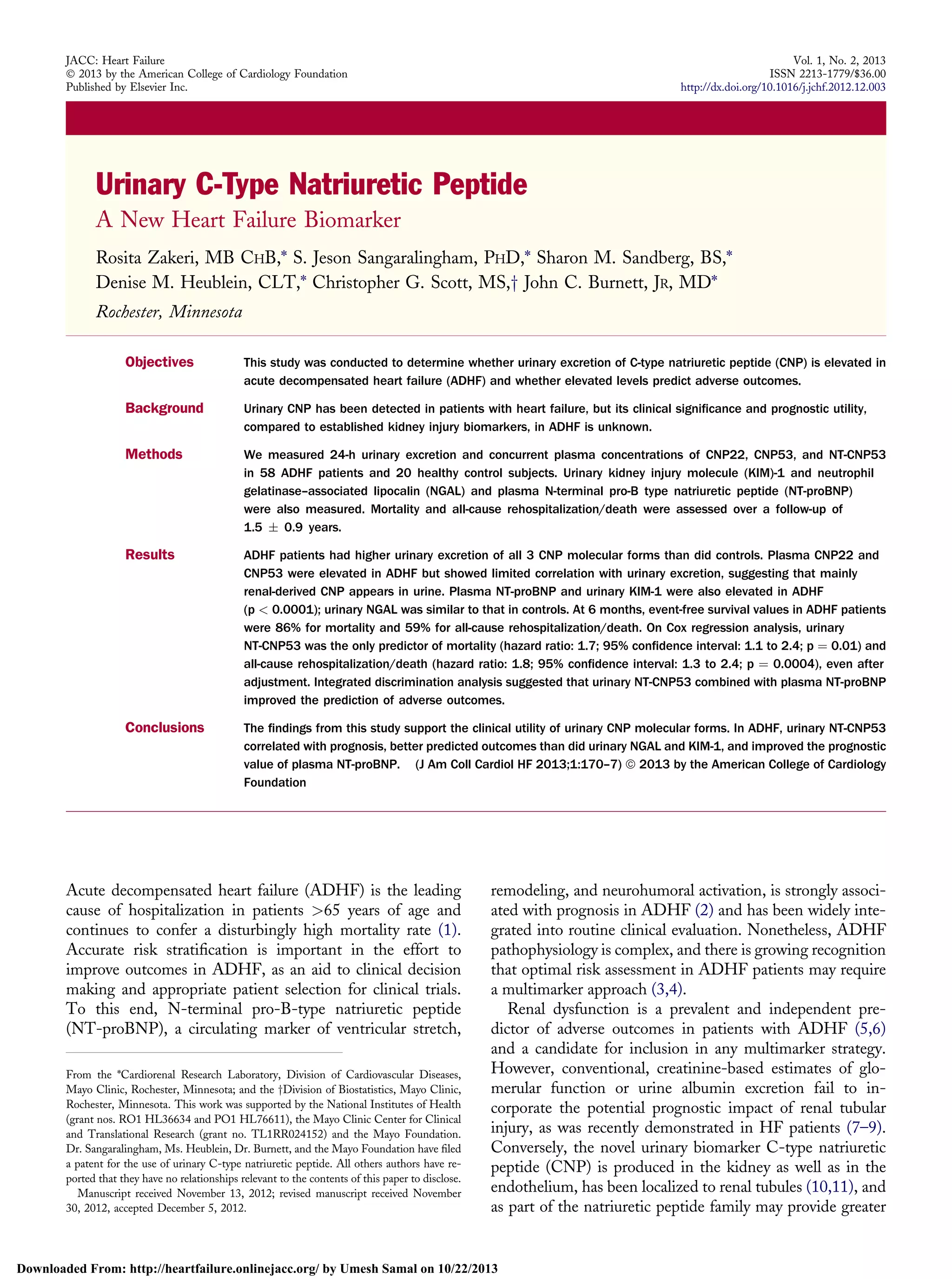
Objectives This study was conducted to determine whether urinary excretion of C-type natriuretic peptide (CNP) is elevated in
acute decompensated heart failure (ADHF) and whether elevated levels predict adverse outcomes.
Background Urinary CNP has been detected in patients with heart failure, but its clinical significance and prognostic utility,
compared to established kidney injury biomarkers, in ADHF is unknown.
Methods We measured 24-h urinary excretion and concurrent plasma concentrations of CNP22, CNP53, and NT-CNP53
in 58 ADHF patients and 20 healthy control subjects. Urinary kidney injury molecule (KIM)-1 and neutrophil
gelatinase–associated lipocalin (NGAL) and plasma N-terminal pro-B type natriuretic peptide (NT-proBNP)
were also measured. Mortality and all-cause rehospitalization/death were assessed over a follow-up of
1.5 Æ 0.9 years.
Results ADHF patients had higher urinary excretion of all 3 CNP molecular forms than did controls. Plasma CNP22 and
CNP53 were elevated in ADHF but showed limited correlation with urinary excretion, suggesting that mainly
renal-derived CNP appears in urine. Plasma NT-proBNP and urinary KIM-1 were also elevated in ADHF
(p < 0.0001); urinary NGAL was similar to that in controls. At 6 months, event-free survival values in ADHF patients
were 86% for mortality and 59% for all-cause rehospitalization/death. On Cox regression analysis, urinary
NT-CNP53 was the only predictor of mortality (hazard ratio: 1.7; 95% confidence interval: 1.1 to 2.4; p ¼ 0.01) and
all-cause rehospitalization/death (hazard ratio: 1.8; 95% confidence interval: 1.3 to 2.4; p ¼ 0.0004), even after
adjustment. Integrated discrimination analysis suggested that urinary NT-CNP53 combined with plasma NT-proBNP
improved the prediction of adverse outcomes.
Conclusions The findings from this study support the clinical utility of urinary CNP molecular forms. In ADHF, urinary NT-CNP53
correlated with prognosis, better predicted outcomes than did urinary NGAL and KIM-1, and improved the prognostic
value of plasma NT-proBNP. (J Am Coll Cardiol HF 2013;1:170–7) ª 2013 by the American College of Cardiology
Foundation
Acute decompensated heart failure (ADHF) is the leading
cause of hospitalization in patients >65 years of age and
continues to confer a disturbingly high mortality rate (1).
Accurate risk stratification is important in the effort to
improve outcomes in ADHF, as an aid to clinical decision
making and appropriate patient selection for clinical trials.
To this end, N-terminal pro-B-type natriuretic peptide
(NT-proBNP), a circulating marker of ventricular stretch,
remodeling, and neurohumoral activation, is strongly associ-
ated with prognosis in ADHF (2) and has been widely inte-
grated into routine clinical evaluation. Nonetheless, ADHF
pathophysiology is complex, and there is growing recognition
that optimal risk assessment in ADHF patients may require
a multimarker approach (3,4).
Renal dysfunction is a prevalent and independent pre-
dictor of adverse outcomes in patients with ADHF (5,6)
and a candidate for inclusion in any multimarker strategy.
However, conventional, creatinine-based estimates of glo-
merular function or urine albumin excretion fail to in-
corporate the potential prognostic impact of renal tubular
injury, as was recently demonstrated in HF patients (7–9).
Conversely, the novel urinary biomarker C-type natriuretic
peptide (CNP) is produced in the kidney as well as in the
endothelium, has been localized to renal tubules (10,11), and
as part of the natriuretic peptide family may provide greater
From the *Cardiorenal Research Laboratory, Division of Cardiovascular Diseases,
Mayo Clinic, Rochester, Minnesota; and the yDivision of Biostatistics, Mayo Clinic,
Rochester, Minnesota. This work was supported by the National Institutes of Health
(grant nos. RO1 HL36634 and PO1 HL76611), the Mayo Clinic Center for Clinical
and Translational Research (grant no. TL1RR024152) and the Mayo Foundation.
Dr. Sangaralingham, Ms. Heublein, Dr. Burnett, and the Mayo Foundation have filed
a patent for the use of urinary C-type natriuretic peptide. All others authors have re-
ported that they have no relationships relevant to the contents of this paper to disclose.
Manuscript received November 13, 2012; revised manuscript received November
30, 2012, accepted December 5, 2012.
JACC: Heart Failure Vol. 1, No. 2, 2013
Ó 2013 by the American College of Cardiology Foundation ISSN 2213-1779/$36.00
Published by Elsevier Inc. http://dx.doi.org/10.1016/j.jchf.2012.12.003
Downloaded From: http://heartfailure.onlinejacc.org/ by Umesh Samal on 10/22/2013
information concerning renal integrity and the cardio–renal
interaction in ADHF.
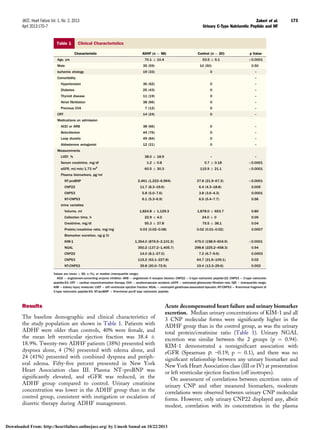
CNP is synthesized as the precursor 103–amino acid (AA)
protein proCNP (AA 1 to 103), which is then cleaved into
NT-proCNP (AA 1 to 50) and CNP53 (AA 51 to 103) by
the intracellular endoprotease furin (Fig. 1) (12). Additional
downstream processing cleaves CNP53, giving rise to the bio-
logically active mature form, CNP22 (AA 82 to 103), and an
inactive form, NT-CNP53 (AA 51 to 81) (12,13). Although
urinary CNP22 excretion has been shown to be elevated in stable
heart failure (HF) (14), the clinical utility of other CNP
molecular forms has not been studied. Furthermore, the prog-
nostic significance of urinary CNP excretion in ADHF is
unknown.
We tested the hypotheses that excretion of NT-CNP53,
which, like NT-proBNP, may have a longer half-life and
be more resistant to degradation than its biologically active
mature form, CNP22, would: 1) be associated with prognosis
in patients with ADHF; 2) provide greater prognostic
information than contemporary urinary biomarkers of tubular
injury (kidney injury molecule [KIM]-1 and neutrophil
gelatinase-associated lipocalin [NGAL]); and 3) be of in-
cremental predictive value to plasma NT-proBNP in the risk
stratification of patients with ADHF.
Methods
Patient population. Sixty ADHF patients and 20 healthy
subjects were recruited. ADHF patients hospitalized at St
Mary’s Hospital, Mayo Clinic, Rochester, Minnesota, were
prospectively identified and enrolled from an ongoing
registry of consecutive admissions between August 2009 and
August 2010. Patients with a clinical diagnosis of HF
consistent with the Framingham criteria (15) were included.
Patients with a urine collection incomplete or incorrect for
adequate urinary biomarker analysis were excluded (n ¼ 2),
leaving a total of 58 consecutive ADHF patients providing
consent. These patients underwent a baseline history assess-
ment, physical examination, and transthoracic echocardiog-
raphy as a part of routine clinical care. Collection of 24-h
urine and plasma samples for the assessment of CNP
molecular forms, urinary KIM-1 and NGAL, and plasma
NT-proBNP were obtained on admission. Urine samples
were collected on ice with acetic acid (30 ml of 1:1 acetic acid;
17.4 M). After the timed urine collection (mean, 22.9 Æ 4 h),
total volume was recorded and samples aliquoted and stored
at –80
C until analysis. Results are expressed using the
Modification of Diet in Renal Disease estimated glomerular
filtration rate (eGFR) (16).
Control subjects were recruited from a population of
volunteers from Rochester, Minnesota; all were nonsmokers
and had no history of cardiovascular or systemic disease.
The 24-h urine and plasma samples were collected on
enrollment. All participants provided written informed
consent for participation, and the study was approved by the
institutional review board at the Mayo Clinic.
Urine biomarker assays. CNP22
(AA 82 TO 103). Urinary CNP22
was determined using a non-
equilibrium radioimmunoassay
(Phoenix Pharmaceuticals Inc.,
Burlingame, California), with an
antibody that detects human
CNP22, as previously described
(11). The range of the standard
curve was 0.5 to 128 pg, with
a lower limit of quantification
(LLOQ) of 0.5 pg. Interassay
and intra-assay variability values
were 11% and 5%, respectively.
Recovery was 85%. Cross-
reactivity values were 0% with
atrial natriuretic peptide (ANP),
brain natriuretic peptide (BNP),
endothelin, and NT-CNP53 and
59% with CNP53.
CNP53 (AA 51 TO 103) AND NT-CNP53
(AA 51 TO 81). Urinary CNP53
and NT-CNP53 were determined using a similar nonequi-
librium radioimmunoassay (Phoenix Pharmaceuticals Inc.),
with antibodies that detect human CNP53 (CNP53 [AA 51
to 103]), and the first 29 amino acids of CNP53, starting from
the amino-terminal only when separated from the ring
structure (NT-CNP53 [AA 51 to 81]). For CNP53 and NT-
CNP53, the range of the standard curve was 0.5 to 128 pg.
Interassay and intra-assay variability values for CNP53 were
8% and 7%, respectively. Recovery was 81 Æ 4%. Cross-
reactivity values were 100% with CNP22 and 0% with
NT-CNP53, ANP, and BNP. Interassay and intra-assay
variability values for NT-CNP53 were 10% and 6%, respec-
tively. Recovery was 82 Æ 5.2%. Cross-reactivity values were
0% with ANP, BNP, CNP22, CNP53, and endothelin.
NGAL AND KIM-1. Urinary concentrations of NGAL and
KIM-1 were measured using enzyme-linked immunoassay as
per the manufacturer’s instructions (Quantikine ELISA,
RD Systems, Inc., Minneapolis, Minnesota). The LLOQs
were 0.012 and 0.009 ng/ml for NGAL and KIM-1, respec-
tively. Intra-assay and interassay coefficients of variation
were 5% and 8%, respectively. NGAL is recognized to
form complexes with matrix metalloproteinase (MMP)-9;
recombinant human MMP-9/NGAL complex demonstrated
0.3% cross-reactivity in the assay used. There was no significant
cross-reactivity or interference in the KIM assay.
URINARY BIOMARKER EXCRETION. Mean urinary flow (milli-
liter per hour) was determined from total urine volume (milli-
liters) and urine collection time (hour). Urinary biomarker
excretion was calculated as the product of urinary biomarker
concentration (picogram per milliliter or nanograms per
milliliter)andurinaryflowrate(milliliter per hour)andadjusted
for urinary creatinine excretion (nanograms per gram Cr).
Abbreviations
and Acronymns
ADHF = acute
decompensated heart failure
ANP = atrial natriuretic
peptide
BNP = brain natriuretic
peptide
CI = confidence interval
CNP = C-type natriuretic
peptide
eGFR = estimated
glomerular filtration rate
IQR = interquartile range
KIM = kidney injury molecule
LLOQ = lower limit of
quantification
NGAL = neutrophil
gelatinase–associated
lipocalin
NT-proBNP = N-terminal pro-
B type natriuretic peptide
JACC: Heart Failure Vol. 1, No. 2, 2013 Zakeri et al.
April 2013:170–7 Urinary C-Type Natriuretic Peptide and HF
171
Downloaded From: http://heartfailure.onlinejacc.org/ by Umesh Samal on 10/22/2013
Plasma biomarker assays. Blood was drawn into ethyl-
enediamine tetraacetic acid tubes and centrifuged at 4
C and
2,500 rpm for 10 min. One milliliter of plasma was ali-
quoted and stored at –80
C until assayed. Plasma concen-
trations of CNP molecular forms were determined using
a nonequilibrium radioimmunoassay (Phoenix Pharmaceu-
ticals Inc.), with anti–human CNP antibodies (17). Plasma
NT-proBNP was measured using electrochemiluminescence
immunoassay (18). The LLOQ for NT-proBNP was 5 pg/ml;
interassay and intra-assay variability values were 3.1% and
2.5%, respectively. There was no cross-reactivity with CNP
forms.
Statistical analysis. All urinary biomarkers demonstrated
a non-Gaussian distribution; therefore, values are presented
as medians (interquartile range [IQR]). For comparisons of
data between the ADHF and control groups, nonparametric
Wilcoxon rank-sum tests were used. Spearman rank corre-
lation was used to ascertain relationships between contin-
uous variables. Biomarker-excretion data were normalized
using natural logarithmic transformation before Cox
regression analysis to detect independent predictors of
mortality and time to first nonelective all-cause rehospitali-
zation/death. Mortality and rehospitalization were ascer-
tained from institutional records, including local primary
care data. Patients were otherwise censored at the time of
last known follow-up. Survival rates were calculated using
the Kaplan-Meier method. The discriminatory ability of
biomarkers was compared using c statistics. Confidence
intervals (CIs) were calculated for c statistics using an
approximate jackknife method of calculating SEs. The
integrated discrimination index (19) was utilized to evaluate
the improvement in predictive accuracy using the combi-
nation of urinary NT-CNP53 and plasma NT-proBNP over
the use of NT-proBNP alone, for study outcomes. Proba-
bility values are 2-sided; p  0.05 was considered significant.
Data were analyzed using JMP software version 9.0 (SAS
Institute Inc., Cary, North Carolina) and SAS version 9.2
(SAS Institute Inc.).
Figure 1 Biosynthesis and Processing of CNP
Precursor protein, pro C-type natriuretic peptide (CNP), is cleaved into N-terminal (NT)-proCNP and CNP53 by the intracellular endoprotease furin. Additional downstream
processing cleaves CNP53 into the biologically active mature form CNP22, and an inactive form, NT-CNP53.
Zakeri et al. JACC: Heart Failure Vol. 1, No. 2, 2013
Urinary C-Type Natriuretic Peptide and HF April 2013:170–7
172
Downloaded From: http://heartfailure.onlinejacc.org/ by Umesh Samal on 10/22/2013
Results
The baseline demographic and clinical characteristics of
the study population are shown in Table 1. Patients with
ADHF were older than controls, 40% were female, and
the mean left ventricular ejection fraction was 38.4 Æ
18.9%. Twenty-two ADHF patients (38%) presented with
dyspnea alone, 4 (7%) presented with edema alone, and
24 (41%) presented with combined dyspnea and periph-
eral edema. Fifty-five percent presented in New York
Heart Association class III. Plasma NT-proBNP was
significantly elevated, and eGFR was reduced, in the
ADHF group compared to control. Urinary creatinine
concentration was lower in the ADHF group than in the
control group, consistent with instigation or escalation of
diuretic therapy during ADHF management.
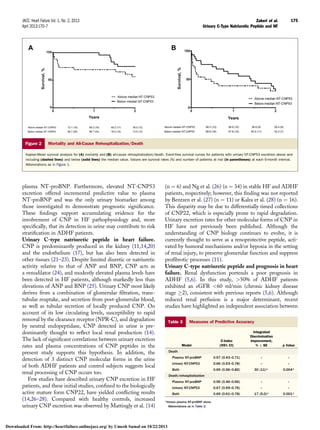
Acute decompensated heart failure and urinary biomarker
excretion. Median urinary concentrations of KIM-1 and all
3 CNP molecular forms were significantly higher in the
ADHF group than in the control group, as was the urinary
total protein/creatinine ratio (Table 1). Urinary NGAL
excretion was similar between the 2 groups (p ¼ 0.94).
KIM-1 demonstrated a nonsignificant association with
eGFR (Spearman r: –0.19; p ¼ 0.1), and there was no
significant relationship between any urinary biomarker and
New York Heart Association class (III or IV) at presentation
or left ventricular ejection fraction (off inotropes).
On assessment of correlations between excretion rates of
urinary CNP and other measured biomarkers, moderate
correlations were observed between urinary CNP molecular
forms. However, only urinary CNP22 displayed any, albeit
modest, correlation with its concentration in the plasma
Table 1 Clinical Characteristics
Characteristic ADHF (n ¼ 58) Control (n ¼ 20) p Value
Age, yrs 70.1 Æ 10.4 53.5 Æ 6.1 0.0001
Male 35 (59) 10 (50) 0.50
Ischemic etiology 19 (33) 0 –
Comorbidity –
Hypertension 36 (62) 0 –
Diabetes 25 (43) 0 –
Thyroid disease 11 (19) 0 –
Atrial fibrillation 38 (66) 0 –
Previous CVA 7 (12) 0 –
CRT 14 (24) 0 –
Medications on admission
ACEI or ARB 38 (66) 0 –
Beta-blocker 44 (76) 0 –
Loop diuretic 49 (84) 0 –
Aldosterone antagonist 12 (21) 0 –
Measurements
LVEF, % 38.0 Æ 18.9 – –
Serum creatinine, mg/dl 1.2 Æ 0.8 0.7 Æ 0.18 0.0001
eGFR, ml/min/1.73 m2
60.5 Æ 30.3 115.9 Æ 21.1 0.0001
Plasma biomarkers, pg/ml
NT-proBNP 2,461 (1,222–6,994) 37.8 (21.9–67.3) 0.0001
CNP22 11.7 (8.3–19.6) 6.4 (4.3–18.8) 0.005
CNP53 5.8 (5.0–7.6) 3.8 (3.6–4.3) 0.0001
NT-CNP53 6.1 (5.3–6.9) 6.5 (5.4–7.7) 0.56
Urine variables
Volume, ml 1,824.8 Æ 1,129.3 1,878.0 Æ 653.7 0.80
Collection time, h 22.9 Æ 4.0 24.0 Æ 0 0.05
Creatinine, mg/dl 55.3 Æ 37.8 75.5 Æ 38.1 0.04
Protein/creatinine ratio, mg/mg 0.03 (0.02–0.08) 0.02 (0.01–0.02) 0.0007
Biomarker excretion, ng/g Cr
KIM-1 1,354.0 (876.5–2,101.5) 475.0 (198.9–604.9) 0.0001
NGAL 350.2 (137.2–1,405.7) 298.8 (225.2–458.3) 0.94
CNP22 14.0 (8.1–27.0) 7.2 (6.7–9.6) 0.0003
CNP53 115.2 (63.1–227.8) 64.7 (21.6–109.1) 0.02
NT-CNP53 35.8 (20.0–72.6) 19.4 (13.3–29.6) 0.002
Values are mean Æ SD, n (%), or median (interquartile range).
ACEI ¼ angiotensin-converting enzyme inhibitor; ARB ¼ angiotensin II receptor blocker; CNP22 ¼ C-type natriuretic peptide-22; CNP53 ¼ C-type natriuretic
peptide-53; CRT ¼ cardiac resynchronization therapy; CVA ¼ cerebrovascular accident; eGFR ¼ estimated glomerular filtration rate; IQR ¼ interquartile range;
KIM ¼ kidney injury molecule; LVEF ¼ left ventricular ejection fraction; NGAL ¼ neutrophil gelatinase-associated lipocalin; NT-CNP53 ¼ N-terminal fragment of
C-type natriuretic peptide-53; NT-proBNP ¼ N-terminal pro-B type natriuretic peptide.
JACC: Heart Failure Vol. 1, No. 2, 2013 Zakeri et al.
April 2013:170–7 Urinary C-Type Natriuretic Peptide and HF
173
Downloaded From: http://heartfailure.onlinejacc.org/ by Umesh Samal on 10/22/2013
(r: 0.28; p ¼ 0.04) (Online Table 1). Urinary CNP22 (r: 0.45;
p ¼ 0.0003) and CNP53 (r: 0.33; p ¼ 0.01) were weakly
associated with plasma NT-proBNP; urinary NT-CNP53
was not. Urinary CNP22 (r: 0.68; p ¼ 0.0001) and urinary
KIM-1 (r: 0.78; p  0.0001) demonstrated marked correla-
tions with the urinary total protein/creatinine ratio; no
correlation was evident with the other urinary biomarkers.
Medications on admission for ADHF are shown in Table 1.
On exploratory analysis, urinary NGAL was higher in the
context of the use of angiotensin-converting enzyme inhib-
itors or angiotensin II receptor blockers (median [IQR]: 444.0
[219.2 to 2,144.1] ng/g Cr) versus no use of angiotensin-
converting enzyme inhibitors or angiotensin II receptor
blockers (177.3 [106.3 to 333.6] ng/g Cr) (p ¼ 0.03), and
urinary NT-CNP53 was lower in ADHF patients on loop
diuretics compared to those not using them (34.0 [17.6 to
61.3] ng/g Cr vs. 60.4 [43.6 to 246.1] ng/g Cr; p ¼ 0.01).
Plasma concentrations of C-type natriuretic peptide.
Plasma CNP22 and CNP53 concentrations were elevated
in the ADHF group compared to those in the control group,
whereas plasma NT-CNP53 was similar (Table 1). Plasma
CNP22 demonstrated limited association to its concurrent
urinary excretion (r: 0.28; p ¼ 0.04) and urinary NT-
CNP53 excretion (r: 0.26; p ¼ 0.05) but no significant
correlation with urinary CNP53 (r: 0.24; p ¼ 0.07) (Online
Table 1). In contrast, neither plasma CNP53 nor plasma
NT-CNP53 displayed any relationship to urinary excretion
of any of the CNP molecular forms studied.
Clinical outcomes. Among the 58 ADHF patients
studied, there were 18 deaths and 18 rehospitalizations
(13 cardiovascular-related rehospitalizations) over a mean
follow-up of 1.5 Æ 0.9 years. Two patients were admitted
for elective cardiac resynchronization therapy; these events
were not included in the final analysis. At 6 months,
the overall event-free survival rates (95% CI) were 85.8%
(77.1 to 95.4) for mortality and 58.9% (47.2 to 73.4) for
rehospitalization/death.
Univariate Cox regression analysis of baseline factors
showed age to be the only variable associated with study
outcomes (mortality: HR ¼ 1.08 [95% CI, 1.02 to 1.15;
p ¼ 0.01]; rehospitalization/death: HR ¼ 1.04 [95% CI, 1.00
to 1.09; p ¼ 0.04]). Sex, New York Heart Association class,
left ventricular ejection fraction, hypertension, and diabetes
were not significantly associated with either outcome. Of
the urinary and plasma biomarkers assessed, only urinary
NT-CNP53 excretion was significantly predictive of mor-
tality and all-cause rehospitalization/death on Cox regression
analysis (Table 2). This association persisted after adjust-
ments for age, urinary protein/creatinine ratio, and plasma
NT-proBNP.
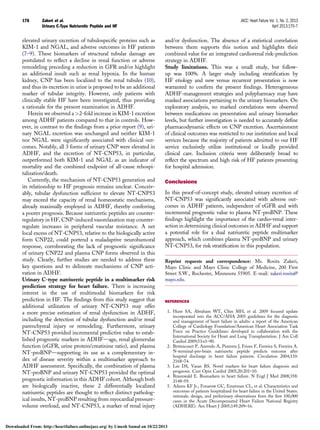
Six-month Kaplan-Meier event-free survival rates (95%
CI) were lower in the subgroup with urinary NT-CNP53
excretion above the median compared to those in the
subgroup with excretion rates below the median (mortality:
73.1% [57.9 to 92.3] vs. 96.7% [90.5 to 100.0]; rehospitali-
zation/death: 46.3% [30.6 to 70.0] vs. 69.8% [55.1 to 88.5])
(Fig. 2). Moreover, on analysis of the c statistic for the
occurrence of all-cause mortality, the addition of urinary NT-
CNP53 to plasma NT-proBNP provided incremental
predictive value compared to plasma NT-proBNP alone
(Table 3). Examination of the integrated discrimination
index provided further evidence that this combination
improved prediction of adverse outcomes in this cohort. No
other urinary or plasma biomarkers in this study demon-
strated significant predictive value.
Discussion
This study investigated the prognostic value of urinary CNP
in patients with ADHF. The major finding was that
increased urinary excretion of NT-CNP53 was associated
with increased mortality and also predicted the composite
outcome of all-cause rehospitalization/death in patients with
ADHF, independent of age, renal glomerular function, and
Table 2
Predictive Values of Urinary NT-CNP53 Excretion and Plasma NT-proBNP for Clinical Outcome
in Patients With ADHF
Model
Outcome
Death All-Cause Rehospitalization/Death
HR (95% CI) p Value HR (95% CI) p Value
Urinary NT-CNP53
Unadjusted 1.67 (1.14–2.37) 0.01 1.78 (1.30–2.39) 0.0004
Model 1 1.54 (1.05–2.22) 0.03 1.75 (1.28–2.36) 0.0007
Model 2 1.60 (1.06–2.38) 0.03 1.74 (1.26–2.36) 0.001
Model 3 1.67 (1.08–2.57) 0.02 1.79 (1.28–2.47) 0.0009
Plasma NT-proBNP
Unadjusted 1.28 (0.85–1.93) 0.24 1.24 (0.94–1.65) 0.13
Model 1 1.35 (0.89–2.04) 0.16 1.26 (0.95–1.67) 0.11
Model 2 1.30 (0.85–1.98) 0.21 1.22 (0.91–1.63) 0.17
Univariate and adjusted Cox proportional hazard analysis, Ln-transformed data (hazard ratio are per 1 log unit increase). Model 1, adjusted for age; model 2,
adjusted for age and urine protein/creatinine ratio; model 3, adjusted for age, urine protein/creatinine ratio, and plasma NT-proBNP.
CI ¼ confidence interval; HR ¼ hazard ratio; NT-CNP53 ¼ N-terminal fragment of C-type natriuretic peptide-53; NT-proBNP ¼ N-terminal pro-B-type
natriuretic peptide.
Zakeri et al. JACC: Heart Failure Vol. 1, No. 2, 2013
Urinary C-Type Natriuretic Peptide and HF April 2013:170–7
174
Downloaded From: http://heartfailure.onlinejacc.org/ by Umesh Samal on 10/22/2013
plasma NT-proBNP. Furthermore, elevated NT-CNP53
excretion offered incremental predictive value to plasma
NT-proBNP and was the only urinary biomarker among
those investigated to demonstrate prognostic significance.
These findings support accumulating evidence for the
involvement of CNP in HF pathophysiology and, more
specifically, that its detection in urine may contribute to risk
stratification in ADHF patients.
Urinary C-type natriuretic peptide in heart failure.
CNP is predominantly produced in the kidney (11,14,20)
and the endothelium (17), but has also been detected in
other tissues (21–23). Despite limited diuretic or natriuretic
activity relative to that of ANP and BNP, CNP acts as
a venodilator (24), and modestly elevated plasma levels have
been detected in HF patients, although markedly less than
elevations of ANP and BNP (25). Urinary CNP most likely
derives from a combination of glomerular filtration, trans-
tubular reuptake, and secretion from post-glomerular blood,
as well as tubular secretion of locally produced CNP. On
account of its low circulating levels, susceptibility to rapid
removal by the clearance receptor (NPR-C), and degradation
by neutral endopeptidase, CNP detected in urine is pre-
dominantly thought to reflect local renal production (14).
The lack of significant correlations between urinary excretion
rates and plasma concentrations of CNP peptides in the
present study supports this hypothesis. In addition, the
detection of 3 distinct CNP molecular forms in the urine
of both ADHF patients and control subjects suggests local
renal processing of CNP occurs too.
Few studies have described urinary CNP excretion in HF
patients, and these initial studies, confined to the biologically
active mature form CNP22, have yielded conflicting results
(14,26–28). Compared with healthy controls, increased
urinary CNP excretion was observed by Mattingly et al. (14)
(n ¼ 6) and Ng et al. (26) (n ¼ 34) in stable HF and ADHF
patients, respectively; however, this finding was not reported
by Bentzen et al. (27) (n ¼ 11) or Kalra et al. (28) (n ¼ 16).
This disparity may be due to differentially timed collections
of CNP22, which is especially prone to rapid degradation.
Urinary excretion rates for other molecular forms of CNP in
HF have not previously been published. Although the
understanding of CNP biology continues to evolve, it is
currently thought to serve as a renoprotective peptide, acti-
vated by humoral mechanisms and/or hypoxia in the setting
of renal injury, to preserve glomerular function and suppress
profibrotic processes (11).
Urinary C-type natriuretic peptide and prognosis in heart
failure. Renal dysfunction portends a poor prognosis in
ADHF (5,6). In this study, 50% of ADHF patients
exhibited an eGFR 60 ml/min (chronic kidney disease
stage !2), consistent with previous reports (5,6). Although
reduced renal perfusion is a major determinant, recent
studies have highlighted an independent association between
Table 3 Measures of Predictive Accuracy
Model
C-Index
(95% CI)
Integrated
Discrimination
Improvement,
% Æ SE p Value
Death
Plasma NT-proBNP 0.57 (0.43–0.71) – –
Urinary NT-CNP53 0.66 (0.53–0.78) – –
Both 0.69 (0.56–0.82) 30 (11)* 0.004*
Death/rehospitalization
Plasma NT-proBNP 0.56 (0.46–0.66) – –
Urinary NT-CNP53 0.67 (0.59–0.76) – –
Both 0.69 (0.61–0.78) 17 (5.0)* 0.001*
*Versus plasma NT-proBNP alone.
Abbreviations as in Table 2.
Figure 2 Mortality and All-Cause Rehospitalization/Death
Kaplan-Meier survival analysis for (A) mortality and (B) all-cause rehospitalization/death. Event-free survival curves for patients with urinary NT-CNP53 excretion above and
including (dashed lines) and below (solid lines) the median value. Values are survival rates (%) and number of patients at risk (in parentheses) at each 6-month interval.
Abbreviations as in Figure 1.
JACC: Heart Failure Vol. 1, No. 2, 2013 Zakeri et al.
April 2013:170–7 Urinary C-Type Natriuretic Peptide and HF
175
Downloaded From: http://heartfailure.onlinejacc.org/ by Umesh Samal on 10/22/2013
elevated urinary excretion of tubulospecific proteins such as
KIM-1 and NGAL, and adverse outcomes in HF patients
(7–9). These biomarkers of structural tubular damage are
postulated to reflect a decline in renal function or adverse
remodeling preceding a reduction in GFR and/or highlight
an additional insult such as renal hypoxia. In the human
kidney, CNP has been localized to the renal tubules (10),
and thus its excretion in urine is proposed to be an additional
marker of tubular integrity. However, only patients with
clinically stable HF have been investigated, thus providing
a rationale for the present examination in ADHF.
Herein we observed a 2-fold increase in KIM-1 excretion
among ADHF patients compared to that in controls. How-
ever, in contrast to the findings from a prior report (9), uri-
nary NGAL excretion was unchanged and neither KIM-1
nor NGAL were significantly associated with clinical out-
comes. Notably, all 3 forms of urinary CNP were elevated in
ADHF, and the excretion of NT-CNP53, in particular,
outperformed both KIM-1 and NGAL as an indicator of
mortality and the combined endpoint of all-cause rehospi-
talization/death.
Currently, the mechanism of NT-CNP53 generation and
its relationship to HF prognosis remains unclear. Conceiv-
ably, tubular dysfunction sufficient to elevate NT-CNP53
may exceed the capacity of renal homeostatic mechanisms,
already maximally employed in ADHF, thereby conferring
a poorer prognosis. Because natriuretic peptides are counter-
regulatory in HF, CNP-induced vasorelaxation may counter-
regulate increases in peripheral vascular resistance. A net
local excess of NT-CNP53, relative to the biologically active
form CNP22, could portend a maladaptive neurohumoral
response, corroborating the lack of prognostic significance
of urinary CNP22 and plasma CNP forms observed in this
study. Clearly, further studies are needed to address these
key questions and to delineate mechanisms of CNP acti-
vation in ADHF.
Urinary C-type natriuretic peptide in a multimarker risk
prediction strategy for heart failure. There is increasing
interest in the use of multimodal biomarkers for risk
prediction in HF. The findings from this study suggest that
additional utilization of urinary NT-CNP53 may offer
a more precise estimation of renal dysfunction in ADHF,
including the detection of tubular dysfunction and/or renal
parenchymal injury or remodeling. Furthermore, urinary
NT-CNP53 provided incremental predictive value to estab-
lished prognostic markers in ADHFdage, renal glomerular
function (eGFR, urine protein/creatinine ratio), and plasma
NT-proBNPdsupporting its use as a complementary in-
dex of disease severity within a multimarker approach to
ADHF assessment. Specifically, the combination of plasma
NT-proBNP and urinary NT-CNP53 provided the optimal
prognostic information in this ADHF cohort. Although both
are biologically inactive, these 2 differentially localized
natriuretic peptides are thought to reflect distinct patholog-
ical insults, NT-proBNP resulting from myocardial pressure-
volume overload, and NT-CNP53, a marker of renal injury
and/or dysfunction. The absence of a statistical correlation
between them supports this notion and highlights their
combined value for an integrated cardiorenal risk-prediction
strategy in ADHF.
Study limitations. This was a small study, but follow-
up was 100%. A larger study including stratification by
HF etiology and new versus recurrent presentation is now
warranted to confirm the present findings. Heterogeneous
ADHF-management strategies and polypharmacy may have
masked associations pertaining to the urinary biomarkers. On
exploratory analysis, no marked correlations were observed
between medications on presentation and urinary biomarker
levels, but further investigation is needed to accurately define
pharmacodynamic effects on CNP excretion. Ascertainment
of clinical outcomes was restricted to our institution and local
services because the majority of patients admitted to our HF
service exclusively utilize institutional or locally provided
clinical care. Inclusion criteria were deliberately broad to
reflect the spectrum and high risk of HF patients presenting
for hospital admission.
Conclusions
In this proof-of-concept study, elevated urinary excretion of
NT-CNP53 was significantly associated with adverse out-
comes in ADHF patients, independent of eGFR and with
incremental prognostic value to plasma NT-proBNP. These
findings highlight the importance of the cardio–renal inter-
action in determining clinical outcomes in ADHF and support
a potential role for a dual natriuretic peptide multimarker
approach, which combines plasma NT-proBNP and urinary
NT-CNP53, for risk stratification in this population.
Reprint requests and correspondence: Ms. Rosita Zakeri,
Mayo Clinic and Mayo Clinic College of Medicine, 200 First
Street S.W., Rochester, Minnesota 55905. E-mail: zakeri.rosita@
mayo.edu.
REFERENCES
1. Hunt SA, Abraham WT, Chin MH, et al. 2009 focused update
incorporated into the ACC/AHA 2005 guidelines for the diagnosis
and management of heart failure in adults: a report of the American
College of Cardiology Foundation/American Heart Association Task
Force on Practice Guidelines: developed in collaboration with the
International Society for Heart and Lung Transplantation. J Am Coll
Cardiol 2009;53:e1–90.
2. Bettencourt P, Azevedo A, Pimenta J, Frioes F, Ferreira S, Ferreira A.
N-terminal-pro-brain natriuretic peptide predicts outcome after
hospital discharge in heart failure patients. Circulation 2004;110:
2168–74.
3. Lee DS, Vasan RS. Novel markers for heart failure diagnosis and
prognosis. Curr Opin Cardiol 2005;20:201–10.
4. Braunwald E. Biomarkers in heart failure. N Engl J Med 2008;358:
2148–59.
5. Adams KF Jr., Fonarow GC, Emerman CL, et al. Characteristics and
outcomes of patients hospitalized for heart failure in the United States:
rationale, design, and preliminary observations from the first 100,000
cases in the Acute Decompensated Heart Failure National Registry
(ADHERE). Am Heart J 2005;149:209–16.
Zakeri et al. JACC: Heart Failure Vol. 1, No. 2, 2013
Urinary C-Type Natriuretic Peptide and HF April 2013:170–7
176
Downloaded From: http://heartfailure.onlinejacc.org/ by Umesh Samal on 10/22/2013
6. Smith GL, Lichtman JH, Bracken MB, et al. Renal impairment and
outcomes in heart failure: systematic review and meta-analysis. J Am
Coll Cardiol 2006;47:1987–96.
7. Damman K, Van Veldhuisen DJ, Navis G, et al. Tubular damage in
chronic systolic heart failure is associated with reduced survival inde-
pendent of glomerular filtration rate. Heart 2010;96:1297–302.
8. Jungbauer CG, Birner C, Jung B, et al. Kidney injury molecule-1 and
N-acetyl-beta-D-glucosaminidase in chronic heart failure: possible
biomarkers of cardiorenal syndrome. Eur J Heart Failure 2011;13:
1104–10.
9. Collins SP, Hart KW, Lindsell CJ, et al. Elevated urinary neutrophil
gelatinase-associated lipocalcin after acute heart failure treatment is
associated with worsening renal function and adverse events. Eur J
Heart Fail 2012;14:1020–9.
10. Totsune K, Takahashi K, Murakami O, et al. Natriuretic peptides in
the human kidney. Hypertension 1994;24:758–62.
11. Sangaralingham SJ, Heublein DM, Grande JP, et al. Urinary C-type
natriuretic peptide excretion: a potential novel biomarker for renal
fibrosis during aging. Am J Physiol Renal Physiol 2011;301:
F943–52.
12. Wu C, Wu F, Pan J, Morser J, Wu Q. Furin-mediated processing of
Pro-C-type natriuretic peptide. J Biol Chem 2003;278:25847–52.
13. Kojima M, Minamino N, Kangawa K, Matsuo H. Cloning and
sequence analysis of a cDNA encoding a precursor for rat C-type
natriuretic peptide (CNP). FEBS Lett 1990;276:209–13.
14. Mattingly MT, Brandt RR, Heublein DM, Wei CM, Nir A,
Burnett JC Jr. Presence of C-type natriuretic peptide in human kidney
and urine. Kidney Int 1994;46:744–7.
15. McKee PA, Castelli WP, McNamara PM, Kannel WB. The natural
history of congestive heart failure: the Framingham study. N Engl J
Med 1971;285:1441–6.
16. Levey AS, Bosch JP, Lewis JB, Greene T, Rogers N, Roth D, for the
Modification of Diet in Renal Disease Study Group. A more accurate
method to estimate glomerular filtration rate from serum creatinine:
a new prediction equation. Ann Intern Med 1999;130:461–70.
17. Stingo AJ, Clavell AL, Heublein DM, Wei CM, Pittelkow MR,
Burnett JC Jr. Presence of C-type natriuretic peptide in cultured human
endothelial cells and plasma. Am J Physiol 1992;263:H1318–21.
18. Costello-Boerrigter LC, Boerrigter G, Redfield MM, et al. Amino-
terminal pro-B-type natriuretic peptide and B-type natriuretic peptide
in the general community: determinants and detection of left ventric-
ular dysfunction. J Am Coll Cardiol 2006;47:345–53.
19. Pencina MJ, D’Agostino RB Sr, D’Agostino RB Jr., Vasan RS.
Evaluating the added predictive ability of a new marker: from area
under the ROC curve to reclassification and beyond. Stat Med 2008;
27:157–72, discussion 207–12.
20. Cataliotti A, Giordano M, De Pascale E, et al. CNP production in the
kidney and effects of protein intake restriction in nephrotic syndrome.
Am J Physiol Renal Physiol 2002;283:F464–72.
21. Totsune K, Takahashi K, Ohneda M, Itoi K, Murakami O, Mouri T.
C-type natriuretic peptide in the human central nervous system:
distribution and molecular form. Peptides 1994;15:37–40.
22. Hagiwara H, Sakaguchi H, Itakura M, et al. Autocrine regulation of rat
chondrocyte proliferation by natriuretic peptide C and its receptor,
natriuretic peptide receptor-B. J Biol Chem 1994;269:10729–33.
23. Kalra PR, Clague JR, Bolger AP, et al. Myocardial production of C-
type natriuretic peptide in chronic heart failure. Circulation 2003;107:
571–3.
24. Stingo AJ, Clavell AL, Aarhus LL, Burnett JC Jr. Cardiovascular and
renal actions of C-type natriuretic peptide. Am J Physiol 1992;262:
H308–12.
25. Del Ry S, Passino C, Maltinti M, Emdin M, Giannessi D. C-type
natriuretic peptide plasma levels increase in patients with chronic
heart failure as a function of clinical severity. Eur J Heart Fail 2005;7:
1145–8.
26. Ng LL, Geeranavar S, Jennings SC, Loke I, O’Brien RJ. Diagnosis of
heart failure using urinary natriuretic peptides. Clin Sci (Lond) 2004;
106:129–33.
27. Bentzen H, Pedersen RS, Nyvad O, Pedersen EB. Effect of exercise on
natriuretic peptides in plasma and urine in chronic heart failure. Int J
Cardiol 2004;93:121–30.
28. Kalra PR, Clague JR, Coats AJ, Anker SD, Poole-Wilson PA,
StruthersAD.C-type natriuretic peptideproductionbythe humankidney
is blunted in chronic heart failure. Clin Sci (Lond) 2010;118:71–7.
Key Words: acute decompensated heart failure - biomarkers - C-type
natriuretic peptide - outcomes.
APPENDIX
For more details on the results of this study, please see the online version of
this article.
JACC: Heart Failure Vol. 1, No. 2, 2013 Zakeri et al.
April 2013:170–7 Urinary C-Type Natriuretic Peptide and HF
177
Downloaded From: http://heartfailure.onlinejacc.org/ by Umesh Samal on 10/22/2013

Urinary c type Natriuretic Peptide

  • 1.
    Urinary C-Type NatriureticPeptide A New Heart Failure Biomarker Rosita Zakeri, MB CHB,* S. Jeson Sangaralingham, PHD,* Sharon M. Sandberg, BS,* Denise M. Heublein, CLT,* Christopher G. Scott, MS,y John C. Burnett, JR, MD* Rochester, Minnesota Objectives This study was conducted to determine whether urinary excretion of C-type natriuretic peptide (CNP) is elevated in acute decompensated heart failure (ADHF) and whether elevated levels predict adverse outcomes. Background Urinary CNP has been detected in patients with heart failure, but its clinical significance and prognostic utility, compared to established kidney injury biomarkers, in ADHF is unknown. Methods We measured 24-h urinary excretion and concurrent plasma concentrations of CNP22, CNP53, and NT-CNP53 in 58 ADHF patients and 20 healthy control subjects. Urinary kidney injury molecule (KIM)-1 and neutrophil gelatinase–associated lipocalin (NGAL) and plasma N-terminal pro-B type natriuretic peptide (NT-proBNP) were also measured. Mortality and all-cause rehospitalization/death were assessed over a follow-up of 1.5 Æ 0.9 years. Results ADHF patients had higher urinary excretion of all 3 CNP molecular forms than did controls. Plasma CNP22 and CNP53 were elevated in ADHF but showed limited correlation with urinary excretion, suggesting that mainly renal-derived CNP appears in urine. Plasma NT-proBNP and urinary KIM-1 were also elevated in ADHF (p < 0.0001); urinary NGAL was similar to that in controls. At 6 months, event-free survival values in ADHF patients were 86% for mortality and 59% for all-cause rehospitalization/death. On Cox regression analysis, urinary NT-CNP53 was the only predictor of mortality (hazard ratio: 1.7; 95% confidence interval: 1.1 to 2.4; p ¼ 0.01) and all-cause rehospitalization/death (hazard ratio: 1.8; 95% confidence interval: 1.3 to 2.4; p ¼ 0.0004), even after adjustment. Integrated discrimination analysis suggested that urinary NT-CNP53 combined with plasma NT-proBNP improved the prediction of adverse outcomes. Conclusions The findings from this study support the clinical utility of urinary CNP molecular forms. In ADHF, urinary NT-CNP53 correlated with prognosis, better predicted outcomes than did urinary NGAL and KIM-1, and improved the prognostic value of plasma NT-proBNP. (J Am Coll Cardiol HF 2013;1:170–7) ª 2013 by the American College of Cardiology Foundation Acute decompensated heart failure (ADHF) is the leading cause of hospitalization in patients >65 years of age and continues to confer a disturbingly high mortality rate (1). Accurate risk stratification is important in the effort to improve outcomes in ADHF, as an aid to clinical decision making and appropriate patient selection for clinical trials. To this end, N-terminal pro-B-type natriuretic peptide (NT-proBNP), a circulating marker of ventricular stretch, remodeling, and neurohumoral activation, is strongly associ- ated with prognosis in ADHF (2) and has been widely inte- grated into routine clinical evaluation. Nonetheless, ADHF pathophysiology is complex, and there is growing recognition that optimal risk assessment in ADHF patients may require a multimarker approach (3,4). Renal dysfunction is a prevalent and independent pre- dictor of adverse outcomes in patients with ADHF (5,6) and a candidate for inclusion in any multimarker strategy. However, conventional, creatinine-based estimates of glo- merular function or urine albumin excretion fail to in- corporate the potential prognostic impact of renal tubular injury, as was recently demonstrated in HF patients (7–9). Conversely, the novel urinary biomarker C-type natriuretic peptide (CNP) is produced in the kidney as well as in the endothelium, has been localized to renal tubules (10,11), and as part of the natriuretic peptide family may provide greater From the *Cardiorenal Research Laboratory, Division of Cardiovascular Diseases, Mayo Clinic, Rochester, Minnesota; and the yDivision of Biostatistics, Mayo Clinic, Rochester, Minnesota. This work was supported by the National Institutes of Health (grant nos. RO1 HL36634 and PO1 HL76611), the Mayo Clinic Center for Clinical and Translational Research (grant no. TL1RR024152) and the Mayo Foundation. Dr. Sangaralingham, Ms. Heublein, Dr. Burnett, and the Mayo Foundation have filed a patent for the use of urinary C-type natriuretic peptide. All others authors have re- ported that they have no relationships relevant to the contents of this paper to disclose. Manuscript received November 13, 2012; revised manuscript received November 30, 2012, accepted December 5, 2012. JACC: Heart Failure Vol. 1, No. 2, 2013 Ó 2013 by the American College of Cardiology Foundation ISSN 2213-1779/$36.00 Published by Elsevier Inc. http://dx.doi.org/10.1016/j.jchf.2012.12.003 Downloaded From: http://heartfailure.onlinejacc.org/ by Umesh Samal on 10/22/2013
  • 2.
    information concerning renalintegrity and the cardio–renal interaction in ADHF. CNP is synthesized as the precursor 103–amino acid (AA) protein proCNP (AA 1 to 103), which is then cleaved into NT-proCNP (AA 1 to 50) and CNP53 (AA 51 to 103) by the intracellular endoprotease furin (Fig. 1) (12). Additional downstream processing cleaves CNP53, giving rise to the bio- logically active mature form, CNP22 (AA 82 to 103), and an inactive form, NT-CNP53 (AA 51 to 81) (12,13). Although urinary CNP22 excretion has been shown to be elevated in stable heart failure (HF) (14), the clinical utility of other CNP molecular forms has not been studied. Furthermore, the prog- nostic significance of urinary CNP excretion in ADHF is unknown. We tested the hypotheses that excretion of NT-CNP53, which, like NT-proBNP, may have a longer half-life and be more resistant to degradation than its biologically active mature form, CNP22, would: 1) be associated with prognosis in patients with ADHF; 2) provide greater prognostic information than contemporary urinary biomarkers of tubular injury (kidney injury molecule [KIM]-1 and neutrophil gelatinase-associated lipocalin [NGAL]); and 3) be of in- cremental predictive value to plasma NT-proBNP in the risk stratification of patients with ADHF. Methods Patient population. Sixty ADHF patients and 20 healthy subjects were recruited. ADHF patients hospitalized at St Mary’s Hospital, Mayo Clinic, Rochester, Minnesota, were prospectively identified and enrolled from an ongoing registry of consecutive admissions between August 2009 and August 2010. Patients with a clinical diagnosis of HF consistent with the Framingham criteria (15) were included. Patients with a urine collection incomplete or incorrect for adequate urinary biomarker analysis were excluded (n ¼ 2), leaving a total of 58 consecutive ADHF patients providing consent. These patients underwent a baseline history assess- ment, physical examination, and transthoracic echocardiog- raphy as a part of routine clinical care. Collection of 24-h urine and plasma samples for the assessment of CNP molecular forms, urinary KIM-1 and NGAL, and plasma NT-proBNP were obtained on admission. Urine samples were collected on ice with acetic acid (30 ml of 1:1 acetic acid; 17.4 M). After the timed urine collection (mean, 22.9 Æ 4 h), total volume was recorded and samples aliquoted and stored at –80 C until analysis. Results are expressed using the Modification of Diet in Renal Disease estimated glomerular filtration rate (eGFR) (16). Control subjects were recruited from a population of volunteers from Rochester, Minnesota; all were nonsmokers and had no history of cardiovascular or systemic disease. The 24-h urine and plasma samples were collected on enrollment. All participants provided written informed consent for participation, and the study was approved by the institutional review board at the Mayo Clinic. Urine biomarker assays. CNP22 (AA 82 TO 103). Urinary CNP22 was determined using a non- equilibrium radioimmunoassay (Phoenix Pharmaceuticals Inc., Burlingame, California), with an antibody that detects human CNP22, as previously described (11). The range of the standard curve was 0.5 to 128 pg, with a lower limit of quantification (LLOQ) of 0.5 pg. Interassay and intra-assay variability values were 11% and 5%, respectively. Recovery was 85%. Cross- reactivity values were 0% with atrial natriuretic peptide (ANP), brain natriuretic peptide (BNP), endothelin, and NT-CNP53 and 59% with CNP53. CNP53 (AA 51 TO 103) AND NT-CNP53 (AA 51 TO 81). Urinary CNP53 and NT-CNP53 were determined using a similar nonequi- librium radioimmunoassay (Phoenix Pharmaceuticals Inc.), with antibodies that detect human CNP53 (CNP53 [AA 51 to 103]), and the first 29 amino acids of CNP53, starting from the amino-terminal only when separated from the ring structure (NT-CNP53 [AA 51 to 81]). For CNP53 and NT- CNP53, the range of the standard curve was 0.5 to 128 pg. Interassay and intra-assay variability values for CNP53 were 8% and 7%, respectively. Recovery was 81 Æ 4%. Cross- reactivity values were 100% with CNP22 and 0% with NT-CNP53, ANP, and BNP. Interassay and intra-assay variability values for NT-CNP53 were 10% and 6%, respec- tively. Recovery was 82 Æ 5.2%. Cross-reactivity values were 0% with ANP, BNP, CNP22, CNP53, and endothelin. NGAL AND KIM-1. Urinary concentrations of NGAL and KIM-1 were measured using enzyme-linked immunoassay as per the manufacturer’s instructions (Quantikine ELISA, RD Systems, Inc., Minneapolis, Minnesota). The LLOQs were 0.012 and 0.009 ng/ml for NGAL and KIM-1, respec- tively. Intra-assay and interassay coefficients of variation were 5% and 8%, respectively. NGAL is recognized to form complexes with matrix metalloproteinase (MMP)-9; recombinant human MMP-9/NGAL complex demonstrated 0.3% cross-reactivity in the assay used. There was no significant cross-reactivity or interference in the KIM assay. URINARY BIOMARKER EXCRETION. Mean urinary flow (milli- liter per hour) was determined from total urine volume (milli- liters) and urine collection time (hour). Urinary biomarker excretion was calculated as the product of urinary biomarker concentration (picogram per milliliter or nanograms per milliliter)andurinaryflowrate(milliliter per hour)andadjusted for urinary creatinine excretion (nanograms per gram Cr). Abbreviations and Acronymns ADHF = acute decompensated heart failure ANP = atrial natriuretic peptide BNP = brain natriuretic peptide CI = confidence interval CNP = C-type natriuretic peptide eGFR = estimated glomerular filtration rate IQR = interquartile range KIM = kidney injury molecule LLOQ = lower limit of quantification NGAL = neutrophil gelatinase–associated lipocalin NT-proBNP = N-terminal pro- B type natriuretic peptide JACC: Heart Failure Vol. 1, No. 2, 2013 Zakeri et al. April 2013:170–7 Urinary C-Type Natriuretic Peptide and HF 171 Downloaded From: http://heartfailure.onlinejacc.org/ by Umesh Samal on 10/22/2013
  • 3.
    Plasma biomarker assays.Blood was drawn into ethyl- enediamine tetraacetic acid tubes and centrifuged at 4 C and 2,500 rpm for 10 min. One milliliter of plasma was ali- quoted and stored at –80 C until assayed. Plasma concen- trations of CNP molecular forms were determined using a nonequilibrium radioimmunoassay (Phoenix Pharmaceu- ticals Inc.), with anti–human CNP antibodies (17). Plasma NT-proBNP was measured using electrochemiluminescence immunoassay (18). The LLOQ for NT-proBNP was 5 pg/ml; interassay and intra-assay variability values were 3.1% and 2.5%, respectively. There was no cross-reactivity with CNP forms. Statistical analysis. All urinary biomarkers demonstrated a non-Gaussian distribution; therefore, values are presented as medians (interquartile range [IQR]). For comparisons of data between the ADHF and control groups, nonparametric Wilcoxon rank-sum tests were used. Spearman rank corre- lation was used to ascertain relationships between contin- uous variables. Biomarker-excretion data were normalized using natural logarithmic transformation before Cox regression analysis to detect independent predictors of mortality and time to first nonelective all-cause rehospitali- zation/death. Mortality and rehospitalization were ascer- tained from institutional records, including local primary care data. Patients were otherwise censored at the time of last known follow-up. Survival rates were calculated using the Kaplan-Meier method. The discriminatory ability of biomarkers was compared using c statistics. Confidence intervals (CIs) were calculated for c statistics using an approximate jackknife method of calculating SEs. The integrated discrimination index (19) was utilized to evaluate the improvement in predictive accuracy using the combi- nation of urinary NT-CNP53 and plasma NT-proBNP over the use of NT-proBNP alone, for study outcomes. Proba- bility values are 2-sided; p 0.05 was considered significant. Data were analyzed using JMP software version 9.0 (SAS Institute Inc., Cary, North Carolina) and SAS version 9.2 (SAS Institute Inc.). Figure 1 Biosynthesis and Processing of CNP Precursor protein, pro C-type natriuretic peptide (CNP), is cleaved into N-terminal (NT)-proCNP and CNP53 by the intracellular endoprotease furin. Additional downstream processing cleaves CNP53 into the biologically active mature form CNP22, and an inactive form, NT-CNP53. Zakeri et al. JACC: Heart Failure Vol. 1, No. 2, 2013 Urinary C-Type Natriuretic Peptide and HF April 2013:170–7 172 Downloaded From: http://heartfailure.onlinejacc.org/ by Umesh Samal on 10/22/2013
  • 4.
    Results The baseline demographicand clinical characteristics of the study population are shown in Table 1. Patients with ADHF were older than controls, 40% were female, and the mean left ventricular ejection fraction was 38.4 Æ 18.9%. Twenty-two ADHF patients (38%) presented with dyspnea alone, 4 (7%) presented with edema alone, and 24 (41%) presented with combined dyspnea and periph- eral edema. Fifty-five percent presented in New York Heart Association class III. Plasma NT-proBNP was significantly elevated, and eGFR was reduced, in the ADHF group compared to control. Urinary creatinine concentration was lower in the ADHF group than in the control group, consistent with instigation or escalation of diuretic therapy during ADHF management. Acute decompensated heart failure and urinary biomarker excretion. Median urinary concentrations of KIM-1 and all 3 CNP molecular forms were significantly higher in the ADHF group than in the control group, as was the urinary total protein/creatinine ratio (Table 1). Urinary NGAL excretion was similar between the 2 groups (p ¼ 0.94). KIM-1 demonstrated a nonsignificant association with eGFR (Spearman r: –0.19; p ¼ 0.1), and there was no significant relationship between any urinary biomarker and New York Heart Association class (III or IV) at presentation or left ventricular ejection fraction (off inotropes). On assessment of correlations between excretion rates of urinary CNP and other measured biomarkers, moderate correlations were observed between urinary CNP molecular forms. However, only urinary CNP22 displayed any, albeit modest, correlation with its concentration in the plasma Table 1 Clinical Characteristics Characteristic ADHF (n ¼ 58) Control (n ¼ 20) p Value Age, yrs 70.1 Æ 10.4 53.5 Æ 6.1 0.0001 Male 35 (59) 10 (50) 0.50 Ischemic etiology 19 (33) 0 – Comorbidity – Hypertension 36 (62) 0 – Diabetes 25 (43) 0 – Thyroid disease 11 (19) 0 – Atrial fibrillation 38 (66) 0 – Previous CVA 7 (12) 0 – CRT 14 (24) 0 – Medications on admission ACEI or ARB 38 (66) 0 – Beta-blocker 44 (76) 0 – Loop diuretic 49 (84) 0 – Aldosterone antagonist 12 (21) 0 – Measurements LVEF, % 38.0 Æ 18.9 – – Serum creatinine, mg/dl 1.2 Æ 0.8 0.7 Æ 0.18 0.0001 eGFR, ml/min/1.73 m2 60.5 Æ 30.3 115.9 Æ 21.1 0.0001 Plasma biomarkers, pg/ml NT-proBNP 2,461 (1,222–6,994) 37.8 (21.9–67.3) 0.0001 CNP22 11.7 (8.3–19.6) 6.4 (4.3–18.8) 0.005 CNP53 5.8 (5.0–7.6) 3.8 (3.6–4.3) 0.0001 NT-CNP53 6.1 (5.3–6.9) 6.5 (5.4–7.7) 0.56 Urine variables Volume, ml 1,824.8 Æ 1,129.3 1,878.0 Æ 653.7 0.80 Collection time, h 22.9 Æ 4.0 24.0 Æ 0 0.05 Creatinine, mg/dl 55.3 Æ 37.8 75.5 Æ 38.1 0.04 Protein/creatinine ratio, mg/mg 0.03 (0.02–0.08) 0.02 (0.01–0.02) 0.0007 Biomarker excretion, ng/g Cr KIM-1 1,354.0 (876.5–2,101.5) 475.0 (198.9–604.9) 0.0001 NGAL 350.2 (137.2–1,405.7) 298.8 (225.2–458.3) 0.94 CNP22 14.0 (8.1–27.0) 7.2 (6.7–9.6) 0.0003 CNP53 115.2 (63.1–227.8) 64.7 (21.6–109.1) 0.02 NT-CNP53 35.8 (20.0–72.6) 19.4 (13.3–29.6) 0.002 Values are mean Æ SD, n (%), or median (interquartile range). ACEI ¼ angiotensin-converting enzyme inhibitor; ARB ¼ angiotensin II receptor blocker; CNP22 ¼ C-type natriuretic peptide-22; CNP53 ¼ C-type natriuretic peptide-53; CRT ¼ cardiac resynchronization therapy; CVA ¼ cerebrovascular accident; eGFR ¼ estimated glomerular filtration rate; IQR ¼ interquartile range; KIM ¼ kidney injury molecule; LVEF ¼ left ventricular ejection fraction; NGAL ¼ neutrophil gelatinase-associated lipocalin; NT-CNP53 ¼ N-terminal fragment of C-type natriuretic peptide-53; NT-proBNP ¼ N-terminal pro-B type natriuretic peptide. JACC: Heart Failure Vol. 1, No. 2, 2013 Zakeri et al. April 2013:170–7 Urinary C-Type Natriuretic Peptide and HF 173 Downloaded From: http://heartfailure.onlinejacc.org/ by Umesh Samal on 10/22/2013
  • 5.
    (r: 0.28; p¼ 0.04) (Online Table 1). Urinary CNP22 (r: 0.45; p ¼ 0.0003) and CNP53 (r: 0.33; p ¼ 0.01) were weakly associated with plasma NT-proBNP; urinary NT-CNP53 was not. Urinary CNP22 (r: 0.68; p ¼ 0.0001) and urinary KIM-1 (r: 0.78; p 0.0001) demonstrated marked correla- tions with the urinary total protein/creatinine ratio; no correlation was evident with the other urinary biomarkers. Medications on admission for ADHF are shown in Table 1. On exploratory analysis, urinary NGAL was higher in the context of the use of angiotensin-converting enzyme inhib- itors or angiotensin II receptor blockers (median [IQR]: 444.0 [219.2 to 2,144.1] ng/g Cr) versus no use of angiotensin- converting enzyme inhibitors or angiotensin II receptor blockers (177.3 [106.3 to 333.6] ng/g Cr) (p ¼ 0.03), and urinary NT-CNP53 was lower in ADHF patients on loop diuretics compared to those not using them (34.0 [17.6 to 61.3] ng/g Cr vs. 60.4 [43.6 to 246.1] ng/g Cr; p ¼ 0.01). Plasma concentrations of C-type natriuretic peptide. Plasma CNP22 and CNP53 concentrations were elevated in the ADHF group compared to those in the control group, whereas plasma NT-CNP53 was similar (Table 1). Plasma CNP22 demonstrated limited association to its concurrent urinary excretion (r: 0.28; p ¼ 0.04) and urinary NT- CNP53 excretion (r: 0.26; p ¼ 0.05) but no significant correlation with urinary CNP53 (r: 0.24; p ¼ 0.07) (Online Table 1). In contrast, neither plasma CNP53 nor plasma NT-CNP53 displayed any relationship to urinary excretion of any of the CNP molecular forms studied. Clinical outcomes. Among the 58 ADHF patients studied, there were 18 deaths and 18 rehospitalizations (13 cardiovascular-related rehospitalizations) over a mean follow-up of 1.5 Æ 0.9 years. Two patients were admitted for elective cardiac resynchronization therapy; these events were not included in the final analysis. At 6 months, the overall event-free survival rates (95% CI) were 85.8% (77.1 to 95.4) for mortality and 58.9% (47.2 to 73.4) for rehospitalization/death. Univariate Cox regression analysis of baseline factors showed age to be the only variable associated with study outcomes (mortality: HR ¼ 1.08 [95% CI, 1.02 to 1.15; p ¼ 0.01]; rehospitalization/death: HR ¼ 1.04 [95% CI, 1.00 to 1.09; p ¼ 0.04]). Sex, New York Heart Association class, left ventricular ejection fraction, hypertension, and diabetes were not significantly associated with either outcome. Of the urinary and plasma biomarkers assessed, only urinary NT-CNP53 excretion was significantly predictive of mor- tality and all-cause rehospitalization/death on Cox regression analysis (Table 2). This association persisted after adjust- ments for age, urinary protein/creatinine ratio, and plasma NT-proBNP. Six-month Kaplan-Meier event-free survival rates (95% CI) were lower in the subgroup with urinary NT-CNP53 excretion above the median compared to those in the subgroup with excretion rates below the median (mortality: 73.1% [57.9 to 92.3] vs. 96.7% [90.5 to 100.0]; rehospitali- zation/death: 46.3% [30.6 to 70.0] vs. 69.8% [55.1 to 88.5]) (Fig. 2). Moreover, on analysis of the c statistic for the occurrence of all-cause mortality, the addition of urinary NT- CNP53 to plasma NT-proBNP provided incremental predictive value compared to plasma NT-proBNP alone (Table 3). Examination of the integrated discrimination index provided further evidence that this combination improved prediction of adverse outcomes in this cohort. No other urinary or plasma biomarkers in this study demon- strated significant predictive value. Discussion This study investigated the prognostic value of urinary CNP in patients with ADHF. The major finding was that increased urinary excretion of NT-CNP53 was associated with increased mortality and also predicted the composite outcome of all-cause rehospitalization/death in patients with ADHF, independent of age, renal glomerular function, and Table 2 Predictive Values of Urinary NT-CNP53 Excretion and Plasma NT-proBNP for Clinical Outcome in Patients With ADHF Model Outcome Death All-Cause Rehospitalization/Death HR (95% CI) p Value HR (95% CI) p Value Urinary NT-CNP53 Unadjusted 1.67 (1.14–2.37) 0.01 1.78 (1.30–2.39) 0.0004 Model 1 1.54 (1.05–2.22) 0.03 1.75 (1.28–2.36) 0.0007 Model 2 1.60 (1.06–2.38) 0.03 1.74 (1.26–2.36) 0.001 Model 3 1.67 (1.08–2.57) 0.02 1.79 (1.28–2.47) 0.0009 Plasma NT-proBNP Unadjusted 1.28 (0.85–1.93) 0.24 1.24 (0.94–1.65) 0.13 Model 1 1.35 (0.89–2.04) 0.16 1.26 (0.95–1.67) 0.11 Model 2 1.30 (0.85–1.98) 0.21 1.22 (0.91–1.63) 0.17 Univariate and adjusted Cox proportional hazard analysis, Ln-transformed data (hazard ratio are per 1 log unit increase). Model 1, adjusted for age; model 2, adjusted for age and urine protein/creatinine ratio; model 3, adjusted for age, urine protein/creatinine ratio, and plasma NT-proBNP. CI ¼ confidence interval; HR ¼ hazard ratio; NT-CNP53 ¼ N-terminal fragment of C-type natriuretic peptide-53; NT-proBNP ¼ N-terminal pro-B-type natriuretic peptide. Zakeri et al. JACC: Heart Failure Vol. 1, No. 2, 2013 Urinary C-Type Natriuretic Peptide and HF April 2013:170–7 174 Downloaded From: http://heartfailure.onlinejacc.org/ by Umesh Samal on 10/22/2013
  • 6.
    plasma NT-proBNP. Furthermore,elevated NT-CNP53 excretion offered incremental predictive value to plasma NT-proBNP and was the only urinary biomarker among those investigated to demonstrate prognostic significance. These findings support accumulating evidence for the involvement of CNP in HF pathophysiology and, more specifically, that its detection in urine may contribute to risk stratification in ADHF patients. Urinary C-type natriuretic peptide in heart failure. CNP is predominantly produced in the kidney (11,14,20) and the endothelium (17), but has also been detected in other tissues (21–23). Despite limited diuretic or natriuretic activity relative to that of ANP and BNP, CNP acts as a venodilator (24), and modestly elevated plasma levels have been detected in HF patients, although markedly less than elevations of ANP and BNP (25). Urinary CNP most likely derives from a combination of glomerular filtration, trans- tubular reuptake, and secretion from post-glomerular blood, as well as tubular secretion of locally produced CNP. On account of its low circulating levels, susceptibility to rapid removal by the clearance receptor (NPR-C), and degradation by neutral endopeptidase, CNP detected in urine is pre- dominantly thought to reflect local renal production (14). The lack of significant correlations between urinary excretion rates and plasma concentrations of CNP peptides in the present study supports this hypothesis. In addition, the detection of 3 distinct CNP molecular forms in the urine of both ADHF patients and control subjects suggests local renal processing of CNP occurs too. Few studies have described urinary CNP excretion in HF patients, and these initial studies, confined to the biologically active mature form CNP22, have yielded conflicting results (14,26–28). Compared with healthy controls, increased urinary CNP excretion was observed by Mattingly et al. (14) (n ¼ 6) and Ng et al. (26) (n ¼ 34) in stable HF and ADHF patients, respectively; however, this finding was not reported by Bentzen et al. (27) (n ¼ 11) or Kalra et al. (28) (n ¼ 16). This disparity may be due to differentially timed collections of CNP22, which is especially prone to rapid degradation. Urinary excretion rates for other molecular forms of CNP in HF have not previously been published. Although the understanding of CNP biology continues to evolve, it is currently thought to serve as a renoprotective peptide, acti- vated by humoral mechanisms and/or hypoxia in the setting of renal injury, to preserve glomerular function and suppress profibrotic processes (11). Urinary C-type natriuretic peptide and prognosis in heart failure. Renal dysfunction portends a poor prognosis in ADHF (5,6). In this study, 50% of ADHF patients exhibited an eGFR 60 ml/min (chronic kidney disease stage !2), consistent with previous reports (5,6). Although reduced renal perfusion is a major determinant, recent studies have highlighted an independent association between Table 3 Measures of Predictive Accuracy Model C-Index (95% CI) Integrated Discrimination Improvement, % Æ SE p Value Death Plasma NT-proBNP 0.57 (0.43–0.71) – – Urinary NT-CNP53 0.66 (0.53–0.78) – – Both 0.69 (0.56–0.82) 30 (11)* 0.004* Death/rehospitalization Plasma NT-proBNP 0.56 (0.46–0.66) – – Urinary NT-CNP53 0.67 (0.59–0.76) – – Both 0.69 (0.61–0.78) 17 (5.0)* 0.001* *Versus plasma NT-proBNP alone. Abbreviations as in Table 2. Figure 2 Mortality and All-Cause Rehospitalization/Death Kaplan-Meier survival analysis for (A) mortality and (B) all-cause rehospitalization/death. Event-free survival curves for patients with urinary NT-CNP53 excretion above and including (dashed lines) and below (solid lines) the median value. Values are survival rates (%) and number of patients at risk (in parentheses) at each 6-month interval. Abbreviations as in Figure 1. JACC: Heart Failure Vol. 1, No. 2, 2013 Zakeri et al. April 2013:170–7 Urinary C-Type Natriuretic Peptide and HF 175 Downloaded From: http://heartfailure.onlinejacc.org/ by Umesh Samal on 10/22/2013
  • 7.
    elevated urinary excretionof tubulospecific proteins such as KIM-1 and NGAL, and adverse outcomes in HF patients (7–9). These biomarkers of structural tubular damage are postulated to reflect a decline in renal function or adverse remodeling preceding a reduction in GFR and/or highlight an additional insult such as renal hypoxia. In the human kidney, CNP has been localized to the renal tubules (10), and thus its excretion in urine is proposed to be an additional marker of tubular integrity. However, only patients with clinically stable HF have been investigated, thus providing a rationale for the present examination in ADHF. Herein we observed a 2-fold increase in KIM-1 excretion among ADHF patients compared to that in controls. How- ever, in contrast to the findings from a prior report (9), uri- nary NGAL excretion was unchanged and neither KIM-1 nor NGAL were significantly associated with clinical out- comes. Notably, all 3 forms of urinary CNP were elevated in ADHF, and the excretion of NT-CNP53, in particular, outperformed both KIM-1 and NGAL as an indicator of mortality and the combined endpoint of all-cause rehospi- talization/death. Currently, the mechanism of NT-CNP53 generation and its relationship to HF prognosis remains unclear. Conceiv- ably, tubular dysfunction sufficient to elevate NT-CNP53 may exceed the capacity of renal homeostatic mechanisms, already maximally employed in ADHF, thereby conferring a poorer prognosis. Because natriuretic peptides are counter- regulatory in HF, CNP-induced vasorelaxation may counter- regulate increases in peripheral vascular resistance. A net local excess of NT-CNP53, relative to the biologically active form CNP22, could portend a maladaptive neurohumoral response, corroborating the lack of prognostic significance of urinary CNP22 and plasma CNP forms observed in this study. Clearly, further studies are needed to address these key questions and to delineate mechanisms of CNP acti- vation in ADHF. Urinary C-type natriuretic peptide in a multimarker risk prediction strategy for heart failure. There is increasing interest in the use of multimodal biomarkers for risk prediction in HF. The findings from this study suggest that additional utilization of urinary NT-CNP53 may offer a more precise estimation of renal dysfunction in ADHF, including the detection of tubular dysfunction and/or renal parenchymal injury or remodeling. Furthermore, urinary NT-CNP53 provided incremental predictive value to estab- lished prognostic markers in ADHFdage, renal glomerular function (eGFR, urine protein/creatinine ratio), and plasma NT-proBNPdsupporting its use as a complementary in- dex of disease severity within a multimarker approach to ADHF assessment. Specifically, the combination of plasma NT-proBNP and urinary NT-CNP53 provided the optimal prognostic information in this ADHF cohort. Although both are biologically inactive, these 2 differentially localized natriuretic peptides are thought to reflect distinct patholog- ical insults, NT-proBNP resulting from myocardial pressure- volume overload, and NT-CNP53, a marker of renal injury and/or dysfunction. The absence of a statistical correlation between them supports this notion and highlights their combined value for an integrated cardiorenal risk-prediction strategy in ADHF. Study limitations. This was a small study, but follow- up was 100%. A larger study including stratification by HF etiology and new versus recurrent presentation is now warranted to confirm the present findings. Heterogeneous ADHF-management strategies and polypharmacy may have masked associations pertaining to the urinary biomarkers. On exploratory analysis, no marked correlations were observed between medications on presentation and urinary biomarker levels, but further investigation is needed to accurately define pharmacodynamic effects on CNP excretion. Ascertainment of clinical outcomes was restricted to our institution and local services because the majority of patients admitted to our HF service exclusively utilize institutional or locally provided clinical care. Inclusion criteria were deliberately broad to reflect the spectrum and high risk of HF patients presenting for hospital admission. Conclusions In this proof-of-concept study, elevated urinary excretion of NT-CNP53 was significantly associated with adverse out- comes in ADHF patients, independent of eGFR and with incremental prognostic value to plasma NT-proBNP. These findings highlight the importance of the cardio–renal inter- action in determining clinical outcomes in ADHF and support a potential role for a dual natriuretic peptide multimarker approach, which combines plasma NT-proBNP and urinary NT-CNP53, for risk stratification in this population. Reprint requests and correspondence: Ms. Rosita Zakeri, Mayo Clinic and Mayo Clinic College of Medicine, 200 First Street S.W., Rochester, Minnesota 55905. E-mail: zakeri.rosita@ mayo.edu. REFERENCES 1. Hunt SA, Abraham WT, Chin MH, et al. 2009 focused update incorporated into the ACC/AHA 2005 guidelines for the diagnosis and management of heart failure in adults: a report of the American College of Cardiology Foundation/American Heart Association Task Force on Practice Guidelines: developed in collaboration with the International Society for Heart and Lung Transplantation. J Am Coll Cardiol 2009;53:e1–90. 2. Bettencourt P, Azevedo A, Pimenta J, Frioes F, Ferreira S, Ferreira A. N-terminal-pro-brain natriuretic peptide predicts outcome after hospital discharge in heart failure patients. Circulation 2004;110: 2168–74. 3. Lee DS, Vasan RS. Novel markers for heart failure diagnosis and prognosis. Curr Opin Cardiol 2005;20:201–10. 4. Braunwald E. Biomarkers in heart failure. N Engl J Med 2008;358: 2148–59. 5. Adams KF Jr., Fonarow GC, Emerman CL, et al. Characteristics and outcomes of patients hospitalized for heart failure in the United States: rationale, design, and preliminary observations from the first 100,000 cases in the Acute Decompensated Heart Failure National Registry (ADHERE). Am Heart J 2005;149:209–16. Zakeri et al. JACC: Heart Failure Vol. 1, No. 2, 2013 Urinary C-Type Natriuretic Peptide and HF April 2013:170–7 176 Downloaded From: http://heartfailure.onlinejacc.org/ by Umesh Samal on 10/22/2013
  • 8.
    6. Smith GL,Lichtman JH, Bracken MB, et al. Renal impairment and outcomes in heart failure: systematic review and meta-analysis. J Am Coll Cardiol 2006;47:1987–96. 7. Damman K, Van Veldhuisen DJ, Navis G, et al. Tubular damage in chronic systolic heart failure is associated with reduced survival inde- pendent of glomerular filtration rate. Heart 2010;96:1297–302. 8. Jungbauer CG, Birner C, Jung B, et al. Kidney injury molecule-1 and N-acetyl-beta-D-glucosaminidase in chronic heart failure: possible biomarkers of cardiorenal syndrome. Eur J Heart Failure 2011;13: 1104–10. 9. Collins SP, Hart KW, Lindsell CJ, et al. Elevated urinary neutrophil gelatinase-associated lipocalcin after acute heart failure treatment is associated with worsening renal function and adverse events. Eur J Heart Fail 2012;14:1020–9. 10. Totsune K, Takahashi K, Murakami O, et al. Natriuretic peptides in the human kidney. Hypertension 1994;24:758–62. 11. Sangaralingham SJ, Heublein DM, Grande JP, et al. Urinary C-type natriuretic peptide excretion: a potential novel biomarker for renal fibrosis during aging. Am J Physiol Renal Physiol 2011;301: F943–52. 12. Wu C, Wu F, Pan J, Morser J, Wu Q. Furin-mediated processing of Pro-C-type natriuretic peptide. J Biol Chem 2003;278:25847–52. 13. Kojima M, Minamino N, Kangawa K, Matsuo H. Cloning and sequence analysis of a cDNA encoding a precursor for rat C-type natriuretic peptide (CNP). FEBS Lett 1990;276:209–13. 14. Mattingly MT, Brandt RR, Heublein DM, Wei CM, Nir A, Burnett JC Jr. Presence of C-type natriuretic peptide in human kidney and urine. Kidney Int 1994;46:744–7. 15. McKee PA, Castelli WP, McNamara PM, Kannel WB. The natural history of congestive heart failure: the Framingham study. N Engl J Med 1971;285:1441–6. 16. Levey AS, Bosch JP, Lewis JB, Greene T, Rogers N, Roth D, for the Modification of Diet in Renal Disease Study Group. A more accurate method to estimate glomerular filtration rate from serum creatinine: a new prediction equation. Ann Intern Med 1999;130:461–70. 17. Stingo AJ, Clavell AL, Heublein DM, Wei CM, Pittelkow MR, Burnett JC Jr. Presence of C-type natriuretic peptide in cultured human endothelial cells and plasma. Am J Physiol 1992;263:H1318–21. 18. Costello-Boerrigter LC, Boerrigter G, Redfield MM, et al. Amino- terminal pro-B-type natriuretic peptide and B-type natriuretic peptide in the general community: determinants and detection of left ventric- ular dysfunction. J Am Coll Cardiol 2006;47:345–53. 19. Pencina MJ, D’Agostino RB Sr, D’Agostino RB Jr., Vasan RS. Evaluating the added predictive ability of a new marker: from area under the ROC curve to reclassification and beyond. Stat Med 2008; 27:157–72, discussion 207–12. 20. Cataliotti A, Giordano M, De Pascale E, et al. CNP production in the kidney and effects of protein intake restriction in nephrotic syndrome. Am J Physiol Renal Physiol 2002;283:F464–72. 21. Totsune K, Takahashi K, Ohneda M, Itoi K, Murakami O, Mouri T. C-type natriuretic peptide in the human central nervous system: distribution and molecular form. Peptides 1994;15:37–40. 22. Hagiwara H, Sakaguchi H, Itakura M, et al. Autocrine regulation of rat chondrocyte proliferation by natriuretic peptide C and its receptor, natriuretic peptide receptor-B. J Biol Chem 1994;269:10729–33. 23. Kalra PR, Clague JR, Bolger AP, et al. Myocardial production of C- type natriuretic peptide in chronic heart failure. Circulation 2003;107: 571–3. 24. Stingo AJ, Clavell AL, Aarhus LL, Burnett JC Jr. Cardiovascular and renal actions of C-type natriuretic peptide. Am J Physiol 1992;262: H308–12. 25. Del Ry S, Passino C, Maltinti M, Emdin M, Giannessi D. C-type natriuretic peptide plasma levels increase in patients with chronic heart failure as a function of clinical severity. Eur J Heart Fail 2005;7: 1145–8. 26. Ng LL, Geeranavar S, Jennings SC, Loke I, O’Brien RJ. Diagnosis of heart failure using urinary natriuretic peptides. Clin Sci (Lond) 2004; 106:129–33. 27. Bentzen H, Pedersen RS, Nyvad O, Pedersen EB. Effect of exercise on natriuretic peptides in plasma and urine in chronic heart failure. Int J Cardiol 2004;93:121–30. 28. Kalra PR, Clague JR, Coats AJ, Anker SD, Poole-Wilson PA, StruthersAD.C-type natriuretic peptideproductionbythe humankidney is blunted in chronic heart failure. Clin Sci (Lond) 2010;118:71–7. Key Words: acute decompensated heart failure - biomarkers - C-type natriuretic peptide - outcomes. APPENDIX For more details on the results of this study, please see the online version of this article. JACC: Heart Failure Vol. 1, No. 2, 2013 Zakeri et al. April 2013:170–7 Urinary C-Type Natriuretic Peptide and HF 177 Downloaded From: http://heartfailure.onlinejacc.org/ by Umesh Samal on 10/22/2013