Urban Tree Selection
In a Changing Climate
Partners in Community Forestry
November 17, 2015 | Denver, CO
Greetings from Michigan
Dr. Bert Cregg, PhD, Michigan State University,
Dept. of Horticulture and Dept. of Forestry
Greetings from Oregon
Nancy Buley, Communications Director
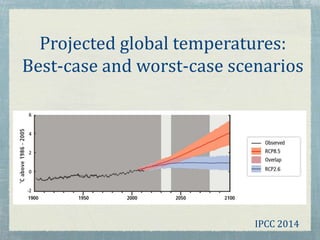
Projected global temperatures:
Best-case and worst-case scenarios
IPCC 2014
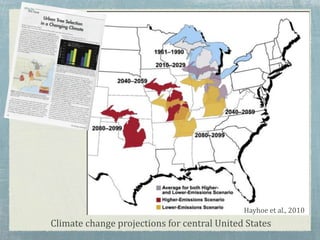
Climate change projections for central United States
Hayhoe et al., 2010
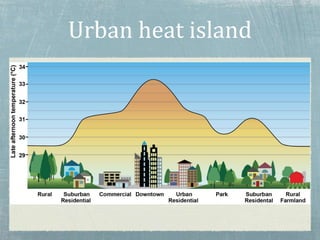
Urban heat island
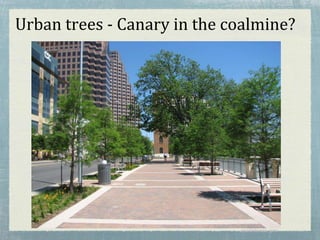
Urban trees - Canary in the coalmine?
austintexas.gov
austintexas.gov
Strategies
for dealing with
climate change
Organisms
have three principal means
of responding to changes in
their environment.
Adaptation
Migration
Acclimation
Assisted colonization
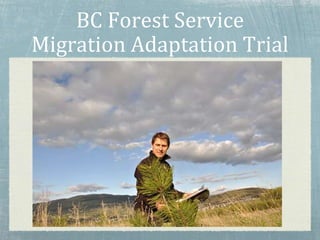
BC Forest Service
Migration Adaptation Trial
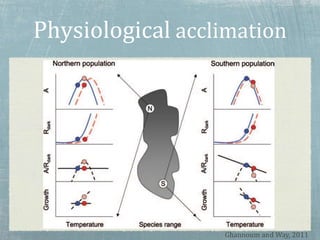
Physiological acclimation
Ghannoum and Way, 2011
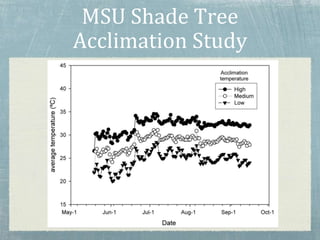
MSU Shade Tree
Acclimation Study
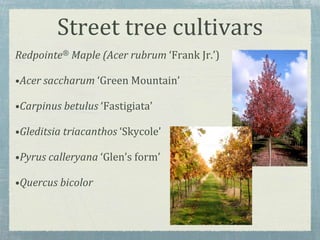
Street tree cultivars
Redpointe® Maple (Acer rubrum ‘Frank Jr.’)
•Acer saccharum ‘Green Mountain’
•Carpinus betulus ‘Fastigiata’
•Gleditsia triacanthos ‘Skycole’
•Pyrus calleryana ‘Glen’s form’
•Quercus bicolor
MSU Shade Tree Acclimation Study
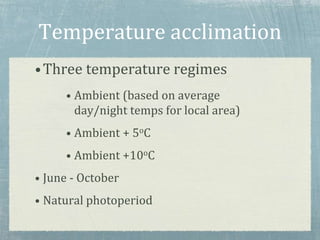
Temperature acclimation
•Three temperature regimes
• Ambient (based on average
day/night temps for local area)
• Ambient + 5oC
• Ambient +10oC
• June - October
• Natural photoperiod
Physiological/morphological
acclimation
•Net photosynthesis
•Dark respiration
•Leaf thickness
•Stomatal density
biology.duke.edu
MSU Shade Tree
Acclimation Study
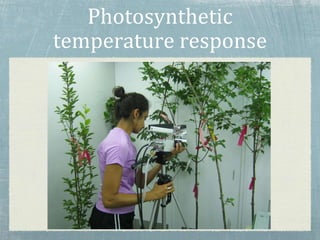
Photosynthetic
temperature response
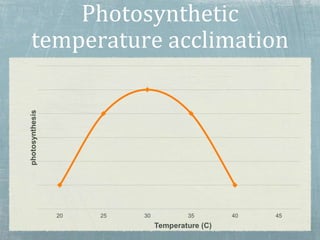
Photosynthetic
temperature acclimation
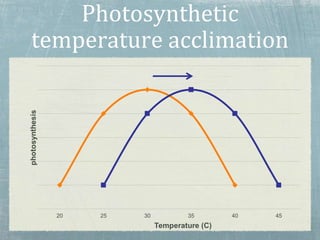
Photosynthetic
temperature acclimation
Acclimation responses to
increased temperature
•Quercus bicolor
• Increased optimum temperature for photosynthesis
•Acer rubrum and Gleditsia triacanthos
• Increased stomatal density
•Pyrus calleryana and Quercus bicolor
• Decreased leaf thickness
Out-planting during
the spring of 2013
Our non-profit
tree planting
partners
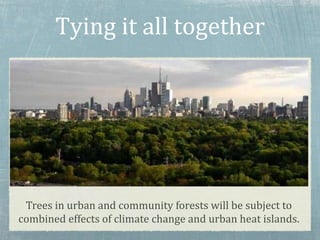
Tying it all together
Trees in urban and community forests will be subject to
combined effects of climate change and urban heat islands.
Great trees for Kansas City
Great trees for Michigan’s future?
Espresso™ Kentucky Coffee Tree
Pacific Sunset® Maple
Bur Oak
Kansas tough – climate resilient
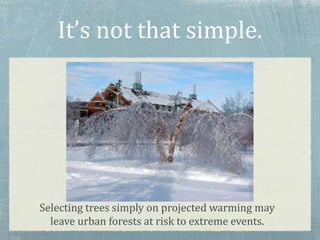
It’s not that simple.
Selecting trees simply on projected warming may
leave urban forests at risk to extreme events.
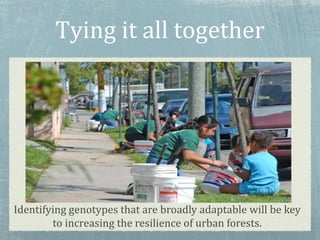
Tying it all together
Identifying genotypes that are broadly adaptable will be key
to increasing the resilience of urban forests.
Tying it all together
Diversity remains the most viable
risk management tool.
Trees for a Changing Climate
31
43
We face a hotter,
drier future
Futurescape
“Increased heat and
sustained drought will
stress water sources and
redefine urban
landscapes.”
Dr. Greg McPherson
Fall, 2014, Western Arborist
Of 7 species, only Chinkapin & Texas Red Oaks suffered no mortality
Evaluating climate ready trees for
Central Valley cities of California
20 year trial
Four sites
96 trees
12 species
----
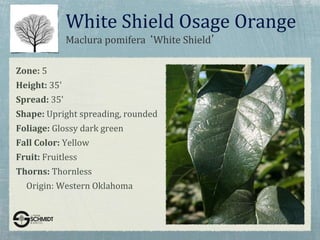
Osage Orange
Emerald Sunshine® Elm
Maclura pomifera ‘White Shield’
White Shield Osage Orange
Zone: 5
Height: 35'
Spread: 35'
Shape: Upright spreading, rounded
Foliage: Glossy dark green
Fall Color: Yellow
Fruit: Fruitless
Thorns: Thornless
Origin: Western Oklahoma
Ulmus propinqua ‘JFS-Bieberich’
Emerald Sunshine® Elm
Zone: 5
Height: 35'
Spread: 25'
Shape: Vase shaped
Foliage: Deep green
Fall Color: Yellow
Heat and drought tolerant,
resists Japanese beetle feeding
Selected in Western Oklahoma
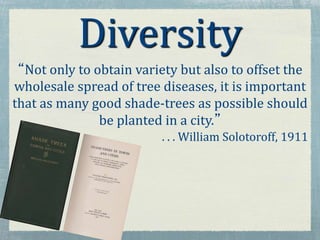
“Not only to obtain variety but also to offset the
wholesale spread of tree diseases, it is important
that as many good shade-trees as possible should
be planted in a city.”
. . . William Solotoroff, 1911
Diversity
What to plant?
Identify trees currently proven in your locale.
Proven urban performers in warmer climates.
Broadly adaptable species
QuercusTaxodium Nyssa
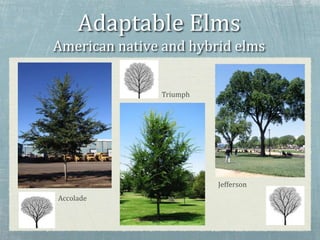
Adaptable Elms
American native and hybrid elms
Triumph
Jefferson
Accolade
20082011
National Elm Trial
•Tests regional suitability of
DED-resistant trees
•16 cultivars /15 states / 10 years
Information at
your fingertips
Downloadable fact sheets
www.jfschmidt.com/pdfs
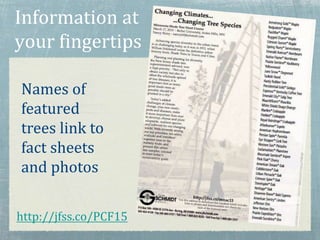
Information at
your fingertips
http://jfss.co/PCF15
Names of
featured
trees link to
fact sheets
and photos
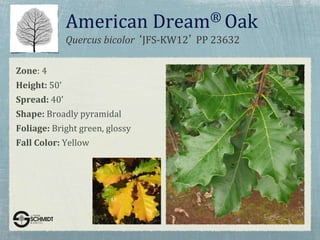
Quercus bicolor ‘JFS-KW12’ PP 23632
American Dream® Oak
Zone: 4
Height: 50'
Spread: 40'
Shape: Broadly pyramidal
Foliage: Bright green, glossy
Fall Color: Yellow
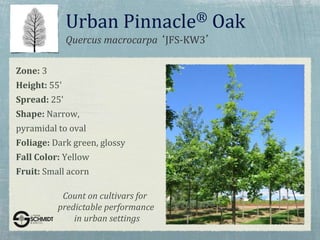
Quercus macrocarpa ‘JFS-KW3’
Urban Pinnacle® Oak
Zone: 3
Height: 55'
Spread: 25'
Shape: Narrow,
pyramidal to oval
Foliage: Dark green, glossy
Fall Color: Yellow
Fruit: Small acorn
Count on cultivars for
predictable performance
in urban settings
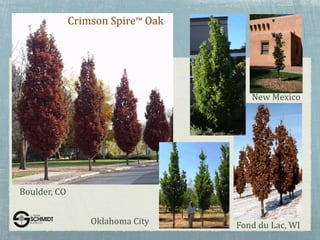
Quercus robur x Q. alba ‘Crimschmidt’
Crimson Spire® Oak
Zone: 4
Height: 45'
Spread: 15'
Shape: Columnar,
tightly fastigiate
Foliage: Dark green
to bluish-green
Fall Color: Rusty red
Resistant to powdery mildew
New Mexico
Fond du Lac, WI
Boulder, CO
Oklahoma City
Crimson Spire™ Oak
Platanus x acerifolia ‘Morton Circle’
Exclamation!® Planetree
Zone: 5
Height: 55'
Spread: 35'
Shape: Upright pyramidal
Foliage: Medium green
Fall Color: Yellow
Vigorous and urban tolerant,
anthracnose and powdery mildew
resistant
Top performer in
Morton Arboretum and
Chicago Botanic Garden trials
Taxodium distichum ‘Mickelson’
Shawnee Brave® Bald Cypress
Zone: 5
Height: 55'
Spread: 20'
Shape: Narrowly pyramidal
Foliage: Green, deciduous
needles
Fall Color: Rusty orange
Widely adaptable to
urban conditions and
range of climate zones
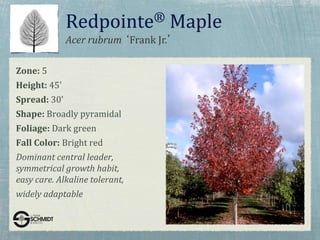
Acer rubrum ‘Frank Jr.’
Redpointe® Maple
Zone: 5
Height: 45'
Spread: 30'
Shape: Broadly pyramidal
Foliage: Dark green
Fall Color: Bright red
Dominant central leader,
symmetrical growth habit,
easy care. Alkaline tolerant,
widely adaptable
Acer saccharum ‘JFS-Caddo2’
Flashfire® Maple
Zone: 5
Height: 45'
Spread: 40'
Shape: Broadly oval
Foliage: Dark green
Fall Color: Bright red
Heat and drought tolerant
Western Oklahoma provenance
Acer truncatum x A. platanoides ‘JFS-KW202’
Crimson Sunset® Maple
Zone: 4
Height: 35'
Spread: 25'
Shape: Upright oval
Foliage: Deep purple
Fall Color: Maroon to
reddish bronze
Heat resistant foliage,
vigorous and drought tolerant
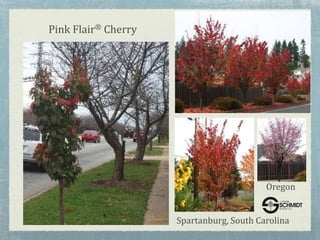
Prunus sargentii ‘JFS-KW58’
Pink Flair® Cherry
Zone: 3b
Height: 25'
Spread: 15'
Shape: Upright narrow vase
Foliage: Dark green, highly
disease resistant
Fall Color: Orange-red
Flower: Single pink, in clusters
“has not suffered any winter injury to date
in our Absaraka site in Zone 3.”
Dr. Dale Herman,
North Dakota State University
Pink Flair® Cherry
Spartanburg, South Carolina
Oregon
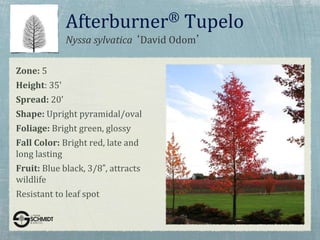
Nyssa sylvatica ‘David Odom’
Afterburner® Tupelo
Zone: 5
Height: 35'
Spread: 20'
Shape: Upright pyramidal/oval
Foliage: Bright green, glossy
Fall Color: Bright red, late and
long lasting
Fruit: Blue black, 3/8”, attracts
wildlife
Resistant to leaf spot
Thank you!

Urban Tree Selection in a Changing Climate

Editor's Notes

  • #6 Based in global climate models, the climate in the midwestern US is projected to get warmer and drier. Under the worst-case scenario, by 2080 the climate in Michigan will be similar to present-day Oklahoma (Note: there are similar maps for other states if we want to present other examples)
  • #7 In urban areas, changes in global climate will be superimposed over existing micro-climate effects such as urban heat islands.
  • #8 As a result of the combined effects of climate change and urban heat islands, urban trees are ‘living on the edge’ and may become the canary in the coalmine for climate change.
  • #9 As a result of the combined effects of climate change and urban heat islands, urban trees are ‘living on the edge’ and may become the canary in the coalmine for climate change.
  • #10 A bit of review: Ecologists tell us that organisms have three possible responses to a change in their environment; adaptation, migration, and acclimation. Adaptation is an evolutionary process – but climates are projected to change faster than trees can evolve so this is not going to help.
  • #11 In terms of migration, trees are sessile organisms – they can’t migrate like animals – but people can move them. The deliberate movement of plants in anticipation of climate change is referred to as assisted migration or assisted colonization. One of the concerns with assisted colonization is the introductions of invasives. Scenario A (moving spp northward within its continuous range) or scenario B (moving spp north within is disjunct range) are considered low risk. Scenario C (a new introduction) may pose more risk for invasivenss.
  • #12 In British Columbia, foresters that manage trees on 100 year rotations have initiated trials to understand the potential impacts of assisted migration on forest trees.
  • #13 Another possible tree response to rising temperatures is acclimation. From physiological studies we know that certain plants are better able to adjust their metabolism (photosynthetic rates, respiration rate) and morphology (leaf thickness, stomatal density) in response to changing environment.
  • #14 5-6’ whips were planted in #10 containers
  • #15 Trees included an array of trees commonly used for street trees
  • #16 In order to better understand the ability of urban trees to acclimate to increased temperatures we have initiated a program of research to investigate the physiological and morphological responses of street tree cultivars under warming conditions.
  • #25 East section of the greenhouse was set to one of three temperatures.
  • #47 Morton Arboretum Study – Andrew Bell – Plane Tree is among the trees considered to be resilient and will be a good tree for Chicagoland area for the long haul.