UpWind
Design limits and solutions for very large wind turbines
A 20 MW turbine is feasible

March 2011


Supported by:


      Design limits and solutions for very large wind turbines   1
Photo: Nordex


       2
       March 2011
Contents


1. UpWind: Summary - a 20 MW turbine is feasible ................................................................ 10

       The need for the UpWind project: exploring the design limits of upscaling ........................................... 11
       UpWind methodology: a lighthouse approach .................................................................................... 13
       UpWind: 20 MW innovative turbine ................................................................................................... 14
       UpWind: rooted in history ................................................................................................................ 16
       UpWind: continuous innovation ........................................................................................................ 18


2. UpWind: Scientific integration ................................................................................................. 20

2.1 Work Package 1A1: Standards and integration .................................................................................. 22

    Challenges and main innovations ........................................................................................................ 22
    Results ............................................................................................................................................. 23
      Subtask A: Reference wind turbine and cost model ........................................................................... 23
      Subtask B: Integral design approach methodology ............................................................................. 23
      Subtask C: Development of (pre)standards for the application of the integral design approach ............. 25
      Subtask D: Integration, review and planning workshops ..................................................................... 26
    References ........................................................................................................................................ 26


2.2. Work Package 1A2: Metrology......................................................................................................... 27

    Challenges and main innovations ........................................................................................................ 27
    Results ............................................................................................................................................. 28
      The metrology database .................................................................................................................. 28
      Advances in metrology .................................................................................................................... 28
      Verification of anemometer calibrations ............................................................................................ 29
    References ........................................................................................................................................ 31


2.3. Work Package 1A3: Training and education ...................................................................................... 32

    Challenges and main innovations ........................................................................................................ 32
    Results and conclusions..................................................................................................................... 33


        Design limits and solutions for very large wind turbines                                                                                          3
Contents


           3. UpWind: Technology integration.............................................................................................. 36

           3.1 Work Package 1B1: Innovative rotor blades (Innoblade)..................................................................... 38

               Challenges and main innovations ........................................................................................................ 38
               Results ............................................................................................................................................. 38
                 Blade aerodynamic design and load calculation................................................................................. 38
                 Materials selection, structural design and structural verification ......................................................... 39
                 Sensor monitoring with response actions.......................................................................................... 39
                 Blade joint ...................................................................................................................................... 40
               References ........................................................................................................................................ 41


           3.2 Work Package 1B2: Transmission and conversion .............................................................................. 44

               Challenges and main innovations ........................................................................................................ 44
               Results ............................................................................................................................................. 44
                 Mechanical transmission ................................................................................................................. 44
                 Generators ..................................................................................................................................... 46
                 Power electronics ............................................................................................................................ 47


           3.3 Work Package 1B3: Smart rotor blades and rotor control ................................................................... 48

               Challenges and main innovations ........................................................................................................ 48
               Research activities and working methods ............................................................................................ 48
                 Task 1: Aerodynamic controls and aeroelastic modelling .................................................................... 49
                 Task 2: Smart structures ................................................................................................................. 49
                 Task 3: Control systems .................................................................................................................. 50
                 Task 4: Smart wind turbine wind tunnel model .................................................................................. 50
                 Task 5: Interfaces ........................................................................................................................... 51
               References ........................................................................................................................................ 52

           3.4 Work Package 1B4: Upscaling .......................................................................................................... 54

               Challenges and main innovations ........................................................................................................ 54
               Activities ........................................................................................................................................... 55


           4                                                                                                                                              March 2011
4. UpWind: Research activities .................................................................................................... 56

4.1 Work Package 2: Aerodynamics and aeroelastics .............................................................................. 58

    Challenges and main innovations ........................................................................................................ 58
    Research activities and results ........................................................................................................... 59
      Structural dynamics — large deflections and non-linear effects .......................................................... 59
      Advanced aerodynamic models ........................................................................................................ 59
      Aerodynamic and aeroelastic modelling of advanced control features and aerodynamic devices ............ 60
      Aeroelastic stability and total damping prediction including hydroelastic interaction ............................. 60
      Computation of aerodynamic noise .................................................................................................. 60


4.2 Work Package 3: Rotor structures and materials ............................................................................... 61

    Challenges and main innovations ........................................................................................................ 61
    Results ............................................................................................................................................. 62
      Task 1: Applied (phenomenological) material model ........................................................................... 62
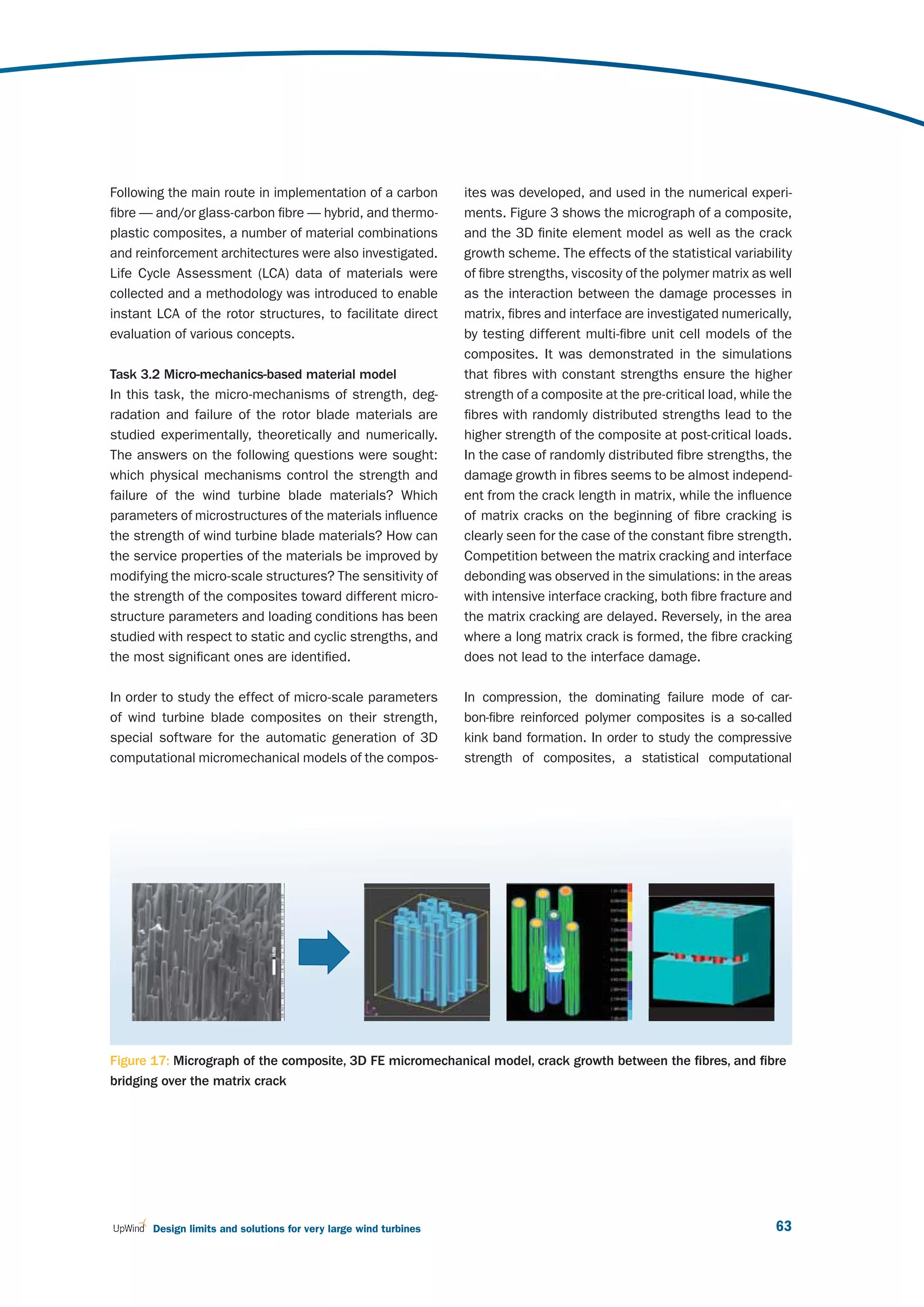
      Task 3.2 Micro-mechanics-based material model ............................................................................... 63
      Task 3.3: Damage-tolerant design concept........................................................................................ 64
      Task 3.4: Upscaling — cost factors .................................................................................................. 66


4.3 Work Package 4: Foundations and support structures........................................................................ 67

    Challenges and main innovations ........................................................................................................ 67
    Results ............................................................................................................................................. 69
      Task 1: Integration of support structure and wind turbine design ........................................................ 69
      Task 2: Support structure concepts for deep-water sites .................................................................... 70
      Task 3: Enhancement of design methods and standards.................................................................... 71
    References ........................................................................................................................................ 72

4.4 Work Package 5: Control systems..................................................................................................... 74

    Challenges and main innovations ........................................................................................................ 74
    Results ............................................................................................................................................. 75
      Supervisory control implications of advanced control ......................................................................... 75
      Online estimation of mechanical load for wind turbines ...................................................................... 76
      Dual pitch control for out-of-plane-blade load reduction ...................................................................... 77
      Identification of wind turbines operating in closed loop ...................................................................... 78
      LIDAR-assisted collective pitch control .............................................................................................. 79
      Validation of load reducing controllers in full-scale field tests ............................................................. 80
      Hardware-in-the-loop testing of pitch actuators .................................................................................. 81
      Riding through grid faults ................................................................................................................. 82
      Impact of the drive train on wind farm VAR Control ............................................................................ 82
    References ........................................................................................................................................ 83


        Design limits and solutions for very large wind turbines                                                                                          5
Contents


           4.5 Work Package 6: Remote sensing ..................................................................................................... 84

               Challenges and main innovations ........................................................................................................ 84
               Results ............................................................................................................................................. 85
                 SODAR – calibration and design improvements ................................................................................. 85
                 LIDAR testing in flat terrain .............................................................................................................. 86
                 LIDAR measurements in complex terrain........................................................................................... 86
                 Power curve testing ......................................................................................................................... 86
                 IEC 61400-12-1 revision.................................................................................................................. 87
                 LIDAR turbulence measurements ..................................................................................................... 87
               References ........................................................................................................................................ 88


           4.6 Work Package 7: Condition monitoring .............................................................................................. 89

               Challenges and main innovations ........................................................................................................ 89
               Results ............................................................................................................................................. 90
                 Optimised condition monitoring systems for use in wind turbines of the next generation ...................... 90
                 “Flight leader” turbines for wind farms.............................................................................................. 90
                 Fault statistics ................................................................................................................................ 92
                 Standardisation .............................................................................................................................. 92
                 Conclusions ................................................................................................................................... 92
               References. ....................................................................................................................................... 93


           4.7 Work Package 8: Flow ...................................................................................................................... 94

               Challenges and main innovations ........................................................................................................ 94
               Results ............................................................................................................................................. 95
               References ........................................................................................................................................ 97


           4.8 Work Package 9: Electrical grid ........................................................................................................ 98

               Challenges and main innovations ........................................................................................................ 98
               Results ............................................................................................................................................. 99
                 Wind farm reliability ........................................................................................................................ 99
                 Power system requirements ........................................................................................................... 100
                 Wind farm electrical design and control .......................................................................................... 101
                 Upscaling ..................................................................................................................................... 102


           6                                                                                                                                             March 2011
Contract number: 019945 (SES6)
Duration: 60 months
Co-ordinator: Risø National Laboratory - DTU
Cover picture: www.iStockphoto.com


PROJECT PARTNERS:
Risø National Laboratory - DTU, Denmark (Risø - DTU), Project Coordinator
Aalborg University (AaU), Denmark
Energy Research Centre of the Netherlands (ECN), The Netherlands
Stichting Kenniscentrum Windturbine Materialen en Constructies (WMC), The Netherlands
Delft University of Technology (DUT), The Netherlands
Centre for Renewable Energy Sources (CRES), Greece
National Technical University of Athens (NTUA), Greece
University of Patras (UP), Greece
Institut für Solare Energieversorgungstechnik Verein an der Universität Kassel (ISET), Germany
Universität Stuttgart (Usttut), Germany
DONG Energy Power A/S (DONG), Denmark
Vattenfall Vindkraft A/S, Denmark
GE Wind Energy Zweigniederlassung der General Electric Deutschland Holding GmbH (GEGR-E), Germany
Gamesa Innovation and Technology (GIT), Spain
Fiberblade Eólica S.A., Spain
GL Garrad Hassan and Partners Ltd. (GL GH), United Kingdom
Werkzeugmaschinenlabor, Aachen University (RWTH – WZL), Germany
LM Glasfiber A.S. (LM), Denmark
Germanischer Lloyd Windenergie GmbH (GL), Germany
Ramboll Danmark A.S.(Ramboll), Denmark
Fundación Robotiker (ROBOTIKER), Spain
VTT Technical Research Centre of Finland (VTT), Finland
SAMTECH S.A (SAMTECH), Belgium
Shell Windenergy BV (SHELL), The Netherlands
Repower Systems AG (REP), Germany
Bosch Rexroth AG (BRM-GT), Germany
Det Norske Veritas, Danmark A/S, Denmark
Lohmann und Stolterfoht GmbH, Germany
University of Edinburgh (UEDIN), United Kingdom
Instytut Podstawowych Problemow Techniki PAN (IPPT), Poland
Institute of Thermomechanics, Academy of Sciences of the Czech Republic (IT ACSR), Czech Republic


      Design limits and solutions for very large wind turbines                                  7
Contents


           Lulea University of Technology (LTU), Sweden
           Council for the Central Laboratory of the Research Councils (CCLRC), United Kingdom
           Vrije Universiteit Brussels (VUB), Belgium
           QinetiQ Ltd. (QinetiQ), United Kingdom
           Vestas Asia Pacific A/S (Vestas APAC), Denmark
           Smart Fibres Ltd. (SmartFibres), United Kingdom
           University of Salford (USAL), United Kingdom
           European Wind Energy Association (EWEA), Belgium
           Ecotècnia S.C.C.L. (ECOTECNIA), Spain
           Fundación CENER - CIEMAT, Spain
           Fraunhofer-Institut fur Windenergie und Energiesystemtechnik (IWES), Germany
           Institute for Superhard Materials of the National Academy of Sciences of Ukraine (ISM), Ukraine
           Department of Civil Engineering, Thapar University (TIET), India
           China University of Mining and Technology (Beijing), State Key Laboratory of Coal Resources and Mine
           Safety (CUMTB), China
           CWMT Fraunhofer (CWMT), Germany


           SUPPORTED BY:
           The Sixth Framework Programme for Research and Development of the European Commission (FP6)


           EXECUTIVE SUMMARY AUTHORS:
           Nicolas Fichaux, European Wind Energy Association
           Jos Beurskens, Energy Research Centre of the Netherlands
           Peter Hjuler Jensen, Risø National Laboratory – DTU
           Justin Wilkes, European Wind Energy Association


           8                                                                                            March 2011
WORK PACKAGES AUTHORS:
Nicolas Fichaux, European Wind Energy Association
Sten Frandsen, Risø National Laboratory – DTU
John Dalsgaard Sørensen, Aalborg University and Risø National Laboratory - DTU
Peter Eecen, Energy Research Centre of the Netherlands
Charalambos Malamatenios, Centre for Renewable Energy Sources
Joaquin Arteaga Gomez, Gamesa
Jan Hemmelmann, GE Global Research
Gijs van Kuik, Delft University of Technology
Bernard Bulder, Energy Research Centre of the Netherlands
Flemming Rasmussen, Risø National Laboratory – DTU
Bert Janssen, Energy Research Centre of the Netherlands
Tim Fischer, Universität Stuttgart
Ervin Bossanyi, GL Garrad Hassan and Partners
Mike Courtney, Risø National Laboratory – DTU
Jochen Giebhardt, Fraunhofer-Institut fur Windenergie und Energiesystemtechnik
Rebecca Barthelmie, Risø National Laboratory – DTU
Ole Holmstrøm, DONG Energy


SPECIAL CONTRIBUTION OF:
Dorina Iuga, European Wind Energy Association
Sharon Wokke, European Wind Energy Association


EDITING:
Sarah Azau, European Wind Energy Association
Chris Rose, European Wind Energy Association
Design and production: De Visu Digital Document Design
Design coordinator: Raffaella Bianchin, European Wind Energy Association
Published in March 2011


LEGAL NOTICE:
Neither the European Commission nor any person acting on behalf of the Commission is
responsible for the use which might be made of the following information.
The views expressed in this publication are the sole responsibility of the author and do not
necessarily reflect the views of the European Commission.


      Design limits and solutions for very large wind turbines                                 9
xxx


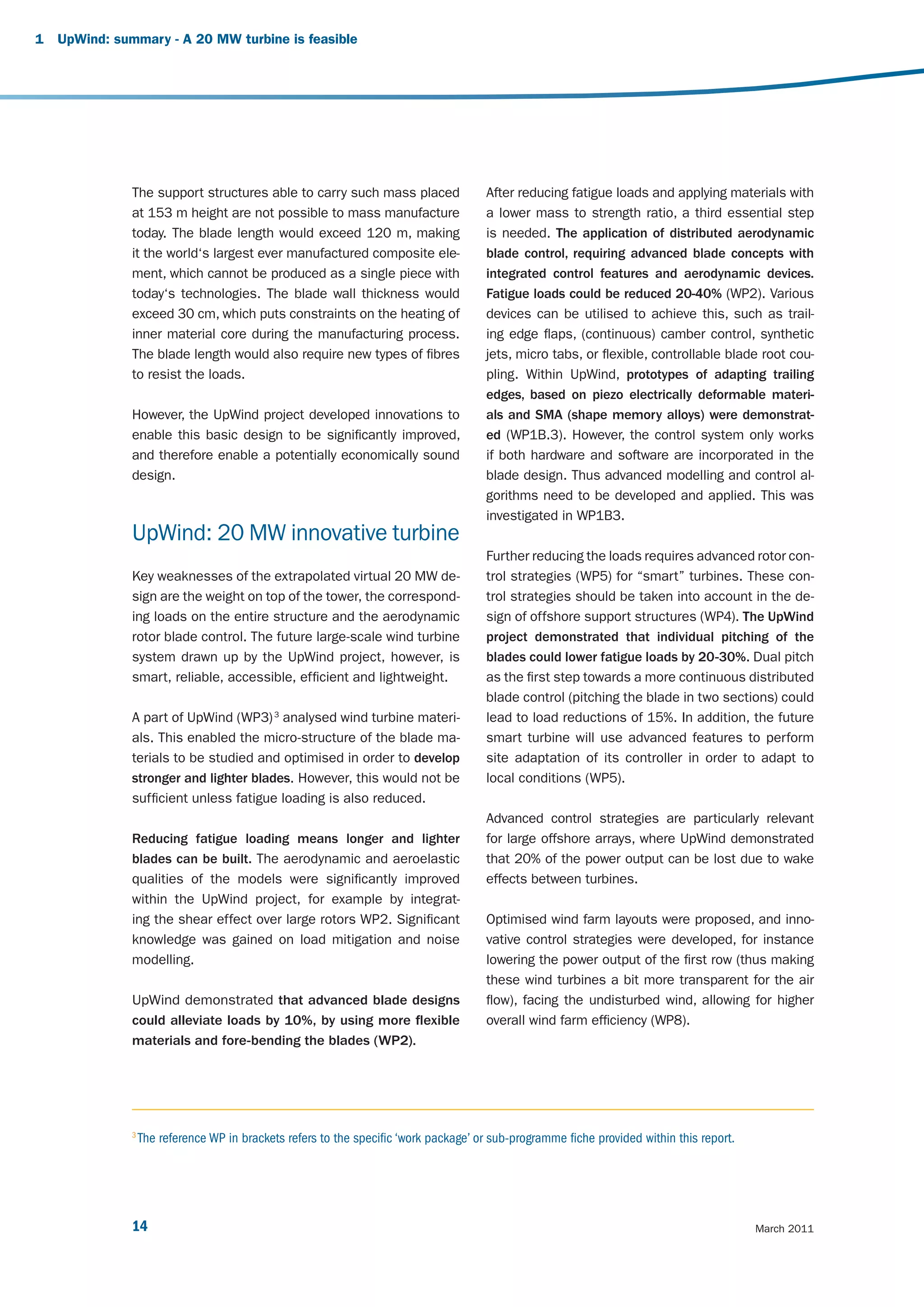
                                                      Photo: Stiftung Offshore Energie/D. Gehrin


      1    UPWIND: SUMMARY
           A 20 MW TURBINE IS FEASIBLE


          10                             March 2011
“ They did not know it was impossible, so they did it.”
                                                                               Mark Twain, American novelist, 1835 - 1910


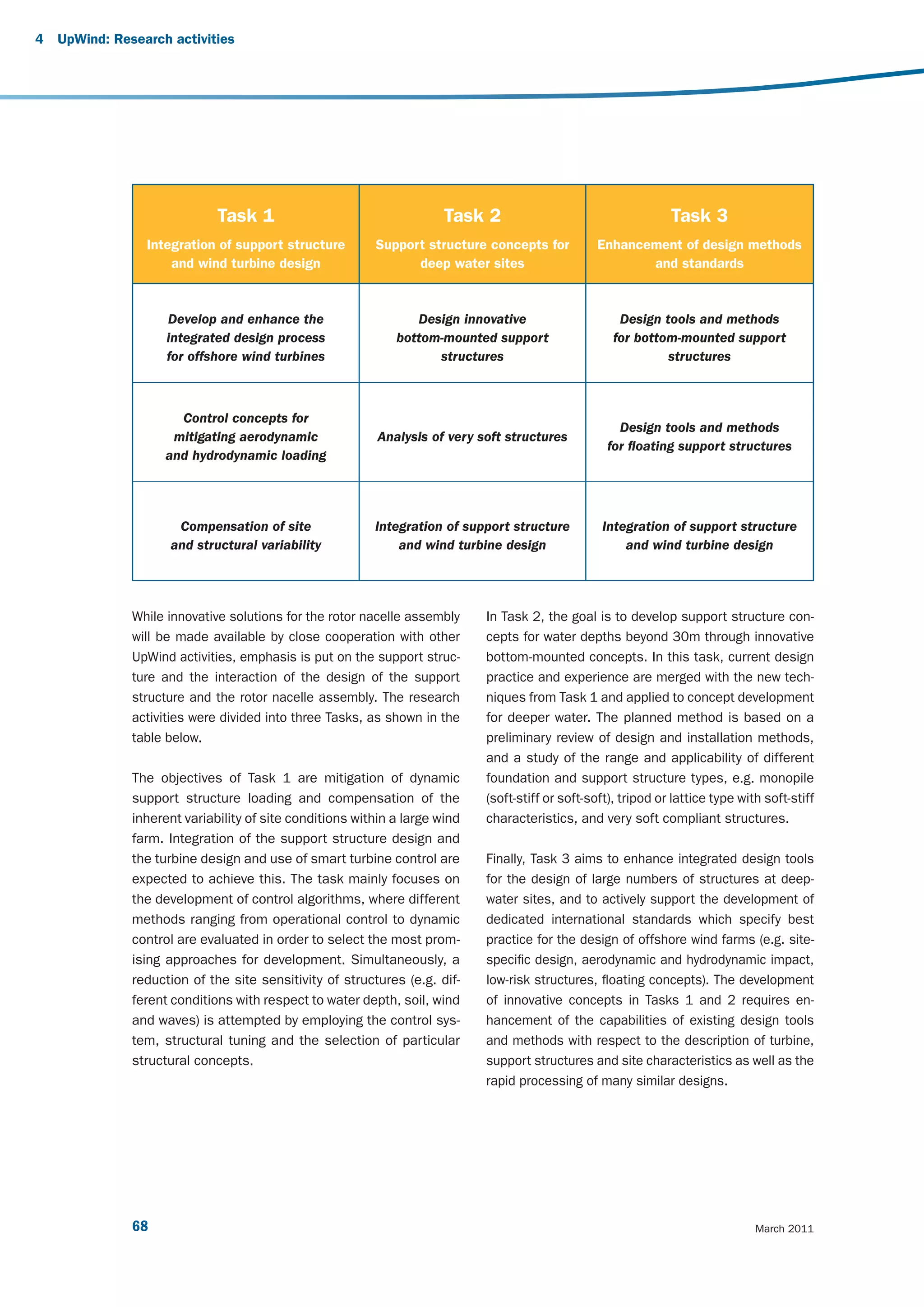
The need for the UpWind project:                                     Thus a significant part of the required future installed
                                                                     wind power will be located offshore. For offshore ap-
exploring the design limits of
                                                                     plication new technologies and know how are needed
upscaling                                                            beyond the existing knowledge base, which is mainly fo-
                                                                     cused on onshore applications. Going offshore implies
The key objective of the European wind industry‘s                    not only new technologies but also upscaling of wind
research and development strategy for the next ten                   turbine dimensions, wind farm capacities and required
years is to become the most competitive energy source                – not yet existing – electrical infrastructure. The need
by 2020 onshore and offshore by 2030 1, without                      for upscaling found its origin in the cost structure of off-
accounting for external costs.                                       shore installations and is the “motor” of modern wind
                                                                     energy research. The results will not be applicable to
In October 2009, the European Commission published                   offshore wind energy technology only, but will also lead
its Communication “Investing in the Development of                   to more cost effective onshore installations.
Low Carbon Technologies (SET-Plan)”, stating that wind
power would be “capable of contributing up to 20% of                 Ultimately, all research activities, aside from other im-
EU electricity by 2020 and as much as 33% by 2030”                   plementation measures, are focused on reductions to
were the industry‘s research needs fully met. The wind               the cost of energy. The industry is taking two pathways
industry agrees with the Commission‘s assessment.                    towards cost reductions in parallel:
Significant additional research efforts in wind energy                   Incremental innovation: cost reductions through
are needed to bridge the gap between the 5% of the                       economies of scale resulting from increased market
European electricity demand which is currently covered                   volumes of mainstream products, with a continuous
by wind energy, and one-fifth of electricity demand in                   improvement of the manufacturing and installation
2020, one-third in 2030 and half by 2050.                                methods and products;
                                                                         Breakthrough innovation: creation of innovative prod-
Meeting the European Commission‘s ambitions for wind                     ucts, including significantly upscaled dedicated (off-
energy would require meeting EWEA‘s high scenario of                     shore) turbines, to be considered as new products.
265 GW of wind power capacity, including 55 GW of
offshore wind by 2020. The Commission‘s 2030 target                  The UpWind project explores both innovation pathways.
of 33% of EU power from wind energy can be reached by                In formulating the UpWind project the initiators realised
meeting EWEA‘s 2030 installed capacity target of 400                 that wind energy technology disciplines were rather
GW wind, 150 GW of which would be offshore. Up to                    fragmented (no integrated verified design methods
2050 a total of 600 GW of wind energy capacity would                 were available), that essential knowledge was still miss-
be envisaged, 250 GW would be onshore and 350 GW                     ing in high priority areas (e.g. external loads), measur-
offshore. Assuming a total electricity demand of 4,000               ing equipment was still not accurate or fast enough,
TWh in 2050 this amount of installed wind power could                and external factors were not taken into consideration
produce about 2,000 TWh and hence meet 50% of the                    in minimising cost of energy (grid connection, founda-
EU‘s electricity demand.                                             tions, wind farm interaction).


1
    http://www.ewea.org/fileadmin/ewea_documents/documents/publications/EWI/EWI_2010_final.pdf


          Design limits and solutions for very large wind turbines                                                            11
1   UpWind: summary - A 20 MW turbine is feasible


               In order to be able to address all shortcomings in an           For instance, the development of control methods for
               effective way a comprehensive matrix project structure          very large rotors requires the full wind behaviour, includ-
               was designed, where disciplinary, scientific integration        ing wind shear and turbulence, to be taken into account.
               and technology integration were included (see page 18).
               A key issue for integrating various research results was        This in turn means the anemometer values must be
               developing an overall engineering cost model.                   corrected based on the rotor effects and therefore ad-
                                                                               vanced wind measurement technologies need to be
               This unique UpWind approach quantifies the contribu-            used. UpWind therefore developed and validated the
               tion of the different types of innovation resulting from        measurement devices and models able to provide such
               the project. Not only are upscaling parameters incor-           measurements (LIDAR).
               porated, but also innovation effects are defined as a
               separate independent parameter. At the time of writing          UpWind also developed the tools and specified the
               the full results of the integration process through cost        methods to enable large designs. These tools and
               modelling was not yet available, but will be published in       methods are available to optimise today‘s designs,
               2011. However, some early conclusions may already be            and are used to improve the reliability and efficiency of
               drawn, such as the benefits of distributed aerodynamic          current products, such as drive trains.
               blade control.
                                                                               UpWind demonstrates that a 20 MW design is feasible.
               The question often arises whether there is one single           No significant problems have been found when upscal-
               “optimum” technology. UpWind did not seek to define             ing wind turbines to that scale, provided some key
               one unique optimum technology but rather explored var-          innovations are developed and integrated. These innova-
               ious high-potential solutions and integrated them with          tions come with extra cost, and the cost / benefit ratio
               respect to the potential reduction of cost of energy. An        depends on a complex set of parameters. The project
               optimised wind turbine is the outcome of a complex              resulted for instance in the specification of mass /
               function combining requirements in terms of efficiency          strength ratios for future very large blades securing the
               (electricity production), reliability, access, transport and    same load levels as the present generation wind tur-
               storage, installation, visibility, support to the electricity   bines. Thus in principle, future large rotors and other
               network, noise emission, cost, and so on.                       turbine components could be realised without cost in-
                                                                               creases, assuming the new materials are within certain
               UpWind‘s focus was the wind turbine as the essential            set cost limits.
               component of a wind electricity plant. Thus external con-
               ditions were only investigated if the results were needed
               to optimise the turbine configuration (e.g. grid connec-           As the UpWind project‘s scope is very wide and
               tion options) and the other way around (control options            the project has laid the basis for essential future
               for wind turbines) in order to optimise wind farms.                strategies for decreasing cost of energy, UpWind
                                                                                  contributed considerably to the recommendations
               UpWind did not seek the optimal wind turbine size, but             of the European Wind Energy Technology Plat-
               investigated the limits of upscaling, up to, approxima-            form and the foundation for the European Wind
               tely, 20 MW / 250 m rotor diameter. Looking at very                Initiative. It is clear from the conclusions of Up-
               large designs, attention is focused on physical phenom-            Wind that the European Wind Initiative‘s research
               ena or model behaviour that are relevant for large-scale           agenda is both feasible and necessary and should
               structures but have negligible effects at lower scales.            therefore be financed without delay by the Euro-
                                                                                  pean Commission, national governments and the
                                                                                  European wind energy sector.


               12                                                                                                              March 2011
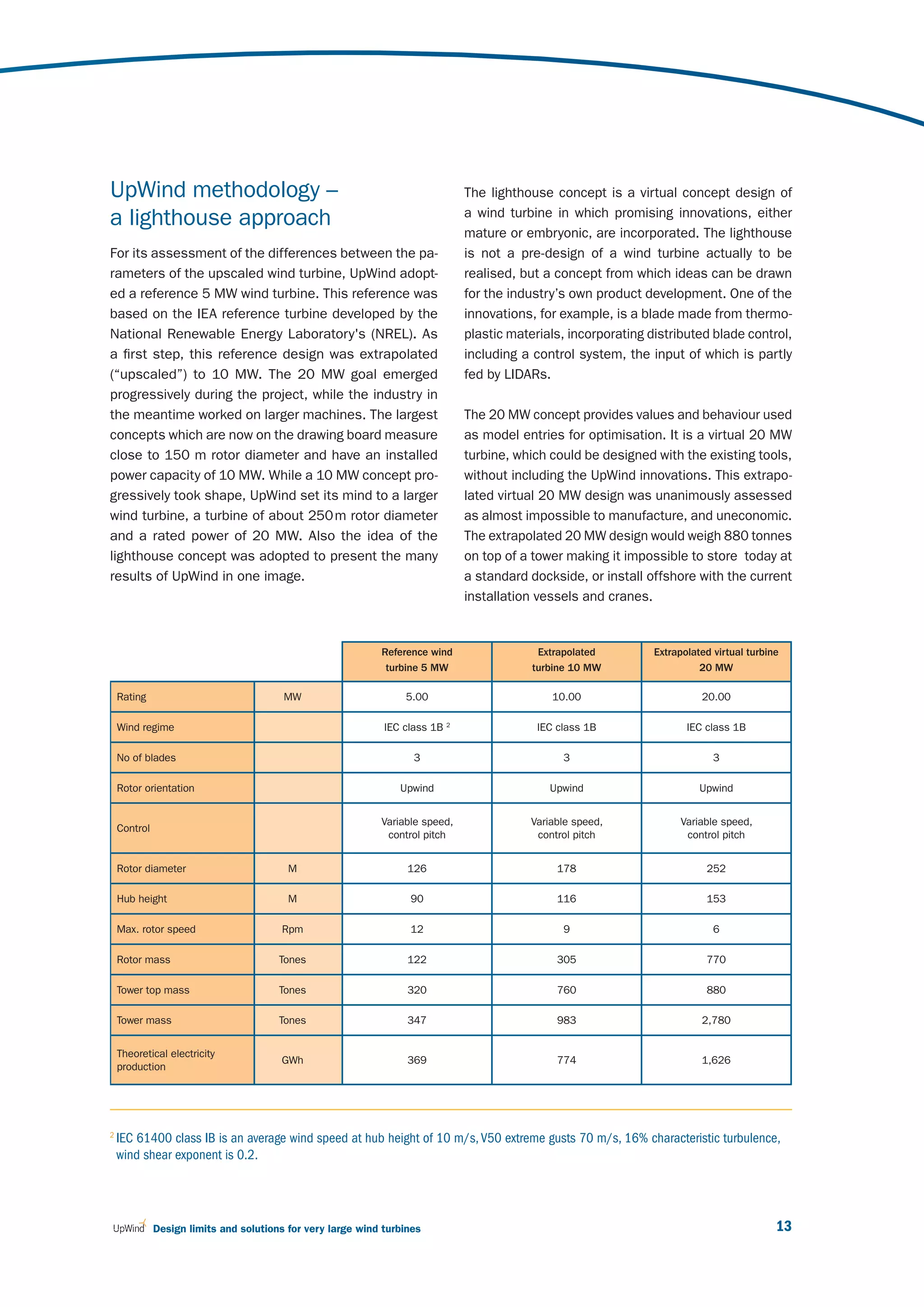
UpWind methodology –                                                           The lighthouse concept is a virtual concept design of
                                                                               a wind turbine in which promising innovations, either
a lighthouse approach
                                                                               mature or embryonic, are incorporated. The lighthouse
For its assessment of the differences between the pa-                          is not a pre-design of a wind turbine actually to be
rameters of the upscaled wind turbine, UpWind adopt-                           realised, but a concept from which ideas can be drawn
ed a reference 5 MW wind turbine. This reference was                           for the industry’s own product development. One of the
based on the IEA reference turbine developed by the                            innovations, for example, is a blade made from thermo-
National Renewable Energy Laboratory's (NREL). As                              plastic materials, incorporating distributed blade control,
a first step, this reference design was extrapolated                           including a control system, the input of which is partly
(“upscaled”) to 10 MW. The 20 MW goal emerged                                  fed by LIDARs.
progressively during the project, while the industry in
the meantime worked on larger machines. The largest                            The 20 MW concept provides values and behaviour used
concepts which are now on the drawing board measure                            as model entries for optimisation. It is a virtual 20 MW
close to 150 m rotor diameter and have an installed                            turbine, which could be designed with the existing tools,
power capacity of 10 MW. While a 10 MW concept pro-                            without including the UpWind innovations. This extrapo-
gressively took shape, UpWind set its mind to a larger                         lated virtual 20 MW design was unanimously assessed
wind turbine, a turbine of about 250 m rotor diameter                          as almost impossible to manufacture, and uneconomic.
and a rated power of 20 MW. Also the idea of the                               The extrapolated 20 MW design would weigh 880 tonnes
lighthouse concept was adopted to present the many                             on top of a tower making it impossible to store today at
results of UpWind in one image.                                                a standard dockside, or install offshore with the current
                                                                               installation vessels and cranes.


                                                             Reference wind                 Extrapolated         Extrapolated virtual turbine
                                                              turbine 5 MW                 turbine 10 MW                   20 MW

    Rating                               MW                       5.00                         10.00                       20.00

    Wind regime                                               IEC class 1B 2                IEC class 1B                IEC class 1B

    No of blades                                                    3                            3                            3

    Rotor orientation                                            Upwind                       Upwind                       Upwind


                                                             Variable speed,               Variable speed,            Variable speed,
    Control
                                                              control pitch                 control pitch              control pitch


    Rotor diameter                        M                        126                          178                         252

    Hub height                            M                        90                           116                         153

    Max. rotor speed                    Rpm                        12                            9                            6

    Rotor mass                          Tones                      122                          305                         770

    Tower top mass                      Tones                      320                          760                         880

    Tower mass                          Tones                      347                          983                        2,780


    Theoretical electricity
                                        GWh                        369                          774                        1,626
    production


2
    IEC 61400 class IB is an average wind speed at hub height of 10 m/s, V50 extreme gusts 70 m/s, 16% characteristic turbulence,
    wind shear exponent is 0.2.


              Design limits and solutions for very large wind turbines                                                                      13
1   UpWind: summary - A 20 MW turbine is feasible


               The support structures able to carry such mass placed                   After reducing fatigue loads and applying materials with
               at 153 m height are not possible to mass manufacture                    a lower mass to strength ratio, a third essential step
               today. The blade length would exceed 120 m, making                      is needed. The application of distributed aerodynamic
               it the world‘s largest ever manufactured composite ele-                 blade control, requiring advanced blade concepts with
               ment, which cannot be produced as a single piece with                   integrated control features and aerodynamic devices.
               today‘s technologies. The blade wall thickness would                    Fatigue loads could be reduced 20-40% (WP2). Various
               exceed 30 cm, which puts constraints on the heating of                  devices can be utilised to achieve this, such as trail-
               inner material core during the manufacturing process.                   ing edge flaps, (continuous) camber control, synthetic
               The blade length would also require new types of fibres                 jets, micro tabs, or flexible, controllable blade root cou-
               to resist the loads.                                                    pling. Within UpWind, prototypes of adapting trailing
                                                                                       edges, based on piezo electrically deformable materi-
               However, the UpWind project developed innovations to                    als and SMA (shape memory alloys) were demonstrat-
               enable this basic design to be significantly improved,                  ed (WP1B.3). However, the control system only works
               and therefore enable a potentially economically sound                   if both hardware and software are incorporated in the
               design.                                                                 blade design. Thus advanced modelling and control al-
                                                                                       gorithms need to be developed and applied. This was
                                                                                       investigated in WP1B3.
               UpWind: 20 MW innovative turbine
                                                                                       Further reducing the loads requires advanced rotor con-
               Key weaknesses of the extrapolated virtual 20 MW de-                    trol strategies (WP5) for “smart” turbines. These con-
               sign are the weight on top of the tower, the correspond-                trol strategies should be taken into account in the de-
               ing loads on the entire structure and the aerodynamic                   sign of offshore support structures (WP4). The UpWind
               rotor blade control. The future large-scale wind turbine                project demonstrated that individual pitching of the
               system drawn up by the UpWind project, however, is                      blades could lower fatigue loads by 20-30%. Dual pitch
               smart, reliable, accessible, efficient and lightweight.                 as the first step towards a more continuous distributed
                                                                                       blade control (pitching the blade in two sections) could
               A part of UpWind (WP3) 3 analysed wind turbine materi-                  lead to load reductions of 15%. In addition, the future
               als. This enabled the micro-structure of the blade ma-                  smart turbine will use advanced features to perform
               terials to be studied and optimised in order to develop                 site adaptation of its controller in order to adapt to
               stronger and lighter blades. However, this would not be                 local conditions (WP5).
               sufficient unless fatigue loading is also reduced.
                                                                                       Advanced control strategies are particularly relevant
               Reducing fatigue loading means longer and lighter                       for large offshore arrays, where UpWind demonstrated
               blades can be built. The aerodynamic and aeroelastic                    that 20% of the power output can be lost due to wake
               qualities of the models were significantly improved                     effects between turbines.
               within the UpWind project, for example by integrat-
               ing the shear effect over large rotors WP2. Significant                 Optimised wind farm layouts were proposed, and inno-
               knowledge was gained on load mitigation and noise                       vative control strategies were developed, for instance
               modelling.                                                              lowering the power output of the first row (thus making
                                                                                       these wind turbines a bit more transparent for the air
               UpWind demonstrated that advanced blade designs                         flow), facing the undisturbed wind, allowing for higher
               could alleviate loads by 10%, by using more flexible                    overall wind farm efficiency (WP8).
               materials and fore-bending the blades (WP2).


               3
                   The reference WP in brackets refers to the specific ‘work package’ or sub-programme fiche provided within this report.


               14                                                                                                                           March 2011
Control and maintenance strategies require load sen-                       UpWind demonstrated the need to take the wind shear
sors, which were adapted and tested within UpWind.                         into account for large rotors (WP6 and WP2). The 20
To avoid sensor failures causing too much loss of en-                      MW rotor is so large that the wind inflow needs to be
ergy output, loss of sensor signals was incorporated                       treated as an inhomogeneous phenomenon. One point
into the control strategies (WP5) and a strategy was de-                   measurement, as recommended by IEC standards, is
veloped to reduce the number of sensors. The fatigue                       not representative anymore. A correction method was
loading on individual wind turbines can be estimated                       developed and demonstrated within UpWind.
from one heavily instrumented turbine in a wind farm
if the relationship of fatigue loading between wind tur-                   The smart control strategies and high resolution mod-
bines inside a wind farm is known. The so-called Flight                    elling described above require a highly accurate wind
Leader Concept 4 was developed in WP7.                                     measurement, since a small deviation can have a sig-
                                                                           nificant impact on reliability. In the metrology domain,
Those load sensors can be Bragg sensors, which were                        UpWind considerably improved knowledge on wind
tested and validated within the project (WP7). UpWind                      measurement accuracy within the MEASNET 5 commu-
demonstrated the efficiency and reliability of such                        nity. Cup anemometers, LIDARs, SODARs and sonic
sensors, and assessed the possibility of including optic                   anemometers (WP1A.2 and WP6) were tested, demon-
fibres within the blade material without damaging the                      strated and improved. UpWind‘s WP1A.2 had access to
structure (WP3).                                                           almost all existing wind measurement databases.

However, using sensors implies the rotor is only react-                    The advanced control strategies of smart blades using
ing to the actual loading phenomenon. As a result of                       smart sensors enable loads to be lowered considerably,
the system inertia, the load will be partly absorbed.                      so lighter structures can be developed. The improved
A step further is to develop preventative load alleviation                 modelling capability means the design safety factors
strategies by detecting and evaluating the upcoming                        can be less conservative, paving the way to lighter struc-
gust or vortex before it arrives at the turbine. A nacelle-                tures (WP1A1). UpWind investigated this path, develop-
mounted LIDAR is able to do this (WP6), and can be                         ing accurate integral design tools that took into account
used as an input signal for the individual blade pitching,                 transport, installation, and operation and maintenance
or in distributed blade control strategies (WP5).                          (O&M). Onshore, the transport of large blades is a par-
                                                                           ticular challenge, and UpWind developed innovative
In recent years, UpWind has been a focal point for LIDAR                   blade concepts (WP1B1) enabling a component to be
development, and has considerably helped the market                        transported in two sections without endangering its
penetration of LIDAR technologies. Although LIDARs                         structural safety or aerodynamic efficiency.
are still considerably more expensive than SODARs for
instance, their technical performance, and thus poten-                     Integral design tools were also developed to improve the
tial, is substantial. UpWind demonstrated that LIDARs                      reliability of the entire drive train (WP1B.2), and to inves-
are sufficiently accurate for wind energy applications.                    tigate the possibility of developing proportionally lighter
(WP1A2). LIDARs can be used for the power curve                            generators for large wind turbine designs. UpWind inves-
estimation of large turbines, for control systems, for                     tigated ten different generator configurations and found
resource assessment in flat terrain, including offshore                    promising potential weight reductions for permanent
and soon in complex terrains (WP1A2 and WP6), and                          magnet transversal flux generators.
for measuring the wind shear over the entire rotor area.


4
  The "flight leader " is a term used in aircraft technologies. The idea behind the “flight leader turbines” is to equip selected turbines at
  representative positions in the wind farm with the required load measurement. The flight leader turbines are thus subject to higher, or
  at least similar, loads to other turbines in a wind farm.
5
  www.measnet.com

         Design limits and solutions for very large wind turbines                                                                               15
1   UpWind: summary - A 20 MW turbine is feasible


               The UpWind project worked on ensuring the reliability of        It will be challenging for the wind energy sector to at-
               large turbines, in particular for far offshore applications.    tract and train the required number of engineers, post-
               UpWind focused on condition monitoring technologies             graduates and PhD students to fulfil its needs. UpWind
               (WP7) and fault prediction systems. Such advanced sys-          focused on training and education (WP1A3), and devel-
               tems enable fault detection and preventative mainte-            oped free of charge advanced training modules on wind
               nance to be carried out, with a large potential for cutting     energy, including the latest innovations in the field. This
               O&M costs. The reliability of the future large blades can       content is distributed through the REnKnow database 6.
               be assessed using probabilistic blade failure simulation
               tools (WP3).
                                                                               UpWind: rooted in history
               Reducing the loads and the nacelle weight enables the
               offshore substructure design to be optimised (WP4).             UpWind is the largest-ever EU-funded research and
               UpWind developed integrated wind turbine/substructure           development project on wind energy. In terms of scope,
               design tools and investigated optimal offshore substruc-        content and volume, the project can be compared to
               ture configurations according to the type of turbine, type      typical national R&D programmes carried out in coun-
               of soil and water depth. Future deeper water locations          tries like Denmark, Spain, the Netherlands and the
               were investigated and innovative cost-effective designs         USA. The UpWind project was made up of 48 partners,
               were analysed.                                                  all leaders in their field, half from the private sector,
                                                                               and half from the research and academic sector. This
               Progress was made on deep water foundation analy-               makes UpWind the largest public/private partnership
               sis, including the development of advanced model-               ever designed for the wind energy sector.
               ling techniques and enhancements of current design
               standards which for example become very important               The story of the UpWind project starts in 2001. At
               for floating designs.                                           that time, the 2001 renewable electricity directive
                                                                               (2001/77/EC) was facilitating the rapid growth of wind
               With the improved intelligence of wind turbines, wind           energy in Europe. By the end of 2000, the installed wind
               farms are operated more and more as power plants,               capacity in Europe was 13 GW. Growth was based on
               providing services to the electricity system, such as           1 to 2 MW wind turbines, the work horses of that time,
               flexibility and controllability of active and reactive power,   and demonstrators of 4 to 5 MW were under develop-
               frequency and voltage, fault-ride-through or black start        ment, showing the potential for upscaling and innova-
               capabilities (WP9). Those capabilities will allow for sub-      tion. Large cost reductions were envisaged. However,
               stantially increased penetration of wind power in the           the wind energy sector needed to considerably acceler-
               grid in the near future. The future large offshore wind         ate its innovation rate if the energy objectives were to
               farms, far from shore, will be connected to HVDC VSC,           be achieved.
               forming the backbone of an integrated European off-
               shore grid, and supporting the emergence of a single
               electricity market.


               6
                   http://www.renknow.net/


               16                                                                                                              March 2011
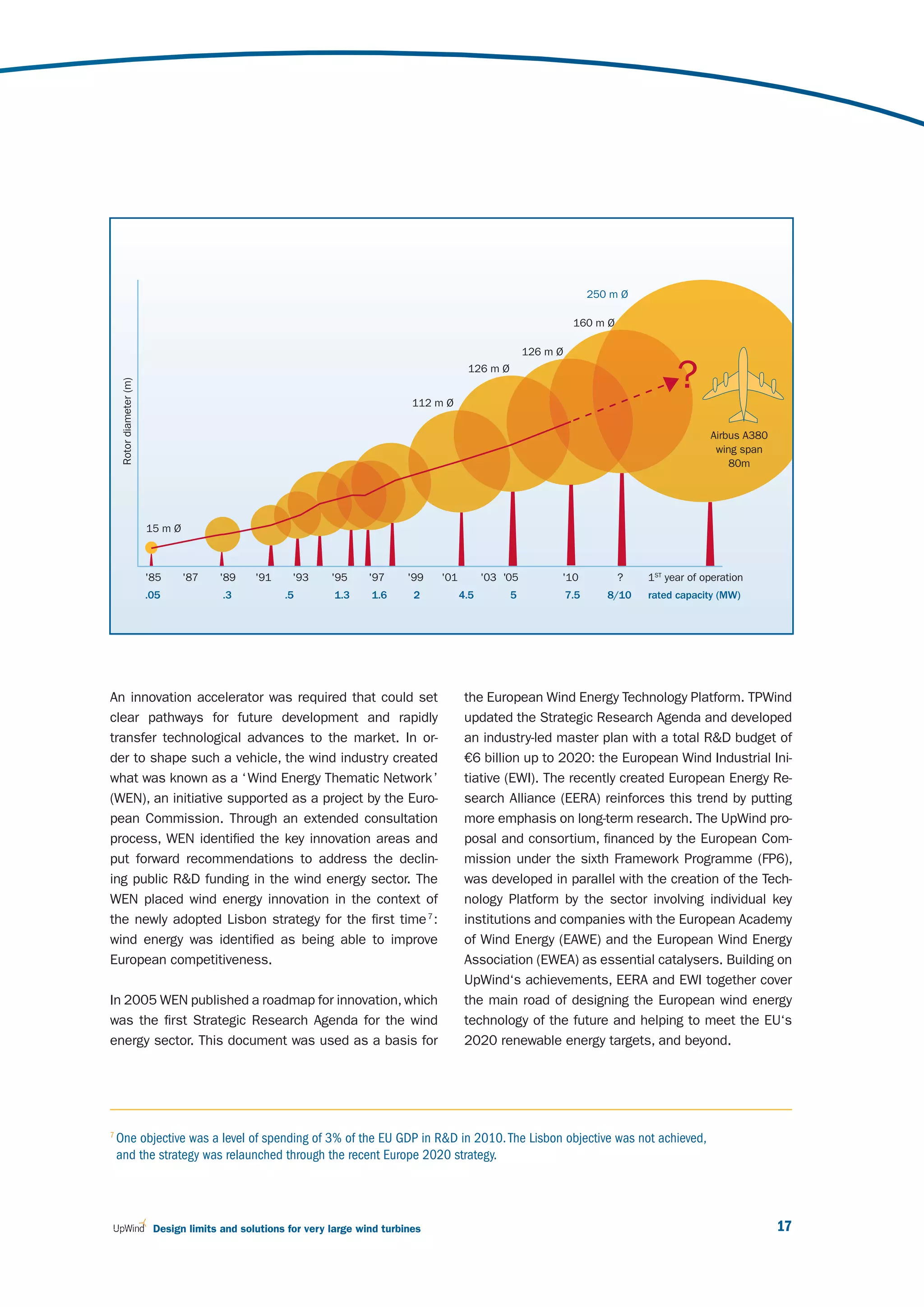
2008

                                                                                                                            250 m Ø

                                                                                                                       160 m Ø

                                                                                                            126 m Ø
                                                                                             126 m Ø
                                                                                                                                            ?
     Rotor diameter (m)


                                                                                 112 m Ø

                                                                                                                                                   Airbus A380
                                                                                                                                                    wing span
                                                                                                                                                       80m


                          15 m Ø


                          '85      '87   '89    '91     '93     '95     '97     '99   '01         '03 '05         '10            ?    1ST year of operation
                          .05            .3           .5        1.3     1.6      2          4.5        5              7.5      8/10   rated capacity (MW)


An innovation accelerator was required that could set                                        the European Wind Energy Technology Platform. TPWind
clear pathways for future development and rapidly                                            updated the Strategic Research Agenda and developed
transfer technological advances to the market. In or-                                        an industry-led master plan with a total R&D budget of
der to shape such a vehicle, the wind industry created                                       €6 billion up to 2020: the European Wind Industrial Ini-
what was known as a ‘ Wind Energy Thematic Network ’                                         tiative (EWI). The recently created European Energy Re-
(WEN), an initiative supported as a project by the Euro-                                     search Alliance (EERA) reinforces this trend by putting
pean Commission. Through an extended consultation                                            more emphasis on long-term research. The UpWind pro-
process, WEN identified the key innovation areas and                                         posal and consortium, financed by the European Com-
put forward recommendations to address the declin-                                           mission under the sixth Framework Programme (FP6),
ing public R&D funding in the wind energy sector. The                                        was developed in parallel with the creation of the Tech-
WEN placed wind energy innovation in the context of                                          nology Platform by the sector involving individual key
the newly adopted Lisbon strategy for the first time 7 :                                     institutions and companies with the European Academy
wind energy was identified as being able to improve                                          of Wind Energy (EAWE) and the European Wind Energy
European competitiveness.                                                                    Association (EWEA) as essential catalysers. Building on
                                                                                             UpWind‘s achievements, EERA and EWI together cover
In 2005 WEN published a roadmap for innovation, which                                        the main road of designing the European wind energy
was the first Strategic Research Agenda for the wind                                         technology of the future and helping to meet the EU‘s
energy sector. This document was used as a basis for                                         2020 renewable energy targets, and beyond.


7
    One objective was a level of spending of 3% of the EU GDP in R&D in 2010. The Lisbon objective was not achieved,
    and the strategy was relaunched through the recent Europe 2020 strategy.


                           Design limits and solutions for very large wind turbines                                                                              17
1   UpWind: summary - A 20 MW turbine is feasible


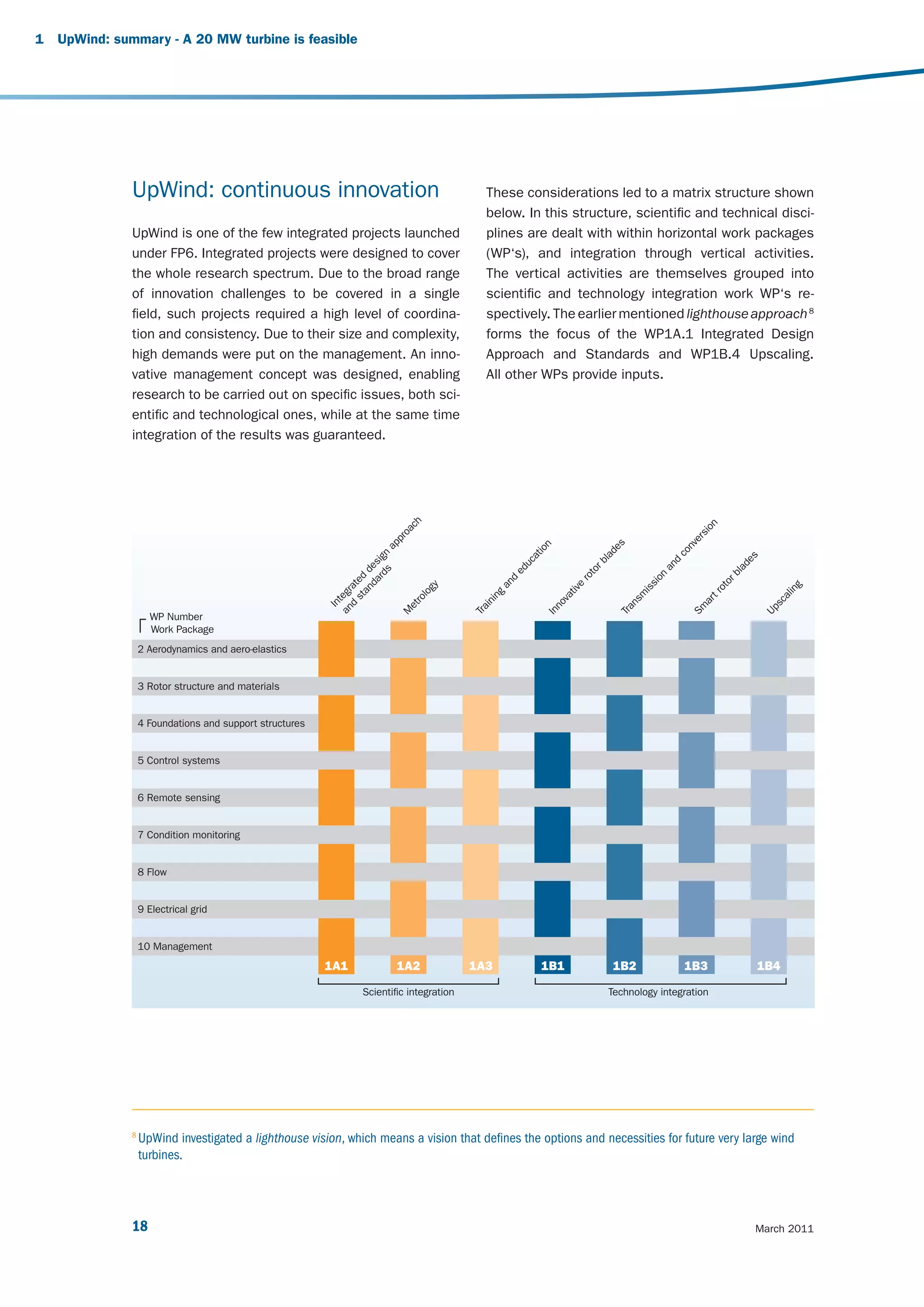
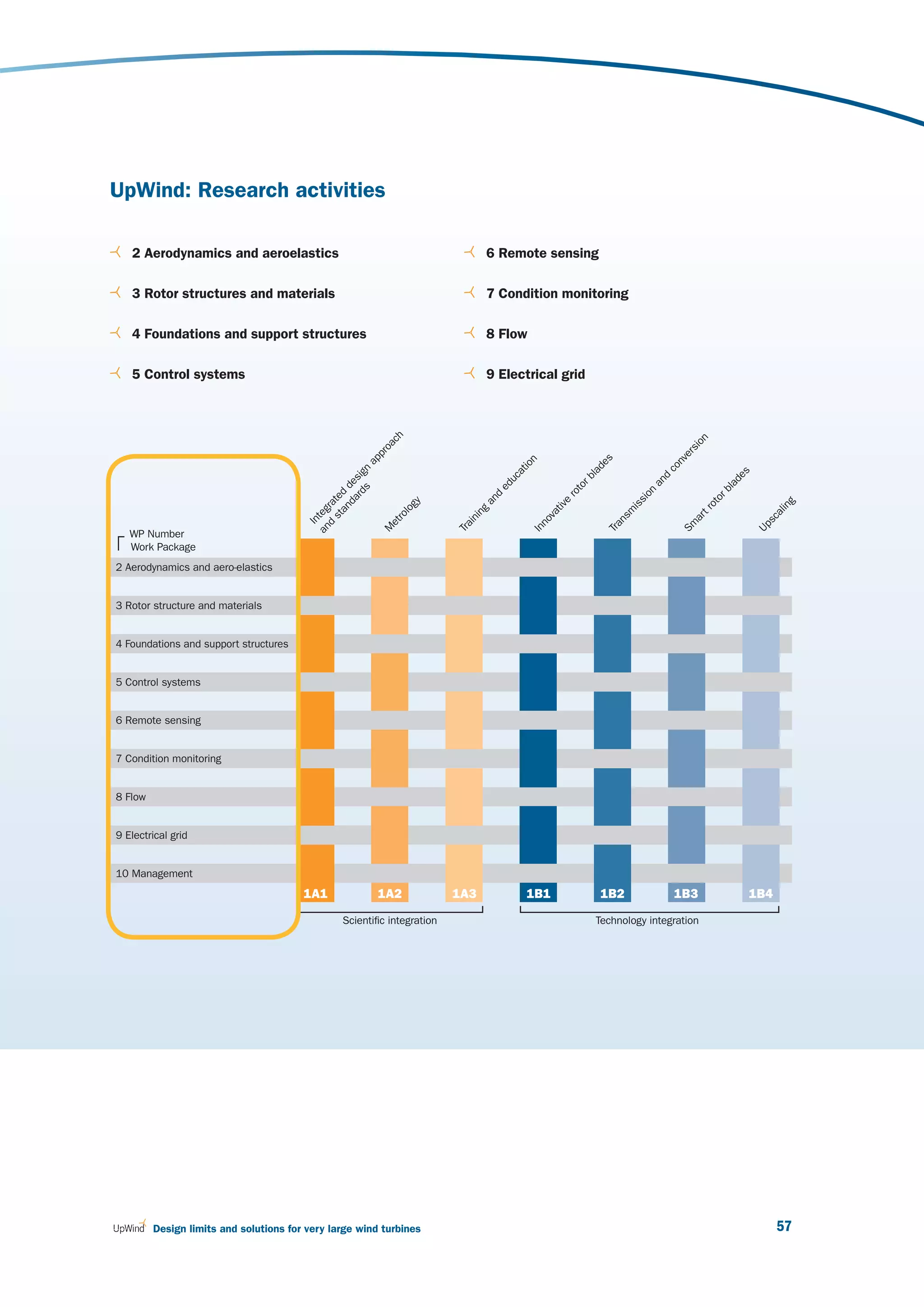
               UpWind: continuous innovation                                                   These considerations led to a matrix structure shown
                                                                                               below. In this structure, scientific and technical disci-
               UpWind is one of the few integrated projects launched                           plines are dealt with within horizontal work packages
               under FP6. Integrated projects were designed to cover                           (WP‘s), and integration through vertical activities.
               the whole research spectrum. Due to the broad range                             The vertical activities are themselves grouped into
               of innovation challenges to be covered in a single                              scientific and technology integration work WP‘s re-
               field, such projects required a high level of coordina-                         spectively. The earlier mentioned lighthouse approach 8
               tion and consistency. Due to their size and complexity,                         forms the focus of the WP1A.1 Integrated Design
               high demands were put on the management. An inno-                               Approach and Standards and WP1B.4 Upscaling.
               vative management concept was designed, enabling                                All other WPs provide inputs.
               research to be carried out on specific issues, both sci-
               entific and technological ones, while at the same time
               integration of the results was guaranteed.
                                                                               ch


                                                                                                                                                    on
                                                                             oa


                                                                                                                                                  si
                                                                           pr


                                                                                                                                                  er
                                                                         ap


                                                                                                                                                nv
                                                                                                                                s
                                                                                                               n


                                                                                                                              de
                                                                                                             io


                                                                                                                                              co
                                                                     rd ign


                                                                                                           at


                                                                                                                            la


                                                                                                                                                                 s
                                                                                                                                                               de
                                                                                                                                            d
                                                                                                         uc


                                                                                                                          rb
                                                                   da es


                                                                                                                                          an


                                                                                                                                                             la
                                                                                                       ed
                                                                       s


                                                                                                                        to
                                                                 an d


                                                                                                                                                           rb
                                                                                                                                         on
                                                                                                                      ro
                                                               st ed


                                                                                                    d
                                                                                                  an


                                                                                                                                                         to
                                                                                                                                       si
                                                                                                                       e
                                                             d at


                                                                                     gy


                                                                                                                                                                             g
                                                                                                                                     is
                                                                                                                    tiv


                                                                                                                                                       ro


                                                                                                                                                                           in
                                                          an egr


                                                                                   lo


                                                                                                   g


                                                                                                                                    m


                                                                                                                                                                         al
                                                                                                                  va
                                                                                                 in


                                                                                                                                                      t
                                                                                 ro


                                                                                                                                  ns


                                                                                                                                                   ar


                                                                                                                                                                       sc
                                                              t


                                                                                               in


                                                                                                                no
                                                            In


                                                                               et


                                                                                                                                                 Sm
                                                                                            Tra


                                                                                                                               Tra


                                                                                                                                                                     Up
                                                                              M


                                                                                                              In


                     WP Number
                     Work Package
                   2 Aerodynamics and aero-elastics


                   3 Rotor structure and materials


                   4 Foundations and support structures


                   5 Control systems


                   6 Remote sensing


                   7 Condition monitoring


                   8 Flow


                   9 Electrical grid


                   10 Management
                                                          1A1                 1A2           1A3              1B1              1B2               1B3              1B4

                                                                   Scientific integration                                    Technology integration


               8
                   UpWind investigated a lighthouse vision, which means a vision that defines the options and necessities for future very large wind
                   turbines.


               18                                                                                                                                                March 2011
In addition to defining a clear way forward for wind              In terms of project financing, UpWind shows the way
energy technology, UpWind had the responsibility of               forward for public-private partnership instruments.
accelerating innovation within the sector. This required          The scale of today‘s challenges, and the scarcity of
strong involvement from the private sector. The involve-          resources require developing innovative funding instru-
ment in UpWind of leading wind turbine and component              ments able to create a leverage effect. Those should
manufacturers, as well as software providers, techni-             combine funding from the Framework Programmes,
cal consultants and energy companies, demonstrated                other Community programmes and Member States,
the sector‘s high level of maturity. Handling Intellectual        private capital, and European Investment Bank instru-
Property within large EU-funded projects was secured              ments. The future FP8 instruments are likely to be flex-
by IP agreements and was dealt with inside the WP                 ible, with less red tape, and their structure is likely
concerned. This proved to be a very effective model.              to be shaped by the time-to-market of innovation, and
                                                                  able to combine those various sources of funding in
The strategy followed by UpWind was to focus on innova-           a coordinated manner. Although UpWind was financed
tion with a long-term aim: exploring the design limits of         under the FP6, some specific WP activities were
very large-scale wind turbines, in the 10-20 MW range.            co-financed by Member State programmes beyond the
UpWind used upscaling as a driver for innovation, and             financial scope of UpWind. One outstanding example is
moved away from the competitive arena. Along the way,             the development of LIDAR remote sensing techniques
the challenges dealt with in UpWind became a reality,             (WP6). This made UpWind the first project within the
with the demonstration of 5 MW turbines, the current              European Wind Initiative priorities that complemented
testing of 7 MW machines, and the development of                  support from the Framework Programmes with coordi-
10 MW designs. The innovation developed within the                nated calls for proposals from committed countries.
project helped solve day-to-day challenges, such as               Within EWI, UpWind is used as a reference case for
was the case in the field of WP1B.2 Transmission and              such instruments.
Conversion. UpWind had an international impact,
through the IEA Wind Implementing agreement, where
the UpWind results are included in several internation-
al task activities. Partnerships, especially in the field
of material research (WP3), were developed with India,
Ukraine and China.


       Design limits and solutions for very large wind turbines                                                        19
xx
xxx
xxx


                                                         Photo: Vestas


      2    UPWIND: SCIENTIFIC INTEGRATION


          20                                March 2011
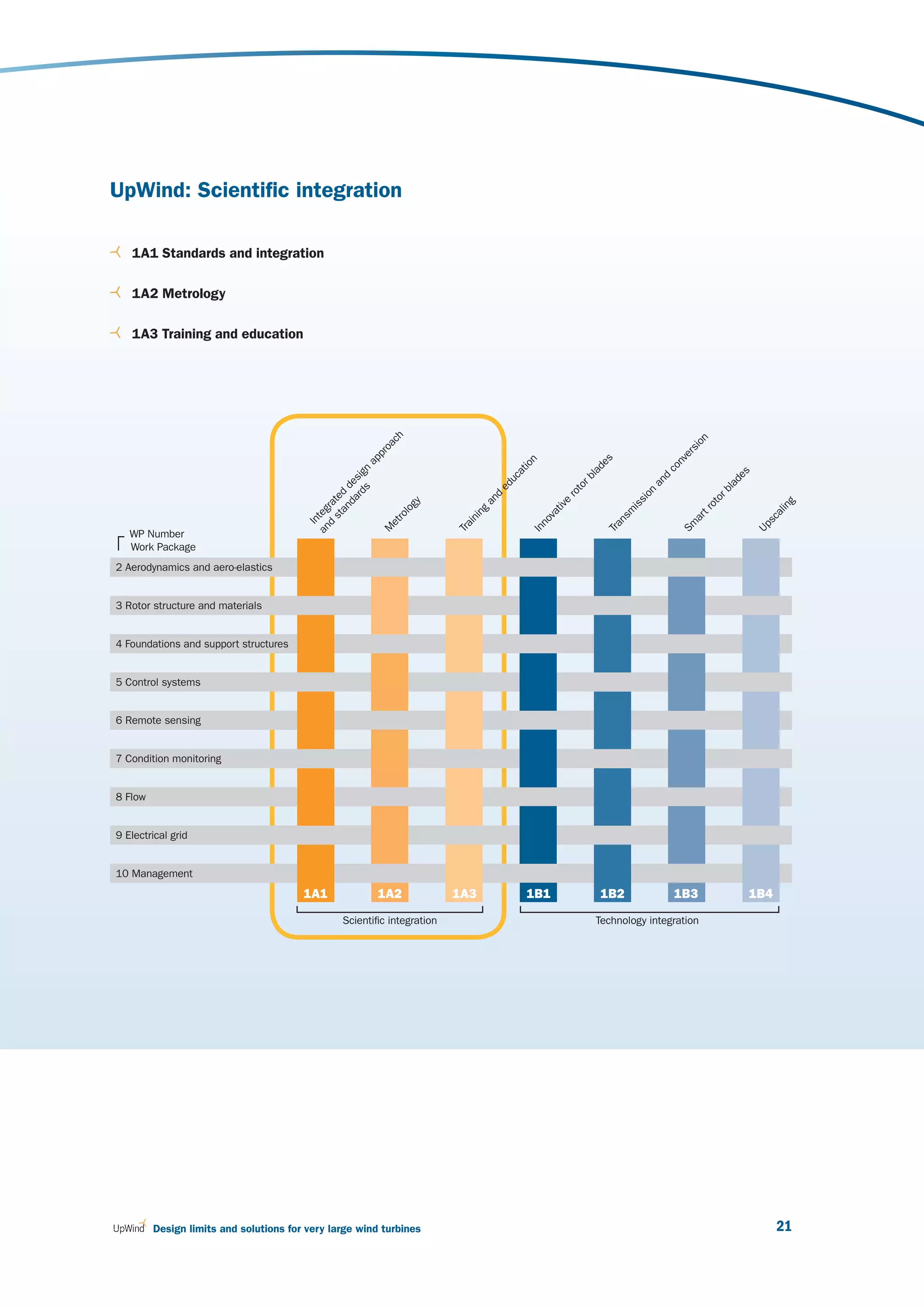
UpWind: Scientific integration

   1A1 Standards and integration

   1A2 Metrology

   1A3 Training and education


                                                             ch


                                                                                                                                   on
                                                           oa


                                                                                                                                 si
                                                         pr


                                                                                                                                 er
                                                       ap


                                                                                                                               nv
                                                                                                               s
                                                                                              n


                                                                                                             de
                                                                                            io


                                                                                                                             co
                                                     s n


                                                                                          at


                                                                                                           la


                                                                                                                                                s
                                                   rd sig


                                                                                                                                              de
                                                                                                                           d
                                                                                        uc


                                                                                                         rb


                                                                                                                         an
                                                 da de


                                                                                                                                            la
                                                                                      ed


                                                                                                       to


                                                                                                                                          rb
                                                                                                                        on
                                                                                                     ro
                                               an d


                                                                                   d
                                             st e


                                                                                 an


                                                                                                                                        to
                                                                                                                      si
                                                                                                      e
                                           d rat


                                                                   gy


                                                                                                                                                            g
                                                                                                                    is
                                                                                                   tiv


                                                                                                                                      ro


                                                                                                                                                          in
                                                                 lo


                                                                                  g
                                         an teg


                                                                                                                   m


                                                                                                                                                        al
                                                                                                 va
                                                                                in


                                                                                                                                     t
                                                               ro


                                                                                                                 ns


                                                                                                                                  ar


                                                                                                                                                      sc
                                                                              in


                                                                                               no
                                           In


                                                             et


                                                                                                                                Sm
                                                                           Tra


                                                                                                              Tra


                                                                                                                                                    Up
                                                            M


   WP Number                                                                                 In
   Work Package
2 Aerodynamics and aero-elastics


3 Rotor structure and materials


4 Foundations and support structures


5 Control systems


6 Remote sensing


7 Condition monitoring


8 Flow


9 Electrical grid


10 Management
                                        1A1                 1A2            1A3              1B1              1B2               1B3              1B4

                                                  Scientific integration                                    Technology integration


         Design limits and solutions for very large wind turbines                                                                                       21
2   UpWind: Scientific integration


               2.1 Work Package 1A1:                                        disciplines within the same framework. In this frame-
                                                                            work, manufacturing, transport, installation and O&M
               Standards and integration                                    procedures become design parameters rather than
                                                                            constraints. It enables the system as a whole to be
               Mr. Sten Frandsen from RisøNational Laboratory - DTU         optimised at a design stage. Finally, a large potential
               died during the month of October 2010. He was the Work       for cost optimisation lies in the design safety levels.
               Package leader of WP 1A1.                                    A probabilistic design of structural wind turbine com-
                                                                            ponents can be used to design components directly,
               The entire UpWind consortium would like to acknowledge       thereby ensuring the design is more uniform and eco-
               the human and scientific abilities he demonstrated along     nomic than that obtained by traditional design using
               his career. Mr. Frandsen was known as a man express-         standards such as the IEC 61400 series.
               ing and standing for his ideas and his contribution to the
               UpWind project was invaluable.                               The challenge is to efficiently update the design stand-
                                                                            ards and to promote the use of an integrated design
               UpWind demonstrates that an integral design ap-              approach. This will ensure consistency between the
               proach can significantly cut costs for current and up-       advanced models and strengthen their integration into
               scaled products. UpWind was trying to find an optimal        wind energy technology, improve the test methods and
               wind turbine design: cost-effective and with appropri-       design concepts developed in UpWind and in turn pro-
               ate design safety levels, influenced by operation and        vide a consistent scientific background for standards
               maintenance and installation strategies.                     and design tools. The approach has four parts:
                                                                                Providing a reference wind turbine for ease of com-
                                                                                munication between the work packages and integra-
               Challenges and main                                              tion and benchmarking of their findings;
                                                                                Development of cost models for upscaling to very
               innovations
                                                                                large wind turbines (20 MW) – in cooperation with
                                                                                the upscaling work package;
               The UpWind project needed a baseline case study to               Development and definition of an integral design
               benchmark innovation. UpWind defined a reference                 method; and
               5  MW turbine, adapted from NREL’s 5  MW design.                 Development of (pre)standards for the application
               During the project, these reference design parameters            of the integral design approach, including interfaces,
               were extrapolated to a virtual 20 MW machine. This               data needs guidelines and proposals for a formal
               enables a comparison to be made between a virtual                international standardisation process.
               extrapolated 20 MW machine and the UpWind innova-
               tive 20 MW machine. A cost model was developed in
               order to isolate and study the dimensioning cost pa-
               rameters of this upscaled wind turbine. However, as an
               optimal design should account for the external design
               constraints, an innovative design approach was devel-
               oped that includes both technical and non-technical


               22                                                                                                          March 2011
Results                                                           The cost model is based on a life-cycle approach
                                                                  including all capitalised costs. The main up-scaling
Subtask A: Reference wind turbine and cost model                  parameter is typically the rotor diameter. The cost
As reference wind turbine an NREL 5 MW model - was                model is basically formulated as function of this
used (see [1]) and improved. An overall framework for             design parameter using an up-scaling factor with an
an optimal design of wind turbines was formulated,                up-scaling exponent (typically 3) and a time-dependent
taking up-scaling and cost modelling into account [2]             technology improvement factor.
and [3]. The approach is based on a life-cycle analysis
including all the expected costs and benefits through-            Subtask B: Integral design approach methodology
out the lifetime of the wind turbine (wind farm).                 UpWind addresses the full life-cycle of the large-scale
                                                                  wind turbines of the future, including the technical and
The cost model was developed for wind turbine up-                 commercial aspects. However, non-technical disciplines
scaling up to 20 MW. These wind turbines are expect-              do not use any kind of model that is compatible with
ed to have a rotor diameter of approximately 250m                 the technical disciplines. There is a strong need for
and a hub height of 153m. A theoretical framework for             new design paradigms that are able to account for both
a risk-based optimal design of large wind turbines was            technical and non-technical disciplines within the same
formulated. Three types of formulation were made: 1)              framework so that manufacturing, transport, installa-
a risk / reliability-based formulation, 2) a determinis-          tion and O&M procedures become design parameters
tic, code-based formulation and 3) a crude determin-              rather than constraints. A new design approach was
istic formulation. These formulations are described in            proposed in UpWind. This approach is based on the
[2] and [3].                                                      principles of systems engineering and features ele-
                                                                  ments of Multi-disciplinary Design Optimisation (MDO),
In the third formulation (crude, deterministic), generic          Knowledge Based Engineering (KBE) and Mono-discipli-
cost models are given as a function of the design                 nary Computational Analysis Methods (MCAM).
parameters using basic up-scaling laws adjusted for
technology improvement effects. There, the optimal                The approach requires knowledge on the design pro-
design is the one which minimises the levelised                   cesses of the wind turbine and their subsystems to be
production costs. The main design parameters are: the             captured and written down. The wind turbine techno-
rotor diameter, the hub height, the tip speed and where           logies currently applied are in this approach, as well as
the wind turbines are placed in relation to one another           those being studied and developed within the UpWind
in wind farms. In a more detailed approach, the cross-            project. The captured knowledge is analysed and trans-
sectional dimensions (such as the geometry of the                 lated into knowledge applications through KBE. These
blade or the tower), the O&M strategy, or more refined            applications address the following areas of the design:
input parameters can be included. External design
parameters are fixed regarding the size of the wind farm
(in terms of MW capacity and / or the geographical area
covered by the wind farm), the wind climate including
the terrain (mean wind speed and turbulence), wave and
current climate (offshore), water depth, soil conditions
and distance from land (or nearest harbour).


       Design limits and solutions for very large wind turbines                                                         23
2   UpWind: Scientific integration


                    The development of a parametric Multi Model            This set of automated tools allows new wind turbine
                    Generator (MMG) for existing and new wind turbine      concepts to be designed. Furthermore, the tools are
                    concepts.                                              interconnected within what is known as a “Design and
                    Automation of the prepared models and aerody-          Engineering Engine” (DEE) [4, 5, 6]. This framework
                    namic and structural analysis of the wind turbine      enables the software tools to communicate through
                    components.                                            agents or functions and provides a loosely coupled
                    Automation of the prepared models and aero-elastic     demand-driven structure for the DEE. Within the frame-
                    analysis of wind turbine components.                   work, each tool is considered an engineering service
                    Automation of the prepared models and cost ana-        providing functionality to the framework.
                    lysis of wind turbine components including material,
                    manufacturing, transport and installation.
                    Standardisation of a communication framework
                    between the different disciplines.


                                                                 Work package 1
                                                               External conditions
                                                              Economic parameters


                                                                     Analysis
                    Wind turbine                                      within                                     Wind turbine
                    design data                                       WP1                                        performance


                    Conversion                                                                                   Conversion


                                                              PROJECT INTERNET SITE


                                                               Other work packages


                    Wind turbine                                     Analysis                                    Wind turbine
                    design data                                      in other                                    performance
                                                                        WP


               Figure 1 : The design and engineering engine


               24                                                                                                      March 2011
Subtask C: Development of (pre)standards for the                  associated tests. Proposals will be submitted to the
application of the integral design approach                       International Organisation for Standards for all electri-
Broad standards were developed and formulated to                  cal, electronic and related technologies known as “elec-
clarify the design requirements of multi megawatt tur-            trotechnologies” (IEC) /ISO (International Organisation
bines. Special emphasis has been put on probabilistic             for Standardisation) and to the European Committee
design of wind turbines, and recommendations of how               for Standardisation (CEN)/European Committee for
to implement research results in international design             Electrotechnical Standardisation (CENELEC).
standards [7].
                                                                  Special emphasis was put on the synthesis and ex-
A high reliability level and significant cost reductions          trapolation of design load computations as required
are required so that offshore and land-based wind                 in IEC 61400-1, in order to arrive at efficient schemes
energy generation becomes competitive with other                  for the derivation of design fatigue and extreme loads
energy technologies. In traditional deterministic, code-          (extrapolation of load effects).
based design, the structural costs are determined in
part by the safety factors, which reflect the uncertainty         The IEC 61400-1 and -3 recommend identifying the 50
related to the design parameters. Improved design                 year extreme component load on the basis of limited
with a consistent reliability level for all components            load simulations through the use of statistical extrapo-
can be obtained through probabilistic design methods,             lation methods. Such methods are often the cause of
where uncertainties connected to loads, strengths and             large variations in the extreme design load level. The
calculation methods are part of the calculation. In prob-         possibility of determining a robust 50 year extreme
abilistic design, single components are designed to a             turbine component load level when using statistical
level of safety, which accounts for an optimal balance            extrapolation methods was investigated, so that the
between failure consequences, material consumption,               50 year load shows limited variations due to different
O&M costs and the probability of failure. Furthermore,            turbulent wind seeds or inflow conditions. Case stud-
by using a probabilistic design basis, it is possible to          ies of isolated high extreme out of plane loads were
design wind turbines so that site-specific information            also dealt with, so as to demonstrate the underlying
on climatic parameters can be used. Probabilistic                 physical reasons for them. The extreme load extrapo-
design of structural wind turbine components can be               lation methodology was made robust through the use
used for direct design of components, thereby ensur-              of Principal Component Analysis (PCA) and simulation
ing a more uniform and economic design than that                  data from two widely used aeroelastic codes was
obtained by traditional design using standards such               applied. The results for the blade root out of plane
as the IEC 61400 series.                                          loads and the tower base fore-aft moments were
                                                                  investigated as those extrapolated loads have shown
The IEC 61400-1 and -3 standards were reviewed                    wide variability in the past and are essential for turbine
within the UpWind project, and an assessment was                  design. The effects of varying wind directions and
made of design load computations and in particular the            linear ocean waves on the extreme loads were also
needs related to very large wind turbines. The methods,           included. Parametric fitting techniques that consider
topics and results identified by UpWind create the                all extreme loads including “outliers” were proposed
need for the revision or development of international             and the physical reasons that result in isolated high
standards for the design of wind energy plants and                extreme loads were highlighted [8]. The isolation of


       Design limits and solutions for very large wind turbines                                                          25
2   UpWind: Scientific integration


               the exact physical reasons that result in the peak         procedure as the spread in the extreme out of plane
               extreme component loads also led to the creation of        loads at each mean wind speed is repeatable, unlike
               simplified fast solvers to determine the 50 year out       those that occur due to wind inflow variations. The
               of plane load level, as opposed to the numerous aer-       effect of soil flexibility further increases the mudline
               oelastic simulations that are usually carried out. This    extreme load level as lower frequencies have higher
               was demonstrated for the offshore turbine mudline out      out of plane load power spectral density. Therefore
               of plane loads because simplified, fast and reason-        the soil flexibility must be modelled while the offshore
               ably accurate procedures enable the turbine designer       foundation mudline ultimate design loads are deter-
               to quickly understand the ultimate design limits [9].      mined [10].
               The comparison of wave loading and wind loading on
               offshore turbine mudline extreme loads showed that         Subtask D: Integration, review and planning workshops
               the significant influence on the mudline load was due      In order to bring together the findings of the project’s
               to the wind inflow, but the effect of the waves and soil   work packages, workshops were regularly arranged with
               conditions cannot be neglected. The wave loading was       a special focus on the upscaling of turbines and the
               seen to be mildly beneficial for the load extrapolation    formulation of cost models.


                                     References


               [1]   Chiciudean T.G., La Rocca G. and van Tooren          [6]   Natarajan A.: Extreme loads Extrapolation for
                     M.J.L.: A Know-ledge Based Engineering                     Offshore Turbines. Presented at the IEA 63rd
                     Approach to Support Automatic Design of Wind               Topical Expert Meeting on High Reliability
                     Turbine Blades, CIRP Design Conference, Twente,            Solutions & Innovative concepts for Offshore
                     The Netherlands, 2008.                                     Wind Turbines, Sept 2010, Trondheim, Norway.


               [2]   Chiciudean T.G. and Cooper C.A.: Design of an        [7]   Sieros G., Chaviaropoulos P,. Sørensen J.D.,
                     Integral Pre-Processor for Wing-Like Structure             Bulder B.H., and Jamieson P.: Upscaling Wind
                     Multi-Model Generation and Analysis. 27th                  Turbines: Theoretical and practical aspects and
                     International Congress of the Aeronautical                 their impact on the cost of energy. Submitted to
                     Sciences, Nice, Farce 2010.                                Wind Energy, 2010.


               [3]   Jonkman J., Butterfield S., Musial W., and Scott      [8]   Sørensen, J.D. and Toft H.S.: Probabilistic
                     G.: Definition of a 5-MW reference wind turbine             design of wind turbines. Energies, Vol. 3,
                     for offshore system development, Tech. Report              2010, pp. 241-257.
                     NREL/TP-500-38060, National Renewable Energy
                     Laboratory (NREL), February 2009.
                                                                          [9]   Sørensen, J.D., Chaviaropoulos T., Jamieson P.,
                                                                                Bulder B.H. and Frandsen S.: Setting the frame
               [4]   Natarajan A. & Verelst D.R.: Robustness of Wind            for up-scaled offshore wind turbines. Taylor &
                     Turbine Extrapolated Extreme Loads, Submitted              Francis, CD-rom proc. for ICOSSAR, Osaka, 2009.
                     to Wind Energy Journal, 2010.

                                                                          [10] van Tooren M., La Rocca G. and Chiciudean T.G.:
               [5]   Natarajan A.: Computationally Efficient                    Further Steps to-wards Quantitative Conceptual
                     Determination of Long Term Extreme                        Aircraft Design. Variational Analysis and Aero-
                     Out-of-Plane Loads for Offshore Turbines.                 space Engineering, Volume 33, Springer New
                     Submitted to EWEC 2011, Brussels.                         York 2009.


               26                                                                                                        March 2011
“ The more your system is optimised, the more your
                                    wind measurement must be reliable and accurate.
                                    Wind measurement techniques for wind energy
                                    are progressing quickly. New sensors are being
                                    validated, with high potential to cut down the costs
                                    and lower the risks. The UpWind project acted
                                    as a node to narrow down wind measurement
                                    uncertainties. It helped translate innovation into IEC
                                    standards, with support of the whole measurement
                                    community ”

                                 Peter Eecen, Work Package Leader, Energy Research Centre of the Netherlands (ECN)


2.2 Work Package 1A2:                                             anemometers often do not respond in a linear manner.
                                                                  The objective of UpWind’s metrology activities was to
Metrology                                                         develop ways to significantly enhance the quality of
                                                                  measurement and testing techniques for wind energy
                                                                  applications. The first part of the metrology task was
Challenges and main                                               to identify the current measurement methods through
                                                                  the metrology database, then to identify metrology
innovations
                                                                  problems that need further work, and finally to con-
                                                                  sider problems to advance wind energy metrology.
Small improvements in the wind turbine’s performance
can generate significant additional revenues over its             This task addressed both the fundamental activities
lifetime. However, if there is too much measurement               for supporting the sector growth (online measurement
uncertainty, it becomes impossible to anticipate the im-          database, revision of IEC standards), and validated
provement to the performance during field tests, and              innovative measurement instruments, which could
therefore difficult to convince the industry to include           potentially lead to large cost reductions. UpWind
those innovations.                                                acknowledged the following elements:
                                                                      LIDARs are potentially reliable measurement instru-
The design improvements resulting from the research                   ments for resource assessment, control strategies,
activities of the UpWind project will require validation              or wake monitoring.
based on reliable and appropriate measurements.                       The use and calibration method of sonic anemo-
UpWind therefore studied OR is studying metrology                     meters for wind measurements were established,
problems related to wind turbine technology. In par-                  and significant improvements are currently being
ticular the fluctuations in wind speed lead to large                  implemented in available products.
measurement uncertainties, and sensors such as cup                    Onsite work is valuable for wind sensor comparison.


       Design limits and solutions for very large wind turbines                                                       27
2   UpWind: Scientific integration


               Results                                                    Advances in metrology
                                                                          Metrology for wind energy is in rapid development.
               The metrology database                                     Some earlier EU projects considered measurement
               The objective is to develop metrology tools to sig-        methods in wind energy [3, 4], making progress on
               nificantly enhance the quality of measurement and          current cup and sonic anemometry, and some devel-
               testing techniques. The first outcome is an assess-        opment needs were identified for sonic anemometry.
               ment of current measurement methods and problems.          Requirements for detailed turbulence measurements
               The required accuracies and sampling frequencies           call for better procedures in international standards
               were identified from the perspective of the data us-       on sonic anemometer calibration and classification.
               ers, and with regards to the UpWind objectives. The        This task is currently considered in the revision work
               information was categorised in groups according to         on the IEC standard on performance measurements
               current analysis techniques, current measurement           [3], where cup anemometer calibrations and classifica-
               techniques, a sensor list, derived problems and            tions have already been implemented.
               commercially available sensors. In order to process
               these large amounts of data a database structure           A significant contribution has been made on power per-
               was designed and implemented. The database in-             formance measurements with the influence of shear.
               cludes eleven primary tables as shown on Figure 2.         A method has been developed which has a good
               The database is available on www.winddata.com as           chance of being implemented in the ongoing revision of
               part of a “database on wind characteristics” and for       the IEC performance standard [5]. A turbulence norma-
               UpWind partners in a portable MS-Access version.           lisation method has been tested [7] but not found
               Preliminary results are listed in [1] and a detailed       efficient enough for inclusion in the IEC standard [5].
               description of each table is listed in [2].                These methods have been tested on several existing
                                                                          datasets, such as the Riso/DTU and ECN test sites.


               Figure 2 : Metrology database structure. The database is accessible through www.winddata.com.

                                                                    Application
                                                                 Table=applications
                                                                        AID


                                                                                                      Condition parameters
                                                                                                         Table=indication
                                                                                                            Param No


                          State-of-art analysis technique      State-of-art-technique                         Parameters
                                   Table=methods                  Table=technique                       Table=parameters
                                      MID, AID                     TID, Param No                        PID, AID, Param No


                      References                   Problems                  Parameter technique               Sensor applications
                    Table=references          Table=problems                   Table=params_tech             Table=sensor_applications
                        RID, MID                 PRID, MID                           TID, PID                        PID, SID


                                                                                                   Sensors
                                                                                             Table=sensor_types
                                                                                               SID, Param No


                                                                                            Commercial sensors
                                                                                           Table=commercial_sensor
                                                                                              CID, SID, Param No


               28                                                                                                              March 2011
In relation to the coming IEC standard on performance                   For resource assessment, and replacing the tradi-
verification with the use of nacelle anemometry [8],                    tional measurement masts, UpWind demonstrated
nacelle anemometry has been studied, both the                           that the ground-based LIDAR measurement principle
theory and its practical application [9]. An alternative                is efficient in flat terrain. In complex terrain and
to nacelle anemometry has also been developed, the                      close to woods, the measurement volume is dis-
so-called spinner anemometer [10, 11]. This type of                     turbed by a vertical turbulence component. Due to a
sensor seems to avoid the draw-backs of nacelle an-                     large measurement volume, ground-based LIDARs
emometry because the sensors are positioned in front                    perform a spatial averaging which has the effect of a
of the rotor on the spinner. Finally, mast correction                   low pass filter on turbulence measurements. This
measurement has also been developed to improve                          effect requires special attention and correction
current measurements [12].                                              methods, which were analysed within the UpWind
                                                                        project by the use of the WAsP engineering tool,
With respect to new wind measurement technologies                       which is a computer based program for the estima-
such as remote sensing (LIDAR & SODAR), a substan-                      tion of extreme wind speeds, wind shears, wind pro-
tial number of projects have been undertaken over the                   files and turbulences in complex (and simple) terrain.
last five years. Ground based LIDARS have been devel-                   LIDAR measurements were made from a rotating
oped significantly, and in the past few years calibration               spinner. The analysis show good perspectives for
and traceability issues have also been tackled and are                  scanning the incoming wind, which may lead to bet-
now being included in the IEC standard revision [5].                    ter controlled wind turbines.
An overview is provided by [6], where significant metrol-               LIDARs have also been used to scan the wake of
ogy contributions are described.                                        wind turbines. These measurements show the
                                                                        curvy wake pattern. Progress has been made with
Focus on LIDAR technology                                               large-scale site wind scanning with three coordi-
LIDAR technology is relatively recent and requires                      nated LIDARs.
testing. Testing against a traditional meteorological
mast has been shown to be efficient for gaining                      Verification of anemometer calibrations
confidence and trust in measurement accuracy.                        In the context of MEASNET 9 a cup anemometer cali-
In principle, LIDAR measurements could be made                       bration round robin and acoustic noise measurement
traceable through the fundamental measurement                        round robin were performed [13] with good results for
principles, but at this stage of development it is not               the associated MEASNET institutes. Together with
feasible. Instead, traceability is secured through                   the MEASNET experts, UpWind worked to try and
comparison with meteorological masts that are                        find a procedure for calibrating sonic anemometers.
themselves traceable through wind tunnel calibrations                The operational characteristics of 26 sonic anemom-
of cup anemometers. LIDARs can fulfil different                      eters have been investigated over a long period of time
objectives:                                                          by [17]. Improvements were required in order to use the
                                                                     sensors for wind energy applications. These improve-
                                                                     ments are being implemented by the manufacturer.


9
    Measnet: International network for harmonised and recognised measurements in wind energy.
    http://www.measnet.com, MEASNET Round Robin (RR) on anemometer calibration is one method of measurement.


          Design limits and solutions for very large wind turbines                                                         29
2   UpWind: Scientific integration


               Standardisation organisations require additional veri-          A sensitivity analysis was carried out on the results.
               fication measures for anemometers. The preferred                The operation time on site, the annual mean wind speed,
               method is to recalibrate the anemometers to verify              the mean turbulence intensity and the annual mean tem-
               that any possible degradation of the operational char-          perature were examined. In order to reduce the statis-
               acteristics of anemometers during their operational             tical scatter, and identify possible interactions, the cases
               period is kept within known limits. As an alternative           studied were separated per anemometer type and binned
               to recalibration, on site comparison was investigated.          (categorised) per parameter type. It was seen that binned
               Data was analysed from various in situ comparisons              values for mean SSD with usage time have low depend-
               of anemometer calibrations. As a measure of “anemo-             ence, since a longer operation time would cause greater
               meter degradation” the square sum of the Systematic             degradation to anemometer bearings. However, for the
               Deviation and the Statistical Deviation (SSD) between           anemometer type examined here, (Vector A100 series)
               the two operating periods is used. For the in situ com-         the SSD values remain below the 0.1 m/s limit even for
               parison to be considered successful, the SSD must               usage time exceeding 365 days [14, 15]. No obvious
               be lower than 0.1 m/s for each wind speed bin (a tool           effect on deviation from site annual mean wind speed,
               used to make samples of wind speed) in the range of             mean turbulence intensity, or mean air temperature were
               6 to 12 m/s. In situ comparisons were successful for            detected for the covered parameter range. Therefore,
               90% of the examined cases. Acceptable results were              “in situ comparison” as described in [16] is a reliable tool
               found even for anemometers operating for more than              for the verification of anemometer calibration integrity.
               18 months on site. Recalibrations of anemometers in
               the wind tunnel after the end of the measurement cam-
               paign were in full accordance with the in situ results.


               Figure 3 : SSD values as a function of operation time on site (only cases with Vector A100 series anemometers)


                                   0.16                                                                                  16

                                                                                                6 to 7
                                   0.14                                                                                  14
                                                                                                9 to 10
                                                                                                11 to 12
                                   0.12                                                                                  12
                                                                                                IEC61400-12-1
                                                                                                                              Sample per bin h


                                                                                                Mean SSD
                     SSD (m/sec)


                                    0.1                                                                                  10
                                                                                                Samples per bin

                                   0.08                                                                                  8


                                   0.06                                                                                  6


                                   0.04                                                                                  4


                                   0.02                                                                                  2


                                     0                                                                                   0
                                          0        200                   400                     600                   800

                                                                 Days of use


               30                                                                                                                     March 2011
References


[1]   Dahlberg J.A., et.al., “Classcup – Development of            [11] Pedersen T.F., Wagner R., et al, Risø-R-1752,
      a standardized cup anemometer suited to wind                      “UPWIND Metrology 1A2.3 – Advancements in
      energy applications”, JOULE 2001.                                 Wind Energy Measurement Methods”, 2010.


[2]   Diznabi B., Investigation of the flow relation                [12] N. Stefanatos, P. Papadopoulos, E. Binopoulos,
      to nacelle anemometry, To be published Master                     A. Kostakos, G. Spyridakis, "Effects of long term
      Thesis, March 2009, MEK-FM-EP-2009-03                             operation on the performance characteristics of
      (not published).                                                  cup anemometers” Proc. Of EWEC 2007, Milan.


[3]   Eecen P.J., Stefanatos N., Petersen S.M., and                [13] N. Stefanatos, A. Kostakos, P. Papadopoulos,
      Hansen K.S., UPWIND METROLOGY; Deliverable                        E. Binopoulos, "Verification of anemometer
      D 1A2.1 List of Measurement Parameters,                           calibrations” Proc. Of EWEC 2010, Warsaw.
      ECN-E--07-015.

                                                                   [14] J.W. Wagenaar, P.J. Eecen, Gill Windmaster Sonic
[4]   Eecen P.J., Stefanatos N., Pedersen T.F. and                      Anemometers, ECN-X--09-144.
      Hansen K.S., UPWIND METROLOGY; Deliverable
      D 1A2.2 Metrology Database, ECN-E--08-079.
                                                                   [15] J.W. Wagenaar, P.J. Eecen, Measurements of Wind,
                                                                        Wave and Currents at the Offshore Wind Farm
[5]   Eecen P.J., and Wagenaar W.J., MEASNET                            Egmond aan Zee, ECN-E--09-015.
      Anemometer Calibration Round Robin 2009,
      Analysis of MEASNET reference wind speed,
      ECN-X-10-067.                                                [16] J.W. Wagenaar, P.J. Eecen, 3D Turbulence at
                                                                        the Offshore Wind Farm Egmond aan Zee,
                                                                        ECN-E--10-075.
[6]   Eecen P.J., 6th MEASNET Round Robin; Sound
      Power Level and Tonality, ECN-X--07-146.
                                                                   [17] “Accuwind – Accurate wind speed measurements
                                                                        in wind energy”, Risø-R-1563(EN), JOULE 2006.
[7]   Frandsen S., Sørensen J.N., Mikkelsen R.,
      Pedersen T.F., Antoniou I., Hansen K.,
      The generics of wind turbine nacelle                         [18] IEC61400-12-1, 2005, “Wind Turbines-Part 12-1:
      anemometry, EWEC 2009.                                            Power performance. measurements of electricity
                                                                        producing wind turbines”.

[8]   Lindelöw-Marsden P., Pedersen T.F., Gottschall
      J., Vesth A., Wagner R., Paulsen U., Courtney                [19] IEC61400-12-2-CD “Wind Turbines-Part 12-2:
      M.S., Flow distortion on boom mounted cup                         Power performance. measurements of electricity
      anemometers, Risø-R-1738(EN), 2010.                               producing wind turbines with the use of nacelle
                                                                        anemometry”.

[9]   T.F. Pedersen, N.N. Sørensen, P. Enevoldsen
      Aerodynamics and characteristics of a spinner                [20] MEASNET Measurement Procedure:
      anemometer, The Science of Making Torque from                     Cup Anemometer Calibration, Ver. 2 2009.
      Wind, August 2007, DTU.


[10] T.F. Pedersen, L. Vita, N.N. Sørensen,
     P. Enevoldsen, Operational experiences with a
     spinner anemometer on a MW size wind turbine,
     EWEC 2008.


        Design limits and solutions for very large wind turbines                                                        31
2   UpWind: Scientific integration


                                            “ Wind energy is growing fast, and the technology
                                              improves every day. Training and education
                                              is fundamental to support the wind sector’s
                                              development. UpWind collected and developed a
                                              unique amount of training materials, and defined
                                              the required training modules to be used for the
                                              professional development of those that wish to
                                              work in this industry ”
                    Charalampos Malamatenios, Work Package Leader, Centre for Renewable Energy Sources and Savings (CRES)


               2.3 Work Package 1A3:                                     done in the field of wind energy technology, and on-
                                                                         the-job training is required to update knowledge and
               Training and education                                    skills. The present situation concerning training and
                                                                         educational materials is however not ideal. Quite a lot
                                                                         of material is available, but it is not standardised, it is
               Challenges and main                                       difficult to access, different courses overlap consider-
                                                                         ably and so on.
               innovations
                                                                         Knowledge dissemination is critical for supporting the
               Over the last ten years, installed wind power capacity    technological innovation of SMEs, which should not
               has gone up by more than 20% per year. Forecasts          lag behind as wind power technologies develop. A fully
               from the industry demonstrate the high potential of       integrated approach, involving academic institutions,
               this technology, which will face a critical shortage of   industry and research institutes, is thus necessary
               manpower in the coming years. Training and educa-         to provide a unique platform to improve educational
               tion is fundamental element to sustainable industrial     materials with respect to content and structure, avoid-
               growth.                                                   ing overlaps, and being in accordance to the users
                                                                         specifications.
               Working with wind energy technology requires a high
               level of education, since improving and enlarging wind    The specific objective of the UpWind training and edu-
               turbines means dealing with specific aeromechanical       cation section is to propose a number of modules
               and structural effects, electrical grid connection and    for international courses in the wind energy field and
               power quality issues, load regulation and part-load       specific supporting training materials. These train-
               performance, as well as their potential environmen-       ing modules could then be used (upon request) for
               tal impact (noise, visual obstruction, bird migration,    researchers and students (PhD level courses), as well
               and so on). In the meantime, a significant amount of      as for energy consultants and project developers (for
               research and development work has been and is being       continuous professional development).


               32                                                                                                        March 2011
Results and conclusions                                                    The WEIEN is:
                                                                              A database for up- and downloading documents;
First, preliminary material (in the form of guidelines,                       A forum for discussion;
templates and so on) was developed, which helped to                           An “open source knowledge creation” tool (like an
design the UpWind course module for the identified                            internal “Wikipedia”);
target groups. Apart from the detailed literature analy-                      A facilitator of the peer-review process for training
sis and web-based survey, a questionnaire based sur-                          materials.
vey was also carried out. Information on wind energy
related training courses was collected from 43 course                      Work on WEIEN is continuous, as the database has
providers.                                                                 to be constantly updated. Also, the “resource guide
                                                                           to course modules” was another important part of
An online database of all courses relevant to wind                         this work, which includes the most essential of the
energy found all over Europe was developed. This is                        common components of the courses surveyed, as
the “Database of EU courses in the field of wind energy”,                  well as the key characteristics of the modules that
and it includes all available details (level, contents,                    need to be developed or updated in order to be in-
duration, contacts, etc.) for the courses. The database                    tegrated into existing and new wind energy courses.
can be found on UpWind’s website 10.
                                                                           This way, the topics covered by a course that will lead
Another major achievement is the “Wind Energy Informa-                     to a PhD decree were developed. It was decided that
tion and Education Network – WEIEN (e-database)”. This                     the target groups of the UpWind training course(s)
database is a restricted area within the RenKnow.net 11                    should already have some basic knowledge of wind
website which has been created for the WEIEN mem-                          energy technology. Therefore, the aim was not to
bers with all relevant functionalities of the REnKnow.net                  create training courses for basic studies, but to build
website.                                                                   on the students’ previously acquired knowledge (as
                                                                           shown in Figure 4).


                  Level 1


                                                                      Habil.,
                                                                       PhD,
                                                                        …


                  Level 2

                                                                     UpWind
                  Concentrate on
                  technical                                          training
                  UpWind issues                                      courses


                  Level 3
                                               Fundamental wind energy training courses
                                                          at university level e.g.
                                                  wind resources, aerodynamics, Betz,
                                               design, electric machines, grid integration,
                                                             economics, etc.


Figure 4 : UpWind training targets students of educational levels 2 (i.e. between the basic Levels of 1 and 3)


10
     http://www.upwind.eu/Paginas/Publications/1A3%20Training%20and%20Education.aspx
11
     http://renknownet.iset.uni-kassel.de


          Design limits and solutions for very large wind turbines                                                              33
2   UpWind: Scientific integration


               The “modules” listed by UpWind are neither full             Eleven topics were identified as the key themes
               courses nor simply lectures. Instead, they are building     of the UpWind course modules, broken down into
               blocks for university lectures/courses, short courses       sub-components (according to what is presented in
               for professionals (CPD units), as well as for any other     Table 1). This is a unique attempt to develop up-to-
               types of training course. To this end, the content          date courses and relevant training materials for wind
               of the UpWind course modules is not a ready-to-go           energy:
               lecture package, but rather the material necessary
               to set new courses up.


                1. Aerodynamics and aeroelastics
                1.1 Damped structural dynamics for composite rotor blades – tools and exercises
                1.2 Advanced aerodynamics and boundary integral element methodology (BEM) corrections
                1.3 Aeroelastic stability
                2. Rotors Structures and materials
                2.1 Innovative materials and processes
                2.2 Fundamental and global material models – calculation techniques to evaluate the material damage
                2.3 Test/measurement techniques for material and component testing, including procedures
                2.4 Elastic stability and static strength of rotor blades – tools and exercises
                2.5 Strength and stiffness degradation of rotor blade composites due to fatigue - life prediction
                2.6 Structural reliability analysis of composite rotor blades
                3. Foundations and support structures
                3.1 Introduction to offshore wind technology
                3.2 Environmental conditions
                3.3 Soil and foundation models
                3.4 Support structures I
                3.5 Support structures II
                3.6 Offshore standardisation
                3.7 Integrated design process of explain
                3.8 Results of Work Package 4
                4. Control systems
                4.1 Wind turbine control concepts
                4.2 Controller tuning and adjustment
                5.3 Control for grid compatibility
                5. Condition monitoring
                5.1 Optimised Condition Monitoring Systems (CMS) for next generation wind turbines
                5.2 “Flight leader turbine” for wind farms
                5.3 Fault statistics
                5.4 International standards
                6. Flow
                6.1 Theoretical analysis of wakes
                6.2 Analysis of wakes in complex terrain
                6.3 Introduction to wake modelling in flow simulation


               34                                                                                                     March 2011
7. Electrical grid
 7.1 Introduction to wind power grid connection and integration
 7.2 Introduction to power system reliability
 7.3 Wind turbines and wind farm design and reliability
 7.4 Power system security and wind turbine stability
 7.5 Power system control with wind power
 7.6 Results from UpWind Work Package 9
 8. Measurements and experiments in wind energy
 8.1 Principles of experiments
 8.2 Wind turbine test site
 8.4 Wind resource measurements
 8.5 Special experiments
 9. Transmission and conversion
 9.1 Mechanical transmission
 9.2 Generators
 9.3 Power electronics
 10. Integral design approach & standards
 10.1 Introduction
 10.2 Integral design approach
 10.3 Cost models
 10.4 Uncertainty modelling
 10.5 Reliability methods
 10.6 Standards
 11. Upscaling and integrated design:
 11.1 Classical upscaling
 11.2 Upscaling through design
 11.3 Cost models I
 11.4 Cost models II
 11.5 Upscaling issues
 11.6 Future concepts


Table 1 : UpWind training modules.


In the last stages of the project, the various UpWind             Non-university status partners used selected mod-
training modules were run as pilots:                              ules developed in WP1A.3 to run workshops on the
    University status partners used the modules for               main topics of wind energy technology;
    postgraduate students and lecturers from other uni-           A detailed presentation of the modules created by
    versities;                                                    this WP was given in a workshop that addressed
                                                                  PhD candidates with a background in engineering.


       Design limits and solutions for very large wind turbines                                                 35
Photo: Vestas


3        UPWIND: TECHNOLOGY INTEGRATION


    36                                    March 2011
UpWind: Technology integration

   1B1: Innovative rotor blades (Innoblade)

   1B2 Transmission and conversion

   1B3 Smart rotor blades and rotor control

   1B4 Upscaling
                                                             ch


                                                                                                                                on
                                                           oa


                                                                                                                              si
                                                         pr


                                                                                                                              er
                                                       ap


                                                                                                                            nv
                                                                                                            s
                                                                                                          de


                                                                                                                          co
                                                     s n


                                                                                                        la


                                                                                                                                             s
                                                   rd sig


                                                                                                                                           de
                                                                                                                        d
                                                                                                      rb


                                                                                                                      an
                                                 da de


                                                                                                                                         la
                                                                                                    to
                                                                                  io nd


                                                                                                                                       rb
                                                                                                                     on
                                                                                                  ro
                                               an d


                                                                                at a
                                             st e


                                                                                                                                     to
                                                                                                                   si
                                                                                                   e
                                           d rat


                                                                             uc ing
                                                                   gy


                                                                                                                                                     g
                                                                                    n


                                                                                                                 is
                                                                                                tiv


                                                                                                                                   ro


                                                                                                                                                   in
                                                                 lo
                                         an teg


                                                                                                                m
                                                                           ed ain


                                                                                                                                                 al
                                                                                              va


                                                                                                                                  t
                                                               ro


                                                                                                              ns


                                                                                                                               ar


                                                                                                                                               sc
                                                                                            no
                                           In


                                                                             Tr
                                                             et


                                                                                                                             Sm
                                                                                                           Tra


                                                                                                                                             Up
                                                            M


   WP Number                                                                              In
   Work Package
2 Aerodynamics and aero-elastics


3 Rotor structure and materials


4 Foundations and support structures


5 Control systems


6 Remote sensing


7 Condition monitoring


8 Flow


9 Electrical grid


10 Management
                                        1A1                 1A2             1A3           1B1             1B2               1B3              1B4

                                                  Scientific integration                                 Technology integration


         Design limits and solutions for very large wind turbines                                                                                  37
3   UpWind: Technology integration


               “ One key point when thinking about increasing the size of wind
                 turbine blades is transport costs. In order to keep these costs under
                 acceptable limits the best choice is sectional blades, capable of being
                 transported with the same means as smaller blades. The use of new
                 tools for the better understanding of such huge blades as well as a
                 reliable monitoring system of the blade are key factors to this new
                 generation of blades ”
                                                                         Joaquin Arteaga Gomez, Work Package Leader, Gamesa


               3.1 Work Package 1B1:                                      such as advanced aerodynamic profiles, advanced
                                                                          design solutions, analysis of new materials, and
               Innovative rotor blade                                     advanced sensor and monitoring technologies, among
               (Innoblade)                                                others.


               Challenges and main                                        Results
               innovations
                                                                          Blade aerodynamic design and load calculation
                                                                          This analysis included aerodynamics design, aero-
               In the last years the cost of wind energy has decreased    elastic design and loads consideration, making use
               due to technical improvements in aerodynamics, ma-         of all current methodologies, but also employing
               terials and structures, reaching an almost constant        innovative methods that are beyond current practice,
               cost per KW recently. In order to move towards more        such as:
               efficient wind turbine designs (bigger rotor diameters        Profile design for efficient energy production as a
               with lower energy costs), new innovative improvements         design option, in relation to the Sirocco project in
               are needed.                                                   which both Gamesa Innovation and Technology and
                                                                             ECN are involved. For an optimal design and per-
               Future multi-megawatt machines will require large             formance, materials and structural design improve-
               blades whose transport costs would become unaf-               ments were considered.
               fordable for blades longer than 50m. Sectional                Contribution of aero-elastic analysis, with the re-
               blades, meaning blades divided into sections, are             sults from FP5 projects Dampblade and Stabcon.
               the best way to reduce transport costs while in-              Aerodynamics design taking into account blade
               creasing the length of the blades. These blades will          deformation.
               be manufactured in separated modules that will be             The use of the blade joints and their effect on
               assembled on site.                                            modal shapes.
                                                                             Integration of the control system in the aerody-
               UpWind has focused on the design and validation of a          namic design and loads calculation, considering
               sectional blade concept which aims to reduce the glob-        blade monitoring and load mitigation strategies.
               al cost of energy and to help develop larger turbines.        Optimisation criteria and design optimisation
               This blade concept includes several new technological         procedures.
               advances regarding blade design and manufacturing,


               38                                                                                                      March 2011
Material selection, structural design and structural
                                                                  verification
                                                                  The current state of composite materials was analysed
                                                                  as well as any new potential materials or innovations
                                                                  that could contribute to better blade designs, and spe-
                                                                  cifically to the design of sectional blades. This analysis
                                                                  found that even though there were promising research
   outboardblade
                                                                  areas in the field, no breakthroughs were about to be
                                                                  achieved, so today a large blade (sectional or otherwise)
                                                                  is built using the standard materials and processes
                                                                  (glass fibre and carbon fibre, as prepregs or dry plies
                                                                  for infusion).
                             inboardblade
                                                                  After this, the structural design of the proposed blade
                                                                  was examined, first considering the blade as a single
Figure 5 : Sectional blade                                        component and secondly as a sectional blade using the
                                                                  one piece configuration as a starting point. This also
                                                                  included the selection of the position of the sectional
These methods were applied to the design of a 42.5 m              joint, choosing the R15 after considering all the factors
blade (this size was chosen to test these new technolo-           (effects on modal shapes and frequencies, weight and
gies, using a Gamesa design as starting point) leading to         length of the two modules and so on).
a functional design of a sectional blade with the following
characteristics and conclusions:                                  Sensor monitoring with response actions
    Brand new “flat–back” profiles were developed for             The possibility to monitor the behaviour of the sec-
    the sections close to the base of the blade (of               tional joint of the innovative blade at any given time
    special relevance for larger blades)                          (for analysis, validation and maintenance) is important.
    The use of a root fairing was analysed, with the              A series of sensors is required, and the measured data
    conclusion that it would lead to a small increase             needs to be transferred to a processing unit. The use
    in the power produced                                         of cable for this transferring is complicated and risky.
    The effects on the modal shapes and natural                   As an alternative, a wireless sensor system was con-
    frequencies of the sectional joint position were              sidered by UpWind. After the current technology had
    studied, with the conclusion that no relevant dif-            been reviewed and the different solutions analysed,
    ferences appear when it is placed between R 10                a system was designed based on the Zigbee certifi -
    to R20 (measure of resistance).                               cation standard. From the test carried out using this
                                                                  system it was found that:
A study of blade damping checked the stability of the                  Signal reception was good up to 30-40 m with a
blade at different configurations (for example, the effect             sensor-emitter placed inside the blade and a receiver
of wind with an angle of attack of around 90º on inac-                 at the nacelle, showing no differences between car-
tive wind turbines). These results were presented at the               bon or glass fibre blades.
EWEA Annual Event (formerly EWEC) 2009.                                Wireless sensors shouldn’t be placed too close to
                                                                       metallic components of the blade.
                                                                       The results were satisfactory (good signal reception)
                                                                       even with the machine rotating.
                                                                       Power consumption was acceptable, and will depend
                                                                       on the amount of data to be transmitted.


       Design limits and solutions for very large wind turbines                                                          39
3   UpWind: Technology integration


               Blade joint                                                      These fittings are bonded to a carbon fibre pultrud-
               Since the main aim of work package is to study the               ed profile that is embedded within the laminates of
               design of a sectional blade, one of the most important           the caps.
               tasks is designing the sectional joint that will allow the       In order to reduce the load transmitted by each
               blade to be put together on site. The first obvious action       fitting, the spar widens near the joint section, in
               was a trade-off study considering different alternatives         order to allocate a bigger number of fittings.
               for the joint:
                   Spar lugs: this option consist of lugs embedded           With this solution, the joint of the two modules is built
                   into the laminates of the spar (both webs and             from two bonded joints (between the fittings and the
                   caps). The lugs form the inboard and outboard             profiles, and between the profiles and the laminates)
                   module are bolted transferring the load by shear.         and a bolted joint between the two channel fittings.
                   Channel fittings: this option bolts two metallic fit-     The behaviour of these kind of joints (bolted and bond-
                   tings that will transfer the load between modules         ed) is well known, but due to the complex geometry of
                   axially. To bond the fitting to the spar some kind of     some of the components, finer and deeper analysis is
                   embedding must be carried out.                            considered necessary. Only after several calculations
                   T-bolts: this solution also uses bolts transferring       and designs were made the main parameters of the
                   the spar loads axially, but in this case the bolts are    components were fixed (such as the geometry of the
                   anchored in holes in the laminate.                        fitting, length of the bonded joints, and so on).

               After considering several factors such as weight, cost,       The validation of the joint’s final configuration has
               assembly and reliability, the project team concluded          been established through detailed 3D FEM simulations
               that channel fittings were the better choice. This option     and a series of tests. These tests were specifically
               was applied to the blade being studied:                       designed to test the strength and fatigue resistance of
                   Each of the modules of the blade (inboard and out-        the bolted and bonded joints.
                   board) will have channel fittings at the joint section,
                   and the two modules will be joined by bolting the
                   fittings of both sides.


               Figure 6: Scheme showing: (a) how inboard and outboard modules are connected (b) detail on how the spar in
               widen to include more fitting (c) 3D transparent view showing how the fitting is bonded to the profile and the latter
               inside the laminate


               40                                                                                                          March 2011
References


[1]   Ashwill T.D. and Paquette J.A., “Composite                   [9]   Fragoulis, A., MOUNTURB: Load and Power
      Materials For Innovative Wind Turbine Blades”,                     Measurement Program on Wind Turbines
      Wind Energy Technology Department, Sandia                          Operating in Complex Mountainous Regions,
      National Laboratories, Albuquerque, NM.                            Final Report for JOU2-CT93-0378 CEU project,
                                                                         1996.

[2]   Brøndsted P., Lilholt H., and Lystrup A.,
      “Composite Materials For Wind Power Turbine                  [10] Fragoulis, A., COMTER.ID: Investigation of
      Blades”, Materials Research Department, Risoe                     Design Aspects and Design Options for Wind
      National Laboratory, Denmark, April 2005 “MIL-                    Turbines.
      HDBK-17-3F”, Department of Defense, US, June
      2002.
                                                                   [11] Operating in Complex Terrain Environments,
                                                                        Final Report for JOR3-CT95-0033 CEU project,
[3]   Bruhn E.F.. Analysis and Design of Flight Vehicle                 1998.
      Structures. Jacobs publishing, Inc. Indianapolis.
      1973.
                                                                   [12] Frazao O. (INESC), Romero R. (INESC), Santos
                                                                        J.L. (INESC, Universidade do Porto). Simultaneous
[4]   Burton T., Sharpe D., Jenkins N. Y, Bossanyi E.                   Measurement of Temperature and Strain using
      Wind Energy Handbook. Wiley. 2001.                                Ring Fiber Bragg Grating Sensors. OFS 16 2003.


[5]   Chaviaropoulos, P.K., “Flap/Lead–lag Aero-elastic            [13] García R. (Univ. Politécnica de Valencia), Sales
      Stability of Wind Turbine Blades,” Wind Energy,                   S. (Univ. Politécnica de Valencia), Capmany
      2001, 4, 183–200.                                                 J. (Univ. Politécnica de Valencia), Warzanskyj
                                                                        W. (Telefónica I+D), McDonald D. (Intune
                                                                        Technologies), Bastiani M. (Ecoazioni). A new
[6]   Chaviaropoulos, P., Politis, E.S., Lekou, D.J.,                   interrogation system for a large number of strain
      Sorensen, N. N, Hansen, M., Bulder, B. H.,                        sensors using Fiber Bragg Grating for application
      Winkelaar, D., Lindenburg, C., Saravanos, D.A.,                   in residential buildings. II European Workshop
      Philippidis, T.P., Galiotis, C., Hansen, M.O.L.,                  on OFS 2004.
      Kossivas, T., “Enhancing the Damping of Wind
      Turbine Rotor Blades, the DAMPBLADE Project,”
      Wind Energy, 2006, 9, 163–177.                               [14] Gdoutos E.E.; Daniel I.M.; Wang K.-A.
                                                                        Compression facing wrinkling of composite
                                                                        sandwich structures. ELSEVIER. January, 2002.
[7]   Doyle C. (Smart Fibres). Fibre Bragg Grating
      Sensors, An introduction to Bragg gratings and
      interrogation techniques, 2003.                              [15] Griffin, D.A., “Blade System Design Studies
                                                                        Volume I: Composite Technologies for Large
                                                                        Wind Turbine Blades”,. SAND2002-1879, Sandia
[8]   Dutton A.G. (ERU), Blanch M.J. (ERU), Vionis                      National Laboratories, Albuquerque, NM.
      P. (CRES), Lekou D. (CRES), van Delft D.R.V.
      (Delft University), Joosse P.A. (Delft University),
      Anastassopoulos (Envirocoustics Abee), Kossivas              [16] Griffin, D.A., “Blade System Design Studies
      T. (Geobiologiki S.A.), Philippidis T.P. (University              Volume II: Preliminary Blade Designs and
      of Patras), Kolaxis Y.G. (University of Patras),                  Recommended Test Matrix”, SAND2004-0073,
      Fernando G. (Cranfield University), Proust A.                      Sandia National Laboratories, Albuquerque, NM.
      (Euro Physical Acoustics, S.A.), Acoustic Emission
      Monitoring during Certification Testing of Wind
      Turbine Blades. (AEGIS Project), February 2003.              [17] Jones R. M. Mechanics of Composite Materials.
                                                                        Scripta Book Co. Washington D.C. 1975.


        Design limits and solutions for very large wind turbines                                                        41
3   UpWind: Technology integration


               [18] Kristensen O.J.D., McGugan M., Sendrup P.,               [25] Parton H. ‘Characterisation of the in-situ
                    Rheinlander J., Rusborg J., Hansen A.M.,                      polymerisation production process for
                    Debel C.P., Sorensen B.F., Fundamentals for                   continuous fibre reinforced thermoplastics’, PhD
                    Remote Structural Health Monitoring of Wind                   Thesis, KU Leuven, February 2006.
                    Turbine Blades Annex E – Full-Scale Test of Wind
                    Turbine Blade, Using Sensors NDT, RISO-R-
                    1333(EN), May 2002.                                      [26] Riziotis V.A., Voutsinas S.G., “GAST: A General
                                                                                  Aerodynamic and Structural Prediction tool
                                                                                  for Wind Turbines,” Proceedings of the 1997
               [19] Lading L., McGugan M., Sendrup P., Rheinlander                European Wind Energy Conference & Exhibition,
                    J., Rusborg J., Fundamentals for Remote                       Dublin, Ireland.
                    Structural Health Monitoring of Wind Turbine
                    Blades Annex B – Sensors and Non-Destructive
                    Testing Methods for Damage Detection in Wind             [27] Riziotis V.A., Voutsinas S.G., Politis E.S.,
                    Turbine Blade s, RISO-R-1341(EN), May 2002.                   Chaviaropoulos P.K., “Assessment of Passive
                                                                                  Instability Suppression Means on Pitch-regulated
                                                                                  Wind Turbines,” Wind Energy, 1008, 11, 171-192.
               [20] Lystrup A., ‘Vacuum consolidation of
                    thermoplastic composites for wind turbine rotor
                    blades’, Proceedings of the 27th RisøInternational       [28] Riziotis V.A., Voutsinas S.G. “Dynamic stall on
                    Symposium on Materials Science, September                     wind turbine rotors: comparative evaluation
                    2006, p231-238.                                               study of different models,” Proceedings of the
                                                                                  1997 European Wind Energy Conference &
                                                                                  Exhibition, Dublin, Ireland.
               [21] Mandell J.F, Samborsky D.D., Li M. Orozco
                    R., and Cairns D.S., “Selection Of Fiberglass
                    Matrix Resins For Increased Toughness And                [29] Riziotis V.A., Voutsinas S.G., Politis E.S.,
                    Environmental Resistance In Wind Turbine                      Chaviaropoulos P.K., “Aeroelastic Stability of
                    Blades”, Department of Chemical Engineering                   Wind Turbines: The Problem, the Methods and
                    and Department of Mechanical Engineering,                     the Issues,” Wind Energy, 2004, 7, 373–392.
                    Montana State University, Bozeman, MT.
                                                                             [30] Schepers J.G., Snel, H., Joint Investigation of
               [22] Markou H., Hansen M.H., Buhl T., van Engelen                  Dynamic Inflow Effects and Implementation of
                    T., Politis E.S., Riziotis V.A., Poulsen,N.K., Larsen,        an Engineering Method for Response Analysis,
                    A.J., Mogensen, T.S., Holierhoek, J.G., “Aeroelastic          ECN Report ECN-C-94-107, the Netherlands, 1994.
                    Stability and Control of Large Wind Turbines –
                    Main Results,” Proceedings of the 2007 European          [31] Schepers J.G., Snel, H., Dynamic Inflow: Yawed
                    Wind Energy Conference & Exhibition, Milan.                   Conditions and Partial Span Pitch Control, ECN
                                                                                  Report ECN-C-95-056, The Netherlands, Final
               [23] Niu M.C.Y., Airframe Structural Design. Technical             Report for JOU2-CT92-0186 CEU project, 1995.
                    Book Company, 1988.
                                                                             [32] Schepers J.G., VEWTDC: Verification of European
               [24] Niu M. Composite airframe structures. Hong                    Wind Turbine Design Codes, Final Report for
                    Kong Conmilit press LTD. Hong Kong. January                   JOR3-CT98-0267 Joule III project, ECN, 2001.
                    1992, Third edition June 2000.


               42                                                                                                         March 2011
[33] Schlotter M., “A Comparison of Core Materials for            [41] Zingraff L. et al., ‘Resin transfer moulding
     Sandwich Composite Constructions”. June, 2002.                    of anionically polymerised polyamide 12’,
                                                                       Composites Part A, Vol. 36, Issue 12,
                                                                       December 2005, pages 1675-1686.
[34] Sundaresan M.J. (NREL), Shulz M.J. (NREL),
     Ghoshal A. (NREL), Structural Health Monitoring
     Static Test of a Wind Turbine Blade, August 1999.            [42] DS 472. Code of practice for loads and safety of
                                                                       wind turbine constructions. The Danish Society
                                                                       of Engineers and the Federation of Engineers.
[35] Teuwen J., ‘Vacuum infused thermoplastic                          1992.
     composites for wind turbine blades’, Presentation
     at Wind Turbine Blade Workshop, Sandia
     National Laboratories, 12-14 May 2008.                       [43] Gamesa Structures Manual (FSM).


[36] Tsai S.W.; Hahn, H. T. Introduction to Composite             [44] Germanischer Lloyd – Rules and Regulations.
     Materials. Technomic Publishing Company.                          Non Marine Technology. Regulations for the
     Wesport.1980.                                                     Certification of Wind Energy Conversions
                                                                       Systems. 2003.

[37] Van Rijswijk K., Bersee H.E.N., ‘Reactive
     processing of textile fiber-reinforced                        [45] IEC 61400-1 Ed.3: Wind Turbine Generator
     thermoplastics – An overview’, Composites:                        Systems – Part 1: Safety Requirements.
     Part A, 2006.                                                     International Electrotechnical Commission.
                                                                       Mayo, 2005.

[38] Van Rijswijk K., Bersee H.E.N., Beukers A.,
     Picken S.J., Van Geenen A.A., ‘Optimisation                  [46] IEC 61400-1 Ed.3: Wind turbines - Part 1:
     of anionic polyamide-6 for vacuum infusion                        Design requirements. International
     of thermoplastic composites: Influence of                          Electrotechnical Commission. Mayo, 2005.
     polymerization temperature on matrix properties’,
     Polymer Testing, volume 25, 2006, p392-404.
                                                                  [47] IV-1 Guideline Certification Wind Turbines.
                                                                       Ed. 2003, sup. 2004. Germanischer Lloyd Wind
[39] Van Rijswijk K., Bersee H.E.N., Beukers A.,                       Energie. 2004.
     Picken S.J., Van Geenen A.A., ‘Optimisation of
     anionic polyamide-6 for vacuum infusion of
     thermoplastic composites: Choice of activator and            [48] TPI Composites, Inc. “Innovative Design
     initiator’, Composites: Part A, volume 37, 2006,                  Approaches for Large Wind Turbine Blades Final
     p949-956.                                                         Report: WindPACT Blade System Design Studies”
                                                                       Sandia National Laboratories: Albuquerque, NM.
                                                                       SAND 2004-0074, Mayo 2004.
[40] Verghese K.E., “Durability of Polymer Matrix
     Composites for Infrastructure: The Role of the
     Interphase”, in Materials Engineering Science.
     1999, Virginia Polytechnic Institute and State
     University: Blacksburg, VA.


       Design limits and solutions for very large wind turbines                                                       43
3   UpWind: Technology integration


               “ Size and weight do matter. We had to investigate the limits of current
                 designs. UpWind provided the necessary tools for upscaling. Integral
                 design tools will significantly increase the reliability of future drive
                 trains, and avoid costly drive train failures. UpWind specified the
                 future generator type, which is proportionally lighter than today’s
                 designs.”

                                                                       Jan Hemmelmann, Work Package Leader, GE Global Research


               3.2 Work Package 1B2:                                         Little room is available for the optimisation of radial flux
                                                                             permanent magnet generators, although their shape is
               Transmission and conversion                                   a compromise between diameter and weight. On the
                                                                             contrary, transversal flux permanent magnet genera-
                                                                             tors could be promising. An analysis was performed to
               Challenges and main                                           compare the mass of ten different generator configura-
                                                                             tions. It seems the transversal flux generators could
               innovations
                                                                             be significantly lighter, thus avoiding a linear increase
                                                                             of the top of mast weight ratio for increasingly large
               The aim for both current wind turbine sizes and for           turbines, and opening new possibilities for upscaling.
               future larger-scale designs is to increase reliability,       Different voltage levels were studied and assessed,
               predictability and efficiency. In terms of reliability, the   potentially further decreasing the costs.
               drive train today is still among the most critical com-
               ponents. It is assumed that the underlying problem of
               unexpected failures is based on a misunderstanding            Results
               of the dynamic behaviour of the complete wind turbine
               system due to the lack of a ready-to-use integral de-         Mechanical transmission
               sign approach. UpWind developed and validated the             In terms of reliability, the drive train is still among the
               necessary simulation tools to overcome this problem.          most critical components of modern wind turbines.
                                                                             Nowadays the typical design of the drive train consists
               Concentrating on upscaled designs, the weight on top          of an integrated serial approach where the single com-
               of the mast is critical for transport, installation and       ponents, such as the rotor shaft, main bearing, gearbox
               design loading. The perfect generator would be reli-          and generator are as close together as possible to
               able, efficient and light. UpWind investigated the path-      ensure compactness and as low a mass as possible.
               ways towards efficient large-scale generators, compar-        Experience from across the wind industry shows that
               ing the existing generator types on energy yields and         this construction approach results in many types of fail-
               through cost models. Particular attention was paid            ures (especially gearbox failures) of drive train compo-
               to permanent magnet generators, currently entering            nents, although the components are designed accord-
               the market with competitive designs, and potentially          ing to contemporary design methods and known loads.
               opening the door to increased reliability and efficiency.     It is assumed that the underlying problem of all these


               44                                                                                                             March 2011
unexpected failures is based on a basic misunderstand-            The tool and the model had to be validated through
ing of the dynamic behaviour of the complete wind                 a comparison with the results of the experiments.
turbine system due to the lack of a ready-to-use integral         Measurements have been taken on a 1.5 MW turbine
design approach. The construction approach should                 and compared to the simulation results, with empha-
simultaneously integrate the structural nonlinear elastic         sis on drive train behaviour. It could be shown that
behaviour with the coupled dynamic behaviour of multi             specific behaviour of drive train components can be
body systems together with the properties of electrical           simulated, matching the observations.
components. The following different system parts need
to be addressed within one coupled “integral” model:              Further enhancements to the multi-body simulation
    Wind field simulation;                                        tools were studied with regard to gear mesh behav-
    Aero-elastic interaction at blades;                           iour. Usually the gear stiffness (for MFBD) is defined
    Non-linear flexibilities of fibre blades;                     as a constant value or an analytic function changing
    Linear flexibilities of metal components e.g. of              with time, but for a detailed gearbox analysis these
    drive train;                                                  assumptions are too simplistic. It was proposed that
    Non-linear behaviour of drive train components e.g.           realistic time varying stiffness gained via FE-simulation
    gears, bearings, bushings;                                    could be used. The mesh stiffness can be computed
    Electro-mechanic behaviour of generator;                      using gear tooth contact analysis software, consid-
    Electrical behaviour of power electronic converter            ering modifications of the teeth like e.g. crownings,
    and grid.                                                     and also considering different torque levels. Thus the
                                                                  mesh stiffness can be varied depending on the torque,
To overcome the limitations identified in design and              the rolling position of the gears and the gear deflection
reliability, it was necessary to develop and verify new           in a static mode, and used for the dynamic simulation.
and enhanced simulation tools. A Multi Flexible Body
Dynamics (MFBD) simulation tool based on the pre-
existing non-linear Finite Element Analysis (FEA) code
SAMCEF Mecano was used, adapted and verified for
detailed analyses of drive train behaviour. A customised
Open Computer Aided Engineering software platform
based on plug-in techniques for a wind turbine applica-
tion has been developed. It contains the pre-defined
or user defined models developed and validated during
the project, with a focus on the drive train. Figure  7
shows the graphical user interface of this profes-
sional software environment that can also be used
for various kinds of analyses and post-processing.
It can also be extended towards specialised computa-
tion software to cover the whole design process from              Figure 7: The challenge of this task was the coupling
the concept to a detailed analysis of the components.             with the MBS model of the wind turbine.


       Design limits and solutions for very large wind turbines                                                         45
3   UpWind: Technology integration


               Generators                                                 that is, the fact that a generator design that minimises
               The main objective was to find the most suitable genera-   active mass leads to a design that maximises inactive
               tor system for the large wind turbines expected by 2020.   or structural mass. Traditionally in the design of the ac-
               Currently, there are three main generator systems used     tive mass, the air gap is kept as small as possible to
               in wind turbines: constant speed with a gearbox and a      optimise the electromagnetic performance. However,
               squirrel cage induction generator, variable speed with a   the integrated electromagnetic–structural optimisation
               gearbox and doubly-fed induction generators, and vari-     strategy indicated that machines with a larger air gap
               able speed direct-drive generators without a gearbox.      will result in lower mass. The aspect ratio of the genera-
               Each concept has its disadvantages.                        tor (ratio of length to air gap radius), depends upon the
                                                                          optimisation criteria. For minimum mass, large aspect
               A first task was a thorough comparison of these            ratios with a larger air gap is desirable, leading to a
               and other possible generator concepts based on             sausage shaped machine. If cost is key, then small as-
               cost models and energy yield models. An overview           pect ratios or pancake machines are more desirable,
               of wind turbine technologies and a comparison of           because active mass decreases with radius, and this is
               different generator topologies based on literature         the most expensive part of the generator. The optimisa-
               and market supply review was carried out. Promis-          tion strategies were also been applied to TFPM machine
               ing direct-drive permanent magnet (PM) machines,           topologies.
               which include the axial flux (AF), radial flux (RF) and
               transverse flux (TF) machines, have been surveyed          A third task was to identify the most suitable generator
               in literature and compared based on the technical          type for large direct-drive wind turbines based on elec-
               data and market aspects. In case of RFPM machines,         tromagnetic analysis models for various configurations
               it can be concluded that the machines are almost           of PM machines. The surface mounted RFPM machine
               optimised electromagnetically, so that it is hard to       and four different flux-concentrating TFPM machines with
               reduce the active material weight and cost of the          single-winding were chosen for the comparative design,
               machines significantly. The disadvantages of the           where a single-sided single-winding flux-concentrating
               AFPM machine must be solved, because it causes             TFPM generator was found to be most promising. The
               the machine cost to increase and manufacturing to be       analysis models were verified by experiments and finite
               difficult. TFPM machines have disadvantages such as        element analyses of a down-scaled, linearised generator.
               complicated construction and manufacturing, and low
               power factor, although the machines have advantages        In order to further reduce the active mass of TFPM ma-
               such as high force density and simple winding with low     chines, a configuration with multiple-slots is proposed in
               copper losses.                                             order to shorten the length of the flux path, which yields
                                                                          more potential to reduce the active mass than RFPM
               The second task was to evaluate the most cost-effec-       generators. Figure 8 illustrates the active mass compari-
               tive wind turbine generator systems by applying design     son of different 10 MW PM generators, where the RFPM
               optimisation and numerical comparison. An integrated       generator serves as baseline and nine different TFPM
               electromagnetic-structural optimisation strategy was       generators are compared to it. The active mass of a claw
               developed to provide the best structural design for        pole design with limited pole area and up to four slots
               direct drive RFPM generators. The preliminary results of   per phase seems to have potential against the baseline
               a structural optimisation highlighted the danger of not    machine. To validate these analytical design results,
               optimising the active and inactive material together –     three-dimensional finite element analyses are needed.


               46                                                                                                        March 2011
250
                                             Generator total active mass
                                                                                                                                 Abbreviations
                                             Copper mass
                                                                                                                                 U: U-core shape
                                             Stator core mass
                                                                                                                                 CP: claw poles
                          200                PM mass
                                             Rotor core mass                                                                     1..8: number of slots per phase
                                                                                                                                 L: limited axial length
                                                                                                                                 A: limited pole area
    Active mass [ton]


                          150


                          100


                           50


                             0
                                    RFPM


                                                TFPM-U


                                                            TFPM-CP/1/L


                                                                          TFPM-CP/2/L


                                                                                          TFPM-CP/4/L


                                                                                                              TFPM-CP/8/L


                                                                                                                            TFPM-CP/1/A


                                                                                                                                           TFPM-CP/2/A


                                                                                                                                                         TFPM-CP/4/A


                                                                                                                                                                       TFPM-CP/8/A
                                                                                        Generator type

Figure 8: Active mass comparison of different 10 MW PM generators.

Power electronics                                                                                       offering the most potential for future developments.
While acknowledging that doubly-fed induction genera-                                                   Currently the lack of tailor-made power semiconduc-
tors are almost standard today, the UpWind research                                                     tors is a substantial drawback. The three-level NPC is
focused on full converter solutions for synchronous                                                     a well established converter topology for the desired
generators. Three different approaches to increase the                                                  output power range, and it supports different out-
power rating to the required level were analysed in de-                                                 put voltage levels. The parallel interleaved converter
tail. An example of a design approach including power                                                   topology provides very good harmonic performance at
device selection, selection of switching frequency, filter                                              the grid interface. The improvements on the harmonic
design, efficiency curve, volume estimates and control                                                  performance are achieved at the expense of some ad-
scheme was drawn up. These concepts include the                                                         ditional circulating currents. A fact common to all three
matrix converter, the three-level neutral point clamped                                                 topologies is that the highest conversion efficiency is
(NPC) converter and the parallel interleaved converter.                                                 achieved with the use of low voltage semiconductors
                                                                                                        (1700V IGBTs). However from the point of view of total
As a result of the benchmarks it can be noted that all                                                  system cost there is a tendency to aim for voltages
topologies are potential candidates for next genera-                                                    that are as high as possible to decrease transformer
tion wind turbines and can serve the desired power                                                      and conductor costs.
conversion rating. The matrix converter is the topology


                        Design limits and solutions for very large wind turbines                                                                                                     47
3   UpWind: Technology integration


                                              “ Longer blades mean more energy harnessed, but
                                                higher loads which could hamper an efficient
                                                design. UpWind successfully simulated and tested
                                                several techniques to control the loads along the
                                                blade span. This is the first step towards a new
                                                rotor technology ”

                                              Gijs van Kuik, Work Package Leader, Energy Research Centre of the Netherlands (ECN)


               3.3 Work Package 1B3: Smart rotor                                 Sensors and control issues, related to the servo-
                                                                                 aero-elastic behaviour of the turbine;
               blades and rotor control                                          Actuator technology;
                                                                                 The (unsteady) aerodynamics of aerofoils with
                                                                                 control devices;
               Challenges and main
                                                                              The way the control devices are implemented is
               innovations
                                                                              important. Control devices influence the aerodynam-
                                                                              ics, while seeking a reduction in a structural res-
               Increasing the rotor diameters of current turbines             ponse. Numerous devices can be implemented in this
               enables more energy to be generated, but without in-           regard, such as trailing edge flaps, (continuous) camber
               novation in load control, this would also increase the         control, synthetic jets, micro tabs, or flexible, control-
               fatigue loading on the entire structure, and require           lable blade root coupling.
               costly structure reinforcements. Load control is also
               crucial to reduce the structural requirements of the large     Little is known about the aerodynamic performance
               turbines of the future, with their large rotor diameters.      of those devices on wind turbines or how they should
               Load control can lead to lighter blades or longer blades       be integrated in the blade’s structure. UpWind inves-
               with the same weight, increased component lifetime,            tigated different options. First by simulating a rotor
               and so it can help with upscaling.                             for a 5 MW turbine, and demonstrating 15 to 25%
                                                                              load reduction, then by investigating adaptive trail-
               Reducing the fatigue loads leads to lower cost energy,         ing edges using shape memory alloys, or increasing
               if it can be implemented in a way that does not add            flexibility by allowing a degree of freedom between
               too much complexity to the turbine. Today, the current         the hub and the blade to be temporarily uncoupled.
               control features of wind turbines do provide the control       The necessary simulation and control tools were de-
               authority over the loading that is required for fatigue load   veloped, and wind tunnel experiments of smart rotor
               reduction. Therefore, UpWind researched the potential          blades were implemented. The final result consists
               of the alleviation of unwanted loading of wind turbines,       of a set of tools for further development and for the
               not only of fatigue loads, but also of peak loads as a         industry, ranging from aero-elastic codes to predict
               result of gusts, with new tools. The challenges that are       the behaviour of wind turbines with smart features
               encountered in this work are related to:                       to dedicated aerofoils and smart actuators.


               48                                                                                                            March 2011
Research activities and working                                       ence of actuator dynamics, and focus on extreme load
                                                                      cases. For a 5 MW turbine with a blade length of 63m,
methods
                                                                      this model can generate 15 to 25% of the equivalent
                                                                      load of fatigue damage. In parallel, the model is used
Task 1: Aerodynamic controls and aero-elastic                         to evaluate the performance of the experimental rotor
modeling                                                              at the TUDelft OJF wind tunnel, as described by Task 4.
An aerofoil with flap design was tested and an aerody-
namic analysis carried out on it. Current aerofoils are               Task 2: Smart structures
not developed for trailing edge flap operation. UpWind                The initial focus was the selection of adaptive mate-
investigated the lift and drag characteristics of a typi-             rial concepts on which to base the actuator, but this
cal, existing tip-aerofoil with trailing edge flap and a new          was later shifted towards addressing specific issues
aerofoil has been specially designed. Numerical investi-              encountered with Shape Memory Alloys (SMA), such as
gations have been made into the unsteady performance                  fatigue properties and actuation speed. In addition, the
of micro-tabs. Benchmarking against a trailing edge flap              potential of SMAs to apply damping to the structure of
is planned.                                                           the blade was evaluated. The SMA morphing surfaces
                                                                      are applied in different demonstrators of blade sec-
Furthermore, an aeroservoelastic model DU_SWAMP 12                    tions. One is based on so called R-phase SMA material
was developed and is used to evaluate global control                  and the other tackles the bandwidth and controllabil-
concepts for smart rotors. A preliminary investigation                ity issues of the material. The combined results lead
has already been performed, comparing centralised and                 to a SMA driven trailing edge morphing surface that
decentralised control concepts on the 5 MW reference                  meets the speed, deflection and durability require-
turbine. The work includes the design of multivariable                ments for load control on wind turbines. In addition,
controllers for distributed flaps, investigation of the influ-        piezoelectric actuators and sensors are also tested.


Figure 9: Demonstrator of a blade section with a R-phase SMA activated trailing edge


12
     DU SWAMP aeroservoelastic simulation environment is employed to capture the complexity of the control design scenario.


           Design limits and solutions for very large wind turbines                                                           49
3   UpWind: Technology integration


               Task 3: Control systems
               A system for the control of spanwise distributed devices
               was developed. Moreover, several control tasks, mainly
               regarding the placement of sensors and the develop-
               ment of algorithms, were carried out in Task 4.

               Task 4: Smart wind turbine wind tunnel model
               A scaled turbine was built for wind tunnel research. This
               was used to research the feasibility of different load
               control concepts in the project (notably camber control
               and the ‘smart’ blade-hub interface) and to validate tur-
               bine models.


               In wind tunnel experiments, a large load reduction poten-     Figure 10: The scale model of a smart rotor in the wind
               tial was observed – up to 60% in the standard deviation       tunnel. The flaps are the silver area‘s in the outboard
               of the strain root sensor.                                    section of the blade.


                                   1


                                 0,5
                MFC signal [V]


                                   0


                                 -0,5


                                   -1
                                        0   0,1   0,2   0,3     0,4        0,5       0,6       0,7      0,8       0,9        1


               Figure 11: Wind tunnel tests on a scaled smart rotor – flapwise root bending moment with (black) and without flap
               activation (yellow).


               50                                                                                                         March 2011
Task 5: Interfaces
Researching the feasibility of ’smart interfaces’. These
interfaces would allow a degree of freedom between the
hub and the blade (the torsional blade, in this case),
which could be temporarily uncoupled. This could allevi-
ate gust loads since during uncoupling the aerodynamic
moment will pitch the blade to feather as the DoF is
released. The load alleviation potential of the concept
was researched in this task. The results show that the
system can be very effective in alleviating gust loads
as can be seen below.


                                                 Blade out of plane bending moment at root
                                            (thick lines: clutch activated, thin lines: no action)

             14


             12


              8
 MY x 10-6


              4


              0


                                  1st blade
             -4
                                  2nd blade
                                  3rd blade

             -8
                  0         2           4           6           8         10     12         14       18   18   20

                                                                    Time [s]


Figure 12: Gust load reduction potential with a torsional "clutch" in the blade-hub-interface.


              Design limits and solutions for very large wind turbines                                              51
3   UpWind: Technology integration


                                             References: Journal papers and book chapters
               •    Barlas T.K., and van Kuik G.A.M., Review of state      •   Hulskamp A.W., and Bersee H.E.N.,
                    of the art in smart rotor control research for wind        Implementation of the ‘smart’ rotor concept,
                    turbines, Progress in Aerospace Sciences, Volume           in: Wind Power Generation and Wind Turbine
                    46, Issue 1, January 2010, Pages: 1-27.                    Design, Edited by Tong, WIT Press, 2010.

               •    Boeije, de Vries, Cleine, van Emden, Zwart,            •   Lutz Th., Herrig A., Würz W., Kamruzzaman
                    Stobbe, Hirschberg, Hoeijmakers, “Fluidic Load             M., and Krämer E.: Design and Wind-Tunnel
                    Control for Wind Turbine Blades,” AIAA paper               Verification of Low-Noise Airfoils for Wind
                    2009-684, January 2009.                                    Turbines, AIAA Journal Vol. 45, No. 4, April 2007.

               •    Frost M., Sedlak P., Sippola M. and Sittner P.,        •   Smid, van Noort, Hirschberg, van Emden, de
                    "Thermomechanical model for NiTi shape                     Vries, Stobbe, Zwart, Hoeijmakers, “Experimental
                    memory wires", Smart Mater. Struct. 19 (2010)              Study of Fluidic Control of a Diffusor: influence
                    094010, doi: 10.1088/0964-1726/19/9/094010.                of slit geometry,” AIAA paper 2009-742, January
                                                                               2009.
               •    Grzędziński J., and Mróz A., Gust load reduction
                    concept in wind turbines, Wind Energy, Volume          •   van Wingerden J.-W., Hulskamp A. W., Barlas
                    13, Issue 2-3, March - April 2010, Pages: 267-274.         T., Marrant B., van Kuik G. A. M., Molenaar D-P.
                                                                               and Verhaegen M., Proof of concept of a `smart'
               •    Heller L., et al., "Quasistatic and Dynamic                wind turbine rotor blade for load reduction, Wind
                    Functional Properties of Thin Superelastic Wires",         Energy, Volume 11, 2008.
                    Eur. Phys. J. Spec. Top., 2008, 128, p 7–15.
                                                                           •   van Wingerden J.-W., Hulskamp A. W., Barlas
               •    Heller L., et al., "Thermomechanical                       T., Houtzager I., Bersee H., van Kuik G., and
                    Characterization of Shape Memory Alloy Tubular             Verhaegen M., Two-degree-of-freedom active
                    Composite Structures", Advances in Science and             vibration control of a prototyped `smart' rotor,
                    Technology, Volume 59 (2008), pp. 150-155.                 Journal of IEEE transactions on controls system
                                                                               technology, published online, 2010.
               •    Hulskamp A.W., van Wingerden J.W., Barlas
                    T., Champliaud H., van Kuik G.A.M., Bersee
                    H.E.N., and Verhaegen M., Design of a scaled
                    wind turbine with a smart rotor for dynamic
                    load control experiments, Wind Energy, 2010,               More papers have been submitted to different
                    Published online, DOI: 10.1002/we.424.                     journals and are awaiting review or publication.


                                                           Conference proceedings
               •    Barlas T. K. and van Kuik G. A. M., Aeroelastic        •   Berg D., Wilson D., Reson B., Berg, J., Barlas T.,
                    modeling and comparison of advanced active                 Halse C., and Crowther A., System ID modern
                    flap control concepts for load reduction on the             control algorithms for active aerodynamic
                    Upwind 5MW wind turbine, Proceedings of the                load control and impact on gearbox loading,
                    EWEC 2009, Marseille, France.                              Proceedings of the Conference on the Science of
                                                                               Making Torque from Wind, June 2010 , Heraklion,
               •    Barlas T., van Wingerden J.-W., Hulskamp T.,               Greece.
                    van Kuik G., Verhaegen M., and Bersee H., Smart
                    dynamic rotor control: Part 2, aeroelastic analysis.   •   Capellaro M., Modeling of an Analytically
                    Proceedings of the Conference on The Science of            Determined Bend Twist Coupled Blade, EAWE
                    making torque from wind conference, June 2010,             2007 Pamplona, Spain.
                    Heraklion, Greece.


               52                                                                                                        March 2011
•   Capellaro M. and Kühn M., Aeroelastic design and             •   Kamruzzaman M., Meister K., Lutz Th., Kühn
    simulation of a bend twist coupled wind turbine                  M., Kraemer E.: Wind Turbine Aerodynamics
    rotor blade, DEWEK 2008 Bremen, Germany.                         and Aeroacoustics at University of Stuttgart - An
                                                                     Overview of Research and Development, 1st Int.
•   Capellaro M. and Kühn M., Boundaries of Bend                     Conf. on the Developments in Renewable Energy
    Twist Coupled Blades, Science of Making Torque                   Technology (ICDRET'09), Dhaka, Bang-ladesh,
    from the Wind 2010, Heraklion Greece.                            December 17-19, 2009.

•   Grzedzinski J., Mróz A., Gust load reduction                 •   Kamruzzaman M., Lutz Th., Herrig A., Krämer E.:
    concept in wind turbines, IV ECCOMAS Them                        Semi-empirical Modeling of Turbulent Anisotropy
    Conf Smart Structures and Materials SMART'09,                    for Airfoil Self Noise Prediction, Submitted to
    Porto, Portugal                                                  16th AIAA/CEAS Aeroacoustics Conference,
                                                                     Sweden, 7 - 9 Jun, 2010.
•   Hulskamp A.W. and Bersee H.E.N., A Shape
    Memory Alloy Activated Morphing Surface for                  •   Sedlák P., Frost M., "Two dimensional
    Aerodynamic Load Control on Wind Turbine                         thermomechanical model for combined loading
    Rotor Blades, 20th International Conference on                   of NiTi wire structures". Proceedings of the ASME
    Adaptive Structures and Technologies, October                    2009 Conference on Smart Materials, Adaptive
    20-22, 2009, Hong Kong.                                          Structures and Intelligent Systems SMASIS2009,
                                                                     September 20-24, 2009, Oxnard, California, USA.
•   Hulskamp A.W., Champliaud H., Wingerden J.W.,
    Barlas T., Bersee H., van Kuik G., and Verhaegen             •   Sippola M. and Lindroos T., Modeling and testing
    M.. Smart dynamic rotor control: Part1, design                   of a load-limiting sandwich structure, ESOMAT
    of a smart rotor. Proceedings of the Conference                  2009.
    on The Science of making torque from wind
    conference, June 2010, Heraklion, Greece.                    •   Sippola M., Lindroos T., Sedlak P., Frost M.,
                                                                     Finite element modeling of shape memory alloy
•   Kamruzzaman M., Lutz Th., Krämer E.: An                          actuated FRP Laminate structures using the irloop
    Approach to RANS Based Prediction of                             sma model in abaqus, THERMEC 2009.
    Airfoil Trailing Edge Far-Field Noise, Second
    International Meeting on Wind Turbine Noise,                 •   van Wingerden J.-W., Barlas T., Hulskamp T.,
    Lyon, France, September 20-21, 2007.                             Bersee H., Verhaegen M., and van Kuik G., Smart
                                                                     dynamic rotor control: Part 3, advanced controller
•   Kamruzzaman M., Lutz Th., Herrig A., Krämer                      design. Proceedings of the Conference on The
    E.: RANS Based Prediction of Airfoil Trailing                    Science of making torque from wind conference,
    Edge Far-Field Noise: Impact of Isotropic and                    June 2010, Heraklion, Greece.
    Anisotropic Turbulence, AIAA paper 2008-2867,
    14th AIAA/CEAS Aeroacoustics Conference,                     •   Wilson D. Reson B., Berg D., Barlas T. and
    Vancouver, Canada, 5 - 7 May 2008.                               van Kuik G. A. M., Active aerodynamic blade
                                                                     distributed flap control design procedure for load
•   Kamruzzaman M., Herrig A., Lutz Th., Würz W.,                    reduction on the UpWind 5MW wind turbine,
    Krämer E., Wagner S.: Comprehensive Evaluation                   Proceedings of the 48th AIAA/ASME, Orlando,
    and Assessment of Trailing Edge Noise Prediction                 FL, U.S.A.
    Based on Dedicated Measurements, 3rd
    International Conference on Wind Turbine Noise,
    17-19 June, Aalborg, Denmark, 2009.

•   Kamruzzaman M., Lutz Th., Ivanov A., Herrig
    A., Würz W., Krämer E.: Evaluation of Measured
    Anisotropic Turbulence Two-point Correlation
    Data for the Accurate Prediction of the
    Turbulence Noise Sources, AIAA paper 2009-
    3313, 15th AIAA/CEAS Aeroacoustics
    Conference, Miami, USA, 11-13 May, 2009.


      Design limits and solutions for very large wind turbines                                                      53
3   UpWind: Technology integration


                                             “ Is bigger cheaper? How far can we go in upscaling?
                                               Yes, we have the technology but the economics will
                                               decide. UpWind compared 20 MW designs, with
                                               and without including the UpWind innovations
                                               and compared them with present technology.
                                               Costs models will tell us the way forward. ”

                                             Bernard Bulder, Work Package Leader, Energy Research Centre of the Netherlands (ECN)


               3.4 Work Package 1B4: Upscaling                             longer produced. Variable speed turbines with indi-
                                                                           vidual blade pitch systems which are connected to
                                                                           the grid via power electronics are becoming a main-
               Challenges and main                                         stream.

               innovations
                                                                           For land application, transportation, installation and
                                                                           sitting limitations might limit the maximum size of
               The wind turbine market has grown rapidly together          wind turbines, contrary to offshore applications.
               with the capacity of wind farms and the size of wind        To enable the future targets for implementation of
               turbines. The upscaling trend reflects the market real-     wind energy to be met, offshore wind energy will need
               ity, where the average wind turbine size is constantly      to become more competitive. Due to the capital cost
               increasing. Upscaling is performed to harness a larg-       structure of wind farms offshore, dominated by the
               er resource, and benefit from economies of scale.           cost of support structures and foundations, offshore
               As a result, during the last two decades wind turbines      applications could require wind turbines to be as large
               have grown in capacity from 250 kW to 6-7 MW in size        as possible.
               from a 25 m rotor diameter to over 125 m. Recent
               announcements were made regarding 10 MW tur-                The UpWind project focused on investigating the
               bines, which should be tested in the coming years.          feasibility and limits of reliable and efficient large
               No agreement has been reached yet on the optimal            concepts. The objective of the within the upscaling
               capacity of a wind turbine or how far upscaling can         work package activities is to identify R&D needs for
               be performed. The uncertainty about the maximum             the expanding future market of large scale machines.
               achievable dimensions depends on load mitigation,           The optimum technology and economics of future
               controllability, and innovative materials and structures.   wind turbines, varying in size and concept and for
                                                                           various applications, needed to be analysed. This re-
               With the growing size of turbines, the technology has       quired a value for the innovations and developments
               developed rapidly. Constant speed, stall-controlled         for all developments that are being investigated in
               machines with fixed blade pitch equipped with in-           UpWind. The UpWind investigated a lighthouse vision
               duction directly connected to the grid dominated the        defining the options and necessities for future very
               market in the early days. Nowadays these are no             large wind turbines.


               54                                                                                                       March 2011
This required a cost analysis of wind turbines, and               relations compared with actual trends to characterise
the relation between cost, size and power rating,                 key design parameters as a function of turbine size.
and some other major cost components are taken                    This model characterises technological developments
into consideration. Three major cost components                   in over four rotor blades and wind turbine towers.
were analysed in this respect: ex-factory costs like              The key scaling parameters includes the mass, rated
transportation, installation and operating and main-              capacity and cost of major components as well as the
tenance. Based on engineering cost models and                     complete turbine system, cost per rated kW, and cost
models based on scaling laws, component and total                 per unit rotor swept area.
system “ex-factory” costs are estimated. Evaluation
of transportation, installation, operating and mainte-            The scaling trends are used to outline a reference
nance costs indicate the economics of wind energy                 20 MW design, based on the upscaling of the 5 MW
for very large turbines of present day technology.                reference UpWind turbine. The reference wind turbine
                                                                  is an artificial wind turbine representative for the
The outline design, based on scaling trends and                   current largest machines on the market: 5 MW rated
experienced engineering judgment and cost analysis                power, 126 m rotor diameter, three-blades, variable
of a 20 MW wind turbine, reveals major problem areas              speed and power control by pitch to vane. Virtual
in upscaling current design concepts. Fundamental                 upscaled designs are created based on scaling
techno-economical barriers are identified and new,                models and optimised with present technology.
disruptive technology must be developed to design                 A critical assessment of the upscaled design will be
very large machines of a rated power between 10 to                undertaken in order to determine the engineering
20 MW, with a rotor diameter between 175 to 250 m.                feasibility, cost implications, investment risks and
                                                                  overall fundamental barriers, as concerns technology,
The final results include a description of the upscal-            design tools and concept, which might prevent such
ing process and the identification of major barriers              large scale wind turbines. The identified barriers may
and options to break through these barriers. An                   be related to the cost of energy, the manufacturing
outline design and a cost analysis of a 20 MW wind                process, the installation process, the structural
turbine based on the upscaling of current technology is           integrity, etc. The identified barriers will be used
compared to integrating the innovative developments               to give direction to the future long term research
of the UpWind project.                                            activities. The results from economic analyses and
                                                                  the conceptual evaluations can be used to inspire the
A vision on promising concepts for the future (off-               development activities of industry.
shore) market is formulated and a road map towards
identifying the requirements making the develop-                  In parallel with the upscaling of the reference wind
ment of larger wind turbines technically and possibly             turbine, the innovative developments in UpWind are
economically viable.                                              evaluated regarding their impact on the cost of energy.
                                                                  Promising concepts for future very large offshore
                                                                  wind turbines are being investigated. For the offshore
Activities                                                        market the ease of installation and maintenance and
                                                                  the robustness of the design are far more important
Based on a systematic analysis of the growth in the               than for onshore. The typical offshore design drivers
scale of wind turbines over the last decades, a scaling           are likely to result in quite a different optimum concept
model was developed, based on classical scaling                   from present common technology.


       Design limits and solutions for very large wind turbines                                                         55
Photo: RES Group


4        UPWIND: RESEARCH ACTIVITIES


    56                                 March 2011
U
. pWind: Research activities


   2 Aerodynamics and aeroelastics                                                6 Remote sensing

   3 Rotor structures and materials                                               7 Condition monitoring

   4 Foundations and support structures                                           8 Flow

   5 Control systems                                                              9 Electrical grid
                                                             ch


                                                                                                                                   on
                                                           oa


                                                                                                                                 si
                                                         pr


                                                                                                                                 er
                                                       ap


                                                                                                                               nv
                                                                                                               s
                                                                                              n


                                                                                                             de
                                                                                            io


                                                                                                                             co
                                                     s n


                                                                                          at


                                                                                                           la


                                                                                                                                                s
                                                   rd sig


                                                                                                                                              de
                                                                                                                           d
                                                                                        uc


                                                                                                         rb


                                                                                                                         an
                                                 da de


                                                                                                                                            la
                                                                                      ed


                                                                                                       to


                                                                                                                                          rb
                                                                                                                        on
                                                                                                     ro
                                               an d


                                                                                   d
                                             st e


                                                                                 an


                                                                                                                                        to
                                                                                                                      si
                                                                                                      e
                                           d rat


                                                                   gy


                                                                                                                                                            g
                                                                                                                    is
                                                                                                   tiv


                                                                                                                                      ro


                                                                                                                                                          in
                                                                 lo


                                                                                  g
                                         an teg


                                                                                                                   m


                                                                                                                                                        al
                                                                                                 va
                                                                                in


                                                                                                                                     t
                                                               ro


                                                                                                                 ns


                                                                                                                                  ar


                                                                                                                                                      sc
                                                                              in


                                                                                               no
                                           In


                                                             et


                                                                                                                                Sm
                                                                           Tra


                                                                                                              Tra


                                                                                                                                                    Up
                                                            M


   WP Number                                                                                 In
   Work Package
2 Aerodynamics and aero-elastics


3 Rotor structure and materials


4 Foundations and support structures


5 Control systems


6 Remote sensing


7 Condition monitoring


8 Flow


9 Electrical grid


10 Management
                                        1A1                 1A2            1A3              1B1              1B2               1B3              1B4

                                                  Scientific integration                                    Technology integration


         Design limits and solutions for very large wind turbines                                                                                       57
4   UpWind: Research activities


                                            “ Upscaling changes the wind turbine dynamic
                                              behaviour. UpWind investigated fundamental
                                              aspects related to coupling aerodynamic and
                                              aeroelastic modeling. The new reliable models
                                              enabled the proposition of innovative development
                                              paths. They demonstrated the perspectives of
                                              intelligent blade concepts, and advanced blade
                                              designs. ”
                                                                         Flemming Rasmussen, Work Package Leader, Risø DTU


               4.1 Work Package 2:                                        The final outcome of this work is a design-basis con-
                                                                          sisting of tools and methods for aerodynamic and
               Aerodynamics and aeroelastics                              aeroelastic design of future large multi-MW turbines
                                                                          covering possible new and innovative concepts.
                                                                          A consensus was created regarding intelligent blade
               Challenges and main                                        concepts, supported by the tools developed in UpWind.
                                                                          Different aspects were investigated:
               innovations
                                                                             The importance of non-linear structural effects on
               Upscaling of wind turbines has several fundamental            loads and stability was quantified, and tools were
               implications on the aeroelastic modelling. UpWind             developed to account for it. UpWind demonstrat-
               investigated an aerodynamic and aeroelastic design            ed that bending-torsion coupling is important and
               basis for large multi-MW turbines. With upscaling,            can be tailored to reduce fatigue loads. We could
               the flexibility of the wind turbine structure increases       reduce the loads by 10% in flapwise direction by
               so that more eigen-frequencies coincide with peaks            using more flexible materials or bending the
               in the aerodynamic load input, and the self induced           blades. Fore-bended blades today appearing on
               loads, e.g. from elastic torsion of the blades, become        the market are therefore highly beneficial, as fore
               more important.                                               pre-bending is beneficial with respect to stability;
                                                                             Shear-coupling and large deformation into beam
               Another effect of upscaling is that an increasing part        and finite elements models were included.
               of the scales in the natural turbulence are compa-            UpWind showed inflow shear causes dynamic in-
               rable with the rotor diameter and become concen-              duction and creates phase shifts, which should
               trated at multiples of the rotational frequency (1p).         be included in models. Phase shifts accounts for
               This leads to bigger variations in dynamic induction          10% of the fatigue loads in current BEM codes
               over the rotor disc, which also originates from atmos-        and this effect becomes more important for larg-
               pheric shear and wake effects, as well as from the            er turbines. As well, ground effect is significant
               increased eigen-motion of the blades and possibly             in shear and should be included in models to
               from distributed control.                                     increase efficiency;


               58                                                                                                      March 2011
Engineering aerodynamic models by application                  So-fore blade pre-bend reduces torsion loads and
   of full 3D unsteady CFD models in complex inflow               increases the blade stability. On the contrary, aft pre-
   such as strong wind shear were analysed and                    bend reduces the damping of the low damped edge-
   developed. There, stability analysis including non-            wise modes. Pre-sweeping the blades also drives a
   linear effects (and structural modal damping pre-              bending/torsion coupling which leads to nose down
   diction) show that coupling effects are important;             torsion deformation and reduced fatigue loads in aft
   Overview of requirements to aerodynamic and                    pre-sweep configurations. The opposite effect is ob-
   aeroelastic design tools in order to predict the               tained for forward sweep.
   potential of different advanced control features
   and aerodynamic devices. Here, dynamic stall
                                                                                                                            1st order beam
   models for the variable trailing edge concept were                                                   1                   2nd order beam - 0
   developed and applied for aeroelastic predictions.                                                                       2nd order beam - 1
                                                                                                                            2nd order beam - 2


                                                                   Torsion angle et blade tip [deg]
   Fatigue load reductions of 20 – 40% have been
   identified;                                                                                        0,5
   Development of concepts to improve the link
   between CFD and aeroacoustic predictions.
   Results show boundary layer predictions and                                                          0
   measurements are in reasonable agreement
   with advanced UpWind methods.
                                                                                                      -0,5


Research activities and results
                                                                                                        -1
                                                                                                             0   5   Time [s]
                                                                                                                        10          15           20
Structural dynamics — large deflections and
                                                                                                                     Time [s]
non-linear effects
Aeroelastic tools that account for important non-                 Figure 13: Predicted torsional deformation of blade
linear structural and geometric effects were devel-               (5 MW) by beam model taking different nonlinear
oped and applied to estimate the importance for                   effects into account.
loads and stability of the blades. The structural
modelling capabilities were advanced by developing                Advanced aerodynamic models
new beam models that account for the detailed inner               Results from different levels of aerodynamic models
structure (complex laminates and sandwich skins).                 have been compared. The advanced models show
It was identified that the torsional deformation was              that the induction varies for the blade in different
affected by the coupling of the blade torsion with the            azimuthal positions when there is shear in the in-
blade bending and should be taken into account in                 flow, due to the skew vortex sheets. BEM models
the modeling of large flexible blades.                            should be implemented such that they model the
                                                                  local inflow and load distribution on the rotor. Another
This is illustrated in Figure 13, which shows that                flow mechanism observed in the simulations of inflow
the tip pitch is up to about one degree different due             with strong shear is a considerable interaction with
to non-linear effects. With respect to the geometri-              the ground. There is a speed-up of the flow below
cal non-linearities, it was found that the bending-               the rotor due to the constraint from the ground on
torsion coupling drives differences in the response               the flow expansion. This means that the ground influ-
of pre-curved blades as compared to straight ones.                ences the aerodynamics of the rotor.


       Design limits and solutions for very large wind turbines                                                                                       59
4   UpWind: Research activities


               Shear due to the wake from an upstream turbine is
               another example of a complex inflow case with con-
               siderable variations of loading and induction across
               the rotor disc, as shown in Figure 14. For the BEM
               type codes this requires a computation of induction
               that is a function of both radial and azimuthal position.

               Aerodynamic and aeroelastic modeling of advanced
               control features and aerodynamic devices
               Unsteady aerodynamic models for the simulation of
               a variable trailing edge flap have been developed and
               incorporated in aeroelastic simulation tools to identify    Figure 14: Half wake flow case at 3D downstream
               the potentials with respect to load reduction or pow-       simulated with a full 3D CFD code. Contour of axial
               er enhancement. The variable trailing edge flap has         velocity is shown together with a contour of vorticity
               proved to be an efficient way to control the loading        (the vortices).
               on a blade. There is a good agreement between the
               simple engineering model and the computationally
               more demanding methods, indicating that the engi-           Computation of aerodynamic noise
               neering type of modeling is adequate for modeling           An extensive assessment and step-by-step validation
               the 2D behaviour of airfoil sections with trailing edge     of different prediction schemes as developed by vari-
               flaps. The aeroelastic simulations indicate that loads      ous partners have been conducted by comparison to
               could be reduced between 20 and 40% by application          detailed measurements of turbulent boundary-layer
               of this concept to large MW turbines.                       properties, wall pressure fluctuations and far-field
                                                                           trailing-edge noise. New schemes have been devel-
               Aeroelastic stability and total damping prediction          oped that allows direct derivation of the turbulence
               including hydroelastic interaction                          properties by means of different turbulence models
               Stability tools have been developed to account for          and consider anisotropy features of the flow. It was
               large blade deflections. Deflection of the long slen-       found that the isotropic version of the Rnoise and
               der blades results in coupling between the different        RISOE-CFD code produce almost the same results
               deflections and thus changes stability characteristics.     if RANS predicted turbulence data are identical.
               As an example, the damping of the first edgewise is         The improved anisotropic prediction scheme provides
               decreased due to the flap wise blade deformation,           the best results on the condition that the turbulence
               and it becomes negative damped at a much lower              noise source parameters are estimated properly
               rotor speed than the flutter speed. It is the geo-          including turbulence anisotropy effects. The accuracy
               metrical coupling with blade torsion that explains the      and consistency of the prediction schemes, there-
               decreased and even negative aerodynamic damping             fore, completely depends on the accurate RANS sim-
               of the first edgewise bending mode. For deformed            ulation results. LES-CAA computations show good
               blade the edgewise bending-torsion coupling changes         agreement with measurements in the frequency
               as the rotor speed increases leading to a change in         region higher than 1~kHz whereas it over-predicts
               looping direction and thus a change in aerodynamic          the sound pressure level in the low frequency region.
               damping.


               60                                                                                                         March 2011
“ Upscaling the current designs with the existing
                                    technology has its limits. New designs and/or
                                    materials are needed. But UpWind found a way
                                    forward, as better knowledge of material behaviour,
                                    advanced methods for the structural design and
                                    improved manufacturing processes could help in
                                    releasing the material safety factors.”
 Bert Janssen, Work Package Leader, Energy Research Centre of the Netherlands (ECN), Wind Energy Department


4.2 Work Package 3:                                               life-cycle analysis. The extended database was
                                                                  used to develop an integrated material model
Rotor structures and materials                                    based on both tests and micro-mechanics. Design
                                                                  and test recommendations are established. Micro
                                                                  scale analysis and microstructure optimization
Challenges and main                                               represent an important source of the future opti-
                                                                  mization of the blade materials.
innovations
                                                                  Study on effective blade details. A structure, repre-
                                                                  senting a structural blade detail, e.g. shear web/
For larger wind turbines, the potential power yield scales        spar cap construction was manufactured, tested,
with the square of the rotor diameter, but the blade mass         analysed numerically and with the assistance of
scales to the third power of rotor diameter (square-cube          NDT methods, to improve understanding of the
law). With the gravity load induced by the dead weight of         structural behaviour of such a detail. This type of
the blades, this increase of blade mass can even pre-             blade details can be tested before performing full
vent successful and economical employment of larger               scale testing.
wind turbines. In order to meet this challenge and allow          Establishment of damage tolerant design concepts
for the next generation of larger wind turbines, higher           and probabilistic strength analysis. A shell-based
demands are placed on materials and structures. This              finite element numerical methodology for life predic-
requires more thorough knowledge of materials and                 tion as well as residual strength was developed. The
safety factors, as well as further investigation into new         numerical simulations were compared to experi-
materials. Previous projects have emphasised the ne-              ments. Two numerical methodologies were devel-
cessity for improved and detailed fatigue life modeling           oped to analyse the probability of failure on layer
for reliable and optimal blade design. In addition, it            level. Simulations were performed to compute the
has become clear that knowledge on the behaviour of               probability failure along the profile of a 26 m blade.
larger scale subcomponents might be indispensable in              Analysis of scaling limits for large blades show the
the blade design process. Furthermore, a change in the            future need for new structural designs, improved
whole concept of structural safety of the blade might be          material models, manufacturing processes and/or
required. UpWind investigated several aspects:                    breakthroughs in material development can lead to
    Improvement of both empirical and fundamental                 more accurate determination of the partial material
    understanding of materials and extension of the               safety factors.
    OPTIDAT material database, including a simplified


       Design limits and solutions for very large wind turbines                                                      61
4   UpWind: Research activities


               Results                                                                                                                     700
                                                                                                                          100
                                                                                                                          1,000


                                                                              Amplitude of cyclic stress [MPa]
                                                                                                                                     600
               Task 1: Applied (phenomenological) material model                                                          10,000
               In order to serve as a basis for advanced material mod-                                                    100,000
                                                                                                                                     500
                                                                                                                          1,000,000
               els, the existing OPTIDAT database is extended with                                                        10,000,000
                                                                                                                                           400
               new materials. The results of this task enable valida-
               tion of the models derived in task 2 and serve as input                                                                     300

               data for UpWind activities. Together with the work car-
                                                                                                                                           200
               ried out in 2, the result is an integrated material model,
               based on both tests and micro-mechanics, for which                                                                          100

               design recommendations and material test recommen-                                                                                0
                                                                                                                 - 800   - 600   - 400   - 200       0   200   400   600   800   1000
               dations are established, Figure 15.
                                                                                                                                  Mean cyclic stress [MPa]
               Test methods for static compression, fatigue and static
               shear were reviewed and compared qualitatively and           Figure 15: Constant life diagram
               quantitatively. These results provide valuable input for
               refinement of test procedures and design recommenda-
               tions.                                                       optical strain measurement techniques. The possibility
                                                                            of embedded strain gauges was the subject of strength
               Extensive experimental work was done at off-reference        and fatigue experiments.
               conditions, performing tests on reference specimens in
               an attempt to decouple the temperature and frequency         A structure, representing a structural blade detail, e.g.
               effects, for use in the integral material model.             shear web/spar cap construction, was manufactured,
                                                                            tested, analysed numerically and with the assistance
               In collaboration with the Condition Monitoring activities,   of NDT methods, to improve understanding of the struc-
               research was carried out on the applicability of fibre       tural behaviour of this detail, Figure 16.


               Figure 16: Subcomponent testing and modelling


               62                                                                                                                                                          March 2011
Following the main route in implementation of a carbon            ites was developed, and used in the numerical experi-
fibre — and/or glass-carbon fibre — hybrid, and thermo-           ments. Figure 3 shows the micrograph of a composite,
plastic composites, a number of material combinations             and the 3D finite element model as well as the crack
and reinforcement architectures were also investigated.           growth scheme. The effects of the statistical variability
Life Cycle Assessment (LCA) data of materials were                of fibre strengths, viscosity of the polymer matrix as well
collected and a methodology was introduced to enable              as the interaction between the damage processes in
instant LCA of the rotor structures, to facilitate direct         matrix, fibres and interface are investigated numerically,
evaluation of various concepts.                                   by testing different multi-fibre unit cell models of the
                                                                  composites. It was demonstrated in the simulations
Task 3.2 Micro-mechanics-based material model                     that fibres with constant strengths ensure the higher
In this task, the micro-mechanisms of strength, deg-              strength of a composite at the pre-critical load, while the
radation and failure of the rotor blade materials are             fibres with randomly distributed strengths lead to the
studied experimentally, theoretically and numerically.            higher strength of the composite at post-critical loads.
The answers on the following questions were sought:               In the case of randomly distributed fibre strengths, the
which physical mechanisms control the strength and                damage growth in fibres seems to be almost independ-
failure of the wind turbine blade materials? Which                ent from the crack length in matrix, while the influence
parameters of microstructures of the materials influence          of matrix cracks on the beginning of fibre cracking is
the strength of wind turbine blade materials? How can             clearly seen for the case of the constant fibre strength.
the service properties of the materials be improved by            Competition between the matrix cracking and interface
modifying the micro-scale structures? The sensitivity of          debonding was observed in the simulations: in the areas
the strength of the composites toward different micro-            with intensive interface cracking, both fibre fracture and
structure parameters and loading conditions has been              the matrix cracking are delayed. Reversely, in the area
studied with respect to static and cyclic strengths, and          where a long matrix crack is formed, the fibre cracking
the most significant ones are identified.                         does not lead to the interface damage.

In order to study the effect of micro-scale parameters            In compression, the dominating failure mode of car-
of wind turbine blade composites on their strength,               bon-fibre reinforced polymer composites is a so-called
special software for the automatic generation of 3D               kink band formation. In order to study the compressive
computational micromechanical models of the compos-               strength of composites, a statistical computational


Figure 17: Micrograph of the composite, 3D FE micromechanical model, crack growth between the fibres, and fibre
bridging over the matrix crack


       Design limits and solutions for very large wind turbines                                                           63
4   UpWind: Research activities


               model was developed on the basis of the Monte-Carlo             Task 3.3: Damage-tolerant design concept
               method and the Budiansky-Fleck fibre kinking condition.         Nowadays, fibre reinforced plastics (FRP) rotor blades
               The effects of fibre misalignment variability, fibre cluster-   are designed according to regulations based on very
               ing and load sharing rules on the damage in composite           first principles of composite mechanics, in which ply
               are studied numerically. It was demonstrated that the           failure of a multilayer element in a finite element (FE)
               clustering of fibres has a negative effect of the damage        model is not followed by property degradation and
               resistance of a composite. Further, the static compres-         thus, investigation of post-FPF (first ply failure) load
               sive loading model is generalised for the case of cyclic        bearing capability is not implemented. Furthermore,
               compressive loading, with and without micro-degradation         material constitutive equations are considered lin-
               of the matrix, and with and without random variations of        ear, although it is common knowledge that in-plane
               loading. It was observed that the random variations of          shear and transverse compressive response of a
               loading shorten the lifetime of the composite: the larger       uniform direction layer is from moderately to highly
               the variability of applied load, the shorter the lifetime.      non-linear.
               The model was further generalised to include the irregu-
               lar fibre waviness and the interface defects. Considering       The objective of the work performed was to formulate
               the cases of small and large interface defects with differ-     and develop a shell-based finite element numerical
               ent density, we observed that the small interface micro-        methodology for life prediction, as well as residual
               cracks do not lead to the sufficient reduction of com-          strength and stiffness of wind turbine rotor blades
               pressive strength even at unrealistically high micro-crack      made of FRP subjected to irregular cyclic loads. In
                                                                                             ,
               density. In contrast, large interface defects have a strong     this task therefore, a continuum damage mechanics
               effect on the compressive strength of the composite.            method was implemented in a ply-to-laminate life pre-
                                                                               diction scheme for composite laminates under cyclic
               In the computational studies of the effects of micro-           constant amplitude (CA) or variable amplitude (VA)
               structures of rotor blade materials on their strength           loading. Instead of considering the geometric descrip-
               and damage resistance, it was observed that a weaker            tion of a type of defect induced by local failure, a set
               fibre/matrix interface prevents the development of ma-          of appropriate stiffness degradation rules was applied,
               trix cracks in the composites. Further, replacement of          resulting in a modified stiffness tensor, i.e. an equiva-
               fibre reinforcements by clusters or bundles of thinner          lent, homogeneous, continuum description, such that
               fibres can ensure higher strength of the composite.             either the resulting strain field or strain energy density
               The effect of the loading frequency on the lifetime of          under the same load is similar to that of the damaged
               materials depends strongly on the damage mecha-                 medium.
               nisms: whether it is rate-dependent or creep-related
               damage. Generally, the micro scale analysis and micro-          An extensive comparison of life prediction numerical
               structure optimization represent an important source            results with experimental data from CA or VA tensile
               of the optimization of the wind blade materials. And            cyclic testing of a [±45]S plate and loading at vari-
               potential review of the safety factors for large blades         ous R-ratios of a multidirectional (MD) Glass/Epoxy
               should include an analysis of the material properties.          laminate [(±45/0)4/±45]T has been performed.


               64                                                                                                             March 2011
Figure 18: Damage modes according to Puck failure criteria of a [(±45/0)4/±45] Gl/Ep MD coupon, at a stress
level of σmax=193 [MPa], R=0.1


As an example, in Figure 18 damage patterns in the                two methodologies were developed within task 3.3,
outer three layers of an MD coupon after 700,000                  where the probability of failure is estimated on the
cycles were shown.                                                layer level, taking into consideration the variability of
                                                                  applied loads, material strength and elasticity proper-
Additionally, quantification of the structural reliabil-          ties. One, based on the Edgeworth Expansion method,
ity level of the wind turbine blade with respect to its           allows for direct connection with currently employed
strength, stiffness and elastic stability should be per-          aero-elastic wind turbine design codes, while the other,
formed in probabilistic terms by relying both on load             employing the Response Surface Method in combina-
uncertainty quantification as well as on material, due            tion with a finite element shell model, allows a more
to the use of composite materials, exhibiting great in-           accurate representation of the blade structure.
herent variability of mechanical properties. To this end,


       Design limits and solutions for very large wind turbines                                                         65
4   UpWind: Research activities


               Task 3.4: Upscaling - cost factors                             blade concepts have been included in a comprehensive
               Input with respect to blades and blade materials for           report to be directly used as input for other UpWind
               the identification of the technological and economic           activities. The following results have been achieved and
               barriers associated with the dimensioning of very large        are included in the report:
               wind turbine design up to 20 MW, through upscaling of              Thickness limitations: today’s root section thick-
               a reference wind turbine of 5 MW were the major core               ness is in the 10-15 cm range. For 20 MW blades,
               of investigation within this task. The most important              with current design parameters, this thickness
               aspects addressed in these studies were:                           could increase to 30 cm. This poses challenges
                   The feasibility of increasing the number of layers or          for production, as well as connection to the hub.
                   the layer thickness, when considering that until now           Possibilities for weight reductions for load mitiga-
                   the upscaling of a wind turbine, as well as the wall           tion, including the possibilities of other materials
                   thickness of the blades is linear with rotor radius, R.        and stiffness issues were indicated under current
                   The possibility of mitigating blade loads by using             design constraints.
                   other materials or other lay-ups.                              Discussion on failure modes necessary for safe-
                   The perspectives of using enhanced materials with              ty factors review. A comparison was performed
                   respect to possible blade weight reduction.                    for the current design standards available at the
                   Quantified possibilities and perspectives of reducing          moment. Today, different levels of partial safety
                   safety factors.                                                factors exist, for DNV or GL, which differ from IEC.
                   The validity of a cost factor of 2.4 in the upscaling of       GL uses more stringent partial safety factors, but
                   blades, since weight itself is not the design driver but       DNV asks for more experimental proof.
                   the costs are.                                                 Cost issues under currently available technologi-
                   The formulation of a cost model for the wind turbine           cal solutions. For the cost function, as has been
                   blade, serving as an input to the overall wind turbine         developed in UpWind, reference values are pro-
                   cost model produced within UpWind.                             vided depending on the type of blade materials
                                                                                  and manufacturing processes.
               Results on the discussed issues of scaling limits, of
               the possibilities of new blade materials, of safety fac-
               tors and of costs of several alternative materials and


               66                                                                                                          March 2011
“ UpWind demonstrated the importance of an integrated
                                    wind turbine and substructure design together with
                                    advanced control concepts to lower the support
                                    structure loading and thus enable cost effective
                                    designs. Significant progress was made on deep water
                                    foundation designs, including the development of
                                    advanced modeling techniques and enhancements of
                                    current design standards which for example become
                                    very important for coming floating designs. Thanks
                                    to UpWind, the industry is better equipped for the
                                    challenges it will face in the coming years. ”
                                                   Tim Fischer, Endowed Chair of Wind Energy (SWE), Universität Stuttgart


4.3 Work Package 4: Foundations                                    though. Beside the challenges these site conditions
                                                                   will pose, offshore wind farms of the future will have
and support structures                                             a typical total capacity of 400-500 MW and will be
                                                                   equipped with turbines in the 5 MW class or more,
                                                                   impacting installation and maintenance strategies.
Challenges and main
                                                                   Therefore, the primary objective of UpWind activities
innovations
                                                                   on offshore foundations and support structures is to
                                                                   develop innovative, cost-efficient wind turbine support
In Europe the total capacity of installed offshore wind            structures to enable the large-scale implementation
power is expected to increase from today’s approxi-                of offshore wind farms across the EU, from sheltered
mately 3 GW up to 40 GW in 2020. The future exploi-                Baltic sites to deep-water Atlantic and Mediterra-
tation of the enormous offshore wind potential will be             nean locations, as well as in other emerging markets
technically and economically feasible only with much               worldwide. The UpWind project looked for solutions
larger wind farms further offshore.                                integrating the foundation design, support structure
                                                                   and turbine machinery, in order to optimise the struc-
Valuable experience regarding different aspects of off-            ture as a whole. A particular emphasis was placed on
shore wind farm design such as installation, marine en-            large wind turbines, deep-water solutions and designs
vironment and component design is available from pre-              insensitive to site conditions, allowing cost-reduction
vious projects. Most of the offshore projects currently            through series production. Open source design and
under way use monopile foundations or gravity-based                costs models were developed for monopile and jacket
support structures designed for shallow water loca-                structure designs. Costs models are able to take
tions up to 20 m water depth. Future sites in European             into consideration different sites (depth and soil) and
waters will require deeper water foundation concepts               turbines (mass and size).


       Design limits and solutions for very large wind turbines                                                        67
4   UpWind: Research activities


                              Task 1                                   Task 2                                    Task 3
                 Integration of support structure         Support structure concepts for           Enhancement of design methods
                     and wind turbine design                    deep water sites                          and standards


                     Develop and enhance the                     Design innovative                     Design tools and methods
                     integrated design process                bottom-mounted support                  for bottom-mounted support
                     for offshore wind turbines                     structures                                 structures


                       Control concepts for
                                                                                                       Design tools and methods
                      mitigating aerodynamic               Analysis of very soft structures
                                                                                                     for floating support structures
                     and hydrodynamic loading


                      Compensation of site                Integration of support structure          Integration of support structure
                     and structural variability               and wind turbine design                   and wind turbine design


               While innovative solutions for the rotor nacelle assembly     In Task 2, the goal is to develop support structure con-
               will be made available by close cooperation with other        cepts for water depths beyond 30m through innovative
               UpWind activities, emphasis is put on the support struc-      bottom-mounted concepts. In this task, current design
               ture and the interaction of the design of the support         practice and experience are merged with the new tech-
               structure and the rotor nacelle assembly. The research        niques from Task 1 and applied to concept development
               activities were divided into three Tasks, as shown in the     for deeper water. The planned method is based on a
               table below.                                                  preliminary review of design and installation methods,
                                                                             and a study of the range and applicability of different
               The objectives of Task 1 are mitigation of dynamic            foundation and support structure types, e.g. monopile
               support structure loading and compensation of the             (soft-stiff or soft-soft), tripod or lattice type with soft-stiff
               inherent variability of site conditions within a large wind   characteristics, and very soft compliant structures.
               farm. Integration of the support structure design and
               the turbine design and use of smart turbine control are       Finally, Task 3 aims to enhance integrated design tools
               expected to achieve this. The task mainly focuses on          for the design of large numbers of structures at deep-
               the development of control algorithms, where different        water sites, and to actively support the development of
               methods ranging from operational control to dynamic           dedicated international standards which specify best
               control are evaluated in order to select the most prom-       practice for the design of offshore wind farms (e.g. site-
               ising approaches for development. Simultaneously, a           specific design, aerodynamic and hydrodynamic impact,
               reduction of the site sensitivity of structures (e.g. dif-    low-risk structures, floating concepts). The development
               ferent conditions with respect to water depth, soil, wind     of innovative concepts in Tasks 1 and 2 requires en-
               and waves) is attempted by employing the control sys-         hancement of the capabilities of existing design tools
               tem, structural tuning and the selection of particular        and methods with respect to the description of turbine,
               structural concepts.                                          support structures and site characteristics as well as the
                                                                             rapid processing of many similar designs.


               68                                                                                                                 March 2011
Results                                                           offshore wind turbine actively. An example is the usage
                                                                  of tower-feedback controller for mitigation of the bending
Task 1: Integration of support structure and                      moments in the fore-aft support structure motion or an
wind turbine design                                               active generator torque controller for the equivalent side-
The work focused on the mitigation of aerodynamic and             ways support structure mode.
hydrodynamic loads on the total offshore wind turbine
system, as through this an optimised and cost-effective           The task has evaluated different load mitigation options
design can be ensured. Load mitigation can be tackled             for a 5 MW turbine model on a monopile in 25 m deep
at three different levels, i.e. at the design, operational        water. It demonstrated that a case-dependent choice
control and dynamic control level (see Figure 19).                of load mitigation systems and a fine-tuned controller
                                                                  can provide sufficient damping to the system in order
On the design level, an objective could be to design the          to reduce hydrodynamic-induced vibrations without sig-
support structure with smaller water piercing members in          nificantly increasing the loading on other components. In
order to reduce inertia-dominated fatigue waves. Beside           this study, the load reduction was used to optimise the
changes in the design characteristics, new approach-              structure in terms of cost. The achieved load reducations
es for operating offshore wind turbines might result in           for the studied monopile were almost 15% lower fatigue
lower total loading. A solution can imply an extension of         loaqds, which led finally to mass savings of 85 tonnes in
the power production range to wind speed of 30 m/s                steel. However, the application of such control concepts
or higher in order to enlarge the effects of aerodynamic          could also extend the application range for monopiles to
damping on the hydrodynamic loading and also to sup-              deeper sites, as this concept will probably still be com-
port grid stability. Finally, different advanced dynamic          petitive against other more complex structures, such as
control systems are available to damp the loads on an             jackets or tripods.


  OWT design conditions/bases:
  • high design aerodynamic damping
  • reduced hydrodynamic sensitivity


                            Operational control:
                            • adjustment of operational parameters according to short-term
                              statistics (wind conditions, actual sea state, wind-wave
                              misalignment, etc.)


                                                          Dynamic control:
                                                          • response feedback control of
                                                            fatigue and extreme loads


Figure 19: Levels of load reduction concepts


       Design limits and solutions for very large wind turbines                                                           69
4   UpWind: Research activities


               Figure 20: Different support structure concepts. From left to right: monopile, tripod, jacket, compliant, barge floater,
               tension leg platform and spar floater structure.


               Task 2: Support structure concepts for deep water sites       design region, having a fundamental frequency below
               The first step was a review of support structure concepts     wave frequencies of appreciable energy, whereby the
               and fabrication and installation methods. A preliminary       structure responds in a ‘compliant’ way to wave loads.
               design approach was presented and an evaluation of            It was found that these concepts could be attractive
               the proposed support structure concepts was made on           when hybrid solutions of floating and bottom-mounted
               the basis of expert opinions, showing that gravity based      structures are applied.
               foundations and monopiles were the preferred concepts
               for depths up to 25 m, tripods and jackets were most          One of the final results in this task was the creation of a
               suitable for the intermediate water depths up to 60 m and     reference structure for the reference 5 MW turbine for a
               compliant and floating structures were most applicable        site in 50 m water depth. The most suitable concept for
               in waters beyond those depths.                                the reference structure is the jacket. The structure is in-
                                                                             tended as a reference which can be used for comparison
               Beside the above mentioned bottom-mounted designs             with other support structure concepts, demonstrating
               with the fundamental frequency in the soft-stiff range, a     the effectiveness of design improvements and to demon-
               study was performed to evaluate the potentials of com-        strate the sensitivity to various design parameters. This
               pliant structures. These structures are in the soft-soft      reference case is used by the IEA Task 30 OC4 project.


               70                                                                                                            March 2011
Task 3: Enhancement of design methods and standards                  like the super-element technique or joint-flexibilities for
A review of various models for irregular, nonlinear waves            braced support structures were implemented and evalu-
suitable for design purposes was performed in order to               ated in the design tool ADCoS-Offshore, a nonlinear finite
judge their relevance for future offshore wind farms. In ad-         element code for the modeling of bottom-mounted off-
dition, support was given to the international standard for          shore wind turbines. The studies showed the importance
offshore wind turbines IEC 61400-3, also with respect to             of these modeling techniques, especially for structures
new requirements for floating support structures.                    with large joints, such as tripods.

In parallel a new design tool for integrated simulations of          For floating structures, a review of the current state-of-the-
offshore wind turbines with advanced deep-water support              art in floating wind turbine design tools was performed,
structures was developed, both for bottom-mounted and                giving an overview of modeling techniques for floating
floating structures.                                                 wind turbines and the advantages and disadvantages of
                                                                     the various approaches. The development of the GH Blad-
For the bottom-mounted part, a finite element based                  ed code from simple modal representation of structural
code with hydrodynamic loading capabilities was em-                  dynamics into a multi-body representation was supported,
ployed for the dynamic modeling of arbitrary space frame             which enables more accurate modeling of the large dis-
structures and was coupled to the rotor nacelle assembly             placements and increased number of degrees of freedom
with all required aeroelastic, electro-mechanical and con-           experienced by floating wind turbines. Advanced modeling
trol features. The rotor nacelle assembly was modelled               approaches for floating wind turbines were analysed, in-
with relatively few modal degrees of freedom with the                cluding extensions for modelling mooring line dynamics,
FLEX5 simulation code, a tool used throughout the wind               rotor-wake aerodynamics for floating wind turbines and
industry. Advanced modeling approaches for bottom-                   development of second order effects and non-linearities
mounted structures were analysed, including effects                  in the hydrodynamic modeling.


Figure 21: FE model of double-K-joint in ANSYS


          Design limits and solutions for very large wind turbines                                                                71
4   UpWind: Research activities


                                    References


               •    Cordle, A., et al.: "Final report Upwind Task 4.3,     •   Fischer, T., deVries, W., Rainey, P., Schmid, B.,
                    EU-UpWind-Projekt“, Del.4.3.6, Bristol, 2011.              Argyriadis, K. and Kühn, M.: “Offshore support
                                                                               structure optimization by means of integrated
                                                                               design and controls”, submitted to Wind Energy,
               •    Cordle, A., McCann, G. and de Vries, W.: "Design           currently under revision.
                    drivers for offshore wind turbine jacket support
                    structures", OMAE 2011 conference, Rotterdam,
                    2011.                                                  •   Fischer, T., de Vries, W., Rainey, P., Schmid, B.,
                                                                               Argyriadis, K. and Kühn, M.: “Integration of
                                                                               support structure and turbine design – Final
               •    Cordle, A. and Jonkman, J.: "State-of-the-art in           results of WP4-Task4.1 on offshore support
                    floating wind Turbine design tools", ISOPE 2011             structures of the EU Upwind project”, ISOPE,
                    conference, Maui, 2011.                                    Maui, 2011.

               •    De Vries, W. et al.: "Final report Upwind Task 4.2,    •   Fischer, T., Popko, W., Soerensen, JD. and Kühn,
                    EU-UpWind-Projekt“, Del.4.2.8, Delft, 2011.                M.: “Load Analysis of the Upwind jacket reference
                                                                               support structure”, DEWEK, Bremen, 2010.
               •    De Vries, W. and Krolis, V.: “Effects of deep water
                    on monopile support structures” EWEC, Milan,           •   Fischer, T., Rainey, P., Bossanyi, E. and Kühn, M.:
                    2007.                                                      “Control strategies for offshore monopile support
                                                                               structures under misaligned wind and wave
               •    De Vries, W. and van der Tempel, J.: “Quick                loading”, Science of Making Torque, Heraklion,
                    monopile design” EOW, Berlin, 2007.                        2010.


               •    De Vries, W.: “Response spectrum analysis for          •   Fischer, T. and Kühn, M.: “Importance and
                    fatigue reduction” EWEC, Marseille, 2009.                  mitigation of loading on offshore wind turbines
                                                                               on monopile support structures in cases of non-
                                                                               availability”, ISOPE, Beijing, 2010.
               •    De Vries, W.: “UpWind deep water support
                    structure comparison study” EOW Stockholm
                    2009.                                                  •   Fischer, T., Rainey, P., Bossanyi, E. and Kühn, M.:
                                                                               “Optimization potential for monopile support
                                                                               structures using offshore-specific wind turbine
               •    Fischer, T., de Vries, W. and Cordle, A.: "Executive       controls”, EOW, Stockholm, 2009.
                    summary – Upwind WP4 “, Stuttgart, 2011.
                                                                           •   Fischer, T. and Kühn, M.: “Site sensitive support
               •    Fischer, T. et al.: "Final report Upwind Task 4.1,         structure and machine design for offshore wind
                    EU-UpWind-Projekt“, Del.4.1.5, Stuttgart, 2011.            farms”, EWEC, Marseille, 2009.


               •    Fischer, T. de Vries, W. and Schmidt, B.: "UpWind      •   Fischer, T., Tono, A., Andersen, U. and Kühn, M.:
                    Design Basis“, Stuttgart, 2011.                            ”Integrated design of offshore wind turbines
                                                                               for compensation of site variability”, DEWEK,
                                                                               Bremen, 2008.


               72                                                                                                         March 2011
•   Fischer, T., Kühn, M. and Passon, P.:                        •   Vemula, N., de Vries, W., Fischer, T., Cordle, A.
    “Load mitigation of aerodynamically and                          and Schmidt, B.: “Design solution for the Upwind
    hydrodynamically induced loads of offshore wind                  reference offshore support structure”, EU-
    turbines”, EWEC, Milan, 2007.                                    UpWind-Projekt, Del.4.2.4, Esbjerg, 2010.


•   Fischer, T., Passon, P. and Kühn, M.: “Control               •   Vorpahl, F.: “Fully-coupled wind turbine
    requirements of load mitigation of aerodynamic                   simulation including substructuring of support
    and hydrodynamic loads of offshore wind                          structure components: Influence of newly
    turbines”, DEWEK, Bremen, 2006.                                  developed modeling approach on fatigue loads
                                                                     for an offshore wind turbine on a tripod support
                                                                     structure, ISOPE, Maui, 2011.
•   Kaufer, D., Fischer, T., Popko, W., Vorpahl, F. and
    Kühn, M.: “Different approaches to modelling
    jacket support structures and their impact on                •   Vorpahl, F, Strobel, M., Busmann, H. and
    overall wind turbine dynamics”, DEWEK, Bremen,                   Kleinhansl, S.: “Superelement approach in fully
    2010.                                                            coupled offshore wind turbine simulation:
                                                                     Influence of the detailed support structure
                                                                     modelling on simulation results for a 5-MW
•   Matha, D.: “Model development and loads                          turbine on a tripod substructure, ISOPE, Beijing,
    analysis of a wind turbine on a floating offshore                 2010.
    tension leg platform”, AIAA 2010-997, ASME
    Wind Energy Symposium Orlando, 2010.
                                                                 •   Vorpahl, F., Blunk, M., Wingerde, A., Busmann, H.
                                                                     and Kleinhansl, S.: “Implementation of a super-
•   Matha, D., Jonkman, J. and Fischer, T.; "Model                   element approach in a design tool for offshore
    development and loads analysis of a wind turbine                 wind turbines with arbitrary support structures”,
    on a floating offshore tension leg platform", EOW,                EOW, 2009.
    Stockholm, 2009.


•   Matha, D: "Model development and loads analysis
    of an offshore wind turbine on a tension leg
    platform, with a comparison to other floating
    turbine concepts," NREL Report, NREL/SR-500-
    45891, 2009.


•   Schlipf, D., Fischer, T., Carcangiu, C., Rosetti,
    M., Bossanyi, E.: “Load analysis of look-ahead
    collective pitch control using LIDAR”, DEWEK,
    Bremen, 2010.


•   Sørensen, J.D.: “Reliability-based calibration of
    fatigue safety factors for offshore wind turbines”,
    ISOPE, Maui, 2011.


      Design limits and solutions for very large wind turbines                                                      73
4   UpWind: Research activities


                                               “Larger turbines need to reduce their mass, and
                                                intelligent control is the key. UpWind demonstrated
                                                it is better to control the loads with intelligence
                                                rather than building stronger, heavier structures
                                                able to withstand those loads. Smart control of
                                                blade pitch can achieve large load reductions, and
                                                this has been confirmed in field tests on actual
                                                turbines. We can now re-optimise the whole design
                                                to improve cost effectiveness. ”
                                        Ervin Bossanyi, Work Package Leader, Garrad Hassan and Partners Ltd. (GL-Garrad Hassan)


               4.4 Work Package 5:                                              Dual pitch control on a single blade could signifi -
                                                                                cantly reduce the loads. Pitching the tip section
               Control systems                                                  more than the root section could result in a 15%
                                                                                reduction in the underlying flapwise loading. This
                                                                                innovation can be combined with the ‘innoblade’
               Challenges and main                                              activities.
                                                                                Load sensors can be used to measure loads di-
               innovations
                                                                                rectly, but it is also possible to estimate some loads
                                                                                instead of measuring them directly. This avoids the
               Further improvements in the cost-effectiveness of wind           costs of sensor installation and maintenance, as
               turbines drives designers towards larger, lighter, more          well as the possibility of sensor malfunction, leading
               flexible structures, in which more ‘intelligent’ control         to increased overall reliability.
               systems play an important part in actively reducing the          On-site adaptation of controllers can be per-
               applied structural loads, avoiding the need for wind             formed in order to adapt to variations in turbine
               turbines simply to withstand the full force of the applied       properties. A closed loop system identification al-
               loads through the use of stronger, heavier and therefore         gorithm was developed, in which the parameters
               more expensive structures. UpWind activities were aimed          of a state-space turbine model are automatically
               at further developing such control strategies and ensuring       adjusted by comparing the predicted and meas-
               that new, often larger and innovative turbines can be            ured responses.
               designed to use these techniques from the start. For this        To ensure fulfilment of the different grid code re-
               to be possible, it is important to build up full confidence      quirements while simultaneously ensuring that
               in the effectiveness and reliability of these strategies in      load envelopes are not exceeded in grid fault situ-
               all situations. Different aspects were investigated:             ations, it is important to be able to model the elec-
                    Individual pitch control can help to significantly reduce   trical dynamics accurately in conjunction with the
                    fatigue loading by 20-30%. This concept was demon-          aerodynamics, structural dynamics and controller
                    strated by field testing on a two-bladed turbine. This      dynamics of the wind turbine. A model of the elec-
                    requires reliable sensors, able to detect their own         trical and control parts of a doubly fed induction
                    failures. This technique can be coupled with nacelle-       generator (DFIG) turbine has been developed and
                    mounted LIDAR sensors, able to visualise incoming           linked into a Bladed model of the turbine, and the
                    gusts, and adapt the pitch in consequence.                  combined model validated against field tests.


               74                                                                                                          March 2011
Wind farms can be utilised to provide voltage con-                                 increases can be mitigated by appropriate supervisory
   trol for the network to which they are connected.                                  control design. For example, Figure 22 shows how the
   A supervisory VAR controller has been developed                                    severe increase in yaw moment due to IPC during a grid
   for a large-scale wind farm to control the voltage                                 loss shutdown can be entirely mitigated by phasing out
   at the point of interconnection (POI) with the grid.                               IPC during periods of high acceleration.

                                                                                      Strategies for detecting failures of individual blade load
Results                                                                               sensors were also investigated. If undetected, these could
                                                                                      result in significant fatigue load increases if IPC action
Supervisory control implications of advanced control                                  continues regardless. Often the sensor itself would detect
Individual pitch control (IPC) is a promising technique for                           its own failures, allowing the IPC to be switched off, but
reducing wind turbine asymmetric fatigue loads by pitch-                              an undetected failure case should still be considered.
ing each blade individually in response to load measure-                              The work has shown that by comparing the mean and
ments. However there is also a risk of increasing extreme                             peak values of the differences between measured blade
loads as the blades might be pitched at different angles                              loads over each revolution, the controller can detect such
during shutdowns, or as a result of failures of individual                            a malfunction with a suitable degree of reliability, obviat-
load sensors. This work shows how these extreme load                                  ing this risk.


                                   Collective pitch        Individual pitch (basic)              Individual pitch, phasing out with rotor acceleration


                           6000

                           4000

                           2000

                              0
     Tower Mz [kNm]


                          - 2000

                          - 4000

                          - 6000

                          - 8000

                      - 10000

                      -   12000
                                   0                  5            10                    15                 20                  25                  30


                                                                                      Time [s]


Figure 22: Effect on loads of phasing out IPC with rotor acceleration


                  Design limits and solutions for very large wind turbines                                                                               75
4 UpWind: Research
Market-based analysis activities


                                         M                                                       M
                                             fore−aft                                                side-side
                           2                                                        2


                           1                                                        1
                    (−)


                                                                            (−)
                           0                                                        0


                           -1                                                       -1


                           -2                                                       -2

                                             t/s                                                      t/s


                                         M                                                       M
                                             fore−aft                                                side-side

                           60                                                       60                              east
                                                                                                                    meas
                           50                                                       50


                           40                                                       40
                 (dB/1p)


                                                                          (dB/1p)


                           30                                                       30


                           20                                                       20


                           10                                                       10


                           0                                                        0
                                0   5                10          15                      0   5               10         15

                                         freq (1p)                                               freq (1p)


               Figure 23: Tower bending moments during measurement sequence with mean wind speed 18 m/s and turbulence
               intensity 10%. Thick- estimated, Thin -measured.


               Online estimation of mechanical load for wind turbines     This work has developed algorithms using existing
               Knowledge of the mechanical loads during wind turbine      commonly-used sensors to estimate other loads by
               operation is useful, both for feedback control as in the   means of state-space observers. Following simulation
               IPC example above, and also for condition monitoring       testing, these estimators have also been field tested
               purposes. Load sensors can be used to measure              on a commercial 5 MW Multibrid (Areva Wind) wind
               some of these loads directly, but it is also possible      turbine.
               to estimate some loads instead of measuring them
               directly. This avoids the costs of sensor installation     Figure 23 compares the estimated tower bending
               and maintenance, as well as the possibility of sensor      moments against actual measurements of the same
               malfunction, leading to increased overall reliability.     loads, demonstrating a good level of agreement.


               76                                                                                                    March 2011
Wind speed (upperline); rotor speed at dual and single pitch (no difference)
                   18
   [RPM] , [M/S]


                   16

                   14

                   12

                   10


                                                    Pitch angle at dual/single pitch control (fat-lines/thin-line)
                   20

                   15
   [DEG]


                   10

                    5


                                            Blade root flap moment; level-at/reduction-by dual pitch (fat/thin line)

                    6
   [MNm]


                    4

                    2

                    0


                                   Blade root flap moment; percentual reduction by dual pitch relative to single-pitch-mean

                   20
   [%]


                   10


                        0               100                  200                 300                 400             500           600
                                                                               Time [s]


Figure 24: Simulation with single and dual pitch control


Dual pitch control for out of plane blade load reduction                          the total torque and the total thrust can be adjusted
When pitch control is used to regulate rotor torque, the                          independently. This was demonstrated in a simulation
rotor thrust also changes, causing fatigue loading and                            using an additional actuator at 66% span. As shown
excitation of tower dynamics. One task was to inves-                              in Figure 24, by pitching the tip section more than the
tigate whether a dual-pitch blade, which has full-span                            root section a 15% reduction in the underlying flapwise
pitch control with an additional pitch actuator allowing                          loading (excluding the component due to rotational
the outer part of the blade to pitch relative to the inner                        sampling) is achieved without any effect on the speed
part, could be used, adjusting both actuators simul-                              regulation.
taneously so that as the wind speed changes, both


                   Design limits and solutions for very large wind turbines                                                           77
4   UpWind: Research activities


                    Magnitude


                                    Constant wind
                                    Turbulent wind
                                    Bladed model 3m/s


                                                                Frequency

               Figure 25 : Comparison of identified models against the theoretical linearised model


               Identification of wind turbines operating in closed loop     state-space turbine model are automatically adjusted
               At the design stage, controller design starts from lin-      by comparing the predicted and measured responses.
               earised models of the turbine dynamics obtained from
               theoretical models. However, differences in the as-built     The algorithms and procedures were originally devel-
               turbine may mean some controller re-tuning is required       oped using simulations with standard IEC61400 turbu-
               at the commissioning stage. System identification tech-      lent winds. Some experimental data were later obtained
               niques are used to estimate linear models starting from      on NREL’s CART2 wind turbine. Figure 25 shows linear
               measurements of dynamic response, and these linear           models for torque loop design as identified from Blad-
               models can then be used for the controller re-tuning.        ed simulations using either constant or turbulent wind
               This work has developed a type of closed loop system         compared to the theoretical model, demonstrating good
               identification algorithm in which the parameters of a        agreement.


               78                                                                                                       March 2011
25


                          v [m/s]
                                       20


                                       15

                                       10
                                            10    15                20                 25               30


                                       30
                          ß [deg]


                                       20


                                       10

                                        5


                                            10    15                20                 25               30


                                       14
                          Ω [pm]


                                       12

                                       10


                                        8


                                            10    15                20                 25               30


                                       12
                          My T [Nim]


                                        8

                                        4

                                        0

                                        -4


                                            10    15                20                 25               30

                                                                  Time [s]


Figure 26: Amelioration of gust response with LIDAR feed-forward


LIDAR assisted collective pitch control                                  measurements were simulated with Bladed and the
As WP6 shows, the accuracy of LIDAR systems has in-                      UpWind controller was extended by an additional pitch
creased to the point where it may be feasible to use                     rate demand increment calculated from these simulat-
them for wind turbine control, by providing a preview of                 ed measurements. An example is shown in Figure 26.
wind disturbances at various distances in front of wind                  The upper plot shows the actual wind gust (black) and
turbines.                                                                LIDAR measurement (grey). Below this are the collective
                                                                         pitch angle, rotor speed and tower base fore-aft bend-
This information can be used to improve control per-                     ing moment for the UpWind controller only (black) and
formance using a predictive feed-forward control struc-                  with LIDAR-based feedforward (grey), showing significant
ture. To estimate the load reduction of extreme and                      improvement.
fatigue loads by LIDAR assisted pitch control, LIDAR


       Design limits and solutions for very large wind turbines                                                               79
4   UpWind: Research activities


                                                                                                                       02050340 OFF                                   02020007 ON
               Validation of load reducing controllers in full-scale                                                   12.42m/s 21.55%TI                              12.09m/s 20.70%TI
               field tests
               An important task of the UpWind project is to use field      1.0e+10


               tests to demonstrate that the very significant load
               reductions predicted with individual pitch control (IPC)     1.0e+09


               can really be achieved in practice. Previously the only
                                                                            1.0e+08
               published results came from simulation models, so
               field test results are vital for increasing confidence of
                                                                            1.0e+07
               turbine designers to use IPC in their new designs. Field
               tests of an advanced controller were carried out on
                                                                            3.0e+06
               the two-bladed ‘Controls Advanced Research Turbine’                0.0                        0.5           1.0           1.5        2.0        2.5     3.0            3.5            4.0             4.5       5.0
                                                                                                                                                    Frequency [Hz]
               (CART2) at NREL in Colorado, USA. This demonstrated
               conclusively that both IPC and fore-aft tower damping       Figure 27: Spectra showing reduction of 1P shaft bend-
               work effectively and as predicted. Figure 27 shows          ing moment with IPC
               spectra of the measured shaft bending moments dur-
                                                                                                                                 Bin averages (showing number of points)
               ing similar wind conditions with and without IPC, clearly                           280
                                                                                                                                                                                                                      1
               demonstrating the elimination of the 1P load peak.                                  260
                                                                                                                             OFF
                                                                                                                                                                                                           2
                                                                                                                             ON
               By calculating damage equivalent loads, for 127 cam-                                                                                                                                         2
                                                                                                   240                                                                            2
               paigns of up to 10 minutes each and binning these                                                                                                      4                     2
                                                                                                                                                                           3
                                                                              Shaft My SN4 [kNm]


                                                                                                   220                                                           4
               against wind speed, Figure 28 clearly demonstrates                                                                                          1
                                                                                                                                                                                                                           1
               the consistent reduction in fatigue loading with IPC ON                             200
                                                                                                                                                    7                                                 31
                                                                                                                                          1                                                                          1
               compared to OFF. No adjustment of the as-designed                                   180                                                                                          6
                                                                                                                                                                                      4
               controller was required, demonstrating the robustness                               160
                                                                                                                                     5                                            1
               of this technique.                                                                                                3
                                                                                                                                                           5     6    3
                                                                                                   140       2 3 6                              2
                                                                                                                                                    10
                                                                                                   120             1
               The field tests also provided the opportunity to test a                                                 4
                                                                                                                           2         6
                                                                                                   100
               fore-aft tower damping algorithm, and as shown in Fig-                                    4             6             8              10           12          14                 16              18             20

                                                                                                                                                Mean wind speed [m/s]
               ure 29 this also showed excellent performance, with a
               large reduction of loading at the first tower frequency.    Figure 28: Binned results showing reduction of damage
                                                                           equivalent loads with IPC
               This field test programme is now being extended to the
                                                                                                                           02050340 OFF                               02020007 ON
               three-bladed CART3 turbine. Field tests are also being                                                      12.42m/s 21.55%TI                          12.09m/s 20.70%TI
               completed on a REpower turbine to test both fore-aft             9.0e+11


               and side-side damping algorithms.
                                                                                1.0e+11


                                                                                1.0e+10


                                                                                1.0e+09


                                                                                1.0e+08


                                                                                                   0.0         0.5          1.0           1.5        2.0        2.5       3.0             3.5         4.0            4.5       5.0
                                                                                                                                                     Frequency [Hz]

                                                                           Figure 29: Spectra showing reduction of fore-aft tower
                                                                           bending moment


               80                                                                                                                                                                                               March 2011
12


                             10
 Blade 1 pitch angle [deg]


                              8


                              6


                              4


                              2


                              0


                             -2
                                  0                    10                   20                    30               40                50               60
                                                                                       Time [s]


Figure 30: Comparison of hardware-in-the-loop simulation (black) against pure simulation (blue) in turbulent wind.


Hardware-in-the-loop testing of pitch actuators                                                   actuator test bed via xPC-Target. With this setup, more
Simulations with hardware-in-the-loop can verify the                                              confidence can be gained in understanding the impact
system performance much better than a pure com-                                                   of individual pitch control on the pitch actuator perfor-
puter simulation. A test rig has been set up with the                                             mance, but the technique has the potential to improve
IWES pitch actuator test bed providing three real pitch                                           understanding also of other wind turbine components.
actuators, linked to a Bladed computer simulation of                                              Performance of the pitch system under several wind
the rest of the turbine and the incident wind field using                                         conditions have been run using the hardware-in-the-loop
the GH Hardware Test package to provide a conveni-                                                pitch actuators, and validated against a pure computer
ent interface. A MATLAB/SIMULINK simulation of the                                                simulation in the same conditions. The comparison
pitch bearing and gearing uses blade loads from the                                               of turbulent wind simulations in Figure 30 shows that
real-time Bladed simulation to transfer the load to the                                           excellent agreement has been obtained.


                                  Design limits and solutions for very large wind turbines                                                                 81
4   UpWind: Research activities


                                                          Potència activa                                                                      Potència reactiva total filtrada

                                       4000                                                                                 2500
                                       3500                                                                                                                                            assaig


                                                                                                   Potència reactiva [kW]
                                                                                                                            2000                                                       simulaciò
                Potència activa [kW]


                                       3000
                                       2500                                                                                 1500
                                       2000
                                                                                                                            1000
                                       1500
                                       1000                                            assaig                                500
                                                                                       simulaciò
                                        500
                                                                                                                               0
                                          0
                                       -500                                                                                 -500
                                              19   19.5   20               20.5   21                                               19   19.5          20               20.5       21


                                                               temps [s]                                                                                   temps [s]


               Figure 31: Comparison of measured and simulated active power (left) and reactive power (right)


               Riding through grid faults                                                                Impact of the drive train on wind farm VAR Control
               Doubly-fed induction generators (DFIG) have been                                          Wind farms can be utilised to provide voltage control for
               widely used on wind turbines because of their well-                                       the network to which they are connected. A supervisory
               known generator and power converter technologies                                          VAR controller has been developed for a large-scale
               and a relatively low cost. To ensure fulfilment of the                                    wind farm to control the voltage at the point of intercon-
               different grid code requirements while simultaneously                                     nection (POI) with the grid. Its use in conjunction with
               ensuring that load envelopes are not exceeded in grid                                     different types of generator and converter systems has
               fault situations, it is important to be able to model the                                 been investigated, including doubly-fed induction gener-
               DIFG accurately in conjunction with the aerodynamics,                                     ators (DFIG) modelled on the GE 1.5/3.6 MW systems,
               structural dynamics and controller dynamics of the                                        and synchronous generators connected to the grid
               wind turbine. To achieve this, a model of the electrical                                  through a full converter as on the GE 2.5 MW machine.
               and control parts of the DFIG has been developed and                                      This has also been compared to a directly-connected
               linked into a Bladed model of the turbine using the DLL                                   synchronous generator system. For synchronous ma-
               interface provided. As well as the generator and con-                                     chines, both static and brushless excitation systems
               verter controller, the model includes a chopper resistor                                  were investigated, and two different VAR control strate-
               which is switched in and out according to DC link volt-                                   gies were investigated. The study has shown that grid
               age, and a crowbar protection system which cuts in if a                                   short circuit ratio is an important consideration, and
               further over-voltage is detected. The combined model                                      also that it is important to monitor the number of wind
               has then been validated using field measurements of                                       turbines connected at any one time. With well-tuned
               voltage dip ride-through tests on an actual ECO100                                        control parameters, the VAR control performance with
               turbine and comparing the measurements against                                            the conventional synchronous machines could have
               simulated results for these cases. Good agreement                                         similar time responses to that obtained with the DFIG
               has been obtained, giving some confidence in using                                        machine type with power electronics grid interface or
               this model to optimise the performance. Figure 31                                         full power converter interfaces.
               shows a comparison of measured and simulated
               active and reactive power.


               82                                                                                                                                                                  March 2011
References


[1]   Bossanyi E. Controller field tests on the NREL                [5]   Jasniewicz B. (2010) Online estimation of
      CART2 turbine, GH Report 11593/BR/08, www.                         mechanical load for wind turbines. Upwind
      upwind.eu/Paginas/Publications/5%20Control%20                      Deliverable 5.3
      systems.aspx.

                                                                   [6]   Savini B., Bossanyi E.A. “Supervisory Control
[2]   Bossanyi E.: Controller for 5MW reference                          Logic Design for Individual Pitch Control”, Poster
      turbine, GH report 11593/BR/04, 2009: www.                         presented at EWEC 2010, Warsaw Poland, April
      upwind.eu/Shared%20Documents/WP5%20 %20                            20-23 2010.
      Publications/D%205.1.1.%20Controller%20for%20
      5MW%20reference%20turbine.pdf.
                                                                   [7]   Schlipf D., Trabucchi, D., Bischoff O., Hofsäß M.,
                                                                         Mann J., Mikkelsen T., Rettenmeier A., Trujillo J.
[3]   Hau M. (2008). Promising load estimation                           J., and Kühn M.: Testing of Frozen Turbulence
      methodologies for wind turbine components.                         Hypothesis for Wind Turbine Applications with
      Upwind Deliverable 5.2                                             a Scanning LIDAR System, Proc. ISARS, Paris,
                                                                         France, 2010.

[4]   Iribas M., Landau I.D. Identification of wind
      turbines in closed loop operation in the presence
      of three dimensional turbulence wind speed.
      Wind Energy Journal 2009; 12:660-675.


        Design limits and solutions for very large wind turbines                                                         83
4   UpWind: Research activities


                                           “ Can remote sensing techniques substitute for
                                             conventional towers with the precision required by
                                             the IEC standards?
                                             In my opinion, yes, definitely, but the first step will
                                             probably be to use remote sensing instruments together
                                             with shorter masts. Upwind has been working actively
                                             on the current revision of the IEC standard for power
                                             curve measurement in order to achieve this aim.
               How do we best exploit the freedom to measure detailed profiles offered
               by remote sensing techniques?
               We are using the profile information to measure more accurate and more
               repeatable power curves. This will ultimately reduce the uncertainty in
               estimating energy production. LIDARs mounted on wind turbines will
               also be able to see the exact ‘shape’ of the incoming wind and pro-actively
               control the blades to reduce loads or even to maximise the power. UpWind
               has been a core element for LIDAR technology development, testing and
               validation.
               Resource assessment projects using LIDAR measurements are readily
               bankable as long as a suitable strategy is agreed with the banker’s
               consultant. In the future, Recommended Practices in part based on the work
               of Upwind will be used to standardise and formalise such agreements ”
                                    Mike Courtney, Risø DTU, Work Package Leader, National Laboratory for Sustainable Energy


               4.5 Work Package 6:                                     UpWind is to research remote sensing methods as a
                                                                       more cost effective alternative to tall masts. One pos-
               Remote sensing                                          sibility is SODAR (an acoustical version of Radar), which
                                                                       measures wind speed by detecting the Doppler shift of
                                                                       sound waves reflected from temperature in homogenei-
               Challenges and main                                     ties at different heights. LIDARs are based on a similar
                                                                       technique but use instead coherent laser light backscat-
               innovations
                                                                       tered from suspended particles (aerosols). LIDARS are
                                                                       much faster and potentially much more accurate than
               As wind turbines get larger, making conventional hub-   SODARs. Recently new wind LIDARs have appeared on
               height wind measurements becomes ever more costly       the market, designed for performing wind measurements
               as the masts get higher and higher. The challenge of    over height ranges relevant to wind turbine applications.


               84                                                                                                    March 2011
More specifically, the objectives of UpWind are to answer         Results
the questions – can remote sensing techniques substitute
conventional towers with the precision required by the            UpWind has contributed very significantly to the de-
IEC standards, and how do we best exploit the freedom             velopment of remote sensing for wind energy. Impor-
to measure detailed profiles offered by remote sensing            tant results have been accomplished, in particular in
techniques? UpWind demonstrated the following points:             the areas of SODAR calibration, bi-static SODAR de-
    With LIDARs, power curve measurements can be                  sign, LIDAR testing, the use of LIDARs in complex ter-
    performed on very large wind turbines without                 rain, power curve testing using remote sensing and the
    masts. The best LIDARs measure wind speeds with               understanding of the turbulence sensed by LIDARs.
    an accuracy close to that of cup anemometers.                 Ultimately many of these advances have contributed to
    Within UpWind, a verification procedure for compar-           the improvement and modernisation of standards and
    ing LIDARs to mast-mounted cup anemometers has                best practices, most notably the IEC 61400-12-1 power
    been developed.                                               performance standard revision.
    For very large turbines, wind shear should be taken
    into consideration in power curve measurements.               Apart from the more formal work, UpWind has func-
    The equivalent wind speed method developed in                 tioned as an important European remote sensing
    UpWind, achieves this aim and improves power                  forum, especially within the field of LIDAR development.
    curve repeatability. IEC 61400-12-1 will probably             Work package meetings have included a number of partici-
    be modified to account for the effect of shear using          pants from outside the project group, both from industry
    an equivalent wind speed and allowing the use of              and other research institutes.
    remote sensing to measure wind profiles.
    Including speed profiles in power curves for large            SODAR–calibration and design improvements
    turbines will also require full profile measurements          A central aim has been to develop techniques for the in-
    for the resource assessment. LIDARs are ideal for             situ calibration of SODARs. One idea that has been devel-
    this task, particularly when the power consumption            oped in the project is to build a transponder system that
    and reliability issues have been tackled.                     simulates the acoustic response of the atmosphere to the
    LIDAR errors in complex terrain are now well un-              transmitted signal under different speed and shear condi-
    derstood and can be predicted if the local flow               tions [8]. This system has been found to be a useful tool
    can be modelled reasonably well. Complex terrain              for laboratory quality control and investigation of SODAR
    ‘correction’ tools are now standard options with              behaviour but has practical limitations in real-life field envi-
    commercial wind LIDARs.                                       ronments. A much simpler system that can measure the ef-
    An important and emerging aspect of LIDAR tech-               fective beam tilt angles by using in-situ tilting of the SODAR
    nology will be the use of nacelle-mounted LIDARs.             has been proposed and tested with promising results [3].
    Wind turbines may in the future, incorporate LIDARs
    in their design, allowing pre-emptive control of the          Bi-static SODAR designs, where the transmitter and
    blades based on the details of the approaching                receiver are physically separated, are much more sensitive
    wind, hence reducing the blade loads. Another im-             than mono-static SODAR and can have significant advan-
    portant application for nacelle-mounted LIDARs will           tages in complex terrain. Under the auspices of UpWind,
    be for measuring reference wind speeds in connec-             a scanning bi-static SODAR design has been proposed
    tion with power and load certification.                       [1]. Successful testing has been carried out in flat terrain
                                                                  and the system will soon undergo trials in mountainous
                                                                  landscape. Several commercial bi-static SODAR designs
                                                                  are now beginning to emerge.


       Design limits and solutions for very large wind turbines                                                               85
4   UpWind: Research activities


               LIDAR testing in flat terrain                                  LIDAR measurements in complex terrain
               Comparisons of measurements from remote sensing                Wind LIDARs use an assumption of horizontally homogene-
               devices with mast measurements are our main tool for           ous flow in order to calculate the horizontal wind speed.
               assessing the performance of LIDARs and SODAR. In flat         Whilst this is a good assumption in flat terrain, in complex
               terrain, the assumption of flow homogeneity inherent in the    terrain the flow is rarely horizontally homogeneous and con-
               design of SODAR and LIDAR profilers is fulfilled, giving the   sequently significant errors can occur in the measurement
               best possible comparison to mast-mounted instruments.          of the horizontal wind speed. A major result for UpWind has
               Concentrating on wind LIDARs that are still rather new and     been to propose a scheme using flow models to predict
               technologically immature has been a major task in UpWind       and correct for the error [2]. Major wind LIDAR manufac-
               and has provided important synergy to other EU projects        tures now offer such an error correction scheme based
               using LIDARs, notably NORSEWInD and SafeWind.                  on CFD modeling as optional services for their products.

               Indisputably, the LIDAR testing carried out under UpWind       Power curve testing
               has provided important feedback to the LIDAR manufactur-       Power curve measurements require wind speed meas-
               ers. For example it has been identified that the deflection    urements at the hub-height of the wind turbine. As wind
               angles of the prisms used in both the major wind LIDAR         turbines increase in size and height, this requirement
               types were too imprecise. New procedures for individually      alone makes ground-based LIDAR or SODAR anemometry
               measuring the prism cone angles have resulted in signifi-      more attractive. At the same time, with increasing rotor
               cant improvements in LIDAR precision. Thorough analyses        diameter, the concept of correlating wind turbine power
               of LIDAR error sources have been undertaken within Up-         production to a single, hub-height wind speed becomes
               Wind [6] and these findings have been used both to im-         more and more suspect. It is now well accepted that the
               prove LIDARs and to improve the LIDAR testing procedure.       wind speed profile has a significant effect on the power
               In flat terrain, many wind LIDARs provide consistently high    production and an equivalent wind speed method has
               correlations to reference cup anemometers [4].                 been proposed to include the influence of the speed
                                                                              shear [11]. Measurements have shown a significant
               As LIDARs have improved, so too has the demand for ac-         reduction in scatter when the power is plotted as a function
               curate testing. The need to validate a whole wind speed        of the equivalent wind speed rather than the hub-height
               profile as opposed to a speed at a single height im-           wind speed [12]. Uncertainty budgets show that a remote
               poses unprecedented demands on the accuracy of boom-           sensing device with a very high correlation to the reference
               mounted cup anemometers. A new scheme using two cup            cup anemometer is required.
               anemometers mounted on two identical but differently
               pointing booms at one height has recently been proposed
               [7] which significantly reduces the uncertainty of boom-
               mounted cup anemometer measurements.


               86                                                                                                              March 2011
Figure 32: Commercial LIDARs undergoing test at Høvsøre, Denmark. UpWind has contributed significantly to wind
LIDAR development and testing.


IEC 61400-12-1 revision                                           LIDAR and reference. In UpWind, this has been examined
Many of the results from UpWind are contributing to the           both theoretically and experimentally.
modernization of the strategically important power curve
standard, IEC 61400-12-1. For very large rotors, UpWind           Firstly, the turbulence measured by a ‘staring’ LIDAR (one
demonstrated that measuring the wind speed at a single            constant line of sight as opposed to scanning) has been
location leads to significant errors in power curve measure-      compared with that measured from an adjacent sonic
ments. Instead, the wind profile over the entire rotor should     anemometer [10]. Good agreement was found. For a
be taken into consideration. A method estimating the              conically scanning LIDAR, several mechanisms combine to
equivalent wind speed was developed and demonstrated.             attenuate the wind speed standard deviation observed by
The equivalent wind speed method is proposed as a cen-            the LIDAR. A model including the spatial averaging both
tral component for the revised standard. Since remote sen-        along the lines of sight and around the scanning circumfer-
sors are obvious tools for measuring wind speed profiles,         ence has been proposed and compared to experimental
UpWind is also contributing concepts and methods for              measurements [13]. Whilst generally good agreement is
LIDAR verification including a rigorous proposal for LIDAR        found, the LIDAR and cup anemometer standard devia-
uncertainty [5].                                                  tions are still very scattered. An even more rigorous model
                                                                  including the contribution from all three components of
LIDAR turbulence measurements                                     turbulence has recently been proposed [9]. Here it is
At a prospective wind energy site, the turbulence inten-          found that the ratio between LIDAR and cup anemometer
sity is often as important to ascertain as the actual wind        turbulence intensity varies markedly both with height and
resource. LIDAR testing has shown that, even when the             atmospheric stability. Using current LIDAR designs, it is
mean wind speed is highly correlated to a reference cup           impossible to accurately measure the horizontal turbu-
anemometer measurement, the standard deviations of                lence intensity unless a sonic anemometer, giving the ratio
wind speed are much less well correlated between the              between the three turbulence components, is present.


       Design limits and solutions for very large wind turbines                                                           87
4   UpWind: Research activities


                                     References


               [1]   Behrens P., Bradley S., A Scanning Bi-static          [8]   Piper B., von Hünerbein S., The Development of
                     SODAR . ISARS 2008, Roskilde Denmark.                       a Transponder Based Technique for the Acoustic
                                                                                 Calibration of SODARs, ISARS 2008, Roskilde
                                                                                 Denmark.
               [2]   Bingöl, F. et al. Conically scanning LIDAR error
                     in complex terrain. Meteorologische Zeitschrift.
                     2009; vol. 18, no. 2, p. 189-195.                     [9]   Sathe A., Mann J., Gottschall J., Courtney M.S.,
                                                                                 Estimating the systematic errors in turbulence
                                                                                 sensed by wind LIDARs Submitted to JTECH,
               [3]   Bradley S., Robust, “blind”, in-situ calibration of         September 2010.
                     SODARs, ISARS 2008, Roskilde Denmark.

                                                                           [10] Sjöholm, M. et al. Spatial averaging-effects on
               [4]   Courtney M.S., Lindelöw P., Wagner R., LIDAR               turbulence measured by a continuous-wave
                     profilers for wind energy – The state of the                coherent LIDAR. Meteorologische Zeitschrift
                     art. Windpower 2009, American Wind Energy                  Band. June, 2009; vol. 18, no. 3, p. 281 – 287.
                     Association, Chicago, 2009.

                                                                           [11] Wagner R., Antoniou I., Petersen S.M., Courtney
               [5]   Gottschall J., Wagner R., Courtney M., Jørgensen           M., Jørgensen H.E.., The influence of the Wind
                     H., Antoniou I., LIDAR profilers in the context             Speed Profile on Wind Turbine Performance
                     of wind energy – A verification procedure for               Measurements, Wind Energy, 12,issue: 4, 348-362,
                     traceable measurements, submitted to Wind                  (2009).
                     Energy, September 2010.

                                                                           [12] Wagner R., Courtney M., Gottschall J., Lindelöw
               [6]   Lindelöw-Marsden P., UpWind D1. Uncertainties              –Marsden P. Accounting for the wind speed
                     in wind assessment with LIDAR, Risø-R-1681,                shear in wind turbine power performance
                     Risø2008.                                                  measurement, submitted to Wind Energy,
                                                                                July 2009, currently under revision.
               [7]   Lindelöw-Marsden P. et al. Investigation of flow
                     distortions on boom mounted cup anemometers           [13] Wagner R., Mikkelsen T., Courtney M.
                     on a lattice tower – proposal of correction                Investigation of turbulence measurements with
                     algorithm and in-field calibration method,                  a continuous wave, conically scanning LiDAR,
                     submitted to Wind Energy, September 2010.                  EWEC 2009, Marseille, France.


               88                                                                                                         March 2011
“ UpWind showed the pathway for improved wind
                                    turbine reliability. It developed the data acquisition
                                    hardware and the analysis tools to predict and detect
                                    failures in large offshore turbines. With the support
                                    of comprehensive fault statistics and load counting/
                                    estimation tools, wind turbines and wind farms will be
                                    smart enough to support a cost-optimised operation
                                    and maintenance management. This is particularly
                                    crucial for far offshore sites, where access is difficult
                                    and faults cause long downtimes. ”

                                      Jochen Giebhardt, Work Package Leader, Fraunhofer Institute for Wind Energy and
                                                                                   Energy System Technology (IWES)


4.6 Work Package 7:                                               UpWind results contribute to the development of reli-
                                                                  able and durable load measurement equipment on the
Condition monitoring                                              basis of optical Fibre Bragg Grating (FBG) sensors for
                                                                  temperature, strain and acceleration. Sensors must be
Challenges and main                                               as reliable as the component which they are monitor-
                                                                  ing; FBG sensors show promising results in lab and
innovations
                                                                  field tests to fulfil a 20-year life cycle, especially when
                                                                  embedded in the matrix of FRP structure components.
The main challenge of the UpWind Condition Monitor-
ing activities is supporting the incorporation of new             The development of an operation & maintenance (O&M)
condition monitoring, fault prediction and operations &           management tool will allow the estimation of remaining
maintenance (O&M) approaches into the next genera-                life time of components by life-cycle load counting,
tion of wind turbines for offshore wind farms, leading            and therefore enable predictive maintenance planning.
to improving the cost effectiveness and availability of           A database of fault statistics was developed, and
offshore wind farms.                                              UpWind results will help to identify technological weak
                                                                  points in large turbines.


       Design limits and solutions for very large wind turbines                                                           89
4   UpWind: Research activities


               The outcomes of this work will reduce the electricity gen-
               erations costs, in particular of large offshore wind turbines
               and wind farms, through:
                   reduced downtimes of turbines by enabling an op-
                   eration level with reduced power output in case of a
                   developing fault;
                   avoiding severe consequential damages on compo-
                   nents;
                   providing support of O&M activities: planning data
                   for logistic (spare parts, heavy equipment, personnel)
                   and optimised time scheduling for O&M activities.

                                                                               Figure 33: Schematic of the fibre optic (FBG) strain
               Results                                                         sensors mounted on the rotor blade roots

               Optimised condition monitoring systems for use in wind
               turbines of the next generation
               With the increasing size and developing technology                 Within these tests, the stress and fatigue behaviour
               of the next wind turbine generation, new approaches                of the GRP material itself and of the applied FBG
               for measurement equipment as well as for signal                    sensors has been determined simultaneously. The
               acquisition and evaluation will be required to perform             results show promising approaches to integrate
               condition monitoring and fault prediction tasks. This              embedded FBG sensors in rotor blades.
               subtask investigates the required improvements and
               new developments of the condition monitoring systems            "Flight leader" turbines for wind farms
               (hardware and software) for wind turbines. UpWind               The planning of O&M measures and the estimation of
               established the following points:                               its cost requires extensive knowledge about the load
                   A review of principle philosophy of condition moni-         applied to the individual turbine in a wind farm during
                   toring in wind turbines and an investigation of the         its life time. To save investment costs, only selected
                   faults and reliability of wind turbine components           turbines, the so called “flight leader turbines” (a term
                   has been prepared and is available at http://               used in aircraft technology), at representative positions
                   www.upwind.eu in the WP7 publication section.               in the wind farm will be equipped with load measure-
                   A fibre optic strain and acceleration measurement           ment sensors. From the measurements at the flight
                   system, based on the Fibre Bragg Grating (FBG)              leader turbines, the load for all turbines in the wind
                   effect, has been installed in a 2.5 MW turbine              farm will be estimated. With these data, a comprehen-
                   (Figure 33). The functionality and the performance          sive O&M scheduling and cost estimation at reason-
                   of the FBG sensors have been demonstrated suc-              able investments for sensor and data acquisition equip-
                   cessfully. Techniques were developed to detect the          ment is possible. The performance of the “flight leader
                   failure of sensors.                                         turbine” concept has been demonstrated by applying
                   In close co-operation with the UpWind activities on         it to a simulated 5x5 offshore wind farm and by a field
                   materials, laboratory tests have been carried out.          test installation in a model wind farm.


               90                                                                                                            March 2011
Annual downtime [days]                                                                                                                                                                  remaining life time [%]


                                                                                                                                                                                                                                                                                                                                                                                 0
                                                                                                                                                                                                                                                                                                                                                                                     20
                                                                                                                                                                                                                                                                                                                                                                                           40
                                                                                                                                                                                                                                                                                                                                                                                                 60
                                                                                                                                                                                                                                                                                                                                                                                                       80
                                                                                                                                                                                                                                                                                                                                                                                                               100
                                                                                                                                                                                                                                                                                                                                                                                                                                     120
                                                                                                                                                      Ge


                                                                                                                                                                                                                                                                                                                                                                           0
                                                                                                                                                          ar


                                                                                                                                                                             0
                                                                                                                                                                                 0,1
                                                                                                                                                                                       0,2
                                                                                                                                                                                              0,3
                                                                                                                                                                                                    0,4
                                                                                                                                                                                                          0,5
                                                                                                                                                                                                                0,6
                                                                                                                                                                                                                      0,7
                                                                                                                                                                                                                            0,8
                                                                                                                                                                                                                                        0,9
                                                                                                                                                                                                                                                 1
                                                                                                                                                              b
                                                                                                                                                      Bl ox
                                                                                                                                                   Ge e  ad ot
                                                                                                                                                                      he
                                                                                                                                                Ge arb bea r
                                                                                                                                                    ne ox rin
                                                                                                                                                        ra be g
                                                                                                                                                           to ar
                                                                                                                                                              r b in
                                                                                                                                                                   e g
                                                                                                                                                           M ari
                                                                                                                                                              ai ng


                                                                                                                                                                                                                                                                                                                                                                           0,2
                                                                                                                                                       Ro n
                                                                                                                                                           to sh
                                                                                                                                                              r        a
                                                                                                                                                        Ge bea ft
                                                                                                                                                             ar rin
                                                                                                                                                                                                                                                                                                                                                                                                                     Break down


                                                                                                                                                                  wh g
                                                                                                                                                                     e
                                                                                                                                                     Az Ge els
                                                                                                                                                        im ar


                                                                                                                                                                                                                                   Drive Train
                                                                                                                                                            ut rin


                                                                                                                                                                                                                                  (∑ 2,6 days)
                                                                                                                                                                                                                                  Components
                                                                                                                                             In                  be g
                                                                                                                                                te


                                                                                                                                                                                                                                                                                                                                                                           0,4
                                                                                                                                                   rm Co arin
                                                                                                                                                       ed up g
                                                                                                                                                   Dr iat ling
                                                                                                                                                      ive e S s
                                                                                                                                                                                                                                                                                                                                                                                                                     Cyclic


                                                                                                                                                            tra ha
                                                                                                                                                                in fts
                                                                                                                                                                    ot
                                                                                                                                                    Bl                he


Design limits and solutions for very large wind turbines
                                                                                                                                                       ad                r
                                                                                                                                                          e
                                                                                                                                                              st
                                                                                                                                                                  ru
                                                                                                                                                                                                                                                                                                                                                                           0,6
                                                                                                                                                        Bl
                                                                                                                                                           ad ctu
                                                                                                                                                      Hu es re
                                                                                                                                                           b oth
                                                                                                                                                              st
                                                                                                                                                                  r er
                                                                                                                                                           Bl uctu
                                                                                                                                                              at
                                                                                                                                                                  e re
                                                                                                                                                                                                                                                                                                                                                         Time / MTBF [-]


                                                                                                                                                             Hu bolt
                                                                                                                                                                  b s
                                                                                                                                                   To Fou othe
                                                                                                                                                                                                                                                                                                                                                                                                                     Condition based


                                                                                                                                                                                                                                                                                                                                                                           0,8


                                                                                                                                                      we nd r


                                                           Figure 35: Components of variable speed wind turbines and their reliabilities
                                                                                                                                                                                                                                   Structural
                                                                                                                                           Na Hou r in atio


                                                                                                                                                                                                                                  (∑ 1,8 days)
                                                                                                                                                                                                                                  Components
                                                                                                                                              ce sin cl. n
                                                                                                                                                 lle g bo
                                                                                                                                                      su str lts
                                                                                                                                                         pp uc
                                                                                                                                                              or tur
                                                                                                                                                                  tf e
                                                                                                                                                                    ra
                                                                                                                                                                       m
                                                                                                                                             Fr
                                                                                                                                                   Ge                    e
                                                                                                                                               eq ner
                                                                                                                                                                                                                                                                                                                                                                           1


                                                                                                                                                   ue ato
                                                                                                                                                       nc r
                                                                                                                                                  Bl y c oth
                                                                                                                                                     ad on er
                                                                                                                                                         e         ve
                                                                                                                                                                                                                                                     Figure 34: Maintenance and repair strategies with respect to condition/reliability based approach


                                                                                                                                                    Ge pitc rter
                                                                                                                                                        ne h d
                                                                                                                                                                                                                                                                                                                                                                                                                     Reliability based


                                                                                                                                                             ra riv
                                                                                                                                             Sl                 t        e
                                                                                                                                                ip Az or c
                                                                                                                                                    rin im oli
                                                                                                                                                                                                                                    Electrical


                                                                                                                                                       gs ut s
                                                                                                                                                                                                                                                                                                                                                                           1,2


                                                                                                                                                                                                                                  (∑ 3,1 days)
                                                                                                                                                                                                                                  Components


                                                                                                                                                             / dri
                                                                                                                                                                br ve
                                                                                                                                                                   us
                                                                                                                                                                      he
                                                                                                                                                                         s


91
4   UpWind: Research activities


               Fault statistics                                             Conclusions
               Fault statistics are used as a starting point for investi-   The overall outcome of the research and technical de-
               gations in new diagnostic methods, materials and wind        velopment activities under WP7 “Condition monitoring”
               turbine concepts. They are essential to identify weak        shall be an O&M cost optimisation concept for the next
               points in the design of wind turbines and their com-         generation of offshore wind turbines with power outputs
               ponents and to establish new O&M strategies. Most            beyond 10 MW. The results have been fed into the in-
               suitable will be a combination of condition-based and        tegration work of other work packages in the project.
               reliability-based O&M concepts (see Figure 34).              Basic scientific and technical results have been made
                                                                            available in international publications and conferences
               Based on the results, a component reliability ranking        as well as in the form of materials for the educational
               has been worked out, as shown in Figure 35. Within           part of the project. Technical knowledge has been com-
               this sub-task, fault statistic data from several data        municated to relevant international standardisation
               bases have been evaluated. It showed large variable          work groups.
               turbines do not only have the “classical” component
               fault problems, but could also show significant prob-        The results of WP7 Condition monitoring will contribute
               lems with electrical components. Fault statistics data       to establish a cost-optimised, condition- and reliability-
               bases are still not fully established. A high interest was   based operation and maintenance strategy for large
               noticed within the sector but confidentiality issues need    offshore wind turbines. Selected results have been pre-
               to be addressed.                                             sented at several international conferences. Reports
                                                                            are available to the research community via the public
               Detailed fault statistic data base analysis has deliv-       UpWind project web site: http://www.upwind.eu in the
               ered a ranking for wind turbine components according         WP7 publication section.
               to their fault and reliability relevance. Furthermore, the
               interdependence of the wind turbine concept and its
               reliability has been analysed.

               Standardisation
               In recent years, several national, European and interna-
               tional standards have been established or are currently
               under development. Within this task, the implementa-
               tion of the standards has been observed. Selected
               results of the work package have been communicated
               by personal attendance of WP members in the respec-
               tive standardisation work groups and have been partly
               integrated.


               92                                                                                                          March 2011
References


[1]   Caselitz P., Giebhardt J., "Rotor Condition                  [9]   Tavner; P.; et al.: ‘Influence of wind speed on
      Monitoring for Improved Operational Safety of                      wind turbine reliability‘; Wind Engineering;
      Offshore Wind Energy Converters", Journal of                       Volume 30; No. 1; 2006.
      Solar Energy Engineering, Pages 253 - 261,
      New York, May 2005.
                                                                   [10] Final public report of the EC project
                                                                        OffshoreM&R, Brussels, 2006; (Web-Link:
[2]   Faulstich, S. et al; ‘Appropriate failure statistics              http://www.iset.uni-kassel.de/osmr/download/
      and reliability characteristics‘; DEWEK 2008;                     FinalPublicReport_OSMR.pdf).
      Bremen

                                                                   [11] Research project ‘Offshore~WMEP’;
[3]   Institut für solare Energieversorgungstechnik                     www.offshore-wmep.de; funded by the Federal
      (Hrsg.), Faulstich et al, ‘Windenergie Report                     for the Environment, Nature Conversation and
      Deutschland 2008’, Kassel, 2008.                                  Nuclear Safety.


[4]   Faulstich S., Hahn B.: ‘Comparison of different              [12] Standard IEC61500-25, Parts 1 to 6,
      wind turbine concepts due to their effects on                     http://www.iec.ch/, 2010, Geneva, Switzerland.
      reliability’, UpWind, EU supported project nr.
      019945(SES6), deliverable WP7.3.2, public report,
      Kassel, 2009.                                                [13] Technical Guideline VDI 3834, “Part 1:
                                                                        Measurement and evaluation of the mechanical
                                                                        vibration of wind energy turbines and their
[5]   Hahn, B.; Jung, H.: ‘Improving wind turbine                       components - Onshore wind energy turbines
      availability by reliability based maintenance’,                   with gears”, Beuth-Verlag, 2009, Berlin, Germany.
      DEWEK 2006, Bremen.

                                                                   [14] VGB PowerTech (Editor), Richtlinie
[6]   Hahn, B.; Giebhardt, J.; ‘Identification of suitable               ‘Referenzkennzeichensystem für Kraftwerke
      statistics about failure rates, MTBF and resulting                RDS-PP – Anwendungserläuterungen für
      downtimes for Wind Turbines‘; UpWind, EU                          Windkraftwerke‘ (Guideline Reference
      supported project nr. 019945(SES6), deliverable                   Designation System for Power Plants, RDS-PP,
      WP7.3.1, public report, Kassel, 2007.                             Application in Wind Turbines), VGB-B 116 D2,
                                                                        2006.

[7]   Obdam, T., Rademakers, L., Braam, H., “Flight
      Leader Concept for Wind Farm Load Counting                   [15] Upwind-Report “Condition Monitoring for Wind
      and Performance Assesment”, EWEC 2009,                            Turbines – State of the Art”, Brussels, 2008
      Marseille, France.                                                (Web-Link: http://www.upwind.eu/Shared%20
                                                                        Documents/WP7%20-20Publications/UpWind-
                                                                        WP7_SOTA_CMS.pdf ).
[8]   Simpson E.H.: The Interpretation of Interaction
      in Contingency Tables. In: Journal of the Royal
      Statistical Society. Series B (Methodological) 13
      (1951), Nr. 2, S. 238–241.


        Design limits and solutions for very large wind turbines                                                          93
4   UpWind: Research activities


                                            “ Large wind farms of 500 MW and more will be
                                              common in the near future, but in an array, wake-
                                              induced losses can be up to 20% of the total power
                                              output. UpWind provided the industry with more
                                              accurate wake models and advanced wake mitigation
                                              strategies to generate more electricity with the same
                                              number of turbines. ”
                                                                          Rebecca Barthelmie, Work Package Leader, Risø DTU


               4.7 Work Package 8: Flow                                   20% of total power output there is considerable benefit
                                                                          to improving wake and wind farm modeling to assist in
                                                                          developing optimised wind farm layouts.
               Challenges and main
                                                                          UpWind performed a comprehensive model evaluation
               innovations
                                                                          of wakes in large offshore wind farms, and improved the
                                                                          performance of many of the models. Within UpWind, sev-
               Wind farms or arrays containing large numbers of wind      eral wake-reducing approaches have been investigated
               turbines are particularly challenging to model. The im-    that aim to optimise the performance of the entire wind
               pact of multiple-turbine wakes (interactions between the   farm. A way forward could be to sacrifice some perfor-
               flow downwind of turbine and the atmosphere) are of        mance of the upstream turbines to lower wake effects
               critical importance to the wind energy industry because    and increased performance of the downstream turbines
               they directly impact both the power output and the tur-    which can (over-)compensate for the loss in performance
               bulence level that determines turbine lifetime. Because    of the upstream turbines. An intermediate approach lies
               wake effects are influenced by both the environment        in upscaling, since the rated power of a wind turbine
               (wind speed distribution, shear, veer, turbulence etc.)    increases with rotor diameter squared while wake losses
               and wind farm characteristics (turbine type, spacing       decrease linearly with diameter. Also, non-conventional
               etc.), they are complex systems (Frandsen et al. 2009).    wind farms were investigated, e.g wind farms which con-
               Since power losses due to wakes can be between 5 and       sist of turbines with unequal size.


               94                                                                                                      March 2011
Results                                                                                                           UpWind performed a comprehensive model evalu-
                                                                                                                  ation of wakes in large offshore wind farms using
An important task in UpWind has been to analyse                                                                   the data described above and the range of models
data for model verification and to categorise turbine                                                             (shown in Table 2). During the course of the project, the
wake losses to identify the most important parameters                                                             performance of many of the models was improved
based on SCADA data, which was recorded on three                                                                  (e.g. (Rathmann et al. 2007, Schlez & Neubert 2009)).
types of wind farms ranging from a small onshore wind                                                             An example result is shown in Figure 36 (Barthelmie
farm (five turbines) located in flat terrain, a complex                                                           et al. 2010). The main finding can be summarised as
terrain wind farm (43 turbines) and three large offshore                                                          acknowledging that wake losses in the centre of large
wind farms (80 turbines, 72 turbines and 36 turbines).                                                            wind farms offshore are larger than modeled using
The offshore climate analysis shows a clear correlation                                                           standard wind farm model parameterizations but, once
between atmospheric stability, ambient turbulence and                                                             corrected, model results were improved in comparison
power deficit (e.g. Hansen et al. 2010). For example,                                                             with data from existing data sets.
the maximum power deficit for three different wind
turbines spacing shows a consistent relationship
decreasing with increasing turbulence intensity.


 Name                                                                           Company                                                               Type
 WAsP                                                                           Risø DTU                                                              Engineering
 WindFarmer                                                                     GH                                                                    CFD-Ainslie
 “Canopy”                                                                       Risø DTU                                                              Under development
 Wakefarm                                                                       ECN                                                                   Parabolised CFD
 CFDWake                                                                        CENER                                                                 CFD
 CRES-flowNS                                                                    CRES                                                                  CFD
 NTUA                                                                           NTUA                                                                  CFD

Table 2: Wake and wind farm models evaluated in UpWind


                               90                                                                                                    90
  Wind fam efficiency [100%]


                                                                                                        Wind fam efficiency [100%]


                               80                                                                                                    80


                               70                                                                                                    70


                               60          Obs.                                                                                      60
                                           WindFarmer
                                           Wakefarm
                                           WAsP k=0.04
                               50                                                         Nysted                                     50                                                Horns-Rev
                                           NTUA
                                                                                          8.0+0.5ms-1                                                                                  8.0+0.5ms-1
                                          -15     -10       -5      0       5        10       15                                          -15   -10      -5       0       5       10       15
                                                         Degrees from wake centre                                                                      Degrees from wake centre


Figure 36: Summary wake model evaluation for specific wind speed of 8.0±0.5 ms-1 and directions at Horns Rev
and Nysted. The wake centre refers to 270o at Horns Rev and 278o at Nysted (according to Barthelmie et al. 2010).


                                    Design limits and solutions for very large wind turbines                                                                                                         95
4   UpWind: Research activities


                                                                 Row 2                                                Row 4
                               1.8                                                              1.8


                               1.6           CRES-flowNS                                        1.6
                                             CFDWake
                                             WAsP
                               1.4                                                              1.4
                                             Measurements

                               1.2                                                              1.2
                 Power ratio


                                                                                  Power ratio
                                1                                                                1


                               0.8                                                              0.8


                               0.6                                                              0.6


                               0.4                                                              0.4

                                                                                                                                  CRES-flowNS
                                                                                                                                  CFDWake
                               0.2                                                              0.2
                                                                                                                                  WAsP
                                                                                                                                  Measurements
                                0                                                                0
                                     0   2           4              6    8   10                   0   2   4              6    8            10

                                                         Number of W/T                                        Number of W/T


               Figure 37: Power ratios of the Wind Turbines in the second and fourth rows of a large wind farm in complex terrain
               for wind direction 327o. The reference is to the average power of the seven Wind Turbines of the first row, for the
               complex terrain wind farm. CRES–flowNS, CFDWake and WAsP predictions are compared with operational data.


               A comprehensive model evaluation of wakes in complex                Within UpWind, several wake-reducing approaches have
               terrain was undertaken using three different cases:                 been investigated that aim to optimise the performance
               (i) Gaussian-type topographies where CFD models and                 of the entire wind farm. One idea is that it may be ben-
                     wind farm models were compared for the case of                eficial to reduce wake effects by sacrificing some per-
                     one hill-top wind turbines to identify differences in         formance of the upstream turbines, e.g. using a non-
                     the wake development between flat and complex                 optimal pitch angle/rotor speed, or a yaw misalignment
                     terrain;                                                      that leads to lower wake effects and increased perfor-
               (ii) CFD models comparisons for the case of five tur-               mances of the downstream turbines which can (over-)
                     bines in flat terrain to evaluate the modeling of             compensate the loss in performance of the upstream
                     wind turbines in wake simulations;                            turbines. An intermediate approach lies in upscaling,
               (iii) CFD model and wind farm model simulations of a                since the rated power of a wind turbine increases with
                     large wind farm comprising 43 turbines in complex             rotor diameter squared while wake losses decrease lin-
                     terrain. The obvious breakthrough in this kind of             early with diameter. Also non-conventional wind farms
                     application stems from the fact that is the first time        were investigated, e.g. wind farms which consist of
                     that CFD tools are employed for power predictions             turbines with unequal size. It was found that all of the
                     in large wind farms in complex terrain (Cabezón               above mentioned approaches have potential but that
                     et al. 2010, Politis et al. 2010). CFD predictions            the conclusions are based on calculations with large
                     have been considerably improved in flat terrain.              uncertainties (Schepers et al. 2010).
                     In complex terrain (see Figure 2), there is still room
                     for improvement, especially in the application of
                     the actuator disk technique (Prospathopoulos et
                     al. 2010).


               96                                                                                                                      March 2011
Typical wind farm layout optimisations operate by using            for overall cost including loading, three new key concepts
the energy yield as a target function. While leading to            have been implemented. This allows us to optimise the
layouts with maximum energy yield, this can be less than           layout of a large wind farm with respect to an economic
optimal for the project economics, due to increased tur-           target function, reduce the turbine loads and vary turbine
bine loading and associated cost. To optimise a layout             types to find the most economic layout.


                        References


[1]   Barthelmie R.J., Pryor S.C., Frandsen S.T.,                   [5]   Politis E., Prospathopoulos J., Cabezón D.,
      Hansen K., Schepers J.G., Rados K., Schlez W.,                      Hansen K., Chaviaropoulos P., Barthelmie R.
      Neubert A., Jensen L.E., Neckelmann S. (2010)                       (2010) Modeling wake effects in large wind farms
      Quantifying the impact of wind turbine wakes on                     in complex terrain: the problem, the methods and
      power output at offshore wind farms. Journal of                     the issues. Wind Energy (WE-10-0103, submitted
      Atmospheric and Oceanic Technology 27:1302-                         2 July 2010).
      1317.

                                                                    [6]   Prospathopoulos J.M., Politis E.S., Chaviaropoulos
[2]   Cabezón D., Hansen K., Barthelmie R.J. (2010)                       P.K., Rados K.G., Schepers J.G., Cabezón D.,
      Analysis and validation of CFD wind farm                            Hansen K.S., Barthelmie R.J. (2010 ) CFD
      models in complex terrain. Effects induced                          Modeling of Wind Farms in Flat and Complex
      by topography and wind turbines EWEC 2010                           Terrain. In: van Kuik G (ed) Proceedings of
      scientific proceedings, Warsaw, Poland, April                        the 2010 European Wind Energy Conference &
      2010, p 7.                                                          Exhibition, Warsaw, 20-23 April 2010, p 23-27.


[3]   Frandsen S., Barthelmie R.J., Jorgensen H.E.,                 [7]   Rathmann O., Frandsen S.T., Barthelmie R.J.
      Rathmann O., Badger J., Hansen K., Ott S.,                          (2007) Wake modeling for intermediate and large
      Rethore P., Larsen S.E., Jensen L. (2009) The                       wind farms. European Wind Energy Conference
      making of a second-generation wind farm                             and Exhibition, Milan, May 2007, p 8.
      efficiency model-complex. Wind Energy 12:431-
      444.
                                                                    [8]   Schepers G., Barthelmie R.J., Politis E.S.
                                                                          (2010) Wake reducing concepts. Upwind WP8
[4]   Hansen K.H., Barthelmie R.J., Jensen L.E.,                          Deliverable 8.5, ECN, Petten, p 30.
      Sommer A. (2010) The impact of turbulence
      intensity and atmospheric stability on power
      deficits due to wind turbine wakes at Horns Rev                [9]   Schlez W., Neubert A. (2009) New developments
      wind farm. Wind Energy Submitted 8 September                        in large wind farm modeling European Wind
      2010. WE-10-0149.                                                   Energy Conference, Marseille, p 8.


        Design limits and solutions for very large wind turbines                                                          97
4   UpWind: Research activities


               “ Wind turbine upscaling has little influence on grid connection costs.
                 Larger wind turbines will require higher voltages in the collection
                 grid, but that is basically an adaption of known technology, which will
                 be driven by costs. The transmission system for offshore wind farms,
                 however, depends on farm size and distance to shore rather than wind
                 turbine size. Cost is a main driver for higher voltages or switch from AC
                 to DC. DC connection is more competitive after 100 km, and is clearly
                 the most feasible technology for larger distances. UpWind investigated
                 various grid connection technologies and analysed the reliability of wind
                 power in the power system. ”

                                                                                   Ole Holmstrøm, Work package Leader, DONG Energy


               4.8 Work Package 9:                                                          Active power and frequency control
                                                                                            Reactive power and voltage control
               Electrical grid                                                              Fault-ride-through capabilities
                                                                                            Extended operative ranges.
               Challenges and main
                                                                             The aim of this UpWind activity has been to investigate
               innovations
                                                                             the design requirements of wind turbines which result
                                                                             from the need for reliability of wind farms in power sys-
               As the penetration of wind energy in power systems in-        tems, and to study possible solutions that can improve
               creases, requirements on power quality and controllabil-      the reliability. Reliability is an important issue as failure
               ity will become more demanding. The rate of wind power        of future very large wind farms may have a significant im-
               development in Spain, Denmark and northern Germany            pact on the power balance in the power system. As off-
               has been so rapid that it could impact the reliability of     shore wind farms are normally more difficult to access
               the power system. Measures to maintain system secu-           than onshore wind farms, failures are likely to cause a
               rity are already being implemented. Improvements incor-       significant lower availability than similar failures on land.
               porated in the wind turbines and wind farms are needed
               to allow a significant level of penetration.

               The challenge is to identify means by which satisfac-
               tory system reliability can be achieved without exces-
               sive investment in transmission or distribution system
               reinforcement by planning and improving the power out-
                                                                               Photo©DOTI


               put controllability of wind power. There are increasing
               requirements for wind energy operation to comply with
               the capabilities of traditional power plants. The main is-
               sues are the flexibility and controllability of wind power:


               98                                                                                                                March 2011
adjustable


                                                              P [MW]
                                                    110%                         power
                                                                               gradient
                                                    P/PN

                                                    0%                       t [min]
       Grid-                                          Active Power Regulation
       Operators
                                                                                                   WT-
                                                                                                   Manufacturer

       Operational Requirements                     Grid integration Requirements                  Technical Developments


       Fault-Ride-Through-Options                     Reactive Power regulation                   Extended Operative Ranges

                   Grid-                                               P                                 +20%x    57Hz
       power P/P


                   fault    with FRT
                                                    - 0,9                         + 0,9          U/Ux                 =50Hz
                           without FRT
                                                    -Q                            +Q                     -20%x    43Hz
                                time


Figure 38: Summary of grid integration requirements for wind turbines


UpWind investigates operational as well as statistical                     Results
aspects of wind farm reliability with a focus on offshore
wind farms. Operational aspects include grid code re-                      The UpWind activities in this field are purely analytical
quirements, extreme wind conditions and specific wind                      and focus on the main subjects of reliability modeling
farm control options. The statistical aspects will be cov-                 and design criteria of future large wind turbines and
ered by the development of a database and by statisti-                     on the subject of improved grid integration. To a large
cal modeling.                                                              degree, the results are provided as results of modeling
                                                                           and simulation.
UpWind considers future large wind turbines turbines
of 5, 10 and 20 MW in very large offshore wind farms                       Wind farm reliability
of hundreds of MW. Significant upscaling will have an                      Power producing units can be considered in two re-
impact on electrical design and may have significant                       spects: the availability of the individual wind farm
influence on reliability and availability. Upscaling trends                itself and the impact on the reliability on the overall
for cost modeling and technical and economical barri-                      electrical power system.
ers in relation to electrical design of the wind turbine
as well as the design of large offshore wind farms are                     The initial problem to be solved is to provide adequate
investigated.                                                              general models and accurate data for the reliabil-
                                                                           ity and risk assessments of wind turbines and wind
                                                                           farms. These models are essential to enable compari-
                                                                           son of different electrical-design and grid-connection
                                                                           options.


       Design limits and solutions for very large wind turbines                                                                  99
4   UpWind: Research activities


               A survey of existing large offshore wind farms was per-      Power system requirements
               formed considering grid events, electrical construc-         The overall power system requirements are reflected
               tion and protection. The results and conclusion show         in the grid codes. In this context it is important to pre-
               that specific wind farm component data is difficult to       dict what can be the future requirements of the trans-
               obtain due to restricted access to data and due to           mission system operators in order to integrate an in-
               lack of statistics from offshore installations. The reli-    creased amount of wind power in the system. These
               ability database considering electrical components in        requirements have to be compared to the capabilities
               wind farms was derived from data for onshore instal-         of the wind turbine technology available today and in
               lations.                                                     the future. A state-of-the-art review of grid codes and
                                                                            a corresponding survey on wind turbine performance
               This served as the basis for the subsequent reliabil-        has been carried out, pinpointing the relevant require-
               ity model of wind turbines and wind farms. These             ments and design criteria in relation to operative rang-
               were developed in different software tools: a general        es, active and reactive power control, and fault-ride-
               commercial reliability software and ECN simulation           through. The review of grid codes shows important
               programme EeFarm. The models focus on the effect             differences is the requirements across Europe. This
               the electrical design has on the reliability of large off-   results in gross inefficiencies for manufacturers and
               shore wind farms considering the characteristics of          developers. This issue is now being addressed by the
               the wind. The developed reliability models are used in       European Wind Energy Association, which states that
               the evaluation of upscaling.                                 there is an increasing need to develop a harmonised
                                                                            set of grid code requirements due to the increasing
               Extreme wind conditions influence the reliability when       penetration of wind power.
               the wind speed drops fast or increases above the cut-
               out wind speed. This is particularly important if sev-       The survey of the existing wind turbine technology
               eral large wind farms are geographically close. Models       reveals that today’s wind turbine technology is capa-
               are developed which can quantify the probability of          ble of fulfilling the current grid code requirements for
               these events in terms of probability and amount of           wind generation. This enables manufacturers to offer
               lost generation and used to study the influence of con-      wind power plant solutions tailored to the different
               trol system modifications, aiming at less abrupt cut-        operational and connection requirements of different
               out of large-scale wind power generation. The analysis       grids. It has also been found, however, that system
               is based on re-analysis data for wind speeds from            operators often are not able to take full advantage of
               Max Planck Institute and from measurements from              the capabilities already available by wind turbine and
               Danish wind farms.                                           wind farm technology due to the lack of operational
                                                                            aggregated control systems for wind power plants.


               100                                                                                                         March 2011
The analysis of small island grids give valuable in-              investigated. The fault-ride-through capability of wind
formation about systems with high wind penetration                turbines is crucial for the secure operation of non-
pinpointing technical limits and measures that can                interconnected power systems. Power system inertia,
increase the wind capacity. The results can be used               protection relays settings, voltage and frequency sta-
to evaluate larger systems. First of all, constraints im-         bility have to be carefully analysed before the pen-
posed by the conventional generators and security of              etration margin levels are expanded. Due to reduced
operation considerations result in significant and fre-           power system inertia under high wind power penetra-
quent wind power curtailments. In addition, small is-             tion, the issue of frequency control provided by mod-
land grids with high penetration of wind power depend             ern wind turbine technology is crucial. Additional con-
more on the reliability of the wind energy than corre-            trol methods developed in wind turbines, like droop,
sponding large interconnected systems. For this rea-              inertia and combined control, provide the capability
son, island systems are used for modeling and simu-               to support the system frequency during events that
lations in order to investigate specific requirements             affect the power balance. Therefore, penetration lev-
needed for wind turbines operating in such systems,               els beyond the limit of 30% (often applied to isolated
along with power and frequency control capabilities, to           power systems) can be further expanded provided
fully exploit the high wind potential available.                  that sophisticated frequency control services are im-
                                                                  plemented in modern wind turbine technology.
Wind farm electrical design and control
The impact of various electrical and control concepts             The impact on interconnected power systems of large
of wind farms on reliability are investigated. The elec-          wind farms with different turbine technologies has
trical designs need to comply with relevant grid codes            been investigated. The investigation focuses on fault-
and maximise reliability, observing reasonable cost               ride-through, power control and voltage support con-
constraints. Different designs of electrical systems              trol capabilities of different wind farm concepts. The
for wind farms are evaluated with respect to the new              contribution to grid support has been assessed and
design criteria from grid codes and their ability to              discussed by means of case studies and simulations
participate in power control, including automatic fre-            with the use of a generic transmission power system
quency and voltage control. This is done for island               model. Simulations showed that both variable speed
(non-interconnected) systems as well as for large in-             wind turbine concepts can help nearby connected stall
terconnected power systems.                                       or active stall wind turbines to ride-through grid faults
                                                                  and can enable them to partly comply with grid code
As for the non-interconnected power systems, the                  requirements, without any need to implement addi-
response of different electrical configurations of                tional ride-through control strategy in the active stall
wind turbines during transient events in the grid is              wind farm.


       Design limits and solutions for very large wind turbines                                                       101
4   UpWind: Research activities


               Among the variety of additional aspects concerning            parameters and investment costs. The results give
               wind farms’ ability to participate in advanced voltage        trends as to choice of voltage levels, AC or DC solutions
               control schemes, one study focus on optimised per-            depending on wind turbine sizes, wind farm sizes and
               formance for a coordinated control of a STATCOM and           distance to shore.
               an ULTC transformer used to achieve a better voltage
               profile in the whole grid in steady state and in contin-      Design criteria for the electrical infrastructure of fu-
               gency situations. Further, the project has also shown         ture wind farms are analysed for both AC and DC solu-
               that by using the control abilities of the future wind tur-   tions. HVDC is further detailed and different types of
               bines and wind farms together with power electronic           technologies used for HVDC. The operation, control
               compensators in a different and more intelligent man-         and protection system was detailed in collaboration
               ner, new features regarding, for instance, the ability to     with HVDC manufacturers. Key components and risks
               help suppress SSR and power system oscillations in            of such systems were identified. Subsequently the
               the network grid can be achieved, which are possibili-        electrical infrastructure focusing solely on DC net-
               ties not yet described in the grid codes.                     works was investigated. AC/DC converters are key
                                                                             components in a DC grid and different topologies are
               The internal transmission system of the future larger         evaluated presently. When it comes to offshore instal-
               offshore wind farms considering new technologies              lations, the converter platform design has to be inno-
               may impact system reliability. Studies are conducted          vated as to the function of the converter components
               in order to investigate HVDC connections and electri-         and for redundancy reasons. The need for standardi-
               cal concepts with respect to their impact on system           sation of components is pointed to be a major factor
               security and compliance with the new design criteria          for the deployment of future DC connections.
               and grid code requirements.
                                                                             A study of wind turbines design aspects focuses on
               Upscaling                                                     the physical size and design. As wind turbines rated
               The upscaling of wind turbines and wind farms is in-          power output increase, a main barrier short-term for
               vestigated, focusing on trends for electrical design          optimised design of an AC collection grid is the con-
               criteria, technical barriers and grid connection costs        nection voltage in wind turbines. The investigation fo-
               considering up to 20 MW wind turbines and large off-          cused on this concludes that the electrical equipment
               shore wind farms 500-1,000 MW.                                (transformers and switchgear) already exists, so that
                                                                             the main issue is to adapt it for offshore wind turbines
               First step is evaluation of upscaling trends for wind farm    and to make it reliable and more cost effective.
               grid connection was made using the developed reliability
               model and an up-to-date data base with component


               102                                                                                                         March 2011
Design limits and solutions for very large wind turbines   103
Upwind - Design limits and solutions for very large wind turbines

Upwind - Design limits and solutions for very large wind turbines

  • 3.
    UpWind Design limits andsolutions for very large wind turbines A 20 MW turbine is feasible March 2011 Supported by: Design limits and solutions for very large wind turbines 1
  • 4.
    Photo: Nordex 2 March 2011
  • 5.
    Contents 1. UpWind: Summary- a 20 MW turbine is feasible ................................................................ 10 The need for the UpWind project: exploring the design limits of upscaling ........................................... 11 UpWind methodology: a lighthouse approach .................................................................................... 13 UpWind: 20 MW innovative turbine ................................................................................................... 14 UpWind: rooted in history ................................................................................................................ 16 UpWind: continuous innovation ........................................................................................................ 18 2. UpWind: Scientific integration ................................................................................................. 20 2.1 Work Package 1A1: Standards and integration .................................................................................. 22 Challenges and main innovations ........................................................................................................ 22 Results ............................................................................................................................................. 23 Subtask A: Reference wind turbine and cost model ........................................................................... 23 Subtask B: Integral design approach methodology ............................................................................. 23 Subtask C: Development of (pre)standards for the application of the integral design approach ............. 25 Subtask D: Integration, review and planning workshops ..................................................................... 26 References ........................................................................................................................................ 26 2.2. Work Package 1A2: Metrology......................................................................................................... 27 Challenges and main innovations ........................................................................................................ 27 Results ............................................................................................................................................. 28 The metrology database .................................................................................................................. 28 Advances in metrology .................................................................................................................... 28 Verification of anemometer calibrations ............................................................................................ 29 References ........................................................................................................................................ 31 2.3. Work Package 1A3: Training and education ...................................................................................... 32 Challenges and main innovations ........................................................................................................ 32 Results and conclusions..................................................................................................................... 33 Design limits and solutions for very large wind turbines 3
  • 6.
    Contents 3. UpWind: Technology integration.............................................................................................. 36 3.1 Work Package 1B1: Innovative rotor blades (Innoblade)..................................................................... 38 Challenges and main innovations ........................................................................................................ 38 Results ............................................................................................................................................. 38 Blade aerodynamic design and load calculation................................................................................. 38 Materials selection, structural design and structural verification ......................................................... 39 Sensor monitoring with response actions.......................................................................................... 39 Blade joint ...................................................................................................................................... 40 References ........................................................................................................................................ 41 3.2 Work Package 1B2: Transmission and conversion .............................................................................. 44 Challenges and main innovations ........................................................................................................ 44 Results ............................................................................................................................................. 44 Mechanical transmission ................................................................................................................. 44 Generators ..................................................................................................................................... 46 Power electronics ............................................................................................................................ 47 3.3 Work Package 1B3: Smart rotor blades and rotor control ................................................................... 48 Challenges and main innovations ........................................................................................................ 48 Research activities and working methods ............................................................................................ 48 Task 1: Aerodynamic controls and aeroelastic modelling .................................................................... 49 Task 2: Smart structures ................................................................................................................. 49 Task 3: Control systems .................................................................................................................. 50 Task 4: Smart wind turbine wind tunnel model .................................................................................. 50 Task 5: Interfaces ........................................................................................................................... 51 References ........................................................................................................................................ 52 3.4 Work Package 1B4: Upscaling .......................................................................................................... 54 Challenges and main innovations ........................................................................................................ 54 Activities ........................................................................................................................................... 55 4 March 2011
  • 7.
    4. UpWind: Researchactivities .................................................................................................... 56 4.1 Work Package 2: Aerodynamics and aeroelastics .............................................................................. 58 Challenges and main innovations ........................................................................................................ 58 Research activities and results ........................................................................................................... 59 Structural dynamics — large deflections and non-linear effects .......................................................... 59 Advanced aerodynamic models ........................................................................................................ 59 Aerodynamic and aeroelastic modelling of advanced control features and aerodynamic devices ............ 60 Aeroelastic stability and total damping prediction including hydroelastic interaction ............................. 60 Computation of aerodynamic noise .................................................................................................. 60 4.2 Work Package 3: Rotor structures and materials ............................................................................... 61 Challenges and main innovations ........................................................................................................ 61 Results ............................................................................................................................................. 62 Task 1: Applied (phenomenological) material model ........................................................................... 62 Task 3.2 Micro-mechanics-based material model ............................................................................... 63 Task 3.3: Damage-tolerant design concept........................................................................................ 64 Task 3.4: Upscaling — cost factors .................................................................................................. 66 4.3 Work Package 4: Foundations and support structures........................................................................ 67 Challenges and main innovations ........................................................................................................ 67 Results ............................................................................................................................................. 69 Task 1: Integration of support structure and wind turbine design ........................................................ 69 Task 2: Support structure concepts for deep-water sites .................................................................... 70 Task 3: Enhancement of design methods and standards.................................................................... 71 References ........................................................................................................................................ 72 4.4 Work Package 5: Control systems..................................................................................................... 74 Challenges and main innovations ........................................................................................................ 74 Results ............................................................................................................................................. 75 Supervisory control implications of advanced control ......................................................................... 75 Online estimation of mechanical load for wind turbines ...................................................................... 76 Dual pitch control for out-of-plane-blade load reduction ...................................................................... 77 Identification of wind turbines operating in closed loop ...................................................................... 78 LIDAR-assisted collective pitch control .............................................................................................. 79 Validation of load reducing controllers in full-scale field tests ............................................................. 80 Hardware-in-the-loop testing of pitch actuators .................................................................................. 81 Riding through grid faults ................................................................................................................. 82 Impact of the drive train on wind farm VAR Control ............................................................................ 82 References ........................................................................................................................................ 83 Design limits and solutions for very large wind turbines 5
  • 8.
    Contents 4.5 Work Package 6: Remote sensing ..................................................................................................... 84 Challenges and main innovations ........................................................................................................ 84 Results ............................................................................................................................................. 85 SODAR – calibration and design improvements ................................................................................. 85 LIDAR testing in flat terrain .............................................................................................................. 86 LIDAR measurements in complex terrain........................................................................................... 86 Power curve testing ......................................................................................................................... 86 IEC 61400-12-1 revision.................................................................................................................. 87 LIDAR turbulence measurements ..................................................................................................... 87 References ........................................................................................................................................ 88 4.6 Work Package 7: Condition monitoring .............................................................................................. 89 Challenges and main innovations ........................................................................................................ 89 Results ............................................................................................................................................. 90 Optimised condition monitoring systems for use in wind turbines of the next generation ...................... 90 “Flight leader” turbines for wind farms.............................................................................................. 90 Fault statistics ................................................................................................................................ 92 Standardisation .............................................................................................................................. 92 Conclusions ................................................................................................................................... 92 References. ....................................................................................................................................... 93 4.7 Work Package 8: Flow ...................................................................................................................... 94 Challenges and main innovations ........................................................................................................ 94 Results ............................................................................................................................................. 95 References ........................................................................................................................................ 97 4.8 Work Package 9: Electrical grid ........................................................................................................ 98 Challenges and main innovations ........................................................................................................ 98 Results ............................................................................................................................................. 99 Wind farm reliability ........................................................................................................................ 99 Power system requirements ........................................................................................................... 100 Wind farm electrical design and control .......................................................................................... 101 Upscaling ..................................................................................................................................... 102 6 March 2011
  • 9.
    Contract number: 019945(SES6) Duration: 60 months Co-ordinator: Risø National Laboratory - DTU Cover picture: www.iStockphoto.com PROJECT PARTNERS: Risø National Laboratory - DTU, Denmark (Risø - DTU), Project Coordinator Aalborg University (AaU), Denmark Energy Research Centre of the Netherlands (ECN), The Netherlands Stichting Kenniscentrum Windturbine Materialen en Constructies (WMC), The Netherlands Delft University of Technology (DUT), The Netherlands Centre for Renewable Energy Sources (CRES), Greece National Technical University of Athens (NTUA), Greece University of Patras (UP), Greece Institut für Solare Energieversorgungstechnik Verein an der Universität Kassel (ISET), Germany Universität Stuttgart (Usttut), Germany DONG Energy Power A/S (DONG), Denmark Vattenfall Vindkraft A/S, Denmark GE Wind Energy Zweigniederlassung der General Electric Deutschland Holding GmbH (GEGR-E), Germany Gamesa Innovation and Technology (GIT), Spain Fiberblade Eólica S.A., Spain GL Garrad Hassan and Partners Ltd. (GL GH), United Kingdom Werkzeugmaschinenlabor, Aachen University (RWTH – WZL), Germany LM Glasfiber A.S. (LM), Denmark Germanischer Lloyd Windenergie GmbH (GL), Germany Ramboll Danmark A.S.(Ramboll), Denmark Fundación Robotiker (ROBOTIKER), Spain VTT Technical Research Centre of Finland (VTT), Finland SAMTECH S.A (SAMTECH), Belgium Shell Windenergy BV (SHELL), The Netherlands Repower Systems AG (REP), Germany Bosch Rexroth AG (BRM-GT), Germany Det Norske Veritas, Danmark A/S, Denmark Lohmann und Stolterfoht GmbH, Germany University of Edinburgh (UEDIN), United Kingdom Instytut Podstawowych Problemow Techniki PAN (IPPT), Poland Institute of Thermomechanics, Academy of Sciences of the Czech Republic (IT ACSR), Czech Republic Design limits and solutions for very large wind turbines 7
  • 10.
    Contents Lulea University of Technology (LTU), Sweden Council for the Central Laboratory of the Research Councils (CCLRC), United Kingdom Vrije Universiteit Brussels (VUB), Belgium QinetiQ Ltd. (QinetiQ), United Kingdom Vestas Asia Pacific A/S (Vestas APAC), Denmark Smart Fibres Ltd. (SmartFibres), United Kingdom University of Salford (USAL), United Kingdom European Wind Energy Association (EWEA), Belgium Ecotècnia S.C.C.L. (ECOTECNIA), Spain Fundación CENER - CIEMAT, Spain Fraunhofer-Institut fur Windenergie und Energiesystemtechnik (IWES), Germany Institute for Superhard Materials of the National Academy of Sciences of Ukraine (ISM), Ukraine Department of Civil Engineering, Thapar University (TIET), India China University of Mining and Technology (Beijing), State Key Laboratory of Coal Resources and Mine Safety (CUMTB), China CWMT Fraunhofer (CWMT), Germany SUPPORTED BY: The Sixth Framework Programme for Research and Development of the European Commission (FP6) EXECUTIVE SUMMARY AUTHORS: Nicolas Fichaux, European Wind Energy Association Jos Beurskens, Energy Research Centre of the Netherlands Peter Hjuler Jensen, Risø National Laboratory – DTU Justin Wilkes, European Wind Energy Association 8 March 2011
  • 11.
    WORK PACKAGES AUTHORS: NicolasFichaux, European Wind Energy Association Sten Frandsen, Risø National Laboratory – DTU John Dalsgaard Sørensen, Aalborg University and Risø National Laboratory - DTU Peter Eecen, Energy Research Centre of the Netherlands Charalambos Malamatenios, Centre for Renewable Energy Sources Joaquin Arteaga Gomez, Gamesa Jan Hemmelmann, GE Global Research Gijs van Kuik, Delft University of Technology Bernard Bulder, Energy Research Centre of the Netherlands Flemming Rasmussen, Risø National Laboratory – DTU Bert Janssen, Energy Research Centre of the Netherlands Tim Fischer, Universität Stuttgart Ervin Bossanyi, GL Garrad Hassan and Partners Mike Courtney, Risø National Laboratory – DTU Jochen Giebhardt, Fraunhofer-Institut fur Windenergie und Energiesystemtechnik Rebecca Barthelmie, Risø National Laboratory – DTU Ole Holmstrøm, DONG Energy SPECIAL CONTRIBUTION OF: Dorina Iuga, European Wind Energy Association Sharon Wokke, European Wind Energy Association EDITING: Sarah Azau, European Wind Energy Association Chris Rose, European Wind Energy Association Design and production: De Visu Digital Document Design Design coordinator: Raffaella Bianchin, European Wind Energy Association Published in March 2011 LEGAL NOTICE: Neither the European Commission nor any person acting on behalf of the Commission is responsible for the use which might be made of the following information. The views expressed in this publication are the sole responsibility of the author and do not necessarily reflect the views of the European Commission. Design limits and solutions for very large wind turbines 9
  • 12.
    xxx Photo: Stiftung Offshore Energie/D. Gehrin 1 UPWIND: SUMMARY A 20 MW TURBINE IS FEASIBLE 10 March 2011
  • 13.
    “ They didnot know it was impossible, so they did it.” Mark Twain, American novelist, 1835 - 1910 The need for the UpWind project: Thus a significant part of the required future installed wind power will be located offshore. For offshore ap- exploring the design limits of plication new technologies and know how are needed upscaling beyond the existing knowledge base, which is mainly fo- cused on onshore applications. Going offshore implies The key objective of the European wind industry‘s not only new technologies but also upscaling of wind research and development strategy for the next ten turbine dimensions, wind farm capacities and required years is to become the most competitive energy source – not yet existing – electrical infrastructure. The need by 2020 onshore and offshore by 2030 1, without for upscaling found its origin in the cost structure of off- accounting for external costs. shore installations and is the “motor” of modern wind energy research. The results will not be applicable to In October 2009, the European Commission published offshore wind energy technology only, but will also lead its Communication “Investing in the Development of to more cost effective onshore installations. Low Carbon Technologies (SET-Plan)”, stating that wind power would be “capable of contributing up to 20% of Ultimately, all research activities, aside from other im- EU electricity by 2020 and as much as 33% by 2030” plementation measures, are focused on reductions to were the industry‘s research needs fully met. The wind the cost of energy. The industry is taking two pathways industry agrees with the Commission‘s assessment. towards cost reductions in parallel: Significant additional research efforts in wind energy Incremental innovation: cost reductions through are needed to bridge the gap between the 5% of the economies of scale resulting from increased market European electricity demand which is currently covered volumes of mainstream products, with a continuous by wind energy, and one-fifth of electricity demand in improvement of the manufacturing and installation 2020, one-third in 2030 and half by 2050. methods and products; Breakthrough innovation: creation of innovative prod- Meeting the European Commission‘s ambitions for wind ucts, including significantly upscaled dedicated (off- energy would require meeting EWEA‘s high scenario of shore) turbines, to be considered as new products. 265 GW of wind power capacity, including 55 GW of offshore wind by 2020. The Commission‘s 2030 target The UpWind project explores both innovation pathways. of 33% of EU power from wind energy can be reached by In formulating the UpWind project the initiators realised meeting EWEA‘s 2030 installed capacity target of 400 that wind energy technology disciplines were rather GW wind, 150 GW of which would be offshore. Up to fragmented (no integrated verified design methods 2050 a total of 600 GW of wind energy capacity would were available), that essential knowledge was still miss- be envisaged, 250 GW would be onshore and 350 GW ing in high priority areas (e.g. external loads), measur- offshore. Assuming a total electricity demand of 4,000 ing equipment was still not accurate or fast enough, TWh in 2050 this amount of installed wind power could and external factors were not taken into consideration produce about 2,000 TWh and hence meet 50% of the in minimising cost of energy (grid connection, founda- EU‘s electricity demand. tions, wind farm interaction). 1 http://www.ewea.org/fileadmin/ewea_documents/documents/publications/EWI/EWI_2010_final.pdf Design limits and solutions for very large wind turbines 11
  • 14.
    1 UpWind: summary - A 20 MW turbine is feasible In order to be able to address all shortcomings in an For instance, the development of control methods for effective way a comprehensive matrix project structure very large rotors requires the full wind behaviour, includ- was designed, where disciplinary, scientific integration ing wind shear and turbulence, to be taken into account. and technology integration were included (see page 18). A key issue for integrating various research results was This in turn means the anemometer values must be developing an overall engineering cost model. corrected based on the rotor effects and therefore ad- vanced wind measurement technologies need to be This unique UpWind approach quantifies the contribu- used. UpWind therefore developed and validated the tion of the different types of innovation resulting from measurement devices and models able to provide such the project. Not only are upscaling parameters incor- measurements (LIDAR). porated, but also innovation effects are defined as a separate independent parameter. At the time of writing UpWind also developed the tools and specified the the full results of the integration process through cost methods to enable large designs. These tools and modelling was not yet available, but will be published in methods are available to optimise today‘s designs, 2011. However, some early conclusions may already be and are used to improve the reliability and efficiency of drawn, such as the benefits of distributed aerodynamic current products, such as drive trains. blade control. UpWind demonstrates that a 20 MW design is feasible. The question often arises whether there is one single No significant problems have been found when upscal- “optimum” technology. UpWind did not seek to define ing wind turbines to that scale, provided some key one unique optimum technology but rather explored var- innovations are developed and integrated. These innova- ious high-potential solutions and integrated them with tions come with extra cost, and the cost / benefit ratio respect to the potential reduction of cost of energy. An depends on a complex set of parameters. The project optimised wind turbine is the outcome of a complex resulted for instance in the specification of mass / function combining requirements in terms of efficiency strength ratios for future very large blades securing the (electricity production), reliability, access, transport and same load levels as the present generation wind tur- storage, installation, visibility, support to the electricity bines. Thus in principle, future large rotors and other network, noise emission, cost, and so on. turbine components could be realised without cost in- creases, assuming the new materials are within certain UpWind‘s focus was the wind turbine as the essential set cost limits. component of a wind electricity plant. Thus external con- ditions were only investigated if the results were needed to optimise the turbine configuration (e.g. grid connec- As the UpWind project‘s scope is very wide and tion options) and the other way around (control options the project has laid the basis for essential future for wind turbines) in order to optimise wind farms. strategies for decreasing cost of energy, UpWind contributed considerably to the recommendations UpWind did not seek the optimal wind turbine size, but of the European Wind Energy Technology Plat- investigated the limits of upscaling, up to, approxima- form and the foundation for the European Wind tely, 20 MW / 250 m rotor diameter. Looking at very Initiative. It is clear from the conclusions of Up- large designs, attention is focused on physical phenom- Wind that the European Wind Initiative‘s research ena or model behaviour that are relevant for large-scale agenda is both feasible and necessary and should structures but have negligible effects at lower scales. therefore be financed without delay by the Euro- pean Commission, national governments and the European wind energy sector. 12 March 2011
  • 15.
    UpWind methodology – The lighthouse concept is a virtual concept design of a wind turbine in which promising innovations, either a lighthouse approach mature or embryonic, are incorporated. The lighthouse For its assessment of the differences between the pa- is not a pre-design of a wind turbine actually to be rameters of the upscaled wind turbine, UpWind adopt- realised, but a concept from which ideas can be drawn ed a reference 5 MW wind turbine. This reference was for the industry’s own product development. One of the based on the IEA reference turbine developed by the innovations, for example, is a blade made from thermo- National Renewable Energy Laboratory's (NREL). As plastic materials, incorporating distributed blade control, a first step, this reference design was extrapolated including a control system, the input of which is partly (“upscaled”) to 10 MW. The 20 MW goal emerged fed by LIDARs. progressively during the project, while the industry in the meantime worked on larger machines. The largest The 20 MW concept provides values and behaviour used concepts which are now on the drawing board measure as model entries for optimisation. It is a virtual 20 MW close to 150 m rotor diameter and have an installed turbine, which could be designed with the existing tools, power capacity of 10 MW. While a 10 MW concept pro- without including the UpWind innovations. This extrapo- gressively took shape, UpWind set its mind to a larger lated virtual 20 MW design was unanimously assessed wind turbine, a turbine of about 250 m rotor diameter as almost impossible to manufacture, and uneconomic. and a rated power of 20 MW. Also the idea of the The extrapolated 20 MW design would weigh 880 tonnes lighthouse concept was adopted to present the many on top of a tower making it impossible to store today at results of UpWind in one image. a standard dockside, or install offshore with the current installation vessels and cranes. Reference wind Extrapolated Extrapolated virtual turbine turbine 5 MW turbine 10 MW 20 MW Rating MW 5.00 10.00 20.00 Wind regime IEC class 1B 2 IEC class 1B IEC class 1B No of blades 3 3 3 Rotor orientation Upwind Upwind Upwind Variable speed, Variable speed, Variable speed, Control control pitch control pitch control pitch Rotor diameter M 126 178 252 Hub height M 90 116 153 Max. rotor speed Rpm 12 9 6 Rotor mass Tones 122 305 770 Tower top mass Tones 320 760 880 Tower mass Tones 347 983 2,780 Theoretical electricity GWh 369 774 1,626 production 2 IEC 61400 class IB is an average wind speed at hub height of 10 m/s, V50 extreme gusts 70 m/s, 16% characteristic turbulence, wind shear exponent is 0.2. Design limits and solutions for very large wind turbines 13
  • 16.
    1 UpWind: summary - A 20 MW turbine is feasible The support structures able to carry such mass placed After reducing fatigue loads and applying materials with at 153 m height are not possible to mass manufacture a lower mass to strength ratio, a third essential step today. The blade length would exceed 120 m, making is needed. The application of distributed aerodynamic it the world‘s largest ever manufactured composite ele- blade control, requiring advanced blade concepts with ment, which cannot be produced as a single piece with integrated control features and aerodynamic devices. today‘s technologies. The blade wall thickness would Fatigue loads could be reduced 20-40% (WP2). Various exceed 30 cm, which puts constraints on the heating of devices can be utilised to achieve this, such as trail- inner material core during the manufacturing process. ing edge flaps, (continuous) camber control, synthetic The blade length would also require new types of fibres jets, micro tabs, or flexible, controllable blade root cou- to resist the loads. pling. Within UpWind, prototypes of adapting trailing edges, based on piezo electrically deformable materi- However, the UpWind project developed innovations to als and SMA (shape memory alloys) were demonstrat- enable this basic design to be significantly improved, ed (WP1B.3). However, the control system only works and therefore enable a potentially economically sound if both hardware and software are incorporated in the design. blade design. Thus advanced modelling and control al- gorithms need to be developed and applied. This was investigated in WP1B3. UpWind: 20 MW innovative turbine Further reducing the loads requires advanced rotor con- Key weaknesses of the extrapolated virtual 20 MW de- trol strategies (WP5) for “smart” turbines. These con- sign are the weight on top of the tower, the correspond- trol strategies should be taken into account in the de- ing loads on the entire structure and the aerodynamic sign of offshore support structures (WP4). The UpWind rotor blade control. The future large-scale wind turbine project demonstrated that individual pitching of the system drawn up by the UpWind project, however, is blades could lower fatigue loads by 20-30%. Dual pitch smart, reliable, accessible, efficient and lightweight. as the first step towards a more continuous distributed blade control (pitching the blade in two sections) could A part of UpWind (WP3) 3 analysed wind turbine materi- lead to load reductions of 15%. In addition, the future als. This enabled the micro-structure of the blade ma- smart turbine will use advanced features to perform terials to be studied and optimised in order to develop site adaptation of its controller in order to adapt to stronger and lighter blades. However, this would not be local conditions (WP5). sufficient unless fatigue loading is also reduced. Advanced control strategies are particularly relevant Reducing fatigue loading means longer and lighter for large offshore arrays, where UpWind demonstrated blades can be built. The aerodynamic and aeroelastic that 20% of the power output can be lost due to wake qualities of the models were significantly improved effects between turbines. within the UpWind project, for example by integrat- ing the shear effect over large rotors WP2. Significant Optimised wind farm layouts were proposed, and inno- knowledge was gained on load mitigation and noise vative control strategies were developed, for instance modelling. lowering the power output of the first row (thus making these wind turbines a bit more transparent for the air UpWind demonstrated that advanced blade designs flow), facing the undisturbed wind, allowing for higher could alleviate loads by 10%, by using more flexible overall wind farm efficiency (WP8). materials and fore-bending the blades (WP2). 3 The reference WP in brackets refers to the specific ‘work package’ or sub-programme fiche provided within this report. 14 March 2011
  • 17.
    Control and maintenancestrategies require load sen- UpWind demonstrated the need to take the wind shear sors, which were adapted and tested within UpWind. into account for large rotors (WP6 and WP2). The 20 To avoid sensor failures causing too much loss of en- MW rotor is so large that the wind inflow needs to be ergy output, loss of sensor signals was incorporated treated as an inhomogeneous phenomenon. One point into the control strategies (WP5) and a strategy was de- measurement, as recommended by IEC standards, is veloped to reduce the number of sensors. The fatigue not representative anymore. A correction method was loading on individual wind turbines can be estimated developed and demonstrated within UpWind. from one heavily instrumented turbine in a wind farm if the relationship of fatigue loading between wind tur- The smart control strategies and high resolution mod- bines inside a wind farm is known. The so-called Flight elling described above require a highly accurate wind Leader Concept 4 was developed in WP7. measurement, since a small deviation can have a sig- nificant impact on reliability. In the metrology domain, Those load sensors can be Bragg sensors, which were UpWind considerably improved knowledge on wind tested and validated within the project (WP7). UpWind measurement accuracy within the MEASNET 5 commu- demonstrated the efficiency and reliability of such nity. Cup anemometers, LIDARs, SODARs and sonic sensors, and assessed the possibility of including optic anemometers (WP1A.2 and WP6) were tested, demon- fibres within the blade material without damaging the strated and improved. UpWind‘s WP1A.2 had access to structure (WP3). almost all existing wind measurement databases. However, using sensors implies the rotor is only react- The advanced control strategies of smart blades using ing to the actual loading phenomenon. As a result of smart sensors enable loads to be lowered considerably, the system inertia, the load will be partly absorbed. so lighter structures can be developed. The improved A step further is to develop preventative load alleviation modelling capability means the design safety factors strategies by detecting and evaluating the upcoming can be less conservative, paving the way to lighter struc- gust or vortex before it arrives at the turbine. A nacelle- tures (WP1A1). UpWind investigated this path, develop- mounted LIDAR is able to do this (WP6), and can be ing accurate integral design tools that took into account used as an input signal for the individual blade pitching, transport, installation, and operation and maintenance or in distributed blade control strategies (WP5). (O&M). Onshore, the transport of large blades is a par- ticular challenge, and UpWind developed innovative In recent years, UpWind has been a focal point for LIDAR blade concepts (WP1B1) enabling a component to be development, and has considerably helped the market transported in two sections without endangering its penetration of LIDAR technologies. Although LIDARs structural safety or aerodynamic efficiency. are still considerably more expensive than SODARs for instance, their technical performance, and thus poten- Integral design tools were also developed to improve the tial, is substantial. UpWind demonstrated that LIDARs reliability of the entire drive train (WP1B.2), and to inves- are sufficiently accurate for wind energy applications. tigate the possibility of developing proportionally lighter (WP1A2). LIDARs can be used for the power curve generators for large wind turbine designs. UpWind inves- estimation of large turbines, for control systems, for tigated ten different generator configurations and found resource assessment in flat terrain, including offshore promising potential weight reductions for permanent and soon in complex terrains (WP1A2 and WP6), and magnet transversal flux generators. for measuring the wind shear over the entire rotor area. 4 The "flight leader " is a term used in aircraft technologies. The idea behind the “flight leader turbines” is to equip selected turbines at representative positions in the wind farm with the required load measurement. The flight leader turbines are thus subject to higher, or at least similar, loads to other turbines in a wind farm. 5 www.measnet.com Design limits and solutions for very large wind turbines 15
  • 18.
    1 UpWind: summary - A 20 MW turbine is feasible The UpWind project worked on ensuring the reliability of It will be challenging for the wind energy sector to at- large turbines, in particular for far offshore applications. tract and train the required number of engineers, post- UpWind focused on condition monitoring technologies graduates and PhD students to fulfil its needs. UpWind (WP7) and fault prediction systems. Such advanced sys- focused on training and education (WP1A3), and devel- tems enable fault detection and preventative mainte- oped free of charge advanced training modules on wind nance to be carried out, with a large potential for cutting energy, including the latest innovations in the field. This O&M costs. The reliability of the future large blades can content is distributed through the REnKnow database 6. be assessed using probabilistic blade failure simulation tools (WP3). UpWind: rooted in history Reducing the loads and the nacelle weight enables the offshore substructure design to be optimised (WP4). UpWind is the largest-ever EU-funded research and UpWind developed integrated wind turbine/substructure development project on wind energy. In terms of scope, design tools and investigated optimal offshore substruc- content and volume, the project can be compared to ture configurations according to the type of turbine, type typical national R&D programmes carried out in coun- of soil and water depth. Future deeper water locations tries like Denmark, Spain, the Netherlands and the were investigated and innovative cost-effective designs USA. The UpWind project was made up of 48 partners, were analysed. all leaders in their field, half from the private sector, and half from the research and academic sector. This Progress was made on deep water foundation analy- makes UpWind the largest public/private partnership sis, including the development of advanced model- ever designed for the wind energy sector. ling techniques and enhancements of current design standards which for example become very important The story of the UpWind project starts in 2001. At for floating designs. that time, the 2001 renewable electricity directive (2001/77/EC) was facilitating the rapid growth of wind With the improved intelligence of wind turbines, wind energy in Europe. By the end of 2000, the installed wind farms are operated more and more as power plants, capacity in Europe was 13 GW. Growth was based on providing services to the electricity system, such as 1 to 2 MW wind turbines, the work horses of that time, flexibility and controllability of active and reactive power, and demonstrators of 4 to 5 MW were under develop- frequency and voltage, fault-ride-through or black start ment, showing the potential for upscaling and innova- capabilities (WP9). Those capabilities will allow for sub- tion. Large cost reductions were envisaged. However, stantially increased penetration of wind power in the the wind energy sector needed to considerably acceler- grid in the near future. The future large offshore wind ate its innovation rate if the energy objectives were to farms, far from shore, will be connected to HVDC VSC, be achieved. forming the backbone of an integrated European off- shore grid, and supporting the emergence of a single electricity market. 6 http://www.renknow.net/ 16 March 2011
  • 19.
    2008 250 m Ø 160 m Ø 126 m Ø 126 m Ø ? Rotor diameter (m) 112 m Ø Airbus A380 wing span 80m 15 m Ø '85 '87 '89 '91 '93 '95 '97 '99 '01 '03 '05 '10 ? 1ST year of operation .05 .3 .5 1.3 1.6 2 4.5 5 7.5 8/10 rated capacity (MW) An innovation accelerator was required that could set the European Wind Energy Technology Platform. TPWind clear pathways for future development and rapidly updated the Strategic Research Agenda and developed transfer technological advances to the market. In or- an industry-led master plan with a total R&D budget of der to shape such a vehicle, the wind industry created €6 billion up to 2020: the European Wind Industrial Ini- what was known as a ‘ Wind Energy Thematic Network ’ tiative (EWI). The recently created European Energy Re- (WEN), an initiative supported as a project by the Euro- search Alliance (EERA) reinforces this trend by putting pean Commission. Through an extended consultation more emphasis on long-term research. The UpWind pro- process, WEN identified the key innovation areas and posal and consortium, financed by the European Com- put forward recommendations to address the declin- mission under the sixth Framework Programme (FP6), ing public R&D funding in the wind energy sector. The was developed in parallel with the creation of the Tech- WEN placed wind energy innovation in the context of nology Platform by the sector involving individual key the newly adopted Lisbon strategy for the first time 7 : institutions and companies with the European Academy wind energy was identified as being able to improve of Wind Energy (EAWE) and the European Wind Energy European competitiveness. Association (EWEA) as essential catalysers. Building on UpWind‘s achievements, EERA and EWI together cover In 2005 WEN published a roadmap for innovation, which the main road of designing the European wind energy was the first Strategic Research Agenda for the wind technology of the future and helping to meet the EU‘s energy sector. This document was used as a basis for 2020 renewable energy targets, and beyond. 7 One objective was a level of spending of 3% of the EU GDP in R&D in 2010. The Lisbon objective was not achieved, and the strategy was relaunched through the recent Europe 2020 strategy. Design limits and solutions for very large wind turbines 17
  • 20.
    1 UpWind: summary - A 20 MW turbine is feasible UpWind: continuous innovation These considerations led to a matrix structure shown below. In this structure, scientific and technical disci- UpWind is one of the few integrated projects launched plines are dealt with within horizontal work packages under FP6. Integrated projects were designed to cover (WP‘s), and integration through vertical activities. the whole research spectrum. Due to the broad range The vertical activities are themselves grouped into of innovation challenges to be covered in a single scientific and technology integration work WP‘s re- field, such projects required a high level of coordina- spectively. The earlier mentioned lighthouse approach 8 tion and consistency. Due to their size and complexity, forms the focus of the WP1A.1 Integrated Design high demands were put on the management. An inno- Approach and Standards and WP1B.4 Upscaling. vative management concept was designed, enabling All other WPs provide inputs. research to be carried out on specific issues, both sci- entific and technological ones, while at the same time integration of the results was guaranteed. ch on oa si pr er ap nv s n de io co rd ign at la s de d uc rb da es an la ed s to an d rb on ro st ed d an to si e d at gy g is tiv ro in an egr lo g m al va in t ro ns ar sc t in no In et Sm Tra Tra Up M In WP Number Work Package 2 Aerodynamics and aero-elastics 3 Rotor structure and materials 4 Foundations and support structures 5 Control systems 6 Remote sensing 7 Condition monitoring 8 Flow 9 Electrical grid 10 Management 1A1 1A2 1A3 1B1 1B2 1B3 1B4 Scientific integration Technology integration 8 UpWind investigated a lighthouse vision, which means a vision that defines the options and necessities for future very large wind turbines. 18 March 2011
  • 21.
    In addition todefining a clear way forward for wind In terms of project financing, UpWind shows the way energy technology, UpWind had the responsibility of forward for public-private partnership instruments. accelerating innovation within the sector. This required The scale of today‘s challenges, and the scarcity of strong involvement from the private sector. The involve- resources require developing innovative funding instru- ment in UpWind of leading wind turbine and component ments able to create a leverage effect. Those should manufacturers, as well as software providers, techni- combine funding from the Framework Programmes, cal consultants and energy companies, demonstrated other Community programmes and Member States, the sector‘s high level of maturity. Handling Intellectual private capital, and European Investment Bank instru- Property within large EU-funded projects was secured ments. The future FP8 instruments are likely to be flex- by IP agreements and was dealt with inside the WP ible, with less red tape, and their structure is likely concerned. This proved to be a very effective model. to be shaped by the time-to-market of innovation, and able to combine those various sources of funding in The strategy followed by UpWind was to focus on innova- a coordinated manner. Although UpWind was financed tion with a long-term aim: exploring the design limits of under the FP6, some specific WP activities were very large-scale wind turbines, in the 10-20 MW range. co-financed by Member State programmes beyond the UpWind used upscaling as a driver for innovation, and financial scope of UpWind. One outstanding example is moved away from the competitive arena. Along the way, the development of LIDAR remote sensing techniques the challenges dealt with in UpWind became a reality, (WP6). This made UpWind the first project within the with the demonstration of 5 MW turbines, the current European Wind Initiative priorities that complemented testing of 7 MW machines, and the development of support from the Framework Programmes with coordi- 10 MW designs. The innovation developed within the nated calls for proposals from committed countries. project helped solve day-to-day challenges, such as Within EWI, UpWind is used as a reference case for was the case in the field of WP1B.2 Transmission and such instruments. Conversion. UpWind had an international impact, through the IEA Wind Implementing agreement, where the UpWind results are included in several internation- al task activities. Partnerships, especially in the field of material research (WP3), were developed with India, Ukraine and China. Design limits and solutions for very large wind turbines 19
  • 22.
    xx xxx xxx Photo: Vestas 2 UPWIND: SCIENTIFIC INTEGRATION 20 March 2011
  • 23.
    UpWind: Scientific integration 1A1 Standards and integration 1A2 Metrology 1A3 Training and education ch on oa si pr er ap nv s n de io co s n at la s rd sig de d uc rb an da de la ed to rb on ro an d d st e an to si e d rat gy g is tiv ro in lo g an teg m al va in t ro ns ar sc in no In et Sm Tra Tra Up M WP Number In Work Package 2 Aerodynamics and aero-elastics 3 Rotor structure and materials 4 Foundations and support structures 5 Control systems 6 Remote sensing 7 Condition monitoring 8 Flow 9 Electrical grid 10 Management 1A1 1A2 1A3 1B1 1B2 1B3 1B4 Scientific integration Technology integration Design limits and solutions for very large wind turbines 21
  • 24.
    2 UpWind: Scientific integration 2.1 Work Package 1A1: disciplines within the same framework. In this frame- work, manufacturing, transport, installation and O&M Standards and integration procedures become design parameters rather than constraints. It enables the system as a whole to be Mr. Sten Frandsen from RisøNational Laboratory - DTU optimised at a design stage. Finally, a large potential died during the month of October 2010. He was the Work for cost optimisation lies in the design safety levels. Package leader of WP 1A1. A probabilistic design of structural wind turbine com- ponents can be used to design components directly, The entire UpWind consortium would like to acknowledge thereby ensuring the design is more uniform and eco- the human and scientific abilities he demonstrated along nomic than that obtained by traditional design using his career. Mr. Frandsen was known as a man express- standards such as the IEC 61400 series. ing and standing for his ideas and his contribution to the UpWind project was invaluable. The challenge is to efficiently update the design stand- ards and to promote the use of an integrated design UpWind demonstrates that an integral design ap- approach. This will ensure consistency between the proach can significantly cut costs for current and up- advanced models and strengthen their integration into scaled products. UpWind was trying to find an optimal wind energy technology, improve the test methods and wind turbine design: cost-effective and with appropri- design concepts developed in UpWind and in turn pro- ate design safety levels, influenced by operation and vide a consistent scientific background for standards maintenance and installation strategies. and design tools. The approach has four parts: Providing a reference wind turbine for ease of com- munication between the work packages and integra- Challenges and main tion and benchmarking of their findings; Development of cost models for upscaling to very innovations large wind turbines (20 MW) – in cooperation with the upscaling work package; The UpWind project needed a baseline case study to Development and definition of an integral design benchmark innovation. UpWind defined a reference method; and 5  MW turbine, adapted from NREL’s 5  MW design. Development of (pre)standards for the application During the project, these reference design parameters of the integral design approach, including interfaces, were extrapolated to a virtual 20 MW machine. This data needs guidelines and proposals for a formal enables a comparison to be made between a virtual international standardisation process. extrapolated 20 MW machine and the UpWind innova- tive 20 MW machine. A cost model was developed in order to isolate and study the dimensioning cost pa- rameters of this upscaled wind turbine. However, as an optimal design should account for the external design constraints, an innovative design approach was devel- oped that includes both technical and non-technical 22 March 2011
  • 25.
    Results The cost model is based on a life-cycle approach including all capitalised costs. The main up-scaling Subtask A: Reference wind turbine and cost model parameter is typically the rotor diameter. The cost As reference wind turbine an NREL 5 MW model - was model is basically formulated as function of this used (see [1]) and improved. An overall framework for design parameter using an up-scaling factor with an an optimal design of wind turbines was formulated, up-scaling exponent (typically 3) and a time-dependent taking up-scaling and cost modelling into account [2] technology improvement factor. and [3]. The approach is based on a life-cycle analysis including all the expected costs and benefits through- Subtask B: Integral design approach methodology out the lifetime of the wind turbine (wind farm). UpWind addresses the full life-cycle of the large-scale wind turbines of the future, including the technical and The cost model was developed for wind turbine up- commercial aspects. However, non-technical disciplines scaling up to 20 MW. These wind turbines are expect- do not use any kind of model that is compatible with ed to have a rotor diameter of approximately 250m the technical disciplines. There is a strong need for and a hub height of 153m. A theoretical framework for new design paradigms that are able to account for both a risk-based optimal design of large wind turbines was technical and non-technical disciplines within the same formulated. Three types of formulation were made: 1) framework so that manufacturing, transport, installa- a risk / reliability-based formulation, 2) a determinis- tion and O&M procedures become design parameters tic, code-based formulation and 3) a crude determin- rather than constraints. A new design approach was istic formulation. These formulations are described in proposed in UpWind. This approach is based on the [2] and [3]. principles of systems engineering and features ele- ments of Multi-disciplinary Design Optimisation (MDO), In the third formulation (crude, deterministic), generic Knowledge Based Engineering (KBE) and Mono-discipli- cost models are given as a function of the design nary Computational Analysis Methods (MCAM). parameters using basic up-scaling laws adjusted for technology improvement effects. There, the optimal The approach requires knowledge on the design pro- design is the one which minimises the levelised cesses of the wind turbine and their subsystems to be production costs. The main design parameters are: the captured and written down. The wind turbine techno- rotor diameter, the hub height, the tip speed and where logies currently applied are in this approach, as well as the wind turbines are placed in relation to one another those being studied and developed within the UpWind in wind farms. In a more detailed approach, the cross- project. The captured knowledge is analysed and trans- sectional dimensions (such as the geometry of the lated into knowledge applications through KBE. These blade or the tower), the O&M strategy, or more refined applications address the following areas of the design: input parameters can be included. External design parameters are fixed regarding the size of the wind farm (in terms of MW capacity and / or the geographical area covered by the wind farm), the wind climate including the terrain (mean wind speed and turbulence), wave and current climate (offshore), water depth, soil conditions and distance from land (or nearest harbour). Design limits and solutions for very large wind turbines 23
  • 26.
    2 UpWind: Scientific integration The development of a parametric Multi Model This set of automated tools allows new wind turbine Generator (MMG) for existing and new wind turbine concepts to be designed. Furthermore, the tools are concepts. interconnected within what is known as a “Design and Automation of the prepared models and aerody- Engineering Engine” (DEE) [4, 5, 6]. This framework namic and structural analysis of the wind turbine enables the software tools to communicate through components. agents or functions and provides a loosely coupled Automation of the prepared models and aero-elastic demand-driven structure for the DEE. Within the frame- analysis of wind turbine components. work, each tool is considered an engineering service Automation of the prepared models and cost ana- providing functionality to the framework. lysis of wind turbine components including material, manufacturing, transport and installation. Standardisation of a communication framework between the different disciplines. Work package 1 External conditions Economic parameters Analysis Wind turbine within Wind turbine design data WP1 performance Conversion Conversion PROJECT INTERNET SITE Other work packages Wind turbine Analysis Wind turbine design data in other performance WP Figure 1 : The design and engineering engine 24 March 2011
  • 27.
    Subtask C: Developmentof (pre)standards for the associated tests. Proposals will be submitted to the application of the integral design approach International Organisation for Standards for all electri- Broad standards were developed and formulated to cal, electronic and related technologies known as “elec- clarify the design requirements of multi megawatt tur- trotechnologies” (IEC) /ISO (International Organisation bines. Special emphasis has been put on probabilistic for Standardisation) and to the European Committee design of wind turbines, and recommendations of how for Standardisation (CEN)/European Committee for to implement research results in international design Electrotechnical Standardisation (CENELEC). standards [7]. Special emphasis was put on the synthesis and ex- A high reliability level and significant cost reductions trapolation of design load computations as required are required so that offshore and land-based wind in IEC 61400-1, in order to arrive at efficient schemes energy generation becomes competitive with other for the derivation of design fatigue and extreme loads energy technologies. In traditional deterministic, code- (extrapolation of load effects). based design, the structural costs are determined in part by the safety factors, which reflect the uncertainty The IEC 61400-1 and -3 recommend identifying the 50 related to the design parameters. Improved design year extreme component load on the basis of limited with a consistent reliability level for all components load simulations through the use of statistical extrapo- can be obtained through probabilistic design methods, lation methods. Such methods are often the cause of where uncertainties connected to loads, strengths and large variations in the extreme design load level. The calculation methods are part of the calculation. In prob- possibility of determining a robust 50 year extreme abilistic design, single components are designed to a turbine component load level when using statistical level of safety, which accounts for an optimal balance extrapolation methods was investigated, so that the between failure consequences, material consumption, 50 year load shows limited variations due to different O&M costs and the probability of failure. Furthermore, turbulent wind seeds or inflow conditions. Case stud- by using a probabilistic design basis, it is possible to ies of isolated high extreme out of plane loads were design wind turbines so that site-specific information also dealt with, so as to demonstrate the underlying on climatic parameters can be used. Probabilistic physical reasons for them. The extreme load extrapo- design of structural wind turbine components can be lation methodology was made robust through the use used for direct design of components, thereby ensur- of Principal Component Analysis (PCA) and simulation ing a more uniform and economic design than that data from two widely used aeroelastic codes was obtained by traditional design using standards such applied. The results for the blade root out of plane as the IEC 61400 series. loads and the tower base fore-aft moments were investigated as those extrapolated loads have shown The IEC 61400-1 and -3 standards were reviewed wide variability in the past and are essential for turbine within the UpWind project, and an assessment was design. The effects of varying wind directions and made of design load computations and in particular the linear ocean waves on the extreme loads were also needs related to very large wind turbines. The methods, included. Parametric fitting techniques that consider topics and results identified by UpWind create the all extreme loads including “outliers” were proposed need for the revision or development of international and the physical reasons that result in isolated high standards for the design of wind energy plants and extreme loads were highlighted [8]. The isolation of Design limits and solutions for very large wind turbines 25
  • 28.
    2 UpWind: Scientific integration the exact physical reasons that result in the peak procedure as the spread in the extreme out of plane extreme component loads also led to the creation of loads at each mean wind speed is repeatable, unlike simplified fast solvers to determine the 50 year out those that occur due to wind inflow variations. The of plane load level, as opposed to the numerous aer- effect of soil flexibility further increases the mudline oelastic simulations that are usually carried out. This extreme load level as lower frequencies have higher was demonstrated for the offshore turbine mudline out out of plane load power spectral density. Therefore of plane loads because simplified, fast and reason- the soil flexibility must be modelled while the offshore ably accurate procedures enable the turbine designer foundation mudline ultimate design loads are deter- to quickly understand the ultimate design limits [9]. mined [10]. The comparison of wave loading and wind loading on offshore turbine mudline extreme loads showed that Subtask D: Integration, review and planning workshops the significant influence on the mudline load was due In order to bring together the findings of the project’s to the wind inflow, but the effect of the waves and soil work packages, workshops were regularly arranged with conditions cannot be neglected. The wave loading was a special focus on the upscaling of turbines and the seen to be mildly beneficial for the load extrapolation formulation of cost models. References [1] Chiciudean T.G., La Rocca G. and van Tooren [6] Natarajan A.: Extreme loads Extrapolation for M.J.L.: A Know-ledge Based Engineering Offshore Turbines. Presented at the IEA 63rd Approach to Support Automatic Design of Wind Topical Expert Meeting on High Reliability Turbine Blades, CIRP Design Conference, Twente, Solutions & Innovative concepts for Offshore The Netherlands, 2008. Wind Turbines, Sept 2010, Trondheim, Norway. [2] Chiciudean T.G. and Cooper C.A.: Design of an [7] Sieros G., Chaviaropoulos P,. Sørensen J.D., Integral Pre-Processor for Wing-Like Structure Bulder B.H., and Jamieson P.: Upscaling Wind Multi-Model Generation and Analysis. 27th Turbines: Theoretical and practical aspects and International Congress of the Aeronautical their impact on the cost of energy. Submitted to Sciences, Nice, Farce 2010. Wind Energy, 2010. [3] Jonkman J., Butterfield S., Musial W., and Scott [8] Sørensen, J.D. and Toft H.S.: Probabilistic G.: Definition of a 5-MW reference wind turbine design of wind turbines. Energies, Vol. 3, for offshore system development, Tech. Report 2010, pp. 241-257. NREL/TP-500-38060, National Renewable Energy Laboratory (NREL), February 2009. [9] Sørensen, J.D., Chaviaropoulos T., Jamieson P., Bulder B.H. and Frandsen S.: Setting the frame [4] Natarajan A. & Verelst D.R.: Robustness of Wind for up-scaled offshore wind turbines. Taylor & Turbine Extrapolated Extreme Loads, Submitted Francis, CD-rom proc. for ICOSSAR, Osaka, 2009. to Wind Energy Journal, 2010. [10] van Tooren M., La Rocca G. and Chiciudean T.G.: [5] Natarajan A.: Computationally Efficient Further Steps to-wards Quantitative Conceptual Determination of Long Term Extreme Aircraft Design. Variational Analysis and Aero- Out-of-Plane Loads for Offshore Turbines. space Engineering, Volume 33, Springer New Submitted to EWEC 2011, Brussels. York 2009. 26 March 2011
  • 29.
    “ The moreyour system is optimised, the more your wind measurement must be reliable and accurate. Wind measurement techniques for wind energy are progressing quickly. New sensors are being validated, with high potential to cut down the costs and lower the risks. The UpWind project acted as a node to narrow down wind measurement uncertainties. It helped translate innovation into IEC standards, with support of the whole measurement community ” Peter Eecen, Work Package Leader, Energy Research Centre of the Netherlands (ECN) 2.2 Work Package 1A2: anemometers often do not respond in a linear manner. The objective of UpWind’s metrology activities was to Metrology develop ways to significantly enhance the quality of measurement and testing techniques for wind energy applications. The first part of the metrology task was Challenges and main to identify the current measurement methods through the metrology database, then to identify metrology innovations problems that need further work, and finally to con- sider problems to advance wind energy metrology. Small improvements in the wind turbine’s performance can generate significant additional revenues over its This task addressed both the fundamental activities lifetime. However, if there is too much measurement for supporting the sector growth (online measurement uncertainty, it becomes impossible to anticipate the im- database, revision of IEC standards), and validated provement to the performance during field tests, and innovative measurement instruments, which could therefore difficult to convince the industry to include potentially lead to large cost reductions. UpWind those innovations. acknowledged the following elements: LIDARs are potentially reliable measurement instru- The design improvements resulting from the research ments for resource assessment, control strategies, activities of the UpWind project will require validation or wake monitoring. based on reliable and appropriate measurements. The use and calibration method of sonic anemo- UpWind therefore studied OR is studying metrology meters for wind measurements were established, problems related to wind turbine technology. In par- and significant improvements are currently being ticular the fluctuations in wind speed lead to large implemented in available products. measurement uncertainties, and sensors such as cup Onsite work is valuable for wind sensor comparison. Design limits and solutions for very large wind turbines 27
  • 30.
    2 UpWind: Scientific integration Results Advances in metrology Metrology for wind energy is in rapid development. The metrology database Some earlier EU projects considered measurement The objective is to develop metrology tools to sig- methods in wind energy [3, 4], making progress on nificantly enhance the quality of measurement and current cup and sonic anemometry, and some devel- testing techniques. The first outcome is an assess- opment needs were identified for sonic anemometry. ment of current measurement methods and problems. Requirements for detailed turbulence measurements The required accuracies and sampling frequencies call for better procedures in international standards were identified from the perspective of the data us- on sonic anemometer calibration and classification. ers, and with regards to the UpWind objectives. The This task is currently considered in the revision work information was categorised in groups according to on the IEC standard on performance measurements current analysis techniques, current measurement [3], where cup anemometer calibrations and classifica- techniques, a sensor list, derived problems and tions have already been implemented. commercially available sensors. In order to process these large amounts of data a database structure A significant contribution has been made on power per- was designed and implemented. The database in- formance measurements with the influence of shear. cludes eleven primary tables as shown on Figure 2. A method has been developed which has a good The database is available on www.winddata.com as chance of being implemented in the ongoing revision of part of a “database on wind characteristics” and for the IEC performance standard [5]. A turbulence norma- UpWind partners in a portable MS-Access version. lisation method has been tested [7] but not found Preliminary results are listed in [1] and a detailed efficient enough for inclusion in the IEC standard [5]. description of each table is listed in [2]. These methods have been tested on several existing datasets, such as the Riso/DTU and ECN test sites. Figure 2 : Metrology database structure. The database is accessible through www.winddata.com. Application Table=applications AID Condition parameters Table=indication Param No State-of-art analysis technique State-of-art-technique Parameters Table=methods Table=technique Table=parameters MID, AID TID, Param No PID, AID, Param No References Problems Parameter technique Sensor applications Table=references Table=problems Table=params_tech Table=sensor_applications RID, MID PRID, MID TID, PID PID, SID Sensors Table=sensor_types SID, Param No Commercial sensors Table=commercial_sensor CID, SID, Param No 28 March 2011
  • 31.
    In relation tothe coming IEC standard on performance For resource assessment, and replacing the tradi- verification with the use of nacelle anemometry [8], tional measurement masts, UpWind demonstrated nacelle anemometry has been studied, both the that the ground-based LIDAR measurement principle theory and its practical application [9]. An alternative is efficient in flat terrain. In complex terrain and to nacelle anemometry has also been developed, the close to woods, the measurement volume is dis- so-called spinner anemometer [10, 11]. This type of turbed by a vertical turbulence component. Due to a sensor seems to avoid the draw-backs of nacelle an- large measurement volume, ground-based LIDARs emometry because the sensors are positioned in front perform a spatial averaging which has the effect of a of the rotor on the spinner. Finally, mast correction low pass filter on turbulence measurements. This measurement has also been developed to improve effect requires special attention and correction current measurements [12]. methods, which were analysed within the UpWind project by the use of the WAsP engineering tool, With respect to new wind measurement technologies which is a computer based program for the estima- such as remote sensing (LIDAR & SODAR), a substan- tion of extreme wind speeds, wind shears, wind pro- tial number of projects have been undertaken over the files and turbulences in complex (and simple) terrain. last five years. Ground based LIDARS have been devel- LIDAR measurements were made from a rotating oped significantly, and in the past few years calibration spinner. The analysis show good perspectives for and traceability issues have also been tackled and are scanning the incoming wind, which may lead to bet- now being included in the IEC standard revision [5]. ter controlled wind turbines. An overview is provided by [6], where significant metrol- LIDARs have also been used to scan the wake of ogy contributions are described. wind turbines. These measurements show the curvy wake pattern. Progress has been made with Focus on LIDAR technology large-scale site wind scanning with three coordi- LIDAR technology is relatively recent and requires nated LIDARs. testing. Testing against a traditional meteorological mast has been shown to be efficient for gaining Verification of anemometer calibrations confidence and trust in measurement accuracy. In the context of MEASNET 9 a cup anemometer cali- In principle, LIDAR measurements could be made bration round robin and acoustic noise measurement traceable through the fundamental measurement round robin were performed [13] with good results for principles, but at this stage of development it is not the associated MEASNET institutes. Together with feasible. Instead, traceability is secured through the MEASNET experts, UpWind worked to try and comparison with meteorological masts that are find a procedure for calibrating sonic anemometers. themselves traceable through wind tunnel calibrations The operational characteristics of 26 sonic anemom- of cup anemometers. LIDARs can fulfil different eters have been investigated over a long period of time objectives: by [17]. Improvements were required in order to use the sensors for wind energy applications. These improve- ments are being implemented by the manufacturer. 9 Measnet: International network for harmonised and recognised measurements in wind energy. http://www.measnet.com, MEASNET Round Robin (RR) on anemometer calibration is one method of measurement. Design limits and solutions for very large wind turbines 29
  • 32.
    2 UpWind: Scientific integration Standardisation organisations require additional veri- A sensitivity analysis was carried out on the results. fication measures for anemometers. The preferred The operation time on site, the annual mean wind speed, method is to recalibrate the anemometers to verify the mean turbulence intensity and the annual mean tem- that any possible degradation of the operational char- perature were examined. In order to reduce the statis- acteristics of anemometers during their operational tical scatter, and identify possible interactions, the cases period is kept within known limits. As an alternative studied were separated per anemometer type and binned to recalibration, on site comparison was investigated. (categorised) per parameter type. It was seen that binned Data was analysed from various in situ comparisons values for mean SSD with usage time have low depend- of anemometer calibrations. As a measure of “anemo- ence, since a longer operation time would cause greater meter degradation” the square sum of the Systematic degradation to anemometer bearings. However, for the Deviation and the Statistical Deviation (SSD) between anemometer type examined here, (Vector A100 series) the two operating periods is used. For the in situ com- the SSD values remain below the 0.1 m/s limit even for parison to be considered successful, the SSD must usage time exceeding 365 days [14, 15]. No obvious be lower than 0.1 m/s for each wind speed bin (a tool effect on deviation from site annual mean wind speed, used to make samples of wind speed) in the range of mean turbulence intensity, or mean air temperature were 6 to 12 m/s. In situ comparisons were successful for detected for the covered parameter range. Therefore, 90% of the examined cases. Acceptable results were “in situ comparison” as described in [16] is a reliable tool found even for anemometers operating for more than for the verification of anemometer calibration integrity. 18 months on site. Recalibrations of anemometers in the wind tunnel after the end of the measurement cam- paign were in full accordance with the in situ results. Figure 3 : SSD values as a function of operation time on site (only cases with Vector A100 series anemometers) 0.16 16 6 to 7 0.14 14 9 to 10 11 to 12 0.12 12 IEC61400-12-1 Sample per bin h Mean SSD SSD (m/sec) 0.1 10 Samples per bin 0.08 8 0.06 6 0.04 4 0.02 2 0 0 0 200 400 600 800 Days of use 30 March 2011
  • 33.
    References [1] Dahlberg J.A., et.al., “Classcup – Development of [11] Pedersen T.F., Wagner R., et al, Risø-R-1752, a standardized cup anemometer suited to wind “UPWIND Metrology 1A2.3 – Advancements in energy applications”, JOULE 2001. Wind Energy Measurement Methods”, 2010. [2] Diznabi B., Investigation of the flow relation [12] N. Stefanatos, P. Papadopoulos, E. Binopoulos, to nacelle anemometry, To be published Master A. Kostakos, G. Spyridakis, "Effects of long term Thesis, March 2009, MEK-FM-EP-2009-03 operation on the performance characteristics of (not published). cup anemometers” Proc. Of EWEC 2007, Milan. [3] Eecen P.J., Stefanatos N., Petersen S.M., and [13] N. Stefanatos, A. Kostakos, P. Papadopoulos, Hansen K.S., UPWIND METROLOGY; Deliverable E. Binopoulos, "Verification of anemometer D 1A2.1 List of Measurement Parameters, calibrations” Proc. Of EWEC 2010, Warsaw. ECN-E--07-015. [14] J.W. Wagenaar, P.J. Eecen, Gill Windmaster Sonic [4] Eecen P.J., Stefanatos N., Pedersen T.F. and Anemometers, ECN-X--09-144. Hansen K.S., UPWIND METROLOGY; Deliverable D 1A2.2 Metrology Database, ECN-E--08-079. [15] J.W. Wagenaar, P.J. Eecen, Measurements of Wind, Wave and Currents at the Offshore Wind Farm [5] Eecen P.J., and Wagenaar W.J., MEASNET Egmond aan Zee, ECN-E--09-015. Anemometer Calibration Round Robin 2009, Analysis of MEASNET reference wind speed, ECN-X-10-067. [16] J.W. Wagenaar, P.J. Eecen, 3D Turbulence at the Offshore Wind Farm Egmond aan Zee, ECN-E--10-075. [6] Eecen P.J., 6th MEASNET Round Robin; Sound Power Level and Tonality, ECN-X--07-146. [17] “Accuwind – Accurate wind speed measurements in wind energy”, Risø-R-1563(EN), JOULE 2006. [7] Frandsen S., Sørensen J.N., Mikkelsen R., Pedersen T.F., Antoniou I., Hansen K., The generics of wind turbine nacelle [18] IEC61400-12-1, 2005, “Wind Turbines-Part 12-1: anemometry, EWEC 2009. Power performance. measurements of electricity producing wind turbines”. [8] Lindelöw-Marsden P., Pedersen T.F., Gottschall J., Vesth A., Wagner R., Paulsen U., Courtney [19] IEC61400-12-2-CD “Wind Turbines-Part 12-2: M.S., Flow distortion on boom mounted cup Power performance. measurements of electricity anemometers, Risø-R-1738(EN), 2010. producing wind turbines with the use of nacelle anemometry”. [9] T.F. Pedersen, N.N. Sørensen, P. Enevoldsen Aerodynamics and characteristics of a spinner [20] MEASNET Measurement Procedure: anemometer, The Science of Making Torque from Cup Anemometer Calibration, Ver. 2 2009. Wind, August 2007, DTU. [10] T.F. Pedersen, L. Vita, N.N. Sørensen, P. Enevoldsen, Operational experiences with a spinner anemometer on a MW size wind turbine, EWEC 2008. Design limits and solutions for very large wind turbines 31
  • 34.
    2 UpWind: Scientific integration “ Wind energy is growing fast, and the technology improves every day. Training and education is fundamental to support the wind sector’s development. UpWind collected and developed a unique amount of training materials, and defined the required training modules to be used for the professional development of those that wish to work in this industry ” Charalampos Malamatenios, Work Package Leader, Centre for Renewable Energy Sources and Savings (CRES) 2.3 Work Package 1A3: done in the field of wind energy technology, and on- the-job training is required to update knowledge and Training and education skills. The present situation concerning training and educational materials is however not ideal. Quite a lot of material is available, but it is not standardised, it is Challenges and main difficult to access, different courses overlap consider- ably and so on. innovations Knowledge dissemination is critical for supporting the Over the last ten years, installed wind power capacity technological innovation of SMEs, which should not has gone up by more than 20% per year. Forecasts lag behind as wind power technologies develop. A fully from the industry demonstrate the high potential of integrated approach, involving academic institutions, this technology, which will face a critical shortage of industry and research institutes, is thus necessary manpower in the coming years. Training and educa- to provide a unique platform to improve educational tion is fundamental element to sustainable industrial materials with respect to content and structure, avoid- growth. ing overlaps, and being in accordance to the users specifications. Working with wind energy technology requires a high level of education, since improving and enlarging wind The specific objective of the UpWind training and edu- turbines means dealing with specific aeromechanical cation section is to propose a number of modules and structural effects, electrical grid connection and for international courses in the wind energy field and power quality issues, load regulation and part-load specific supporting training materials. These train- performance, as well as their potential environmen- ing modules could then be used (upon request) for tal impact (noise, visual obstruction, bird migration, researchers and students (PhD level courses), as well and so on). In the meantime, a significant amount of as for energy consultants and project developers (for research and development work has been and is being continuous professional development). 32 March 2011
  • 35.
    Results and conclusions The WEIEN is: A database for up- and downloading documents; First, preliminary material (in the form of guidelines, A forum for discussion; templates and so on) was developed, which helped to An “open source knowledge creation” tool (like an design the UpWind course module for the identified internal “Wikipedia”); target groups. Apart from the detailed literature analy- A facilitator of the peer-review process for training sis and web-based survey, a questionnaire based sur- materials. vey was also carried out. Information on wind energy related training courses was collected from 43 course Work on WEIEN is continuous, as the database has providers. to be constantly updated. Also, the “resource guide to course modules” was another important part of An online database of all courses relevant to wind this work, which includes the most essential of the energy found all over Europe was developed. This is common components of the courses surveyed, as the “Database of EU courses in the field of wind energy”, well as the key characteristics of the modules that and it includes all available details (level, contents, need to be developed or updated in order to be in- duration, contacts, etc.) for the courses. The database tegrated into existing and new wind energy courses. can be found on UpWind’s website 10. This way, the topics covered by a course that will lead Another major achievement is the “Wind Energy Informa- to a PhD decree were developed. It was decided that tion and Education Network – WEIEN (e-database)”. This the target groups of the UpWind training course(s) database is a restricted area within the RenKnow.net 11 should already have some basic knowledge of wind website which has been created for the WEIEN mem- energy technology. Therefore, the aim was not to bers with all relevant functionalities of the REnKnow.net create training courses for basic studies, but to build website. on the students’ previously acquired knowledge (as shown in Figure 4). Level 1 Habil., PhD, … Level 2 UpWind Concentrate on technical training UpWind issues courses Level 3 Fundamental wind energy training courses at university level e.g. wind resources, aerodynamics, Betz, design, electric machines, grid integration, economics, etc. Figure 4 : UpWind training targets students of educational levels 2 (i.e. between the basic Levels of 1 and 3) 10 http://www.upwind.eu/Paginas/Publications/1A3%20Training%20and%20Education.aspx 11 http://renknownet.iset.uni-kassel.de Design limits and solutions for very large wind turbines 33
  • 36.
    2 UpWind: Scientific integration The “modules” listed by UpWind are neither full Eleven topics were identified as the key themes courses nor simply lectures. Instead, they are building of the UpWind course modules, broken down into blocks for university lectures/courses, short courses sub-components (according to what is presented in for professionals (CPD units), as well as for any other Table 1). This is a unique attempt to develop up-to- types of training course. To this end, the content date courses and relevant training materials for wind of the UpWind course modules is not a ready-to-go energy: lecture package, but rather the material necessary to set new courses up. 1. Aerodynamics and aeroelastics 1.1 Damped structural dynamics for composite rotor blades – tools and exercises 1.2 Advanced aerodynamics and boundary integral element methodology (BEM) corrections 1.3 Aeroelastic stability 2. Rotors Structures and materials 2.1 Innovative materials and processes 2.2 Fundamental and global material models – calculation techniques to evaluate the material damage 2.3 Test/measurement techniques for material and component testing, including procedures 2.4 Elastic stability and static strength of rotor blades – tools and exercises 2.5 Strength and stiffness degradation of rotor blade composites due to fatigue - life prediction 2.6 Structural reliability analysis of composite rotor blades 3. Foundations and support structures 3.1 Introduction to offshore wind technology 3.2 Environmental conditions 3.3 Soil and foundation models 3.4 Support structures I 3.5 Support structures II 3.6 Offshore standardisation 3.7 Integrated design process of explain 3.8 Results of Work Package 4 4. Control systems 4.1 Wind turbine control concepts 4.2 Controller tuning and adjustment 5.3 Control for grid compatibility 5. Condition monitoring 5.1 Optimised Condition Monitoring Systems (CMS) for next generation wind turbines 5.2 “Flight leader turbine” for wind farms 5.3 Fault statistics 5.4 International standards 6. Flow 6.1 Theoretical analysis of wakes 6.2 Analysis of wakes in complex terrain 6.3 Introduction to wake modelling in flow simulation 34 March 2011
  • 37.
    7. Electrical grid 7.1 Introduction to wind power grid connection and integration 7.2 Introduction to power system reliability 7.3 Wind turbines and wind farm design and reliability 7.4 Power system security and wind turbine stability 7.5 Power system control with wind power 7.6 Results from UpWind Work Package 9 8. Measurements and experiments in wind energy 8.1 Principles of experiments 8.2 Wind turbine test site 8.4 Wind resource measurements 8.5 Special experiments 9. Transmission and conversion 9.1 Mechanical transmission 9.2 Generators 9.3 Power electronics 10. Integral design approach & standards 10.1 Introduction 10.2 Integral design approach 10.3 Cost models 10.4 Uncertainty modelling 10.5 Reliability methods 10.6 Standards 11. Upscaling and integrated design: 11.1 Classical upscaling 11.2 Upscaling through design 11.3 Cost models I 11.4 Cost models II 11.5 Upscaling issues 11.6 Future concepts Table 1 : UpWind training modules. In the last stages of the project, the various UpWind Non-university status partners used selected mod- training modules were run as pilots: ules developed in WP1A.3 to run workshops on the University status partners used the modules for main topics of wind energy technology; postgraduate students and lecturers from other uni- A detailed presentation of the modules created by versities; this WP was given in a workshop that addressed PhD candidates with a background in engineering. Design limits and solutions for very large wind turbines 35
  • 38.
    Photo: Vestas 3 UPWIND: TECHNOLOGY INTEGRATION 36 March 2011
  • 39.
    UpWind: Technology integration 1B1: Innovative rotor blades (Innoblade) 1B2 Transmission and conversion 1B3 Smart rotor blades and rotor control 1B4 Upscaling ch on oa si pr er ap nv s de co s n la s rd sig de d rb an da de la to io nd rb on ro an d at a st e to si e d rat uc ing gy g n is tiv ro in lo an teg m ed ain al va t ro ns ar sc no In Tr et Sm Tra Up M WP Number In Work Package 2 Aerodynamics and aero-elastics 3 Rotor structure and materials 4 Foundations and support structures 5 Control systems 6 Remote sensing 7 Condition monitoring 8 Flow 9 Electrical grid 10 Management 1A1 1A2 1A3 1B1 1B2 1B3 1B4 Scientific integration Technology integration Design limits and solutions for very large wind turbines 37
  • 40.
    3 UpWind: Technology integration “ One key point when thinking about increasing the size of wind turbine blades is transport costs. In order to keep these costs under acceptable limits the best choice is sectional blades, capable of being transported with the same means as smaller blades. The use of new tools for the better understanding of such huge blades as well as a reliable monitoring system of the blade are key factors to this new generation of blades ” Joaquin Arteaga Gomez, Work Package Leader, Gamesa 3.1 Work Package 1B1: such as advanced aerodynamic profiles, advanced design solutions, analysis of new materials, and Innovative rotor blade advanced sensor and monitoring technologies, among (Innoblade) others. Challenges and main Results innovations Blade aerodynamic design and load calculation This analysis included aerodynamics design, aero- In the last years the cost of wind energy has decreased elastic design and loads consideration, making use due to technical improvements in aerodynamics, ma- of all current methodologies, but also employing terials and structures, reaching an almost constant innovative methods that are beyond current practice, cost per KW recently. In order to move towards more such as: efficient wind turbine designs (bigger rotor diameters Profile design for efficient energy production as a with lower energy costs), new innovative improvements design option, in relation to the Sirocco project in are needed. which both Gamesa Innovation and Technology and ECN are involved. For an optimal design and per- Future multi-megawatt machines will require large formance, materials and structural design improve- blades whose transport costs would become unaf- ments were considered. fordable for blades longer than 50m. Sectional Contribution of aero-elastic analysis, with the re- blades, meaning blades divided into sections, are sults from FP5 projects Dampblade and Stabcon. the best way to reduce transport costs while in- Aerodynamics design taking into account blade creasing the length of the blades. These blades will deformation. be manufactured in separated modules that will be The use of the blade joints and their effect on assembled on site. modal shapes. Integration of the control system in the aerody- UpWind has focused on the design and validation of a namic design and loads calculation, considering sectional blade concept which aims to reduce the glob- blade monitoring and load mitigation strategies. al cost of energy and to help develop larger turbines. Optimisation criteria and design optimisation This blade concept includes several new technological procedures. advances regarding blade design and manufacturing, 38 March 2011
  • 41.
    Material selection, structuraldesign and structural verification The current state of composite materials was analysed as well as any new potential materials or innovations that could contribute to better blade designs, and spe- cifically to the design of sectional blades. This analysis found that even though there were promising research outboardblade areas in the field, no breakthroughs were about to be achieved, so today a large blade (sectional or otherwise) is built using the standard materials and processes (glass fibre and carbon fibre, as prepregs or dry plies for infusion). inboardblade After this, the structural design of the proposed blade was examined, first considering the blade as a single Figure 5 : Sectional blade component and secondly as a sectional blade using the one piece configuration as a starting point. This also included the selection of the position of the sectional These methods were applied to the design of a 42.5 m joint, choosing the R15 after considering all the factors blade (this size was chosen to test these new technolo- (effects on modal shapes and frequencies, weight and gies, using a Gamesa design as starting point) leading to length of the two modules and so on). a functional design of a sectional blade with the following characteristics and conclusions: Sensor monitoring with response actions Brand new “flat–back” profiles were developed for The possibility to monitor the behaviour of the sec- the sections close to the base of the blade (of tional joint of the innovative blade at any given time special relevance for larger blades) (for analysis, validation and maintenance) is important. The use of a root fairing was analysed, with the A series of sensors is required, and the measured data conclusion that it would lead to a small increase needs to be transferred to a processing unit. The use in the power produced of cable for this transferring is complicated and risky. The effects on the modal shapes and natural As an alternative, a wireless sensor system was con- frequencies of the sectional joint position were sidered by UpWind. After the current technology had studied, with the conclusion that no relevant dif- been reviewed and the different solutions analysed, ferences appear when it is placed between R 10 a system was designed based on the Zigbee certifi - to R20 (measure of resistance). cation standard. From the test carried out using this system it was found that: A study of blade damping checked the stability of the Signal reception was good up to 30-40 m with a blade at different configurations (for example, the effect sensor-emitter placed inside the blade and a receiver of wind with an angle of attack of around 90º on inac- at the nacelle, showing no differences between car- tive wind turbines). These results were presented at the bon or glass fibre blades. EWEA Annual Event (formerly EWEC) 2009. Wireless sensors shouldn’t be placed too close to metallic components of the blade. The results were satisfactory (good signal reception) even with the machine rotating. Power consumption was acceptable, and will depend on the amount of data to be transmitted. Design limits and solutions for very large wind turbines 39
  • 42.
    3 UpWind: Technology integration Blade joint These fittings are bonded to a carbon fibre pultrud- Since the main aim of work package is to study the ed profile that is embedded within the laminates of design of a sectional blade, one of the most important the caps. tasks is designing the sectional joint that will allow the In order to reduce the load transmitted by each blade to be put together on site. The first obvious action fitting, the spar widens near the joint section, in was a trade-off study considering different alternatives order to allocate a bigger number of fittings. for the joint: Spar lugs: this option consist of lugs embedded With this solution, the joint of the two modules is built into the laminates of the spar (both webs and from two bonded joints (between the fittings and the caps). The lugs form the inboard and outboard profiles, and between the profiles and the laminates) module are bolted transferring the load by shear. and a bolted joint between the two channel fittings. Channel fittings: this option bolts two metallic fit- The behaviour of these kind of joints (bolted and bond- tings that will transfer the load between modules ed) is well known, but due to the complex geometry of axially. To bond the fitting to the spar some kind of some of the components, finer and deeper analysis is embedding must be carried out. considered necessary. Only after several calculations T-bolts: this solution also uses bolts transferring and designs were made the main parameters of the the spar loads axially, but in this case the bolts are components were fixed (such as the geometry of the anchored in holes in the laminate. fitting, length of the bonded joints, and so on). After considering several factors such as weight, cost, The validation of the joint’s final configuration has assembly and reliability, the project team concluded been established through detailed 3D FEM simulations that channel fittings were the better choice. This option and a series of tests. These tests were specifically was applied to the blade being studied: designed to test the strength and fatigue resistance of Each of the modules of the blade (inboard and out- the bolted and bonded joints. board) will have channel fittings at the joint section, and the two modules will be joined by bolting the fittings of both sides. Figure 6: Scheme showing: (a) how inboard and outboard modules are connected (b) detail on how the spar in widen to include more fitting (c) 3D transparent view showing how the fitting is bonded to the profile and the latter inside the laminate 40 March 2011
  • 43.
    References [1] Ashwill T.D. and Paquette J.A., “Composite [9] Fragoulis, A., MOUNTURB: Load and Power Materials For Innovative Wind Turbine Blades”, Measurement Program on Wind Turbines Wind Energy Technology Department, Sandia Operating in Complex Mountainous Regions, National Laboratories, Albuquerque, NM. Final Report for JOU2-CT93-0378 CEU project, 1996. [2] Brøndsted P., Lilholt H., and Lystrup A., “Composite Materials For Wind Power Turbine [10] Fragoulis, A., COMTER.ID: Investigation of Blades”, Materials Research Department, Risoe Design Aspects and Design Options for Wind National Laboratory, Denmark, April 2005 “MIL- Turbines. HDBK-17-3F”, Department of Defense, US, June 2002. [11] Operating in Complex Terrain Environments, Final Report for JOR3-CT95-0033 CEU project, [3] Bruhn E.F.. Analysis and Design of Flight Vehicle 1998. Structures. Jacobs publishing, Inc. Indianapolis. 1973. [12] Frazao O. (INESC), Romero R. (INESC), Santos J.L. (INESC, Universidade do Porto). Simultaneous [4] Burton T., Sharpe D., Jenkins N. Y, Bossanyi E. Measurement of Temperature and Strain using Wind Energy Handbook. Wiley. 2001. Ring Fiber Bragg Grating Sensors. OFS 16 2003. [5] Chaviaropoulos, P.K., “Flap/Lead–lag Aero-elastic [13] García R. (Univ. Politécnica de Valencia), Sales Stability of Wind Turbine Blades,” Wind Energy, S. (Univ. Politécnica de Valencia), Capmany 2001, 4, 183–200. J. (Univ. Politécnica de Valencia), Warzanskyj W. (Telefónica I+D), McDonald D. (Intune Technologies), Bastiani M. (Ecoazioni). A new [6] Chaviaropoulos, P., Politis, E.S., Lekou, D.J., interrogation system for a large number of strain Sorensen, N. N, Hansen, M., Bulder, B. H., sensors using Fiber Bragg Grating for application Winkelaar, D., Lindenburg, C., Saravanos, D.A., in residential buildings. II European Workshop Philippidis, T.P., Galiotis, C., Hansen, M.O.L., on OFS 2004. Kossivas, T., “Enhancing the Damping of Wind Turbine Rotor Blades, the DAMPBLADE Project,” Wind Energy, 2006, 9, 163–177. [14] Gdoutos E.E.; Daniel I.M.; Wang K.-A. Compression facing wrinkling of composite sandwich structures. ELSEVIER. January, 2002. [7] Doyle C. (Smart Fibres). Fibre Bragg Grating Sensors, An introduction to Bragg gratings and interrogation techniques, 2003. [15] Griffin, D.A., “Blade System Design Studies Volume I: Composite Technologies for Large Wind Turbine Blades”,. SAND2002-1879, Sandia [8] Dutton A.G. (ERU), Blanch M.J. (ERU), Vionis National Laboratories, Albuquerque, NM. P. (CRES), Lekou D. (CRES), van Delft D.R.V. (Delft University), Joosse P.A. (Delft University), Anastassopoulos (Envirocoustics Abee), Kossivas [16] Griffin, D.A., “Blade System Design Studies T. (Geobiologiki S.A.), Philippidis T.P. (University Volume II: Preliminary Blade Designs and of Patras), Kolaxis Y.G. (University of Patras), Recommended Test Matrix”, SAND2004-0073, Fernando G. (Cranfield University), Proust A. Sandia National Laboratories, Albuquerque, NM. (Euro Physical Acoustics, S.A.), Acoustic Emission Monitoring during Certification Testing of Wind Turbine Blades. (AEGIS Project), February 2003. [17] Jones R. M. Mechanics of Composite Materials. Scripta Book Co. Washington D.C. 1975. Design limits and solutions for very large wind turbines 41
  • 44.
    3 UpWind: Technology integration [18] Kristensen O.J.D., McGugan M., Sendrup P., [25] Parton H. ‘Characterisation of the in-situ Rheinlander J., Rusborg J., Hansen A.M., polymerisation production process for Debel C.P., Sorensen B.F., Fundamentals for continuous fibre reinforced thermoplastics’, PhD Remote Structural Health Monitoring of Wind Thesis, KU Leuven, February 2006. Turbine Blades Annex E – Full-Scale Test of Wind Turbine Blade, Using Sensors NDT, RISO-R- 1333(EN), May 2002. [26] Riziotis V.A., Voutsinas S.G., “GAST: A General Aerodynamic and Structural Prediction tool for Wind Turbines,” Proceedings of the 1997 [19] Lading L., McGugan M., Sendrup P., Rheinlander European Wind Energy Conference & Exhibition, J., Rusborg J., Fundamentals for Remote Dublin, Ireland. Structural Health Monitoring of Wind Turbine Blades Annex B – Sensors and Non-Destructive Testing Methods for Damage Detection in Wind [27] Riziotis V.A., Voutsinas S.G., Politis E.S., Turbine Blade s, RISO-R-1341(EN), May 2002. Chaviaropoulos P.K., “Assessment of Passive Instability Suppression Means on Pitch-regulated Wind Turbines,” Wind Energy, 1008, 11, 171-192. [20] Lystrup A., ‘Vacuum consolidation of thermoplastic composites for wind turbine rotor blades’, Proceedings of the 27th RisøInternational [28] Riziotis V.A., Voutsinas S.G. “Dynamic stall on Symposium on Materials Science, September wind turbine rotors: comparative evaluation 2006, p231-238. study of different models,” Proceedings of the 1997 European Wind Energy Conference & Exhibition, Dublin, Ireland. [21] Mandell J.F, Samborsky D.D., Li M. Orozco R., and Cairns D.S., “Selection Of Fiberglass Matrix Resins For Increased Toughness And [29] Riziotis V.A., Voutsinas S.G., Politis E.S., Environmental Resistance In Wind Turbine Chaviaropoulos P.K., “Aeroelastic Stability of Blades”, Department of Chemical Engineering Wind Turbines: The Problem, the Methods and and Department of Mechanical Engineering, the Issues,” Wind Energy, 2004, 7, 373–392. Montana State University, Bozeman, MT. [30] Schepers J.G., Snel, H., Joint Investigation of [22] Markou H., Hansen M.H., Buhl T., van Engelen Dynamic Inflow Effects and Implementation of T., Politis E.S., Riziotis V.A., Poulsen,N.K., Larsen, an Engineering Method for Response Analysis, A.J., Mogensen, T.S., Holierhoek, J.G., “Aeroelastic ECN Report ECN-C-94-107, the Netherlands, 1994. Stability and Control of Large Wind Turbines – Main Results,” Proceedings of the 2007 European [31] Schepers J.G., Snel, H., Dynamic Inflow: Yawed Wind Energy Conference & Exhibition, Milan. Conditions and Partial Span Pitch Control, ECN Report ECN-C-95-056, The Netherlands, Final [23] Niu M.C.Y., Airframe Structural Design. Technical Report for JOU2-CT92-0186 CEU project, 1995. Book Company, 1988. [32] Schepers J.G., VEWTDC: Verification of European [24] Niu M. Composite airframe structures. Hong Wind Turbine Design Codes, Final Report for Kong Conmilit press LTD. Hong Kong. January JOR3-CT98-0267 Joule III project, ECN, 2001. 1992, Third edition June 2000. 42 March 2011
  • 45.
    [33] Schlotter M.,“A Comparison of Core Materials for [41] Zingraff L. et al., ‘Resin transfer moulding Sandwich Composite Constructions”. June, 2002. of anionically polymerised polyamide 12’, Composites Part A, Vol. 36, Issue 12, December 2005, pages 1675-1686. [34] Sundaresan M.J. (NREL), Shulz M.J. (NREL), Ghoshal A. (NREL), Structural Health Monitoring Static Test of a Wind Turbine Blade, August 1999. [42] DS 472. Code of practice for loads and safety of wind turbine constructions. The Danish Society of Engineers and the Federation of Engineers. [35] Teuwen J., ‘Vacuum infused thermoplastic 1992. composites for wind turbine blades’, Presentation at Wind Turbine Blade Workshop, Sandia National Laboratories, 12-14 May 2008. [43] Gamesa Structures Manual (FSM). [36] Tsai S.W.; Hahn, H. T. Introduction to Composite [44] Germanischer Lloyd – Rules and Regulations. Materials. Technomic Publishing Company. Non Marine Technology. Regulations for the Wesport.1980. Certification of Wind Energy Conversions Systems. 2003. [37] Van Rijswijk K., Bersee H.E.N., ‘Reactive processing of textile fiber-reinforced [45] IEC 61400-1 Ed.3: Wind Turbine Generator thermoplastics – An overview’, Composites: Systems – Part 1: Safety Requirements. Part A, 2006. International Electrotechnical Commission. Mayo, 2005. [38] Van Rijswijk K., Bersee H.E.N., Beukers A., Picken S.J., Van Geenen A.A., ‘Optimisation [46] IEC 61400-1 Ed.3: Wind turbines - Part 1: of anionic polyamide-6 for vacuum infusion Design requirements. International of thermoplastic composites: Influence of Electrotechnical Commission. Mayo, 2005. polymerization temperature on matrix properties’, Polymer Testing, volume 25, 2006, p392-404. [47] IV-1 Guideline Certification Wind Turbines. Ed. 2003, sup. 2004. Germanischer Lloyd Wind [39] Van Rijswijk K., Bersee H.E.N., Beukers A., Energie. 2004. Picken S.J., Van Geenen A.A., ‘Optimisation of anionic polyamide-6 for vacuum infusion of thermoplastic composites: Choice of activator and [48] TPI Composites, Inc. “Innovative Design initiator’, Composites: Part A, volume 37, 2006, Approaches for Large Wind Turbine Blades Final p949-956. Report: WindPACT Blade System Design Studies” Sandia National Laboratories: Albuquerque, NM. SAND 2004-0074, Mayo 2004. [40] Verghese K.E., “Durability of Polymer Matrix Composites for Infrastructure: The Role of the Interphase”, in Materials Engineering Science. 1999, Virginia Polytechnic Institute and State University: Blacksburg, VA. Design limits and solutions for very large wind turbines 43
  • 46.
    3 UpWind: Technology integration “ Size and weight do matter. We had to investigate the limits of current designs. UpWind provided the necessary tools for upscaling. Integral design tools will significantly increase the reliability of future drive trains, and avoid costly drive train failures. UpWind specified the future generator type, which is proportionally lighter than today’s designs.” Jan Hemmelmann, Work Package Leader, GE Global Research 3.2 Work Package 1B2: Little room is available for the optimisation of radial flux permanent magnet generators, although their shape is Transmission and conversion a compromise between diameter and weight. On the contrary, transversal flux permanent magnet genera- tors could be promising. An analysis was performed to Challenges and main compare the mass of ten different generator configura- tions. It seems the transversal flux generators could innovations be significantly lighter, thus avoiding a linear increase of the top of mast weight ratio for increasingly large The aim for both current wind turbine sizes and for turbines, and opening new possibilities for upscaling. future larger-scale designs is to increase reliability, Different voltage levels were studied and assessed, predictability and efficiency. In terms of reliability, the potentially further decreasing the costs. drive train today is still among the most critical com- ponents. It is assumed that the underlying problem of unexpected failures is based on a misunderstanding Results of the dynamic behaviour of the complete wind turbine system due to the lack of a ready-to-use integral de- Mechanical transmission sign approach. UpWind developed and validated the In terms of reliability, the drive train is still among the necessary simulation tools to overcome this problem. most critical components of modern wind turbines. Nowadays the typical design of the drive train consists Concentrating on upscaled designs, the weight on top of an integrated serial approach where the single com- of the mast is critical for transport, installation and ponents, such as the rotor shaft, main bearing, gearbox design loading. The perfect generator would be reli- and generator are as close together as possible to able, efficient and light. UpWind investigated the path- ensure compactness and as low a mass as possible. ways towards efficient large-scale generators, compar- Experience from across the wind industry shows that ing the existing generator types on energy yields and this construction approach results in many types of fail- through cost models. Particular attention was paid ures (especially gearbox failures) of drive train compo- to permanent magnet generators, currently entering nents, although the components are designed accord- the market with competitive designs, and potentially ing to contemporary design methods and known loads. opening the door to increased reliability and efficiency. It is assumed that the underlying problem of all these 44 March 2011
  • 47.
    unexpected failures isbased on a basic misunderstand- The tool and the model had to be validated through ing of the dynamic behaviour of the complete wind a comparison with the results of the experiments. turbine system due to the lack of a ready-to-use integral Measurements have been taken on a 1.5 MW turbine design approach. The construction approach should and compared to the simulation results, with empha- simultaneously integrate the structural nonlinear elastic sis on drive train behaviour. It could be shown that behaviour with the coupled dynamic behaviour of multi specific behaviour of drive train components can be body systems together with the properties of electrical simulated, matching the observations. components. The following different system parts need to be addressed within one coupled “integral” model: Further enhancements to the multi-body simulation Wind field simulation; tools were studied with regard to gear mesh behav- Aero-elastic interaction at blades; iour. Usually the gear stiffness (for MFBD) is defined Non-linear flexibilities of fibre blades; as a constant value or an analytic function changing Linear flexibilities of metal components e.g. of with time, but for a detailed gearbox analysis these drive train; assumptions are too simplistic. It was proposed that Non-linear behaviour of drive train components e.g. realistic time varying stiffness gained via FE-simulation gears, bearings, bushings; could be used. The mesh stiffness can be computed Electro-mechanic behaviour of generator; using gear tooth contact analysis software, consid- Electrical behaviour of power electronic converter ering modifications of the teeth like e.g. crownings, and grid. and also considering different torque levels. Thus the mesh stiffness can be varied depending on the torque, To overcome the limitations identified in design and the rolling position of the gears and the gear deflection reliability, it was necessary to develop and verify new in a static mode, and used for the dynamic simulation. and enhanced simulation tools. A Multi Flexible Body Dynamics (MFBD) simulation tool based on the pre- existing non-linear Finite Element Analysis (FEA) code SAMCEF Mecano was used, adapted and verified for detailed analyses of drive train behaviour. A customised Open Computer Aided Engineering software platform based on plug-in techniques for a wind turbine applica- tion has been developed. It contains the pre-defined or user defined models developed and validated during the project, with a focus on the drive train. Figure  7 shows the graphical user interface of this profes- sional software environment that can also be used for various kinds of analyses and post-processing. It can also be extended towards specialised computa- tion software to cover the whole design process from Figure 7: The challenge of this task was the coupling the concept to a detailed analysis of the components. with the MBS model of the wind turbine. Design limits and solutions for very large wind turbines 45
  • 48.
    3 UpWind: Technology integration Generators that is, the fact that a generator design that minimises The main objective was to find the most suitable genera- active mass leads to a design that maximises inactive tor system for the large wind turbines expected by 2020. or structural mass. Traditionally in the design of the ac- Currently, there are three main generator systems used tive mass, the air gap is kept as small as possible to in wind turbines: constant speed with a gearbox and a optimise the electromagnetic performance. However, squirrel cage induction generator, variable speed with a the integrated electromagnetic–structural optimisation gearbox and doubly-fed induction generators, and vari- strategy indicated that machines with a larger air gap able speed direct-drive generators without a gearbox. will result in lower mass. The aspect ratio of the genera- Each concept has its disadvantages. tor (ratio of length to air gap radius), depends upon the optimisation criteria. For minimum mass, large aspect A first task was a thorough comparison of these ratios with a larger air gap is desirable, leading to a and other possible generator concepts based on sausage shaped machine. If cost is key, then small as- cost models and energy yield models. An overview pect ratios or pancake machines are more desirable, of wind turbine technologies and a comparison of because active mass decreases with radius, and this is different generator topologies based on literature the most expensive part of the generator. The optimisa- and market supply review was carried out. Promis- tion strategies were also been applied to TFPM machine ing direct-drive permanent magnet (PM) machines, topologies. which include the axial flux (AF), radial flux (RF) and transverse flux (TF) machines, have been surveyed A third task was to identify the most suitable generator in literature and compared based on the technical type for large direct-drive wind turbines based on elec- data and market aspects. In case of RFPM machines, tromagnetic analysis models for various configurations it can be concluded that the machines are almost of PM machines. The surface mounted RFPM machine optimised electromagnetically, so that it is hard to and four different flux-concentrating TFPM machines with reduce the active material weight and cost of the single-winding were chosen for the comparative design, machines significantly. The disadvantages of the where a single-sided single-winding flux-concentrating AFPM machine must be solved, because it causes TFPM generator was found to be most promising. The the machine cost to increase and manufacturing to be analysis models were verified by experiments and finite difficult. TFPM machines have disadvantages such as element analyses of a down-scaled, linearised generator. complicated construction and manufacturing, and low power factor, although the machines have advantages In order to further reduce the active mass of TFPM ma- such as high force density and simple winding with low chines, a configuration with multiple-slots is proposed in copper losses. order to shorten the length of the flux path, which yields more potential to reduce the active mass than RFPM The second task was to evaluate the most cost-effec- generators. Figure 8 illustrates the active mass compari- tive wind turbine generator systems by applying design son of different 10 MW PM generators, where the RFPM optimisation and numerical comparison. An integrated generator serves as baseline and nine different TFPM electromagnetic-structural optimisation strategy was generators are compared to it. The active mass of a claw developed to provide the best structural design for pole design with limited pole area and up to four slots direct drive RFPM generators. The preliminary results of per phase seems to have potential against the baseline a structural optimisation highlighted the danger of not machine. To validate these analytical design results, optimising the active and inactive material together – three-dimensional finite element analyses are needed. 46 March 2011
  • 49.
    250 Generator total active mass Abbreviations Copper mass U: U-core shape Stator core mass CP: claw poles 200 PM mass Rotor core mass 1..8: number of slots per phase L: limited axial length A: limited pole area Active mass [ton] 150 100 50 0 RFPM TFPM-U TFPM-CP/1/L TFPM-CP/2/L TFPM-CP/4/L TFPM-CP/8/L TFPM-CP/1/A TFPM-CP/2/A TFPM-CP/4/A TFPM-CP/8/A Generator type Figure 8: Active mass comparison of different 10 MW PM generators. Power electronics offering the most potential for future developments. While acknowledging that doubly-fed induction genera- Currently the lack of tailor-made power semiconduc- tors are almost standard today, the UpWind research tors is a substantial drawback. The three-level NPC is focused on full converter solutions for synchronous a well established converter topology for the desired generators. Three different approaches to increase the output power range, and it supports different out- power rating to the required level were analysed in de- put voltage levels. The parallel interleaved converter tail. An example of a design approach including power topology provides very good harmonic performance at device selection, selection of switching frequency, filter the grid interface. The improvements on the harmonic design, efficiency curve, volume estimates and control performance are achieved at the expense of some ad- scheme was drawn up. These concepts include the ditional circulating currents. A fact common to all three matrix converter, the three-level neutral point clamped topologies is that the highest conversion efficiency is (NPC) converter and the parallel interleaved converter. achieved with the use of low voltage semiconductors (1700V IGBTs). However from the point of view of total As a result of the benchmarks it can be noted that all system cost there is a tendency to aim for voltages topologies are potential candidates for next genera- that are as high as possible to decrease transformer tion wind turbines and can serve the desired power and conductor costs. conversion rating. The matrix converter is the topology Design limits and solutions for very large wind turbines 47
  • 50.
    3 UpWind: Technology integration “ Longer blades mean more energy harnessed, but higher loads which could hamper an efficient design. UpWind successfully simulated and tested several techniques to control the loads along the blade span. This is the first step towards a new rotor technology ” Gijs van Kuik, Work Package Leader, Energy Research Centre of the Netherlands (ECN) 3.3 Work Package 1B3: Smart rotor Sensors and control issues, related to the servo- aero-elastic behaviour of the turbine; blades and rotor control Actuator technology; The (unsteady) aerodynamics of aerofoils with control devices; Challenges and main The way the control devices are implemented is innovations important. Control devices influence the aerodynam- ics, while seeking a reduction in a structural res- Increasing the rotor diameters of current turbines ponse. Numerous devices can be implemented in this enables more energy to be generated, but without in- regard, such as trailing edge flaps, (continuous) camber novation in load control, this would also increase the control, synthetic jets, micro tabs, or flexible, control- fatigue loading on the entire structure, and require lable blade root coupling. costly structure reinforcements. Load control is also crucial to reduce the structural requirements of the large Little is known about the aerodynamic performance turbines of the future, with their large rotor diameters. of those devices on wind turbines or how they should Load control can lead to lighter blades or longer blades be integrated in the blade’s structure. UpWind inves- with the same weight, increased component lifetime, tigated different options. First by simulating a rotor and so it can help with upscaling. for a 5 MW turbine, and demonstrating 15 to 25% load reduction, then by investigating adaptive trail- Reducing the fatigue loads leads to lower cost energy, ing edges using shape memory alloys, or increasing if it can be implemented in a way that does not add flexibility by allowing a degree of freedom between too much complexity to the turbine. Today, the current the hub and the blade to be temporarily uncoupled. control features of wind turbines do provide the control The necessary simulation and control tools were de- authority over the loading that is required for fatigue load veloped, and wind tunnel experiments of smart rotor reduction. Therefore, UpWind researched the potential blades were implemented. The final result consists of the alleviation of unwanted loading of wind turbines, of a set of tools for further development and for the not only of fatigue loads, but also of peak loads as a industry, ranging from aero-elastic codes to predict result of gusts, with new tools. The challenges that are the behaviour of wind turbines with smart features encountered in this work are related to: to dedicated aerofoils and smart actuators. 48 March 2011
  • 51.
    Research activities andworking ence of actuator dynamics, and focus on extreme load cases. For a 5 MW turbine with a blade length of 63m, methods this model can generate 15 to 25% of the equivalent load of fatigue damage. In parallel, the model is used Task 1: Aerodynamic controls and aero-elastic to evaluate the performance of the experimental rotor modeling at the TUDelft OJF wind tunnel, as described by Task 4. An aerofoil with flap design was tested and an aerody- namic analysis carried out on it. Current aerofoils are Task 2: Smart structures not developed for trailing edge flap operation. UpWind The initial focus was the selection of adaptive mate- investigated the lift and drag characteristics of a typi- rial concepts on which to base the actuator, but this cal, existing tip-aerofoil with trailing edge flap and a new was later shifted towards addressing specific issues aerofoil has been specially designed. Numerical investi- encountered with Shape Memory Alloys (SMA), such as gations have been made into the unsteady performance fatigue properties and actuation speed. In addition, the of micro-tabs. Benchmarking against a trailing edge flap potential of SMAs to apply damping to the structure of is planned. the blade was evaluated. The SMA morphing surfaces are applied in different demonstrators of blade sec- Furthermore, an aeroservoelastic model DU_SWAMP 12 tions. One is based on so called R-phase SMA material was developed and is used to evaluate global control and the other tackles the bandwidth and controllabil- concepts for smart rotors. A preliminary investigation ity issues of the material. The combined results lead has already been performed, comparing centralised and to a SMA driven trailing edge morphing surface that decentralised control concepts on the 5 MW reference meets the speed, deflection and durability require- turbine. The work includes the design of multivariable ments for load control on wind turbines. In addition, controllers for distributed flaps, investigation of the influ- piezoelectric actuators and sensors are also tested. Figure 9: Demonstrator of a blade section with a R-phase SMA activated trailing edge 12 DU SWAMP aeroservoelastic simulation environment is employed to capture the complexity of the control design scenario. Design limits and solutions for very large wind turbines 49
  • 52.
    3 UpWind: Technology integration Task 3: Control systems A system for the control of spanwise distributed devices was developed. Moreover, several control tasks, mainly regarding the placement of sensors and the develop- ment of algorithms, were carried out in Task 4. Task 4: Smart wind turbine wind tunnel model A scaled turbine was built for wind tunnel research. This was used to research the feasibility of different load control concepts in the project (notably camber control and the ‘smart’ blade-hub interface) and to validate tur- bine models. In wind tunnel experiments, a large load reduction poten- Figure 10: The scale model of a smart rotor in the wind tial was observed – up to 60% in the standard deviation tunnel. The flaps are the silver area‘s in the outboard of the strain root sensor. section of the blade. 1 0,5 MFC signal [V] 0 -0,5 -1 0 0,1 0,2 0,3 0,4 0,5 0,6 0,7 0,8 0,9 1 Figure 11: Wind tunnel tests on a scaled smart rotor – flapwise root bending moment with (black) and without flap activation (yellow). 50 March 2011
  • 53.
    Task 5: Interfaces Researchingthe feasibility of ’smart interfaces’. These interfaces would allow a degree of freedom between the hub and the blade (the torsional blade, in this case), which could be temporarily uncoupled. This could allevi- ate gust loads since during uncoupling the aerodynamic moment will pitch the blade to feather as the DoF is released. The load alleviation potential of the concept was researched in this task. The results show that the system can be very effective in alleviating gust loads as can be seen below. Blade out of plane bending moment at root (thick lines: clutch activated, thin lines: no action) 14 12 8 MY x 10-6 4 0 1st blade -4 2nd blade 3rd blade -8 0 2 4 6 8 10 12 14 18 18 20 Time [s] Figure 12: Gust load reduction potential with a torsional "clutch" in the blade-hub-interface. Design limits and solutions for very large wind turbines 51
  • 54.
    3 UpWind: Technology integration References: Journal papers and book chapters • Barlas T.K., and van Kuik G.A.M., Review of state • Hulskamp A.W., and Bersee H.E.N., of the art in smart rotor control research for wind Implementation of the ‘smart’ rotor concept, turbines, Progress in Aerospace Sciences, Volume in: Wind Power Generation and Wind Turbine 46, Issue 1, January 2010, Pages: 1-27. Design, Edited by Tong, WIT Press, 2010. • Boeije, de Vries, Cleine, van Emden, Zwart, • Lutz Th., Herrig A., Würz W., Kamruzzaman Stobbe, Hirschberg, Hoeijmakers, “Fluidic Load M., and Krämer E.: Design and Wind-Tunnel Control for Wind Turbine Blades,” AIAA paper Verification of Low-Noise Airfoils for Wind 2009-684, January 2009. Turbines, AIAA Journal Vol. 45, No. 4, April 2007. • Frost M., Sedlak P., Sippola M. and Sittner P., • Smid, van Noort, Hirschberg, van Emden, de "Thermomechanical model for NiTi shape Vries, Stobbe, Zwart, Hoeijmakers, “Experimental memory wires", Smart Mater. Struct. 19 (2010) Study of Fluidic Control of a Diffusor: influence 094010, doi: 10.1088/0964-1726/19/9/094010. of slit geometry,” AIAA paper 2009-742, January 2009. • Grzędziński J., and Mróz A., Gust load reduction concept in wind turbines, Wind Energy, Volume • van Wingerden J.-W., Hulskamp A. W., Barlas 13, Issue 2-3, March - April 2010, Pages: 267-274. T., Marrant B., van Kuik G. A. M., Molenaar D-P. and Verhaegen M., Proof of concept of a `smart' • Heller L., et al., "Quasistatic and Dynamic wind turbine rotor blade for load reduction, Wind Functional Properties of Thin Superelastic Wires", Energy, Volume 11, 2008. Eur. Phys. J. Spec. Top., 2008, 128, p 7–15. • van Wingerden J.-W., Hulskamp A. W., Barlas • Heller L., et al., "Thermomechanical T., Houtzager I., Bersee H., van Kuik G., and Characterization of Shape Memory Alloy Tubular Verhaegen M., Two-degree-of-freedom active Composite Structures", Advances in Science and vibration control of a prototyped `smart' rotor, Technology, Volume 59 (2008), pp. 150-155. Journal of IEEE transactions on controls system technology, published online, 2010. • Hulskamp A.W., van Wingerden J.W., Barlas T., Champliaud H., van Kuik G.A.M., Bersee H.E.N., and Verhaegen M., Design of a scaled wind turbine with a smart rotor for dynamic load control experiments, Wind Energy, 2010, More papers have been submitted to different Published online, DOI: 10.1002/we.424. journals and are awaiting review or publication. Conference proceedings • Barlas T. K. and van Kuik G. A. M., Aeroelastic • Berg D., Wilson D., Reson B., Berg, J., Barlas T., modeling and comparison of advanced active Halse C., and Crowther A., System ID modern flap control concepts for load reduction on the control algorithms for active aerodynamic Upwind 5MW wind turbine, Proceedings of the load control and impact on gearbox loading, EWEC 2009, Marseille, France. Proceedings of the Conference on the Science of Making Torque from Wind, June 2010 , Heraklion, • Barlas T., van Wingerden J.-W., Hulskamp T., Greece. van Kuik G., Verhaegen M., and Bersee H., Smart dynamic rotor control: Part 2, aeroelastic analysis. • Capellaro M., Modeling of an Analytically Proceedings of the Conference on The Science of Determined Bend Twist Coupled Blade, EAWE making torque from wind conference, June 2010, 2007 Pamplona, Spain. Heraklion, Greece. 52 March 2011
  • 55.
    Capellaro M. and Kühn M., Aeroelastic design and • Kamruzzaman M., Meister K., Lutz Th., Kühn simulation of a bend twist coupled wind turbine M., Kraemer E.: Wind Turbine Aerodynamics rotor blade, DEWEK 2008 Bremen, Germany. and Aeroacoustics at University of Stuttgart - An Overview of Research and Development, 1st Int. • Capellaro M. and Kühn M., Boundaries of Bend Conf. on the Developments in Renewable Energy Twist Coupled Blades, Science of Making Torque Technology (ICDRET'09), Dhaka, Bang-ladesh, from the Wind 2010, Heraklion Greece. December 17-19, 2009. • Grzedzinski J., Mróz A., Gust load reduction • Kamruzzaman M., Lutz Th., Herrig A., Krämer E.: concept in wind turbines, IV ECCOMAS Them Semi-empirical Modeling of Turbulent Anisotropy Conf Smart Structures and Materials SMART'09, for Airfoil Self Noise Prediction, Submitted to Porto, Portugal 16th AIAA/CEAS Aeroacoustics Conference, Sweden, 7 - 9 Jun, 2010. • Hulskamp A.W. and Bersee H.E.N., A Shape Memory Alloy Activated Morphing Surface for • Sedlák P., Frost M., "Two dimensional Aerodynamic Load Control on Wind Turbine thermomechanical model for combined loading Rotor Blades, 20th International Conference on of NiTi wire structures". Proceedings of the ASME Adaptive Structures and Technologies, October 2009 Conference on Smart Materials, Adaptive 20-22, 2009, Hong Kong. Structures and Intelligent Systems SMASIS2009, September 20-24, 2009, Oxnard, California, USA. • Hulskamp A.W., Champliaud H., Wingerden J.W., Barlas T., Bersee H., van Kuik G., and Verhaegen • Sippola M. and Lindroos T., Modeling and testing M.. Smart dynamic rotor control: Part1, design of a load-limiting sandwich structure, ESOMAT of a smart rotor. Proceedings of the Conference 2009. on The Science of making torque from wind conference, June 2010, Heraklion, Greece. • Sippola M., Lindroos T., Sedlak P., Frost M., Finite element modeling of shape memory alloy • Kamruzzaman M., Lutz Th., Krämer E.: An actuated FRP Laminate structures using the irloop Approach to RANS Based Prediction of sma model in abaqus, THERMEC 2009. Airfoil Trailing Edge Far-Field Noise, Second International Meeting on Wind Turbine Noise, • van Wingerden J.-W., Barlas T., Hulskamp T., Lyon, France, September 20-21, 2007. Bersee H., Verhaegen M., and van Kuik G., Smart dynamic rotor control: Part 3, advanced controller • Kamruzzaman M., Lutz Th., Herrig A., Krämer design. Proceedings of the Conference on The E.: RANS Based Prediction of Airfoil Trailing Science of making torque from wind conference, Edge Far-Field Noise: Impact of Isotropic and June 2010, Heraklion, Greece. Anisotropic Turbulence, AIAA paper 2008-2867, 14th AIAA/CEAS Aeroacoustics Conference, • Wilson D. Reson B., Berg D., Barlas T. and Vancouver, Canada, 5 - 7 May 2008. van Kuik G. A. M., Active aerodynamic blade distributed flap control design procedure for load • Kamruzzaman M., Herrig A., Lutz Th., Würz W., reduction on the UpWind 5MW wind turbine, Krämer E., Wagner S.: Comprehensive Evaluation Proceedings of the 48th AIAA/ASME, Orlando, and Assessment of Trailing Edge Noise Prediction FL, U.S.A. Based on Dedicated Measurements, 3rd International Conference on Wind Turbine Noise, 17-19 June, Aalborg, Denmark, 2009. • Kamruzzaman M., Lutz Th., Ivanov A., Herrig A., Würz W., Krämer E.: Evaluation of Measured Anisotropic Turbulence Two-point Correlation Data for the Accurate Prediction of the Turbulence Noise Sources, AIAA paper 2009- 3313, 15th AIAA/CEAS Aeroacoustics Conference, Miami, USA, 11-13 May, 2009. Design limits and solutions for very large wind turbines 53
  • 56.
    3 UpWind: Technology integration “ Is bigger cheaper? How far can we go in upscaling? Yes, we have the technology but the economics will decide. UpWind compared 20 MW designs, with and without including the UpWind innovations and compared them with present technology. Costs models will tell us the way forward. ” Bernard Bulder, Work Package Leader, Energy Research Centre of the Netherlands (ECN) 3.4 Work Package 1B4: Upscaling longer produced. Variable speed turbines with indi- vidual blade pitch systems which are connected to the grid via power electronics are becoming a main- Challenges and main stream. innovations For land application, transportation, installation and sitting limitations might limit the maximum size of The wind turbine market has grown rapidly together wind turbines, contrary to offshore applications. with the capacity of wind farms and the size of wind To enable the future targets for implementation of turbines. The upscaling trend reflects the market real- wind energy to be met, offshore wind energy will need ity, where the average wind turbine size is constantly to become more competitive. Due to the capital cost increasing. Upscaling is performed to harness a larg- structure of wind farms offshore, dominated by the er resource, and benefit from economies of scale. cost of support structures and foundations, offshore As a result, during the last two decades wind turbines applications could require wind turbines to be as large have grown in capacity from 250 kW to 6-7 MW in size as possible. from a 25 m rotor diameter to over 125 m. Recent announcements were made regarding 10 MW tur- The UpWind project focused on investigating the bines, which should be tested in the coming years. feasibility and limits of reliable and efficient large No agreement has been reached yet on the optimal concepts. The objective of the within the upscaling capacity of a wind turbine or how far upscaling can work package activities is to identify R&D needs for be performed. The uncertainty about the maximum the expanding future market of large scale machines. achievable dimensions depends on load mitigation, The optimum technology and economics of future controllability, and innovative materials and structures. wind turbines, varying in size and concept and for various applications, needed to be analysed. This re- With the growing size of turbines, the technology has quired a value for the innovations and developments developed rapidly. Constant speed, stall-controlled for all developments that are being investigated in machines with fixed blade pitch equipped with in- UpWind. The UpWind investigated a lighthouse vision duction directly connected to the grid dominated the defining the options and necessities for future very market in the early days. Nowadays these are no large wind turbines. 54 March 2011
  • 57.
    This required acost analysis of wind turbines, and relations compared with actual trends to characterise the relation between cost, size and power rating, key design parameters as a function of turbine size. and some other major cost components are taken This model characterises technological developments into consideration. Three major cost components in over four rotor blades and wind turbine towers. were analysed in this respect: ex-factory costs like The key scaling parameters includes the mass, rated transportation, installation and operating and main- capacity and cost of major components as well as the tenance. Based on engineering cost models and complete turbine system, cost per rated kW, and cost models based on scaling laws, component and total per unit rotor swept area. system “ex-factory” costs are estimated. Evaluation of transportation, installation, operating and mainte- The scaling trends are used to outline a reference nance costs indicate the economics of wind energy 20 MW design, based on the upscaling of the 5 MW for very large turbines of present day technology. reference UpWind turbine. The reference wind turbine is an artificial wind turbine representative for the The outline design, based on scaling trends and current largest machines on the market: 5 MW rated experienced engineering judgment and cost analysis power, 126 m rotor diameter, three-blades, variable of a 20 MW wind turbine, reveals major problem areas speed and power control by pitch to vane. Virtual in upscaling current design concepts. Fundamental upscaled designs are created based on scaling techno-economical barriers are identified and new, models and optimised with present technology. disruptive technology must be developed to design A critical assessment of the upscaled design will be very large machines of a rated power between 10 to undertaken in order to determine the engineering 20 MW, with a rotor diameter between 175 to 250 m. feasibility, cost implications, investment risks and overall fundamental barriers, as concerns technology, The final results include a description of the upscal- design tools and concept, which might prevent such ing process and the identification of major barriers large scale wind turbines. The identified barriers may and options to break through these barriers. An be related to the cost of energy, the manufacturing outline design and a cost analysis of a 20 MW wind process, the installation process, the structural turbine based on the upscaling of current technology is integrity, etc. The identified barriers will be used compared to integrating the innovative developments to give direction to the future long term research of the UpWind project. activities. The results from economic analyses and the conceptual evaluations can be used to inspire the A vision on promising concepts for the future (off- development activities of industry. shore) market is formulated and a road map towards identifying the requirements making the develop- In parallel with the upscaling of the reference wind ment of larger wind turbines technically and possibly turbine, the innovative developments in UpWind are economically viable. evaluated regarding their impact on the cost of energy. Promising concepts for future very large offshore wind turbines are being investigated. For the offshore Activities market the ease of installation and maintenance and the robustness of the design are far more important Based on a systematic analysis of the growth in the than for onshore. The typical offshore design drivers scale of wind turbines over the last decades, a scaling are likely to result in quite a different optimum concept model was developed, based on classical scaling from present common technology. Design limits and solutions for very large wind turbines 55
  • 58.
    Photo: RES Group 4 UPWIND: RESEARCH ACTIVITIES 56 March 2011
  • 59.
    U . pWind: Researchactivities 2 Aerodynamics and aeroelastics 6 Remote sensing 3 Rotor structures and materials 7 Condition monitoring 4 Foundations and support structures 8 Flow 5 Control systems 9 Electrical grid ch on oa si pr er ap nv s n de io co s n at la s rd sig de d uc rb an da de la ed to rb on ro an d d st e an to si e d rat gy g is tiv ro in lo g an teg m al va in t ro ns ar sc in no In et Sm Tra Tra Up M WP Number In Work Package 2 Aerodynamics and aero-elastics 3 Rotor structure and materials 4 Foundations and support structures 5 Control systems 6 Remote sensing 7 Condition monitoring 8 Flow 9 Electrical grid 10 Management 1A1 1A2 1A3 1B1 1B2 1B3 1B4 Scientific integration Technology integration Design limits and solutions for very large wind turbines 57
  • 60.
    4 UpWind: Research activities “ Upscaling changes the wind turbine dynamic behaviour. UpWind investigated fundamental aspects related to coupling aerodynamic and aeroelastic modeling. The new reliable models enabled the proposition of innovative development paths. They demonstrated the perspectives of intelligent blade concepts, and advanced blade designs. ” Flemming Rasmussen, Work Package Leader, Risø DTU 4.1 Work Package 2: The final outcome of this work is a design-basis con- sisting of tools and methods for aerodynamic and Aerodynamics and aeroelastics aeroelastic design of future large multi-MW turbines covering possible new and innovative concepts. A consensus was created regarding intelligent blade Challenges and main concepts, supported by the tools developed in UpWind. Different aspects were investigated: innovations The importance of non-linear structural effects on Upscaling of wind turbines has several fundamental loads and stability was quantified, and tools were implications on the aeroelastic modelling. UpWind developed to account for it. UpWind demonstrat- investigated an aerodynamic and aeroelastic design ed that bending-torsion coupling is important and basis for large multi-MW turbines. With upscaling, can be tailored to reduce fatigue loads. We could the flexibility of the wind turbine structure increases reduce the loads by 10% in flapwise direction by so that more eigen-frequencies coincide with peaks using more flexible materials or bending the in the aerodynamic load input, and the self induced blades. Fore-bended blades today appearing on loads, e.g. from elastic torsion of the blades, become the market are therefore highly beneficial, as fore more important. pre-bending is beneficial with respect to stability; Shear-coupling and large deformation into beam Another effect of upscaling is that an increasing part and finite elements models were included. of the scales in the natural turbulence are compa- UpWind showed inflow shear causes dynamic in- rable with the rotor diameter and become concen- duction and creates phase shifts, which should trated at multiples of the rotational frequency (1p). be included in models. Phase shifts accounts for This leads to bigger variations in dynamic induction 10% of the fatigue loads in current BEM codes over the rotor disc, which also originates from atmos- and this effect becomes more important for larg- pheric shear and wake effects, as well as from the er turbines. As well, ground effect is significant increased eigen-motion of the blades and possibly in shear and should be included in models to from distributed control. increase efficiency; 58 March 2011
  • 61.
    Engineering aerodynamic modelsby application So-fore blade pre-bend reduces torsion loads and of full 3D unsteady CFD models in complex inflow increases the blade stability. On the contrary, aft pre- such as strong wind shear were analysed and bend reduces the damping of the low damped edge- developed. There, stability analysis including non- wise modes. Pre-sweeping the blades also drives a linear effects (and structural modal damping pre- bending/torsion coupling which leads to nose down diction) show that coupling effects are important; torsion deformation and reduced fatigue loads in aft Overview of requirements to aerodynamic and pre-sweep configurations. The opposite effect is ob- aeroelastic design tools in order to predict the tained for forward sweep. potential of different advanced control features and aerodynamic devices. Here, dynamic stall 1st order beam models for the variable trailing edge concept were 1 2nd order beam - 0 developed and applied for aeroelastic predictions. 2nd order beam - 1 2nd order beam - 2 Torsion angle et blade tip [deg] Fatigue load reductions of 20 – 40% have been identified; 0,5 Development of concepts to improve the link between CFD and aeroacoustic predictions. Results show boundary layer predictions and 0 measurements are in reasonable agreement with advanced UpWind methods. -0,5 Research activities and results -1 0 5 Time [s] 10 15 20 Structural dynamics — large deflections and Time [s] non-linear effects Aeroelastic tools that account for important non- Figure 13: Predicted torsional deformation of blade linear structural and geometric effects were devel- (5 MW) by beam model taking different nonlinear oped and applied to estimate the importance for effects into account. loads and stability of the blades. The structural modelling capabilities were advanced by developing Advanced aerodynamic models new beam models that account for the detailed inner Results from different levels of aerodynamic models structure (complex laminates and sandwich skins). have been compared. The advanced models show It was identified that the torsional deformation was that the induction varies for the blade in different affected by the coupling of the blade torsion with the azimuthal positions when there is shear in the in- blade bending and should be taken into account in flow, due to the skew vortex sheets. BEM models the modeling of large flexible blades. should be implemented such that they model the local inflow and load distribution on the rotor. Another This is illustrated in Figure 13, which shows that flow mechanism observed in the simulations of inflow the tip pitch is up to about one degree different due with strong shear is a considerable interaction with to non-linear effects. With respect to the geometri- the ground. There is a speed-up of the flow below cal non-linearities, it was found that the bending- the rotor due to the constraint from the ground on torsion coupling drives differences in the response the flow expansion. This means that the ground influ- of pre-curved blades as compared to straight ones. ences the aerodynamics of the rotor. Design limits and solutions for very large wind turbines 59
  • 62.
    4 UpWind: Research activities Shear due to the wake from an upstream turbine is another example of a complex inflow case with con- siderable variations of loading and induction across the rotor disc, as shown in Figure 14. For the BEM type codes this requires a computation of induction that is a function of both radial and azimuthal position. Aerodynamic and aeroelastic modeling of advanced control features and aerodynamic devices Unsteady aerodynamic models for the simulation of a variable trailing edge flap have been developed and incorporated in aeroelastic simulation tools to identify Figure 14: Half wake flow case at 3D downstream the potentials with respect to load reduction or pow- simulated with a full 3D CFD code. Contour of axial er enhancement. The variable trailing edge flap has velocity is shown together with a contour of vorticity proved to be an efficient way to control the loading (the vortices). on a blade. There is a good agreement between the simple engineering model and the computationally more demanding methods, indicating that the engi- Computation of aerodynamic noise neering type of modeling is adequate for modeling An extensive assessment and step-by-step validation the 2D behaviour of airfoil sections with trailing edge of different prediction schemes as developed by vari- flaps. The aeroelastic simulations indicate that loads ous partners have been conducted by comparison to could be reduced between 20 and 40% by application detailed measurements of turbulent boundary-layer of this concept to large MW turbines. properties, wall pressure fluctuations and far-field trailing-edge noise. New schemes have been devel- Aeroelastic stability and total damping prediction oped that allows direct derivation of the turbulence including hydroelastic interaction properties by means of different turbulence models Stability tools have been developed to account for and consider anisotropy features of the flow. It was large blade deflections. Deflection of the long slen- found that the isotropic version of the Rnoise and der blades results in coupling between the different RISOE-CFD code produce almost the same results deflections and thus changes stability characteristics. if RANS predicted turbulence data are identical. As an example, the damping of the first edgewise is The improved anisotropic prediction scheme provides decreased due to the flap wise blade deformation, the best results on the condition that the turbulence and it becomes negative damped at a much lower noise source parameters are estimated properly rotor speed than the flutter speed. It is the geo- including turbulence anisotropy effects. The accuracy metrical coupling with blade torsion that explains the and consistency of the prediction schemes, there- decreased and even negative aerodynamic damping fore, completely depends on the accurate RANS sim- of the first edgewise bending mode. For deformed ulation results. LES-CAA computations show good blade the edgewise bending-torsion coupling changes agreement with measurements in the frequency as the rotor speed increases leading to a change in region higher than 1~kHz whereas it over-predicts looping direction and thus a change in aerodynamic the sound pressure level in the low frequency region. damping. 60 March 2011
  • 63.
    “ Upscaling thecurrent designs with the existing technology has its limits. New designs and/or materials are needed. But UpWind found a way forward, as better knowledge of material behaviour, advanced methods for the structural design and improved manufacturing processes could help in releasing the material safety factors.” Bert Janssen, Work Package Leader, Energy Research Centre of the Netherlands (ECN), Wind Energy Department 4.2 Work Package 3: life-cycle analysis. The extended database was used to develop an integrated material model Rotor structures and materials based on both tests and micro-mechanics. Design and test recommendations are established. Micro scale analysis and microstructure optimization Challenges and main represent an important source of the future opti- mization of the blade materials. innovations Study on effective blade details. A structure, repre- senting a structural blade detail, e.g. shear web/ For larger wind turbines, the potential power yield scales spar cap construction was manufactured, tested, with the square of the rotor diameter, but the blade mass analysed numerically and with the assistance of scales to the third power of rotor diameter (square-cube NDT methods, to improve understanding of the law). With the gravity load induced by the dead weight of structural behaviour of such a detail. This type of the blades, this increase of blade mass can even pre- blade details can be tested before performing full vent successful and economical employment of larger scale testing. wind turbines. In order to meet this challenge and allow Establishment of damage tolerant design concepts for the next generation of larger wind turbines, higher and probabilistic strength analysis. A shell-based demands are placed on materials and structures. This finite element numerical methodology for life predic- requires more thorough knowledge of materials and tion as well as residual strength was developed. The safety factors, as well as further investigation into new numerical simulations were compared to experi- materials. Previous projects have emphasised the ne- ments. Two numerical methodologies were devel- cessity for improved and detailed fatigue life modeling oped to analyse the probability of failure on layer for reliable and optimal blade design. In addition, it level. Simulations were performed to compute the has become clear that knowledge on the behaviour of probability failure along the profile of a 26 m blade. larger scale subcomponents might be indispensable in Analysis of scaling limits for large blades show the the blade design process. Furthermore, a change in the future need for new structural designs, improved whole concept of structural safety of the blade might be material models, manufacturing processes and/or required. UpWind investigated several aspects: breakthroughs in material development can lead to Improvement of both empirical and fundamental more accurate determination of the partial material understanding of materials and extension of the safety factors. OPTIDAT material database, including a simplified Design limits and solutions for very large wind turbines 61
  • 64.
    4 UpWind: Research activities Results 700 100 1,000 Amplitude of cyclic stress [MPa] 600 Task 1: Applied (phenomenological) material model 10,000 In order to serve as a basis for advanced material mod- 100,000 500 1,000,000 els, the existing OPTIDAT database is extended with 10,000,000 400 new materials. The results of this task enable valida- tion of the models derived in task 2 and serve as input 300 data for UpWind activities. Together with the work car- 200 ried out in 2, the result is an integrated material model, based on both tests and micro-mechanics, for which 100 design recommendations and material test recommen- 0 - 800 - 600 - 400 - 200 0 200 400 600 800 1000 dations are established, Figure 15. Mean cyclic stress [MPa] Test methods for static compression, fatigue and static shear were reviewed and compared qualitatively and Figure 15: Constant life diagram quantitatively. These results provide valuable input for refinement of test procedures and design recommenda- tions. optical strain measurement techniques. The possibility of embedded strain gauges was the subject of strength Extensive experimental work was done at off-reference and fatigue experiments. conditions, performing tests on reference specimens in an attempt to decouple the temperature and frequency A structure, representing a structural blade detail, e.g. effects, for use in the integral material model. shear web/spar cap construction, was manufactured, tested, analysed numerically and with the assistance In collaboration with the Condition Monitoring activities, of NDT methods, to improve understanding of the struc- research was carried out on the applicability of fibre tural behaviour of this detail, Figure 16. Figure 16: Subcomponent testing and modelling 62 March 2011
  • 65.
    Following the mainroute in implementation of a carbon ites was developed, and used in the numerical experi- fibre — and/or glass-carbon fibre — hybrid, and thermo- ments. Figure 3 shows the micrograph of a composite, plastic composites, a number of material combinations and the 3D finite element model as well as the crack and reinforcement architectures were also investigated. growth scheme. The effects of the statistical variability Life Cycle Assessment (LCA) data of materials were of fibre strengths, viscosity of the polymer matrix as well collected and a methodology was introduced to enable as the interaction between the damage processes in instant LCA of the rotor structures, to facilitate direct matrix, fibres and interface are investigated numerically, evaluation of various concepts. by testing different multi-fibre unit cell models of the composites. It was demonstrated in the simulations Task 3.2 Micro-mechanics-based material model that fibres with constant strengths ensure the higher In this task, the micro-mechanisms of strength, deg- strength of a composite at the pre-critical load, while the radation and failure of the rotor blade materials are fibres with randomly distributed strengths lead to the studied experimentally, theoretically and numerically. higher strength of the composite at post-critical loads. The answers on the following questions were sought: In the case of randomly distributed fibre strengths, the which physical mechanisms control the strength and damage growth in fibres seems to be almost independ- failure of the wind turbine blade materials? Which ent from the crack length in matrix, while the influence parameters of microstructures of the materials influence of matrix cracks on the beginning of fibre cracking is the strength of wind turbine blade materials? How can clearly seen for the case of the constant fibre strength. the service properties of the materials be improved by Competition between the matrix cracking and interface modifying the micro-scale structures? The sensitivity of debonding was observed in the simulations: in the areas the strength of the composites toward different micro- with intensive interface cracking, both fibre fracture and structure parameters and loading conditions has been the matrix cracking are delayed. Reversely, in the area studied with respect to static and cyclic strengths, and where a long matrix crack is formed, the fibre cracking the most significant ones are identified. does not lead to the interface damage. In order to study the effect of micro-scale parameters In compression, the dominating failure mode of car- of wind turbine blade composites on their strength, bon-fibre reinforced polymer composites is a so-called special software for the automatic generation of 3D kink band formation. In order to study the compressive computational micromechanical models of the compos- strength of composites, a statistical computational Figure 17: Micrograph of the composite, 3D FE micromechanical model, crack growth between the fibres, and fibre bridging over the matrix crack Design limits and solutions for very large wind turbines 63
  • 66.
    4 UpWind: Research activities model was developed on the basis of the Monte-Carlo Task 3.3: Damage-tolerant design concept method and the Budiansky-Fleck fibre kinking condition. Nowadays, fibre reinforced plastics (FRP) rotor blades The effects of fibre misalignment variability, fibre cluster- are designed according to regulations based on very ing and load sharing rules on the damage in composite first principles of composite mechanics, in which ply are studied numerically. It was demonstrated that the failure of a multilayer element in a finite element (FE) clustering of fibres has a negative effect of the damage model is not followed by property degradation and resistance of a composite. Further, the static compres- thus, investigation of post-FPF (first ply failure) load sive loading model is generalised for the case of cyclic bearing capability is not implemented. Furthermore, compressive loading, with and without micro-degradation material constitutive equations are considered lin- of the matrix, and with and without random variations of ear, although it is common knowledge that in-plane loading. It was observed that the random variations of shear and transverse compressive response of a loading shorten the lifetime of the composite: the larger uniform direction layer is from moderately to highly the variability of applied load, the shorter the lifetime. non-linear. The model was further generalised to include the irregu- lar fibre waviness and the interface defects. Considering The objective of the work performed was to formulate the cases of small and large interface defects with differ- and develop a shell-based finite element numerical ent density, we observed that the small interface micro- methodology for life prediction, as well as residual cracks do not lead to the sufficient reduction of com- strength and stiffness of wind turbine rotor blades pressive strength even at unrealistically high micro-crack made of FRP subjected to irregular cyclic loads. In , density. In contrast, large interface defects have a strong this task therefore, a continuum damage mechanics effect on the compressive strength of the composite. method was implemented in a ply-to-laminate life pre- diction scheme for composite laminates under cyclic In the computational studies of the effects of micro- constant amplitude (CA) or variable amplitude (VA) structures of rotor blade materials on their strength loading. Instead of considering the geometric descrip- and damage resistance, it was observed that a weaker tion of a type of defect induced by local failure, a set fibre/matrix interface prevents the development of ma- of appropriate stiffness degradation rules was applied, trix cracks in the composites. Further, replacement of resulting in a modified stiffness tensor, i.e. an equiva- fibre reinforcements by clusters or bundles of thinner lent, homogeneous, continuum description, such that fibres can ensure higher strength of the composite. either the resulting strain field or strain energy density The effect of the loading frequency on the lifetime of under the same load is similar to that of the damaged materials depends strongly on the damage mecha- medium. nisms: whether it is rate-dependent or creep-related damage. Generally, the micro scale analysis and micro- An extensive comparison of life prediction numerical structure optimization represent an important source results with experimental data from CA or VA tensile of the optimization of the wind blade materials. And cyclic testing of a [±45]S plate and loading at vari- potential review of the safety factors for large blades ous R-ratios of a multidirectional (MD) Glass/Epoxy should include an analysis of the material properties. laminate [(±45/0)4/±45]T has been performed. 64 March 2011
  • 67.
    Figure 18: Damagemodes according to Puck failure criteria of a [(±45/0)4/±45] Gl/Ep MD coupon, at a stress level of σmax=193 [MPa], R=0.1 As an example, in Figure 18 damage patterns in the two methodologies were developed within task 3.3, outer three layers of an MD coupon after 700,000 where the probability of failure is estimated on the cycles were shown. layer level, taking into consideration the variability of applied loads, material strength and elasticity proper- Additionally, quantification of the structural reliabil- ties. One, based on the Edgeworth Expansion method, ity level of the wind turbine blade with respect to its allows for direct connection with currently employed strength, stiffness and elastic stability should be per- aero-elastic wind turbine design codes, while the other, formed in probabilistic terms by relying both on load employing the Response Surface Method in combina- uncertainty quantification as well as on material, due tion with a finite element shell model, allows a more to the use of composite materials, exhibiting great in- accurate representation of the blade structure. herent variability of mechanical properties. To this end, Design limits and solutions for very large wind turbines 65
  • 68.
    4 UpWind: Research activities Task 3.4: Upscaling - cost factors blade concepts have been included in a comprehensive Input with respect to blades and blade materials for report to be directly used as input for other UpWind the identification of the technological and economic activities. The following results have been achieved and barriers associated with the dimensioning of very large are included in the report: wind turbine design up to 20 MW, through upscaling of Thickness limitations: today’s root section thick- a reference wind turbine of 5 MW were the major core ness is in the 10-15 cm range. For 20 MW blades, of investigation within this task. The most important with current design parameters, this thickness aspects addressed in these studies were: could increase to 30 cm. This poses challenges The feasibility of increasing the number of layers or for production, as well as connection to the hub. the layer thickness, when considering that until now Possibilities for weight reductions for load mitiga- the upscaling of a wind turbine, as well as the wall tion, including the possibilities of other materials thickness of the blades is linear with rotor radius, R. and stiffness issues were indicated under current The possibility of mitigating blade loads by using design constraints. other materials or other lay-ups. Discussion on failure modes necessary for safe- The perspectives of using enhanced materials with ty factors review. A comparison was performed respect to possible blade weight reduction. for the current design standards available at the Quantified possibilities and perspectives of reducing moment. Today, different levels of partial safety safety factors. factors exist, for DNV or GL, which differ from IEC. The validity of a cost factor of 2.4 in the upscaling of GL uses more stringent partial safety factors, but blades, since weight itself is not the design driver but DNV asks for more experimental proof. the costs are. Cost issues under currently available technologi- The formulation of a cost model for the wind turbine cal solutions. For the cost function, as has been blade, serving as an input to the overall wind turbine developed in UpWind, reference values are pro- cost model produced within UpWind. vided depending on the type of blade materials and manufacturing processes. Results on the discussed issues of scaling limits, of the possibilities of new blade materials, of safety fac- tors and of costs of several alternative materials and 66 March 2011
  • 69.
    “ UpWind demonstratedthe importance of an integrated wind turbine and substructure design together with advanced control concepts to lower the support structure loading and thus enable cost effective designs. Significant progress was made on deep water foundation designs, including the development of advanced modeling techniques and enhancements of current design standards which for example become very important for coming floating designs. Thanks to UpWind, the industry is better equipped for the challenges it will face in the coming years. ” Tim Fischer, Endowed Chair of Wind Energy (SWE), Universität Stuttgart 4.3 Work Package 4: Foundations though. Beside the challenges these site conditions will pose, offshore wind farms of the future will have and support structures a typical total capacity of 400-500 MW and will be equipped with turbines in the 5 MW class or more, impacting installation and maintenance strategies. Challenges and main Therefore, the primary objective of UpWind activities innovations on offshore foundations and support structures is to develop innovative, cost-efficient wind turbine support In Europe the total capacity of installed offshore wind structures to enable the large-scale implementation power is expected to increase from today’s approxi- of offshore wind farms across the EU, from sheltered mately 3 GW up to 40 GW in 2020. The future exploi- Baltic sites to deep-water Atlantic and Mediterra- tation of the enormous offshore wind potential will be nean locations, as well as in other emerging markets technically and economically feasible only with much worldwide. The UpWind project looked for solutions larger wind farms further offshore. integrating the foundation design, support structure and turbine machinery, in order to optimise the struc- Valuable experience regarding different aspects of off- ture as a whole. A particular emphasis was placed on shore wind farm design such as installation, marine en- large wind turbines, deep-water solutions and designs vironment and component design is available from pre- insensitive to site conditions, allowing cost-reduction vious projects. Most of the offshore projects currently through series production. Open source design and under way use monopile foundations or gravity-based costs models were developed for monopile and jacket support structures designed for shallow water loca- structure designs. Costs models are able to take tions up to 20 m water depth. Future sites in European into consideration different sites (depth and soil) and waters will require deeper water foundation concepts turbines (mass and size). Design limits and solutions for very large wind turbines 67
  • 70.
    4 UpWind: Research activities Task 1 Task 2 Task 3 Integration of support structure Support structure concepts for Enhancement of design methods and wind turbine design deep water sites and standards Develop and enhance the Design innovative Design tools and methods integrated design process bottom-mounted support for bottom-mounted support for offshore wind turbines structures structures Control concepts for Design tools and methods mitigating aerodynamic Analysis of very soft structures for floating support structures and hydrodynamic loading Compensation of site Integration of support structure Integration of support structure and structural variability and wind turbine design and wind turbine design While innovative solutions for the rotor nacelle assembly In Task 2, the goal is to develop support structure con- will be made available by close cooperation with other cepts for water depths beyond 30m through innovative UpWind activities, emphasis is put on the support struc- bottom-mounted concepts. In this task, current design ture and the interaction of the design of the support practice and experience are merged with the new tech- structure and the rotor nacelle assembly. The research niques from Task 1 and applied to concept development activities were divided into three Tasks, as shown in the for deeper water. The planned method is based on a table below. preliminary review of design and installation methods, and a study of the range and applicability of different The objectives of Task 1 are mitigation of dynamic foundation and support structure types, e.g. monopile support structure loading and compensation of the (soft-stiff or soft-soft), tripod or lattice type with soft-stiff inherent variability of site conditions within a large wind characteristics, and very soft compliant structures. farm. Integration of the support structure design and the turbine design and use of smart turbine control are Finally, Task 3 aims to enhance integrated design tools expected to achieve this. The task mainly focuses on for the design of large numbers of structures at deep- the development of control algorithms, where different water sites, and to actively support the development of methods ranging from operational control to dynamic dedicated international standards which specify best control are evaluated in order to select the most prom- practice for the design of offshore wind farms (e.g. site- ising approaches for development. Simultaneously, a specific design, aerodynamic and hydrodynamic impact, reduction of the site sensitivity of structures (e.g. dif- low-risk structures, floating concepts). The development ferent conditions with respect to water depth, soil, wind of innovative concepts in Tasks 1 and 2 requires en- and waves) is attempted by employing the control sys- hancement of the capabilities of existing design tools tem, structural tuning and the selection of particular and methods with respect to the description of turbine, structural concepts. support structures and site characteristics as well as the rapid processing of many similar designs. 68 March 2011
  • 71.
    Results offshore wind turbine actively. An example is the usage of tower-feedback controller for mitigation of the bending Task 1: Integration of support structure and moments in the fore-aft support structure motion or an wind turbine design active generator torque controller for the equivalent side- The work focused on the mitigation of aerodynamic and ways support structure mode. hydrodynamic loads on the total offshore wind turbine system, as through this an optimised and cost-effective The task has evaluated different load mitigation options design can be ensured. Load mitigation can be tackled for a 5 MW turbine model on a monopile in 25 m deep at three different levels, i.e. at the design, operational water. It demonstrated that a case-dependent choice control and dynamic control level (see Figure 19). of load mitigation systems and a fine-tuned controller can provide sufficient damping to the system in order On the design level, an objective could be to design the to reduce hydrodynamic-induced vibrations without sig- support structure with smaller water piercing members in nificantly increasing the loading on other components. In order to reduce inertia-dominated fatigue waves. Beside this study, the load reduction was used to optimise the changes in the design characteristics, new approach- structure in terms of cost. The achieved load reducations es for operating offshore wind turbines might result in for the studied monopile were almost 15% lower fatigue lower total loading. A solution can imply an extension of loaqds, which led finally to mass savings of 85 tonnes in the power production range to wind speed of 30 m/s steel. However, the application of such control concepts or higher in order to enlarge the effects of aerodynamic could also extend the application range for monopiles to damping on the hydrodynamic loading and also to sup- deeper sites, as this concept will probably still be com- port grid stability. Finally, different advanced dynamic petitive against other more complex structures, such as control systems are available to damp the loads on an jackets or tripods. OWT design conditions/bases: • high design aerodynamic damping • reduced hydrodynamic sensitivity Operational control: • adjustment of operational parameters according to short-term statistics (wind conditions, actual sea state, wind-wave misalignment, etc.) Dynamic control: • response feedback control of fatigue and extreme loads Figure 19: Levels of load reduction concepts Design limits and solutions for very large wind turbines 69
  • 72.
    4 UpWind: Research activities Figure 20: Different support structure concepts. From left to right: monopile, tripod, jacket, compliant, barge floater, tension leg platform and spar floater structure. Task 2: Support structure concepts for deep water sites design region, having a fundamental frequency below The first step was a review of support structure concepts wave frequencies of appreciable energy, whereby the and fabrication and installation methods. A preliminary structure responds in a ‘compliant’ way to wave loads. design approach was presented and an evaluation of It was found that these concepts could be attractive the proposed support structure concepts was made on when hybrid solutions of floating and bottom-mounted the basis of expert opinions, showing that gravity based structures are applied. foundations and monopiles were the preferred concepts for depths up to 25 m, tripods and jackets were most One of the final results in this task was the creation of a suitable for the intermediate water depths up to 60 m and reference structure for the reference 5 MW turbine for a compliant and floating structures were most applicable site in 50 m water depth. The most suitable concept for in waters beyond those depths. the reference structure is the jacket. The structure is in- tended as a reference which can be used for comparison Beside the above mentioned bottom-mounted designs with other support structure concepts, demonstrating with the fundamental frequency in the soft-stiff range, a the effectiveness of design improvements and to demon- study was performed to evaluate the potentials of com- strate the sensitivity to various design parameters. This pliant structures. These structures are in the soft-soft reference case is used by the IEA Task 30 OC4 project. 70 March 2011
  • 73.
    Task 3: Enhancementof design methods and standards like the super-element technique or joint-flexibilities for A review of various models for irregular, nonlinear waves braced support structures were implemented and evalu- suitable for design purposes was performed in order to ated in the design tool ADCoS-Offshore, a nonlinear finite judge their relevance for future offshore wind farms. In ad- element code for the modeling of bottom-mounted off- dition, support was given to the international standard for shore wind turbines. The studies showed the importance offshore wind turbines IEC 61400-3, also with respect to of these modeling techniques, especially for structures new requirements for floating support structures. with large joints, such as tripods. In parallel a new design tool for integrated simulations of For floating structures, a review of the current state-of-the- offshore wind turbines with advanced deep-water support art in floating wind turbine design tools was performed, structures was developed, both for bottom-mounted and giving an overview of modeling techniques for floating floating structures. wind turbines and the advantages and disadvantages of the various approaches. The development of the GH Blad- For the bottom-mounted part, a finite element based ed code from simple modal representation of structural code with hydrodynamic loading capabilities was em- dynamics into a multi-body representation was supported, ployed for the dynamic modeling of arbitrary space frame which enables more accurate modeling of the large dis- structures and was coupled to the rotor nacelle assembly placements and increased number of degrees of freedom with all required aeroelastic, electro-mechanical and con- experienced by floating wind turbines. Advanced modeling trol features. The rotor nacelle assembly was modelled approaches for floating wind turbines were analysed, in- with relatively few modal degrees of freedom with the cluding extensions for modelling mooring line dynamics, FLEX5 simulation code, a tool used throughout the wind rotor-wake aerodynamics for floating wind turbines and industry. Advanced modeling approaches for bottom- development of second order effects and non-linearities mounted structures were analysed, including effects in the hydrodynamic modeling. Figure 21: FE model of double-K-joint in ANSYS Design limits and solutions for very large wind turbines 71
  • 74.
    4 UpWind: Research activities References • Cordle, A., et al.: "Final report Upwind Task 4.3, • Fischer, T., deVries, W., Rainey, P., Schmid, B., EU-UpWind-Projekt“, Del.4.3.6, Bristol, 2011. Argyriadis, K. and Kühn, M.: “Offshore support structure optimization by means of integrated design and controls”, submitted to Wind Energy, • Cordle, A., McCann, G. and de Vries, W.: "Design currently under revision. drivers for offshore wind turbine jacket support structures", OMAE 2011 conference, Rotterdam, 2011. • Fischer, T., de Vries, W., Rainey, P., Schmid, B., Argyriadis, K. and Kühn, M.: “Integration of support structure and turbine design – Final • Cordle, A. and Jonkman, J.: "State-of-the-art in results of WP4-Task4.1 on offshore support floating wind Turbine design tools", ISOPE 2011 structures of the EU Upwind project”, ISOPE, conference, Maui, 2011. Maui, 2011. • De Vries, W. et al.: "Final report Upwind Task 4.2, • Fischer, T., Popko, W., Soerensen, JD. and Kühn, EU-UpWind-Projekt“, Del.4.2.8, Delft, 2011. M.: “Load Analysis of the Upwind jacket reference support structure”, DEWEK, Bremen, 2010. • De Vries, W. and Krolis, V.: “Effects of deep water on monopile support structures” EWEC, Milan, • Fischer, T., Rainey, P., Bossanyi, E. and Kühn, M.: 2007. “Control strategies for offshore monopile support structures under misaligned wind and wave • De Vries, W. and van der Tempel, J.: “Quick loading”, Science of Making Torque, Heraklion, monopile design” EOW, Berlin, 2007. 2010. • De Vries, W.: “Response spectrum analysis for • Fischer, T. and Kühn, M.: “Importance and fatigue reduction” EWEC, Marseille, 2009. mitigation of loading on offshore wind turbines on monopile support structures in cases of non- availability”, ISOPE, Beijing, 2010. • De Vries, W.: “UpWind deep water support structure comparison study” EOW Stockholm 2009. • Fischer, T., Rainey, P., Bossanyi, E. and Kühn, M.: “Optimization potential for monopile support structures using offshore-specific wind turbine • Fischer, T., de Vries, W. and Cordle, A.: "Executive controls”, EOW, Stockholm, 2009. summary – Upwind WP4 “, Stuttgart, 2011. • Fischer, T. and Kühn, M.: “Site sensitive support • Fischer, T. et al.: "Final report Upwind Task 4.1, structure and machine design for offshore wind EU-UpWind-Projekt“, Del.4.1.5, Stuttgart, 2011. farms”, EWEC, Marseille, 2009. • Fischer, T. de Vries, W. and Schmidt, B.: "UpWind • Fischer, T., Tono, A., Andersen, U. and Kühn, M.: Design Basis“, Stuttgart, 2011. ”Integrated design of offshore wind turbines for compensation of site variability”, DEWEK, Bremen, 2008. 72 March 2011
  • 75.
    Fischer, T., Kühn, M. and Passon, P.: • Vemula, N., de Vries, W., Fischer, T., Cordle, A. “Load mitigation of aerodynamically and and Schmidt, B.: “Design solution for the Upwind hydrodynamically induced loads of offshore wind reference offshore support structure”, EU- turbines”, EWEC, Milan, 2007. UpWind-Projekt, Del.4.2.4, Esbjerg, 2010. • Fischer, T., Passon, P. and Kühn, M.: “Control • Vorpahl, F.: “Fully-coupled wind turbine requirements of load mitigation of aerodynamic simulation including substructuring of support and hydrodynamic loads of offshore wind structure components: Influence of newly turbines”, DEWEK, Bremen, 2006. developed modeling approach on fatigue loads for an offshore wind turbine on a tripod support structure, ISOPE, Maui, 2011. • Kaufer, D., Fischer, T., Popko, W., Vorpahl, F. and Kühn, M.: “Different approaches to modelling jacket support structures and their impact on • Vorpahl, F, Strobel, M., Busmann, H. and overall wind turbine dynamics”, DEWEK, Bremen, Kleinhansl, S.: “Superelement approach in fully 2010. coupled offshore wind turbine simulation: Influence of the detailed support structure modelling on simulation results for a 5-MW • Matha, D.: “Model development and loads turbine on a tripod substructure, ISOPE, Beijing, analysis of a wind turbine on a floating offshore 2010. tension leg platform”, AIAA 2010-997, ASME Wind Energy Symposium Orlando, 2010. • Vorpahl, F., Blunk, M., Wingerde, A., Busmann, H. and Kleinhansl, S.: “Implementation of a super- • Matha, D., Jonkman, J. and Fischer, T.; "Model element approach in a design tool for offshore development and loads analysis of a wind turbine wind turbines with arbitrary support structures”, on a floating offshore tension leg platform", EOW, EOW, 2009. Stockholm, 2009. • Matha, D: "Model development and loads analysis of an offshore wind turbine on a tension leg platform, with a comparison to other floating turbine concepts," NREL Report, NREL/SR-500- 45891, 2009. • Schlipf, D., Fischer, T., Carcangiu, C., Rosetti, M., Bossanyi, E.: “Load analysis of look-ahead collective pitch control using LIDAR”, DEWEK, Bremen, 2010. • Sørensen, J.D.: “Reliability-based calibration of fatigue safety factors for offshore wind turbines”, ISOPE, Maui, 2011. Design limits and solutions for very large wind turbines 73
  • 76.
    4 UpWind: Research activities “Larger turbines need to reduce their mass, and intelligent control is the key. UpWind demonstrated it is better to control the loads with intelligence rather than building stronger, heavier structures able to withstand those loads. Smart control of blade pitch can achieve large load reductions, and this has been confirmed in field tests on actual turbines. We can now re-optimise the whole design to improve cost effectiveness. ” Ervin Bossanyi, Work Package Leader, Garrad Hassan and Partners Ltd. (GL-Garrad Hassan) 4.4 Work Package 5: Dual pitch control on a single blade could signifi - cantly reduce the loads. Pitching the tip section Control systems more than the root section could result in a 15% reduction in the underlying flapwise loading. This innovation can be combined with the ‘innoblade’ Challenges and main activities. Load sensors can be used to measure loads di- innovations rectly, but it is also possible to estimate some loads instead of measuring them directly. This avoids the Further improvements in the cost-effectiveness of wind costs of sensor installation and maintenance, as turbines drives designers towards larger, lighter, more well as the possibility of sensor malfunction, leading flexible structures, in which more ‘intelligent’ control to increased overall reliability. systems play an important part in actively reducing the On-site adaptation of controllers can be per- applied structural loads, avoiding the need for wind formed in order to adapt to variations in turbine turbines simply to withstand the full force of the applied properties. A closed loop system identification al- loads through the use of stronger, heavier and therefore gorithm was developed, in which the parameters more expensive structures. UpWind activities were aimed of a state-space turbine model are automatically at further developing such control strategies and ensuring adjusted by comparing the predicted and meas- that new, often larger and innovative turbines can be ured responses. designed to use these techniques from the start. For this To ensure fulfilment of the different grid code re- to be possible, it is important to build up full confidence quirements while simultaneously ensuring that in the effectiveness and reliability of these strategies in load envelopes are not exceeded in grid fault situ- all situations. Different aspects were investigated: ations, it is important to be able to model the elec- Individual pitch control can help to significantly reduce trical dynamics accurately in conjunction with the fatigue loading by 20-30%. This concept was demon- aerodynamics, structural dynamics and controller strated by field testing on a two-bladed turbine. This dynamics of the wind turbine. A model of the elec- requires reliable sensors, able to detect their own trical and control parts of a doubly fed induction failures. This technique can be coupled with nacelle- generator (DFIG) turbine has been developed and mounted LIDAR sensors, able to visualise incoming linked into a Bladed model of the turbine, and the gusts, and adapt the pitch in consequence. combined model validated against field tests. 74 March 2011
  • 77.
    Wind farms canbe utilised to provide voltage con- increases can be mitigated by appropriate supervisory trol for the network to which they are connected. control design. For example, Figure 22 shows how the A supervisory VAR controller has been developed severe increase in yaw moment due to IPC during a grid for a large-scale wind farm to control the voltage loss shutdown can be entirely mitigated by phasing out at the point of interconnection (POI) with the grid. IPC during periods of high acceleration. Strategies for detecting failures of individual blade load Results sensors were also investigated. If undetected, these could result in significant fatigue load increases if IPC action Supervisory control implications of advanced control continues regardless. Often the sensor itself would detect Individual pitch control (IPC) is a promising technique for its own failures, allowing the IPC to be switched off, but reducing wind turbine asymmetric fatigue loads by pitch- an undetected failure case should still be considered. ing each blade individually in response to load measure- The work has shown that by comparing the mean and ments. However there is also a risk of increasing extreme peak values of the differences between measured blade loads as the blades might be pitched at different angles loads over each revolution, the controller can detect such during shutdowns, or as a result of failures of individual a malfunction with a suitable degree of reliability, obviat- load sensors. This work shows how these extreme load ing this risk. Collective pitch Individual pitch (basic) Individual pitch, phasing out with rotor acceleration 6000 4000 2000 0 Tower Mz [kNm] - 2000 - 4000 - 6000 - 8000 - 10000 - 12000 0 5 10 15 20 25 30 Time [s] Figure 22: Effect on loads of phasing out IPC with rotor acceleration Design limits and solutions for very large wind turbines 75
  • 78.
    4 UpWind: Research Market-basedanalysis activities M M fore−aft side-side 2 2 1 1 (−) (−) 0 0 -1 -1 -2 -2 t/s t/s M M fore−aft side-side 60 60 east meas 50 50 40 40 (dB/1p) (dB/1p) 30 30 20 20 10 10 0 0 0 5 10 15 0 5 10 15 freq (1p) freq (1p) Figure 23: Tower bending moments during measurement sequence with mean wind speed 18 m/s and turbulence intensity 10%. Thick- estimated, Thin -measured. Online estimation of mechanical load for wind turbines This work has developed algorithms using existing Knowledge of the mechanical loads during wind turbine commonly-used sensors to estimate other loads by operation is useful, both for feedback control as in the means of state-space observers. Following simulation IPC example above, and also for condition monitoring testing, these estimators have also been field tested purposes. Load sensors can be used to measure on a commercial 5 MW Multibrid (Areva Wind) wind some of these loads directly, but it is also possible turbine. to estimate some loads instead of measuring them directly. This avoids the costs of sensor installation Figure 23 compares the estimated tower bending and maintenance, as well as the possibility of sensor moments against actual measurements of the same malfunction, leading to increased overall reliability. loads, demonstrating a good level of agreement. 76 March 2011
  • 79.
    Wind speed (upperline);rotor speed at dual and single pitch (no difference) 18 [RPM] , [M/S] 16 14 12 10 Pitch angle at dual/single pitch control (fat-lines/thin-line) 20 15 [DEG] 10 5 Blade root flap moment; level-at/reduction-by dual pitch (fat/thin line) 6 [MNm] 4 2 0 Blade root flap moment; percentual reduction by dual pitch relative to single-pitch-mean 20 [%] 10 0 100 200 300 400 500 600 Time [s] Figure 24: Simulation with single and dual pitch control Dual pitch control for out of plane blade load reduction the total torque and the total thrust can be adjusted When pitch control is used to regulate rotor torque, the independently. This was demonstrated in a simulation rotor thrust also changes, causing fatigue loading and using an additional actuator at 66% span. As shown excitation of tower dynamics. One task was to inves- in Figure 24, by pitching the tip section more than the tigate whether a dual-pitch blade, which has full-span root section a 15% reduction in the underlying flapwise pitch control with an additional pitch actuator allowing loading (excluding the component due to rotational the outer part of the blade to pitch relative to the inner sampling) is achieved without any effect on the speed part, could be used, adjusting both actuators simul- regulation. taneously so that as the wind speed changes, both Design limits and solutions for very large wind turbines 77
  • 80.
    4 UpWind: Research activities Magnitude Constant wind Turbulent wind Bladed model 3m/s Frequency Figure 25 : Comparison of identified models against the theoretical linearised model Identification of wind turbines operating in closed loop state-space turbine model are automatically adjusted At the design stage, controller design starts from lin- by comparing the predicted and measured responses. earised models of the turbine dynamics obtained from theoretical models. However, differences in the as-built The algorithms and procedures were originally devel- turbine may mean some controller re-tuning is required oped using simulations with standard IEC61400 turbu- at the commissioning stage. System identification tech- lent winds. Some experimental data were later obtained niques are used to estimate linear models starting from on NREL’s CART2 wind turbine. Figure 25 shows linear measurements of dynamic response, and these linear models for torque loop design as identified from Blad- models can then be used for the controller re-tuning. ed simulations using either constant or turbulent wind This work has developed a type of closed loop system compared to the theoretical model, demonstrating good identification algorithm in which the parameters of a agreement. 78 March 2011
  • 81.
    25 v [m/s] 20 15 10 10 15 20 25 30 30 ß [deg] 20 10 5 10 15 20 25 30 14 Ω [pm] 12 10 8 10 15 20 25 30 12 My T [Nim] 8 4 0 -4 10 15 20 25 30 Time [s] Figure 26: Amelioration of gust response with LIDAR feed-forward LIDAR assisted collective pitch control measurements were simulated with Bladed and the As WP6 shows, the accuracy of LIDAR systems has in- UpWind controller was extended by an additional pitch creased to the point where it may be feasible to use rate demand increment calculated from these simulat- them for wind turbine control, by providing a preview of ed measurements. An example is shown in Figure 26. wind disturbances at various distances in front of wind The upper plot shows the actual wind gust (black) and turbines. LIDAR measurement (grey). Below this are the collective pitch angle, rotor speed and tower base fore-aft bend- This information can be used to improve control per- ing moment for the UpWind controller only (black) and formance using a predictive feed-forward control struc- with LIDAR-based feedforward (grey), showing significant ture. To estimate the load reduction of extreme and improvement. fatigue loads by LIDAR assisted pitch control, LIDAR Design limits and solutions for very large wind turbines 79
  • 82.
    4 UpWind: Research activities 02050340 OFF 02020007 ON Validation of load reducing controllers in full-scale 12.42m/s 21.55%TI 12.09m/s 20.70%TI field tests An important task of the UpWind project is to use field 1.0e+10 tests to demonstrate that the very significant load reductions predicted with individual pitch control (IPC) 1.0e+09 can really be achieved in practice. Previously the only 1.0e+08 published results came from simulation models, so field test results are vital for increasing confidence of 1.0e+07 turbine designers to use IPC in their new designs. Field tests of an advanced controller were carried out on 3.0e+06 the two-bladed ‘Controls Advanced Research Turbine’ 0.0 0.5 1.0 1.5 2.0 2.5 3.0 3.5 4.0 4.5 5.0 Frequency [Hz] (CART2) at NREL in Colorado, USA. This demonstrated conclusively that both IPC and fore-aft tower damping Figure 27: Spectra showing reduction of 1P shaft bend- work effectively and as predicted. Figure 27 shows ing moment with IPC spectra of the measured shaft bending moments dur- Bin averages (showing number of points) ing similar wind conditions with and without IPC, clearly 280 1 demonstrating the elimination of the 1P load peak. 260 OFF 2 ON By calculating damage equivalent loads, for 127 cam- 2 240 2 paigns of up to 10 minutes each and binning these 4 2 3 Shaft My SN4 [kNm] 220 4 against wind speed, Figure 28 clearly demonstrates 1 1 the consistent reduction in fatigue loading with IPC ON 200 7 31 1 1 compared to OFF. No adjustment of the as-designed 180 6 4 controller was required, demonstrating the robustness 160 5 1 of this technique. 3 5 6 3 140 2 3 6 2 10 120 1 The field tests also provided the opportunity to test a 4 2 6 100 fore-aft tower damping algorithm, and as shown in Fig- 4 6 8 10 12 14 16 18 20 Mean wind speed [m/s] ure 29 this also showed excellent performance, with a large reduction of loading at the first tower frequency. Figure 28: Binned results showing reduction of damage equivalent loads with IPC This field test programme is now being extended to the 02050340 OFF 02020007 ON three-bladed CART3 turbine. Field tests are also being 12.42m/s 21.55%TI 12.09m/s 20.70%TI completed on a REpower turbine to test both fore-aft 9.0e+11 and side-side damping algorithms. 1.0e+11 1.0e+10 1.0e+09 1.0e+08 0.0 0.5 1.0 1.5 2.0 2.5 3.0 3.5 4.0 4.5 5.0 Frequency [Hz] Figure 29: Spectra showing reduction of fore-aft tower bending moment 80 March 2011
  • 83.
    12 10 Blade 1 pitch angle [deg] 8 6 4 2 0 -2 0 10 20 30 40 50 60 Time [s] Figure 30: Comparison of hardware-in-the-loop simulation (black) against pure simulation (blue) in turbulent wind. Hardware-in-the-loop testing of pitch actuators actuator test bed via xPC-Target. With this setup, more Simulations with hardware-in-the-loop can verify the confidence can be gained in understanding the impact system performance much better than a pure com- of individual pitch control on the pitch actuator perfor- puter simulation. A test rig has been set up with the mance, but the technique has the potential to improve IWES pitch actuator test bed providing three real pitch understanding also of other wind turbine components. actuators, linked to a Bladed computer simulation of Performance of the pitch system under several wind the rest of the turbine and the incident wind field using conditions have been run using the hardware-in-the-loop the GH Hardware Test package to provide a conveni- pitch actuators, and validated against a pure computer ent interface. A MATLAB/SIMULINK simulation of the simulation in the same conditions. The comparison pitch bearing and gearing uses blade loads from the of turbulent wind simulations in Figure 30 shows that real-time Bladed simulation to transfer the load to the excellent agreement has been obtained. Design limits and solutions for very large wind turbines 81
  • 84.
    4 UpWind: Research activities Potència activa Potència reactiva total filtrada 4000 2500 3500 assaig Potència reactiva [kW] 2000 simulaciò Potència activa [kW] 3000 2500 1500 2000 1000 1500 1000 assaig 500 simulaciò 500 0 0 -500 -500 19 19.5 20 20.5 21 19 19.5 20 20.5 21 temps [s] temps [s] Figure 31: Comparison of measured and simulated active power (left) and reactive power (right) Riding through grid faults Impact of the drive train on wind farm VAR Control Doubly-fed induction generators (DFIG) have been Wind farms can be utilised to provide voltage control for widely used on wind turbines because of their well- the network to which they are connected. A supervisory known generator and power converter technologies VAR controller has been developed for a large-scale and a relatively low cost. To ensure fulfilment of the wind farm to control the voltage at the point of intercon- different grid code requirements while simultaneously nection (POI) with the grid. Its use in conjunction with ensuring that load envelopes are not exceeded in grid different types of generator and converter systems has fault situations, it is important to be able to model the been investigated, including doubly-fed induction gener- DIFG accurately in conjunction with the aerodynamics, ators (DFIG) modelled on the GE 1.5/3.6 MW systems, structural dynamics and controller dynamics of the and synchronous generators connected to the grid wind turbine. To achieve this, a model of the electrical through a full converter as on the GE 2.5 MW machine. and control parts of the DFIG has been developed and This has also been compared to a directly-connected linked into a Bladed model of the turbine using the DLL synchronous generator system. For synchronous ma- interface provided. As well as the generator and con- chines, both static and brushless excitation systems verter controller, the model includes a chopper resistor were investigated, and two different VAR control strate- which is switched in and out according to DC link volt- gies were investigated. The study has shown that grid age, and a crowbar protection system which cuts in if a short circuit ratio is an important consideration, and further over-voltage is detected. The combined model also that it is important to monitor the number of wind has then been validated using field measurements of turbines connected at any one time. With well-tuned voltage dip ride-through tests on an actual ECO100 control parameters, the VAR control performance with turbine and comparing the measurements against the conventional synchronous machines could have simulated results for these cases. Good agreement similar time responses to that obtained with the DFIG has been obtained, giving some confidence in using machine type with power electronics grid interface or this model to optimise the performance. Figure 31 full power converter interfaces. shows a comparison of measured and simulated active and reactive power. 82 March 2011
  • 85.
    References [1] Bossanyi E. Controller field tests on the NREL [5] Jasniewicz B. (2010) Online estimation of CART2 turbine, GH Report 11593/BR/08, www. mechanical load for wind turbines. Upwind upwind.eu/Paginas/Publications/5%20Control%20 Deliverable 5.3 systems.aspx. [6] Savini B., Bossanyi E.A. “Supervisory Control [2] Bossanyi E.: Controller for 5MW reference Logic Design for Individual Pitch Control”, Poster turbine, GH report 11593/BR/04, 2009: www. presented at EWEC 2010, Warsaw Poland, April upwind.eu/Shared%20Documents/WP5%20 %20 20-23 2010. Publications/D%205.1.1.%20Controller%20for%20 5MW%20reference%20turbine.pdf. [7] Schlipf D., Trabucchi, D., Bischoff O., Hofsäß M., Mann J., Mikkelsen T., Rettenmeier A., Trujillo J. [3] Hau M. (2008). Promising load estimation J., and Kühn M.: Testing of Frozen Turbulence methodologies for wind turbine components. Hypothesis for Wind Turbine Applications with Upwind Deliverable 5.2 a Scanning LIDAR System, Proc. ISARS, Paris, France, 2010. [4] Iribas M., Landau I.D. Identification of wind turbines in closed loop operation in the presence of three dimensional turbulence wind speed. Wind Energy Journal 2009; 12:660-675. Design limits and solutions for very large wind turbines 83
  • 86.
    4 UpWind: Research activities “ Can remote sensing techniques substitute for conventional towers with the precision required by the IEC standards? In my opinion, yes, definitely, but the first step will probably be to use remote sensing instruments together with shorter masts. Upwind has been working actively on the current revision of the IEC standard for power curve measurement in order to achieve this aim. How do we best exploit the freedom to measure detailed profiles offered by remote sensing techniques? We are using the profile information to measure more accurate and more repeatable power curves. This will ultimately reduce the uncertainty in estimating energy production. LIDARs mounted on wind turbines will also be able to see the exact ‘shape’ of the incoming wind and pro-actively control the blades to reduce loads or even to maximise the power. UpWind has been a core element for LIDAR technology development, testing and validation. Resource assessment projects using LIDAR measurements are readily bankable as long as a suitable strategy is agreed with the banker’s consultant. In the future, Recommended Practices in part based on the work of Upwind will be used to standardise and formalise such agreements ” Mike Courtney, Risø DTU, Work Package Leader, National Laboratory for Sustainable Energy 4.5 Work Package 6: UpWind is to research remote sensing methods as a more cost effective alternative to tall masts. One pos- Remote sensing sibility is SODAR (an acoustical version of Radar), which measures wind speed by detecting the Doppler shift of sound waves reflected from temperature in homogenei- Challenges and main ties at different heights. LIDARs are based on a similar technique but use instead coherent laser light backscat- innovations tered from suspended particles (aerosols). LIDARS are much faster and potentially much more accurate than As wind turbines get larger, making conventional hub- SODARs. Recently new wind LIDARs have appeared on height wind measurements becomes ever more costly the market, designed for performing wind measurements as the masts get higher and higher. The challenge of over height ranges relevant to wind turbine applications. 84 March 2011
  • 87.
    More specifically, theobjectives of UpWind are to answer Results the questions – can remote sensing techniques substitute conventional towers with the precision required by the UpWind has contributed very significantly to the de- IEC standards, and how do we best exploit the freedom velopment of remote sensing for wind energy. Impor- to measure detailed profiles offered by remote sensing tant results have been accomplished, in particular in techniques? UpWind demonstrated the following points: the areas of SODAR calibration, bi-static SODAR de- With LIDARs, power curve measurements can be sign, LIDAR testing, the use of LIDARs in complex ter- performed on very large wind turbines without rain, power curve testing using remote sensing and the masts. The best LIDARs measure wind speeds with understanding of the turbulence sensed by LIDARs. an accuracy close to that of cup anemometers. Ultimately many of these advances have contributed to Within UpWind, a verification procedure for compar- the improvement and modernisation of standards and ing LIDARs to mast-mounted cup anemometers has best practices, most notably the IEC 61400-12-1 power been developed. performance standard revision. For very large turbines, wind shear should be taken into consideration in power curve measurements. Apart from the more formal work, UpWind has func- The equivalent wind speed method developed in tioned as an important European remote sensing UpWind, achieves this aim and improves power forum, especially within the field of LIDAR development. curve repeatability. IEC 61400-12-1 will probably Work package meetings have included a number of partici- be modified to account for the effect of shear using pants from outside the project group, both from industry an equivalent wind speed and allowing the use of and other research institutes. remote sensing to measure wind profiles. Including speed profiles in power curves for large SODAR–calibration and design improvements turbines will also require full profile measurements A central aim has been to develop techniques for the in- for the resource assessment. LIDARs are ideal for situ calibration of SODARs. One idea that has been devel- this task, particularly when the power consumption oped in the project is to build a transponder system that and reliability issues have been tackled. simulates the acoustic response of the atmosphere to the LIDAR errors in complex terrain are now well un- transmitted signal under different speed and shear condi- derstood and can be predicted if the local flow tions [8]. This system has been found to be a useful tool can be modelled reasonably well. Complex terrain for laboratory quality control and investigation of SODAR ‘correction’ tools are now standard options with behaviour but has practical limitations in real-life field envi- commercial wind LIDARs. ronments. A much simpler system that can measure the ef- An important and emerging aspect of LIDAR tech- fective beam tilt angles by using in-situ tilting of the SODAR nology will be the use of nacelle-mounted LIDARs. has been proposed and tested with promising results [3]. Wind turbines may in the future, incorporate LIDARs in their design, allowing pre-emptive control of the Bi-static SODAR designs, where the transmitter and blades based on the details of the approaching receiver are physically separated, are much more sensitive wind, hence reducing the blade loads. Another im- than mono-static SODAR and can have significant advan- portant application for nacelle-mounted LIDARs will tages in complex terrain. Under the auspices of UpWind, be for measuring reference wind speeds in connec- a scanning bi-static SODAR design has been proposed tion with power and load certification. [1]. Successful testing has been carried out in flat terrain and the system will soon undergo trials in mountainous landscape. Several commercial bi-static SODAR designs are now beginning to emerge. Design limits and solutions for very large wind turbines 85
  • 88.
    4 UpWind: Research activities LIDAR testing in flat terrain LIDAR measurements in complex terrain Comparisons of measurements from remote sensing Wind LIDARs use an assumption of horizontally homogene- devices with mast measurements are our main tool for ous flow in order to calculate the horizontal wind speed. assessing the performance of LIDARs and SODAR. In flat Whilst this is a good assumption in flat terrain, in complex terrain, the assumption of flow homogeneity inherent in the terrain the flow is rarely horizontally homogeneous and con- design of SODAR and LIDAR profilers is fulfilled, giving the sequently significant errors can occur in the measurement best possible comparison to mast-mounted instruments. of the horizontal wind speed. A major result for UpWind has Concentrating on wind LIDARs that are still rather new and been to propose a scheme using flow models to predict technologically immature has been a major task in UpWind and correct for the error [2]. Major wind LIDAR manufac- and has provided important synergy to other EU projects tures now offer such an error correction scheme based using LIDARs, notably NORSEWInD and SafeWind. on CFD modeling as optional services for their products. Indisputably, the LIDAR testing carried out under UpWind Power curve testing has provided important feedback to the LIDAR manufactur- Power curve measurements require wind speed meas- ers. For example it has been identified that the deflection urements at the hub-height of the wind turbine. As wind angles of the prisms used in both the major wind LIDAR turbines increase in size and height, this requirement types were too imprecise. New procedures for individually alone makes ground-based LIDAR or SODAR anemometry measuring the prism cone angles have resulted in signifi- more attractive. At the same time, with increasing rotor cant improvements in LIDAR precision. Thorough analyses diameter, the concept of correlating wind turbine power of LIDAR error sources have been undertaken within Up- production to a single, hub-height wind speed becomes Wind [6] and these findings have been used both to im- more and more suspect. It is now well accepted that the prove LIDARs and to improve the LIDAR testing procedure. wind speed profile has a significant effect on the power In flat terrain, many wind LIDARs provide consistently high production and an equivalent wind speed method has correlations to reference cup anemometers [4]. been proposed to include the influence of the speed shear [11]. Measurements have shown a significant As LIDARs have improved, so too has the demand for ac- reduction in scatter when the power is plotted as a function curate testing. The need to validate a whole wind speed of the equivalent wind speed rather than the hub-height profile as opposed to a speed at a single height im- wind speed [12]. Uncertainty budgets show that a remote poses unprecedented demands on the accuracy of boom- sensing device with a very high correlation to the reference mounted cup anemometers. A new scheme using two cup cup anemometer is required. anemometers mounted on two identical but differently pointing booms at one height has recently been proposed [7] which significantly reduces the uncertainty of boom- mounted cup anemometer measurements. 86 March 2011
  • 89.
    Figure 32: CommercialLIDARs undergoing test at Høvsøre, Denmark. UpWind has contributed significantly to wind LIDAR development and testing. IEC 61400-12-1 revision LIDAR and reference. In UpWind, this has been examined Many of the results from UpWind are contributing to the both theoretically and experimentally. modernization of the strategically important power curve standard, IEC 61400-12-1. For very large rotors, UpWind Firstly, the turbulence measured by a ‘staring’ LIDAR (one demonstrated that measuring the wind speed at a single constant line of sight as opposed to scanning) has been location leads to significant errors in power curve measure- compared with that measured from an adjacent sonic ments. Instead, the wind profile over the entire rotor should anemometer [10]. Good agreement was found. For a be taken into consideration. A method estimating the conically scanning LIDAR, several mechanisms combine to equivalent wind speed was developed and demonstrated. attenuate the wind speed standard deviation observed by The equivalent wind speed method is proposed as a cen- the LIDAR. A model including the spatial averaging both tral component for the revised standard. Since remote sen- along the lines of sight and around the scanning circumfer- sors are obvious tools for measuring wind speed profiles, ence has been proposed and compared to experimental UpWind is also contributing concepts and methods for measurements [13]. Whilst generally good agreement is LIDAR verification including a rigorous proposal for LIDAR found, the LIDAR and cup anemometer standard devia- uncertainty [5]. tions are still very scattered. An even more rigorous model including the contribution from all three components of LIDAR turbulence measurements turbulence has recently been proposed [9]. Here it is At a prospective wind energy site, the turbulence inten- found that the ratio between LIDAR and cup anemometer sity is often as important to ascertain as the actual wind turbulence intensity varies markedly both with height and resource. LIDAR testing has shown that, even when the atmospheric stability. Using current LIDAR designs, it is mean wind speed is highly correlated to a reference cup impossible to accurately measure the horizontal turbu- anemometer measurement, the standard deviations of lence intensity unless a sonic anemometer, giving the ratio wind speed are much less well correlated between the between the three turbulence components, is present. Design limits and solutions for very large wind turbines 87
  • 90.
    4 UpWind: Research activities References [1] Behrens P., Bradley S., A Scanning Bi-static [8] Piper B., von Hünerbein S., The Development of SODAR . ISARS 2008, Roskilde Denmark. a Transponder Based Technique for the Acoustic Calibration of SODARs, ISARS 2008, Roskilde Denmark. [2] Bingöl, F. et al. Conically scanning LIDAR error in complex terrain. Meteorologische Zeitschrift. 2009; vol. 18, no. 2, p. 189-195. [9] Sathe A., Mann J., Gottschall J., Courtney M.S., Estimating the systematic errors in turbulence sensed by wind LIDARs Submitted to JTECH, [3] Bradley S., Robust, “blind”, in-situ calibration of September 2010. SODARs, ISARS 2008, Roskilde Denmark. [10] Sjöholm, M. et al. Spatial averaging-effects on [4] Courtney M.S., Lindelöw P., Wagner R., LIDAR turbulence measured by a continuous-wave profilers for wind energy – The state of the coherent LIDAR. Meteorologische Zeitschrift art. Windpower 2009, American Wind Energy Band. June, 2009; vol. 18, no. 3, p. 281 – 287. Association, Chicago, 2009. [11] Wagner R., Antoniou I., Petersen S.M., Courtney [5] Gottschall J., Wagner R., Courtney M., Jørgensen M., Jørgensen H.E.., The influence of the Wind H., Antoniou I., LIDAR profilers in the context Speed Profile on Wind Turbine Performance of wind energy – A verification procedure for Measurements, Wind Energy, 12,issue: 4, 348-362, traceable measurements, submitted to Wind (2009). Energy, September 2010. [12] Wagner R., Courtney M., Gottschall J., Lindelöw [6] Lindelöw-Marsden P., UpWind D1. Uncertainties –Marsden P. Accounting for the wind speed in wind assessment with LIDAR, Risø-R-1681, shear in wind turbine power performance Risø2008. measurement, submitted to Wind Energy, July 2009, currently under revision. [7] Lindelöw-Marsden P. et al. Investigation of flow distortions on boom mounted cup anemometers [13] Wagner R., Mikkelsen T., Courtney M. on a lattice tower – proposal of correction Investigation of turbulence measurements with algorithm and in-field calibration method, a continuous wave, conically scanning LiDAR, submitted to Wind Energy, September 2010. EWEC 2009, Marseille, France. 88 March 2011
  • 91.
    “ UpWind showedthe pathway for improved wind turbine reliability. It developed the data acquisition hardware and the analysis tools to predict and detect failures in large offshore turbines. With the support of comprehensive fault statistics and load counting/ estimation tools, wind turbines and wind farms will be smart enough to support a cost-optimised operation and maintenance management. This is particularly crucial for far offshore sites, where access is difficult and faults cause long downtimes. ” Jochen Giebhardt, Work Package Leader, Fraunhofer Institute for Wind Energy and Energy System Technology (IWES) 4.6 Work Package 7: UpWind results contribute to the development of reli- able and durable load measurement equipment on the Condition monitoring basis of optical Fibre Bragg Grating (FBG) sensors for temperature, strain and acceleration. Sensors must be Challenges and main as reliable as the component which they are monitor- ing; FBG sensors show promising results in lab and innovations field tests to fulfil a 20-year life cycle, especially when embedded in the matrix of FRP structure components. The main challenge of the UpWind Condition Monitor- ing activities is supporting the incorporation of new The development of an operation & maintenance (O&M) condition monitoring, fault prediction and operations & management tool will allow the estimation of remaining maintenance (O&M) approaches into the next genera- life time of components by life-cycle load counting, tion of wind turbines for offshore wind farms, leading and therefore enable predictive maintenance planning. to improving the cost effectiveness and availability of A database of fault statistics was developed, and offshore wind farms. UpWind results will help to identify technological weak points in large turbines. Design limits and solutions for very large wind turbines 89
  • 92.
    4 UpWind: Research activities The outcomes of this work will reduce the electricity gen- erations costs, in particular of large offshore wind turbines and wind farms, through: reduced downtimes of turbines by enabling an op- eration level with reduced power output in case of a developing fault; avoiding severe consequential damages on compo- nents; providing support of O&M activities: planning data for logistic (spare parts, heavy equipment, personnel) and optimised time scheduling for O&M activities. Figure 33: Schematic of the fibre optic (FBG) strain Results sensors mounted on the rotor blade roots Optimised condition monitoring systems for use in wind turbines of the next generation With the increasing size and developing technology Within these tests, the stress and fatigue behaviour of the next wind turbine generation, new approaches of the GRP material itself and of the applied FBG for measurement equipment as well as for signal sensors has been determined simultaneously. The acquisition and evaluation will be required to perform results show promising approaches to integrate condition monitoring and fault prediction tasks. This embedded FBG sensors in rotor blades. subtask investigates the required improvements and new developments of the condition monitoring systems "Flight leader" turbines for wind farms (hardware and software) for wind turbines. UpWind The planning of O&M measures and the estimation of established the following points: its cost requires extensive knowledge about the load A review of principle philosophy of condition moni- applied to the individual turbine in a wind farm during toring in wind turbines and an investigation of the its life time. To save investment costs, only selected faults and reliability of wind turbine components turbines, the so called “flight leader turbines” (a term has been prepared and is available at http:// used in aircraft technology), at representative positions www.upwind.eu in the WP7 publication section. in the wind farm will be equipped with load measure- A fibre optic strain and acceleration measurement ment sensors. From the measurements at the flight system, based on the Fibre Bragg Grating (FBG) leader turbines, the load for all turbines in the wind effect, has been installed in a 2.5 MW turbine farm will be estimated. With these data, a comprehen- (Figure 33). The functionality and the performance sive O&M scheduling and cost estimation at reason- of the FBG sensors have been demonstrated suc- able investments for sensor and data acquisition equip- cessfully. Techniques were developed to detect the ment is possible. The performance of the “flight leader failure of sensors. turbine” concept has been demonstrated by applying In close co-operation with the UpWind activities on it to a simulated 5x5 offshore wind farm and by a field materials, laboratory tests have been carried out. test installation in a model wind farm. 90 March 2011
  • 93.
    Annual downtime [days] remaining life time [%] 0 20 40 60 80 100 120 Ge 0 ar 0 0,1 0,2 0,3 0,4 0,5 0,6 0,7 0,8 0,9 1 b Bl ox Ge e ad ot he Ge arb bea r ne ox rin ra be g to ar r b in e g M ari ai ng 0,2 Ro n to sh r a Ge bea ft ar rin Break down wh g e Az Ge els im ar Drive Train ut rin (∑ 2,6 days) Components In be g te 0,4 rm Co arin ed up g Dr iat ling ive e S s Cyclic tra ha in fts ot Bl he Design limits and solutions for very large wind turbines ad r e st ru 0,6 Bl ad ctu Hu es re b oth st r er Bl uctu at e re Time / MTBF [-] Hu bolt b s To Fou othe Condition based 0,8 we nd r Figure 35: Components of variable speed wind turbines and their reliabilities Structural Na Hou r in atio (∑ 1,8 days) Components ce sin cl. n lle g bo su str lts pp uc or tur tf e ra m Fr Ge e eq ner 1 ue ato nc r Bl y c oth ad on er e ve Figure 34: Maintenance and repair strategies with respect to condition/reliability based approach Ge pitc rter ne h d Reliability based ra riv Sl t e ip Az or c rin im oli Electrical gs ut s 1,2 (∑ 3,1 days) Components / dri br ve us he s 91
  • 94.
    4 UpWind: Research activities Fault statistics Conclusions Fault statistics are used as a starting point for investi- The overall outcome of the research and technical de- gations in new diagnostic methods, materials and wind velopment activities under WP7 “Condition monitoring” turbine concepts. They are essential to identify weak shall be an O&M cost optimisation concept for the next points in the design of wind turbines and their com- generation of offshore wind turbines with power outputs ponents and to establish new O&M strategies. Most beyond 10 MW. The results have been fed into the in- suitable will be a combination of condition-based and tegration work of other work packages in the project. reliability-based O&M concepts (see Figure 34). Basic scientific and technical results have been made available in international publications and conferences Based on the results, a component reliability ranking as well as in the form of materials for the educational has been worked out, as shown in Figure 35. Within part of the project. Technical knowledge has been com- this sub-task, fault statistic data from several data municated to relevant international standardisation bases have been evaluated. It showed large variable work groups. turbines do not only have the “classical” component fault problems, but could also show significant prob- The results of WP7 Condition monitoring will contribute lems with electrical components. Fault statistics data to establish a cost-optimised, condition- and reliability- bases are still not fully established. A high interest was based operation and maintenance strategy for large noticed within the sector but confidentiality issues need offshore wind turbines. Selected results have been pre- to be addressed. sented at several international conferences. Reports are available to the research community via the public Detailed fault statistic data base analysis has deliv- UpWind project web site: http://www.upwind.eu in the ered a ranking for wind turbine components according WP7 publication section. to their fault and reliability relevance. Furthermore, the interdependence of the wind turbine concept and its reliability has been analysed. Standardisation In recent years, several national, European and interna- tional standards have been established or are currently under development. Within this task, the implementa- tion of the standards has been observed. Selected results of the work package have been communicated by personal attendance of WP members in the respec- tive standardisation work groups and have been partly integrated. 92 March 2011
  • 95.
    References [1] Caselitz P., Giebhardt J., "Rotor Condition [9] Tavner; P.; et al.: ‘Influence of wind speed on Monitoring for Improved Operational Safety of wind turbine reliability‘; Wind Engineering; Offshore Wind Energy Converters", Journal of Volume 30; No. 1; 2006. Solar Energy Engineering, Pages 253 - 261, New York, May 2005. [10] Final public report of the EC project OffshoreM&R, Brussels, 2006; (Web-Link: [2] Faulstich, S. et al; ‘Appropriate failure statistics http://www.iset.uni-kassel.de/osmr/download/ and reliability characteristics‘; DEWEK 2008; FinalPublicReport_OSMR.pdf). Bremen [11] Research project ‘Offshore~WMEP’; [3] Institut für solare Energieversorgungstechnik www.offshore-wmep.de; funded by the Federal (Hrsg.), Faulstich et al, ‘Windenergie Report for the Environment, Nature Conversation and Deutschland 2008’, Kassel, 2008. Nuclear Safety. [4] Faulstich S., Hahn B.: ‘Comparison of different [12] Standard IEC61500-25, Parts 1 to 6, wind turbine concepts due to their effects on http://www.iec.ch/, 2010, Geneva, Switzerland. reliability’, UpWind, EU supported project nr. 019945(SES6), deliverable WP7.3.2, public report, Kassel, 2009. [13] Technical Guideline VDI 3834, “Part 1: Measurement and evaluation of the mechanical vibration of wind energy turbines and their [5] Hahn, B.; Jung, H.: ‘Improving wind turbine components - Onshore wind energy turbines availability by reliability based maintenance’, with gears”, Beuth-Verlag, 2009, Berlin, Germany. DEWEK 2006, Bremen. [14] VGB PowerTech (Editor), Richtlinie [6] Hahn, B.; Giebhardt, J.; ‘Identification of suitable ‘Referenzkennzeichensystem für Kraftwerke statistics about failure rates, MTBF and resulting RDS-PP – Anwendungserläuterungen für downtimes for Wind Turbines‘; UpWind, EU Windkraftwerke‘ (Guideline Reference supported project nr. 019945(SES6), deliverable Designation System for Power Plants, RDS-PP, WP7.3.1, public report, Kassel, 2007. Application in Wind Turbines), VGB-B 116 D2, 2006. [7] Obdam, T., Rademakers, L., Braam, H., “Flight Leader Concept for Wind Farm Load Counting [15] Upwind-Report “Condition Monitoring for Wind and Performance Assesment”, EWEC 2009, Turbines – State of the Art”, Brussels, 2008 Marseille, France. (Web-Link: http://www.upwind.eu/Shared%20 Documents/WP7%20-20Publications/UpWind- WP7_SOTA_CMS.pdf ). [8] Simpson E.H.: The Interpretation of Interaction in Contingency Tables. In: Journal of the Royal Statistical Society. Series B (Methodological) 13 (1951), Nr. 2, S. 238–241. Design limits and solutions for very large wind turbines 93
  • 96.
    4 UpWind: Research activities “ Large wind farms of 500 MW and more will be common in the near future, but in an array, wake- induced losses can be up to 20% of the total power output. UpWind provided the industry with more accurate wake models and advanced wake mitigation strategies to generate more electricity with the same number of turbines. ” Rebecca Barthelmie, Work Package Leader, Risø DTU 4.7 Work Package 8: Flow 20% of total power output there is considerable benefit to improving wake and wind farm modeling to assist in developing optimised wind farm layouts. Challenges and main UpWind performed a comprehensive model evaluation innovations of wakes in large offshore wind farms, and improved the performance of many of the models. Within UpWind, sev- Wind farms or arrays containing large numbers of wind eral wake-reducing approaches have been investigated turbines are particularly challenging to model. The im- that aim to optimise the performance of the entire wind pact of multiple-turbine wakes (interactions between the farm. A way forward could be to sacrifice some perfor- flow downwind of turbine and the atmosphere) are of mance of the upstream turbines to lower wake effects critical importance to the wind energy industry because and increased performance of the downstream turbines they directly impact both the power output and the tur- which can (over-)compensate for the loss in performance bulence level that determines turbine lifetime. Because of the upstream turbines. An intermediate approach lies wake effects are influenced by both the environment in upscaling, since the rated power of a wind turbine (wind speed distribution, shear, veer, turbulence etc.) increases with rotor diameter squared while wake losses and wind farm characteristics (turbine type, spacing decrease linearly with diameter. Also, non-conventional etc.), they are complex systems (Frandsen et al. 2009). wind farms were investigated, e.g wind farms which con- Since power losses due to wakes can be between 5 and sist of turbines with unequal size. 94 March 2011
  • 97.
    Results UpWind performed a comprehensive model evalu- ation of wakes in large offshore wind farms using An important task in UpWind has been to analyse the data described above and the range of models data for model verification and to categorise turbine (shown in Table 2). During the course of the project, the wake losses to identify the most important parameters performance of many of the models was improved based on SCADA data, which was recorded on three (e.g. (Rathmann et al. 2007, Schlez & Neubert 2009)). types of wind farms ranging from a small onshore wind An example result is shown in Figure 36 (Barthelmie farm (five turbines) located in flat terrain, a complex et al. 2010). The main finding can be summarised as terrain wind farm (43 turbines) and three large offshore acknowledging that wake losses in the centre of large wind farms (80 turbines, 72 turbines and 36 turbines). wind farms offshore are larger than modeled using The offshore climate analysis shows a clear correlation standard wind farm model parameterizations but, once between atmospheric stability, ambient turbulence and corrected, model results were improved in comparison power deficit (e.g. Hansen et al. 2010). For example, with data from existing data sets. the maximum power deficit for three different wind turbines spacing shows a consistent relationship decreasing with increasing turbulence intensity. Name Company Type WAsP Risø DTU Engineering WindFarmer GH CFD-Ainslie “Canopy” Risø DTU Under development Wakefarm ECN Parabolised CFD CFDWake CENER CFD CRES-flowNS CRES CFD NTUA NTUA CFD Table 2: Wake and wind farm models evaluated in UpWind 90 90 Wind fam efficiency [100%] Wind fam efficiency [100%] 80 80 70 70 60 Obs. 60 WindFarmer Wakefarm WAsP k=0.04 50 Nysted 50 Horns-Rev NTUA 8.0+0.5ms-1 8.0+0.5ms-1 -15 -10 -5 0 5 10 15 -15 -10 -5 0 5 10 15 Degrees from wake centre Degrees from wake centre Figure 36: Summary wake model evaluation for specific wind speed of 8.0±0.5 ms-1 and directions at Horns Rev and Nysted. The wake centre refers to 270o at Horns Rev and 278o at Nysted (according to Barthelmie et al. 2010). Design limits and solutions for very large wind turbines 95
  • 98.
    4 UpWind: Research activities Row 2 Row 4 1.8 1.8 1.6 CRES-flowNS 1.6 CFDWake WAsP 1.4 1.4 Measurements 1.2 1.2 Power ratio Power ratio 1 1 0.8 0.8 0.6 0.6 0.4 0.4 CRES-flowNS CFDWake 0.2 0.2 WAsP Measurements 0 0 0 2 4 6 8 10 0 2 4 6 8 10 Number of W/T Number of W/T Figure 37: Power ratios of the Wind Turbines in the second and fourth rows of a large wind farm in complex terrain for wind direction 327o. The reference is to the average power of the seven Wind Turbines of the first row, for the complex terrain wind farm. CRES–flowNS, CFDWake and WAsP predictions are compared with operational data. A comprehensive model evaluation of wakes in complex Within UpWind, several wake-reducing approaches have terrain was undertaken using three different cases: been investigated that aim to optimise the performance (i) Gaussian-type topographies where CFD models and of the entire wind farm. One idea is that it may be ben- wind farm models were compared for the case of eficial to reduce wake effects by sacrificing some per- one hill-top wind turbines to identify differences in formance of the upstream turbines, e.g. using a non- the wake development between flat and complex optimal pitch angle/rotor speed, or a yaw misalignment terrain; that leads to lower wake effects and increased perfor- (ii) CFD models comparisons for the case of five tur- mances of the downstream turbines which can (over-) bines in flat terrain to evaluate the modeling of compensate the loss in performance of the upstream wind turbines in wake simulations; turbines. An intermediate approach lies in upscaling, (iii) CFD model and wind farm model simulations of a since the rated power of a wind turbine increases with large wind farm comprising 43 turbines in complex rotor diameter squared while wake losses decrease lin- terrain. The obvious breakthrough in this kind of early with diameter. Also non-conventional wind farms application stems from the fact that is the first time were investigated, e.g. wind farms which consist of that CFD tools are employed for power predictions turbines with unequal size. It was found that all of the in large wind farms in complex terrain (Cabezón above mentioned approaches have potential but that et al. 2010, Politis et al. 2010). CFD predictions the conclusions are based on calculations with large have been considerably improved in flat terrain. uncertainties (Schepers et al. 2010). In complex terrain (see Figure 2), there is still room for improvement, especially in the application of the actuator disk technique (Prospathopoulos et al. 2010). 96 March 2011
  • 99.
    Typical wind farmlayout optimisations operate by using for overall cost including loading, three new key concepts the energy yield as a target function. While leading to have been implemented. This allows us to optimise the layouts with maximum energy yield, this can be less than layout of a large wind farm with respect to an economic optimal for the project economics, due to increased tur- target function, reduce the turbine loads and vary turbine bine loading and associated cost. To optimise a layout types to find the most economic layout. References [1] Barthelmie R.J., Pryor S.C., Frandsen S.T., [5] Politis E., Prospathopoulos J., Cabezón D., Hansen K., Schepers J.G., Rados K., Schlez W., Hansen K., Chaviaropoulos P., Barthelmie R. Neubert A., Jensen L.E., Neckelmann S. (2010) (2010) Modeling wake effects in large wind farms Quantifying the impact of wind turbine wakes on in complex terrain: the problem, the methods and power output at offshore wind farms. Journal of the issues. Wind Energy (WE-10-0103, submitted Atmospheric and Oceanic Technology 27:1302- 2 July 2010). 1317. [6] Prospathopoulos J.M., Politis E.S., Chaviaropoulos [2] Cabezón D., Hansen K., Barthelmie R.J. (2010) P.K., Rados K.G., Schepers J.G., Cabezón D., Analysis and validation of CFD wind farm Hansen K.S., Barthelmie R.J. (2010 ) CFD models in complex terrain. Effects induced Modeling of Wind Farms in Flat and Complex by topography and wind turbines EWEC 2010 Terrain. In: van Kuik G (ed) Proceedings of scientific proceedings, Warsaw, Poland, April the 2010 European Wind Energy Conference & 2010, p 7. Exhibition, Warsaw, 20-23 April 2010, p 23-27. [3] Frandsen S., Barthelmie R.J., Jorgensen H.E., [7] Rathmann O., Frandsen S.T., Barthelmie R.J. Rathmann O., Badger J., Hansen K., Ott S., (2007) Wake modeling for intermediate and large Rethore P., Larsen S.E., Jensen L. (2009) The wind farms. European Wind Energy Conference making of a second-generation wind farm and Exhibition, Milan, May 2007, p 8. efficiency model-complex. Wind Energy 12:431- 444. [8] Schepers G., Barthelmie R.J., Politis E.S. (2010) Wake reducing concepts. Upwind WP8 [4] Hansen K.H., Barthelmie R.J., Jensen L.E., Deliverable 8.5, ECN, Petten, p 30. Sommer A. (2010) The impact of turbulence intensity and atmospheric stability on power deficits due to wind turbine wakes at Horns Rev [9] Schlez W., Neubert A. (2009) New developments wind farm. Wind Energy Submitted 8 September in large wind farm modeling European Wind 2010. WE-10-0149. Energy Conference, Marseille, p 8. Design limits and solutions for very large wind turbines 97
  • 100.
    4 UpWind: Research activities “ Wind turbine upscaling has little influence on grid connection costs. Larger wind turbines will require higher voltages in the collection grid, but that is basically an adaption of known technology, which will be driven by costs. The transmission system for offshore wind farms, however, depends on farm size and distance to shore rather than wind turbine size. Cost is a main driver for higher voltages or switch from AC to DC. DC connection is more competitive after 100 km, and is clearly the most feasible technology for larger distances. UpWind investigated various grid connection technologies and analysed the reliability of wind power in the power system. ” Ole Holmstrøm, Work package Leader, DONG Energy 4.8 Work Package 9: Active power and frequency control Reactive power and voltage control Electrical grid Fault-ride-through capabilities Extended operative ranges. Challenges and main The aim of this UpWind activity has been to investigate innovations the design requirements of wind turbines which result from the need for reliability of wind farms in power sys- As the penetration of wind energy in power systems in- tems, and to study possible solutions that can improve creases, requirements on power quality and controllabil- the reliability. Reliability is an important issue as failure ity will become more demanding. The rate of wind power of future very large wind farms may have a significant im- development in Spain, Denmark and northern Germany pact on the power balance in the power system. As off- has been so rapid that it could impact the reliability of shore wind farms are normally more difficult to access the power system. Measures to maintain system secu- than onshore wind farms, failures are likely to cause a rity are already being implemented. Improvements incor- significant lower availability than similar failures on land. porated in the wind turbines and wind farms are needed to allow a significant level of penetration. The challenge is to identify means by which satisfac- tory system reliability can be achieved without exces- sive investment in transmission or distribution system reinforcement by planning and improving the power out- Photo©DOTI put controllability of wind power. There are increasing requirements for wind energy operation to comply with the capabilities of traditional power plants. The main is- sues are the flexibility and controllability of wind power: 98 March 2011
  • 101.
    adjustable P [MW] 110% power gradient P/PN 0% t [min] Grid- Active Power Regulation Operators WT- Manufacturer Operational Requirements Grid integration Requirements Technical Developments Fault-Ride-Through-Options Reactive Power regulation Extended Operative Ranges Grid- P +20%x 57Hz power P/P fault with FRT - 0,9 + 0,9 U/Ux =50Hz without FRT -Q +Q -20%x 43Hz time Figure 38: Summary of grid integration requirements for wind turbines UpWind investigates operational as well as statistical Results aspects of wind farm reliability with a focus on offshore wind farms. Operational aspects include grid code re- The UpWind activities in this field are purely analytical quirements, extreme wind conditions and specific wind and focus on the main subjects of reliability modeling farm control options. The statistical aspects will be cov- and design criteria of future large wind turbines and ered by the development of a database and by statisti- on the subject of improved grid integration. To a large cal modeling. degree, the results are provided as results of modeling and simulation. UpWind considers future large wind turbines turbines of 5, 10 and 20 MW in very large offshore wind farms Wind farm reliability of hundreds of MW. Significant upscaling will have an Power producing units can be considered in two re- impact on electrical design and may have significant spects: the availability of the individual wind farm influence on reliability and availability. Upscaling trends itself and the impact on the reliability on the overall for cost modeling and technical and economical barri- electrical power system. ers in relation to electrical design of the wind turbine as well as the design of large offshore wind farms are The initial problem to be solved is to provide adequate investigated. general models and accurate data for the reliabil- ity and risk assessments of wind turbines and wind farms. These models are essential to enable compari- son of different electrical-design and grid-connection options. Design limits and solutions for very large wind turbines 99
  • 102.
    4 UpWind: Research activities A survey of existing large offshore wind farms was per- Power system requirements formed considering grid events, electrical construc- The overall power system requirements are reflected tion and protection. The results and conclusion show in the grid codes. In this context it is important to pre- that specific wind farm component data is difficult to dict what can be the future requirements of the trans- obtain due to restricted access to data and due to mission system operators in order to integrate an in- lack of statistics from offshore installations. The reli- creased amount of wind power in the system. These ability database considering electrical components in requirements have to be compared to the capabilities wind farms was derived from data for onshore instal- of the wind turbine technology available today and in lations. the future. A state-of-the-art review of grid codes and a corresponding survey on wind turbine performance This served as the basis for the subsequent reliabil- has been carried out, pinpointing the relevant require- ity model of wind turbines and wind farms. These ments and design criteria in relation to operative rang- were developed in different software tools: a general es, active and reactive power control, and fault-ride- commercial reliability software and ECN simulation through. The review of grid codes shows important programme EeFarm. The models focus on the effect differences is the requirements across Europe. This the electrical design has on the reliability of large off- results in gross inefficiencies for manufacturers and shore wind farms considering the characteristics of developers. This issue is now being addressed by the the wind. The developed reliability models are used in European Wind Energy Association, which states that the evaluation of upscaling. there is an increasing need to develop a harmonised set of grid code requirements due to the increasing Extreme wind conditions influence the reliability when penetration of wind power. the wind speed drops fast or increases above the cut- out wind speed. This is particularly important if sev- The survey of the existing wind turbine technology eral large wind farms are geographically close. Models reveals that today’s wind turbine technology is capa- are developed which can quantify the probability of ble of fulfilling the current grid code requirements for these events in terms of probability and amount of wind generation. This enables manufacturers to offer lost generation and used to study the influence of con- wind power plant solutions tailored to the different trol system modifications, aiming at less abrupt cut- operational and connection requirements of different out of large-scale wind power generation. The analysis grids. It has also been found, however, that system is based on re-analysis data for wind speeds from operators often are not able to take full advantage of Max Planck Institute and from measurements from the capabilities already available by wind turbine and Danish wind farms. wind farm technology due to the lack of operational aggregated control systems for wind power plants. 100 March 2011
  • 103.
    The analysis ofsmall island grids give valuable in- investigated. The fault-ride-through capability of wind formation about systems with high wind penetration turbines is crucial for the secure operation of non- pinpointing technical limits and measures that can interconnected power systems. Power system inertia, increase the wind capacity. The results can be used protection relays settings, voltage and frequency sta- to evaluate larger systems. First of all, constraints im- bility have to be carefully analysed before the pen- posed by the conventional generators and security of etration margin levels are expanded. Due to reduced operation considerations result in significant and fre- power system inertia under high wind power penetra- quent wind power curtailments. In addition, small is- tion, the issue of frequency control provided by mod- land grids with high penetration of wind power depend ern wind turbine technology is crucial. Additional con- more on the reliability of the wind energy than corre- trol methods developed in wind turbines, like droop, sponding large interconnected systems. For this rea- inertia and combined control, provide the capability son, island systems are used for modeling and simu- to support the system frequency during events that lations in order to investigate specific requirements affect the power balance. Therefore, penetration lev- needed for wind turbines operating in such systems, els beyond the limit of 30% (often applied to isolated along with power and frequency control capabilities, to power systems) can be further expanded provided fully exploit the high wind potential available. that sophisticated frequency control services are im- plemented in modern wind turbine technology. Wind farm electrical design and control The impact of various electrical and control concepts The impact on interconnected power systems of large of wind farms on reliability are investigated. The elec- wind farms with different turbine technologies has trical designs need to comply with relevant grid codes been investigated. The investigation focuses on fault- and maximise reliability, observing reasonable cost ride-through, power control and voltage support con- constraints. Different designs of electrical systems trol capabilities of different wind farm concepts. The for wind farms are evaluated with respect to the new contribution to grid support has been assessed and design criteria from grid codes and their ability to discussed by means of case studies and simulations participate in power control, including automatic fre- with the use of a generic transmission power system quency and voltage control. This is done for island model. Simulations showed that both variable speed (non-interconnected) systems as well as for large in- wind turbine concepts can help nearby connected stall terconnected power systems. or active stall wind turbines to ride-through grid faults and can enable them to partly comply with grid code As for the non-interconnected power systems, the requirements, without any need to implement addi- response of different electrical configurations of tional ride-through control strategy in the active stall wind turbines during transient events in the grid is wind farm. Design limits and solutions for very large wind turbines 101
  • 104.
    4 UpWind: Research activities Among the variety of additional aspects concerning parameters and investment costs. The results give wind farms’ ability to participate in advanced voltage trends as to choice of voltage levels, AC or DC solutions control schemes, one study focus on optimised per- depending on wind turbine sizes, wind farm sizes and formance for a coordinated control of a STATCOM and distance to shore. an ULTC transformer used to achieve a better voltage profile in the whole grid in steady state and in contin- Design criteria for the electrical infrastructure of fu- gency situations. Further, the project has also shown ture wind farms are analysed for both AC and DC solu- that by using the control abilities of the future wind tur- tions. HVDC is further detailed and different types of bines and wind farms together with power electronic technologies used for HVDC. The operation, control compensators in a different and more intelligent man- and protection system was detailed in collaboration ner, new features regarding, for instance, the ability to with HVDC manufacturers. Key components and risks help suppress SSR and power system oscillations in of such systems were identified. Subsequently the the network grid can be achieved, which are possibili- electrical infrastructure focusing solely on DC net- ties not yet described in the grid codes. works was investigated. AC/DC converters are key components in a DC grid and different topologies are The internal transmission system of the future larger evaluated presently. When it comes to offshore instal- offshore wind farms considering new technologies lations, the converter platform design has to be inno- may impact system reliability. Studies are conducted vated as to the function of the converter components in order to investigate HVDC connections and electri- and for redundancy reasons. The need for standardi- cal concepts with respect to their impact on system sation of components is pointed to be a major factor security and compliance with the new design criteria for the deployment of future DC connections. and grid code requirements. A study of wind turbines design aspects focuses on Upscaling the physical size and design. As wind turbines rated The upscaling of wind turbines and wind farms is in- power output increase, a main barrier short-term for vestigated, focusing on trends for electrical design optimised design of an AC collection grid is the con- criteria, technical barriers and grid connection costs nection voltage in wind turbines. The investigation fo- considering up to 20 MW wind turbines and large off- cused on this concludes that the electrical equipment shore wind farms 500-1,000 MW. (transformers and switchgear) already exists, so that the main issue is to adapt it for offshore wind turbines First step is evaluation of upscaling trends for wind farm and to make it reliable and more cost effective. grid connection was made using the developed reliability model and an up-to-date data base with component 102 March 2011
  • 105.
    Design limits andsolutions for very large wind turbines 103