UPPER LIMB
PERIPHERAL
NEUROPATHY
Aseel ALshareef
Median nerve
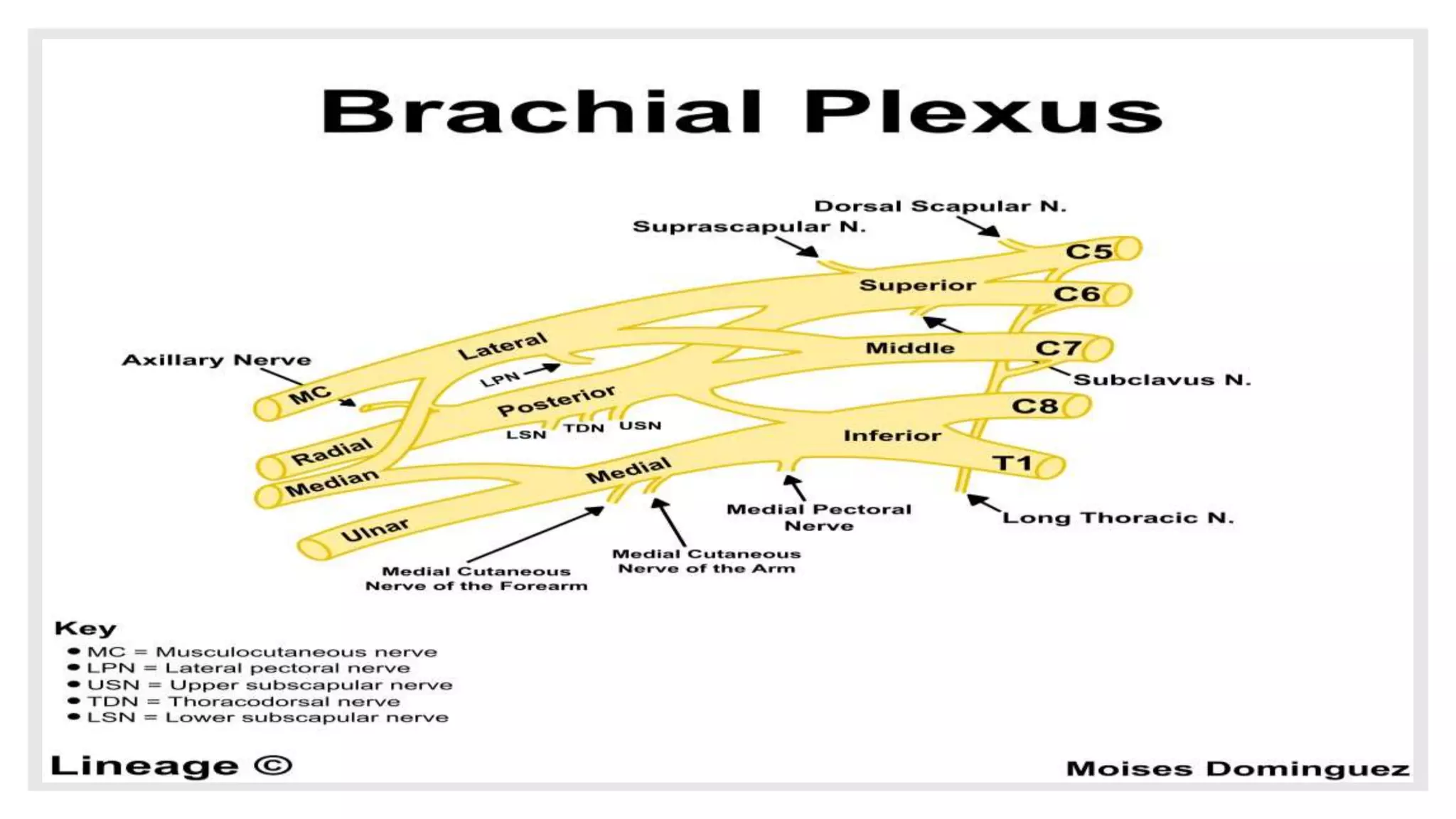
◦ Root value: C5,6,7,8,T1.
◦ it formed by union of lateral cord and medial cord of brachial plexus.
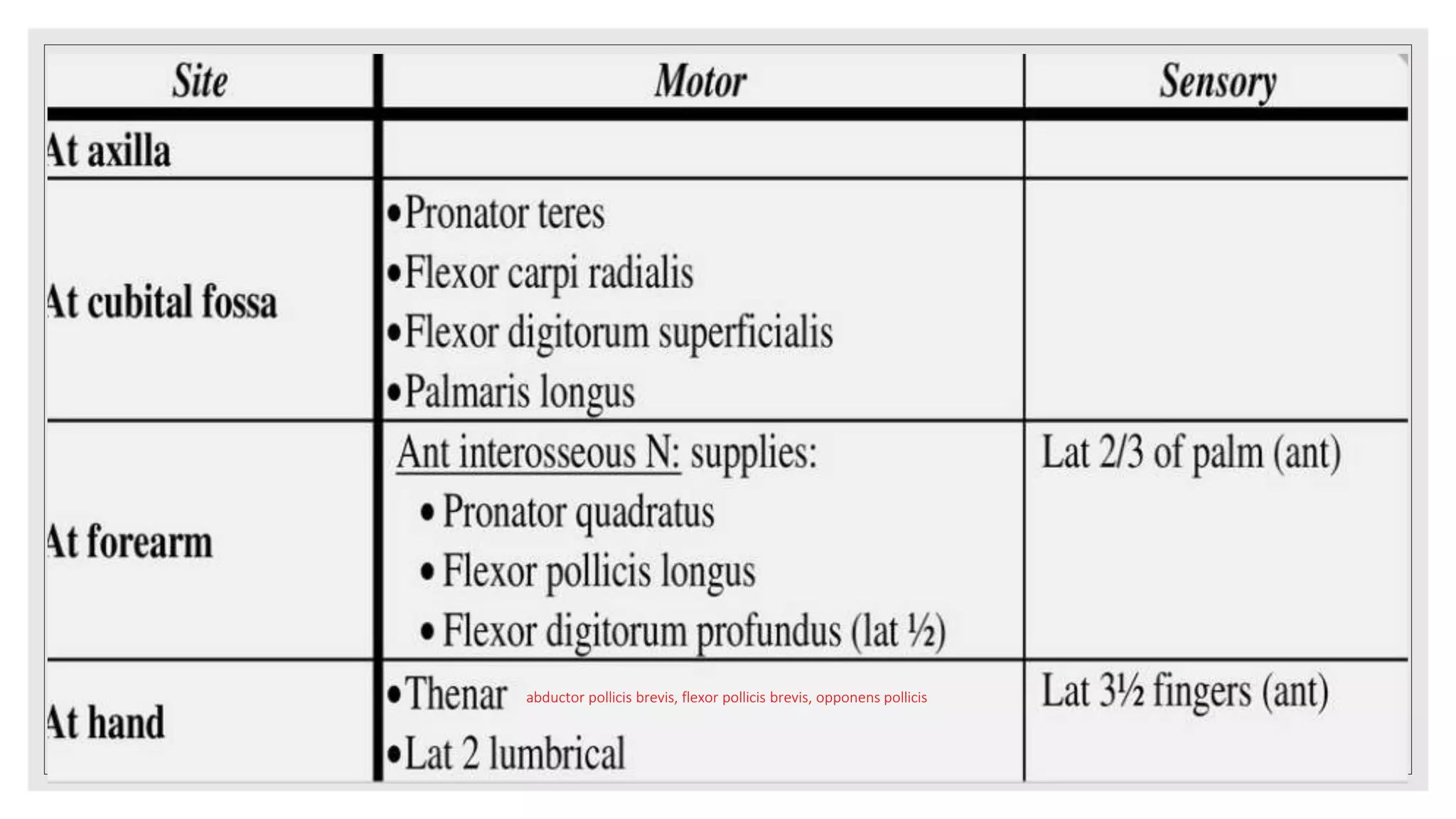
◦ that supplies most of the superficial and deep flexors in the forearm, thenar and lumbrical muscles.
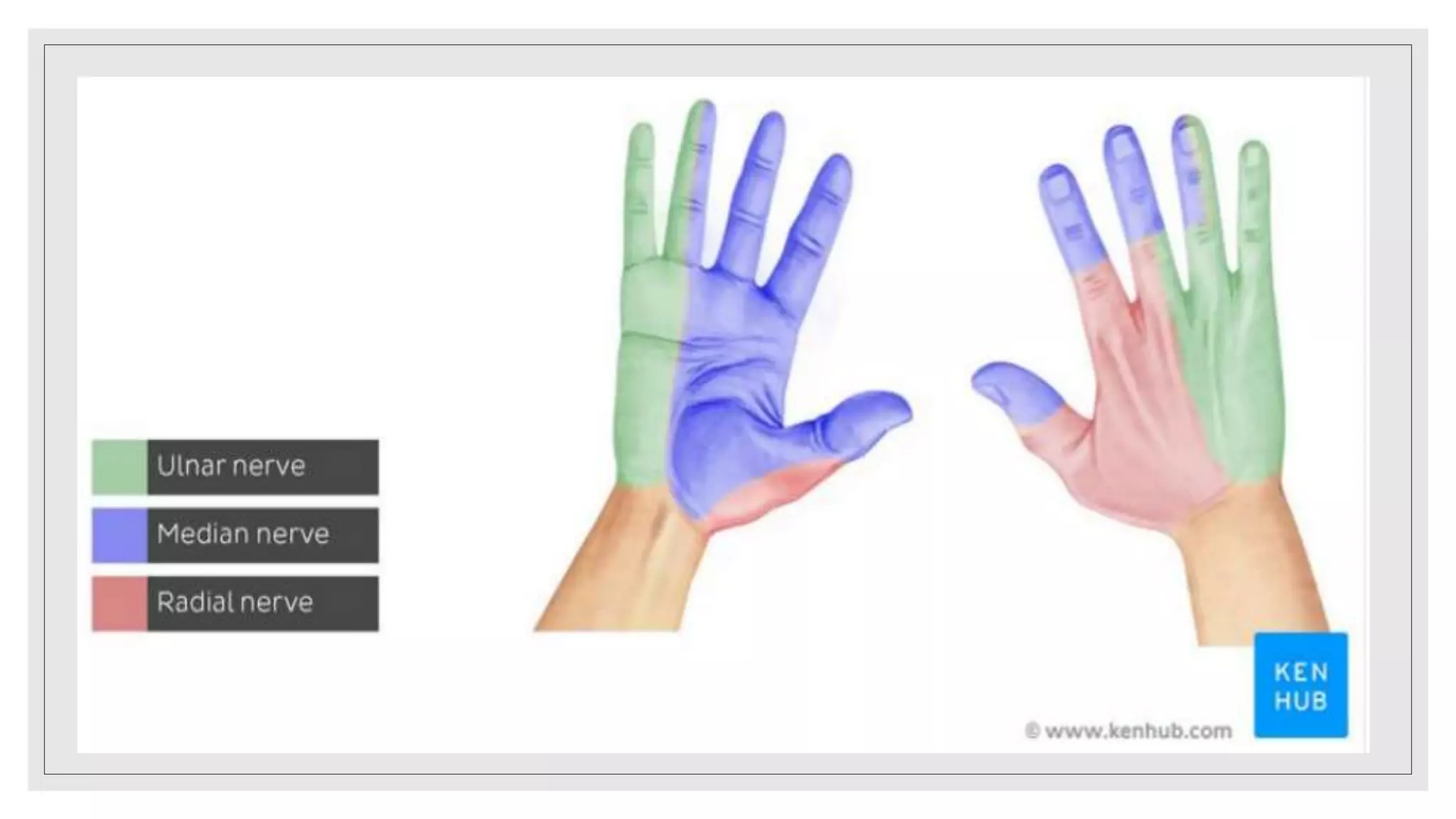
◦ It also gives sensation to certain areas of the skin of the hand.
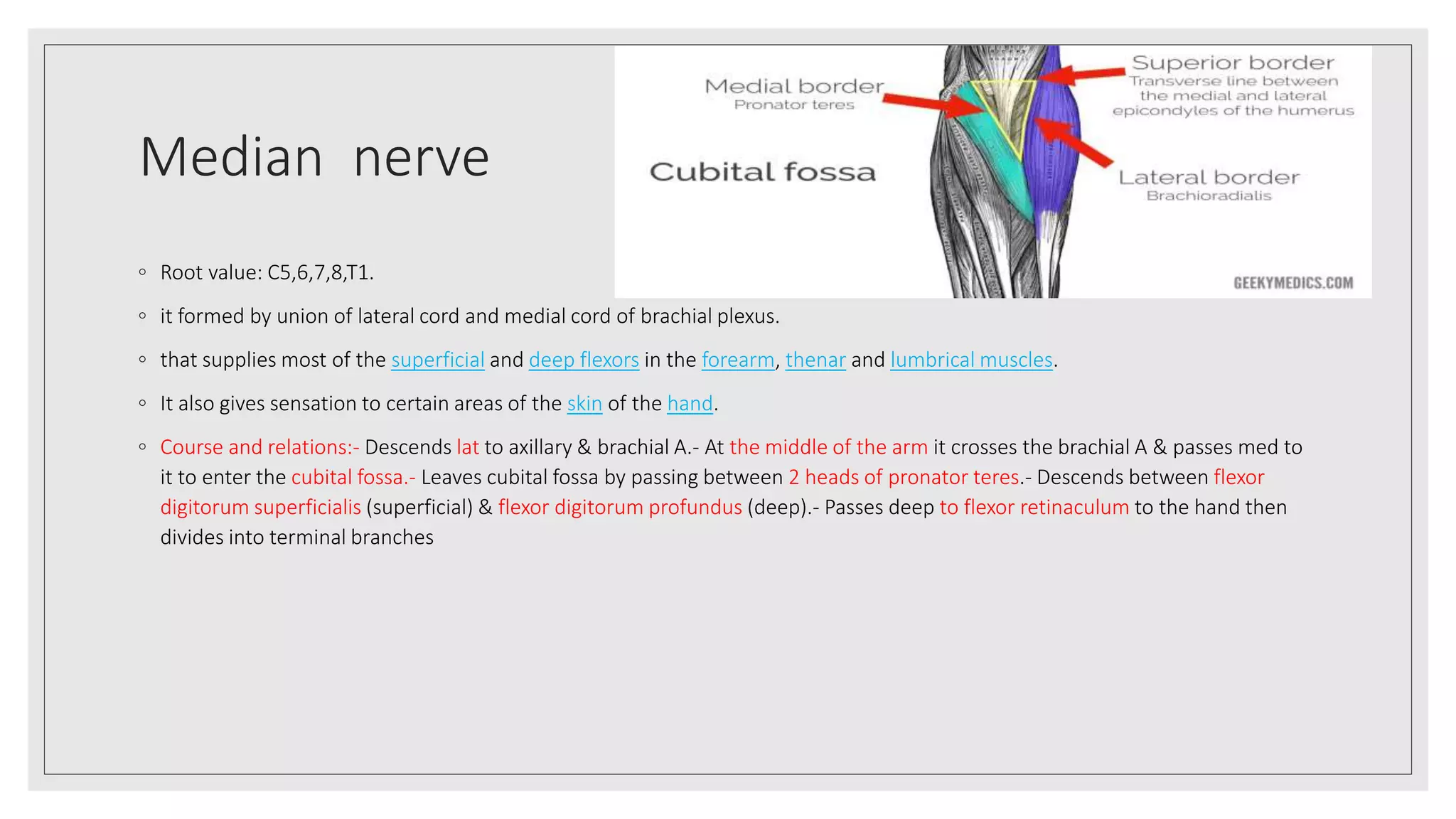
◦ Course and relations:- Descends lat to axillary & brachial A.- At the middle of the arm it crosses the brachial A & passes med to
it to enter the cubital fossa.- Leaves cubital fossa by passing between 2 heads of pronator teres.- Descends between flexor
digitorum superficialis (superficial) & flexor digitorum profundus (deep).- Passes deep to flexor retinaculum to the hand then
divides into terminal branches
abductor pollicis brevis, flexor pollicis brevis, opponens pollicis
◦ Injury above cubital fossa:Motor:
◦ • Paralysis of pronator teres & quadrates loss of pronation.
◦ • Paralysis of wrist flexors except flexor carpi ulnar is weak flexion accompanied by adduction.
◦ • Paralysis of flexor pollicis longus & brevis → loss of thumb flexion.
◦ • Paralysis of opponens pollicis → loss of opposition (Ape like).
◦ Injury at wrist:
◦ Cause: carpal tunnel syndrome due to compression by inflammation, bone dislocation or overstretch by extended hands (e.g.:
typewriters).
◦ Motor: loss of opposition (Ape like hand).
◦ Sensory: loss of sensation of ant side of lat 3½ fingers.
Ulnar nerve
◦ ULNAR NERVE arise from the median cord of brachial plexus
Root value: C7,8,T1.
◦ Descends med to axillary & brachial A.- At mid arm it passes to post compartment.- Passes post to med epicondyle. (bw medial
epicondyle and olecranon in ulnar groove )-
◦ Passes between 2 heads of flexor carpi ulnaris to forearm.-
◦ Descends between flexor carpi ulnaris (superficial) & flexor digitorum profundus (deep).-
◦ Passes superficial to flexor retinaculum to the hand.
Injury
◦ Motor:
◦ • Paralysis of flexor carpi ulnaris weak flexion of wrist accompanied by abduction.
◦ • Paralysis of med 2 lumbricals clawing of ring & little fingers (partial claw hand).
◦ • Paralysis of interossei loss of adduction and abduction of med 4 fingers.
◦ • Paralysis of adductor pollicis loss of adduction of thumb.
◦ Sensory: loss of sensation of med 1/3 of hand & med 1½ fingers (ant & post).
Radial nerve
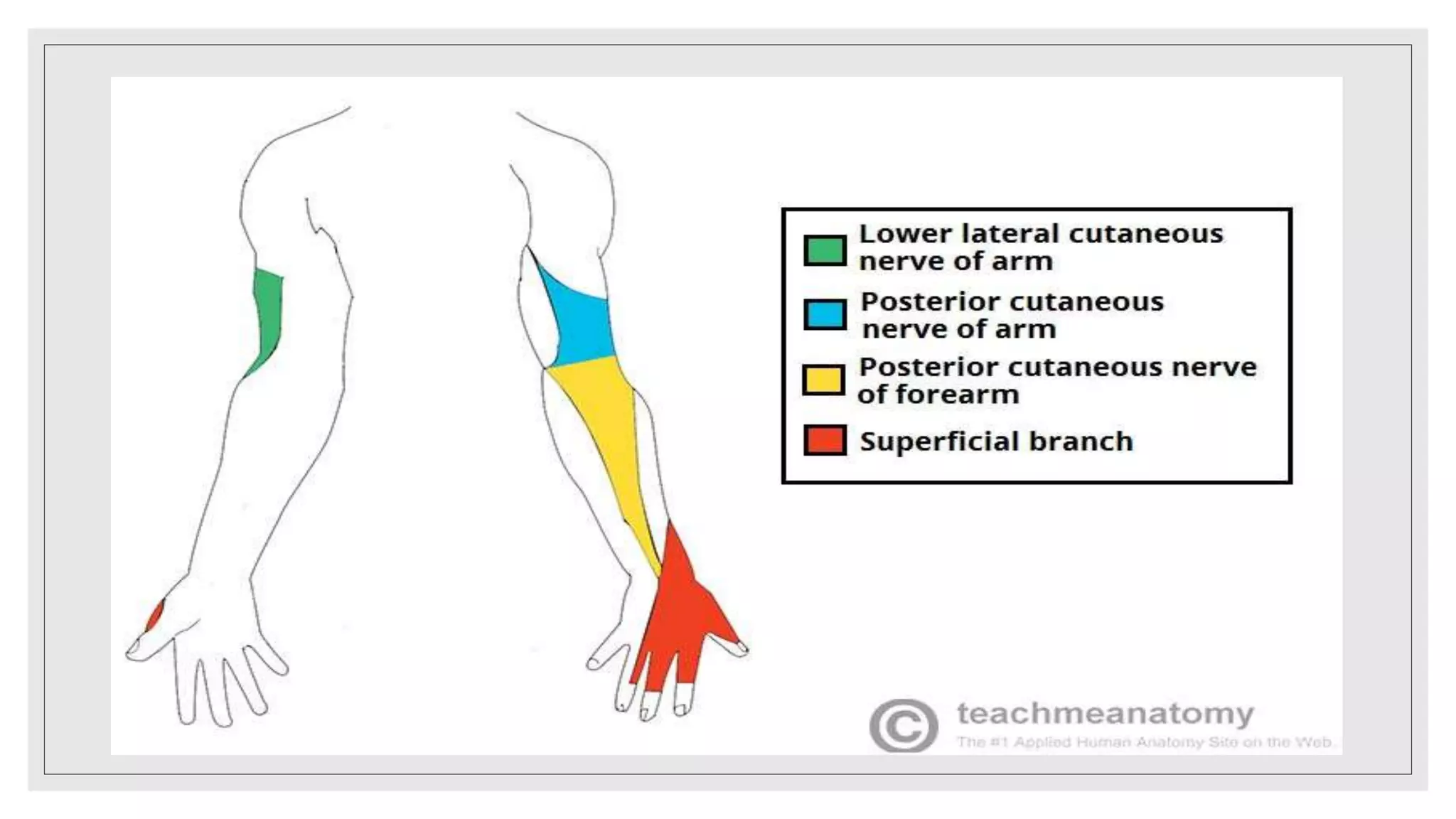
◦ It start from the posterior cord of brachial plexus C5-T1
◦ The branches of the radial nerve provide motor supply for the posterior muscles of the arm and forearm, as well as the sensory
supply of the skin of the arm, forearm and hand.
◦ Radial nerve start from axilla then by radial groove goes to the posterior compartment and supply triceps then it goes anterior
bw brachioradialis and brachialis to become anterior to lateral epichondyl it enter cubital fossa then after it it branches to deep
and superficial supplying all extensor muscles of wrist and fingers and supinator of hand .
Upper limb peripheral neuropathy.pptx

Upper limb peripheral neuropathy.pptx

  • 1.
  • 3.
    Median nerve ◦ Rootvalue: C5,6,7,8,T1. ◦ it formed by union of lateral cord and medial cord of brachial plexus. ◦ that supplies most of the superficial and deep flexors in the forearm, thenar and lumbrical muscles. ◦ It also gives sensation to certain areas of the skin of the hand. ◦ Course and relations:- Descends lat to axillary & brachial A.- At the middle of the arm it crosses the brachial A & passes med to it to enter the cubital fossa.- Leaves cubital fossa by passing between 2 heads of pronator teres.- Descends between flexor digitorum superficialis (superficial) & flexor digitorum profundus (deep).- Passes deep to flexor retinaculum to the hand then divides into terminal branches
  • 4.
    abductor pollicis brevis,flexor pollicis brevis, opponens pollicis
  • 7.
    ◦ Injury abovecubital fossa:Motor: ◦ • Paralysis of pronator teres & quadrates loss of pronation. ◦ • Paralysis of wrist flexors except flexor carpi ulnar is weak flexion accompanied by adduction. ◦ • Paralysis of flexor pollicis longus & brevis → loss of thumb flexion. ◦ • Paralysis of opponens pollicis → loss of opposition (Ape like). ◦ Injury at wrist: ◦ Cause: carpal tunnel syndrome due to compression by inflammation, bone dislocation or overstretch by extended hands (e.g.: typewriters). ◦ Motor: loss of opposition (Ape like hand). ◦ Sensory: loss of sensation of ant side of lat 3½ fingers.
  • 8.
    Ulnar nerve ◦ ULNARNERVE arise from the median cord of brachial plexus Root value: C7,8,T1. ◦ Descends med to axillary & brachial A.- At mid arm it passes to post compartment.- Passes post to med epicondyle. (bw medial epicondyle and olecranon in ulnar groove )- ◦ Passes between 2 heads of flexor carpi ulnaris to forearm.- ◦ Descends between flexor carpi ulnaris (superficial) & flexor digitorum profundus (deep).- ◦ Passes superficial to flexor retinaculum to the hand.
  • 11.
    Injury ◦ Motor: ◦ •Paralysis of flexor carpi ulnaris weak flexion of wrist accompanied by abduction. ◦ • Paralysis of med 2 lumbricals clawing of ring & little fingers (partial claw hand). ◦ • Paralysis of interossei loss of adduction and abduction of med 4 fingers. ◦ • Paralysis of adductor pollicis loss of adduction of thumb. ◦ Sensory: loss of sensation of med 1/3 of hand & med 1½ fingers (ant & post).
  • 12.
    Radial nerve ◦ Itstart from the posterior cord of brachial plexus C5-T1 ◦ The branches of the radial nerve provide motor supply for the posterior muscles of the arm and forearm, as well as the sensory supply of the skin of the arm, forearm and hand. ◦ Radial nerve start from axilla then by radial groove goes to the posterior compartment and supply triceps then it goes anterior bw brachioradialis and brachialis to become anterior to lateral epichondyl it enter cubital fossa then after it it branches to deep and superficial supplying all extensor muscles of wrist and fingers and supinator of hand .