Planning Green Spaces in Urban Context – Opportunities and
Challenges
*Vikas Sharma
**Jit Kumar Gupta
Abstract; Propelled by ever increasing population, looking for better options for economic
growth and gainful employment nations ,across globe, are urbanizing at a rapid pace. Led by
large scale additions of built environment, cities are facing high degree of growth, development
and congestion. Congestion of people in the buildings and congestion of buildings on the land
are becoming norms of the urban fabric. In addition, uncontrolled rural-urban migration is
putting enormous pressure on urban infrastructures, both physical and social. Major causality
of this uncontrolled, rapid, haphazard and unplanned urban growth and congestion, is acute
shortage and non-availability of adequate open spaces in various layers of urban settlements.
Lack of access to safe open and green spaces, has emerged as the critical area of concern for
urban residents, planners and policy makers. With limited availability of green spaces,
majority of cities are facing crisis and challenges of quality of life, quality of air, rising
temperature and quality of development. Breaking the monotony of brick, mortar, glass and
concrete in the urban setting, green spaces occupy special place in the urban context. Green
spaces are known for distinct advantages of not only providing vital lungs to the cities by
generating fresh air; making people feel happy, live healthy and making them more productive
but also bring nature back to the cities. In addition, these spaces hold numerous advantages and
make value addition to the health of the residents, community and the places where they are
created. Making provision of green areas for residents, on prescribed norms and standards,
helps not only in enhancing the beauty and environmental quality of neighborhoods but also
make value addition to places, due to numerous critical functions performed by such spaces.
Many cities are known globally for the quality of open spaces they promote, create and house.
Despite numerous distinct advantages, making provision of urban spaces in the urban spaces
remains a challenge due to; ever-rising urban land values, privitisation of urban development,
high cost involved in the development and management of urban spaces; treating land as a
commodity for making large economic gains etc. Looking at the role, importance and relevance
of green spaces in the human living and challenges faced in providing open spaces , paper
explores various options of providing adequate open spaces in urban context, a distinct
reality.
Key Words; Urbanisation, Green Spaces, Quality of life, Happiness, Health, Productivity
Introduction;
Green spaces are known as land parcels, which remain largely covered with vegetation, grass,
trees, shrubs. in the parlance of urban planning and in land use planning, open spaces are
defined as areas under parks, green spaces, playfields and areas under natural landscape . These
areas in the urban planning vocabulary, are termed as non-saleable areas and form integral part
of the urban neighbourhood and newly created townships. They are prohibited to be sold and
used for any commercial purposes. No change of land use of such areas for purposes of
commercialisation and urbanisation is permitted. These areas tend to have minimal built spaces
and are made universally accessible with special provision made for providing accessibility to
the physically challenged. Depending upon the hierarchy they occupy, these green spaces are
provided with toilet facilities and furniture for sitting and socialising. Green and public spaces
are known to be major determinants of quality of life of the people residing in the
neighbourhood. Development and maintenance of these green spaces remain expensive and cost-
intensive and require large manpower and resources. Greenspaces are known to be multi-
functional in nature. Some of the critical functions performed by these spaces involve and
include;
 breathing spaces – making available fresh air to the residents , encouraging and
promoting physical and social activities in an otherwise stressed urban environment
 living spaces – improving quality of life and generating happiness
 playing spaces – incentivizing children and elders for adventure and physical activities
in a safe, secure and healthy environs.
 Spongy spaces – creating opportunities of absorbing large quantity of rainfall and
avoiding flooding in urban spaces
 Valued Spaces ; making value addition to communities, neighbourhoods and property
 learning spaces - creating opportunities for acknowledging, understanding, appreciating
the diversities and complexities of flora and fauna existing in nature
 natural spaces – removing disconnect and bringing nature and human habitat on the
common platform
 socializing spaces - creating options and opportunities for bringing people and
communities to socialize for celebrating events, festivals and activities
 activity spaces – inspiring, encouraging and supporting creativities, innovations and
activities among individuals and communities in a natural setting
 Identity spaces- providing landmarks for recognition and distinct identity to the place,
area and the neighborhood.
Role and Relevance of Green spaces
Rational understanding of process and relationship between urbanization and factors governing
the health will be critical to make urbanization/cities growth more rational , supporter and
promoter of better health and happiness in urban areas. According to, ’World Health
Organization (WHO)’, globally, obesity and mental illness are the two major health related
issues, adversely impacting large proportion of population in developed and developing
countries. Globally, 6 million people are stated to die every year due to air pollution. 98% cities
in low and middle income countries and 56% cities in high income economies; do not meet air
quality specified by the WHO norms. All these problems have genesis in the adverse
environment created by cities, due to prevailing high degree of congestion, pollution and
haphazard and unplanned pattern of development. With basic and essential amenities; physical
and social infrastructure; services, open and green spaces, eluding majority of urban residents,
prevailing environment helps promoting a life-style of passivity among majority of urban
population. Indian cities are known to have enormous shortage of green spaces. As against
specified norms of 9 sqm of open space, Indian cities only have 2.7 sqm of open spaces available
on per capita basis.
Majority of the health related issues and physical health challenges, can be effectively and
rationally tackled and eliminated, through various activities undertaken in the green
environment. Benefits associated with public open spaces / parks are known to include better
general health; reduced stress level; reduced depression and reduced obesity. WHO studies also
underlines lack of physical activity as the major global public health risks. Studies have also
revealed that people using public open spaces remain three times healthier than non-users.
Evaluation made in respect of benefits of open and green spaces of the largest 85 cities in
USA (population of 57.2 million), found health savings from parks, estimated to be order of
$3.08 billion
Considering the role and importance of green, open and public spaces, policies and programs
evolved for making cities better places to live have also underscored the role and importance of
creating large number of green spaces within the physical framework of our cities. New Urban
Agenda has called for increasing safe, inclusive, accessible, green and quality public spaces.
The 2030 Agenda for Sustainable Development, asks nations to pledge ; providing universal
access to safe, inclusive and accessible, green and public spaces, in particular, for women and
children, older persons and persons with disabilities. Even the mission AMRUT, launched by
Government of India, has also called for,’ developing green and well maintained open spaces
and parks to increase the amenity value of the cities. Green spaces have proved their credibility
to serve numerous purposes, perform numerous functions, providing distinct advantages for
supporting and making value addition to human living in the urban context
Value additions, made by green/open spaces to the urban landscape, can be described in terms
of;
 Decarbonizing cities by offsetting greenhouse gas emissions and slowing global
warming.through large scale CO2 absorption.
• Making value addition to the quality of human living by making cities happy and
healthy places to live
• Bringing cities and nature on the common platform by maintaining, protecting and
promoting biodiversity, natural habitats / ecosystems-creating valuable space for
birds/animals in cities
• Increasing property value of the neighbourhood
• Promoting socialization and fostering a sense of community besides providing
social/ psychological benefits.
• Providing resources for relaxation and recreation and promoting better
relationship between man and environment
• Making cities easier to bike/ walk
• Making cities Cool- Reducing heat islands
• Making cities sustainable and least consumers of energy
• Offering cost-effective and natural solutions for addressing storm water runoff;
flooding and air pollution in the urban areas.
• Making cities water efficient by promoting ground water recharging
• Promoting Tourism, generating employment and reducing poverty.
• Minimizing air, water, and noise pollution; improving quality of air/filtering air,
by removing harmful gases like NO2, CO, SO2 and air particulates
• Promoting Mental Health ; Reducing Stress and violence; Improving concentration;
allowing psychological restoration;
• Speedily curing patients; positively impacting children.
• Providing vital lungs to the city for ensuring constant supply of fresh air and O2
• Promoting aesthetic value by beautification and enhancing urban landscape.
• Reducing congestion by making cities more open/healthy
• Promoting local ecology and environment by substituting grey infrastructure with
green spaces; conserving nature ;creating ecological awareness; serving as islands
of nature and biodiversity.
Roadblocks in creating Green Spaces ;
Despite the fact green spaces remain essential and critical for the health, happiness, quality of
life and overcoming large number of urban stresses and strains, still availability of adequate open
spaces on prescribed norms remain elusive in majority of cities and towns. Green spaces in
urban context remain marginalized , diluted and muted. They don’t command priority , respect
and care it deserves with agencies involved in planning and development of urban settlements.
For majority of developers and colonisers, green spaces are considered shear wastage of land and
resources , because these spaces don’t generate any wealth for them. Competing urban planning
priorities and high prevailing cost of urban land, also favour and prioritize the utilization of land
for commercial purposes rather than green spaces. Statutory norms and standards made
applicable at local level, generally exclude specifying the area to be provided as green spaces.
This gap and missing link, is invariably exploited by the developers, to reduce the area under
green spaces.
Further, major challenge to the provision of green areas emerges from the unplanned, sub-
standard and haphazard development taking place in large majority of urban areas because such
development, being violative of all norms, ethics and standards of planned development,
invariably eliminates the provision of public amenities and services including open and green
spaces. Outcome of such development leads to perpetual shortage of open spaces in the urban
context. Slums in the urban areas remain the major victims and are subjected to large number
of health related issues, due to total absence of open spaces in such development. In addition,
existing open spaces in cities are also not maintained properly and rationally and are generally
subjected to total neglect. These spaces, over a period of time, emerge as no man’s land, and are
then subjected to illegal occupation and encroachment. With the passage of time, these spaces
are either occupied by slums or become breeding ground for informal activities and markets.
Lack of awareness and appreciation of the role and importance of green and open spaces on the
part of authorities, regulating planning and managing the urban areas and financial constraints
imposed by limited allocation of resources; are also largely responsible for prevailing acute
shortage of open spaces in the cities and towns. Failure of the authorities and communities to
understand the context of green spaces in promoting the health and happiness of communities,
providing tangible and intangible benefits and yielding health related dividends, has led to
according low priority to the open spaces in the planning and development vocabulary of the
urban areas. Sub-division of land into small parcels on large scale and involvement of small
time developers engaged in construction of group housing on a small land parcels/site has, also
contributed to the exclusion of the green spaces from the urban development. High population
density, ever rising prices of urban land coupled with limited supply of land, inefficient
functioning of urban land market and high degree of land speculation has cumulatively
contributed to the limited availability of green spaces in the cities and towns. Prevailing
economic considerations, and market forces remain largely responsible for lack of such spaces in
the urban areas.
Way Forward
 Planning for Green Spaces; Cities are more than buildings and people.Cities are full of
dualities and contradictions. They contain both order and chaos; showcasing beauty and
ugliness; housing rich and poor; promoting prosperity and poverty , never static, always
evoloving and devolving and remain places of happenings. Full of people, activities,
institutions and vehicles, cities are choking, short of fresh air and healthy environs,due to
paucity and acute shortage of open and green spaces.Vehicular pollution is killing environs,
ecology, people and cities.Occupying limited space and limited proportion of land, open
spaces always remain at premium in urban context. With growing cities, green and open
spaces become more relevant and valuable and attraction for inhabitants. Globally,most
“liveable” /famous cities are known by the parks, open spaces, gardens, play grounds and
public spaces they house. Hyde Park in London, Central Park in New York; Pinjore Garden-
Kalka; Shalimar/Tulip Garden- Srinagar; Rose Garden Chandigarh; Budha Jayanti Park-
Delhi are few of the examples of green spaces, which have put these cities and towns on the
global map of tourism and eminence. In addition to making value addition to cities and
communities, green and open spaces are known for their numerous intangible benefits in
terms of, creating positive attitudes; making people active, happy and healthy; promoting
socialisation besides promoting and preserving bio-diversity , which unfortunately remain
poorly understood/appreciated and poorly evidenced.
Considering enormous value they hold for ecology, environment, people and communities,
urban green spaces should be seen as an essential and integral part of urban infrastructure and
not an add-on or a luxury for urban areas. Better tools and methodologies are needed for
evaluating and doing a cost-benefit analysis of parks and open spaces, for understanding the
services they render to the urbanites, communities, neighbourhood, environment, bio-
diversity and cities. Making adequate and qualitative provision of open spaces in the urban
settlements needs objective analysis and evaluation, so that benefits accruing to urban
settlements due to making appropriate provision of open spaces in the urban areas on the
prescribed norms and standards, should be clearly understood and appreciated, in order to
make them integral and essential part of city planning, designing, development and
management frame-work.
Understanding the context, role and importance of urban green spaces in reshaping,
redefining, reinventing, innovating and repositioning of the existing and future cities and
making them healthy and happy places to live, will remain critical. Making provision of
adequate open spaces, using urban planning as the potent lever and effective tool, will
always remain relevant and valuable. Looking objectively, strategies for providing open
spaces in urban areas must revolve around;
 Preserving, protecting and promoting all existing vegetation , flora and fauna. and
making value addition to existing green space in cities.
 Providing green spaces, open spaces, play grounds and public spaces on prescribed
norms, as integral part of city planning and development process
• Creating a well-defined hierarchy of open spaces in the urban and regional context
• Defining rationally and realistically, norms and standards to be adopted for
providing open spaces in the urban planning and development.
• Ensuring equitable distribution of open areas, covering all inhabitants and
minimizing concentration of open spaces in the city.
• Actively involving residents and communities in planning, designing, development
and maintenance of open spaces by making green spaces community-led
programme rather than government led agenda.
• Promoting and celebrating green spaces, by organizing competitions and dedicated
festivals like Rose/chrysanthemum Festival etc. besides recognizing and awarding
best planned and maintained individual gardens at residential/ institutional level, on
periodic basis.
• Promoting sustainable landscaping by using native species/ plants for achieving
economy in the development of adequate tree cover besides ensuring the survival
and growth of trees and saving water and energy.
• Promoting Xeri-scaping, as an option for minimizing consumption of precious
water resource in the landscaping of green spaces.
• Involving educational institutions / campuses, having large area, for large scale tree
plantation and creating green/landscaped area within the institutions/campus.
• Involving and making children and students active partner in greening cities, and
for increasing and making addition to the inventory of green spaces in the cities.
• Making environment/ ecology, integral part of education/study curricula at school
and higher level of education and creating awareness about role /importance of
green spaces at individual/community level to make addition and improve the
availability of green spaces in the city.
 Defining Hierarchy of Open Spaces; In order to ensure the availability of green spaces
beyond physical barrier and making it accessible to the poorest of the poor citizens of any
settlement, it will be critical to define the levels of physical planning adopted for human
settlement and also the fabric of open spaces to be provided at each level of such
planning. Accordingly, open spaces need to be planned in a well- defined hierarchy
involving; open spaces at regional level; specialized open spaces like, zoo, botanical
gardens; open spaces at city level; sub- city level; district level; neighbourhood level
and open spaces at local/ housing cluster level. However, efforts shall be required to be
made to cover the entire city and all the local residents and communities, within the
framework of green spaces. In order to follow the hierarchy of green spaces, it will be
critical that the system of open spaces should be made integral part of the Master
plans/Development plans evolved for the city. In addition, detailed policy framework and
guidelines need to be defined for creating such open spaces while working out the local
area plans, on prescribed norms and standards. Chandigarh evolved its master plan
following a dedicated system of providing green belts , to link entire city with the
Shivalik range of hills, located in the north. Tianjin Eco-City planned extensive green
(vegetation) and blue (water) networks to provide quality living /working environment.
 Valuing People Perception; Urban green spaces hold different social meanings and
understandings for different user groups due to variety of social interactions.
Accordingly, green spaces in cities and towns are used in a variety of ways, depending
upon social and physical factors involving accessibility , facilities, attractiveness,
location, size and security. These determinants are known for their complexities,
interconnectivity, and variance. Accordingly, it is important, vital and critical, to
understand the needs of local residents and the manner, green spaces may be used. In
order to enable urban development to serve and match the local needs and values
besides bridging the gap between vision and ground reality, public engagement in the
planning and design process would be critical for understanding the needs of the
community. Greening of cities, when carried out without appropriate consultation, study
and analysis, may prove to be counterproductive and emerge as a liability rather than an
asset for the community and the city, where such spaces are provided. The manner in
which people use and appreciate green spaces, assume importance for rational and
logical planning and placing of green spaces.
 Rationalizing Size; The availability of green spaces in urban areas, in adequate quantity
and quality, remains most critical for making optimum use of such spaces. Use of green
spaces is found to be positively linked with the size of green space. Larger sized green
spaces remain more active and productive due to variety of uses to which these spaces
can be put. Larger spaces may be more likely to be used for active purposes including
doing physical activity, playing games, socializing, resting, doing yogas, walking,
running, holding events, functions etc., while smaller spaces remain largely passive, used
essentially for socializing, resting, gossiping and restitution. Minimum size of green
space to be recognized as open spaces has been mandated to be 500 sqm by the URPDFI
guidelines. However, size, shape and extent of the green spaces will largely depend upon/
dictated by the planning framework and planning concept/philosophy, adopted by the
planner for defining the contours of the neighborhood.
 Ensuring Accessibility; Most critical component dictating the use of green spaces
remains; easy, unobstructed and universal accessibility to such spaces. If green spaces
do not have appropriate level of accessibility, such spaces will always remain
marginalized ,facing neglect, abuse and misuse. Accessibility to site is largely dictated by
the location in the context of overall planning; physical distances (of residential areas and
users), from the green space and available means of approach . Frequent users of green
spaces are known to be persons living in close proximity to a green space, within a
distance of less than 0.5 km or 5minutes’ walk. Crossing major roads are considered
major impediment/roadblock to accessibility to such spaces. Accordingly, green spaces
should be planned and placed in such a manner that accessing it does not involve any
crossing over a major traffic artery/road. Availability of unobstructed pedestrian
pathways and cycle tracks, connecting residential area with green spaces, remain the
most preferred choice of the users in the urban areas. For promoting higher order of
usability, all green spaces should be made universally accessible to all the residents
including , physically challenged, senior citizens, children and women , in order to
ensure that no inhabitant is deprived of the benefits of green spaces created in the
neighbourhood/city. In large number of cases where new townships are created, land
developed for green space remains accessible only to the local residents to the exclusion
of other communities and neighbourhoods. Restricting accessibility despite availability,
is seen a major threat to usability and promoting inequities in accessing the available
urban green spaces. In order to promote universal visibility, accessibility and usability of
green spaces pan city , concept of gated communities would need review, revision and
redefinition. Pattern of physically planning , typology of layout plans adopted for
positioning green spaces within the planned areas remain crucial for ensuring their
accessibility. Green spaces facing the housing blocks are found to have high order of
accessibility, whereas remotely located green spaces are avoided by the residents, despite
their positivity’s.
 Promoting Quality ; The quality of infrastructure , elements and characteristics used in
the planning, designing and development of the green spaces are known to considerably
impact the usability of such spaces in the urban areas. Well planned, well defined , well
developed green spaces, having features which facilitate physical activities, doing
physical exercises in groups, having space for yoga, meditation; space for sitting and
socialising; covered shelter for protection from sun and rain; adequate arrangement of
lighting and options for walking and running besides providing a perception of safety
and security, remain most active and have proved to be users-friendly. Such spaces have
invariably been found to have large number of users. Fencing provided with well -
defined entries/exits, for securing the green spaces, are also useful in giving distinct
identity to green spaces and stopping the entry of unwanted animals and trespassing into
these spaces.
 Valuing Trees; Adding trees has its own context in the green spaces because trees are
known to provide distinct advantages in not only producing oxygen, essential for human
living, but also provide valuable shade and natural cooling during the hot summers
besides improving the aesthetics of green spaces. Difference of temperature between area
under sunlight and shade has been found to be approximately 2-2.5 degree Celsius. As
per studies made, every human being , on an average breathes about 9.5 tonnes of air on
annual basis. Oxygen only makes up about 23 % of air by mass. For making available
the oxygen needed by an individual roughly, seven / eight fully matured trees are
required at the local level. In addition, a single tree, on an average, offers a cooling effect
in atmosphere equivalent to about 5 air-conditioners and accordingly trees in the urban
context help cities to overcome the problem of heat island, and urban warming. Trees, by
lowering down the local temperature, help in reducing energy consumption and
decarbonizing the cities by minimizing the consumption of energy involved in cooling
buildings.
.
 Valuing Safety and Security; Perception of adequate security, and safety are other
important features regulating the use of green spaces and impacting the user’s perception
and understanding of usability of such spaces. Rundown and unprotected open
spaces ,having undefined ownership, may often be associated with illegal activities
including gambling, homelessness as well as crime and vandalism. Such activities
invariably lead to large number of users avoiding green spaces, especially women,
children and elders. Physical location also considerably impacts the perception of
security of the users, because studies have concluded that green spaces created in remote
areas, away from the residential and activity areas, are invariably avoided due to sense of
insecurity attached to them. Accordingly, while positioning, planning and developing
green spaces, elements of visibility must be integrated to promote sense of security and
safety among users..
 Optimising Location; Location of green spaces remains one of the most critical factors
in determining the usability of green spaces. Studies made has revealed that green
spaces, provided in a distant corner of neighbourhood, have invariably been found to
have less acceptability by the community and are generally avoided by the users. These
spaces invariably face neglect and large scale misuse, abuse and encroachments. Green
spaces provided within a cluster, enclosed by the houses, are the one which remain most
preferred destination for the users. In addition to being used for majority of the time, such
spaces are known to be most safe and secure, well-kept and are subjected to least
encroachment, misuse and illegal activities. Green spaces provided at the back of houses
are invariably treated like backyards by such houses and are seen more as a dumping
ground rather than an area for recreation and physical activity. Tendency of encroaching
green spaces and treating green spaces as extension of the individual houses are also
observed in majority of such cases. Green spaces provided on the side of the houses are
invariably treated as an extension of the corner house and are enclosed and protected as
private green space. Considering these facts, it will be vital to consider the location of
the green spaces during the planning of the residential neighbourhoods. Planners must
have intimate knowledge of positioning of such spaces so that they are not encroached,
misused and abused. Green spaces should not remain concentrated in few residential
pockets and should be divided into different areas so as to cover entire population. High
density housing cluster should have larger proportion of open spaces, whereas larger
sized plots, having low density, should have lesser proportion of such spaces, due to
large availability of open spces within the individual house. Basis of distribution of green
spaces should be the density, number of households and population housed in the area
and not the area occupied by the number of houses.
 Promoting Usability; Detailed studies made has revealed that green spaces are not being
used by same category of people during the day. The age group of users has been found
to be at variance during different hours of the day. Variations of age groups using green
spaces have also been observed during different seasons of the year. During morning and
evening, most of the users belong to the age group which are employed during the day or
running their own business. These users include both men and women and members of
such families. Few of them also use these spaces in the evening. Housewives are seen to
be major users in the late hour of the morning and the evening. Children preferably use
these spaces in the morning and evening ,where facilities for playing games are available.
Providing swings, rides and other children-focused games, have been found to increase
the usability of green spaces by attracting more children in the parks. Further, creating
open gyms, have found favour with large number of users , which value the role and
importance of exercises to remain healthy. Provision of these infrastructures have
increased the intensity and duration of utilization of the green spaces. Senior
citizens/retirees favour morning and afternoon times for relaxing or socializing. During
winter, most preferred time remains during the availability of sun in the day and during
summers, morning and evenings are the preferred time for using green spaces. Providing
options for the shaded spaces also help promote the use of green spaces during the
summers and rainy times. Accordingly, keeping in view the user’s fabric, choices,
preferences and age groups, green spaces need to be, rationally and innovatively,
planned ,designed and developed, for ensuring their optimum utilization.
 Sourcing Land; Non-availability of adequate land, at appropriate places in appropriate
quantity and at appropriate price, remains the biggest roadblock in creating qualitative
and making available appropriate level of open spaces in the urban areas. Cost of land
and lack of understanding on the part of the users and city authorities, remains the major
roadblock in providing such spaces in urban areas. In order to define and identify areas
for creating green spaces, land suitability analysis of the area to be planned, must be
carried out in detail. Identifying the area which needs to be conserved/preserved; areas
unfit for human habitation; areas subjected to legal infirmities for urban development and
areas fit/ripe for urban development ,will remain valuable for optimizing the available
land and for evolving rational plans. Areas identified as unsuitable and subjected to legal
infirmities for urban development including areas available along the major highways
and around water bodies should be earmarked and used for planning and development
of green spaces. Earmarking, sourcing, planning and developing all existing and
available low-lying areas/areas should be effectively developed and used as open
spaces/parks/recreation. . Entire stretches of land, coming under High-Tension Electrical
lines and land earmarked as, ‘no-construction zone’, due to statutory provisions, need to
be used exclusively for developing green belts in the city. Areas identified to be
preserved and protected should also be supplemented with creating green spaces.
Preparing inventory of available open spaces for safeguarding such spaces from being
encroached, misused and abused, would always remain important. All water bodies
should be supported with green spaces to make value addition and protected from all
possible human interventions and encroachments. Similar options must be exercised in
promoting and preserving areas around/within heritage, existing in the city. Making
optimum use of large areas available along the transportation network for plantation,
greening and creating network of green spaces ,will help in creating large pool of such
spaces in the city. Removing all existing encroachments, on designated
open/greenspaces and developing such areas as green areas, and greening large
vacant/unbuilt area available with the existing local level institutions will help in making
large additions to such spaces. Promoting City forests (developing high intensity/density
green cover in cities) on large scale, will not only add green spaces but will also bring
back lost flora, fauna and bio-diversity into the city. Bringing all parking areas under the
aegis of tree plantation can go a long way in creating large green cover in the cities.
Potential of green roofs and green walls also needs to be explored for making addition
to vocabulary of green spaces by converting large unused and abused spaces in the
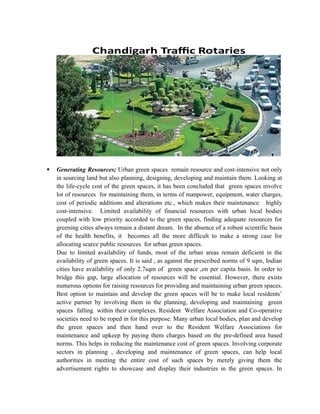
city.Traffic island, traffic rotaries, underpasses, over-bridges and fly-overs, created in the
urban areas to rationalize and regulate flow of traffic, offer valuable space/ opportunities
to make addition to green spaces in the cities. Chandigarh Municipal Corporation, has
exploited the potential of such spces to create large volume of beautiful open spaces
without incurring any cost. Looking objectively, cities contain/offer lot of opportunities,
which remain untapped, unexplored, for sourcing land for making additions to green
spaces.
 Generating Resources; Urban green spaces remain resource and cost-intensive not only
in sourcing land but also planning, designing, developing and maintain them. Looking at
the life-cycle cost of the green spaces, it has been concluded that green spaces involve
lot of resources for maintaining them, in terms of manpower, equipment, water charges,
cost of periodic additions and alterations etc., which makes their maintenance highly
cost-intensive. Limited availability of financial resources with urban local bodies
coupled with low priority accorded to the green spaces, finding adequate resources for
greening cities always remain a distant dream. In the absence of a robust scientific basis
of the health benefits, it becomes all the more difficult to make a strong case for
allocating scarce public resources for urban green spaces.
Due to limited availability of funds, most of the urban areas remain deficient in the
availability of green spaces. It is said , as against the prescribed norms of 9 sqm, Indian
cities have availability of only 2.7sqm of green space ,on per capita basis. In order to
bridge this gap, large allocation of resources will be essential. However, there exists
numerous options for raising resources for providing and maintaining urban green spaces.
Best option to maintain and develop the green spaces will be to make local residents’
active partner by involving them in the planning, developing and maintaining green
spaces falling within their complexes. Resident Welfare Association and Co-operative
societies need to be roped in for this purpose. Many urban local bodies, plan and develop
the green spaces and then hand over to the Resident Welfare Associations for
maintenance and upkeep by paying them charges based on the pre-defined area based
norms. This helps in reducing the maintenance cost of green spaces. Involving corporate
sectors in planning , developing and maintenance of green spaces, can help local
authorities in meeting the entire cost of such spaces by merely giving them the
advertisement rights to showcase and display their industries in the green spaces. In
addition, levying Internal Development Charges(IDC) and External Development
Charges( EDC), which include charges for landscaping of the licensed area, provide
adequate resources for not only developing green areas within the sanctioned township,
but also making available resources for city level landscaping and developing green
spaces/belts/playgrounds, on the proportionate basis. It has been observed that planned
development remains the best option for sourcing land and making available adequate
financial resources for the development of green spaces in the cities. Accordingly, for
developing appropriate level of green spaces, cities must opt for and promote planned
development. In addition, to using land as the resource for developing green spaces,
Government of India has also launched a scheme for greening and making value addition
to the cities and towns. Atal Mission of Rejuvenation of Urban Transformation
(AMRUT), includes green spaces as a major and important component of cities. Sources
made available under the Mission can be made use of for planning and development of
green spaces in the city. In addition, all the urban local bodies, development authorities,
Housing Boards, Improvement Trusts, Industrial Development Authorities etc., engaged
in real estate development should be asked to earmark dedicated funds for the
development of green spaces and landscaping the city, where they are operating.
Singapore Experiment with Green Spaces -Vertical Gardens; For overcoming the limitations
of availability of adequate land, imposed by being an island country, Singapore is experimenting
with number of options to increase the green footprints in the city. One of the innovative options
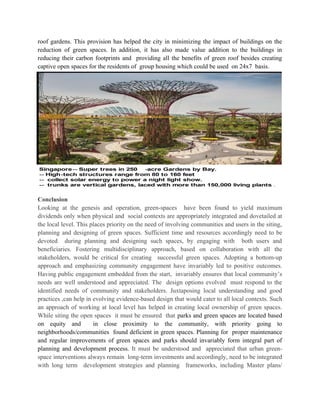
used, is to create vertical gardens in area reclaimed from the sea, known as, ‘Garden by the Bay’.
Spread over an area of 250 acres, the Garden is ,a nature park located in the Central
Region of Singapore, adjacent to the Marina Reservoir. Garden has been developed as the part of
the nation's plans to transform Singapore from a "Garden City" to a "City in a Garden", with the
sole aim of raising the quality of life by enhancing greenery and flora in the city. Gardens is
intended to be Singapore's premier urban outdoor recreation space and a national icon,
containing number of green options including conservatories; flower dome; cloud forest;
children garden; horticulture themed gardens; bayfront plaza and floral fantasy. In addition to
creating green spaces at the ground level and various other elements; garden includes number of
Super Trees created in the garden. Super trees, are high-tech tree like structures, ranging in
height from 80-160 feet, with trunks acting as vertical gardens laced with more than 1,50,000
living plants and having provision of sourcing solar energy, for a night show organized in the
garden besides shading and working as environmental engines for the gardens. Super trees are
home to number of exotic ferns, vines, orchids, having vast collection of other plants. The
Super trees also showcase air intake and exhaust functions as part of the conservatories' cooling
systems. Garden serve dual purpose for the city, involving leisure, entertainment and de-stressing
residents, visitors, tourists besides providing the benefit of large number of trees/green spaces
for decarbonizing and promoting green spaces in the city. In addition, Singapore has also
modified its building regulations, providing for compensating the entire quantum of green space,
occupied by the built environment within the building designed, in the shape of terrace gardens/
roof gardens. This provision has helped the city in minimizing the impact of buildings on the
reduction of green spaces. In addition, it has also made value addition to the buildings in
reducing their carbon footprints and providing all the benefits of green roof besides creating
captive open spaces for the residents of group housing which could be used on 24x7 basis.
Conclusion
Looking at the genesis and operation, green-spaces have been found to yield maximum
dividends only when physical and social contexts are appropriately integrated and dovetailed at
the local level. This places priority on the need of involving communities and users in the siting,
planning and designing of green spaces. Sufficient time and resources accordingly need to be
devoted during planning and designing such spaces, by engaging with both users and
beneficiaries. Fostering multidisciplinary approach, based on collaboration with all the
stakeholders, would be critical for creating successful green spaces. Adopting a bottom-up
approach and emphasizing community engagement have invariably led to positive outcomes.
Having public engagement embedded from the start, invariably ensures that local community’s
needs are well understood and appreciated. The design options evolved must respond to the
identified needs of community and stakeholders. Juxtaposing local understanding and good
practices ,can help in evolving evidence-based design that would cater to all local contexts. Such
an approach of working at local level has helped in creating local ownership of green spaces.
While siting the open spaces it must be ensured that parks and green spaces are located based
on equity and in close proximity to the community, with priority going to
neighborhoods/communities found deficient in green spaces. Planning for proper maintenance
and regular improvements of green spaces and parks should invariably form integral part of
planning and development process. It must be understood and appreciated that urban green-
space interventions always remain long-term investments and accordingly, need to be integrated
with long term development strategies and planning frameworks, including Master plans/
Development plans, transport policies, sustainability and biodiversity strategies. For ensuring
adequate provision of green spaces on sustained basis and on prescribed norms and standards,
prevailing development control regulations building bye-laws, zoning regulations must be
appropriately, reviewed, revised and redefined to include appropriate provisions for green
spaces, green streets, sidewalk planters, or other greening strategies. For having appropriate level
of green spaces, these spaces should be included and made integral part of the urban
infrastructure and should be adequately reflected in the infrastructure plans evolved at the local
level. Urban spaces should be made integral part of all policies and plans evolved for creating
healthy environment, including green spaces and public spaces for promoting leisure and
recreation. Looking at the multiplicity of usages, multiplicity of purposes served and large
number of benefits accruing, it becomes critical that cities would need to be made more clean,
green and eco-friendly by providing quality green spaces. Providing quality green spaces at
prescribed norms, as an integral part of urban infrastructure and long term planning,
development , management process, can help and ensure making cities; more livable,
sustainable, safe, inclusive, resilient, happy and healthy places to live in and work with.
Bibliography;
 Lee ACK; Jordan HC Jordan, Horsley J ; Value of urban green spaces in
promoting healthy living and wellbeing: prospects for planning;
 Slater JS, Richard MS; Christiana; Jeanette G; US Public Health Response to
COVID-19 and Chronic Disease special supplement, and Mental Health - a Global
Public Health Issue
 Gupta JK; Building Carbon Neutral Cities Through Green Roofs; unpublished
paper; September 2021
 Wikipedia; Garden By the Bay; https://en.wikipedia.org/wiki/Gardens_by_the_Bay
 McCarthy J, Sánchez E; 6 Ways Green Roofs Protect Cities From Climate Change--From
fighting heat waves to stopping floods
 Davis C; 4 Reasons Green Roofs Do A Building Good; July 13, 2015
 Rosenzweig, et.; Green Roofs in the New York Metropolitan Region, Research
Report,"
 Note; All images are sourced through Google, which are gratefully and sincerely
acknowledged and appreciated with gratitude. Images are not being used for any
commercial purpose but used for academic/research purposes and for illustration to
make the text clear.
Authors;-
 Vikas Sharma
 Associate Professor, Department of Architecture Chandigarh University, Punjab
 Jit Kumar Gupta
Former Advisor, Town Planning, Punjab Urban Development Authority
Planning Green Spaces in urban Contextntext

Planning Green Spaces in urban Contextntext

  • 1.
    Planning Green Spacesin Urban Context – Opportunities and Challenges *Vikas Sharma **Jit Kumar Gupta Abstract; Propelled by ever increasing population, looking for better options for economic growth and gainful employment nations ,across globe, are urbanizing at a rapid pace. Led by large scale additions of built environment, cities are facing high degree of growth, development and congestion. Congestion of people in the buildings and congestion of buildings on the land are becoming norms of the urban fabric. In addition, uncontrolled rural-urban migration is putting enormous pressure on urban infrastructures, both physical and social. Major causality of this uncontrolled, rapid, haphazard and unplanned urban growth and congestion, is acute shortage and non-availability of adequate open spaces in various layers of urban settlements. Lack of access to safe open and green spaces, has emerged as the critical area of concern for urban residents, planners and policy makers. With limited availability of green spaces, majority of cities are facing crisis and challenges of quality of life, quality of air, rising temperature and quality of development. Breaking the monotony of brick, mortar, glass and concrete in the urban setting, green spaces occupy special place in the urban context. Green spaces are known for distinct advantages of not only providing vital lungs to the cities by generating fresh air; making people feel happy, live healthy and making them more productive but also bring nature back to the cities. In addition, these spaces hold numerous advantages and make value addition to the health of the residents, community and the places where they are created. Making provision of green areas for residents, on prescribed norms and standards, helps not only in enhancing the beauty and environmental quality of neighborhoods but also make value addition to places, due to numerous critical functions performed by such spaces. Many cities are known globally for the quality of open spaces they promote, create and house. Despite numerous distinct advantages, making provision of urban spaces in the urban spaces remains a challenge due to; ever-rising urban land values, privitisation of urban development, high cost involved in the development and management of urban spaces; treating land as a commodity for making large economic gains etc. Looking at the role, importance and relevance of green spaces in the human living and challenges faced in providing open spaces , paper explores various options of providing adequate open spaces in urban context, a distinct reality. Key Words; Urbanisation, Green Spaces, Quality of life, Happiness, Health, Productivity
  • 2.
    Introduction; Green spaces areknown as land parcels, which remain largely covered with vegetation, grass, trees, shrubs. in the parlance of urban planning and in land use planning, open spaces are defined as areas under parks, green spaces, playfields and areas under natural landscape . These areas in the urban planning vocabulary, are termed as non-saleable areas and form integral part of the urban neighbourhood and newly created townships. They are prohibited to be sold and used for any commercial purposes. No change of land use of such areas for purposes of commercialisation and urbanisation is permitted. These areas tend to have minimal built spaces and are made universally accessible with special provision made for providing accessibility to the physically challenged. Depending upon the hierarchy they occupy, these green spaces are provided with toilet facilities and furniture for sitting and socialising. Green and public spaces are known to be major determinants of quality of life of the people residing in the neighbourhood. Development and maintenance of these green spaces remain expensive and cost- intensive and require large manpower and resources. Greenspaces are known to be multi- functional in nature. Some of the critical functions performed by these spaces involve and include;  breathing spaces – making available fresh air to the residents , encouraging and promoting physical and social activities in an otherwise stressed urban environment  living spaces – improving quality of life and generating happiness  playing spaces – incentivizing children and elders for adventure and physical activities in a safe, secure and healthy environs.  Spongy spaces – creating opportunities of absorbing large quantity of rainfall and avoiding flooding in urban spaces  Valued Spaces ; making value addition to communities, neighbourhoods and property  learning spaces - creating opportunities for acknowledging, understanding, appreciating the diversities and complexities of flora and fauna existing in nature  natural spaces – removing disconnect and bringing nature and human habitat on the common platform  socializing spaces - creating options and opportunities for bringing people and communities to socialize for celebrating events, festivals and activities  activity spaces – inspiring, encouraging and supporting creativities, innovations and activities among individuals and communities in a natural setting  Identity spaces- providing landmarks for recognition and distinct identity to the place, area and the neighborhood. Role and Relevance of Green spaces
  • 3.
    Rational understanding ofprocess and relationship between urbanization and factors governing the health will be critical to make urbanization/cities growth more rational , supporter and promoter of better health and happiness in urban areas. According to, ’World Health Organization (WHO)’, globally, obesity and mental illness are the two major health related issues, adversely impacting large proportion of population in developed and developing countries. Globally, 6 million people are stated to die every year due to air pollution. 98% cities in low and middle income countries and 56% cities in high income economies; do not meet air quality specified by the WHO norms. All these problems have genesis in the adverse environment created by cities, due to prevailing high degree of congestion, pollution and haphazard and unplanned pattern of development. With basic and essential amenities; physical and social infrastructure; services, open and green spaces, eluding majority of urban residents, prevailing environment helps promoting a life-style of passivity among majority of urban population. Indian cities are known to have enormous shortage of green spaces. As against specified norms of 9 sqm of open space, Indian cities only have 2.7 sqm of open spaces available on per capita basis. Majority of the health related issues and physical health challenges, can be effectively and rationally tackled and eliminated, through various activities undertaken in the green environment. Benefits associated with public open spaces / parks are known to include better general health; reduced stress level; reduced depression and reduced obesity. WHO studies also underlines lack of physical activity as the major global public health risks. Studies have also revealed that people using public open spaces remain three times healthier than non-users. Evaluation made in respect of benefits of open and green spaces of the largest 85 cities in USA (population of 57.2 million), found health savings from parks, estimated to be order of $3.08 billion Considering the role and importance of green, open and public spaces, policies and programs evolved for making cities better places to live have also underscored the role and importance of creating large number of green spaces within the physical framework of our cities. New Urban Agenda has called for increasing safe, inclusive, accessible, green and quality public spaces. The 2030 Agenda for Sustainable Development, asks nations to pledge ; providing universal access to safe, inclusive and accessible, green and public spaces, in particular, for women and children, older persons and persons with disabilities. Even the mission AMRUT, launched by Government of India, has also called for,’ developing green and well maintained open spaces and parks to increase the amenity value of the cities. Green spaces have proved their credibility to serve numerous purposes, perform numerous functions, providing distinct advantages for supporting and making value addition to human living in the urban context Value additions, made by green/open spaces to the urban landscape, can be described in terms of;  Decarbonizing cities by offsetting greenhouse gas emissions and slowing global warming.through large scale CO2 absorption.
  • 4.
    • Making valueaddition to the quality of human living by making cities happy and healthy places to live • Bringing cities and nature on the common platform by maintaining, protecting and promoting biodiversity, natural habitats / ecosystems-creating valuable space for birds/animals in cities • Increasing property value of the neighbourhood • Promoting socialization and fostering a sense of community besides providing social/ psychological benefits. • Providing resources for relaxation and recreation and promoting better relationship between man and environment • Making cities easier to bike/ walk • Making cities Cool- Reducing heat islands • Making cities sustainable and least consumers of energy • Offering cost-effective and natural solutions for addressing storm water runoff; flooding and air pollution in the urban areas. • Making cities water efficient by promoting ground water recharging • Promoting Tourism, generating employment and reducing poverty. • Minimizing air, water, and noise pollution; improving quality of air/filtering air, by removing harmful gases like NO2, CO, SO2 and air particulates • Promoting Mental Health ; Reducing Stress and violence; Improving concentration; allowing psychological restoration; • Speedily curing patients; positively impacting children. • Providing vital lungs to the city for ensuring constant supply of fresh air and O2 • Promoting aesthetic value by beautification and enhancing urban landscape. • Reducing congestion by making cities more open/healthy • Promoting local ecology and environment by substituting grey infrastructure with green spaces; conserving nature ;creating ecological awareness; serving as islands of nature and biodiversity. Roadblocks in creating Green Spaces ; Despite the fact green spaces remain essential and critical for the health, happiness, quality of life and overcoming large number of urban stresses and strains, still availability of adequate open spaces on prescribed norms remain elusive in majority of cities and towns. Green spaces in urban context remain marginalized , diluted and muted. They don’t command priority , respect and care it deserves with agencies involved in planning and development of urban settlements. For majority of developers and colonisers, green spaces are considered shear wastage of land and resources , because these spaces don’t generate any wealth for them. Competing urban planning priorities and high prevailing cost of urban land, also favour and prioritize the utilization of land for commercial purposes rather than green spaces. Statutory norms and standards made applicable at local level, generally exclude specifying the area to be provided as green spaces.
  • 5.
    This gap andmissing link, is invariably exploited by the developers, to reduce the area under green spaces. Further, major challenge to the provision of green areas emerges from the unplanned, sub- standard and haphazard development taking place in large majority of urban areas because such development, being violative of all norms, ethics and standards of planned development, invariably eliminates the provision of public amenities and services including open and green spaces. Outcome of such development leads to perpetual shortage of open spaces in the urban context. Slums in the urban areas remain the major victims and are subjected to large number of health related issues, due to total absence of open spaces in such development. In addition, existing open spaces in cities are also not maintained properly and rationally and are generally subjected to total neglect. These spaces, over a period of time, emerge as no man’s land, and are then subjected to illegal occupation and encroachment. With the passage of time, these spaces are either occupied by slums or become breeding ground for informal activities and markets. Lack of awareness and appreciation of the role and importance of green and open spaces on the part of authorities, regulating planning and managing the urban areas and financial constraints imposed by limited allocation of resources; are also largely responsible for prevailing acute shortage of open spaces in the cities and towns. Failure of the authorities and communities to understand the context of green spaces in promoting the health and happiness of communities, providing tangible and intangible benefits and yielding health related dividends, has led to according low priority to the open spaces in the planning and development vocabulary of the urban areas. Sub-division of land into small parcels on large scale and involvement of small time developers engaged in construction of group housing on a small land parcels/site has, also contributed to the exclusion of the green spaces from the urban development. High population density, ever rising prices of urban land coupled with limited supply of land, inefficient functioning of urban land market and high degree of land speculation has cumulatively contributed to the limited availability of green spaces in the cities and towns. Prevailing economic considerations, and market forces remain largely responsible for lack of such spaces in the urban areas. Way Forward  Planning for Green Spaces; Cities are more than buildings and people.Cities are full of dualities and contradictions. They contain both order and chaos; showcasing beauty and ugliness; housing rich and poor; promoting prosperity and poverty , never static, always evoloving and devolving and remain places of happenings. Full of people, activities, institutions and vehicles, cities are choking, short of fresh air and healthy environs,due to paucity and acute shortage of open and green spaces.Vehicular pollution is killing environs, ecology, people and cities.Occupying limited space and limited proportion of land, open spaces always remain at premium in urban context. With growing cities, green and open spaces become more relevant and valuable and attraction for inhabitants. Globally,most
  • 6.
    “liveable” /famous citiesare known by the parks, open spaces, gardens, play grounds and public spaces they house. Hyde Park in London, Central Park in New York; Pinjore Garden- Kalka; Shalimar/Tulip Garden- Srinagar; Rose Garden Chandigarh; Budha Jayanti Park- Delhi are few of the examples of green spaces, which have put these cities and towns on the global map of tourism and eminence. In addition to making value addition to cities and communities, green and open spaces are known for their numerous intangible benefits in terms of, creating positive attitudes; making people active, happy and healthy; promoting socialisation besides promoting and preserving bio-diversity , which unfortunately remain poorly understood/appreciated and poorly evidenced. Considering enormous value they hold for ecology, environment, people and communities, urban green spaces should be seen as an essential and integral part of urban infrastructure and not an add-on or a luxury for urban areas. Better tools and methodologies are needed for evaluating and doing a cost-benefit analysis of parks and open spaces, for understanding the services they render to the urbanites, communities, neighbourhood, environment, bio- diversity and cities. Making adequate and qualitative provision of open spaces in the urban settlements needs objective analysis and evaluation, so that benefits accruing to urban settlements due to making appropriate provision of open spaces in the urban areas on the prescribed norms and standards, should be clearly understood and appreciated, in order to make them integral and essential part of city planning, designing, development and management frame-work. Understanding the context, role and importance of urban green spaces in reshaping, redefining, reinventing, innovating and repositioning of the existing and future cities and making them healthy and happy places to live, will remain critical. Making provision of adequate open spaces, using urban planning as the potent lever and effective tool, will always remain relevant and valuable. Looking objectively, strategies for providing open spaces in urban areas must revolve around;  Preserving, protecting and promoting all existing vegetation , flora and fauna. and making value addition to existing green space in cities.  Providing green spaces, open spaces, play grounds and public spaces on prescribed norms, as integral part of city planning and development process • Creating a well-defined hierarchy of open spaces in the urban and regional context • Defining rationally and realistically, norms and standards to be adopted for providing open spaces in the urban planning and development. • Ensuring equitable distribution of open areas, covering all inhabitants and minimizing concentration of open spaces in the city. • Actively involving residents and communities in planning, designing, development and maintenance of open spaces by making green spaces community-led programme rather than government led agenda. • Promoting and celebrating green spaces, by organizing competitions and dedicated festivals like Rose/chrysanthemum Festival etc. besides recognizing and awarding
  • 7.
    best planned andmaintained individual gardens at residential/ institutional level, on periodic basis. • Promoting sustainable landscaping by using native species/ plants for achieving economy in the development of adequate tree cover besides ensuring the survival and growth of trees and saving water and energy. • Promoting Xeri-scaping, as an option for minimizing consumption of precious water resource in the landscaping of green spaces. • Involving educational institutions / campuses, having large area, for large scale tree plantation and creating green/landscaped area within the institutions/campus. • Involving and making children and students active partner in greening cities, and for increasing and making addition to the inventory of green spaces in the cities. • Making environment/ ecology, integral part of education/study curricula at school and higher level of education and creating awareness about role /importance of green spaces at individual/community level to make addition and improve the availability of green spaces in the city.  Defining Hierarchy of Open Spaces; In order to ensure the availability of green spaces beyond physical barrier and making it accessible to the poorest of the poor citizens of any settlement, it will be critical to define the levels of physical planning adopted for human settlement and also the fabric of open spaces to be provided at each level of such planning. Accordingly, open spaces need to be planned in a well- defined hierarchy involving; open spaces at regional level; specialized open spaces like, zoo, botanical gardens; open spaces at city level; sub- city level; district level; neighbourhood level and open spaces at local/ housing cluster level. However, efforts shall be required to be made to cover the entire city and all the local residents and communities, within the framework of green spaces. In order to follow the hierarchy of green spaces, it will be critical that the system of open spaces should be made integral part of the Master plans/Development plans evolved for the city. In addition, detailed policy framework and guidelines need to be defined for creating such open spaces while working out the local area plans, on prescribed norms and standards. Chandigarh evolved its master plan following a dedicated system of providing green belts , to link entire city with the Shivalik range of hills, located in the north. Tianjin Eco-City planned extensive green (vegetation) and blue (water) networks to provide quality living /working environment.  Valuing People Perception; Urban green spaces hold different social meanings and understandings for different user groups due to variety of social interactions. Accordingly, green spaces in cities and towns are used in a variety of ways, depending upon social and physical factors involving accessibility , facilities, attractiveness, location, size and security. These determinants are known for their complexities, interconnectivity, and variance. Accordingly, it is important, vital and critical, to understand the needs of local residents and the manner, green spaces may be used. In order to enable urban development to serve and match the local needs and values
  • 8.
    besides bridging thegap between vision and ground reality, public engagement in the planning and design process would be critical for understanding the needs of the community. Greening of cities, when carried out without appropriate consultation, study and analysis, may prove to be counterproductive and emerge as a liability rather than an asset for the community and the city, where such spaces are provided. The manner in which people use and appreciate green spaces, assume importance for rational and logical planning and placing of green spaces.  Rationalizing Size; The availability of green spaces in urban areas, in adequate quantity and quality, remains most critical for making optimum use of such spaces. Use of green spaces is found to be positively linked with the size of green space. Larger sized green spaces remain more active and productive due to variety of uses to which these spaces can be put. Larger spaces may be more likely to be used for active purposes including doing physical activity, playing games, socializing, resting, doing yogas, walking, running, holding events, functions etc., while smaller spaces remain largely passive, used essentially for socializing, resting, gossiping and restitution. Minimum size of green space to be recognized as open spaces has been mandated to be 500 sqm by the URPDFI guidelines. However, size, shape and extent of the green spaces will largely depend upon/ dictated by the planning framework and planning concept/philosophy, adopted by the planner for defining the contours of the neighborhood.  Ensuring Accessibility; Most critical component dictating the use of green spaces remains; easy, unobstructed and universal accessibility to such spaces. If green spaces do not have appropriate level of accessibility, such spaces will always remain marginalized ,facing neglect, abuse and misuse. Accessibility to site is largely dictated by the location in the context of overall planning; physical distances (of residential areas and users), from the green space and available means of approach . Frequent users of green spaces are known to be persons living in close proximity to a green space, within a distance of less than 0.5 km or 5minutes’ walk. Crossing major roads are considered major impediment/roadblock to accessibility to such spaces. Accordingly, green spaces should be planned and placed in such a manner that accessing it does not involve any crossing over a major traffic artery/road. Availability of unobstructed pedestrian pathways and cycle tracks, connecting residential area with green spaces, remain the most preferred choice of the users in the urban areas. For promoting higher order of usability, all green spaces should be made universally accessible to all the residents including , physically challenged, senior citizens, children and women , in order to ensure that no inhabitant is deprived of the benefits of green spaces created in the neighbourhood/city. In large number of cases where new townships are created, land developed for green space remains accessible only to the local residents to the exclusion of other communities and neighbourhoods. Restricting accessibility despite availability, is seen a major threat to usability and promoting inequities in accessing the available urban green spaces. In order to promote universal visibility, accessibility and usability of green spaces pan city , concept of gated communities would need review, revision and
  • 9.
    redefinition. Pattern ofphysically planning , typology of layout plans adopted for positioning green spaces within the planned areas remain crucial for ensuring their accessibility. Green spaces facing the housing blocks are found to have high order of accessibility, whereas remotely located green spaces are avoided by the residents, despite their positivity’s.  Promoting Quality ; The quality of infrastructure , elements and characteristics used in the planning, designing and development of the green spaces are known to considerably impact the usability of such spaces in the urban areas. Well planned, well defined , well developed green spaces, having features which facilitate physical activities, doing physical exercises in groups, having space for yoga, meditation; space for sitting and socialising; covered shelter for protection from sun and rain; adequate arrangement of lighting and options for walking and running besides providing a perception of safety and security, remain most active and have proved to be users-friendly. Such spaces have invariably been found to have large number of users. Fencing provided with well - defined entries/exits, for securing the green spaces, are also useful in giving distinct identity to green spaces and stopping the entry of unwanted animals and trespassing into these spaces.  Valuing Trees; Adding trees has its own context in the green spaces because trees are known to provide distinct advantages in not only producing oxygen, essential for human living, but also provide valuable shade and natural cooling during the hot summers besides improving the aesthetics of green spaces. Difference of temperature between area under sunlight and shade has been found to be approximately 2-2.5 degree Celsius. As per studies made, every human being , on an average breathes about 9.5 tonnes of air on annual basis. Oxygen only makes up about 23 % of air by mass. For making available the oxygen needed by an individual roughly, seven / eight fully matured trees are required at the local level. In addition, a single tree, on an average, offers a cooling effect in atmosphere equivalent to about 5 air-conditioners and accordingly trees in the urban context help cities to overcome the problem of heat island, and urban warming. Trees, by lowering down the local temperature, help in reducing energy consumption and decarbonizing the cities by minimizing the consumption of energy involved in cooling buildings.
  • 10.
    .  Valuing Safetyand Security; Perception of adequate security, and safety are other important features regulating the use of green spaces and impacting the user’s perception and understanding of usability of such spaces. Rundown and unprotected open spaces ,having undefined ownership, may often be associated with illegal activities including gambling, homelessness as well as crime and vandalism. Such activities invariably lead to large number of users avoiding green spaces, especially women, children and elders. Physical location also considerably impacts the perception of security of the users, because studies have concluded that green spaces created in remote areas, away from the residential and activity areas, are invariably avoided due to sense of insecurity attached to them. Accordingly, while positioning, planning and developing green spaces, elements of visibility must be integrated to promote sense of security and safety among users..  Optimising Location; Location of green spaces remains one of the most critical factors in determining the usability of green spaces. Studies made has revealed that green spaces, provided in a distant corner of neighbourhood, have invariably been found to have less acceptability by the community and are generally avoided by the users. These spaces invariably face neglect and large scale misuse, abuse and encroachments. Green spaces provided within a cluster, enclosed by the houses, are the one which remain most
  • 11.
    preferred destination forthe users. In addition to being used for majority of the time, such spaces are known to be most safe and secure, well-kept and are subjected to least encroachment, misuse and illegal activities. Green spaces provided at the back of houses are invariably treated like backyards by such houses and are seen more as a dumping ground rather than an area for recreation and physical activity. Tendency of encroaching green spaces and treating green spaces as extension of the individual houses are also observed in majority of such cases. Green spaces provided on the side of the houses are invariably treated as an extension of the corner house and are enclosed and protected as private green space. Considering these facts, it will be vital to consider the location of the green spaces during the planning of the residential neighbourhoods. Planners must have intimate knowledge of positioning of such spaces so that they are not encroached, misused and abused. Green spaces should not remain concentrated in few residential pockets and should be divided into different areas so as to cover entire population. High density housing cluster should have larger proportion of open spaces, whereas larger sized plots, having low density, should have lesser proportion of such spaces, due to large availability of open spces within the individual house. Basis of distribution of green spaces should be the density, number of households and population housed in the area and not the area occupied by the number of houses.  Promoting Usability; Detailed studies made has revealed that green spaces are not being used by same category of people during the day. The age group of users has been found to be at variance during different hours of the day. Variations of age groups using green spaces have also been observed during different seasons of the year. During morning and evening, most of the users belong to the age group which are employed during the day or running their own business. These users include both men and women and members of such families. Few of them also use these spaces in the evening. Housewives are seen to be major users in the late hour of the morning and the evening. Children preferably use these spaces in the morning and evening ,where facilities for playing games are available. Providing swings, rides and other children-focused games, have been found to increase the usability of green spaces by attracting more children in the parks. Further, creating open gyms, have found favour with large number of users , which value the role and importance of exercises to remain healthy. Provision of these infrastructures have increased the intensity and duration of utilization of the green spaces. Senior citizens/retirees favour morning and afternoon times for relaxing or socializing. During winter, most preferred time remains during the availability of sun in the day and during summers, morning and evenings are the preferred time for using green spaces. Providing options for the shaded spaces also help promote the use of green spaces during the summers and rainy times. Accordingly, keeping in view the user’s fabric, choices, preferences and age groups, green spaces need to be, rationally and innovatively, planned ,designed and developed, for ensuring their optimum utilization.  Sourcing Land; Non-availability of adequate land, at appropriate places in appropriate quantity and at appropriate price, remains the biggest roadblock in creating qualitative
  • 12.
    and making availableappropriate level of open spaces in the urban areas. Cost of land and lack of understanding on the part of the users and city authorities, remains the major roadblock in providing such spaces in urban areas. In order to define and identify areas for creating green spaces, land suitability analysis of the area to be planned, must be carried out in detail. Identifying the area which needs to be conserved/preserved; areas unfit for human habitation; areas subjected to legal infirmities for urban development and areas fit/ripe for urban development ,will remain valuable for optimizing the available land and for evolving rational plans. Areas identified as unsuitable and subjected to legal infirmities for urban development including areas available along the major highways and around water bodies should be earmarked and used for planning and development of green spaces. Earmarking, sourcing, planning and developing all existing and available low-lying areas/areas should be effectively developed and used as open spaces/parks/recreation. . Entire stretches of land, coming under High-Tension Electrical lines and land earmarked as, ‘no-construction zone’, due to statutory provisions, need to be used exclusively for developing green belts in the city. Areas identified to be preserved and protected should also be supplemented with creating green spaces. Preparing inventory of available open spaces for safeguarding such spaces from being encroached, misused and abused, would always remain important. All water bodies should be supported with green spaces to make value addition and protected from all possible human interventions and encroachments. Similar options must be exercised in promoting and preserving areas around/within heritage, existing in the city. Making optimum use of large areas available along the transportation network for plantation, greening and creating network of green spaces ,will help in creating large pool of such spaces in the city. Removing all existing encroachments, on designated open/greenspaces and developing such areas as green areas, and greening large vacant/unbuilt area available with the existing local level institutions will help in making large additions to such spaces. Promoting City forests (developing high intensity/density green cover in cities) on large scale, will not only add green spaces but will also bring back lost flora, fauna and bio-diversity into the city. Bringing all parking areas under the aegis of tree plantation can go a long way in creating large green cover in the cities. Potential of green roofs and green walls also needs to be explored for making addition to vocabulary of green spaces by converting large unused and abused spaces in the city.Traffic island, traffic rotaries, underpasses, over-bridges and fly-overs, created in the urban areas to rationalize and regulate flow of traffic, offer valuable space/ opportunities to make addition to green spaces in the cities. Chandigarh Municipal Corporation, has exploited the potential of such spces to create large volume of beautiful open spaces without incurring any cost. Looking objectively, cities contain/offer lot of opportunities, which remain untapped, unexplored, for sourcing land for making additions to green spaces.
  • 13.
     Generating Resources;Urban green spaces remain resource and cost-intensive not only in sourcing land but also planning, designing, developing and maintain them. Looking at the life-cycle cost of the green spaces, it has been concluded that green spaces involve lot of resources for maintaining them, in terms of manpower, equipment, water charges, cost of periodic additions and alterations etc., which makes their maintenance highly cost-intensive. Limited availability of financial resources with urban local bodies coupled with low priority accorded to the green spaces, finding adequate resources for greening cities always remain a distant dream. In the absence of a robust scientific basis of the health benefits, it becomes all the more difficult to make a strong case for allocating scarce public resources for urban green spaces. Due to limited availability of funds, most of the urban areas remain deficient in the availability of green spaces. It is said , as against the prescribed norms of 9 sqm, Indian cities have availability of only 2.7sqm of green space ,on per capita basis. In order to bridge this gap, large allocation of resources will be essential. However, there exists numerous options for raising resources for providing and maintaining urban green spaces. Best option to maintain and develop the green spaces will be to make local residents’ active partner by involving them in the planning, developing and maintaining green spaces falling within their complexes. Resident Welfare Association and Co-operative societies need to be roped in for this purpose. Many urban local bodies, plan and develop the green spaces and then hand over to the Resident Welfare Associations for maintenance and upkeep by paying them charges based on the pre-defined area based norms. This helps in reducing the maintenance cost of green spaces. Involving corporate sectors in planning , developing and maintenance of green spaces, can help local authorities in meeting the entire cost of such spaces by merely giving them the advertisement rights to showcase and display their industries in the green spaces. In
  • 14.
    addition, levying InternalDevelopment Charges(IDC) and External Development Charges( EDC), which include charges for landscaping of the licensed area, provide adequate resources for not only developing green areas within the sanctioned township, but also making available resources for city level landscaping and developing green spaces/belts/playgrounds, on the proportionate basis. It has been observed that planned development remains the best option for sourcing land and making available adequate financial resources for the development of green spaces in the cities. Accordingly, for developing appropriate level of green spaces, cities must opt for and promote planned development. In addition, to using land as the resource for developing green spaces, Government of India has also launched a scheme for greening and making value addition to the cities and towns. Atal Mission of Rejuvenation of Urban Transformation (AMRUT), includes green spaces as a major and important component of cities. Sources made available under the Mission can be made use of for planning and development of green spaces in the city. In addition, all the urban local bodies, development authorities, Housing Boards, Improvement Trusts, Industrial Development Authorities etc., engaged in real estate development should be asked to earmark dedicated funds for the development of green spaces and landscaping the city, where they are operating. Singapore Experiment with Green Spaces -Vertical Gardens; For overcoming the limitations of availability of adequate land, imposed by being an island country, Singapore is experimenting with number of options to increase the green footprints in the city. One of the innovative options used, is to create vertical gardens in area reclaimed from the sea, known as, ‘Garden by the Bay’. Spread over an area of 250 acres, the Garden is ,a nature park located in the Central Region of Singapore, adjacent to the Marina Reservoir. Garden has been developed as the part of the nation's plans to transform Singapore from a "Garden City" to a "City in a Garden", with the sole aim of raising the quality of life by enhancing greenery and flora in the city. Gardens is intended to be Singapore's premier urban outdoor recreation space and a national icon, containing number of green options including conservatories; flower dome; cloud forest; children garden; horticulture themed gardens; bayfront plaza and floral fantasy. In addition to creating green spaces at the ground level and various other elements; garden includes number of Super Trees created in the garden. Super trees, are high-tech tree like structures, ranging in height from 80-160 feet, with trunks acting as vertical gardens laced with more than 1,50,000 living plants and having provision of sourcing solar energy, for a night show organized in the garden besides shading and working as environmental engines for the gardens. Super trees are home to number of exotic ferns, vines, orchids, having vast collection of other plants. The Super trees also showcase air intake and exhaust functions as part of the conservatories' cooling systems. Garden serve dual purpose for the city, involving leisure, entertainment and de-stressing residents, visitors, tourists besides providing the benefit of large number of trees/green spaces for decarbonizing and promoting green spaces in the city. In addition, Singapore has also modified its building regulations, providing for compensating the entire quantum of green space, occupied by the built environment within the building designed, in the shape of terrace gardens/
  • 15.
    roof gardens. Thisprovision has helped the city in minimizing the impact of buildings on the reduction of green spaces. In addition, it has also made value addition to the buildings in reducing their carbon footprints and providing all the benefits of green roof besides creating captive open spaces for the residents of group housing which could be used on 24x7 basis. Conclusion Looking at the genesis and operation, green-spaces have been found to yield maximum dividends only when physical and social contexts are appropriately integrated and dovetailed at the local level. This places priority on the need of involving communities and users in the siting, planning and designing of green spaces. Sufficient time and resources accordingly need to be devoted during planning and designing such spaces, by engaging with both users and beneficiaries. Fostering multidisciplinary approach, based on collaboration with all the stakeholders, would be critical for creating successful green spaces. Adopting a bottom-up approach and emphasizing community engagement have invariably led to positive outcomes. Having public engagement embedded from the start, invariably ensures that local community’s needs are well understood and appreciated. The design options evolved must respond to the identified needs of community and stakeholders. Juxtaposing local understanding and good practices ,can help in evolving evidence-based design that would cater to all local contexts. Such an approach of working at local level has helped in creating local ownership of green spaces. While siting the open spaces it must be ensured that parks and green spaces are located based on equity and in close proximity to the community, with priority going to neighborhoods/communities found deficient in green spaces. Planning for proper maintenance and regular improvements of green spaces and parks should invariably form integral part of planning and development process. It must be understood and appreciated that urban green- space interventions always remain long-term investments and accordingly, need to be integrated with long term development strategies and planning frameworks, including Master plans/
  • 16.
    Development plans, transportpolicies, sustainability and biodiversity strategies. For ensuring adequate provision of green spaces on sustained basis and on prescribed norms and standards, prevailing development control regulations building bye-laws, zoning regulations must be appropriately, reviewed, revised and redefined to include appropriate provisions for green spaces, green streets, sidewalk planters, or other greening strategies. For having appropriate level of green spaces, these spaces should be included and made integral part of the urban infrastructure and should be adequately reflected in the infrastructure plans evolved at the local level. Urban spaces should be made integral part of all policies and plans evolved for creating healthy environment, including green spaces and public spaces for promoting leisure and recreation. Looking at the multiplicity of usages, multiplicity of purposes served and large number of benefits accruing, it becomes critical that cities would need to be made more clean, green and eco-friendly by providing quality green spaces. Providing quality green spaces at prescribed norms, as an integral part of urban infrastructure and long term planning, development , management process, can help and ensure making cities; more livable, sustainable, safe, inclusive, resilient, happy and healthy places to live in and work with. Bibliography;  Lee ACK; Jordan HC Jordan, Horsley J ; Value of urban green spaces in promoting healthy living and wellbeing: prospects for planning;  Slater JS, Richard MS; Christiana; Jeanette G; US Public Health Response to COVID-19 and Chronic Disease special supplement, and Mental Health - a Global Public Health Issue  Gupta JK; Building Carbon Neutral Cities Through Green Roofs; unpublished paper; September 2021  Wikipedia; Garden By the Bay; https://en.wikipedia.org/wiki/Gardens_by_the_Bay  McCarthy J, Sánchez E; 6 Ways Green Roofs Protect Cities From Climate Change--From fighting heat waves to stopping floods  Davis C; 4 Reasons Green Roofs Do A Building Good; July 13, 2015  Rosenzweig, et.; Green Roofs in the New York Metropolitan Region, Research Report,"  Note; All images are sourced through Google, which are gratefully and sincerely acknowledged and appreciated with gratitude. Images are not being used for any commercial purpose but used for academic/research purposes and for illustration to make the text clear. Authors;-  Vikas Sharma  Associate Professor, Department of Architecture Chandigarh University, Punjab  Jit Kumar Gupta Former Advisor, Town Planning, Punjab Urban Development Authority