



The information provided in this document is general in nature and may not apply to any specific situation. Specific advice should be sought before taking any
action based on the information provided. Under no circumstances shall LawPlus Ltd. or any of their directors, partners and lawyers be liable for any direct or
indirect, incidental or consequential loss or damage that results from the use of or the reliance upon the information contained in this document. Copyright ©
2020 LawPlus Ltd.
UPDATE ON LAWS 2020
Kowit Somwaiya, Managing Partner
Oramart Aurore Saardphak, Senior Associate
LawPlus Ltd.
Korean-Thai Chamber of Commerce
8 October 2020
Dusit Thani Hotel, Pattaya
Established in 2003
Major practices
 Banking and Securities
 Corporate, Commercial and FDI
 Mergers & Acquisitions
 Intellectual Property
 Real Property and Construction
 Telecommunications, Media and Technology
 Litigation and Dispute Resolution
www.lawplusltd.com
11 full-time lawyers
9 litigation lawyers
7 assistants
Professional, Practical, Prompt and Pro-active
3
E-Meeting
Personal Data Protection
Topics
4
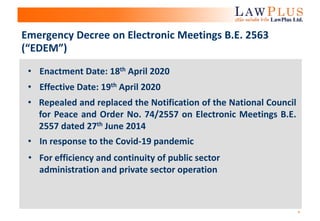
Emergency Decree on Electronic Meetings B.E. 2563
(“EDEM”)
• Repealed and replaced the Notification of the National Council
for Peace and Order No. 74/2557 on Electronic Meetings B.E.
2557 dated 27th June 2014
• In response to the Covid-19 pandemic
• Effective Date: 19th April 2020
• Enactment Date: 18th April 2020
• For efficiency and continuity of public sector
administration and private sector operation
5
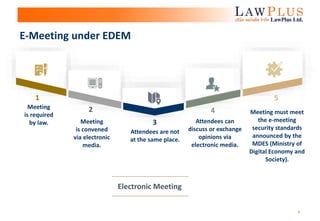
E-Meeting under EDEM
Meeting
is required
by law.
1
Meeting
is convened
via electronic
media.
2
Attendees are not
at the same place.
3 Attendees can
discuss or exchange
opinions via
electronic media.
4 Meeting must meet
the e-meeting
security standards
announced by the
MDES (Ministry of
Digital Economy and
Society).
5
Electronic Meeting
6
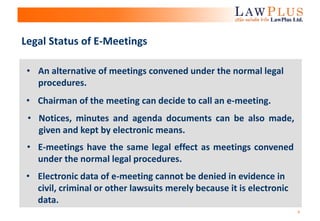
Legal Status of E-Meetings
• E-meetings have the same legal effect as meetings convened
under the normal legal procedures.
• Electronic data of e-meeting cannot be denied in evidence in
civil, criminal or other lawsuits merely because it is electronic
data.
• Chairman of the meeting can decide to call an e-meeting.
• An alternative of meetings convened under the normal legal
procedures.
• Notices, minutes and agenda documents can be also made,
given and kept by electronic means.
7
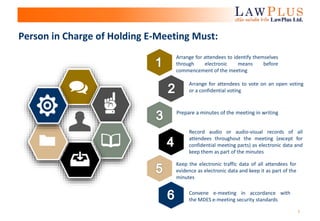
Arrange for attendees to identify themselves
through electronic means before
commencement of the meeting
Arrange for attendees to vote on an open voting
or a confidential voting
Prepare a minutes of the meeting in writing
Keep the electronic traffic data of all attendees for
evidence as electronic data and keep it as part of the
minutes
Record audio or audio-visual records of all
attendees throughout the meeting (except for
confidential meeting parts) as electronic data and
keep them as part of the minutes
Convene e-meeting in accordance with
the MDES e-meeting security standards
Person in Charge of Holding E-Meeting Must:
8
• MDES Notification on Standards for Maintaining Security
of Meetings via Electronic Means B.E. 2563 dated 12th
May 2020
• Effective Date: 27th May 2020
• Security standards for e-meetings under EDEM and
international e-meeting security standards
MDES E-Meeting Security Standards
9
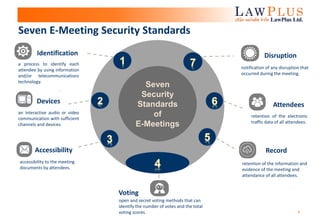
Seven
Security
Standards
of
E-Meetings
.
.
a process to identify each
attendee by using information
and/or telecommunications
technology.
an interactive audio or video
communication with sufficient
channels and devices.
Voting
open and secret voting methods that can
identify the number of votes and the total
voting scores.
Record
retention of the information and
evidence of the meeting and
attendance of all attendees.
Attendees
retention of the electronic
traffic data of all attendees.
Accessibility
accessibility to the meeting
documents by attendees.
Disruption
notification of any disruption that
occurred during the meeting.
Identification
Devices
Seven E-Meeting Security Standards
10
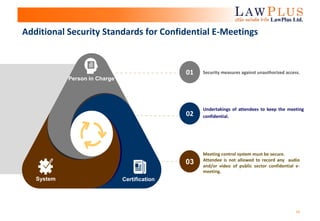
Additional Security Standards for Confidential E-Meetings
01 Security measures against unauthorized access.
02
Undertakings of attendees to keep the meeting
confidential.
03
CertificationSystem
Person in Charge
Meeting control system must be secure.
Attendee is not allowed to record any audio
and/or video of public sector confidential e-
meeting.
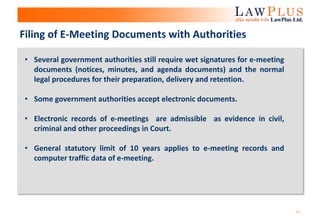
11
• Several government authorities still require wet signatures for e-meeting
documents (notices, minutes, and agenda documents) and the normal
legal procedures for their preparation, delivery and retention.
• Some government authorities accept electronic documents.
• Electronic records of e-meetings are admissible as evidence in civil,
criminal and other proceedings in Court.
• General statutory limit of 10 years applies to e-meeting records and
computer traffic data of e-meeting.
Filing of E-Meeting Documents with Authorities
12
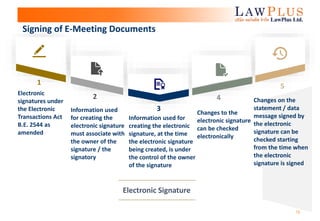
Signing of E-Meeting Documents
Electronic
signatures under
the Electronic
Transactions Act
B.E. 2544 as
amended
1
Information used
for creating the
electronic signature
must associate with
the owner of the
signature / the
signatory
2
Information used for
creating the electronic
signature, at the time
the electronic signature
being created, is under
the control of the owner
of the signature
3 Changes to the
electronic signature
can be checked
electronically
4 Changes on the
statement / data
message signed by
the electronic
signature can be
checked starting
from the time when
the electronic
signature is signed
5
Electronic Signature
13
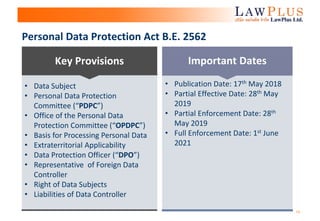
Personal Data Protection Act B.E. 2562
• Publication Date: 17th May 2018
• Partial Effective Date: 28th May
2019
• Partial Enforcement Date: 28th
May 2019
• Full Enforcement Date: 1st June
2021
Important DatesKey Provisions
• Data Subject
• Personal Data Protection
Committee (“PDPC”)
• Office of the Personal Data
Protection Committee (“OPDPC”)
• Basis for Processing Personal Data
• Extraterritorial Applicability
• Data Protection Officer (“DPO”)
• Representative of Foreign Data
Controller
• Right of Data Subjects
• Liabilities of Data Controller
14
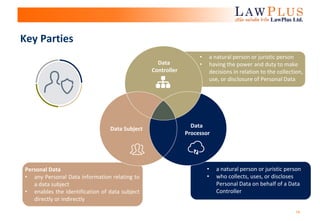
Key Parties
• a natural person or juristic person
• having the power and duty to make
decisions in relation to the collection,
use, or disclosure of Personal Data
• a natural person or juristic person
• who collects, uses, or discloses
Personal Data on behalf of a Data
Controller
Data
Controller
Data Subject
Data
Processor
Personal Data
• any Personal Data information relating to
a data subject
• enables the identification of data subject
directly or indirectly
15
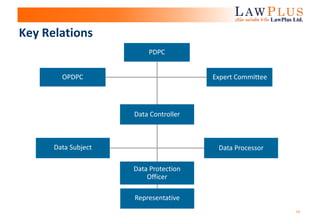
Key Relations
Expert CommitteeOPDPC
PDPC
Data Subject Data Processor
Representative
Data Controller
Data Protection
Officer
16
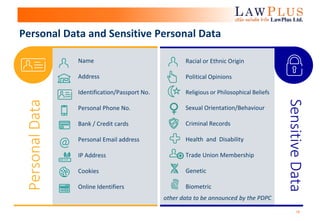
Personal Data and Sensitive Personal Data
Name
Address
Identification/Passport No.
Personal Phone No.
Bank / Credit cards
Personal Email address
IP Address
Cookies
Online Identifiers
PersonalData
Racial or Ethnic Origin
Political Opinions
Religious or Philosophical Beliefs
Sexual Orientation/Behaviour
Criminal Records
Health and Disability
Trade Union Membership
Genetic
Biometric
SensitiveData
other data to be announced by the PDPC
17
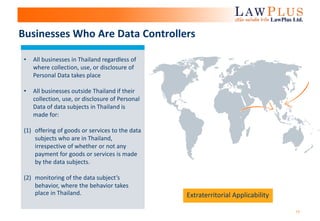
Businesses Who Are Data Controllers
• All businesses in Thailand regardless of
where collection, use, or disclosure of
Personal Data takes place
• All businesses outside Thailand if their
collection, use, or disclosure of Personal
Data of data subjects in Thailand is
made for:
(1) offering of goods or services to the data
subjects who are in Thailand,
irrespective of whether or not any
payment for goods or services is made
by the data subjects.
(2) monitoring of the data subject’s
behavior, where the behavior takes
place in Thailand. Extraterritorial Applicability
18
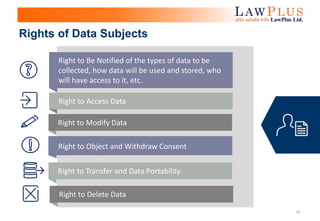
Rights of Data Subjects
Right to Be Notified of the types of data to be
collected, how data will be used and stored, who
will have access to it, etc.
Right to Access Data
Right to Modify Data
Right to Transfer and Data Portability
Right to Delete Data
Right to Object and Withdraw Consent
19
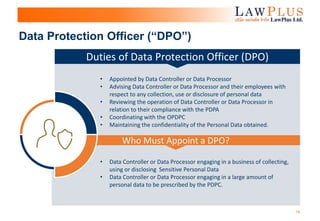
Data Protection Officer (“DPO”)
Duties of Data Protection Officer (DPO)
• Appointed by Data Controller or Data Processor
• Advising Data Controller or Data Processor and their employees with
respect to any collection, use or disclosure of personal data
• Reviewing the operation of Data Controller or Data Processor in
relation to their compliance with the PDPA
• Coordinating with the OPDPC
• Maintaining the confidentiality of the Personal Data obtained.
• Data Controller or Data Processor engaging in a business of collecting,
using or disclosing Sensitive Personal Data
• Data Controller or Data Processor engaging in a large amount of
personal data to be prescribed by the PDPC.
Who Must Appoint a DPO?
20
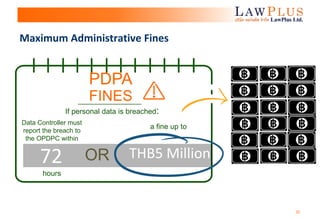
Maximum Administrative Fines
If personal data is breached:
PDPA
FINES
OR
Data Controller must
report the breach to
the OPDPC within
hours
a fine up to
72 THB5 Million
21
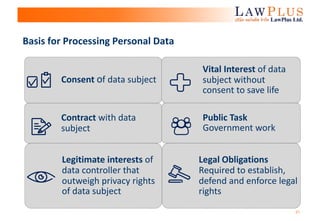
Consent of data subject
Contract with data
subject
Legal Obligations
Required to establish,
defend and enforce legal
rights
Vital Interest of data
subject without
consent to save life
Public Task
Government work
Legitimate interests of
data controller that
outweigh privacy rights
of data subject
Basis for Processing Personal Data
22
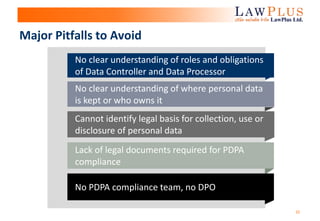
Major Pitfalls to Avoid
Lack of legal documents required for PDPA
compliance
No clear understanding of where personal data
is kept or who owns it
Cannot identify legal basis for collection, use or
disclosure of personal data
No clear understanding of roles and obligations
of Data Controller and Data Processor
No PDPA compliance team, no DPO
23
kowit.somwaiya@lawplusltd.com
LawPlus Ltd.
Unit 1401, 14th Floor, 990 Abdulrahim Place
Rama IV Road, Bangkok 10500, Thailand
Tel. +66 (0)2 636 0662, Fax +66 (0)2 636 0663
www.lawplusltd.com
Questions?
More Information?
24
Unit 1401, 14th Floor, 990 Abdulrahim Place, Rama IV Road, Bangkok 10500, Thailand
Tel. +66 (0)2 636 0662, Fax +66 (0)2 636 0663
www.lawplusltd.com

Update on Laws and Practices 2020

  • 1.
    The information providedin this document is general in nature and may not apply to any specific situation. Specific advice should be sought before taking any action based on the information provided. Under no circumstances shall LawPlus Ltd. or any of their directors, partners and lawyers be liable for any direct or indirect, incidental or consequential loss or damage that results from the use of or the reliance upon the information contained in this document. Copyright © 2020 LawPlus Ltd. UPDATE ON LAWS 2020 Kowit Somwaiya, Managing Partner Oramart Aurore Saardphak, Senior Associate LawPlus Ltd. Korean-Thai Chamber of Commerce 8 October 2020 Dusit Thani Hotel, Pattaya
  • 2.
    Established in 2003 Majorpractices  Banking and Securities  Corporate, Commercial and FDI  Mergers & Acquisitions  Intellectual Property  Real Property and Construction  Telecommunications, Media and Technology  Litigation and Dispute Resolution www.lawplusltd.com 11 full-time lawyers 9 litigation lawyers 7 assistants Professional, Practical, Prompt and Pro-active
  • 3.
  • 4.
    4 Emergency Decree onElectronic Meetings B.E. 2563 (“EDEM”) • Repealed and replaced the Notification of the National Council for Peace and Order No. 74/2557 on Electronic Meetings B.E. 2557 dated 27th June 2014 • In response to the Covid-19 pandemic • Effective Date: 19th April 2020 • Enactment Date: 18th April 2020 • For efficiency and continuity of public sector administration and private sector operation
  • 5.
    5 E-Meeting under EDEM Meeting isrequired by law. 1 Meeting is convened via electronic media. 2 Attendees are not at the same place. 3 Attendees can discuss or exchange opinions via electronic media. 4 Meeting must meet the e-meeting security standards announced by the MDES (Ministry of Digital Economy and Society). 5 Electronic Meeting
  • 6.
    6 Legal Status ofE-Meetings • E-meetings have the same legal effect as meetings convened under the normal legal procedures. • Electronic data of e-meeting cannot be denied in evidence in civil, criminal or other lawsuits merely because it is electronic data. • Chairman of the meeting can decide to call an e-meeting. • An alternative of meetings convened under the normal legal procedures. • Notices, minutes and agenda documents can be also made, given and kept by electronic means.
  • 7.
    7 Arrange for attendeesto identify themselves through electronic means before commencement of the meeting Arrange for attendees to vote on an open voting or a confidential voting Prepare a minutes of the meeting in writing Keep the electronic traffic data of all attendees for evidence as electronic data and keep it as part of the minutes Record audio or audio-visual records of all attendees throughout the meeting (except for confidential meeting parts) as electronic data and keep them as part of the minutes Convene e-meeting in accordance with the MDES e-meeting security standards Person in Charge of Holding E-Meeting Must:
  • 8.
    8 • MDES Notificationon Standards for Maintaining Security of Meetings via Electronic Means B.E. 2563 dated 12th May 2020 • Effective Date: 27th May 2020 • Security standards for e-meetings under EDEM and international e-meeting security standards MDES E-Meeting Security Standards
  • 9.
    9 Seven Security Standards of E-Meetings . . a process toidentify each attendee by using information and/or telecommunications technology. an interactive audio or video communication with sufficient channels and devices. Voting open and secret voting methods that can identify the number of votes and the total voting scores. Record retention of the information and evidence of the meeting and attendance of all attendees. Attendees retention of the electronic traffic data of all attendees. Accessibility accessibility to the meeting documents by attendees. Disruption notification of any disruption that occurred during the meeting. Identification Devices Seven E-Meeting Security Standards
  • 10.
    10 Additional Security Standardsfor Confidential E-Meetings 01 Security measures against unauthorized access. 02 Undertakings of attendees to keep the meeting confidential. 03 CertificationSystem Person in Charge Meeting control system must be secure. Attendee is not allowed to record any audio and/or video of public sector confidential e- meeting.
  • 11.
    11 • Several governmentauthorities still require wet signatures for e-meeting documents (notices, minutes, and agenda documents) and the normal legal procedures for their preparation, delivery and retention. • Some government authorities accept electronic documents. • Electronic records of e-meetings are admissible as evidence in civil, criminal and other proceedings in Court. • General statutory limit of 10 years applies to e-meeting records and computer traffic data of e-meeting. Filing of E-Meeting Documents with Authorities
  • 12.
    12 Signing of E-MeetingDocuments Electronic signatures under the Electronic Transactions Act B.E. 2544 as amended 1 Information used for creating the electronic signature must associate with the owner of the signature / the signatory 2 Information used for creating the electronic signature, at the time the electronic signature being created, is under the control of the owner of the signature 3 Changes to the electronic signature can be checked electronically 4 Changes on the statement / data message signed by the electronic signature can be checked starting from the time when the electronic signature is signed 5 Electronic Signature
  • 13.
    13 Personal Data ProtectionAct B.E. 2562 • Publication Date: 17th May 2018 • Partial Effective Date: 28th May 2019 • Partial Enforcement Date: 28th May 2019 • Full Enforcement Date: 1st June 2021 Important DatesKey Provisions • Data Subject • Personal Data Protection Committee (“PDPC”) • Office of the Personal Data Protection Committee (“OPDPC”) • Basis for Processing Personal Data • Extraterritorial Applicability • Data Protection Officer (“DPO”) • Representative of Foreign Data Controller • Right of Data Subjects • Liabilities of Data Controller
  • 14.
    14 Key Parties • anatural person or juristic person • having the power and duty to make decisions in relation to the collection, use, or disclosure of Personal Data • a natural person or juristic person • who collects, uses, or discloses Personal Data on behalf of a Data Controller Data Controller Data Subject Data Processor Personal Data • any Personal Data information relating to a data subject • enables the identification of data subject directly or indirectly
  • 15.
    15 Key Relations Expert CommitteeOPDPC PDPC DataSubject Data Processor Representative Data Controller Data Protection Officer
  • 16.
    16 Personal Data andSensitive Personal Data Name Address Identification/Passport No. Personal Phone No. Bank / Credit cards Personal Email address IP Address Cookies Online Identifiers PersonalData Racial or Ethnic Origin Political Opinions Religious or Philosophical Beliefs Sexual Orientation/Behaviour Criminal Records Health and Disability Trade Union Membership Genetic Biometric SensitiveData other data to be announced by the PDPC
  • 17.
    17 Businesses Who AreData Controllers • All businesses in Thailand regardless of where collection, use, or disclosure of Personal Data takes place • All businesses outside Thailand if their collection, use, or disclosure of Personal Data of data subjects in Thailand is made for: (1) offering of goods or services to the data subjects who are in Thailand, irrespective of whether or not any payment for goods or services is made by the data subjects. (2) monitoring of the data subject’s behavior, where the behavior takes place in Thailand. Extraterritorial Applicability
  • 18.
    18 Rights of DataSubjects Right to Be Notified of the types of data to be collected, how data will be used and stored, who will have access to it, etc. Right to Access Data Right to Modify Data Right to Transfer and Data Portability Right to Delete Data Right to Object and Withdraw Consent
  • 19.
    19 Data Protection Officer(“DPO”) Duties of Data Protection Officer (DPO) • Appointed by Data Controller or Data Processor • Advising Data Controller or Data Processor and their employees with respect to any collection, use or disclosure of personal data • Reviewing the operation of Data Controller or Data Processor in relation to their compliance with the PDPA • Coordinating with the OPDPC • Maintaining the confidentiality of the Personal Data obtained. • Data Controller or Data Processor engaging in a business of collecting, using or disclosing Sensitive Personal Data • Data Controller or Data Processor engaging in a large amount of personal data to be prescribed by the PDPC. Who Must Appoint a DPO?
  • 20.
    20 Maximum Administrative Fines Ifpersonal data is breached: PDPA FINES OR Data Controller must report the breach to the OPDPC within hours a fine up to 72 THB5 Million
  • 21.
    21 Consent of datasubject Contract with data subject Legal Obligations Required to establish, defend and enforce legal rights Vital Interest of data subject without consent to save life Public Task Government work Legitimate interests of data controller that outweigh privacy rights of data subject Basis for Processing Personal Data
  • 22.
    22 Major Pitfalls toAvoid Lack of legal documents required for PDPA compliance No clear understanding of where personal data is kept or who owns it Cannot identify legal basis for collection, use or disclosure of personal data No clear understanding of roles and obligations of Data Controller and Data Processor No PDPA compliance team, no DPO
  • 23.
    23 kowit.somwaiya@lawplusltd.com LawPlus Ltd. Unit 1401,14th Floor, 990 Abdulrahim Place Rama IV Road, Bangkok 10500, Thailand Tel. +66 (0)2 636 0662, Fax +66 (0)2 636 0663 www.lawplusltd.com Questions? More Information?
  • 24.
    24 Unit 1401, 14thFloor, 990 Abdulrahim Place, Rama IV Road, Bangkok 10500, Thailand Tel. +66 (0)2 636 0662, Fax +66 (0)2 636 0663 www.lawplusltd.com