©2015 Waters Corporation 1
Comprehensive Investigation of the Utilization
of SFC/ ESI Positive Mode MS
for Chiral and Achiral Bioanalytical Studies
Paul D. Rainville Ph.D.
©2015 Waters Corporation 2
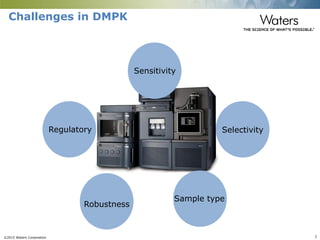
Challenges in DMPK
Sensitivity
Sample type
SelectivityRegulatory
Robustness
©2015 Waters Corporation 3
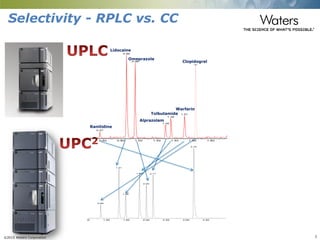
Selectivity - RPLC vs. CC
Time
0.50 1.00 1.50 2.00 2.50 3.00 3.50
%
0
3.19
1.31
0.85
1.83
1.48
2.17
2.00
Time
0.20 0.40 0.60 0.80 1.00 1.20 1.40 1.60 1.80
%
4
15Aug2011_fresh solution_replicate 4 MRM of 6 Channels ES+
TIC
2.07e5
0.86
0.57
0.96
1.51
1.36
1.30
Ranitidine
Lidocaine
Omeprazole
Clopidogrel
test mix 12.5pg/50pg
Time
0.20 0.40 0.60 0.80 1.00 1.20 1.40 1.60 1.80
%
3
09Sep2011_008 MRM of 7 Channels ES+
TIC
1.68e6
1.44
0.73
0.48
1.23
0.85
1.29
1.61
Warfarin
Tolbutamide
Alprazolam
©2015 Waters Corporation 4
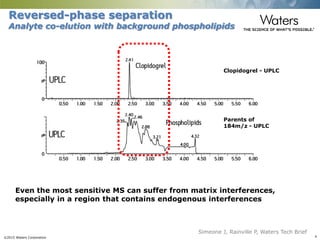
Clopidogrel - UPLC
Parents of
184m/z - UPLC
Reversed-phase separation
Analyte co-elution with background phospholipids
Even the most sensitive MS can suffer from matrix interferences,
especially in a region that contains endogenous interferences
Simeone J, Rainville P, Waters Tech Brief
©2015 Waters Corporation 5
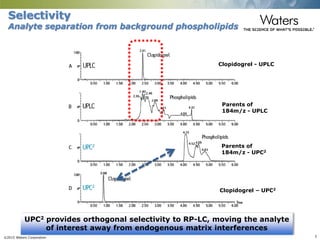
Clopidogrel – UPC2
Parents of
184m/z - UPC2
Selectivity
Analyte separation from background phospholipids
UPC2 provides orthogonal selectivity to RP-LC, moving the analyte
of interest away from endogenous matrix interferences
Clopidogrel - UPLC
Parents of
184m/z - UPLC
©2015 Waters Corporation 6
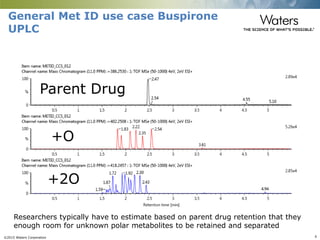
General Met ID use case Buspirone
UPLC
Parent Drug
+O
+2O
Researchers typically have to estimate based on parent drug retention that they
enough room for unknown polar metabolites to be retained and separated
©2015 Waters Corporation 7
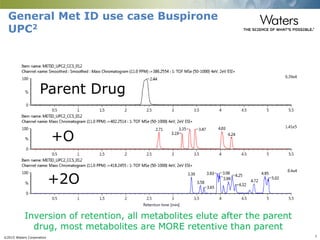
General Met ID use case Buspirone
UPC2
Inversion of retention, all metabolites elute after the parent
drug, most metabolites are MORE retentive than parent
Parent Drug
+O
+2O
©2015 Waters Corporation 8
Time
-0.00 2.00 4.00 6.00 8.00 10.00 12.00 14.00
%
0
-0.00 2.00 4.00 6.00 8.00 10.00 12.00 14.00
%
0
100
-0.00 2.00 4.00 6.00 8.00 10.00 12.00 14.00
%
0
100
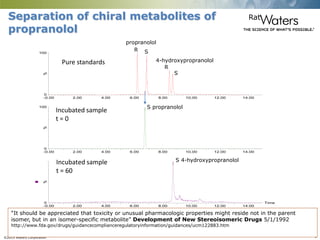
R S
R
S
Incubated sample
t = 0
Incubated sample
t = 60
propranolol
4-hydroxypropranolol
S propranolol
S 4-hydroxypropranolol
RatSeparation of chiral metabolites of
propranolol
Pure standards
“It should be appreciated that toxicity or unusual pharmacologic properties might reside not in the parent
isomer, but in an isomer-specific metabolite” Development of New Stereoisomeric Drugs 5/1/1992
http://www.fda.gov/drugs/guidancecomplianceregulatoryinformation/guidances/ucm122883.htm
©2015 Waters Corporation 9
Time
0.10 0.20 0.30 0.40 0.50 0.60 0.70 0.80 0.90
%
19
0.10 0.20 0.30 0.40 0.50 0.60 0.70 0.80 0.90
%
0
100
0.10 0.20 0.30 0.40 0.50 0.60 0.70 0.80 0.90
%
0
100
0.60
0.86
0.91
0.60
0.56
0.82 0.85
0.520.15
0.12
0.03
0.05
0.43
0.310.29
0.280.19
0.27
0.36
0.41
0.46
0.57 0.60
0.64
0.65
0.75 0.860.82
0.75
0.77
0.960.94
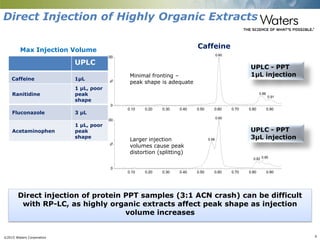
UPLC - PPT
1µL injection
UPLC - PPT
3µL injection
Minimal fronting –
peak shape is adequate
Caffeine
Direct Injection of Highly Organic Extracts
UPLC
Caffeine 1µL
Max Injection Volume
Direct injection of protein PPT samples (3:1 ACN crash) can be difficult
with RP-LC, as highly organic extracts affect peak shape as injection
volume increases
3 more moleculesRanitidine
1 µL, poor
peak
shape
Fluconazole 3 µL
Acetaminophen
1 µL, poor
peak
shape
Larger injection
volumes cause peak
distortion (splitting)
©2015 Waters Corporation 10
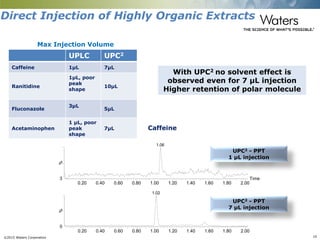
With UPC2 no solvent effect is
observed even for 7 µL injection
Higher retention of polar molecule
Direct Injection of Highly Organic Extracts
UPLC UPC2
Caffeine 1µL 7µL
Ranitidine
1µL, poor
peak
shape
10µL
Fluconazole
3µL
5µL
Acetaminophen
1 µL, poor
peak
shape
7µL
Max Injection Volume
Caffeine
UPC2 - PPT
7 µL injection
UPC2 - PPT
1 µL injection
0.20 0.40 0.60 0.80 1.00 1.20 1.40 1.60 1.80 2.00
%
0
1.02
Time
0.20 0.40 0.60 0.80 1.00 1.20 1.40 1.60 1.80 2.00
%
3
0.20 0.40 0.60 0.80 1.00 1.20 1.40 1.60 1.80 2.00
%
1
0.20 0.40 0.60 0.80 1.00 1.20 1.40 1.60 1.80 2.00
%
0
0.20 0.40 0.60 0.80 1.00 1.20 1.40 1.60 1.80 2.00
%
0
1.01
1.02
1.06
©2015 Waters Corporation 11
Typical Sample Preparation Procedures
for Lipid Analysis
 Liquid-liquid extraction using chloroform/MeOH (2/1)
–Folch method / Blight and Dyer method
 RPLC: phase transfer required to be able to injected onto RP system
 UPC2: phase transfer process can be eliminated by injecting directly
onto a UPC2 system
©2015 Waters Corporation 12
Comparison of GC/MS and UPC2 methods for
the determination of fatty acids in whole
blood samples
 Fatty acid profiling of biological samples has gained tremendous
importance in order to understand patient dietary lipid profiles
in relation to disease states.
 GC/MS, or GC/FID methods have become important tools
 Decreased need for sample preparation has been implemented
in this study
 In this study a simplified sample preparation method was
compared using UPC2-MS with a classical derivatization method
GC/MS
©2015 Waters Corporation 13
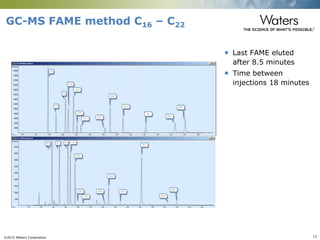
 Last FAME eluted
after 8.5 minutes
 Time between
injections 18 minutes
GC-MS FAME method C16 – C22
©2015 Waters Corporation 14
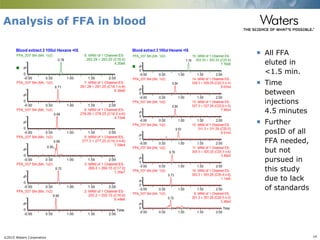
Analysis of FFA in blood
 All FFA
eluted in
<1.5 min.
 Time
between
injections
4.5 minutes
 Further
posID of all
FFA needed,
but not
pursued in
this study
due to lack
of standards
©2015 Waters Corporation 15
Prostaglandins: Background
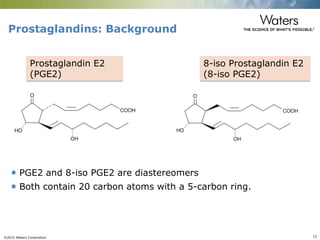
 PGE2 and 8-iso PGE2 are diastereomers
 Both contain 20 carbon atoms with a 5-carbon ring.
Prostaglandin E2
(PGE2)
8-iso Prostaglandin E2
(8-iso PGE2)
©2015 Waters Corporation 16
Challenges for PG Separation
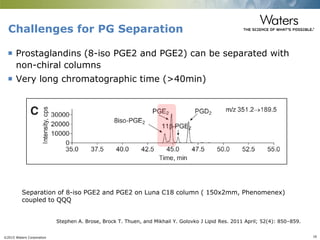
 Prostaglandins (8-iso PGE2 and PGE2) can be separated with
non-chiral columns
 Very long chromatographic time (>40min)
Separation of 8-iso PGE2 and PGE2 on Luna C18 column ( 150x2mm, Phenomenex)
coupled to QQQ
Stephen A. Brose, Brock T. Thuen, and Mikhail Y. Golovko J Lipid Res. 2011 April; 52(4): 850–859.
©2015 Waters Corporation 17
Fast Separation of Prostaglandin
Diastereomers Using UPC2
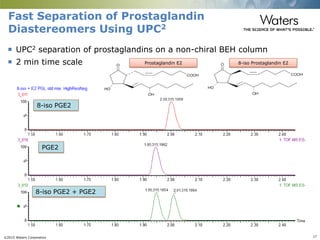
 UPC2 separation of prostaglandins on a non-chiral BEH column
 2 min time scale
PGE2
8-iso PGE2
8-iso PGE2 + PGE2
Prostaglandin E2 8-iso Prostaglandin E2
©2015 Waters Corporation 18
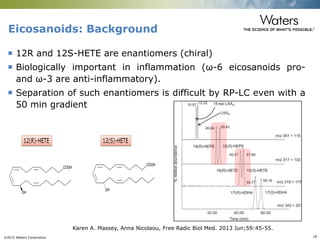
Eicosanoids: Background
 12R and 12S-HETE are enantiomers (chiral)
 Biologically important in inflammation (ω-6 eicosanoids pro-
and ω-3 are anti-inflammatory).
 Separation of such enantiomers is difficult by RP-LC even with a
50 min gradient
Karen A. Massey, Anna Nicolaou, Free Radic Biol Med. 2013 Jun;59:45-55.
©2015 Waters Corporation 19
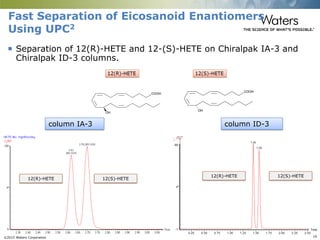
Fast Separation of Eicosanoid Enantiomers
Using UPC2
 Separation of 12(R)-HETE and 12-(S)-HETE on Chiralpak IA-3 and
Chiralpak ID-3 columns.
12(R)-HETE 12(S)-HETE
column ID-3column IA-3
©2015 Waters Corporation 20
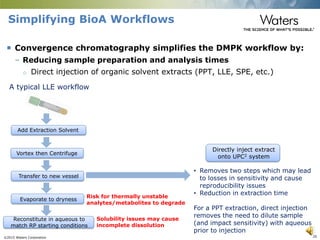
Simplifying BioA Workflows
 Convergence chromatography simplifies the DMPK workflow by:
– Reducing sample preparation and analysis times
o Direct injection of organic solvent extracts (PPT, LLE, SPE, etc.)
Add Extraction Solvent
Transfer to new vessel
Evaporate to dryness
Risk for thermally unstable
analytes/metabolites to degrade
Reconstitute in aqueous to
match RP starting conditions
Solubility issues may cause
incomplete dissolution
Directly inject extract
onto UPC2 system
• Removes two steps which may lead
to losses in sensitivity and cause
reproducibility issues
• Reduction in extraction time
For a PPT extraction, direct injection
removes the need to dilute sample
(and impact sensitivity) with aqueous
prior to injection
A typical LLE workflow
Vortex then Centrifuge
©2015 Waters Corporation 21
%CV averaged over three days, N = 18
meets guidelines for method validation
Sensitivity better than that achieved with UPLC-Xevo TQ-S
Linear with r2 in the range of 25 – 5000 pg/mL
Avg. QC
LLOQ
Avg. QC LOW Avg. QC MID Avg. QC
HIGH
5.13 6.70 4.90 5.90
Regulated Bioanalysis with UPC2
3 day validation studies of Clopidogrel with LLE
QC
LLOQ
QC
LOW QC MID
QC
HIGH
25.0
pg/mL
75.0
pg/mL
350
pg/mL
3500
pg/mL
23.6 71.6 355 3384
23.4 76.5 358 3422
25.0 67.2 363 3299
22.0 63.6 349 3237
25.9 72.8 333 3558
23.3 74.0 346 3629
Mean 23.9 71.0 351 3422
St Dev 1.38 4.73 10.5 150
% CV 5.8 6.7 3.0 4.4
% Bias -4.5 -5.4 -6.5 -8.8
QC
LLOQ
QC
LOW QC MID
QC
HIGH
25.0
pg/mL
75.0
pg/mL
350
pg/mL
3500
pg/mL
21.4 74.6 404 3464
22.3 80.4 379 3577
21.8 66.8 390 3395
20.5 68.9 370 3387
21.7 74.2 343 3647
21.3 69.9 361 3459
Mean 21.5 72.5 374 3488
St Dev 0.60 4.94 21.5 103
% CV 2.8 6.8 5.7 3.0
% Bias -14.0 -3.4 -0.1 -7.0
QC
LLOQ
QC
LOW QC MID
QC
HIGH
25.0
pg/mL
75.0
pg/mL
350
pg/mL
3500
pg/mL
28.0 69.8 358 3083
27.1 63.2 337 3684
25.1 74.3 340 3257
27.7 68.3 346 3940
30.3 75.7 395 3967
29.9 67.7 347 3857
Mean 28.0 69.8 354 3631
St Dev 1.91 4.59 21.3 375
% CV 6.8 6.6 6.0 10.3
% Bias 12.1 -6.9 -5.7 -3.2
©2015 Waters Corporation 22
Convergence Chromatography/MS in
DMPK
 Provides an orthogonal separation technique to reversed-phase
chromatography
– Reduce potential matrix interferences
– May provide better retention for polar metabolites
 Simplifies sample analysis workflows:
– Combines multiple techniques (GC/NP/RP) into ONE analytical
platform
– Reduces sample prep and analysis times to streamline the analytical
workflow
o Direct injection of organic solvents/extracts
o Reduces solvent usage
o No derivatization required for free fatty acid analysis
 Separates compounds with structural similarity
– Optical isomers, positional isomers, structural analogs, conjugates
©2015 Waters Corporation 23
Acknowledgements
 Giorgis Isaacs
 Jennifer Simeone
 Michael Jones
 Steven Lai
 Hernando Olivos
 Adam Ladak

Comprehensive Investigation of the Utilization of SFC/ESI Positive Mode MS for Chiral and Achiral Bioanalytical Studies

  • 1.
    ©2015 Waters Corporation1 Comprehensive Investigation of the Utilization of SFC/ ESI Positive Mode MS for Chiral and Achiral Bioanalytical Studies Paul D. Rainville Ph.D.
  • 2.
    ©2015 Waters Corporation2 Challenges in DMPK Sensitivity Sample type SelectivityRegulatory Robustness
  • 3.
    ©2015 Waters Corporation3 Selectivity - RPLC vs. CC Time 0.50 1.00 1.50 2.00 2.50 3.00 3.50 % 0 3.19 1.31 0.85 1.83 1.48 2.17 2.00 Time 0.20 0.40 0.60 0.80 1.00 1.20 1.40 1.60 1.80 % 4 15Aug2011_fresh solution_replicate 4 MRM of 6 Channels ES+ TIC 2.07e5 0.86 0.57 0.96 1.51 1.36 1.30 Ranitidine Lidocaine Omeprazole Clopidogrel test mix 12.5pg/50pg Time 0.20 0.40 0.60 0.80 1.00 1.20 1.40 1.60 1.80 % 3 09Sep2011_008 MRM of 7 Channels ES+ TIC 1.68e6 1.44 0.73 0.48 1.23 0.85 1.29 1.61 Warfarin Tolbutamide Alprazolam
  • 4.
    ©2015 Waters Corporation4 Clopidogrel - UPLC Parents of 184m/z - UPLC Reversed-phase separation Analyte co-elution with background phospholipids Even the most sensitive MS can suffer from matrix interferences, especially in a region that contains endogenous interferences Simeone J, Rainville P, Waters Tech Brief
  • 5.
    ©2015 Waters Corporation5 Clopidogrel – UPC2 Parents of 184m/z - UPC2 Selectivity Analyte separation from background phospholipids UPC2 provides orthogonal selectivity to RP-LC, moving the analyte of interest away from endogenous matrix interferences Clopidogrel - UPLC Parents of 184m/z - UPLC
  • 6.
    ©2015 Waters Corporation6 General Met ID use case Buspirone UPLC Parent Drug +O +2O Researchers typically have to estimate based on parent drug retention that they enough room for unknown polar metabolites to be retained and separated
  • 7.
    ©2015 Waters Corporation7 General Met ID use case Buspirone UPC2 Inversion of retention, all metabolites elute after the parent drug, most metabolites are MORE retentive than parent Parent Drug +O +2O
  • 8.
    ©2015 Waters Corporation8 Time -0.00 2.00 4.00 6.00 8.00 10.00 12.00 14.00 % 0 -0.00 2.00 4.00 6.00 8.00 10.00 12.00 14.00 % 0 100 -0.00 2.00 4.00 6.00 8.00 10.00 12.00 14.00 % 0 100 R S R S Incubated sample t = 0 Incubated sample t = 60 propranolol 4-hydroxypropranolol S propranolol S 4-hydroxypropranolol RatSeparation of chiral metabolites of propranolol Pure standards “It should be appreciated that toxicity or unusual pharmacologic properties might reside not in the parent isomer, but in an isomer-specific metabolite” Development of New Stereoisomeric Drugs 5/1/1992 http://www.fda.gov/drugs/guidancecomplianceregulatoryinformation/guidances/ucm122883.htm
  • 9.
    ©2015 Waters Corporation9 Time 0.10 0.20 0.30 0.40 0.50 0.60 0.70 0.80 0.90 % 19 0.10 0.20 0.30 0.40 0.50 0.60 0.70 0.80 0.90 % 0 100 0.10 0.20 0.30 0.40 0.50 0.60 0.70 0.80 0.90 % 0 100 0.60 0.86 0.91 0.60 0.56 0.82 0.85 0.520.15 0.12 0.03 0.05 0.43 0.310.29 0.280.19 0.27 0.36 0.41 0.46 0.57 0.60 0.64 0.65 0.75 0.860.82 0.75 0.77 0.960.94 UPLC - PPT 1µL injection UPLC - PPT 3µL injection Minimal fronting – peak shape is adequate Caffeine Direct Injection of Highly Organic Extracts UPLC Caffeine 1µL Max Injection Volume Direct injection of protein PPT samples (3:1 ACN crash) can be difficult with RP-LC, as highly organic extracts affect peak shape as injection volume increases 3 more moleculesRanitidine 1 µL, poor peak shape Fluconazole 3 µL Acetaminophen 1 µL, poor peak shape Larger injection volumes cause peak distortion (splitting)
  • 10.
    ©2015 Waters Corporation10 With UPC2 no solvent effect is observed even for 7 µL injection Higher retention of polar molecule Direct Injection of Highly Organic Extracts UPLC UPC2 Caffeine 1µL 7µL Ranitidine 1µL, poor peak shape 10µL Fluconazole 3µL 5µL Acetaminophen 1 µL, poor peak shape 7µL Max Injection Volume Caffeine UPC2 - PPT 7 µL injection UPC2 - PPT 1 µL injection 0.20 0.40 0.60 0.80 1.00 1.20 1.40 1.60 1.80 2.00 % 0 1.02 Time 0.20 0.40 0.60 0.80 1.00 1.20 1.40 1.60 1.80 2.00 % 3 0.20 0.40 0.60 0.80 1.00 1.20 1.40 1.60 1.80 2.00 % 1 0.20 0.40 0.60 0.80 1.00 1.20 1.40 1.60 1.80 2.00 % 0 0.20 0.40 0.60 0.80 1.00 1.20 1.40 1.60 1.80 2.00 % 0 1.01 1.02 1.06
  • 11.
    ©2015 Waters Corporation11 Typical Sample Preparation Procedures for Lipid Analysis  Liquid-liquid extraction using chloroform/MeOH (2/1) –Folch method / Blight and Dyer method  RPLC: phase transfer required to be able to injected onto RP system  UPC2: phase transfer process can be eliminated by injecting directly onto a UPC2 system
  • 12.
    ©2015 Waters Corporation12 Comparison of GC/MS and UPC2 methods for the determination of fatty acids in whole blood samples  Fatty acid profiling of biological samples has gained tremendous importance in order to understand patient dietary lipid profiles in relation to disease states.  GC/MS, or GC/FID methods have become important tools  Decreased need for sample preparation has been implemented in this study  In this study a simplified sample preparation method was compared using UPC2-MS with a classical derivatization method GC/MS
  • 13.
    ©2015 Waters Corporation13  Last FAME eluted after 8.5 minutes  Time between injections 18 minutes GC-MS FAME method C16 – C22
  • 14.
    ©2015 Waters Corporation14 Analysis of FFA in blood  All FFA eluted in <1.5 min.  Time between injections 4.5 minutes  Further posID of all FFA needed, but not pursued in this study due to lack of standards
  • 15.
    ©2015 Waters Corporation15 Prostaglandins: Background  PGE2 and 8-iso PGE2 are diastereomers  Both contain 20 carbon atoms with a 5-carbon ring. Prostaglandin E2 (PGE2) 8-iso Prostaglandin E2 (8-iso PGE2)
  • 16.
    ©2015 Waters Corporation16 Challenges for PG Separation  Prostaglandins (8-iso PGE2 and PGE2) can be separated with non-chiral columns  Very long chromatographic time (>40min) Separation of 8-iso PGE2 and PGE2 on Luna C18 column ( 150x2mm, Phenomenex) coupled to QQQ Stephen A. Brose, Brock T. Thuen, and Mikhail Y. Golovko J Lipid Res. 2011 April; 52(4): 850–859.
  • 17.
    ©2015 Waters Corporation17 Fast Separation of Prostaglandin Diastereomers Using UPC2  UPC2 separation of prostaglandins on a non-chiral BEH column  2 min time scale PGE2 8-iso PGE2 8-iso PGE2 + PGE2 Prostaglandin E2 8-iso Prostaglandin E2
  • 18.
    ©2015 Waters Corporation18 Eicosanoids: Background  12R and 12S-HETE are enantiomers (chiral)  Biologically important in inflammation (ω-6 eicosanoids pro- and ω-3 are anti-inflammatory).  Separation of such enantiomers is difficult by RP-LC even with a 50 min gradient Karen A. Massey, Anna Nicolaou, Free Radic Biol Med. 2013 Jun;59:45-55.
  • 19.
    ©2015 Waters Corporation19 Fast Separation of Eicosanoid Enantiomers Using UPC2  Separation of 12(R)-HETE and 12-(S)-HETE on Chiralpak IA-3 and Chiralpak ID-3 columns. 12(R)-HETE 12(S)-HETE 12(R)-HETE 12(S)-HETE column ID-3column IA-3
  • 20.
    ©2015 Waters Corporation20 Simplifying BioA Workflows  Convergence chromatography simplifies the DMPK workflow by: – Reducing sample preparation and analysis times o Direct injection of organic solvent extracts (PPT, LLE, SPE, etc.) Add Extraction Solvent Transfer to new vessel Evaporate to dryness Risk for thermally unstable analytes/metabolites to degrade Reconstitute in aqueous to match RP starting conditions Solubility issues may cause incomplete dissolution Directly inject extract onto UPC2 system • Removes two steps which may lead to losses in sensitivity and cause reproducibility issues • Reduction in extraction time For a PPT extraction, direct injection removes the need to dilute sample (and impact sensitivity) with aqueous prior to injection A typical LLE workflow Vortex then Centrifuge
  • 21.
    ©2015 Waters Corporation21 %CV averaged over three days, N = 18 meets guidelines for method validation Sensitivity better than that achieved with UPLC-Xevo TQ-S Linear with r2 in the range of 25 – 5000 pg/mL Avg. QC LLOQ Avg. QC LOW Avg. QC MID Avg. QC HIGH 5.13 6.70 4.90 5.90 Regulated Bioanalysis with UPC2 3 day validation studies of Clopidogrel with LLE QC LLOQ QC LOW QC MID QC HIGH 25.0 pg/mL 75.0 pg/mL 350 pg/mL 3500 pg/mL 23.6 71.6 355 3384 23.4 76.5 358 3422 25.0 67.2 363 3299 22.0 63.6 349 3237 25.9 72.8 333 3558 23.3 74.0 346 3629 Mean 23.9 71.0 351 3422 St Dev 1.38 4.73 10.5 150 % CV 5.8 6.7 3.0 4.4 % Bias -4.5 -5.4 -6.5 -8.8 QC LLOQ QC LOW QC MID QC HIGH 25.0 pg/mL 75.0 pg/mL 350 pg/mL 3500 pg/mL 21.4 74.6 404 3464 22.3 80.4 379 3577 21.8 66.8 390 3395 20.5 68.9 370 3387 21.7 74.2 343 3647 21.3 69.9 361 3459 Mean 21.5 72.5 374 3488 St Dev 0.60 4.94 21.5 103 % CV 2.8 6.8 5.7 3.0 % Bias -14.0 -3.4 -0.1 -7.0 QC LLOQ QC LOW QC MID QC HIGH 25.0 pg/mL 75.0 pg/mL 350 pg/mL 3500 pg/mL 28.0 69.8 358 3083 27.1 63.2 337 3684 25.1 74.3 340 3257 27.7 68.3 346 3940 30.3 75.7 395 3967 29.9 67.7 347 3857 Mean 28.0 69.8 354 3631 St Dev 1.91 4.59 21.3 375 % CV 6.8 6.6 6.0 10.3 % Bias 12.1 -6.9 -5.7 -3.2
  • 22.
    ©2015 Waters Corporation22 Convergence Chromatography/MS in DMPK  Provides an orthogonal separation technique to reversed-phase chromatography – Reduce potential matrix interferences – May provide better retention for polar metabolites  Simplifies sample analysis workflows: – Combines multiple techniques (GC/NP/RP) into ONE analytical platform – Reduces sample prep and analysis times to streamline the analytical workflow o Direct injection of organic solvents/extracts o Reduces solvent usage o No derivatization required for free fatty acid analysis  Separates compounds with structural similarity – Optical isomers, positional isomers, structural analogs, conjugates
  • 23.
    ©2015 Waters Corporation23 Acknowledgements  Giorgis Isaacs  Jennifer Simeone  Michael Jones  Steven Lai  Hernando Olivos  Adam Ladak