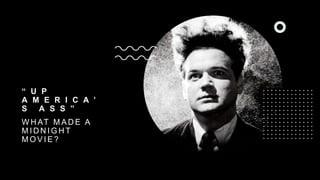
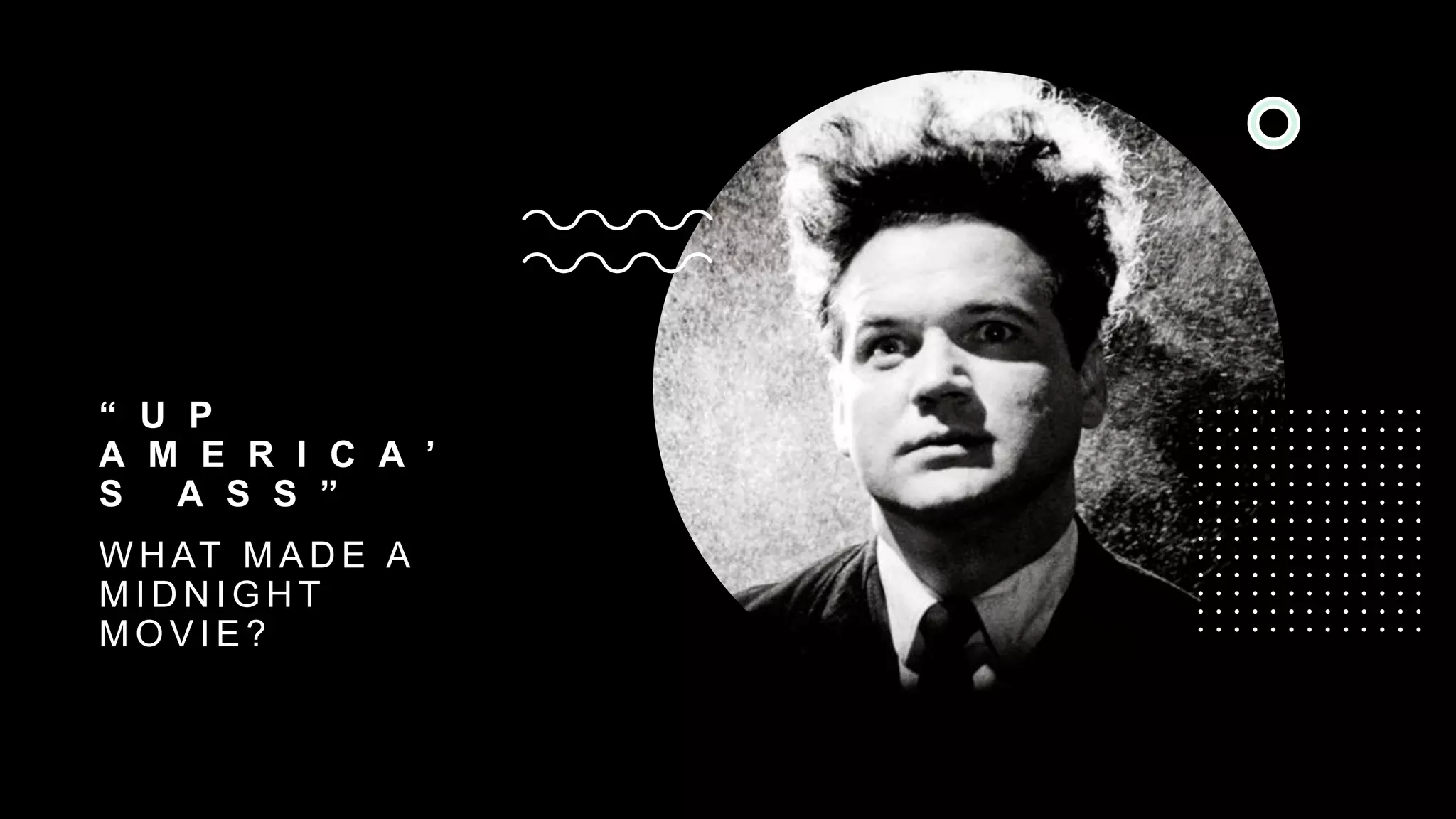
“ U P
A M E R I C A ’
S A S S ”
W H AT M A D E A
M I D N I G H T
M O V I E ?
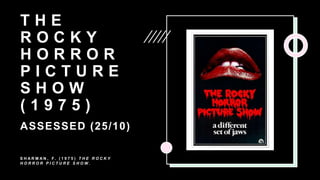
T H E
R O C K Y
H O R R O R
P I C T U R E
S H O W
( 1 9 7 5 )
ASSESSED (25/10)
S H A R M A N , F. ( 1 9 7 5 ) T H E R O C K Y
H O R R O R P I C T U R E S H O W .
Rocky Horror is, at its core, is a story about the changing social, sexual and cultural landscape that
took place through the 1960’s and the 1970’s. Or to put it another way the transition from modernism
to post-modernism in art. Rocky Horror uses the genre trappings of pulp sci-fi, gothic fiction and
musicals to present this transition.
The characters of Brad and Janet are extremely similar to protagonists found in modernist pulp
fiction; A pair of conventionally beautiful lovers that fall into the character architypes of the slightly
dorky yet confident young man and the slightly ditzy and curious young woman. They see marriage
as not only a necessity for their sex life but also for their relationship as a whole.
Using the classical horror tropes of a broken down car, back-roads and a stormy night the pair are
not confronted with wolfmen or creatures from the black lagoon but instead with a real existential
threat to them: A group androgynous eccentrics that openly reference sexuality being lead by a
transvestite. Just as the mainly conservative, pious and sexually repressive culture and art of the
America of the 60’s and 70’s was meet with a hugely influential counter-culture that openly mocked
and criticised the formers styles and values. Throughout the film the modernist pair go from placating
and patronising the group to being seduced by the lifestyle and end the film in corsets and stockings
having both had pre marital sex with the same transvestite. Through these actions the ideal
modernist protagonists have become their own antithesis.
Themes of homosexuality, promiscuity and gender role subversion are omni-present and became
the main reason for the films cult success. While not initially popular with most audiences, it founds
it’s own in the very sub-cultures it was paying homage to. If you were a member of the counter
culture deliberately or by necessity: a screening of Rocky Horror was not only a chance to see a
person like yourself in the media you consumed but also a chance to celebrate those aspects of life
that mainstream media lacked.
From the study of Rocky Horror it becomes obvious that a large part of the films success was its
openness with taboo subjects and a rejection of the mainstream that attracted a smaller, yet loyal
audience that could relate and find entertainment in the subversion.
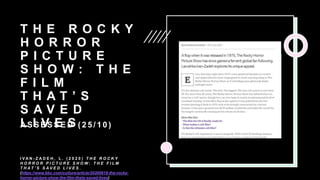
T H E R O C K Y
H O R R O R
P I C T U R E
S H O W : T H E
F I L M
T H A T ’ S
S A V E D
L I V E SA S S E S S E D ( 2 5 / 1 0 )
I V A N - Z A D E H , L . ( 2 0 2 0 ) T H E R O C K Y
H O R R O R P I C T U R E S H O W : T H E F I L M
T H A T ’ S S A V E D L I V E S .
(https://www.bbc.com/culture/article/20200618-the-rocky-
horror-picture-show-the-film-thats-saved-lives)
“I know a lot of people, Rocky Horror is like their home, it’s their connection to
everybody – all their friends,” - Larry Viezel: President of the Rocky Horror Picture
Show Fan Club.
From reading this article its clear that that the main force behind the success of
Rocky Horror’s success has been the support of fringe groups. The films initial,
1975 run was a monumental flop with the only success being a few screening at
L.A. in which many audience members would watch the films multiple times. The
film was screened on the first of April the following year in a well known New York
arthouse cinema. In an area that had only 6 six years before experienced what is
now considered one the seminal acts in LGBT rights history: The Stonewall Riots.
The audience of the screening was a collection of social outcasts and cultural
oddities in human form. This audience quickly latched on to the films post-modern
take on pulp sci-fi, the openly sexual content of the film and the addition of
challenging gender and sexual roles that permeate the film. From that point, Rocky
Horror screening became synonymous with the gay community and the growing
sub culture in America and Britain. Over the years screenings became interactive
with attendees dressing as the characters, singing along with songs and responding
to the films dialog. To this day the Rocky Horror is seen as a safe place for
members of the LGBTQ community.
From studying this article it becomes obvious that Rocky Horror became the
phenomenon it is from the themes and subversions that were not common place in
mainstream entertainment at the time.
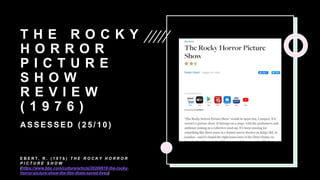
T H E R O C K Y
H O R R O R
P I C T U R E
S H O W
R E V I E W
( 1 9 7 6 )
A S S E S S E D ( 2 5 / 1 0 )
E B E R T, R . ( 1 9 7 6 ) T H E R O C K Y H O R R O R
P I C T U R E S H O W
(https://www.bbc.com/culture/article/20200618-the-rocky-
horror-picture-show-the-film-thats-saved-lives)
“ ‘The Rocky Horror Picture Show’ would be more fun, I suspect, if weren’t a picture
show.” - Roger Ebert: Renounced American Film Critic.
From reading this article I now have a perspective not only from a source
contemporary with Rocky Horror’s release, but also a review that was written prior
to the phenomenon of audience participation and the cult classic status that Rocky
Horror now enjoys. The most intriguing takeaway from this review is Ebert’s opinion
that Rocky Horror lacks the “mutual karma” that comes from live performance and
an audience’s participation in that performance. Rodger gives the impression that
Rocky Horror is best enjoyed with a implicit understanding that it’s a filmed play, as
its choreography, composition and general tone would imply. The rest of the piece is
an outline the plot of the film.
The most interesting part of the piece is Ebert’s prediction on what would improve
the Rocky Horror experience. It’s strange to imagine the film as anything other than
a cult classic with audience participation being a huge part of the piece’s cultural
impact today, this review not only makes clear that it wasn’t always in that position,
but that it was apparent that Rocky Horror could easily harbour a rabid cult
audience with its themes, tone and presentation.
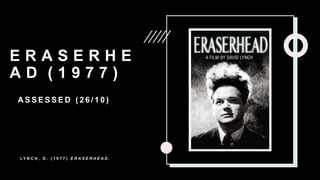
E R A S E R H E
A D ( 1 9 7 7 )
A S S E S S E D ( 2 6 / 1 0 )
L Y N C H , D . ( 1 9 7 7 ) E R A S E R H E A D .
“In heaven, everything is fine” – Lady in the Radiator: Figure of Hope in Eraserhead.
Eraserhead is almost beyond analysis in the medium of film. It comes from the bizarre, abrasive and
genius mind of David Lynch: a person who openly makes films for himself and out of his entire
catalogue Eraserhead is his most personal. All I can offer in terms of research is my interpretation.
In my opinion Eraserhead is the closest filmmaking has ever come to representing a nightmare and
the fears on display are that of childbirth, marriage and settling in general. That becomes apparent
as the film goes on with sperm-like creatures invading the protagonist’s (Henry) dreams and
fantasies. The most apparent figure of these themes is the horrific “baby” that Henry sires with Mary
X, this leads to an unhappy and unexpected marriage which quickly breaks down; Henry is
subsequently left to care for his child by himself and remains bewildered throughout. Henry’s life
unravels, with the baby getting sick and his muse across the hallway from him seeing him as his
horrific child with Henry attached, meaning that a relationship in impossible between the two. The
only escape Henry is allowed is the lady living in his radiator who tells him that “In heaven,
everything is fine.” which, including the lady’s tendency to squish the sperm monsters Henry is
haunted by, is possibly an illusion to suicide, contraception or abortion.
The success of Eraserhead is the films through line of Henry and his plot that an audience can follow
along with. Too often in experimental cinema the genre label is used as a excuse for poor
storytelling, but not here; to most audiences Eraserhead will be emotionally relatable if not directly
understood. The long, locked down shots and continuous, haunting. soundscape make for an
extremely personal style that puts an audience in the same headspace of Henry, bewildered and
existentially terrified of the seeming mundane. The films cult film status was obviously somewhat
due to the films unique crossroads of experiential and mainstream storytelling styles but also the
subversions of modernist tropes, particularly those revolving around the importance and value of
family and settling down. Starting a family isn’t presented as a positive, planned for life goal. It’s the
endpoint, a self imposed nightmarish prison that comes out of nowhere with no real escape other
than death. Meeting your girlfriend’s parents is a terrifying mirror into your own future. The birth of
your child is the metaphorical death of you. The theme of dysfunctional families is a strong one
throughout post-modern media with Eraserhead being a particularly strong example.
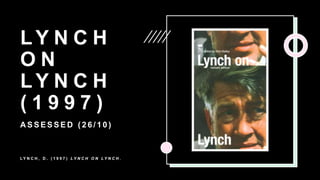
L Y N C H
O N
L Y N C H
( 1 9 9 7 )
A S S E S S E D ( 2 6 / 1 0 )
L Y N C H , D . ( 1 9 9 7 ) L Y N C H O N L Y N C H .
“I just happen to like electricity, but I’m not really wild about the new plugs in America.” –
David Lynch.
While reading “Lynch on Lynch” one is exposed to Lynch’s personality in as pure a form
as the written word can allow and to be entirely honest Its hard to parse the useful from
the Lynch-isms that, despite being fascinating and informative in a different sense, hold
little relevance to the points that I am currently researching.
David Lynch is admirable in his ability to keep a child like wonder in his attitude to film;
throughout the book David is asked to explain his interpretation of events or how scenes
where put together. David tacitly refuses to do so, not out of an egotistic want for a
mystique or for a lack of depth of the films part. Instead David has a genuine belief that
the elements of mystery in his films that will never be solved, add to the films longevity
and tone. This off hand refusal to explain was certainly an aspect of post-modernism but
not necessarily a influential one. A large part of the films production fell in line with
postmodern production standards of the seventies, that being that the film is headed up
by the director and the crew was more like a collective of people passionate about the
filmmakers vision, with another example being the “Hippie Commune” that was the set of
“Pink Flamingos” or the infamous “Factory” of Andy Warhol. David Lynch made
Eraserhead in 5 years with the exact same crew, the film’s star: Jack Nance even kept
the exact same haircut for those five years so filming could restarted at any point with
continuity being respected. I feel that this book gives great insight into David’s mind at
the time of filming and will be a useful resource for later reference.
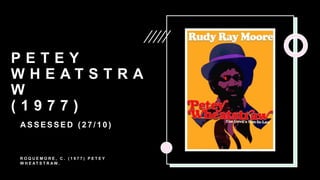
P E T E Y
W H E A T S T R A
W
( 1 9 7 7 )
A S S E S S E D ( 2 7 / 1 0 )
R O Q U E M O R E , C . ( 1 9 7 7 ) P E T E Y
W H E AT S T R A W .
Petey Wheastraw: The Devil’s Son in Law is a film of extremes, as should be
expected from the Blaxploitation genre. For being a low budget Rudy Ray Moore
film, Petey Wheatstraw manages to paint an entertaining picture of black life in
1970’s America. The interesting aspect at play throughout Petey Wheatstraw is the
absurdity which which the film explores the topic of racism throughout the film in
specific the symbol of watermelons. In the opening of the film Petey Wheatstraw is
born in ramshackle house but not before a watermelon is delivered before him.
Throughout the film nearly every main character inexplicably eats watermelons, the
gag culminates in a pick-up truck full of watermelons exploding, covering the
neighbourhood in watermelon chunks. The gag clearly plays into the absurdity of
the stereotype of watermelons to a ludicrous degree, intentionally making fun of the
white audiences that flocked to watch Blaxploitation films through a racist lens.
Another not-so-subtle insult to the audience is the plot, revolving around Petey
being given a second chance at life and magical powers, with this power Petey
doesn’t undo his mistakes or clean up the neighbourhood, instead he embarrasses
some local comedians that Petey Doesn't like, the absurd narcissism and
selfishness displayed by Petey is another example of a racist stereotype being
taken to extreme lengths for commentary and comedy purposes. Petey Wheatstraw
is an incredibly imaginative and entertaining film that knows its audience and isn’t
afraid to outright criticize them.
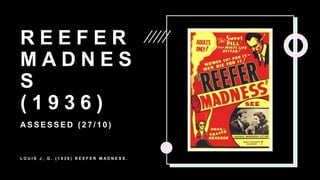
R E E F E R
M A D N E S
S
( 1 9 3 6 )
A S S E S S E D ( 2 7 / 1 0 )
L O U I S J , G . ( 1 9 3 6 ) R E E F E R M A D N E S S .
Reefer Madness is a unique success story in the genre of midnight movies given
how the audience the piece was indented to reach and the audience it eventually
got were entirely separate and in many ways incompatible from each other.
Reefer Madness was produced as a piece of propaganda, warning parents about
the allegedly destructive affects of marijuana. Like most propaganda films produced
at the time, the topic is blown far out of proportion and the film generally exists to
shock rather than to inform. Given how vapid and uninformative the film was it
would be expected to fall out of popularity as soon as political doctrine changed and
for about a decade, it did. The film was allegedly rediscovered when a group of high
school seniors in 1970’s LA found the film reels in their schools storage and started
screening it for their friends. Regardless of whether that story is true or not it makes
perfect sense that Reefer Madness would find an audience at a time when the
debate around the use of marijuana was at an impasse and the postmodern,
rebellious attitudes towards the politics of “The Ike Years” were at a similar position.
The film became a microcosm of the growing unrest permeating across America
through the 60’s and 70’s; screenings for Reefer Madness became a gathering of
artists, activists, students and potheads coming together to openly and relentlessly
mocking the values of the past, thus making the response to the film an openly
postmodern one.
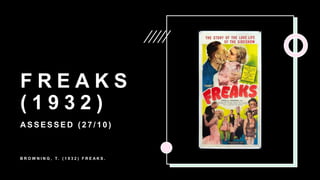
F R E A K S
( 1 9 3 2 )
A S S E S S E D ( 2 7 / 1 0 )
B R O W N I N G , T. ( 1 9 3 2 ) F R E A K S .
Freaks is an early example of “Exploration Horror” that would later become a main
stay of low budget films going forward. In the America of 1932, where eugenics was
a popular practice and even mild deviation from the norm was met with distrust and
isolation it makes sense that the most terrifying image for an audience of the time
wouldn’t be gothic monsters but instead, a reflection of the aspects of society that
didn’t fit within their view of normalcy.
As a film, Freaks was an anomaly at the time because instead of using costumes
and make-up to create monsters the film used real people with physical disabilities
and, in a move that thoroughly horrified audiences of the time, humanises and
sympathises with them. This was in direct response to the “us vs them” political
views of the time that focused on dehumanising its opponents, so when confronted
with a member of “the other’s” personal life in a down to earth way it shocked and
outraged audiences. This, for the time, realistic and grounded portrayal of disabled
people led to the film acquiring a niche audience that could relate to the underdog
status of the film’s subjects. This continues the tradition of cult films being bastions
of representation for people from marginalised backgrounds.
H O W J O H N
W A T E R S A N D
M I N K S T O L E
M A D E
N O T O R I O U S
C U L T F I L M
P I N K
F L A M I N G O S
( 2 0 2 0 )
A S S E S S E D ( 2 7 / 1 0 )
H O A D , P. ( 2 0 2 0 ) H O W J O H N W AT E R S
A N D M I N K S T O L E M A D E N O T O R I O U S
C U L T F I L M P I N K F L A M I N G O S .
( h t t p s : / / w w w . t h e g u a r d i a n . c o m / f i l m / 2 0 2
0 / m a r / 1 7 / h o w - j o h n - w a t e r s - a n d - m i n k -
s t o l e - m a d e - n o t o r i o u s - c u l t - f i l m - p i n k -
f l a m i n g o s )
Its clear from the interviews in this article make it clear that Pink flamingos was a
product of an America at odds with itself, indeed the film was produced not long
after the films director: John Waters had been in attendance the infamous “Manson
Family” trail. In terms of filmmaking, after years of exploration filmmaking pushing
the boundary's of what could be shown to an audience, pornography has just been
legalised and so filmmakers eager to shock found themselves with a new line to
cross, for John Waters this gave him inspiration: “things that weren’t illegal on film
yet, but should be.” The film is infamous for its raw aesthetic but according to
Waters it was heavy rehearsed, lending to how intentional the film and its message
actually were. Knowing about how intentional and intense the film was to produce
along with the context of the time period adds a new appreciation for the story about
an honest and open group of people having to rise above a group of people more
focused on publicity and image. The film comes off as an angry celebration, as most
Waters films do, of the how culture was responding to events and people like the
aforementioned Charles Manson: with cynicism and subversion that got morphed
into a status symbol over a genuine want for change. It could even be argued that
Pink Flamingos was one of the first: post-postmodern acting as a blunt parody of
the boundary pushing auteur that in this case happened to be an obese drag queen
that eats dog faeces. After reading this article I have a new appreciation for a film
that could’ve, under a less driven director, been another mindless exploitation film
with nothing to say or set it apart.
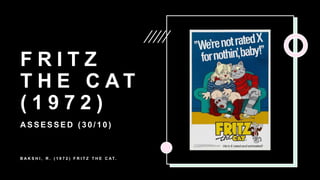
F R I T Z
T H E C A T
( 1 9 7 2 )
A S S E S S E D ( 3 0 / 1 0 )
B A K S H I , R . ( 1 9 7 2 ) F R I T Z T H E C AT.
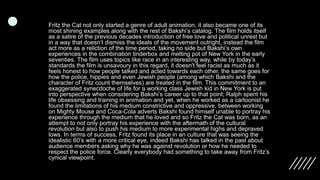
Fritz the Cat not only started a genre of adult animation, it also became one of its
most shining examples along with the rest of Bakshi’s catalog. The film holds itself
as a satire of the previous decades introduction of free love and political unrest but
in a way that doesn’t dismiss the ideals of the movement outright, instead the film
act more as a reliction of the time period, taking no side but Bakshi’s own
experiences in the combination tinderbox and melting pot of New York in the early
seventies. The film uses topics like race in an interesting way, while by today’s
standards the film is unsavoury in this regard, it doesn't feel racist as much as it
feels honest to how people talked and acted towards each other, the same goes for
how the police, hippies and even Jewish people (among which Bakshi and the
character of Fritz count themselves) are treated in the film. This commitment to an
exaggerated synecdoche of life for a working class Jewish kid in New York is put
into perspective when considering Bakshi’s career up to that point; Ralph spent his
life obsessing and training in animation and yet, when he worked as a cartoonist he
found the limitations of his medium constrictive and oppressive, between working
on Mighty Mouse and Coca-Cola adverts Bakshi found himself unable to portray his
experience through the medium that he loved and so Fritz the Cat was born, as an
attempt to not only portray his experience with the aftermath of the cultural
revolution but also to push his medium to more experimental highs and depraved
lows. In terms of success, Fritz found its place in an culture that was seeing the
idealistic 60’s with a more critical eye, indeed Bakshi has talked in the past about
audience members asking why he was against revolution or how he needed to
respect the police force. Clearly everybody had something to take away from Fritz’s
cynical viewpoint.
C A N N I B A L
H O L O C A U S
T : ‘ K E E P
F I L M I N G !
K I L L M O R E
P E O P L E ! ’
A S S E S S E D ( 3 0 / 1 0 )
R O S E , S . ( 2 0 1 1 ) C A N N I B A L
H O L O C A U S T: ‘ K E E P F I L M I N G ! K I L L
M O R E P E O P L E ! ’ .
( h t t p s : / / w w w . t h e g u a r d i a n . c o m / f i l m / 2 0 1 1
/ s e p / 1 5 / c a n n i b a l - h o l o c a u s t )
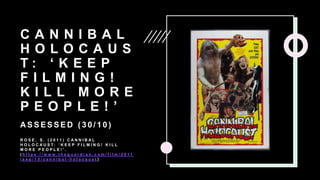
When watching Cannibal Holocaust by itself its easy to interpret it as yet another
escalation in the exploitation genre, with something to say but being too ‘70’s Italian
film’ to be coherent. It’s only when hearing from the horses mouth that Cannibal
holocaust becomes not only tolerable but a meaningful and impressive innovation in
immersive film. The film is half controversy by design, being inspired
sensationalised and violent coverage of the “Red Brigades” militia. The film’s
director: Ruggero Deodato wanted to immerse his audience in events as much as
possible and as such hired relatively unknown actors and had them agree to
‘disappear’ after the films release to reinforce their characters deaths in the film
which, along with the documentary shooting style, got Deodato arrested on
suspicion of murdering his actors. This, if nothing else speaks volumes about how
dedicated Deodato was to making sure his message of media exploitation rang true
with audiences and it did, founding the genre of found footage and blurring the line
between an audience and the media they consume, making one feed off and inform
the other. The success of Cannibal Holocaust can mainly be attributed to its style,
the actual content was almost passé in 1980 given the previous decade’s penchant
for boundary pushing in the exploitation and horror genres. The style of the film
elevated the content of the film, giving an audience a direct connection to the
characters and events unlike anything that had been seen at this point, an audience
was made to feel like an unwilling participant in the horrific actions of the
characters.
N I G H T
O F T H E
L I V I N G
D E A D
( 1 9 6 8 )
A S S E S S E D ( 3 0 / 1 0 )
R O M E R O , G . ( 1 9 6 8 ) N I G H T O F T H E
L I V I N G D E A D .
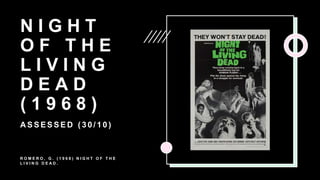
Night of the Living Dead continues to stand alone for many reasons, but in terms of
midnight movies it holds a particular importance as one of the first examples of a
film being shown at a later time because of its niche or unsavoury content; in
October of 1968 a typical horror film was able to be seen by children of any age
because the MPAA was yet to be instated, on top of this, horror films at this point
were typically entertainingly scary, it was thought that an audience should be able to
laugh at itself while watching a horror film. When the general public of 1968 America
was met with a frank breakdown of society by the hands of an unemotional,
unfeeling and unstoppable force, not motivated by ideology but by hunger. The very
central conceit of the film was hard to stomach by the audience of the time, the idea
of the strictly segmented society that praised and relied on authority and military
might falling so quickly in a crisis was an existential terror that went past an
optimistic criticism of authority that was common throughout the mid to late 60’s and
fell straight into a nihilistic fear of an apocalyptic scenario that wasn’t unfounded at
the time. The racial content of the film was also a fairly radical move at the time
given how many other horror films of the past decade would focus on a dashing,
idealised white main character that would destroy any monsters that they came
across with little to no effort, to not only have your main protagonist be a black man,
but a competent if fallible black man that had to deal with morally grey white
characters through the film, was a strong statement at the time. The films
uncompromisingly cynical outlook, social subversion and extreme violence at the
time all lead to the film gaining a reputation and therefore a “forbidden” that would
sell tickets for midnight movies for decades to come.

Up america's ass research.

  • 1.
    “ U P AM E R I C A ’ S A S S ” W H AT M A D E A M I D N I G H T M O V I E ?
  • 2.
    T H E RO C K Y H O R R O R P I C T U R E S H O W ( 1 9 7 5 ) ASSESSED (25/10) S H A R M A N , F. ( 1 9 7 5 ) T H E R O C K Y H O R R O R P I C T U R E S H O W .
  • 3.
    Rocky Horror is,at its core, is a story about the changing social, sexual and cultural landscape that took place through the 1960’s and the 1970’s. Or to put it another way the transition from modernism to post-modernism in art. Rocky Horror uses the genre trappings of pulp sci-fi, gothic fiction and musicals to present this transition. The characters of Brad and Janet are extremely similar to protagonists found in modernist pulp fiction; A pair of conventionally beautiful lovers that fall into the character architypes of the slightly dorky yet confident young man and the slightly ditzy and curious young woman. They see marriage as not only a necessity for their sex life but also for their relationship as a whole. Using the classical horror tropes of a broken down car, back-roads and a stormy night the pair are not confronted with wolfmen or creatures from the black lagoon but instead with a real existential threat to them: A group androgynous eccentrics that openly reference sexuality being lead by a transvestite. Just as the mainly conservative, pious and sexually repressive culture and art of the America of the 60’s and 70’s was meet with a hugely influential counter-culture that openly mocked and criticised the formers styles and values. Throughout the film the modernist pair go from placating and patronising the group to being seduced by the lifestyle and end the film in corsets and stockings having both had pre marital sex with the same transvestite. Through these actions the ideal modernist protagonists have become their own antithesis. Themes of homosexuality, promiscuity and gender role subversion are omni-present and became the main reason for the films cult success. While not initially popular with most audiences, it founds it’s own in the very sub-cultures it was paying homage to. If you were a member of the counter culture deliberately or by necessity: a screening of Rocky Horror was not only a chance to see a person like yourself in the media you consumed but also a chance to celebrate those aspects of life that mainstream media lacked. From the study of Rocky Horror it becomes obvious that a large part of the films success was its openness with taboo subjects and a rejection of the mainstream that attracted a smaller, yet loyal audience that could relate and find entertainment in the subversion.
  • 4.
    T H ER O C K Y H O R R O R P I C T U R E S H O W : T H E F I L M T H A T ’ S S A V E D L I V E SA S S E S S E D ( 2 5 / 1 0 ) I V A N - Z A D E H , L . ( 2 0 2 0 ) T H E R O C K Y H O R R O R P I C T U R E S H O W : T H E F I L M T H A T ’ S S A V E D L I V E S . (https://www.bbc.com/culture/article/20200618-the-rocky- horror-picture-show-the-film-thats-saved-lives)
  • 5.
    “I know alot of people, Rocky Horror is like their home, it’s their connection to everybody – all their friends,” - Larry Viezel: President of the Rocky Horror Picture Show Fan Club. From reading this article its clear that that the main force behind the success of Rocky Horror’s success has been the support of fringe groups. The films initial, 1975 run was a monumental flop with the only success being a few screening at L.A. in which many audience members would watch the films multiple times. The film was screened on the first of April the following year in a well known New York arthouse cinema. In an area that had only 6 six years before experienced what is now considered one the seminal acts in LGBT rights history: The Stonewall Riots. The audience of the screening was a collection of social outcasts and cultural oddities in human form. This audience quickly latched on to the films post-modern take on pulp sci-fi, the openly sexual content of the film and the addition of challenging gender and sexual roles that permeate the film. From that point, Rocky Horror screening became synonymous with the gay community and the growing sub culture in America and Britain. Over the years screenings became interactive with attendees dressing as the characters, singing along with songs and responding to the films dialog. To this day the Rocky Horror is seen as a safe place for members of the LGBTQ community. From studying this article it becomes obvious that Rocky Horror became the phenomenon it is from the themes and subversions that were not common place in mainstream entertainment at the time.
  • 6.
    T H ER O C K Y H O R R O R P I C T U R E S H O W R E V I E W ( 1 9 7 6 ) A S S E S S E D ( 2 5 / 1 0 ) E B E R T, R . ( 1 9 7 6 ) T H E R O C K Y H O R R O R P I C T U R E S H O W (https://www.bbc.com/culture/article/20200618-the-rocky- horror-picture-show-the-film-thats-saved-lives)
  • 7.
    “ ‘The RockyHorror Picture Show’ would be more fun, I suspect, if weren’t a picture show.” - Roger Ebert: Renounced American Film Critic. From reading this article I now have a perspective not only from a source contemporary with Rocky Horror’s release, but also a review that was written prior to the phenomenon of audience participation and the cult classic status that Rocky Horror now enjoys. The most intriguing takeaway from this review is Ebert’s opinion that Rocky Horror lacks the “mutual karma” that comes from live performance and an audience’s participation in that performance. Rodger gives the impression that Rocky Horror is best enjoyed with a implicit understanding that it’s a filmed play, as its choreography, composition and general tone would imply. The rest of the piece is an outline the plot of the film. The most interesting part of the piece is Ebert’s prediction on what would improve the Rocky Horror experience. It’s strange to imagine the film as anything other than a cult classic with audience participation being a huge part of the piece’s cultural impact today, this review not only makes clear that it wasn’t always in that position, but that it was apparent that Rocky Horror could easily harbour a rabid cult audience with its themes, tone and presentation.
  • 8.
    E R AS E R H E A D ( 1 9 7 7 ) A S S E S S E D ( 2 6 / 1 0 ) L Y N C H , D . ( 1 9 7 7 ) E R A S E R H E A D .
  • 9.
    “In heaven, everythingis fine” – Lady in the Radiator: Figure of Hope in Eraserhead. Eraserhead is almost beyond analysis in the medium of film. It comes from the bizarre, abrasive and genius mind of David Lynch: a person who openly makes films for himself and out of his entire catalogue Eraserhead is his most personal. All I can offer in terms of research is my interpretation. In my opinion Eraserhead is the closest filmmaking has ever come to representing a nightmare and the fears on display are that of childbirth, marriage and settling in general. That becomes apparent as the film goes on with sperm-like creatures invading the protagonist’s (Henry) dreams and fantasies. The most apparent figure of these themes is the horrific “baby” that Henry sires with Mary X, this leads to an unhappy and unexpected marriage which quickly breaks down; Henry is subsequently left to care for his child by himself and remains bewildered throughout. Henry’s life unravels, with the baby getting sick and his muse across the hallway from him seeing him as his horrific child with Henry attached, meaning that a relationship in impossible between the two. The only escape Henry is allowed is the lady living in his radiator who tells him that “In heaven, everything is fine.” which, including the lady’s tendency to squish the sperm monsters Henry is haunted by, is possibly an illusion to suicide, contraception or abortion. The success of Eraserhead is the films through line of Henry and his plot that an audience can follow along with. Too often in experimental cinema the genre label is used as a excuse for poor storytelling, but not here; to most audiences Eraserhead will be emotionally relatable if not directly understood. The long, locked down shots and continuous, haunting. soundscape make for an extremely personal style that puts an audience in the same headspace of Henry, bewildered and existentially terrified of the seeming mundane. The films cult film status was obviously somewhat due to the films unique crossroads of experiential and mainstream storytelling styles but also the subversions of modernist tropes, particularly those revolving around the importance and value of family and settling down. Starting a family isn’t presented as a positive, planned for life goal. It’s the endpoint, a self imposed nightmarish prison that comes out of nowhere with no real escape other than death. Meeting your girlfriend’s parents is a terrifying mirror into your own future. The birth of your child is the metaphorical death of you. The theme of dysfunctional families is a strong one throughout post-modern media with Eraserhead being a particularly strong example.
  • 10.
    L Y NC H O N L Y N C H ( 1 9 9 7 ) A S S E S S E D ( 2 6 / 1 0 ) L Y N C H , D . ( 1 9 9 7 ) L Y N C H O N L Y N C H .
  • 11.
    “I just happento like electricity, but I’m not really wild about the new plugs in America.” – David Lynch. While reading “Lynch on Lynch” one is exposed to Lynch’s personality in as pure a form as the written word can allow and to be entirely honest Its hard to parse the useful from the Lynch-isms that, despite being fascinating and informative in a different sense, hold little relevance to the points that I am currently researching. David Lynch is admirable in his ability to keep a child like wonder in his attitude to film; throughout the book David is asked to explain his interpretation of events or how scenes where put together. David tacitly refuses to do so, not out of an egotistic want for a mystique or for a lack of depth of the films part. Instead David has a genuine belief that the elements of mystery in his films that will never be solved, add to the films longevity and tone. This off hand refusal to explain was certainly an aspect of post-modernism but not necessarily a influential one. A large part of the films production fell in line with postmodern production standards of the seventies, that being that the film is headed up by the director and the crew was more like a collective of people passionate about the filmmakers vision, with another example being the “Hippie Commune” that was the set of “Pink Flamingos” or the infamous “Factory” of Andy Warhol. David Lynch made Eraserhead in 5 years with the exact same crew, the film’s star: Jack Nance even kept the exact same haircut for those five years so filming could restarted at any point with continuity being respected. I feel that this book gives great insight into David’s mind at the time of filming and will be a useful resource for later reference.
  • 12.
    P E TE Y W H E A T S T R A W ( 1 9 7 7 ) A S S E S S E D ( 2 7 / 1 0 ) R O Q U E M O R E , C . ( 1 9 7 7 ) P E T E Y W H E AT S T R A W .
  • 13.
    Petey Wheastraw: TheDevil’s Son in Law is a film of extremes, as should be expected from the Blaxploitation genre. For being a low budget Rudy Ray Moore film, Petey Wheatstraw manages to paint an entertaining picture of black life in 1970’s America. The interesting aspect at play throughout Petey Wheatstraw is the absurdity which which the film explores the topic of racism throughout the film in specific the symbol of watermelons. In the opening of the film Petey Wheatstraw is born in ramshackle house but not before a watermelon is delivered before him. Throughout the film nearly every main character inexplicably eats watermelons, the gag culminates in a pick-up truck full of watermelons exploding, covering the neighbourhood in watermelon chunks. The gag clearly plays into the absurdity of the stereotype of watermelons to a ludicrous degree, intentionally making fun of the white audiences that flocked to watch Blaxploitation films through a racist lens. Another not-so-subtle insult to the audience is the plot, revolving around Petey being given a second chance at life and magical powers, with this power Petey doesn’t undo his mistakes or clean up the neighbourhood, instead he embarrasses some local comedians that Petey Doesn't like, the absurd narcissism and selfishness displayed by Petey is another example of a racist stereotype being taken to extreme lengths for commentary and comedy purposes. Petey Wheatstraw is an incredibly imaginative and entertaining film that knows its audience and isn’t afraid to outright criticize them.
  • 14.
    R E EF E R M A D N E S S ( 1 9 3 6 ) A S S E S S E D ( 2 7 / 1 0 ) L O U I S J , G . ( 1 9 3 6 ) R E E F E R M A D N E S S .
  • 15.
    Reefer Madness isa unique success story in the genre of midnight movies given how the audience the piece was indented to reach and the audience it eventually got were entirely separate and in many ways incompatible from each other. Reefer Madness was produced as a piece of propaganda, warning parents about the allegedly destructive affects of marijuana. Like most propaganda films produced at the time, the topic is blown far out of proportion and the film generally exists to shock rather than to inform. Given how vapid and uninformative the film was it would be expected to fall out of popularity as soon as political doctrine changed and for about a decade, it did. The film was allegedly rediscovered when a group of high school seniors in 1970’s LA found the film reels in their schools storage and started screening it for their friends. Regardless of whether that story is true or not it makes perfect sense that Reefer Madness would find an audience at a time when the debate around the use of marijuana was at an impasse and the postmodern, rebellious attitudes towards the politics of “The Ike Years” were at a similar position. The film became a microcosm of the growing unrest permeating across America through the 60’s and 70’s; screenings for Reefer Madness became a gathering of artists, activists, students and potheads coming together to openly and relentlessly mocking the values of the past, thus making the response to the film an openly postmodern one.
  • 16.
    F R EA K S ( 1 9 3 2 ) A S S E S S E D ( 2 7 / 1 0 ) B R O W N I N G , T. ( 1 9 3 2 ) F R E A K S .
  • 17.
    Freaks is anearly example of “Exploration Horror” that would later become a main stay of low budget films going forward. In the America of 1932, where eugenics was a popular practice and even mild deviation from the norm was met with distrust and isolation it makes sense that the most terrifying image for an audience of the time wouldn’t be gothic monsters but instead, a reflection of the aspects of society that didn’t fit within their view of normalcy. As a film, Freaks was an anomaly at the time because instead of using costumes and make-up to create monsters the film used real people with physical disabilities and, in a move that thoroughly horrified audiences of the time, humanises and sympathises with them. This was in direct response to the “us vs them” political views of the time that focused on dehumanising its opponents, so when confronted with a member of “the other’s” personal life in a down to earth way it shocked and outraged audiences. This, for the time, realistic and grounded portrayal of disabled people led to the film acquiring a niche audience that could relate to the underdog status of the film’s subjects. This continues the tradition of cult films being bastions of representation for people from marginalised backgrounds.
  • 18.
    H O WJ O H N W A T E R S A N D M I N K S T O L E M A D E N O T O R I O U S C U L T F I L M P I N K F L A M I N G O S ( 2 0 2 0 ) A S S E S S E D ( 2 7 / 1 0 ) H O A D , P. ( 2 0 2 0 ) H O W J O H N W AT E R S A N D M I N K S T O L E M A D E N O T O R I O U S C U L T F I L M P I N K F L A M I N G O S . ( h t t p s : / / w w w . t h e g u a r d i a n . c o m / f i l m / 2 0 2 0 / m a r / 1 7 / h o w - j o h n - w a t e r s - a n d - m i n k - s t o l e - m a d e - n o t o r i o u s - c u l t - f i l m - p i n k - f l a m i n g o s )
  • 19.
    Its clear fromthe interviews in this article make it clear that Pink flamingos was a product of an America at odds with itself, indeed the film was produced not long after the films director: John Waters had been in attendance the infamous “Manson Family” trail. In terms of filmmaking, after years of exploration filmmaking pushing the boundary's of what could be shown to an audience, pornography has just been legalised and so filmmakers eager to shock found themselves with a new line to cross, for John Waters this gave him inspiration: “things that weren’t illegal on film yet, but should be.” The film is infamous for its raw aesthetic but according to Waters it was heavy rehearsed, lending to how intentional the film and its message actually were. Knowing about how intentional and intense the film was to produce along with the context of the time period adds a new appreciation for the story about an honest and open group of people having to rise above a group of people more focused on publicity and image. The film comes off as an angry celebration, as most Waters films do, of the how culture was responding to events and people like the aforementioned Charles Manson: with cynicism and subversion that got morphed into a status symbol over a genuine want for change. It could even be argued that Pink Flamingos was one of the first: post-postmodern acting as a blunt parody of the boundary pushing auteur that in this case happened to be an obese drag queen that eats dog faeces. After reading this article I have a new appreciation for a film that could’ve, under a less driven director, been another mindless exploitation film with nothing to say or set it apart.
  • 20.
    F R IT Z T H E C A T ( 1 9 7 2 ) A S S E S S E D ( 3 0 / 1 0 ) B A K S H I , R . ( 1 9 7 2 ) F R I T Z T H E C AT.
  • 21.
    Fritz the Catnot only started a genre of adult animation, it also became one of its most shining examples along with the rest of Bakshi’s catalog. The film holds itself as a satire of the previous decades introduction of free love and political unrest but in a way that doesn’t dismiss the ideals of the movement outright, instead the film act more as a reliction of the time period, taking no side but Bakshi’s own experiences in the combination tinderbox and melting pot of New York in the early seventies. The film uses topics like race in an interesting way, while by today’s standards the film is unsavoury in this regard, it doesn't feel racist as much as it feels honest to how people talked and acted towards each other, the same goes for how the police, hippies and even Jewish people (among which Bakshi and the character of Fritz count themselves) are treated in the film. This commitment to an exaggerated synecdoche of life for a working class Jewish kid in New York is put into perspective when considering Bakshi’s career up to that point; Ralph spent his life obsessing and training in animation and yet, when he worked as a cartoonist he found the limitations of his medium constrictive and oppressive, between working on Mighty Mouse and Coca-Cola adverts Bakshi found himself unable to portray his experience through the medium that he loved and so Fritz the Cat was born, as an attempt to not only portray his experience with the aftermath of the cultural revolution but also to push his medium to more experimental highs and depraved lows. In terms of success, Fritz found its place in an culture that was seeing the idealistic 60’s with a more critical eye, indeed Bakshi has talked in the past about audience members asking why he was against revolution or how he needed to respect the police force. Clearly everybody had something to take away from Fritz’s cynical viewpoint.
  • 22.
    C A NN I B A L H O L O C A U S T : ‘ K E E P F I L M I N G ! K I L L M O R E P E O P L E ! ’ A S S E S S E D ( 3 0 / 1 0 ) R O S E , S . ( 2 0 1 1 ) C A N N I B A L H O L O C A U S T: ‘ K E E P F I L M I N G ! K I L L M O R E P E O P L E ! ’ . ( h t t p s : / / w w w . t h e g u a r d i a n . c o m / f i l m / 2 0 1 1 / s e p / 1 5 / c a n n i b a l - h o l o c a u s t )
  • 23.
    When watching CannibalHolocaust by itself its easy to interpret it as yet another escalation in the exploitation genre, with something to say but being too ‘70’s Italian film’ to be coherent. It’s only when hearing from the horses mouth that Cannibal holocaust becomes not only tolerable but a meaningful and impressive innovation in immersive film. The film is half controversy by design, being inspired sensationalised and violent coverage of the “Red Brigades” militia. The film’s director: Ruggero Deodato wanted to immerse his audience in events as much as possible and as such hired relatively unknown actors and had them agree to ‘disappear’ after the films release to reinforce their characters deaths in the film which, along with the documentary shooting style, got Deodato arrested on suspicion of murdering his actors. This, if nothing else speaks volumes about how dedicated Deodato was to making sure his message of media exploitation rang true with audiences and it did, founding the genre of found footage and blurring the line between an audience and the media they consume, making one feed off and inform the other. The success of Cannibal Holocaust can mainly be attributed to its style, the actual content was almost passé in 1980 given the previous decade’s penchant for boundary pushing in the exploitation and horror genres. The style of the film elevated the content of the film, giving an audience a direct connection to the characters and events unlike anything that had been seen at this point, an audience was made to feel like an unwilling participant in the horrific actions of the characters.
  • 24.
    N I GH T O F T H E L I V I N G D E A D ( 1 9 6 8 ) A S S E S S E D ( 3 0 / 1 0 ) R O M E R O , G . ( 1 9 6 8 ) N I G H T O F T H E L I V I N G D E A D .
  • 25.
    Night of theLiving Dead continues to stand alone for many reasons, but in terms of midnight movies it holds a particular importance as one of the first examples of a film being shown at a later time because of its niche or unsavoury content; in October of 1968 a typical horror film was able to be seen by children of any age because the MPAA was yet to be instated, on top of this, horror films at this point were typically entertainingly scary, it was thought that an audience should be able to laugh at itself while watching a horror film. When the general public of 1968 America was met with a frank breakdown of society by the hands of an unemotional, unfeeling and unstoppable force, not motivated by ideology but by hunger. The very central conceit of the film was hard to stomach by the audience of the time, the idea of the strictly segmented society that praised and relied on authority and military might falling so quickly in a crisis was an existential terror that went past an optimistic criticism of authority that was common throughout the mid to late 60’s and fell straight into a nihilistic fear of an apocalyptic scenario that wasn’t unfounded at the time. The racial content of the film was also a fairly radical move at the time given how many other horror films of the past decade would focus on a dashing, idealised white main character that would destroy any monsters that they came across with little to no effort, to not only have your main protagonist be a black man, but a competent if fallible black man that had to deal with morally grey white characters through the film, was a strong statement at the time. The films uncompromisingly cynical outlook, social subversion and extreme violence at the time all lead to the film gaining a reputation and therefore a “forbidden” that would sell tickets for midnight movies for decades to come.