UNPACKING
CURRICULUM
STANDARDS AND
COMPETENCIES
INTRODUCTION
This chapter discusses the process for unpacking
curriculum standards and competincies, which is
one of the most essential tasks teachers in
emplementing the k12 Basic Education Curriculum.
Curriculum Standards are broad statement of what
students need to know and do as a result of
learning.
In the DepED K-12 Curriculum Standards
classified as:
1. Content Standards
2. Performance Standards
The k-12 Curriculum also include larning
competencies
Memorandum Curriculum No. 8 Series 2015.
Difine curriculum standards and learning
competencies as:
Performance standards - The abilities and skills that
the learners are expected to demonstrate in relation
to the content standards and integration of 21st
century skills.
Learning competencies - Refers to the knowledge,
skills and understanding the learners need to
demonstrate in every lesson or activity.
Steps in Unpacking Curriculum
Standards and Competencies
• STEP 1: Classify Standards as knowledge, skills, and
values.
• knowledge if the learning competencies calls for
remembering and basic comprehension Of a
concept or skill.
• Skills if the learning competency calls for the
learner to demonstrate or apply a skill or desired
behavior.
• Values if the learning competency calls for valuing
and appreciation.
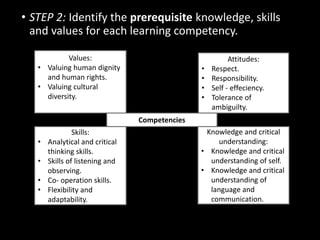
• STEP 2: Identify the prerequisite knowledge, skills
and values for each learning competency.
Competencies
Values:
• Valuing human dignity
and human rights.
• Valuing cultural
diversity.
Skills:
• Analytical and critical
thinking skills.
• Skills of listening and
observing.
• Co- operation skills.
• Flexibility and
adaptability.
Attitudes:
• Respect.
• Responsibility.
• Self - effeciency.
• Tolerance of
ambiguilty.
Knowledge and critical
understanding:
• Knowledge and critical
understanding of self.
• Knowledge and critical
understanding of
language and
communication.
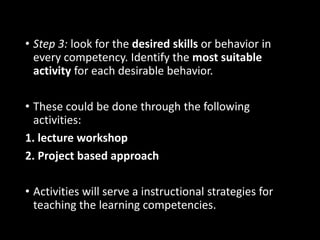
• Step 3: look for the desired skills or behavior in
every competency. Identify the most suitable
activity for each desirable behavior.
• These could be done through the following
activities:
1. lecture workshop
2. Project based approach
• Activities will serve a instructional strategies for
teaching the learning competencies.
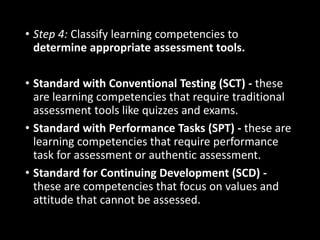
• Step 4: Classify learning competencies to
determine appropriate assessment tools.
• Standard with Conventional Testing (SCT) - these
are learning competencies that require traditional
assessment tools like quizzes and exams.
• Standard with Performance Tasks (SPT) - these are
learning competencies that require performance
task for assessment or authentic assessment.
• Standard for Continuing Development (SCD) -
these are competencies that focus on values and
attitude that cannot be assessed.
Thank you!

UNPACKING CURRI-WPS Office.pptx

  • 1.
  • 2.
    INTRODUCTION This chapter discussesthe process for unpacking curriculum standards and competincies, which is one of the most essential tasks teachers in emplementing the k12 Basic Education Curriculum. Curriculum Standards are broad statement of what students need to know and do as a result of learning.
  • 3.
    In the DepEDK-12 Curriculum Standards classified as: 1. Content Standards 2. Performance Standards
  • 4.
    The k-12 Curriculumalso include larning competencies Memorandum Curriculum No. 8 Series 2015. Difine curriculum standards and learning competencies as: Performance standards - The abilities and skills that the learners are expected to demonstrate in relation to the content standards and integration of 21st century skills. Learning competencies - Refers to the knowledge, skills and understanding the learners need to demonstrate in every lesson or activity.
  • 5.
    Steps in UnpackingCurriculum Standards and Competencies
  • 6.
    • STEP 1:Classify Standards as knowledge, skills, and values. • knowledge if the learning competencies calls for remembering and basic comprehension Of a concept or skill. • Skills if the learning competency calls for the learner to demonstrate or apply a skill or desired behavior. • Values if the learning competency calls for valuing and appreciation.
  • 7.
    • STEP 2:Identify the prerequisite knowledge, skills and values for each learning competency. Competencies Values: • Valuing human dignity and human rights. • Valuing cultural diversity. Skills: • Analytical and critical thinking skills. • Skills of listening and observing. • Co- operation skills. • Flexibility and adaptability. Attitudes: • Respect. • Responsibility. • Self - effeciency. • Tolerance of ambiguilty. Knowledge and critical understanding: • Knowledge and critical understanding of self. • Knowledge and critical understanding of language and communication.
  • 8.
    • Step 3:look for the desired skills or behavior in every competency. Identify the most suitable activity for each desirable behavior. • These could be done through the following activities: 1. lecture workshop 2. Project based approach • Activities will serve a instructional strategies for teaching the learning competencies.
  • 9.
    • Step 4:Classify learning competencies to determine appropriate assessment tools. • Standard with Conventional Testing (SCT) - these are learning competencies that require traditional assessment tools like quizzes and exams. • Standard with Performance Tasks (SPT) - these are learning competencies that require performance task for assessment or authentic assessment. • Standard for Continuing Development (SCD) - these are competencies that focus on values and attitude that cannot be assessed.
  • 10.