What is a competency?
A competency is the capability to apply or use a set of related knowledge, skills, and
abilities required to successfully perform "critical work functions" or tasks in a defined
work setting. Competencies often serve as the basis for skill standards that specify the
level of knowledge, skills, and abilities required for success in the workplace as well as
potential measurement criteria for assessing competency attainment.
The difference between a competency and a learning objective
Competencies define the applied skills and knowledge that enable people to
successfully perform their work while learning objectives are specific to a course of
instruction. Competencies are relevant to an individual’s job responsibilities, roles and
capabilities. They are a way to verify that a learner has in fact learned what was
intended in the learning objectives. Learning objectives describe what the learner
should be able to achieve at the end of a learning period. Learning objectives should be
specific, measurable statements and written in behavioral terms. In short, objectives say
what we want the learners to know and competencies say how we can be certain they
know it.
Here is an example of competencies and learning objectives relating to the
competency:
Competency:
 Utilizes appropriate methods for interacting sensitively, effectively, and
professionally with persons from diverse cultural, socioeconomic, educational,
racial, ethnic and professional backgrounds, and persons of all ages and lifestyle
preferences (competency from: Council on Linkages Between Academia and
Public Health Practice)
Learning objectives from a course that relate to the above competency:
 Describe the demographic trends and epidemiological trends related to diverse
populations in the United States and abroad
 Compare and contrast diversity and cultural competency in the public health
context
 Identify a framework to design culturally competent public health care services
for diverse populations
How to write a competency:
1. Begin with a present tense action verb.
(Example: Convert meters to points and inches.)
2. Each action verb requires an object.
(Example: Identify bacteria, fungi, and parasites.)
(Verb followed by object)
3. Each competency is measurable and/or observable.
(Example: Describe general methods of child study by describing such
procedures as longitudinal study, case study and correlational study.)
4. Each competency is based on performance.
(Example: Evaluate literacy genre from a historical perspective by comparing
and contrasting the literary works in the 19th
Century.)
5. Do not use evaluative or relative adjectives.
(Do not use words like good, effective, appropriate.)
6. Do not use evaluative or relative adverbs.
(Do not use words like quickly, slowly, immediately.)
7. Do not use qualifying phrases.
(Do not use a phrase such as “Write with greater confidence.”)
8. Say what you mean, using only necessary words.
Content
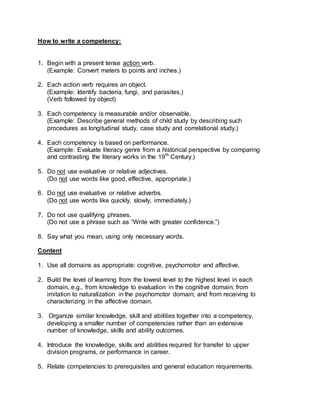
1. Use all domains as appropriate: cognitive, psychomotor and affective.
2. Build the level of learning from the lowest level to the highest level in each
domain, e.g., from knowledge to evaluation in the cognitive domain; from
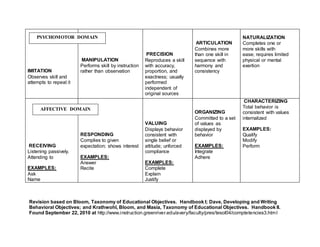
imitation to naturalization in the psychomotor domain; and from receiving to
characterizing in the affective domain.
3. Organize similar knowledge, skill and abilities together into a competency,
developing a smaller number of competencies rather than an extensive
number of knowledge, skills and ability outcomes.
4. Introduce the knowledge, skills and abilities required for transfer to upper
division programs, or performance in career.
5. Relate competencies to prerequisites and general education requirements.
KNOWLEDGE
Recognition and recall of
facts and specifics
EXAMPLES:
Define
Describes
List
State
COMPREHENSION
Interprets, translates,
summarizes, or
paraphrases given
information
EXAMPLES:
Convert
Infer
Rewrite
APPLICATION
Processes
information in
a situation
different from
original
learning
context
EXAMPLES:
Demonstrate
Relate
Produce
ANALYSIS
Separates
whole into
parts; clarifies
relationships
among
elements
EXAMPLES:
Diagram
Outline
Illustrate
SYNTHESIS
Combines
elements to
form new
entity from
original one
EXAMPLES
Compile
Compose
Design
EVALUATION
Makes decisions,
judges, or selects
based on criteria
and rationale
EXAMPLES:
Compare
Contrast
Justify
Summarize
COGNITIVE DOMAIN
Evaluatedesired learning level
LEVELS OF LEARNING
IMITATION
Observes skill and
attempts to repeat it
MANIPULATION
Performs skill by instruction
rather than observation
PRECISION
Reproduces a skill
with accuracy,
proportion, and
exactness; usually
performed
independent of
original sources
ARTICULATION
Combines more
than one skill in
sequence with
harmony and
consistency
NATURALIZATION
Completes one or
more skills with
ease; requires limited
physical or mental
exertion
RECEIVING
Listening passively.
Attending to
EXAMPLES:
Ask
Name
RESPONDING
Complies to given
expectation; shows interest
EXAMPLES:
Answer
Recite
VALUING
Displays behavior
consistent with
single belief or
attitude; unforced
compliance
EXAMPLES:
Complete
Explain
Justify
ORGANIZING
Committed to a set
of values as
displayed by
behavior
EXAMPLES:
Integrate
Adhere
CHARACTERIZING
Total behavior is
consistent with values
internalized
EXAMPLES:
Qualify
Modify
Perform
Revision based on Bloom, Taxonomy of Educational Objectives. Handbook I; Dave, Developing and Writing
Behavioral Objectives; and Krathwohl, Bloom, and Masia, Taxonomy of Educational Objectives. Handbook II.
Found September 22, 2010 at http://www.instruction.greenriver.edu/avery/faculty/pres/tesol04/comptetencies3.html
PSYCHOMOTOR DOMAIN
AFFECTIVE DOMAIN

Competencies-and-Learning-Objectives.pdf

  • 1.
    What is acompetency? A competency is the capability to apply or use a set of related knowledge, skills, and abilities required to successfully perform "critical work functions" or tasks in a defined work setting. Competencies often serve as the basis for skill standards that specify the level of knowledge, skills, and abilities required for success in the workplace as well as potential measurement criteria for assessing competency attainment. The difference between a competency and a learning objective Competencies define the applied skills and knowledge that enable people to successfully perform their work while learning objectives are specific to a course of instruction. Competencies are relevant to an individual’s job responsibilities, roles and capabilities. They are a way to verify that a learner has in fact learned what was intended in the learning objectives. Learning objectives describe what the learner should be able to achieve at the end of a learning period. Learning objectives should be specific, measurable statements and written in behavioral terms. In short, objectives say what we want the learners to know and competencies say how we can be certain they know it. Here is an example of competencies and learning objectives relating to the competency: Competency:  Utilizes appropriate methods for interacting sensitively, effectively, and professionally with persons from diverse cultural, socioeconomic, educational, racial, ethnic and professional backgrounds, and persons of all ages and lifestyle preferences (competency from: Council on Linkages Between Academia and Public Health Practice) Learning objectives from a course that relate to the above competency:  Describe the demographic trends and epidemiological trends related to diverse populations in the United States and abroad  Compare and contrast diversity and cultural competency in the public health context  Identify a framework to design culturally competent public health care services for diverse populations
  • 2.
    How to writea competency: 1. Begin with a present tense action verb. (Example: Convert meters to points and inches.) 2. Each action verb requires an object. (Example: Identify bacteria, fungi, and parasites.) (Verb followed by object) 3. Each competency is measurable and/or observable. (Example: Describe general methods of child study by describing such procedures as longitudinal study, case study and correlational study.) 4. Each competency is based on performance. (Example: Evaluate literacy genre from a historical perspective by comparing and contrasting the literary works in the 19th Century.) 5. Do not use evaluative or relative adjectives. (Do not use words like good, effective, appropriate.) 6. Do not use evaluative or relative adverbs. (Do not use words like quickly, slowly, immediately.) 7. Do not use qualifying phrases. (Do not use a phrase such as “Write with greater confidence.”) 8. Say what you mean, using only necessary words. Content 1. Use all domains as appropriate: cognitive, psychomotor and affective. 2. Build the level of learning from the lowest level to the highest level in each domain, e.g., from knowledge to evaluation in the cognitive domain; from imitation to naturalization in the psychomotor domain; and from receiving to characterizing in the affective domain. 3. Organize similar knowledge, skill and abilities together into a competency, developing a smaller number of competencies rather than an extensive number of knowledge, skills and ability outcomes. 4. Introduce the knowledge, skills and abilities required for transfer to upper division programs, or performance in career. 5. Relate competencies to prerequisites and general education requirements.
  • 3.
    KNOWLEDGE Recognition and recallof facts and specifics EXAMPLES: Define Describes List State COMPREHENSION Interprets, translates, summarizes, or paraphrases given information EXAMPLES: Convert Infer Rewrite APPLICATION Processes information in a situation different from original learning context EXAMPLES: Demonstrate Relate Produce ANALYSIS Separates whole into parts; clarifies relationships among elements EXAMPLES: Diagram Outline Illustrate SYNTHESIS Combines elements to form new entity from original one EXAMPLES Compile Compose Design EVALUATION Makes decisions, judges, or selects based on criteria and rationale EXAMPLES: Compare Contrast Justify Summarize COGNITIVE DOMAIN Evaluatedesired learning level LEVELS OF LEARNING
  • 4.
    IMITATION Observes skill and attemptsto repeat it MANIPULATION Performs skill by instruction rather than observation PRECISION Reproduces a skill with accuracy, proportion, and exactness; usually performed independent of original sources ARTICULATION Combines more than one skill in sequence with harmony and consistency NATURALIZATION Completes one or more skills with ease; requires limited physical or mental exertion RECEIVING Listening passively. Attending to EXAMPLES: Ask Name RESPONDING Complies to given expectation; shows interest EXAMPLES: Answer Recite VALUING Displays behavior consistent with single belief or attitude; unforced compliance EXAMPLES: Complete Explain Justify ORGANIZING Committed to a set of values as displayed by behavior EXAMPLES: Integrate Adhere CHARACTERIZING Total behavior is consistent with values internalized EXAMPLES: Qualify Modify Perform Revision based on Bloom, Taxonomy of Educational Objectives. Handbook I; Dave, Developing and Writing Behavioral Objectives; and Krathwohl, Bloom, and Masia, Taxonomy of Educational Objectives. Handbook II. Found September 22, 2010 at http://www.instruction.greenriver.edu/avery/faculty/pres/tesol04/comptetencies3.html PSYCHOMOTOR DOMAIN AFFECTIVE DOMAIN