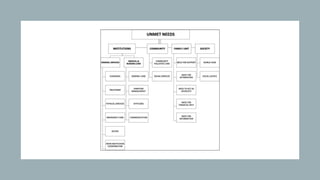
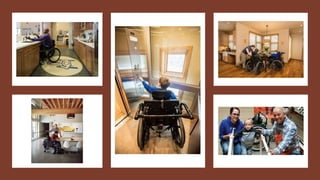
UNMET NEEDS
• Additional and unmet needs
– what do you think this
means?
WORD TO
DESCRIBE UNMET
ARE
• unsatisfied, unfulfilled,
backordered, dissatisfied,
unrealized.
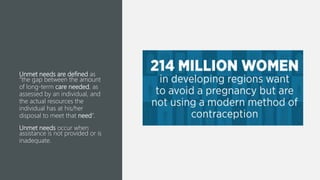
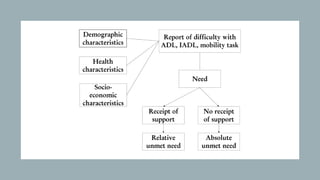
Unmet needs are defined as
“the gap between the amount
of long-term care needed, as
assessed by an individual, and
the actual resources the
individual has at his/her
disposal to meet that need”.
Unmet needs occur when
assistance is not provided or is
inadequate.
UNMET
NEEDS OF
DEMENTIA
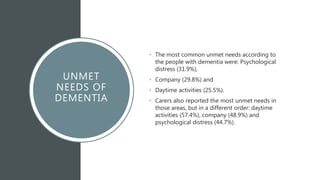
• The most common unmet needs according to
the people with dementia were: Psychological
distress (31.9%),
• Company (29.8%) and
• Daytime activities (25.5%).
• Carers also reported the most unmet needs in
those areas, but in a different order: daytime
activities (57.4%), company (48.9%) and
psychological distress (44.7%).
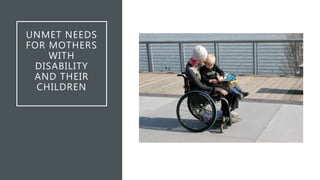
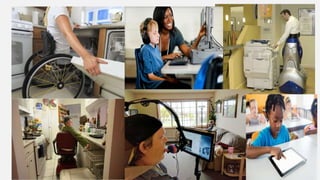
UNMET NEEDS
FOR MOTHERS
WITH
DISABILITY
AND THEIR
CHILDREN
SUPPORTS AND
SERVICES FOR
MOTHERS WITH
DISABILITIES
• Several of the mothers wish that there were more supports and services for parents with disabilities.
• “In-home assistance, affordable care, financial support with out fear of losing benefits.”
• “Not aware of Antenatal classes for disabled pregnant mothers, aftercare/homecare with disabled providers as part of
team.
Childbirth education classes will teach you about:
• how to prepare for labour.
• signs of labour/when to call the hospital.
• stages of a normal labour.
• pain relief options.
• birthing positions.
• relaxation and breathing techniques.
• possible birthing complications.
• birth planning and assistance.
• “Natural supports often come from an integrated, inclusive community. These helps all families.”
• Parenting is hard and they need support in ADL’s.
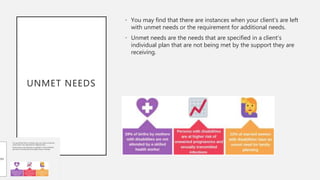
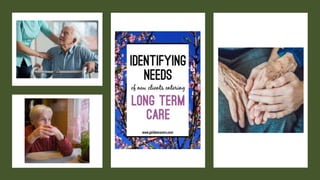
UNMET NEEDS
• You may find that there are instances when your client’s are left
with unmet needs or the requirement for additional needs.
• Unmet needs are the needs that are specified in a client's
individual plan that are not being met by the support they are
receiving.
WHAT ARE
UNMET
EMOTIONAL
NEEDS?
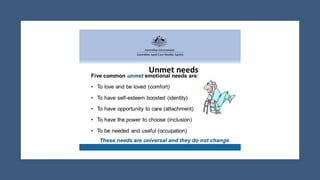
• Some of our emotional
needs are to feel accepted,
appreciated, important,
valued, cared about,
understood. When we don't
feel enough of one of these,
we have an
"unmet emotional need."
Here is a list of
human emotional needs.
UNMET HEALTH
NEEDS
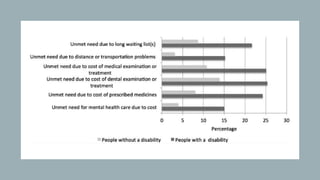
• The factor on unmet
needs for health care are
used to assess equity
to healthcare services.
• They refer to the proportion
of persons aged 15 or over
that felt they
needed health care in the
previous 12 months but did
not receive it for reasons of
financial barriers, long
waiting lists and
transportation problems.
ADDITIONAL
NEEDS
• Additional needs are new
needs that did not originally
apply to your client and were
not initially outlined within
their individualised plan but
have recently surfaced.
Can any of you think of an
additional unmet need for a
client you have worked with?
UNMET NEEDS
ARE OFTEN
ASSOCIATED WITH
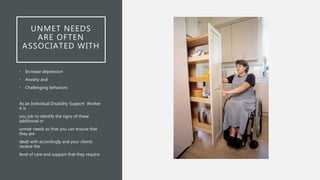
• Increase depression
• Anxiety and
• Challenging behaviors
As an Individual Disability Support Worker
it is
you job to identify the signs of these
additional or
unmet needs so that you can ensure that
they are
dealt with accordingly and your clients
receive the
level of care and support that they require.
SITUATION
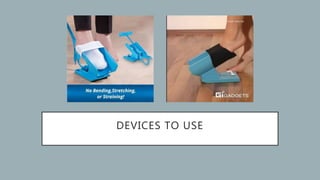
You have a client that is usually able to dress
themselves, In their care plan it specifies that they
wish to do this alone and without your assistance.
Recently, their health has deteriorated and they
cannot bend to put their socks on. You have
noticed that they are struggling each morning and
raise the issue with your superiors. Although it
was not originally stipulated in their care plan, you
think that providing them with extra help so that
they can put their socks on (whether this is help
from yourself or a gadget/device) is an additional
need that should be incorporated into their plan.
DEVICES TO USE
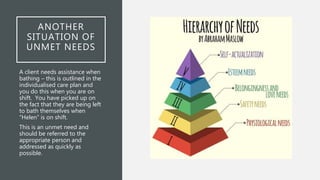
ANOTHER
SITUATION OF
UNMET NEEDS
A client needs assistance when
bathing – this is outlined in the
individualised care plan and
you do this when you are on
shift. You have picked up on
the fact that they are being left
to bath themselves when
“Helen” is on shift.
This is an unmet need and
should be referred to the
appropriate person and
addressed as quickly as
possible.
I N DICATORS T HAT A
P E RSON H AS U NMET
N E E DS.
legal and ethical considerations relevant to individualised
planning and support, and how these are applied in an
organisation and individual practice, including:
• duty of care.
• individual rights and equality.
• constraint.
• imprisonment.
• abuse.
• support in meeting additional expenses when
participating in employment, education and other areas
of life
• employment support.
THE UN DISABILITY
CONVENTION SETS
OUT HOW HUMAN
RIGHTS AND
FREEDOMS APPLY TO
PEOPLE WITH
DISABILITY,
INCLUDING THE
RIGHT TO:
• have the same access as everyone else to the physical environment,
transport, information and communications, and other facilities and
services
• live independently and be included in the community
• equal opportunity and inclusion in education
• the highest attainable standard of health and access to health and
rehabilitation services
• effective measures to ensure the equal right of people with disability to
work, including support for reasonable adjustments to be made to the
work environment
• an adequate standard of living, including access to housing and to
assistance with disability expenses where necessary
• equal recognition before the law and access to justice
• respect for privacy and family relationships
• be free from cruel, inhuman or degrading treatment
• freedom of movement and personal mobility.
T H E R E I S S T R O N G E V I D E N C E O F
C O N T I N U I N G , U N M E T N E E D F O R
D I S A B I L I T Y S E R V I C E S , S U P P O R T
A N D A S S I S T A N C E I N A U S T R A L I A
I N A R E A S I N C L U D I N G :
• personal assistance and care
• support for family carers
• support to live independently
• appropriate accommodation options, including
supported accommodation and respite services
• interpreting services
• education aides and other adjustments to enable
equal opportunity in education
• access to assistive technology
B E HAVIOUR I S A WAY
O F COMMUNICATING
U NMET N E EDS
• Some of your clients with disabilities use
behaviour that can be described as ‘difficult’,
‘hard to manage’, ‘aggressive’ or ‘challenging’.
• This choice of language reflects an underlying
yet misguided belief that the client has control
over his/her decisions and support workers
may respond with a corrective approach to
attempt to manage the behaviour and control
the student.
• Responding to tricky behaviour with negative
consequences can result in a power struggle
between support workers and clients and is
damaging for all relationships.
• Punishment is detrimental and can escalate the
clients behaviour.
IDENTIFIED RISK
• Risk in the workplace goes further than identifying physical
hazards, especially in the care industry. It is your job to identify
and respond to situations of potential or actual risk. When
responding to these risk, you should ensure that it is within the
scope of your own role.
Common hazards and risks in aged care
• lifting, supporting and moving patients.
• moving and handling equipment such as beds, mattresses,
trolleys and wheelchairs.
• occupational violence.
• work-related stress.
• bullying and harassment.
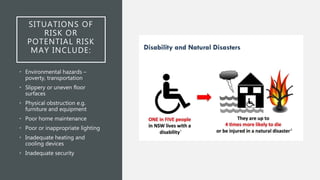
SITUATIONS OF
RISK OR
POTENTIAL RISK
MAY INCLUDE:
• Environmental hazards –
poverty, transportation
• Slippery or uneven floor
surfaces
• Physical obstruction e.g.
furniture and equipment
• Poor home maintenance
• Poor or inappropriate lighting
• Inadequate heating and
cooling devices
• Inadequate security
OTHER RISK
FACTORS
• Evidence of abuse
• Evidence of self-harm
• Evidence of self-neglect
• Impaired cognitive functioning
• Impaired judgement and problem solving
abilities
• Social rights infringements
• Sudden or unexpected change in health status,
including sensory loss
• Uncharacteristic or behaviors of concern
• The items of this list should be well-know and
understood by Individual support workers, who
should be trained to recognise signs and know
the appropriate action to take.
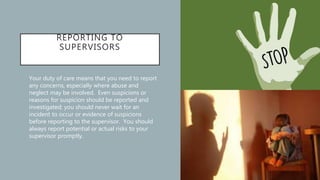
REPORTING TO
SUPERVISORS
• Your duty of care means that you need to report
any concerns, especially where abuse and
neglect may be involved. Even suspicions or
reasons for suspicion should be reported and
investigated; you should never wait for an
incident to occur or evidence of suspicions
before reporting to the supervisor. You should
always report potential or actual risks to your
supervisor promptly.
RISKS
RISKS IN THE WORK PLACE CAN INCLUDE:
• Risk
• Loose carpets
• Wet floor
• Broken equipment
• Poor lighting
• Aggressive client
• Moving clients and equipment
• Response
• Glue/staple or cordoned off until professional
comes to fix floor
• Mop or cordoned off until cleaners arrive
• Tag and label broken equipment and store
until repaired by qualified personal
• Put in better lighting
• Professional assessment of triggers and
causes
• Follow correct techniques and safe manual
handling techniques.
THE END

Unmet needs and risks

  • 2.
    UNMET NEEDS • Additionaland unmet needs – what do you think this means?
  • 3.
    WORD TO DESCRIBE UNMET ARE •unsatisfied, unfulfilled, backordered, dissatisfied, unrealized.
  • 6.
    Unmet needs aredefined as “the gap between the amount of long-term care needed, as assessed by an individual, and the actual resources the individual has at his/her disposal to meet that need”. Unmet needs occur when assistance is not provided or is inadequate.
  • 7.
    UNMET NEEDS OF DEMENTIA • Themost common unmet needs according to the people with dementia were: Psychological distress (31.9%), • Company (29.8%) and • Daytime activities (25.5%). • Carers also reported the most unmet needs in those areas, but in a different order: daytime activities (57.4%), company (48.9%) and psychological distress (44.7%).
  • 9.
  • 10.
    SUPPORTS AND SERVICES FOR MOTHERSWITH DISABILITIES • Several of the mothers wish that there were more supports and services for parents with disabilities. • “In-home assistance, affordable care, financial support with out fear of losing benefits.” • “Not aware of Antenatal classes for disabled pregnant mothers, aftercare/homecare with disabled providers as part of team. Childbirth education classes will teach you about: • how to prepare for labour. • signs of labour/when to call the hospital. • stages of a normal labour. • pain relief options. • birthing positions. • relaxation and breathing techniques. • possible birthing complications. • birth planning and assistance. • “Natural supports often come from an integrated, inclusive community. These helps all families.” • Parenting is hard and they need support in ADL’s.
  • 11.
    UNMET NEEDS • Youmay find that there are instances when your client’s are left with unmet needs or the requirement for additional needs. • Unmet needs are the needs that are specified in a client's individual plan that are not being met by the support they are receiving.
  • 12.
    WHAT ARE UNMET EMOTIONAL NEEDS? • Someof our emotional needs are to feel accepted, appreciated, important, valued, cared about, understood. When we don't feel enough of one of these, we have an "unmet emotional need." Here is a list of human emotional needs.
  • 13.
    UNMET HEALTH NEEDS • Thefactor on unmet needs for health care are used to assess equity to healthcare services. • They refer to the proportion of persons aged 15 or over that felt they needed health care in the previous 12 months but did not receive it for reasons of financial barriers, long waiting lists and transportation problems.
  • 14.
    ADDITIONAL NEEDS • Additional needsare new needs that did not originally apply to your client and were not initially outlined within their individualised plan but have recently surfaced. Can any of you think of an additional unmet need for a client you have worked with?
  • 20.
    UNMET NEEDS ARE OFTEN ASSOCIATEDWITH • Increase depression • Anxiety and • Challenging behaviors As an Individual Disability Support Worker it is you job to identify the signs of these additional or unmet needs so that you can ensure that they are dealt with accordingly and your clients receive the level of care and support that they require.
  • 21.
    SITUATION You have aclient that is usually able to dress themselves, In their care plan it specifies that they wish to do this alone and without your assistance. Recently, their health has deteriorated and they cannot bend to put their socks on. You have noticed that they are struggling each morning and raise the issue with your superiors. Although it was not originally stipulated in their care plan, you think that providing them with extra help so that they can put their socks on (whether this is help from yourself or a gadget/device) is an additional need that should be incorporated into their plan.
  • 22.
  • 23.
    ANOTHER SITUATION OF UNMET NEEDS Aclient needs assistance when bathing – this is outlined in the individualised care plan and you do this when you are on shift. You have picked up on the fact that they are being left to bath themselves when “Helen” is on shift. This is an unmet need and should be referred to the appropriate person and addressed as quickly as possible.
  • 24.
    I N DICATORST HAT A P E RSON H AS U NMET N E E DS. legal and ethical considerations relevant to individualised planning and support, and how these are applied in an organisation and individual practice, including: • duty of care. • individual rights and equality. • constraint. • imprisonment. • abuse. • support in meeting additional expenses when participating in employment, education and other areas of life • employment support.
  • 25.
    THE UN DISABILITY CONVENTIONSETS OUT HOW HUMAN RIGHTS AND FREEDOMS APPLY TO PEOPLE WITH DISABILITY, INCLUDING THE RIGHT TO: • have the same access as everyone else to the physical environment, transport, information and communications, and other facilities and services • live independently and be included in the community • equal opportunity and inclusion in education • the highest attainable standard of health and access to health and rehabilitation services • effective measures to ensure the equal right of people with disability to work, including support for reasonable adjustments to be made to the work environment • an adequate standard of living, including access to housing and to assistance with disability expenses where necessary • equal recognition before the law and access to justice • respect for privacy and family relationships • be free from cruel, inhuman or degrading treatment • freedom of movement and personal mobility.
  • 26.
    T H ER E I S S T R O N G E V I D E N C E O F C O N T I N U I N G , U N M E T N E E D F O R D I S A B I L I T Y S E R V I C E S , S U P P O R T A N D A S S I S T A N C E I N A U S T R A L I A I N A R E A S I N C L U D I N G : • personal assistance and care • support for family carers • support to live independently • appropriate accommodation options, including supported accommodation and respite services • interpreting services • education aides and other adjustments to enable equal opportunity in education • access to assistive technology
  • 27.
    B E HAVIOURI S A WAY O F COMMUNICATING U NMET N E EDS • Some of your clients with disabilities use behaviour that can be described as ‘difficult’, ‘hard to manage’, ‘aggressive’ or ‘challenging’. • This choice of language reflects an underlying yet misguided belief that the client has control over his/her decisions and support workers may respond with a corrective approach to attempt to manage the behaviour and control the student. • Responding to tricky behaviour with negative consequences can result in a power struggle between support workers and clients and is damaging for all relationships. • Punishment is detrimental and can escalate the clients behaviour.
  • 28.
    IDENTIFIED RISK • Riskin the workplace goes further than identifying physical hazards, especially in the care industry. It is your job to identify and respond to situations of potential or actual risk. When responding to these risk, you should ensure that it is within the scope of your own role. Common hazards and risks in aged care • lifting, supporting and moving patients. • moving and handling equipment such as beds, mattresses, trolleys and wheelchairs. • occupational violence. • work-related stress. • bullying and harassment.
  • 29.
    SITUATIONS OF RISK OR POTENTIALRISK MAY INCLUDE: • Environmental hazards – poverty, transportation • Slippery or uneven floor surfaces • Physical obstruction e.g. furniture and equipment • Poor home maintenance • Poor or inappropriate lighting • Inadequate heating and cooling devices • Inadequate security
  • 30.
    OTHER RISK FACTORS • Evidenceof abuse • Evidence of self-harm • Evidence of self-neglect • Impaired cognitive functioning • Impaired judgement and problem solving abilities • Social rights infringements • Sudden or unexpected change in health status, including sensory loss • Uncharacteristic or behaviors of concern • The items of this list should be well-know and understood by Individual support workers, who should be trained to recognise signs and know the appropriate action to take.
  • 31.
    REPORTING TO SUPERVISORS • Yourduty of care means that you need to report any concerns, especially where abuse and neglect may be involved. Even suspicions or reasons for suspicion should be reported and investigated; you should never wait for an incident to occur or evidence of suspicions before reporting to the supervisor. You should always report potential or actual risks to your supervisor promptly.
  • 32.
    RISKS RISKS IN THEWORK PLACE CAN INCLUDE: • Risk • Loose carpets • Wet floor • Broken equipment • Poor lighting • Aggressive client • Moving clients and equipment • Response • Glue/staple or cordoned off until professional comes to fix floor • Mop or cordoned off until cleaners arrive • Tag and label broken equipment and store until repaired by qualified personal • Put in better lighting • Professional assessment of triggers and causes • Follow correct techniques and safe manual handling techniques.
  • 33.