www.social-care.tv
Product Syllabus:
c What is anxiety
c When anxiety becomes a problem
c Effects
c Symptoms
c Contributing factors
c Parental behaviour
c Triggers
c Health issues
c Diet
c Smoking
c Caffeine
c Anticipatory anxiety
c Situational anxiety
c Generalised Anxiety Disorder
c Social phobia
c Panic Disorder
c Agoraphobia
c Specific phobias
c Post Traumatic Stress Disorder
c Obsessive Compulsive Disorder
c Consequences
c Treatment
c CBT
c Exercise
c Relaxation
c Sleep
c Breathing techniques
c Herbal remedies
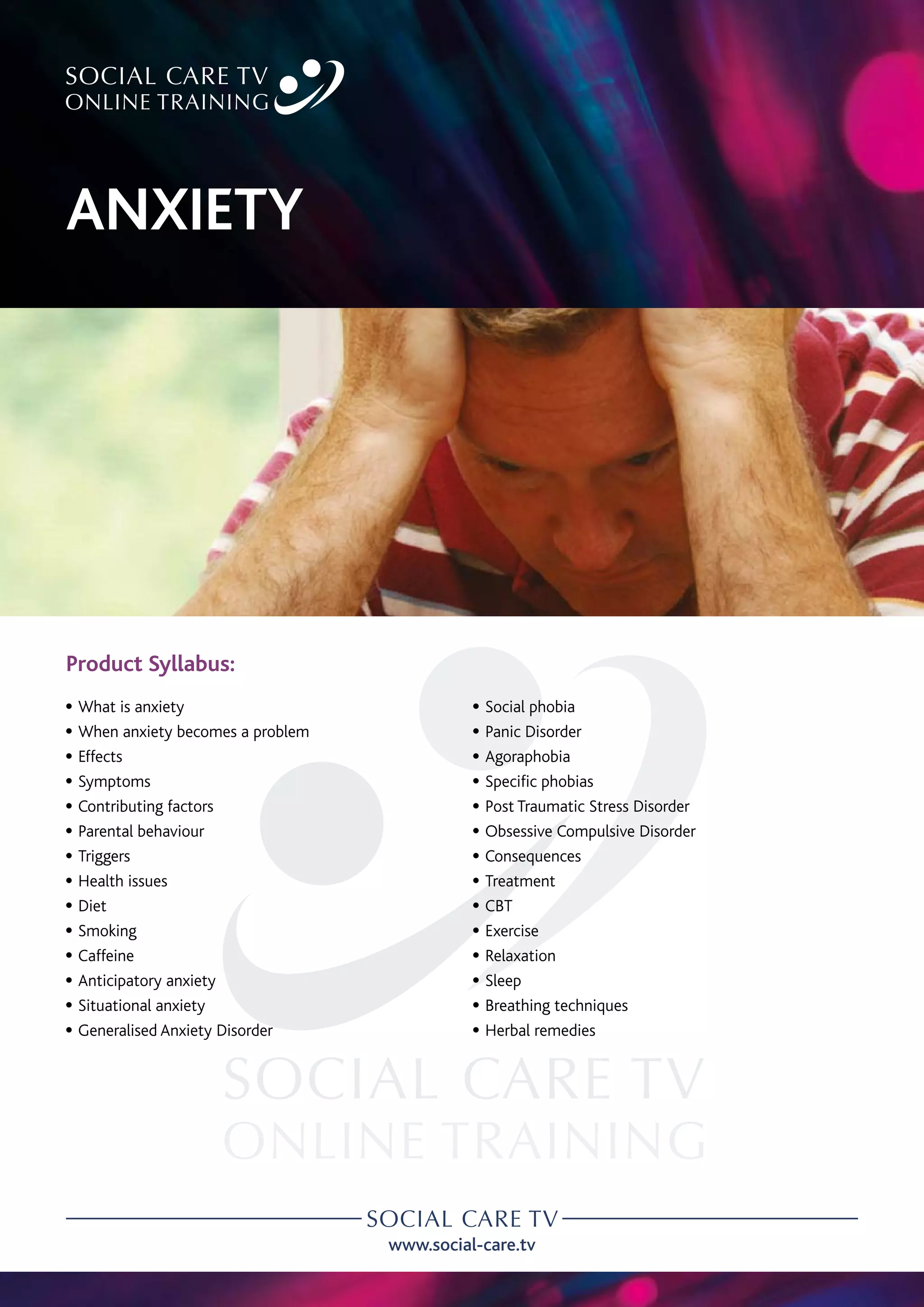
ANXIETY
www.social-care.tv
Product Syllabus:
c Importance
c What is assessing needs?
c Adapting your service
c Who can assess
c Types of needs
c Status needs
c Satisfying needs
c Understanding needs
c Building relationships
c Person centred care
c Needs, wishes & preferences
c Assessing competently
c Reviewing assessments
c Record keeping
c Confidentiality
c Consent
c Timing
c Assessing needs vs. care planning
c Communication
c Interviewing skills
c Accessing documents
c Transporting documents
c Data protection
c Updating assessments
c Types of assessments
c Observation
c Outcomes
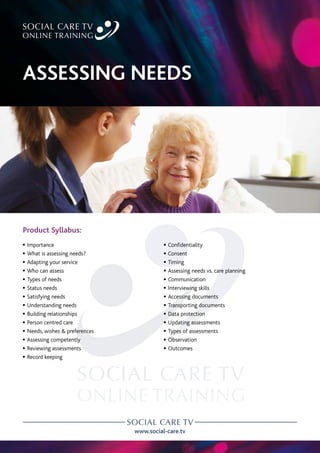
ASSESSING NEEDS
www.social-care.tv
Product Syllabus:
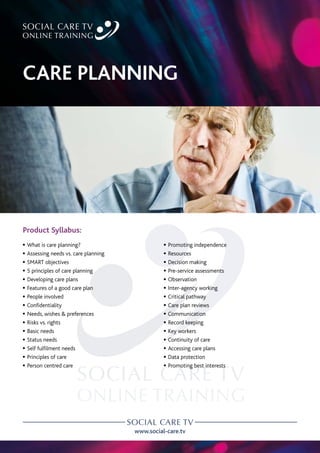
CARE PLANNING
c What is care planning?
c Assessing needs vs. care planning
c SMART objectives
c 5 principles of care planning
c Developing care plans
c Features of a good care plan
c People involved
c Confidentiality
c Needs, wishes & preferences
c Risks vs. rights
c Basic needs
c Status needs
c Self fulfilment needs
c Principles of care
c Person centred care
c Promoting independence
c Resources
c Decision making
c Pre-service assessments
c Observation
c Inter-agency working
c Critical pathway
c Care plan reviews
c Communication
c Record keeping
c Key workers
c Continuity of care
c Accessing care plans
c Data protection
c Promoting best interests
www.social-care.tv
Product Syllabus:
c Behavioural disorders
c Fear and anger
c Violence and aggression
c Effects of challenging behaviour
c Risk assessment
c Incident prevention
c The grinding down effect of challenging behaviour
c Risk reduction
c Flash points
c Triggers
c Predictability
c Warning signs
c Verbal warning signs
c Non verbal warning signs
c Physical threats
c Disaster! The situation has,“kicked off”
c Escalation of a problem
c Defusing a situation
c Communication
c Body language
c Breakaway techniques
c Reasonable force
c Restraint
c Nothing is going to stop the problem - what to do?
c Supporting colleagues
c Working alone
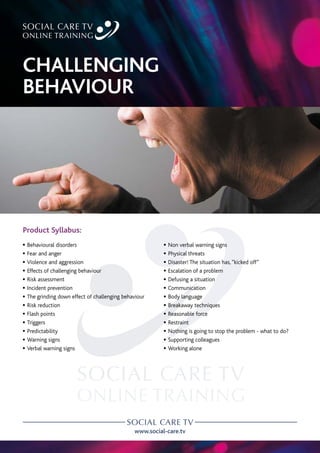
CHALLENGING
BEHAVIOUR
www.social-care.tv
Product Syllabus:
c Definition of child abuse
c Definition of child safeguarding
c Children’s rights
c Parental responsibility
c Policies and procedures
c Physical abuse
c Injuries in children
c Signs of physical abuse
c Fabricated or induced illness
c Emotional abuse
c Signs of emotional abuse
c Institutional abuse
c Child sexual abuse
c Signs of sexual abuse
c Child sexual exploitation
c Paedophiles
c Grooming
c Female genital mutilation
c Child neglect
c Signs of neglect
c Child trafficking
c Modern slavery
c Forced marriage
c County lines
c Domestic abuse
c Online abuse
c Radicalisation
c Behaviours in abused children
c Consequences of child abuse
c Adverse childhood experiences
c Post-traumatic stress disorder
c Smacking and restraint
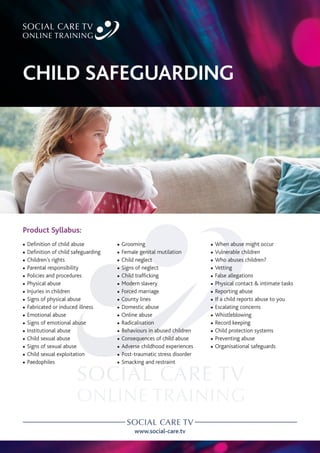
CHILD SAFEGUARDING
c When abuse might occur
c Vulnerable children
c Who abuses children?
c Vetting
c False allegations
c Physical contact & intimate tasks
c Reporting abuse
c If a child reports abuse to you
c Escalating concerns
c Whistleblowing
c Record keeping
c Child protection systems
c Preventing abuse
c Organisational safeguards
www.social-care.tv
Product Syllabus:
c Motivating communication
c Communication techniques
c Verbal communication
c Non-verbal communication
c Behavioural communication
c Communicating responsibly
c Supporting needs, wishes and preferences
c Privacy & dignity
c Confidentiality
c Sharing information appropriately
c Gossip
c Barriers
c Blocks
c Questioning techniques
c Open questions
c Closed questions
c Prompting and probing
c Silence as a communication tool
c Listening
c Active listening
c Reflective listening
c Empathy
c Eye contact
c Facial expressions
c Gestures
c Body language
c Physical contact, touch
c Personal space
c Dealing with misunderstandings
c Syndromes, conditions and communication
c Hearing problems
c Sight problems
c Communication aids
c 
Introduction to communication theories such as
Johari Window and Transactional Analysis
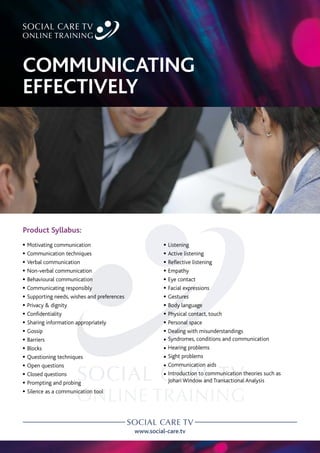
COMMUNICATING
EFFECTIVELY
www.social-care.tv
Product Syllabus:
c What is consent
c Competence
c Refusing treatment
c Informed decisions
c Communication
c Preferences
c Giving consent
c When to gain consent
c Validity
c Informed consent
c Express consent
c Implied consent
c Factors affecting consent
c Treating without consent
c Withdrawing consent
c Mental capacity
c Advocates
c Consent  the courts
c Record keeping
c Promoting consent
c Risk taking
c Rights vs. responsibilities
c Promoting best interests
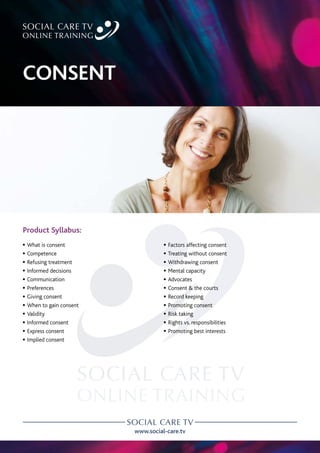
CONSENT
www.social-care.tv
Product Syllabus:
c What substances hazardous to health are
c Health responsibilities in the workplace
c Safe storage
c Safe disposal
c Employer’s duties
c Employee’s duties
c Risk assessment
c The assessment process
c What if something does go wrong?
c Hazard warning labels
c Data sheets (safety data sheets)
c Chemicals
c Diluting and decanting
c Using chemicals safely
c Substances are more than just chemicals
c Waste - regular
c Waste - clinical
c Micro-organisms
c Infection control
c Communicable diseases
c Fumes
c Dust
c Shavings
c Respiratory hazards
c Medication
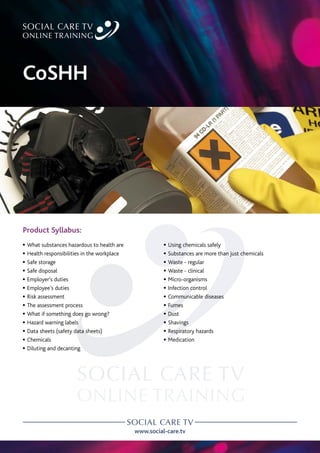
CoSHH
www.social-care.tv
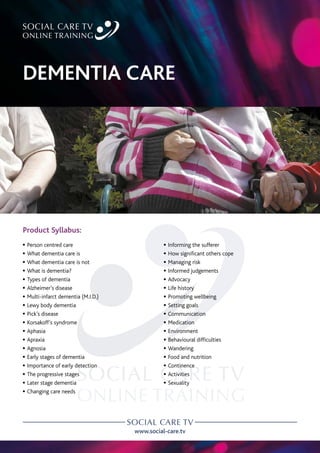
Product Syllabus:
c Person centred care
c What dementia care is
c What dementia care is not
c What is dementia?
c Types of dementia
c Alzheimer’s disease
c Multi-infarct dementia (M.I.D.)
c Lewy body dementia
c Pick’s disease
c Korsakoff’s syndrome
c Aphasia
c Apraxia
c Agnosia
c Early stages of dementia
c Importance of early detection
c The progressive stages
c Later stage dementia
c Changing care needs
c Informing the sufferer
c How significant others cope
c Managing risk
c Informed judgements
c Advocacy
c Life history
c Promoting wellbeing
c Setting goals
c Communication
c Medication
c Environment
c Behavioural difficulties
c Wandering
c Food and nutrition
c Continence
c Activities
c Sexuality
DEMENTIA CARE
www.social-care.tv
Product Syllabus:
c What development is about
c Basic duties and how they develop
c Dealing with change
c Sources of information
c The role of your manager
c Working with others
c The roles of others
c Being supported
c Giving support
c Taking responsibility
c Being accountable
c Seeking help
c Human needs and their development
c Taking care of yourself
c Health promotion
c Nutrition and diet
c Sleep problems
c Stress
c Reflective practice
c Supervision
c Personal development plans
c Delivering best practice care
c Training
c Gaining skills
c Feedback
c Health and social care qualifications
DEVELOP AS
A WORKER
www.social-care.tv
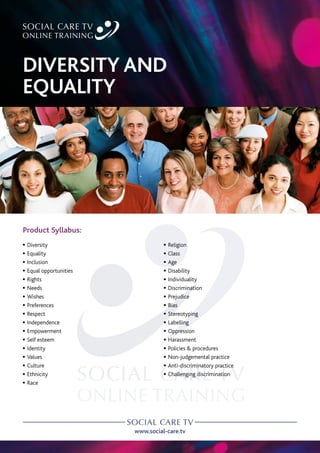
Product Syllabus:
c Diversity
c Equality
c Inclusion
c Equal opportunities
c Rights
c Needs
c Wishes
c Preferences
c Respect
c Independence
c Empowerment
c Self esteem
c Identity
c Values
c Culture
c Ethnicity
c Race
c Religion
c Class
c Age
c Disability
c Individuality
c Discrimination
c Prejudice
c Bias
c Stereotyping
c Labelling
c Oppression
c Harassment
c Policies  procedures
c Non-judgemental practice
c Anti-discriminatory practice
c Challenging discrimination
DIVERSITY AND
EQUALITY
www.social-care.tv
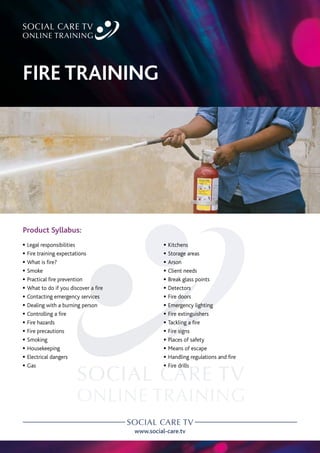
Product Syllabus:
c Legal responsibilities
c Fire training expectations
c What is fire?
c Smoke
c Practical fire prevention
c What to do if you discover a fire
c Contacting emergency services
c Dealing with a burning person
c Controlling a fire
c Fire hazards
c Fire precautions
c Smoking
c Housekeeping
c Electrical dangers
c Gas
c Kitchens
c Storage areas
c Arson
c Client needs
c Break glass points
c Detectors
c Fire doors
c Emergency lighting
c Fire extinguishers
c Tackling a fire
c Fire signs
c Places of safety
c Means of escape
c Handling regulations and fire
c Fire drills
FIRE TRAINING
www.social-care.tv
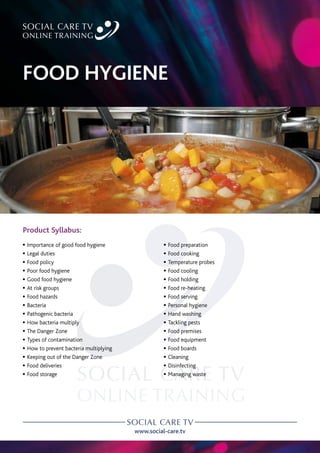
Product Syllabus:
c Importance of good food hygiene
c Legal duties
c Food policy
c Poor food hygiene
c Good food hygiene
c At risk groups
c Food hazards
c Bacteria
c Pathogenic bacteria
c How bacteria multiply
c The Danger Zone
c Types of contamination
c How to prevent bacteria multiplying
c Keeping out of the Danger Zone
c Food deliveries
c Food storage
c Food preparation
c Food cooking
c Temperature probes
c Food cooling
c Food holding
c Food re-heating
c Food serving
c Personal hygiene
c Hand washing
c Tackling pests
c Food premises
c Food equipment
c Food boards
c Cleaning
c Disinfecting
c Managing waste
FOOD HYGIENE
www.social-care.tv
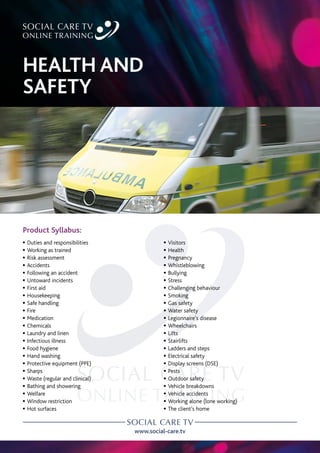
Product Syllabus:
c Duties and responsibilities
c Working as trained
c Risk assessment
c Accidents
c Following an accident
c Untoward incidents
c First aid
c Housekeeping
c Safe handling
c Fire
c Medication
c Chemicals
c Laundry and linen
c Infectious illness
c Food hygiene
c Hand washing
c Protective equipment (PPE)
c Sharps
c Waste (regular and clinical)
c Bathing and showering
c Welfare
c Window restriction
c Hot surfaces
c Visitors
c Health
c Pregnancy
c Whistleblowing
c Bullying
c Stress
c Challenging behaviour
c Smoking
c Gas safety
c Water safety
c Legionnaire’s disease
c Wheelchairs
c Lifts
c Stairlifts
c Ladders and steps
c Electrical safety
c Display screens (DSE)
c Pests
c Outdoor safety
c Vehicle breakdowns
c Vehicle accidents
c Working alone (lone working)
c The client’s home
HEALTH AND
SAFETY
www.social-care.tv
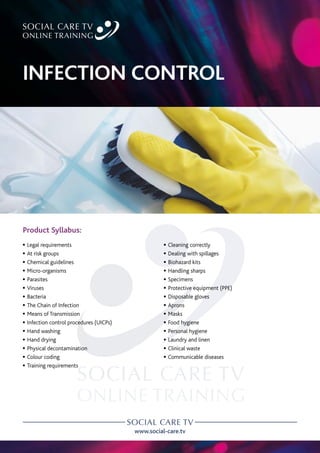
Product Syllabus:
c Legal requirements
c At risk groups
c Chemical guidelines
c Micro-organisms
c Parasites
c Viruses
c Bacteria
c The Chain of Infection
c Means of Transmission
c Infection control procedures (UICPs)
c Hand washing
c Hand drying
c Physical decontamination
c Colour coding
c Training requirements
c Cleaning correctly
c Dealing with spillages
c Biohazard kits
c Handling sharps
c Specimens
c Protective equipment (PPE)
c Disposable gloves
c Aprons
c Masks
c Food hygiene
c Personal hygiene
c Laundry and linen
c Clinical waste
c Communicable diseases
INFECTION CONTROL
www.social-care.tv
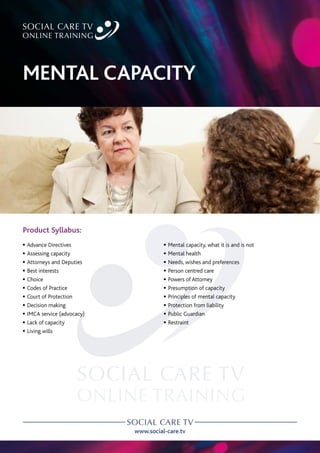
Product Syllabus:
c Advance Directives
c Assessing capacity
c Attorneys and Deputies
c Best interests
c Choice
c Codes of Practice
c Court of Protection
c Decision making
c IMCA service (advocacy)
c Lack of capacity
c Living wills
c Mental capacity, what it is and is not
c Mental health
c Needs, wishes and preferences
c Person centred care
c Powers of Attorney
c Presumption of capacity
c Principles of mental capacity
c Protection from liability
c Public Guardian
c Restraint
MENTAL CAPACITY
www.social-care.tv
Product Syllabus:
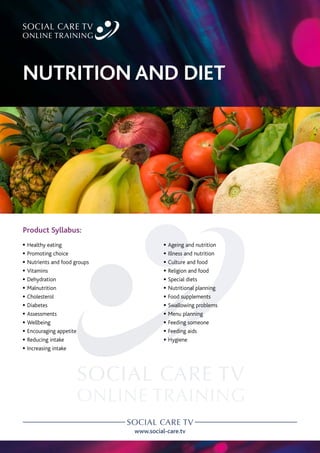
c Healthy eating
c Promoting choice
c Nutrients and food groups
c Vitamins
c Dehydration
c Malnutrition
c Cholesterol
c Diabetes
c Assessments
c Wellbeing
c Encouraging appetite
c Reducing intake
c Increasing intake
c Ageing and nutrition
c Illness and nutrition
c Culture and food
c Religion and food
c Special diets
c Nutritional planning
c Food supplements
c Swallowing problems
c Menu planning
c Feeding someone
c Feeding aids
c Hygiene
NUTRITION AND DIET
www.social-care.tv
Product Syllabus:
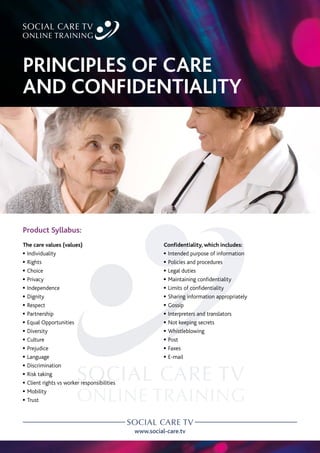
The care values (values)
c Individuality
c Rights
c Choice
c Privacy
c Independence
c Dignity
c Respect
c Partnership
c Equal Opportunities
c Diversity
c Culture
c Prejudice
c Language
c Discrimination
c Risk taking
c Client rights vs worker responsibilities
c Mobility
c Trust
Confidentiality, which includes:
c Intended purpose of information
c Policies and procedures
c Legal duties
c Maintaining confidentiality
c Limits of confidentiality
c Sharing information appropriately
c Gossip
c Interpreters and translators
c Not keeping secrets
c Whistleblowing
c Post
c Faxes
c E-mail
PRINCIPLES OF CARE
AND CONFIDENTIALITY
www.social-care.tv
Product Syllabus:
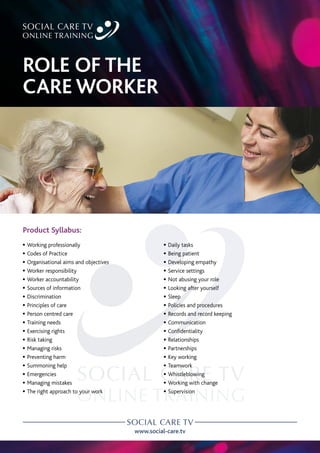
c Working professionally
c Codes of Practice
c Organisational aims and objectives
c Worker responsibility
c Worker accountability
c Sources of information
c Discrimination
c Principles of care
c Person centred care
c Training needs
c Exercising rights
c Risk taking
c Managing risks
c Preventing harm
c Summoning help
c Emergencies
c Managing mistakes
c The right approach to your work
c Daily tasks
c Being patient
c Developing empathy
c Service settings
c Not abusing your role
c Looking after yourself
c Sleep
c Policies and procedures
c Records and record keeping
c Communication
c Confidentiality
c Relationships
c Partnerships
c Key working
c Teamwork
c Whistleblowing
c Working with change
c Supervision
ROLE OF THE
CARE WORKER
www.social-care.tv
Product Syllabus:
•
• Abuse and neglect
•
• 6 key principles of safeguarding
•
• Criminal offences
•
• Risk assessment
•
• Vulnerable adults
•
• The abuse of power
•
• Violating rights
•
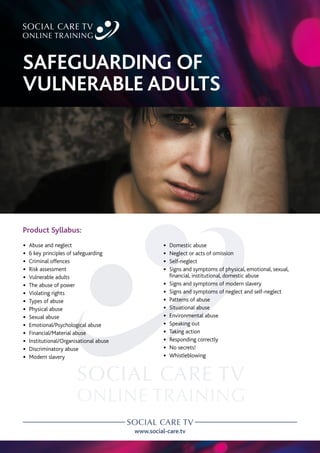
• Types of abuse
•
• Physical abuse
•
• Sexual abuse
•
• Emotional/Psychological abuse
•
• Financial/Material abuse
•
• Institutional/Organisational abuse
•
• Discriminatory abuse
•
• Modern slavery
•
• Domestic abuse
•
• Neglect or acts of omission
•
• Self-neglect
•
• 
Signs and symptoms of physical, emotional, sexual,
financial, institutional, domestic abuse
•
• Signs and symptoms of modern slavery
•
• Signs and symptoms of neglect and self-neglect
•
• Patterns of abuse
•
• Situational abuse
•
• Environmental abuse
•
• Speaking out
•
• Taking action
•
• Responding correctly
•
• No secrets!
•
• Whistleblowing
SAFEGUARDING OF
VULNERABLE ADULTS

Care certificate-induction

  • 1.
    www.social-care.tv Product Syllabus: c Whatis anxiety c When anxiety becomes a problem c Effects c Symptoms c Contributing factors c Parental behaviour c Triggers c Health issues c Diet c Smoking c Caffeine c Anticipatory anxiety c Situational anxiety c Generalised Anxiety Disorder c Social phobia c Panic Disorder c Agoraphobia c Specific phobias c Post Traumatic Stress Disorder c Obsessive Compulsive Disorder c Consequences c Treatment c CBT c Exercise c Relaxation c Sleep c Breathing techniques c Herbal remedies ANXIETY
  • 2.
    www.social-care.tv Product Syllabus: c Importance cWhat is assessing needs? c Adapting your service c Who can assess c Types of needs c Status needs c Satisfying needs c Understanding needs c Building relationships c Person centred care c Needs, wishes & preferences c Assessing competently c Reviewing assessments c Record keeping c Confidentiality c Consent c Timing c Assessing needs vs. care planning c Communication c Interviewing skills c Accessing documents c Transporting documents c Data protection c Updating assessments c Types of assessments c Observation c Outcomes ASSESSING NEEDS
  • 3.
    www.social-care.tv Product Syllabus: CARE PLANNING cWhat is care planning? c Assessing needs vs. care planning c SMART objectives c 5 principles of care planning c Developing care plans c Features of a good care plan c People involved c Confidentiality c Needs, wishes & preferences c Risks vs. rights c Basic needs c Status needs c Self fulfilment needs c Principles of care c Person centred care c Promoting independence c Resources c Decision making c Pre-service assessments c Observation c Inter-agency working c Critical pathway c Care plan reviews c Communication c Record keeping c Key workers c Continuity of care c Accessing care plans c Data protection c Promoting best interests
  • 4.
    www.social-care.tv Product Syllabus: c Behaviouraldisorders c Fear and anger c Violence and aggression c Effects of challenging behaviour c Risk assessment c Incident prevention c The grinding down effect of challenging behaviour c Risk reduction c Flash points c Triggers c Predictability c Warning signs c Verbal warning signs c Non verbal warning signs c Physical threats c Disaster! The situation has,“kicked off” c Escalation of a problem c Defusing a situation c Communication c Body language c Breakaway techniques c Reasonable force c Restraint c Nothing is going to stop the problem - what to do? c Supporting colleagues c Working alone CHALLENGING BEHAVIOUR
  • 5.
    www.social-care.tv Product Syllabus: c Definitionof child abuse c Definition of child safeguarding c Children’s rights c Parental responsibility c Policies and procedures c Physical abuse c Injuries in children c Signs of physical abuse c Fabricated or induced illness c Emotional abuse c Signs of emotional abuse c Institutional abuse c Child sexual abuse c Signs of sexual abuse c Child sexual exploitation c Paedophiles c Grooming c Female genital mutilation c Child neglect c Signs of neglect c Child trafficking c Modern slavery c Forced marriage c County lines c Domestic abuse c Online abuse c Radicalisation c Behaviours in abused children c Consequences of child abuse c Adverse childhood experiences c Post-traumatic stress disorder c Smacking and restraint CHILD SAFEGUARDING c When abuse might occur c Vulnerable children c Who abuses children? c Vetting c False allegations c Physical contact & intimate tasks c Reporting abuse c If a child reports abuse to you c Escalating concerns c Whistleblowing c Record keeping c Child protection systems c Preventing abuse c Organisational safeguards
  • 6.
    www.social-care.tv Product Syllabus: c Motivatingcommunication c Communication techniques c Verbal communication c Non-verbal communication c Behavioural communication c Communicating responsibly c Supporting needs, wishes and preferences c Privacy & dignity c Confidentiality c Sharing information appropriately c Gossip c Barriers c Blocks c Questioning techniques c Open questions c Closed questions c Prompting and probing c Silence as a communication tool c Listening c Active listening c Reflective listening c Empathy c Eye contact c Facial expressions c Gestures c Body language c Physical contact, touch c Personal space c Dealing with misunderstandings c Syndromes, conditions and communication c Hearing problems c Sight problems c Communication aids c Introduction to communication theories such as Johari Window and Transactional Analysis COMMUNICATING EFFECTIVELY
  • 7.
    www.social-care.tv Product Syllabus: c Whatis consent c Competence c Refusing treatment c Informed decisions c Communication c Preferences c Giving consent c When to gain consent c Validity c Informed consent c Express consent c Implied consent c Factors affecting consent c Treating without consent c Withdrawing consent c Mental capacity c Advocates c Consent the courts c Record keeping c Promoting consent c Risk taking c Rights vs. responsibilities c Promoting best interests CONSENT
  • 8.
    www.social-care.tv Product Syllabus: c Whatsubstances hazardous to health are c Health responsibilities in the workplace c Safe storage c Safe disposal c Employer’s duties c Employee’s duties c Risk assessment c The assessment process c What if something does go wrong? c Hazard warning labels c Data sheets (safety data sheets) c Chemicals c Diluting and decanting c Using chemicals safely c Substances are more than just chemicals c Waste - regular c Waste - clinical c Micro-organisms c Infection control c Communicable diseases c Fumes c Dust c Shavings c Respiratory hazards c Medication CoSHH
  • 9.
    www.social-care.tv Product Syllabus: c Personcentred care c What dementia care is c What dementia care is not c What is dementia? c Types of dementia c Alzheimer’s disease c Multi-infarct dementia (M.I.D.) c Lewy body dementia c Pick’s disease c Korsakoff’s syndrome c Aphasia c Apraxia c Agnosia c Early stages of dementia c Importance of early detection c The progressive stages c Later stage dementia c Changing care needs c Informing the sufferer c How significant others cope c Managing risk c Informed judgements c Advocacy c Life history c Promoting wellbeing c Setting goals c Communication c Medication c Environment c Behavioural difficulties c Wandering c Food and nutrition c Continence c Activities c Sexuality DEMENTIA CARE
  • 10.
    www.social-care.tv Product Syllabus: c Whatdevelopment is about c Basic duties and how they develop c Dealing with change c Sources of information c The role of your manager c Working with others c The roles of others c Being supported c Giving support c Taking responsibility c Being accountable c Seeking help c Human needs and their development c Taking care of yourself c Health promotion c Nutrition and diet c Sleep problems c Stress c Reflective practice c Supervision c Personal development plans c Delivering best practice care c Training c Gaining skills c Feedback c Health and social care qualifications DEVELOP AS A WORKER
  • 11.
    www.social-care.tv Product Syllabus: c Diversity cEquality c Inclusion c Equal opportunities c Rights c Needs c Wishes c Preferences c Respect c Independence c Empowerment c Self esteem c Identity c Values c Culture c Ethnicity c Race c Religion c Class c Age c Disability c Individuality c Discrimination c Prejudice c Bias c Stereotyping c Labelling c Oppression c Harassment c Policies procedures c Non-judgemental practice c Anti-discriminatory practice c Challenging discrimination DIVERSITY AND EQUALITY
  • 12.
    www.social-care.tv Product Syllabus: c Legalresponsibilities c Fire training expectations c What is fire? c Smoke c Practical fire prevention c What to do if you discover a fire c Contacting emergency services c Dealing with a burning person c Controlling a fire c Fire hazards c Fire precautions c Smoking c Housekeeping c Electrical dangers c Gas c Kitchens c Storage areas c Arson c Client needs c Break glass points c Detectors c Fire doors c Emergency lighting c Fire extinguishers c Tackling a fire c Fire signs c Places of safety c Means of escape c Handling regulations and fire c Fire drills FIRE TRAINING
  • 13.
    www.social-care.tv Product Syllabus: c Importanceof good food hygiene c Legal duties c Food policy c Poor food hygiene c Good food hygiene c At risk groups c Food hazards c Bacteria c Pathogenic bacteria c How bacteria multiply c The Danger Zone c Types of contamination c How to prevent bacteria multiplying c Keeping out of the Danger Zone c Food deliveries c Food storage c Food preparation c Food cooking c Temperature probes c Food cooling c Food holding c Food re-heating c Food serving c Personal hygiene c Hand washing c Tackling pests c Food premises c Food equipment c Food boards c Cleaning c Disinfecting c Managing waste FOOD HYGIENE
  • 14.
    www.social-care.tv Product Syllabus: c Dutiesand responsibilities c Working as trained c Risk assessment c Accidents c Following an accident c Untoward incidents c First aid c Housekeeping c Safe handling c Fire c Medication c Chemicals c Laundry and linen c Infectious illness c Food hygiene c Hand washing c Protective equipment (PPE) c Sharps c Waste (regular and clinical) c Bathing and showering c Welfare c Window restriction c Hot surfaces c Visitors c Health c Pregnancy c Whistleblowing c Bullying c Stress c Challenging behaviour c Smoking c Gas safety c Water safety c Legionnaire’s disease c Wheelchairs c Lifts c Stairlifts c Ladders and steps c Electrical safety c Display screens (DSE) c Pests c Outdoor safety c Vehicle breakdowns c Vehicle accidents c Working alone (lone working) c The client’s home HEALTH AND SAFETY
  • 15.
    www.social-care.tv Product Syllabus: c Legalrequirements c At risk groups c Chemical guidelines c Micro-organisms c Parasites c Viruses c Bacteria c The Chain of Infection c Means of Transmission c Infection control procedures (UICPs) c Hand washing c Hand drying c Physical decontamination c Colour coding c Training requirements c Cleaning correctly c Dealing with spillages c Biohazard kits c Handling sharps c Specimens c Protective equipment (PPE) c Disposable gloves c Aprons c Masks c Food hygiene c Personal hygiene c Laundry and linen c Clinical waste c Communicable diseases INFECTION CONTROL
  • 16.
    www.social-care.tv Product Syllabus: c AdvanceDirectives c Assessing capacity c Attorneys and Deputies c Best interests c Choice c Codes of Practice c Court of Protection c Decision making c IMCA service (advocacy) c Lack of capacity c Living wills c Mental capacity, what it is and is not c Mental health c Needs, wishes and preferences c Person centred care c Powers of Attorney c Presumption of capacity c Principles of mental capacity c Protection from liability c Public Guardian c Restraint MENTAL CAPACITY
  • 17.
    www.social-care.tv Product Syllabus: c Healthyeating c Promoting choice c Nutrients and food groups c Vitamins c Dehydration c Malnutrition c Cholesterol c Diabetes c Assessments c Wellbeing c Encouraging appetite c Reducing intake c Increasing intake c Ageing and nutrition c Illness and nutrition c Culture and food c Religion and food c Special diets c Nutritional planning c Food supplements c Swallowing problems c Menu planning c Feeding someone c Feeding aids c Hygiene NUTRITION AND DIET
  • 18.
    www.social-care.tv Product Syllabus: The carevalues (values) c Individuality c Rights c Choice c Privacy c Independence c Dignity c Respect c Partnership c Equal Opportunities c Diversity c Culture c Prejudice c Language c Discrimination c Risk taking c Client rights vs worker responsibilities c Mobility c Trust Confidentiality, which includes: c Intended purpose of information c Policies and procedures c Legal duties c Maintaining confidentiality c Limits of confidentiality c Sharing information appropriately c Gossip c Interpreters and translators c Not keeping secrets c Whistleblowing c Post c Faxes c E-mail PRINCIPLES OF CARE AND CONFIDENTIALITY
  • 19.
    www.social-care.tv Product Syllabus: c Workingprofessionally c Codes of Practice c Organisational aims and objectives c Worker responsibility c Worker accountability c Sources of information c Discrimination c Principles of care c Person centred care c Training needs c Exercising rights c Risk taking c Managing risks c Preventing harm c Summoning help c Emergencies c Managing mistakes c The right approach to your work c Daily tasks c Being patient c Developing empathy c Service settings c Not abusing your role c Looking after yourself c Sleep c Policies and procedures c Records and record keeping c Communication c Confidentiality c Relationships c Partnerships c Key working c Teamwork c Whistleblowing c Working with change c Supervision ROLE OF THE CARE WORKER
  • 20.
    www.social-care.tv Product Syllabus: • • Abuseand neglect • • 6 key principles of safeguarding • • Criminal offences • • Risk assessment • • Vulnerable adults • • The abuse of power • • Violating rights • • Types of abuse • • Physical abuse • • Sexual abuse • • Emotional/Psychological abuse • • Financial/Material abuse • • Institutional/Organisational abuse • • Discriminatory abuse • • Modern slavery • • Domestic abuse • • Neglect or acts of omission • • Self-neglect • • Signs and symptoms of physical, emotional, sexual, financial, institutional, domestic abuse • • Signs and symptoms of modern slavery • • Signs and symptoms of neglect and self-neglect • • Patterns of abuse • • Situational abuse • • Environmental abuse • • Speaking out • • Taking action • • Responding correctly • • No secrets! • • Whistleblowing SAFEGUARDING OF VULNERABLE ADULTS