A Double Concept of
Mentoring: Vertical
Learning Communities
at a Large Research
University
Michele Rabkin & Maura Nolan
2
3
Traditional goals of the research
university
• Conduct research
• Publish research
• Produce new PhDs
• …and educate undergraduates
4
Changing context
• Public pressure to focus on undergraduate education
• More diverse student body
• Less prepared student body
5
Liberal arts college model
• Small student population
• Small class sizes
• Intensive faculty-student interaction
6
Research university challenges
• Large student population
• Large class sizes
• Faculty must balance teaching and research
7
Learning community model
• Intentional
• Collaborative learning
• Academic subject matter
• Social interactions
• Intellectually stimulating environment
• Sense of belonging
• Increased commitment
8
Learning community types
• Curricular
• Classroom
• Residential
• Student-type
9
Participating in learning communities is uniformly and
positively linked with student academic performance,
engagement in educationally fruitful activities (such as
academic integration, active and collaborative learning, and
interaction with faculty members), gains associated with
college attendance, and overall satisfaction with the college
experience.
--Zhao & Kuh, 2004
Sample: 80,479 first-year and senior students randomly
selected from 364 four-year colleges and universities and who
completed the National Survey of Student Engagement in the
spring of 2002.
10
Liberal arts college model =
Learning community model
11
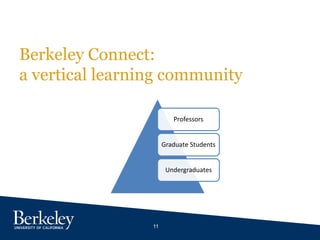
Berkeley Connect:
a vertical learning community
Professors
Graduate Students
Undergraduates
12
New learning community type
• Curricular not based on existing curriculum
• Classroom not part of pre-existing course
• Residential open to all students (residential and commuter)
• Student-type open to all students (not honors or remedial)
13
Learning community
characteristics
• Intentional
• Collaborative learning
• Academic subject matter
• Social interactions
• Intellectually stimulating environment
• Sense of belonging
• Increased commitment
14
• Architecture
• English
• Environmental Science, Policy, and Management (ESPM)
• Ethnic Studies & African American Studies
• History
• Math
• Music
• Philosophy
• Physics
• Sociology
15
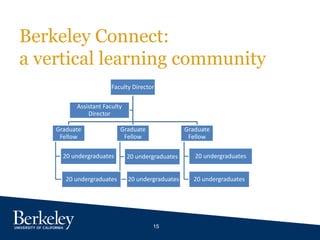
Berkeley Connect:
a vertical learning community
Faculty Director
Graduate
Fellow
20 undergraduates
20 undergraduates
Graduate
Fellow
20 undergraduates
20 undergraduates
Graduate
Fellow
20 undergraduates
20 undergraduates
Assistant Faculty
Director
16
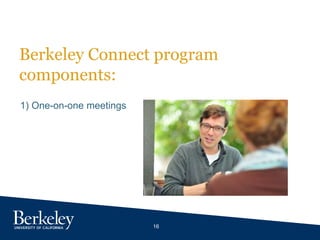
Berkeley Connect program
components:
1) One-on-one meetings
17
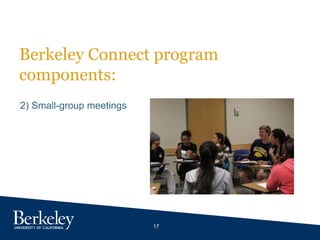
Berkeley Connect program
components:
2) Small-group meetings
18
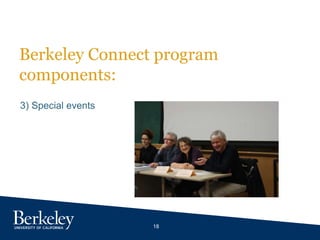
Berkeley Connect program
components:
3) Special events
19
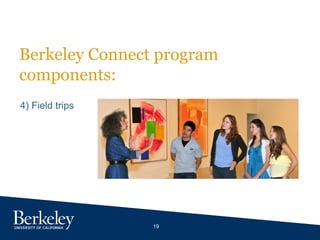
Berkeley Connect program
components:
4) Field trips
20
21
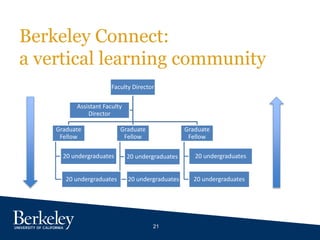
Berkeley Connect:
a vertical learning community
Faculty Director
Graduate
Fellow
20 undergraduates
20 undergraduates
Graduate
Fellow
20 undergraduates
20 undergraduates
Graduate
Fellow
20 undergraduates
20 undergraduates
Assistant Faculty
Director
22
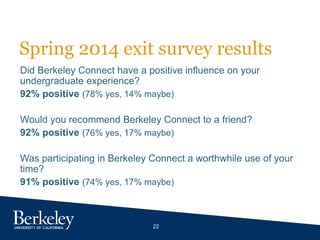
Spring 2014 exit survey results
Did Berkeley Connect have a positive influence on your
undergraduate experience?
92% positive (78% yes, 14% maybe)
Would you recommend Berkeley Connect to a friend?
92% positive (76% yes, 17% maybe)
Was participating in Berkeley Connect a worthwhile use of your
time?
91% positive (74% yes, 17% maybe)
23
24
berkeleyconnect.berkeley.edu

UNM PowerPoint

  • 1.
    A Double Conceptof Mentoring: Vertical Learning Communities at a Large Research University Michele Rabkin & Maura Nolan
  • 2.
  • 3.
    3 Traditional goals ofthe research university • Conduct research • Publish research • Produce new PhDs • …and educate undergraduates
  • 4.
    4 Changing context • Publicpressure to focus on undergraduate education • More diverse student body • Less prepared student body
  • 5.
    5 Liberal arts collegemodel • Small student population • Small class sizes • Intensive faculty-student interaction
  • 6.
    6 Research university challenges •Large student population • Large class sizes • Faculty must balance teaching and research
  • 7.
    7 Learning community model •Intentional • Collaborative learning • Academic subject matter • Social interactions • Intellectually stimulating environment • Sense of belonging • Increased commitment
  • 8.
    8 Learning community types •Curricular • Classroom • Residential • Student-type
  • 9.
    9 Participating in learningcommunities is uniformly and positively linked with student academic performance, engagement in educationally fruitful activities (such as academic integration, active and collaborative learning, and interaction with faculty members), gains associated with college attendance, and overall satisfaction with the college experience. --Zhao & Kuh, 2004 Sample: 80,479 first-year and senior students randomly selected from 364 four-year colleges and universities and who completed the National Survey of Student Engagement in the spring of 2002.
  • 10.
    10 Liberal arts collegemodel = Learning community model
  • 11.
    11 Berkeley Connect: a verticallearning community Professors Graduate Students Undergraduates
  • 12.
    12 New learning communitytype • Curricular not based on existing curriculum • Classroom not part of pre-existing course • Residential open to all students (residential and commuter) • Student-type open to all students (not honors or remedial)
  • 13.
    13 Learning community characteristics • Intentional •Collaborative learning • Academic subject matter • Social interactions • Intellectually stimulating environment • Sense of belonging • Increased commitment
  • 14.
    14 • Architecture • English •Environmental Science, Policy, and Management (ESPM) • Ethnic Studies & African American Studies • History • Math • Music • Philosophy • Physics • Sociology
  • 15.
    15 Berkeley Connect: a verticallearning community Faculty Director Graduate Fellow 20 undergraduates 20 undergraduates Graduate Fellow 20 undergraduates 20 undergraduates Graduate Fellow 20 undergraduates 20 undergraduates Assistant Faculty Director
  • 16.
  • 17.
  • 18.
  • 19.
  • 20.
  • 21.
    21 Berkeley Connect: a verticallearning community Faculty Director Graduate Fellow 20 undergraduates 20 undergraduates Graduate Fellow 20 undergraduates 20 undergraduates Graduate Fellow 20 undergraduates 20 undergraduates Assistant Faculty Director
  • 22.
    22 Spring 2014 exitsurvey results Did Berkeley Connect have a positive influence on your undergraduate experience? 92% positive (78% yes, 14% maybe) Would you recommend Berkeley Connect to a friend? 92% positive (76% yes, 17% maybe) Was participating in Berkeley Connect a worthwhile use of your time? 91% positive (74% yes, 17% maybe)
  • 23.
  • 24.