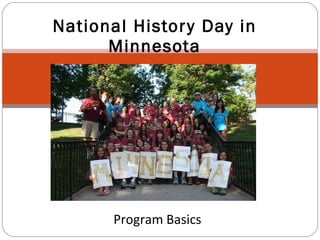
National History Day in Minnesota Program Basics
What is History Day? Research based Teacher-driven Builds skills – research, writing, reading, organization Connects to Social Studies and ELA research standards
What is History Day? “ NHD students outperform their non-HD peers on state standardized tests in multiple subjects, including reading, science and math, as well as social studies.” (p.5) “ NHD students are critical thinkers who can digest, analyze and synthesize information.” (p. 8) “ NHD students learn 21 st  century college- and career- ready skills. They learn to collaborate with team members, talk to experts, manage their time and persevere.” (p. 8)
What is History Day? Student decisions: Topic selection – World, American, Minnesota, etc. Individual or group (up to 5) Presentation format (website, documentary, performance, exhibit, paper) Research – library, archive, historic site, database Teacher’s Rule Workshops School Visits by staff Mentors Materials – Master Teacher Network
Models of History Day Participation Social Studies/ History Classroom Assignment Projects usually account for 25 to 50% of overall grade Students advancing to HD events usually receive extra credit for participation Minimum of 10 weeks to complete the assignment  Alternative Classroom Enrichment Assignment Students have completed the standard curriculum  Students can choose to substitute an in-depth research assignment or other tests to participate in History Day  Gifted/Talented Enrichment Activity HD is offered as part of menu of co-curricular and extra curricular activities Classroom credit is optional
Theme 2012 Revolution, Reaction, Reform in History Revolution – an overthrow and replacement of an established government; radical and pervasive change in society and social structure; sudden, complete or marked change in something; cycle of successive events or changes Reaction – action in response to some influence or event Reform – the improvement or amendment of what is wrong, corrupt, or unsatisfactory; to change to a better state or form 2013 – Turning Points in History
Program Structure in Minnesota Program Coordinator Program Specialists/ Associates Library Partners (CRPSLA, Wilson,  Minitex, SCSU, SELCO, etc.) U of MN T.A./ Mentors MNSCU mentors Misc. History Day operatives ex.  Historic sites Local/ County historical  societies former History Day participants Judges
The Contest  National Event:  Univ. of MD, College Park June, 2012 Regional Events: Defined by ECSU boundaries, 13 contests occur throughout the month of March – 4500 students participate at colleges and universities. State Event:  University of Minnesota, Twin Cities April 29, 2012 School Events: Take place in individual schools, organized by a lead teacher or coordinator—generally occur in February - 30,000 student participation Junior  - Grades 6 -8 Senior  - Grades 9 - 12
Assessment  - Historical Quality
Assessment  - Connection to the Theme
Assessment - Clarity of Presentation

Program Overview Mankato

  • 1.
    National History Dayin Minnesota Program Basics
  • 2.
    What is HistoryDay? Research based Teacher-driven Builds skills – research, writing, reading, organization Connects to Social Studies and ELA research standards
  • 3.
    What is HistoryDay? “ NHD students outperform their non-HD peers on state standardized tests in multiple subjects, including reading, science and math, as well as social studies.” (p.5) “ NHD students are critical thinkers who can digest, analyze and synthesize information.” (p. 8) “ NHD students learn 21 st century college- and career- ready skills. They learn to collaborate with team members, talk to experts, manage their time and persevere.” (p. 8)
  • 4.
    What is HistoryDay? Student decisions: Topic selection – World, American, Minnesota, etc. Individual or group (up to 5) Presentation format (website, documentary, performance, exhibit, paper) Research – library, archive, historic site, database Teacher’s Rule Workshops School Visits by staff Mentors Materials – Master Teacher Network
  • 5.
    Models of HistoryDay Participation Social Studies/ History Classroom Assignment Projects usually account for 25 to 50% of overall grade Students advancing to HD events usually receive extra credit for participation Minimum of 10 weeks to complete the assignment Alternative Classroom Enrichment Assignment Students have completed the standard curriculum Students can choose to substitute an in-depth research assignment or other tests to participate in History Day Gifted/Talented Enrichment Activity HD is offered as part of menu of co-curricular and extra curricular activities Classroom credit is optional
  • 6.
    Theme 2012 Revolution,Reaction, Reform in History Revolution – an overthrow and replacement of an established government; radical and pervasive change in society and social structure; sudden, complete or marked change in something; cycle of successive events or changes Reaction – action in response to some influence or event Reform – the improvement or amendment of what is wrong, corrupt, or unsatisfactory; to change to a better state or form 2013 – Turning Points in History
  • 7.
    Program Structure inMinnesota Program Coordinator Program Specialists/ Associates Library Partners (CRPSLA, Wilson, Minitex, SCSU, SELCO, etc.) U of MN T.A./ Mentors MNSCU mentors Misc. History Day operatives ex. Historic sites Local/ County historical societies former History Day participants Judges
  • 8.
    The Contest National Event: Univ. of MD, College Park June, 2012 Regional Events: Defined by ECSU boundaries, 13 contests occur throughout the month of March – 4500 students participate at colleges and universities. State Event: University of Minnesota, Twin Cities April 29, 2012 School Events: Take place in individual schools, organized by a lead teacher or coordinator—generally occur in February - 30,000 student participation Junior - Grades 6 -8 Senior - Grades 9 - 12
  • 9.
    Assessment -Historical Quality
  • 10.
    Assessment -Connection to the Theme
  • 11.
    Assessment - Clarityof Presentation

Editor's Notes

  • #6 History Day program is being used many different ways in the classroom Ultimately we do no stress the competition/winning aspect of the program – in Minneapolis SPAN (Special Program for Adolescent Needs) students complete History Day projects
  • #8 Volunteers – retired teachers/ professors, MHS staff, mentors, former participants, friends, family, etc.