Unlocking DevOps
Security
Here is where your presentation begins
01 02
03 04
Table of contents
Kubernetes Security
CI/CD Pipeline
Security
Infrastructure
Security
IAM in DevOps
(Keycloak)
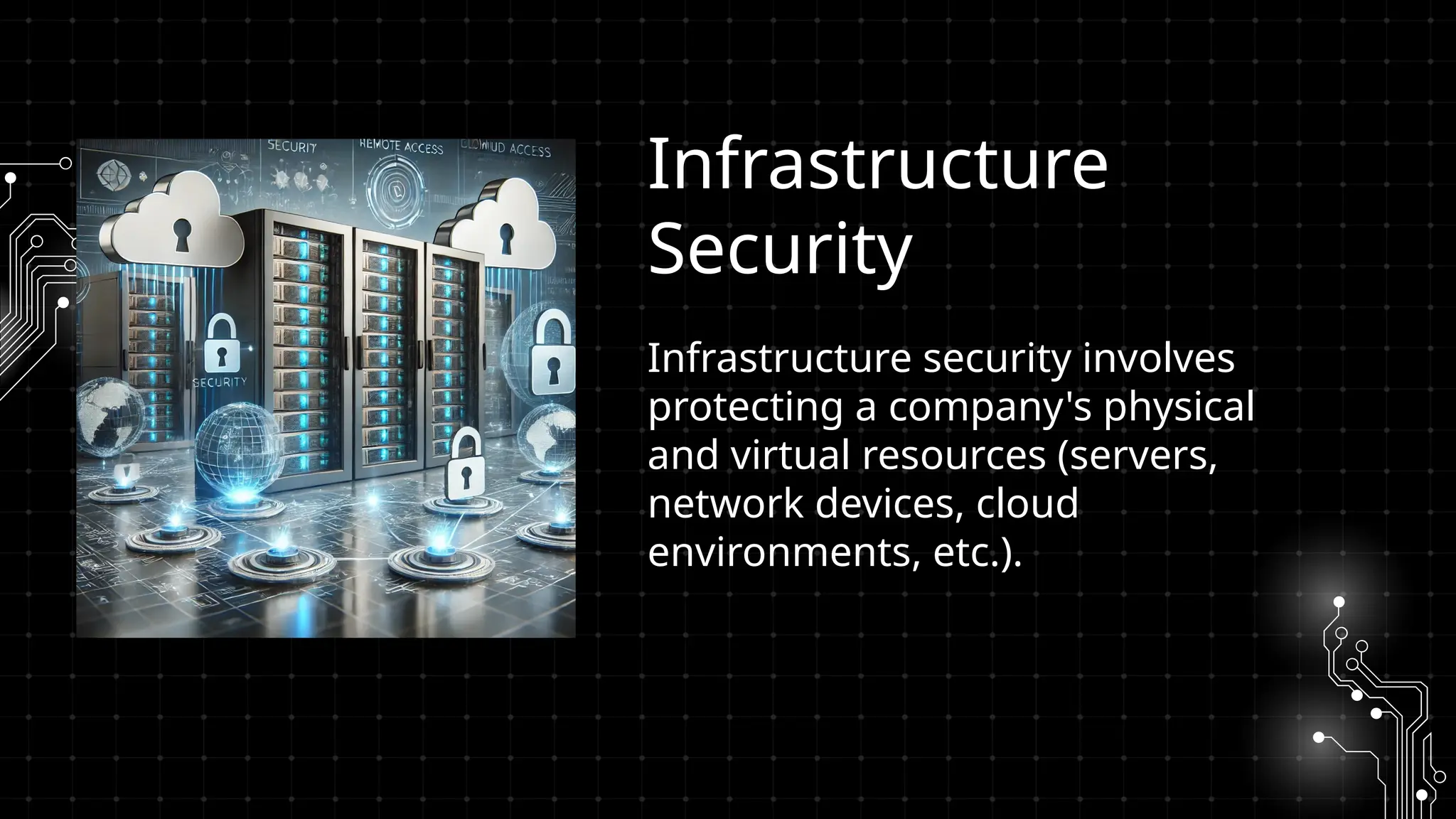
Infrastructure security involves
protecting a company's physical
and virtual resources (servers,
network devices, cloud
environments, etc.).
Infrastructure
Security
Infrastructure Security
● WAF - Web Application Firewall
● PAM - Privileged Access Management
● Infrastructure as Code (Terraform, Cloudformation, Terrascan)
● NSX Vmware - Network and Security Virtualization
● Configuration Management Tools (Ansible, Saltstack)
● CIS Benchmarks
● Logging of the system (filebeat, winlogbeat)
● Secret Management Tools - (Vault, AWS Secret management )
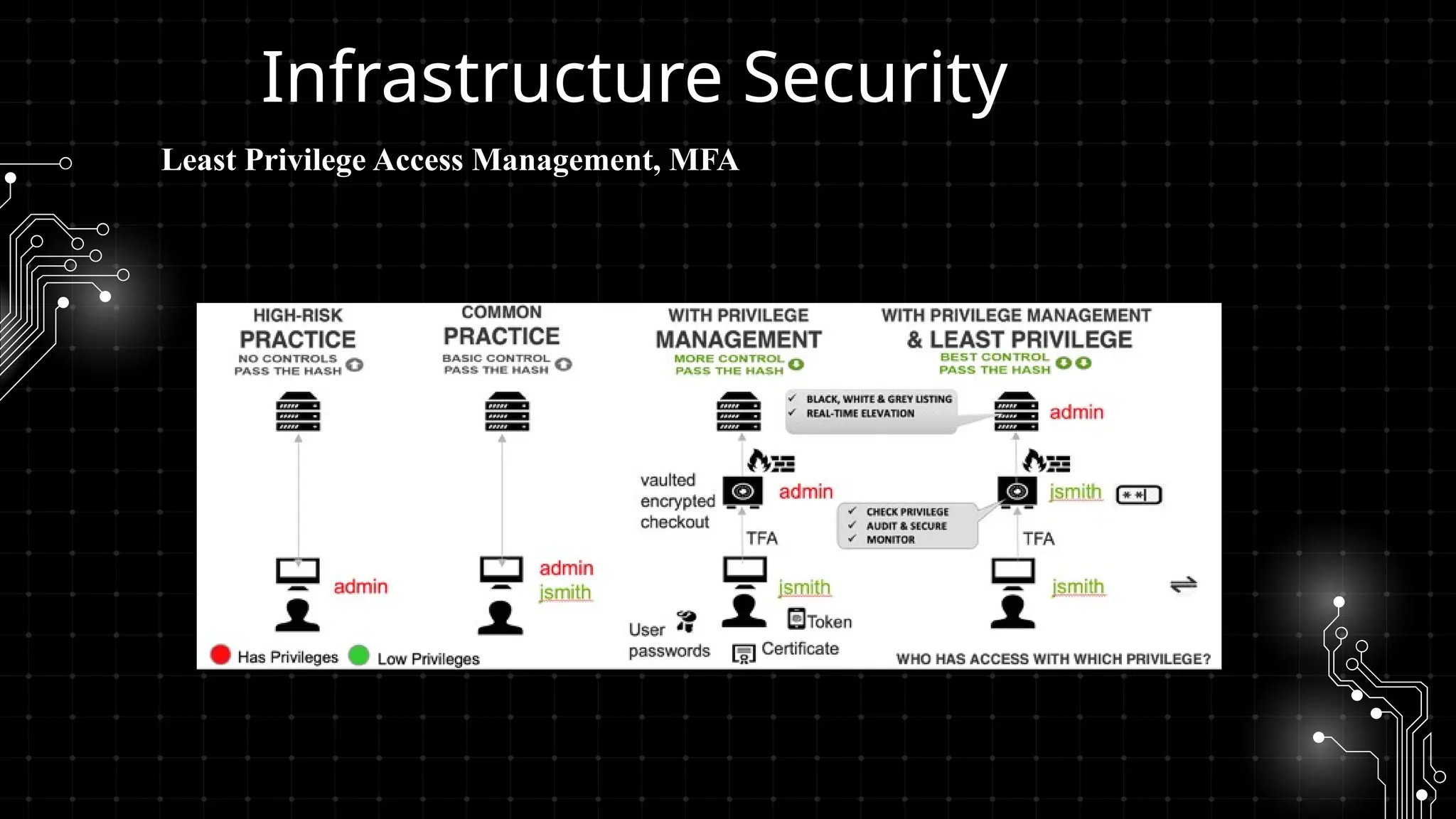
● Least Privilege Access Implementation, MFA
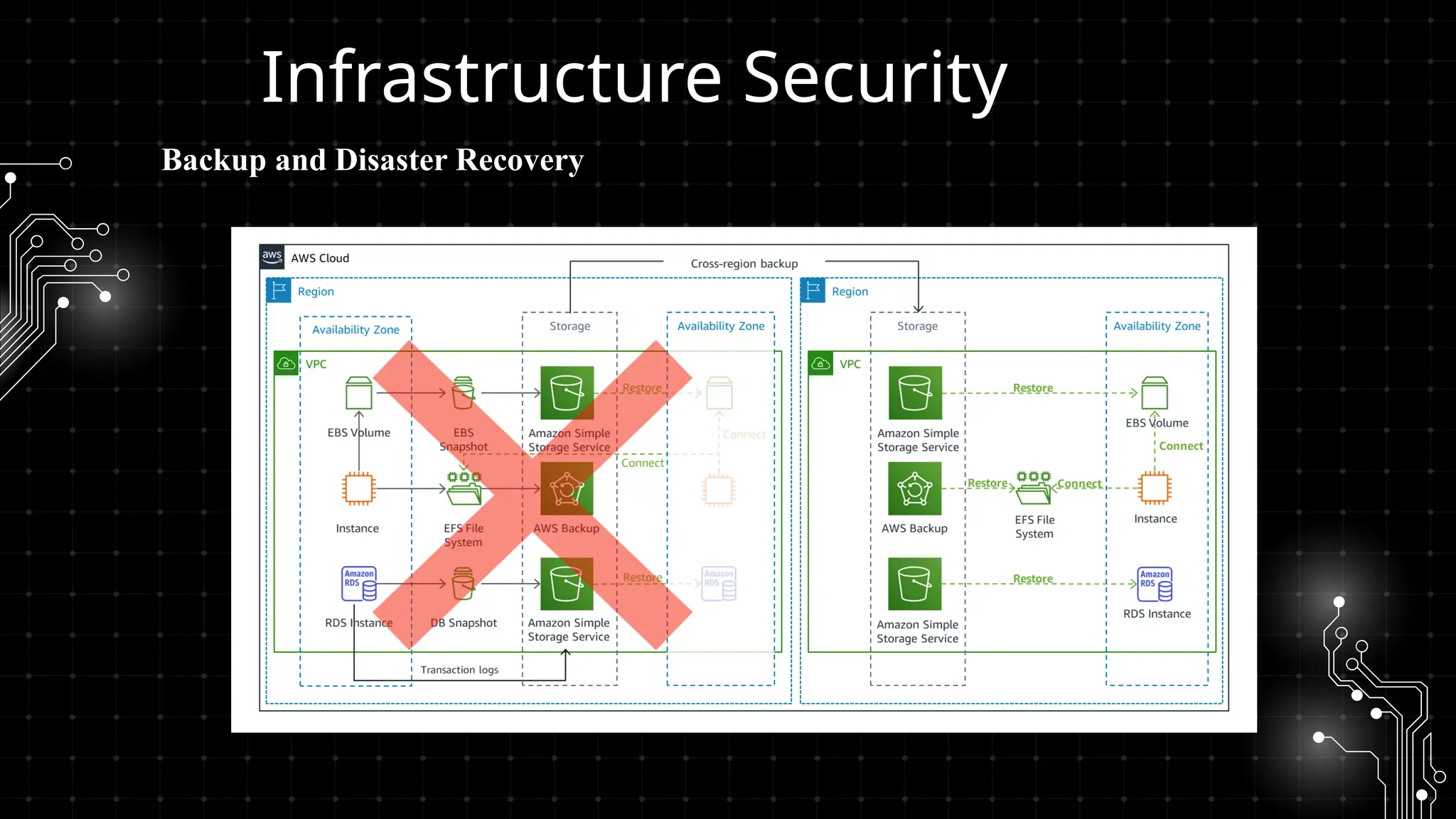
● Backup and Recovery (Implement backuping system and disaster recovery
plan)
Infrastructure Security
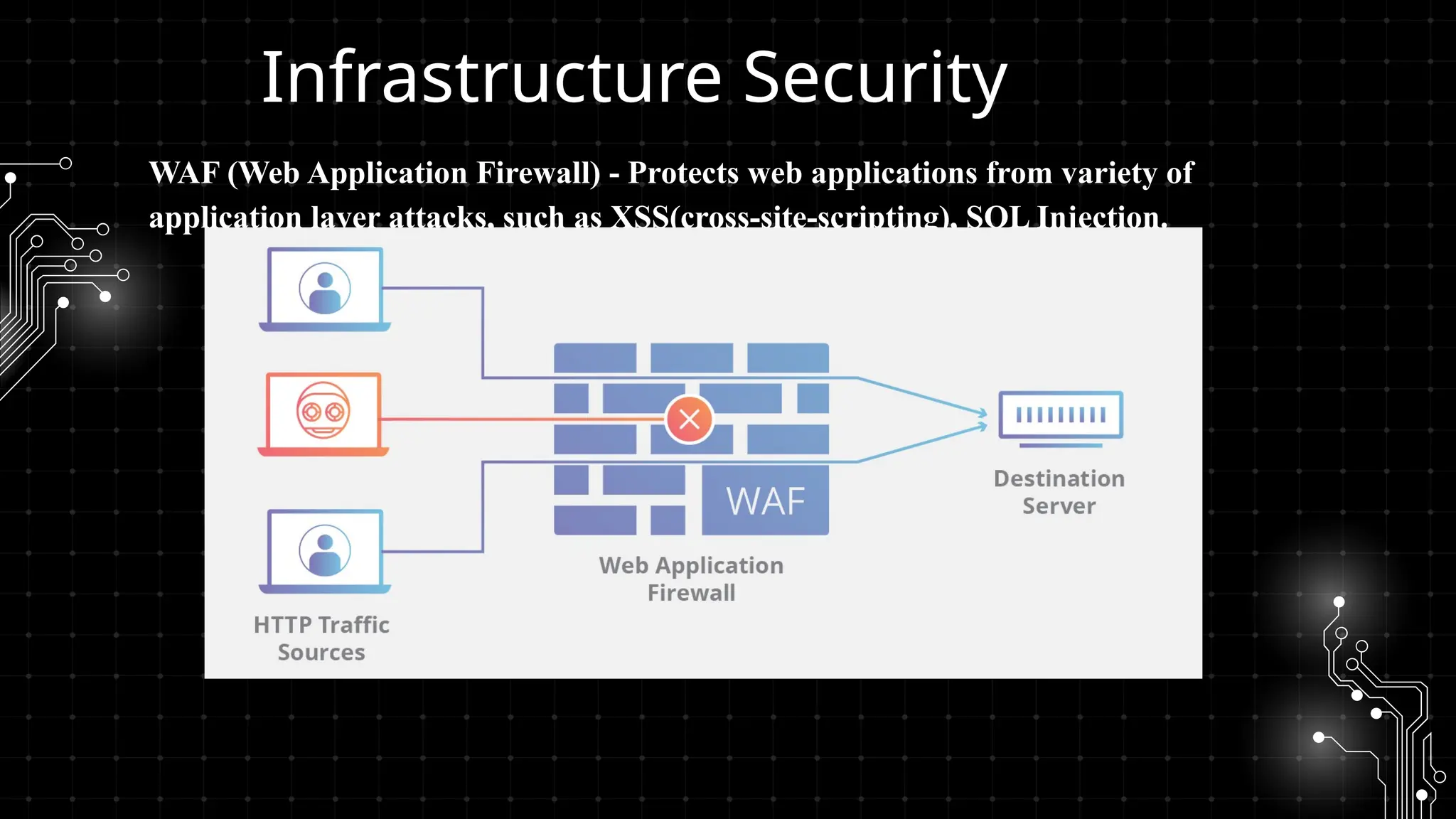
WAF (Web Application Firewall) - Protects web applications from variety of
application layer attacks, such as XSS(cross-site-scripting), SQL Injection.
Infrastructure Security
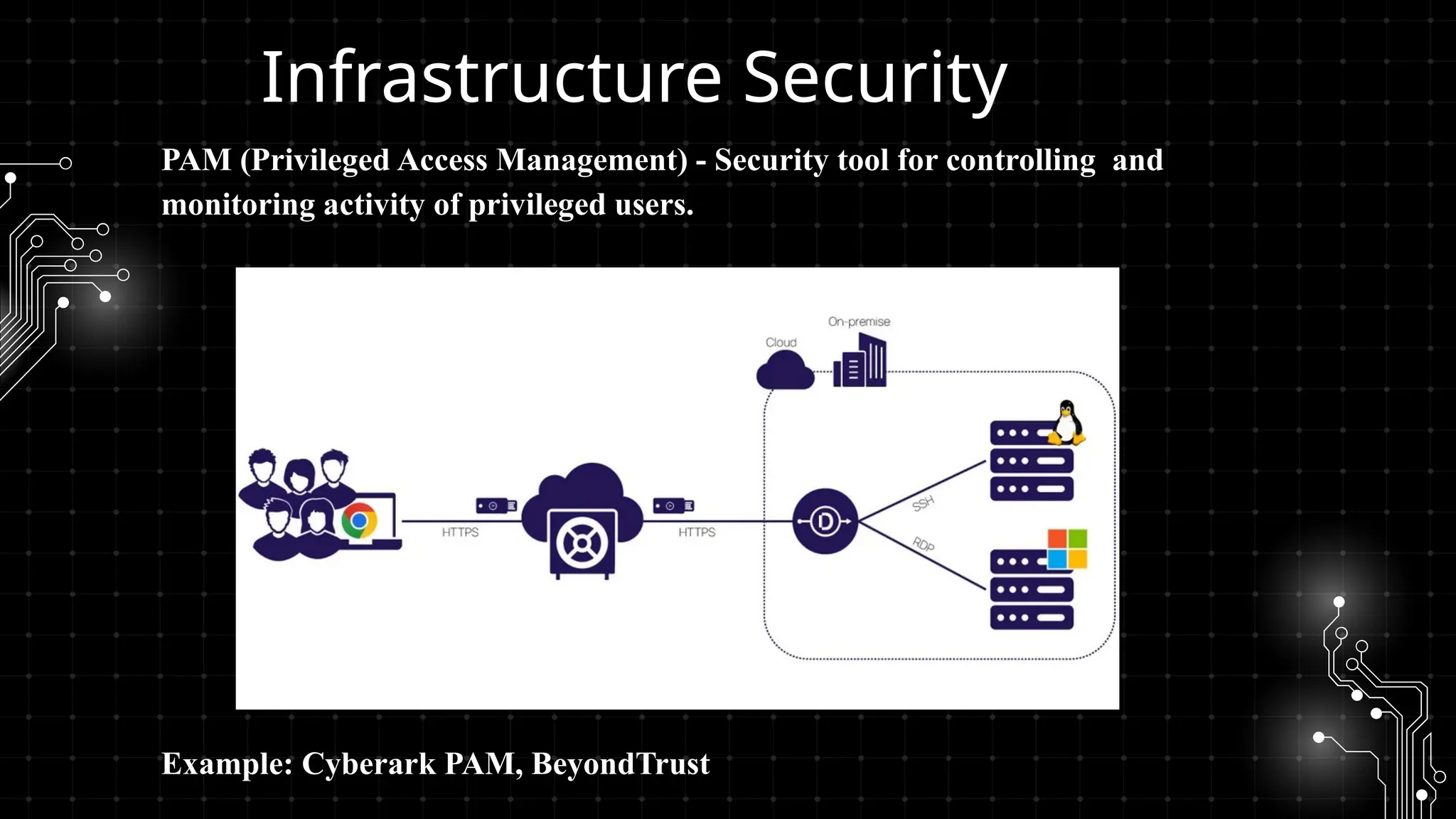
PAM (Privileged Access Management) - Security tool for controlling and
monitoring activity of privileged users.
Example: Cyberark PAM, BeyondTrust
Infrastructure Security
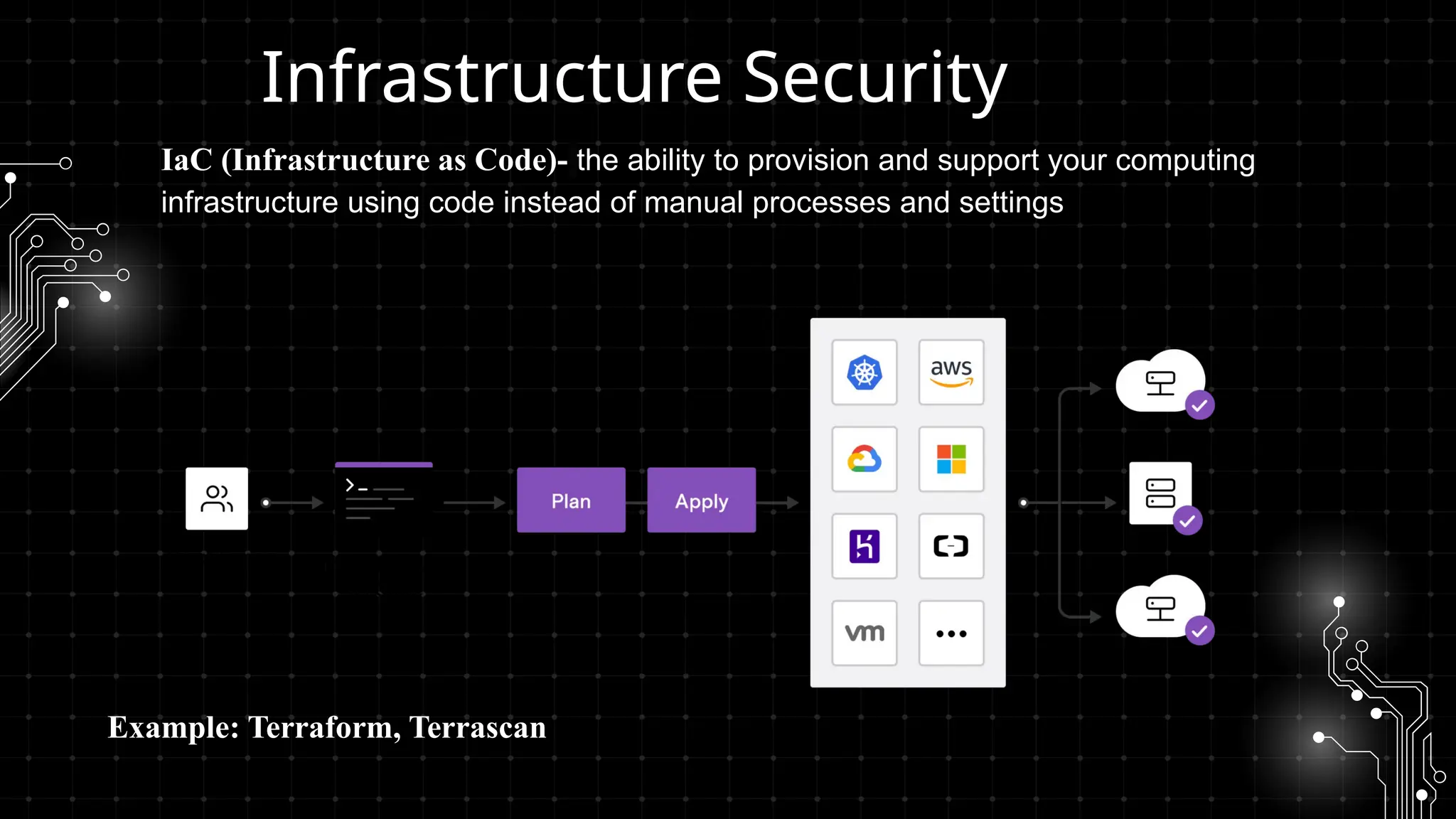
IaC (Infrastructure as Code)- the ability to provision and support your computing
infrastructure using code instead of manual processes and settings
Example: Terraform, Terrascan
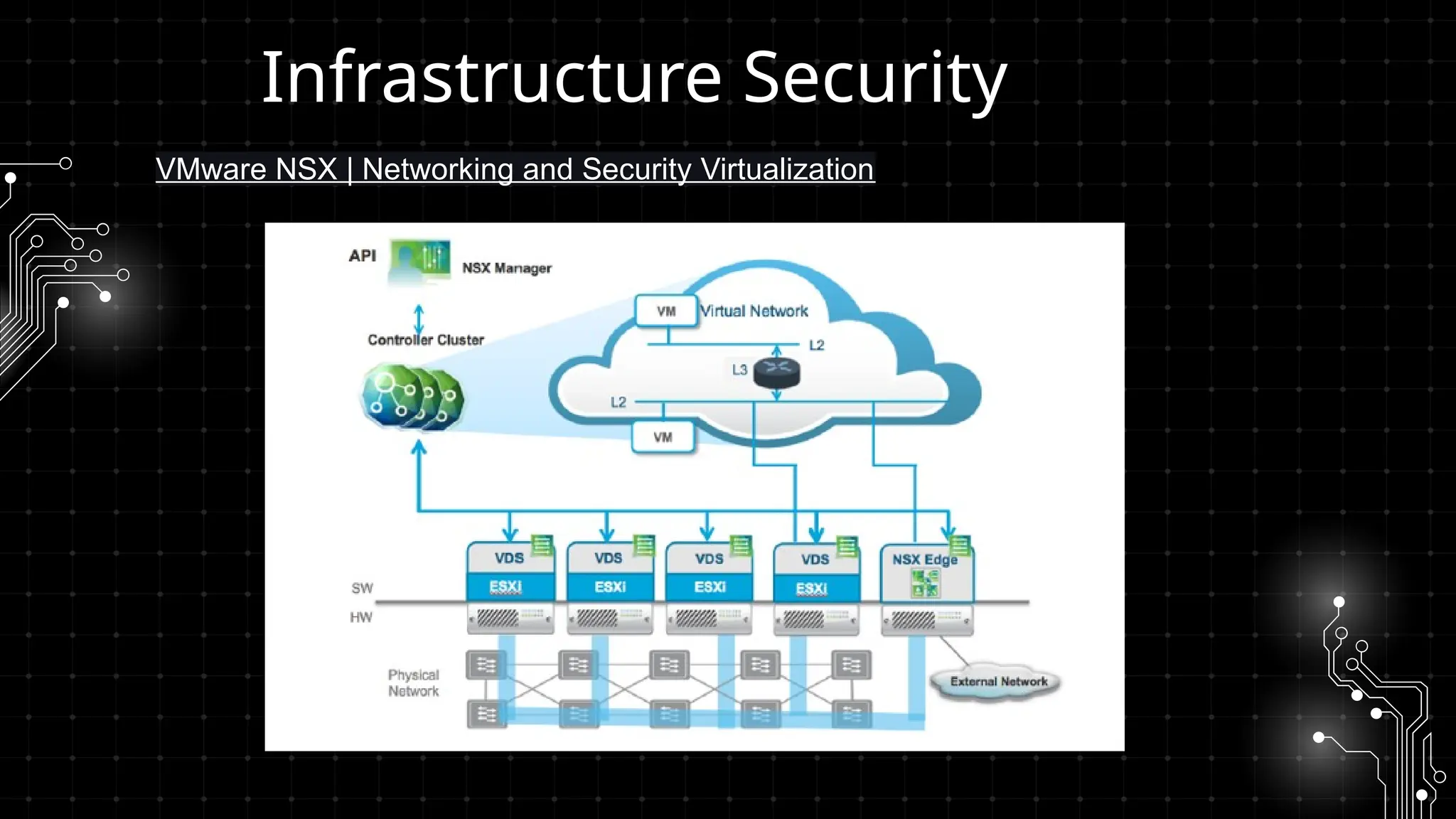
VMware NSX | Networking and Security Virtualization
Infrastructure Security
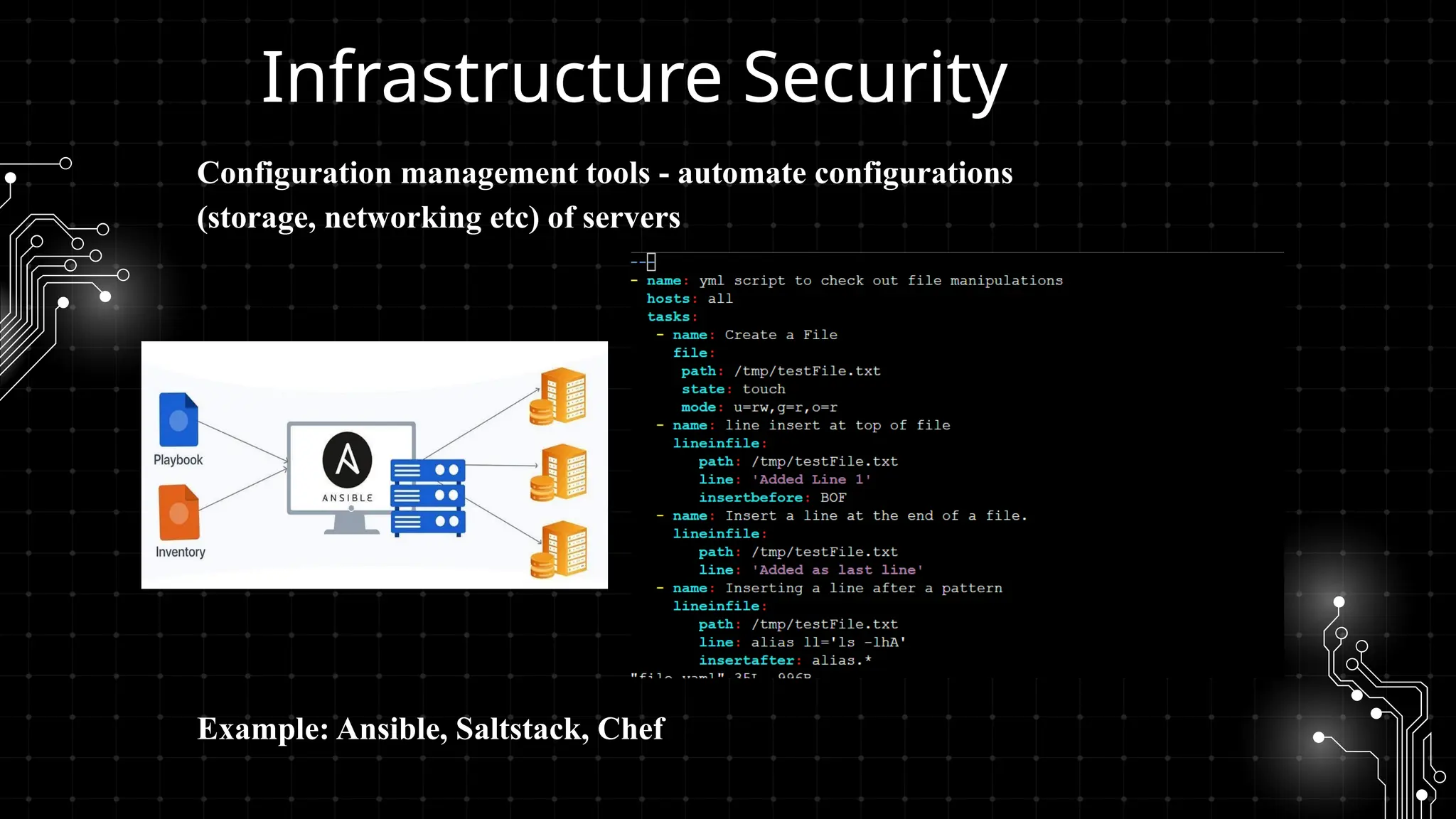
Configuration management tools - automate configurations
(storage, networking etc) of servers
Example: Ansible, Saltstack, Chef
Infrastructure Security
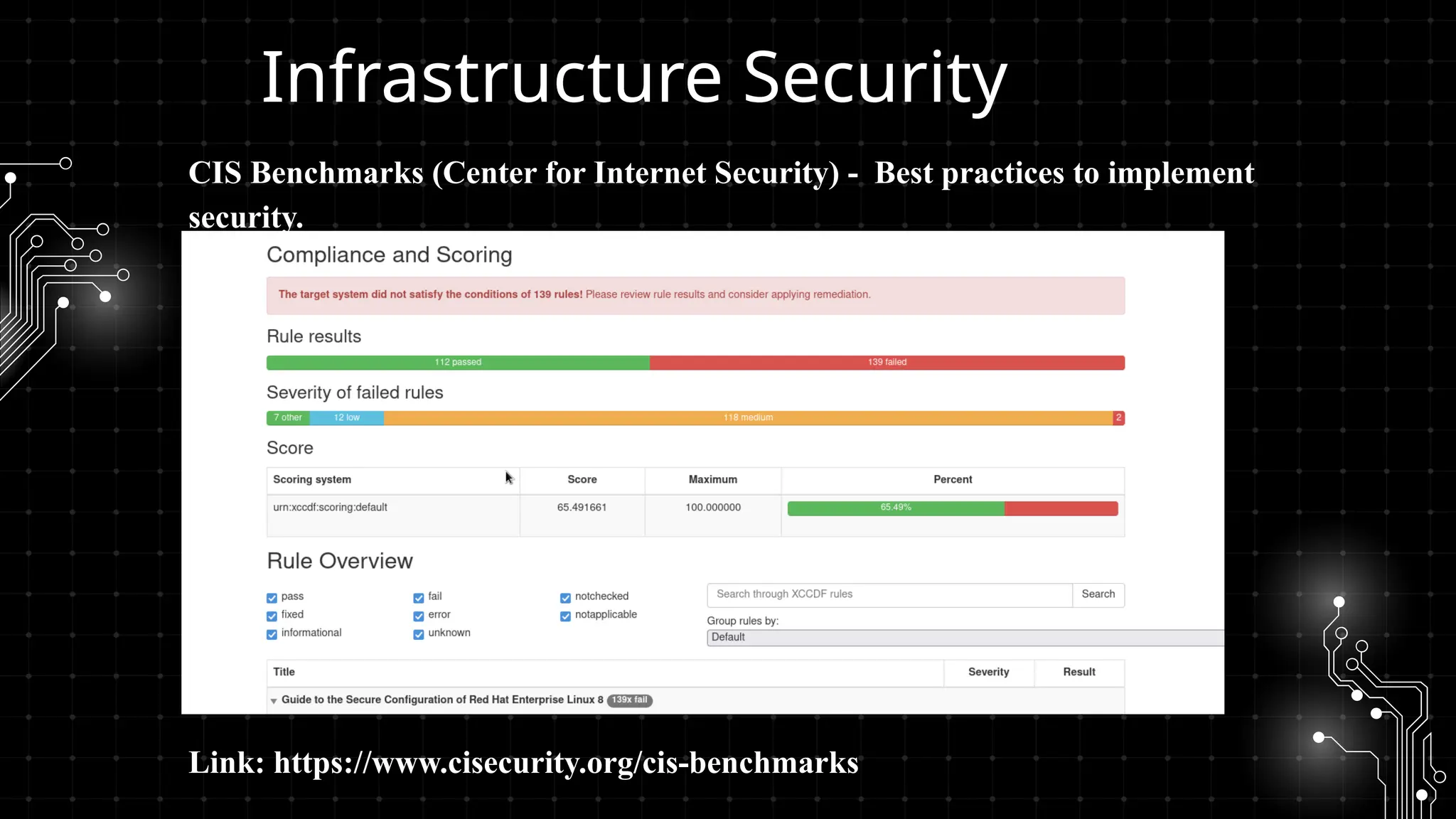
CIS Benchmarks (Center for Internet Security) - Best practices to implement
security.
Link: https://www.cisecurity.org/cis-benchmarks
Infrastructure Security
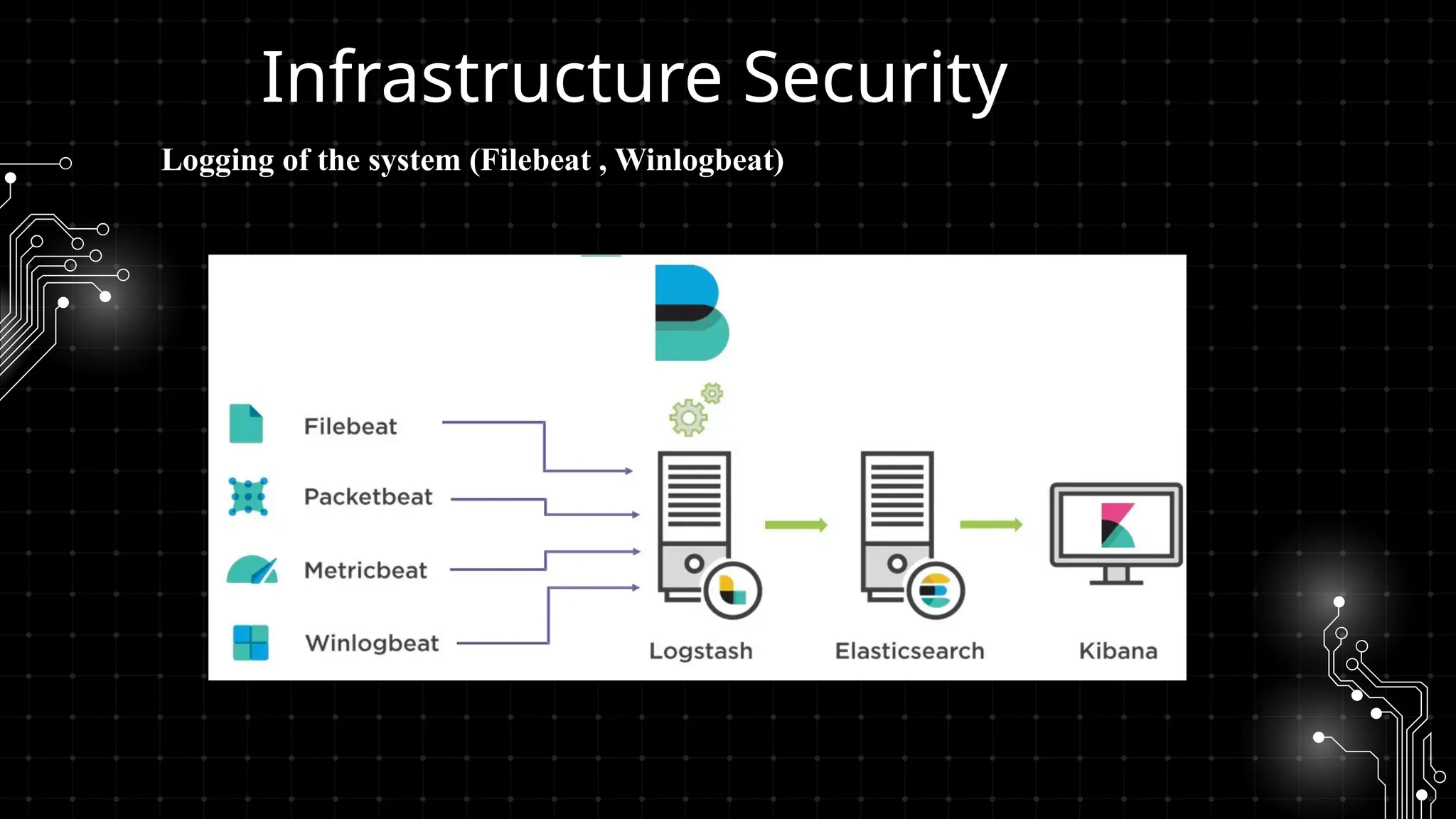
Logging of the system (Filebeat , Winlogbeat)
Infrastructure Security
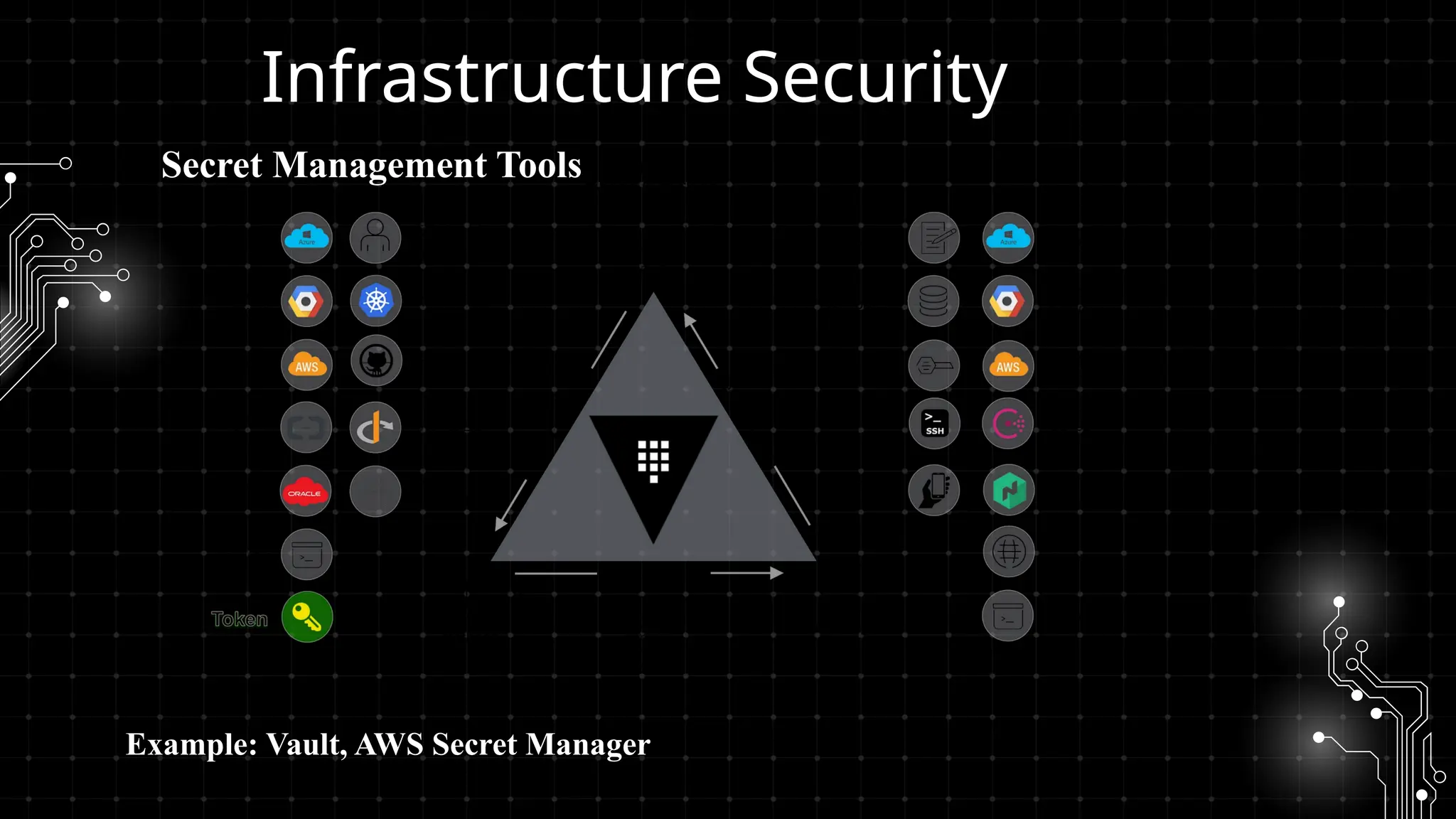
Secret Management Tools
Example: Vault, AWS Secret Manager
Infrastructure Security
Least Privilege Access Management, MFA
Infrastructure Security
Backup and Disaster Recovery
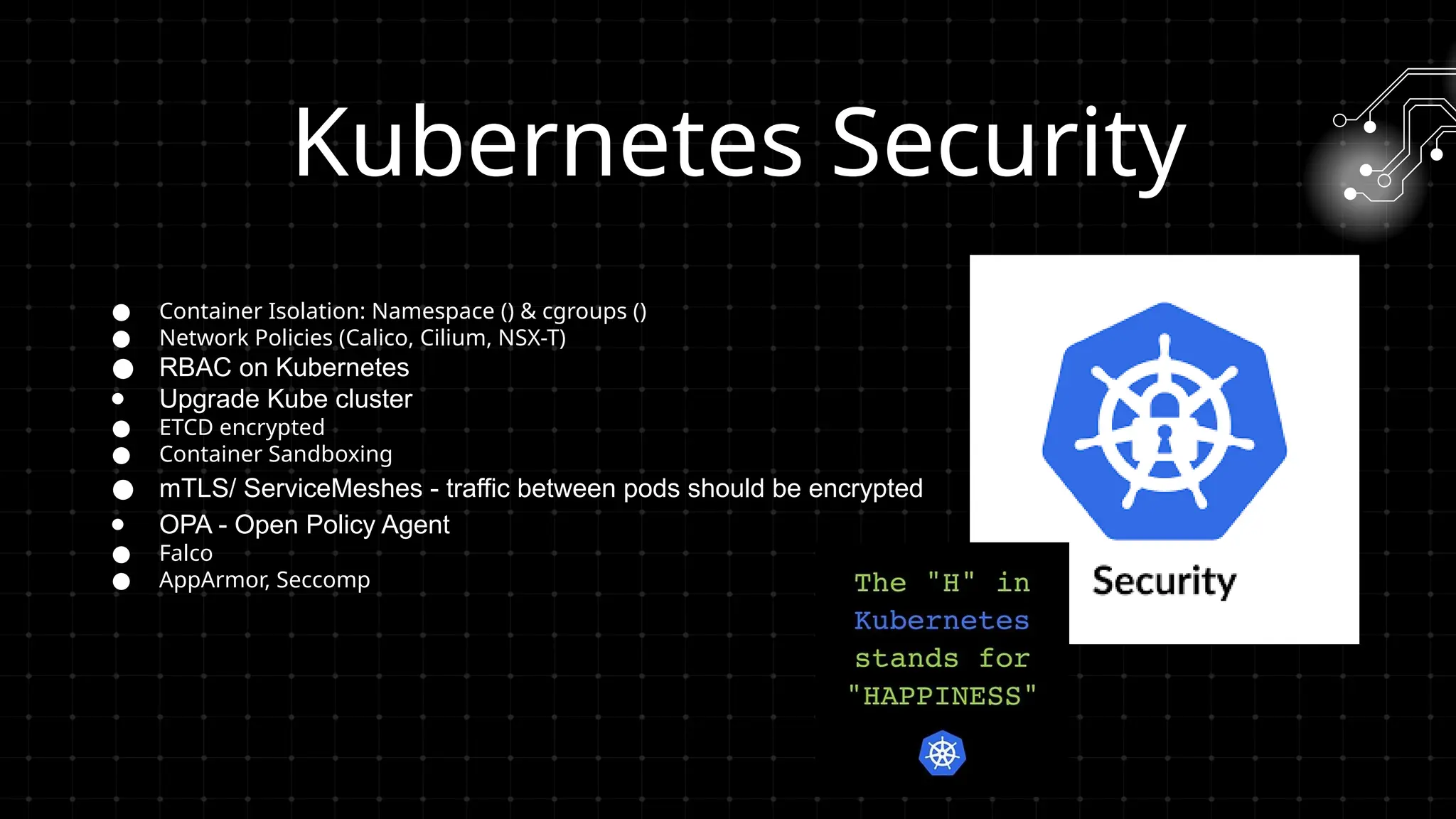
● Container Isolation: Namespace () & cgroups ()
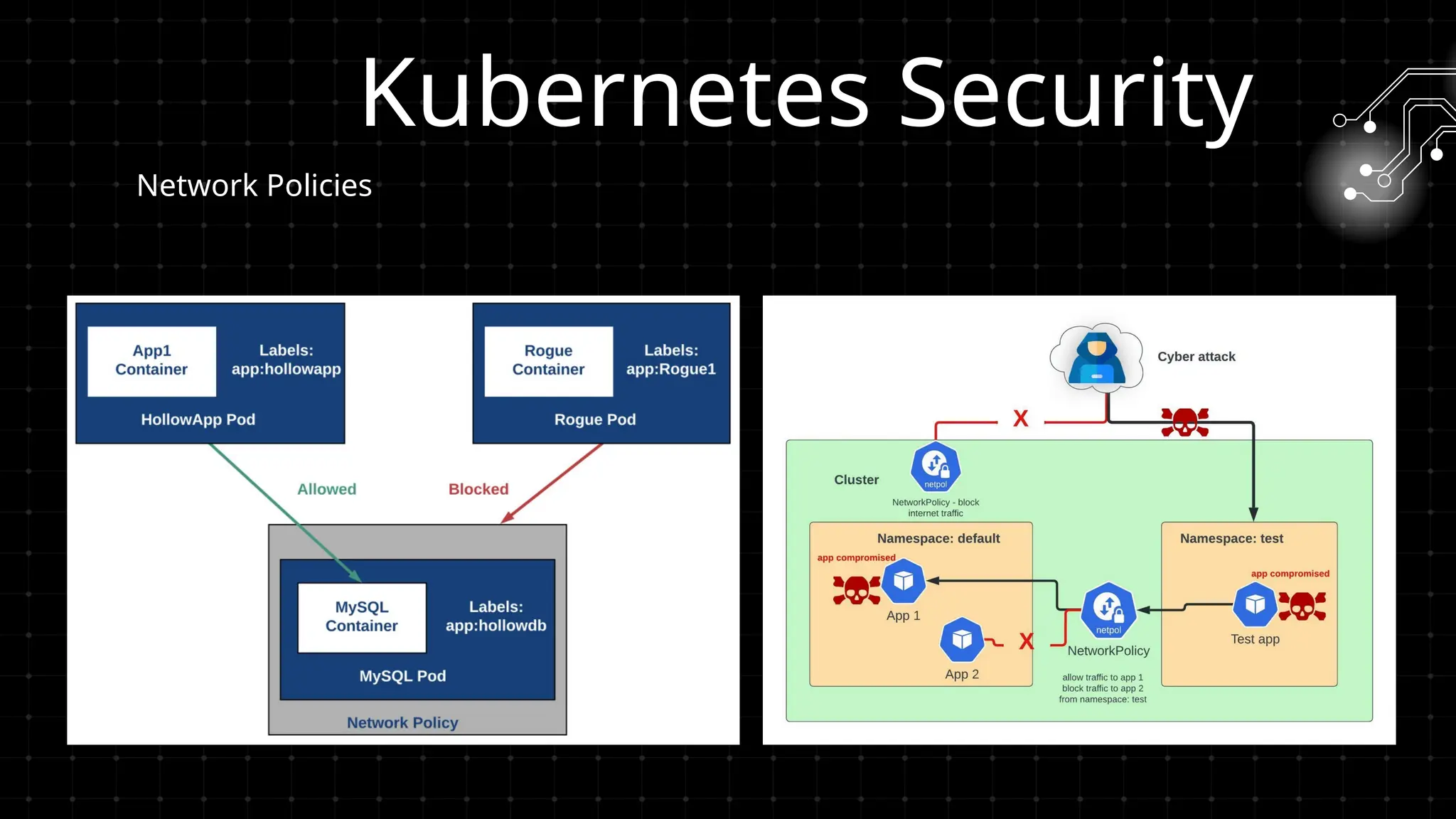
● Network Policies (Calico, Cilium, NSX-T)
● RBAC on Kubernetes
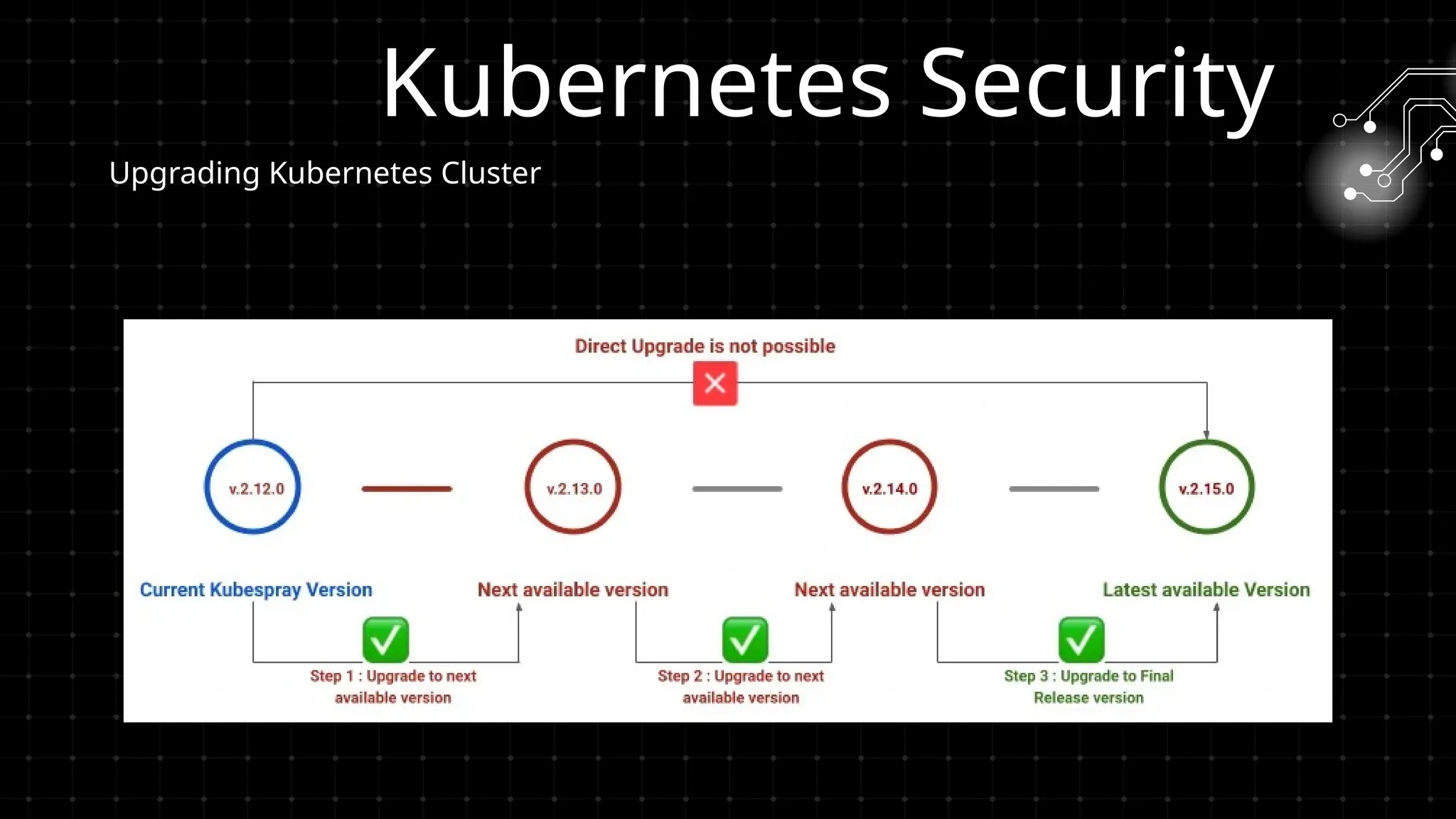
● Upgrade Kube cluster
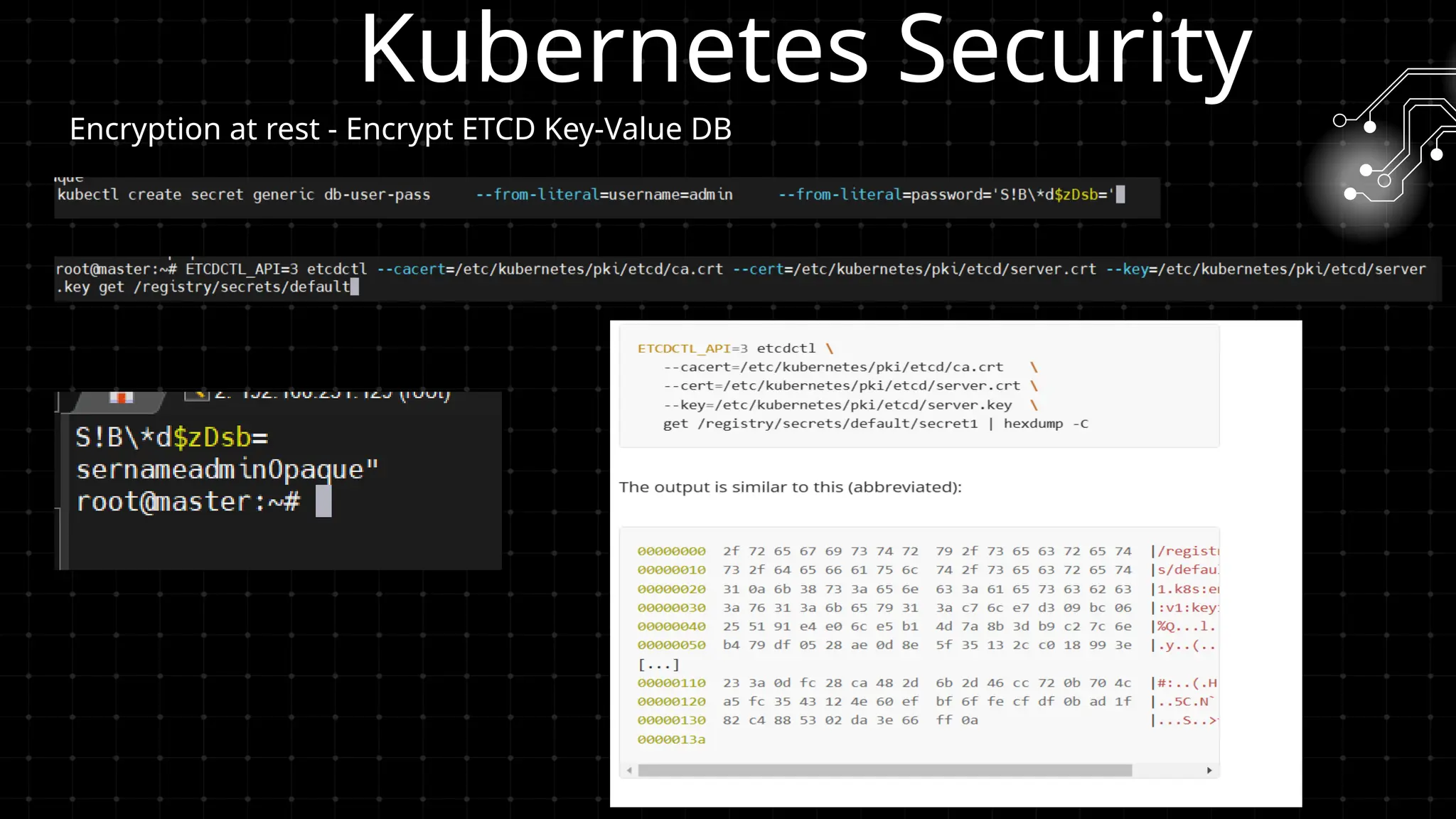
● ETCD encrypted
● Container Sandboxing
● mTLS/ ServiceMeshes - traffic between pods should be encrypted
● OPA - Open Policy Agent
● Falco
● AppArmor, Seccomp
Kubernetes Security
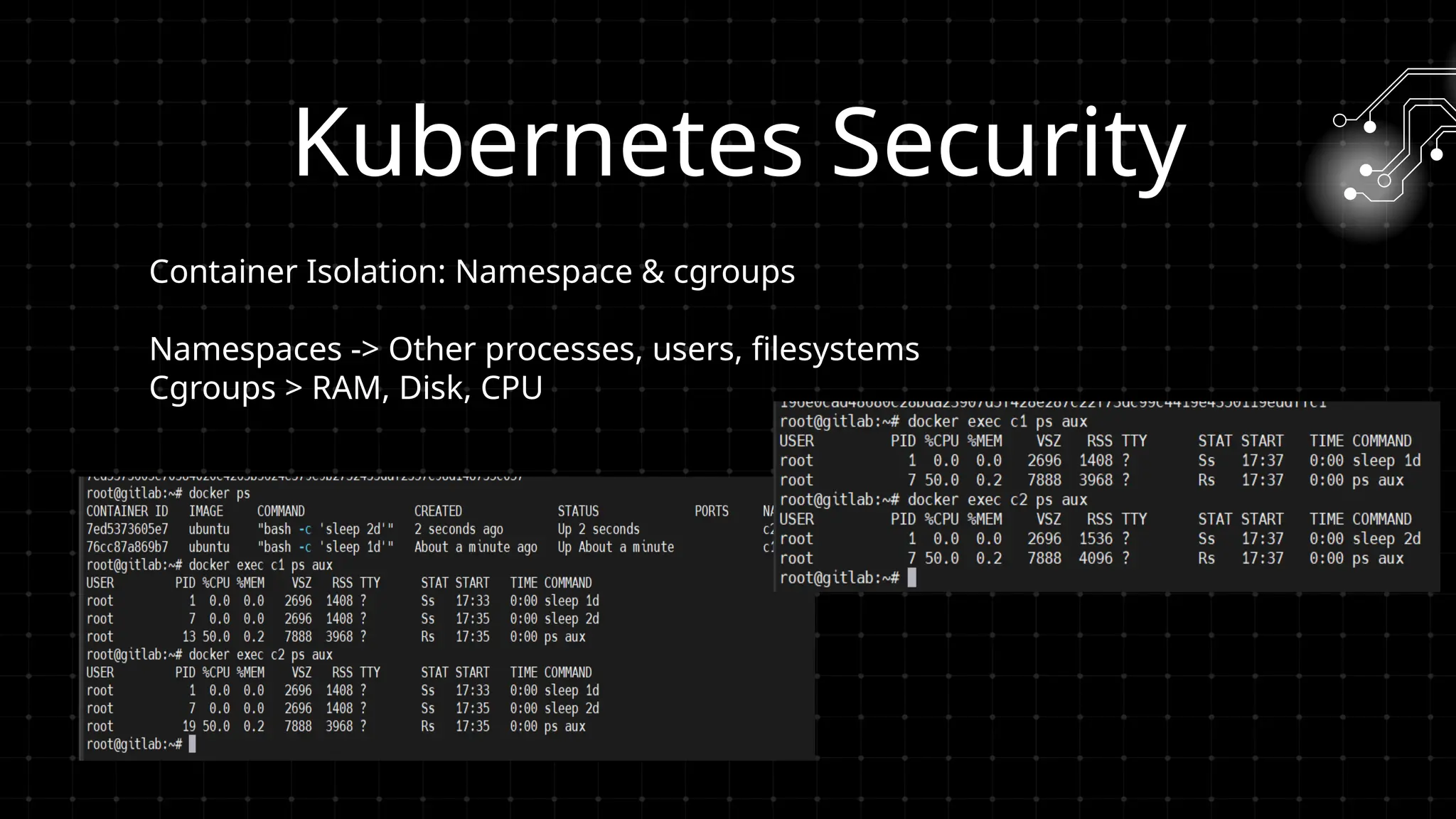
Container Isolation: Namespace & cgroups
Namespaces -> Other processes, users, filesystems
Cgroups > RAM, Disk, CPU
Kubernetes Security
Network Policies
Kubernetes Security
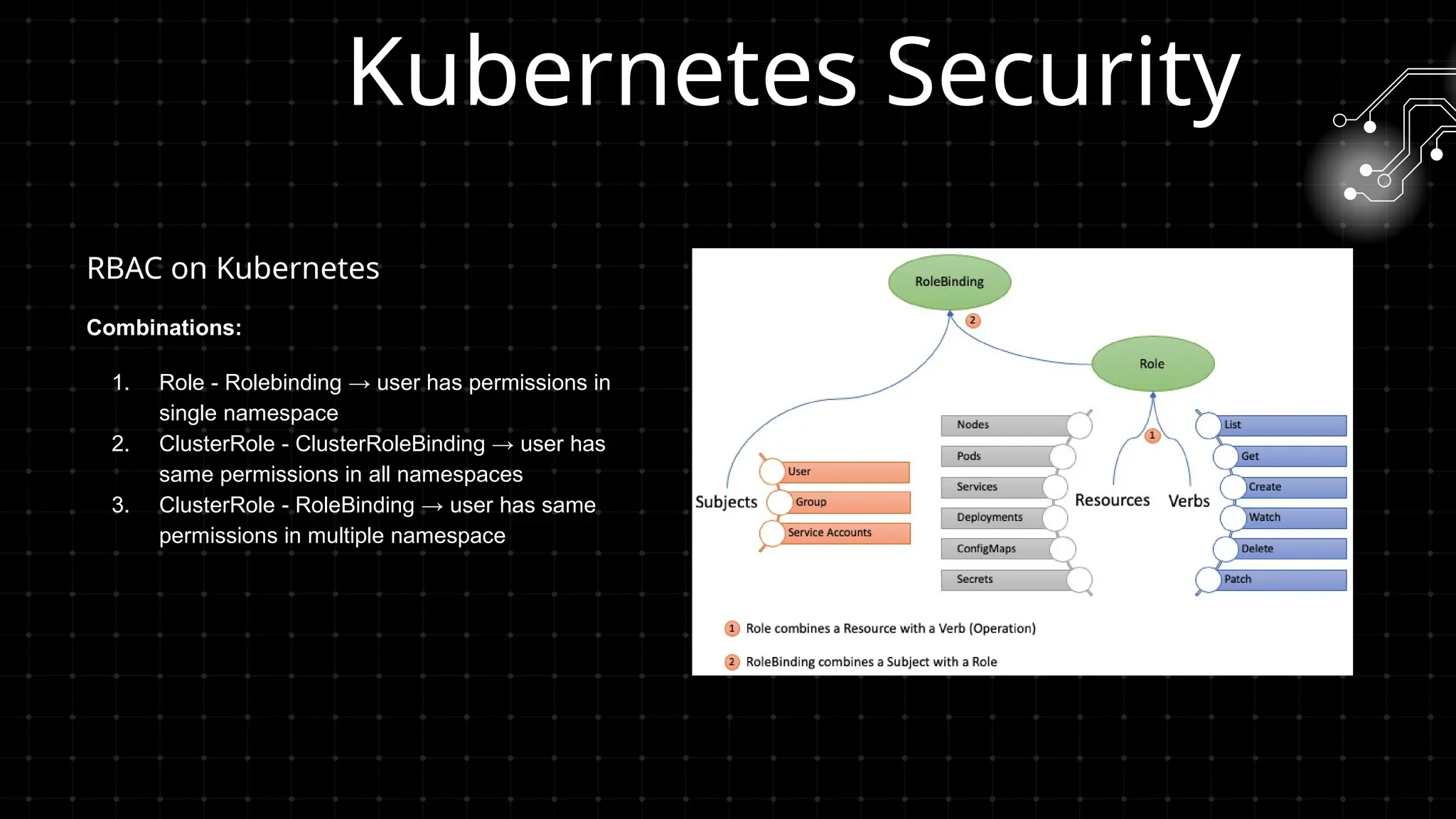
RBAC on Kubernetes
Combinations:
1. Role - Rolebinding → user has permissions in
single namespace
2. ClusterRole - ClusterRoleBinding → user has
same permissions in all namespaces
3. ClusterRole - RoleBinding → user has same
permissions in multiple namespace
Kubernetes Security
Upgrading Kubernetes Cluster
Kubernetes Security
Encryption at rest - Encrypt ETCD Key-Value DB
Kubernetes Security
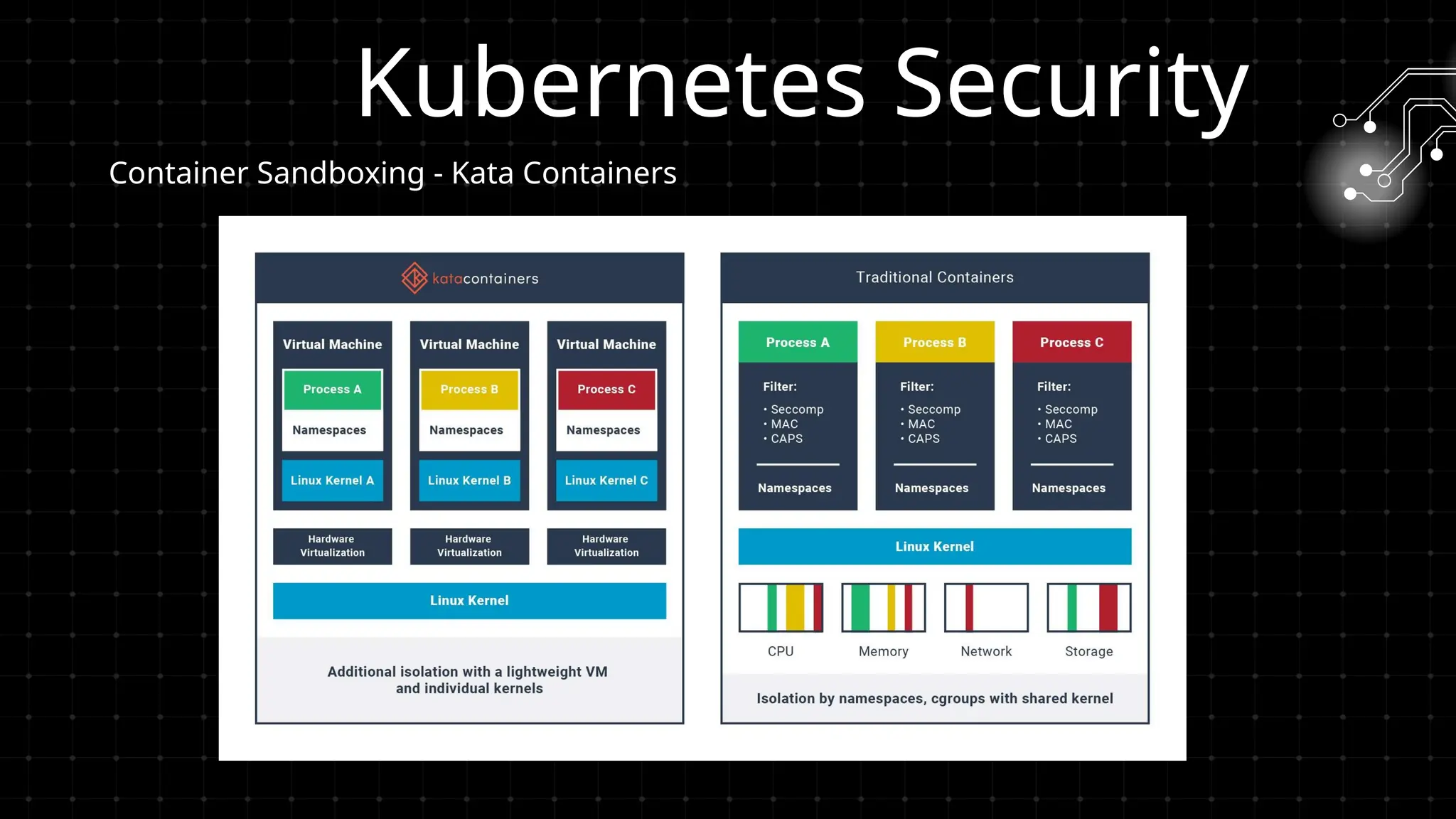
Container Sandboxing - Kata Containers
Kubernetes Security
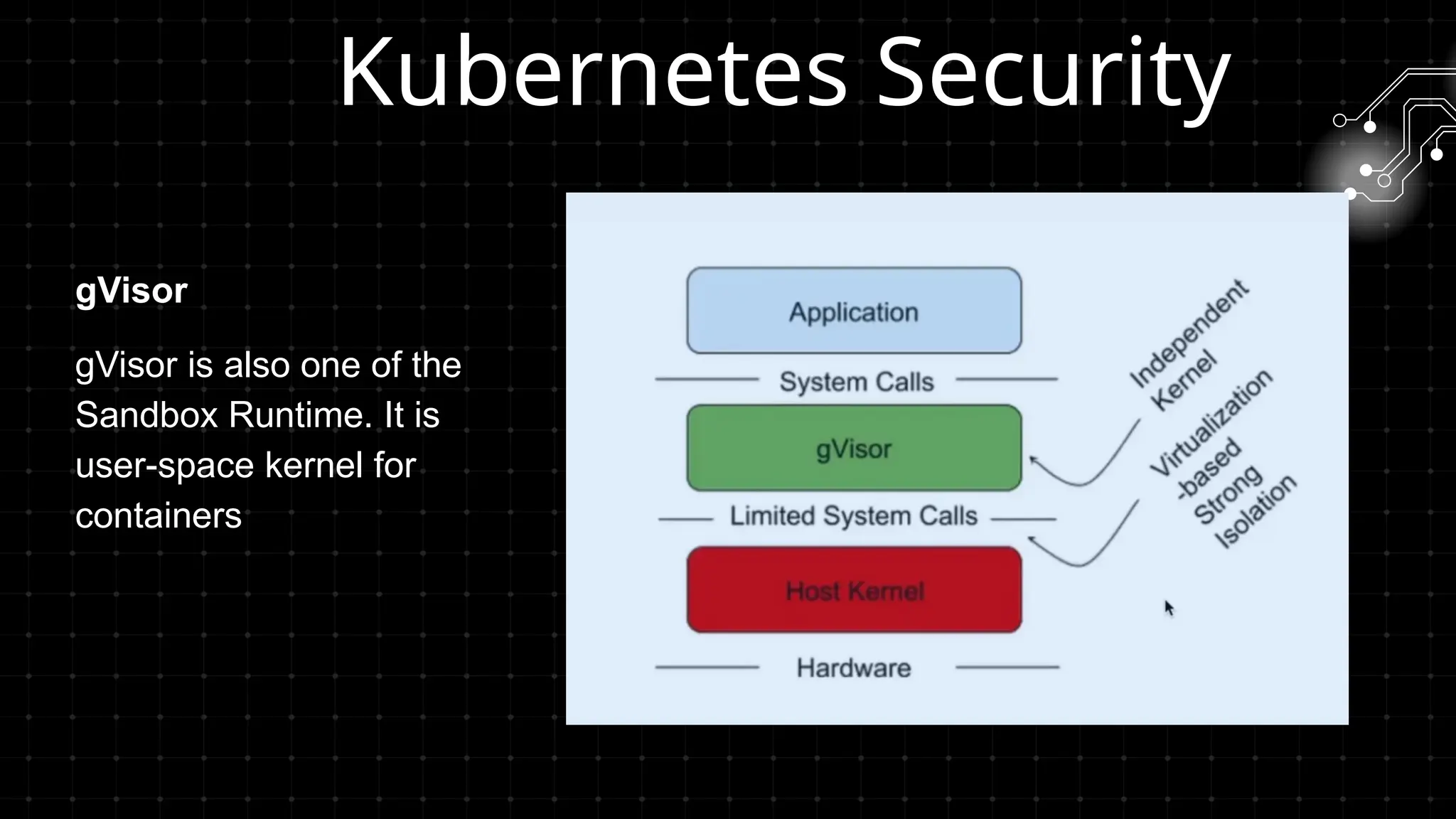
gVisor
gVisor is also one of the
Sandbox Runtime. It is
user-space kernel for
containers
Kubernetes Security
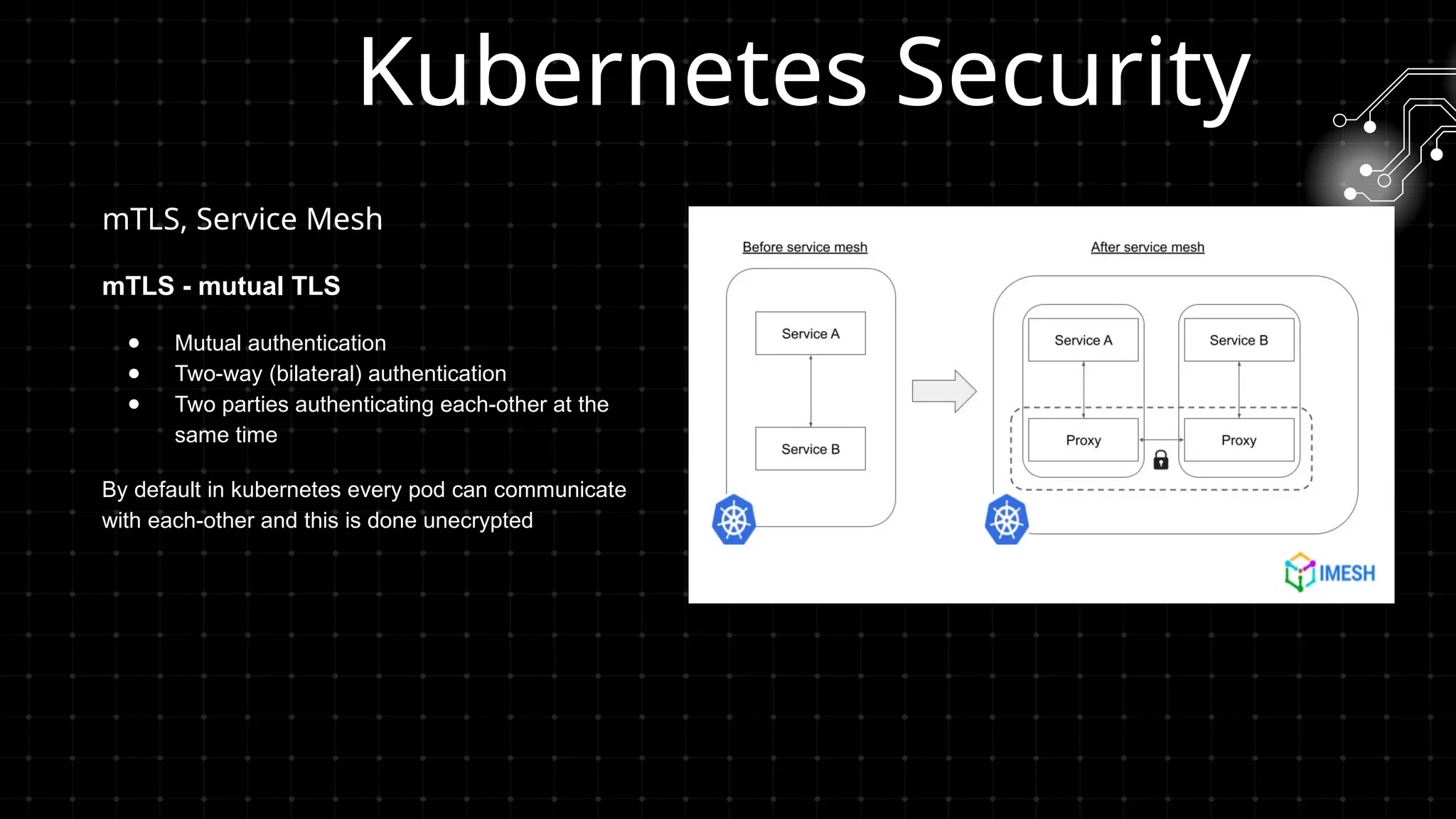
mTLS, Service Mesh
mTLS - mutual TLS
● Mutual authentication
● Two-way (bilateral) authentication
● Two parties authenticating each-other at the
same time
By default in kubernetes every pod can communicate
with each-other and this is done unecrypted
Kubernetes Security
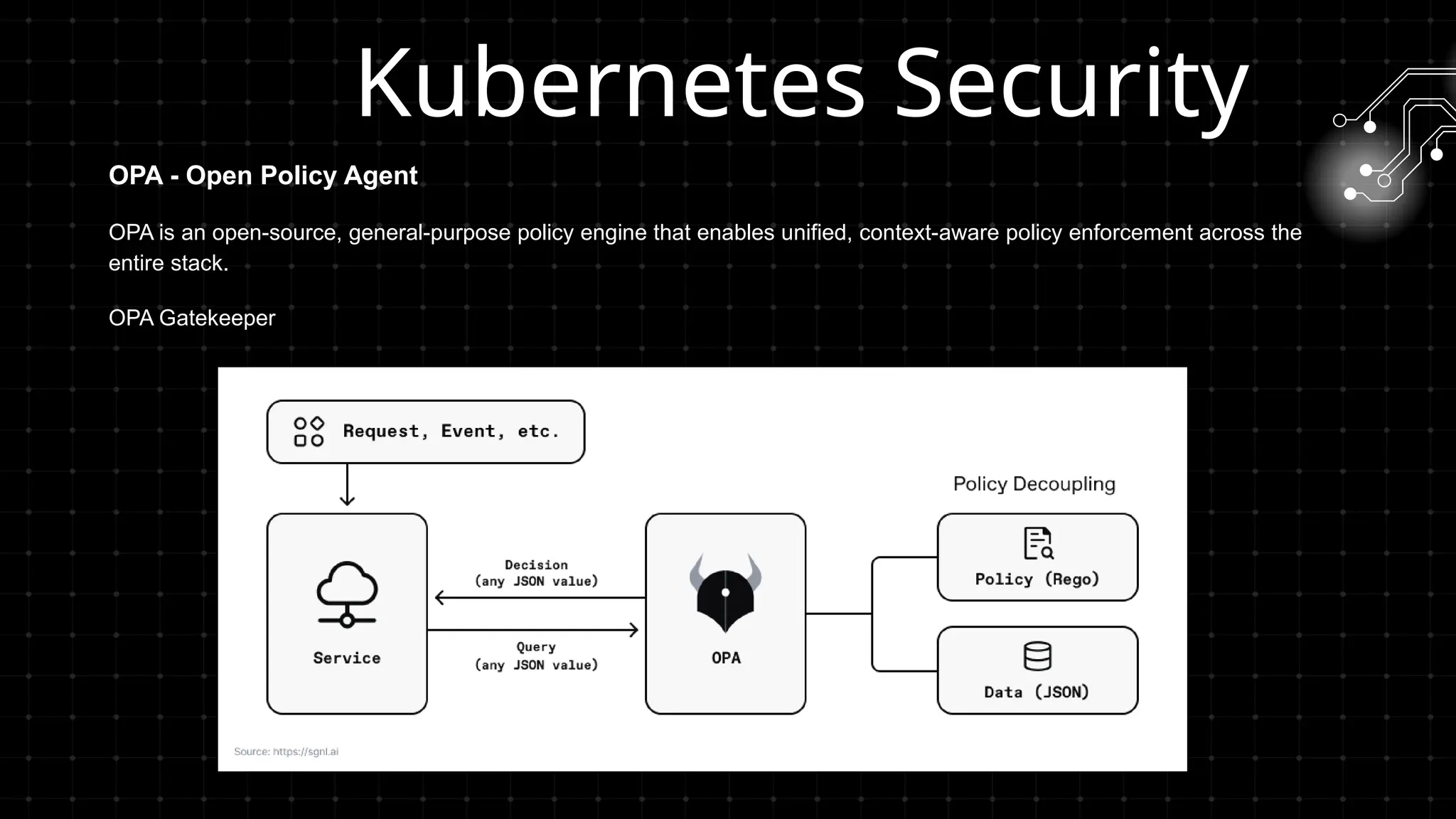
OPA - Open Policy Agent
OPA is an open-source, general-purpose policy engine that enables unified, context-aware policy enforcement across the
entire stack.
OPA Gatekeeper
Kubernetes Security
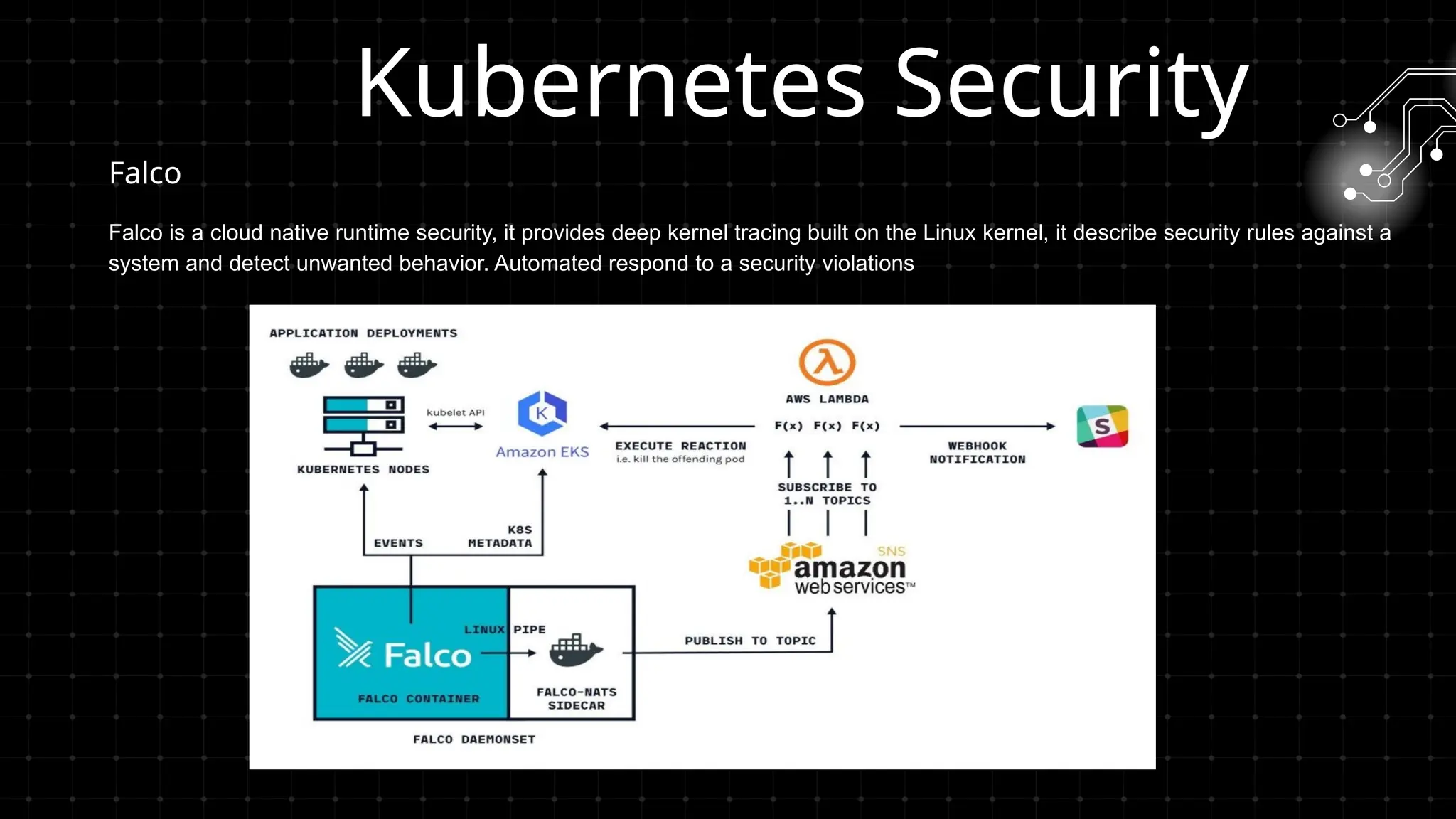
Falco
Falco is a cloud native runtime security, it provides deep kernel tracing built on the Linux kernel, it describe security rules against a
system and detect unwanted behavior. Automated respond to a security violations
Kubernetes Security
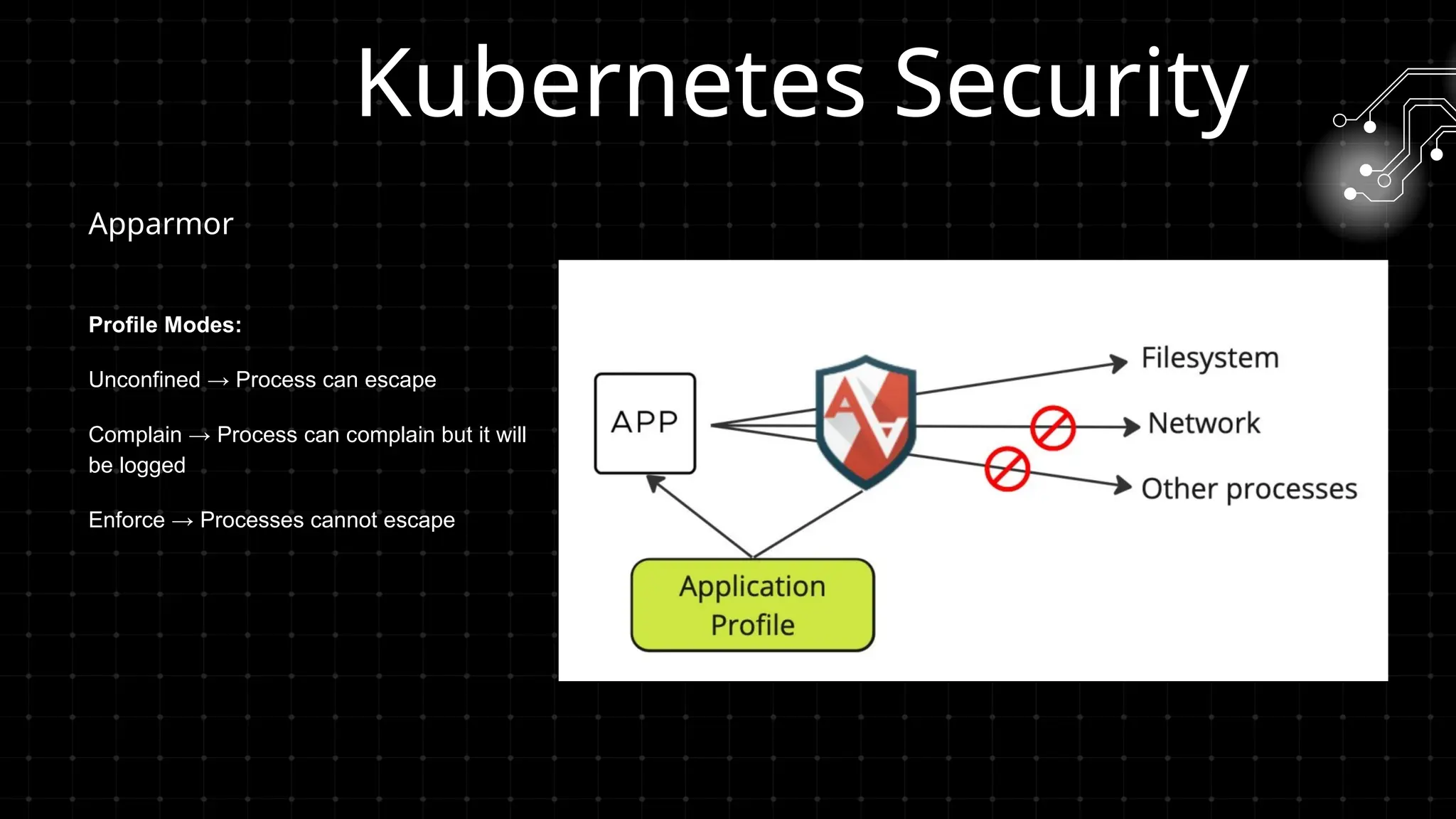
Apparmor
Kubernetes Security
Profile Modes:
Unconfined → Process can escape
Complain → Process can complain but it will
be logged
Enforce → Processes cannot escape
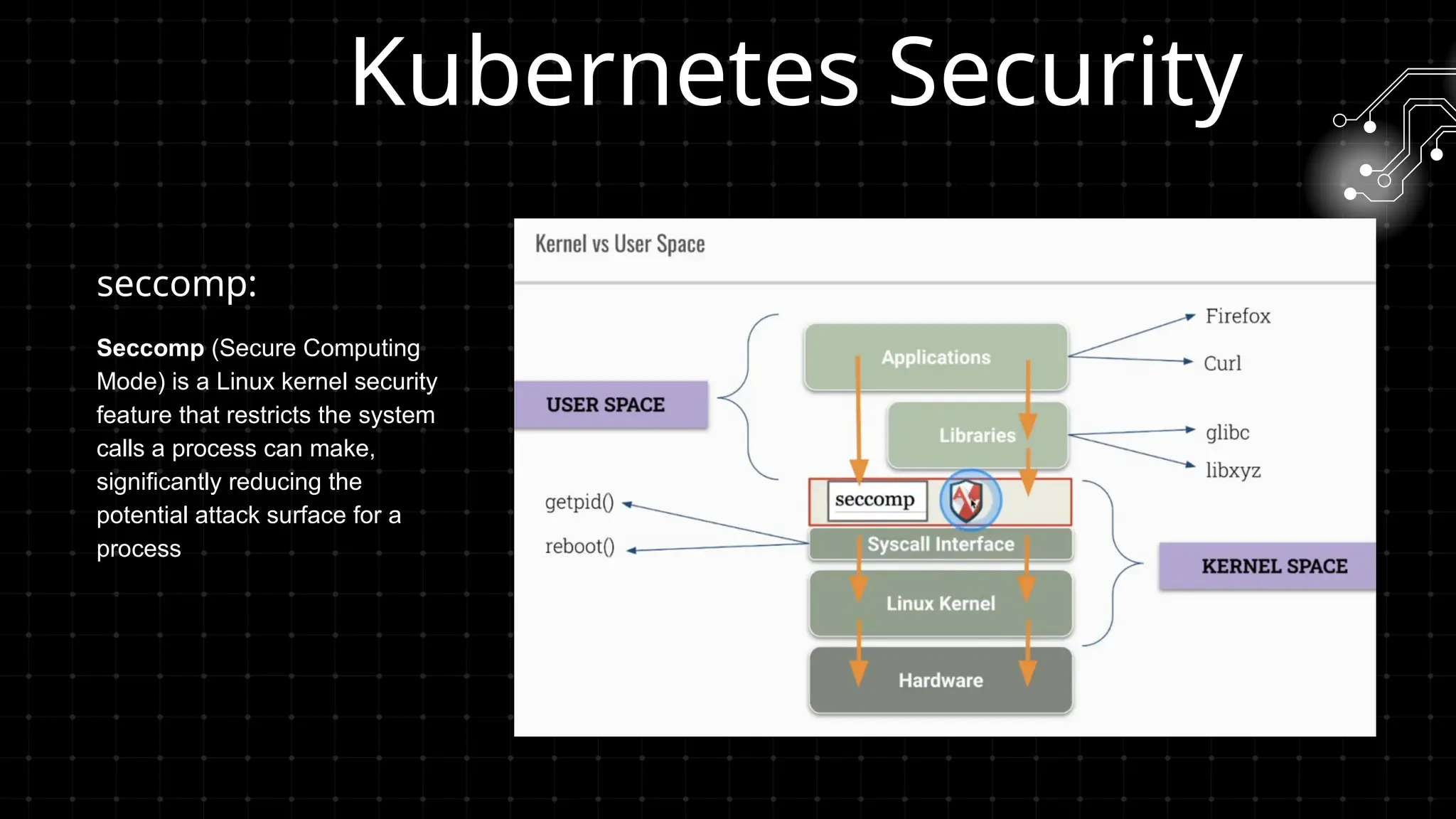
seccomp:
Seccomp (Secure Computing
Mode) is a Linux kernel security
feature that restricts the system
calls a process can make,
significantly reducing the
potential attack surface for a
process
Kubernetes Security
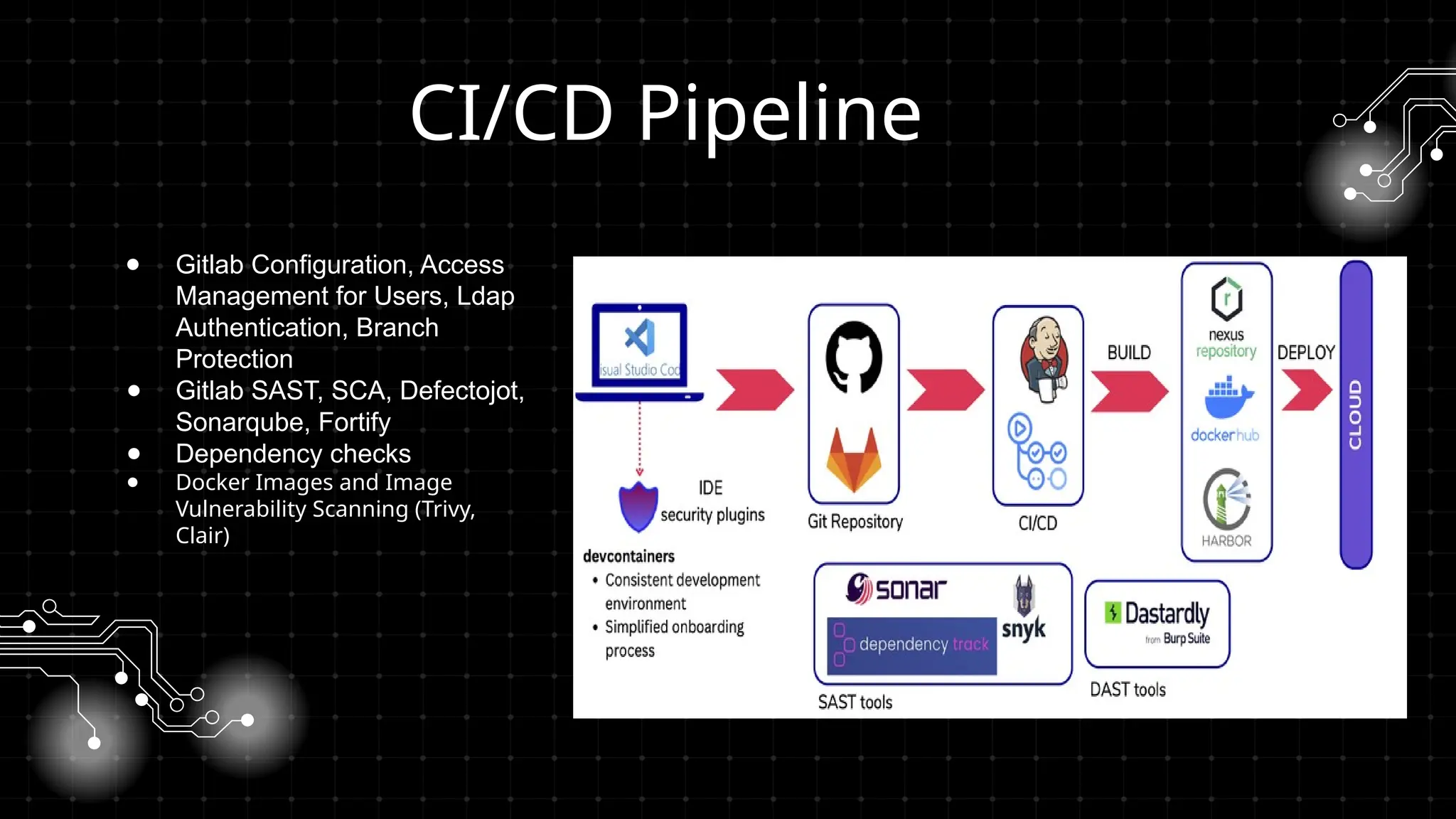
CI/CD Pipeline
● Gitlab Configuration, Access
Management for Users, Ldap
Authentication, Branch
Protection
● Gitlab SAST, SCA, Defectojot,
Sonarqube, Fortify
● Dependency checks
● Docker Images and Image
Vulnerability Scanning (Trivy,
Clair)
CI/CD Pipeline
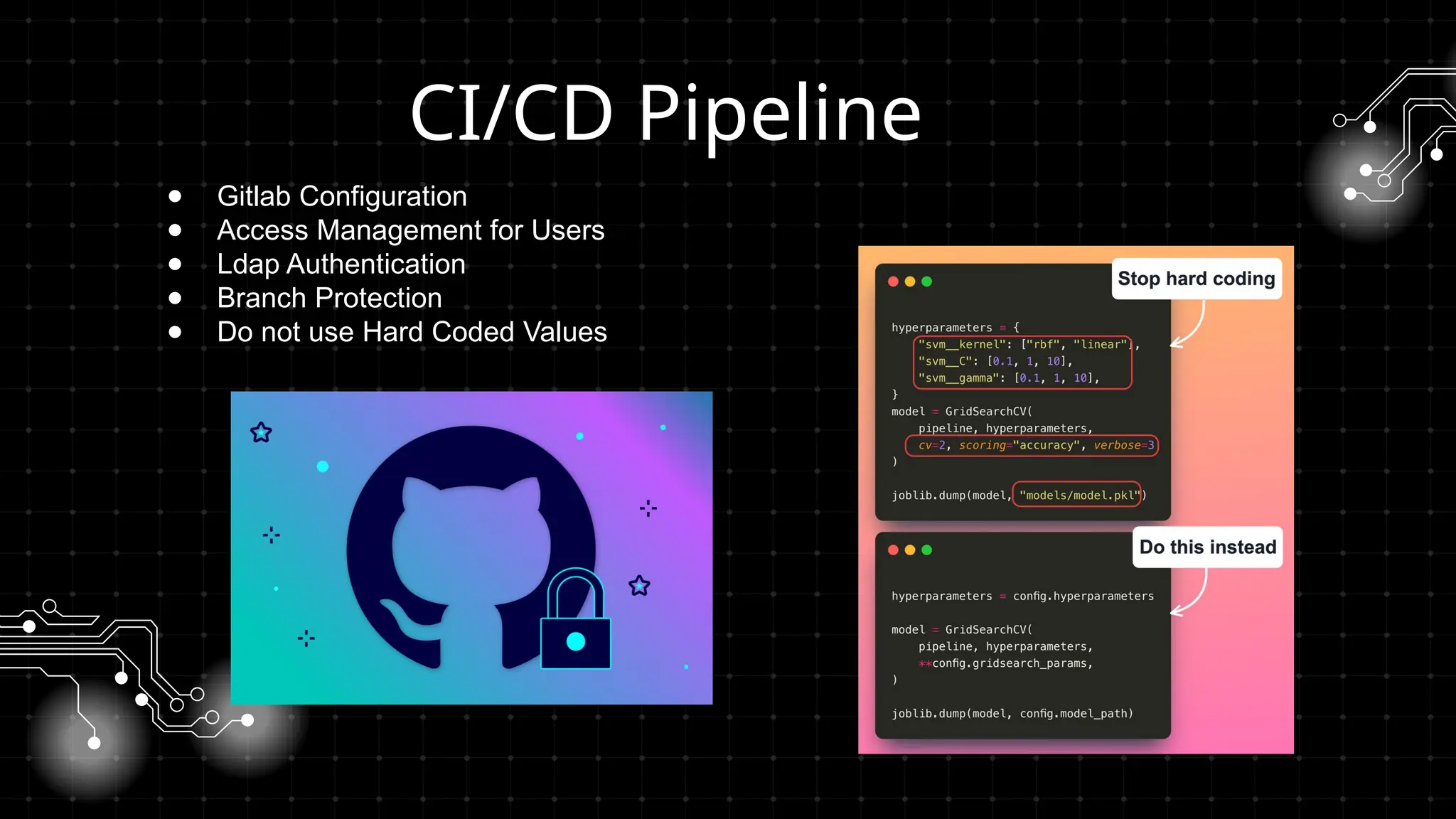
● Gitlab Configuration
● Access Management for Users
● Ldap Authentication
● Branch Protection
● Do not use Hard Coded Values
CI/CD Pipeline
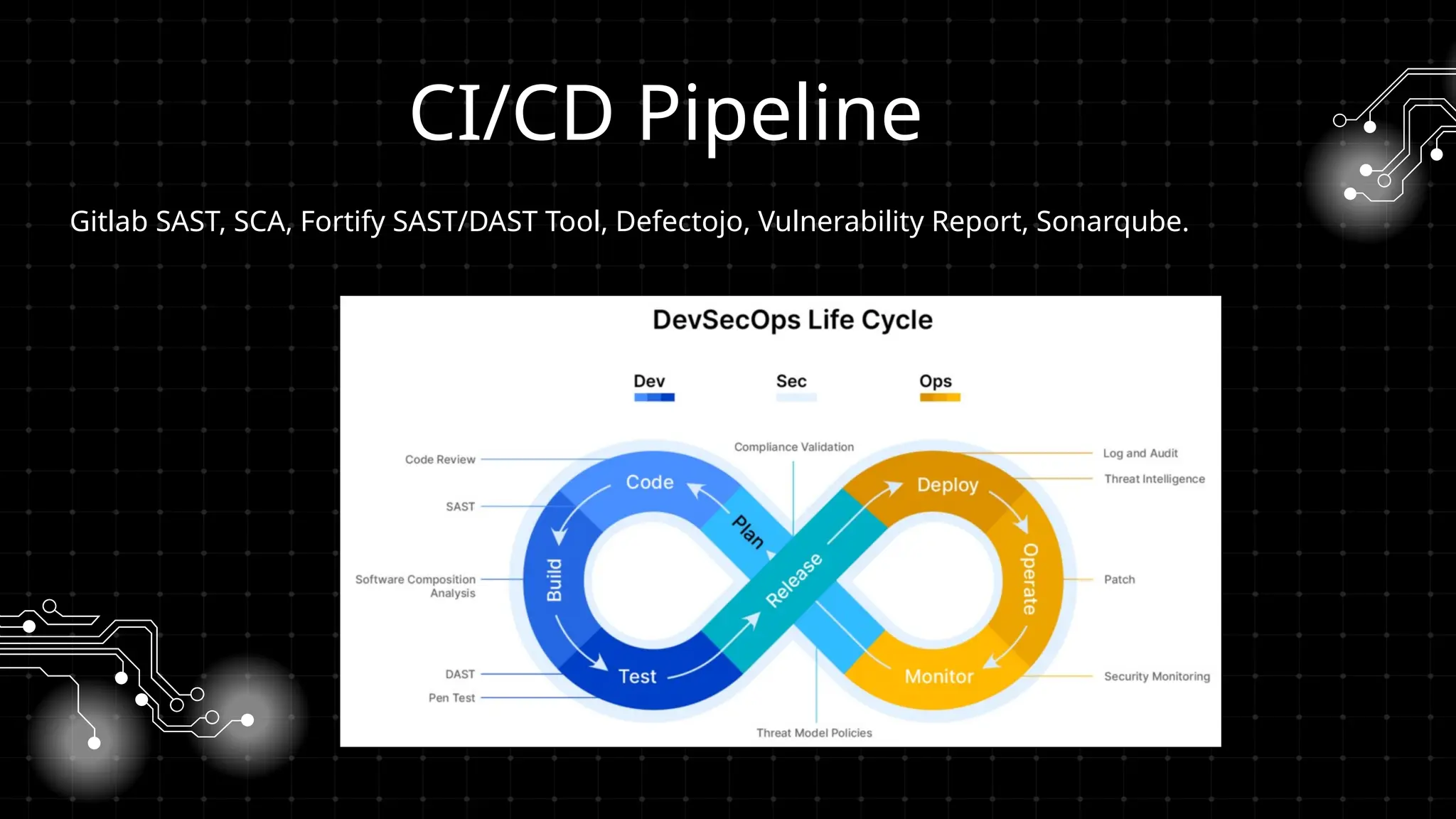
Gitlab SAST, SCA, Fortify SAST/DAST Tool, Defectojo, Vulnerability Report, Sonarqube.
CI/CD Pipeline
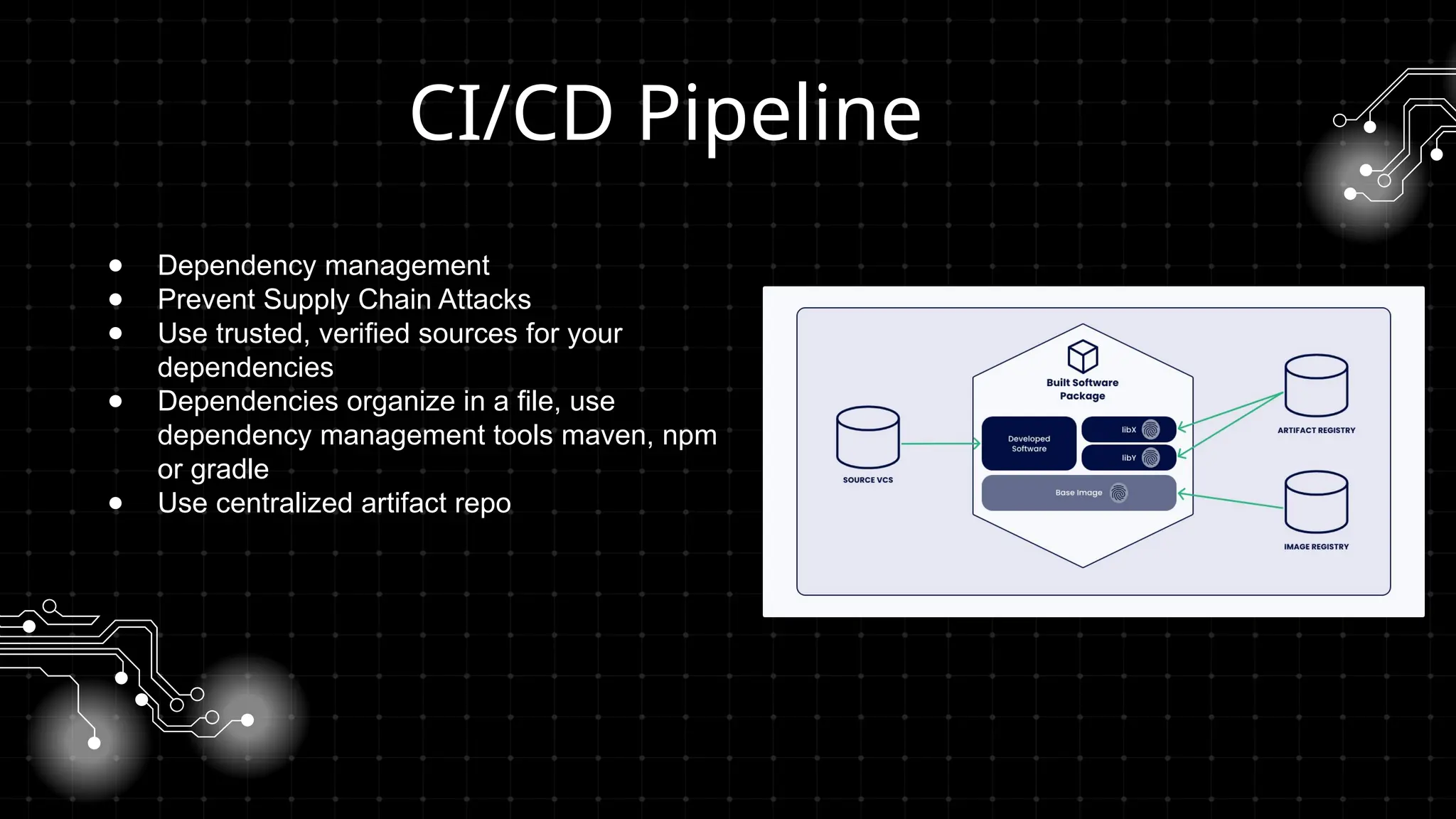
● Dependency management
● Prevent Supply Chain Attacks
● Use trusted, verified sources for your
dependencies
● Dependencies organize in a file, use
dependency management tools maven, npm
or gradle
● Use centralized artifact repo
CI/CD Pipeline
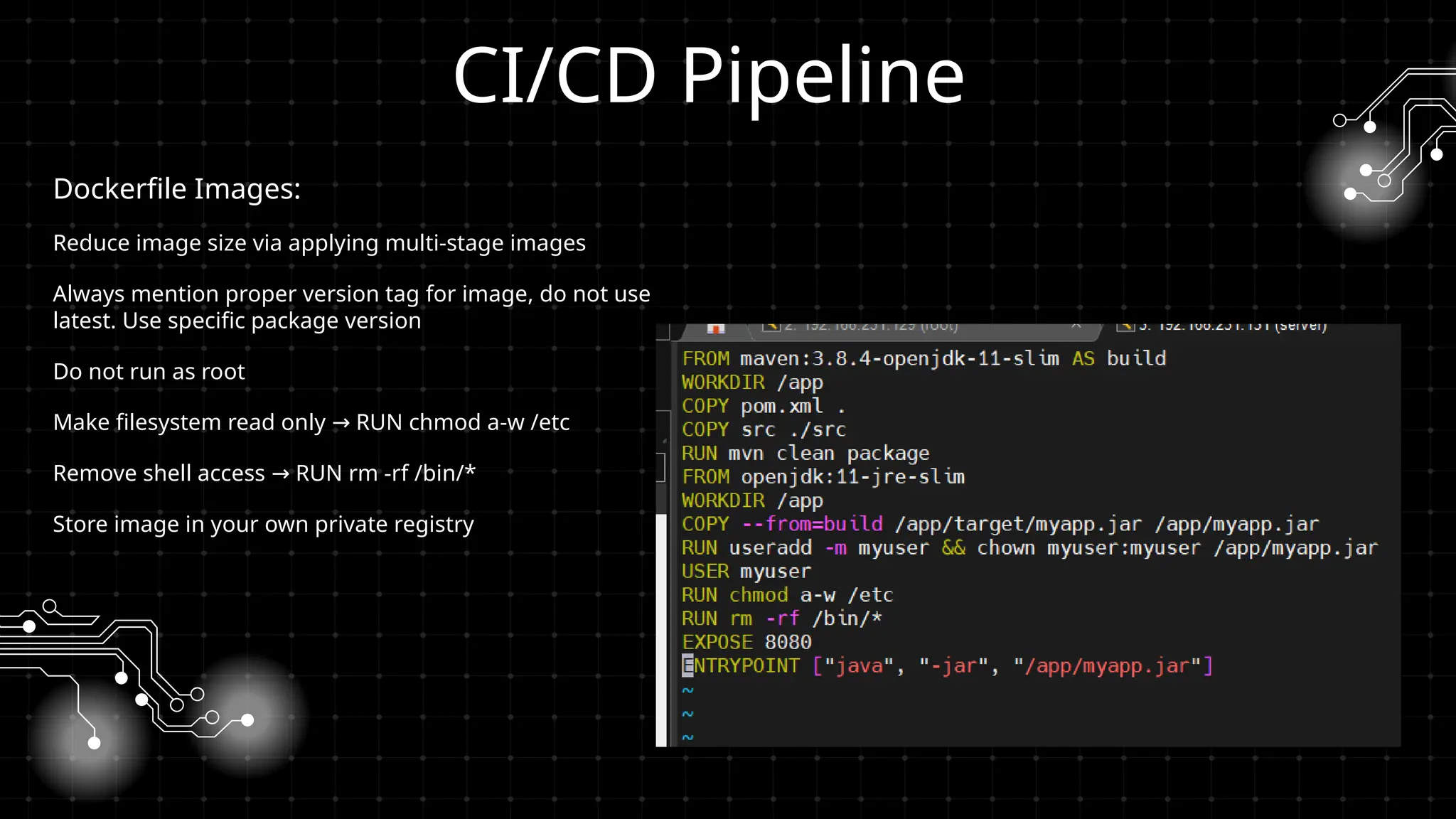
Dockerfile Images:
Reduce image size via applying multi-stage images
Always mention proper version tag for image, do not use
latest. Use specific package version
Do not run as root
Make filesystem read only RUN chmod a-w /etc
→
Remove shell access RUN rm -rf /bin/*
→
Store image in your own private registry
CI/CD Pipeline
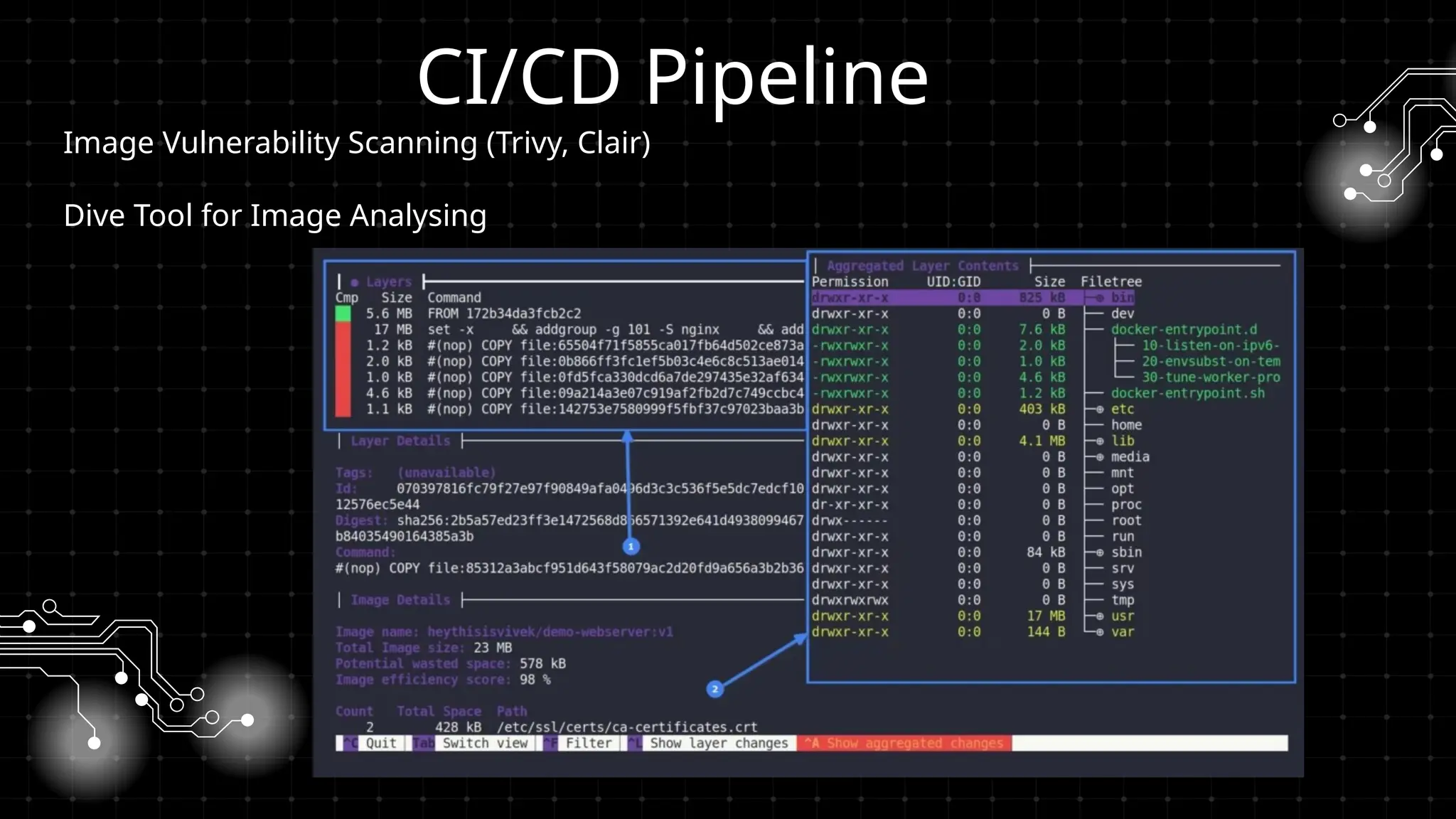
Image Vulnerability Scanning (Trivy, Clair)
Dive Tool for Image Analysing
Keycloak (IAM)
• Authentication & Authorization
(OpenID Connect & OAuth2)
• Single Sign-On (SSO)
• User federation (LDAP, AD.
DB)
• Social Login (Google, Facebook)
• RBAC
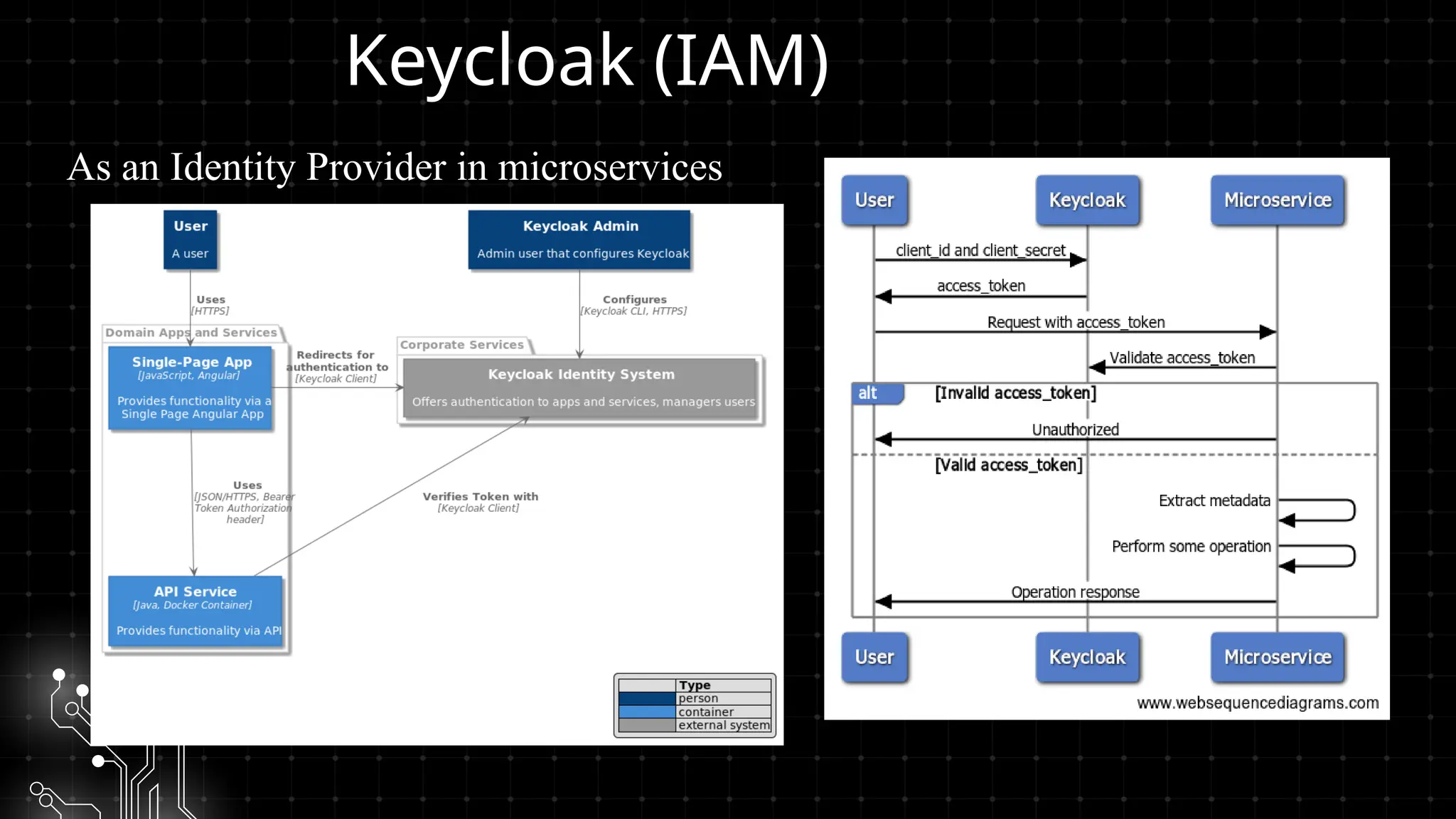
Keycloak (IAM)
As an Identity Provider in microservices
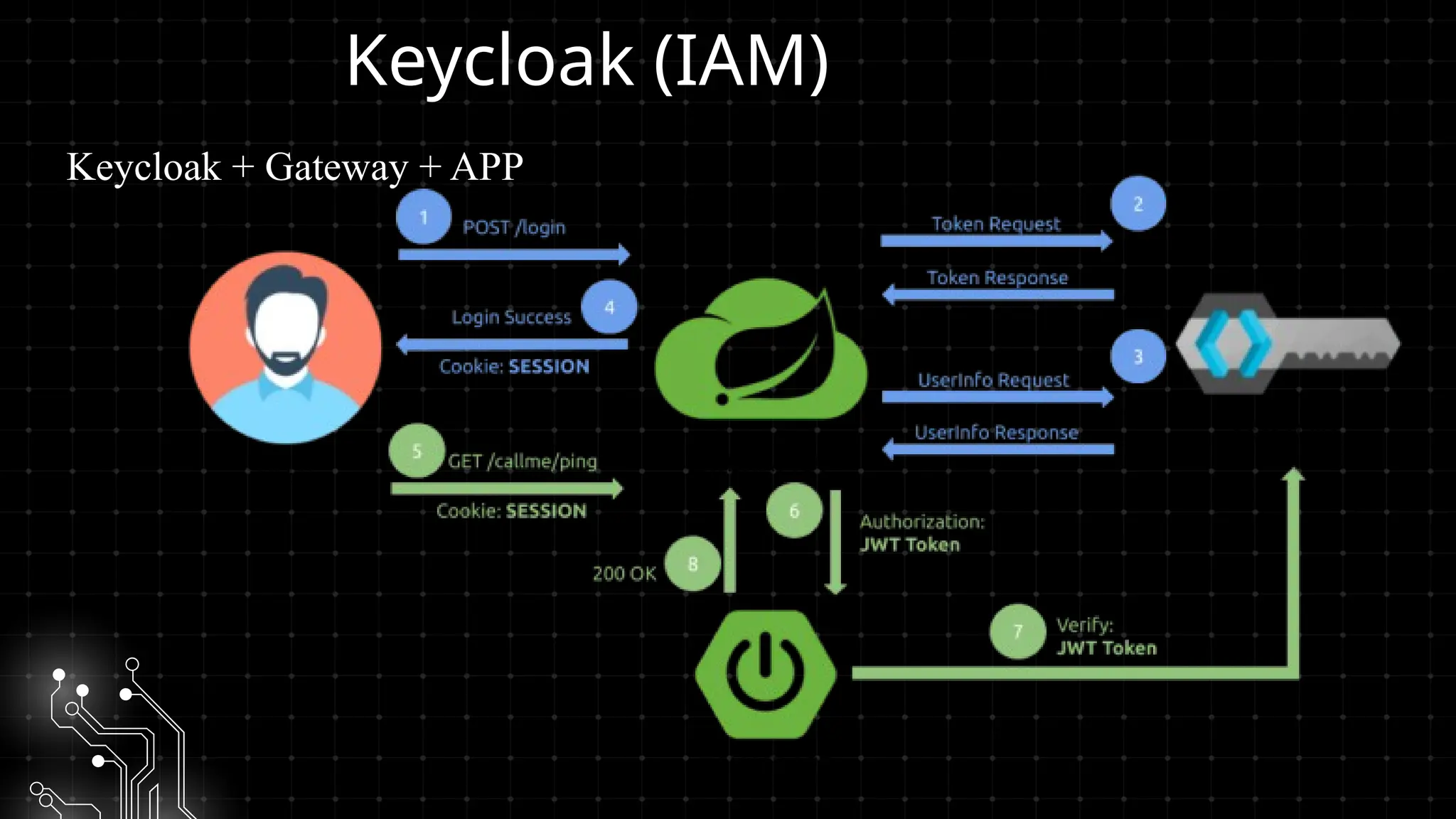
Keycloak (IAM)
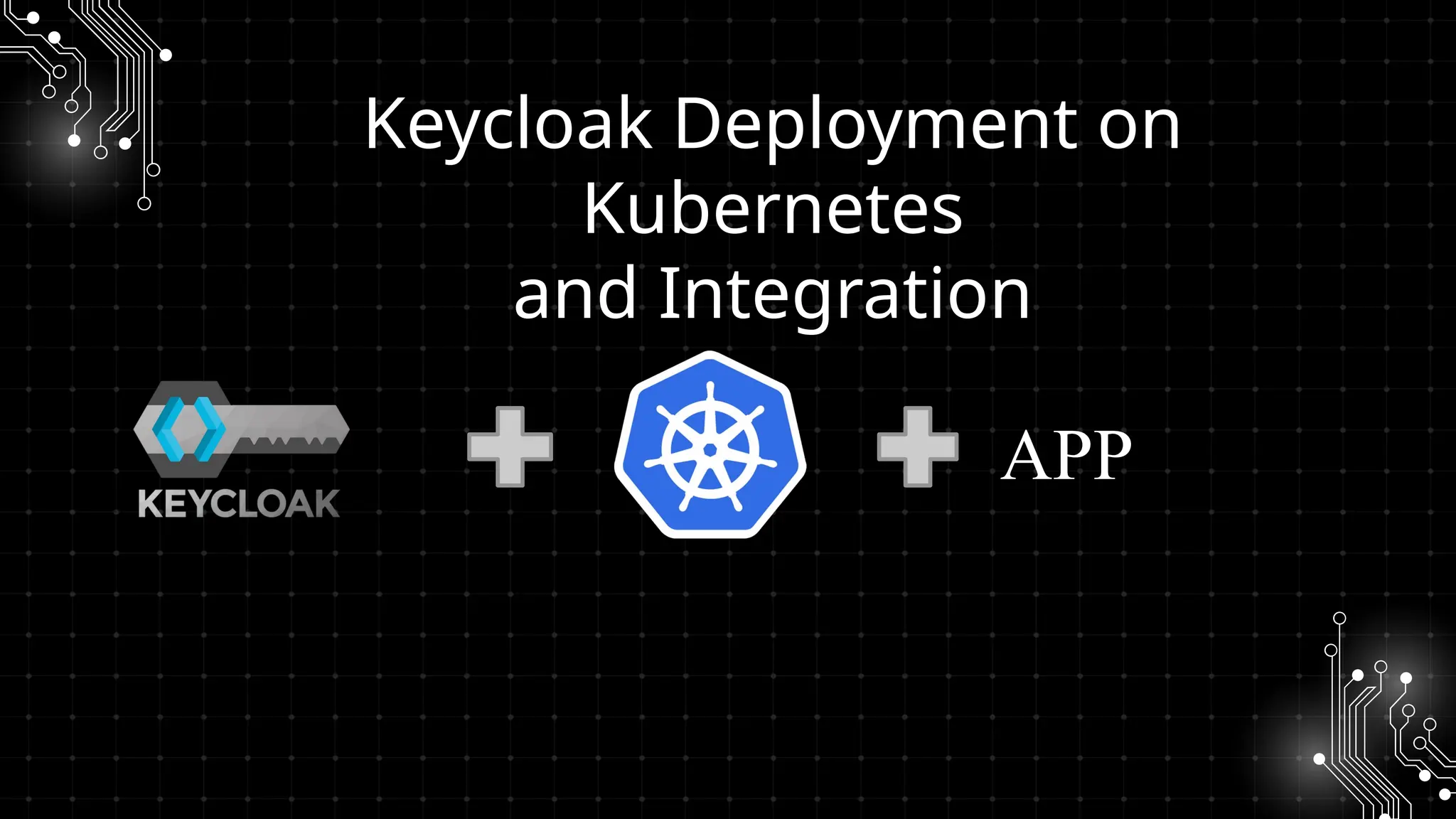
Keycloak + Gateway + APP
Keycloak Deployment on
Kubernetes
and Integration
APP
Thanks!

Unlocking DevOps Secuirty :Vault & Keylock

  • 1.
    Unlocking DevOps Security Here iswhere your presentation begins
  • 2.
    01 02 03 04 Tableof contents Kubernetes Security CI/CD Pipeline Security Infrastructure Security IAM in DevOps (Keycloak)
  • 3.
    Infrastructure security involves protectinga company's physical and virtual resources (servers, network devices, cloud environments, etc.). Infrastructure Security
  • 4.
    Infrastructure Security ● WAF- Web Application Firewall ● PAM - Privileged Access Management ● Infrastructure as Code (Terraform, Cloudformation, Terrascan) ● NSX Vmware - Network and Security Virtualization ● Configuration Management Tools (Ansible, Saltstack) ● CIS Benchmarks ● Logging of the system (filebeat, winlogbeat) ● Secret Management Tools - (Vault, AWS Secret management ) ● Least Privilege Access Implementation, MFA ● Backup and Recovery (Implement backuping system and disaster recovery plan)
  • 5.
    Infrastructure Security WAF (WebApplication Firewall) - Protects web applications from variety of application layer attacks, such as XSS(cross-site-scripting), SQL Injection.
  • 6.
    Infrastructure Security PAM (PrivilegedAccess Management) - Security tool for controlling and monitoring activity of privileged users. Example: Cyberark PAM, BeyondTrust
  • 7.
    Infrastructure Security IaC (Infrastructureas Code)- the ability to provision and support your computing infrastructure using code instead of manual processes and settings Example: Terraform, Terrascan
  • 8.
    VMware NSX |Networking and Security Virtualization Infrastructure Security
  • 9.
    Infrastructure Security Configuration managementtools - automate configurations (storage, networking etc) of servers Example: Ansible, Saltstack, Chef
  • 10.
    Infrastructure Security CIS Benchmarks(Center for Internet Security) - Best practices to implement security. Link: https://www.cisecurity.org/cis-benchmarks
  • 11.
    Infrastructure Security Logging ofthe system (Filebeat , Winlogbeat)
  • 12.
    Infrastructure Security Secret ManagementTools Example: Vault, AWS Secret Manager
  • 13.
  • 14.
  • 15.
    ● Container Isolation:Namespace () & cgroups () ● Network Policies (Calico, Cilium, NSX-T) ● RBAC on Kubernetes ● Upgrade Kube cluster ● ETCD encrypted ● Container Sandboxing ● mTLS/ ServiceMeshes - traffic between pods should be encrypted ● OPA - Open Policy Agent ● Falco ● AppArmor, Seccomp Kubernetes Security
  • 16.
    Container Isolation: Namespace& cgroups Namespaces -> Other processes, users, filesystems Cgroups > RAM, Disk, CPU Kubernetes Security
  • 17.
  • 18.
    RBAC on Kubernetes Combinations: 1.Role - Rolebinding → user has permissions in single namespace 2. ClusterRole - ClusterRoleBinding → user has same permissions in all namespaces 3. ClusterRole - RoleBinding → user has same permissions in multiple namespace Kubernetes Security
  • 19.
  • 20.
    Encryption at rest- Encrypt ETCD Key-Value DB Kubernetes Security
  • 21.
    Container Sandboxing -Kata Containers Kubernetes Security
  • 22.
    gVisor gVisor is alsoone of the Sandbox Runtime. It is user-space kernel for containers Kubernetes Security
  • 23.
    mTLS, Service Mesh mTLS- mutual TLS ● Mutual authentication ● Two-way (bilateral) authentication ● Two parties authenticating each-other at the same time By default in kubernetes every pod can communicate with each-other and this is done unecrypted Kubernetes Security
  • 24.
    OPA - OpenPolicy Agent OPA is an open-source, general-purpose policy engine that enables unified, context-aware policy enforcement across the entire stack. OPA Gatekeeper Kubernetes Security
  • 25.
    Falco Falco is acloud native runtime security, it provides deep kernel tracing built on the Linux kernel, it describe security rules against a system and detect unwanted behavior. Automated respond to a security violations Kubernetes Security
  • 26.
    Apparmor Kubernetes Security Profile Modes: Unconfined→ Process can escape Complain → Process can complain but it will be logged Enforce → Processes cannot escape
  • 27.
    seccomp: Seccomp (Secure Computing Mode)is a Linux kernel security feature that restricts the system calls a process can make, significantly reducing the potential attack surface for a process Kubernetes Security
  • 28.
    CI/CD Pipeline ● GitlabConfiguration, Access Management for Users, Ldap Authentication, Branch Protection ● Gitlab SAST, SCA, Defectojot, Sonarqube, Fortify ● Dependency checks ● Docker Images and Image Vulnerability Scanning (Trivy, Clair)
  • 29.
    CI/CD Pipeline ● GitlabConfiguration ● Access Management for Users ● Ldap Authentication ● Branch Protection ● Do not use Hard Coded Values
  • 30.
    CI/CD Pipeline Gitlab SAST,SCA, Fortify SAST/DAST Tool, Defectojo, Vulnerability Report, Sonarqube.
  • 31.
    CI/CD Pipeline ● Dependencymanagement ● Prevent Supply Chain Attacks ● Use trusted, verified sources for your dependencies ● Dependencies organize in a file, use dependency management tools maven, npm or gradle ● Use centralized artifact repo
  • 32.
    CI/CD Pipeline Dockerfile Images: Reduceimage size via applying multi-stage images Always mention proper version tag for image, do not use latest. Use specific package version Do not run as root Make filesystem read only RUN chmod a-w /etc → Remove shell access RUN rm -rf /bin/* → Store image in your own private registry
  • 33.
    CI/CD Pipeline Image VulnerabilityScanning (Trivy, Clair) Dive Tool for Image Analysing
  • 34.
    Keycloak (IAM) • Authentication& Authorization (OpenID Connect & OAuth2) • Single Sign-On (SSO) • User federation (LDAP, AD. DB) • Social Login (Google, Facebook) • RBAC
  • 35.
    Keycloak (IAM) As anIdentity Provider in microservices
  • 36.
  • 37.
  • 38.