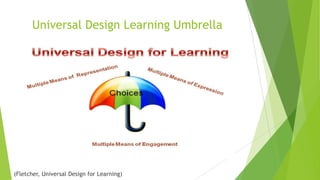
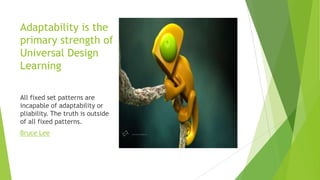
This document discusses Universal Design for Learning (UDL), an educational framework that aims to support all learners by providing flexible methods of presentation, expression, and engagement. It outlines three key principles of UDL: 1) using multiple and flexible methods for presentation of material, 2) supporting strategic learning through various means of expression, and 3) employing different options for motivating and engaging students affectively. The document asserts that UDL can address diverse learning preferences and abilities levels. It also notes that adaptability is UDL's main strength, and quotes Bruce Lee stating that truth exists beyond fixed approaches.




![Works Cited
Aguinaga Ph.D., N. (2009). Universal design for learning (udl), differentiating instruction (di) and
responding to intervention (rti). In Retrieved from http://cstl-coe.semo.edu/naguinaga/Universal Design
for Learning DI RTI.pdf
Fletcher, W. (Designer). (2009). Universal Design for Learning [Print Photo]. Retrieved from
http://www.spotsylvania.k12.va.us/itrt/Resources/ConferenceInformation/2009ConferencePresentation
s/UniversalDesignforLearning/tabid/4404/Default.aspx
Rose, D. (n.d.). Retrieved from http://www.cast.org/library/UDLguidelines/version1.html
Suarez, D. (n.d.). Retrieved from http://challengebychoice.wordpress.com/tiered-instruction-andassessment/
Yerrick, R., & Johnson, J. (2009). Meeting the needs of middle grade science learners through
pedagogical and technological intervention. Contemporary Issues in Technology and Teacher
Education, 9(3). Retrieved from http://www.citejournal.org/vol9/iss3/science/article1.cfm
Chameleon, [Print Photo]. Retrieved from http://hdw.eweb4.com/out/95728.html](https://image.slidesharecdn.com/universaldesignlearning-140225184804-phpapp01/85/Universal-design-learning-8-320.jpg)


![Universal design for learning [Autosaved].pptx](https://cdn.slidesharecdn.com/ss_thumbnails/universaldesignforlearningautosaved-250311092345-e855ac97-thumbnail.jpg?width=640&height=640&fit=bounds)


