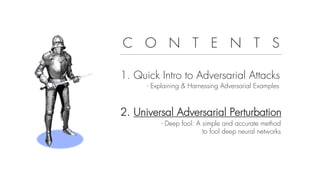
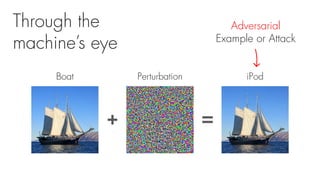
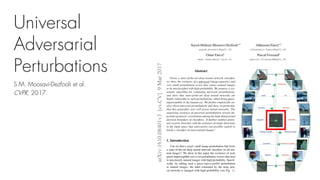
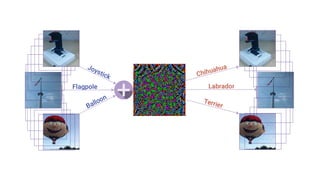
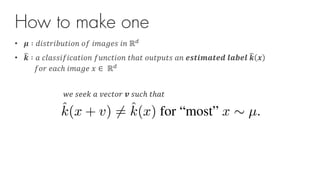
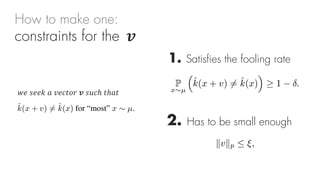
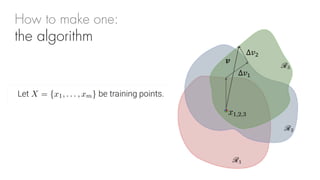
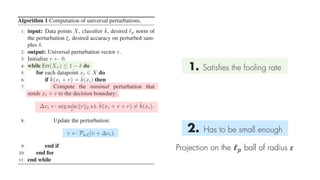
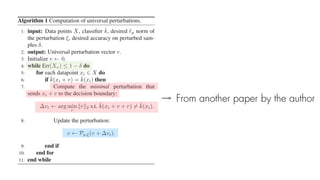
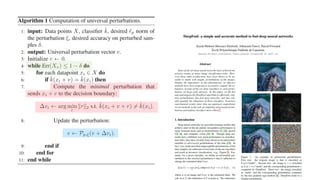
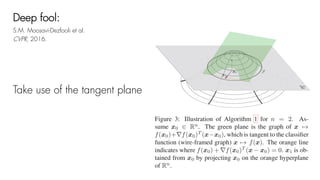
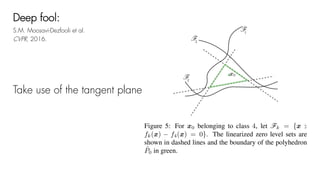
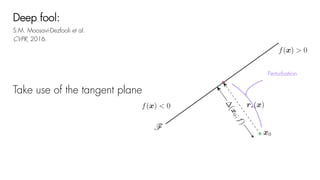
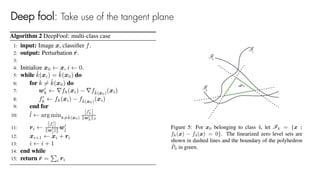
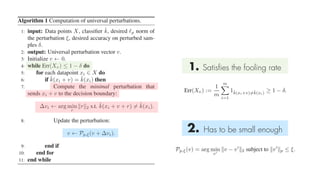
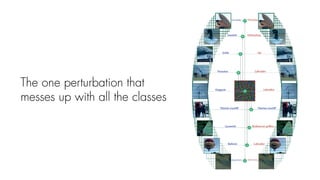
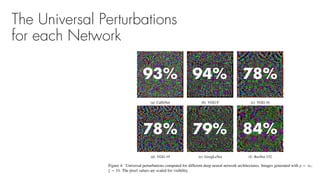
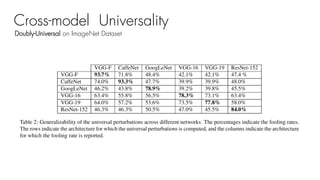
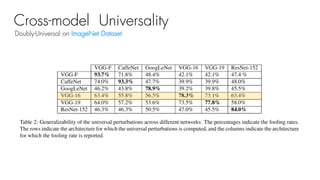
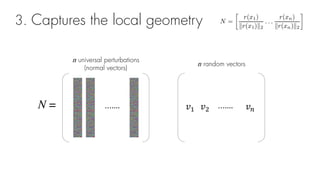
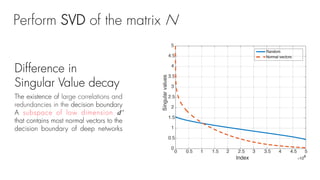
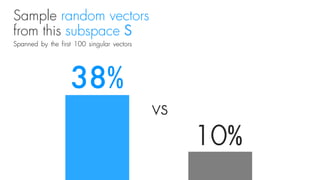
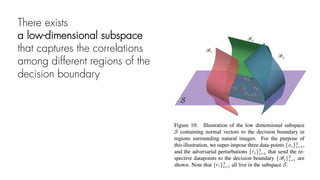
This document summarizes a seminar on universal adversarial perturbations. It begins with a quick introduction to adversarial attack methods like DeepFool. It then discusses the concept of universal adversarial perturbations - single perturbations that can fool neural networks into misclassifying most images. The document explains how universal perturbations are crafted to satisfy a fooling rate while being small. It shows that a single perturbation can achieve high fooling rates across different networks and models. It also discusses how universal perturbations capture the local geometry and correlations in the decision boundaries of neural networks.

![Explaining and Harnessing Adversarial Examples
I.J. Goodfellow et al. ICLR, 2015.
Fast Gradient Sign Method [FGSM]](https://image.slidesharecdn.com/presentationfinaleupload-180305022101/85/Universal-Adversarial-Perturbation-9-320.jpg)
![!" = " + %
&
Fast Gradient Sign Method [FGSM]
Explaining and Harnessing Adversarial Examples
I.J. Goodfellow et al. ICLR, 2015.
Perturbation
Gradient of the
cost function](https://image.slidesharecdn.com/presentationfinaleupload-180305022101/85/Universal-Adversarial-Perturbation-10-320.jpg)
![Fast Gradient Sign Method [FGSM]
Explaining and Harnessing Adversarial Examples
I.J. Goodfellow et al. ICLR, 2015.
RAW Images ATTACKED Images
With Maxout Network
Misclassification Rate
- MNIST : 89.4%](https://image.slidesharecdn.com/presentationfinaleupload-180305022101/85/Universal-Adversarial-Perturbation-11-320.jpg)
![Fast Gradient Sign Method [FGSM]
Explaining and Harnessing Adversarial Examples
I.J. Goodfellow et al. ICLR, 2015.
RAW Images ATTACKED Images
With Conv Maxout Network
Misclassification Rate
- CIFAR-10 : 87.2%](https://image.slidesharecdn.com/presentationfinaleupload-180305022101/85/Universal-Adversarial-Perturbation-12-320.jpg)
![Fast Gradient Sign Method [FGSM]
Explaining and Harnessing Adversarial Examples
I.J. Goodfellow et al. ICLR, 2015.
: Intensity of the Attack](https://image.slidesharecdn.com/presentationfinaleupload-180305022101/85/Universal-Adversarial-Perturbation-13-320.jpg)









![[SOTIF US Conference] Introduction to Safe ML](https://cdn.slidesharecdn.com/ss_thumbnails/20190930crdcccsafemlv1-190930165846-thumbnail.jpg?width=640&height=640&fit=bounds)


![Random Forest Intro [랜덤포레스트 설명]](https://cdn.slidesharecdn.com/ss_thumbnails/theforestslideshare-170924111713-thumbnail.jpg?width=640&height=640&fit=bounds)
![Neural Network Intro [인공신경망 설명]](https://cdn.slidesharecdn.com/ss_thumbnails/neuralnetworkfinale-170924112506-thumbnail.jpg?width=640&height=640&fit=bounds)


![Decision Tree Intro [의사결정나무]](https://cdn.slidesharecdn.com/ss_thumbnails/thetreeslideshare-170922160319-thumbnail.jpg?width=640&height=640&fit=bounds)


![5G Explained! A High Level Overview [Introduction]](https://cdn.slidesharecdn.com/ss_thumbnails/5gexplainedahighleveloverview-260119165306-cc137a3e-thumbnail.jpg?width=640&height=640&fit=bounds)


