Basic MachineBasic Machine
ProcessesProcesses
Competency D403.00Competency D403.00
Identify the basic conceptsIdentify the basic concepts
of the manufacturingof the manufacturing
processes.processes.
Basic Machine ProcessesBasic Machine Processes
Objective D403.01Objective D403.01
Explain the conceptsExplain the concepts
of the manufacturingof the manufacturing
process.process.
ManufacturingManufacturing
 Arrived from the Latin word
“manu factus”, meaning “made
by hand”.
 Manufacturing is the process of
converting raw materials into
products.
WHY STUDYWHY STUDY
MANUFACTURING PROCESSES?MANUFACTURING PROCESSES?
The designer and the drafter
must have a working knowledge
of the various processes that
could produce a part in order to:
lower cost and reduce
production time.
Three Phases Of TheThree Phases Of The
Manufacturing ProcessManufacturing Process
1. Product design.
2. Selection of materials.
3. Selection of production
methods and techniques.
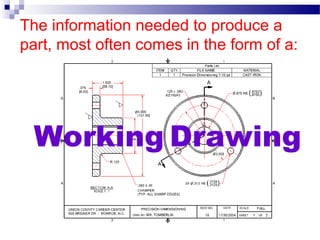
The information needed to produce a
part, most often comes in the form of a:
Working Drawing
Three Main Stages Of TheThree Main Stages Of The
Production Of A Machined PartProduction Of A Machined Part
Rough Forming
Casting, Forging, Welding
Finishing
Drilling, machining, surfacing
Assembling
The assembly of parts
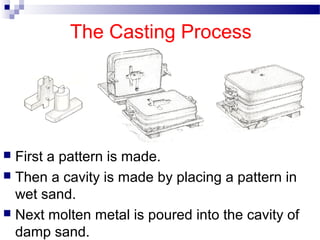
The Casting Process
 First a pattern is made.
 Then a cavity is made by placing a pattern in
wet sand.
 Next molten metal is poured into the cavity of
damp sand.
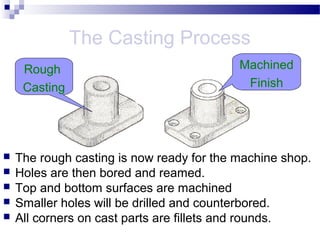
The Casting Process
 The rough casting is now ready for the machine shop.
 Holes are then bored and reamed.
 Top and bottom surfaces are machined
 Smaller holes will be drilled and counterbored.
 All corners on cast parts are fillets and rounds.
Rough
Casting
Machined
Finish
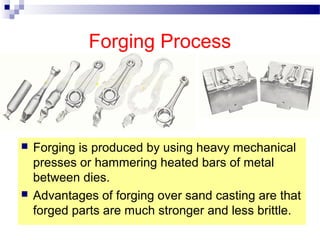
Forging Process
 Forging is produced by using heavy mechanical
presses or hammering heated bars of metal
between dies.
 Advantages of forging over sand casting are that
forged parts are much stronger and less brittle.
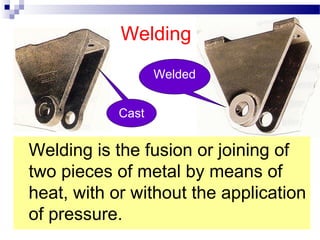
Welding
Welding is the fusion or joining of
two pieces of metal by means of
heat, with or without the application
of pressure.
Cast
Welded
ManufacturingManufacturing MaterialsMaterials
Fall into three general categories:
1. Metal
2. Plastic
3. Inorganic materials
Metals are classified as:Metals are classified as:
 Ferrous - contain iron and steel.
 Nonferrous - do not have iron content
(such as copper and aluminum).
 Alloys - mixture of two or more metals.
Inorganic Materials Include:Inorganic Materials Include:
• Carbon and graphite - have low
tensile strength (ability to be
stretched).
• Ceramics are clay and glass
materials. (resistant to heat,
chemicals, & corrosion).
Heat-Treating:Heat-Treating:
 Annealing – is the process generally
used to soften metal by heating followed by
slow cooling.
 Hardening – requires heating and then
rapid cooling in oil or water.
Plastics Processing
The plastics industry represents one of the
major manufacturing segments.
 Thermoplastic – becoming or remaining
soft and moldable when subjected to
heat.
 Thermosetting – becoming permanently
hard and unmoldable when once
subjected to heat.
Typical Plastic Processing Operations Include:
 Extrusion
 Blow Molding
 Injection Molding
 Thermoforming
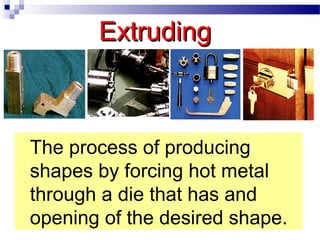
ExtrudingExtruding
The process of producing
shapes by forcing hot metal
through a die that has and
opening of the desired shape.
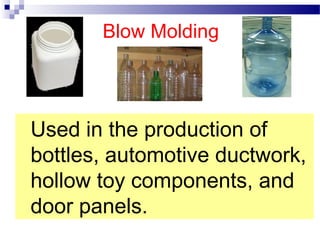
Blow Molding
Used in the production of
bottles, automotive ductwork,
hollow toy components, and
door panels.
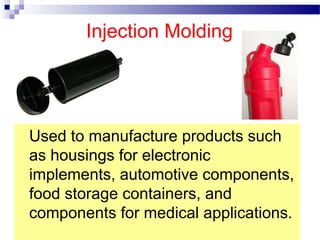
Injection Molding
Used to manufacture products such
as housings for electronic
implements, automotive components,
food storage containers, and
components for medical applications.
.


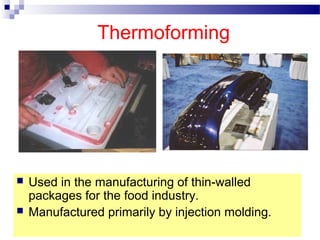
Thermoforming
 Used in the manufacturing of thin-walled
packages for the food industry.
 Manufactured primarily by injection molding.
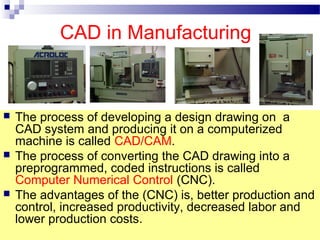
CAD in Manufacturing
 The process of developing a design drawing on a
CAD system and producing it on a computerized
machine is called CAD/CAM.
 The process of converting the CAD drawing into a
preprogrammed, coded instructions is called
Computer Numerical Control (CNC).
 The advantages of the (CNC) is, better production and
control, increased productivity, decreased labor and
lower production costs.
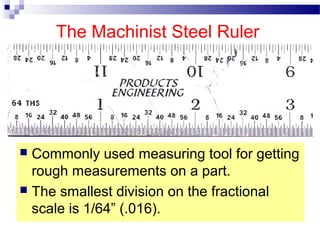
The Machinist Steel Ruler
 Commonly used measuring tool for getting
rough measurements on a part.
 The smallest division on the fractional
scale is 1/64” (.016).
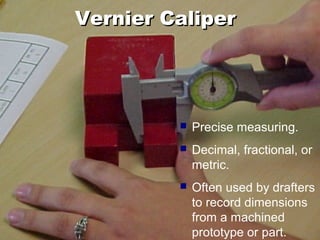
Vernier CaliperVernier Caliper
 Precise measuring.
 Decimal, fractional, or
metric.
 Often used by drafters
to record dimensions
from a machined
prototype or part.
6” Dial Caliper
Inside Inside
Outside
DepthStep
4-way
Measurement
4-way
Measurement
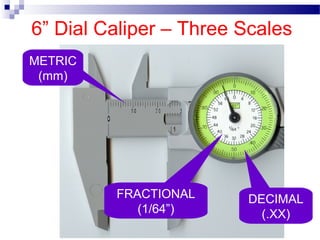
6” Dial Caliper – Three Scales
METRIC
(mm)
DECIMAL
(.XX)
FRACTIONAL
(1/64”)

Unitc manufacturing basic-machine_processes

  • 1.
    Basic MachineBasic Machine ProcessesProcesses CompetencyD403.00Competency D403.00 Identify the basic conceptsIdentify the basic concepts of the manufacturingof the manufacturing processes.processes.
  • 2.
    Basic Machine ProcessesBasicMachine Processes Objective D403.01Objective D403.01 Explain the conceptsExplain the concepts of the manufacturingof the manufacturing process.process.
  • 3.
    ManufacturingManufacturing  Arrived fromthe Latin word “manu factus”, meaning “made by hand”.  Manufacturing is the process of converting raw materials into products.
  • 4.
    WHY STUDYWHY STUDY MANUFACTURINGPROCESSES?MANUFACTURING PROCESSES? The designer and the drafter must have a working knowledge of the various processes that could produce a part in order to: lower cost and reduce production time.
  • 5.
    Three Phases OfTheThree Phases Of The Manufacturing ProcessManufacturing Process 1. Product design. 2. Selection of materials. 3. Selection of production methods and techniques.
  • 6.
    The information neededto produce a part, most often comes in the form of a: Working Drawing
  • 7.
    Three Main StagesOf TheThree Main Stages Of The Production Of A Machined PartProduction Of A Machined Part Rough Forming Casting, Forging, Welding Finishing Drilling, machining, surfacing Assembling The assembly of parts
  • 8.
    The Casting Process First a pattern is made.  Then a cavity is made by placing a pattern in wet sand.  Next molten metal is poured into the cavity of damp sand.
  • 9.
    The Casting Process The rough casting is now ready for the machine shop.  Holes are then bored and reamed.  Top and bottom surfaces are machined  Smaller holes will be drilled and counterbored.  All corners on cast parts are fillets and rounds. Rough Casting Machined Finish
  • 10.
    Forging Process  Forgingis produced by using heavy mechanical presses or hammering heated bars of metal between dies.  Advantages of forging over sand casting are that forged parts are much stronger and less brittle.
  • 11.
    Welding Welding is thefusion or joining of two pieces of metal by means of heat, with or without the application of pressure. Cast Welded
  • 12.
    ManufacturingManufacturing MaterialsMaterials Fall intothree general categories: 1. Metal 2. Plastic 3. Inorganic materials
  • 13.
    Metals are classifiedas:Metals are classified as:  Ferrous - contain iron and steel.  Nonferrous - do not have iron content (such as copper and aluminum).  Alloys - mixture of two or more metals.
  • 14.
    Inorganic Materials Include:InorganicMaterials Include: • Carbon and graphite - have low tensile strength (ability to be stretched). • Ceramics are clay and glass materials. (resistant to heat, chemicals, & corrosion).
  • 15.
    Heat-Treating:Heat-Treating:  Annealing –is the process generally used to soften metal by heating followed by slow cooling.  Hardening – requires heating and then rapid cooling in oil or water.
  • 16.
    Plastics Processing The plasticsindustry represents one of the major manufacturing segments.  Thermoplastic – becoming or remaining soft and moldable when subjected to heat.  Thermosetting – becoming permanently hard and unmoldable when once subjected to heat.
  • 17.
    Typical Plastic ProcessingOperations Include:  Extrusion  Blow Molding  Injection Molding  Thermoforming
  • 18.
    ExtrudingExtruding The process ofproducing shapes by forcing hot metal through a die that has and opening of the desired shape.
  • 19.
    Blow Molding Used inthe production of bottles, automotive ductwork, hollow toy components, and door panels.
  • 20.
    Injection Molding Used tomanufacture products such as housings for electronic implements, automotive components, food storage containers, and components for medical applications. .      
  • 21.
    Thermoforming  Used inthe manufacturing of thin-walled packages for the food industry.  Manufactured primarily by injection molding.
  • 22.
    CAD in Manufacturing The process of developing a design drawing on a CAD system and producing it on a computerized machine is called CAD/CAM.  The process of converting the CAD drawing into a preprogrammed, coded instructions is called Computer Numerical Control (CNC).  The advantages of the (CNC) is, better production and control, increased productivity, decreased labor and lower production costs.
  • 23.
    The Machinist SteelRuler  Commonly used measuring tool for getting rough measurements on a part.  The smallest division on the fractional scale is 1/64” (.016).
  • 24.
    Vernier CaliperVernier Caliper Precise measuring.  Decimal, fractional, or metric.  Often used by drafters to record dimensions from a machined prototype or part.
  • 25.
    6” Dial Caliper InsideInside Outside DepthStep 4-way Measurement 4-way Measurement
  • 26.
    6” Dial Caliper– Three Scales METRIC (mm) DECIMAL (.XX) FRACTIONAL (1/64”)