Non-Tariff Barrier
Presented By Linda Garcia
International Economics and World Trade
ALNT-ECO 5000
November 16, 2015
Professor: Cornelis Los
Introduction
What Is a Tariff
In simplest terms, a tariff is a tax. It adds to the cost of imported goods and is one
of several trade policies that a country can enact.
Why Are Tariffs and Trade Barriers Used
Tariffs are often created to protect infant industries and developing economies, but
are also used by more advanced economies with developed industries.
 Import Quotas
•I chose import quotas which are a form of protectionism . An import
quotas fixes the quantity of a particular good that foreign producer may
bring into the country over a specific period . The U.S. government imposes
quotas to protect domestic industries from foreign competition. Import
quotas protect worker who might have been laid off. That is why this is
important to me to keep employment rates high.
Effect of Import Quotas
Effect
•Import Quotas effect on consumers and on producers.
•The price of the good adjusts to balance supply (domestic plus imported) and
demand. The quota causes the price of the good to rise above the world price. The
imported quantity demanded falls and the domestic quantity supplied rises. Thus,
the import quota reduces the imports.
•While import quotas and other foreign trade policies can be beneficial to the
aggregate domestic economy they tend to be most beneficial, and thus most
commonly promoted by, domestic firms facing competition from foreign imports.
Benefits
Who Benefits
•The benefits of tariffs are uneven. Because a tariff is a tax, the government will see
increased revenue as imports enter the domestic market.
•The effect of tariffs and trade barriers on businesses, consumers and the government shifts
over time.
•During this time period, businesses will profit and the government will see an increase in
revenue from duties.
The Bottom Line
•Free trade benefits consumers through increased choice and reduced prices, but because the
global economy brings with it uncertainty, many governments impose tariffs and other trade
barriers to protect industry. There is a delicate balance between the pursuit of efficiencies and
the government's need to ensure low unemployment.
Historical Example/Effects
•In 1959, the U.S. government established the Mandatory Oil Import Quota
program (MOIP), which restricted the amount of imported crude oil and refined
products allowed into the United States and gave preferential treatment to oil
imports from Canada, Mexico, and, somewhat later, Venezuela.
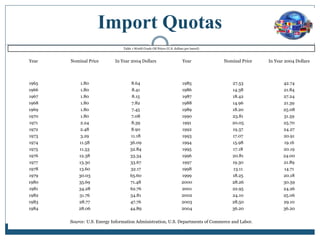
•The collective effort to raise oil prices was unsuccessful during the 1960s; real
i.e., inflation adjusted world market prices for crude oil fell from $9.78 (in 2004
dollars) in 1960 to $7.08 in 1970. However, real prices began to rise slowly in 1971
and then increased sharply in late 1973 and 1974, from roughly $10.00 per barrel to
more than $36.00 per barrel in the wake of the 1973 Arab-Israeli (“Yom Kippur”)
War.
Import Quotas
Table 1 World Crude Oil Prices (U.S. dollars per barrel)
Year Nominal Price In Year 2004 Dollars Year Nominal Price In Year 2004 Dollars
1965 1.80 8.64 1985 27.53 42.74
1966 1.80 8.41 1986 14.38 21.84
1967 1.80 8.15 1987 18.42 27.24
1968 1.80 7.82 1988 14.96 21.39
1969 1.80 7.45 1989 18.20 25.08
1970 1.80 7.08 1990 23.81 31.59
1971 2.24 8.39 1991 20.05 25.70
1972 2.48 8.90 1992 19.37 24.27
1973 3.29 11.18 1993 17.07 20.91
1974 11.58 36.09 1994 15.98 19.16
1975 11.53 32.84 1995 17.18 20.19
1976 12.38 33.34 1996 20.81 24.00
1977 13.30 33.67 1997 19.30 21.89
1978 13.60 32.17 1998 13.11 14.71
1979 30.03 65.60 1999 18.25 20.18
1980 35.69 71.48 2000 28.26 30.59
1981 34.28 62.76 2001 22.95 24.26
1982 31.76 54.81 2002 24.10 25.06
1983 28.77 47.76 2003 28.50 29.10
1984 28.06 44.89 2004 36.20 36.20
Source: U.S. Energy Information Administration, U.S. Departments of Commerce and Labor.
Import Quotas
Who Benefits
•The benefits of tariffs are uneven. Because a tariff is a tax, the government will
see increased revenue as imports enter the domestic market.
•The effect of tariffs and trade barriers on businesses, consumers and the
government shifts over time.
•During this time period, businesses will profit and the government will see an
increase in revenue from duties.
The Bottom Line
•Free trade benefits consumers through increased choice and reduced prices, but
because the global economy brings with it uncertainty, many governments impose
tariffs and other trade barriers to protect industry. There is a delicate balance
between the pursuit of efficiencies and the government's need to ensure low
unemployment.
Import Quotas
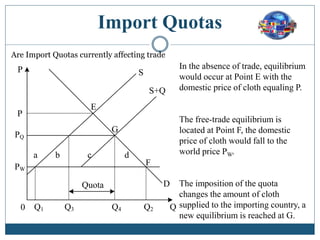
Are Import Quotas currently affecting trade
P S
S+Q
D
E
G
F
P
PQ
PW
0 Q1 Q3 Q4 Q2 Q
a b c d
Quota
In the absence of trade, equilibrium
would occur at Point E with the
domestic price of cloth equaling P.
The free-trade equilibrium is
located at Point F, the domestic
price of cloth would fall to the
world price PW.
The imposition of the quota
changes the amount of cloth
supplied to the importing country, a
new equilibrium is reached at G.
Import Quotas
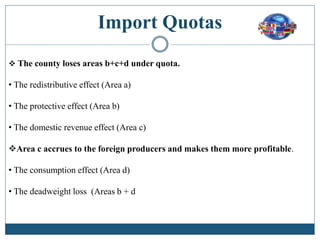
 The county loses areas b+c+d under quota.
• The redistributive effect (Area a)
• The protective effect (Area b)
• The domestic revenue effect (Area c)
Area c accrues to the foreign producers and makes them more profitable.
• The consumption effect (Area d)
• The deadweight loss (Areas b + d
Import Quotas
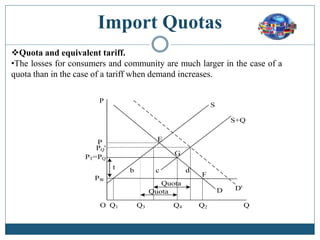
Quota and equivalent tariff.
•The losses for consumers and community are much larger in the case of a
quota than in the case of a tariff when demand increases.
P
S
S+Q
D
E
G
F
P
PT=PQ
PW
O Q1 Q3 Q4 Q2 Q
b c d
Quota
PQ'
Quota
D'
t
Conclusion
•Although tariffs have historically been the most important form of trade restriction,
there are many other types of trade barriers, such as import quotas, voluntary export
restraints, and antidumping actions.
• As tariffs were negotiated down during the postwar period, the importance of
nontariff trade barriers has greatly increased.
Resources
http://www.cbp.gov/trade/quota/guide-import-goods/commodities
http://internationalshippingusa.com/Import_Quotas_in_International_Sh
ipping.aspx
Source: U.S. Energy Information Administration, U.S. Departments of Commerce
and Labor.

Non tariff barrier

  • 1.
    Non-Tariff Barrier Presented ByLinda Garcia International Economics and World Trade ALNT-ECO 5000 November 16, 2015 Professor: Cornelis Los
  • 2.
    Introduction What Is aTariff In simplest terms, a tariff is a tax. It adds to the cost of imported goods and is one of several trade policies that a country can enact. Why Are Tariffs and Trade Barriers Used Tariffs are often created to protect infant industries and developing economies, but are also used by more advanced economies with developed industries.  Import Quotas •I chose import quotas which are a form of protectionism . An import quotas fixes the quantity of a particular good that foreign producer may bring into the country over a specific period . The U.S. government imposes quotas to protect domestic industries from foreign competition. Import quotas protect worker who might have been laid off. That is why this is important to me to keep employment rates high.
  • 3.
    Effect of ImportQuotas Effect •Import Quotas effect on consumers and on producers. •The price of the good adjusts to balance supply (domestic plus imported) and demand. The quota causes the price of the good to rise above the world price. The imported quantity demanded falls and the domestic quantity supplied rises. Thus, the import quota reduces the imports. •While import quotas and other foreign trade policies can be beneficial to the aggregate domestic economy they tend to be most beneficial, and thus most commonly promoted by, domestic firms facing competition from foreign imports.
  • 4.
    Benefits Who Benefits •The benefitsof tariffs are uneven. Because a tariff is a tax, the government will see increased revenue as imports enter the domestic market. •The effect of tariffs and trade barriers on businesses, consumers and the government shifts over time. •During this time period, businesses will profit and the government will see an increase in revenue from duties. The Bottom Line •Free trade benefits consumers through increased choice and reduced prices, but because the global economy brings with it uncertainty, many governments impose tariffs and other trade barriers to protect industry. There is a delicate balance between the pursuit of efficiencies and the government's need to ensure low unemployment.
  • 5.
    Historical Example/Effects •In 1959,the U.S. government established the Mandatory Oil Import Quota program (MOIP), which restricted the amount of imported crude oil and refined products allowed into the United States and gave preferential treatment to oil imports from Canada, Mexico, and, somewhat later, Venezuela. •The collective effort to raise oil prices was unsuccessful during the 1960s; real i.e., inflation adjusted world market prices for crude oil fell from $9.78 (in 2004 dollars) in 1960 to $7.08 in 1970. However, real prices began to rise slowly in 1971 and then increased sharply in late 1973 and 1974, from roughly $10.00 per barrel to more than $36.00 per barrel in the wake of the 1973 Arab-Israeli (“Yom Kippur”) War.
  • 6.
    Import Quotas Table 1World Crude Oil Prices (U.S. dollars per barrel) Year Nominal Price In Year 2004 Dollars Year Nominal Price In Year 2004 Dollars 1965 1.80 8.64 1985 27.53 42.74 1966 1.80 8.41 1986 14.38 21.84 1967 1.80 8.15 1987 18.42 27.24 1968 1.80 7.82 1988 14.96 21.39 1969 1.80 7.45 1989 18.20 25.08 1970 1.80 7.08 1990 23.81 31.59 1971 2.24 8.39 1991 20.05 25.70 1972 2.48 8.90 1992 19.37 24.27 1973 3.29 11.18 1993 17.07 20.91 1974 11.58 36.09 1994 15.98 19.16 1975 11.53 32.84 1995 17.18 20.19 1976 12.38 33.34 1996 20.81 24.00 1977 13.30 33.67 1997 19.30 21.89 1978 13.60 32.17 1998 13.11 14.71 1979 30.03 65.60 1999 18.25 20.18 1980 35.69 71.48 2000 28.26 30.59 1981 34.28 62.76 2001 22.95 24.26 1982 31.76 54.81 2002 24.10 25.06 1983 28.77 47.76 2003 28.50 29.10 1984 28.06 44.89 2004 36.20 36.20 Source: U.S. Energy Information Administration, U.S. Departments of Commerce and Labor.
  • 7.
    Import Quotas Who Benefits •Thebenefits of tariffs are uneven. Because a tariff is a tax, the government will see increased revenue as imports enter the domestic market. •The effect of tariffs and trade barriers on businesses, consumers and the government shifts over time. •During this time period, businesses will profit and the government will see an increase in revenue from duties. The Bottom Line •Free trade benefits consumers through increased choice and reduced prices, but because the global economy brings with it uncertainty, many governments impose tariffs and other trade barriers to protect industry. There is a delicate balance between the pursuit of efficiencies and the government's need to ensure low unemployment.
  • 8.
    Import Quotas Are ImportQuotas currently affecting trade P S S+Q D E G F P PQ PW 0 Q1 Q3 Q4 Q2 Q a b c d Quota In the absence of trade, equilibrium would occur at Point E with the domestic price of cloth equaling P. The free-trade equilibrium is located at Point F, the domestic price of cloth would fall to the world price PW. The imposition of the quota changes the amount of cloth supplied to the importing country, a new equilibrium is reached at G.
  • 9.
    Import Quotas  Thecounty loses areas b+c+d under quota. • The redistributive effect (Area a) • The protective effect (Area b) • The domestic revenue effect (Area c) Area c accrues to the foreign producers and makes them more profitable. • The consumption effect (Area d) • The deadweight loss (Areas b + d
  • 10.
    Import Quotas Quota andequivalent tariff. •The losses for consumers and community are much larger in the case of a quota than in the case of a tariff when demand increases. P S S+Q D E G F P PT=PQ PW O Q1 Q3 Q4 Q2 Q b c d Quota PQ' Quota D' t
  • 11.
    Conclusion •Although tariffs havehistorically been the most important form of trade restriction, there are many other types of trade barriers, such as import quotas, voluntary export restraints, and antidumping actions. • As tariffs were negotiated down during the postwar period, the importance of nontariff trade barriers has greatly increased.
  • 12.

Editor's Notes

  • #3 Restrictions and regulations that a nation imposes on international trade deal with the nation’s trade or commerce, they are generally known as trade or commercial policies. We will see that although trade restrictions are invariably rationalized in terms of national welfare, in reality they are usually advocated by those special groups in the nation that stand to benefit from such restrictions.
  • #4 Because the import quota prevents domestic consumers from buying an imported good, the supply of the good is no longer perfect elastic at the world price. Instead, as long as the price of the good is above the world price, the license holders import as much as they are permitted, and the total supply of the good equals the domestic supply plus the quota amount. Domestic firms benefit with higher sales, greater profits, and more income to resource owners. However, by increasing domestic prices and restricting accessing to imports, foreign trade policies also tend to be harmful to domestic consumers. Because the quota raises the domestic price above the world price, domestic sellers are better off, and domestic buyers are worse off. In addition, the license holders are better off because they make a profit from buying at the world price and selling at the higher domestic price. Thus, import quotas decrease consumer surplus while increasing producer surplus and license-holder surplus.
  • #6 OPEC is in many ways a cartel a group of producers that attempts to restrict output in order to raise prices above the competitive level. The decision-making center of OPEC is the Conference, comprising national delegations at the level of oil minister, which meets twice each year to decide overall oil output and thus pricesand to assign output quotas for the individual members. Those quotas are upper limits on the amount of oil each member is allowed to produce. The Conference also may meet in special sessions when deemed necessary, particularly when downward pressure on prices becomes acute.
  • #7 Source: U.S. Energy Information Administration, U.S. Departments of Commerce and Labor.
  • #8 Domestic industries also benefit from a reduction in competition, since import prices are artificially inflated. Unfortunately for consumers both individual consumers and businesses higher import prices mean higher prices for goods. If the price of steel is inflated due to tariffs, individual consumers pay more for products using steel, and businesses pay more for steel that they use to make goods. In short, tariffs and trade barriers tend to be pro-producer and anti-consumer.
  • #10 With a given import quota, an increase in demand will result in a higher domestic price and greater domestic production than with an equivalent import tariff. On the other hand, with a given import tariff, an increase in demand will leave the domestic price and domestic production unchanged but will result in higher consumption and imports
  • #11 A quota is a direct quantitative restriction on the amount of a commodity allowed to be imported or exported in a nation. In this section, we examine import quotas. . Import quotas can be used to protect a domestic industry or agriculture and for balance-of-payments reasons. Import quotas were very common in Western Europe immediately after World War II. Since then they have been used by practically all industrial nations to protect their agriculture and by developing nations to stimulate the import substitution of manufactured products and for balance-of-payments reasons.