LocalandGlobal
Communicationin
Multicultural
Settings
Learning
Outcomes
1. Describe the styles in communication
considering various multicultural settings.
2. Determine varieties and registers of
spoken and written language.
3. Adopt cultural an intercultural
awareness and sensitivity in
communicating ideas.
4. Develop a sense of appreciation on the
richness and diversity of registers used in
written and spoken communication.
COMMUNICATION
STYLESINVARIOUS
MULTICULTURAL
CONTEXTS
1.
Communication style refers to the
choices people make and the
strategies or tools they use in the
process of communication. A style
may sometimes depend on the
demands of the communicative
situation, as well as on the needs
and requirements of the target
recipients of the information.
The model, developed by Dr. Eileen M.
Russo, shows four different communication
styles (direct, spirited, systematic and
considerate), categorized further into two
different dimensions (level of assertiveness
and level of expressiveness). All of these
must be considered because people with
different cultural contexts tend to have
varying levels and styles of
communication.
TheCommunication
StylesMatrix
Thecombination oftheselevelsresult tothebasic communication styles:
Spirited = High Expressiveness + High Assertiveness
Considerate = High Expressiveness + Low Assertiveness
Direct = Low Expressiveness + High Assertiveness
Systematic = Low Expressiveness + Low Assertiveness
Spirited Communication Style
● People with the spirited communication style are very interested in the ‘big
picture’. They are the dreamers, the inventors, and the innovators in the
group. Their communication may be full of grand
ideas and hyperboles that tend to be very persuasive to others at first.
● Keeping to an agenda is sometimes a challenge for those with the spirited
communication styles both time management and remaining focused
are challenges for this group.
● Their written or verbal communication may tend to wards the dramatic.
● While they can be very entertaining, getting them to communicate clearly
on specific topics may take the assistance of someone else to guide them
through a conversation and keep them on track by bringing them back to
the subject at hand.
Systematic Communication Style
● Those with a systematic communication style like to focus on facts and details rather than opinions
and possibilities. Expect to use and appreciate logic when you communicate with a systematic. They
will appreciate facts and analysis rather than the ‘big picture’ ideas that have not yet been proved
useful.
● They may be slower to respond to your communication, as they are probably analyzing
the situation and constructing a logical, well thought-out response.
● Those with a systematic communication style are uncomfortable with expressing their feelings
about things and do not like conflict. They may tend to shut down communication rather than
dealing with emotional or confrontational situations. If you give them directions,
you will need to be very thorough and precise in relaying them.
● The more information you can give them, the happier they will be–as long as the information
is relevant to the current discussion or is relevant background information.
Considerate Communication Style
● Those with the considerate communication style are very concerned about the feelings of others.
They want to please other people and to be included in her peer group.
● They like to work with others, help others, and connect to the reason personal level. If there is
conflicting your group, they will be the ones to attempt to mediate it.
● They want everyone to have the chance to speak their minds, have their turns, and receiver
recognition for their contribution.
● They are natural trainers and counselors, and enjoy helping others succeed. They will encourage
group collaboration and communication, though they are not always inclined to speak their own
minds.
Direct Communication Style
● When communicating with someone who has the direct communication style, the key
is to get to the main point of your communication as soon as possible, and to do so in
as efficient as manner as possible.
● As indicated in the communication style matrix, people with the direct
communication style are highly assertive and not expressive.
● They tend to tell others what to do instead of asking others what they think should be
done, and they will not easily show emotions in their communications with others.
● Their communication style is meant to be expedient, though others may not always
see it that way. They may appear terse and cold to others, who might take their style of
communicating personally.
VARIETIESANDREGISTERS
OFSPOKENANDWRITTEN
LANGUAGE
2.
In a multicultural society, people
must use culturally-appropriate
terms, gestures, expressions and
images in any communicative
situation.
Language
Varieties
Also called “lects”, these refer to
the different variants of a
language that can be
sufficiently delimited from one
another in terms of social,
historical, or geo-spatial factors,
thus forming language clusters.
It refers to a new
language that develops
into situations where
speakers of different
languages need to
communicate but do
not share a common
language.
a. Pidgin
It is a pidgin that
becomes the first
language of the
children, or the
mother tongue of a
certain community.
b. Creole
It is not a language
that is not distinct from
a national language,
but rather a variety of
a language spoken in
a particular area of a
country
c. Regional
Dialect
Heregoes yourtimelineorprocess.
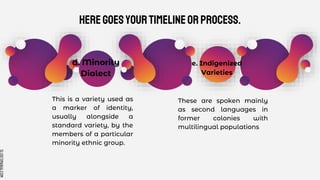
This is a variety used as
a marker of identity,
usually alongside a
standard variety, by the
members of a particular
minority ethnic group.
d. Minority
Dialect
These are spoken mainly
as second languages in
former colonies with
multilingual populations
e. Indigenized
Varieties
Language
Registers
A language register is characterized
by the way a speaker uses
language differently in different
social circumstances. These are
determined by such factors as social
atmosphere, purpose of
communication, audience, and the
general context of the discourse.
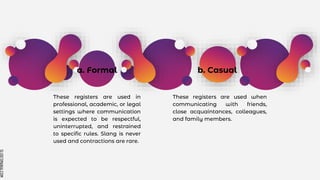
These registers are used in
professional, academic, or legal
settings where communication
is expected to be respectful,
uninterrupted, and restrained
to specific rules. Slang is never
used and contractions are rare.
a. Formal
These registers are used when
communicating with friends,
close acquaintances, colleagues,
and family members.
b. Casual
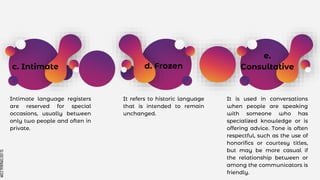
Intimate language registers
are reserved for special
occasions, usually between
only two people and often in
private.
c. Intimate
It refers to historic language
that is intended to remain
unchanged.
d. Frozen
It is used in conversations
when people are speaking
with someone who has
specialized knowledge or is
offering advice. Tone is often
respectful, such as the use of
honorifics or courtesy titles,
but may be more casual if
the relationship between or
among the communicators is
friendly.
e.
Consultative
● Language registers can also be classified as Formal, Informal, or
Neutral. Formal language registers are appropriate for professional
situations, such as when speaking to a supervisor or writing an invitation
letter.
● Informal language registers, on the other hand, are conversational and
appropriate when speaking or writing to a friend or to someone you
know quite well.
● The use of one or a combination of these registers highly depends on the
audience (person/s for whom the message is intended) and the context
(nature of the communicative situation).
● Using the proper registers show respect, interest, and a certain level of
professionalism, hence enhancing harmonious personal and
professional relationships. These are also used in writing short notes,
personal journals, or diaries.
● Lastly, neutral language registers are non-emotional and laden with
facts. These are most appropriate for research or technical writing.
Improvingone’s Abilityin
Communicatingina
MulticulturalSetting
3.
● Everything should start with a personal desire and strong
conviction to relate more effectively with persons having
different cultural backgrounds. This will not only create positive
personal relationships, but also open more opportunities for
professional growth. Limiting one’s reliance on preconceived
notions and established stereotypes is also a major leap
towards effective intercultural communication.
specificguidelinesTHATcanenhanceyour abilitytohandle situations
involvingintercultural communication
1. Refrain from forming expectations based solely on your culture.
2. Remove personal biases or any stereotype that may impede understanding.
3. Make a personal commitment to develop communication skills appropriate in
multicultural settings.
o I will make a commitment to seek information from persons whose
cultures are different from my own.
o I will try to understand how the experiences of persons from different
cultures leads them to develop perspectives that differ from mine.
o I will pay attention to the situation and the context when I
communicate with persons from different cultures.
o I will make every effort to become a more flexible communicator.
o I will not insist that persons from other cultures should communicate
with me on my terms.

Unit-2-Purposive communication......pptx

  • 1.
  • 2.
    Learning Outcomes 1. Describe thestyles in communication considering various multicultural settings. 2. Determine varieties and registers of spoken and written language. 3. Adopt cultural an intercultural awareness and sensitivity in communicating ideas. 4. Develop a sense of appreciation on the richness and diversity of registers used in written and spoken communication.
  • 3.
  • 4.
    Communication style refersto the choices people make and the strategies or tools they use in the process of communication. A style may sometimes depend on the demands of the communicative situation, as well as on the needs and requirements of the target recipients of the information.
  • 5.
    The model, developedby Dr. Eileen M. Russo, shows four different communication styles (direct, spirited, systematic and considerate), categorized further into two different dimensions (level of assertiveness and level of expressiveness). All of these must be considered because people with different cultural contexts tend to have varying levels and styles of communication. TheCommunication StylesMatrix
  • 6.
    Thecombination oftheselevelsresult tothebasiccommunication styles: Spirited = High Expressiveness + High Assertiveness Considerate = High Expressiveness + Low Assertiveness Direct = Low Expressiveness + High Assertiveness Systematic = Low Expressiveness + Low Assertiveness
  • 7.
    Spirited Communication Style ●People with the spirited communication style are very interested in the ‘big picture’. They are the dreamers, the inventors, and the innovators in the group. Their communication may be full of grand ideas and hyperboles that tend to be very persuasive to others at first. ● Keeping to an agenda is sometimes a challenge for those with the spirited communication styles both time management and remaining focused are challenges for this group. ● Their written or verbal communication may tend to wards the dramatic. ● While they can be very entertaining, getting them to communicate clearly on specific topics may take the assistance of someone else to guide them through a conversation and keep them on track by bringing them back to the subject at hand.
  • 8.
    Systematic Communication Style ●Those with a systematic communication style like to focus on facts and details rather than opinions and possibilities. Expect to use and appreciate logic when you communicate with a systematic. They will appreciate facts and analysis rather than the ‘big picture’ ideas that have not yet been proved useful. ● They may be slower to respond to your communication, as they are probably analyzing the situation and constructing a logical, well thought-out response. ● Those with a systematic communication style are uncomfortable with expressing their feelings about things and do not like conflict. They may tend to shut down communication rather than dealing with emotional or confrontational situations. If you give them directions, you will need to be very thorough and precise in relaying them. ● The more information you can give them, the happier they will be–as long as the information is relevant to the current discussion or is relevant background information.
  • 9.
    Considerate Communication Style ●Those with the considerate communication style are very concerned about the feelings of others. They want to please other people and to be included in her peer group. ● They like to work with others, help others, and connect to the reason personal level. If there is conflicting your group, they will be the ones to attempt to mediate it. ● They want everyone to have the chance to speak their minds, have their turns, and receiver recognition for their contribution. ● They are natural trainers and counselors, and enjoy helping others succeed. They will encourage group collaboration and communication, though they are not always inclined to speak their own minds.
  • 10.
    Direct Communication Style ●When communicating with someone who has the direct communication style, the key is to get to the main point of your communication as soon as possible, and to do so in as efficient as manner as possible. ● As indicated in the communication style matrix, people with the direct communication style are highly assertive and not expressive. ● They tend to tell others what to do instead of asking others what they think should be done, and they will not easily show emotions in their communications with others. ● Their communication style is meant to be expedient, though others may not always see it that way. They may appear terse and cold to others, who might take their style of communicating personally.
  • 11.
  • 12.
    In a multiculturalsociety, people must use culturally-appropriate terms, gestures, expressions and images in any communicative situation.
  • 13.
    Language Varieties Also called “lects”,these refer to the different variants of a language that can be sufficiently delimited from one another in terms of social, historical, or geo-spatial factors, thus forming language clusters.
  • 14.
    It refers toa new language that develops into situations where speakers of different languages need to communicate but do not share a common language. a. Pidgin It is a pidgin that becomes the first language of the children, or the mother tongue of a certain community. b. Creole It is not a language that is not distinct from a national language, but rather a variety of a language spoken in a particular area of a country c. Regional Dialect
  • 15.
    Heregoes yourtimelineorprocess. This isa variety used as a marker of identity, usually alongside a standard variety, by the members of a particular minority ethnic group. d. Minority Dialect These are spoken mainly as second languages in former colonies with multilingual populations e. Indigenized Varieties
  • 16.
    Language Registers A language registeris characterized by the way a speaker uses language differently in different social circumstances. These are determined by such factors as social atmosphere, purpose of communication, audience, and the general context of the discourse.
  • 17.
    These registers areused in professional, academic, or legal settings where communication is expected to be respectful, uninterrupted, and restrained to specific rules. Slang is never used and contractions are rare. a. Formal These registers are used when communicating with friends, close acquaintances, colleagues, and family members. b. Casual
  • 18.
    Intimate language registers arereserved for special occasions, usually between only two people and often in private. c. Intimate It refers to historic language that is intended to remain unchanged. d. Frozen It is used in conversations when people are speaking with someone who has specialized knowledge or is offering advice. Tone is often respectful, such as the use of honorifics or courtesy titles, but may be more casual if the relationship between or among the communicators is friendly. e. Consultative
  • 19.
    ● Language registerscan also be classified as Formal, Informal, or Neutral. Formal language registers are appropriate for professional situations, such as when speaking to a supervisor or writing an invitation letter. ● Informal language registers, on the other hand, are conversational and appropriate when speaking or writing to a friend or to someone you know quite well.
  • 20.
    ● The useof one or a combination of these registers highly depends on the audience (person/s for whom the message is intended) and the context (nature of the communicative situation). ● Using the proper registers show respect, interest, and a certain level of professionalism, hence enhancing harmonious personal and professional relationships. These are also used in writing short notes, personal journals, or diaries. ● Lastly, neutral language registers are non-emotional and laden with facts. These are most appropriate for research or technical writing.
  • 21.
  • 22.
    ● Everything shouldstart with a personal desire and strong conviction to relate more effectively with persons having different cultural backgrounds. This will not only create positive personal relationships, but also open more opportunities for professional growth. Limiting one’s reliance on preconceived notions and established stereotypes is also a major leap towards effective intercultural communication.
  • 23.
    specificguidelinesTHATcanenhanceyour abilitytohandle situations involvinginterculturalcommunication 1. Refrain from forming expectations based solely on your culture. 2. Remove personal biases or any stereotype that may impede understanding. 3. Make a personal commitment to develop communication skills appropriate in multicultural settings. o I will make a commitment to seek information from persons whose cultures are different from my own. o I will try to understand how the experiences of persons from different cultures leads them to develop perspectives that differ from mine. o I will pay attention to the situation and the context when I communicate with persons from different cultures. o I will make every effort to become a more flexible communicator. o I will not insist that persons from other cultures should communicate with me on my terms.