Unit 1: planet Earth
Teacher: Begoña Cristellys
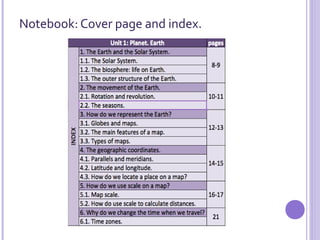
Notebook: Cover page and index.
1.The earth and the solar system (page 8)
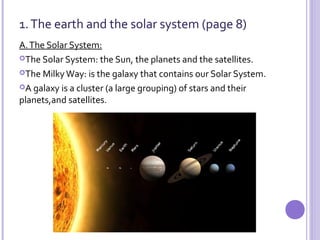
A.The Solar System:
The Solar System: the Sun, the planets and the satellites.
The MilkyWay: is the galaxy that contains our Solar System.
A galaxy is a cluster (a large grouping) of stars and their
planets,and satellites.
1.The earth and the solar system (song)
 Copy and complete:
• Mercury is the closest planet to the Sun.
• Venus comes next. It’s the hottest one.
• Earth comes third, the only life that we know.
• Mars has the largest canyon and volcano.
• The gassy planet Jupiter, the largest you will find.
• Saturn has rings around the outside.
• Uranus in funny ‘cause it spins on its side.
• Neptune looks blue, the coldest of its kind.
B. The biosphere: life on Earth.
oOnly in Earth life exists because of the following conditions:
• Ideal temperature.
• Atmosphere that protects the planet from the Sun’s radiation.
• Water.
oBiosphere: the ecological system in which life exists.
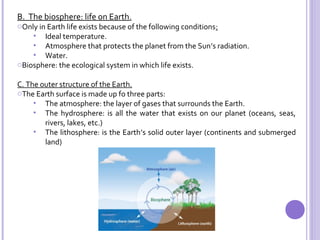
C. The outer structure of the Earth.
oThe Earth surface is made up fo three parts:
• The atmosphere: the layer of gases that surrounds the Earth.
• The hydrosphere: is all the water that exists on our planet (oceans, seas,
rivers, lakes, etc.)
• The lithosphere: is the Earth’s solid outer layer (continents and submerged
land)
Activities (pages 8 & 9):
2.What is the meaning of the following terms?
 Solar System:
 The Sun and the celestial bodies (planets and satellites) that orbit it.
 Orbit:
 An orbit is a repeating path that one object in space takes around
another. All orbits are elliptical in shape, meaning they're egg-
shaped, or oval, rather than circular.
 Satellite:
 Is an astronomical body or a man-made object that orbit a planet,
as the Moon.
2.The movement of the earth.
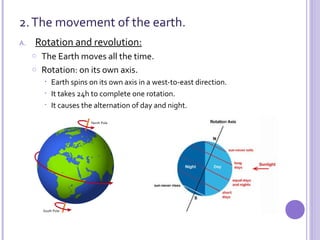
A. Rotation and revolution:
o The Earth moves all the time.
o Rotation: on its own axis.
• Earth spins on its own axis in a west-to-east direction.
• It takes 24h to complete one rotation.
• It causes the alternation of day and night.
•
2.The movement of the earth.
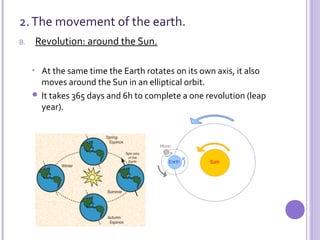
B. Revolution: around the Sun.
• At the same time the Earth rotates on its own axis, it also
moves around the Sun in an elliptical orbit.
 It takes 365 days and 6h to complete a one revolution (leap
year).
What types of maps are there?
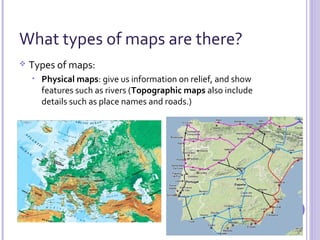
 Types of maps:
• Physical maps: give us information on relief, and show
features such as rivers (Topographic maps also include
details such as place names and roads.)
What types of maps are there?
 Types of maps:
• Thematic maps: give information on a particular subject,
such as climate or population.
What types of maps are there?
 Types of maps:
• Political maps: give information on political organisation,
such an international or regional frontiers.
What types of maps are there?
 Types of maps:
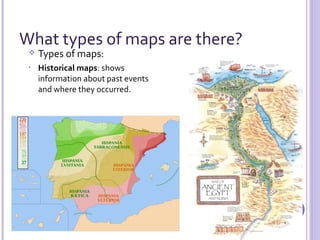
• Historical maps: shows
information about past events
and where they occurred.
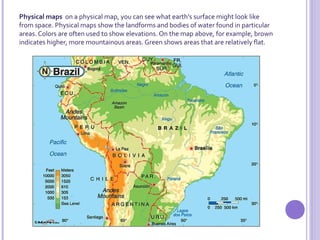
Physical maps on a physical map, you can see what earth's surface might look like
from space. Physical maps show the landforms and bodies of water found in particular
areas. Colors are often used to show elevations. On the map above, for example, brown
indicates higher, more mountainous areas. Green shows areas that are relatively flat.
2.The movement of the earth.
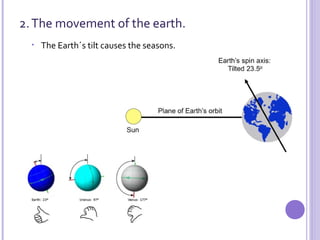
• The Earth´s tilt causes the seasons.
Activities
 What is the rotation of the Earth? How long does it
take?
 It is when the Earth spins continually on its own axis in a
west-to-east direction.The movement of the Earth on
its own axis. It takes 24 hours to complete one rotation.
 Why does the rotation of the Earth cause the
alternation of day and nigth?
 Because the Earth is spherical so the Sun cannot
iluminate the whole planet simultaneously.
 Does the length of day and nigth change more at the
Equator or at the poles during the year?Why?
 At the poles. Because there are six months of day and
six of night.
activities
 What is the revolution of the Earth? How long does it
takes?
 The Earth moves around the Sun in an elliptical orbit. It
takes 365 days and six hours to complete one
revolution.
 Why does the revolution of the Earth cause the
seasons?
 Because the Earth is tilted so the angle of the Sun’s rays
changes in each hemisphere during the year and this
cause the seasons.
activities
 At what angle do the Sun’s rays reach the northen
hemisphere in summer?
 The Sun ray’s reach the northen hemisphere almost
vertically.
 What do the following terms mean?
 Equinox: Spring and autumn begin at the two equinoxes,
when the Sun ray’s are vertical at the equator, and nigth and
day are equally long in both hemispheres.
 Solstice: Summer and winter begin at the two solstices,
when the Sun’s rays are vertical at one of the tropics. Days
are long and warm in one hemisphere, but sort and cold in
the other.
 Leap year: every four years we add an extra day to February,
so the year has 366.
activities
 June-september is not the period when the Earth is
closest to the Sun. So why is summer?
 Because the Sun’s rays reach the northen hemisphere
almost verticallys
 Complete the table with the missing information:
City Latitude Longitude
Saint Petersburg 60ºN 30ºE
Rio de Janeiro 21ºS 38ºW
London 50º N 0º
Sydney 32ºS 150ºE
Rome 41ºN 10ºE
Quito 0º 80ºW
Kinshasha 7ºS 10ºE

Unit1.Planet Earth

  • 1.
    Unit 1: planetEarth Teacher: Begoña Cristellys
  • 2.
  • 3.
    1.The earth andthe solar system (page 8) A.The Solar System: The Solar System: the Sun, the planets and the satellites. The MilkyWay: is the galaxy that contains our Solar System. A galaxy is a cluster (a large grouping) of stars and their planets,and satellites.
  • 4.
    1.The earth andthe solar system (song)  Copy and complete: • Mercury is the closest planet to the Sun. • Venus comes next. It’s the hottest one. • Earth comes third, the only life that we know. • Mars has the largest canyon and volcano. • The gassy planet Jupiter, the largest you will find. • Saturn has rings around the outside. • Uranus in funny ‘cause it spins on its side. • Neptune looks blue, the coldest of its kind.
  • 5.
    B. The biosphere:life on Earth. oOnly in Earth life exists because of the following conditions: • Ideal temperature. • Atmosphere that protects the planet from the Sun’s radiation. • Water. oBiosphere: the ecological system in which life exists. C. The outer structure of the Earth. oThe Earth surface is made up fo three parts: • The atmosphere: the layer of gases that surrounds the Earth. • The hydrosphere: is all the water that exists on our planet (oceans, seas, rivers, lakes, etc.) • The lithosphere: is the Earth’s solid outer layer (continents and submerged land)
  • 6.
    Activities (pages 8& 9): 2.What is the meaning of the following terms?  Solar System:  The Sun and the celestial bodies (planets and satellites) that orbit it.  Orbit:  An orbit is a repeating path that one object in space takes around another. All orbits are elliptical in shape, meaning they're egg- shaped, or oval, rather than circular.  Satellite:  Is an astronomical body or a man-made object that orbit a planet, as the Moon.
  • 7.
    2.The movement ofthe earth. A. Rotation and revolution: o The Earth moves all the time. o Rotation: on its own axis. • Earth spins on its own axis in a west-to-east direction. • It takes 24h to complete one rotation. • It causes the alternation of day and night. •
  • 8.
    2.The movement ofthe earth. B. Revolution: around the Sun. • At the same time the Earth rotates on its own axis, it also moves around the Sun in an elliptical orbit.  It takes 365 days and 6h to complete a one revolution (leap year).
  • 9.
    What types ofmaps are there?  Types of maps: • Physical maps: give us information on relief, and show features such as rivers (Topographic maps also include details such as place names and roads.)
  • 10.
    What types ofmaps are there?  Types of maps: • Thematic maps: give information on a particular subject, such as climate or population.
  • 11.
    What types ofmaps are there?  Types of maps: • Political maps: give information on political organisation, such an international or regional frontiers.
  • 12.
    What types ofmaps are there?  Types of maps: • Historical maps: shows information about past events and where they occurred.
  • 13.
    Physical maps ona physical map, you can see what earth's surface might look like from space. Physical maps show the landforms and bodies of water found in particular areas. Colors are often used to show elevations. On the map above, for example, brown indicates higher, more mountainous areas. Green shows areas that are relatively flat.
  • 14.
    2.The movement ofthe earth. • The Earth´s tilt causes the seasons.
  • 17.
    Activities  What isthe rotation of the Earth? How long does it take?  It is when the Earth spins continually on its own axis in a west-to-east direction.The movement of the Earth on its own axis. It takes 24 hours to complete one rotation.  Why does the rotation of the Earth cause the alternation of day and nigth?  Because the Earth is spherical so the Sun cannot iluminate the whole planet simultaneously.  Does the length of day and nigth change more at the Equator or at the poles during the year?Why?  At the poles. Because there are six months of day and six of night.
  • 18.
    activities  What isthe revolution of the Earth? How long does it takes?  The Earth moves around the Sun in an elliptical orbit. It takes 365 days and six hours to complete one revolution.  Why does the revolution of the Earth cause the seasons?  Because the Earth is tilted so the angle of the Sun’s rays changes in each hemisphere during the year and this cause the seasons.
  • 19.
    activities  At whatangle do the Sun’s rays reach the northen hemisphere in summer?  The Sun ray’s reach the northen hemisphere almost vertically.  What do the following terms mean?  Equinox: Spring and autumn begin at the two equinoxes, when the Sun ray’s are vertical at the equator, and nigth and day are equally long in both hemispheres.  Solstice: Summer and winter begin at the two solstices, when the Sun’s rays are vertical at one of the tropics. Days are long and warm in one hemisphere, but sort and cold in the other.  Leap year: every four years we add an extra day to February, so the year has 366.
  • 20.
    activities  June-september isnot the period when the Earth is closest to the Sun. So why is summer?  Because the Sun’s rays reach the northen hemisphere almost verticallys  Complete the table with the missing information: City Latitude Longitude Saint Petersburg 60ºN 30ºE Rio de Janeiro 21ºS 38ºW London 50º N 0º Sydney 32ºS 150ºE Rome 41ºN 10ºE Quito 0º 80ºW Kinshasha 7ºS 10ºE