DATABASE MANAGEMENT  SYSTEMS
INDEX UNIT-6 PPT SLIDES S.NO  Module as per  Lecture   PPT Session planner    No  Slide NO -------------------------------------------------------------------------------------------------------------------------------- Transaction concept & State  L1  L1- 1 to L1- 7 Implementation of atomicity and durability  L2  L2- 1 to L2- 8 Serializability    L3 L3- 1 to L3- 8 Recoverability L4 L4- 1 to L4- 8 Implementation of isolation  L5 L5- 1 to L5- 6 Lock based protocols   L6 L6- 1 to L6 -5 Lock based protocols    L7 L7- 1 to L7- 10 Timestamp based protocols L8 L8- 1 to L8- 6 Validation based protocol L9 L9- 1 to L9- 9
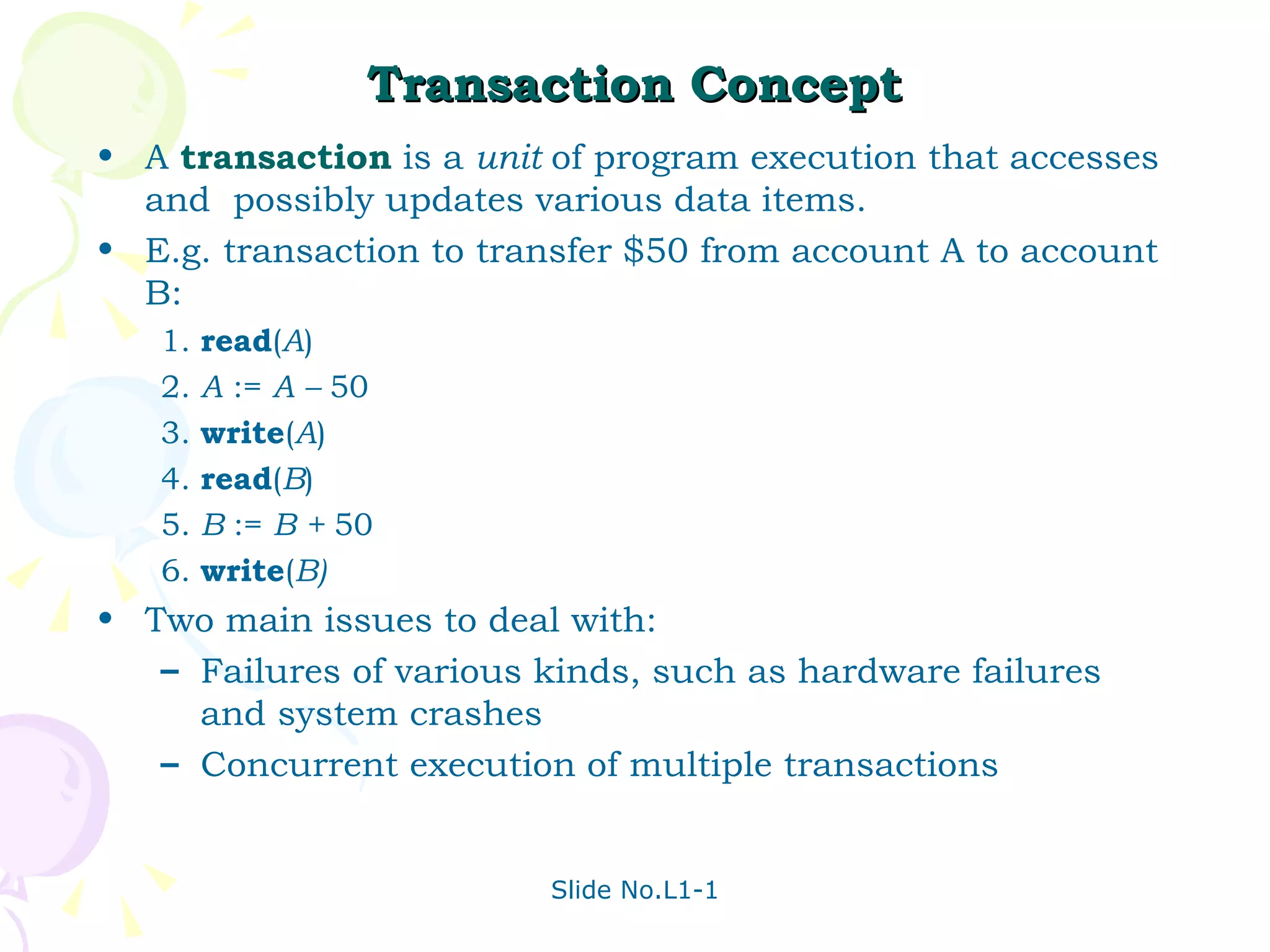
Transaction Concept A  transaction   is a  unit  of program execution that accesses and  possibly updates various data items. E.g. transaction to transfer $50 from account A to account B: 1. read ( A ) 2. A  :=  A –  50 3. write ( A ) 4. read ( B ) 5. B  :=  B +  50 6. write ( B) Two main issues to deal with: Failures of various kinds, such as hardware failures and system crashes Concurrent execution of multiple transactions
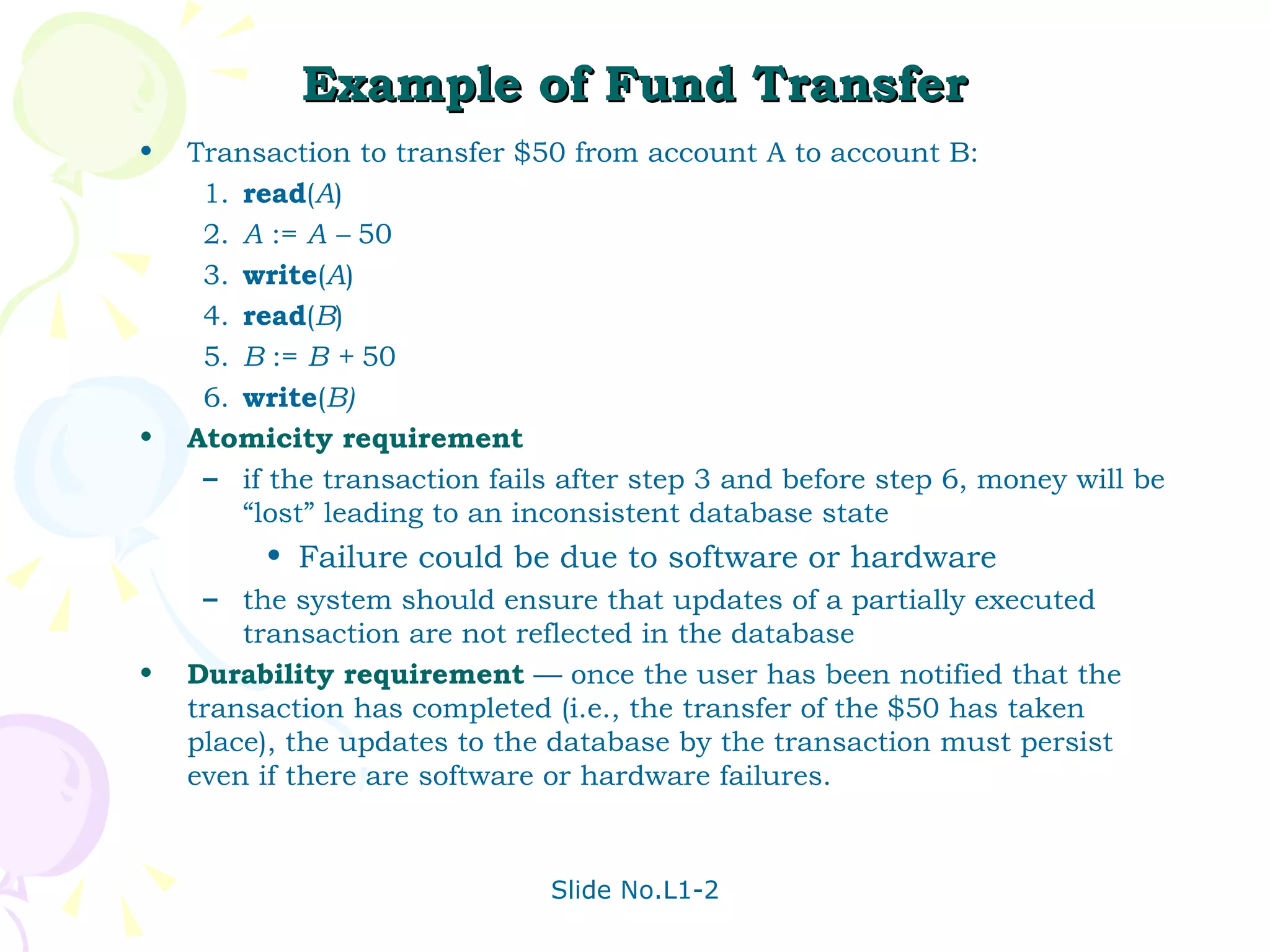
Example of Fund Transfer Transaction to transfer $50 from account A to account B: 1. read ( A ) 2. A  :=  A –  50 3. write ( A ) 4. read ( B ) 5. B  :=  B +  50 6. write ( B) Atomicity requirement   if the transaction fails after step 3 and before step 6, money will be “lost” leading to an inconsistent database state Failure could be due to software or hardware the system should ensure that updates of a partially executed transaction are not reflected in the database Durability requirement  — once the user has been notified that the transaction has completed (i.e., the transfer of the $50 has taken place), the updates to the database by the transaction must persist even if there are software or hardware failures.
Example of Fund Transfer (Cont.) Transaction to transfer $50 from account A to account B: 1. read ( A ) 2. A  :=  A –  50 3. write ( A ) 4. read ( B ) 5. B  :=  B +  50 6. write ( B) Consistency requirement  in above example: the sum of A and B is unchanged by the execution of the transaction In general, consistency requirements include  Explicitly specified integrity constraints such as primary keys and foreign keys Implicit integrity constraints e.g. sum of balances of all accounts, minus sum of loan amounts must equal value of cash-in-hand A transaction must see a consistent database. During transaction execution the database may be temporarily inconsistent. When the transaction completes successfully the database must be consistent Erroneous transaction logic can lead to inconsistency
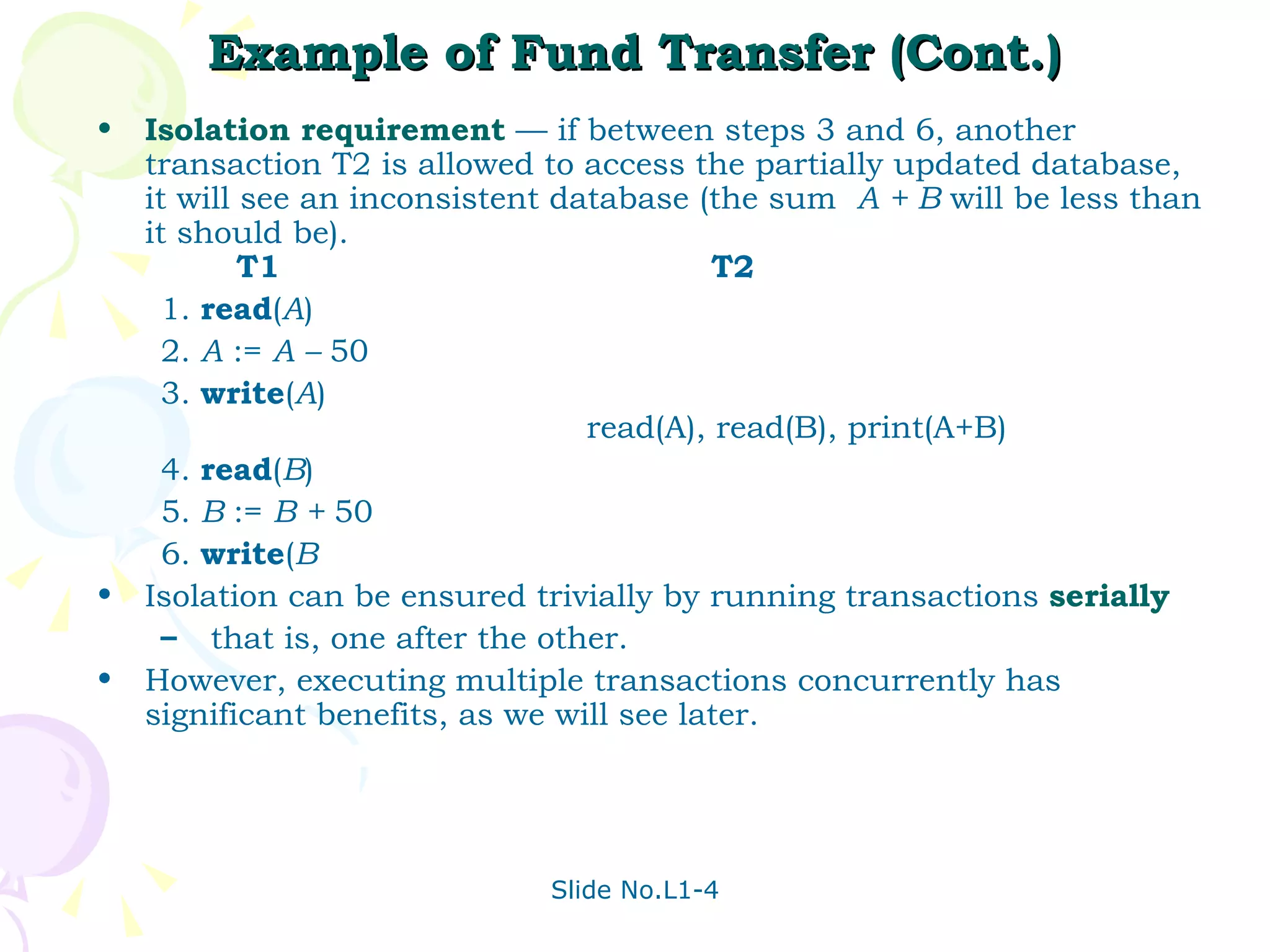
Example of Fund Transfer (Cont.) Isolation requirement  — if between steps 3 and 6, another transaction T2 is allowed to access the partially updated database, it will see an inconsistent database (the sum  A + B  will be less than it should be).   T1  T2 1. read ( A ) 2. A  :=  A –  50 3. write ( A )   read(A), read(B), print(A+B) 4. read ( B ) 5. B  :=  B +  50 6. write ( B Isolation can be ensured trivially by running transactions  serially that is, one after the other.  However, executing multiple transactions concurrently has significant benefits, as we will see later.
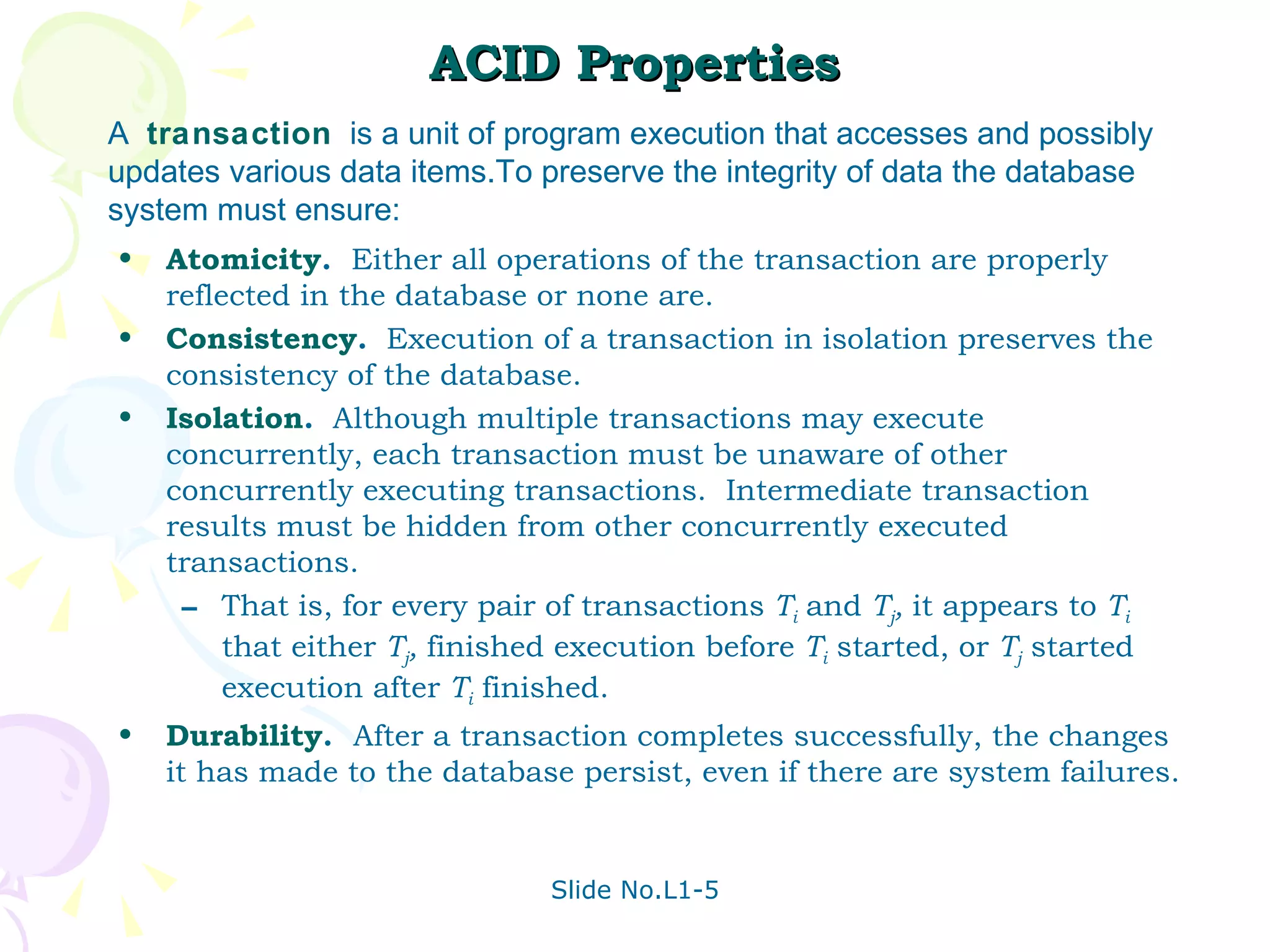
ACID Properties Atomicity .  Either all operations of the transaction are properly reflected in the database or none are. Consistency .   Execution of a transaction in isolation preserves the consistency of the database. Isolation .   Although multiple transactions may execute concurrently, each transaction must be unaware of other concurrently executing transactions.  Intermediate transaction results must be hidden from other concurrently executed transactions.  That is, for every pair of transactions  T i   and  T j ,  it appears to  T i   that either  T j ,  finished execution before  T i  started, or  T j  started execution after  T i  finished. Durability .  After a transaction completes successfully, the changes it has made to the database persist, even if there are system failures.  A  transaction   is a unit of program execution that accesses and possibly updates various data items.To preserve the integrity of data the database system must ensure:
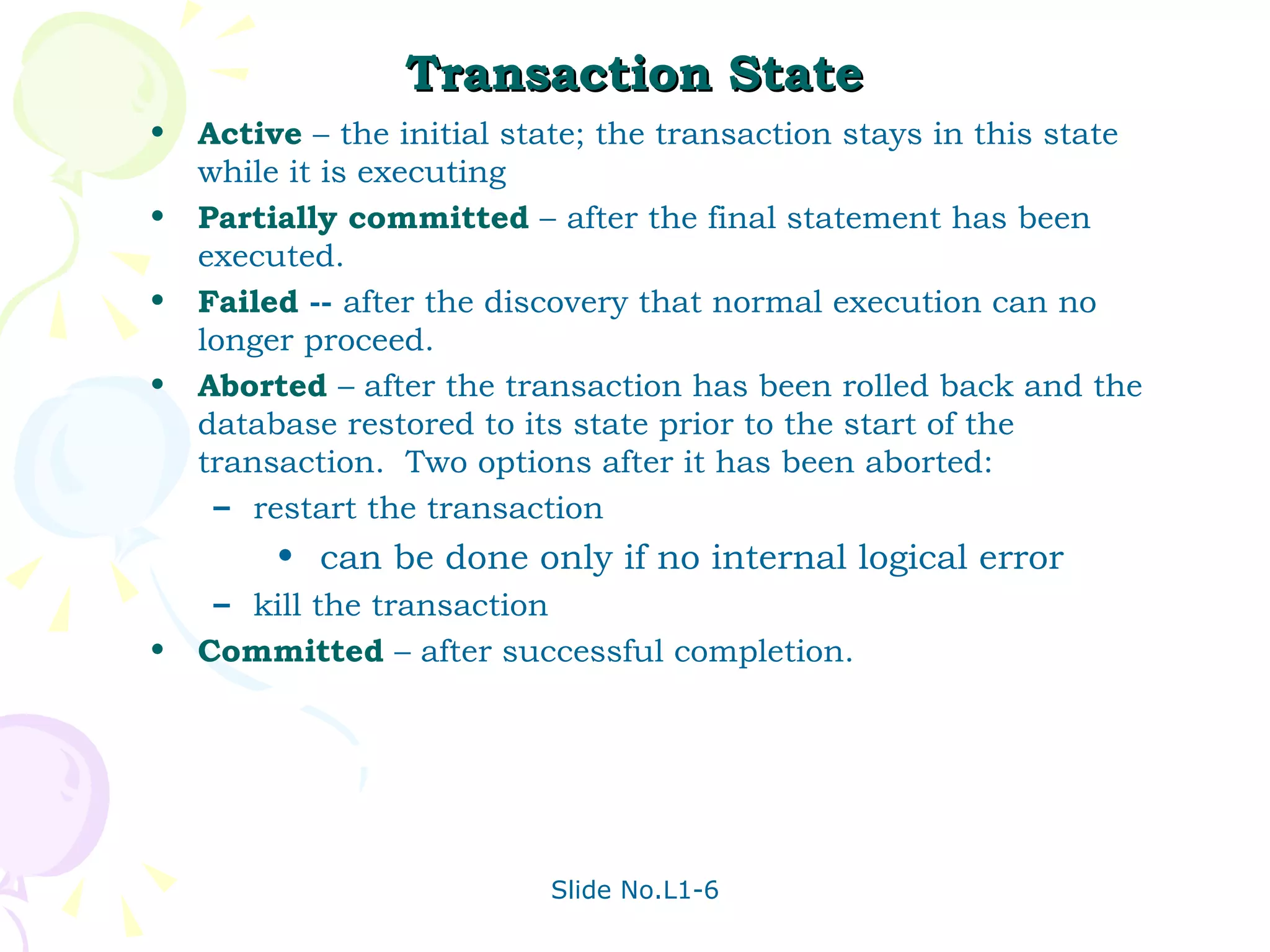
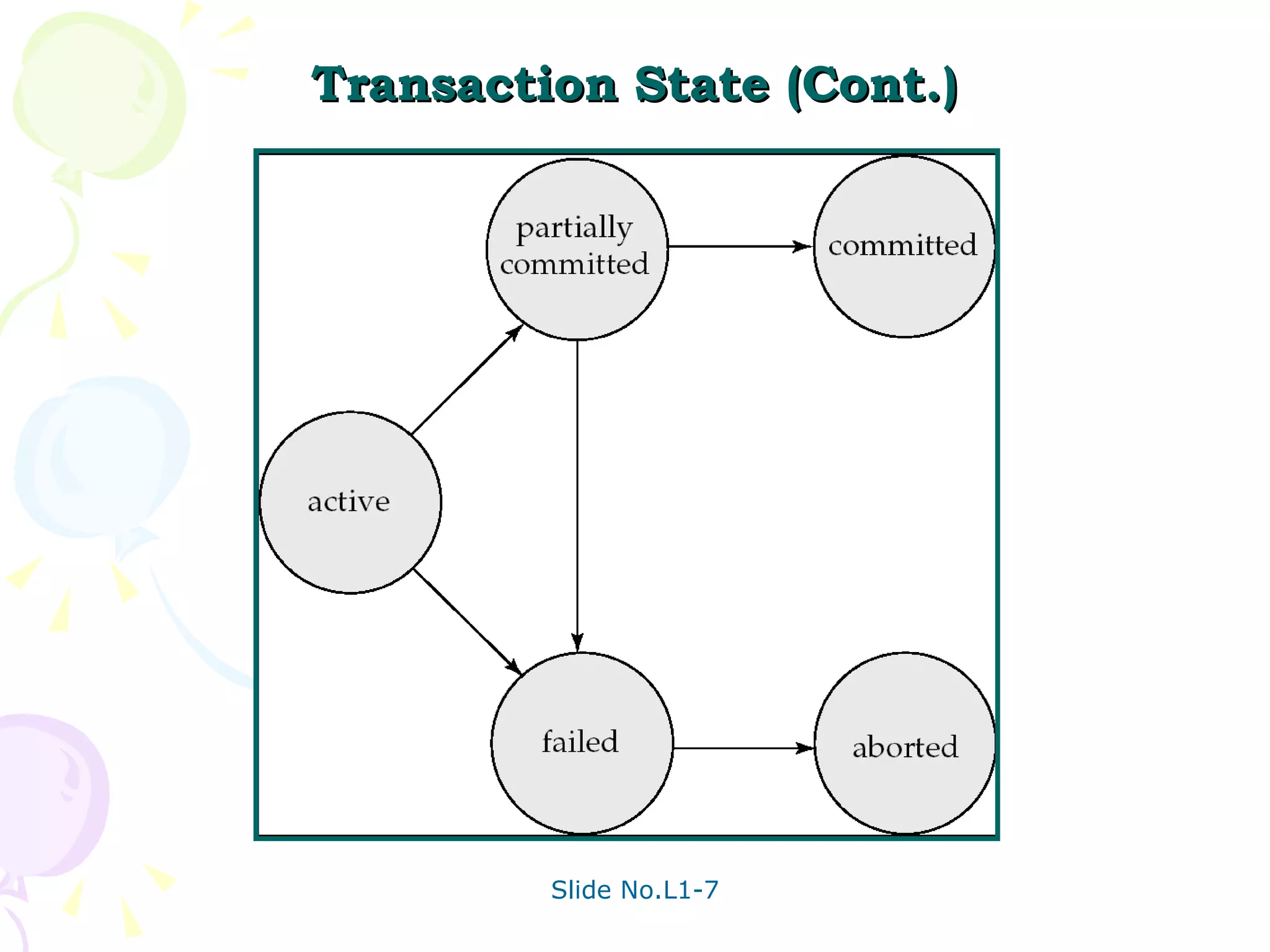
Transaction State Active  –   the initial state; the transaction stays in this state while it is executing Partially committed  –   after the final statement has been executed. Failed  --  after the discovery that normal execution can no longer proceed. Aborted  – after the transaction has been rolled back and the database restored to its state prior to the start of the transaction.  Two options after it has been aborted: restart the transaction can be done only if no internal logical error kill the transaction Committed  – after successful completion.
Transaction State (Cont.)
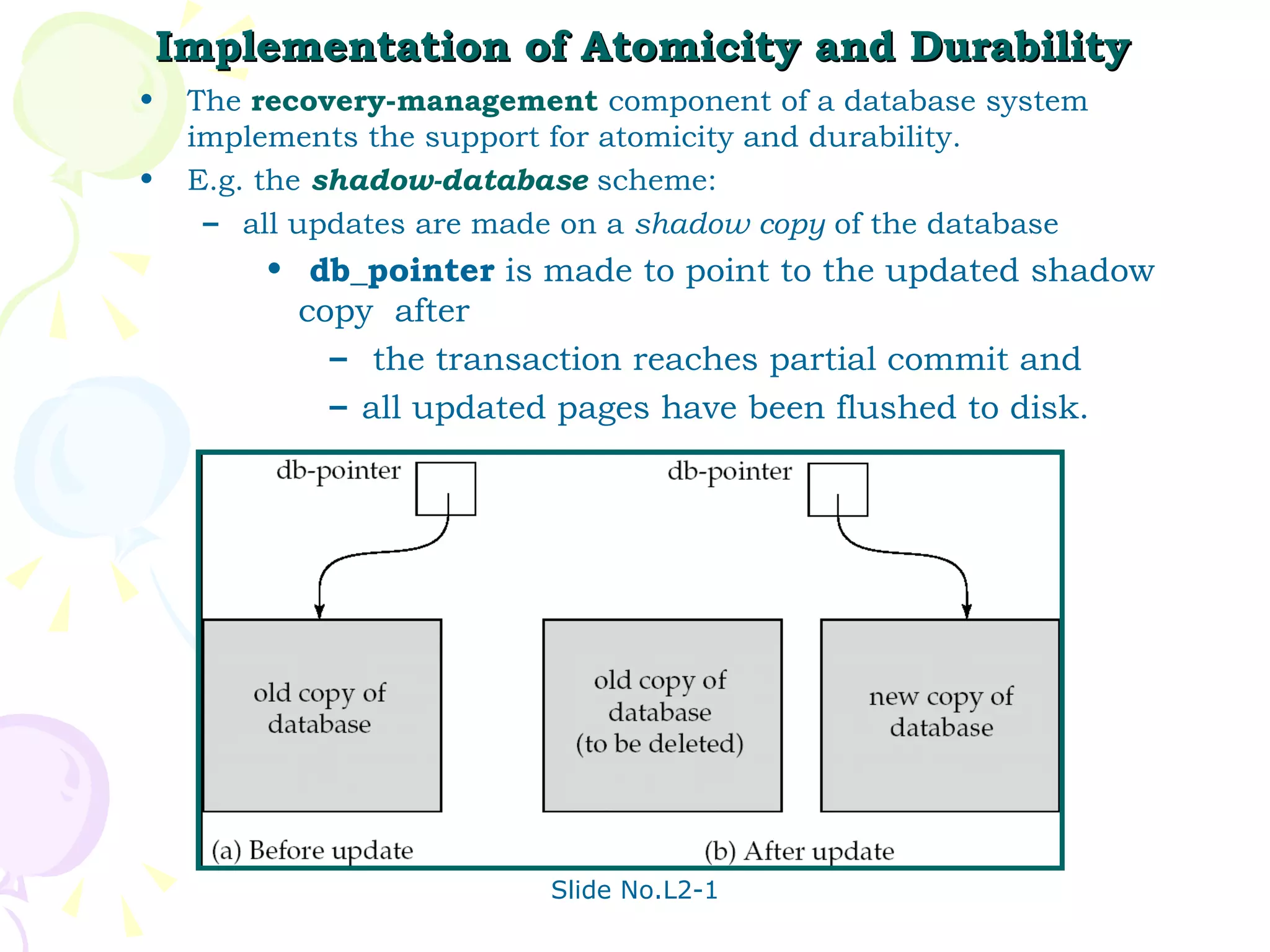
Implementation of Atomicity and Durability The  recovery-management  component of a database system implements the support for atomicity and durability. E.g. the  shadow-database  scheme: all updates are made on a  shadow copy  of the database db_pointer  is made to point to the updated shadow copy  after the transaction reaches partial commit and  all updated pages have been flushed to disk.
Implementation of Atomicity and Durability (Cont.) db_pointer always points to the current consistent copy of the database. In case transaction fails, old consistent copy pointed to by  db_pointer  can be used, and the shadow copy can be deleted.  The shadow-database scheme: Assumes that only one transaction is active at a time. Assumes disks do not fail Useful for text editors, but  extremely inefficient for large databases (why?) Variant called shadow paging reduces copying of data, but is still not practical for large databases Does not handle concurrent transactions Will study better schemes in Chapter 17.
Concurrent Executions Multiple transactions are allowed to run concurrently in the system.  Advantages are: increased processor and disk utilization , leading to better transaction  throughput E.g. one transaction can be using the CPU while another is reading from or writing to the disk reduced average response time  for transactions: short transactions need not wait behind long ones. Concurrency control schemes   – mechanisms  to achieve isolation that is, to control the interaction among the concurrent transactions in order to prevent them from destroying the consistency of the database Will study in Chapter 16, after studying notion of correctness of concurrent executions.
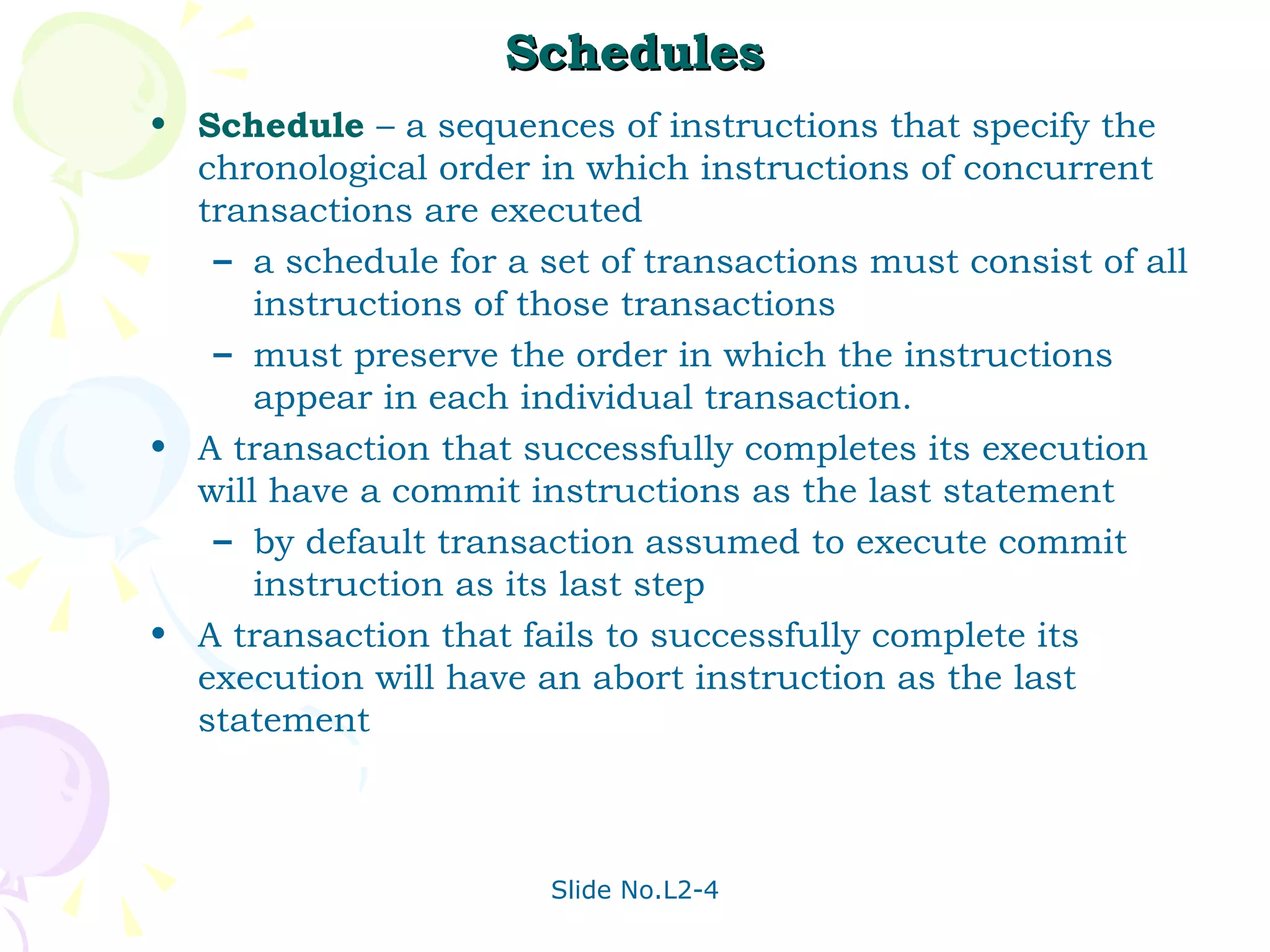
Schedules Schedule  – a sequences of instructions that specify the chronological order in which instructions of concurrent transactions are executed a schedule for a set of transactions must consist of all instructions of those transactions must preserve the order in which the instructions appear in each individual transaction. A transaction that successfully completes its execution will have a commit instructions as the last statement  by default transaction assumed to execute commit instruction as its last step A transaction that fails to successfully complete its execution will have an abort instruction as the last statement
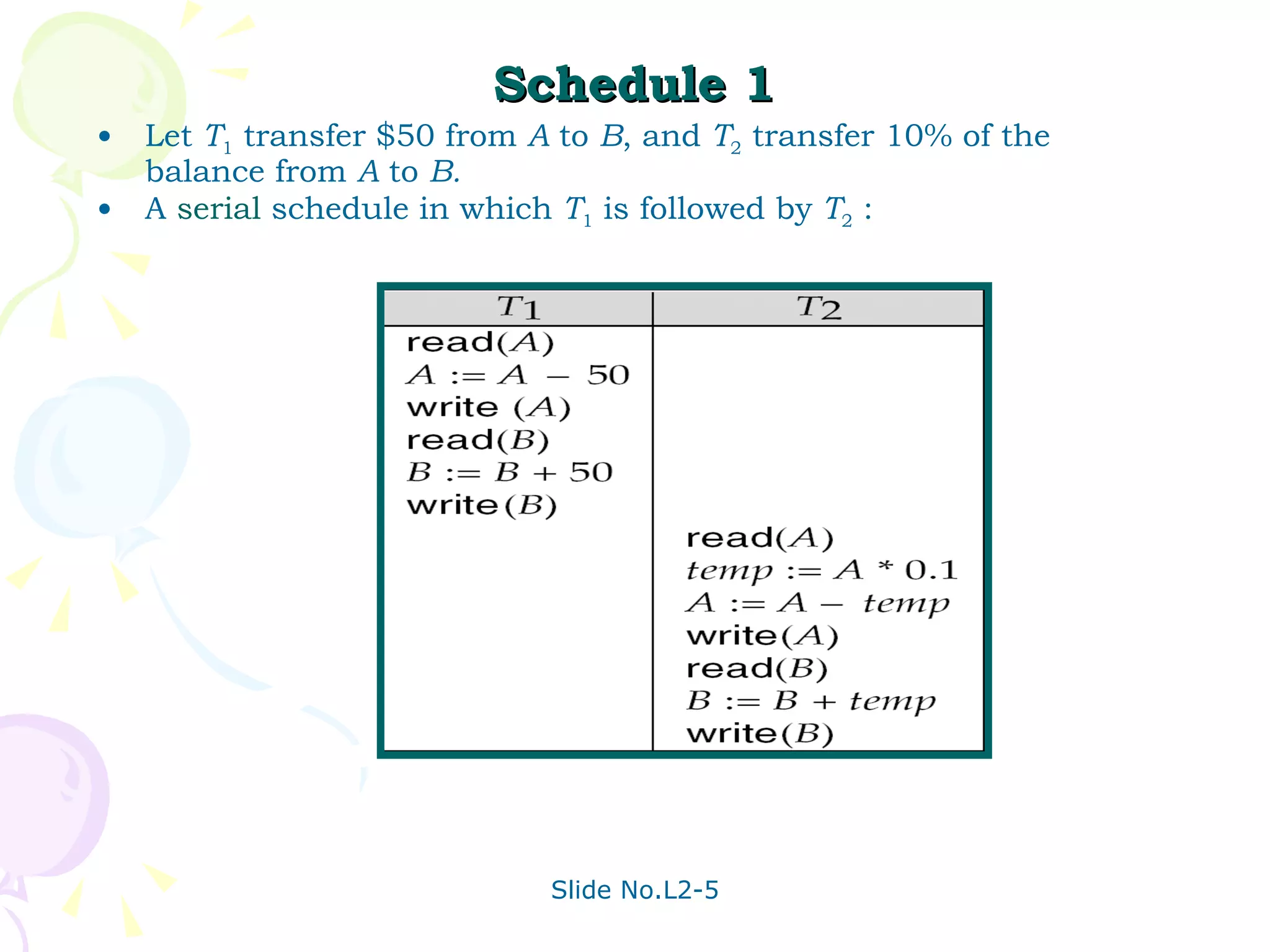
Schedule 1 Let  T 1  transfer $50 from  A  to  B , and  T 2  transfer 10% of the balance from  A  to  B.   A  serial  schedule in which  T 1  is followed by  T 2  :
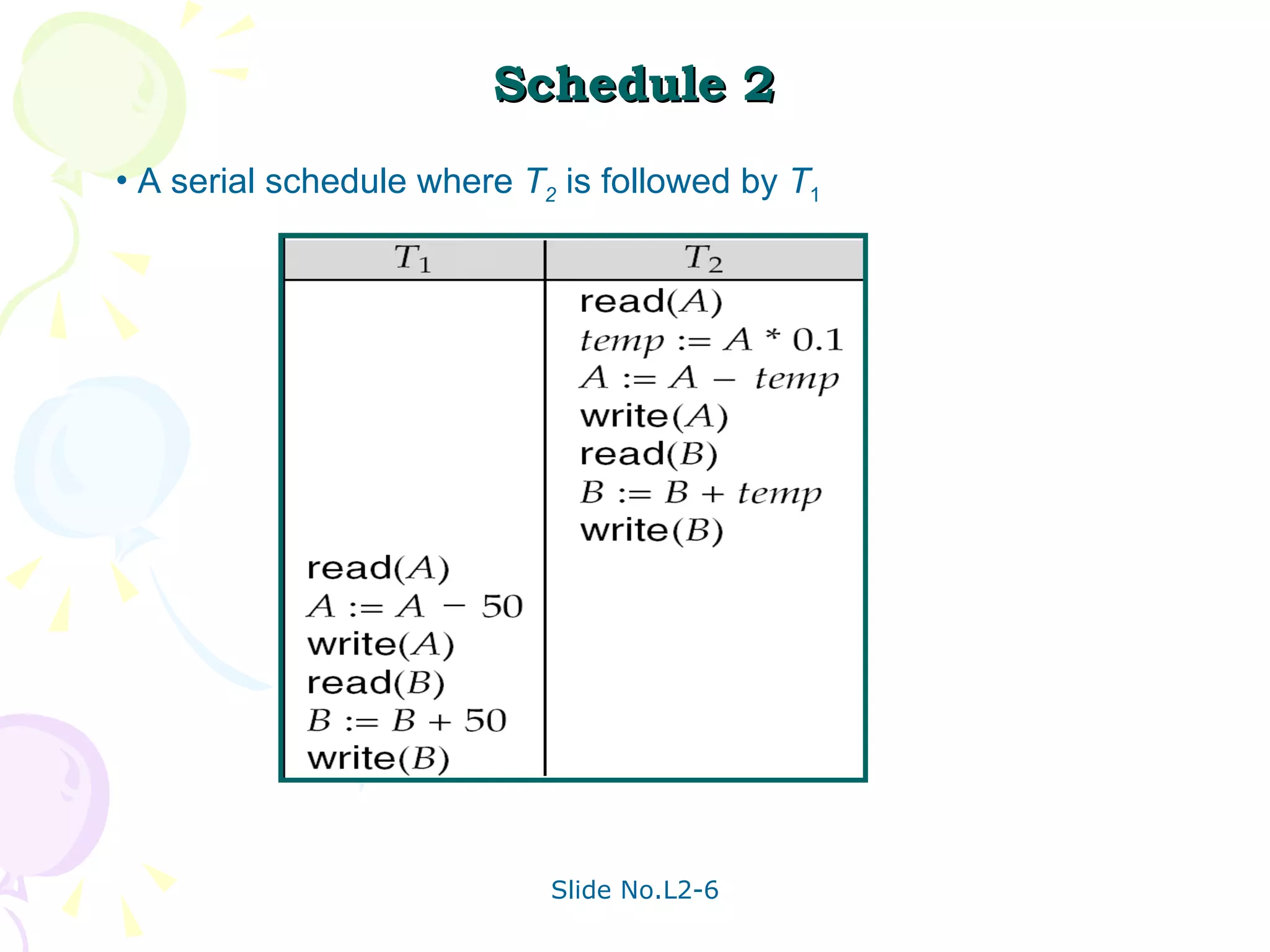
Schedule 2 A serial schedule where  T 2  is followed by  T 1
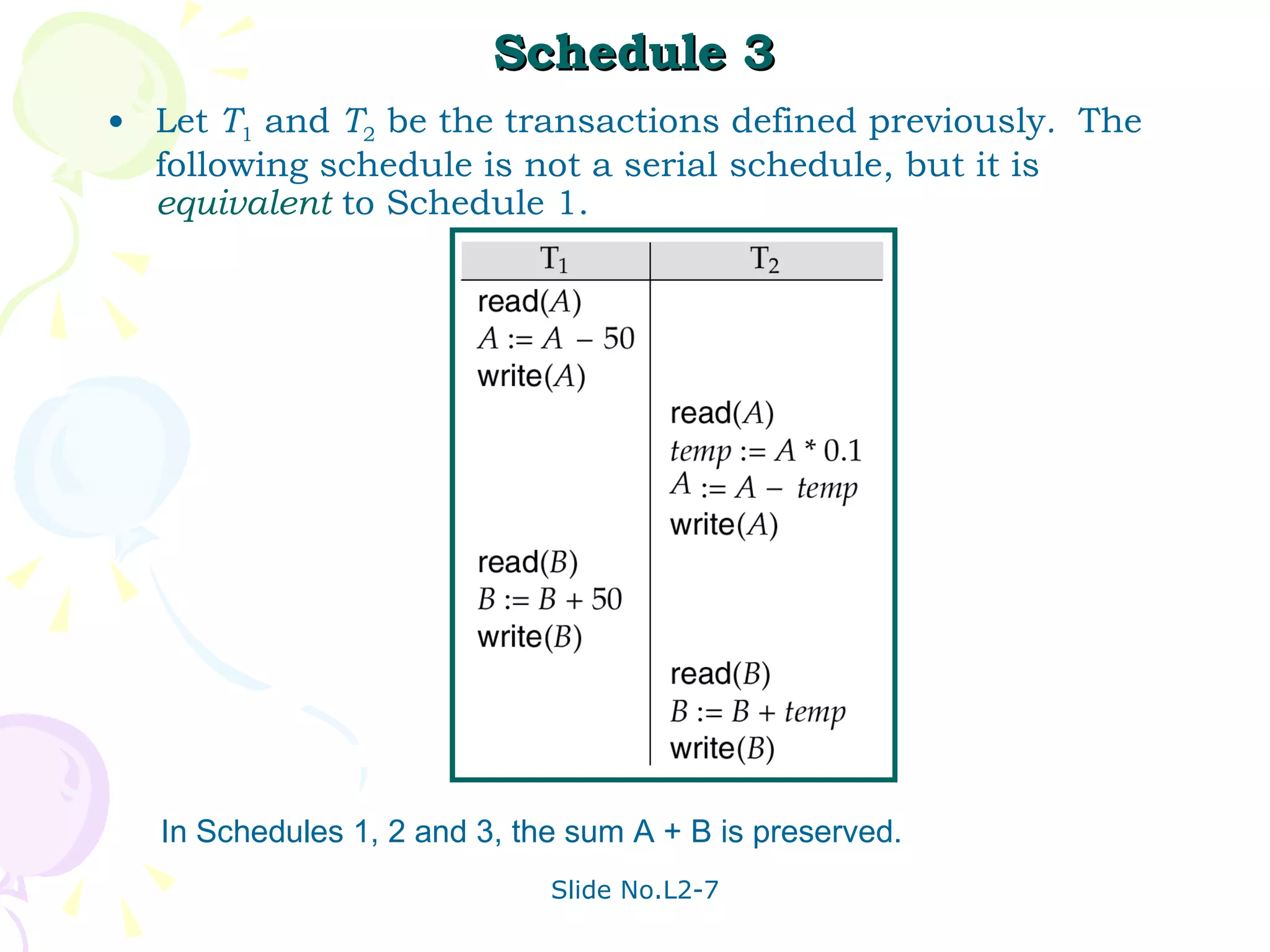
Schedule 3 Let  T 1  and  T 2  be the transactions defined previously .   The following schedule is not a serial schedule, but it is  equivalent  to Schedule 1. In Schedules 1, 2 and 3, the sum A + B is preserved.
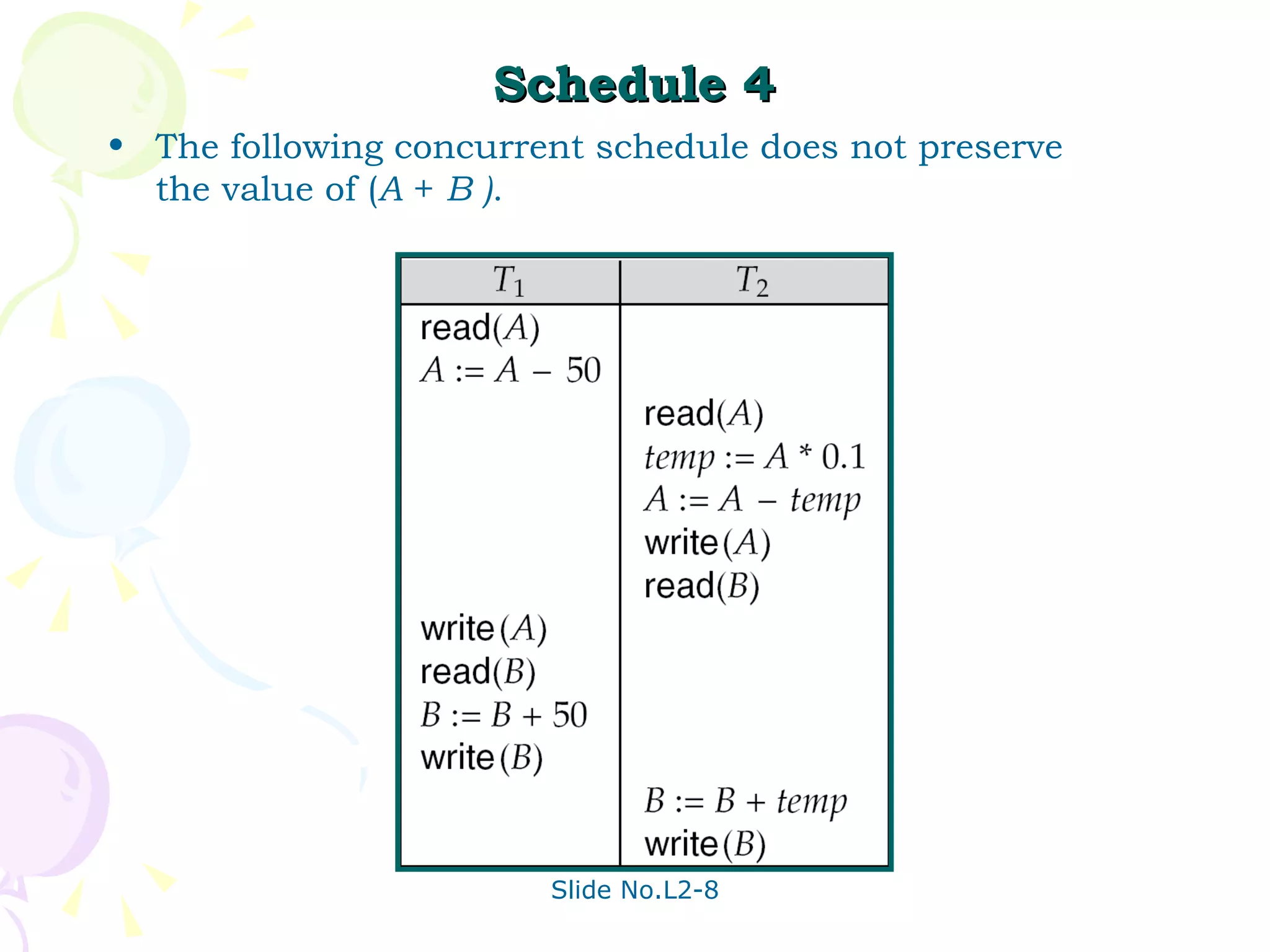
Schedule 4 The following concurrent schedule does not preserve the value of ( A  +  B   ) .
Serializability Basic Assumption  – Each transaction preserves database consistency. Thus serial execution of a set of transactions preserves database consistency. A (possibly concurrent) schedule is serializable if it is equivalent to a serial schedule.  Different forms of schedule equivalence give rise to the notions of: 1. conflict serializability 2. view serializability Simplified view of transactions We ignore operations other than  read  and  write  instructions We assume that transactions may perform arbitrary computations on data in local buffers in between reads and writes.  Our simplified schedules consist of only  read  and  write  instructions.
Conflicting Instructions  Instructions  l i  and  l j  of transactions  T i  and  T j  respectively,  conflict  if and only if there exists some item  Q  accessed by both  l i  and  l j , and at least one of these instructions wrote  Q.   1.  l i  =  read ( Q), l j  =  read ( Q ).  l i  and  l j   don’t conflict.   2.  l i  =  read ( Q),  l j  =  write ( Q ).  They conflict.   3.  l i  =  write ( Q), l j  =  read ( Q ).  They conflict   4.  l i  =  write ( Q), l j  =  write ( Q ).  They conflict Intuitively, a conflict between  l i   and  l j  forces a (logical) temporal order between them.  If  l i  and  l j  are consecutive in a schedule and they do not conflict, their results would remain the same even if they had been interchanged in the schedule.
Conflict Serializability If a schedule  S  can be transformed into a schedule  S´  by a series of swaps of non-conflicting instructions, we say that  S  and  S´  are  conflict equivalent . We say that a schedule  S  is  conflict serializable  if it is conflict equivalent to a serial schedule
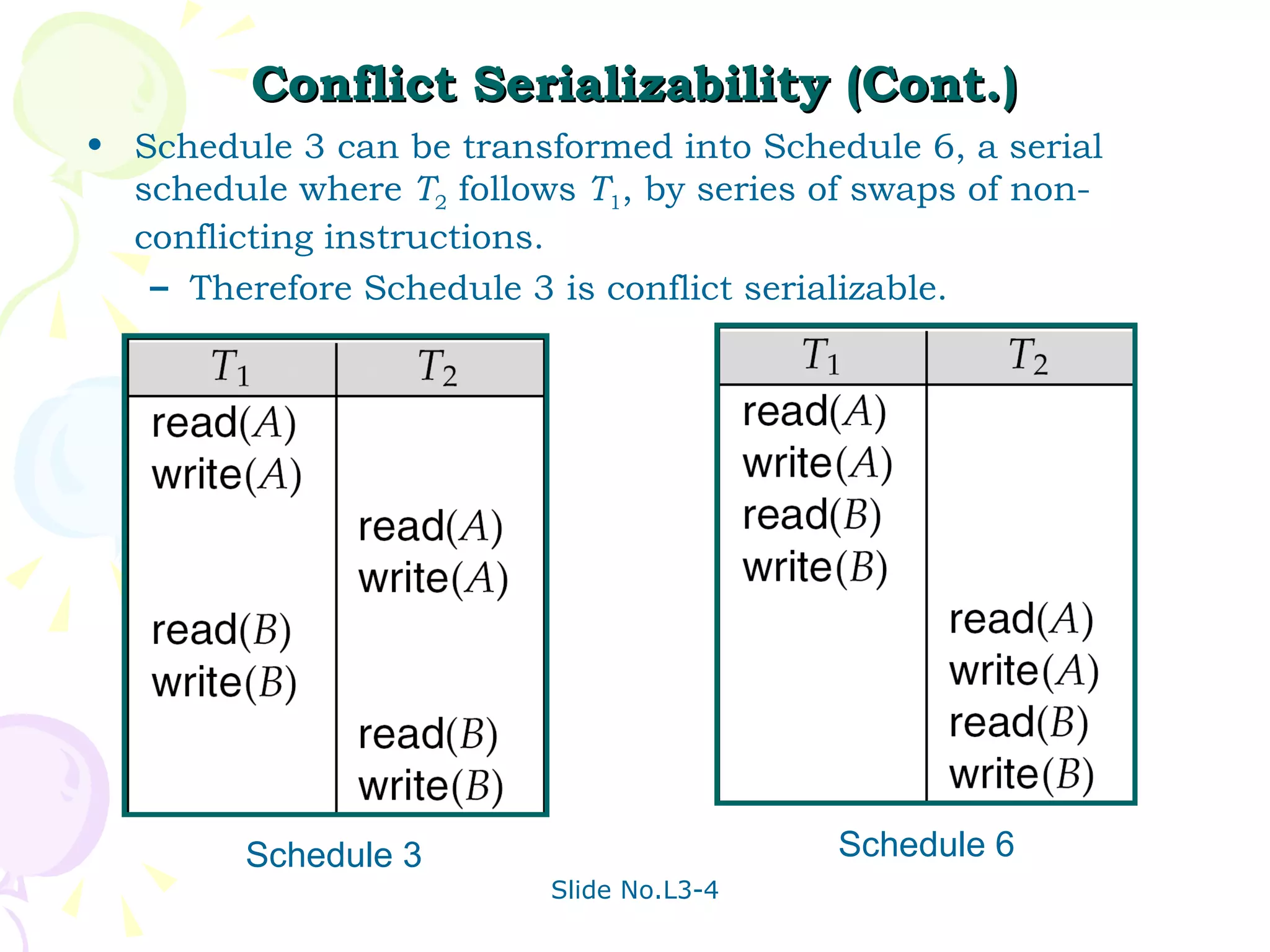
Conflict Serializability (Cont.) Schedule 3 can be transformed into Schedule 6, a serial schedule where  T 2  follows  T 1 , by series of swaps of non-conflicting instructions.  Therefore Schedule 3 is conflict serializable. Schedule 3 Schedule 6
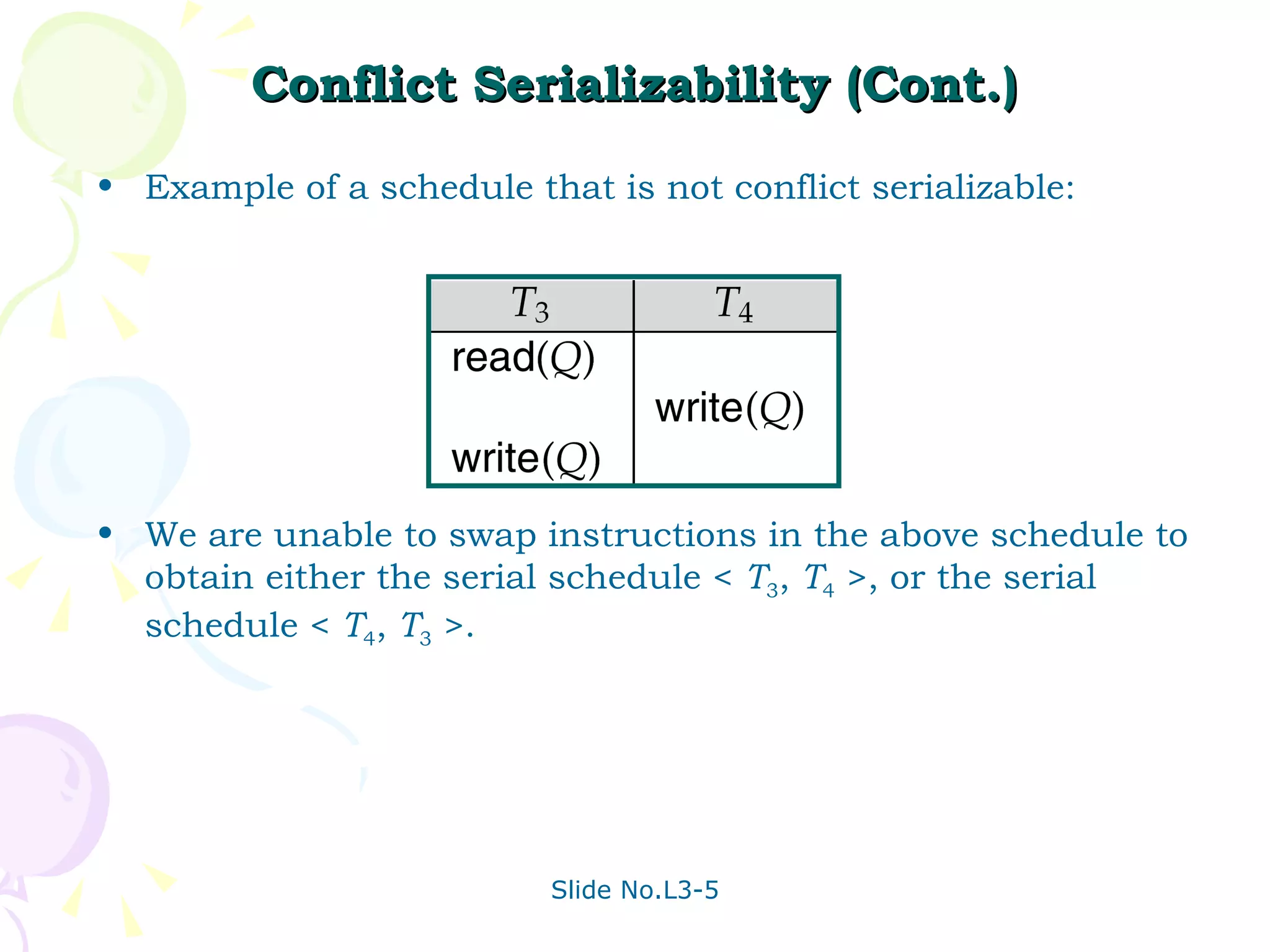
Conflict Serializability (Cont.) Example of a schedule that is not conflict serializable: We are unable to swap instructions in the above schedule to obtain either the serial schedule <  T 3 ,  T 4  >, or the serial schedule <  T 4 ,  T 3  >.
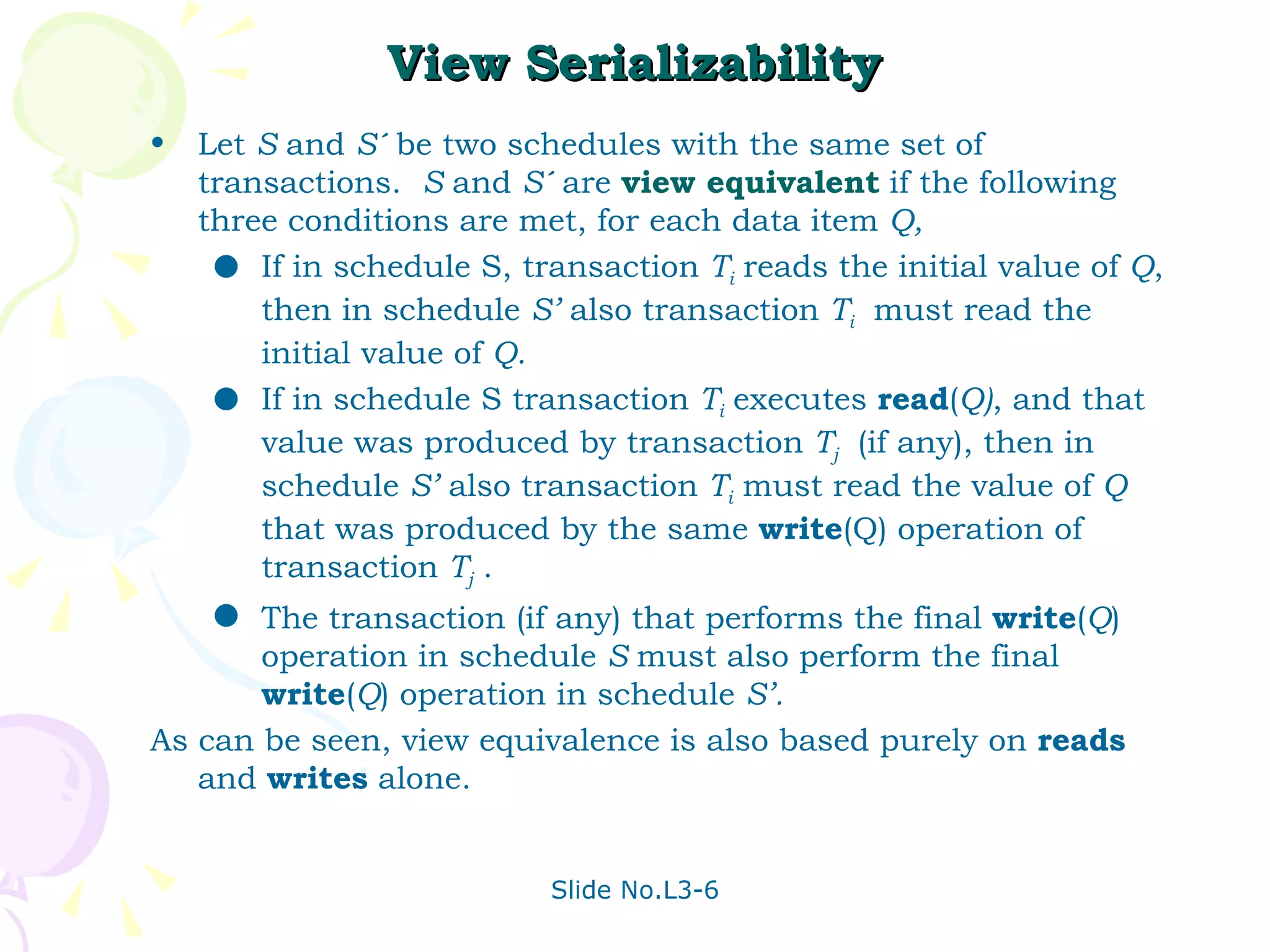
View Serializability Let  S  and  S´  be two schedules with the same set of transactions.  S  and  S´  are  view equivalent   if the following three conditions are met, for each data item  Q,   If in schedule S, transaction  T i   reads the initial value of  Q , then in schedule  S’  also transaction  T i   must read the initial value of  Q. If in schedule S transaction  T i   executes  read ( Q) , and that value was produced by transaction  T j   (if any), then in schedule  S’  also transaction  T i  must read the value of  Q  that was produced by the same  write (Q) operation of transaction  T j  . The transaction (if any) that performs the final  write ( Q ) operation in schedule  S  must also perform the final   write ( Q ) operation in schedule  S’. As can be seen, view equivalence is also based purely on  reads  and  writes  alone.
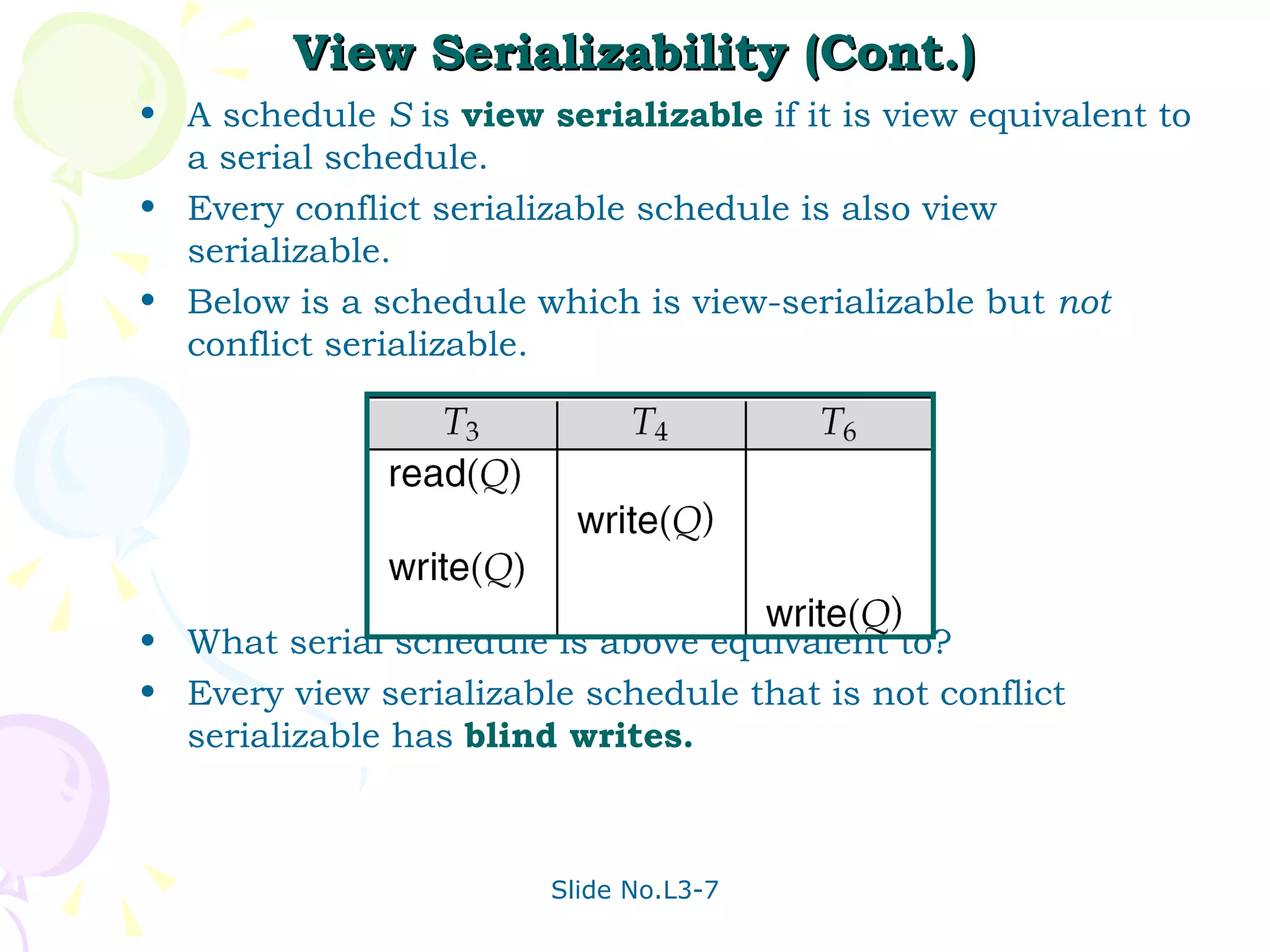
View Serializability (Cont.) A schedule  S  is  view serializable   if it is view equivalent to a serial schedule. Every conflict serializable schedule is also view serializable. Below is a schedule which is view-serializable but  not  conflict serializable. What serial schedule is above equivalent to? Every view serializable schedule that is not conflict serializable has  blind writes.
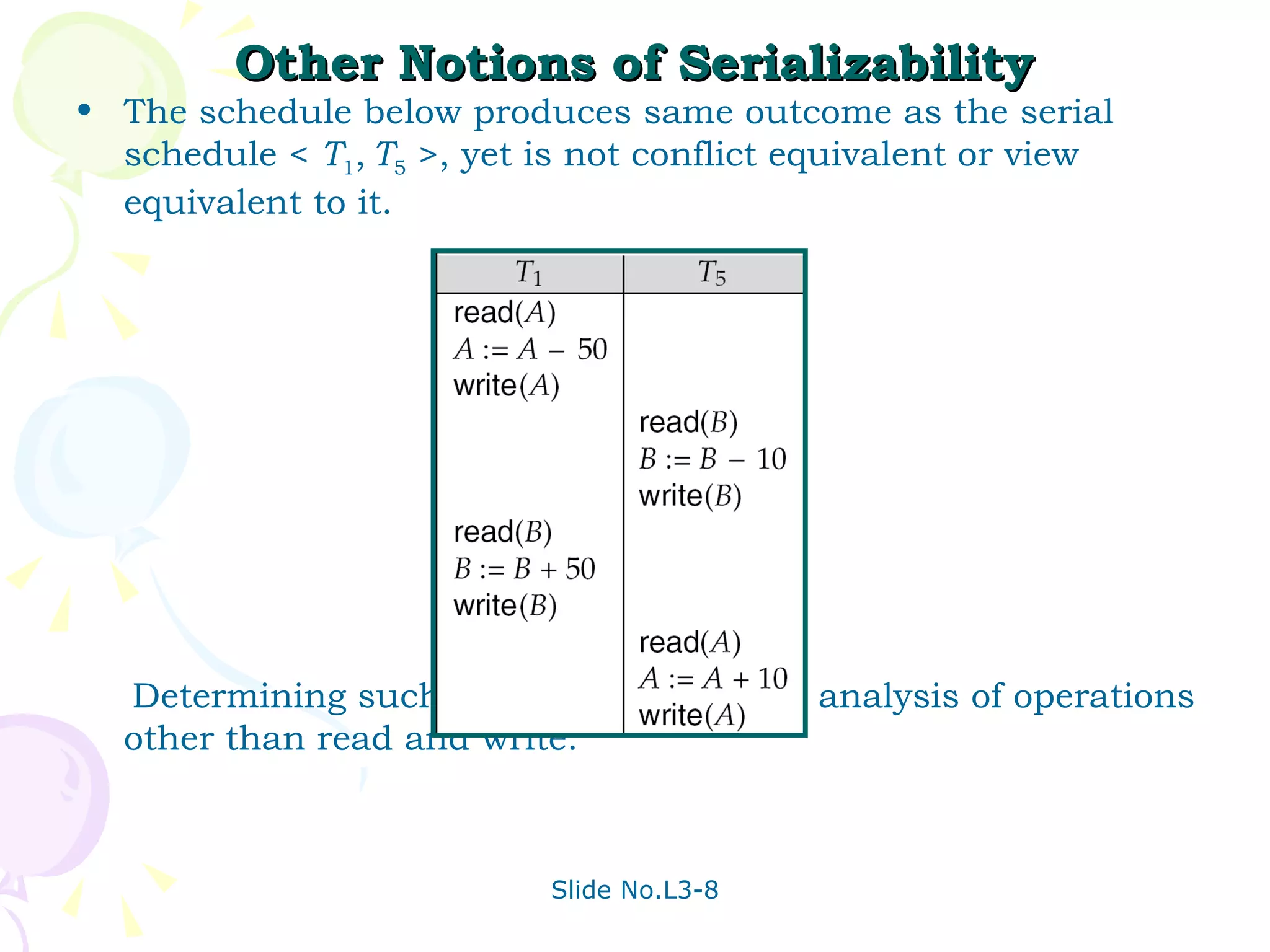
Other Notions of Serializability The schedule below produces same outcome as the serial schedule <  T 1 ,   T 5  >, yet is not conflict equivalent or view equivalent to it. Determining such equivalence requires analysis of operations other than read and write.
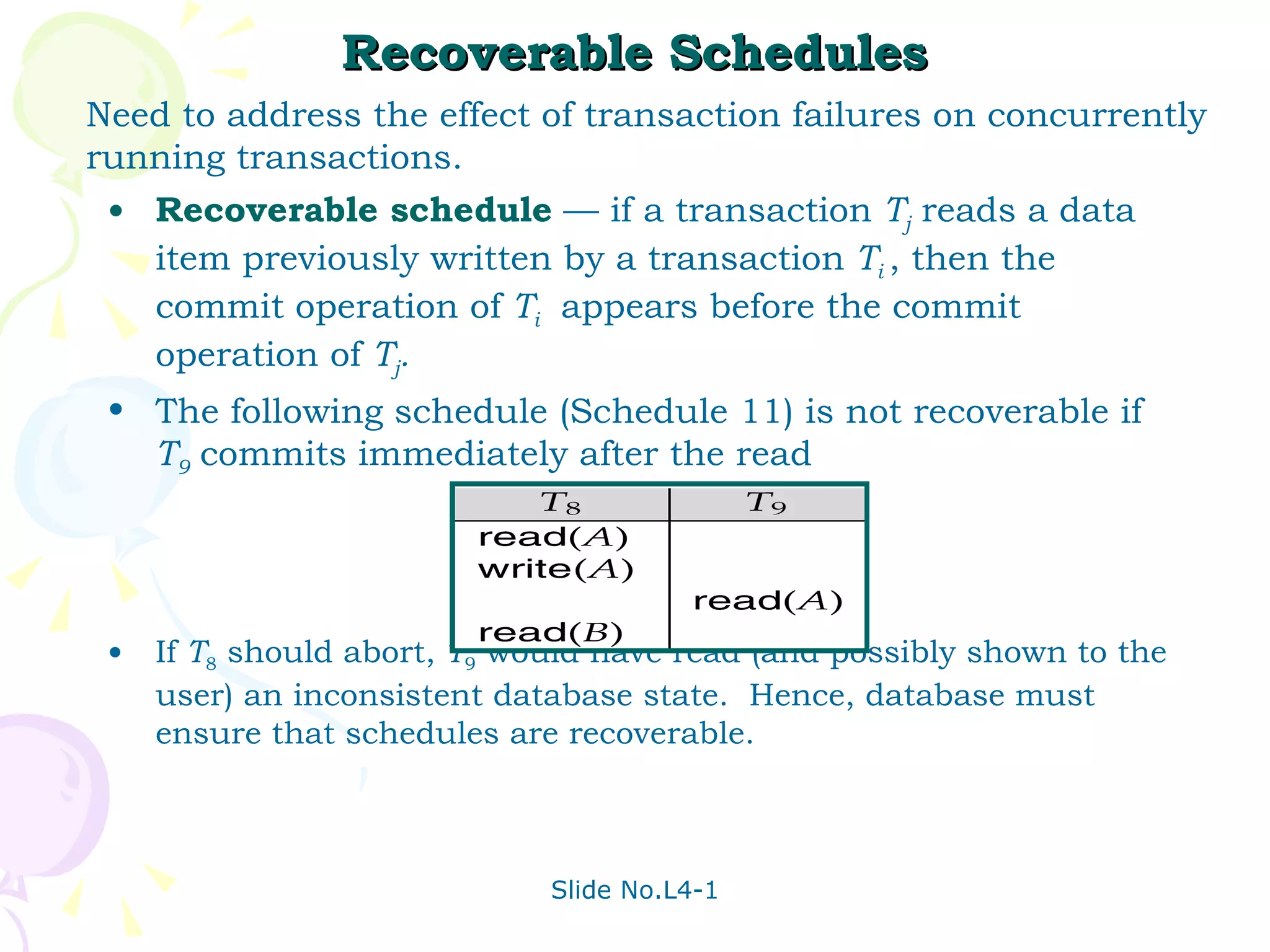
Recoverable Schedules Recoverable   schedule  — if a transaction  T j  reads a data item previously written by a transaction  T i  , then the commit operation of  T i   appears before the commit operation of  T j . The following schedule (Schedule 11) is not recoverable if  T 9   commits immediately after the read If  T 8  should abort,  T 9  would have read (and possibly shown to the user) an inconsistent database state.  Hence, database must ensure that schedules are recoverable. Need to address the effect of transaction failures on concurrently  running transactions.
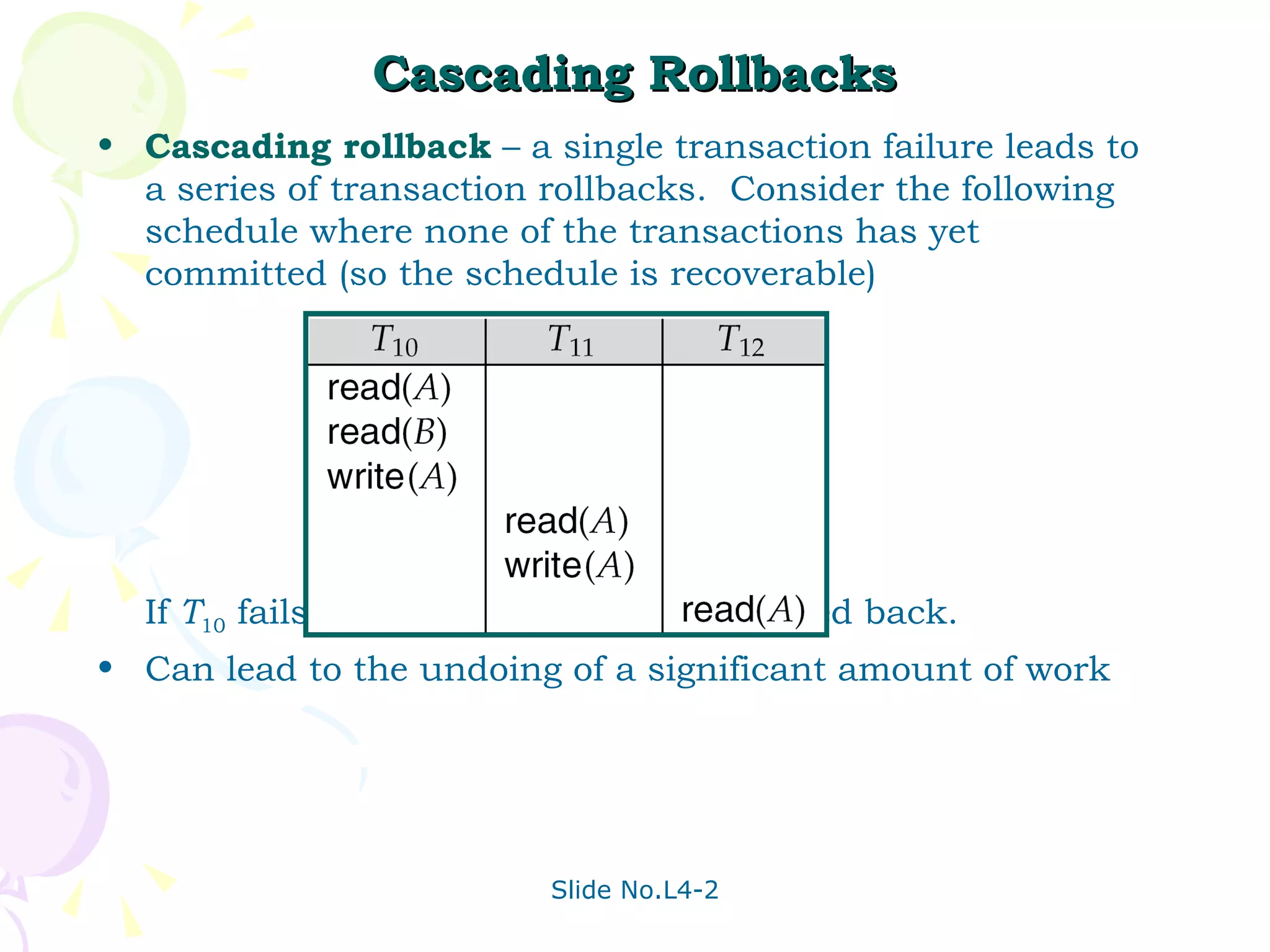
Cascading Rollbacks Cascading rollback  – a single transaction failure leads to a series of transaction rollbacks.  Consider the following schedule where none of the transactions has yet committed (so the schedule is recoverable) If  T 10  fails,  T 11  and  T 12  must also be rolled back. Can lead to the undoing of a significant amount of work
Cascadeless Schedules Cascadeless   schedules  — cascading rollbacks cannot occur; for each pair of transactions  T i   and  T j  such that  T j   reads a data item previously written by  T i , the commit operation of  T i   appears before the read operation of  T j . Every cascadeless schedule is also recoverable It is desirable to restrict the schedules to those that are cascadeless
Concurrency Control A database must provide a mechanism that will ensure that all possible schedules are  either conflict or view serializable, and  are recoverable and preferably cascadeless A policy in which only one transaction can execute at a time generates serial schedules, but provides a poor degree of concurrency Are serial schedules recoverable/cascadeless? Testing a schedule for serializability  after  it has executed is a little too late! Goal  – to develop concurrency control protocols that will assure serializability.
Concurrency Control vs. Serializability Tests Concurrency-control protocols allow concurrent schedules, but ensure that the schedules are conflict/view serializable, and are recoverable and cascadeless . Concurrency control protocols generally do not examine the precedence graph as it is being created Instead a protocol imposes a discipline that avoids nonseralizable schedules. We study such protocols in Chapter 16. Different concurrency control protocols provide different tradeoffs between the amount of concurrency they allow and the amount of overhead that they incur. Tests for serializability help us understand why a concurrency control protocol is correct.
Weak Levels of Consistency Some applications are willing to live with weak levels of consistency, allowing schedules that are not serializable E.g. a read-only transaction that wants to get an approximate total balance of all accounts  E.g. database statistics computed for query optimization can be approximate (why?) Such transactions need not be serializable with respect to other transactions Tradeoff accuracy for performance
Levels of Consistency in SQL-92 Serializable   — default Repeatable read   —   only committed records to be read, repeated reads of same record must return same value.  However, a transaction may not be serializable – it may find some records inserted by a transaction but not find others. Read committed   —   only committed records can be read, but successive reads of record may return different (but committed) values. Read uncommitted  —   even uncommitted records may be read.  Lower degrees of consistency useful for gathering approximate information about the database  Warning: some database systems do not ensure serializable schedules by default E.g. Oracle and PostgreSQL by default support a level of consistency called snapshot isolation (not part of the SQL standard)
Transaction Definition in SQL Data manipulation language must include a construct for specifying the set of actions that comprise a transaction. In SQL, a transaction begins implicitly. A transaction in SQL ends by: Commit work  commits current transaction and begins a new one. Rollback work  causes current transaction to abort. In almost all database systems, by default, every SQL statement also commits implicitly if it executes successfully Implicit commit can be turned off by a database directive E.g. in JDBC,  connection.setAutoCommit(false);
Implementation of Isolation Schedules must be conflict or view serializable, and recoverable, for the sake of database consistency, and preferably cascadeless. A policy in which only one transaction can execute at a time generates serial schedules, but provides a poor degree of concurrency. Concurrency-control schemes tradeoff between the amount of concurrency they allow and the amount of overhead that they incur. Some schemes allow only conflict-serializable schedules to be generated, while others allow  view-serializable schedules that are not conflict-serializable.
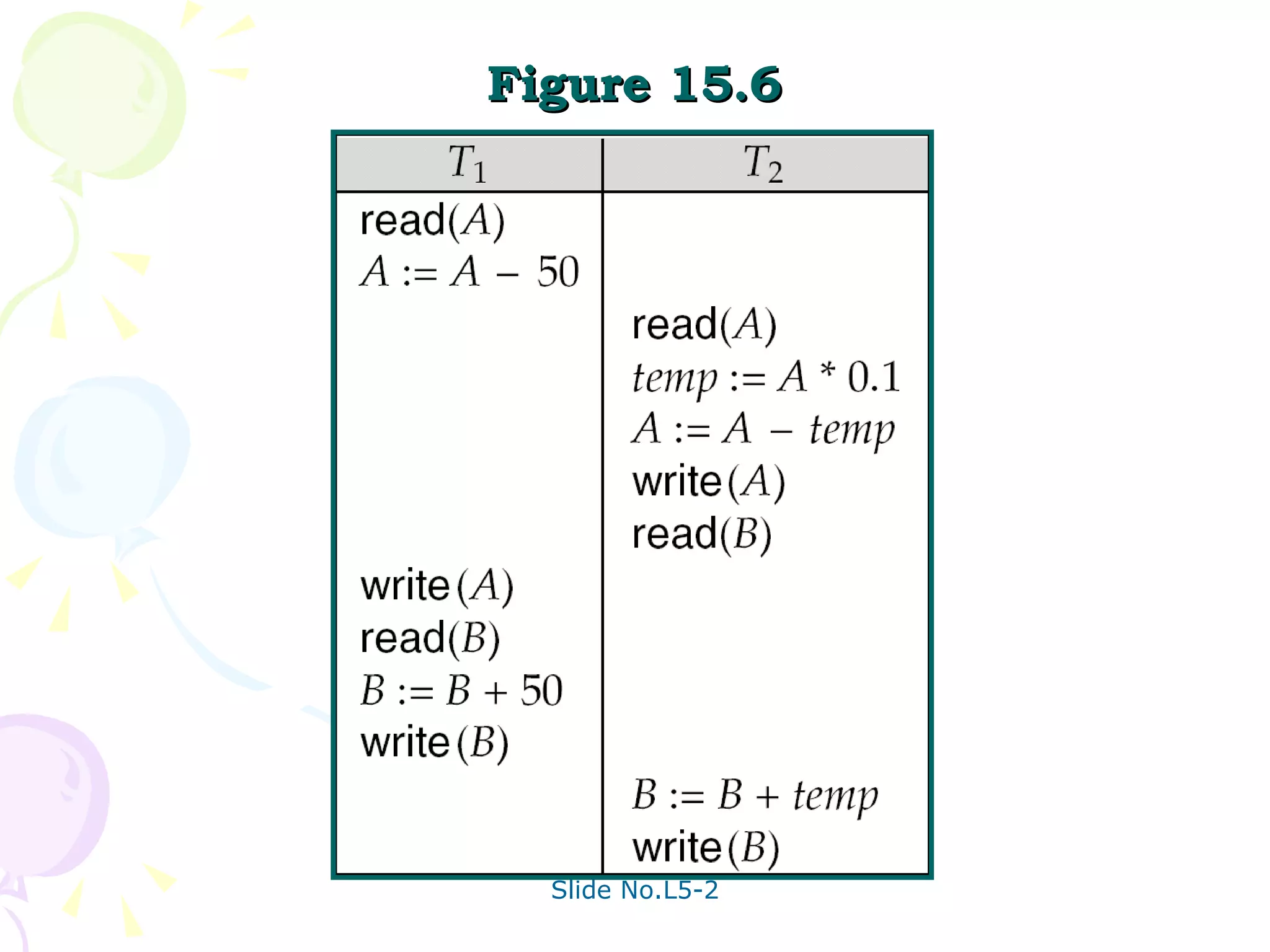
Figure 15.6
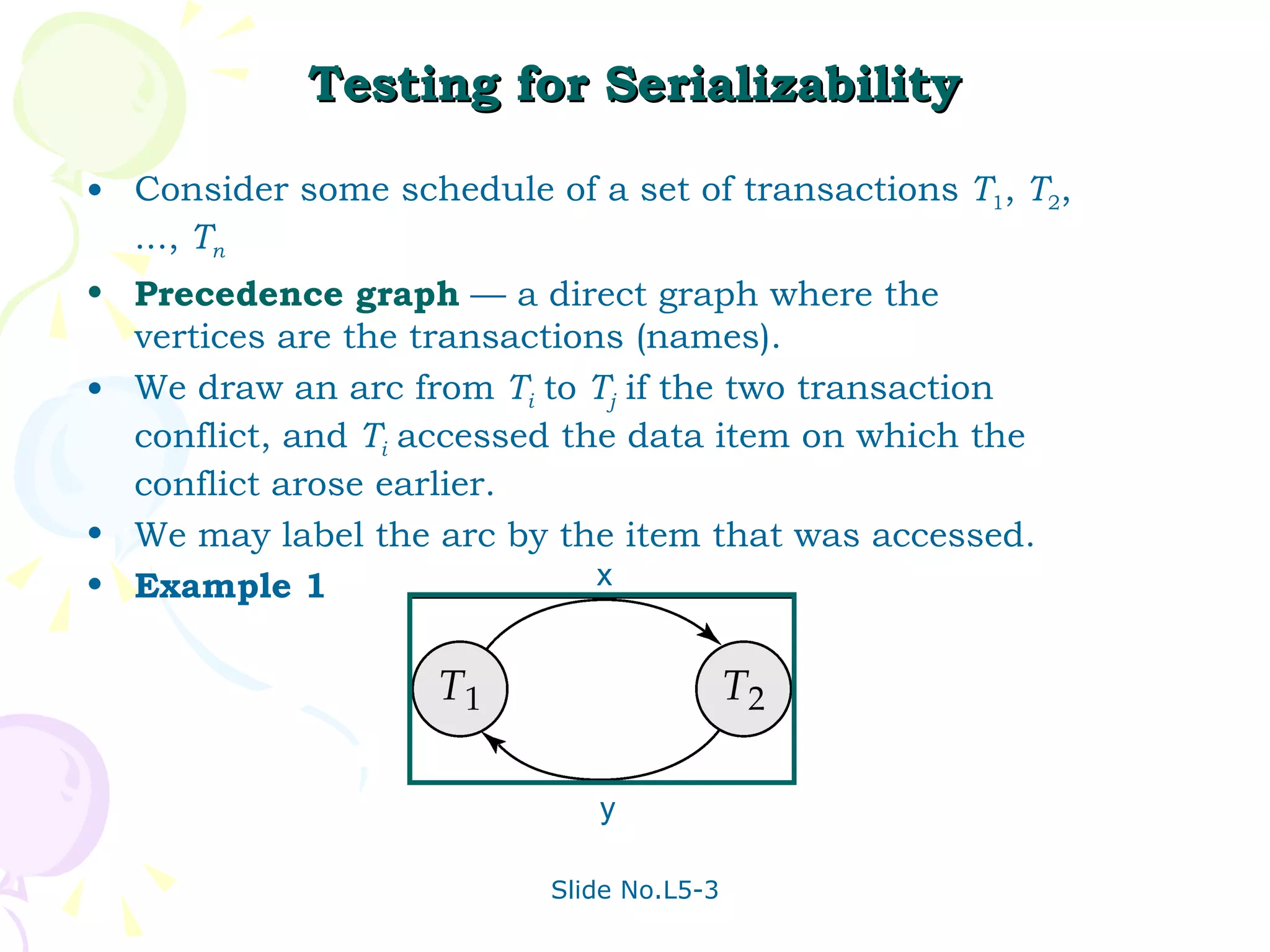
Testing for Serializability Consider some schedule of a set of transactions  T 1 ,  T 2 , ...,  T n Precedence graph   — a direct graph where the vertices are the transactions (names). We draw an arc from  T i   to  T j   if the two transaction conflict, and  T i   accessed the data item on which the conflict arose earlier. We may label the arc by the item that was accessed. Example 1 x y
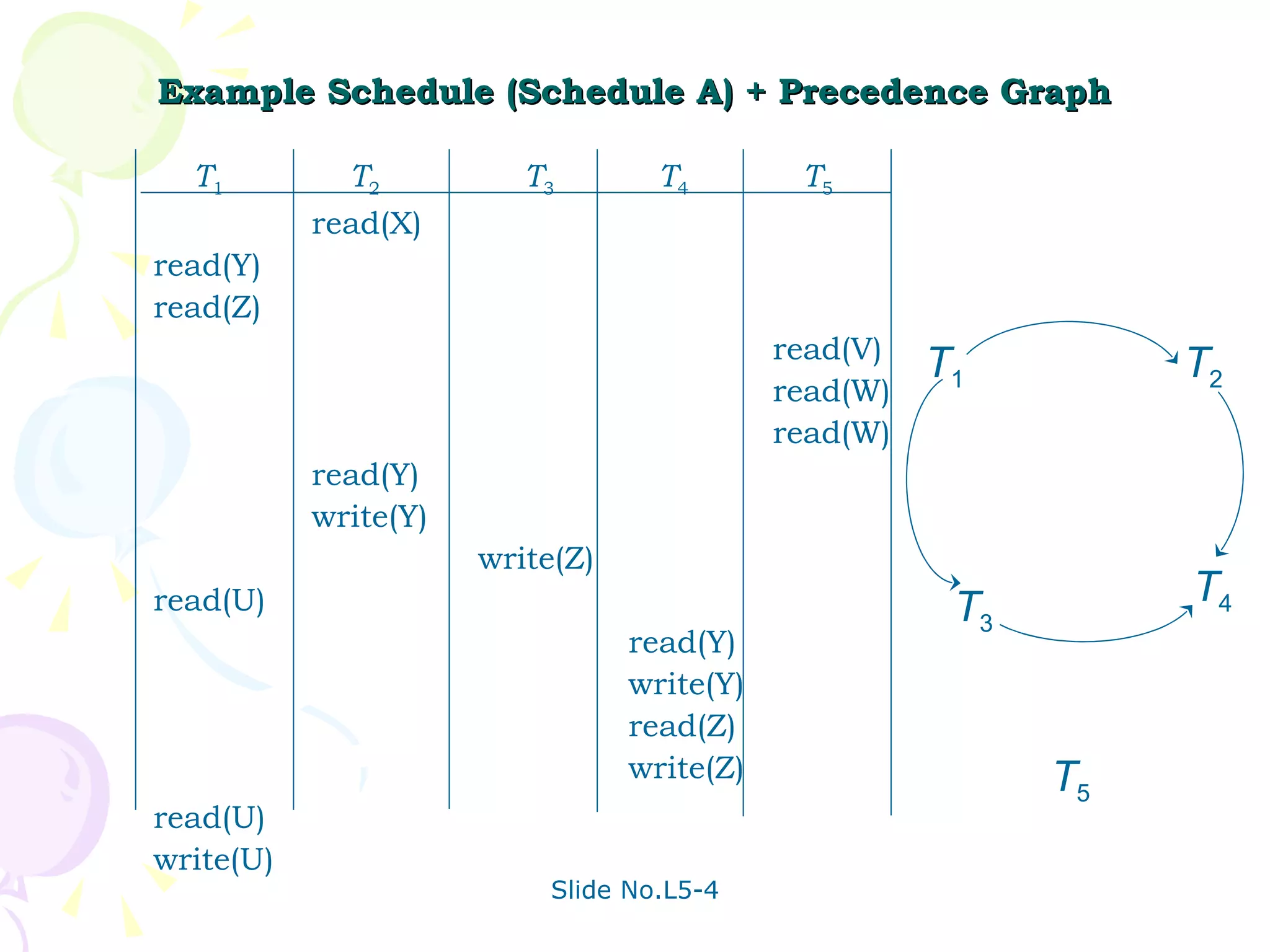
Example Schedule (Schedule A) + Precedence Graph T 1   T 2   T 3   T 4   T 5 read(X) read(Y) read(Z) read(V) read(W) read(W) read(Y) write(Y) write(Z) read(U) read(Y) write(Y) read(Z) write(Z) read(U) write(U) T 5 T 3 T 4 T 1 T 2
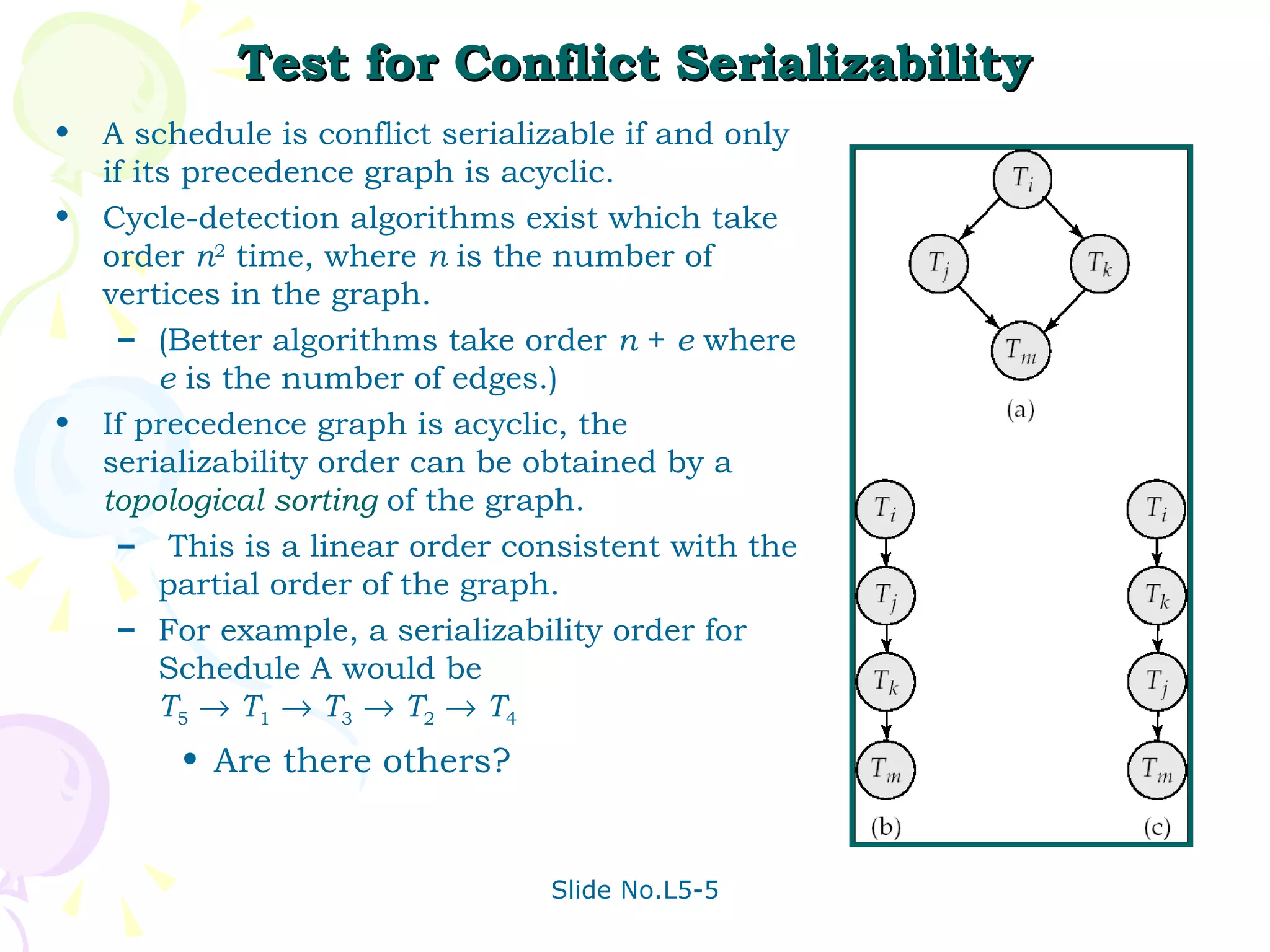
Test for Conflict Serializability A schedule is conflict serializable if and only if its precedence graph is acyclic. Cycle-detection algorithms exist which take order  n 2  time, where  n  is the number of vertices in the graph.  (Better algorithms take order  n  +  e  where  e  is the number of edges.) If precedence graph is acyclic, the serializability order can be obtained by a  topological sorting  of the graph.  This is a linear order consistent with the partial order of the graph. For example, a serializability order for Schedule A would be T 5      T 1      T 3      T 2      T 4 Are there others?
Test for View Serializability The precedence graph test for conflict serializability cannot be used directly to test for view serializability. Extension to test for view serializability has cost exponential in the size of the precedence graph. The problem of checking if a schedule is view serializable falls in the class of  NP -complete problems.  Thus existence of an efficient algorithm is  extremely  unlikely. However practical algorithms that just check some  sufficient   conditions  for view serializability can still be used.
Lock-Based Protocols A lock is a mechanism to control concurrent access to a data item Data items can be locked in two modes : 1 .  exclusive  (X) mode . Data item can be both read as well as  written. X-lock is requested using  lock-X  instruction. 2 .  shared  (S) mode . Data item can only be read. S-lock is  requested using  lock-S  instruction. Lock requests are made to concurrency-control manager. Transaction can proceed only after request is granted.
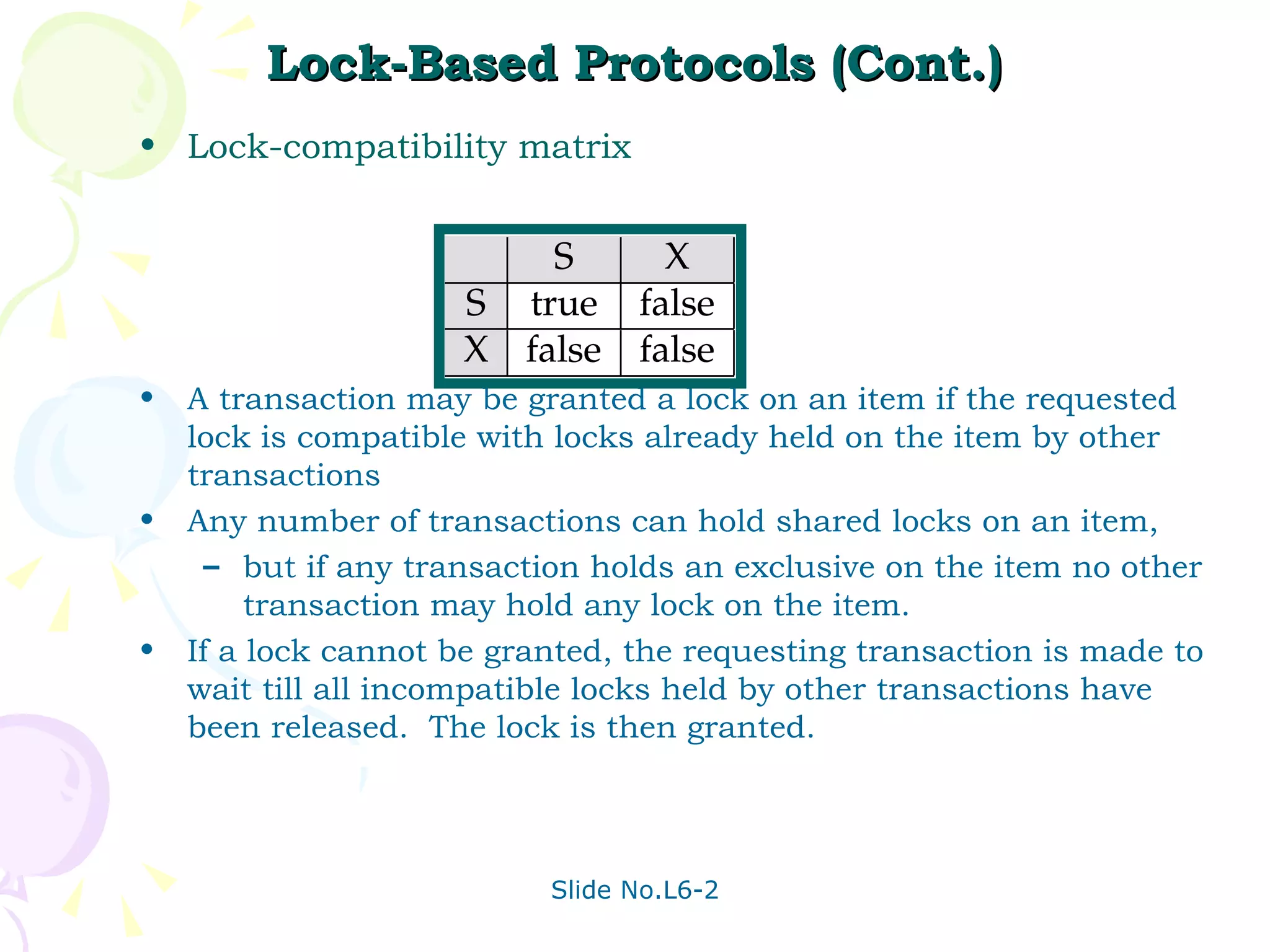
Lock-Based Protocols (Cont.) Lock-compatibility matrix A transaction may be granted a lock on an item if the requested lock is compatible with locks already held on the item by other transactions Any number of transactions can hold shared locks on an item,  but if any transaction holds an exclusive on the item no other transaction may hold any lock on the item. If a lock cannot be granted, the requesting transaction is made to wait till all incompatible locks held by other transactions have been released.  The lock is then granted.
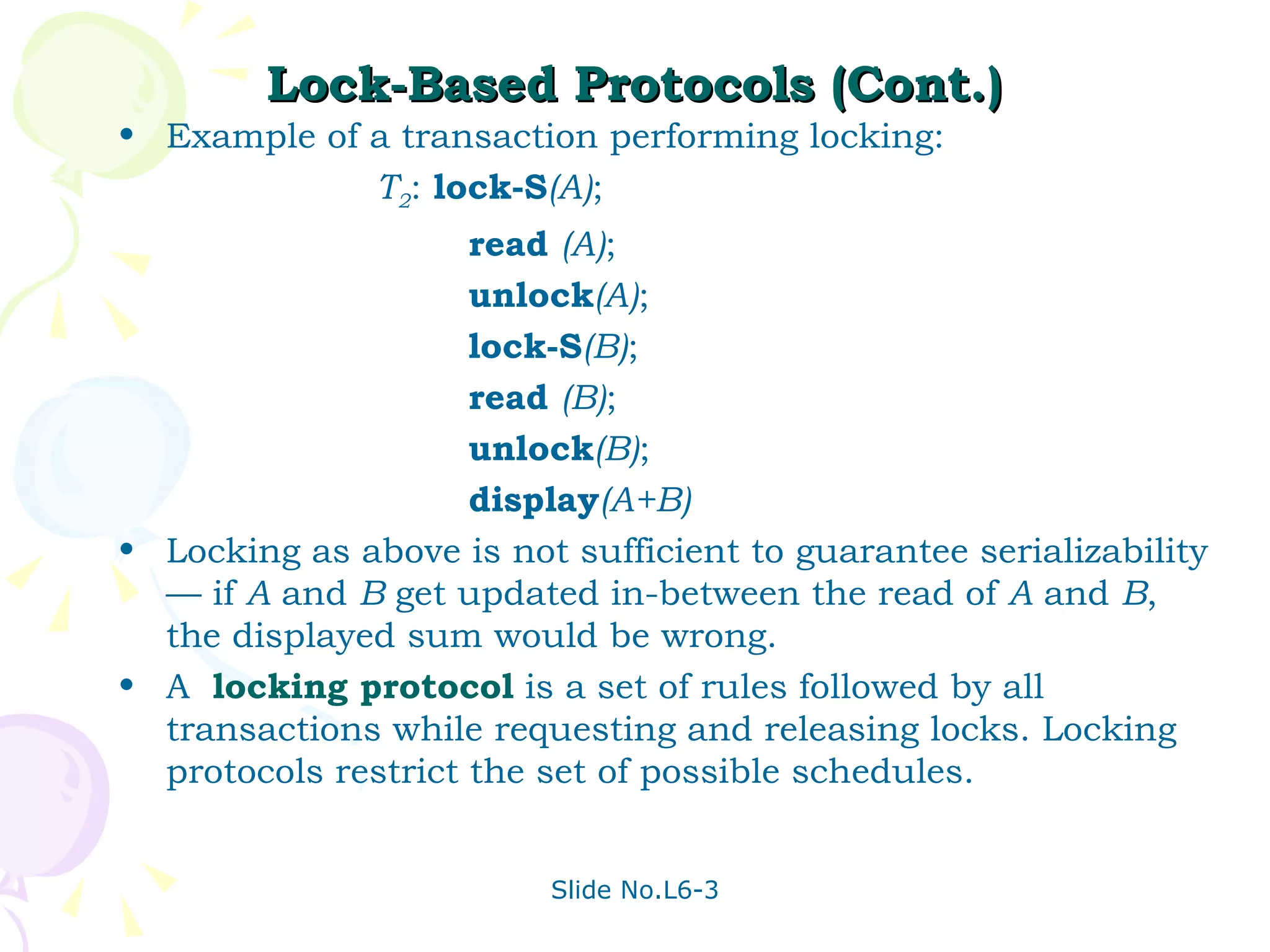
Lock-Based Protocols (Cont.) Example of a transaction performing locking: T 2 :  lock-S (A) ; read  (A) ; unlock (A) ; lock-S (B) ; read  (B) ; unlock (B) ; display (A+B) Locking as above is not sufficient to guarantee serializability — if  A  and  B  get updated in-between the read of  A  and  B , the displayed sum would be wrong. A  locking protocol  is a set of rules followed by all transactions while requesting and releasing locks. Locking protocols restrict the set of possible schedules.
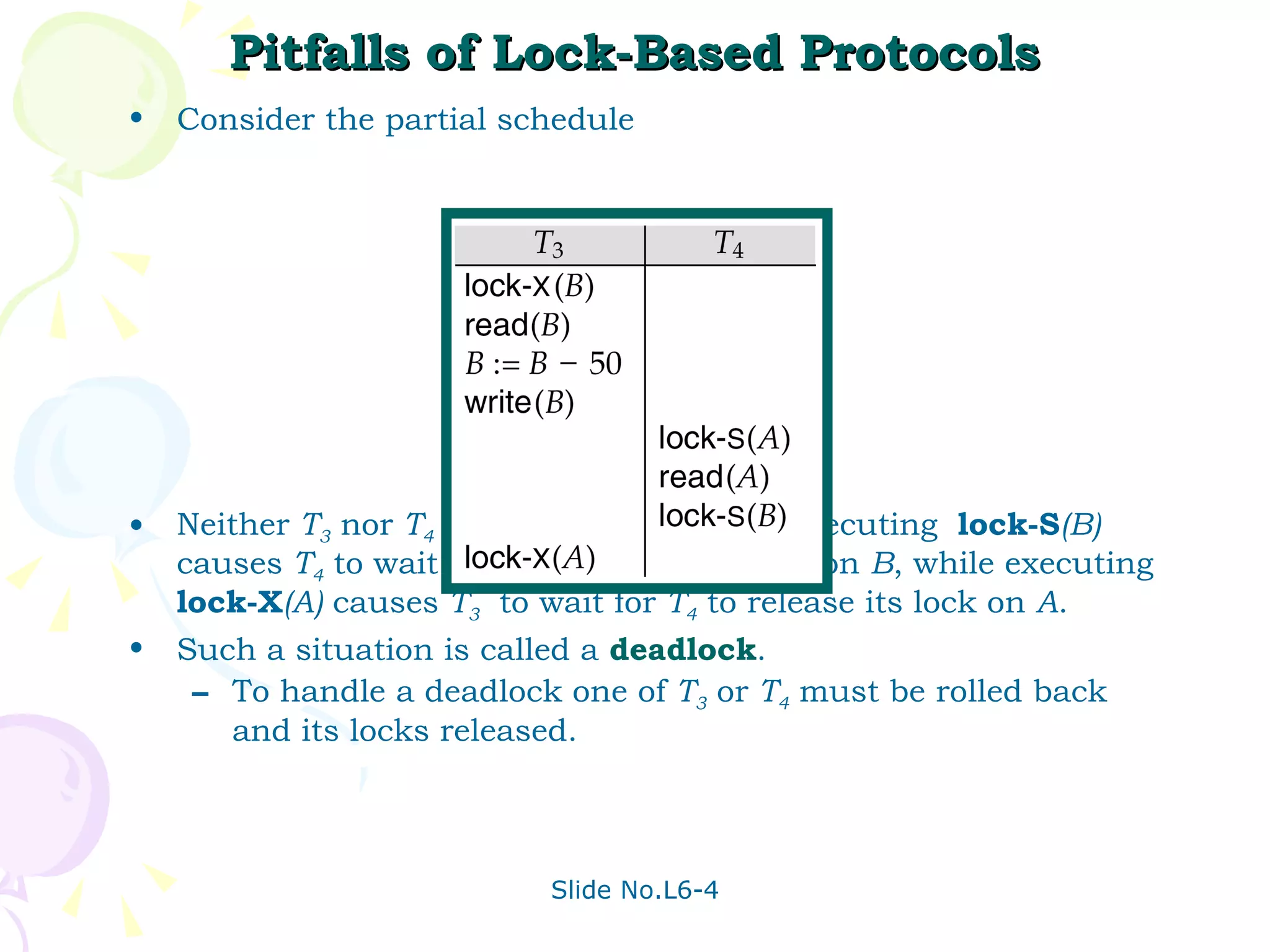
Pitfalls of Lock-Based Protocols Consider the partial schedule Neither  T 3  nor  T 4  can make progress — executing  lock-S (B)  causes  T 4  to wait for  T 3  to release its lock on  B , while executing  lock-X (A)  causes  T 3   to wait for  T 4  to release its lock on  A . Such a situation is called a  deadlock .  To handle a deadlock one of  T 3  or  T 4  must be rolled back  and its locks released.
Pitfalls of Lock-Based Protocols (Cont.) The potential for deadlock exists in most locking protocols. Deadlocks are a necessary evil. Starvation  is also possible if concurrency control manager is badly designed. For example: A transaction may be waiting for an X-lock on an item, while a sequence of other transactions request and are granted an S-lock on the same item.  The same transaction is repeatedly rolled back due to deadlocks. Concurrency control manager can be designed to prevent starvation.
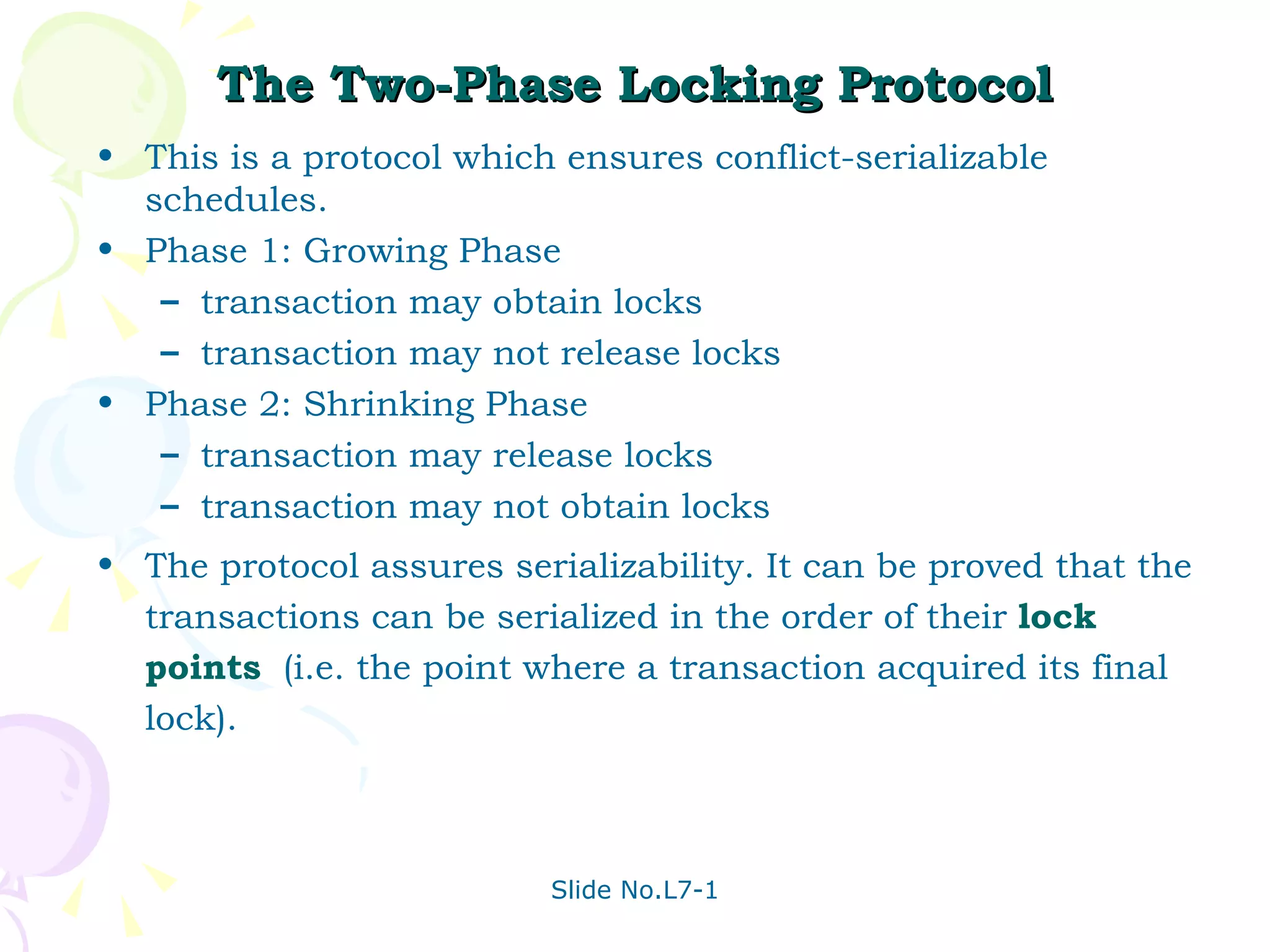
The Two-Phase Locking Protocol This is a protocol which ensures conflict-serializable schedules. Phase 1: Growing Phase transaction may obtain locks  transaction may not release locks Phase 2: Shrinking Phase transaction may release locks transaction may not obtain locks The protocol assures serializability. It can be proved that the transactions can be serialized in the order of their  lock points   (i.e. the point where a transaction acquired its final lock).
The Two-Phase Locking Protocol (Cont.) Two-phase locking  does not  ensure freedom from deadlocks Cascading roll-back is possible under two-phase locking. To avoid this, follow a modified protocol called  strict two-phase locking . Here a transaction must hold all its exclusive locks till it commits/aborts. Rigorous two-phase locking  is even stricter: here  all  locks are held till commit/abort. In this protocol transactions can be serialized in the order in which they commit.
The Two-Phase Locking Protocol (Cont.) There can be conflict serializable schedules that cannot be obtained if two-phase locking is used.  However, in the absence of extra information (e.g., ordering of  access to data), two-phase locking is needed for conflict serializability in the following sense: Given a transaction  T i  that does not follow two-phase locking, we can find a transaction  T j  that uses two-phase locking, and a schedule for  T i  and  T j  that is not conflict serializable.
Lock Conversions Two-phase locking with lock conversions: –  First Phase:  can acquire a lock-S on item can acquire a lock-X on item can convert a lock-S to a lock-X (upgrade) –  Second Phase: can release a lock-S can release a lock-X can convert a lock-X to a lock-S  (downgrade) This protocol assures serializability. But still relies on the programmer to insert the various  locking instructions.
Automatic Acquisition of Locks A transaction  T i  issues the standard read/write instruction, without explicit locking calls. The operation  read ( D ) is processed as: if   T i  has a lock on  D then read( D )  else begin   if necessary wait until no other  transaction has a  lock-X  on  D grant  T i  a  lock-S  on  D ; read( D ) end
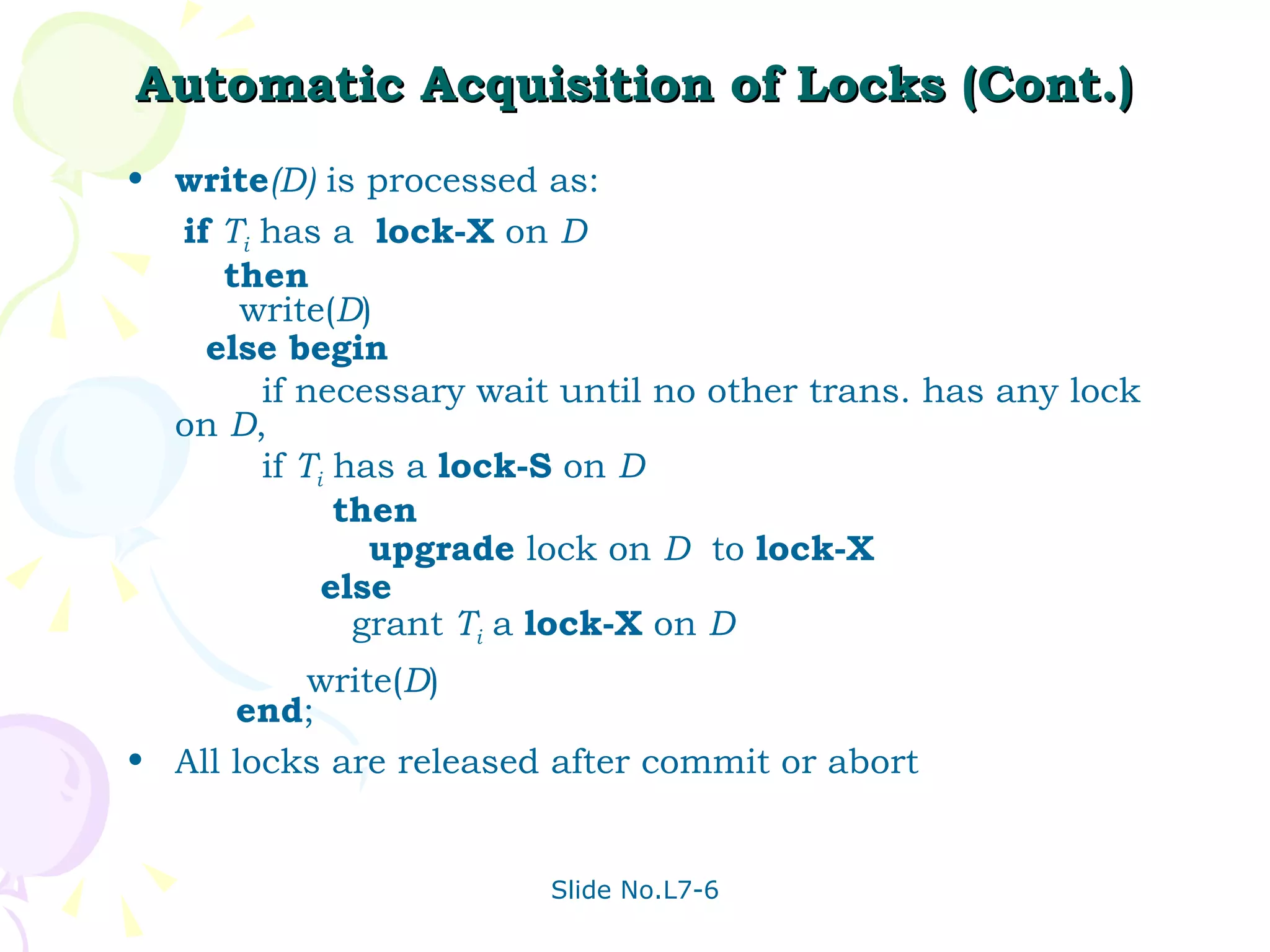
Automatic Acquisition of Locks (Cont.) write (D)  is processed as: if  T i  has a  lock-X  on  D   then   write( D ) else begin if necessary wait until no other trans. has any lock on  D , if  T i  has a  lock-S  on  D then upgrade  lock on  D   to  lock-X else grant  T i  a  lock-X  on  D write( D ) end ; All locks are released after commit or abort
Implementation of Locking A  lock manager  can be implemented as a separate process to which transactions send lock and unlock requests The lock manager replies to a lock request by sending a lock grant messages (or a message asking the transaction to roll back, in case of  a deadlock) The requesting transaction waits until its request is answered The lock manager maintains a data-structure called a  lock table  to record granted locks and pending requests The lock table is usually implemented as an in-memory hash table indexed on the name of the data item being locked
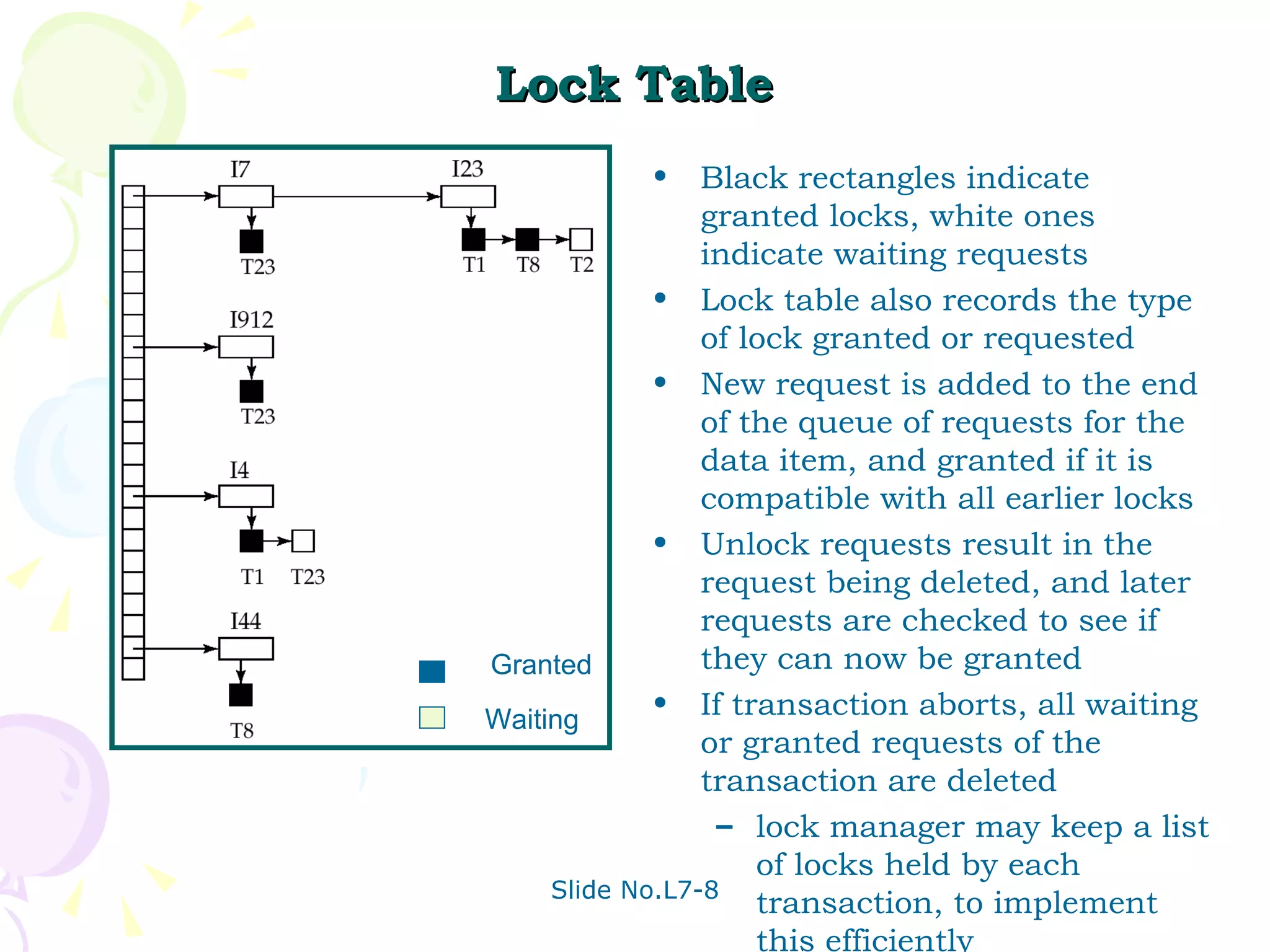
Lock Table Black rectangles indicate granted locks, white ones indicate waiting requests Lock table also records the type of lock granted or requested New request is added to the end of the queue of requests for the data item, and granted if it is compatible with all earlier locks Unlock requests result in the request being deleted, and later requests are checked to see if they can now be granted If transaction aborts, all waiting or granted requests of the transaction are deleted  lock manager may keep a list of locks held by each transaction, to implement this efficiently Granted Waiting
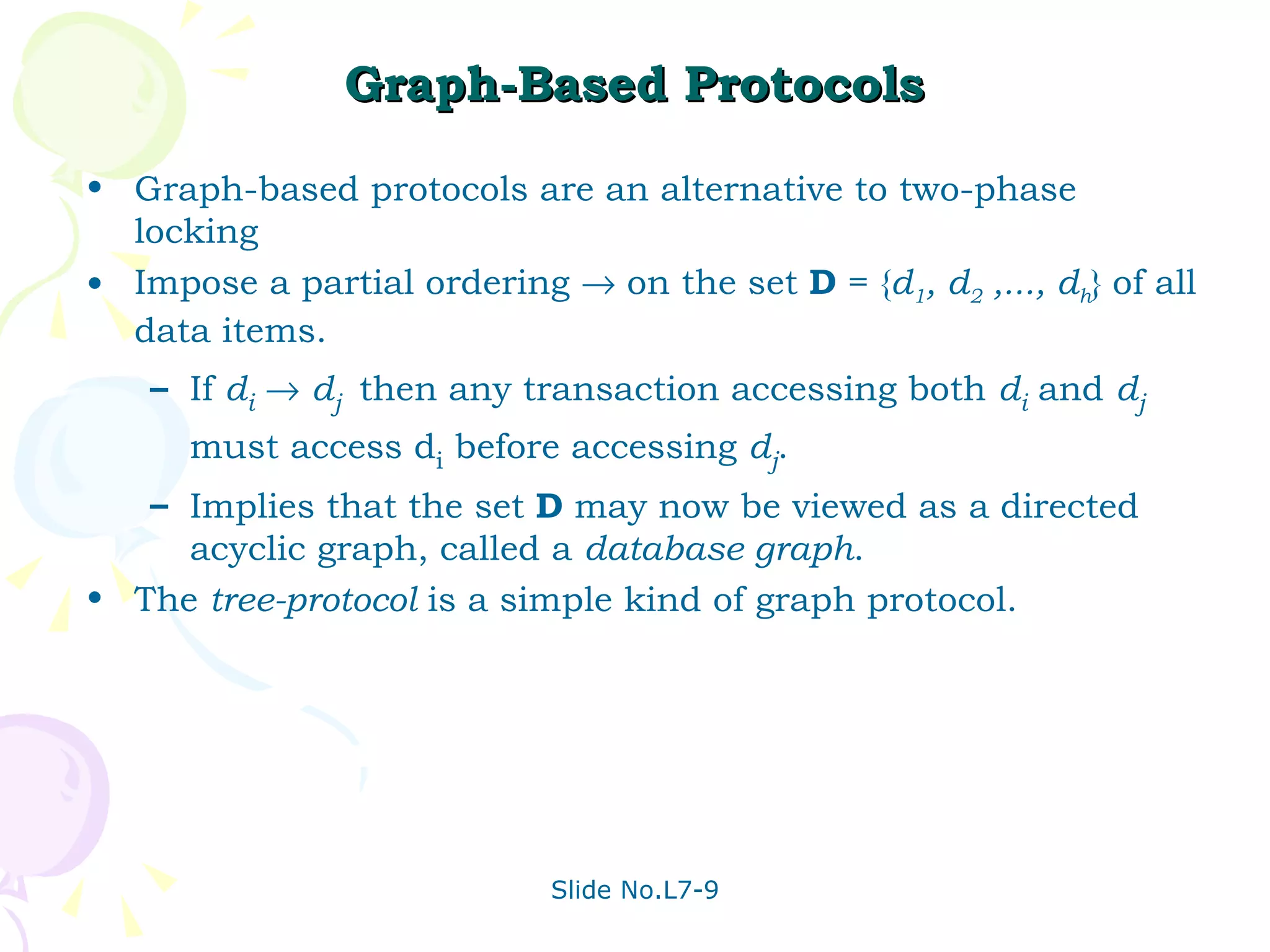
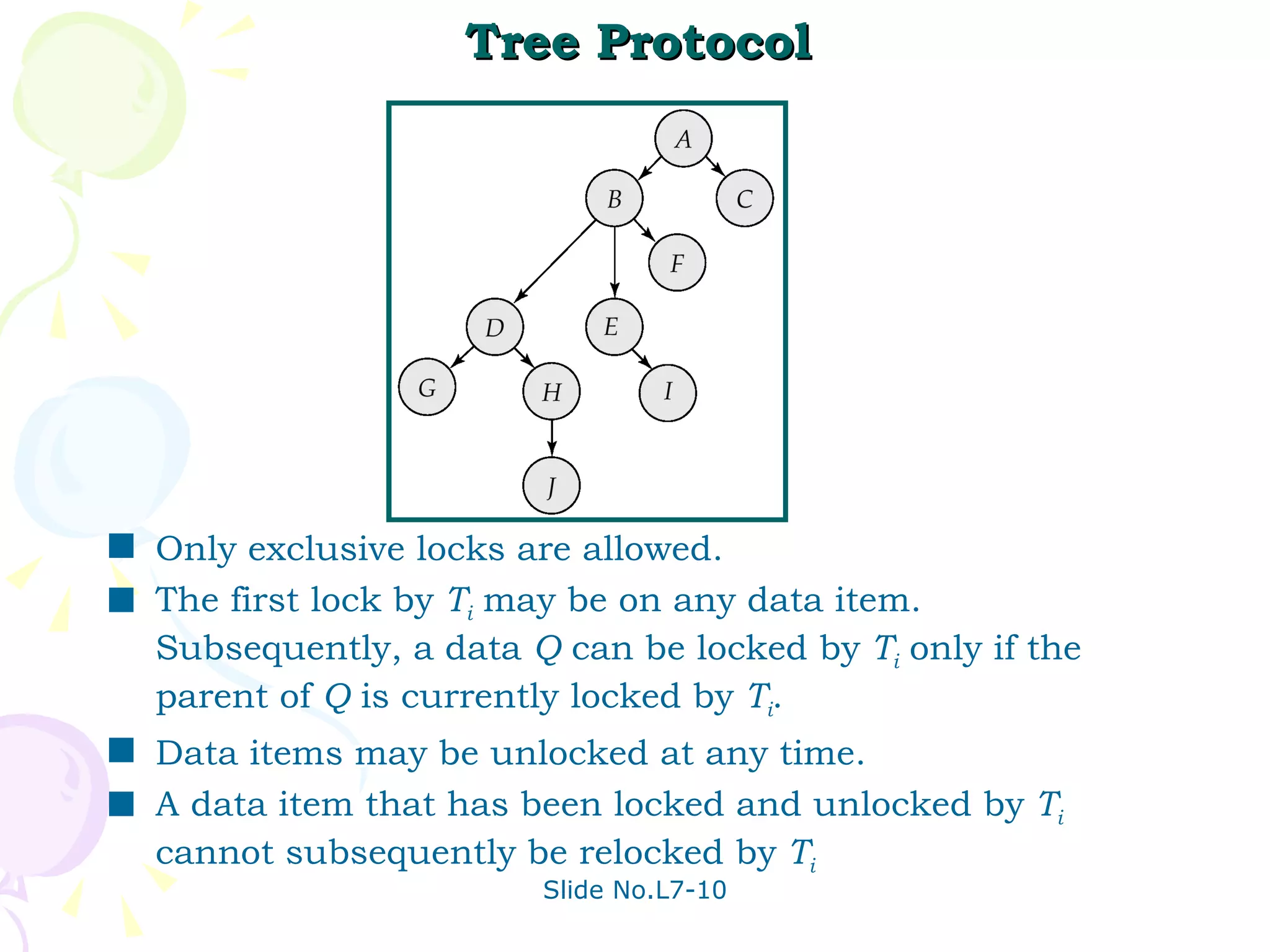
Graph-Based Protocols Graph-based protocols are an alternative to two-phase locking Impose a partial ordering    on the set  D  = { d 1 , d 2  ,..., d h } of all data items. If  d i      d j  then any transaction accessing both  d i  and  d j  must access d i  before accessing  d j . Implies that the set  D  may now be viewed as a directed acyclic graph, called a  database graph . The  tree-protocol  is a simple kind of graph protocol.
Tree Protocol Only exclusive locks are allowed. The first lock by  T i  may be on any data item. Subsequently, a data  Q  can be locked by  T i  only if the parent of  Q  is currently locked by  T i . Data items may be unlocked at any time. A data item that has been locked and unlocked by  T i   cannot subsequently be relocked by  T i
Timestamp-Based Protocols Each transaction is issued a timestamp when it enters the system. If an old transaction  T i  has time-stamp TS( T i ), a new transaction  T j  is assigned time-stamp TS( T j ) such that TS( T i ) <TS( T j ).  The protocol manages concurrent execution such that the time-stamps determine the serializability order. In order to assure such behavior, the protocol maintains for each data  Q  two timestamp values: W-timestamp ( Q ) is the largest time-stamp of any transaction that executed  write ( Q ) successfully. R-timestamp ( Q ) is the largest time-stamp of any transaction that executed  read ( Q ) successfully.
Timestamp-Based Protocols (Cont.) The timestamp ordering protocol ensures that any conflicting  read  and  write  operations are executed in timestamp order. Suppose a transaction T i  issues a  read ( Q ) If TS( T i )     W -timestamp( Q ), then  T i  needs to read a value of  Q   that was already overwritten. Hence, the  read  operation is rejected, and  T i   is rolled back. If TS( T i )    W -timestamp( Q ), then the  read  operation is executed, and R-timestamp( Q ) is set to  max (R-timestamp( Q ), TS( T i )).
Timestamp-Based Protocols (Cont.) Suppose that transaction  T i  issues  write ( Q ). If TS( T i ) < R-timestamp( Q ), then the value of  Q  that  T i  is producing was needed previously, and the system assumed that that value would never be produced.  Hence, the  write  operation is rejected, and  T i  is rolled back. If TS( T i ) < W-timestamp( Q ), then  T i  is attempting to write an obsolete value of  Q .  Hence, this  write  operation is rejected, and  T i  is rolled back. Otherwise, the  write  operation is executed, and W-timestamp( Q ) is set to TS( T i ).
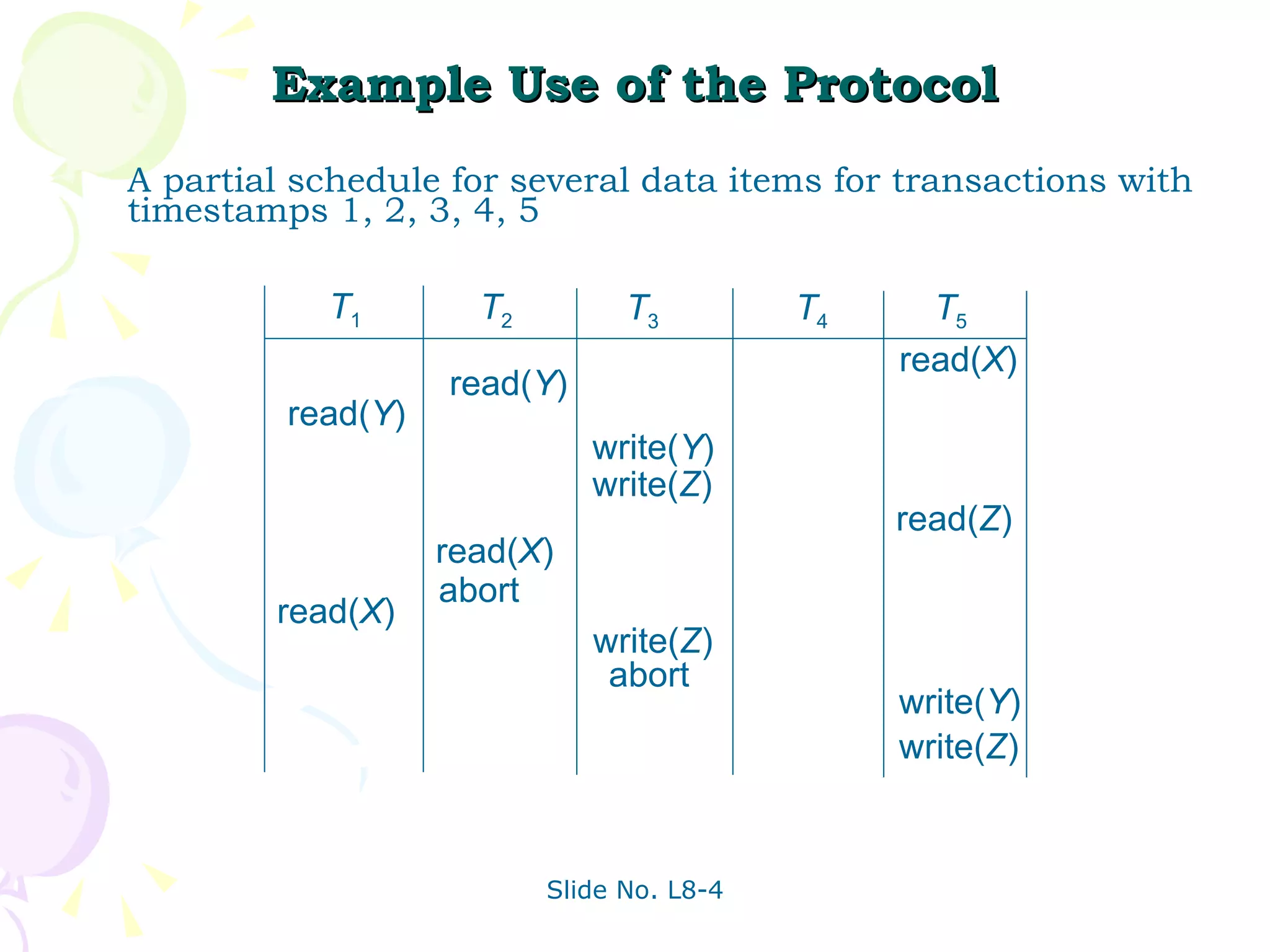
Example Use of the Protocol A partial schedule for several data items for transactions with timestamps 1, 2, 3, 4, 5 T 1 T 2 T 3 T 4 T 5 read( Y ) read( X )  read( Y ) write( Y )  write( Z )  read( Z )  read( X )  abort  read( X )  write( Z )  abort  write( Y )  write( Z )
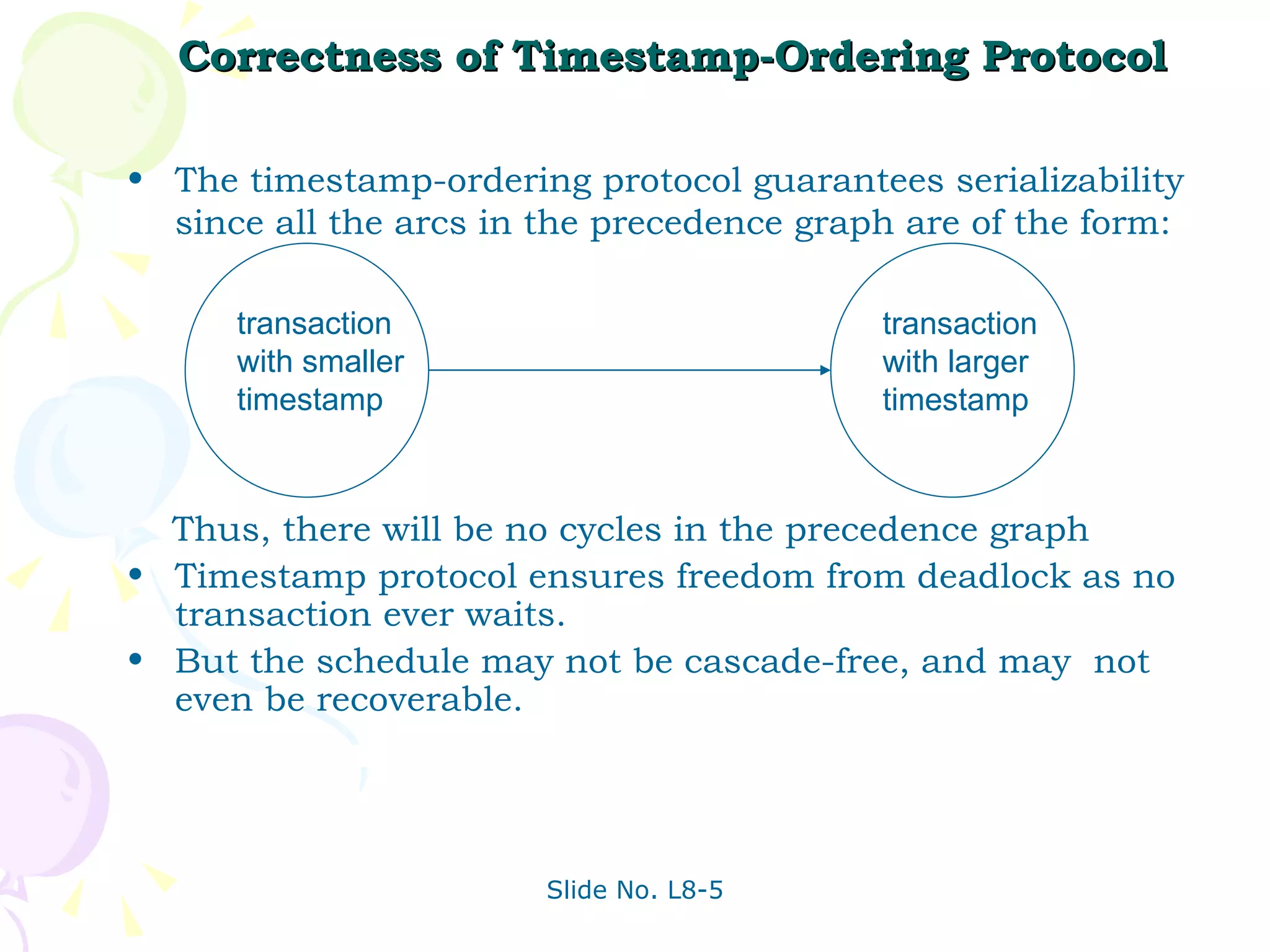
Correctness of Timestamp-Ordering Protocol The timestamp-ordering protocol guarantees serializability since all the arcs in the precedence graph are of the form: Thus, there will be no cycles in the precedence graph Timestamp protocol ensures freedom from deadlock as no transaction ever waits.  But the schedule may not be cascade-free, and may  not even be recoverable. transaction with smaller timestamp transaction with larger timestamp
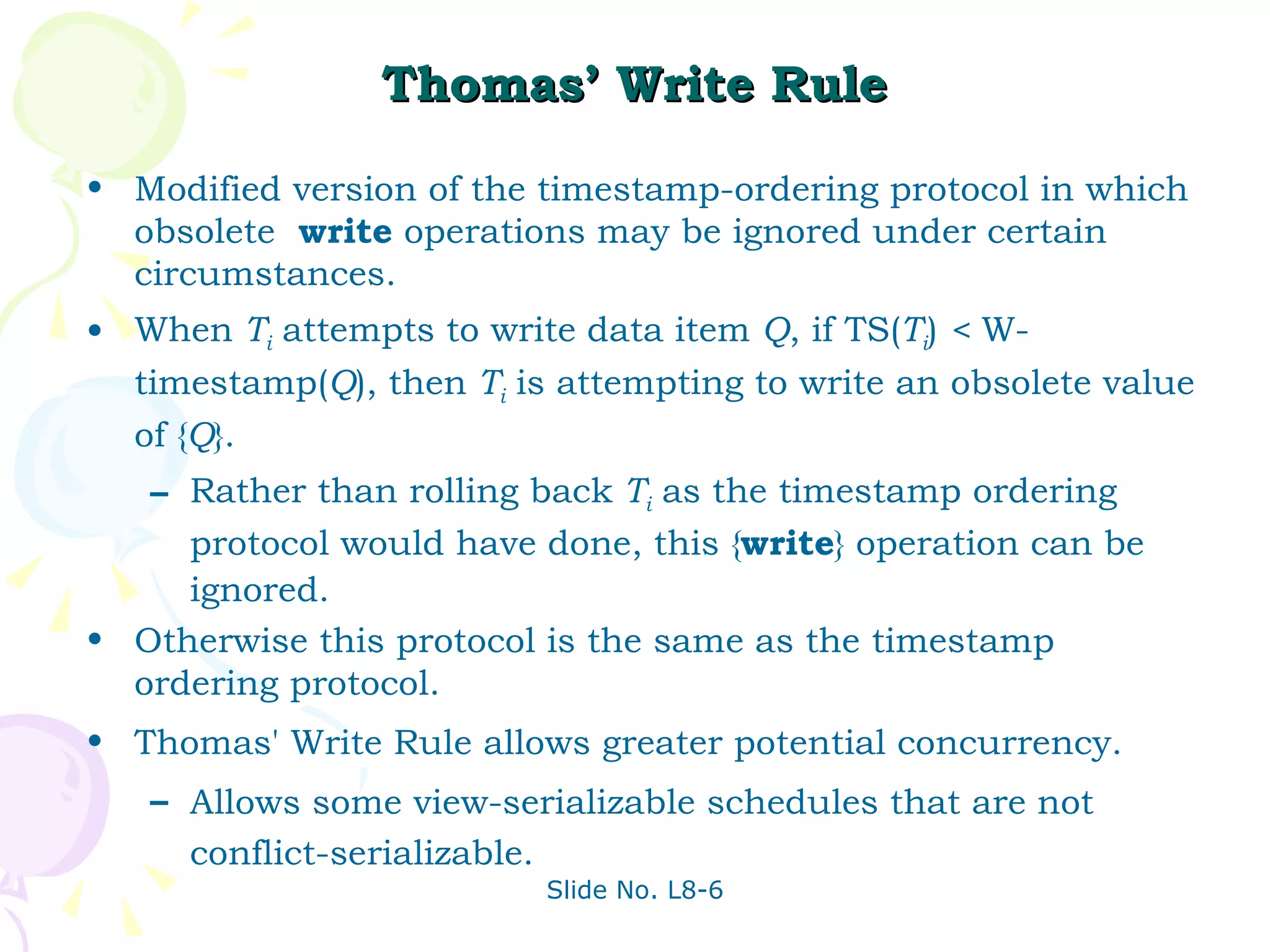
Thomas’ Write Rule Modified version of the timestamp-ordering protocol in which obsolete  write  operations may be ignored under certain circumstances. When  T i  attempts to write data item  Q , if TS( T i )  <  W-timestamp( Q ), then  T i  is attempting to write an obsolete value of { Q }.  Rather than rolling back  T i  as the timestamp ordering protocol would have done, this { write } operation can be ignored. Otherwise this protocol is the same as the timestamp ordering protocol. Thomas' Write Rule allows greater potential concurrency.  Allows some view-serializable schedules that are not conflict-serializable.
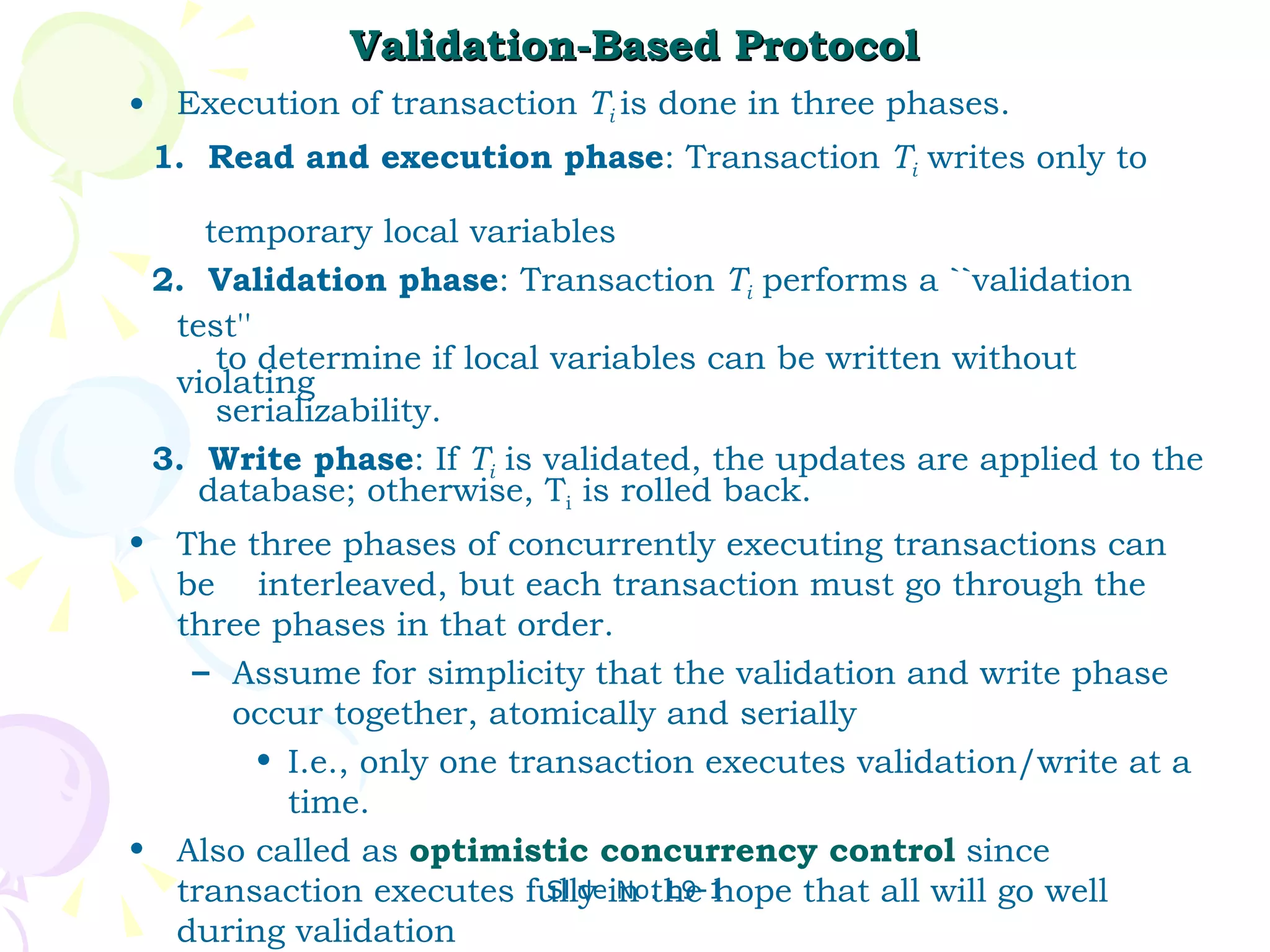
Validation-Based Protocol Execution of transaction  T i   is done in three phases. 1.  Read and execution phase : Transaction  T i  writes only to  temporary local variables 2.  Validation phase : Transaction  T i  performs a ``validation test''  to determine if local variables can be written without violating  serializability. 3.  Write phase : If  T i  is validated, the updates are applied to the    database; otherwise, T i  is rolled back. The three phases of concurrently executing transactions can be  interleaved, but each transaction must go through the three phases in that order. Assume for simplicity that the validation and write phase occur together, atomically and serially I.e., only one transaction executes validation/write at a time.  Also called as  optimistic concurrency control  since transaction executes fully in the hope that all will go well during validation
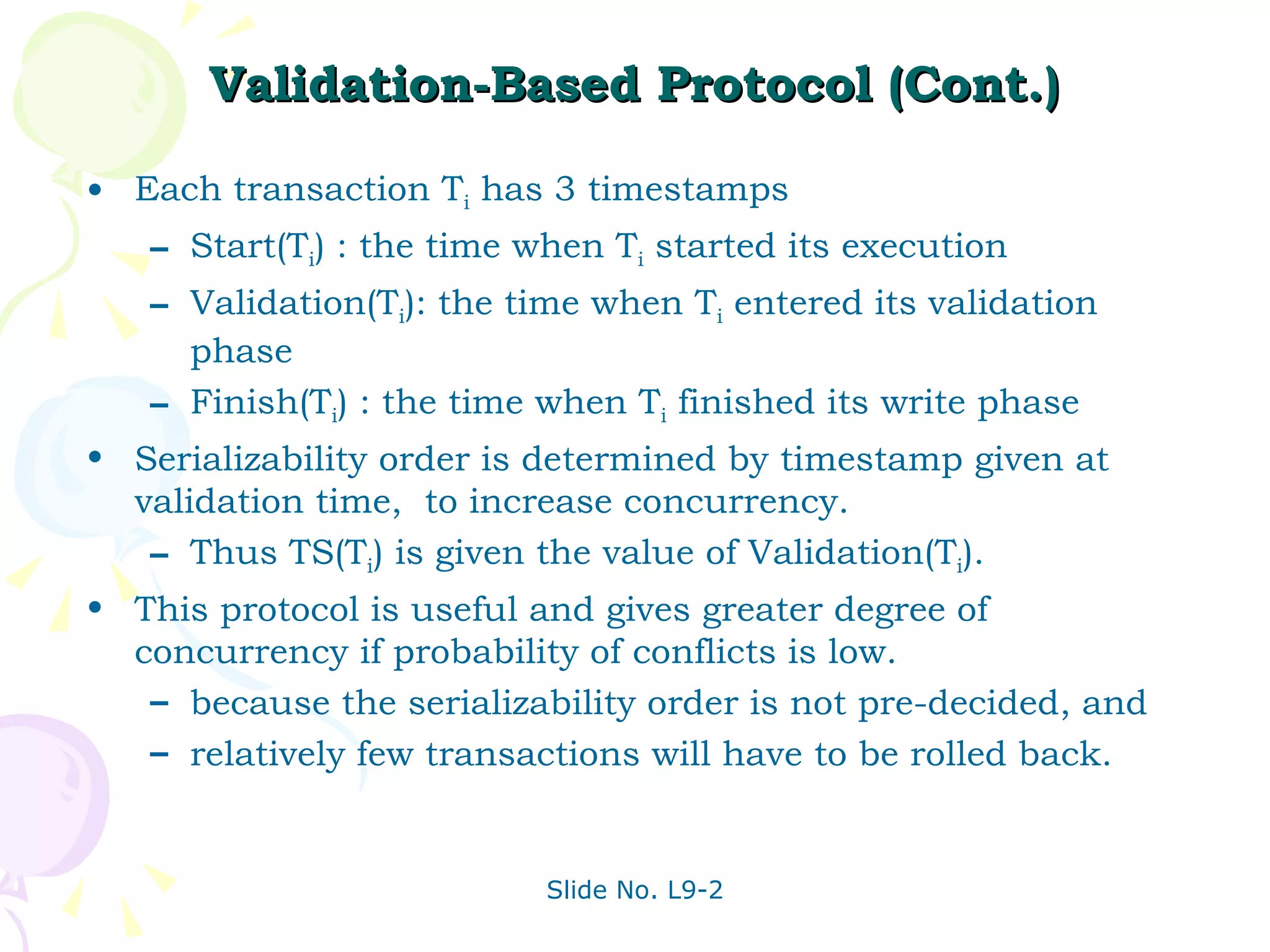
Validation-Based Protocol (Cont.) Each transaction T i  has 3 timestamps Start(T i ) : the time when T i  started its execution Validation(T i ): the time when T i  entered its validation phase Finish(T i ) : the time when T i  finished its write phase Serializability order is determined by timestamp given at validation time,  to increase concurrency.  Thus TS(T i ) is given the value of Validation(T i ). This protocol is useful and gives greater degree of concurrency if probability of conflicts is low.  because the serializability order is not pre-decided, and relatively few transactions will have to be rolled back.
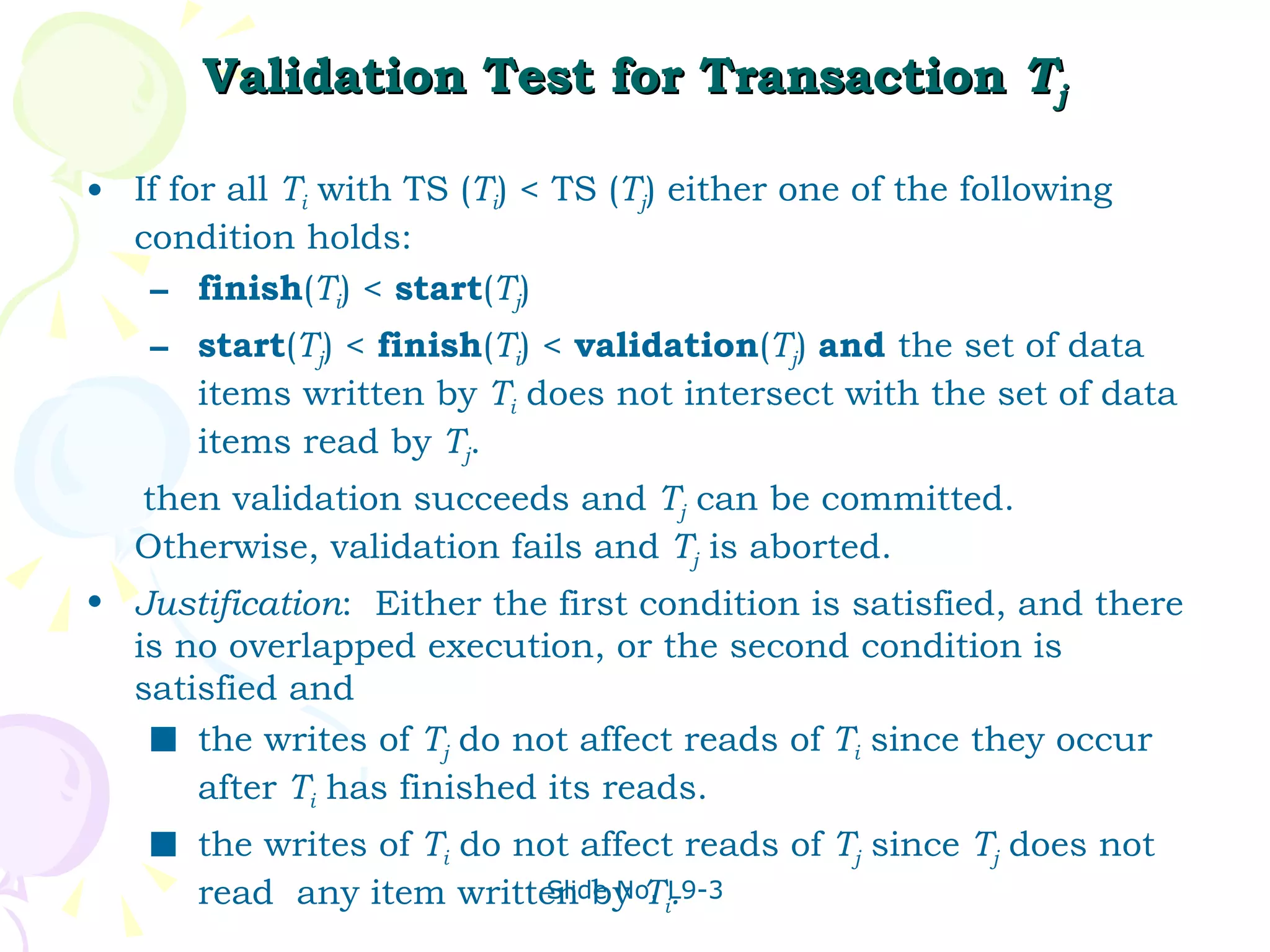
Validation Test for Transaction  T j If for all  T i  with TS ( T i ) < TS ( T j ) either one of the following condition holds: finish ( T i ) <  start ( T j )  start ( T j ) <  finish ( T i ) <  validation ( T j )  and  the set of data items written by  T i  does not intersect with the set of data items read by  T j .  then validation succeeds and  T j  can be committed.  Otherwise, validation fails and  T j  is aborted. Justification :  Either the first condition is satisfied, and there is no overlapped execution, or the second condition is satisfied and the writes of  T j   do not affect reads of  T i  since they occur after  T i  has finished its reads. the writes of  T i  do not affect reads of  T j  since  T j   does not read  any item written by  T i .
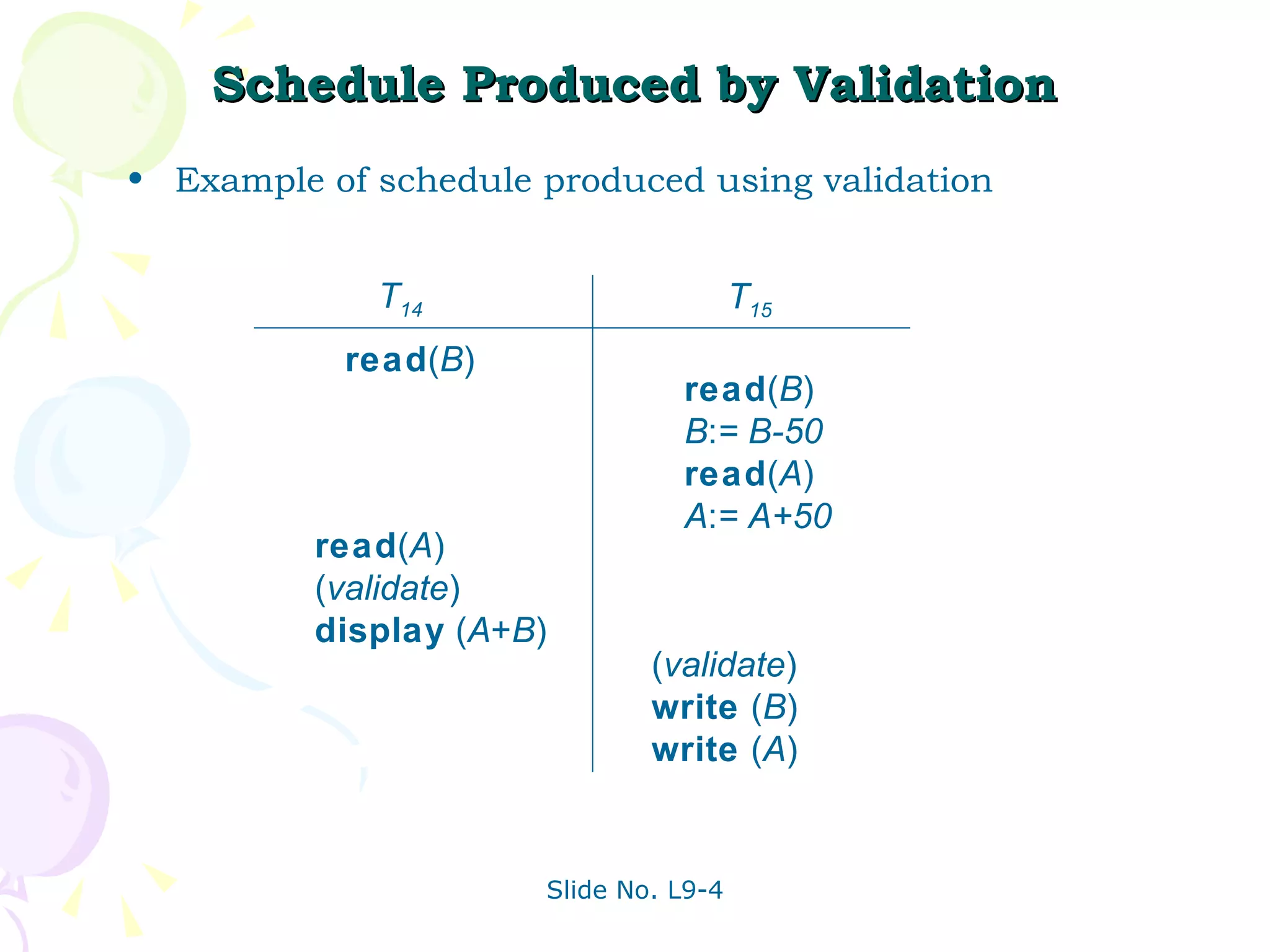
Schedule Produced by Validation Example of schedule produced using validation T 14 T 15 read ( B ) read ( B ) B : = B-50 read ( A ) A : = A+50 read ( A ) ( validate ) display  ( A + B ) ( validate ) write  ( B ) write  ( A )
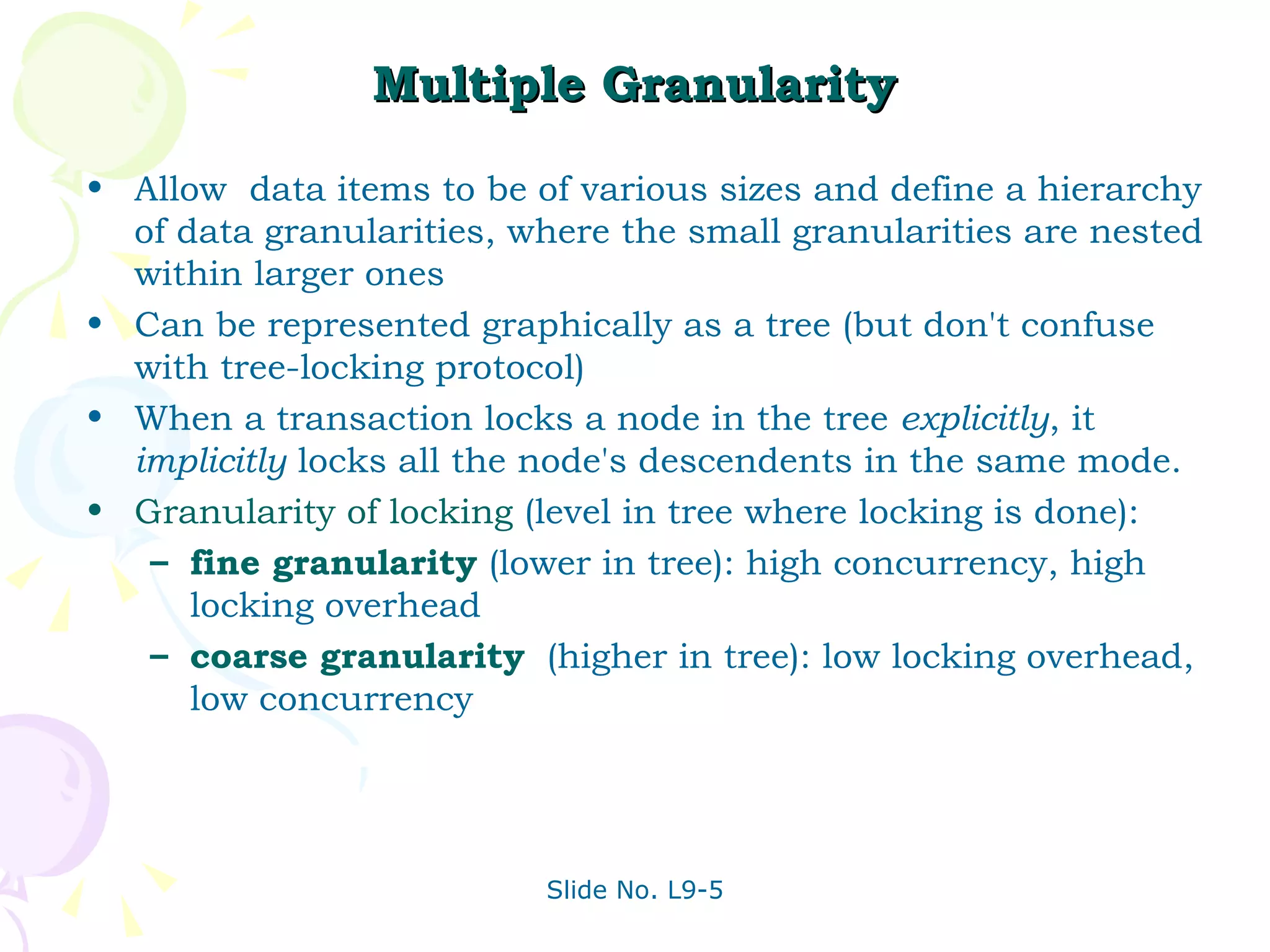
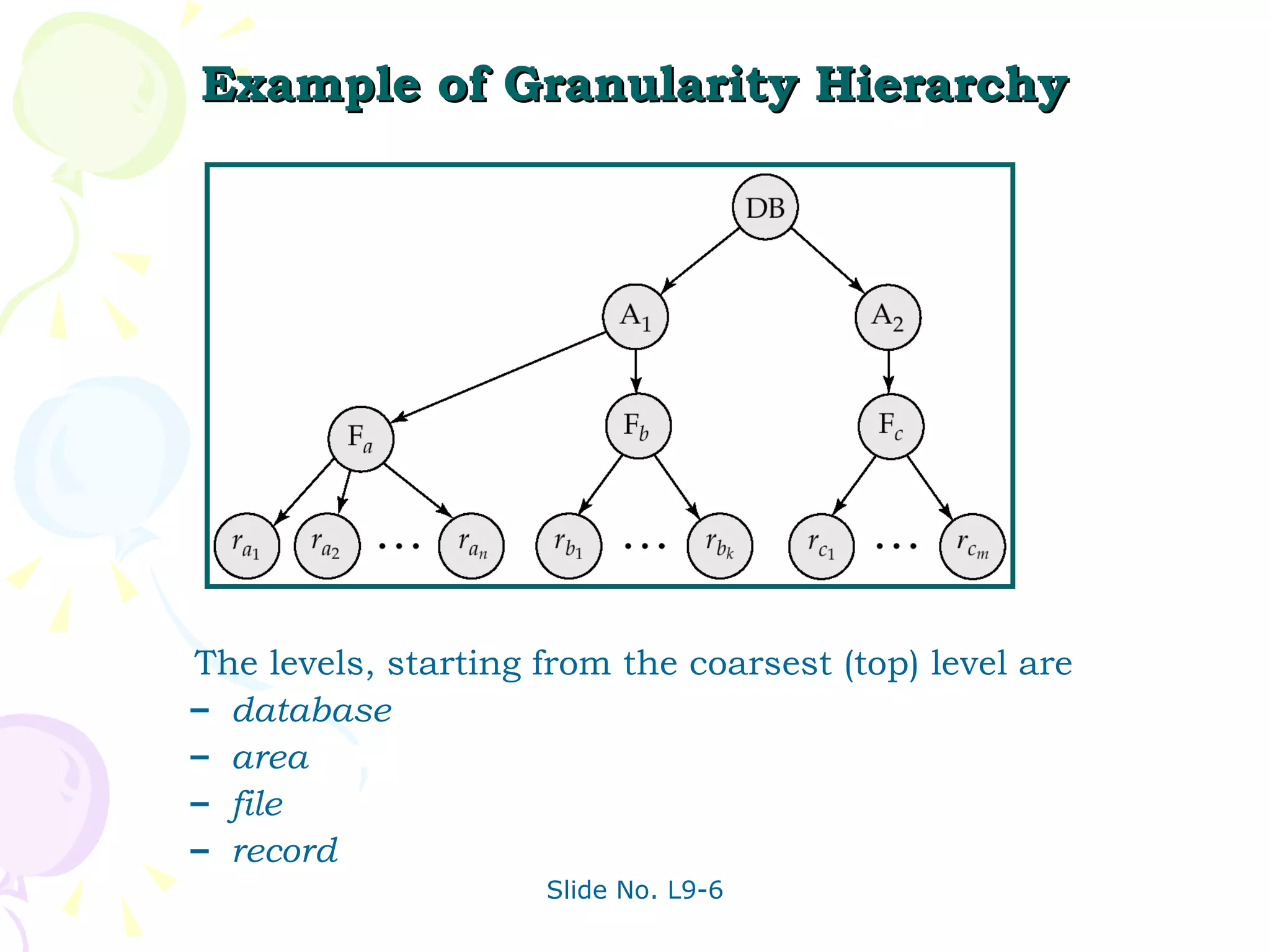
Multiple Granularity Allow  data items to be of various sizes and define a hierarchy of data granularities, where the small granularities are nested within larger ones Can be represented graphically as a tree (but don't confuse with tree-locking protocol) When a transaction locks a node in the tree  explicitly , it  implicitly  locks all the node's descendents in the same mode. Granularity of locking  (level in tree where locking is done): fine granularity  (lower in tree): high concurrency, high locking overhead coarse granularity   (higher in tree): low locking overhead, low concurrency
Example of Granularity Hierarchy The levels, starting from the coarsest (top) level are database area file record
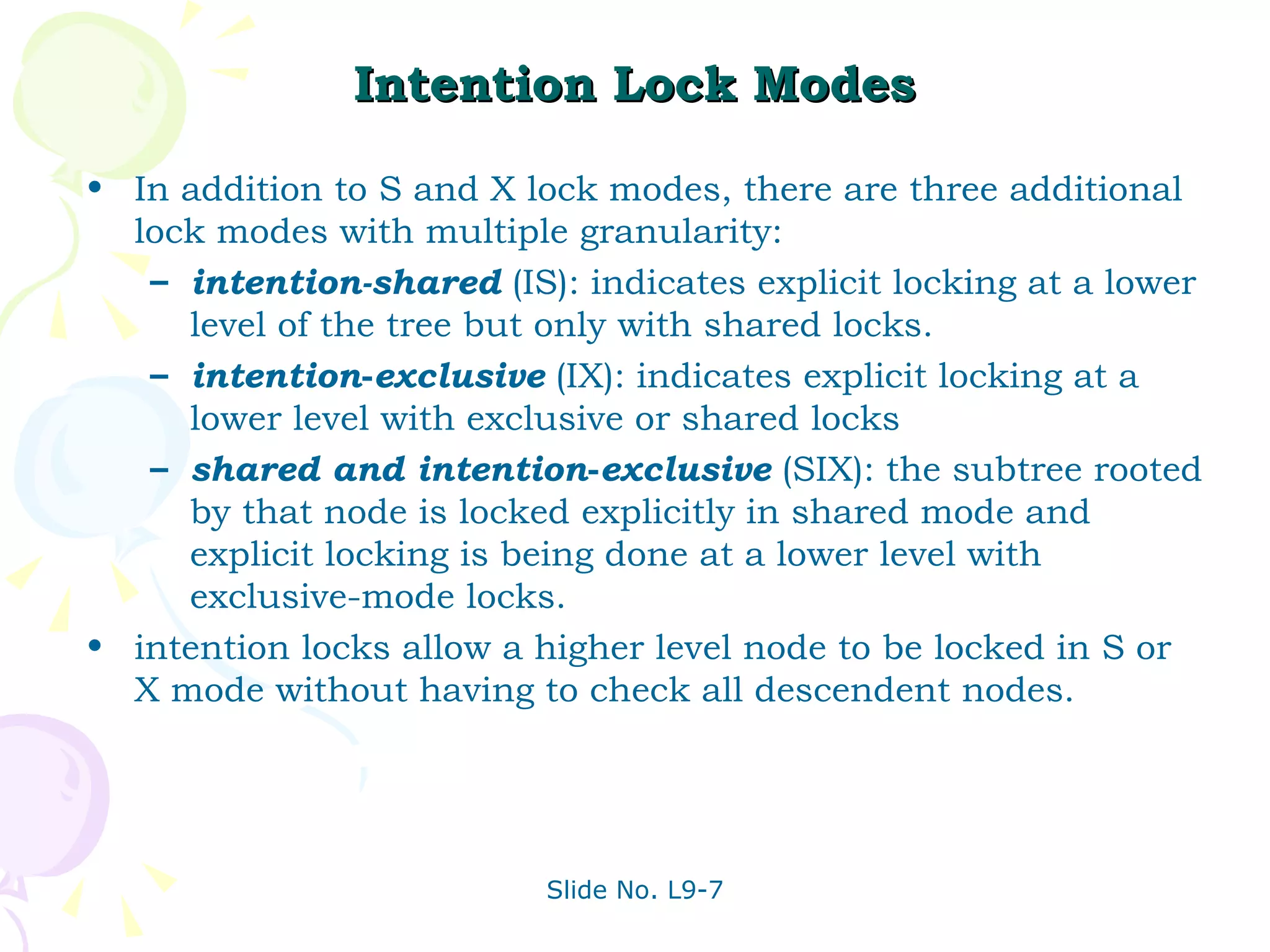
Intention Lock Modes In addition to S and X lock modes, there are three additional lock modes with multiple granularity: intention-shared  (IS): indicates explicit locking at a lower level of the tree but only with shared locks. intention - exclusive  (IX): indicates explicit locking at a lower level with exclusive or shared locks shared and intention - exclusive  (SIX): the subtree rooted by that node is locked explicitly in shared mode and explicit locking is being done at a lower level with exclusive-mode locks. intention locks allow a higher level node to be locked in S or X mode without having to check all descendent nodes.
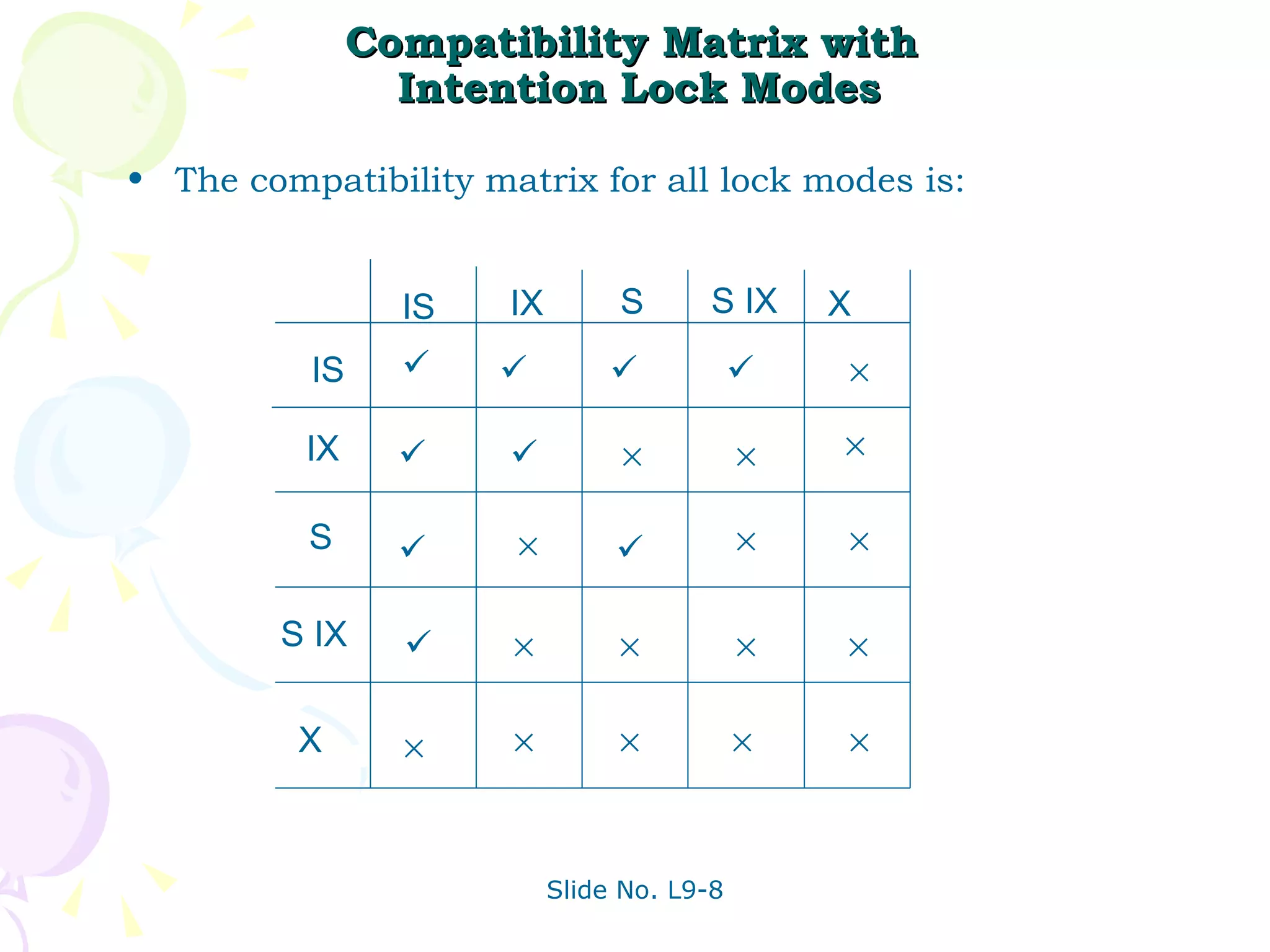
Compatibility Matrix with  Intention Lock Modes The compatibility matrix for all lock modes is:  IS IX S S IX X  IS IX S S IX X                          
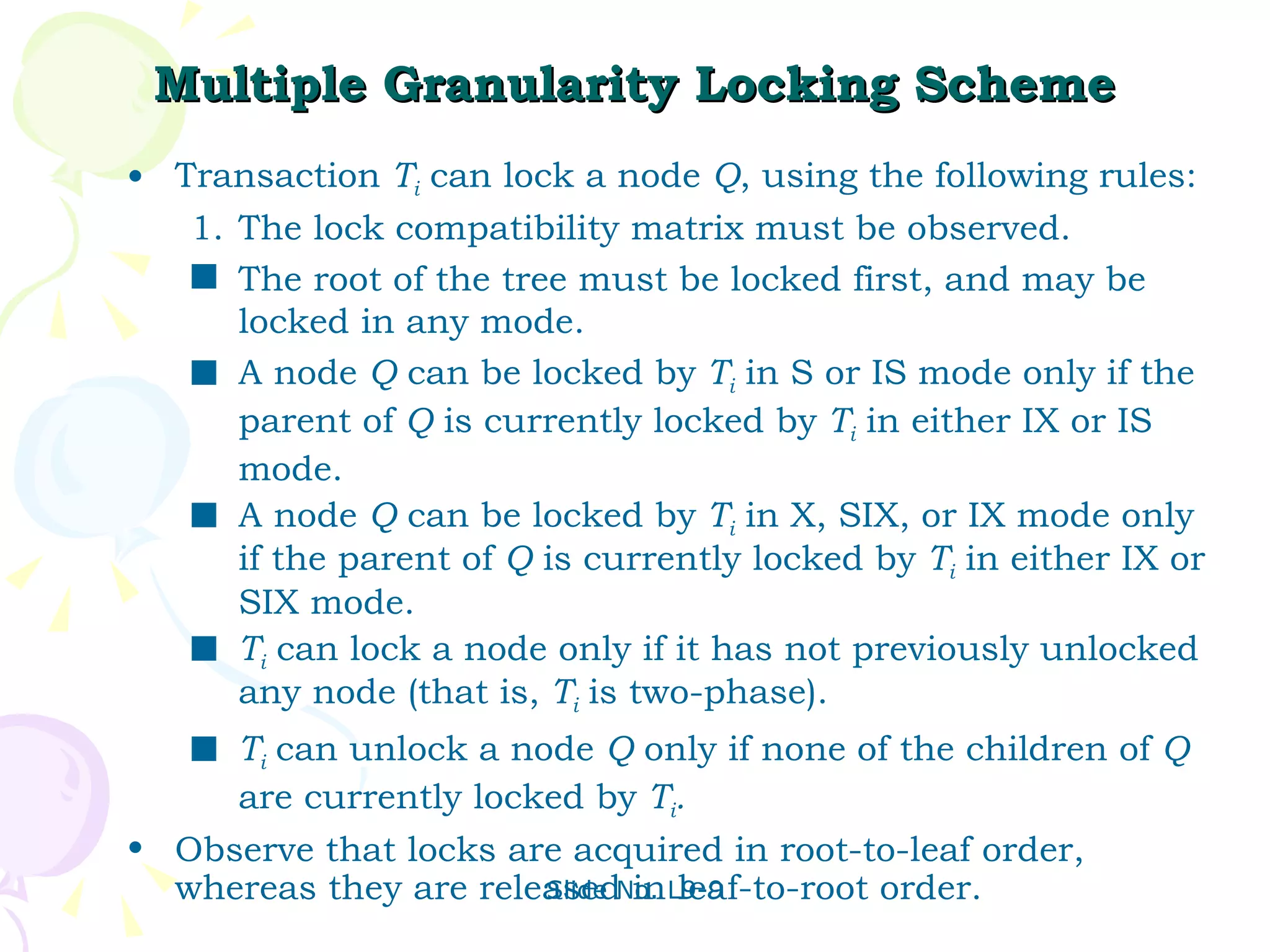
Multiple Granularity Locking Scheme Transaction  T i  can lock a node  Q , using the following rules: The lock compatibility matrix must be observed. The root of the tree must be locked first, and may be locked in any mode. A node  Q  can be locked by  T i  in S or IS mode only if the parent of  Q  is currently locked by  T i  in either IX or IS mode. A node  Q  can be locked by  T i  in X, SIX, or IX mode only if the parent of  Q  is currently locked by  T i  in either IX or SIX mode. T i  can lock a node only if it has not previously unlocked any node (that is,  T i   is two-phase). T i   can unlock a node  Q  only if none of the children of  Q  are currently locked by  T i . Observe that locks are acquired in root-to-leaf order, whereas they are released in leaf-to-root order.

Unit06 dbms

  • 1.
  • 2.
    INDEX UNIT-6 PPTSLIDES S.NO Module as per Lecture PPT Session planner No Slide NO -------------------------------------------------------------------------------------------------------------------------------- Transaction concept & State L1 L1- 1 to L1- 7 Implementation of atomicity and durability L2 L2- 1 to L2- 8 Serializability L3 L3- 1 to L3- 8 Recoverability L4 L4- 1 to L4- 8 Implementation of isolation L5 L5- 1 to L5- 6 Lock based protocols L6 L6- 1 to L6 -5 Lock based protocols L7 L7- 1 to L7- 10 Timestamp based protocols L8 L8- 1 to L8- 6 Validation based protocol L9 L9- 1 to L9- 9
  • 3.
    Transaction Concept A transaction is a unit of program execution that accesses and possibly updates various data items. E.g. transaction to transfer $50 from account A to account B: 1. read ( A ) 2. A := A – 50 3. write ( A ) 4. read ( B ) 5. B := B + 50 6. write ( B) Two main issues to deal with: Failures of various kinds, such as hardware failures and system crashes Concurrent execution of multiple transactions
  • 4.
    Example of FundTransfer Transaction to transfer $50 from account A to account B: 1. read ( A ) 2. A := A – 50 3. write ( A ) 4. read ( B ) 5. B := B + 50 6. write ( B) Atomicity requirement if the transaction fails after step 3 and before step 6, money will be “lost” leading to an inconsistent database state Failure could be due to software or hardware the system should ensure that updates of a partially executed transaction are not reflected in the database Durability requirement — once the user has been notified that the transaction has completed (i.e., the transfer of the $50 has taken place), the updates to the database by the transaction must persist even if there are software or hardware failures.
  • 5.
    Example of FundTransfer (Cont.) Transaction to transfer $50 from account A to account B: 1. read ( A ) 2. A := A – 50 3. write ( A ) 4. read ( B ) 5. B := B + 50 6. write ( B) Consistency requirement in above example: the sum of A and B is unchanged by the execution of the transaction In general, consistency requirements include Explicitly specified integrity constraints such as primary keys and foreign keys Implicit integrity constraints e.g. sum of balances of all accounts, minus sum of loan amounts must equal value of cash-in-hand A transaction must see a consistent database. During transaction execution the database may be temporarily inconsistent. When the transaction completes successfully the database must be consistent Erroneous transaction logic can lead to inconsistency
  • 6.
    Example of FundTransfer (Cont.) Isolation requirement — if between steps 3 and 6, another transaction T2 is allowed to access the partially updated database, it will see an inconsistent database (the sum A + B will be less than it should be). T1 T2 1. read ( A ) 2. A := A – 50 3. write ( A ) read(A), read(B), print(A+B) 4. read ( B ) 5. B := B + 50 6. write ( B Isolation can be ensured trivially by running transactions serially that is, one after the other. However, executing multiple transactions concurrently has significant benefits, as we will see later.
  • 7.
    ACID Properties Atomicity. Either all operations of the transaction are properly reflected in the database or none are. Consistency . Execution of a transaction in isolation preserves the consistency of the database. Isolation . Although multiple transactions may execute concurrently, each transaction must be unaware of other concurrently executing transactions. Intermediate transaction results must be hidden from other concurrently executed transactions. That is, for every pair of transactions T i and T j , it appears to T i that either T j , finished execution before T i started, or T j started execution after T i finished. Durability . After a transaction completes successfully, the changes it has made to the database persist, even if there are system failures. A transaction is a unit of program execution that accesses and possibly updates various data items.To preserve the integrity of data the database system must ensure:
  • 8.
    Transaction State Active – the initial state; the transaction stays in this state while it is executing Partially committed – after the final statement has been executed. Failed -- after the discovery that normal execution can no longer proceed. Aborted – after the transaction has been rolled back and the database restored to its state prior to the start of the transaction. Two options after it has been aborted: restart the transaction can be done only if no internal logical error kill the transaction Committed – after successful completion.
  • 9.
  • 10.
    Implementation of Atomicityand Durability The recovery-management component of a database system implements the support for atomicity and durability. E.g. the shadow-database scheme: all updates are made on a shadow copy of the database db_pointer is made to point to the updated shadow copy after the transaction reaches partial commit and all updated pages have been flushed to disk.
  • 11.
    Implementation of Atomicityand Durability (Cont.) db_pointer always points to the current consistent copy of the database. In case transaction fails, old consistent copy pointed to by db_pointer can be used, and the shadow copy can be deleted. The shadow-database scheme: Assumes that only one transaction is active at a time. Assumes disks do not fail Useful for text editors, but extremely inefficient for large databases (why?) Variant called shadow paging reduces copying of data, but is still not practical for large databases Does not handle concurrent transactions Will study better schemes in Chapter 17.
  • 12.
    Concurrent Executions Multipletransactions are allowed to run concurrently in the system. Advantages are: increased processor and disk utilization , leading to better transaction throughput E.g. one transaction can be using the CPU while another is reading from or writing to the disk reduced average response time for transactions: short transactions need not wait behind long ones. Concurrency control schemes – mechanisms to achieve isolation that is, to control the interaction among the concurrent transactions in order to prevent them from destroying the consistency of the database Will study in Chapter 16, after studying notion of correctness of concurrent executions.
  • 13.
    Schedules Schedule – a sequences of instructions that specify the chronological order in which instructions of concurrent transactions are executed a schedule for a set of transactions must consist of all instructions of those transactions must preserve the order in which the instructions appear in each individual transaction. A transaction that successfully completes its execution will have a commit instructions as the last statement by default transaction assumed to execute commit instruction as its last step A transaction that fails to successfully complete its execution will have an abort instruction as the last statement
  • 14.
    Schedule 1 Let T 1 transfer $50 from A to B , and T 2 transfer 10% of the balance from A to B. A serial schedule in which T 1 is followed by T 2 :
  • 15.
    Schedule 2 Aserial schedule where T 2 is followed by T 1
  • 16.
    Schedule 3 Let T 1 and T 2 be the transactions defined previously . The following schedule is not a serial schedule, but it is equivalent to Schedule 1. In Schedules 1, 2 and 3, the sum A + B is preserved.
  • 17.
    Schedule 4 Thefollowing concurrent schedule does not preserve the value of ( A + B ) .
  • 18.
    Serializability Basic Assumption – Each transaction preserves database consistency. Thus serial execution of a set of transactions preserves database consistency. A (possibly concurrent) schedule is serializable if it is equivalent to a serial schedule. Different forms of schedule equivalence give rise to the notions of: 1. conflict serializability 2. view serializability Simplified view of transactions We ignore operations other than read and write instructions We assume that transactions may perform arbitrary computations on data in local buffers in between reads and writes. Our simplified schedules consist of only read and write instructions.
  • 19.
    Conflicting Instructions Instructions l i and l j of transactions T i and T j respectively, conflict if and only if there exists some item Q accessed by both l i and l j , and at least one of these instructions wrote Q. 1. l i = read ( Q), l j = read ( Q ). l i and l j don’t conflict. 2. l i = read ( Q), l j = write ( Q ). They conflict. 3. l i = write ( Q), l j = read ( Q ). They conflict 4. l i = write ( Q), l j = write ( Q ). They conflict Intuitively, a conflict between l i and l j forces a (logical) temporal order between them. If l i and l j are consecutive in a schedule and they do not conflict, their results would remain the same even if they had been interchanged in the schedule.
  • 20.
    Conflict Serializability Ifa schedule S can be transformed into a schedule S´ by a series of swaps of non-conflicting instructions, we say that S and S´ are conflict equivalent . We say that a schedule S is conflict serializable if it is conflict equivalent to a serial schedule
  • 21.
    Conflict Serializability (Cont.)Schedule 3 can be transformed into Schedule 6, a serial schedule where T 2 follows T 1 , by series of swaps of non-conflicting instructions. Therefore Schedule 3 is conflict serializable. Schedule 3 Schedule 6
  • 22.
    Conflict Serializability (Cont.)Example of a schedule that is not conflict serializable: We are unable to swap instructions in the above schedule to obtain either the serial schedule < T 3 , T 4 >, or the serial schedule < T 4 , T 3 >.
  • 23.
    View Serializability Let S and S´ be two schedules with the same set of transactions. S and S´ are view equivalent if the following three conditions are met, for each data item Q, If in schedule S, transaction T i reads the initial value of Q , then in schedule S’ also transaction T i must read the initial value of Q. If in schedule S transaction T i executes read ( Q) , and that value was produced by transaction T j (if any), then in schedule S’ also transaction T i must read the value of Q that was produced by the same write (Q) operation of transaction T j . The transaction (if any) that performs the final write ( Q ) operation in schedule S must also perform the final write ( Q ) operation in schedule S’. As can be seen, view equivalence is also based purely on reads and writes alone.
  • 24.
    View Serializability (Cont.)A schedule S is view serializable if it is view equivalent to a serial schedule. Every conflict serializable schedule is also view serializable. Below is a schedule which is view-serializable but not conflict serializable. What serial schedule is above equivalent to? Every view serializable schedule that is not conflict serializable has blind writes.
  • 25.
    Other Notions ofSerializability The schedule below produces same outcome as the serial schedule < T 1 , T 5 >, yet is not conflict equivalent or view equivalent to it. Determining such equivalence requires analysis of operations other than read and write.
  • 26.
    Recoverable Schedules Recoverable schedule — if a transaction T j reads a data item previously written by a transaction T i , then the commit operation of T i appears before the commit operation of T j . The following schedule (Schedule 11) is not recoverable if T 9 commits immediately after the read If T 8 should abort, T 9 would have read (and possibly shown to the user) an inconsistent database state. Hence, database must ensure that schedules are recoverable. Need to address the effect of transaction failures on concurrently running transactions.
  • 27.
    Cascading Rollbacks Cascadingrollback – a single transaction failure leads to a series of transaction rollbacks. Consider the following schedule where none of the transactions has yet committed (so the schedule is recoverable) If T 10 fails, T 11 and T 12 must also be rolled back. Can lead to the undoing of a significant amount of work
  • 28.
    Cascadeless Schedules Cascadeless schedules — cascading rollbacks cannot occur; for each pair of transactions T i and T j such that T j reads a data item previously written by T i , the commit operation of T i appears before the read operation of T j . Every cascadeless schedule is also recoverable It is desirable to restrict the schedules to those that are cascadeless
  • 29.
    Concurrency Control Adatabase must provide a mechanism that will ensure that all possible schedules are either conflict or view serializable, and are recoverable and preferably cascadeless A policy in which only one transaction can execute at a time generates serial schedules, but provides a poor degree of concurrency Are serial schedules recoverable/cascadeless? Testing a schedule for serializability after it has executed is a little too late! Goal – to develop concurrency control protocols that will assure serializability.
  • 30.
    Concurrency Control vs.Serializability Tests Concurrency-control protocols allow concurrent schedules, but ensure that the schedules are conflict/view serializable, and are recoverable and cascadeless . Concurrency control protocols generally do not examine the precedence graph as it is being created Instead a protocol imposes a discipline that avoids nonseralizable schedules. We study such protocols in Chapter 16. Different concurrency control protocols provide different tradeoffs between the amount of concurrency they allow and the amount of overhead that they incur. Tests for serializability help us understand why a concurrency control protocol is correct.
  • 31.
    Weak Levels ofConsistency Some applications are willing to live with weak levels of consistency, allowing schedules that are not serializable E.g. a read-only transaction that wants to get an approximate total balance of all accounts E.g. database statistics computed for query optimization can be approximate (why?) Such transactions need not be serializable with respect to other transactions Tradeoff accuracy for performance
  • 32.
    Levels of Consistencyin SQL-92 Serializable — default Repeatable read — only committed records to be read, repeated reads of same record must return same value. However, a transaction may not be serializable – it may find some records inserted by a transaction but not find others. Read committed — only committed records can be read, but successive reads of record may return different (but committed) values. Read uncommitted — even uncommitted records may be read. Lower degrees of consistency useful for gathering approximate information about the database Warning: some database systems do not ensure serializable schedules by default E.g. Oracle and PostgreSQL by default support a level of consistency called snapshot isolation (not part of the SQL standard)
  • 33.
    Transaction Definition inSQL Data manipulation language must include a construct for specifying the set of actions that comprise a transaction. In SQL, a transaction begins implicitly. A transaction in SQL ends by: Commit work commits current transaction and begins a new one. Rollback work causes current transaction to abort. In almost all database systems, by default, every SQL statement also commits implicitly if it executes successfully Implicit commit can be turned off by a database directive E.g. in JDBC, connection.setAutoCommit(false);
  • 34.
    Implementation of IsolationSchedules must be conflict or view serializable, and recoverable, for the sake of database consistency, and preferably cascadeless. A policy in which only one transaction can execute at a time generates serial schedules, but provides a poor degree of concurrency. Concurrency-control schemes tradeoff between the amount of concurrency they allow and the amount of overhead that they incur. Some schemes allow only conflict-serializable schedules to be generated, while others allow view-serializable schedules that are not conflict-serializable.
  • 35.
  • 36.
    Testing for SerializabilityConsider some schedule of a set of transactions T 1 , T 2 , ..., T n Precedence graph — a direct graph where the vertices are the transactions (names). We draw an arc from T i to T j if the two transaction conflict, and T i accessed the data item on which the conflict arose earlier. We may label the arc by the item that was accessed. Example 1 x y
  • 37.
    Example Schedule (ScheduleA) + Precedence Graph T 1 T 2 T 3 T 4 T 5 read(X) read(Y) read(Z) read(V) read(W) read(W) read(Y) write(Y) write(Z) read(U) read(Y) write(Y) read(Z) write(Z) read(U) write(U) T 5 T 3 T 4 T 1 T 2
  • 38.
    Test for ConflictSerializability A schedule is conflict serializable if and only if its precedence graph is acyclic. Cycle-detection algorithms exist which take order n 2 time, where n is the number of vertices in the graph. (Better algorithms take order n + e where e is the number of edges.) If precedence graph is acyclic, the serializability order can be obtained by a topological sorting of the graph. This is a linear order consistent with the partial order of the graph. For example, a serializability order for Schedule A would be T 5  T 1  T 3  T 2  T 4 Are there others?
  • 39.
    Test for ViewSerializability The precedence graph test for conflict serializability cannot be used directly to test for view serializability. Extension to test for view serializability has cost exponential in the size of the precedence graph. The problem of checking if a schedule is view serializable falls in the class of NP -complete problems. Thus existence of an efficient algorithm is extremely unlikely. However practical algorithms that just check some sufficient conditions for view serializability can still be used.
  • 40.
    Lock-Based Protocols Alock is a mechanism to control concurrent access to a data item Data items can be locked in two modes : 1 . exclusive (X) mode . Data item can be both read as well as written. X-lock is requested using lock-X instruction. 2 . shared (S) mode . Data item can only be read. S-lock is requested using lock-S instruction. Lock requests are made to concurrency-control manager. Transaction can proceed only after request is granted.
  • 41.
    Lock-Based Protocols (Cont.)Lock-compatibility matrix A transaction may be granted a lock on an item if the requested lock is compatible with locks already held on the item by other transactions Any number of transactions can hold shared locks on an item, but if any transaction holds an exclusive on the item no other transaction may hold any lock on the item. If a lock cannot be granted, the requesting transaction is made to wait till all incompatible locks held by other transactions have been released. The lock is then granted.
  • 42.
    Lock-Based Protocols (Cont.)Example of a transaction performing locking: T 2 : lock-S (A) ; read (A) ; unlock (A) ; lock-S (B) ; read (B) ; unlock (B) ; display (A+B) Locking as above is not sufficient to guarantee serializability — if A and B get updated in-between the read of A and B , the displayed sum would be wrong. A locking protocol is a set of rules followed by all transactions while requesting and releasing locks. Locking protocols restrict the set of possible schedules.
  • 43.
    Pitfalls of Lock-BasedProtocols Consider the partial schedule Neither T 3 nor T 4 can make progress — executing lock-S (B) causes T 4 to wait for T 3 to release its lock on B , while executing lock-X (A) causes T 3 to wait for T 4 to release its lock on A . Such a situation is called a deadlock . To handle a deadlock one of T 3 or T 4 must be rolled back and its locks released.
  • 44.
    Pitfalls of Lock-BasedProtocols (Cont.) The potential for deadlock exists in most locking protocols. Deadlocks are a necessary evil. Starvation is also possible if concurrency control manager is badly designed. For example: A transaction may be waiting for an X-lock on an item, while a sequence of other transactions request and are granted an S-lock on the same item. The same transaction is repeatedly rolled back due to deadlocks. Concurrency control manager can be designed to prevent starvation.
  • 45.
    The Two-Phase LockingProtocol This is a protocol which ensures conflict-serializable schedules. Phase 1: Growing Phase transaction may obtain locks transaction may not release locks Phase 2: Shrinking Phase transaction may release locks transaction may not obtain locks The protocol assures serializability. It can be proved that the transactions can be serialized in the order of their lock points (i.e. the point where a transaction acquired its final lock).
  • 46.
    The Two-Phase LockingProtocol (Cont.) Two-phase locking does not ensure freedom from deadlocks Cascading roll-back is possible under two-phase locking. To avoid this, follow a modified protocol called strict two-phase locking . Here a transaction must hold all its exclusive locks till it commits/aborts. Rigorous two-phase locking is even stricter: here all locks are held till commit/abort. In this protocol transactions can be serialized in the order in which they commit.
  • 47.
    The Two-Phase LockingProtocol (Cont.) There can be conflict serializable schedules that cannot be obtained if two-phase locking is used. However, in the absence of extra information (e.g., ordering of access to data), two-phase locking is needed for conflict serializability in the following sense: Given a transaction T i that does not follow two-phase locking, we can find a transaction T j that uses two-phase locking, and a schedule for T i and T j that is not conflict serializable.
  • 48.
    Lock Conversions Two-phaselocking with lock conversions: – First Phase: can acquire a lock-S on item can acquire a lock-X on item can convert a lock-S to a lock-X (upgrade) – Second Phase: can release a lock-S can release a lock-X can convert a lock-X to a lock-S (downgrade) This protocol assures serializability. But still relies on the programmer to insert the various locking instructions.
  • 49.
    Automatic Acquisition ofLocks A transaction T i issues the standard read/write instruction, without explicit locking calls. The operation read ( D ) is processed as: if T i has a lock on D then read( D ) else begin if necessary wait until no other transaction has a lock-X on D grant T i a lock-S on D ; read( D ) end
  • 50.
    Automatic Acquisition ofLocks (Cont.) write (D) is processed as: if T i has a lock-X on D then write( D ) else begin if necessary wait until no other trans. has any lock on D , if T i has a lock-S on D then upgrade lock on D to lock-X else grant T i a lock-X on D write( D ) end ; All locks are released after commit or abort
  • 51.
    Implementation of LockingA lock manager can be implemented as a separate process to which transactions send lock and unlock requests The lock manager replies to a lock request by sending a lock grant messages (or a message asking the transaction to roll back, in case of a deadlock) The requesting transaction waits until its request is answered The lock manager maintains a data-structure called a lock table to record granted locks and pending requests The lock table is usually implemented as an in-memory hash table indexed on the name of the data item being locked
  • 52.
    Lock Table Blackrectangles indicate granted locks, white ones indicate waiting requests Lock table also records the type of lock granted or requested New request is added to the end of the queue of requests for the data item, and granted if it is compatible with all earlier locks Unlock requests result in the request being deleted, and later requests are checked to see if they can now be granted If transaction aborts, all waiting or granted requests of the transaction are deleted lock manager may keep a list of locks held by each transaction, to implement this efficiently Granted Waiting
  • 53.
    Graph-Based Protocols Graph-basedprotocols are an alternative to two-phase locking Impose a partial ordering  on the set D = { d 1 , d 2 ,..., d h } of all data items. If d i  d j then any transaction accessing both d i and d j must access d i before accessing d j . Implies that the set D may now be viewed as a directed acyclic graph, called a database graph . The tree-protocol is a simple kind of graph protocol.
  • 54.
    Tree Protocol Onlyexclusive locks are allowed. The first lock by T i may be on any data item. Subsequently, a data Q can be locked by T i only if the parent of Q is currently locked by T i . Data items may be unlocked at any time. A data item that has been locked and unlocked by T i cannot subsequently be relocked by T i
  • 55.
    Timestamp-Based Protocols Eachtransaction is issued a timestamp when it enters the system. If an old transaction T i has time-stamp TS( T i ), a new transaction T j is assigned time-stamp TS( T j ) such that TS( T i ) <TS( T j ). The protocol manages concurrent execution such that the time-stamps determine the serializability order. In order to assure such behavior, the protocol maintains for each data Q two timestamp values: W-timestamp ( Q ) is the largest time-stamp of any transaction that executed write ( Q ) successfully. R-timestamp ( Q ) is the largest time-stamp of any transaction that executed read ( Q ) successfully.
  • 56.
    Timestamp-Based Protocols (Cont.)The timestamp ordering protocol ensures that any conflicting read and write operations are executed in timestamp order. Suppose a transaction T i issues a read ( Q ) If TS( T i )  W -timestamp( Q ), then T i needs to read a value of Q that was already overwritten. Hence, the read operation is rejected, and T i is rolled back. If TS( T i )  W -timestamp( Q ), then the read operation is executed, and R-timestamp( Q ) is set to max (R-timestamp( Q ), TS( T i )).
  • 57.
    Timestamp-Based Protocols (Cont.)Suppose that transaction T i issues write ( Q ). If TS( T i ) < R-timestamp( Q ), then the value of Q that T i is producing was needed previously, and the system assumed that that value would never be produced. Hence, the write operation is rejected, and T i is rolled back. If TS( T i ) < W-timestamp( Q ), then T i is attempting to write an obsolete value of Q . Hence, this write operation is rejected, and T i is rolled back. Otherwise, the write operation is executed, and W-timestamp( Q ) is set to TS( T i ).
  • 58.
    Example Use ofthe Protocol A partial schedule for several data items for transactions with timestamps 1, 2, 3, 4, 5 T 1 T 2 T 3 T 4 T 5 read( Y ) read( X ) read( Y ) write( Y ) write( Z ) read( Z ) read( X ) abort read( X ) write( Z ) abort write( Y ) write( Z )
  • 59.
    Correctness of Timestamp-OrderingProtocol The timestamp-ordering protocol guarantees serializability since all the arcs in the precedence graph are of the form: Thus, there will be no cycles in the precedence graph Timestamp protocol ensures freedom from deadlock as no transaction ever waits. But the schedule may not be cascade-free, and may not even be recoverable. transaction with smaller timestamp transaction with larger timestamp
  • 60.
    Thomas’ Write RuleModified version of the timestamp-ordering protocol in which obsolete write operations may be ignored under certain circumstances. When T i attempts to write data item Q , if TS( T i ) < W-timestamp( Q ), then T i is attempting to write an obsolete value of { Q }. Rather than rolling back T i as the timestamp ordering protocol would have done, this { write } operation can be ignored. Otherwise this protocol is the same as the timestamp ordering protocol. Thomas' Write Rule allows greater potential concurrency. Allows some view-serializable schedules that are not conflict-serializable.
  • 61.
    Validation-Based Protocol Executionof transaction T i is done in three phases. 1. Read and execution phase : Transaction T i writes only to temporary local variables 2. Validation phase : Transaction T i performs a ``validation test'' to determine if local variables can be written without violating serializability. 3. Write phase : If T i is validated, the updates are applied to the database; otherwise, T i is rolled back. The three phases of concurrently executing transactions can be interleaved, but each transaction must go through the three phases in that order. Assume for simplicity that the validation and write phase occur together, atomically and serially I.e., only one transaction executes validation/write at a time. Also called as optimistic concurrency control since transaction executes fully in the hope that all will go well during validation
  • 62.
    Validation-Based Protocol (Cont.)Each transaction T i has 3 timestamps Start(T i ) : the time when T i started its execution Validation(T i ): the time when T i entered its validation phase Finish(T i ) : the time when T i finished its write phase Serializability order is determined by timestamp given at validation time, to increase concurrency. Thus TS(T i ) is given the value of Validation(T i ). This protocol is useful and gives greater degree of concurrency if probability of conflicts is low. because the serializability order is not pre-decided, and relatively few transactions will have to be rolled back.
  • 63.
    Validation Test forTransaction T j If for all T i with TS ( T i ) < TS ( T j ) either one of the following condition holds: finish ( T i ) < start ( T j ) start ( T j ) < finish ( T i ) < validation ( T j ) and the set of data items written by T i does not intersect with the set of data items read by T j . then validation succeeds and T j can be committed. Otherwise, validation fails and T j is aborted. Justification : Either the first condition is satisfied, and there is no overlapped execution, or the second condition is satisfied and the writes of T j do not affect reads of T i since they occur after T i has finished its reads. the writes of T i do not affect reads of T j since T j does not read any item written by T i .
  • 64.
    Schedule Produced byValidation Example of schedule produced using validation T 14 T 15 read ( B ) read ( B ) B : = B-50 read ( A ) A : = A+50 read ( A ) ( validate ) display ( A + B ) ( validate ) write ( B ) write ( A )
  • 65.
    Multiple Granularity Allow data items to be of various sizes and define a hierarchy of data granularities, where the small granularities are nested within larger ones Can be represented graphically as a tree (but don't confuse with tree-locking protocol) When a transaction locks a node in the tree explicitly , it implicitly locks all the node's descendents in the same mode. Granularity of locking (level in tree where locking is done): fine granularity (lower in tree): high concurrency, high locking overhead coarse granularity (higher in tree): low locking overhead, low concurrency
  • 66.
    Example of GranularityHierarchy The levels, starting from the coarsest (top) level are database area file record
  • 67.
    Intention Lock ModesIn addition to S and X lock modes, there are three additional lock modes with multiple granularity: intention-shared (IS): indicates explicit locking at a lower level of the tree but only with shared locks. intention - exclusive (IX): indicates explicit locking at a lower level with exclusive or shared locks shared and intention - exclusive (SIX): the subtree rooted by that node is locked explicitly in shared mode and explicit locking is being done at a lower level with exclusive-mode locks. intention locks allow a higher level node to be locked in S or X mode without having to check all descendent nodes.
  • 68.
    Compatibility Matrix with Intention Lock Modes The compatibility matrix for all lock modes is: IS IX S S IX X IS IX S S IX X                         
  • 69.
    Multiple Granularity LockingScheme Transaction T i can lock a node Q , using the following rules: The lock compatibility matrix must be observed. The root of the tree must be locked first, and may be locked in any mode. A node Q can be locked by T i in S or IS mode only if the parent of Q is currently locked by T i in either IX or IS mode. A node Q can be locked by T i in X, SIX, or IX mode only if the parent of Q is currently locked by T i in either IX or SIX mode. T i can lock a node only if it has not previously unlocked any node (that is, T i is two-phase). T i can unlock a node Q only if none of the children of Q are currently locked by T i . Observe that locks are acquired in root-to-leaf order, whereas they are released in leaf-to-root order.