Unit test
Introduction
The goal of unit test is to isolate each part of the program and show that individual parts are correct.
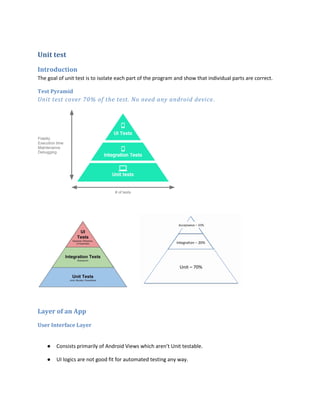
Test Pyramid
Unit test cover 70% of the test. No need any android device.
Layer of an App
User Interface Layer
● Consists primarily of Android Views which aren’t Unit testable.
● UI logics are not good fit for automated testing any way.
Application layer
● User input handling and flow control
● Contains Android Components Activities, Fragments & Services which are not unit testable.
Domain Layer
● Use cases are very good abstraction for domain / business logic.
● Don’t put business logics inside Activity or Fragment.
● Don’t issue static calls from this layer
Infrastructure Layer
● Often Used 3rd
party libraries.
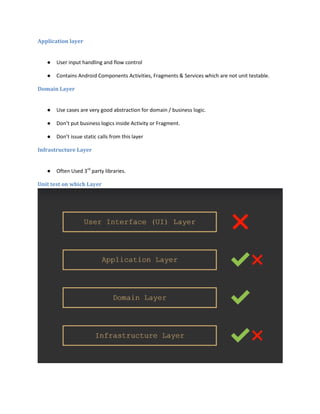
Unit test on which Layer
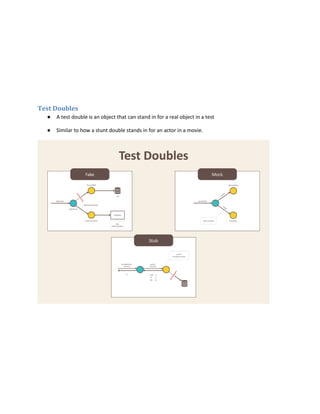
Test Doubles
● A test double is an object that can stand in for a real object in a test
● Similar to how a stunt double stands in for an actor in a movie.
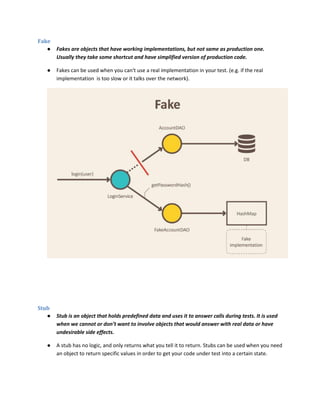
Fake
● Fakes are objects that have working implementations, but not same as production one.
Usually they take some shortcut and have simplified version of production code.
● Fakes can be used when you can't use a real implementation in your test. (e.g. if the real
implementation is too slow or it talks over the network).
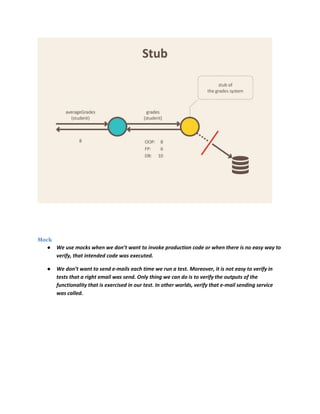
Stub
● Stub is an object that holds predefined data and uses it to answer calls during tests. It is used
when we cannot or don’t want to involve objects that would answer with real data or have
undesirable side effects.
● A stub has no logic, and only returns what you tell it to return. Stubs can be used when you need
an object to return specific values in order to get your code under test into a certain state.
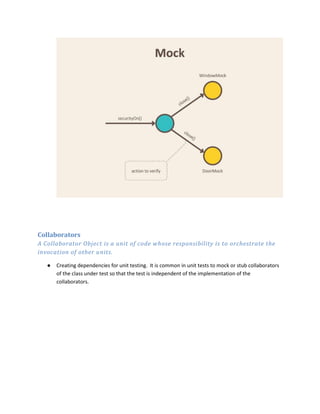
Mock
● We use mocks when we don’t want to invoke production code or when there is no easy way to
verify, that intended code was executed.
● We don’t want to send e-mails each time we run a test. Moreover, it is not easy to verify in
tests that a right email was send. Only thing we can do is to verify the outputs of the
functionality that is exercised in our test. In other worlds, verify that e-mail sending service
was called.
Collaborators
A Collaborator Object is a unit of code whose responsibility is to orchestrate the
invocation of other units.
● Creating dependencies for unit testing. It is common in unit tests to mock or stub collaborators
of the class under test so that the test is independent of the implementation of the
collaborators.
Example
Unit test Class Body
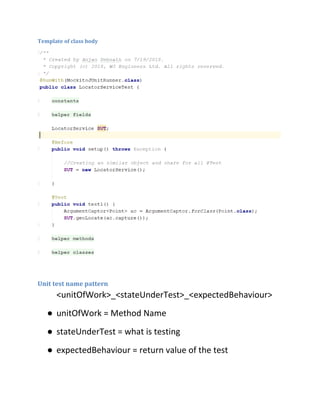
Each unit test class must contain a setup method. The object name of the class
that is under test will be named as SUT which stands for System Under Test.
Template of class body
Unit test name pattern
<unitOfWork>_<stateUnderTest>_<expectedBehaviour>
● unitOfWork = Method Name
● stateUnderTest = what is testing
● expectedBehaviour = return value of the test
Example
Reverse_emptyString_emptyStringReturned()
Method body
@Test
public void test_customerIdPassed_nameReturned() {
//arrange
//action
//assertion
}
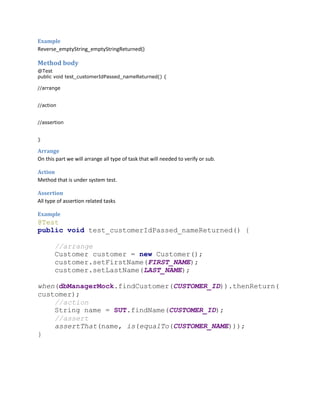
Arrange
On this part we will arrange all type of task that will needed to verify or sub.
Action
Method that is under system test.
Assertion
All type of assertion related tasks
Example
@Test
public void test_customerIdPassed_nameReturned() {
//arrange
Customer customer = new Customer();
customer.setFirstName(FIRST_NAME);
customer.setLastName(LAST_NAME);
when(dbManagerMock.findCustomer(CUSTOMER_ID)).thenReturn(
customer);
//action
String name = SUT.findName(CUSTOMER_ID);
//assert
assertThat(name, is(equalTo(CUSTOMER_NAME)));
}
Object vs Data Structure
Object
Expose Behavior
Hide implementation detail
Should be injected into other objects
Need to be unit tested explicitly.
Data Structure
Expose Data
No Behavior
No need to be substituted with test doubles
Reference
● https://hackernoon.com/objects-vs-data-structures-e380b962c1d2
● https://www.codingblocks.net/podcast/objects-vs-data-structures/
Test Driven Development TDD
Please follow Uncle Bob’s TDD rule to properly maintain your unit test.
Unit test documentation

Unit test documentation

  • 1.
    Unit test Introduction The goalof unit test is to isolate each part of the program and show that individual parts are correct. Test Pyramid Unit test cover 70% of the test. No need any android device. Layer of an App User Interface Layer ● Consists primarily of Android Views which aren’t Unit testable. ● UI logics are not good fit for automated testing any way.
  • 2.
    Application layer ● Userinput handling and flow control ● Contains Android Components Activities, Fragments & Services which are not unit testable. Domain Layer ● Use cases are very good abstraction for domain / business logic. ● Don’t put business logics inside Activity or Fragment. ● Don’t issue static calls from this layer Infrastructure Layer ● Often Used 3rd party libraries. Unit test on which Layer
  • 3.
    Test Doubles ● Atest double is an object that can stand in for a real object in a test ● Similar to how a stunt double stands in for an actor in a movie.
  • 4.
    Fake ● Fakes areobjects that have working implementations, but not same as production one. Usually they take some shortcut and have simplified version of production code. ● Fakes can be used when you can't use a real implementation in your test. (e.g. if the real implementation is too slow or it talks over the network). Stub ● Stub is an object that holds predefined data and uses it to answer calls during tests. It is used when we cannot or don’t want to involve objects that would answer with real data or have undesirable side effects. ● A stub has no logic, and only returns what you tell it to return. Stubs can be used when you need an object to return specific values in order to get your code under test into a certain state.
  • 5.
    Mock ● We usemocks when we don’t want to invoke production code or when there is no easy way to verify, that intended code was executed. ● We don’t want to send e-mails each time we run a test. Moreover, it is not easy to verify in tests that a right email was send. Only thing we can do is to verify the outputs of the functionality that is exercised in our test. In other worlds, verify that e-mail sending service was called.
  • 6.
    Collaborators A Collaborator Objectis a unit of code whose responsibility is to orchestrate the invocation of other units. ● Creating dependencies for unit testing. It is common in unit tests to mock or stub collaborators of the class under test so that the test is independent of the implementation of the collaborators.
  • 7.
    Example Unit test ClassBody Each unit test class must contain a setup method. The object name of the class that is under test will be named as SUT which stands for System Under Test.
  • 8.
    Template of classbody Unit test name pattern <unitOfWork>_<stateUnderTest>_<expectedBehaviour> ● unitOfWork = Method Name ● stateUnderTest = what is testing ● expectedBehaviour = return value of the test
  • 9.
    Example Reverse_emptyString_emptyStringReturned() Method body @Test public voidtest_customerIdPassed_nameReturned() { //arrange //action //assertion } Arrange On this part we will arrange all type of task that will needed to verify or sub. Action Method that is under system test. Assertion All type of assertion related tasks Example @Test public void test_customerIdPassed_nameReturned() { //arrange Customer customer = new Customer(); customer.setFirstName(FIRST_NAME); customer.setLastName(LAST_NAME); when(dbManagerMock.findCustomer(CUSTOMER_ID)).thenReturn( customer); //action String name = SUT.findName(CUSTOMER_ID); //assert assertThat(name, is(equalTo(CUSTOMER_NAME))); }
  • 10.
    Object vs DataStructure Object Expose Behavior Hide implementation detail Should be injected into other objects Need to be unit tested explicitly. Data Structure Expose Data No Behavior No need to be substituted with test doubles Reference ● https://hackernoon.com/objects-vs-data-structures-e380b962c1d2 ● https://www.codingblocks.net/podcast/objects-vs-data-structures/ Test Driven Development TDD Please follow Uncle Bob’s TDD rule to properly maintain your unit test.